THE TATTLERS (continued 2)
Reading edition
So much sympathy was expressed for the other kind of dog life that the Judge felt gratified to see that these getting-together parties the dogs were having were creating a good effect.
Even little Ruby, who seldom thought of anyone but herself, unless it was to envy some one, was becoming less selfish. “Oh, the poor things!” she exclaimed, licking her white forepaws while she was saying it. She gave those paws particular attention, and the habit was so strong with her that, perhaps, it didn’t lessen her sincerity.
The Judge told them he thought that, as not many of them ever had a chance to travel, he would tell them a story about one dog who was a great traveler, and also a very clever fellow. This dog was a setter and his name was Jack.
JACK THE TRAVELER
Mr. Wheeler’s home was broken up, for Mrs. Wheeler had passed away, leaving no one but her husband, as there were no children.
Mr. Wheeler was alone but not lonely, for he still had Jack, his faithful setter; and there was a cat, but she had been Mrs. Wheeler’s pet.
His dog Jack was a good hunting dog, and hunting was his master’s favorite sport. So they two, having similar tastes, were on intimate terms, and at all times were quite congenial.
After disposing of his little shop, Mr. Wheeler decided he would follow the trail to California. He purchased a Ford with money from the sale of his small stock of merchandise; he rented his home and, leaving the cat with the Widow Higgins, who lived next door, was ready to pack for the trip. His gun was cleaned, and his camping outfit made ready. All necessary equipment for an extended trip was gathered up, and a supply of provisions laid in.
How eager Jack was about all these preparations! He felt very important, too, having been given to understand that he was a partner in this enterprise.
Jack, being a pointer and setter, as most hunting dogs are, would set in the evening, after the day’s work was done, with his nose pointed toward the setting sun, while he dreamed of the great times they would have when they did finally get started.
The cat was on hand and wanted to go along, it seemed. But Jack saw to it that she was left behind. He chased her up a tree and barked good-by to her.
Dogs of this kind, although loyal friends, are of one-track minds. In Jack’s mind was just one idea, and that was to be in the game with his master. He had no regrets at leaving the old home where he was born and raised. The master was all that counted. Home to him meant only to be able to eat out of his master’s hand and to lie at his master’s feet. That the dogs he was used to playing with would miss him, affected him not in the least.
Finally, Jack was perched on the seat beside Mr. Wheeler; the gun was handy; they were ready to go. Giving everything a final looking over, they started on their trek across the intervening states to California—gun, dog, man and pipe, all essential to each other’s happiness.
It was about the first of October, the most delightful time to travel. The days were ideal. The trees were in their most gorgeous fall colorings, yellows deepening into rich browns and tans, vivid scarlets softened to maroons; greens of every shade—one glorious riot of color.
The master’s eyes took in these autumnal glories, but most of the time they were fixed straight ahead on the road, to make sure of good going. As for Jack, what did he care for nature’s color scheme? The color of a chipmunk or a jack rabbit meant much more to him.
There were also many other things of interest to look at. Of course the dogs were the chief attraction. Jack had not known there were so many kinds. He saw big dogs and little dogs of every description; and, wonder of wonders, one small dog was actually being carried along the street in a lady’s arms! Another was all dressed up, with some kind of a coat on, and a brass collar. Poor things, to be so hampered!
In one town, he saw a little fluffy white thing coming down the street, with a ribbon bow on top of its head, just like the little Higgins girl wore. A dog dressed up like a girl! Could anything be worse? He tried to pat himself on the back, so glad was he that he was just a common dog.
School was out for the noon recess as they passed a large school building, and Jack was astonished at seeing so many children. He didn’t care particularly for children, not having been raised with them. He liked to romp with the little Higgins boys once in a while, when there was nothing more interesting, such as a hunting trip, on hand. Those boys were good sports, who could throw a ball just about right for him to see it stop, so he could get it easily and take it back to them. But this noisy, scrapping crowd—they might be all right, but he was glad there were none of them in his family.
Now they were leaving the town and, driving up under some trees, they stopped for lunch. Eating lunch in the car with his master was a privilege. Not many dogs enjoyed one like it, but his was an exceptional master.
Once more they were on their way, and there would be no more stops until camping time. He might as well turn around a couple of times, lie down, and go to sleep. After this nap, he felt refreshed and more alert to passing objects. So many automobiles, where were they all coming from, and where were those others all going? Big cars and little cars, of every make and description, all seemed to want to get there first.
How glad Jack was that his master was in no hurry! In fact, Mr. Wheeler never was known to be in a hurry about anything. This jogging along just suited Jack, too, and gave him time to make observations that would be impossible if they were tearing along. In every way his master was a comfortable person to live with; he would always stick to this good master.
Some of the other cars had dogs in them, and some were loaded with children. One fact that impressed Jack was that the larger, more comfortable, and apparently softer cushioned cars contained the smallest dogs, while the poor old flivvers, with the floppy curtains and wheezy engines, seemed to carry all the tired looking women and children. Also, if a faithful dog were brought along, he was compelled to ride in the most uncomfortable position on the running board, getting dust in his eyes and cramps in his legs.
While Jack pitied these poor unfortunate fellows, he was thankful that such was not his fate.
There was one large car that fairly dazzled his eyes with its shining, silver mountings. A negro was driving, and, as the car passed, Jack noticed that the only person in it was a very fat lady. On a silk pillow beside her was a mite of a dog, no larger than a skinned rat would be, but it was covered with a bushy coat of soft, silky hair, and looked like an over-grown, woolly worm. Jack was fond of teasing woolly worms, and that was why he thought of the comparison.
They were now approaching a long stretch of open country, and getting further away from familiar scenes. The cornfields, with corn in shocks, and yellow pumpkins strewn over the ground, bordered both sides of the road. Jack rabbits, quail and chipmunks were scampering in all directions, stirring Jack to a quiver of excitement. Wouldn’t his master stop and take a shot at them?
Then, just in front of them, sitting in the middle of the road, with its back to the oncoming car, he spied a fine specimen of a jack rabbit. Stopping the car, Mr. Wheeler cautiously took aim, and up in the air went the cottontail. With a bounce, Jack was there to catch it as it came back to earth, and he brought it to the car. Now, they would have fresh meat for supper, and how hungry he was!
They established their camp in a byroad. While the tent was being pitched, Jack was as helpful as he could be, lying on the loose ends of the canvas to keep the wind from blowing it away; at least, that was his idea of it. To be sure, his master said he was in the way, but masters are sometimes mistaken. Everything being set, and the rabbit browning nicely on the little camp stove, the smell made Jack’s mouth water with anticipation.
Then, what should drive up but a rickety old flivver, with a tired looking, thin lady, and a number of hungry children along with a cramped-up dog! They were a sorry lot from “York State,” bound for the “land of sunshine,” where the thin lady, who was really ill, hoped to regain her health. Jack was wishing they had hastened along.
Mr. Wheeler, being a kind-hearted man, welcomed the newcomers. As there were little children, and the mother looked so ill, his ready sympathy was aroused and he asked them to join him at his meal; and he was glad that he had something nourishing to offer them, in the way of coffee and rabbit, with plenty of bread and gravy for the little ones. It made him happy to see these hungry travelers eat until they were satisfied.
Jack did not enter with his master into the spirit of this benevolence. Instead he grew sulky, as nothing had been left for him but a few well picked bones. Feeling that Fate had played him an unkind trick, he felt revengeful, and that he must have satisfaction from some source. So he proceeded to take it out on the stiff-jointed dog. Going to the side of the car where the poor fellow was lying, Jack began sniffling contemptuously. All of his virtuous feelings concerning this crowd were gone. The other dog assumed an indifferent air, which only aggravated Jack more.
He began snapping at his victim’s heels, and that started it; the fight was on, which showed there was some spunk left in the other dog, even if he did not look the part. Over and over they rolled, snapping and snarling, and biting at one another. Jack, being the larger, seemed to be gaining on the under dog, when the blood of his adversary, who was part bull, began to boil, and grasping Jack by the neck, he held on with a death grip. At this turn of the battle, the owners of the two dogs came running up. They brought with them pails of water, sticks, and everything at hand that could be used to separate the fighting canines. Each began by beating the other’s dog, protesting that if one must be killed, it must not be theirs.
The lady brought an umbrella and helped, notwithstanding her weakened condition. Forcing the umbrella between her dog’s jaws, she managed to loosen his hold on Jack’s throat, by spreading it enough to break his grip. Jack then, feeling that the victory was his, retreated to have his wounds dressed.
This little unpleasantness was a dampener on the newly formed friendship between Mr. Wheeler and his guests. He felt that no longer did he wish to continue the acquaintance of these people, so he asked them to move on. They refused, and so he decided to break camp.
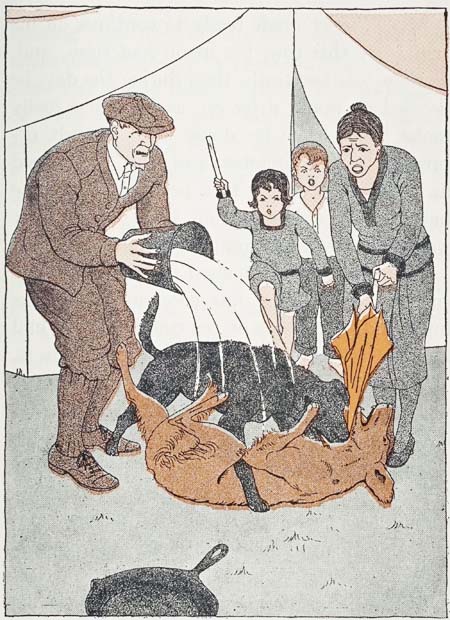
“The Fight Was On”
Mr. Wheeler made ready to continue on his trip. By this time the moon had risen, and, as there was less traffic than during the day, he decided he would drive on, as he would really make better time by doing so. He felt depressed by the circumstances that had forced an unpleasant ending to a perfect day; but he had learned a lesson from these events that would prove valuable on the rest of the journey.
Jack was trying to sleep on the back seat cushion. His back was sore; his pride was hurt, and, if that dog on the running board had been any stiffer than he felt, he hoped to know it.
The night driving was pleasant. The roads were smooth, and only occasionally Mr. Wheeler had to pull out for a passing car. Soon his spirits rose and, as they went on through the villages, he noticed the lights were cheerful. At some places there was music and dancing, and the ring of merry laughter filled the air.
It was after midnight when our travelers drove into a sheltering clump of scrubby oaks to spend the rest of the night. Mr. Wheeler, rousing Jack from off the back seat, curled up there himself and went to sleep. By morning, Jack was feeling better. Being in good health, he soon recovered from his skirmish with the strange dog. His throat was still sore, and the skin was torn, but it was healing nicely, and so was his pride.
The next night was uneventful, so they rested and were refreshed. They pushed on toward town for breakfast. Jack was allowed to eat on the back porch of the restaurant, after which he hopped into the front seat beside his master, ready for more observations.
They were now going through the prairie country, and they saw prairie dogs sitting on their haunches, looking like sentinels beside their homes. Jack would have liked a chance at one of them, to give it a good shake, but his wounds would not allow him to attempt it. Two jack rabbits were shot. Even in this sport, he was not feeling “peppy” enough to take part, although by supper time he was sufficiently recovered to enjoy his share of the good cheer. This time he got real meat. The bones were left, not even buried, which showed he was not really himself yet.
By the time the city of Denver was reached, Jack was fully recovered and very alert. Mr. Wheeler ran the car into a garage for repairs, and they started out to see the sights while waiting. As they were near the Capitol building, Mr. Wheeler thought he would like to go to the top, as all tourists do. Of course, Jack was not allowed to accompany him. An officer gave Jack permission to lie on the lawn and watch the squirrels at play.
Though he did not feel quite right about going without his dog, Mr. Wheeler began the ascent. When he reached the topmost balcony, he looked down to where he had left Jack. Imagine his horror at seeing the dog chasing one of the squirrels up a tree and barking his lustiest at it. He also saw an officer running toward Jack, and then beating him with a club until the dog howled louder and louder. Mr. Wheeler descended as fast as he could, which, on account of the narrowness of the steps, it was hard to do; and he found that the dog catcher had been called to take Jack to the pound. Nothing would do but that Mr. Wheeler must go along and settle with the chief.
Jack was loaded into a cage with a lot of other dogs. They were all snarling and snapping, but at heart they were very good dogs, who had been guilty only of some thoughtlessness, or some small fault perhaps that they did not know was wrong. Poor Jack!
The waiting room at the chief’s office was filled with irate men and women who had come to claim their various pets. All were sure a great injustice had been done; a great mistake had been made in taking up their dogs.
Time dragged along for poor Jack. He thought he had been having trouble enough, since he had started on this pleasure trip, without this; and it all came about just because he was following a natural impulse, something for which he was in no way responsible. What a nuisance their old laws were, anyway!
Finally the room cleared, and Mr. Wheeler had a chance to present his case, and get Jack released. How glad Jack was that his beloved master had been watching, and was able to go with him and help him out of his predicament!
The next problem was how to get to the car, as the pound was in the outskirts of the city, and Jack would not be permitted to ride on the street car. Also it was much too far to walk. Something must be done quickly, for it was getting late. Beside the dog pound was a settlement of a certain class of merchants of the street, venders of old clothes, rags and old iron, necessary commodities of a sort, and there the horse-drawn vehicle was the mode of transportation.
While Mr. Wheeler was debating in his mind what to do, along came one of these merchants driving a half-starved horse. Noticing the look of perplexity on Mr. Wheeler’s face, he inquired, “What’s the trouble, Boss?” Then a bright idea entered Mr. Wheeler’s head. He told the man of his desire to get to another part of the city, but that he had no way to do so, and he wondered if it would be possible for the merchant to take them. The merchant, having had a rather bad day in his business, consented, thinking that here would be a way to make accounts balance. They did some quibbling over the charges, which Mr. Wheeler thought very “steep,” for he was asked to pay two fares for both of them. As he could not very well help himself, he agreed to the price, and they started. Thus they returned to their lodging.
Next morning, after both had enjoyed a good breakfast, they set out on the last lap of their journey. Following the old Santa Fe trail, they found the country they were passing through very interesting. Jack kept his eyes open and his ears pricked up.
He was attracted by the Indian Villages, where dogs were numerous and all seemed to be living happy-go-lucky lives. Really they looked too lazy to come in out of the rain, if it ever should rain, which it didn’t; therefore they were deprived of even this exercise.
For a long stretch nothing much occurred to interest them.
By noon they were nearing another town, a Mexican settlement. More lazy dogs were seen lying under any shelter that afforded shade from the blistering sun. Jack wondered what these dogs lived on. They looked well fed, for Mexican dogs, that never get fat. Seeing strings of something red hanging on fences and from nails driven into the houses, he wondered if it was meat. If so, where did they get it? If only his master would stop long enough, he would have liked to sample some of this drying beef. But Mr. Wheeler was getting very tired, having all the driving to do, and was anxious to get to his journey’s end. He would welcome the sight of the green pepper trees he had heard so much about. He was planning on stopping for a long rest at the first tourist camp they came to, and so he did as little stopping on the way as possible.
At last our travelers reached the land of sunshine and flowers. They were tired and travel-stained, but glad to be at their journey’s end. Their first night at the camp was a new experience. It seemed like a neighborhood meeting of some sort, all were so friendly and willing to tell of their experiences. Almost every one Mr. Wheeler met had either been through the town of Woodville, Iowa, or knew some one from there, or some one who had passed through there, so he felt quite at home among them.
Many had brought their dogs along, but Jack, after his experience with the strange dog during their trip, was more cautious about making advances. He had learned that the best policy was “to live and let live,” and so he got along very well with these dogs.
After getting rested and learning where was the best place for them to locate, man and dog moved into a pleasant suburb of one of the larger towns, taking rooms with a friendly widow, who was fond of dogs but cared very little for cats, which was agreeable to Jack. Now, he would get plenty of good things to eat and lots of attention. Although Jack was strictly a man’s dog, the arrangement suited him very well indeed.
One of the first things his master had to do was to buy a license for Jack. The dog must wear a collar with a number on the back, or some day the dog catcher would get him again. Jack was not very proud of his new collar, but, since collars were being worn, he must conform and get used to being a city dog.
Jack and the landlady, whose name was Mrs. Weir, became quite good friends, though he refused to be trained to any new habits. His old ones were good enough for him.
Mr. Wheeler, having good prospects of going into business, concluded to return to Woodville, sell his home, and locate permanently in California. Therefore he made preparations for the return trip and was soon ready to start. Jack, of course, was disappointed at not being included in the arrangement. He was left with Mrs. Weir, who was to give him every needed attention. He was tied up till Mr. Wheeler was well on his way, and did some lusty howling, which he kept up until the neighbors protested, and he was given his liberty.
No sooner was he loose than he took up the trail in pursuit of his beloved master. However, as Mr. Wheeler had several days’ start, it was impossible, even if he had made no stops, for Jack to overtake him. Jack did stop many times. He got very tired and hungry, having to depend on his own efforts for food. Most of his nights were spent in prowling around, hunting for a possible loosely covered garbage can, to get a meal. When he was out in the open spaces, he would catch any wild game he could. This all caused delays, so that, by the time he reached his old home town, his master was well on his way back.
Jack was very glad to see all the Higgins family, even the cat, and never once during his stay did he chase her up the tree, nor in any way annoy her. He had seen much of the world since last they met, and travel had broadened and made him more considerate of others, as a well mannered dog should be.
He was not satisfied—the place wasn’t the same—and he missed his master. So in a few weeks he was missing. Then, some months later, Mrs. Higgins received a letter from Mr. Wheeler saying that Jack had returned to California. Though very thin in body, he seemed none the worse for his adventures.
All the dogs thought this was a very fine story, and begged the Judge to tell them some more. So, at the next session, he told them a couple of brief narratives, one about a puppy and young turkey, and another about a blind man’s dog.
TOM AND DANIEL
“Many of you dogs who have never lived on a ranch or a farm, may not know that a dog and a tom turkey can be just as unfriendly as a dog and a cat,” said the Judge, as he thought of a story which illustrated this point.
“There seems to be a sort of jealousy between them, which manifests itself at a very early age, and develops into bitter hatred as they grow older. This was the case with Tom and the collie I am telling you of.
“The puppy and the turkey came into the world at about the same time, and the little lady who owned them divided her attention between them. Young turkeys are delicate little creatures and require the greatest care to get them started. The puppy was usually at the heels of his mistress when she fed the turkeys, but, instead of pretending to help, as he did with the little chickens, he would bark and snap at them, frightening them.
“In the flock there was one young Tom who early showed a disposition to defend himself, and his puppyship got many a peck on the nose. Thus began the trouble which led to war, and many a battle royal was fought between them, but there was never any bloodshed.
“Their maneuvering took place around the woodpile back of the house. The turkey would be strutting in all the glory of his brilliant plumage and war paint, arrogant and ready to battle any intruder. Along would come Daniel. With a war whoop of a gobble, Tom would start after the dog, and round and round the woodpile they would go, with Daniel just a few steps ahead of his pursuer, until, tired out, he would hop on to the woodpile and bark insultingly at his enemy. The turkey would puff up his feathers, drop his wings, spread out his tail, and look as if he were bursting with rage.
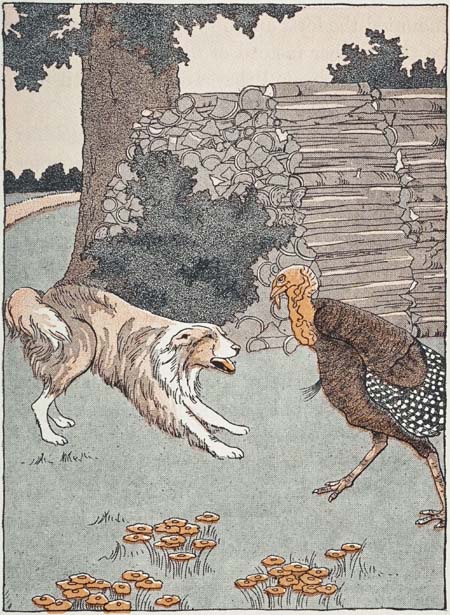
A Battle Between the Two Warriors
“When he could stand it no longer, Tom would fly at Daniel, who knew the tactics of the bird, and would dodge to one side, so that his majesty would land on the other side. This was just what Daniel had in mind when he mounted the fort; and now it was his chance to be the pursuer instead of the pursued. Again around and around they would go, until both were almost exhausted.
“The lady decided to sell the young gobbler, and he was taken several miles to a new home, and Daniel was left to his possessions.
“One day, several months after Tom’s departure, the lady had occasion to go to the place where the gobbler was sold. She took the dog with her and left him in the car while she did her errand.
“Returning to the car, she found Daniel gone. Then she heard a familiar bark, answered by a warlike gobble, and she saw that a battle was on between the two warriors, as of old. Instead of the woodpile, a small building was their fortress this time. Not only a dog never forgets, but a turkey gobbler seems to be neither a forgiver nor a forgetter.
“That is all of that story,” the Judge told his audience, “and next time I am going to tell you about a blind man’s dog.”
THE BLIND MAN’S DOG
At his post on the corner, not far from the park entrance, was another little dog, whose occupation would not permit of his attending these gatherings, if he had been invited, which he was not.
As the park dogs went by, either led by their attendants or chasing one another, as some were never free to do, this dog, from his place by the side of his master, would look in wonder at them. Where were they going, and what would they do when they arrived? How strange they all looked! He was anxious to know if he resembled any of them. He looked over as much of his body as he could see without turning a backward somersault.
He had four legs, as they had, and his coat, which was white where it was not black, and black where it was not white, was smooth and sleek. But his tail—there was the difference. None of them had his kind of a tail. Some of theirs were bushy, others were short and stiff. He wondered how they could ever express their feelings with such tails. One little pom had her tail curled up over her back like a doughnut. No, his tail evidently was not in the prevailing fashion, as none of the park dogs were wearing his kind. Not beautiful, but how useful was this straight, tapering tail of his! How easily he could express his every mood with it!
If he were happy, how fast he could wag that willing little tail. Should any one be harsh or unkind to him, down would go that same little indicator. So, if his tail were not in the popular style for the season, it answered his purposes, as a gauge for his feelings, which was more important.
His ears were small and stuck up on the top of his little head like sentinels, sensitive, alert, always pricked up to hear every sound that came through the air. Then those piercing black eyes—they were his chief asset. There was special use for them, and it was important that they have sharp vision, as he must be “eyes for the blind.”
His beloved master looked to him for protection, as he moved about from one place to another; and the dog had to pilot him to his place of business, where his firm sold papers. The firm consisted of himself, Tony, his partner, and the dog, Job, so named on account of his characteristic patience.
Man and dog were inseparable. They had lived together ever since Job was small enough to go into the blind man’s pocket. At that time, Peg, Job’s mother, was the pilot, and she had trained her son for the work when she should grow too old and feeble to do it.
Every evening they would start out from the small cottage, where they lived with the blind man’s dear old mother. Job would lead on cautiously to the corner. Here they would stop, waiting for the signal to cross. Then Job would lead carefully to the middle of the street, watching the lights, and over to the high curb on the other side. This he would mount, turn around and pull on the leash, so his master would know that the other side of the street was reached, when he could measure the height with his cane, as he must step up. On the dog would lead, through the crowd to the soap box on the corner, where his master would open up his business for the night.
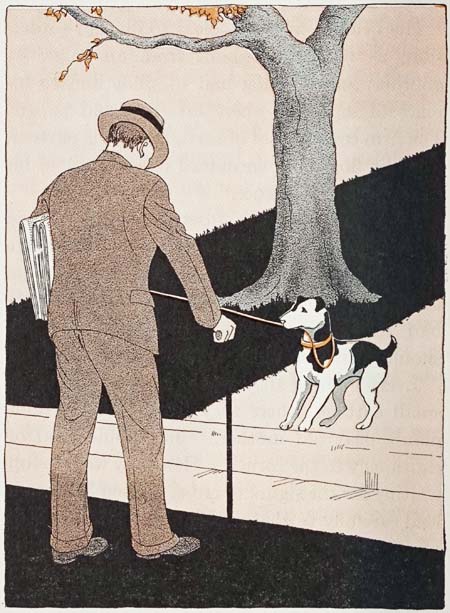
Job Was “Eyes for the Blind”
Tony would be there already with his supply of papers. Each of the partners had his own kind to sell. Soon the blind man would call, “Morning Times—all the latest morning news!” although it was really early evening. This call would be heard along the street with Tony’s clear soprano cutting the air with “Extray—Extray—Evening Herald—Evening News—read the latest, all about the game!” Meanwhile Job, the personification of patience, would take his position near his master, to watch for any stray pennies that might drop from the hands of his master when a purchase was made.
Tony kept an eye on the blind man’s business to see that no one took advantage of him. This did not often happen, however, for those wonderfully sensitive nerves in the blind man’s fingers had become very acute, and the sense of touch was keen to the value of the coin that was given into his hands. He was not easily fooled. Seldom was Tony called on for anything except to get more change.
The blind man was a youngish looking man, not unpleasing to look at. He was clean, of fair skin, and had all the marks of having been injured while helping to make his country a safe place to live in, which was indeed the fact.
In Tony and Job he had two faithful allies, the former having no claim to such a relationship, other than a fellow feeling of helplessness that Tony was experiencing when they first met, which had been entirely overcome through this partnership. It had helped Tony to forget himself in helping one more unfortunate than himself.
Tony didn’t belong to any one in particular. Now, since he had adopted Job and his blind master, he felt he had something to live for, and he ceased to feel the need of belonging. He told the blind man when he first met him that his father was dead, and his mother had married a man with a houseful of children. Tony had been told to get out, and to make his own way.
Small and under-nourished, the lad went forth, his first stop being the corner where the blind man was being harassed by a gang of newsboys, who were trying to drown his feeble voice, and loudly hawking their papers. The confusion and noise were great. Tony came upon the scene just in time to help his present-day friend out, by going to his side and beginning to sing.
It was no classical song that he sang, but it had its effect. As “Yes, we have no bananas to-day,” rang out sweet and clear amid the hubbub, everyone passing took notice of the situation; and Tony could sing!
Among those whose attention was attracted was the owner of the building in front of whose premises this all occurred. Driving off the hawkers, so as to give the blind man a chance, he permitted Tony to help him, and in this way the partnership was formed.
Tony slept at police headquarters that night. The next day at school arrangements were made for him to live at a boys’ refuge home, with the privilege of selling papers in the evening with the blind man and Job as partners. Now that Tony was not always hungry, his voice was growing stronger. Calling “Extray” had helped to develop his vocal cords.
At school he could be depended upon to lead the choruses. His clear, sweet notes, as they sang “Star Spangled Banner,” could be heard above the rest of the singing. One day the choir master from one of the churches came to hear them, with the idea of finding some material for a boys’ vested choir for his fashionable church.
After hearing the children sing, he asked that Tony be allowed to sing alone. This the little Italian boy was proud to do, and he sang so sweetly that the choir master engaged him, and asked him to meet with the choir for practice on Saturday afternoon.
This was the beginning of better things for little Tony. The boys’ choir was to make its first appearance on Easter morning, and Tony was to be the soloist.
The blind man and Job had heard about it several times, for Tony was full of the subject, so full that he bubbled over. He would start out with “Evening News,” and trail off up into high C, ending in “All love excelling,” before he came down to earth again.
His partner, too, was fond of music. His beloved Violin was his only solace. The sad appealing notes that he was able to produce on that old instrument went straight to one’s heart. Then there was Job. Maybe he didn’t love music, but he would stand before his master, listening intently, ears pricked to sharpest aspect, body tense, and tail oscillating with measured beat to the rhythm, and when the tension grew too strong, a dismal howl would relieve his pent-up feelings.
The practicing had been going on for several Saturday afternoons. The next Sunday was Easter. The blind man was not in the habit of going to church, although his dear old mother was a regular attendant, but there was an inducement to go this Easter morning that he had never felt before. Tony was to sing in the choir. He would go just for that.
The church was beautifully decorated for the occasion. The choir boys in their vestments marched to their places, singing a stately processional. Proud mothers filled the pews, each looking with adoring eyes at her own beloved boy. Tony had no one to care. All were strangers to him, so he thought, as he looked over the throng. Then away to one side, in a pew alone, he saw something that made him happy, for there were his partners, Job and his master.
Job paid little or no attention to anything that was being done or said. The choir had sung one song. Other things had been done, but nothing that a dog cared about. Then the organ played the prelude, and a voice, full of sweetness and charm, started out with, “Love Divine, all love excelling.” This aroused Job’s interest. He sat up and took notice; his body stiffened, his ears twitched. When everyone was enraptured with the little Italian’s music, in the pause after the solo, Job’s over-wrought feelings overcame him. One pathetic wail, toning off into a dismal howl, broke the sacred silence.
The Judge, satisfied with this conclusion of the exercises, dismissed the dogs with the feeling that the lessons they had learned from this experience would be beneficial and lasting—that the motto he had given them, “To live and let live,” would influence all their lives. Bidding them a kind good-by, he adjourned the court.