Front matter
Reading edition
E-text prepared by Graeme Mackreth and the Online Distributed Proofreading Team (http://www.pgdp.net) from page images generously made available by Internet Archive (https://archive.org)
Note: Images of the original pages are available through Internet Archive. See https://archive.org/details/perryssaintsorfi00nich
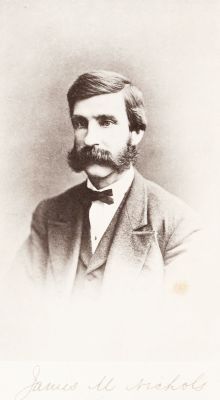
James M Nichols
PERRY'S SAINTS
OR
THE FIGHTING PARSON'S REGIMENT IN THE WAR OF THE REBELLION
BY
JAMES M. NICHOLS
BOSTON
D. LOTHROP AND COMPANY
32 Franklin Street
Copyright, 1885, by
D. Lothrop and Company.
Electrotyped by
C.J. Peters & Son, Boston.
MEMORIAL SKETCH OF THE AUTHOR.
To the rising generation the war of the rebellion already seems more like a romance than a reality. One by one the active participants in that momentous period of the nation's history are passing away. In a few years there will not be a veteran left to tell the story of his own experience on field and in camp. Hardly had the writer of the following pages completed and revised his work, and placed the copy in the hands of the publishers, when he, too, was summoned to join the great army beyond. That he had a touch of the rare quality which we call heroism, as well as fervent patriotism, is sufficient reason why the reader should know something more about him than is disclosed in the faithful and comprehensive record of his army life contained in this volume.
James M. Nichols was born in Haverhill, Mass., in 1835. His early education was received in the public schools of his native town, and he prepared for college at Phillips Academy, Andover, Mass. He graduated at Williams College in 1857, having been a fellow-student with President James A. Garfield. The storming of Fort Sumter fired his heart with patriotism, and he was soon among his own townsmen actively engaged in enlisting a company which was at once consolidated in another organization. He then went to New York, and was commissioned as a lieutenant in the 48th regiment, but afterwards rose to the rank of captain. During his three years of service Colonel Nichols was second to none in that famous regiment in thorough devotion to duty and in the display of soldierly qualities. On several occasions he was in command of the regiment, and led it through many a fiery ordeal with courage and ability. In recognition of these services he was brevetted successively major, lieutenant-colonel, and colonel. In private life Mr. Nichols was frank, manly, impulsive, sympathetic, and an earnest Christian. To these qualities were added musical gifts and a rare power in conversation, which made him a delightful companion; while to those who knew him best, his thorough genuineness, and the nobility of a nature which scorned everything narrow and mean, made him the trusted and beloved friend. He died suddenly, July 1, 1886, from the effects of disease contracted in the service. He was tenderly borne to his last resting-place by comrades from the Grand Army of the Republic, and he has left behind as the inalienable possession of his sons the legacy of a pure, upright, and useful life.
PREFACE.
The following narrative is, for the most part, a transcript from journals kept by the writer during his three years and more of service in the army of the Union. Facts, experiences, and observations, were noted down from day to day, whether we were in camp, in garrison, or in the field, and are given to the public in the hope not only of affording pleasure to those who have never shared in such experiences, but of correcting erroneous impressions in regard to the real life of the soldier. Those who served in the army, I feel assured, will recognize the truthfulness of the picture of army life.
James M. Nichols, Brev.-Col. U.S. Vols.
Haverhill, Mass.
CONTENTS.
CHAPTER I.
Causes of the War. 13
CHAPTER II.
Colonel Perry. Formation and character of the regiment. Luther B. Wyman, Esq. 19
CHAPTER III.
Camp Wyman. Incidents of camp life. Lieutenant Elfwing. Fête Champêtre. Departure for seat of war. List of officers. In camp near Washington. Off for Annapolis. General Butler in Maryland. Attitude of Governor Hicks. Waiting at Annapolis. Colonel Perry's last sermon. Journey to New York. Return of contrabands. Departure for Fortress Monroe. 32
CHAPTER IV.
At Fortress Monroe. General Viele's talk. Weary waiting. Off at last. Order of sailing. Storm. Horrors of the voyage. Vessels lost. Off Port Royal. Tatnall's Mosquito fleet. Bombardment of Hilton Head and Bay Point by navy. Surrender. Captain Drayton. Landing of troops. First camp on Confederate soil. Foraging. Negroes' account of bombardment. Inspection and review. The sutler. Thanksgiving. 48
CHAPTER V.
Expedition to Port Royal Ferry. Progress up Broad River. Colonel Perry acting brigadier-general. The rebel yell heard for the first time. The regiment's first baptism of fire. The old horse. Night on the field. Return to Hilton Head. Object of the expedition. Presentation of flag to the regiment. Off for Dawfuskie. Southern homes. Preparatory work by Major Beard and others. Building batteries on Jones and Bird Islands. Mud and malaria. Reconnoissances and midnight wanderings. 73
CHAPTER VI.
Planting batteries on Tybee Island. General Gilmore. Listening for the opening gun. Bombardment of Fort Pulaski. Watching the contest from Dawfuskie. Surrender of the fort. Its appearance after the bombardment. 94
CHAPTER VII.
Camp life at Dawfuskie. Scheelings and his "leetle tog." High living. Effects of malaria. Discussing the situation. Emancipation order of General Hunter. Lincoln the emancipator. John C. Calhoun and nullification. Ordered to Pulaski. James Island expedition. A sad failure. Shouting service of the negroes. 100
CHAPTER VIII.
The wreck of the sutler's schooner. Its consequences. The death of Colonel Perry. His character. Action of officers. Sent to New York. Lieutenant-Colonel Barton promoted. Detailed on recruiting service. General Mitchell commander of the department. Expedition to Bluffton. Blockade-runner Emma. Confederate ironclad. Back with the regiment. Its condition. Bluffton again visited. Ravages of war. 112
CHAPTER IX.
Expedition to Coosawhatchie. Landing at Dawson's plantation. March to Coosawhatchie. Ambuscade. Firing on Confederate train. Confederate prisoners. Destruction of track. Retreat. Peril of Lieutenant Corwin. Lieutenant Branding wounded. Pocataligo expedition a failure. Perilous voyage back to Pulaski. Confederate weapons. Yellow fever. Death of General Mitchell. His character. Review of Coosawhatchie. 124
CHAPTER X.
At Fort Pulaski. Changes at Dawfuskie. Amusements. The pride and taste of the soldiers in fitting up their quarters. Mosquitoes and other pests. Thanksgiving celebration. Incidents of garrison life. Flag of truce. Confederate ironclad. New Year's Day. Mr. Logan's account of the condition of things in Savannah. Prices of provisions, etc. Resignation and departure of Chaplain Strickland. Inspector-General Townsend's and Colonel Green's opinion of the regiment. Flag of truce. Interesting interview with Adjutant-General Gordon and Lieutenant Styles, of the Confederate army. Formation of negro regiments. Our theatre. Building a steam launch. Deserters. Capture of blockade-runner. Effect of garrison life on the regiment. Capture of Confederate ironclad Atlanta. 132
CHAPTER XI.
Good-by to Fort Pulaski. At St. Helena Island, under General Strong. Billinghurst and Regua battery. Folly Island. Masked batteries. Attack on Morris Island. Killed and wounded of the regiment. Captain Lent. Capture of Confederate batteries. Building batteries. Hot work and little rest. Completion of batteries. Assault on Wagner. Badly managed. Terrible losses. General Strong. Negro soldiers. Their effect upon the Confederates. After the assault. The shelling by the Confederates. Incident. 157
CHAPTER XII.
Back to the regiment. Off for St. Augustine. The duties of provost-marshal. The quaint old city. Its pleasant people. Two months of rest. Lieutenant Ingraham. Back to Hilton Head. The regiment reunited. Visit to Morris Island. Captain Eaton. Fort Wagner and its reminders. Lieutenant-Colonel Green. 178
CHAPTER XIII.
Relations between the 47th and 48th regiments. Re-enlistment of veterans. Court-martial. Departure of veterans on furlough. Expedition to Florida. Battle of Olustee. A great blunder. Heavy losses. Admirable conduct of the troops. Dr. Defendorf. The retreat. Return of veterans. Sergeant Thompson. At Palatka. Expedition into the country. Dunn's Creek. Its marvellous beauty. Ludicrous scenes. Good-by to Palatka. At Gloucester Point, Va. A happy change. Shelter tents. General Grant. Army of the James under Butler. General Terry. 188
CHAPTER XIV.
Bermuda Hundred. Company E as skirmishers. Battle of Chester Heights. Couldn't resist the temptation. Company E fighting on its own account. Bad predicament. Company E did nobly. More fighting. In sight of Richmond. Confederate sharpshooters cleaned out. Battle of Drury's Bluff. Company E again in a bad spot. Wonderful examples of discipline and soldierly conduct. General Terry to the rescue. Retreat. Back to old quarters. Captain Lock wood. 205
CHAPTER XV.
Assigned to 6th corps. On the way to the Army of the Potomac. A dreadful march. At Cold Harbor. Trying situation. Assume command. A gallant charge. Grand success. Severe losses. Driven back. Lack of support. Incidents of the battle. The demoralized general. Further account of Cold Harbor. Occupying the Confederate line. A sad picture of war. An uncomfortable situation. Relieved. Close work. Change of base. Grand but perilous movement of the army. The old church at Jamestown. 222
CHAPTER XVI.
Back to Bermuda Hundred. A running fight. Destruction of railroad. Kindness of Major Young and General Terry. Ordered to charge. A happy escape. President Lincoln and General Butler. Ordered to attack Confederate line. Recalled. Captain Fee and others killed. Picket-lines at Petersburg. Sanitary and Christian Commissions. Mine explosion. Our losses. Major Swartwout. Effects of malaria. 241
CHAPTER XVII.
On duty at the front. Strange sickness. General Grant under fire. Captain D'Arcy. Battle of Strawberry Plains. Splendid behavior of the regiment. Lieutenants Tantum and Sears picked off by Confederate sharpshooters. Other losses. The excited officer. Hurried retreat. Captain Taylor. The greeting of General Terry. A night's rest. On picket duty. Sad condition of the regiment. Expiration of term of enlistment. Disaffection. Severe duty. Artillery attack on Petersburg. Out of the service. 254
CHAPTER XVIII.
Discharge of old members of the regiment. Attack at Chapin's farm. Partial success. Condition of the South. New recruits. In winter-quarters. Thanksgiving Day. Resignation of Colonel Barton. His long and faithful service. Tenth and Eighteenth corps united. Expedition against Fort Fisher. Second expedition e and capture of the fort. An important event. Other successes. March to Wilmington. Pursuit of the Confederates. Their surrender of Union prisoners. Their condition. On the march to join Sherman's army. Sherman's grand march to the sea-coast, and its results. Grant's operations ending in surrender of Lee and his army. With Sherman's army on the march for Johnston. Announcement of surrender of General Lee. Continued pursuit of Johnston. Lincoln's assassination. Its effect on the army. Surrender of Johnston. 264
CHAPTER XIX.
A general review. Change in condition of the regiment. Barrett as provost-marshal. Delicate question. Colonel Coan. Gradual disbandment of the army. Discharge of the 48th. Some personal explanations. 289
CHAPTER XX.
Special references to some of the officers of the regiment. Remarks upon prominent questions before the country. Finis. 295
LIST OF ILLUSTRATIONS.
Fort Sumter. The Union Volunteer Refreshment Saloon. Fortress Monroe. Map of a Portion of "Sea Islands," showing "Port Royal." Plan of the Battle at Port Royal Harbor. Fort Walker. Fort Beauregard. Drayton's Mansion. Pope's House at Hilton Head. Live Oak Grove at Port Royal. Negro Quarters. Obstructions in Savannah River. Fort Pulaski. Breach in Fort Pulaski. The Planter. Headquarters of Hunter and Mitchell. Martello Tower, Tybee Island. New Ironsides and Monitors. The Interior of Fort Sumter. Siege of Charleston. Noiseless Hauling of the Guns. Bomb and Splinter Proof. Fort Wagner at Point of Assault. Fort Wagner, Sea Front. The Swamp Angel Battery. A Florida Swamp and Jungle. General Grant's Headquarters at City Point. Line of Defence at Bermuda Hundred. Pickets on Duty. Fort Darling. General Smith's Headquarters, Cold Harbor. Position of General Smith's Command at Cold Harbor, Va.. Battery and Church Tower. Site of Jamestown. Battery near Dutch Gap. Defences of Richmond and Petersburg. Outline of the Crater and Magazines. Army's Huts at Chapin's Farm. Officer's Quarters, Chapin's Farm. Pontoon Bridge at Jones' Landing, near Deep Bottom. Interior of Fort Fisher. Plan of Land and Naval Operations at Fort Fisher. Mound Battery near Fort Fisher. M'lean's House, the Place of Lee's Surrender. Place of Johnston's Surrender to Sherman.
PERRY'S SAINTS.
CHAPTER I.
Causes of the War.
For years the irrepressible conflict had been going on. From the halls of Congress to the remotest hamlet of the North, the subject of slavery—its national wrong and its individual cruelties—was the constant occasion for irritating debate and violent denunciation. The wall of separation between the North and the South was slowly but steadily building. In the North there had grown up a settled determination that the territorial limits of slavery should be extended no farther, and that the relation of master and slave should not exist in any State north of Mason's and Dixon's line. As this sentiment found frequent expression in active resistance to those laws which sought to protect the master in his rights when travelling or sojourning in the North for purposes of business or relaxation, and in the increasingly aggressive acts of individuals and societies, who sought by all the means in their power to awaken in the slaves a desire for liberty, and to make their way easy for escape from bondage, the conviction became universal at the South that to preserve that institution, regarded as so necessary to their physical and social life, and to establish an effectual barrier to the encroachments of the popular sentiments, not of the North alone, but of the civilized world, there must be separation, and a distinct government of their own.
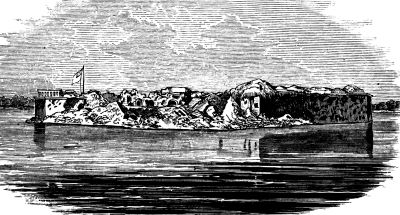
FORT SUMTER.
The conclusion was a logical one, but the territory gained by the blood and treasure of all the people belonged equally to all; and separate existence on the part of the two sections was impossible; and the echoes of the first gun in Charleston harbor, aimed against the Federal flag at Sumter, reverberated among the hills and through the valleys of the North, till every household was awakened, and every arm nerved for the coming conflict. The South had calculated upon divisions and dissensions. It had long been maturing its plans and organizing its forces. The head of the Federal government, and many of the councillors and advisers of the administration, were men who either quietly ignored or actively participated in these preparations. The arsenals within its limits, and the fortified points along its coast, with the vast quantities of government property which they contained, were with few exceptions taken possession of without a struggle. Everything at those places in the North where materials of war were manufactured or stored had been ordered to the South. Our navy had been detailed to foreign service, so that at the outbreak of the rebellion there were but two small vessels available for immediate use. Consequently, at the outset, the South possessed many important advantages. But it was mistaken in its conclusions. The unanimity of feeling at the North was hardly less than at the South; and when a new executive sent out his appeals to the loyal States, the answer was immediate. From every city and town, from every village and hamlet, and almost from every household, the word came back: "We are ready for any sacrifice"; "All we have is at the service of the government." The young men put on their armor and gathered themselves together, and the old men lifted their hands towards heaven and blessed them. Wife and mother, though with tears of anguish, said God-speed. The way was dark; but there was no hesitation, no doubt.
CHAPTER II.
Colonel Perry. Formation and character of the regiment. Luther B. Wyman, Esq.
Among those to whom the call to arms came with especial force, was the Rev. James H. Perry. He had received a military education from his country, and his country needed his services, and although for many years his mission had been one of peace and good will, his country's needs were an urgent call, and, like the prophets of old, he girt on his armor and prepared for battle.
His was a singular history. Born in Ulster County, N.Y., June, 1811, he early developed great physical and mental strength. That he naturally inclined to a military life, he gave evidence by the fact that, while yet a youth, he was prepared for entrance to West Point, the appointment to which had been promised him by President Jackson for political services rendered by his father. But the wishes of the President were thwarted during his first administration, and it was not until his second election that he secured to young Perry the appointment by sending the warrant to him by special messenger from Washington. In the mean time, the young man had not been idle, but had prepared himself for and entered upon the practice of the law, was married, and seemed settled in his life work. His early tastes, however, and his natural inclinations, decided him upon the acceptance of the appointment.
At West Point his independent and manly character brought him into frequent difficulties. The terms "Mudsills" and "Chivalry," and those of similar import, were, even at that early period, used to distinguish the Northerners from those of Southern birth, and while many of the Northern youth submitted tamely to the assumptions of the Southrons, Perry, who was not of a yielding disposition, and recognized no arbitrary claims to superiority, asserted his right to equality, and maintained it with such courage and ability that he soon became the acknowledged leader of his party, and his strength and skill were often called into requisition to repel attacks, which were the more vicious and dangerous because it was soon apparent that no one of his fellow-students could cope with him on equal terms. In one of these encounters, he barely escaped with his life, having, without suitable weapons, to protect himself against the attack of several, who were well armed and specially prepared for the contest. Court-martialled for participation in this affair, he was sentenced to dismissal. President Jackson not only annulled the sentence, but sent him a letter of commendation.
Soon after leaving West Point, he offered his services to the Texan government, which was then engaged in its struggle for independence. In his endeavor to raise a regiment he was only partially successful, but, with a considerable number of followers, he joined the revolutionary forces, when his natural abilities and military education soon secured to him a prominent place in the little army. We are not able, if space would permit, to give a detailed account of his experiences while in the Texan service. We only know that he held a high and honorable position through the whole struggle, which was finally decided by the battle of San Jacinto.
This proved the turning-point in his career. A short time previous, the forces under Santa Anna had been guilty of an unprovoked and cold-blooded massacre, which so outraged the feelings of the Texan officers that they bound themselves by the most solemn oaths to take the life of Santa Anna, whenever and wherever they should encounter him. The battle of San Jacinto, which secured the independence of Texas, and led to its annexation to the Federal Union, occurred soon after. In this battle, Colonel Perry commanded the Texan left, and, although the Mexican army outnumbered many times the revolutionary forces, in the final charge it was completely routed. In this charge, Colonel Perry found himself opposed by Santa Anna in person, as he thought, and, in compliance with the oath which he had taken, he sought and slew him. Learning soon after that he had been misled by the description given him of the Mexican commander, and that he whom he had slain was a brave and honorable officer, especially esteemed for his high character, he was so grieved and shocked that he left the Texan service abruptly, and all the offices and honors to which he was entitled by reason of his eminent services, and wended his way back to the North, carrying with him a burden of regret and sorrow, from which, in all the varying experiences of his after life, he never fully escaped. A dark cloud overshadowed his life ever after, and at times he seemed to suffer intensely.
Whether it was under the influence of this feeling that he was led to turn so completely from his chosen profession to seek in the ministry a relief from this burden, or subjected to religious influences at a time when he was unsettled in respect to his future, he felt called to this special field of labor, we cannot tell. We do know, however, that in a short time he prepared himself for the work, and for upwards of a quarter of a century devoted himself to it with unwavering zeal. For the most part, his labors were confined to the states of New York and Connecticut, where he occupied some of the most important pulpits of the Methodist-Episcopal Church.
In his new calling he exhibited marked ability, being distinguished no less for his earnest piety, and the zealous discharge of the duties of his office, than for the intellectual vigor which characterized his pulpit utterances. Several times in the course of his ministry, he was selected to represent his brethren in the general conferences of the church, and we cannot doubt the statement which we find in the short sketch of his life, from which we have gathered many facts relating to him, that in the ministry, as in the profession of arms, he found few equals and very few superiors.
At the time of the breaking-out of the war, he was the pastor of the Pacific Street Methodist-Episcopal Church, in the city of Brooklyn, having previously ministered to several others of the most prominent congregations in the same city, in all of which he is remembered with the highest respect and most tender affection. From Dickinson College he received the degree of D.D., and, at the time of our introduction to him, was in the pride of his strength, a man of noble form, of impressive manner, quiet and deliberate in his utterances, and clear and steadfast in his purposes. He had then embarked in the service of his country, and there was no looking back to more congenial employment.
The news of the bombardment of Fort Sumter was received while the conference of which he was a member was in session. Immediately rising in his seat, he said: "I was educated by the government; it now needs my services. I shall resign my ministry, and again take up my sword." His resolution was loudly cheered by the conference. Accepting the command of an organization, which had for some time been recruiting, by authority from the Secretary of War, under the title of Continental Guards, he infused into it new life and character. As companies formed, the regiment took its place as a part of the state quota, and was known as the 48th New York State Volunteers.
Under the State law, all officers, before receiving their commissions, were subject to examination by a military board appointed for the purpose; but, by the courtesy of the Governor, Colonel Perry was allowed to select his own officers, without the intervention of this board; and those whom he selected were sworn into service with the companies as fast as they were formed, without examination. He took personal charge of the enlistments, sending out to those places where he was well known, and as a result, the personnel and morale of the regiment were far above the average of those who entered the service. Indeed, I believe I should not trespass upon the truth, should I venture the statement, as the result of observations extending over more than three years, among troops from all sections of the North and West, that no regiment entered the service of the United States, during the war, which could claim superiority over the 48th, in the character of its officers and enlisted men.
While this result was due, in a large measure, to the influence of Colonel Perry's name and character, more especially in respect to the officers (and we cannot overestimate this influence), to Lieut.-Col. William B. Barton, and Quartermaster Irving M. Avery belongs the credit of originating the organization, and preserving it for a considerable period under circumstances most perplexing and embarrassing. It happened in this wise. Being personal friends, and fired with the enthusiasm which prevailed so generally, they conceived the plan of raising a company, and opened a recruiting station for that purpose. The number of recruits soon passed the limits of their early ambition, and they found themselves with several hundred men on their hands; and the problem as to how to secure them, and at the same time provide them with food and shelter, taxed to the utmost their energies, as well as the pecuniary resources of themselves and friends. Both were young, and with limited means, and their conduct under the circumstances illustrates most happily the generous impulse of enthusiasm which seized upon the people of the North, and for a time shut out all those baser and meaner motives which developed among certain classes during the progress of the war.
By most persistent efforts among the wealthier citizens of Brooklyn, and at the War Department at Washington, and at great pecuniary risk to themselves and their immediate friends, they succeeded so far in the enlistment of men, and the provision for their needs, that they felt warranted in looking forward to a regimental organization. It was then that they cast about for a suitable commander, and were led to approach Colonel Perry, with whose previous history they were somewhat acquainted, with the result as indicated in the foregoing pages.
When we take into consideration the circumstances of these two young men, and the nature and extent of the difficulties they encountered, at one time feeding and housing several hundred men out of their scanty resources, for a considerable period entirely alone and unaided in their work, we feel that they may well take to themselves a full share in the achievements of the regiment, whose birth and early life were so largely the results of their personal exertions and sacrifices.
It is scarcely to be wondered at that the regiment received the appellation of "Perry's Saints," for while many, both officers and men, were very far from being saint-like in tastes or disposition, the term was not altogether without significance. As an illustration, Captain Knowles, of Company D, was both teacher and preacher, when word was received that Dr. Perry was raising a regiment. In a short time he joined him with a company taken from school and parish, of which he became the captain. I remember very well that at the time of the re-enlistment as veterans, when I was temporarily in command of the regiment, a member of that company, a private, came to me to inquire about the terms of re-enlistment, stating that he had a farm worth several thousand dollars, and other property; that he had not been home during his term of service, and he not only wished to see his friends, but to be assured, by personal examination, that his interests were well cared for by those to whom they were entrusted. Satisfied that the terms of re-enlistment would be carried out, and that he would have the furlough promised, he did not hesitate, and as a veteran served faithfully to the end of the war. He illustrates the quality of Company D.
They were called the "Die No Mores," from the fact that while in Fort Pulaski, in their social meetings, the hymn of which this forms a part was their favorite. Poor Paxton! the brave and noble fellow! how fond we were of him, and how much we missed him. Even now I seem to hear him, as he calls to his company, in that terrible attack on Fort Wagner, "Come on, Die No Mores, follow me, Die No Mores." And they followed him, out of the darkness and tumult of that bloody night, into the light and peace of a better life, as we trust; unto Him who hath said to all men, "Follow me, and thou shalt die no more."
But comparisons are odious. Each company in the regiment had its characteristics, and all were excellent; and their officers, almost without exception, were men of education and refinement. In the work of forming the regiment, and preparing it for the field, Colonel Perry was not left alone, but was materially assisted by many influential friends from among his parishioners, who liberally provided whatever was necessary, and did all in their power to lighten his burdens and remove obstacles. The same men were the generous friends of the regiment during its whole term of service. Among them, the most prominent, and the most constant, was Luther B. Wyman, Esq., of Brooklyn, for whom our first camp, at Fort Hamilton, was named, and who will always be held in affectionate remembrance by the members of the 48th. He was a gentleman of high social qualities, of cultivated tastes, of wide influence and considerable means, and his personal friendship for Colonel Perry induced an active interest in the regiment which he was forming. He sought to promote its welfare and secure its rights, as well as to minister to its comforts, to such an extent that he was known as its special friend and patron. While engaged in service at the front, we were assured of a zealous friend at home, whose interest at the State House was powerful to secure us against the intrigues of political managers, who too often found convenient places for friends and followers in the offices which became vacant through the casualties of war.
CHAPTER III.
Camp Wyman. Incidents of camp life. Lieutenant Elfwing. Fête Champêtre. Departure for seat of war. List of officers. In camp near Washington. Off for Annapolis. General Butler in Maryland. Attitude of Governor Hicks. Waiting at Annapolis. Colonel Perry's last sermon. Journey to New York. Return of contrabands. Departure for Fortress Monroe.
July 24, 1861, Camp Wyman was formed, at Fort Hamilton, in New York Bay. August 16, the first two companies were mustered into service, and September 15 we received orders to be ready to proceed to Washington. In camp, the time was spent in preparing for the field. The men were regularly drilled, and the officers, by study and practice, endeavored to fit themselves for the duties before them. Not all the time was given to serious work. The men had leisure for recreation, and the officers, as they became acquainted with each other, found suitable amusements while in camp, and were allowed ample opportunity to visit friends, and procure whatever was considered needful or desirable for the campaign before us.
Lieutenant Elfwing, who had enjoyed larger experience than most of us, and withal something of a military education, undertook to initiate us into the mysteries of the sword exercise, which was supposed to be necessary to give us good and regular standing among our fellow-officers; but, fortunately for us, experience proved it to be an accomplishment, rather than a necessity. The only result of Elfwing's proficiency which became generally known, was through the good-natured acquiescence of Colonel Perry, in the proposal for a friendly trial, which occurred while we were in camp on Dawfuskie Island, S.C. We never knew that he renewed the proposal. It was generally understood that, recovering his sword, he wended his way back to his rustic bower, and in the company of congenial friends, found comforting assuagement of his mortification and chagrin, in that indescribable, but most mollifying mixture called puddle.
Elfwing was a noble-hearted, generous man. Educated not only in the schools, but by varied and extensive travel, quick of apprehension, of retentive memory and ready humor, his mind was stored with incidents of personal experience, gathered not only in his native country, Sweden, but in different parts of Europe, as well as through several years of residence in our own country. It was a delight to listen to him, for he had a very happy manner in conversation, and with his friends about him, and fairly engaged in his reminiscent wanderings, took from many an hour its weariness and many a night its sleep. A gallant soldier, he distinguished himself in every engagement in which he participated, and even the loss of a leg did not prevent his continuance in service. When we last heard of him, he was United States Consul at Stockholm, and we trust is still enjoying the honor and comfort of that office, and a more quiet and restful life than when we were together.
As previously stated, September 15, orders were received to be ready to proceed to Washington. The President had urged upon the governors of the loyal states, to hurry forward all regiments as fast as they were prepared for the field, and Governor Morgan, who was always earnest in support of the government, gave personal attention to the matter, visiting the camps, and endeavoring by his presence to arouse enthusiasm, and push forward the troops. He had not succeeded according to his wishes when he visited our camp, and on that account seemed especially pleased, when the colonel assured him that we were ready to start at a moment's notice. Among the members of his staff who accompanied him, was Chester A. Arthur, Ex-President of the United States, remembered by those who saw him at that time as a young man of fine appearance and agreeable manner.
We cannot omit to mention the fête champêtre, on that beautiful evening shortly before our departure, when so many of the friends of the regiment gathered for a few brief hours of enjoyment, before the last good-by was said. All the available resources, within and without the camp, were called into requisition to make the occasion a joyous one: and so it proved. But there is sadness linked with the happy memories of that night. Many a last good-by was said, as the early hours of morning bid the guests depart. Never again did Colonel Perry look on the face of wife or children left behind. And many a sod, in the valleys and along the hillsides of the South, rests over the silent forms of those who parted from kindred and loved ones then. But no one, at that time, had thought for such things; and when, on the 17th, we broke camp, and took our departure for the seat of war, 964 strong, we felt only the justice of our cause, and the glory of our purpose. Fortunate is it that weak human nature does not always stop to measure the probable or possible consequences of its act: a provision of Infinite Wisdom, that we know naught of the future.
The following is a list of the officers when we left Camp Wyman:—
STAFF OFFICERS.
Colonel, James H. Perry. Lieut.-Col., Wm. B. Barton. Major, Oliver T. Beard. Adjt., Anthony W. Goodell. Surgeon, Joseph L. Mulford. Asst. Surgeon, Patrick H. Humphries. Chaplain, William P. Strickland, D.D. Quartermaster, Irving M. Avery.
LINE OFFICERS.
Co. A.
Captain, Louis H. Lent. 1st Lieut., B. Ryder Corwin. 2d " Asa H. Fergurson.
Co. B.
Captain, Edward R. Travis. 1st Lieut., Nere A. Elfwing. 2d " Theodore C. Vidal.
Co. C.
Captain, James Farrell. 1st Lieut., George McArdle. 2d " Townsend L. Hatfield.
Co. D.
Captain, Daniel C. Knowles. 1st Lieut., James O. Paxson. 2d " John Bodine.
Co. E.
Captain, William B. Coan. 1st Lieut., Frederick Hurst. 2d " Rob. S. Edwards.
Co. F. Captain, James M. Green. 1st Lieut., Sam. K. Wallace. 2d " H.W. Robinson.
Co. G.
Captain, Anthony Elmendorf. 1st Lieut., Wm. H. Dunbar. 2d " James M. Nichols.
Co. H.
Captain, D.W. Strickland. 1st Lieut., W.L. Lockwood. 2d " C.N. Patterson.
Co. I.
Captain, Joseph G. Ward. 1st Lieut., S.M. Swartwout. 2d " Jas. H. Perry, Jr.
Co. K.
Captain, Samuel J. Foster. 1st Lieut., Sylvanus G. Gale. 2d " Albert F. Miller.
The spirit with which we went forth to service is evidenced by the following, taken from the journal of Melville R. Conklin, a private of Company K. Mentioning the fact that Governor Morgan visited the camp on the 15th, bringing orders to go to Washington, he says: "The order was hailed with joy by every man in camp, as we are all anxious for active duty." The 16th was occupied in packing up, and the Long Roll was beaten for the first time at 2 o'clock on the morning of the 17th, when the men were formed in line, with knapsacks, haversacks, and canteens, but without arms. These were furnished us when we reached the boat which conveyed us on our way to the South.
It is an interesting fact that Colonel Perry did not give up his work as preacher and pastor until informed of the final order to march, which was communicated to him while he was engaged in the public exercises of the church. Bringing the services to an abrupt conclusion, he started for his command, and never resumed the office of preacher, except on one occasion, which will be referred to hereafter.
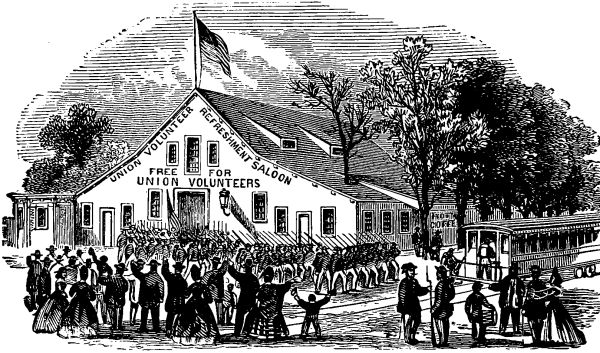
Of our journey, we remember only the hospitable welcome at Philadelphia, where we stopped for dinner. Ample provision had been made, and, in common with thousands of others, we have occasion for gratitude to the men and women who, not only at this time, but during the whole war, contributed so generously of their means and personal services, to provide for the wants of the soldiers who passed through their city on their way to the front. At Washington, we were assigned quarters for a single night, in a large brick building on Pennsylvania Avenue, not far from Willard's Hotel. Early the following morning, orders were received to go into camp on the plain back of the Capitol, but, the colonel not being decided as to the exact location, we spent the night without shelter. This was a slight foretaste of the life before us, and in many minds, through that first night of exposure, away from friends, and fairly entered upon new and uncertain experiences, there was a lingering look behind, while through the imagination swept those changing pictures of the future, to which a vague uncertainty or sad foreboding gave a solemn tone.
But the morning light dispelled these dreams, and the novelty of pitching tents and establishing camp for ourselves, kept mind and hand busy. In a few days we changed our location to the immediate vicinity of the other regiments of our brigade, and for the next few weeks our time was fully occupied in perfecting our company and regimental drill. Well we remember the idle speculations of officers and men in regard to our final destination, but while we were soon assured that we were to form a part of the expeditionary corps under Sherman, beyond this, we were completely at fault. And well we might be, since the particular point to be attacked was left to the selection of General Sherman and Admiral Dupont, who were themselves some time in doubt. Colonel Perry soon gave ample evidence of his superior qualifications as an officer, and as a regiment, in a short time, we took the highest rank among the troops with whom we were associated.
October 5 we left Washington for Annapolis, and this movement determined for us, finally, that we were to join the great southern expedition, and that our point of attack was to be in the very centre and hot-bed of the rebellion—and we were satisfied. There was no thought of the danger from the enemy or the inclemency of the climate, but only of the possibility of being able to strike such effective blows as would give us an honorable place in the final suppression of the rebellion.
At Annapolis Junction, we found part of the troops who had been detailed to protect the railroads, rendered necessary by the attitude of the people of Maryland, who at this time leaned all too generally towards their Southern brethren. Even Governor Hicks, although loyal at heart, under the pressure of the hot-headed secessionists who surrounded him, had protested to the President against the passage of troops through the state, and had it not been for the prompt decision and energetic action of General Butler, the Federal government would have suffered serious embarrassment in this matter. The bayonets of his soldiers opened the way, while their intelligence supplied the means of transportation. Roads were rebuilt, and engines repaired, while troops were stationed along the lines to guard them from interruption. Although Governor Hicks, in the meantime, had recovered his loyalty, so nearly lost, the troops whom we met were still needed to secure its constancy. It was midnight when we reached Annapolis, in the midst of a driving storm, and the deserted college buildings were the only places which promised shelter. To these we were refused admittance by the trustees, but upon the colonel's remarking that he had never seen a lock that a bayonet would not pick, there was no further hesitation. Some other lessons were needed before the people learned the temper of our troops. The answer of the colonel gave a tone to the arguments of the officers when they were refused accommodations by the landlord of the City Hotel, and he acknowledged their cogency. The man who maltreated one of our negro servants assumed a most melancholy attitude of entreaty under the influence of a similar kind of logic, and, if still living, has not forgotten the lessons of that night. Indeed, the whole town was so quickly converted that a delegation was sent to our colonel, as soon as his previous profession became known, to request him to conduct the services in the Methodist church on the first Sabbath after our arrival. Turning to the adjutant, and expressing a disinclination to officiate, he remarked, "You can detail Dr. Strickland, or Major Beard, or Captain Knowles, or Lieutenant Gale, or Sergeant Irvine, or some of the enlisted men." And so he could, for each of those named, and some others in the regiment, were regularly ordained ministers. But the colonel was induced to perform the service, and, attired in full military dress, preached an eloquent sermon.
We soon found many loyal people in the city. The officers were kindly welcomed at the house of Governor Hicks, and Judge Brewer opened his doors with generous hospitality. Orders were strict, and none were permitted to go out of camp without special permission, for no one knew the time for our departure, but such liberty was granted as this uncertainty would allow.
At this time we had a band, but no suitable instruments, and the colonel, knowing that I had reasons for wishing to visit New York once more before our departure on the expedition, kindly detailed me to attend to the business of procuring them. The railroads were then pushed to their utmost in the transportation of troops and supplies, and, finding that the road to Baltimore was so blockaded as to render it very uncertain how long a time the passage to and from that city would occupy, by much persuasion a loyal colored citizen was induced to furnish a horse for the journey.
To any one familiar with the condition of the roads in our Southern states at this period, a journey of thirty miles or more on horseback, through a strange country, would have presented little attraction, and if you add the fact that the sentiments of the people throughout the state were such that Federal troops were picketed along the railroads, and at other points, to guard against the destruction of property, and quell seditious movements, the journey would not have been rendered any more fascinating. Fortunately for my peace of mind, the exact state of things was not fully known by me, and more fortunate still that the horse so quickly developed a better acquaintance with the way than his rider as to be left almost entirely to his own guidance. Occasionally, when a fallen tree had completely obstructed the path, or a dense undergrowth had, from infrequent use, been suffered to obliterate all trace of its presence, or, worse still, when an angle of the road (if it could be dignified by such a term), discovered several paths of equally uncertain character, I admit to a degree of apprehension lest he should take me to some convenient crib, where my welcome would be somewhat warmer than I desired. But if the currents of his life moved rather slowly, they ran in loyal veins, and except for a few uncertain companions who joined me at times, I gave myself up to such enjoyments as the somewhat monotonous way afforded.
Arrived at Baltimore, I left my horse, and proceeded to New York by rail. One day was all the time needed for the transaction of my business, and the following afternoon found me again in Baltimore, anxious to get back to camp, in fear lest the expedition might have sailed, and I be left behind. A short time was taken to collect a few supplies previously overlooked, and as the western sun was just sinking behind the hills, I started on my journey back. I had become better acquainted with the condition of affairs in the state, and scrutinized more closely the countenances and manners of those whom I met, especially of the few who, travelling in the same direction as myself, seemed to insist upon the value of their company to a degree not fully warranted by the suddenness and limited extent of our acquaintance. There was quite sufficient opportunity for reflection during the long hours, that seemed to drag so slowly, as I picked my way in the darkness through those interminable woods, but, like all other things, the journey had its ending. As I approached Annapolis, I was neither shocked nor disconcerted by the challenge of our outpost sentinel, "Who goes there." The orders were strict, and I had no countersign, and it was a relief when the presence of the officer of the guard permitted suitable explanations. These were given while we walked along together towards the camp-fire, and as soon as its light permitted recognition, the exclamations, "Hello, Jim!" and "How are you, Val?" left no room for further hesitation. College and classmates, we had parted several years before, to meet for the first time again under these peculiar circumstances. But the impatience of both horse and rider permitted no lengthened colloquy, and in a few moments I was enjoying the hearty welcome of the colonel and other officers.
October 18 we steamed away from Annapolis in the Empire City, towards Fortress Monroe, the general point of rendezvous for the expedition. Here, by order of the general in command, Colonel Perry was compelled, much against his will, to detail a guard from the regiment to return to slavery a negro found on the transport. Thus the great moral, social, and political movements of the world have always been hampered and clogged by their early scruples. We were never after called upon to perform a similar service.
CHAPTER IV.
At Fortress Monroe. General Viele's talk. Weary waiting. Off at last. Order of sailing. Storm. Horrors of the voyage. Vessels lost. Off Port Royal. Tatnall's Mosquito fleet. Bombardment of Hilton Head and Bay Point by navy. Surrender. Captain Drayton. Landing of troops. First camp on Confederate soil. Foraging. Negroes' account of bombardment. Inspection and review. The sutler. Thanksgiving.
At Fortress Monroe we remained until the 29th, when, with a fleet of seventy vessels, transports, and men-of-war, we put to sea, and steered for our final destination. I must not forget to mention that, during our stay at this point, there was much talk of a landing; whether for an attack upon some place in the vicinity, or merely for practice in view of what was before us, we never knew, but it gave occasion to General Viele, who commanded our brigade, to call our officers together in the cabin of the steamer, to impress upon them the dangers of the undertaking. It was a bloody lesson, probably thought necessary in the case of simple volunteers, the conclusion of which was that we need entertain no hopes save of a glorious departure to the shades beyond. However, as it is the immediate danger which impresses us most, it was not surprising that we took courage from our hopes, and there was no unusual despondency on our part. Some of the more reckless even ventured to suggest a doubt of the general's information on the subject of our final disposal.
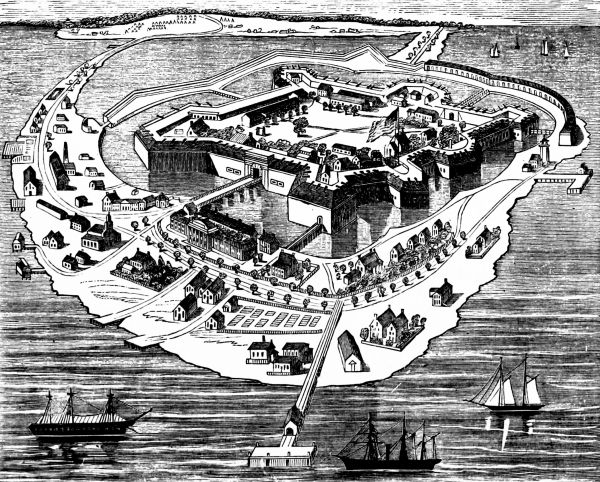
FORTRESS MONROE.
The passage to Port Royal, S.C., which proved our objective point, was a very trying one. The breeze, which at the time of our departure was blowing freshly from the storm quarter, soon stiffened into a gale, such as is seldom encountered even on our dangerous coast, and which threatened the destruction of the fleet. The very admirable order in which we started, with the transports in three columns, covered and protected on either side by the gunboats, was soon broken up, and many of the smaller vessels, which were unfitted for sea service, soon found themselves separated from the fleet, which became completely scattered and in the utmost danger. Some put back to Hampton Roads; one, the Governor, went down, after being relieved for the most part of its crew and the marines who had charge of its freight, and several went ashore and were destroyed by the rebels. During the storm the sealed instructions which had been given to each captain for such an emergency, were opened, and when it abated, the vessels that had weathered the gale quickly gathered at the point designated in the orders.
The discomforts of that voyage, no one can realize who has not been similarly situated. The sea-sickness was trying, but was as nothing compared with the discomfort arising from the close confinement in the fetid atmosphere of the ship, with no means of relaxation and no way of escape. It was a terrible experience. Owing to the great numbers crowded into the vessel, bunks were built all around and in the immediate vicinity of the boiler, and to these the men were very closely confined, until the effluvia from their reeking bodies—for, in the intense heat, all clothing was dispensed with—added to the stench of the filthy vessel, and the irritating annoyance of the vermin with which the steamer was infested, made a fitting counterpart of pandemonium, in point of suffering. Some relief was gained by the transfer, at Hampton Roads, of two companies, with a portion of the freight, to the steamer Matanzas, and a small detail, under Lieutenant Dunbar, to the steamer Belvidere, but it was only slight.
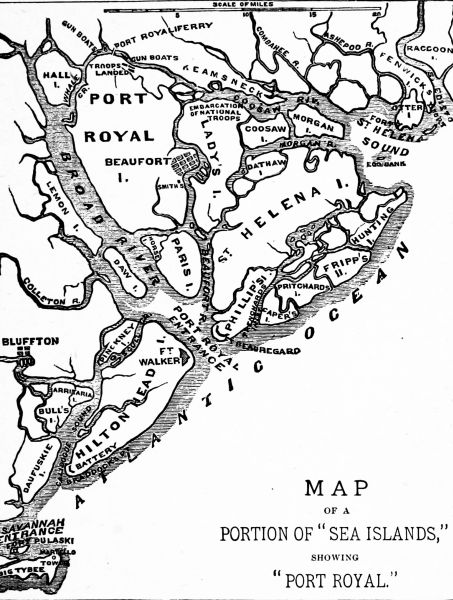
MAP OF A PORTION OF "SEA ISLANDS," SHOWING "PORT ROYAL."
Our grand old colonel, in the height of the storm, securing himself to the mast, spent many hours apparently enjoying the magnificent exhibition of power. Nothing disturbed his equanimity, and his watchful care of those committed to him was never remitted.
November 4 we arrived off Port Royal bar. Under the supervision of an officer of the Coast Survey, soundings were made, and buoys planted along the channel. That night a few vessels crossed the bar, and in the morning the whole squadron moved in, headed by the flagship Wabash. While the soundings were being made, the Confederate Mosquito fleet, under Commodore Tatnall, opened quite a spirited fire, but without effect. And as all the movements of the various vessels were plainly visible from the transports, which were well out of range of the guns, we enjoyed the advantage of witnessing the proceedings, without sharing either the responsibility or danger. On the 6th, the weather was unfavorable, and the attack on Forts Walker and Beauregard, which defended the harbor on either side, was deferred until the 7th. On that morning the gunboats moved farther in, headed by the Wabash, and the attack on the two forts commenced about 10 A.M. The more effectually to escape the fire of the forts, the gunboats moved continually in a circle, each delivering its broadside as it approached the forts. First, the Wabash poured in its heavy shot and shell upon Fort Beauregard, at Bay Point, as long as its guns bore upon it, and wearing round, opened on Fort Walker, at Hilton Head, while the gunboats, following in order, kept up the cannonade without cessation. This continued until between 2 and 3 o'clock P.M., when the forts surrendered.
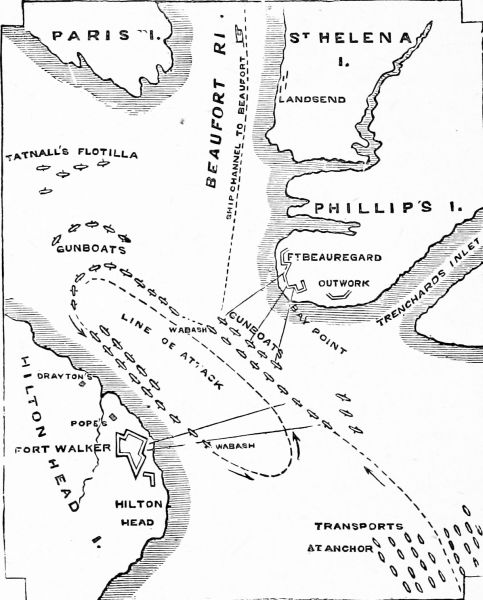
PLAN OF THE BATTLE AT PORT ROYAL HARBOR.
Although anchored nearly five miles away, we could follow the direction of many of the shot and shell, especially the latter, and observe their effect. A little after noon, the Mercury, a small gunboat, got on the southerly side of Fort Walker, so near that its guns could not be sufficiently depressed to bear upon her, and from that point was able not only to shell the troops outside of the fort, who were held in reserve, but to throw in so effective an enfilading fire upon the fort itself that its guns could not be served. It was a stroke of impudence which seemed so ludicrous on account of the apparent insignificance of the little craft that the troops on the transports shouted themselves hoarse in admiration of this seeming act of bravado, which, however, proved an important feature of the attack. As soon as the fire from Fort Walker ceased, and it was apparent that at least a part of its garrison, with the other forces on the island, was retreating, a flag of truce was sent ashore to arrange the terms of surrender. But it was too late for any conference, as none but the dead and wounded remained, and the Stars and Stripes soon waved the announcement that the first step in the avenging of Fort Sumter had been consummated.
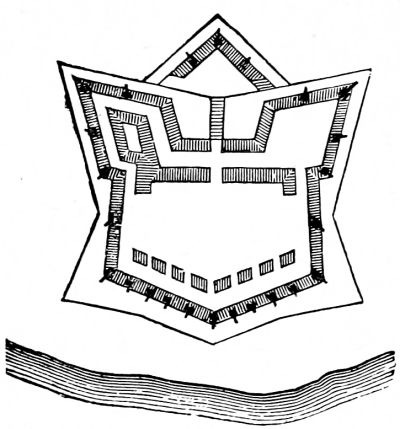
FORT WALKER.
Not a man in the command but felt the significance of that victory. Charleston was nearer now than it had been before, and, in the minds of many, it seemed but a little thing to cover the intervening distance with victorious troops. The flight of the Confederates was precipitate, and they left behind everything that would cumber a rapid retreat. Fort Beauregard had suffered less from the bombardment than Fort Walker, but the fall of the latter hastened its evacuation, and on the following morning no opposition was offered to its occupation by our forces.
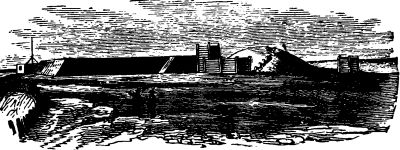
FORT BEAUREGARD.
One fact in this attack is worthy of special mention. General Drayton commanded the Confederate forces on Hilton Head, and the home of the family was located on a prominent point near the shore, overlooking the bay, while his brother, Captain Drayton, commanded the gunboat Pocahontas, which participated in the bombardment. Some time afterwards, in company with other officers, I visited the Monitor, which he then commanded, and his grave and saddened demeanor told of the sacrifice he had made in his loyalty to the government.
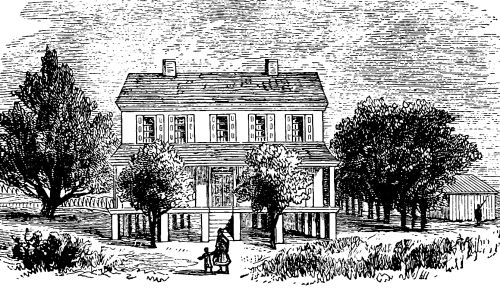
DRAYTON'S MANSION.
I know that patriotism is a word with some considered stale and obsolete. Such know little of the temper of the brave men who composed our army and navy during that terrible struggle. For while few were called upon to make such sacrifices as Captain Drayton, the number of those who went to war for hire only was but a small detachment of that great army. And the arguments, even of those unlettered men who formed so large a part of the rank and file, as I have often heard them stated, though clothed in rude and homely language, had in them a degree of intelligence, and were so charged with honesty and sincerity, so backed by courage and fidelity on many a gory field, that it were shame to say the stream of patriotism has run dry. It has not now, and never will, while men have manhood left, honor to defend, homes to protect, good laws and a righteous government to transmit.
November 9 we were all ready to land, having been provided with two days' cooked rations, but for lack of transportation we were detained on board the steamer until Sunday morning, the 10th. The night previous was spent in securing boats and attaching them to our steamer, so that on Sunday morning, as soon as the word was received, we pulled for the shore with a will. At this time, the harbor presented a most animated appearance. The transports were crowded together near the shore, all busy in discharging freight. Boats of all sizes and descriptions were passing to and fro, and horses and other animals were being hoisted from the holds by means of broad bands which encircled them, swung over the sides of the vessels, and gently dumped into the water, to find their way to land as they could, while men stood by ready to secure them on the shore. Occasionally the poor distracted brutes, confused by the unwonted sounds, and half drowned by their sudden and unexpected immersion, turned seaward, but were soon brought back.
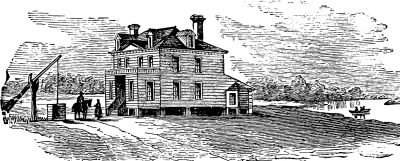
POPE'S HOUSE AT HILTON HEAD.
It was a beautiful Sabbath morning, but with little to remind us of the sacred character of the day. After landing, we marched a little way from the beach and remained until about noon, when our camp was located, not far from general headquarters, and we proceeded to prepare the ground for our tents, and establish guards and pickets. Two nights were spent without shelter, on account of the difficulty and delay in landing baggage. After this we settled down to regular work. From ten to twelve each day we had battalion drill, in which the colonel was very exacting, requiring the officers to know their duties, and holding them responsible for the condition and drill of their companies. Company drill was from two to four in the afternoon, and dress parade in the evening, often followed by more battalion drill. Details were made for fatigue duty in building entrenchments, an extensive line of earthworks was thrown up as a precautionary measure, and frequently nearly the whole regiment was picking, shovelling, or felling trees to furnish material for the works. There was no idle time, except when a day on picket or other guard duty secured the following as a day of rest.
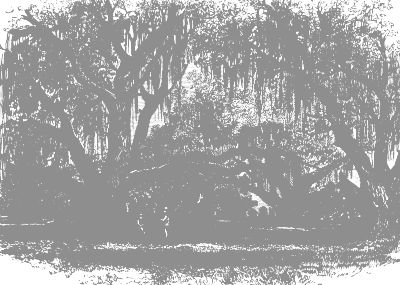
LIVE OAK GROVE AT PORT ROYAL.
Having been detailed as officer of the guard the first day in camp, the following day I was permitted by the colonel to accompany a small party bound on a tour of observation. During the day we wandered far away from camp, to the other side of the island, and the afternoon found us on the borders of a large plantation, which proved to be that of a Mr. Seabrook. Approaching the place, we mistook the whitewashed huts of the negroes for tents, and remained a long time in doubt whether to advance or retreat, feeling quite certain that it was a Confederate encampment that we saw. While debating what course to pursue, a stray contraband relieved our apprehensions by informing us that our troops occupied the place. We found on our arrival a detachment of the 45th Pennsylvania, posted there to keep watch for Confederates and prevent foraging. That night we spent in Mr. Seabrook's store, after using the portion of the afternoon that remained to us after our arrival in endeavors to secure some of the cattle, pigs, and poultry, which seemed to be wanting an owner, to which the guard, usually lenient on such points, raised few objections. These came mostly from the quadrupeds and bipeds themselves, and were so strenuous that the result of our efforts was a meagre show of two or three lean pigs, an occasional hen, and an ancient goose, which succumbed to my own personal prowess.
On our way back to camp, the next day, we narrowly escaped arrest, as General Viele had issued an order that all parties coming in from foraging should be deprived of what they had collected and sent to his headquarters under arrest. My poor goose suffered the fate of the pigs and hens, and no doubt rested heavily on the stomachs of the pickets, if not on their consciences. We were glad to escape with the loss of our plunder.
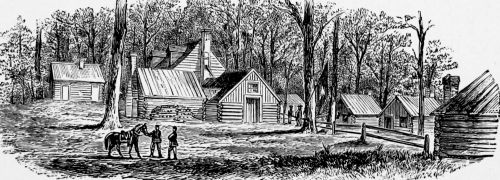
NEGRO QUARTERS.
Supplies were abundant, the negroes bringing to camp whatever the plantations produced, and although General Viele issued an order that everything should be taken to his headquarters, where a general market would be held every morning, no attention was paid to it, and as far as we ever heard, no general market was established.
About a week after the capture of Hilton Head, I was detailed to take command of the Grand Guard, whose headquarters were at Drayton's plantation. The negroes had generally remained here, as well as at the other places within the range of our command, and were encouraged to cultivate the plantations abandoned by their masters. This was important, as the famous Sea Islands formed a part of the territory captured by our forces, and considerable of the cotton remained unpicked, while nothing had been done towards the harvesting of corn, potatoes, and many other products of the soil. Some of the negroes here were owned by Captain Drayton, who had left them in the care of his brother, and no doubt some of the shot from his guns had fallen among his own people. The evidences of the cannonading were manifest all about, and the negroes, when questioned as to its effects upon them, declared that at first they didn't mind the firing, but "when them rotten shot began to spatter about them, they jes' ran for de woods."
The regiment soon became proficient in drill, in spite of the frequent details for fatigue duty, and was regarded as one of the best, if not the very best, in the Department.
November 24 we had a general inspection and review, by Generals Sherman and Viele, in which the brigade marched first in quick, and then in double-quick time, around a circle of some two miles in extent, according to the journal of Conklin, to which reference has before been made. We can all testify that it seemed much longer, with the sand sometimes almost ankle-deep. General Viele perhaps thought us amply paid for the exertion, when he declared that we marched as well as regulars, and were equal to any regiment in the service.
Day followed day with about the same round of duties. We had already become fairly accustomed to tent life, our food supply was ample and good, and the paymaster furnished the means of providing ourselves with comforts and luxuries according to our several positions, or, rather, the amount of pay received. Besides the regimental sutler, who was prepared to furnish anything, from Golden Seal to toothpicks, for a consideration, shops of all kinds sprang up with amazing rapidity, as soon as it became known that this would be a permanent basis of operations, and usually only a short time elapsed after the visit of the paymaster, before his next appearance was looked for with eagerness, even by the sutler, who cultivated a disposition for extravagance, by giving credit to such as seemed likely to regard the obligation. Occasionally, when, too grasping, he became exorbitant in his prices, or in the rate of interest charged for accommodation loans—for too often the offices of banker and sutler were combined—a sudden raid would equalize the account.
At this time, measles and smallpox prevailed to some extent, and from the former several deaths occurred, while the latter was limited to a few cases by the isolation of those attacked.
Thanksgiving and Christmas passed with no observance on the part of the non-commissioned officers and privates, except perhaps a more general application to pick and spade. On Thanksgiving Day, the officers, many of whom had been suitably remembered by friends at home, united their private stores with such good things as could be collected in the vicinity, and indulged themselves in unusual luxuries, forgetting for the time their surroundings, and giving themselves up to the full enjoyment of the day, so far as their duties permitted.
CHAPTER V.
Expedition to Port Royal Ferry. Progress up Broad River. Colonel Perry acting brigadier-general. The rebel yell heard for the first time. The regiment's first baptism of fire. The old horse. Night on the field. Return to Hilton Head. Object of the expedition. Presentation of flag to the regiment. Off for Dawfuskie. Southern homes. Preparatory work by Major Beard and others. Building batteries on Jones and Bird Islands. Mud and malaria. Reconnoissances and midnight wanderings.
The closing day of the year brought rumors of a contemplated movement. The scene of operations, and their extent, were only subjects for conjecture. Early on the last day of the year, we received notice to be in readiness to march with a number of days' cooked rations, and about noon of that day started for the dock. The expedition was under the command of General Stephens, and two regiments were taken from our brigade,—the 47th and our own,—in addition to those of his regular command. By the middle of the afternoon we were on board of the steam transport Delaware, and on our way up Broad River towards Beaufort, where we anchored for the night. In the early morning, we started for Port Royal Ferry, against which point we learned that the expedition was directed. Several gunboats accompanied us, under the command of Captain Rodgers. Our progress up the river was slow and cautious, until we arrived opposite the plantation of Mr. Adams, where we disembarked.
We were much interested, while on the steamer, in watching that portion of our troops already landed, as they could be distinctly seen, pursuing their winding way through the woods and over the fields, their bayonets glistening in the sunlight. Sometimes they went at slow step, at others in quick or double-quick time. Sometimes they fired, and charged the Confederates whom they encountered, while the gunboats covered them to guard against attack by superior forces, all the time shelling the woods in front of them as they advanced. As soon as landed, we formed in line and moved forward, the two regiments—the 47th New York and our own—under the command of Colonel Perry. Acting as reserves, the duty assigned us was to intercept the Confederate retreat. Very soon, however, orders were received to attack the battery which was found to cover the road over which we were expected to advance, and the 47th was moved through the woods on the right to attack it in flank, while the 48th was to charge in front. Some delay occurred in establishing the position of the 47th, and arranging so that the attack might be simultaneous. Well do I remember the rebel yell, heard for the first time as I was returning from conveying orders from our colonel to the 47th. Accompanied by the discharge of cannon and musketry, it seemed, to my unaccustomed ears, as if the inhabitants of pandemonium had been let loose, and as I rounded the last point of woods which shut out from view the scene of operations, I expected nothing less than a hand-to-hand conflict. Instead, I found the regiment lying quietly down between the furrows of a cornfield, over which the Confederate shot skipped harmlessly. In this way the men were protected while awaiting the final order to charge. This was found unnecessary, for the yell of the Confederates proved only the parting word given while in the act of abandoning the battery, which was speedily occupied by our troops. The guns were removed, and the works destroyed, and we continued our advance towards Port Royal Ferry, where the enemy was known to be strongly entrenched.
At this time two horses had been captured and placed at the disposal of the colonel and his aid, to which position I had been appointed. I have no recollections of the colonel's, but my horse soon gave evidence of manifold infirmities. Three times we rolled over together on that cotton-field, before it was discovered that, with his other weaknesses, he was stone blind, when he was left to tempt some other officer, and I returned to nature's conveyance, sadder and sorer for the experience. That night we lay down on the field, but gained little rest, as the Confederates were known to be in force in the vicinity, and an attack was looked for. The next morning we embarked for Hilton Head, the objects of the expedition having been accomplished, in the destruction of the Confederate works, which were being constructed for the purpose of preventing any forward movement on our part in that direction, and confining us closely within the territory already captured. This was only one of the points which the Confederates proposed to fortify, which were intended not only as a restraint upon any forward movement by us, but also as bases of aggressive operations against us.
January 12 the regiment was presented, through Adjutant Goodell, with a beautiful flag from the ladies of Hanson Place Methodist-Episcopal Church of Brooklyn, of which Colonel Perry had been pastor. That flag has waved over many battle-fields, and is a witness that the 48th never faltered in the discharge of any duty. It is now in the custody of the Long Island Historical Society, having been committed to its charge, with suitable ceremonies, on the evening of April 21, 1881.
January 25, 1862, we broke camp, and marched to Seabrook's Landing, on our way to Dawfuskie, an island bordering on the Savannah River, some four or five miles above Fort Pulaski. That night we spent at Seabrook's, and on the next morning embarked on the steamer Winfield Scott, and proceeded to a place on Dawfuskie called Hay's Point, where five companies disembarked, and at 9 P.M., under the command of Lieutenant-Colonel Barton, started for the other side of the island. Three hours of wearisome marching brought us to Dunn's plantation on the bank of the river. Pickets were established, and sentries posted, and we got what sleep we could. The next day was occupied largely in procuring supplies of food, as everything of that nature had been left on the Winfield Scott. Detachments were sent out in all directions to secure the cattle, pigs and poultry abandoned by their owners on the approach of our troops, and to collect whatever else could be found that was edible. The men were quartered in the houses and sheds, while the officers occupied the family mansion. In the afternoon we learned that the Winfield Scott had been wrecked on Long Pine Island, where the other wing of the regiment remained until taken off by the steamer Mayflower, which conveyed them, with the regimental baggage and supplies, to Cooper's Landing, on Dawfuskie. At this point they remained until February 1, when they joined us, and, a permanent camp was established near the borders of the woods, a little way back from the river.
During the interval there was little of severe duty, and all were allowed the largest liberty consistent with proper discipline. Frequent excursions were made to different points on the island, especially to the beautiful residences along the shore. Of these, the most attractive were Munger's and Stoddard's, the former a short distance below us, the latter some miles away, and occupying a commanding position, overlooking the sound. Both gave evidence of large wealth and cultivated tastes, in the character of the houses and beauty of their surroundings, and as we wandered through the shaded avenues, and among the shrubs and flowers, in gardens where roses and japonicas grew in tropical luxuriance, where the air was full of sweet odors, and the eye confused with the multitude and variety of brilliant colors, and remembered that these abodes of happiness and beauty had been abandoned to pillage and destruction, and that wherever our armies penetrated, homes would be broken up, and in the place of comfort would come suffering, and in the place of beauty, desolation, we cursed the madness of those who had brought such miseries on the land.
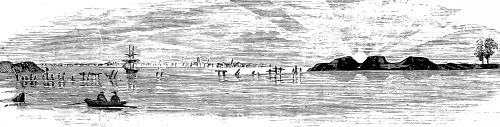
OBSTRUCTIONS IN SAVANNAH RIVER.
While we were enjoying this short season of comparative idleness, active and aggressive operations were going on all about us. Expeditions were planned, obstructions removed from the creeks and rivers where openings were desired, and midnight scouting parties penetrated the surrounding country in all directions, even to the very walls of Pulaski. In all of these, Major Beard, of our regiment, took a leading part, and did most efficient service. As we sat around the fire one evening at Dunn's, he suddenly appeared among us, with General Gilmore, who had already been promoted from the position of Captain of Engineers in the regular army, to that of Brigadier-General of volunteers. They had just returned from the work of clearing the spiles from Wall's Cut, by which a convenient way was opened for our boats to the Savannah. Much of the night was spent in listening to their adventures, but we little knew how intimately connected these were with our own immediate future.
It was not long after our camp was established, before we had our full share of labor and danger. It had been determined to establish batteries on the islands of the Savannah, to cut off communication with Fort Pulaski, and prevent re-enforcements and supplies. The points where these were to be located having been selected, the engineers were ordered to prepare the materials for their construction, and our regiment and a portion of the 7th Connecticut were employed for weeks in conveying this material from the woods to the dock for transportation. Some eight or ten thousand logs, of from ten to fifteen feet in length, and from three to six inches in diameter, were carried a distance of from three-quarters of a mile to a mile and a half, on the shoulders of our men, and, in consequence, many of our best soldiers were ruptured or otherwise injured, and crept out of the service, maimed and ruined for life. Late on the evening of February 9, a detachment under Captain Greene was ordered to report at the dock to complete the loading of the Mayflower. It was raining very hard, but the men worked faithfully until after midnight, when word came from brigade headquarters to take off a part of the load. This was done, and the admirable foresight of the commanding general was fully appreciated, as was manifest from the frequent comments in which the men indulged, which had the merit of earnestness if not of elegance.
At 3 A.M. of the 10th, we started for Jones Island. We were all wet, hungry, and tired. Not expecting to leave Dawfuskie, we had taken no provisions. There was no opportunity for sleep, for, arriving quickly at the point of debarkation, the work of unloading and conveying the materials across the island was pushed forward hurriedly. It was a season of the year when, even in this southern latitude, the sun gave but scanty heat, and the men must needs work lively to keep the blood from chilling. The island was but a deposit of soft mud, into which they sank to their knees at almost every step, while occasionally the logs or planks which they carried were needed to bridge over spots otherwise impassable. During the forenoon, a party was despatched to camp in a small boat, for food, but the supply which they brought was totally inadequate, from the size of the boat and the number to be fed. During the day all the materials for building the battery were conveyed across the island, a distance of about a mile.
While engaged in this work, a Confederate steamer made its appearance, and stopped opposite, and so near to us that every movement of those on deck was discernible. The officers, with their glasses, scoured every point in the vicinity, while we crouched down among the cane-brakes. So long as the steamer remained, we expected a shot from her guns, or a closer inspection by one of her boats, which would have been extremely disagreeable, as the order for detail required us to leave our guns in camp, and there were not six rifles on the island. Fortunately we were not discovered, and the steamer, after a little delay, proceeded down to Fort Pulaski. About this time the guns for the battery arrived, and the general in command of the district, who had arrived with them, declared that they must be mounted before morning. We felt very much like harnessing him to the foremost, and giving him a taste of Jones Island mud, but there were objections to such a procedure, and, instead, we made a platform on which to load them, and prepared to do our utmost. By frequent crossing and recrossing, a way had been sufficiently marked through the canes, but the constant tread of heavy feet had reduced the soft mud to the consistency of oil for a depth of several inches, making a road not perfectly calculated for the transportation of cannon. However, there was no time for hesitation, and placing two planks before the wheels, we united our strength in the task of maintaining them on these planks, while we carefully urged them on, replacing the planks as we proceeded. Woe be it, if, slipping on the greasy mud which covered the planks, as they sometimes did, they buried themselves in the soft embrace of its slimy nastiness. Should it be asked how were they recovered, it would be impossible to tell. We can only say they were, and that with slow and suffering steps we guided, pushed, and pulled them forward, until flesh and blood rebelled at loss of food and sleep, and they were covered up, and we ordered back to camp, to be relieved by others. We had to wait, however, until the relief came from Dawfuskie, and I quote from Sergeant Thompson's journal to show how this second night was spent: "At midnight we covered the guns and endeavored to find some place to lie down in. Found a place, but was soon routed out by the tide. Came to the conclusion to walk the rest of the night to keep warm. Found a twenty-foot plank with four men on it. Jumped on and ran my chance. Kept moving until morning." This was only the beginning of such labor and exposure, and is it a wonder that so many men, protected from rebel bullets, have come out of such a service as we have here described, to worry through a life of suffering, the effects of which they have transmitted, and will continue to transmit to children and to children's children. The malaria of those mud islands is considered death to any one, even to such as have been acclimated to the South, and their only inhabitant is the ugly alligator.
This battery was hardly established before, pushing across the river, another was planted on Bird Island, farther up, so that, together, they cut off all further communication with Fort Pulaski, by way of the Savannah. An attempt was made to destroy these batteries, but without result, except in the disabling of several of the enemy's steamers, after which we were left in undisputed possession.
The smell of the mud of Bird Island lingers in the nostrils yet, and it is no wonder that in the progress of the work of establishing the battery, at times not a man was fit for duty. Whiskey and quinine were powerless to stay the effects of such labor and exposure. As a partial protection, our tents were nailed to heavy timbers a foot or more in diameter, snatched from the river as they floated down, while boards were laid across on which we slept, but even then in the high spring tides we were scarcely out of water, and not a spot was dry on the whole island.
During our stay on Bird Island, frequent reconnoissances were made up the river in different directions. One dark night, two boats were sent up the Savannah, on either side of Elba Island, to ascertain if batteries were being planted, which would threaten ours of Bird and Jones Islands. Closely hugging the shore, we worked along cautiously, to avoid being seen by the Confederate pickets. At a distance of some miles from where we started, while the pickets on the shore were plainly visible by the light of their camp fires, one of our men was attacked with a sudden and most sonorous cough. Suspecting that it was intended to stop our further progress, we waited patiently for its cessation, and resumed our progress up the river, until suddenly the sound of voices immediately in front of us gave warning that we had gone too far for safety. Fortunately, the tide had turned, and a single whisper stopped the motion of the oars, otherwise we should not have suffered long from the chillness of the night air. Dropping back with the tide, stopping occasionally to learn more certainly that there were no batteries where they had been suspected, we reached our quarters in season for an early breakfast.
Lying alongside, but extending much farther up the river than Bird, was McQueen's Island, the upper extremity of which was bounded by St. Augustine's Creek, which connected the Savannah with Wilmington River, and afforded a channel of communication with Fort Pulaski by means of small boats. Across St. Augustine's Creek, the telegraph wire connecting the city with the fort had been stretched on tall, heavily constructed spindles. The wire had been destroyed some time before, but the fact that steamboats from Savannah, at some risk from our battery, continued to come down to this point, and seemed busily engaged in some operations near these spindles, determined Major Beard, who commanded on the island, to investigate the matter, and, if possible, to bring away a scow which was known to be lying in that vicinity. The investigation was very proper, but the object of getting the scow we never understood. However, a detail was made, a boat was dragged across McQueen's Island to Wilmington River, and from that point a small party, with a guide supposed to be acquainted with the region, started for these spindles. It was a curious experience, paddling along under the overhanging banks in perfect silence, save when the vivid imagination of some one of the party pictured a Confederate picket from some peculiar conformation of the shore or eccentric growth of bush or shrub, when a word of caution would stay our progress until cooler eyes discovered the deception. One of the party even descried a picket beside its camp fire, whose bright glow shed a clear light upon their waiting figures, but to all the others there was but the blackness of darkness, and we passed on without molestation. The leaky little dug-out, which required constant bailing to keep it afloat, had room for neither rest nor comfort. Hour after hour we paddled along with the incoming tide, vainly hoping to reach the point we sought, every moment taking us farther within the lines of the enemy, and when, at last, completely lost amidst a maze of devious, winding creeks, the tide turned, we turned also, and by marvellous good fortune found our way back before the morning dawn discovered us to the Confederates. Determined to have that scow, and equally determined to have a better knowledge of the country before a second attempt was made, a small party was started one bright afternoon, which, rowing some distance up the river, landed on McQueen's Island, and striking through the canes, made straight for the spindles. We took no notice of the picket on the other side of the island, but kept right on, until, approaching the shore of the creek, the men were held back behind the trees and bushes which grew along the bank, until we could be assured of no special danger. Satisfied on this point, they were allowed to come on, and we gathered along the shore, and endeavored to impress upon each others' minds the direction of the creek, the location of the scow, and the probable means of reaching it from Wilmington River. The order to return had been given, when suddenly the Confederates appeared from behind the timbers of the spindles opposite, and not a hundred yards distant, and from the bushes near, and the order to lie down was given none too quickly to avoid the bullets which came whistling over our heads in close proximity. No one of our party was hurt, and we never received an official report of the number killed and wounded by our return fire. The locality was not sufficiently attractive to induce us to remain until the report was made up. Not only the danger of being cut off by the picket we had passed, but the shells from our own battery soon began to trouble us, for, as it afterwards transpired, one of our number, unaccustomed to the sound of bullets, became so thoroughly frightened at the first discharge that he started for camp by the most direct course, and on his arrival announced that we had been attacked by greatly superior numbers, and that he had been sent back for re-enforcements. Our own battery was soon throwing shot and shell over our heads, much to our discomfort,—for those missiles often make serious mistakes, and fall where they are least intended,—and all that could be spared were preparing to set out to rescue us from the peril to which we were exposed, when our appearance on the river put an end to the alarm. On reaching the island, we found the utmost excitement prevailing, and that every preparation had been made for the reception and care of our wounded. The author of all this confusion was discovered to be suffering the extreme effects of fright, and in a pitiable condition of mental and physical prostration. His youth, for he was a mere boy, shielded him from the consequences of his conduct, which otherwise would have been very serious. He was never permitted, however, to forget the circumstances and effects of his fright. Soon after this I was sent to Wilmington River to intercept the despatch boats, which, we had reason to suppose, found their way to the fort, but although many nights were spent in watching, while the miasma from the swamps was doing its deadly work, penetrating to the very bone and marrow, and preparing many a poor fellow for his final rest, the creeks and rivers which intersected the country in all directions afforded abundant means for avoiding us, and we made no captures.
CHAPTER VI.
Planting batteries on Tybee Island. General Gilmore. Listening for the opening gun. Bombardment of Fort Pulaski. Watching the contest from Dawfuskie. Surrender of the fort. Its appearance after the bombardment.
While we were engaged in the work described in the last chapter, General Gilmore was planting his batteries on Tybee Island, which borders the mouth of the Savannah. These were placed from one to two miles distant from Fort Pulaski, and in the work of establishing them, difficulties were encountered similar to those which so thoroughly tested the skill and endurance of our men on the mud islands above. It required the combined efforts of two hundred and fifty men to drag a single mortar from the beach where they were landed, to position, and as several of the batteries were in plain sight from the fort, the work was largely done at night, until the embankments afforded sufficient protection. The fire from the fort was annoying, but less constant and spirited from the confidence of its commander in its security against the fire of guns so far distant. The value of rifled cannon for siege operations at long range was about to be tested, and while the result in this instance was not entirely to the satisfaction of the commandant of the fort, it fully justified the confidence of General Gilmore, for to him belongs the credit of this achievement, from its inception to its final termination.
By April 6 we became aware that the crisis was approaching, and from that day anxiously listened for the opening gun.
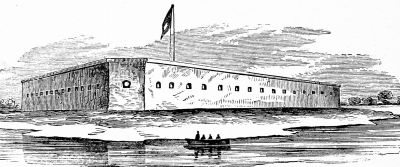
FORT PULASKI.
On the 9th, a demand was made for the surrender of the fort, to which the commandant replied, "I was placed here to defend, not to surrender." And he had an opportunity, for on the morning of the 10th the boom of cannon was heard, and from that time until about two o'clock of the afternoon of the following day, the batteries kept up a steady and constant fire. On the first day we could discover little effect, as we watched the progress of the contest from the shore of Dawfuskie, but the next day the frequent clouds of dust arising, especially from the southwest angle of the fort, indicated that progress was being made. During the night the firing had been continued, with intervals of about fifteen minutes, permitting little rest to the garrison, and effectually preventing all attempts to repair or strengthen the fort, and in the morning all the batteries opened and kept up a terrific cannonade, until the white flag appeared. Throughout the day the shore was lined with the excited soldiers, especially in the vicinity of Munger's, where a few of us secured places in a large willow tree overhanging the water, and affording an unobstructed view of the conflict. It was not long before a large breach was visible, which gradually widened as the day advanced. The firing from the fort was spirited, but had little effect. Several times the flagstaff was cut away by our shot, and as often replaced, until about 2 P.M. of the 11th, when the firing ceased. Still, we were ignorant of the exact state of affairs, until an accident revealed the fact that the fort had surrendered. A sailing vessel was seen slowly drifting towards it. A steamer followed, apparently for the purpose of rendering assistance, but for some reason she seemed to be unmanageable, and gradually approached and passed the fort without drawing its fire. By this we knew that Pulaski was ours, and another entrance for blockade runners was closed.
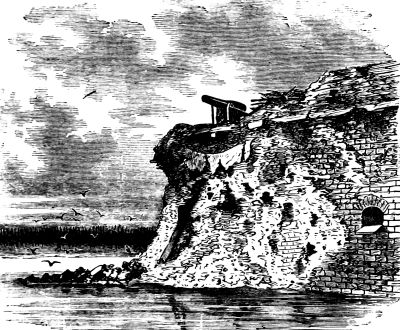
BREACH IN FORT PULASKI.
Soon after its surrender, the officers were from time to time allowed to visit it. One bright morning, after the details for the day had been made, in company with several other officers, I was rowed across the river, and spent the day in the quiet inspection of the fort and surroundings. The effects of the bombardment were everywhere visible. Guns were dismounted, bomb-proofs torn and shattered, and the traverses—great mounds of earth for the protection of the gunners, and to guard against the effects of enfilading shots—were levelled almost to the ground. The terre-plein was ploughed and furrowed in every direction, while wide and deep ditches extended across it, to ward off the effects of bursting shells. In many places the blandages, which were heavy timbers inclined against the inner wall, although covered with earth to the depth of three or four feet, were splintered and broken, and large sections of the walls themselves destroyed. The angle against which the heaviest fire had been directed was a gaping mass of ruins, through which at last the shot and shell drove steadily against the magazine, threatening to envelop fort and garrison in one common destruction. It was this danger which compelled the surrender.
CHAPTER VII.
Camp life at Dawfuskie. Scheelings and his "leetle tog." High living. Effects of malaria. Discussing the situation. Emancipation order of General Hunter. Lincoln the emancipator. John C. Calhoun and nullification. Ordered to Pulaski. James Island expedition. A sad failure. Shouting service of the negroes.
For the next few weeks our duties were less severe than they had been. The men, by various expedients, had softened down the severer features of camp life. The tents were enclosed in frameworks of poles, which were covered and decorated with evergreens and southern moss, and the officers vied with each other in rendering their quarters attractive. The most pretentious of all were perhaps those of Captain Elfwing, commonly known as Volks Garden, from the fact that, having many friends in the 46th New York, a German regiment, he brought back from his frequent visits to them liberal supplies of their favorite beverage. Several companies of the regiment were stationed at Cooper's Landing and at other exposed points on the island, and on moonlight nights we sometimes made up parties to accompany the officer of the day in his grand rounds. Often these were made occasions for pleasant entertainments at the little outposts. At Cooper's Landing especially we always found hearty welcome, perhaps because we were often the bearers of letters, which, received at headquarters, were sent in this way to those on detached service. Sometimes the colonel visited not only these stations, but other points less carefully guarded, but from which an attack might be possible. At times the officers united in a general mess, but for the most part were divided up into small parties of such as were most congenial, which allowed to a greater extent the indulgence of individual tastes.
The bugler, Anthony Scheelings, must not be overlooked, for at this time especially he was one of the most useful members of our organization. With his little pack of dogs, he was roaming the woods from early morning till evening parade, and seldom returned without an abundance of appetizing game, which he distributed among the messes with impartial liberality. Occasionally a huge rattlesnake contested with him the right of way, but with gun and dogs he was more than a match for beast or reptile. On one occasion however, Scheelings returned from his accustomed ramble with downcast countenance, and upon being questioned as to the cause of his depression, could only answer, "mine leetle tog, mine leetle tog." Some time afterwards, when his grief had lost some of its poignancy, he was able to explain that, while hunting in the marsh, the little cur which was his special favorite, in jumping across a narrow creek, had suddenly disappeared from sight. A huge alligator was discovered soon after, making its way to deeper water, whose movements were hastened by the contents of Scheelings' gun, but the "leetle tog" never returned. The woods abounded with birds and animals, and the numerous creeks and bayous furnished a continuous supply of delicious oysters, and the great sea-turtles, which deposited their eggs along the shores of the river and sound, were often caught too far from their favorite element to effect a retreat. Drill, guard and picket duty were kept up with regularity and constancy, but we look back upon the interval between the fall of Pulaski and our assignment as its garrison as one of comparative rest and comfort. The effects of our exposure on the river batteries now began to be manifest in the pale faces and shrunken forms that crept about the camp, showing that the slow but deadly malarial poison was fastening upon its victims. Loss of appetite, broken sleep, and a general feeling of lassitude, which found but slight alleviation in quinine, were the precursors of more violent attacks, from which many escaped at the time, but whose after life of miserable weakness and suffering has told how deeply were sown the poisonous seeds of lingering disease.
Our mails came with frequency and regularity, and the papers were fairly devoured in the eagerness to learn of operations in the other departments of the army, but the confusion of statements, often half falsehoods and half conjecture, with the reports of deserters, and negroes who found their way through the rebel lines, and the claims of the Southern papers which they brought, altogether, made a jumble and jargon, in which the truth was buried too deeply for any hope of resurrection. The affairs of our own department were equally involved in obscurity and doubt as far as we were concerned, except those matters in which we took part. This uncertainty, however, did not prevent an active interest in and frequent discussion of movements, and that fiction took the place of fact detracted nothing from the hotness of the argument. We fed on what was furnished us, and often built our hopes and theories, fought battles and gained great victories, on the brilliant but groundless conjectures of unreliable correspondents.