Front matter (continued 2)
Reading edition
From the journal of Sergeant Thompson I learn that on May 12 the emancipation order of General Hunter was read to the troops. While this was somewhat premature, and was annulled by orders from Washington, it foreshadowed the purpose of President Lincoln, who, with a majority of the people of the North, soon came to regard it as a military necessity, and as such the proclamation of January 1, 1863, was issued, by which slavery in this country was forever abolished. Comparatively few slaves were immediately affected, but as our armies penetrated the rebellious states at different points, and the negroes were not only received and protected, but were organized into regiments for service against their late masters, the wisdom of the measure was fully demonstrated. For this act the name of Lincoln, handed down from age to age, will ever be held sacred in the memory of man, as one of the greatest benefactors of the race.
By the middle of May it became manifest that new movements were contemplated in the department. The other regiments on Dawfuskie were gradually withdrawn, and we became interested to learn what disposition was to be made of us. On the 19th the rumor reached us that we were to garrison Fort Pulaski, while most of the troops were to be concentrated in an attack upon Charleston. The 6th Connecticut and the 28th Massachusetts, which had been encamped near us, were ordered away, and we were left almost alone. On the 21st a party visited Hilton Head, where assurances were received that we should form a part of the attacking force, but results showed the falsity of this assurance.
On our return from the Head we stopped at the house on Braddock's Point formerly occupied by John C. Calhoun, and, among the letters scattered about, found many dating back to 1832, which showed the general prevalence of the nullification doctrines at that time, throughout the state. Had the loyalty and energy of President Jackson descended to Buchanan, these years of suffering and loss would all have been avoided. But out of the evil has come such good that few will dare to say that the results are not worth all the sacrifice.
May 23 all doubt in regard to our destination was removed by despatches from Generals Terry and Benham, directing us to proceed at once to Fort Pulaski to do garrison duty. We were very indignant, and felt ourselves grievously wronged, in being placed in what we regarded as ignominious retirement, after having labored so hard, and prepared ourselves so thoroughly for the field; and the officers united in a respectful but spirited protest to be forwarded to the commanding general, but the colonel, knowing better than we, disapproved, and there was no alternative.
On the 25th, the steamer Mattano took seven companies to the fort, leaving E, B, and C on the island, under the command of Captain Coan. At the wharf we were met by General Terry, who directed us to pitch our tents in the most convenient places outside the fort, still occupied by the 7th Connecticut, which was under marching orders. Several days elapsed before the final orders came for the transfer of this regiment to Edisto Island, during which nearly our whole command was constantly engaged in fatigue duty. Company K was detailed to occupy the hulk of an old vessel that had been anchored in the channel, just opposite the fort, and it was not until June 2 that the remaining companies were moved into the fort and entered upon garrison duty. On the same day our troops, under General Benham, landed on James Island, on their way to Charleston. The Stono River had been cleared of obstructions by the navy, and it was supposed that the enemy could not interpose an effectual barrier to our advance. The Confederates were gradually driven back, but finally made a stand at a place called Secessionville, which possessed many natural advantages for defence. On the 15th, preparations having been completed, General Stephens charged the earthworks with his division; but the position was too strong, and he was obliged to retire, with heavy loss. A second attempt was about to be made, with a better disposition of the troops, when General Benham ordered the withdrawal of General Wright's division, and General Stephens was obliged to follow. The losses were very heavy, owing to the nature of the ground. The Confederates were able to concentrate the fire of artillery and infantry upon a narrow neck of land between two marshes, over which our troops must pass to make any substantial progress. They soon received re-enforcements, and this attempt on Charleston was abandoned.
From the first it seemed to be determined at Washington that no important movements were expected in our department. The number of troops was always too small for any large undertaking, and in maintaining a depot of supplies and a place for repairs for the navy, and shutting up the entrances to the coast in our vicinity, and thus limiting the operations of the blockade-runners, we seemed to meet all requirements.
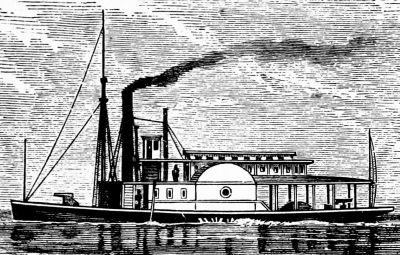
THE PLANTER.
While the attempt at James Island was being made, I was on the steamer Cosmopolitan, the headquarters of General Benham, and the reports that were continually brought in were heart-rending. Our troops were cruelly slaughtered, and many fell who had been our companions on Dawfuskie and elsewhere. My business, which was with the commanding general, delayed me several days, and while on the boat, one evening, I was much interested by the performances of the negroes on the lower deck. A great many of them had fled from the neighboring plantations and found refuge on the boat, so that the lower hold was crowded with them. At first, my attention was caught by the sound of the soft, plaintive music of a few female voices. The melody was wild and peculiar, differing from anything I had ever heard before, but presently the character of the music changed to the rude and boisterous, in which a multitude of voices were joined. Being interested, I descended to where I could view the proceedings, and was thus able to witness that singular religious exercise called shouting—which bears a striking resemblance to the ordinary worship of the Shakers. At first the dancing was confined to a few, and some leading voice sang the melody, and the others joined in the chorus, but by and by even the old and decrepit men and women seemed seized by the spirit of music and motion, and one by one were drawn into the moving circle, swelling the volume of sound until the vessel fairly shook with the fierceness of the hallelujah. It was a tumultuous, but hearty expression of thanksgiving that the bonds of slavery had been sundered.
CHAPTER VIII.
The wreck of the sutler's schooner. Its consequences. The death of Colonel Perry. His character. Action of officers. Sent to New York. Lieutenant-Colonel Barton promoted. Detailed on recruiting service. General Mitchell commander of the department. Expedition to Bluffton. Blockade-runner Emma. Confederate ironclad. Back with the regiment. Its condition. Bluffton again visited. Ravages of war.
On the 16th and 17th of June, a fearful storm prevailed along the coast during which a schooner was discovered on her beam ends, on the bar off the west end of Cockspur Island. With much difficulty the crew was rescued, but the vessel became a total wreck, and the cargo, which consisted of sutler supplies, floated ashore on Tybee and Cockspur Islands. Cases of claret and champagne and barrels of beer and wine, were too strong an attraction to be resisted, and the result was that on the 17th the regiment was in a terrible state of demoralization. As soon as the facts were discovered by the colonel, the severest measures were applied. Guards were set along the shores to secure the cargo, and those who were intoxicated were confined in the guard-house and dungeon. The liquor was collected, and locked up in the magazine, and comparative order was restored. It is probable, however, that the excitement and vexation so overcame the colonel as to induce the attack of the following day. It was the first time that the brutalizing effects of the war had manifested themselves in our regiment, and he was grievously wounded. At about three o'clock of the afternoon of June 18, while the colonel was writing at his desk, his pen suddenly dropped from his hand, his head dropped, and scarcely with other sign, the silver cord was loosed and the golden bowl was broken. It was a sad day in the regiment. He was so strong—so far above the jealousies of ordinary army life—so just and true—that he was as a rock of defence to such as were in any way dependent upon him. Although holding a subordinate position, we felt that he had no superior in the department, in those qualities which constitute a leader and commander. How well I remember him, as firmly seated on his gray horse, the gift of his ministerial friends and others, he moved about the field at battalion drill, so familiar with the duties of his position as never to suggest a doubt, giving the word of command without effort, but with a power of tone such as I have never heard equalled. Here, as elsewhere, always dignified, always composed. A man to respect, to trust, to obey. It was his misfortune to be confined in a department which furnished so little scope for his abilities, and a still greater misfortune that he incurred the envy and jealousy of those over him. At the time of his death he had applied for leave of absence, and the promise of promotion led him to expect a transfer to some other corps. Had he lived, so large an estimate had we formed of his abilities that we should have expected his rapid advancement to a conspicuous position among the leading generals of the army. As a man he was admired and beloved, for, although reserved and reticent, he did not withhold his confidence, and esteem from such as he deemed worthy of it. Everything relating to those under him received his personal attention, and in cases of discipline, while sometimes severe, he was always just, and when he died the feeling was universal throughout the regiment that the loss we had suffered could never be made up to us. From the time of my first introduction to him, until that morning when I parted from him at Pulaski, never again to see him in life, I recall many instances of his kindness and thoughtful consideration; but they are too personal to be recorded here. Notwithstanding his reserve and his habitual seclusion, except when engaged in active duty, he knew his officers better than they thought, and cared for them better than they knew. As an evidence of this I recall with great distinctness the ride we had together, when we visited various points on Dawfuskie, when he found the rebels were making preparations to annoy or attack us. On our return as we slowly rode towards camp, the conversation turned upon the character and relative merits of the officers of the regiment. He was in a singularly communicative mood, and spoke with unusual freedom. There was no unkindness, no bitterness in what he said, but there was abundant evidence of keenness of observation, and a knowledge of the temper and disposition of those of whom he spoke, and had he lived, no good man would have had occasion to fear him, and no bad man to despise him. His parting words at our last interview in Pulaski, meant more than I knew then, but they were not needed to keep him in my mind, embalmed with loving thoughts and precious memories. We buried him outside the fort, but subsequently his body was removed to Cyprus Hill Cemetery, in Brooklyn; and a granite monument has now been erected above his remains,—by the efforts of James H. Perry Post, G.A. R., and the survivors of the regiment, assisted by the Hanson Place Methodist-Episcopal Church of Brooklyn, of which he had been the pastor. On this is inscribed, in fitting words, the story of his life, his services and sacrifice.
His death left us in a state of some embarrassment. The promotion to the colonelcy naturally belonged to Lieutenant-Colonel Barton, but Major Beard had done much important service in the department, which seemed to deserve recognition, and in addition, his father's relations with prominent men in Brooklyn could command their influence. But he lacked the full confidence of his brother-officers, and his promotion over Lieutenant-Colonel Barton would have been an undesirable precedent to establish, and at a meeting held for the purpose of ascertaining the views of the officers of the line and staff, it was found that we were unanimous in favor of Lieutenant-Colonel Barton, and a paper was drawn up, and signed, requesting from the Governor his appointment. Chosen for the purpose of conveying this, with other letters of recommendation, from Major-General Hunter and Brigadier-General Terry, I hastened to New York by the first steamer, in company with Lieutenant-Colonel Barton, and had the satisfaction of securing all that we desired. From this time until October, being detained in New York, with Captain Farrell, on recruiting service, I must depend upon the journals of Thompson and Conklin, and the sketch recently written and sent me by Major Barrett, for an account of what transpired in the regiment during the interval.
The record is short, and lacking in interesting or important circumstances; occasionally, a flag of truce came down from Savannah, with persons who desired to join their friends in the North. General Mitchell, who had established a character by successful operations in the West, relieved General Hunter, and by his urbanity, and an undefined and indefinable magnetism, had captivated the soldiers, while his reputation as a successful general inspired them with a belief that the department of the South would thereafter have opportunity to make for itself a place in the history of the war, by solid achievements. Poor man! how little he knew of the lack of material, of opportunity and force, in his new command. Better for him had he remained in a subordinate position in the West, where the field was large, and afforded encouragement for the exhibition of military skill and genius.
The work of repairing the fort was carried on energetically, and an occasional excursion up the river, or to neighboring islands, relieved the monotony of garrison duty. One expedition to Bluffton, on the May River, for the purpose of destroying the salt works, resulted not only in its immediate object, but in securing a large supply of excellent and convenient furniture, including a piano for headquarters. The blockade-runner Emma, having for a long time been tied to the wharf at Savannah, made an effort to escape with its cargo of cotton. Just as the sun was beginning to light up the horizon, it was discovered near the entrance to Wright's River, hard and fast, with a receding tide. Boats were manned and sent with all speed to secure her, but too late to save more than the scorched and blackened remains of her valuable cargo of cotton. The fact that an English steamer had, by the contributions of the ladies of Savannah, been converted into a ram of powerful armament kept the garrison on the lookout for an attack, until it became known through deserters that she was an unwieldy mass of iron, with engines of insufficient capacity to move her against the ordinary current of the river.
One morning our gunboats, in the spirit of mere bravado, ran up the river to within range of Fort Jackson and the batteries near, but without result, except to show how poorly both were provided with artillery. Had the navy made a serious attempt on Savannah, we always felt that it would have met with but feeble opposition. There had grown up a wholesome dread of our gunboats, especially of the ironclads, and although our troops met with obstinate resistance, wherever the navy could penetrate the way was almost undisputed.
While affairs were thus comparatively stagnated in the department, Captain Farrell and myself were hard at work recruiting, and, as a result, the regiment was brought up to nearly its original number. It was a pleasant relief from the stale, stupid life in garrison, and afforded an opportunity to recover from the dreadful effects of the exposure on the swamps and islands of the Savannah. Some of the duties, however, were by no means agreeable; and when the order came for a return to the regiment, it was very welcome. We had been away long enough, and were quite willing that others should take our places; and October 2, when we rejoined the regiment, it was with a feeling of pride that we took up the regular duties of army life again.
During our absence, the officers had been accustomed to meet together to discuss tactics and military law, and it was apparent that we must make special exertion to place ourselves abreast of those who had thus profited. Some few changes had taken place. At night the "All's well," which every hour was carried round the fort from sentinel to sentinel, proclaimed the fact that every one was watchful, and illustrated the system which prevailed. The several expeditions to Bluffton had furnished our quarters with useful and attractive furniture, and, with every convenience for garrison duty, we should have been content, except for the feeling that we might be serving our country better in more active operations.
October 9, General Mitchell and staff visited the fort, and it soon became known that an expedition was planned in which a portion at least of our regiment would take part. From that time until the 21st, the companies which were to join the expedition engaged in target practice every day, and there was much emulation among them. The officers also joined in the practice, for the sake of encouragement. In the meantime the steamboat Planter made another expedition to Bluffton, to complete the demolition of the salt works. Just as we were about to cast off from the dock to return to the fort, the Confederates, who had been awaiting their opportunity, attacked us, and for a few moments the firing was quite sharp. Owing to the low state of the tide, our artillery was useless, until, having cut the hawser, we swung out into the stream, when a few discharges of grape and canister scattered the enemy and we proceeded back to the fort. Our casualties were one killed and several wounded. The frequent expeditions had stripped the town of almost everything portable, and it is not surprising that the inhabitants were desperately angry. It was a pretty village, apparently a summer resort for the wealthier people of Charleston and Savannah. The houses, for the most part of neat and attractive appearance and embowered in trees, stretched along for some distance on the high table-land near the water, and the shore of the river was dotted here and there with boat and bathing houses of pretty design. Deep ravines ran from the river back through the town until lost in the darkened shades of the woods beyond. But the houses were desolate and given up to pillage, the happy households scattered, lost in the whirlpool of mad rebellion, fathers and sons were measuring out their life-blood in the rebel army, and mothers and daughters were mourning over the loss of friends and homes and all that makes life dear, while suffering the terrible privations of an invaded country. A sad picture of the cruelties of war!
CHAPTER IX.
Expedition to Coosawhatchie. Landing at Dawson's plantation. March to Coosawhatchie. Ambuscade. Firing on Confederate train. Confederate prisoners. Destruction of track. Retreat. Peril of Lieutenant Corwin. Lieutenant Blanding wounded. Pocataligo expedition a failure. Perilous voyage back to Pulaski. Confederate weapons. Yellow fever. Death of General Mitchell. His character. Review of Coosawhatchie.
October 21 we embarked on the steamer Planter, six companies of fifty men each, and proceeded to Hilton Head, where we joined the main body of troops belonging to the expedition, and, accompanied by a number of gunboats, started for the point of attack. The morning of the 22d found us opposite Mackey's Point on the Coosawhatchie River, in rear of the fleet, which numbered in all fifteen gunboats and transports. This was the point of disembarkation for the main body, but we proceeded farther up the river, accompanied by two gunboats. We had not gone far before our boat grounded on a point on the Dawson plantation near the house, and we landed in small boats. A few cavalry pickets delayed us a little, but we finally started up the road with Company H deployed as skirmishers under command of the writer. This road led directly to the village of Coosawhatchie, and ran nearly parallel to the railroad. The attempt to skirmish through the woods was soon abandoned, owing to the dense growth of plants and shrubs and trailing vines. The Spanish bayonet plant was the most formidable, its thick bristling points presenting such obstacles to our progress that we were soon compelled to confine ourselves to an advanced position on the road. Where other roads intersected, guards were stationed. A short march brought us to an open space, with the railroad in plain sight, only about two hundred yards distant from the turnpike. Without waiting for special orders, Company H was deployed along the railway embankment, at the same time that the whistle of an engine warned us that a train was approaching. Carefully posting the men along the track, but out of sight, a cautious observation discovered the train stopped a short distance below us. It was a period of anxious suspense, until we were assured that it was again in motion, when, the most careful instructions having been given as to when and how to fire, we awaited its approach. Several platform cars were loaded with troops, and as we poured in our fire upon them, at only a few feet distance, the effect was terrible. In an instant those crowded masses of humanity had disappeared. Some were killed and more were wounded, but a large number jumped from the train and concealed themselves in the swamp and woods. A few were taken prisoners, but the wounded were left to be cared for by their own people, who were known to be near by, as we had no means of caring for them. It was a cruel ambuscade, for as they came to the place where we were awaiting them, it was apparent that they had no intimation of our presence in the vicinity. We hoped to injure the engine and so wreck the train, and a number of the most reliable men were assigned to that special duty; but it passed on out of sight, and we gave our attention to the destruction of the railroad, under the direction of the engineers who had accompanied us for such purposes. Not much was accomplished before heavy firing warned us that we could not delay; and, collecting the prisoners and such arms as we had captured, we proceeded to join the regiment. This had arrived at the open space just in season to discharge the little cannon, which the colonel had borrowed from the navy, at the passing train, when it pushed on, hoping to destroy the bridge which crossed the river a little farther up the road; but the Confederates were found strongly entrenched, with heavy batteries guarding its approaches, and, after carefully feeling of the position and drawing the fire of the batteries, the colonel was obliged to give the order to return. Company H was again thrown out as skirmishers, and, discovering what was supposed to be a Confederate detachment, commenced firing. Fortunately, before any injury was done, it was ascertained that it was Lieutenant Corwin with his company, which had been left to guard a threatening point. Nothing further occurred until we reached the boat, when, as we were embarking, the little knot of cavalry which had been closely watching our movements for some time rode rapidly forward and gave us a volley, by which Lieutenant Blanding, of the 3d Rhode Island Artillery, who accompanied us, was severely wounded. A few shells from the little Parrot gun on our bow dispersed them, and we steamed down the river without further casualty. The main body of the expedition had the usual experience at Pocotaligo, where they hoped to be able to effectually destroy the railroad. The force was too small, and was repulsed with severe loss. We nevertheless expected to renew the attempt the next day; but this purpose was given up, and we were ordered back to the fort. The perils of our return passage were quite equal to any that we had encountered, for in the intense darkness the pilot lost his way, and for a long time we were buffeted about by wind and waves, not knowing what was to become of us. The next day we had leisure to examine the weapons we had captured. It was a curious collection, consisting of rifles, swords of venerable age, and a species of cleaver, much resembling those commonly used by butchers, showing to what extremities the Home Guards, at least, were already reduced. As I write I have a specimen of the last mentioned weapon on my table, personally taken from a rebel at Coosawhatchie.
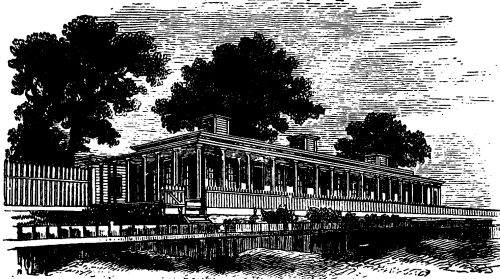
HEADQUARTERS OF HUNTER AND MITCHELL.
October 28, General Mitchell was reported seriously ill with yellow fever, and General Brannon assumed command of the department. October 29, Dr. Strickland, our chaplain, an old friend of General Mitchell, was sent for to attend him. October 30, General Mitchell died, at 6 P.M. And as others at Hilton Head were prostrated with the same disease, there was danger that it would spread through the department, and every precaution was taken to guard against it. The loss of General Mitchell was a severe blow. He had the confidence of the troops, had shown his ability as a commander, and was supposed to be in such relations with the authorities at Washington as to promise such additions to our forces as would enable us to undertake something of importance. Our last expedition would perhaps have had a better result had he been well enough to assume its direction. As it was, the colors of the Whippy Swamp Guards, with the prisoners and arms, captured by Company H of our regiment, were the only favorable results, while the complete failure of the main expedition, with the loss of so many men, added another to the disheartening blows from which the department had suffered from the beginning. And now the loss of General Mitchell, on whom our hopes were centred, left us without a promise for the future. Soon after our return from Coosawhatchie, two deserters from the 1st Georgia regiment, called the Whippy Swamp Guards, came down from Savannah. They reported the loss of thirty men, their major, and the engineer of the train, at Coosawhatchie, together with their colors. These latter, which we had in our possession, attested the correctness of their statement in at least one particular. Had the Confederates whom we attacked been commanded by any one of ordinary ability, troops would have been sent down by the railroad to cut off our retreat, for there was but one road by which we could return, and this was bordered on either side by impenetrable woods, so that a small force could have held us and made our escape impossible. It is probable that our attack at the railroad so disconcerted them that before they recovered, it was too late to interrupt our rapid retreat. Those who sent us into such a trap either knew nothing of the country, or were willing to make the sacrifice of our command for the sake of drawing off troops from the main point of attack. Looking back upon it now, it seems a part of the blundering operations which characterized our department for the most of the time that we were there, the attack on Pulaski forming a happy exception to the general rule.
CHAPTER X.
At Fort Pulaski. Changes at Dawfuskie. Amusements. The pride and taste of the soldiers in fitting up their quarters. Mosquitoes and other pests. Thanksgiving celebration. Incidents of garrison life. Flag of truce. Confederate ironclad. New Year's Day. Mr. Logan's account of the condition of things in Savannah. Prices of provisions, etc. Resignation and departure of Chaplain Strickland. Inspector-General Townsend's and Colonel Green's opinion of the regiment. Flag of truce. Interesting interview with Adjutant-General Gordon and Lieutenant Styles, of the Confederate army. Formation of negro regiments. Our theatre. Building a steam-launch. Deserters. Capture of blockade-runner. Effect of garrison life on the regiment. Capture of Confederate ironclad Atlanta.
After our return from Coosawhatchie, for a time, we were left undisturbed in garrison. The work of repairing the fort and replacing the guns injured in the bombardment continued, with company and battalion drill, whenever the weather permitted. November 4, a few officers made a trip to Dawfuskie, visiting Munger's and Stoddard's; but neglect and decay were manifest everywhere. A few old negroes, abandoned because of inability to bring further profit, with the desolated homes, together exhibited the barbarisms of war and slavery. The cold weather soon relieved our apprehensions from yellow fever; and affairs at the fort moved on in the old sluggish current. Games of ball on the terre-plein, and hunting on the islands near, varied the monotony somewhat, and artillery drill added somewhat to our regular duties. The ducks in the bay were numerous; and, as we had collected quite a fleet of boats, parties were made up, almost daily, to hunt them.
Thanksgiving was approaching, and we determined to make the day memorable. The officers contributed liberally, and committees were appointed to plan for a celebration, which should not only afford pleasure to ourselves, but attract to the fort the general officers of the department, as well as others. November 18, we indulged in a regatta. The colonel had selected the most promising craft, and fitted it up quite handsomely; others also had apparently been fortunate in their selections, but Captain Strickland, while obliged to take an inferior boat, had in Company H the most skilful sailors of the regiment, who, for love of their captain and the honor of the company, worked with a will to overcome all inequalities. The trial trip of our boat was made very early in the morning of the day on which the race occurred, and resulted in christening it the "Tub," by those who had watched its movements. A few changes and alterations were made, and it was ready to start with the others. The race was very exciting, and the course a long one, and it was for some time doubtful which would win the prize, but when the Tub came into the dock, having distanced the whole fleet, by common consent she received the more reputable name of Maggie.
During the pleasant days of autumn, scarcely a day passed without some form of amusement or recreation. The Sabbath, while we were in garrison, was usually observed in a becoming manner, and was a day of rest from work and play, save in the matter of inspection. Regularly every Sunday morning the colonel, accompanied by his staff, made a thorough examination of the interior of the fort, and such was the character of the men, and the discipline which prevailed, that no effort was spared to make these inspections satisfactory. The companies which occupied the casemates on two sides of the fort availed themselves of all the materials at hand to fit them up in a manner not only to secure the greatest comfort to themselves, but to render them most attractive in appearance. And it was a great pleasure to note from Sabbath to Sabbath the ingenuity and skill displayed in the arrangements for eating and sleeping, as well as for general effects. Bunks were made, either single or double, and tastefully covered with colored netting, to ward off the attacks of mosquitoes and sand flies. Tables, chairs, and lounges of various designs occupied the spaces around the guns, while dogs, cats, 'coons, and other pets shared the quarters and the messes. The season for sand flies, mosquitoes, and fleas, passed by with the warm weather, but each for a time had proven severe trials to us all. First the sand flies swarmed in countless numbers, microscopic in size, all bite and poison, penetrating everywhere, and, while they lasted, the agony of dress parade, with the men at rest, will be remembered, but cannot be described. The mosquitoes were quite tolerable, but when, under the hot sun of midsummer, the fleas made their appearance, there was little rest night or day. Walking on the shore, it seemed sometimes as if every grain of sand had been quickened into life, like the dragon's teeth of Jason.
Rumors reached us, from time to time, that an effort would be made to recapture the fort, and General Beauregard was reported to have stated, in a speech, that but a few days would elapse before he would replace the present commandant. Others have made similar mistakes, and to few is given the spirit of prophecy.
November 27, Thanksgiving Day, opened bright and beautiful, the atmosphere clear and cool. All preparations had been made, and we awaited the coming of our guests. The chaplain consecrated the day in a short but interesting sermon upon the political aspects of the country. After the discourse, the amusements of the day commenced, with target-shooting and boat-races. When these were concluded, the officers marched to the south dock, to meet the guests. Three boats came, quite loaded with passengers, among them Generals Brannon and Terry. Proceeding to the fort to the sound of music and the firing of salutes which announced the quality of our visitors, the amusements of the day recommenced, with foot-races, followed by hurdle, sack, and wheel-barrow races, greased pole, greased pig, and other games. Perhaps the most ludicrous were the attempts of the negroes, with hands tied behind them, to pick out with their teeth the gold piece concealed in a tub of flour. Finally the day closed with dress parade by the non-commissioned officers and privates, in which the most grotesque costumes were used, and the largest liberty permitted. Taking advantage of this, the peculiarities of the officers were brought out with the grossest exaggerations, manner and tone being imitated so well, and withal in such good-natured frolicsome spirit, that the subjects of the pleasantries enjoyed it equally with the others. The published orders were admirable hits, ending with the one attributed to Major Beard, which, after announcing the death of a member of the regiment, concluded with, "The God of battles will give him a soldier's rest by order of O.T. Beard, Major Commanding." A long nooning gave ample time for the dinner, which was spread in a temporary building on the terre-plein, and consisted of a variety of fish, fowl, and joints, with the usual accompaniments. The evening and most of the night were given up to dancing. At midnight a supper was served, and many of us retired, but a few, who had passed the bounds of moderation in their libations, served to keep alive the echoes of song and laughter until the morning brought exhaustion, and permitted a little rest. The day was a memorable one, contrasting as it did so severely with the events which placed us there and continued to disturb the country. The following day we parted with our guests, and resumed the old routine.
At this time our company was stationed on Tybee Island, with headquarters in the Martello Tower, and it was a common trip to run over and dine with Swartwout, who was one of the most genial and hospitable officers in the regiment. He had very comfortable apartments on the top of the tower, and his men were pleasantly disposed in neat and cheerful barracks near by. There were horses to ride, and a long, beautiful, and solid beach to ride on, little to do, no special annoyances, plenty of game and an almost independent command, so that those detailed there were inclined to remain.
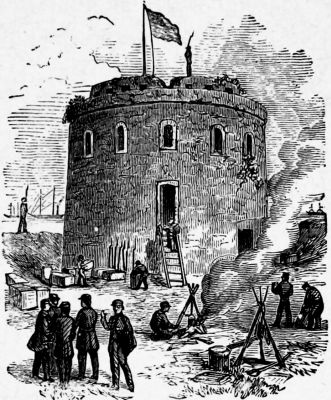
MARTELLO TOWER, TYBEE ISLAND.
Soon after our arrival at the fort for garrison duty, a bed of fine large and luscious oysters was discovered near by, having been planted by the former occupants of the fort, by whose labors we profited much, for the supply seemed unlimited. Base-ball became a regular institution, in which the whole garrison joined, from the colonel down. When the officers were not playing, the men occupied the ground, when off duty. And it was well, for we needed all the exercise we could get, on account of the enervating effect of the long confinement in the fort, and we wished to be ready for active service, which we trusted would come in time.
December 24, Colonel Barton returned from Hilton Head with the announcement that Lieutenant-Colonel Beard had resigned, and his resignation had been accepted, and that several ironclads were expected from the North.
December 27, the steamboat Mattano conveyed a party up the river on flag of truce. Starting early in the forenoon, we proceeded slowly to a point nearly opposite St. Augustine's Creek, when we were hailed by the officer of a Confederate picket, and, having dropped anchor, awaited the return of the messenger which had been sent to the ram Georgia as soon as we appeared in sight. This was plainly visible, about a mile distant,—a low, sullen mass of iron, apparently immovable. While waiting the return of the messenger, we had ample opportunity to examine it, but could make out little beyond her general shape. Designed to clear the river and vicinity of our gunboats, she had thus far proved a failure, and, as confessed by an officer who visited us, had greatly disappointed those who had furnished the means to build her. The officer sent to communicate with us was Lieutenant Johnson, who, in the course of a very pleasant conversation, stated that for seventeen years he was in the United States service. That at the time of our attack on Port Royal he was in command of one of the steamers of Commodore Tatnall's fleet, which was nearly blown out of water by one of our eleven-inch shells. In the afternoon, Captain Sawyer, of General Mercer's staff, came alongside, having started for Pulaski on flag of truce. His boat was manned by sailors from New York.
January 1, 1863, opened with a clear sky and an invigorating atmosphere. It was observed as a holiday, and Captain Elfwing, who could not forget, even in our unfavorable conditions, the good old custom of open house and spread table, invited his friends to partake of his hospitalities. Lieutenant Wallace, who had resigned, spent the day in taking leave of his companions.
January 3, nine men from the 47th New York State Volunteers, a regiment with which we had been brigaded from the first, and between which and our regiment there had always existed a special friendship, came to the fort in the steamer Mattano, for a match game of base-ball with our picked nine. They took their defeat in the best humor, and nothing occurred to mar the good-fellowship between the two regiments.
January 8, Mr. Logan, who went up to Savannah December 27, returned to the fort with several ladies. Lieutenant Johnson came with them, and our acquaintance was renewed. Papers were exchanged, and from the Savannah News we gained information which silenced certain unfavorable rumors which had been current in the garrison for some days. Mr. Logan gave an interesting account of what he saw within the Confederate lines, and we note a few of his statements. The supply of clothing had become so reduced that the cast-off garments of past generations were drawn upon, so that the grotesqueness of costumes, even among the better classes, was often ludicrous. The prices of nearly everything had advanced to enormous figures. The following will serve as examples. Tea was fourteen dollars a pound, salt fifteen dollars a bushel, flour from thirty to fifty dollars a barrel, men's boots from twenty to forty dollars per pair. He further stated that his brother-in-law paid a hundred dollars for a coat made of Kentucky jean, and fifty dollars for two pairs of hand cards for carding cotton. He himself paid two dollars for a tooth-brush, and four dollars for a daguerreotype. Sugar was sold for seventy-five cents per pound by the hogshead, and other articles in proportion. Merchants had but little in their stores; and great inconvenience, and even suffering, generally prevailed. From these facts we derived great encouragement. If they indicated the condition of things generally in the South, the war could not last long. The report of the capture of Vicksburg, about this time, strengthened this feeling. The news, generally, was encouraging.
February 3, Generals Hunter, Foster, Negley, Potter, and Seymour visited the fort. General Hunter was quite extravagant in his praises of the regiments. February 6, Dr. Strickland left us, and was not expected to return. He was an excellent chaplain. Faithful, earnest, and fearless, he helped materially in keeping the regiment to its high standard of morals and propriety. While not aggressive, he was constant in his labors, and was heartily respected in them. There was a wholesome and agreeable freedom in his manner, combined with dignity of habit and speech, which we liked. He had many warm friends, and, if any enemies, they were not known.
February 9, the regiment was inspected by Colonel Green, the assistant inspector-general of the army, who came to the fort accompanied by General E.D. Townsend, Adjutant-General, U.S. A. They both expressed themselves very much pleased at our appearance, and complimented us very highly.
February 16, I was despatched on another flag of truce, with Captain Kenzie, of General Hunter's staff, who was entrusted with special business for headquarters. Near Bird Island, the steamboat Ida met us, and Captain Gordon, adjutant-general of General Mercer's staff, with wife and two children, came on board our boat, accompanied by Captain and Lieutenant Styles of the Virginia army. They were all people of education and refinement, and during the several hours that we spent together, there was no suggestion of personal antagonism as an outgrowth of the general attitude which we maintained towards each other. In spite of my earnest protest against the introduction of any irritating subject, the war, its causes, and its different phases, were discussed with freedom, but without the least appearance of bitterness. Mrs. Gordon and family had suffered privations in common with others, and Lieutenant Styles spoke of the division of the army to which he was attached as often without shoes, and even sufficient food, but bearing everything without complaint. The coat he had on, made of ordinary gray cloth, cost one hundred and fifty dollars, and he had ordered a pair of cavalry boots, to cost sixty dollars—thus corroborating the statements of Mr. Logan. The picture which he drew of the soldiers of the Confederate army,—marching over the snow without shoes, with a cake of gingerbread in hand, costing a dollar, and a newspaper in pocket, costing twenty-five cents,—would have been pathetic had it not suggested such a lamentable want of judgment, in preferring the luxury of gingerbread and newspapers to the comfort and protection of suitable covering for the feet. We parted with mutual expressions of personal esteem, knowing that within the hour of our parting, we might be called upon, in the discharge of duty to which we were bound, to take each other's life, while we equally lamented the necessity for such brutality.
February 20, reports reached us of difficulty between General Hunter and some of the officers on the staffs of the new generals who had come to the department from North Carolina, who showed too little respect for the negro soldiers, the pets of the commanding general. And this reminds me of neglect in overlooking the fact that, in the formation of the negro regiments, Lieutenant Corwin obtained the position of major, and several of our sergeants and corporals obtained commissions. Advanced positions in these regiments were offered to several of our officers, who declined to accept them.
February 23, our theatre was opened, with the following entertainment:—Address by Corporal Michaels. Singing by the members. Farce, "Family Jars." Song, "The Flea," by Owens, of Company H. Recitation by Hutchinson. Light balancing by Dr. Haven. Tragedy, 1st act of "Richard III." Song by Dickson. Concluding with the tableau, "Washington's Grave." The theatre was very pretty, and the performances excellent. The scene-painting was done by Harrison, who was by profession a scenic artist, and was very good. From this time forward, during our stay at the fort, performances were continued regularly, and afforded a great deal of pleasure.
March 3, several officers went to the Ogeechee river to witness the attack on Fort McAllister by the ironclads. About this time a little engine and boiler were completed, under the direction of Captain Paxson, out of materials found in the fort, and placed in a large boat, which had floated down to the island. They worked satisfactorily, and this little craft was used for a long time in trips about the island and to neighboring points. Our regiment might be taken as an example of the material of our army. Every profession, and almost every department of mechanical pursuits, was represented, and, whatever work was required, there was no lack of such as were familiar with it.
March 15, four men, comprising a Confederate picket, came in to the fort, bringing their officer with them, much against his will. They were well armed, with Maynard rifles and Colt's revolvers. In all, twelve deserters came in within ten days. Day after day we were called upon to entertain visitors, and the fort became a place of resort for the idle and curious in the department. The theatre was a great attraction.
March 30, a small schooner was discovered near the entrance to Munger's River, and the colonel started for her in the Mattano. At first she hoisted the English colors, but was compelled to acknowledge that she was a blockade-runner, bound for Savannah with a load of salt. She was our first prize.
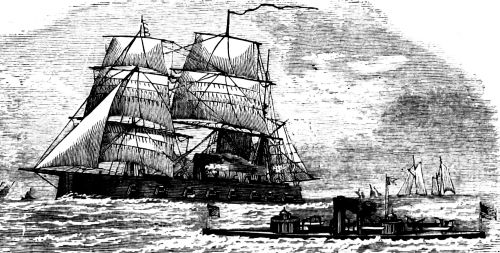
NEW IRONSIDES AND MONITORS.
March 31, we learned, through Mr. Whitney, the designer of the monitor Keokuk, who was visiting his cousin, Captain Lockwood, that there were now eight ironclads at Hilton Head, or near Charleston Harbor, which meant that something was to be done. The men were soon set to work moving mortars to the south dock for shipment. Great activity prevailed; constant communication was kept up with Hilton Head by signal to Braddock's Point; and a steamboat was nearly all the time at the service of Colonel Barton. In addition to our regiment, a company of the 3d Rhode Island Artillery, under Captain Gould, had for a long time, formed a part of the garrison; and at this time several gunboats were in the river, to help protect the fort against any attack which might be made on Pulaski while our ironclads were operating against the forts in Charleston Harbor.
April 7, an attack was made upon Fort Sumter, which was unsuccessful, owing to the obstructions in the channel, which confined the operations of our fleet. The Keokuk, which took the most advanced position, and received the heaviest fire, was so injured that she sank on the following morning.
From this time until June 3 nothing occurred of special interest. We all had leisure for recreation, which was really needed to overcome the effect of confinement in this debilitating climate. Every fair day, after the regular drills, the terre-plein was turned into a playground. Every one drifted into habits of idleness, and while an admirable opportunity was afforded, during our stay in the fort, for reading and study, few had the inclination to engage in serious or profitable pursuits; and so many were inclined to occupations of a frivolous and demoralizing character that it is safe to say that the morals of the regiment suffered a severer strain during our stay in Fort Pulaski than during all the remainder of its service in the army.
June 3, several companies were ordered to be ready with cooked rations, and it soon became known that Bluffton was to be burned. Why this order was issued, we never knew; but it was carried out most literally. Judging from the force detailed, opposition must have been expected; but the work was accomplished without any hindrance, and the beautiful little village was reduced to a mass of ruins.
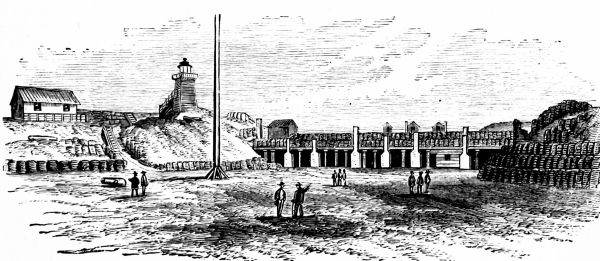
THE INTERIOR OF FORT SUMTER.
June 12, General Hunter was relieved by General Quincy A. Gilmore, the same who was captain of engineers in the first expedition to Port Royal.
June 17, we became aware that something unusual was taking place in Warsaw Sound; and after an early breakfast, several of us took positions favorable for observation, on that portion of the ramparts overlooking that quarter. A number of steamers were visible, and for a few moments there was heavy firing. We thought we distinguished the rebel ironclad Atlanta, formerly the Frugal, and the return of the steamboat Island City from the scene of operations confirmed this impression. From her we received a full account of the affair. The Atlanta came down Wilmington River, expecting to capture the two ironclads, who were on the lookout for her, but four shots from the Nahant were all that was needed to crush in her sides, and reduce her to submission. At close range, even her four inches of iron plate, backed by fifteen inches of solid oak, were not proof against the heavy guns of the monitor. The other vessels which came down from Savannah to see and perhaps participate somewhat in the fight did not wait for their share, but returned with all speed to report the sad failure.
CHAPTER XI.
Good-by to Fort Pulaski. At St. Helena Island, under General Strong. Billinghurst and Regua battery. Folly Island. Masked batteries. Attack on Morris Island. Killed and wounded of the regiment. Captain Lent. Capture of Confederate batteries. Building batteries. Hot work and little rest. Completion of batteries. Assault on Wagner. Badly managed. Terrible losses. General Strong. Negro soldiers. Their effect upon the Confederates. After the assault. The shelling by the Confederates. Incident.
June 18, General Gilmore arrived at the fort, and in the evening a telegraphic despatch was received,—for, some time before this, a telegraphic cable had been successfully laid between Braddock's Point and the fort,—ordering us to have eight companies ready to start in the morning, with cooked rations. Although we were ready at the time appointed, it was decided to be better to defer embarkation until evening, that it might not become known to the Confederates that the garrison was so weakened. Accordingly, when the darkness of night had settled down on the fort, the eight companies marched to the dock and embarked in the Ben De Ford, which steamed away from the fort, but anchored off Tybee Island for the night. Companies G and I were left behind; but before we started, the officers all gathered together, and joined in "Auld Lang Syne." Seldom had such a solemn feeling rested upon us, and the cheers and good-wishes of those who parted there were to many the last words of fellowship together upon earth.
The following morning, we passed the Atlanta, on our way to St. Helena Island. It was a formidable-looking craft, being supplied with a heavy armament, and all the appliances for offence and defence, including an immense ram and an ingenious contrivance for exploding torpedoes. Arrived at St. Helena Island, our destination, we found ourselves in the brigade of General Strong.
June 27, the writer was placed in command of the Billinghurst and Regua battery, and separated from the regiment. As soon as detailed, reported to General Strong, and had twenty-five men detailed from the several regiments of the brigade to handle the pieces. Each of these consisted of twenty-five rifle barrels on a carriage, so arranged that the fire from a single cap, opposite the centre barrel, was through a tube communicated to all, so that they could be discharged simultaneously. The barrels were heavy, with long range, and, as a defence against attack of infantry, might be very effective. The idea was similar to the French mitrailleuse; but whether borrowed from it, we cannot tell. This was the only battery of the kind ever used in the department, and, being entirely new, every moment was occupied in practice, in getting the range, and in securing the necessary equipments. Worse than all, it was necessary to improvise a drill while the practice was going on, but General Strong, who was one of the noblest, kindest, and most considerate of men, assisted in every way, and by all the means at his command. It was not long before we were as much captivated by his military bearing and his gentle urbanity of manner as the other officers and men of his brigade. It is given to but few men to attach others to them as he did.
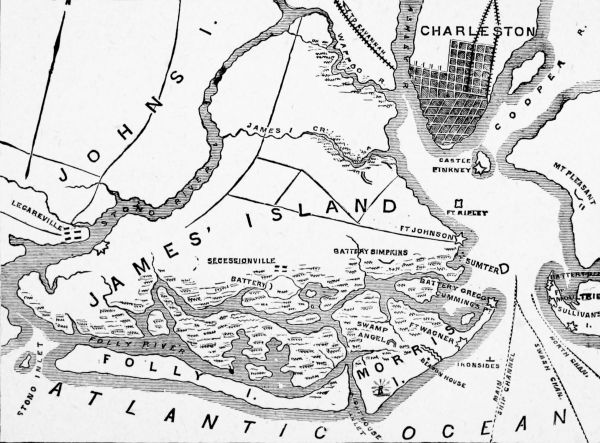
SIEGE OF CHARLESTON.
July 4, we were ordered on board the Harriet M. Weed, and proceeded to Folly Island, on the northerly portion of which we encamped until the 10th, when we moved up to the other end of the island, in rear of our batteries. These contained about fifty guns, and had been masked by a grove of trees until this morning, when a clearing had been made, and the guns opened fire. Only the day previous, a number of Confederate officers had been out on the sandbar which at low tide almost connected Folly with Morris Island, and made a careful inspection of the vicinity, with their field-glasses, all the time in plain sight of our men behind the batteries, but without discovering anything. The bombardment was a disagreeable surprise to them. Arrived behind the batteries, we were compelled to go their whole length and return, on account of confusion of orders, while the shot and shell from the Confederate batteries opposite played around us in the most reckless manner.
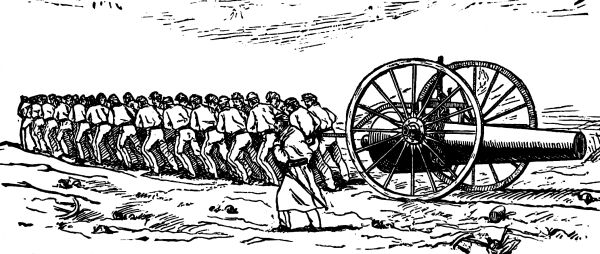
NOISELESS HAULING OF THE GUNS.
That night we crossed to Morris Island, and encamped on the beach. In the meantime the 48th, with other troops, had been massed near the end of Folly Island, and as soon as the cannonading from our guns ceased, landed on Morris Island, charged the Confederate works, and, proceeding on, cleared every obstruction, even to the very foot of Wagner. But not without loss. Quite a number were killed and wounded. Among the killed was Captain Lent of Company A, a man of genial, happy disposition, beloved by every one. Although a brave, earnest, and competent officer, he was so quiet and retiring in his habits that he seemed almost out of place in such scenes, and it was hard to reconcile so gentle and amiable a life with such a sudden and cruel death. While encamped on Folly Island, he called at the battery on his way to the front, and I well remember his expression as we parted: "How I wish I had your place! I would rather have it than the command of the regiment." It was not of danger that he thought, but of the independence of the command. Before the attack, our regiment was divided for convenience of landing, and while our guns were thundering against the batteries opposite, the men were waiting in anxious expectancy; and when the word was given they shot across the little strip of water, and, in the face of a murderous fire, rushed up the beach, and with fixed bayonets carried all before them. There was no faltering, but only an onward movement; and, although many fell, others supplied their places, and with cheer upon cheer they cleared the Confederate works, capturing men, guns, camp-equipage, and everything, until the recall was sounded, and they came slowly back to count their dead and wounded. It was a gallant charge, and in it General Strong set the example, when, leaving shoes in the clinging sand, he rushed forward, the first to land, and the last to realize the necessity for a recall. It was a glorious charge and a glorious success, which gave a vantage-ground for our troops on which to plant their batteries, and a place for successful operations against the strong defences of Charleston. Had the proper use been made of this early success, Wagner would have been ours; but, unfortunately, the attack on this fort was delayed until the following morning, when, with a garrison re-enforced, our attacking column was easily repulsed. The days that followed were full of labor and exposure. The guns of Wagner and Sumter searched every nook and cranny of the island, and many men lay down at night to sleep, to waken in the Eternal City. As fast as possible, guns were hurried up into position to bear upon Wagner, and the heavy armaments of the ironclads kept up a constant clamor, but with little effect; shot and shell came flying into camp in all directions. General Strong's headquarters were fairly uprooted by a bursting shell, and when solicited to move to a less exposed position he laughed, as if it were only play. Hour by hour he grew into the affections of his command, and it is certain that no officer was ever more beloved. After a time, earthworks were thrown up across the island, near Wagner; and the men, from habit, learned to protect themselves in some measure from the enemy's fire. July 13, the 48th were at the front for twenty-four hours, during which time the Confederates made a sortie, but were repulsed with considerable loss. A sergeant endeavored to capture Lieutenant Tantum, but made a bad mistake. The powerful grasp of the lieutenant was not to be resisted, and the sergeant went to the rear, an humble prisoner. Attached to our battery, and under my command, was a small company of sharpshooters, with telescopic rifles, who buried themselves in the sand close to the walls of Wagner in the hour before light in the morning, and proved most effective in controlling the fire of the fort. Not a head or hand could appear without being reminded of their presence.
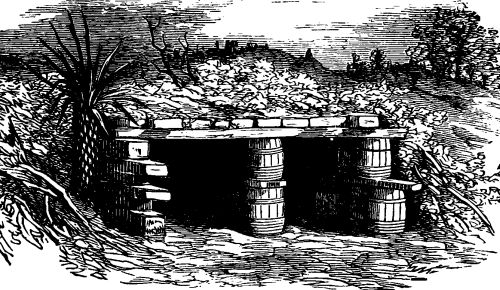
BOMB AND SPLINTER PROOF.
July 18, the attack on Fort Wagner commenced at about 10 A.M., and a steady fire from our batteries and the ironclads was kept up until evening. The following is the account of the assault, written by J.A. Barrett, who was second lieutenant of Company H:—
"We lay on our arms all day, and just before dark were formed in column by companies, and advanced under a galling fire up the beach. It was a trying hour, our ranks thinning at every step. For much of the way the right of our column was obliged to wade in the water. On our left another column composed of the 54th Massachusetts colored regiment, under Colonel Shaw, also advanced on the fort. We waded the moat and scaled the parapet. Our loss was terrible, sometimes whole companies being mowed down at once. We jumped over the parapet into one bastion where there were two guns, but the firing was so hot that we were unable to turn them to any use. Darkness was upon us, and we could see nothing. The supporting columns coming up in our rear, poured in a heavy fire, mistaking us for the rebels. Our killed and wounded kept piling up. A rebel officer for some purpose came among our men, and was seized by a private of the 48th, who called to Colonel Barton that he had a prisoner. To which the colonel replied: 'Take him to the rear.' 'But he won't come,' said the private, who was nicknamed 'Plucky.' 'If he wont yield, then bayonet him,' was the order; when a wounded man dragged himself up, and, with all his remaining strength, plunged his bayonet into the side of the rebel officer, and, falling back, expired. A retreat was ordered, but was not altogether understood, and some fifty of our men remained and continued firing. I was severely wounded in the thigh, but roused myself, and directed the fire of these few men as best I could, collecting ammunition from the dead and wounded. When this gave out, I ordered all who could to go to the rear. This section of the fort was literally full of dead and wounded, piled up even with the parapet. I crossed over their bodies, slid down the slope and crossed the moat, which was full of our dead. A rebel sentry was pacing up and down the beach, but by keeping near the bank I was able to pass him. My scabbard was shot away, my pistol bent and useless, and, leaning on my sword, I hobbled down the beach to camp. The 48th went into this assault with five hundred men and sixteen officers, and three hundred men and fourteen officers were killed, wounded, or prisoners."
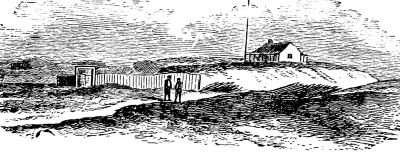
FORT WAGNER AT POINT OF ASSAULT.
While this brief account is valuable, as the statement of a cool, self-possessed, and brave officer, who participated in the assault, and was an eye-witness to what he states, no words can adequately describe the horrors of that night. Sufficient time had elapsed, since the occupation of the island by our troops, to allow of a complete and careful preparation for the assault, which the enemy had reason to expect. A large re-enforcement was added to the garrison, and the men were most carefully drilled in the minutest details, to provide against every possible emergency. The heavy bombardment which preceded the assault, while it seemed as if it would tear the fort from its foundation, had really no serious effect in weakening it; and as soon as it ceased, the men were withdrawn from the bomb-proofs, where they had been completely protected, and assigned to their positions, and, when our troops made the assault, were as ready to receive them as if not a cannon had been fired. On our part, there seemed to be a want of accurate information, and of carefully matured plan, which resulted in confusion of action; while on their part, there was the most intelligent and thorough preparation possible, and most perfect concert of action between all those assigned to special duties in the defence. The result was inevitable, and the carnage terrible. The responsibility of the assault was generally ascribed to General Seymour, and, as subsequent events clearly proved, it was a useless sacrifice of life. General Gilmore continued to plant batteries, by which we not only reached the forts in the vicinity, but, with the famous Swamp Angel guns, threw shot and shell a distance of five miles into the city of Charleston. These batteries, and the mine which he constructed, which destroyed one whole force of Wagner, compelled its evacuation on the night of September 6.
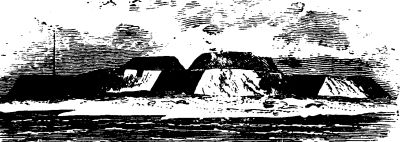
FORT WAGNER, SEA FRONT.
On the night of the assault, July 18, there was no sleep in the 48th. It was past midnight when the last of the men came in from the fort, and the horrible scenes through which they had passed, and the anguish of grief over friends and comrades, maimed and wounded, or lying silent in that pit of darkness and blood, forbade all thought of rest. Colonel Barton was wounded through the thigh, Lieutenant-Colonel Green, Captains Farrell and Hurst, and Lieutenant Edwards were dead, and Captain Paxson was mortally wounded. Captains Lockwood, Elfwing, and Swartwout, and Lieutenants Miller, Barrett, and Acker, were also severely wounded. It was a heart-rending sight when, on the following morning, I visited them in the steamer which was to convey them to Hilton Head. No one could doubt the quality of the 48th now. The heroism of the men was only equalled by that of their officers. None could have been braver. All the wounded officers had made their escape with the exception of Lieutenants Taylor and Fox, who were left in the hands of the Confederates. While we mourned for our immediate friends and associates, we did not forget that our brigade commander, General Strong, was among the fatally wounded. I had been accustomed to report to him in person for commands for the battery; and, of all the men I have ever known, few have left such deep and such pleasant impressions on my memory as he—of the gentlest and most winning manners, yet always the thorough soldier, brave even to rashness, kind, courteous, and considerate, he grew more and more beloved as he became better known. He never asked men to go where he would not lead the way.
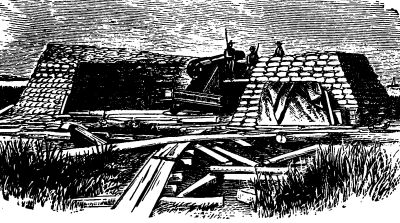
THE SWAMP ANGEL BATTERY.
On the night of the assault, my battery was stationed at the outer lines of our defences, on the shore, to resist any counter attack which the Confederates might make, and I witnessed much of its horrors. As one after another of the wounded came in, eager and anxious were the questions asked, until the return of the torn and broken remnants of the proud columns which a few moments before had rushed to victory told too plainly the story of savage butchery and defeat. Well do I remember the appearance of the negro soldiers as they came straggling back from the front that night, for I was not favorably impressed by their conduct. I have often thought that their presence in the attacking column was a mistake, and that the hatred and disgust which they caused in the minds of the Confederates overcame every other feeling, to such an extent that the instinct of self-defence was converted into brutal ferocity, as was manifest in their treatment not only of the colored soldiers themselves, but the gallant officers who led them. With the highest respect for the opinions of those who have testified to the discipline and valor of the negro troops, I am impelled to say, in spite of the criticisms that my statement may provoke, that my own observation and experience, as well as the experience of others, have convinced me that the prevailing opinion, especially in New England, of the valuable services rendered by colored troops in actual conflict, is erroneous, and that their most effective work during the war was done with the pick and spade. If quickness of perception and independence of thought and action are desirable qualities in a soldier, this conclusion seems both obvious and necessary. After the repulse of the 18th, the Billinghurst and Regua battery was kept at the front all the time, and, although protected somewhat by earthworks, there was no complete guard against the shells which night and day exploded all about us. One of my men was sitting in the sand just outside the battery, when a shell from Wagner literally ploughed him out of his seat. Fortunately, it did not explode, and he only experienced a good shaking-up. Night after night we were obliged to keep watch of those magnificent streams of light which, proceeding from the mortars at Castle Pinkney, seemed charged with intelligence as well as powder, for as they moved through the air and reached the point over our batteries, they appeared to poise themselves as if to select the most vulnerable point, when they descended with a peculiar whizzing sound into our very midst. Our only recourse was, by determining on which side the earthworks they would fall, to make the most expeditious movement to the other side, to await the explosion.
I remember one night when it was determined to plant a chevaux-de-frise from our battery to low-water mark. A night was chosen when it was thought that the heavy clouds would obscure the moon and conceal our operations. The wagons proceeded up the beach with the materials, until they had nearly reached the point selected, when the opening clouds disclosed them to the garrison of Wagner. No time was lost in opening upon them with their Armstrong guns, from the parapet. The first shot produced a stampede, and in an instant the teams had turned about, and the horses were scampering back, with the shot and shell skipping about them in the most unceremonious fashion. The sight was so ludicrous that I was thrown off my guard, and exploding with laughter, until the danger of my own position was recalled by the bursting of shells about my head.
CHAPTER XII.
Back to the regiment. Off for St. Augustine. The duties of provost-marshal. The quaint old city. Its pleasant people. Two months of rest. Lieutenant Ingraham. Back to Hilton Head. The regiment reunited. Visit to Morris Island. Captain Eaton. Fort Wagner and its reminders. Lieutenant-Colonel Green.
July 30, at my own request, I was relieved from the command of the Billinghurst and Regua battery, and returned to the regiment. While an independent position, it was one in which there was no promise of important service, and I have never heard that the batteries were ever successfully used. They lacked the strength of the ordinary battery, and the mobility of columns of troops. I joined the regiment at Hilton Head just in season to superintend its embarkation for St. Augustine, Major Strickland and Captain Coan being ill.
Arrived at St. Augustine August 2, and remained until October 3. Our duties were light, and opportunity was afforded for recovery from the effects of the Morris Island campaign. As provost-marshal, I had the complete supervision of the city, the receiving of flags of truce, and the regulation and examination of the correspondence between the inhabitants and their friends within the Confederate lines. All fire-arms had been taken from the citizens by my predecessor; but the owners were permitted to use them occasionally for hunting, under certain restrictions. People were allowed to come in and go out of the city, when it was apparent that no harm could result, and the planters outside were encouraged to bring in produce and other supplies under the scrutiny of men detailed for the purpose. The materials of the theatre were brought from Fort Pulaski, and the performances afforded much amusement, and helped to make the regiment popular during our stay. We found many pleasant people, some of whom had never sympathized with the rebellion, and were glad of the protection of United States troops. Others, while bitter and hostile, were incapable of any harm. The quaint old town was in itself a never-ending fund of enjoyment and interest. The men were comfortably quartered, and the officers indulged in unusual luxuries. Among those whom I recall of the good people who resided there were Mrs. Anderson and her son, the doctor, whose delightful home in the suburbs, in its surroundings and furnishing, but more especially in its charming atmosphere of culture and refinement, so often helped us to throw off the hardening and brutalizing effects of army life and associations. The Misses Mather and Perritt, with whom a number of our officers boarded, natives of the North, driven to this softer climate by delicate health, were in the fullest sympathy and accord with us, and were not only exceedingly kind, but afforded much assistance, by reason of their familiar acquaintance with the city, its affairs, and its people.
The two months spent in St. Augustine passed quickly and pleasantly. Occasionally, the pickets were fired upon, but no regular attack was made. Communication was undoubtedly kept up between the citizens and the enemy, outside the city, in spite of the great precautions taken to prevent it. Applicants for admission to the city were reported waiting at the picket stations almost daily, some of whom were received and others turned away. Visitors came to the city by almost every steamer, and the abundant leisure of most of the officers allowed of their generous entertainment. From my office I looked across the square, past the old building with open front, formerly used as a slave mart but now converted into a general market, to the office of the commissary—Lieutenant Ingraham; and frequently, when the duties of the forenoon were well over, we signalled to each other to drop work, and engaged in some form of recreation together. During our stay at St. Augustine we were thrown much together, and the pleasant feelings which I had always entertained towards him ripened into a strong attachment. I think of him now with feelings of peculiar sadness. Some time before the battle of Cold Harbor, his promotion rendered it necessary that he should take his place as an officer of the company to which he was attached. Previous to this he had always been detailed in the quartermaster's or commissary departments. At that battle, while we occupied the Confederate line of works which we had just captured, we were subjected to a merciless enfilading fire, which we could neither avoid nor return effectively. Lieutenant Ingraham, in command of his company, had pressed to the very front, and, while encouraging his men by word and example, he suddenly dropped from my side, and I never saw him more. With a great rush, the enemy was upon us both in front and flank, and we were pushed through the woods, and our wounded and dead were left to their care. Ingraham was a good soldier, a good friend, and a good man. October 3, a steamer, containing the 24th Massachusetts regiment arrived at the dock, and we were ordered to prepare for our departure. October 6, we bade good-by to the old city, to the many good people who had done so much to make our stay among them contented and restful, and to the peculiar comforts and pleasures, which, to so many, were the only suggestion of home that came into their lives during their long term of service. On the 7th we reached Beaufort, S.C., and reported to General Saxton. The next day the writer was ordered by the colonel to proceed with four companies to Seabrook Landing, to guard the shipping. This point was rather an important one at the time, being used as a coaling station and for naval repairs. November 9, one hundred and fifty-six conscripts arrived from New York and were distributed to the various companies of the regiment. November 13, companies G and I, so long detached as garrison of Fort Pulaski, joined us at Hilton Head, where regimental headquarters were then established. November 20, the subject of re-enlistment as veterans began to be agitated, and the promise of thirty days furlough and a bounty were strong inducements. November 25, having business at Morris Island, I took occasion to visit Fort Wagner, which had been rebuilt under the supervision of Captain Eaton of the New York Engineer regiment, a most excellent officer, who seemed almost to belong to us, having had charge of the repairing of Fort Pulaski while we were there as garrison. With him I wandered about the fort, and around the localities marked by special events connected with the siege and assault. But memory was too busy with painful scenes to permit of much satisfaction. As we talked together of old times, and recalled the names of those with whom we had been intimate at Pulaski, it seemed impossible to realize that the clean white sand on which we were then treading had drank in the life-blood of so many, and the clear, bright, sparkling water, that idly played upon the beach, had reached out its eager tongue to lick up the cruel stains. The air was mild, not a cloud obscured the sun's rays, and the silence that reigned about us was profound, almost oppressive, but, as we recalled the past, the din of battle rang in our ears; the flash of musketry pierced through the darkness of night and lighted up a scene of carnage; the groans and cries of the wounded and dying mingled with the shouts and yells and fierce oaths of combatants. The spirit of peace rested upon the landscape which lay spread out before us, and upon the face of the quiet waters which, with gentle embrace, pressed lightly against the shore; but the past came back to us like a mighty surging torrent; a tempest raged; darkness and horror enveloped us, and we turned away. We could not endure it, and were glad to get back to camp, to lose the thought of the past in the performance of present duty.
During this visit, as we talked together of the friends who had fallen, one name more than any other occupied our thoughts and conversation. It was that of Lieutenant-Colonel Green, whom Captain Eaton had known quite intimately when he was quartered with us at Fort Pulaski. Like those of us who had known him longer, he had not only formed a strong personal attachment for him, but, from the peculiar and somewhat opposite traits of character which he exhibited, had become specially interested in watching his career. It was not singular, for no one could be associated with him, for any length of time, without being attracted towards him and becoming interested in him. Possessed of a frank and generous disposition, he was not only beloved by those under him, because of his thoughtful consideration of them, but equally by his fellow-officers, because of his sprightly, sunny temperament. He was welcome everywhere, and, on all social occasions, his quick and susceptible nature caught and communicated the spirit of humor that prevailed, until no one could withstand its influence. He bubbled over with mirth whenever the occasion or surroundings stirred the humorous vein within him, and was the frequent instigator of the harmless practical jokes with which the officers sometimes sought to enliven the dulness of garrison life. I can see him now, as, after a period of duty, he starts out from his quarters in search of recreation, the very personification of mischief. He never needed to go far, for every latch-string was out for him, and none but the hardest and most obdurate could withstand the appeal of his merry eyes and bright, cheery countenance. He was a good soldier, always ready for duty, and in its discharge both earnest and exact. From "grave to gay" was sometimes a rapid transition with him; but he saw every duty to its ending, and, especially when hardship and danger were involved, every fibre of his mental and physical nature was absorbed in its performance. Few will be remembered longer by his comrades than he, and none with more general warmth of affection.
CHAPTER XIII
Relations between the 47th and 48th regiments. Re-enlistment of veterans. Court-martial. Departure of veterans on furlough. Expedition to Florida. Battle of Olustee. A great blunder. Heavy losses. Admirable conduct of the troops. Dr. Defendorf. The retreat. Return of veterans. Sergeant Thompson. At Palatka. Expedition into the country. Dunn's Creek. Its marvellous beauty. Ludicrous scenes. Good-by to Palatka. At Gloucester Point, Va. A happy change. Shelter tents. General Grant. Army of the James under Butler. General Terry.
Of the several months that followed, until January 31, 1864, little can be gathered from the journals which furnish the materials for this history. Aside from the usual routine of duties incident to life in camp, a few changes took place in the distribution of the companies to the outposts within the district. On Thanksgiving Day the members of the 47th New York State Volunteers were our guests, and on Christmas we partook of their hospitalities, cementing by these courtesies that bond of union between the two regiments which was unbroken during our term of service, and was one of the pleasantest facts in our army experience. The rivalry between the two regiments seemed to manifest itself only in generous expressions and friendly offices.
During this period, the officers used all their influence to induce re-enlistments as veterans, and, as a result, some three hundred or more of the best men in the regiment signified their willingness to sacrifice anew their comfort and safety, their prospects in life, and life itself, if necessary, in the service of their country, if perchance, by such a sacrifice the blessings which they and their fathers had enjoyed, and by which the world had so largely benefited, might be transmitted to future generations. If, after the lapse of years, and in the dim light of the past, such a sacrifice seems a common thing to those who, in security and comfort, at this time, thought of little but of the opportunity afforded, through the waste and destruction of war, for the accumulation of riches, or to those who, too young to take interest in the events of which we write, know nothing of them except as a part of the history of days gone by; it was not a common thing to those who, having already given of the best of their years, and the freshness and vigor of their strength, declared their willingness to plunge anew into those scenes the effect of which they knew full well was to harden their natures, blunt and benumb their sensibilities, and paralyze those finer instincts through which come the enjoyments most prized in life; it was not a common sacrifice for these men to turn again from the sweet influences and tender affections of home and friends that others might be benefited. Nor let it be said that the considerations to which I have referred could have entered the minds of only the intelligent few, while to the great body of the army they were far beyond their thought; for, while we must admit that there were different degrees of intelligence, and that that which formulated itself in clear, distinct, and logical following in some minds was but faintly outlined in others, who so dull that, from the lessons of the past three years, had gathered so little as not to appreciate this new demand upon them! Had children forgotten father and mother, husbands their wives and little ones!
About this time I was made familiar with a feature of army life to which I have made only slight reference. As a member of a general court-martial, day after day and week after week was occupied in the examination of charges of the gravest character, involving the liberty and life of scores of officers and men. It was the highest tribunal by which those composing the rank and file of the command could be adjudged. Questions of the gravest moment, and of supremest interest to those concerned, were discussed and determined. It was a responsibility shared only by the highest judges in the land, and life and death often hung upon our decisions. A photograph of army life is incomplete without this feature, and while the duty is the gravest and the most solemn which an officer is called upon to perform, it is as necessary to the well-being and efficiency of an army as the ordinary courts of justice to the preservation of the state.
January 30, the Enfans Perdus, an independent battalion, was consolidated into the 47th and 48th New York regiments. The number received by us was about one hundred and fifty. On the 31st, the veterans left for New York, under the charge of several officers. February 4, those left behind received orders to prepare six days' cooked rations, and be in readiness to march, and on the 5th, with the left wing of the 115th New York, they embarked on board the steamer Delaware. On the 6th they left Hilton Head, in company with a number of transports, under the convoy of a gunboat, and proceeded to Florida; the force numbering in all from six to seven thousand men, and comprising artillery, cavalry, and infantry. The artillery and cavalry were under the immediate command of Colonel Henry, and the infantry under Colonels Barton, Hawley, and Scammon, with General Seymour in command of the whole expedition. Its object was to aid the Union people of the state in withdrawing it from Confederate control. General Gilmore accompanied the troops as far as Jacksonville, where they disembarked, and, after seeing that all necessary arrangements were made which could promote the success of the enterprise, returned to Hilton Head, leaving with General Seymour instructions not to attempt an advance beyond Baldwin without further orders, nor unless well assured of success. His intention was to hold and fortify several important points, including Jacksonville, as centres of Federal authority, and reopen those sections to trade. But General Seymour, apparently satisfied that he could not be successfully opposed by any Confederate forces within the state, conceived the idea of destroying the railroad, and cutting off communication with Georgia. As soon as notified of this intended movement, General Gilmore sent a despatch to stop it, but was too late to prevent the massacre which followed. On the 20th a general advance was ordered, and the troops proceeded towards Lake City, about five thousand in all; Colonel Henry with the cavalry in advance, followed by three columns of infantry; Colonel Hawley, with his brigade, on the left; Colonel Barton in the centre; and Colonel Scammon, with his regiment, on the right. In the rear was a brigade of colored troops, under Colonel Montgomery. Near Olustee they came upon a strong force of Confederates favorably posted in the woods, with a swamp in front, over which our troops must pass to reach them. Before they were well aware of the vicinity of the enemy, a murderous fire was opened on them, at a distance of little more than a hundred yards, and for more than two hours they could scarcely do more than stand up to be slaughtered, the nature of the ground and the strength of the enemy effectually preventing any advance. No severer test could be applied to men than they suffered at the battle of Olustee, and when, at evening, the troops were withdrawn, nearly one-fourth of their number were dead or wounded. The most of the latter were left on the field, under the care of Surgeon Defendorf of our regiment, who volunteered to remain with them; an act of bravery and self-sacrifice which cannot be too highly commended. The testimony of those engaged in this affair, as we gather it from journals and other sources, is that it was the most trying position in which they were placed during the war, and the heroism displayed by our men is accounted marvellous. The retreat to Jacksonville was such as might have been expected from broken, dispirited, and defeated troops, with a strong body of the enemy in their rear, flushed with victory, and determined upon their destruction. On the way back, the stores at Baldwin were burned, and when the broken columns were gathered at Jacksonville, it was found that twelve hundred men had been sacrificed, five pieces of artillery and a large number of small arms left in the hands of the Confederates, while the purpose of the government in ordering the expedition was completely frustrated. Our own regiment, whose conduct in the affair was beyond all praise, suffered terribly.
While these events were transpiring, the veterans, and the officers sent with them, were enjoying the comforts of home and the society of friends once more. But the time was all too short, for on the 9th of March we were securely housed in Fort Schuyler, waiting for transportation to the South, which was furnished on the 11th, when we embarked on the steamer Arago, and on the morning of the 16th landed at Hilton Head. Some of us took the opportunity to visit our wounded men in the hospitals. Among them was Sergeant Thompson, whose journal has been of so great service in the composition of this history. It is a pleasure to record of him that he was a faithful soldier, and that, in the recent battle of Olustee, he was conspicuous for coolness and bravery. His services as a soldier ended at this time, and we hope that his subsequent career has been both successful and happy.
Late on the evening of the 16th, we started on the steamer Dictator, to join the other portion of the regiment, which was stationed at Palatka, on the St. John's River, where we arrived on the 18th. The camp was located on the outskirts of the town, and protected by entrenchments. The village consisted of some thirty or forty houses, with three churches, and was almost entirely deserted by its former inhabitants, only a few Union men remaining with their families. Very little occurred, during our stay at Palatka, of special interest. There were occasional alarms, and several attacks by small bodies of Confederates. Pickets were stationed at some distance on the hills back of the town, and the country between was frequently patrolled by guards who were mounted for the purpose.
On the afternoon of the 25th, an expedition was started for the interior, consisting of forty men, with guides, under the command of the writer. We were conveyed up the river about fifteen miles, in the gunboat Ottawa, to what was called Dunn's Creek, through which we proceeded in small boats. The beauty of this stream is impressed on my memory with wonderful distinctness. At its point of junction with the St. John's, and for some little distance, it was narrow, with considerable current, but, as we proceeded, it broadened out, and moved so sluggishly that, at times, it seemed caught and held by the rank growth of grasses and other plants which filled its bed and covered its surface. The branches of the overhanging trees intermingled above our heads, and the pendent moss and dense foliage formed a canopy, through which the sunbeams struggled with dim and softened light, while on either bank the shrubs and trailing vines presented an almost impenetrable wall of bright green leaves and fragrant flowers. Only the songs of birds that fluttered about us broke the stillness, for every one was strangely impressed and subdued by the marvellous beauty by which we were surrounded. Silently we pursued our way, except when an occasional opening broke the spell that bound us, until, shooting out of the darkness which had gradually enveloped us, we emerged into the bright moonlight which lighted up the waters of Dunn's Lake. A sharp row of two hours or more brought us to Booth's Landing, where we disembarked. Our object was to capture a few obnoxious individuals who were making special trouble for the Union men who lived in that region; and the night was spent in visits from house to house, much to the discomfort of the inmates. Some very ludicrous scenes occurred, for, while the utmost consideration was used, consistent with the success of our plans, sometimes the occupants of the houses were startled most unceremoniously from their sleep by the tramp of armed men, who entered without knocking, and occupied without permission. A few captures were made, including a Confederate soldier home on leave, and on the following day we rowed back to camp, having accomplished upwards of fifty miles within the twenty-four hours. April 1, one of our pickets was captured, and we never heard of the man afterwards.
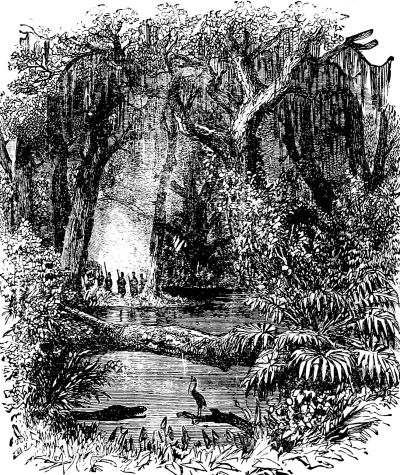
A FLORIDA SWAMP AND JUNGLE.
April 14, we bade good-by to Palatka, and started for Hilton Head. At Jacksonville we were transferred to the steamer Ben De Ford, and ordered to Beaufort, where we spent a day. On the following day, bidding a final adieu to the Department of the South, we headed for Fortress Monroe, where we made but a brief stop, our destination being Gloucester Point, opposite Yorktown, on the York River.
Glad were we to get into another department, for, from the first, we had felt that, while often performing the most arduous service that falls to the lot of the soldier, the limits of our operations were circumscribed, and the results meagre. Now we were going into the very midst of the conflict. The nature of the change was made manifest by the substitution of shelter tents for those we had been accustomed to use. Each man was served with a single tent, which he carried with his blanket on his back, and by joining with two or three of his comrades, and uniting their tents, a fair shelter or covering could be obtained. The officers were served after the same fashion, the only distinction being that three tents were furnished them instead of one, and they were not compelled to carry their baggage.
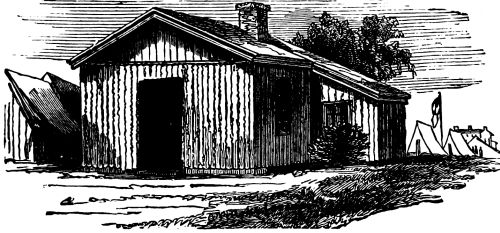
GENERAL GRANT'S HEADQUARTERS AT CITY POINT.
Who does not recall the first experience with the shelter tents, into whose openings we were obliged to crawl on our hands and knees to effect an entrance, or the curious sight which the various camps presented, especially at night, when the innumerable sparks of light which dotted the sandy plain seemed to rise from subterranean caverns, and suggested anything but human habitations? Few were so dull as not to interpret this change from the ample quarters of the Southern Department as meaning for us more active duty, frequent and rapid marches, and fewer comforts. However, there was only a little good-natured grumbling. We all realized that more labor and care would be necessary to preserve arms and equipments in that excellent condition which had elicited such general commendation from the inspectors of the regiment; but it was given cheerfully for the most part, and our reputation for superiority in discipline, drill, and general appearance did not suffer in the comparison with the new troops by whom we were surrounded. General Grant had been made lieutenant-general, and virtually commander-in-chief, and had established his headquarters with the Army of the Potomac. Having shown his ability in many successful campaigns in the West, he was now to contend with a general who easily held the first place in the Confederate service, and with an army long accustomed to victory—fortunately at last, the choice of the President had fallen upon the right man, and he was invested with authority which extended over all the military power of the government. Possessing in a remarkable degree those rare qualities of equanimity and self-possession under all circumstances, he united with these a clear understanding of the condition of the Confederate armies, and the ability to organize and carry forward a well defined and comprehensive plan, which embraced every corps and division in the several departments, by which he was able to hurl against the already weakening forces of the enemy, in simultaneous attacks, the whole power of the Federal army. Allowing little time or opportunity to the enemy for rest or recuperation, he never confessed or accepted defeat.
Our corps, the 10th, was commanded by General Gilmore, while General W.T. Smith commanded the 18th, with which we were associated, the operations of these two being under the direction of General Butler, who commanded the department. April 29, the superfluous baggage of the officers was sent with the company property to Norfolk. April 30, general inspection and review.
At this time General Terry was in command of a division of our corps, and Colonel Barton, who at Hilton Head had been district as well as brigade commander, was in charge of the brigade of which our regiment formed a part, the 47th New York and the 76th and 97th Pennsylvania regiments completing the organization. For General Terry we had already formed a strong attachment. From the time that we met him first, when our regiment was ordered to garrison Fort Pulaski, we had frequently been under him, had watched him through the Morris Island campaign, as temporary commander of the Department of the South, had observed his quiet self-possession, his kindly disposition, and careful forethought for those under him, and had learned to look to him with the respect, confidence, and affection which can only be won by those of superior qualities of mind and heart. We could narrate many incidents in his career, all of which would tend to justify the high estimate in which he is held by the country at large, and, in common with all who have ever served under him, we rejoice in his prosperity, and wish for him a continuance and increase of the favor with which he is justly regarded by the people, whom he has so well served.