PERKINS, THE FAKEER (continued 4)
Reading edition
CHAPTER VI.
PROTOPLASM AND FROTH.
We have forgot what we have been,
And what we are we little know.
--Thomas W. Parsons.
There was not the least doubt that our dinner in honor of the German biologist, Plätner, had been a tremendous success. Long before we had reached the game course I had caught the gleam of triumph in Tom's eyes, and across the long board my gaze had met his in joyous congratulation. It was not merely personal glory that we had won by this well-conceived and smoothly executed social function. In a way, we had vindicated our caste, had proved to a censorious world that the inner circle of metropolitan society is not wholly frivolous, utterly indifferent to the achievements of genius and the marvelous feats of modern science.
When Tom had first suggested to me the possibility of our entertaining Plätner, whose efforts had won the enthusiasm of materialists in all parts of the world, I had fought shy of the project. Tom's idea was to gather at our table the most noted scientists of the city, with the German biologist as the magnet, and to select our women from among the cleverest of our set, once vulgarly known as the "Four Hundred." Upon his first presentation of the scheme I had argued that it was impracticable, that the scientists would find our women frivolous, and that our women would be horribly bored by the sages. Even up to the moment of our entrance to the dining-room I had been annoyed by the fear that my pessimistic attitude toward the function was to be vindicated, that Tom's effort to make oil and water mix was doomed to failure.
And the funniest thing about the whole affair is that we were saved from disaster and raised to glory through the quaint personality of the Herr Doctor, our guest of honor. A typical German savant in appearance, with spectacles, beard and agitated hair, he displayed from the outset a perfect self-control beneath which, one quickly realized, glowed the fires of a fine enthusiasm. Speaking French or English with a fluency that was enviable, he aired his hobby in a genial, entertaining way, which saved him from being the bore that a man with a fixed idea is so apt to prove. Protoplasm may seem to be a most unpromising topic upon which to base the conversation at a fashionable dinner-party, but I found myself intensely interested, before the oyster-plates had been removed, in the scientific discussion that the learned Herr Doctor had set in motion and Tom had deftly kept alive.
"I had been impressed, years ago," Plätner had begun, in answer to a polite question from Mrs. "Ned" Farrington, who is a very tactful woman; "I had been impressed by the similarity of protoplasm to a fine froth." Here the German scientist held an oyster poised on a fork and gazed at it musingly, the while he continued, in almost flawless English: "The most available froth, soap lather, is made up of air bubbles entangled in soap solution. After years of experimenting, my friends, I succeeded in making an oil foam from soapy water and olive oil. Under the microscope my solution closely resembles protoplasm."
"Does it really?" cried Mrs. "Ned," rapturously.
"Wonderful!" commented Professor Shanks, America's most noted zoölogist.
"It's curious," remarked Elinor Scarsdale, rather cleverly, I thought, "that from protoplasm to the highest civilization there should have been a struggle from soap to soap."
The Herr Doctor glanced approvingly at the brightest débutante of the season.
"In those words, young lady," he said, with flattering emphasis, "you have summed up the whole history of physical evolution. But to continue: My drops of oil foam act as if they were alive, their movements bearing a most marvelous resemblance to the activities of Pelomyxa, a jelly-like marine creature, protoplasmic in its simplicity." The Herr Doctor was again addressing his remarks to his oyster fork.
"Do I understand you, Dr. Plätner," asked Tom, from the foot of the table, "that, under the microscope, rhozopod protoplasm, for example, would resemble your--ah--oil foam?"
"So closely, sir," answered Herr Plätner, instantly, "that I have often deceived the most expert microscopists in Germany. Furthermore, Mr. Minturn, my artificial protoplasm retains its activity for long periods of time. I made one drop, sir, that was alive, so to speak, for six days."
"And then it died?" asked Mrs. "Ned," mournfully.
"To speak unscientifically, yes," answered the German, carefully. "Now, what are we to gather from all this, my friends?" The butler had removed the oysters, and the Herr Doctor was forced to glance at his audience.
"New reverence for soap and olive oil," suggested one of the younger scientists, a professor at a neighboring university.
Plätner eyed the speaker suspiciously, and then said:
"That, of course, sir; but much more than that. I have proved conclusively, my friends, that the primary movements of life are due to structure, and that there is absolutely no necessity for believing in any peculiar vital essence or force. The living cell, I confidently assert, may be built up out of inert matter. The old-fashioned idea of a vital spark being absolutely essential is as obsolete as the belief in special creation. Let me live a hundred years, my friends, and I'll make for you a Goethe or a Shakespeare out of soap lather and olive oil."
"Just imagine it!" exclaimed Mrs. Farringdon, gazing with exaggerated admiration at the German genius.
"It's really not so shocking to our pride of ancestry as it seems at first sight;" Tom ventured to suggest. "Our generation has become reconciled, perforce, to its humble origin. It is hard for us to realize how severely Darwinism shocked our fathers and mothers."
"As I understand you, Dr. Plätner," broke in Mrs. "Bob" Vincent, turning the blaze of her great, dark eyes full upon the German's face, "your discovery is a triumph for the extreme materialists? It destroys absolutely all the bases upon which the belief in psychic forces rests? We are machines, wound up to run for a while, and then to stop forever?"
"You have practically stated my creed, madame," answered the Herr Doctor, gravely. "Constant motion, constant change--these are the alpha and the omega of the universe. Why should we superimpose the concept of a psychical existence upon a structure that is already perfect? As I said in other words, my friends, I could, if sufficient time were granted to me, rebuild the earth and its creatures in my laboratory."
"Provided that it was situated near a barber shop and a delicatessen store," whispered Dr. Hopkins, who had been listening in silence on my left to our guest of honor. I was glad to hear this subdued note of protest from so eminent a source, but he shook his gray head as I glanced at him approvingly. Professor Hopkins, Ph. D., loves science but hates controversy. Had he crossed swords at that moment with the German he would have found, I imagine, that the sympathies of my guests were with the materialist. When a scientist frankly tells you that he can manufacture protoplasm, and goes on to describe to you his method of procedure, it's well to pause before plunging into an argument with him. But I, who had good reason to know that Herr Plätner was ludicrously at fault in his conception of the universe, could not but regret that so brilliant a champion as Dr. Hopkins had not rushed to the defense of the truth. For a moment I was almost tempted to defy the rules of hospitality and voice the new faith that had come to me in the existence of psychic mysteries. This inclination was intensified by Herr Plätner's answer to a question put to him by one of the men.
"It's all the veriest rubbish," I heard the German saying, with great emphasis. "All those Oriental philosophies and religions are merely picturesque presentments of the truths that are clearly stated by modern materialism, so-called. What is Nirvana but simply cessation of motion? Admitting reincarnation, for example, as a working hypothesis, it would mean simply the coming and going of atomic vibrations with successive losses of identity. They are dreamers, those Orientals, seeing half truths clearly enough, but never following them out to their logical conclusions."
"And yet the East is the mother of lather and olive oil," murmured Dr. Hopkins, under his breath.
At that instant my heart leaped into my throat, and I sprang to my feet in affright. With Horatio in her arms, his nurse had rushed frantically into the dining-room, despite the interference of the butler, and, with blanched face and staring eyes, was bearing down on me, with the purpose, evidently, of thrusting the baby into my grasp.
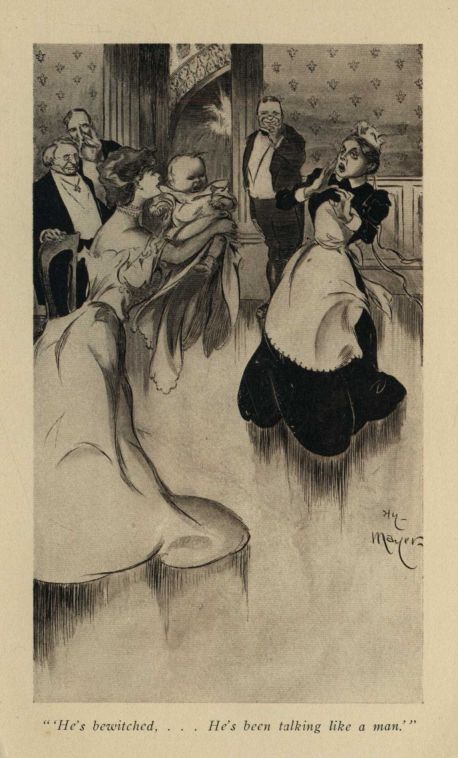
"He's bewitched, ... He's been talking like a man."
"Take him! take him!" she cried, hysterically, and before I could resist her insistence, Horatio was squirming in my bare arms. "He's bewitched," continued his nurse, frantically. "He's been talking like a man. I'm through with him. He ain't a baby! You just wait a moment, Mrs. Minturn. He'll speak again in a moment. He's got a voice like a steam calliope. And what he says! Oh, my!"
"Take her away at once," Tom was crying to the butler. "She has gone crazy," he went on, rushing past our astounded guests to my assistance. "Don't be frightened, my dear! I always thought that she was unbalanced, and now I know it. Poor little Horatio! He looks scared to death!"
CHAPTER VII.
A BIOLOGIST AND A BABY.
We know these things are so, we ask not why,
But act and follow as the dream goes on.
--Lord Houghton.
"Isn't he a lovely baby!"
"Don't send him away, Mrs. Minturn."
"Get his high chair for him, James."
"See him smile! I don't wonder at his relief. Just imagine being in the care of a crazy nurse!"
"What wild eyes she had! You say she was always eccentric, Mr. Minturn?"
"The baby's only eight months old? Really, Mrs. Minturn, he looks older."
"He has such pretty eyes! And look at the dimples in his little hands. Doesn't he ever cry? How good he is, dear little fellow!"
"Horatio! What a fine, dignified name! Horatio held a bridge, didn't he? or was it a full house?"
"What a question for a famous scientist to ask!"
The baby, erect and smiling in his high chair, had wonderfully enlivened our dinner-party. Even Tom, startled as he had been by the advent of the distraught nurse, was now wholly at his ease and beamed genially from the foot of the table upon the youngster, who seemed to be delighted at the attention that he was receiving from beautiful women and famous men. As he sat there, merrily waving a spoon in the air and crowing lustily, I watched him with mingled pride and consternation. Although a most distressing episode had been brought to a picturesque conclusion, there seemed to me to be startling possibilities in the present situation. I did not like the flush upon the baby's cheeks, the unnatural gleam in his laughing eyes. Impulsively I bent down and kissed him upon his pretty mouth. My worst fears were instantly realized, and I felt my spinal marrow turn to ice. I had detected the odor of a cocktail upon Horatio's--or, rather, Jack's--breath.
"I am forced to acknowledge, madame," I heard Herr Plätner saying, in answer to one of Mrs. Farringdon's leading questions, "I am forced to acknowledge that my theories destroy much of the poetry of life. It is a most prosaic attitude that I am forced to hold toward yonder most beautiful baby, for example. Romance would point to him as an immortal soul in embryo. Realism asserts that he is a machine, like the rest of us, with a longer lease of activity before him than you or I have, who have been ticking, so to speak, for several years."
"Be good, Horatio!" I whispered. "Don't cry. You can have an ice pretty soon."
The baby brought his spoon down upon the table with a thump, and actually glared at the German professor, while my guests laughed gaily at the child's precocious demonstration.
"Isn't he cunning!" exclaimed Elinor Scarsdale, delightedly.
"He seems to have a prejudice against me, nicht wahr?" remarked the Herr Doctor, laughing aloud.
"You aren't to blame for that, little boy," murmured Dr. Hopkins, so that I alone could hear him. "He says that you are sprung from oil and lather and are rushing toward annihilation."
"Bah!" yelled the baby. "Bah! bah! bah!"
"'Ba-ba, ba-ba, black sheep, have 'oo any wool?' quoted Professor Rogers, the noted comparative philologist, who has identified the germ of epic poetry in the earliest known cradle songs.
"Isn't he fascinating!" cried Elinor Scarsdale, referring to the baby, not to the philologist.
"If you'll excuse me for a time," I said to my guests, seeing that Tom was growing weary of Horatio's prominence at the table, "I'll take the baby to the nursery."
"You'll do it at your peril," I heard a deep voice grumble, and Dr. Hopkins jumped nervously and glanced at me in amazement.
"Don't run off with him, Mrs. Minturn," cried Mrs. Farringdon; and her protest was sustained by a chorus of "don't" and "do let him stay."
"It may be only temporary," I heard Dr. Plätner saying, as he gazed at Professor Shanks, who had asked him, evidently, a question about the baby's nurse. "It's not an uncommon form of insanity, and may be only temporary. I recall an instance of a very learned and perfectly harmless professor at Göttingen who believed for years that his pet cat talked Sanskrit to him. There was at my own university a young man wholly sane, apparently, who made a record of conversations that he had held with the skeleton of a gorilla. Both of these men were eventually restored to mental health, and have never had a return of their delusions. It is fortunate, however, that the poor woman, whose insanity we have so recently witnessed, exhibited her mania at this time. What might have happened otherwise to that charming little baby I shudder to think."
Horatio was pounding the table with a spoon, as if applauding the Herr Doctor's remarks. Suddenly he dropped the spoon and made a grab for Dr. Hopkins's wine-glass.
"What vivacity he has!" remarked Professor Shanks, as if addressing a roomful of students interested in a zoölogical specimen.
"He seems to know a rare vintage when he sees it," suggested Dr. Hopkins, intending, of course, to compliment his hostess.
"I think my dear--" began Tom, nervously.
"Don't go any further, Mr. Minturn," cried Elinor Scarsdale, playfully. "The baby is so much more interesting than----"
"Protoplasm," added Dr. Hopkins, under his breath.
Dr. Plätner was gazing at the baby searchingly. He had been impressed evidently by certain eccentricities in Horatio's bearing.
"How old did you say the boy was, madame?" asked the German savant, presently.
"Eight months," I answered, a catch in my voice that I could not control.
"He's--ah--very intelligent for a child of that age," commented Plätner, laboring under the mistake that he was saying something complimentary. "He has a most expressive face."
As the baby was scowling savagely at the German at that moment, and frantically shaking his little fists at him, there were both pith and point to the latter's remark.
"Rot!" muttered Jack, wickedly. I sprang to my feet and lifted him from his chair. He kicked protestingly for a moment, and gave vent to a yell that bore witness to his possession of a marvelous pair of lungs.
"Be quiet, Horatio," I whispered, imploringly, hurrying toward the door, without further apology to my guests. "If you'll be silent now, I'll have a bottle of champagne brought to the nursery."
At these words the baby nestled affectionately in my arms, and I felt that the fight was won. Just as we reached the doorway, however, Jack clambered to my shoulder and waved his little fist defiantly at my guests.
"Damn that frowsy old German donkey!" he muttered, close to my ear. "I'd give half a bottle of cocktails to prove to him what an amazing ignoramus he is! Just wait a minute, will you, Clarissa?"
I rushed out of the dining-room without more ado. In another instant Jack would have said the word that trembled on his tiny mouth, the word that would have brought the whole temple of modern materialism toppling down upon Herr Plätner's devoted head.
CHAPTER VIII.
HUSH-A-BY, NUMBER ONE!
Methinks that e'en through my laughter
Oft trembles a strain of dread;
A shivery ghost of laughter
That is loath to rise from the dead.
--Hjalmar Hjorth Boyesen.
The nursery was in a condition of much disorder as I entered it with the baby's arms around my neck. Much to my surprise and delight Jack had fallen asleep as we mounted the stairs. How to get him into his crib without rousing him was a problem that I longed to solve, although I had determined not to return to the dining-room. I would send a maid presently to tell the butler to inform Tom that I could not leave the baby at this crisis. Surely our guests would consider a crazy nurse sufficient excuse for the retirement of their hostess.
But Jack opened his little eyes and crowed, rather hilariously, as I laid him on his pillows.
"Don't go, my dear Clarissa," he said, his baby tones strangely out of harmony with his words. "I have much to say to you at once. I owe you an explanation and apology. Sit down, won't you?"
"Keep quiet, Jack," I whispered, "I'll be back in a moment."
After I had despatched a servant to the dining-room with my message to Tom, and had assured myself that the baby's hysterical nurse had left the house--poor woman, I was sincerely sorry for her!--I returned to the nursery and shut myself in, with a feeling of great relief. So intense, indeed, was my nervous reaction after hours of varied emotions that I sank at once into a chair to check a sensation of dizziness that had come over me as I crossed the room.
"Isn't this cosy!" exclaimed the baby, kneeling at the side of his crib and striving to touch me with his fat, uncertain little hands. "I wanted to say to you, Clarissa, that I did not deliberately plan to frighten that tyrannical nurse of mine. To tell you the truth, my dear, I had taken just one swallow too much of those cocktails and was astonished to discover that, while thus slightly elevated, so to speak, I could communicate in the language of maturity with this--ah--comparative stranger. Naturally, it was a great shock to the nurse. As I remarked to you before, my dear, she's narrow. A more broad-minded woman would not have rushed before the public, making a kind of Balaam's ass of a helpless baby. But she's been discharged, of course?"
"She has gone away, if that's what you mean," I answered, laughing rather hysterically. "How do you account for your sudden loquacity in her presence, Jack?"
"That's a mystery," said the baby, screwing up his tiny mouth into a funny little knot. "Spirits had something to do with it, I suppose."
"Spirits!" I repeated, nervously.
"Yes," responded Jack, clapping his palms together with a ludicrously infantile gesture. "You see, my dear, there were spirits in the cocktail. To tell you the truth, Clarissa, I'm a bit scared. I'm going to swear off. By the way, did you order that champagne?"
"No," I answered, curtly.
"Well, perhaps it's better, on the whole, that you didn't," sighed the baby, tumbling back on his pillows and waving his chubby legs in the air. "I've about made up my mind, my dear, to lead a better life. It'll be easier for me to be good than it has been, now that the nurse is gone. She was so narrow, Clarissa! It was always on my mind, and it finally drove me to drink."
"I'll have to replace her at once, Jack," I remarked, drawing my chair closer to the crib. "What--ah--that is--have you some idea as to just what kind of a nurse you'd like?"
The baby was on his knees again at the side of the crib, waving his expressive fists in the air.
"Understand me, Clarissa," he said, sternly, "I refuse to risk my life again by placing myself in the power of a hireling nurse. You can't expect people of that kind to be open to new ideas. To a man of my temperament, my dear, you must realize that repeated doses of baby-talk are actually cloying. If you could engage some broad-minded, elderly woman who had been deaf and dumb from birth, I might put up with her for a while. But, of course, it would be hard to find such a prize. You'll have to look after your little baby yourself, my dear, until I'm a few years older. It'll be hard for you, I realize that, Clarissa. But, frankly, is there any other alternative? If I'm to lead a better life, my dear, I must have some encouragement."
I leaned back in my chair, and closed my eyes wearily. The burden that had been thrust upon me was growing greater than I could bear.
"We'll postpone this discussion until to-morrow, Jack," I said, presently. "I must think it all out carefully before I can come to a decision. Meanwhile, you'd better go to sleep. It's getting late, you know."
"You aren't going to leave me here alone, Clarissa?" cried the baby, nervously. "You'd better not. There'll be trouble if you do."
The fact was that I was in a quandary as to what was the proper thing to do, under the circumstances. I had only just begun to realize how many problems had been solved by the presence of the nurse. At this time of night it was impossible, of course, to get anybody to take her place. At such a crisis as this the natural solution of the problem lay in my temporary occupancy of her position. But I shrank from the obligation that fate had so unkindly thrust upon me. Lifting the very willing baby from the crib, I carried him to a rocking-chair, hoping that I might get him to sleep while I came thoughtfully to a determination regarding my course of action for the immediate future.
"Gently!" murmured Jack, cuddling gratefully in my arms. "A long, slow, dreamy kind of rocking is not so bad, Clarissa. It's the tempestuous, jerky style that I object to. That confounded nurse had a secret sorrow. It used to bother her whenever she got me into this chair. She'd groan and weep and swing me up and down, as if she were trying to pulverize her grief, with me as the hammer. Then I'd begin to yell, and she'd rock all the harder. You can't imagine, Clarissa, what your little Horatio has suffered of late."
I laughed aloud nervously, knowing that my merriment had a cruel sound, but unable to control it.
"Did you think that I was joking!" growled Jack, clutching at my chin, angrily.
"Forgive me, Jack!" I exclaimed, repentantly. "I know that you've had an awfully hard time, poor boy. And I promise you that I shall try my best to make life easier for you, from now on. And now, Jack, do try to get to sleep! I'll see to it that you are perfectly comfortable to-night, and to-morrow we'll talk about the future. Would you like to have me sing to you, Jack, as I rock you?"
The baby fairly shook with suppressed laughter at the suggestion.
"Doesn't it seem absurd, Clarissa?" he gasped, between chuckles. "Just imagine what it really means. You're about to hum hush-a-bye-baby to Number One, while Number Two is down-stairs talking scientific rubbish to a lot of old fogies! If you should ever write your memoirs, my dear----"
"Hush, Jack!" I cried, petulantly, setting the chair in motion. "I shall never write anything for publication."
"Nonsense," commented the baby, drowsily. "Everybody does. You'll be sure to try it on some day. What a story you could tell, couldn't you, my dear? You might call it, with my permission, 'Clarissa's Troublesome Baby.'"
CHAPTER IX.
A BOSTON GIRL.
It would be curious if we should find science and philosophy taking up again the old theory of metempsychosis. But stranger things have happened in the history of human opinion.--James Freeman Clarke.
It was only through the exercise of the nicest care that I escaped a complete nervous collapse during the weeks immediately following our now famous dinner to Herr Plätner. I was tempted at times to run off to Europe and leave my fevered household to fend for itself. I seemed to spend the larger part of my time in keeping Jack quiet and Tom cool. Which was the more difficult task I am unable to say. Jack remained stubbornly unreasonable regarding the kind of nurse he was willing to submit to, while Tom grumbled continually because I spent so much time with the baby.
"What is the trouble in the nursery, Clarissa?" the latter asked me one morning at breakfast. "You have tried ten different experiments there since that crazy woman left us, and now you tell me that her place is again vacant. We pay the highest wages, Horatio is not a sickly, fretful child, but still these alleged nurses come and go, offering, so far as I can learn, only the flimsiest excuses for throwing up a seemingly desirable situation. There must be something radically wrong up there. Have you any idea, my dear, what it is?"
How could I tell Tom the truth about the matter? Had I informed him that the baby still insisted upon my engaging an elderly woman deaf and dumb from birth, and refused to adapt himself to any one of the many compromises that I had offered to him, Tom would have been justified in suspecting the existence of insanity germs in our nursery. He had seen one woman issue therefrom in an apparently crazy condition, and he had noted the eccentric fickleness of her successors. If I should now lay the actual facts before him, he would have good reason to believe that I also had lost my mental balance. At that moment there came to me a vague dread of my second husband's scientific habit of mind. It was evident that he was bent upon collecting data about the baby and his nurses, in order that he might reach some reasonable conclusion in explanation of the existing disturbed conditions in our formerly unruffled household. And the unfortunate part of it was that Tom had the leisure and, I feared, the inclination to wrestle with this problem until he had solved it in some way satisfactory to his exacting mind.
"The root of the trouble, Tom," I answered, presently, after carefully weighing my words before uttering them, "the root of the trouble is not in the baby or the nursery or the wages--or in me. It is to be found in the great change that is going on in the conditions of domestic service. A child's nurse to-day--I mean one of the kind that we should be willing to employ--is a highly-trained specialist who has grown haughty and despotic in the mere exercise of her profession. She realizes that the demand for experts in her line is greater than the supply, and----"
"I see," interrupted Tom, rather rudely, I thought. "But it does seem to me that if other people in our position, Clare, can find satisfactory nurses, we should not be the one family in the city that is forced to take care of its own baby. I am willing to pay any amount of money to insure Horatio's comfort. I'll admit that he is difficult at times. He seems to be a very sensitive, highly-strung child, but there's nothing abnormal about him. He's pugnacious and hot-tempered, but most healthy boy babies are inclined to be spunky, aren't they? What I object to is that he is gradually absorbing all your time, day and night, Clare. I'm not jealous of Horatio, my dear, but I don't believe in the old-fashioned idea that parents should sacrifice their comfort upon the altar of the nursery. You understand my position, do you not?"
"Gwendolen will be here to-day, Tom," I said, smiling at his disturbed face from across the table. "I hope that she'll take a fancy to the baby. At all events, she'll relieve the situation. When your wife's in the nursery, Tom, you'll have your cousin to talk to."
"Bah!" grumbled Tom, rising and placing a hand on the back of his chair, "Gwendolen's pretty and chic and up to date, but she's not in your class intellectually, my dear."
I smiled gratefully at Tom's compliment, but my mind was not at ease. Wasn't the presence of Gwendolen Van Voorhees in the house more likely to prove disastrous than satisfactory? When, however, Tom had insisted that his cousin's long-deferred visit to us be made at once, I could find no reasonable argument to oppose to his washes. From various points of view, Gwendolen's advent to the household appeared to be desirable. She was a charming girl, well read, widely traveled and a thoroughbred little mondaine. But I dreaded her arrival, despite the fact that I could not have put the vague fears that haunted me into specific words. I was beginning to realize what it means in this prosaic, unimaginative world to hide in one's bosom an uncanny secret. There had come to me, of late, moments when the inclination to tell Tom the whole truth about Horatio--or, rather, Jack--was almost irresistible. Perhaps my real reason for objecting to Gwendolen's presence was my fear, unacknowledged to myself, that I should be tempted eventually to tell her the amazing tale of Jack's ridiculous reincarnation. There were times, and they had constantly become more frequent, when the burden of my secret seemed greater than I could bear, when the longing to confess to somebody that the baby was a psychical freak of the most astounding kind burned hot within me. As I lingered over my coffee in the breakfast-room that morning, after Tom's departure, the immediate future looked black enough, and I could not see that the coming of Gwendolen gave it a lighter shade.
Nevertheless, I was really glad to welcome her later in the morning as I met her at the door of the drawing-room, and kissed her pretty, piquante mouth affectionately.
"I was awfully glad to come to you, Clare," she cried, vivaciously, as we mounted the stairs that I might show her to her rooms. "You know the song with the chorus, 'There's one New York, only one New York?' It's been running through my mind for two days."
"But I thought that you were wedded to Boston, Gwen," I remarked, my mind wandering for a moment as we passed the closed door of the nursery.
Presently we were seated cozily before an open fire in the guest chamber, while Gwendolen, dark, petite, smiling, appeared to me to be a most ornamental and fascinating addition to our little circle.
"Boston is amusing," she was saying, in her pleasantly emphatic way, "but it's so erratic, don't you know. My nerves always begin to ache after I've been there a few weeks. They are so fond of fads, Clare, those clever Bostonians! They take up everything, you know, and always go to extremes."
"It's American history now, is it not?" I asked.
"Yes," answered Gwen, gazing at the fire musingly. "That's coming in again. But they're perfectly crazy about theosophy just at present. You'd be amazed, Clare, to discover how much I know about Nirvana and adepts and metempsychosis, and all that kind of thing. Several of my most intimate friends have become vegetarians and live mostly on baked beans. It's awfully funny--they take it all so seriously."
"And what do you really think of it, Gwen?" I asked, nervously.
"Think of what, of which, my dear? Of living on beans, do you mean?"
"No. Beans are only a side issue, or, to speak with Tom's scientific accuracy, a side dish. What do you think, for instance, of reincarnation?"
"I don't know what to think about it, Clare," she answered, reflectively, pushing her dainty little feet toward the fire and gazing into my face with earnest eyes. "Do you know, there are times when I really imagine that there's something in it! Of course, it's absurd in a way, but it does solve a great many problems, does it not? It conforms beautifully to the laws of evolution and the conservation of energy, and there are so many things that can't be explained by any other theory! But it always makes me shudder to think of it. Imagine, Clare, being born again in Turkey, for example. Wouldn't it be shocking?"
I laughed, rather hysterically.
"The whole subject is too silly for any use," I managed to say, in a superior kind of way. "It does very well for Boston, of course, but it will never have much of a run here in New York."
"What a narrow way of looking at it, Clare!" exclaimed Gwendolen, protestingly. "Of course, I'm not a theosophist, but I'm broad-minded enough to realize that what's true in Benares or Boston must be true in New York. If reincarnation is really going on in this world, I can't believe that any exception is made in favor of our Knickerbocker families."
Again I laughed aloud, nervously. It was pleasing to me to discover that Gwendolen had a mind open to startling truths, but I regretted the fact that I must henceforth constantly fight against the temptation to tell her my great secret. The imminence of my peril in this regard was illustrated at once, for she turned to me suddenly and asked, with great vivacity of manner:
"Where is the baby, Clare? Won't you let me see him at once? I came to visit him, you know; not you or Tom. He's got such a lovely name! 'Horatio' is so fine and dignified! What do you call him for short, my dear?"
"I have not given him a nickname, Gwendolen," I answered, coldly. "If you wish to, we'll go to the nursery at once. As I told you in my letter, we've had difficulty in getting the baby a nurse. Just at present, I'm obliged to spend most of my time with him. But I gave you fair warning, you know."
"I'm so glad that I can have the run of the nursery," cried Gwendolen, gaily, springing to her feet. "I do so love really nice children, Clare! Is he a jolly baby? Will he take to me, do you think?"
I answered her question as we reached the door of the nursery: "I am sure I can't say, Gwen. Horatio is very eccentric and pronounced in his likes and dislikes. But if he goes to you at once, follow my advice and don't toss him up and down violently. He says--that is, he doesn't like to be shaken after taken."
CHAPTER X.
AN UNCANNY FLIRTATION.
And thou, too--when on me fell thine eye,
What disclos'd thy cheek's deep-purple dye?
Tow'rd each other, like relations dear,
As an exile to his home draws near,
Were we not then flying?
--Schiller.
I must acknowledge that the enthusiasm displayed by the baby when he caught sight of Gwendolen filled me with mingled astonishment and annoyance. He sat bolt upright in his crib, waved his hands joyously in the air, and crowed lustily. I realized that the poor little chap was laboring under a delusion, that he had mistaken Tom's fascinating cousin for a new nurse; but, even so, why should he act as if he were intoxicated with happiness? I could not check the conviction that Jack was making an exhibition of very bad taste by his warm reception of Gwendolen. That I was jealous of her was not true--that would have been absurd--but it was not pleasant to realize that the baby could rejoice openly in the advent of one who, as he believed at the moment, was to take my place in the nursery. Jack's horrible psychical disaster had greatly endeared him to me, and I could not help feeling hurt at his eagerness to go to a perfect stranger. There was something not altogether infantile in the way in which he threw his chubby little arms around Gwendolen's neck and tucked his smiling little face into her cheek, chuckling contentedly, while the girl laughed aloud.
"Isn't he just the sweetest little thing that ever lived!" cried Gwendolen, with spontaneous enthusiasm. "Did you see him jump right into my arms, Clare? Such a thing never happened to me before. Is he always so cordial to strangers?"
"As I told you, Gwendolen, Horatio goes to extremes in his likes and dislikes. He evidently approves of you." For the life of me, I could not prevent my voice from sounding cold and harsh. But the girl was too thoroughly interested in the baby to note the lack of cordiality in my tones.
"'Oo clear 'ittle angelic creature," she was murmuring to him, as she seated herself in the rocking-chair, with Jack cuddled in her arms. "Will 'oo always love 'oo cousin Gwen?"
Here was a kind of baby-talk that Jack seemed to like, for his every sound and movement expressed approval of Gwendolen's nonsensical endearments. But, I must admit, it annoyed me. Logically, I could not blame Gwendolen for displaying a sudden fondness for the baby. She had no way of knowing that she was holding my first husband on her lap. I was glad that she was ignorant of the fact, but, while my mind fully exonerated her, my heart protested against her fetching ways with the child. Jack as a baby had never appeared to such advantage. He smiled and laughed, winked his eyes, made funny little holes with his mouth, and waved his tiny fists in the air in a kind of oratorical way that was irresistibly amusing.
"He's perfectly sweet!" cried Gwendolen, glancing at me with dancing eyes. "I don't think that I ever cared much for a baby before, Clare, but Horatio has cleared the first bunker beautifully. Is he always like this?"
I laughed aloud, nervously. I hadn't the courage to say anything uncomplimentary of the baby at that moment, not knowing how far I could trust Jack's self-control, and so I remarked, in a non-committal way:
"He's a very good baby, on the whole, my dear. Of course, he isn't to be blamed for protesting if things don't go just right with him."
"Of course 'oo aren't, 'oo lovely 'ittle caramel," murmured Gwendolen, her cheeks pressed against Jack's baby face. "I've always been so sorry for babies, Clare, because they couldn't talk. It must be trying when a pin is sticking into you somewhere to have your gums rubbed by a misguided nurse, or to be rocked violently when the heat of the room has made your head ache."
The baby gave vent to a most astounding yell of delight, a very precocious exhibition of emotion that made Gwendolen laugh merrily. But his vivacity quite upset me. I feared, momentarily, that his enthusiasm would find speech an imperative necessity, and that Gwendolen would discover to her consternation that what was theory in Boston had become practice in New York. Thereupon I acted in a most tactless way. I bent down and removed Jack from Gwendolen's arms to mine.
"Put me back, or I'll denounce you," whispered the baby, in my ear. Then he began to howl in the most exaggerated infantile manner. I was annoyed to realize that my cheeks had flushed with anger and that a feeling of hot jealousy had swept over me. Gwendolen, sympathetic and impressionable, had noticed the outward manifestations of my inward turmoil and had hurried toward the door.
"I'll go back to my room, Clare," she said, as she passed me. "When you've put him to sleep, come to me. I want to tell you what I think of him. Au revoir, 'oo dear, sweet 'ittle marshmallow!"
Jack and I were alone in the nursery, and I seated myself wearily in the rocking-chair, holding the uneasy baby on my lap.
"What did you do that for, Clarissa?" he growled, kicking violently with his expressive legs. "I was in for the time of my life--this life, I mean--and you deliberately snatched me from that lovely girl's arms and practically drove her from the room. Do you not realize that you have been very cruel, my dear? Surely you can't be ignorant of the fact that I lead a very colorless life. Suddenly the tiresome humdrum of my existence is broken by a chance for a perfectly harmless flirtation. Do you rejoice at your little baby's momentary relief from ennui? Not at all; you treat me with the most tyrannical harshness, grudging me the slightest change in the horrible monotony of this infernal nursery. What's that girl's name?"
"Gwendolen Van Voorhees," I murmured. "She's Tom's cousin."
"She called herself Cousin Gwen and expressed the hope that I might always love her," mused Jack, gazing with eyes too old for his face at his dimpled, restless fists. "I don't like Tom, Clarissa, but his cousin does him credit. I shall always love her. No, don't rock, my dear. I don't want to go to sleep. If you don't mind, Clarissa, I should like to lie very quiet and think about Gwendolen. Isn't it a beautiful name? I'm sorry my name's Horatio. Don't rock, not even a little bit. I'm very nervous, am I not? I'd give half a dozen slips and my silver rattlebox for a smoke, Clarissa. Do you think that a cigarette would hurt me?"
"You remember, Jack, that cocktails didn't agree with you," I argued, soothingly. "I'm sure that tobacco would be very bad for you."
"Of course you are," grumbled the baby, resuming his impatient gestures with his legs. "You think that everything worth having is bad for me, Clarissa. I suppose that you intend to cut me off entirely from Cousin Gwen?"
"Don't be unreasonable, Jack," I implored him. "Gwen can come here just as often as she cares to. But you must realize, Jack, that I have no confidence left in your veracity or discretion. You don't keep your promises to me and you seem to have no realization of the terrible results that might come from a discovery of your identity."
"Is this a curtain-lecture, Clarissa?" growled Jack. "I tell you flatly, my dear, that I can't stand much more. I've about reached the limit of my self-control. There's a deadly dullness to this kind of a life that is slowly driving your sweet 'ittle baby-boy, Cousin Gwen's caramel and marshmallow, to desperation."
"But what can you do, Jack?" I asked, frightened by the peculiar tones in his voice. "My role is as hard to play as yours, is it not? We must both be brave and circumspect, my dear."
"Bah!" exclaimed the baby, rudely, clutching at my chin with his absurd little hands. "You may rock a little now, Clarissa, very gently. Perhaps I could get a nap if you'd stop scolding me for a few moments."
CHAPTER XL
A MYSTERIOUS ELOPEMENT.
Empty is the cradle; baby's gone!
--Old Song.
From one standpoint I have come close to the end of my narrative; from another, I am still at its beginning. But, with Tom's permission, I have placed the foregoing facts before the public in the hope that the statement may be read by somebody in Europe, Asia, Africa or America, who is able to assist us in solving a hard problem. The New York newspapers have mingled fact and fiction, realism and romance, in the articles bearing upon what they call "The Great Minturn Mystery," in a manner most annoying to my husband and myself. The only really sympathetic and enlightening account of the awful affliction that has fallen on our erstwhile happy home was printed by a Boston journal whose editor is a Buddhist. But I'm getting too far ahead of my story!
Yet I have nothing to relate that you, who keep abreast of the times, do not already know. You remember reading in your morning newspaper, a few months ago, of the strange disappearance from Mr. Thomas Minturn's town house of his baby, Horatio Minturn, and a guest, the well-known society favorite, Miss Gwendolen Van Voorhees. You have perused, I suppose, subsequent journalistic presentments of the case, telling how futile had been the search for our lost ones. Tom, as the public knows, has offered enormous rewards for the slightest clue that should serve to throw even a glimmer of light upon the most astounding disappearance of modern times. We have employed the most famous detectives in all parts of the world in our vain efforts to find some trace of the fugitives--if such Jack and Gwendolen may be called. But, up to the present moment, we have learned nothing that can help us in any way in our weary quest. In desperation, and as a last resort, I have written and published this account of the events that led up to our great loss. When the editor of a magazine insisted that I should choose a title for my amazing presentment of our weird experience, a lump came into my throat and tears bedimmed my eyes. Had not Jack himself, with a most uncanny foresight, chosen the title of my unwilling deposition? "Clarissa's Troublesome Baby!" Alas, how little did I realize at the time of his suggestion how appropriate would be this caption to my melancholy tale!
"Where's Gwendolen?" Tom had asked of me at breakfast upon the morning of the fateful day that was to shatter for all time my second husband's materialistic tendency of thought. "In the nursery, as usual, I presume?"
"She'd rather play with the baby than eat or sleep, Tom," I answered laughingly. "In the present dearth of nursemaids, Gwendolen's enthusiasm for Horatio is most opportune."
Tom laughed as he lighted his after-breakfast cigar.
"Let's go to the nursery, Clarissa, and bid them good morning. I haven't seen Horatio for forty-eight hours. I'm glad that Gwen likes him so well, but I really feel that I am entitled to a glimpse of the youngster now and again."
Thus did Tom and I gaily mount the stairway to our doom. We rushed, so to speak, with laughing faces, to the very edge of a precipice, and toppled over, with a quip half spoken upon our white lips.
As we entered the nursery, crying playfully to Gwendolen to abdicate the throne she had usurped, we were struck silent and motionless by the sudden discovery that the room was empty. Tom was, of course, less shocked than I by Jack's deserted nest. There came to me, as I stood there, cold and trembling, on the threshold of the nursery, the conviction that I was confronting the scene of another miracle, an environment within which I should never again be annoyed by psychical mysteries.
I was recalled to myself by Tom's voice saying:
"What do you suppose has become of them, my dear? Gwendolen! Horatio! Where are you?"
Ah, but the pathos of it all! Gwendolen! Horatio! Where are you? Were you wilfully, heartlessly selfish, indifferent, in your strange ecstasy, to the sorrow that you brought to others, or were you powerless in the grasp of fate, forced through psychical affinity to disappear thus weirdly from the sight of men?
You must see, dear reader, that what I have written cannot come to an end that will satisfy either your mind or your heart. I began with an exclamation point; I must conclude with an interrogation mark. And in that obligation I find that my tale resembles every human life. We come to earth with a cry, and we leave it with a question. So far as man is concerned, evolution has been merely a zigzag progress up from protoplasm to a problem.
And how has Tom withstood the unmaterialistic revelation that I have been forced to make to him and to the public? Has he been shaken in his faith in the teachings of Büchner, Haeckel and Herr Plätner? Of course, being a man, he is slow to admit that his nursery has vouchsafed to him more enlightenment than his library, but he has grown very gentle and sympathetic when I talk to him about the possibility that the dreams of the brooding East may be nearer the ultimate truth than the syllogisms of the practical West. You see, it was a condition, not a theory, which confronted Tom that morning in our empty nursery.
Nevertheless, he tells me that he has just hired a young detective, who is said to have a genius for solving mysteries that his older colleagues have abandoned as beyond their skill. Let me assure you, dear reader, that if Tom's latest employee gets on the track of Gwendolen Van Voorhees and little Horatio Minturn, I shall see to it that the public be instantly informed of the fact.
* * * * * * * *
A PURITAN WITCH
A Romantic Love Story
By MARVIN DANA
Author of "The Woman of Orchids," etc.
THRILLING * TENDER * ABSORBING
This is a romance that abounds in the best qualities of the best fiction: action that is essential and vigorous, sentiment that is genuine and pure, a plot that is new and stirring, a setting that is fitting and distinctive. The artistic conception of the story happily unites realism and romance. The reader's interest is aroused in the first chapter; it is increased steadily to the climax of a happy ending.
THE ILLUSTRATIONS ARE FROM DRAWINGS IN PHOTOGRAVURE
By P. R. AUDIBERT
Crown 8vo, Cloth, $1.25
THE SMART SET PUBLISHING CO.
452 Fifth Avenue, New York City
* * * * *
The Vulgarians
BY EDGAR FAWCETT
Author of "The Evil that Men Do," etc.
An account of a trio from the West, who become immensely wealthy. Their entry into New York is full of both humor and sentiment.
In this story the author has achieved the best expression of his genius. Parvenus of immense wealth are here made real before the reader, and not only real, but lovable as well. The story is at once ingenious and simple, entertaining and profound. It is a most valuable picture of American life, drawn from facts, and must stand as an important contribution to literature.
COMMENTS OF THE PRESS
Boston Transcript.--"An excellent example of the author's skill."
Mail and Express.--"Typical of the author's talent in all its phases."
Willington News.--"An excellent story of American life."
Town Topics.--"Mr. Fawcett has evidently lost none of his cunning as a novelist; this story is full of power and vigorous effects."
Illustrated by Archie Gunn
Crown 8vo, Cloth, $1.00
THE SMART SET PUBLISHING CO.
452 Fifth Avenue, New York City
* * * * *
The Fighting Chance
THE ROMANCE OF AN INGENUE
By Gertrude Lynch
The story is a modern romance dealing with prominent public characters in Washington political life, depicting a vivid picture of a phase in the life of an honest statesman. The theme is treated with great skill by an author whose personal experience enables her to write luminously of department life. The love interest in the story is fascinating, while the plot is absolutely distinctive--as original as it is satisfying.
COMMENTS OF THE PRESS
Utica Press.--"A cleverly written story and has some fine characters."
N. Y. Journal.--"The story is as interesting as it is valuable."
Salt Lake Tribune.--"A fine story."
Boston Transcript.--"There is enough excitement and love interest in 'The Fighting Chance' to entice anyone who is alert for a good story."
Town Topics.--"One of those delightful comedies in which the fighting consists of wit combats, and the story is told with a vividness that makes it possible to visualize all the scenes and characters amid natural surroundings. The action is cleverly dramatic and the dénouement is skilfully held in suspense."
Illustrated by Bayard Jones
Crown 8vo, Cloth, $1.25
THE SMART SET PUBLISHING CO,
452 Fifth Avenue, New York City