PERKINS, THE FAKEER (continued 2)
Reading edition
"Him? Who's him?" I cried, cold with dread.
"Yamama," answered my voice, exultantly.
"Good God, Caroline!" I yelled through the 'phone, but my wife had cut me off.
Stumbling into a chair, I rested Caroline's aching head upon her moist, trembling hand.
"Yamama!" I murmured, terror-stricken. "He's the chocolate-colored adept that Mrs. Taunton referred to. Pigs! Frogs! He's the scoundrel that put Caroline up to this. He is coming here to look at me! Damn him!"
Excess of emotion had undone me. I felt the hot tears scorching Caroline's cold hand.
CHAPTER IX.
AFTERNOON CALLERS.
Still in dreams it comes upon me that I once on wings did soar;
But or e'er my flight commences this my dream must all be o'er.
--From the Persian.
As I look back upon it now, that afternoon wears the aspect of a variegated nightmare, from which I could not awaken.
"What will madame wear this afternoon?" Suzanne had asked me when I had returned to my apartments above-stairs.
I kicked viciously at the empty air with one of Caroline's dainty feet. The time had come, evidently, for Suzanne to change my costume again. Should I take a ride or a walk, or remain at home? If I went out for a ride, I should have only my own bitter thoughts for company. If I took a stroll up the Avenue, almost anything unpleasant might happen to me. If I stayed in the house, I must receive callers. No one of these alternatives was alluring, but I was forced to choose the latter. For a number of rather vague reasons, I did not dare to cut off my line of communication with Caroline. She had become, as it were, a flying column not yet out of touch with headquarters.
"And she ought to be shot for disobedience to orders," I mused, aloud.
"Pardon me, madame?" exclaimed Suzanne, interrogatively.
"N'importe, girl," I answered, testily. "I shall remain at home, Suzanne. Give orders down-stairs that I have a headache and can receive no one."
"But Madame is looking so much better!" protested Suzanne. "And the débutantes will call to-day. It is madame's afternoon."
"Well, do your worst, then," I grumbled, discontentedly. "Can you get me some cloves, Suzanne?"
An hour later, I entered the drawing-room after a perilous descent from the second story, to confront three young women, who, I had gathered from Suzanne, held Caroline in high esteem as a chaperon. I had committed their names to memory before leaving the dressing-room, but the effort to get down-stairs without spraining my wife's ankles had obliterated from my mind all traces of its recent acquisition. I stood, flushing painfully, gazing into the smiling faces of three handsome, modish girls who were wholly strangers to their vicarious hostess.
"Oh, Mrs. Stevens, what a charming day!"
"How lovely you are looking!"
"Wasn't the Crompton dance perfectly stunning?"
"Mr. Van Tromp made such a pretty epigram about your costume!"
"Just a moment--ah--girls," I gasped, seating myself awkwardly, and inclined to lose my temper. "There's a painful lack of method about all this. Suppose we begin at the beginning. You were saying--ah--my dear--?" I remarked to the calmest of the trio. The latter exchanged puzzled glances with her companions.
"I was speaking of the compliment that Mr. Van Tromp paid to you," explained the maiden, rather dolefully.
"He's a bad lot, that young Van Tromp," I exclaimed, impulsively. "Perhaps I ought not to talk against another man--ah--behind her--I mean his--back, but Van Romeo's too easy, girls. He writes poetry. I have no doubt that he makes puns. Charming--ah--day, isn't it?"
My beautiful callers had lost their vivacity. One of them--a pretty little brunette--had grown pale.
"What about the coaching-party, Mrs. Stevens?" the one I took to be the eldest of the three ventured to ask, presently.
"It's all arranged--ah--my dear," I answered, recklessly. "We're to have a dozen cases of champagne and a brass band of ten pieces. I'm up for all day, you see. If little Van Tromp praised my executive ability--ah--girls, he'd have a career open to him. Merrily we'll bowl along, bowl along--I'm to handle the reins, you know."
There were now three pallid maidens confronting me. In the eyes of the eldest I saw a gleam of mingled suspicion and fear.
"I must be going," she gasped.
"Don't go," I implored her, overacting my hospitable role a bit. There flashed through my mind a scene from a Gilbert-Sullivan opera--"The Mikado"--and I caught myself humming the air of "Three Little Girls from School Are We."
Jones, to my consternation, stalked into the drawing-room, as if about to reprove me for my lack of dignity.
"Pardon me, madame," said my bête noir, pompously, "but Mr. Stevens insists upon your coming to the telephone."
My callers were on their feet, instantly. They appeared to be glad of an excuse for leaving me, and, also, somewhat astonished at the butler's choice of words.
"Don't let us keep you a moment," cried the eldest.
"Remember me to Mr. Stevens," urged the little brunette, mischievously.
"Good-bye! We are so grateful to you, Mrs. Stevens," exclaimed the third, with a sigh of relief.
"Be good!" I answered, gaily. "Come again--ah--young ladies. Don't mind Jones. You'll get used to him. Look in next month, won't you? Ta-ta!"
I stumbled over my skirts as I stepped forward, and the little flock of débutantes hurried away in affright, glancing over their shoulders at me in a manner that suggested gossip to come.
"Hello!" I shouted through the 'phone, when I had managed to reach the library. "Is that you--ah--Reginald? Where are you?"
"Yes. This is Reginald," I heard my voice in answer. "I'm at the 'Varsity Club. Charming place. Nice boys here. You seem to be popular, my dear. 'Here's to you, good as you are, and here's to me, bad as I am; but as good as you are, and as bad as I am, I'm as good as you are, bad as I am!'"
"Good Lord--ah--ah--Reginald!" I faltered, horror-stricken.
"Don't worry, Caroline," came my voice, soothingly. "It's all right. I know when to stop. Had any callers? This is your day at home, is it not?"
"I'll send the coupé for you at once--ah--Reginald," I said, with great presence of mind. "Go easy till it arrives, will you?"
"What do you mean to imply, Caroline?" growled my wife, a note of anger in my voice. "I'm going to walk home by-and-bye. You needn't bother about the coupé. I hear the boys calling to me. Here's to you, my dear! Good-bye!"
Before I could utter another word, Caroline had cut me off, and I turned from the 'phone, despondently. For a moment, it seemed to me that the library was surrounded by an iron grating and that I wore a ball and chain attached to my legs. Caroline and "the Old Crowd!" I am forced to confess that the hot tears came into my wife's eyes as I seated myself in a reading-chair and found myself face to face with a loneliness that was provocative of despair.
Jones was hot on the scent. He strode into the library and bore down upon me relentlessly, carrying a tray upon which rested two calling-cards.
"They are in the drawing-room, madame," said the butler, indifferently.
Caroline's toast came ringing to my ears. "Here's to you, good as you are, and here's to me, bad as I am!" And here I sat, bullied by Jones and the plaything of a lot of light-headed women of all ages. For one wild, feverish, moment the thought of revolt darted through my mind. I might faint, or have a fit, and Jones would be forced to dismiss my callers. But I quickly realized that I was not up to a brilliant histrionic effort. Even as it was, I was playing another's role with but indifferent success.
Two elderly women, richly garbed, arose as I reentered the drawing-room.
"I'm so glad to see you--ah--my dears," I said, in a voice pitched to indicate cordiality. One of my callers tossed her head haughtily, while the prim mouth of her companion fell open. This was not encouraging, and I remained silent. We stared at each other for a long, agonizing moment.
"How do you do?" I began again, with much less assurance. "Go away, little girls," kept running through my mind from that diabolical, tinkling "Mikado."
"We are very well, I believe," remarked Mrs. Martin, as she proved to be, coldly. "I think I may answer for Mrs. Smythe's health."
"I am in perfect health," exclaimed Mrs. Smythe, with emphasis, staring at me in a superior kind of way.
"There's nothing like perfect health--ah--my friends," I said, in a high, almost hysterical, falsetto. "Who is it who says that a man is as old as he feels and a woman as old as she looks?"
"Whoever said it, Mrs. Stevens, did us a great injustice," commented Mrs. Martin, with some warmth. "I am as young in spirit as I was ten years ago, but I don't look it."
"No, you don't look it," I hastened to remark, cordially; but my comment was not well received. Mrs. Martin glanced at Mrs. Smythe, and they stood erect on the instant.
"You're not going--ah--my dears?" I cried, thinking it too good to be true.
"You will pardon the liberty that I am about to take, Mrs. Stevens," began Mrs. Martin, sternly, "but it seems only fair to you that we should ask a question before leaving you. You are out of sorts to-day? Not quite yourself, are you?"
"Not quite," I answered, drawing myself up to Caroline's full height and struggling against an inclination to give vent to wild, feverish laughter. "I may say--Mrs.--ah--my dear--that I'm not quite myself. Not quite! It'll pass off. I have every reason to believe it'll pass off. But you're right. I'm not quite myself."
My frankness, which appalled me as I thought of it afterward, seemed to have a soothing effect upon my callers.
"You really do too much, Mrs. Stevens," remarked Mrs. Smythe, in a motherly way. "You should try to get a nap at once."
"Your nerves are affected," Mrs. Martin added, speaking gently. "You are overdoing things. Did you ever try the rest cure?"
"Yes. I've been giving it a chance to-day," I confessed. "But it doesn't work. I can't sleep in the daytime. Bear that in mind--ah--my dear. Don't talk to me about a nap. As I said to Caroline--ah--Reginald, I'm up for all day. But you know what nerves are, do you not?"
Mrs. Martin again glanced furtively at Mrs. Smythe, and without more ado they swept out of the drawing-room.
I dropped into a chair, a feeling of relief mingled with self-disgust sweeping over me. I realized that I had been making a sad botch of the part that I had attempted to play. At that moment, heavy footsteps behind me aroused me from my black-and-white revery. Two large, hot hands were placed over my eyes, and the end of a beard tickled Caroline's forehead.
"Guess who it is?" I heard my deep voice saying. "Here's to you, good as you are!"
"Caroline!" I exclaimed, conflicting emotions agitating my soul.
"Guess again, little woman," said my wife, playfully, in my voice. "They call me 'Reggie' at the club."
CHAPTER X.
RECRIMINATIONS.
We know these things are so, we ask not why,
But act and follow as the dream goes on.
--Milnes.
"Yes, I've had a simply perfect day, my dear," remarked Caroline, frankly, as we left the library to ascend to our second-story suite. "I've made twenty thousand dollars--by not taking your advice--and as to the 'Old Crowd' at the 'Varsity Club, I think they're really charming. I've been doing a good deal of miscellaneous thinking, my dear, and I'm convinced that women have a great future before them."
"What women?" I cried, impatiently, as I tripped against the top stair and caught my better half by the tail of my coat.
"You'll do better with practice," remarked Caroline, soothingly. "I'm sure you enjoyed the day. Who has been here?"
"That'll keep," I answered, resisting an inclination to tweak my own nose. "Where's Jenkins?"
Caroline indulged in a hoarse chuckle.
"Jenkins has gone to Hoboken. He won't be back for at least a month. I think I can get on without a man. How's Suzanne?"
We had come to a standstill in the upper hall, just outside of the main door to our private rooms.
"How'll you manage to dress for dinner?" I asked, gazing at my flushed, triumphant face with sharply contrasted emotions. I was glad to see it again, but I did not like Caroline's way of using it.
"I'm very quick to learn," answered my voice, tauntingly. "You must admit, my dear, that I've been a success to-day. You don't think that I'm to be overcome by a man's dinner costume?"
A chill ran through me, and Caroline's voice trembled as I said:
"What do you--ah--think I'd better wear to-night? Suzanne'll ask me presently."
A jovial laugh greeted my words. The humorous side of our horrible plight seemed to be always apparent to Caroline.
"You must be sure to do me credit, my dear boy," said my wife, gruffly. "You've glanced over my wardrobe, have you not?"
The hot blood came into my adopted cheeks at the suggestion.
"I--I've been too--ah--busy to look into the--ah--matter," I faltered. "Damn it, Caroline, don't be so confoundedly superior! I'm crushed and discouraged. That's straight. Give me a word of advice, will you? What shall I wear to-night? I don't want to make a fool of myself before Suzanne."
"Poor Suzanne!" growled Caroline, somewhat irrelevantly, I thought. "She must have had a day of it! Tell her you'll wear the dress I wore at the Leonards' dinner-party last week. You needn't say much about my hair. Suzanne'll know what to do with it."
Her hand, or rather mine, was on the knob of the door, when a hideous and persistent horror that had haunted me for some time forced me to say, in Caroline's most insistent treble:
"Why--oh, why--did you allow Edgerton to ask that infernal Yamama to come here to-night? It was madness, Caroline."
"Call me Reginald," interposed my wife, coolly.
"It was madness, I say--ah--Reginald. It was that--or worse."
My heart beat fast in Caroline's bosom.
"What do you mean?" asked my wife, thrusting my face forward, and transfixing me with my own eyes.
"You've enjoyed the day, haven't you?" I asked, my temper overcoming my prudence. "Well, I haven't. I've been driven nearly crazy by a lot of fool women, while you've had the time of your life."
"I don't follow you," remarked my wife, severely.
"That's just it," I cried, angrily. "You lead me, and I'm forced to follow you. I tell you frankly that I've grown suspicious. You've been studying Oriental mysticism. You've been to lectures and séances, and, for all I know, you may be a favorite pupil of this chocolate-drop, Yamama."
My wife drew herself up to my full height, and gazed down at me, freezingly.
"You mean to imply, Mrs. Stevens," she remarked, with studied coldness, "that I was deliberately responsible for what happened this morning, or last night?"
"Don't dare to call me Mrs. Stevens, Caroline," I whispered, shaking with futile rage. "If I have suspected you, have I not had sufficient circumstantial evidence? Mrs. Taunton tells me that this rascally fakir Yamama turns people into pigs, frogs, any old thing. And you've allowed Edgerton to bring him here to-night! I don't believe that you have the slightest desire to--ah--change back again."
My wife laughed aloud in my most disagreeable manner.
"Here's to you, good as you are, and here's to me, bad as I am!" she cried, with most untimely geniality, and, without more ado, threw open the door to our apartments. In the center of the room stood Suzanne, pale but self-contained, awaiting my advent. For a moment, a mad project tempted me. If I rushed downstairs and had a fit in the lower hall, I might escape many of the horrors that the evening threatened to bring with it. But if I took this heroic course a doctor would be called in. On the whole, I preferred Suzanne to a physician.
I realize, clearly enough, that I lack the ability to keep or reject data with the unerring judgment of the professional story-teller. I should like to give to my testimony a somewhat artistic structure, but I am hampered in this inclination by the necessity of following the actual sequence of events. Being neither a novelist nor a scientist, I am in danger of making an amorphous presentment of facts that shall fail either to convince the psychologist or entertain the idle reader of an empty tale. On the whole, I am prone to make sacrifices in behalf of the latter. My natural inclination is toward Art rather than toward Science, and for this reason I shall remain silent regarding the petty episodes of the hour that followed my talk with Caroline. As it is, my narrative is overweighted with what may be called details of the toilet.
At half-after six my wife and I entered our drawing-room under a flag of truce. The annoyances that had hampered Caroline's unaided efforts to don my evening clothes had had a beneficial effect upon her exultant, overbearing tendencies. She was subdued in manner to the verge of gloom.
"Why are you so downhearted, my dear?" I asked. "Don't you like--ah--my appearance?"
"Which appearance?" growled Caroline, glaring at me. "Are the studs in the right place?"
"Of course they are," I answered cheerfully. "I never looked better, I'm sure. I congratulate you. And Suzanne tells me that this costume is very becoming to you. The one I have on, I mean. Have you noticed, Caroline, what an infernal nuisance pronouns have become? I'm glad our nouns have no gender. What did you say to young Van Tromp at the Cromptons' dance?"
My beard seemed to fairly bristle with Caroline's anger and astonishment.
"Van Tromp!" she exclaimed, in a surly basso. "What has he been doing now? Horrid little thing! He's not one of the boys, is he, my dear?"
I had seated myself with some difficulty, annoyed at Suzanne for lacing Caroline so tightly, but rather pleased, inwardly, at my feminine beauty and Parisian costume. Caroline stood not far away, six feet tall, broad-shouldered, a manly figure in black and white.
"Van Tromp," I remarked, in the soft musical tones that had at last reconciled me to my borrowed voice, "Van Tromp is a wandering minstrel, a troubadour out of his time, an age-end Romeo, who haunts Juliet's balcony at all hours of the day and night playing a hurdy-gurdy and reciting his own rhymes. Van Tromp is the one bright gleam in a black and starless night. He would atone for a dreary day were not Yamama coming too."
"I don't understand you, Caroline," growled my wife, shifting my feet uneasily.
"You haven't told me what Van Tromp said to you at the Cromptons' dance," I said, relentlessly. "I'll return to the subject later on. Now tell me--ah--Reginald, what you know about Yamama. You intimated, unless I am mistaken, that my suspicions as to your collusion with this Oriental fakir were unfounded?"
"Unfounded!" exclaimed my wife, scornfully. "Absurd! ridiculous! Do you imagine that I would choose this clumsy body of yours in preference to mine? Look at me, and then glance at the mirror, my dear. I'll admit that I've had a very enjoyable day. But I assure you I know little more about Yamama than you do. I am very nervous about him. I don't know what he'll do to us. But I have a horrible fear that he will read our secret at a glance."
"If he does--ah--Caroline," I cried, excitedly, "slug him! Never mind about hospitality. Hit him a crack on the nose. You can apologize to Edgerton afterward."
"That's just like a man," grumbled Caroline. "You think you can defeat esoteric Buddhism with your fists. I'm rather ashamed of you, my dear."
I felt the blood coming into Caroline's cheeks.
"It won't do, of course," I murmured, presently. "We must use diplomacy, not force, in dealing with this Oriental nuisance. Perhaps Yamama will find little Van Tromp sufficiently amusing to enable us to escape detection. I'm inclined to think that Van Tromp is the outward and visible sign of a love-sick tadpole. His sister, the débutante, is not so bad. I suppose she'll fall to Edgerton at dinner?"
"We must have a rehearsal, you and I," remarked Caroline, gruffly. "I escort Mrs. Edgerton, of course, and you'll take Van Tromp's arm. You'll like that."
"Do you see these violets--ah--Reginald?" I cried, dramatically, making a gesture toward Van Tromp's floral offering, now bedecking my corsage. "He sent them to you. What was Van Romeo's little game? You were to wear the violets to-night, if you really meant what you said to him at the Cromptons' dance. As you always mean what you say, my dear, I have hung out the sign of your--ah--veracity, so to speak. There's more to come, of course. There's a poem, for one thing. I'll read it aloud when we get our coffee."
I saw that my heavy face was flushed and that my eyes glowed with anger as I glanced upward at my wife. She strode toward me menacingly, and laid a heavy hand upon her bare shoulder. Seizing Van Tromp's violets, before I could recover from my astonishment, she tore them from their fastenings, and hurled them toward a remote corner of the drawing-room.
"You carry a joke too far," she growled, menacingly. "If you dare to read that poem I'll--I'll tell Yamama the whole story when he comes. I know what to say to him, and he'll do what I ask him to do. I give you fair warning."
I fell back in my chair, cold and disheartened. My worst suspicions seemed to be confirmed. Caroline was in league, as I had feared, with that sunburnt fakir from the Far East! At that moment, Jones entered the room.
"Mr. and Mrs. Edgerton," he announced, and, an instant later, "Miss Van Tromp, Mr. Van Tromp."
CHAPTER XI.
A DINNER AND A DISCUSSION.
Yesterday This Day's Madness did prepare:
To-morrow's Silence, Triumph, or Despair.
Drink! for you know not whence you came, nor why.
Drink! for you know not why you go, nor where.
--Omar Kháyyám.
It is always, under the best of conditions, uncertain how a dinner-party will "go off." People are not unlike the ingredients of a salad-dressing. The smoothness of the dressing depends upon a mysterious chemical affinity that is recognized by the salad-maker but never wholly understood. All the arts are closely related to each other. A dinner-party, a salad-dressing or an epic poem demands creative effort, and is successful in so far as its creator has made an effective fusion of its separate parts.
Caroline had been inclined to believe that her fame as a dinner-giver was no more than her due. She had reached an altitude as a triumphant hostess from which she could make experiments of a more or less interesting kind. She enjoyed bringing together around our board seemingly antagonistic social molecules to see if they would fuse. She had planned to-night's dinner much as a chemist prepares his materials for a novel combination. Edgerton and Mrs. Edgerton, Van Tromp and Miss Van Tromp formed the basis for an experiment that might produce either a perfume or an explosion.
What the result would have been had Caroline's effort not been hampered by a soul-transposition that made many things awkward to us that were unobserved by our guests, I cannot say. A large portion of the function, especially its earlier stages, is a blur and a buzz in my memory. It had been like this from the first, whenever I had come into the butler's sphere of influence. Van Tromp and Edgerton were not especially terrifying. I knew their limitations. But Jones impressed me as a mystery, concealing in a wooden exterior most frightful possibilities for mischief. I did not fully recover my self-control, if such it could be called, until after the fish had been served. By that time, the situation in the dining-room was about as follows:
Caroline, playing the rôle of host, was doing nicely, but was, I feared, inclined to over-act the part a bit. Little Van Tromp, a blue-eyed, insignificant-looking man, with a tender mustache, pointed blond beard and too much hair on his head, was lowspirited and inclined to wander in his talk. He would glance at my corsage, and then cast a reproachful, languishing glance at Caroline's eyes, into which I found it possible, now and then, to throw an expression of coquetry that revived the poet's drooping spirits for a time. Mrs. Edgerton, a handsome mondaine, was always self-poised, animated and self-satisfied. Miss Van Tromp, unlike her sister, Mrs. Taunton, was petite, vivacious and rather pretty, but somewhat in awe of her brother's genius. Edgerton was a typical New Yorker of the prosperous type, possessing blood, breeding and a pleasing exterior.
Mrs. Edgerton thought that I looked somewhat fagged.
"I've had such a busy day, don't you know--ah--my dear," I exclaimed, glancing at my face across the table, and flushing at the gleam of merriment that Caroline flashed at me from my eyes.
"You and Mrs. Edgerton really do too much," commented Edgerton, politely. "We are apt to underestimate a woman's cares and burdens, Reggie," he added, addressing Caroline.
"Indeed we are," Caroline asserted, readily, in my deep voice. "I'm inclined to think, Edgerton," she continued, giving a splendid imitation of my most impressive manner, "that we do scant justice to our wives, while we are forever harping upon our own importance."
"Hear! hear!" cried little Van Tromp, playfully. I manfully resisted an inclination to hurl a wine-glass at his too picturesque head.
Mrs. Edgerton smiled at me. "What has happened to Mr. Stevens, Caroline?" she cried, jocosely. "Unless my memory is at fault, I have heard him say that you and I are 'long on leisure and short on work.'"
"An epigram!" piped the poet, rolling his eyes in exaggerated rapture.
"Did I ever make that remark?" I heard my voice asking in surprise. "I'm afraid, Mrs. Edgerton, that you have misrepresented the source of what Mr. Van Tromp has mistaken for an epigram. It sounds to me, who never said it, more like a Wall street bull."
"I can't bear that," I ventured, in Caroline's merriest tones, and Miss Van Tromp giggled.
"The point at issue, as I understand it," began Edgerton, genially, "is whether Reggie is making a confession. Did you cry 'Peccavi!' old man?"
"You are as great a sinner in this matter as I am," answered Caroline, seriously, looking at Edgerton. "How often have I heard you complain of overwork, my dear fellow! They were saying at the club this afternoon that you seldom reached there before four o'clock."
A flush came into Edgerton's face, and Mrs. Edgerton laughed aloud.
"Betrayed! betrayed!" she exclaimed, gleefully. "Reggie has deserted you, hubbie dear."
"This is absolutely shocking!" cried Miss Van Tromp. "I shall never marry."
"Let us change the subject," I suggested, suppressing a shudder as Jones glided past me. "We have become a horrible warning to our two unmarried guests--ah--Reginald."
"I am not easily frightened, Mrs. Stevens," the poet dared to say, looking at me courageously.
"Discretion is the better part of bachelorhood," I retorted, and Van Romeo collapsed at once.
"I am so excited at the prospect of meeting Yamama," said Mrs. Edgerton, presently. "He says such wonderful things!"
"And does 'em, too," I murmured, under my breath, and flashing a glance at my smiling face across the table.
"What does he say?" asked Miss Van Tromp, with youthful curiosity.
"Oh, I can't begin to tell you," protested Mrs. Edgerton, and then began: "He says that poetry suffices; that he cannot understand why prose was invented."
"Hear! hear!" cried little Van Tromp, with enthusiasm.
"He abhors egotism. Intellectual self-satisfaction is hideous, he says."
"He ought to know," I exclaimed, and Caroline had the audacity to laugh.
"Go on, Mrs. Edgerton," cried the Van Tromps with one voice.
"Yamama tells us that our Western world is not only self-satisfied, but ignorant. We are contented with half-truths. Science makes a discovery, as it imagines, and, behold! it is something that the East has known for ages."
"But how about the famine in India?" asked Edgerton, argumentatively. "If they know so much, these Eastern wise men, why don't they make grain grow in a dry season? They are great frauds, eh, Reggie?"
"I don't agree with you, Edgerton," I heard my voice in answer. "You fail to get their point of view."
"Betrayed again, Edgerton," laughed the poet.
"What's their point of view?" grumbled Edgerton, casting a glance of surprise at Caroline.
"If you believed in reincarnation," exclaimed my wife, in my somewhat overbearing manner, "you would look upon death as merely a stepping-stone to a higher existence. A famine, don't you see, helps a large number of souls up the spiral."
"Mr. Stevens has become a theosophist," cried Mrs. Edgerton, in exaggerated amazement.
"How perfectly lovely," commented Miss Van Tromp, somewhat irrelevantly. I saw Jones pouring wine at the poet's corner, and I thought that his hand trembled. I'm sure that my voice was unsteady as I remarked:
"But--ah--Reginald, what about snakes and--ah--frogs? Starvation is bad enough, but you aren't going up a spiral if you are changed into something that squirms and crawls."
"It's not like climbing a ladder," answered my voice, authoritatively. "You may go down, now and then, but as the ages pass the general trend is upward."
"It's awfully interesting," reflected Miss Van Tromp, aloud. "But how is it done?"
"It isn't done!" exclaimed Edgerton, almost angrily, "it's only half-baked. Of all the absurd nonsense that is talked this Oriental mysticism is the worst. That's why I was glad to get this man Yamama to come here this evening. I want to prove to Mrs. Edgerton that he's just about as significant as a Bab ballad."
"Do you think that Yamama will be inclined to do--ah--stunts, Mr. Edgerton?" I faltered, catching the butler's eye, and wondering why Caroline's toes got cold so easily.
"What do you mean by stunts, my dear?" Caroline asked, using my voice, rather sternly. "Yamama, I imagine, would not understand the word. He is not here to play tricks."
"What is he here for--ah--my dear?" I asked, in a falsetto that was too shrill to be good form. Mrs. Edgerton looked annoyed, and Edgerton said, half-apologetically:
"Really, Mrs. Stevens, I thought that you would be glad to have Yamama come to us to-night. Frankly, I wanted to make a closer study of the man, and your husband assured me that it would be pleasing to you to have him here."
"Don't think me inhospitable and ungrateful, Mr. Edgerton," I began in Caroline's smoothest manner. "I shall enjoy meeting Yamama, of course. But do you really think that a man who prefers poetry to prose can be trusted?"
Van Tromp gasped and glanced furtively at Caroline. The latter raised her wine-glass, smiled at me gaily, and I heard my voice crying:
"Here's to you, my dear, good as you are!"
"What are you staring at, Jones?" I asked, angrily, turning sharply toward the butler. He continued his task of serving the course without noticing my reproof. My wife and guests were gazing at me in surprise.
"A toast! A toast!" cried little Van Tromp, almost hysterically.
Edgerton laughed aloud. "Let us drink to the mysterious East," he suggested, like one who bore an olive branch in his hand.
"To the secrets of the Orient and Yamama!" amended Caroline, showing my teeth to me in a cruel smile.
"Yamama! Yamama!" murmured my guests.
As we sipped our wine, I glanced at Jones. There was a flush on his phlegmatic face, but he appeared to be paying no attention to anything but his duties.
CHAPTER XII.
YAMAMA AND RELEASE.
Then dimness passed upon me, and that song
Was sounding o'er me when I woke
To be a pilgrim on the nether earth.
--Dean Alford.
On our return to the drawing-room, I found myself annoyed by the attention of little Van Tromp and appalled by the imminent advent of Yamama. A new and most distressing dread had crept into my errant soul. I had begun to think that I should come to hate my wife, unless she altered at once her mode of procedure. The fear was upon me that she had enjoyed the day's experience sufficiently to tempt her to make existing conditions permanent. Angry as I was with her, I realized that diplomacy was a better tool at present than denunciation.
"I must speak to her at once," I mused aloud, glancing at my manly, patrician, well-groomed outward seeming as Caroline stood at the further end of the room, chatting with Miss Van Tromp and the Edgertons. An exclamation beside me convinced me that little Van Tromp was very wide-awake.
"Shall I take you to her, Mrs. Stevens? There is no sacrifice that I would not make for you. You would go to Mrs. Edgerton?"
"Mrs. Edgerton?" I exclaimed, somewhat dazed for the moment. "No; I was referring to--ah--Reginald. Tell him I want to see him, will you, old man? These infernal skirts are such a nuisance!"
The poet's eloquent eyes recalled me to my senses. He was gazing at me in amazement, evidently wondering if I had drunk too deep a toast to Yamama.
"What a pitiable fate is mine!" murmured Van Romeo, gloomily. "I have been dreaming of this moment for days, and, lo! you destroy my happiness by a word. Chasing a rainbow is so much more delightful that summoning your lesser half!"
"Lesser half, indeed!" I could not refrain from saying, bitterly. "My three-quarters, or more. Look here, Van Tromp, if you don't move more rapidly I shall read those silly verses of yours to Yamama when he arrives, and he'll turn you into a green-and-yellow parrot. Good heavens, man, it's too late! There he is!"
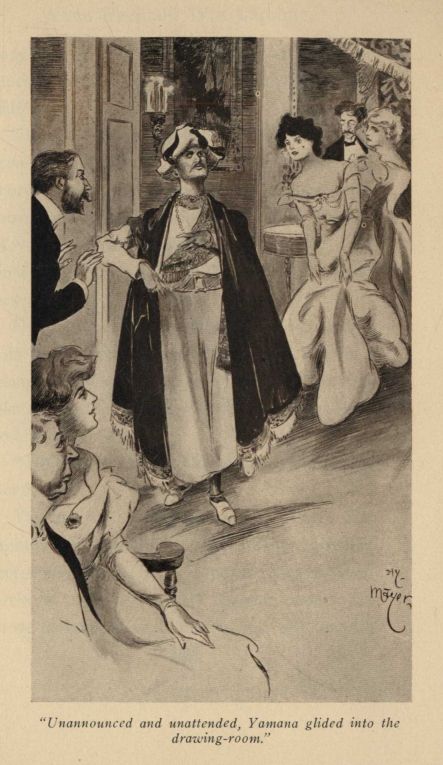
"Unannounced and unattended, Yamama glided into the drawing-room."
Unannounced and unattended, Yamama glided into the drawing-room. I recognized him at a glance, and Caroline's bosom heaved with a conflict of emotions. Little Van Tromp had jumped to his feet.
"Isn't he stunning?" he exclaimed most unpoetically.
Yamama was, indeed, pleasing to the eye. His light-brown complexion, dark brilliant eyes and gorgeous costume made a picture that gave an Oriental splendor to our drawing-room. He stood motionless for a moment, half-way between Caroline and me. Suddenly it flashed upon me that I had a duty to perform. Caroline and I reached Yamama at the same time.
"It was so kind of you to come to us," I heard Caroline saying to the adept. "Mrs. Stevens was overjoyed to hear that you had consented to honor us."
Yamama's black, fathomless eyes smiled at me, like deep, dark pools touched by sunshine. A chill ran through me, but I found strength to say, falteringly:
"Glad to see you, Mr.--ah--Yamama. We're so interested--ah--Reginald and I--in Bhesotericuddhism! Glad to see you! Aren't we--ah--Reggie?"
I suspected that Caroline chuckled behind my beard. I am sure that the smile in Yamama's eyes deepened.
We had grouped ourselves around the adept, who stood calm, picturesque, silent, in the center of the room; the majesty and mystery of the brooding East seeming to fill the universe of a sudden. It was as some priceless Oriental rug had become on the instant not merely an ornament, but a creation of infinite psychical significance.
"Does he talk?" Edgerton whispered to me, and I glanced at him, reprovingly. Mrs. Edgerton was gazing, awestruck, at Yamama. Presently, the adept spoke, in a voice that drove from my fevered mind all thoughts of frogs, snakes and tadpoles.
"Man is composed of seven principles, a unit, but capable of partial separation."
"Well, rather!" I could not refrain from saying, but Yamama ignored my rudeness. He went on impressively, while the group surrounding him listened eagerly, fascinated by his appearance and manner.
"The evolutionary process demands a number of planets, corresponding to the seven principles. On each of these planets a long series of lives is required before a full circuit is made."
"How wildly exciting!" cried Miss Van Tromp. Yamama smiled, indulgently. Then he said:
"Before reaching the perfection attainable, every soul must pass through many minor circuits. We are said to be in the middle of the fifth circuit of our fourth round, and the evolution of this circuit began about a million years ago."
"It knocks the Ferris Wheel silly," I overheard Edgerton mutter to himself, and I felt an unaccountable anger at his flippancy.
"I should so like to ask you a question," faltered Miss Van Tromp, and Yamama bowed his inspired head, resignedly.
"How soon do we come back after we die?"
"When a man dies," answered the adept, in his low, soft, musical voice, "his ego holds the impetus of his earthly desires until they are purged away from that higher self, which then passes into a spiritual state, when all the psychic and spiritual forces it has generated during the earthly life are unfolded. It progresses on those planes until the dormant physical impulses assert themselves, and curve the soul around to another incarnation, whose form is the resultant of the earlier lives."
"That's easy," muttered Edgerton, at my shoulder.
"I've often felt that way," exclaimed Van Tromp, gazing ecstatically at Yamama.
"Are you making converts?" asked Mrs. Edgerton.
A haughty smile, dark-red streaked with white against a brown background, the whole lighted by two eyes of marvelous power, met our gaze.
"Only by soul itself is soul perceived," answered Yamama, somewhat irrelevantly, I thought.
"You're out, my dear," whispered Edgerton, playfully, to his wife.
"May I trouble you, my dear sir," began Van Tromp, pompously--"may I trouble you to explain to a mind darkened by Occidental erudition why it is that the West is so blind to the mighty truths that you teach?"
"That's a touchdown," muttered Edgerton.
Yamama gazed fixedly at the poet for a time. Then he said:
"The West is not blind to the mighty truths of which you speak. You only imagine that you do not see them. Your great thinkers have taught what we teach. Schopenhauer, Lessing, Hegel, Leibnitz, Herder, Fichte the younger, are with us. Your great poets sing the eternal verities. It is nothing new, that which I bring to you from the East."
"Is there--ah--any reason to fear," I dared to ask, "that when we--ah--change around again--I mean--ah--get reincarnated, you see, that we become--ah--frogs or--or snakes--that is, if we don't--ah--so to speak, stay put?"
My voice had been gradually ascending Caroline's scale until it hit the interrogation mark in a sharp falsetto. As Yamama's eyes met mine I thought for an instant that I had been struck by lightning. What his strange glance--cutting through me until I knew that I had no secrets left--meant I had no way of determining. I was like a rabbit fascinated by an anaconda.
"There is salvation for him whose self disappears before truth, whose will is bent upon what he ought to do, whose sole desire is the performance of his duty. The root of all evil is ignorance." Thus spake Yamama, whether in answer to my question I could not decide.
"What's the matter with the love of money?" asked Edgerton, in an unconventional tone of voice. His bump of reverence is not well developed.
"'Tis but a small part of the ignorance that enfolds you like a worthless garment," answered the adept, coldly.
"That's one on me," I heard Edgerton mutter, while Mrs. Edgerton laughed, softly.
"The Enlightened One," went on Yamama, literally in a brown study, "saw the four noble truths which point out the path that leads to Nirvana or the extinction of self."
"Good eye!" murmured Edgerton, and his wife whispered "Hush!"
As I glanced at Caroline, I saw that my face had undergone a change. She was watching the adept with my eyes, but the expression on my countenance was wholly her own.
"The attainment of truth," continued Yamama, "is possible only when self is recognized as an illusion. Righteousness can be practiced only when we have freed our mind from the passion of egotism. Perfect peace can dwell only where all vanity has disappeared."
"I've known that for years," exclaimed Van Tromp, brushing his hair back from his forehead in a self-conscious way.
I had begun to feel faint.
"Won't you be seated--ah--Mr. Yamama?" I asked, hoping that he would observe my indisposition. Even as I spoke, I lost sight of him. The lights went out of a sudden, and a sharp, exquisite pain shot through me. I was surrounded by a fathomless gloom, as if the universe had turned black at a word. I was conscious, but seemingly alone in a dark void. For a moment only was I cognizant of self. Then there came a flash of dazzling light, and I knew no more.
My testimony is at an end. A week has passed since Caroline and I awoke one morning to find our souls transposed. We are still confined to our rooms, suffering, our physician tells us, from acute nervous prostration. But "Richard's himself again!" When we recovered our senses--for Caroline had fainted at the moment when Yamama dissappeared from my sight--we found ourselves restored to our respective bodies; but the shock of our psychical interchange had left us physically weak and depressed.
I have not yet had the energy to compare notes with Caroline in regard to our uncanny experiences. But, fearing that my memory might play me false, I have relieved the tedium of my convalescence by jotting down the foregoing presentment, in the hope, as I have said before, that the data may prove of interest to minds more erudite than mine and my wife's.
Jenkins has returned from Hoboken--or wherever he went--and I have had him remove my beard. It had become a horror to me. Suzanne is very attentive to Caroline, and seems to have recovered her spirits.
One significant fact I have reserved for the last. It has caused me much uneasiness, not unmingled with a sense of relief. Jones has not been seen since the night of our weird dinner-party. No trace of him has been found. I have advertised for a butler, but have not yet received an application that appealed to me in my present supersensitive condition. What I want is a butler as unlike Jones as possible. Unfortunately, he was a pattern of his kind. But I hate the very thought of him, and so I shall drop my pen at this point and watch Suzanne and Caroline through the open door. I think I shall try to get down to the club to-morrow to see the boys.
II.
How Chopin Came to Remsen.
There cometh evil to my house,
And none of ye have wit to help me know
What the great gods portend sending me this.
THE LIGHT OF ASIA.
HOW CHOPIN CAME TO REMSEN.
CHAPTER I.
CHOPIN'S OPUS 47
It brings an instinct from some other sphere,
For its fine senses are familiar all,
And with the unconscious habit of a dream,
It calls and they obey.
N. P. WILLIS.
It has been with the greatest reluctance that I have agreed to submit to the public all the details, so far as they are known to me, of my husband's seemingly miraculous change from an average man into a genius. Poor Tom! He was so happy as a phlegmatic, well-balanced, common-place lawyer and clubman, devoted to his wife, his profession and his friends! But now, alas, his amazing eccentricities demand from me a presentation of his case that shall change censure into sympathy and malicious gossip into either silence or truth.
I am forced to admit at the outset that Tom is justified in attributing his present predicament to my own fondness for music. He had protested, gently but firmly, against the series of musicals that I had planned to give last season.
"They'll be an awful nuisance, my dear," he had remarked, gloomily, gazing at me appealingly across the table at which we were dining en tête-à-tête. "Why not substitute bridge whist in place of the music? Why will you insist on asking a crowd of people who don't care a rap for anything but ragtime to listen to your high-priced soloists? A musical, Winifred, is both expensive and tiresome."
"What a Philistine you are, Tom!" I exclaimed, protestingly, knowing, however, that my dear old pachyderm would not wince at the epithet I had hurled at him across the board. Tom's vocabulary is not large, and possesses a legal rather than a Biblical flavor.
"What's a Philistine?" he asked, indifferently. "If it's a fellow who objects to inviting a lot o' people that he doesn't like to listen to a lot o' playing and singing that they don't like, well, then, I'm it. But what's the use of my getting out an injunction? If you've made up your mind to give these musicals, Winifred, I might as well quash my appeal. I've no standing in this court."
One of the advantages of living with a man for ten years is that one is eventually confronted by a most fascinating problem. "Why did I marry him?" is the question that adds a keen zest to existence. We derive a new interest in life from the hope that the future may provide us with an answer to this query. I can remember now, to my sorrow, that I gazed across the table at Tom's heavy, immobile face, and longed for some radical, perhaps supernatural, change in the man that should render him more congenial to me, more sympathetic, less practical, matter-of-fact, commonplace. A moment later I felt ashamed of myself for the disloyalty of my wish. It may be that subsequent events were preordained as a punishment to me for the internal discontent to which I had temporarily succumbed.
"Tom doesn't look quite fat, my dear," remarked Mrs. Jack Van Corlear to me early in the evening of my first--and last--musical. "Is he working too hard? Jack tells me that Tom has been made counsel for the Pepper and Salt Trust."
"It's not that," I answered, lightly, glancing at Tom and noting the unusual pallor of his too fleshy face. "He's expecting an evening of torture, you know. He hates music. He can't tell a nocturne from a ballade--and they both torment him. But he's an awfully good fellow, isn't he? See, he's trying to talk to Signor Turino. I hope he'll remember that Verdi didn't write 'Lohengrin.' I've been coaching Tom for several days, but it's hard, my dear Mrs. Jack, to make a man who doesn't play or sing a note remember that the Moonlight Sonata is not from Gounod's 'Faust,' and that it's bad form to ask Mlle. Vanoni if she admires 'Florodora.'"
My duties as hostess and the pronounced success of the earlier numbers of my program led me presently to forget Tom's existence. He had been cruelly unjust to my guests in asserting that they would prefer ragtime to the classics. The applause that had rewarded the efforts of both Turino and Vanoni had been spontaneous and genuine. Signorina Molatti had created an actual furor with her violin solo, intensified, no doubt, by her marvelous beauty. It was Molatti's success that presently recalled Tom to my reluctant consciousness. As the dark-eyed, fervid young woman responded smilingly to an insistent encore, I caught a glimpse of my unimpressionable husband, standing erect at the rear of the crowded music-room and watching the girl's every movement with eyes alight with interest and approval. I had not seen his unresponsive countenance so animated before in years. Mrs. Jack Van Corlear had followed my glance, and a mischievous smile was in her face as she leaned toward me.
"Perhaps Tom is more musical than you imagine, my dear," she whispered, maliciously.
"Do you think it's the violin?" I returned, laughingly, ashamed of the feeling of annoyance that her playful pin-prick had given me.
Jealous of Tom! The idea was too absurd. I had so often wished to be, but his devotion to me had always been chronic and incurable. "It's really bad form," I had once said to him; "your indifference to other women, Tom, causes comment. Overemphasis is always vulgar. You underscore our conjugal bliss, my dear boy, in a way that has become a kind of silent reproach to other people. You must really have a mild flirtation now and then, Tom."
It seemed to me that the vivacious Molatti had noted Tom's too apparent enthusiasm, for she smiled and nodded to him as she made ready to coax her Cremona into giving her silent auditors new proof of her most amazing genius. I, a lover of music, had been carried into unknown, blissful realms by the magic of her bow, my whole being throbbing with the joy of strange, weird harmonies that lured my errant soul away from earth, away from my duties as a hostess, my worries as a wife. I came back to my music-room with a thump. Something unusual, out of the common, was taking place, but at first I could not concentrate my faculties in a way to put me in touch with my environment. Presently I realized that Signorina Molatti had left the dais and--could I believe my senses?--that Tom brazenly, nonchalantly, before the gaze of two hundred wondering eyes, had seated himself at the piano.
"What's the matter with him?" whispered Mrs. Van Corlear to me in an awe-struck tone.
"Wait," I answered, irrelevantly; "maybe he won't do it."
"Do what?" she returned, almost hysterically.
"I don't know," I gasped; and the thought flashed through my mind that possibly Tom had been drinking.
There lay the hush of expectancy on the astonished throng. Here and there furtive glances were cast at my program cards in search of Tom's name on a little list made up wholly of world-famous artists. But the large majority of my guests knew as well as I that Tom had never touched a piano in his life, that his ignorance of music was as pronounced as his detestation of it. But he might have been a Paderewski in his total absence of all awkwardness or self-consciousness as he sat motionless at the instrument for a moment, coolly surveying us all, in very truth like a master musician sure of himself and rejoicing in the delight that he was about to vouchsafe to his auditors.
I cannot recall now without a shudder the sensation that cut through my every nerve as Tom raised his large, pudgy hands above the keyboard, his small, gray eyes turned toward the ceiling just above my throbbing head. He looked at that instant like the very incarnation of Philistinism poised to hurl down destruction upon the center of all harmonies.
"It's revenge," I groaned, under my breath, and felt Mrs. Jack's cold hand creep into mine.
Down came the paws of Nemesis, and lo, the injustice that I had done to Tom was revealed to me. His touch was masterly. I could not have been more amazed had I seen an elephant threading a needle. The whole episode was strangely blended of the uncanny and realistic. I found myself noting the angle at which Tom held his chin. He always raised it thus when his man shaved him, his head thrown back and his eyes half-closed.
Then gradually it dawned on me that I was taking keen delight in his rendition of that marvelous ballade in A flat major that Chopin dedicated to Mlle. de Noailles. There is nothing more thoroughly Chopinesque in all the master's works than this perfect exposition of the refined in art. Tom's rendering of the lovely theme in F major, one of the most delicate in the world of music, thrilled me with startled admiration. But a chill came over me. What would he do with the section in C sharp minor, with its inverted dominant pedal in the right hand while the left is carrying on the theme? Without both skill and passion on the part of the performer the interpretation of this passage is certain to be commonplace. But hardly had this doubt assailed me when I knew that Tom had triumphed over every obstacle of technique and temperament, that he was approaching the harmonic grandeur of the finale with the poise and power of genius in full control of itself and its medium.
I have never fainted. Swooning went out of fashion long before my time, and I am devoted to the modern cult of self-control, but if it hadn't been for Mrs. Jack, who is really fond of me at times, I think that the last bar of Tom's Opus 47 would have seen my finish. The room had begun to whirl in a circle, like a merry-go-round in evening dress, when she steadied me by whispering:
"It's all right, my dear. Tom wins by four lengths, well in hand."
I came to myself in the very center of a storm of applause. Our guests had forgotten the conventionalities pertaining to a will-ordered musical. The men were on their feet, cheering. The women waved fans and handkerchiefs, and pelted Tom with violets and roses. The poor fellow sat at the piano in a half-dazed condition. A bunch of flowers, deftly thrown, struck him on the forehead, and he put his gifted hand to his brow as if he had just been recalled to consciousness.
"Encore! Encore!" cried our guests. Turino was gesticulating frantically, while Mlle. Vanoni and Signorina Molatti smiled and clapped their hands in exaggerated ecstasy.
I was worried by the expression that had come into Tom's face, and made my way quickly toward the piano.
"Aren't you well, my dear?" I asked, bending toward him, while the uproar behind me decreased a bit.
"What have I been doing, Winifred?" he asked, sheepishly, like one who wakens from a dream. "Get one of your damned dagos to sing, will you? I've got to have a drink or die!"
Standing erect abruptly, Tom cast a defiant glance at the chattering throng behind me and hurriedly made his way through a side door from the music-room. As I turned away from the piano I saw that Signorina Molatti's eyes were fixed upon his retreating figure with an expression that my worldly wisdom could not interpret. There was more of wonder than of admiration in her gaze, a gleam of questioning and longing that might, it seemed to me, readily flame into hot anger.
CHAPTER II.
REMSEN CONFRONTS A MYSTERY.
From memories that come not and go not;
Like music once heard by an ear
That cannot forget or reclaim it;
A something so shy it would shame it
To make it a show.
JAMES RUSSELL LOWELL.
After saying good-night to the last of my guests, who had expressed regret at the rumor that my husband was seriously indisposed, I hurried to the smoking-room, having learned that Tom had fled thither as a refuge from the curious and the congratulatory. As I came upon him he was alternately puffing a cigar and sipping a brandy-and-soda. On the instant the conflicting emotions that had beset me during the evening became a wave of anger, sweeping over me with irresistible force.
"Why have you deceived me, Tom Remsen?" I cried, sinking into a chair and resting my aching head against its back, as I scanned his pale, weary countenance attentively. "You have always pretended that you had no knowledge of music. I have heard you say that you could not whistle even a bar of 'Yankee Doodle' correctly. What a poseur you have been! And to-night, in a vulgar, theatrical way you suddenly exhibit the most astonishing talent. There is not an amateur in the world, Tom, who can interpret Chopin with such sympathy, such perfection of technique, such reserved power as you displayed this evening. You have placed me in a ridiculous position, and I can't conceive of any reasonable motive for your unnatural reticence. Why, Tom--answer me!--why have you concealed from me the fact that you are an accomplished--yes, a brilliant musician? Think of all the pleasure that we have lost in the last ten years by your deception and falsehoods--for that's what they were, Tom!" My voice broke a little, and I felt the tears creeping toward my eyes. "You have been cruel, Tom! Knowing my passionate love for music, why did you choose to hide a talent that would have drawn us so close together? And your revelation! It was the very refinement of brutality, Tom Remsen, to place me in such an awkward attitude! How could I explain my ignorance of your genius to our friends? They must consider me either a fool or a liar. As for what they think of you, Tom--"
"Stop it, Winifred!" cried my husband, hoarsely, putting up a hand protestingly. "I've had enough. I can't stand anything more to-night. If I tried to tell you the truth you wouldn't believe it, so you'd better leave me. I'll smoke another cigar. I'll never get to sleep again, I fear."
His last words sounded like a groan. My mood was softened by his evident distress.
"Do try to tell me the truth, Tom," I said, gently. "I'll believe what you say. There's a difference between positive and negative lying. I don't think you'd tell me a deliberate falsehood, Tom."
There was something in his appearance at this moment that suggested to me a wounded animal at bay. Presently he lighted a fresh cigar, and gazing at me steadily, said:
"The cold, hard truth is this, Winifred: I never touched the keys of a piano in my life until an hour ago. I remember being drawn irresistibly to the instrument. What happened afterward I don't know. The first thing that I can recall was being hit in the head with some fool woman's bouquet. I remember saying, 'No flowers, please,' in a silly kind of way, but what it all meant I didn't know, and I don't know now. Do you?"
I sat speechless, gazing at Tom in amazement. He had never, in the twelve years of our betrothal and marriage, told me an untruth. I had often caught myself envying women whose husbands spiced the realism of domestic life with a romantic tale now and again. I know a woman who derives great intellectual enjoyment from cross-questioning her lesser half every twenty-four hours in an effort to prove that nature designed her for a clever detective. She would have drooped and died had she married Tom.
As I watched his honest face, pale now and careworn, I realized that I was confronted by two explanations of the present crisis, either one of which was inconceivable. Tom had told me a deliberate lie, or a miracle, to use an unscientific word, had been wrought through forces the existence of which I had always denied.
"No, Tom, I don't know what it means," I answered, presently. "How did you happen to choose the Chopin ballade for your début?"
I had not intended to hurt the poor fellow's feelings, but the change in his expression from weariness to wonderment filled me with remorse.
"I didn't choose anything," he muttered, reproachfully. "If I made an ass of myself, Winifred, I was not responsible. What the deuce did I do? You haven't told me--and I don't know."
By an effort of will I controlled the nervous chill that was threatening me, and said, quietly:
"Tom, you played Chopin's Ballade Number 3, Opus 47, in a way that would have satisfied Chopin himself. No performer living could have equaled your rendition. It was masterly."
Tom's mouth fell open in amazement. He closed it over a brandy-and-soda. "I can't believe it," he cried, setting down his glass and gazing at the smoke curling up from his cigar. "Why, Winifred, the thing's absurd. I never heard the--what do you call it?--in my life. And if I'd listened to it every day for a year I couldn't play it. I couldn't even whistle it."
I laughed aloud hysterically. There was a ludicrous side to the situation, despite its uncanny features.
"What are you laughing at, Winifred?" demanded Tom, angrily. "Is there anything funny about all this? It seems, if I can believe what you say, that I made a kind of pianola of myself without knowing it. Is that a joke? I tell you, Winifred, it's paresis or something worse. Maybe I'll rob a bank next. And when I'm bailed out, I suppose I'll find you on a broad grin."
I was too near the verge of nervous collapse to repress the feeling of unreasonable annoyance that came over me at Tom's words. "I think you're very unjust, Tom," I exclaimed, with great lack of judgment.
"Unjust!" he echoed, petulantly. "Unjust to whom--to what?"
"You're unjust to Chopin," I answered, hotly, realizing that I was talking in a distinctly childish way. "Playing one of his masterpieces is not quite like robbing a bank."
"Why not," he snapped, "if I don't know how to play it? I certainly robbed those fool women of their flowers, didn't I? They pelted me with bouquets as if I were a boy wonder or a long-haired bang-the-keys, and I don't know the soft pedal from the key of E. I wouldn't do Chopin an injustice. He's dead, isn't he? But you mustn't do me an injustice, Winifred. I can't stand anything more to-night."
My heart seemed to come into my throat with a sob, and I drew my chair close to Tom's and took his cold hand in mine. "I'm sorry, Tom. I didn't mean to hurt your feelings, but I've been sorely tried, you must admit. I'm not quite myself, I fear."
Tom turned quickly and gazed squarely into my eyes. "Don't you worry, Winifred. You're yourself, all right. But who the dickens am I? If I'm Tom Remsen, I can't play Chopin. And you say I did play Chopin. I don't say I didn't. But how did I do it? Tom Remsen couldn't do it. Look at my hands, Winifred. Could my fingers knock a pianissimo out of a minor chord?--if that's what that fellow Chopin does. I tell you, it's queer, and I don't like it."
A well defined shudder shook Tom's heavy frame, and his hand, as it rested in mine, trembled perceptibly. His voice had sunk to a whisper as he asked: "Do you think it possible, Winifred, I was hypnotized, Winifred? I never took any stock in hypnotism, but there may be something in it. That Signor Turino has got a queer eye."
"I'm sure I don't know what to think, Tom," I admitted, reluctantly. By abandoning the theory that Tom had deceived me for a dozen years I was plunged into a tempestuous sea of mystery and conjecture. "But come, my dear boy, you are fagged out. We'll talk it over in the morning. Perhaps our minds will be clearer after a few hours' sleep."
"I couldn't sleep now," he returned nervously, glancing at his watch. "Don't go yet, Winifred. It's only two o'clock."
We sat silent for a time, hand clasped in hand, like a youth and maiden awed by a sudden realization of the marvelous mysteries of existence.
Presently Tom spoke again, and I felt that it was a lawyer, in full control of his nerves, who questioned me. "Did I look--ah--dazed--or queer--when I went to the piano, my dear?"
"No, Tom," I answered, after a pause. "You--you--now, don't think me flippant--you looked just as you do when you're being shaved."
"Before all those people!" he gasped. "What do you mean, Winifred?"
"Your chin was up in the air, Tom, and your head was thrown back."
"But you didn't see any lather?" he asked, foolishly.
"Don't be silly, Tom," I cried, petulantly. But I had done him another injustice; he had not intended to be jocose.
"And then what did I do?" he asked, eagerly.
"And then you played that ballade with the inspiration of genius and the technique of a master."
"It stumps me!" he muttered. "Winifred, is there anything about this fellow Chopin in the library? Any books about him?"
"Yes, Tom, several; but you'd better not look at them to-night--if at all. Perhaps to-morrow you won't care to."
Tom's heavy features assumed their most stubborn aspect. He stood erect, still holding my hand, and I was forced to rise.
"Come with me, Winifred. I'm going to solve this mystery before I sleep, even if it takes two days. Come!"
Without further protest I accompanied Tom to the library.
CHAPTER III.
BIOGRAPHICAL DATA.
And, to meet us, nectar fountains still
Poured forever forth their blissful rill;
Forcibly we broke the seal of Things,
And to Truth's bright sunny hills our wings
Joyously were soaring.
SCHILLER.
It was a real relief to get into the library. Tom felt it, and his face soon resumed its normal expression. The heavy shadows beneath his eyes remained, but there had come a flush into his cheeks, and he carried himself with the air of a man who has a purpose in life and is in a fair way to accomplish it. I remember that the idea came into my mind that Tom had assumed the attitude of a lawyer who has been retained by the prosecution and has but little time in which to prepare his case. I had grown tactless, I fear, in my change of mood, for I was indiscreet enough to say, as Tom seated himself beside the library-table, leaving it to me to find the books that he wished to consult; "In the case of Winifred Remsen and others, against the late Frederic François Chopin, charged with house-breaking and breach of the peace."
Tom turned instantly, and a gleam of anger flashed in his eyes as they met mine. "If you cannot treat this matter with the seriousness that I think that it deserves, Winifred, you would do well to retire. It's no joke. When I make a donkey of myself before a lot of perfectly respectable people, I consider it a matter of some importance. You don't seem to grasp the full horror of it all. I suppose that I'm liable to have another attack at any time. In fact, it may become chronic. I have of late come across very curious psychical phenomena in a professional way, Winifred, and I insist on taking every precaution before you are forced to place me in the hands of the alienists."
"Tom!" I cried, in horror, and remorse. "You mustn't talk like that. There's nothing the matter with your mind. I'll admit that I can't explain what happened to-night, but I'm sure that it was not caused by any mental trouble on your part. There is doubtless some very simple and commonplace explanation of your--your----"
"Call it seizure," suggested Tom, curtly. "What do you find there?"
I carried a little armful of books to the table, and placed them within Tom's reach.
"Here's a 'Life of Chopin,' by Niecks," I said. "'Frederic Chopin,' by Franz Liszt. Here's Joseph Bennett and Karasowski and the 'Histoire de ma Vie,' by George Sand. And here are Willeby and Mme. Audley. And I think I have----"
"That'll do for to-night," remarked Tom, seizing the volume nearest to his hand. "What kind of a chap was this Chopin, anyway?"
"He was simply fascinating," I remarked, indiscreetly.
"H'm!" growled Tom, angrily. "Not very respectable, I suppose you mean. George Sand! She was a woman, wasn't she? How did she happen to write his life? What did she know about him?"
I have called Tom a Philistine. Perhaps that was too harsh a term to use, but I'm sure there is a good deal of the Puritan about him.
"She used to see a good deal of him," I answered, rather lamely. "They were great chums for a while."
"H'm," growled Tom, throwing aside George Sand's work and opening another. Presently, he began to read biographical scraps aloud, for all the world like an angry police official drawing up a sweeping indictment against a man of genius.
"'The little Frederick duly received the name of Frederic François, after the son of Count Sharbek, who stood as his godfather,'" began Tom. "'We are told that he very soon showed a great susceptibility to musical sounds, although hardly in the direction which we should have expected, for he howled lustily whenever he heard them.'"
Tom looked up from the printed page, and our eyes met.
"That's a curious coincidence, Winifred," he remarked, musingly. "It's a family tradition that I used to yell like a young Indian whenever they tried to sing to me in my babyhood. A rattle-box would quiet me, but the sweetest lullaby always made me howl. But I must get on. Chopin began well, didn't he?"
There was silence for a time as Tom feverishly scanned the pages of his book.
"The dickens! Listen to this!" he exclaimed, presently. "'During his ninth year he was invited to assist at a concert for the benefit of the poor. He played a pianoforte concerto, the composition of Adalbert Gyrowetz, a famous composer of the time.'"
Tom placed the book on the table, and held the pages open with his hand as he glanced at me over his shoulder. "If he played that kind of thing at nine years of age, Winifred, there was something uncanny about it. It was just as unnatural as what happened to me to-night. I'm beginning to formulate a theory about this kind of thing, my dear." Tom placed the open book face downward, and turned squarely toward me. "Music, you see, may be, like electricity, imprisoned, as it were, in a universe of both conductors and non-conductors. It may be that a temperament, like mine for instance, that is permanently a non-conductor might, under given conditions become temporarily a conductor. Chopin played like a master at nine years of age. He had become a conductor, and remained so permanently. When he howled at music as a baby he was still a non-conductor--just as I had been up to to-night--or rather last night. Possibly, the conditions that made me a kind of spasmodic music-box, with the Chopin peg pulled out, may never occur again. What do you think, Winifred? Doesn't all that sound reasonable?"
Before I could formulate a sensible answer to a not very sensible proposition Tom had resumed the perusal of his book. He appeared to me like a man fascinated against his will by a line of investigation that he had begun as a disagreeable duty. But I was glad to see that he had regained full control of himself, and that his countenance no longer displayed traces of intense mental disquietude.
"He was a pretty lively boy," remarked Tom, a few moments later. "Listen, Winifred! 'At school, Frederic was a prime favorite, and was always in the midst of any fun or mischief that was going on. His talent for mimicry was always extraordinary, and has been commented on not only by George Sand and Liszt but by Balzac.'"
Tom gazed at me, musingly. "Do you consider that significant, my dear?" he asked, with a seriousness that struck me as both ludicrous and pathetic. I was getting worried by Tom's persistence in this futile line of endeavor.
"It's nearly three o'clock, Tom Remsen," I cried, standing erect. "Come up-stairs at once. It won't be fair to your clients for you to get to your office fagged out for lack of sleep."
"Sit down, Winifred," he said, peremptorily. "It's little use I'll be to my clients until I find out what happened to me in the music-room. Suppose that I should have an attack of--what shall I call it?--Chopinitis--in the court-room? I should suddenly begin to sing--or perhaps whistle a--what-d'you-call'em?--pianoforte concerto--what would the judge say? I'd be disbarred, Winifred, for indecent exposure of musical genius. No; I'm going to find out more about this strange affair--here and now."
I was forced to reseat myself, protesting silently against Tom's absurd stubbornness. I endeavored in vain to shake off a feeling of uneasiness that was creeping over me, a sensation that was closely akin to fear of the phlegmatic man who sat before me motionless and calm, pursuing a course of study that had been inspired by a most untenable supposition. What had Chopin to do with the matter? What difference could it make to Tom whether the latter had been one kind of man or another? It was ridiculous to assert that in Chopin's personality might be found an explanation of the curious incident that had made my musical so memorable. My prejudice against Spiritualists, Christian Scientists, Theosophists and other eccentrics had been, I had believed, shared by my husband. But there he sat at three o'clock in the morning trying to find among the biographical data before him some explanation of his recent "seizure," that must, of necessity, lean toward the occult. That a well-balanced, rather materialistic lawyer, whose mental methods were habitually logical, should suddenly begin to dabble in psychical mysteries in this way frightened me the more the longer I weighed Tom's words and actions in all their bearings. Nevertheless, I was forced to admit to myself that he had never looked saner in his life than he did at that moment, as he turned from his book again and gazed straight into my tired eyes.
"He was a very flirtatious chap, Winifred, and very fickle. Listen to this: 'Although of a peculiarly impressionable and susceptible disposition, and, as a not unnatural consequence, more or less fickle where women were concerned, Chopin's love affairs did, on more than one occasion, assume a serious aspect. He had conceived a fancy for the granddaughter of a celebrated master, and although contemplating matrimony with her, he had at the same time in his mind's eye another lady resident in Poland, his loyalty being engaged nowhere and his fickle heart concentrated on no one passion. One day, when visiting the former young lady in company with a musician who was at the time better known in Paris that he himself, she unconsciously offered a chair to his companion first. So piqued was he at what he considered a slight that he not only never called on her again, but dismissed her entirely from his thoughts.' Do you begin to see, Winifred, what a queer fellow he was? Really, I'm inclined to think----"
I was standing erect, gazing at him, angrily.
"If you are joking, Tom," I exclaimed, having lost all patience, "I think you are displaying most wretched taste. If you are really in earnest, I am very sorry for you. I'm going to bed. I hope I'll find you fully recovered at breakfast."
He did not seem to be at all impressed by my exhibition of temper.
"Wait just a moment, Winifred," he suggested, his eyes fixed on his book. "Here it is about George Sand--their first meeting, you know. Wait! I'll read it to you."
"I shall not wait, Tom Remsen," I cried. "Chopin's love affairs are nothing to me--and they should be nothing to you. Good night. This is my last word. Good night."
As I reached the door, I glanced over my shoulder. Tom seemed to have forgotten my existence. He had plunged again into the dust-heap of an old scandal that seemed to fascinate him--Tom Remsen, who had hitherto always deprecated and avoided that kind of research.
CHAPTER IV.
SIGNORINA MOLATTI.
And thou, too--when on me fell thine eye,
What disclos'd thy cheek's deep-purple dye?
SCHILLER.
Two days went by, and while I still pondered the great mystery and kept a close watch on Tom, I had begun to hope that the exactions of his profession had led him to abandon his effort to explain what he had called his "seizure." He had been busy of late with the technicalities involved in the formation of a new trust, and his mind seemed to be wholly engrossed by this gigantic task. By tacit consent we had both avoided all reference to my recent musical and its weird and inexplicable outcome. At times, I was almost inclined to believe that Tom had forgotten Chopin and all his works.
As for myself, I could not recover a normal state of mind. For the first time in my life, I felt an admiration for the very characteristics of my husband's make-up that hitherto had annoyed and wearied me. His ability to rebound at once from the shock that he had sustained filled me with both envy and amazement. I had begun to realize that the mental poise of an unimpressionable, unimaginative man is a very desirable and praise-worthy possession.
I regretted at times that I could not throw myself into some despotic occupation that should demand all my physical and mental energies. As yet, I had not found the courage to face the world and its questionings. For two days, I had denied myself to even my most intimate friends, not excepting Mrs. Jack Van Corlear, who had hurried to me on the day succeeding my musical. I knew that my callers were actuated by a not unnatural curiosity, and I lacked the nervous energy to face people who would politely claim the right to know why Tom had always concealed his genius as a pianist. I think I fully understand the set in which I move. We dearly love a new sensation. Without leaving my house or receiving a single visitor, I could readily grasp the fact that the leading topic of conversation in society at the moment revolved around Tom Remsen as a masterly interpreter of Chopin.
Chopin! I had begun to hate the name. But I had not been able to resist the temptation to spend many hours in the library poring over the books that dealt, directly or indirectly, with his personality and achievements. The temporary enthusiasm that Tom had displayed for research into the life of Frederic Chopin bade fair to become a permanent passion in my case. I devoted whole afternoons to playing, in my amateurish way, his waltzes, mazurkas, nocturnes and ballads. One of the latter, his Opus 47, I had not the audacity to attempt. Somehow, Tom's recent rendition of the piece seemed to stand as a barrier that it would be sacrilege for me to cross. Nevertheless, I longed to hear the ballad again, and was almost tempted to ask Tom to play it to me alone. That he was wholly incapable of repeating his recent performance, my mind refused to believe. I had returned, almost unconsciously, to my first conviction, that my husband had wilfully deceived me for years regarding his musical ability.
I sat poring over an English criticism of Chopin's posthumous works late one afternoon when a card was brought to me in the library that tempted me to come out of my self-imposed retreat. It bore the name:
SIGNORINA MOLATTI.
In the half-light of the drawing-room, the girl looked handsomer than in the glare of evening lamps. Her dark, oriental beauty was at its best in the subdued glow of early twilight. She was dressed in a rich but quiet Parisian costume, and I felt that her attractiveness increased the further she was removed from Signor Turino, Mlle. Vanoni and the other noted artists with whom she associated. Nevertheless, I realized that my manner was cold and unsympathetic as we seated ourselves and I awaited her pleasure. Having had business dealings with the signorina I was not willing to admit that she could assume the right to call on me as a social equal.
But patrician blood must have flowed in Molatti's veins, for she sat there silent and calm, and my skirmish line was driven back. I spoke first. The self-confidence in the girl's smile hurt me.
"It is a pleasure, signorina, to have an opportunity I had not hoped for, to thank you again for the great pleasure you afforded my guests the night before last."
"But it is me, signora, who is in the debt of you," said Molatti, in her soft, musical, broken English. "I hava coma to you to thanka you and to ask a leetle favor. Signor Remsen! oh, eet was so wonderful--so vera wonderful! I hava waited all my leetle life for eet."
I stared at the girl in astonishment. Her enthusiasm, her gestures, the brilliant glow in her dark eyes offended me. And "eet!" What was "eet," for which she had waited all her life?
"Yes?" I remarked, interrogatively. Her fervor was not cooled by the iced water of my question mark.
"Leesten to me, signora. I hava worsheeped Chopin since I was a leetle girl. I have heard alla the great interpretaires of the maestro. But I have nevaire heard Chopin. In my dreams--si, signora, but nevaire in my hours that are awake. But I cama here! Signor Remsen--he playa Chopin! Eet was no dream. Eet was the soul of the maestro speaking to the soul of me. Eet was wonderful--so vera wonderful!"
Conflicting emotions warred within me. I hardly dared speak lest I should either laugh or cry hysterically. With lips compressed I sat motionless, staring at the girl, into whose eloquent eyes there had come a pleading look that suggested tears.
"Signor Remsen," she murmured, presently, like a devotee who breathes the name of an idol--"do you thinka, signora, that he would let me hear him play again? Peety me, signora! I cannot sleep. I cannot eat. I crave only the music of the maestro--music that I hava heard only once in my leetle life. Signor Remsen! Eef he would permeet me--justa once--to accompany him on my leetle violin--oh, signora, I coulda then die happy. I should hava leeved just a leetle while, and then I would not care. But now, I am so unhappy--so vera miserable!"
I was too nervous to stand this kind of thing any longer. I rose, and Molatti faced me, erect at once.
"You pay my husband's talent a great compliment, signorina," I said, coldly; "but I cannot take it on myself to answer you in his name. However, I shall present your request to him and let you know at once what he says." A diabolical impulse came over me, and I added: "Of course, Mr. Remsen would not wish you to starve, signorina, nor to die a horrible death from insomnia."
The girl spiked my guns--if that be the right expression--by a merry, musical laugh.
"You are so vera kind!" she cried. "I kissa your lovely hand."
Before I could prevent it she had touched my outstretched hand with her red, smiling lips; then she took her departure. I returned to the library in a condition that verged dangerously on complete nervous collapse.
At dinner that evening, Tom was unwontedly silent. As I glanced at him over my soup there was something in his face that suggested thoughts not connected with the Pepper and Salt Trust. I was soon to become accustomed to this expression and to identify it in my mind as "Chopinesque."
"Aren't you feeling well to-night, Tom?" I ventured presently, noting that he was drinking more wine than usual.
"A bit tired, Winifred," he answered, absently. Then his eyes met mine, and I saw that he was worried. I had planned to fulfill conscientiously my promise to Signorina Molatti, but the time seemed inopportune. I was glad, presently, that I had refrained from mentioning my caller and her mission. As we were sipping our coffee Tom tossed an envelope across the table to me.
I opened it with a chill misgiving. It ran as follows:
MR. THOMAS REMSEN.
DEAR SIR: As it has come to the knowledge of the Executive Committee of the Chopin Society of New York that your rendition of the works of our master is unexcelled by any living performer, we humbly beg of you to accept the hospitality of our association at an early date, to be chosen by you. Our members and their guests would consider it the highest of privileges could they be permitted to hear you play such selections from Chopin as you might wish to perform. Thanking you in advance for the great joy that you will vouchsafe to us by accepting this invitation, we remain, etc.
There lay a wan smile on Tom's face as he met my gaze. "Kind, aren't they?" he muttered. "What the deuce'll I write to 'em, Winifred?"
"You can't accept, of course," I said, confidently. Then I hesitated, surprised at the queer gleam in Tom's eyes. "Can you?" I added, weakly.
"I can, I suppose," he remarked, with an effort at playfulness. "There's no law against it."
His answer struck me as strangely unlike him. If he had cried, "The Chopin Society be damned!" I should have felt more at ease, less oppressed by a sensation of nameless dread. There was something distinctly uncanny in Tom's manner.
"It would be a good joke on 'em, wouldn't it, if I should accept their bid?" he remarked as he lighted his cigar. "Confound their impudence! That's what they deserve."
"But--but--Tom, would you try to--to play?" I gasped, in dismay.
Tom laughed in a way that shocked my overwrought nerves. It was a shrill, unnatural note of merriment, that struck me as diabolical. "Play?" he repeated, sardonically. "Why not? Do you imagine, madame, that the marvelous genius of Thomas Remsen, interpreter of Frederic François Chopin, is to be confined strictly to your musicals? That would be a gross injustice to the music-loving world, would it not? But come into the library with me, Winifred. I must resume my studies as a student of 'the master.'"
I followed Tom mechanically, fascinated by his gruesome mood. For the life of me I couldn't tell whether he was joking or in earnest, whether it was his mind or mine that had lost its poise.
CHAPTER V.
A POLISH FANTASIA.
Ah, sure, as Hindoo legends tell,
When music's tones the bosom swell
The scenes of former life return.
DR. LEYDEN.
I made a clean breast of the whole matter to Mrs. Jack Van Corlear the next morning. I had sent for her early in the day, saying that I was in trouble and needed advice, and she came to me at once. It was a great relief to me just to look into her eyes and hold her hand.
"It's about Tom!" she remarked, sagely. "Has he done it again?"
Her question made me realize fully the awkwardness of my position. Close as our friendship had been, I had never gossipped about Tom to Mrs. Jack. If there is anything more vulgar than what Tom had once called "extra-marital confidences between women," I don't know what it is. But I was forced to talk about my husband's increasing eccentricity to somebody, or endanger my own mental health. I knew that I should derive temporary nervous restoration from a heart-to-heart confab with a woman who has the reputation of being "a mighty good fellow." I have heard people complain that Mrs. Jack was "too horsey" for their taste. But if you are seeking a friend who shall possess courage, reticence and common sense, pick out a woman that rides. A fondness for horses seems to enlarge a woman's sympathies, while at the same time it increases her discretion.
"He has not actually done it again, my dear," I answered; "but he threatens to. He informed me at breakfast this morning that he intended to accept the invitation of the Chopin Society. Furthermore, he said he was going to send the society a cheque for their Chopin Monument Fund."
"Tom's a thoroughbred, isn't he?" exclaimed Mrs. Jack, with what struck me as ill-timed enthusiasm. "But tell me more about Signorina Molatti. Did you keep your promise to her?"
"Yes; I told him this morning about her call. Do you know, he seemed to be actually pleased. It wasn't like Tom at all. Young women always bore him. And he has a special abhorrence for people connected in any way with the stage."
"Now, Winifred, tell me honestly: Has Tom never played a note in all the twelve years that you have known him?"
"Never! never! never!" I cried, hotly. It was so hard to make even Mrs. Jack, who fully understands me, get at my point of view.
"And he wins a big handicap the first time he starts," mused my confidante. "It's miraculous! Is there a strain of music in his blood, my dear? Any of the Remsens gifted that way?"
"Not that I ever heard of," I answered, rather petulantly. Mrs. Jack's surmises seemed to be as unsatisfactory as my own solitary musings.
"Is he going to play for Molatti?" she asked, presently.
The blood rushed to my cheeks as I realized that this was the keynote to the whole conversation. "He says he is," I confessed, reluctantly. "You may not believe it, but he actually joked about it; said that it would be cruel on his part to withhold from 'a worthy young woman'--what an expression!--a pleasure that might restore her appetite and sleep."
Mrs. Jack laughed aloud, despite the frown on my brow. "Give him the bit, my dear," she advised, playfully. "You aren't afraid of a little black filly over a distance, are you? But tell me, what does Tom say about it all? You tell me that he speaks of his recent rendition of the Chopin ballad as 'a seizure.'"
"For nearly two days, my dear, I fondly imagined he had forgotten all about it. He didn't speak of it. But last night he went into the library and recommenced his researches into the life of Chopin. I couldn't help laughing at some of the comments he made, but he was in dead earnest all the time. I am forced to believe Tom really thinks he is--it seems so absurd when one puts it into words--thinks he is haunted by Chopin's spirit, or something of that kind."
Mrs. Jack's mood changed and the merriment in her face disappeared. "Do you know," she remarked, thoughtfully. "I am sometimes inclined to think that we are awfully ignorant about some things. I have heard of so many queer occurrences of an uncanny nature lately--and among the very nicest kind of people, too. And it used to be really good form to have a family ghost, you know. Perhaps it's coming in again. Old fashions have a way of cropping up again, haven't they?"
I could not refrain from smiling at Mrs. Jack's peculiar attitude toward psychical mysteries. However, I refused to be led into generalities. "But just look at the ludicrousness of the idea," I began. "Admitting, my dear, that Chopin's soul has grown uneasy and desires a temporary reincarnation, would he be likely to select Tom as a--what shall I call it?--medium? Wouldn't he be more inclined to haunt a man who was naturally musical, or at least loved music? But you know, Mrs. Jack, what Tom is. He hasn't the slightest liking for music of any kind. Unless he has been a great actor for many years, never for an instant forgetting his role, I'm sure of this."
"What can we know about the methods or longings of a disembodied spirit?" argued my confidante, logically enough. "Perhaps Chopin was backing a long shot, just for the excitement of the thing."
I glanced at Mrs. Jack, half-angrily. I thought for a moment that she was inclined to poke fun at me. But her face was as serious as mine, and I repented quickly of my unjust suspicion.
And thus we talked in a circle for an hour or more. Mrs. Jack lunched with me, and finally persuaded me to spend the afternoon with her, driving along the river side. As we drew up in front of the house about five o'clock, I turned to her with gratitude in my heart and eyes and voice.
"Thank you so much, my dear," I said, gratefully. "I'll come to you in the morning if there are any new developments in the case." I had turned away when Mrs. Jack called me back.
"It's a problem that you and I can't solve, little woman," she said, affectionately. "If he has another attack, or any new symptoms develop, what would you think of consulting a specialist? I'd go with you, of course. We needn't give out names, you know."
"A specialist--in what?" I asked, trying to repress a feeling of annoyance that I must conceal from a friend who had been all kindness to me at a crisis.
"Think it over," returned Mrs. Jack, vaguely. "I'm sure I don't know who is an authority on--what did Tom call it--Chopinitis. But come to me in the morning, anyway; I may have something really practical to suggest. And don't touch him with the whip! Tom's a thoroughbred, you know, my dear. Good-bye!"
As I entered the hall, depressed by a quick reaction from my recent cheerfulness, I was roused from my self-absorption by a revelation that drove the blood to my head and made me dizzy for a moment. From the music-room, always unoccupied at this hour of the day, came the weird, searching harmonies of a Polish fantasia arranged for the piano and violin. The effect was marvelous. Softened by distance, the perfect accord of the two instruments bore testimony to the complete sympathy that existed between the pianist and the wielder of the bow. There was something in this half-barbaric music that set my veins on fire. Hardly knowing what I did and with no thought of what I intended to do, I crossed the drawing-room quickly and noiselessly, and stood motionless at the entrance to the music-room.
I remember now that I felt no sensation of astonishment at what I saw. It seemed to me that the picture before my eyes was just what I had come from a remote distance to gaze upon.
Tom was seated at the piano, his back toward me. Beside him stood Signorina Molatti, her Cremona resting against her shoulder. They had not heard my footsteps, and I realized that if I had yelled like a wild Indian they would not have come to earth. They played like creatures in a trance, and I felt the strange, seductive hypnotism of the mad, sweet, feverish music that they made, as I stood there voiceless, motionless, helpless, hopeless. Vainly I appealed to my pride. Vainly I strove to act as one worthy of the name of mondaine. The shock had been too sudden, too severe, and I could not trust myself.
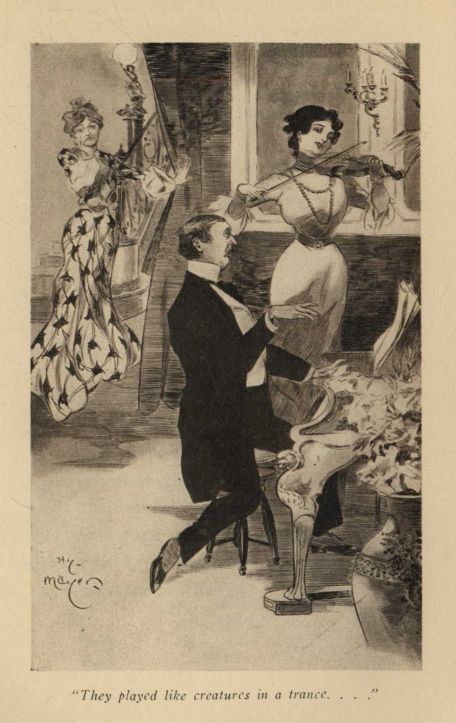
"They played like creatures in a trance..."
As silently as I had come, I crept away. Recrossing the drawing-room, I encountered the butler in the hall. My face flushed with shame as I said to him:
"If Mr. Remsen asks for me, James, say that I have not returned."
Then I stumbled up-stairs to my rooms, dismissed my maid curtly, and gave way like a foolish girl to foolish tears.
CHAPTER VI.
CONSULTING A SPECIALIST.
An angel is too fine a thing
To sit behind my chair and sing