RIDE TO THE GEYSERS. (continued 2)
Ólafur Pálsson translation
Such were some of our thoughts as we stood, at midnight, 129singing these grand old psalm tunes, by the side of the Geyser; reminded, in a peculiar manner, that the whole surface of the globe is after all but a thin crust, cooled down and caked over the great molten central mass of liquid fire which constitutes our planet; and how easily, were latent forces called forth, or even were those powers which are already developed only roused into more energetic action, the whole might explode[10] like a shell filled with molten iron—the myriad scattered fragments then “spinning down the ringing grooves of change” as a shower of asteroids—nor could the orphaned moon survive the dire catastrophe!
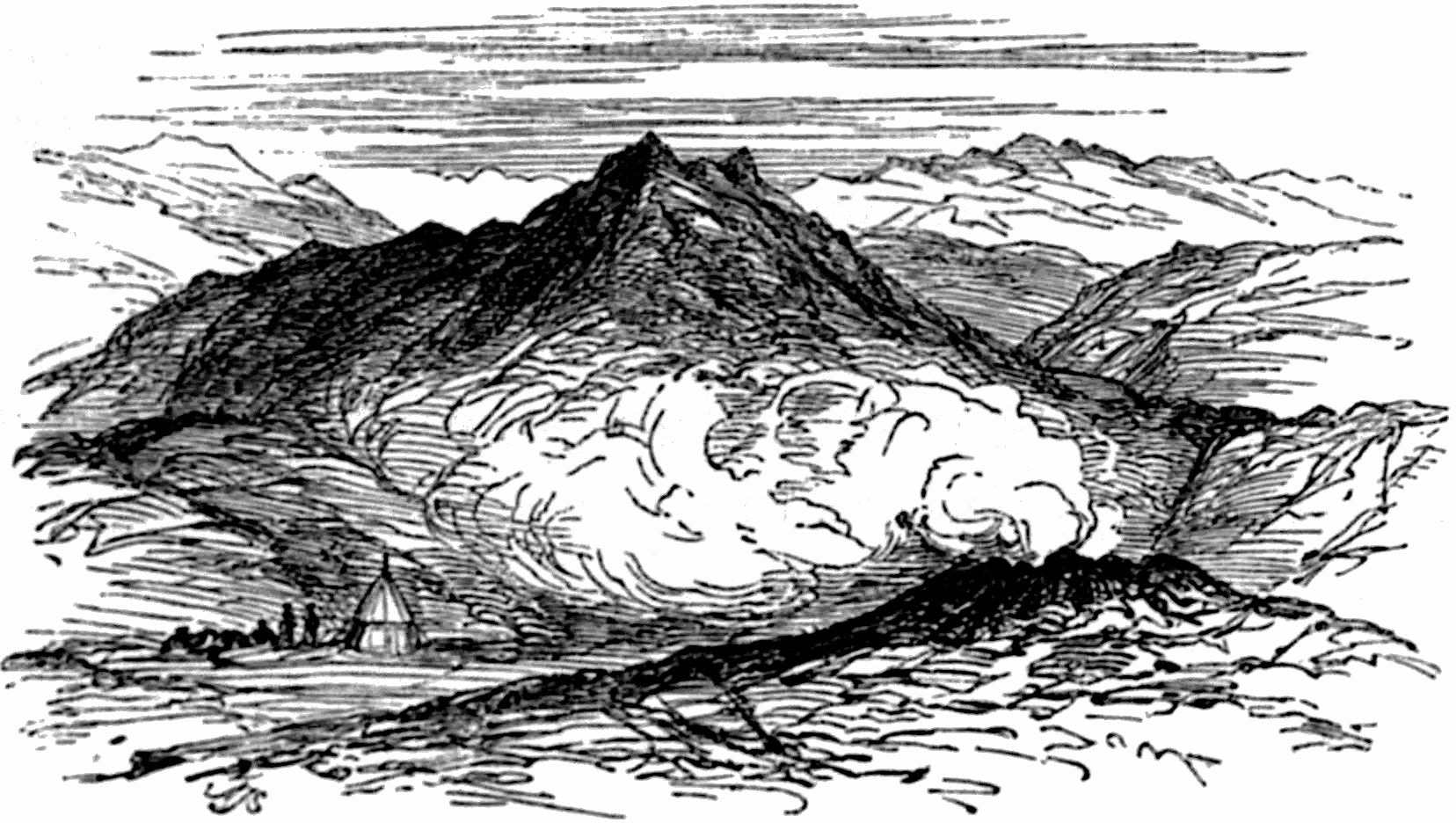
THE GREAT GEYSER.
Although midnight is spoken of, it was quite light, and I sketched for nearly an hour and a half, beginning at a 130quarter-past 12 o’clock. Before Professor Chadbourne left for the night-quarters which Zöga had secured for him at the neighbouring farm, we two stood together on the brink of the Great Geyser, filled our glasses with its hot water—pure, and, as soon as it cooled down below the scalding point, drank to absent friends on both sides of the Atlantic; this toast having special reference to our own distant homes. Then four separate Geyser-bumpers were devoted respectively to Longfellow, William and Mary Howitt, Dr. Laurence Edmondston of Shetland, and Gísli Brynjúlfsson the Icelandic poet.
Properly speaking there was no night at all; only a slight dim towards two o’clock in the morning, which I took as a hint to get quietly under the canvas of our tent. The wind rose, increasing to a gale; our tent-lining came down and the sides flapped up, fluttering in the wind with a noise like platoon firing. For me, sleep was impossible; but as I was very tired and things could not well be much worse, I patiently lay still till five o’clock in the morning, when we all rose, and Zöga struck the tent. The wind blowing from the north-coast, on which many icebergs were at present stranded, was piercingly cold, and reminded us of the Duke’s allusion, in the forest of Arden, to
“The icy fang
And churlish chiding of the winter’s wind;
Which when it bites and blows upon my body
Even till I shrink with cold, I smite and say,
This is no flattery.”
As breakfast would not be ready for a couple of hours, I took some brandy and hot water at the Geyser, literally to stop my teeth from chattering, and descended into the 131gully behind to examine the banks of coloured clay. These lie, just under the Geyser, on the north-west side. Steam may be observed escaping from many little clay holes, and the sound of boiling may be heard inside at places where there are no holes. This hot clay is deposited in horizontal layers, red, purple, violet, white, light blue, and pale green. These colours occur by themselves, and are also occasionally found mixed together, mottled and variegated like a cake of fancy soap or a sheet of marble paper. Judging by the taste, the clay seems impregnated with sulphuric acid; and, to the touch, it is of a very fine consistency, having no grit whatever. I secured specimens of the finest colours, cutting them like butter with a table knife, and filled several empty preserved-meat cans to take home for analysis. The colours are most beautiful, but, apparently caused by oxydized iron, would, I fear, be useless as pigments. If this fine clay could be put to any use in the potteries, thousands of tons might be obtained here and also at Krisuvik.
What leads me to suppose that the colouring matter of the alumina chiefly consists of iron, is the fact that, excepting where the layers were evidently freshly laid bare to view by water or by some other mechanical means, the banks, however beautifully variegated beneath, invariably exhibited no colour but red on the surface; or, in other words, the iron was uniformly oxydized by exposure to the air.[11]
Further down the gully, we came upon large rough slabs of whitish stone, beautifully variegated with tints 132of violet, red, and yellow, dashed with blue. These were in compact laminae, and each colour about the fourth of an inch in thickness. In several instances however the colours, as in the clays, were mixed. I broke up several masses, and secured a number of the most characteristic and beautiful specimens. We also obtained chalcedony and agate, at times approaching to opal; these and cornelian being only varieties of silex, colour making the chief difference.
Before filling some bottles with Geyser water, as the wind was fresh, I set one of them afloat to be carried across the basin before it. When the half of its venturous voyage was accomplished and it had reached the tube in the centre, a little eruption came on, by which the bottle was thrown up, and floated over the outer edge of the basin. I succeeded in getting hold of it uninjured, arrested in a little pool amid the boiling water which was flowing down the sides, and afterwards filled it, marking it specially for Dr. R. Angus Smith;—“one whose name,” in a different sense however from that in which Keats used the expression, “is writ in water,” and let me add, in air too; for, in connection with sanatory matters and the supply or purification of these two health-giving elements to towns, no man in Europe has analyzed more water; nor was there any known index of local atmospheric insalubrity but the mortality bills, till he made his great discovery—the Air-test. On all such subjects there is no higher scientific authority.
Wandering, once more to bid farewell to the other springs, we could not but remark that the whole slope is a thin crust, with innumerable caldrons below; these each preserve their individuality, although the central heat be 133common to all, for the various eruptions seem to be quite independent of each other. Blesi was quite tranquil during the eruption of its neighbour the great Geyser; and the other springs take as little notice of the Little Geyser’s activity as it does of Strokr. Wonder ever increases, although the ground has been gone over so often as to be already quite familiar to us.
Breakfast waits and is soon despatched with keen relish. Packing done, horses ready, and a guide left to find three that have strayed, we start on our return journey to Thingvalla and Reykjavik at a quarter to eight A.M. Truly, as Shakspere hath it,
“Nature oftentimes breaks forth
In strange eruptions!”
The wind was still from the north and bitterly chill. On rounding the shoulder of the hill, we picked up the Professor, at the farm house. The room he slept in had been all carefully washed out on purpose to receive him, the earthen floor as well, so that it was very damp. He was assisted to undress by the hostess, till he called a halt, and insisted on retaining some portion of his under-clothing. Then, after he lay down, a basin of milk was brought and placed at his bed-side. Had he looked under the pillow, he would probably have discovered a bottle of brandy deposited there for his own especial use; but, as the worthy Professor would have left it precisely as he found it, no “sense of loss” dawned upon him when the probability was hinted at.
Rector Jonson subsequently explained to me the rationale of the hostess, or her daughter, attending to guests. Among the Icelanders, wet feet and thorough 134drenchings are incident to locomotion. It is the universally acknowledged duty of the female department to render the way-worn traveller such assistance as he may require, taking away his wet stockings and mud-soaked garments at night, and returning them to him, dry and comfortable, in the morning. This simple old custom, which is also to be met with in various parts of Norway and Sweden, will give the key to many funny exaggerations on the subject, where the art of putting things has been employed chiefly in the direction of the ludicrous.
We see on the way many lovely wild flowers, which confirm our previous observation that they are larger in the petals, but smaller in the leaves and stems than the same kinds at home; the aroma is also less. This is caused by their receiving more light and less heat, in the short Icelandic summer, than in more southern climes.
Graceful white sea-swallows are darting about; curlews are very tame, flying within a few yards of us or sitting unconcerned on stones till we ride past them, noting their beautifully speckled breasts, long bent bills, and plaintive tremulous whistle.
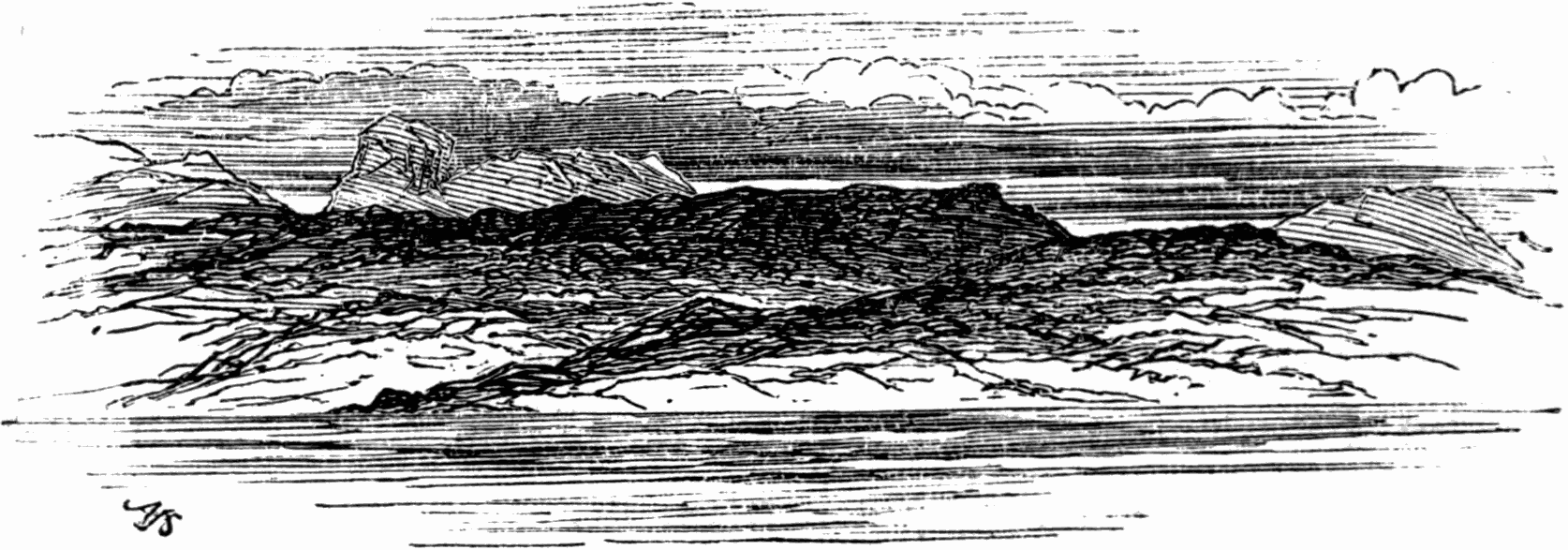
SKAPTÁR JÖKUL.
The atmosphere was now much clearer, and many distant snow-covered mountains were visible on our left. 135Zöga pointed out one of a peculiar shape, which he informed us was Skaptár Jökul, the most destructive volcano in the island. Of this, however, again.
A bird, with a red breast, perched on a block of lava near us; this, the Professor told me, was the American robin. It seemed as large as our blackbird.
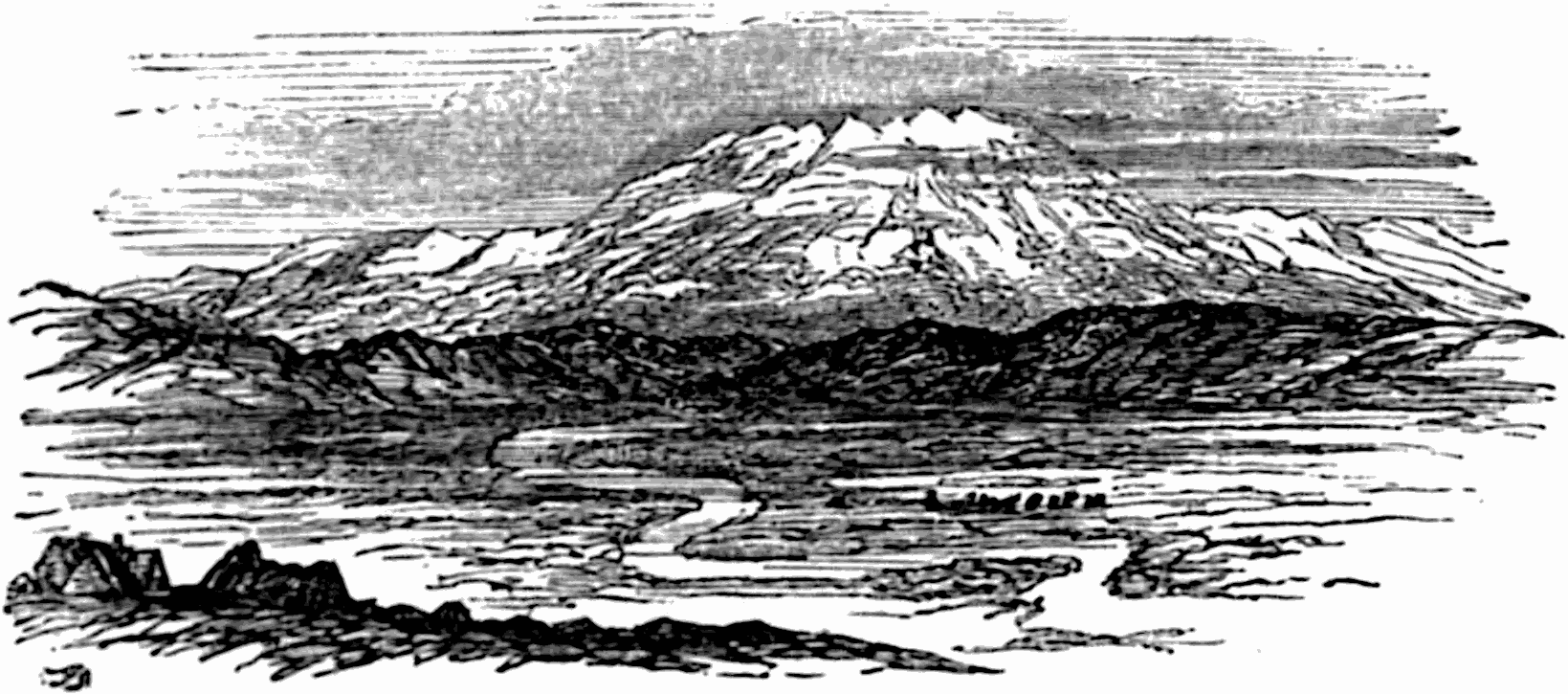
MOUNT HEKLA.
Retracing our steps, we crossed the Bruará, ascended the heights, and at length got into the green level plain, halting at the same spot where we had rested in coming along. Here we obtained a magnificent view of Hekla, and made a number of sketches. The prospect varies but little, as we ride along skirting the hills and at length ascend them on the other side of the plain. From this point, Hekla still appears dome-shaped; the three peaks being scarcely perceptible from the distance—about thirty miles—at which we stand, and only indicated by very slight dints in its rounded outline. The mountain, covered with snow and mottled here and there with black patches, rises beyond a low range of purple hills and towers high above them, in shape and colour not unlike Mont Blanc as seen from the banks of the 136Arve below Geneva, if we could only imagine the monarch of mountains deprived of his surrounding Aiguilles, and left standing alone over the vale of Chamouni.
The bird’s-eye view of the great flat green plain, with rivers meandering through it, which stretches from the low range of purple hills over which Hekla rises to the foot of the heights on which we now ride, is both striking and picturesque.
About twenty volcanoes have been in action in Iceland for the last 1000 years. Of these the eruptions of Hekla have been the most frequent, although by no means so destructive as many of the others. Only attaining a height of about 5000 feet, it owes its celebrity to the frequency of its eruptions; to its rising from a plain, being visible from a frequented part of the island, and quite accessible; and also to the fact of its being well seen, from the sea, by vessels sailing to Greenland and North America. Four and twenty eruptions, of lava, sand or pumice, are recorded; the last having occurred in 1846. The intervals between these eruptions vary from six to seventy-six years, the average period being thirty-five; but some of them have lasted as long as six years at a time.
We give an account of one of these eruptions, selecting that of 1766, which was remarkable for its violence. “Four years before it took place, when Olafsen and Povelsen were there, some of the people were flattering themselves with the belief, that as there had been no outbreak from the principal crater for upwards of seventy years, its energies were completely exhausted. Others on the contrary, thought that there was on this account only more reason to expect that it 137would soon again commence. The preceding winter was remarkably mild, so that the lakes and rivers in the vicinity seldom froze, and were much diminished, probably from the internal heat. On the 4th April 1766, there were some slight shocks of an earthquake; and early next morning a pillar of sand, mingled with fire and red hot stones, burst with a loud thundering noise from its summit. Masses of pumice, six feet in circumference, were thrown to the distance of ten or fifteen miles, together with heavy magnetic stones, one of which, eight pounds weight, fell fourteen miles off, and sank into the ground though still hardened by the frost. The sand was carried towards the north-west, covering the land, one hundred and fifty miles round, four inches deep; impeding the fishing boats along the coast, and darkening the air, so that at Thingore, 140 miles distant, it was impossible to know whether a sheet of paper was white or black. At Holum, 155 miles to the north, some persons thought they saw the stars shining through the sand-cloud. About mid-day, the wind veering round to the south-east, conveyed the dust into the central desert, and prevented it from totally destroying the pastures. On the 9th April the lava first appeared, spreading about five miles towards the south-west, and on the 23d May, a column of water was seen shooting up in the midst of the sand. The last violent eruption was on the 5th July, the mountains in the interval often ceasing to eject any matter; and the large stones thrown into the air were compared to a swarm of bees clustering round the mountain-top; the noise was heard like loud thunder forty miles distant, and the accompanying earthquakes were more severe at 138Krisuvik, eighty miles westward, than at half the distance on the opposite side. The eruptions are said to be in general more violent during a north or west wind than when it blows from the south or east, and on this occasion more matter was thrown out in mild than in stormy weather. Where the ashes were not too thick, it was observed that they increased the fertility of the grass fields, and some of them were carried even to the Orkney islands, the inhabitants of which were at first terrified by what they considered showers of “black snow.”[12]
This mountain, with its pits of burning sulphur and mud, and openings from whence issue smoke and flames, is associated with the old superstitions of the Icelanders as the entrance to the dark abode of Hela, and those gloomy regions of woe where the souls of the wicked are tormented with fire. Nor are these ideas to be wondered at in connection with the terrible phenomena of such an Inferno.
As Hekla lay gleaming peacefully in the sunshine, with a heavier mantle of snow, we are told, than usual, I bade adieu to it by attempting yet another sketch from the pony’s back, pulling the rein for five minutes, and then galloping on after my companions.
Having rounded the shoulder of the hill, we now lost sight of Hekla and the greater part of the plain. In a region where some brushwood and a few flowers grew among dark coloured rocks, we came upon a fine 139example of ropy looking lava, curiously wrinkled in cooling, and all corrugated in wavy lines. Soon afterwards we saw a sloping mass of rock, some sixty feet square, inclined at an angle of 25°, polished smooth by the ice-drift, and deeply abraded in grooves, all running southwards. The marks were not to be mistaken, and were more distinct than those we had observed in coming.
Here I gathered specimens of geraniums and other flowers, placing them between the leaves of my pocket Wordsworth. Coming to a glade of dwarf willows, we observed bees feeding on the flowers of the flossy species, and were forthwith, even in this northern region, reminded of Mount Hybla, recalling Virgil’s line,
“Hyblæis apibus florem depastâ salicti.”
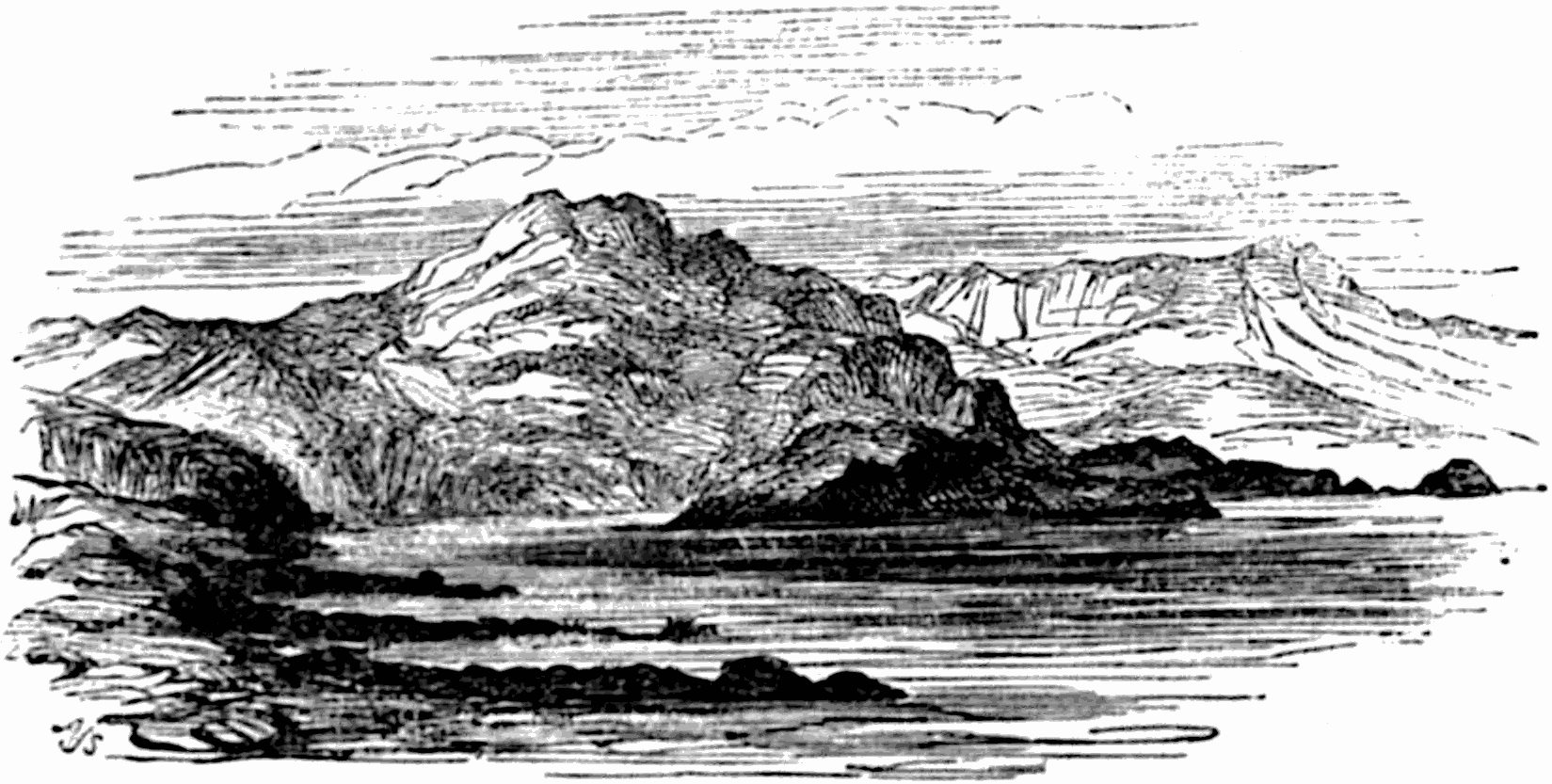
LAKE OF THINGVALLA.
The Professor, Mr. Murray, and I, riding together, now reached and descended the Hrafnagjá or Raven’s Chasm, which has already been described. It was steeper than a stair, full of breaks and irregular turns. 140At some places, the ponies drew up their hind legs and slid down. It seems more perilous to descend than to climb such places, but the ponies are very sure-footed. On a bosky slope, I pulled the bridle and made a sketch of the lake of Thingvalla, the waters of which were intensely blue.
Crossing the plain of Thingvalla, we reached our rendezvous—the Pastor’s house—about nine o’clock at night, after a splendid day’s ride; some of us, much to our own surprise, being not only in excellent spirits, but fresh and in good physical condition; rough-riding feats and prolonged fatigues notwithstanding. We dined on trout, soup, &c.; and at 20 minutes to 11 P.M. I wandered out, alone, to the Althing to sketch and gather flowers.
The three lost ponies, that strayed from the Geysers, have just come in. I see them now scampering before the guide and passing the waterfall of the Oxerá, which thunders over the black rock-wall, about half a mile from the descent into the Almannagjá. The fall looks like a square sheet of burnished silver from the sacred Lögberg or Hill of Laws, on which I now sit writing, entrenched and moated round with deep volcanic chasms about two-thirds filled with clear water.
Skialdbreid—or Broadshield—Jökul, to the north-west, is mottled towards its base with black patches, but its summit and flanks are lit up with pure roseate light. Armannsfell, one of a range nearer and more to the north, is of a dark rich venetian red colour touched with bronze and exhibits a living glow, an effect I have never elsewhere seen equalled or even approached. Whereever the light falls, all is transfigured and glorious beyond description; yet there is no approach to hardness, 141either of line or tint, but an atmosphere of subduing softness, transparency, and purity, magically invests everything with an etherial spiritual beauty: such effects are peculiar to Iceland.
Having made a sketch of the lake, I retired to rest, the last of our party. We slept, without undressing, in our old quarters—on the floor of the pastor’s parlour.
Tuesday morning.—Rose between five and six o’clock, and went out to gather ferns—aspidium or crystoperis—on the Althing. The scene around was singularly wild, and yet strikingly picturesque in its desolate strangeness; while the tender green of the valley itself afforded a refreshing rest to the eye. On returning I made a sketch of the priest’s house;[13] examined the site of the little church which was being re-erected; strolled down by the river side, and performed my ablutions in it—laying my clothes in the priest’s fishing coble, which was lying hauled up on the bank.
I then paused at the simple churchyard close by, and tried to conjure up life and heart histories for those who had entered this “Saula-hleith”—or soul-gate, as the churchyard is beautifully named—while hymns were being chanted over them, and who were now resting peacefully beneath the green sod.
Conversation with the pastor was again attempted to be carried on in Latin. His morning salutation was “bonus dies,” or other remarks about the weather, as with ourselves. After squaring accounts, on leaving, we gave him—as a nimbus for the rix-dollars—a mediaeval “pax-vobiscum,” in exchange for his many expressions of good-will towards us, and his rounded classical “vale!”
142The glebe hay was being tedded, but the ground here as elsewhere is covered with little hummocks. Were it only levelled and drained, the soil, one would think, should raise turnips in quantity, and, certainly, larger hay crops would be obtained. During the short summer there is not time for the grain to ripen; but food suitable for cattle might readily be grown in the valleys; for it is chiefly by the rearing of stock, that Iceland, when she can muster the requisite enterprise and activity, will, in all probability, advance to commercial prosperity.
After sketching the gorge of the Almannagjá—see illustration, p. 81—we ascended it, crossed the lava plateau, and rapidly retraced our steps to the capital, only pausing now and again to take a sketch.
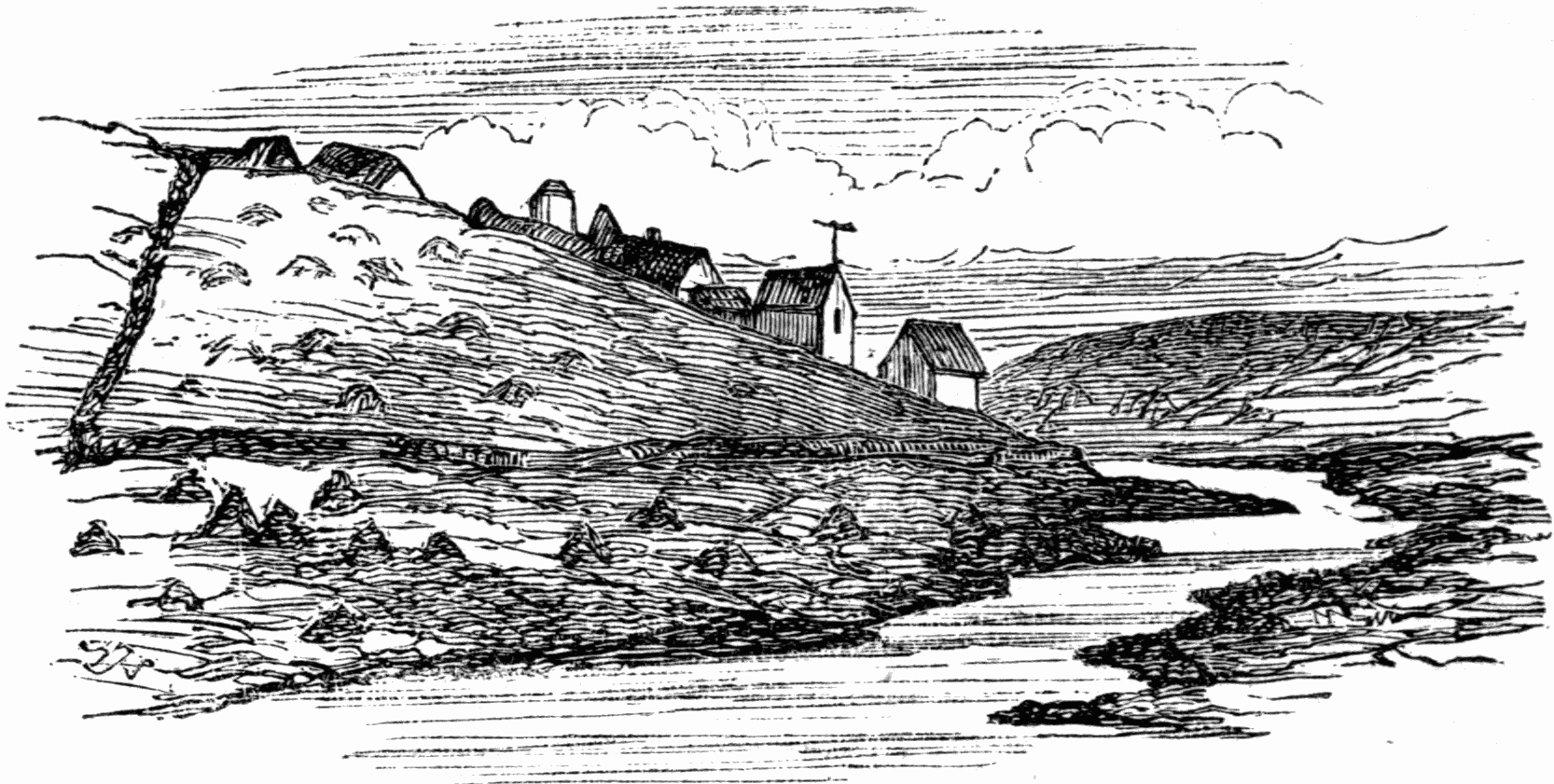
ICELANDIC FARM.
Over the last part of our journey, from the river which we forded just below the farm house on the hill, to Reykjavik, we rode like the wind—men and horses alike eager to get to the end of their journey. Our entry into the town was a regular scrimmage. It was a quarter to 143three P.M. when we got in, having done the distance from Thingvalla in six hours. By this time we had ceased to wonder at any feats performed by the ponies. Seldom, if ever, disconcerted, they go at anything in a most patient philosophical manner, and get over difficulties which elsewhere one would think insurmountable, and sheer madness to attempt. Thanks to mackintosh overboots—made specially for the purpose—at the end of the journey, I was the only one of our party whose feet were dry.