Chapter XXVI · HIIAKA CONTINUES HER PRAYERS
Reading edition
While Hiiaka in her ministrations did not omit anything that might aid and expedite Lohiau’s physical recovery, her chief reliance was in the spiritual aid of the gods; for which purpose prayer followed prayer like the pictures in a moving show:
He Mele Kunikuni no Lohiau
Ka pule kanana ola i mua o ke kahuna:
Kulia i Kupukupu o-luna nei.
O imi, imi, o nalowale, i loa’a e—
Loa’a kau hala, uku i ka oiwi.
No ke aloha i kono, haele maua;
I ike aku au i ka uwé ana iho, e.
Eli-eli kapu, eli-eli noa. Ua noa-a!
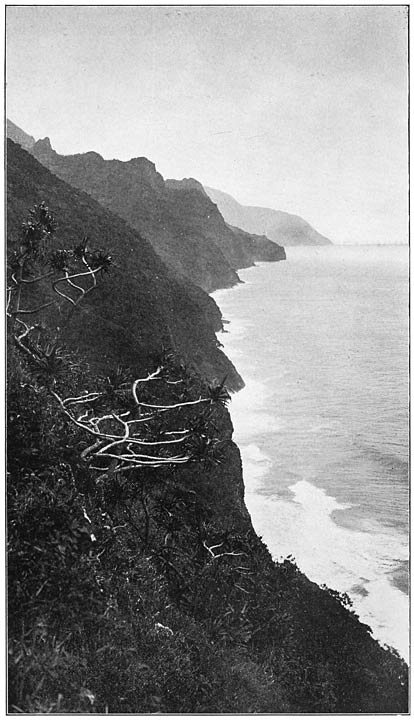
THE CLIFFS OF KALALAU
TRANSLATION
Attend, o Uli: a prayer this for life,
Poured forth in the house of the priest.
Let it touch the hearts of the shining band,
The princes who rule in the heavenly courts.
Who is this healer named Kupukupu?
His are the soot-black swine, the yellow dog;
The tiny cloud-bud and the cloud full-blown;
The cloud quick with rain, and the sky
That is mottled and checkered with clouds;
The tall Man, the Lord of the Mountain;
His fellows who rest in the tree-shade—
Bent-kneed, they pray in their forest-temple.
Suffice it: here’s flowing bowl, Hoalii.
Seek the God; stay not till you find him.
If at fault, an offering this for your flesh.
The twain of us came at the call of love,
That my tears might pour with the others.
Profound the tabu; profound be the peace!
It is peace!
Prayer followed on the heels of prayer:
Kulia i ke Alohi-lani.
Uï ’a kupua o luna nei:
Owai kupua o luna nei?
Kahe ka wai o na Hoalii;
Nei wale ka pili moku;
Na ke aloha i kono e hele;
Hele mai la au, o Hiiaka,
I ke aloha a ka hanau:
Hanau ke ola;
A ola, a ola, e-e!
This mele-pule, though closely resembling, in many parts identical with, that on page 144 seems worth reproducing here.
TRANSLATION
Speed, O Uli, this prayer for health;
Give it wings to the heavenly courts.
The question is asked the shining band:
Who are the spirits of power up here?
The azure Cloud-god that floats on high;
God Ku of the Cumulus cloud-bank;
Ku of the Mackerel-patchéd sky;
Ku of the Cloud that roofs the horizon;
Ku, the Cloud-god sailing apart;
And Ku, the Cloud-god, ruddy and ragged;
The Heroes, too, who dwell in the mountains,
Our Comrades they, who range the forest;
Women-gods of the ether who heal—
Powers that hold with thee, God Laká:
He gives men the rich-ripe mountain-apple.
The Gods pour out their healing water;
The bunchy thatch-grass waves in awe;
God Echo whose voices rumble afar;
And the Landscapist Ku and the Princess
Who plucked and ate the fateful ulei.
The women who sit in the outskirts,
All clad in robes of funeral black—
Great love has prompted their coming.
I Hiiaka, the shadow, have come,
From love to my birth-mate, my sister.
Be this, then, the birth-place of life!
Oh for life! for life! give us life!
“How is it with you, O Lohiau?” inquired Hiiaka.
“Continue to kneel at the shrine. Prostrate yourself at the lake of our mistress,” answered Lohiau.
Thereupon, Hiiaka, greatly encouraged, resumed her praying and chanted in a clear tone:
A ka luna i Kilauea,
A Wahine-kapu i ka Lua;
Kapu na papa elima o ka Lua;
Kapu Kilauea i ke ahi a ka Wahine—
Kapu ia Ka-moho-alii, he alii hanau kapu.
E ho’i au e ike me ku’u haku.
Ke haku’iku’i mai nei ka lani;
Owaowá ka honua;
Ua moe kánaka kai o ka honua;
Ua ala kukui a Kane.
Kane-po, hooulu mai;
He hiamoe kapu kou hoala ana.
E ala e, Kahiki-ku;
E ala e, Kahiki-moe;
E ala ho’i au, ua hiki mai oe;
Ua ala ka lani, ua ala ka honua;
Ua ala ka uka, ua ala ke kai.
Akahi la o ke aloha i hiki mai ai;
Ke ho’onaue nei, naue ku’u houpo.
I ka houpo ka lele hewa a Kane;
Ilaila ke kia’i ho’iho’i aina.
Ala a moe i ke ka’i o ko haku;
Ala mai no, e!
Eia au o Hiiaka.
Ala mai, ho’i!
(I e! Holoe!)
TRANSLATION
On the heights about Kilauea;
With the sacred dame in the Pit —
Five tabu strata has Kilauea;
Tabu’s the Pit through the Goddess’ fire;
Tabu hedges round Moho-alii—
A tabu god was he from his birth.
To these will I go with my lord.
The heavens above are in turmoil;
The earth beneath is riven;
The Sea-powers of earth are sleeping;
The Torch of Kane has risen:
O God of the Night, inspire me!
Thy sleep needs a sacred waking.
Awake, O Kahiki-ku!
Awake, O Kahiki-moe!
I, too, will awake at thy coming.
The heavens are awake, and the earth
Is astir from mountain to sea.
To-day comes the first pang of love;
My heart, my heart, how wildly it moves!
My breast is torn, torn by God Kane.
In the breast lurks the mischief of Kane—
The heart is the fortress of Honor’s guard.
Awake! repose in thy sovereign’s care.
I pray thee awake!
Here am I, Hiiaka.
Awake, I beg and entreat thee!
Let my prayer speed its way!
Ke hooulu au, e Kane-kapolei, i mua,
I o ulu Kini o ke Akua;
Ulu mai o Kane, o Kanaloa.
O Hiiaka au la, o ke kaula, a ke kahuna,
Nana i hana, nana i hooulu;
A hooulu au i ke ola, a he ola no;
He ola ho’i kou, e Lohiau-ipo i Haena;
A ola ho’i, he ola;
He ola nui, he ola iki;
He ola a kulia i ka nu’u;
A ola oe, e Lohiau-ipo.
I e! holo e!
TRANSLATION
To the temple, its healing rite,
I summon you, Kane-kapoléi;
Pray gather, ye Wilderness Host;
Come Kane, and come Kanaloa;
Hiiaka, prophet and priest, am I:
It is mine to inspire, to perform:
I have striven for life and life came—
Your life, Lohiau of Haena—
Aye, life, life indeed;
Life in its fullness, life in detail;
Life to stand at the temple shrine:
Such life be yours, beloved Lohiau!
Urge on; let the cure work!
Hiiaka chanted also another prayer:
E Lono, e Lono, e Lono-ku-lani,
E Lono noho i ka wai,
O houlu oe, o inana oe;
Hoinana i ke ola;
Ho’opu’epu’e ana oe i ka wai,
I ka Wai, ka Wai Ola a Kane,
Ka Wai Ola a Kanaloa,
I ka Hikina, i ke Komohana—
I wai hua, i wai lani!
I e, holo e!
TRANSLATION
O Lono, Lono, God Lono on high,
Lono, whose realm is the watery vast—
Inspirer, promoter, art thou;
Give aid to this work of perfect cure;
Thou givest life’s magic to water,
The living water, Water of Kane,
The living Water of Kanaloa,
Which flows in the east, flows in the west,
In the bubbling fount, in heaven’s rain.
Speed now, urge on the cure!
Prayer quickly followed prayer, like the moving pictures in a shifting scene:
Kane a Ha’i-wahine;
Ha’i pua o ka nahelehele,
Ha’i hana maile o ka wao,
Houluulu lei ho’i o Laká;
O Hiiaka kaula mana ia, e;
Nana i ho’uluulu na ma’i;
A a’e, a ulu, a noho i kou kahu.
Eia ka wai la, he Wai ola, e!
E ola, ho’i, e-e!
TRANSLATION
Here stand I in stress, Laká,
Thou husband of Ha’inakolo;
What flowers have I plucked in the wild,
What maile stripped in the forest,
To twine into wreaths for Laká!
Thus toiled the seer Hiiaka;
For hers was the magic of cure.
But come thou, mount, enter, possess;
Give life to thy servant and priest.
Here’s water, the Water of Life!
Grant life in abundance, life!
The conclusion of this prayer saw Lohiau quite restored to consciousness, but in a state of utter bewilderment as to his surroundings. He found himself most unaccountably in a small rocky chamber with two women who were utter strangers in attendance on him. Before him, as he looked out, hung the apron of a mountain precipice, while in the distance and far below tossed the ocean, a familiar sight that called him back to earth at once, stirring pleasant fancies in his mind and waking in him a yearning for the sea.