Chapter XX · HIIAKA EXPERIENCES KOOLAU WEATHER
Reading edition
Hiiaka found many things to try her patience and ruffle her temper in Pali-Koolau: Squalls, heavy with rain-drops picked up by the wind in its passage across the broad Pacific, slatted against her and mired the path; but worse than any freak of the weather were her encounters with that outlaw thing, the mo’o; not the bold robber creature of Hawaii which took to the wilds, as if in recognition of its own outlawry, but that meaner skulk, whose degenerate spirit had parted with its last atom of virtuous courage and clung to human society only as a vampire, unwilling to forego its parasitic hold on humanity. It was in the mood and spirit begotten of such experiences that she sang:
Ino Koolau, e, ino Koolau!
Ai kena i ka ua o Koolau:
Ke ua mai la i Ma-elieli,
Ke hoowa’awa’a mai la i Heeia,
Ke kupá la ka ua i ke kai.
Ha’a hula le’a ka ua
I Ahui-manu, ka ua hooni,
Hoonaue i ka pu’u ko’a,
Lu’u-lu’u e, lu’u-lu’u iho nei au
I ka puolo waimaka o ka onohi—
Ke kulu iho nei, e.
TRANSLATION
Vile, vile is this Koolau weather:
One soaks in the rain till he’s full.
The rain, it pours at Ma-eli-eli;
It gutters the land at He-eia;
It lashes the sea with a whip.
The rain, it dances in glee
At Ahui-manu, moving
And piling the coral in heaps,
Shifting from side to side of the house,
This whisking rain of Kaha-lu’u.
Heavy and sad, alas, am I,
Mine eyes, a bundle of tears,
Are full to o’erflowing.
As they approached Kua-loa, the huge mo’o-dragon, Moko-li’i, reared himself up and, pluming and vaunting himself, sought to terrify them and prevent their passage. Hiiaka did not flinch in her attack. When she had killed the monster, she set up his flukes as a landmark which now forms the rock known to this day as Moko-li’i. The body of the dragon she disposed in such a way that it helped form the road-bed of the traveled highway. After this achievement she vented her feelings in an exultant song:
Ki’e-ki’e Kane-hoa-lani
I keiki, i Makahiapo na Koolau:
Lau Koolau, kena wale i ka ino;
He ino loa no, e!
TRANSLATION
Kane-hoa lifts to the sky;
Moko-li’i swims in the ocean—
The first-born child of Koolau—
A legion of fiends is Koolau,
Eager for mischief, subtle of trick.
Coming to where the deep and narrow gorge of Ka-liu-wa’a valley opens out, Hiiaka discerned the nature-carved lineaments of her ancestor Kauhi ke-i-maka-o-ka-lani, as he was epitheted, a rocky form set in the pali, but veiled to ordinary sight by a fringe of ti and kukui. Its eye-sockets, moist with the dripping dew of heaven, gleamed upon her with a wondrous longing, which she answered in song:
O kuahiwi mauna pali poko, ke he’e ia,
E like la me Ka-liu-wa’a,
E kui, e lei au:
O ka maka o ke akua,
Uluulu ka manu i kona hulu;
Ke lele kaha ia lupe la;
Lawe ka ua, lawe ka makani,
Kele-kele i o akua la, e ke Akua.
He akua ia la, aohe ike mai:
Ke ala nei;—E ala;
E ala, e ala mai ana, e!
E ala, e, ka Hooilo ua i ka lani!
E ala, e!
TRANSLATION
Kauhi, thou watch-tower of heaven,
Ensconced in the zigzag fluted wall—
Slipp’ry to climb as Ka-liu-wa’a,
Or the straggling Puna-Hilo hills.—
Ah, the drupes of Manu’u-ke-eu!
Let me string, let me wear them!
Thy body lies smothered in ferns;
Thine eye shines on high like a star,
Or jeweled eye of bat, Pe’a-pe’a.
As a bird, now ruffle your plumage—
How sways the kite in the wind!
On balanced wing, then swing and float,
Warding off rain, warding off wind,
Like a sea-gull, clad in feathery mail,
Course about on the wings of a god.
He’s surely a god; yet hears he not;
Fierceness gleams from his eye.
Now he looks, now turns—and to me!
Awake, thou explorer of heaven!
Awake, thou sender of Winter’s rain!
The spouse, Ma-ú, of Winter is night;
The time of arising has come!
This kupua, Kauhi, termed the watch-tower of heaven, having come from Kahiki in the train of Pele’s followers, and having been stationed in this cliff, had got no further in his travels than Oahu. He bemoaned his fate as that of a malihini god, a stranger to the rest of the group. On being roused by this prayer-song of Hiiaka, as he gazed upon the beautiful goddess, a divine ambition stirred within him—to journey with her, enjoy her society, and make acquaintance with the land to which he was still a stranger. With this purpose in mind, at the conclusion of her address, he chanted this response:
O Pele la ko’u akua:
Miha ka lani, miha ka honua:
Ka awa nei o Hiiaka,
E Pele honua-mea!
O ka Wahine i Kilauea,
I ka inu hana awa;
Hele ho’i ke ala mauka o Ka-ú
Hele ho’i ke ala makai o Puna,
Kanaenae a ke ’kua malihini.
TRANSLATION
Pele, indeed, is my god.
Calm be the heavens, peaceful the earth:
Here’s awa fresh-torn from the ground,
Awa that’s been lifted to heaven,
An off’ring for goddess Hiiaka,
A growth of the kingdom Mauli-ola,
Awa that makes for health and peace;
Its woman-ban cleared by aspersion.
Pele, O Pele of the sacred land,
And thou, O Mother Haumea;
Thou Woman of Kilauea,
Fire-goddess who dug the Pit deep;
Niece to Ma-ú, Maka-li’i’s wife;
Own child of heavenly Haumea;
And thou Kukuena, that rules
In the rite of toothing the awa—
A brew that is fit for the gods—
Love-offering this of the stranger god,
Denied, alas, the road through upland
Ka-ú and the lowlands of Puna,
To Ka-ma’a and the bird-limed tree—
Sure route to the potent root of Apua—
The up-road to Ku-ka-la-ula,
Thence leading to Sulphur-hill:
Land where the gods did once dwell!
A laud this, voiced by the stranger god.
At the conclusion of this kanaenae Kauhi said to Hiiaka, “If you are the woman that consumes the forests of Puna, when you travel I will go with you.” (“Ina ooe ka wahine ai laau o Puna, ooe hele, oau hele.”)
Hiiaka did not wish to offend the aggrieved deity; at the same time she could not consent to his proposition. In this dilemma she did her best to soothe his feelings and reconcile him to his lot:
Ku’u Akua i ka hale hau,
Hale kanáka ole,
E noho i ke kai o Ma’a-kua,
Alae ia e ke ki ohuohu, e!
Pene’i wale no ka iki Akua.
Auwe, ku’u Akua, e!
TRANSLATION
My god of the chilly mansion,—
A house without human tenant,—
Abide yet the blasts of the sea,
The slap of the broad leafy ti.
Such the advice of a lesser god:
My tender farewell this to Thee.
Kauhi was indignant at this evasive dismissal of his entreaty. The thought that Hiiaka should countenance his perpetual imprisonment in the bleak cliff filled him with rage. With a mighty effort he lifted himself and tore away the covering of tree-roots, earth and rocks that embraced him until he came to a crouching position. That was the limit of his power: he could do no more. A stony form in the mountain wall of Kahana, resembling the shape of a man on all-fours, remains to vouch for the truth of this legend.
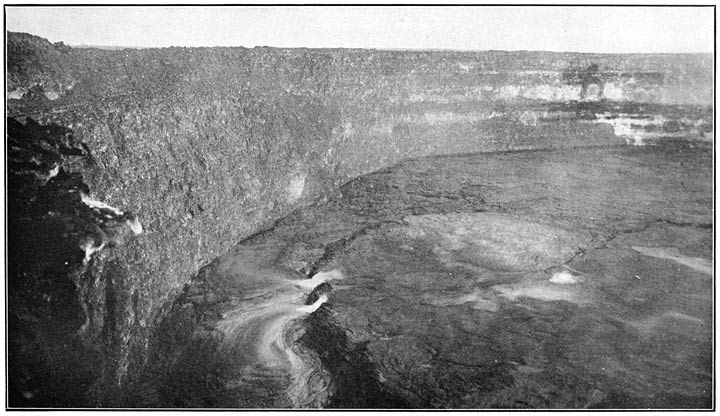
HALEMAUMAU—THE LAKE OF FIRE