PART THE FOURTH
Reading edition
I
It was just two days before the end of Graeme's fourth week in Sark. His spirits were rising to the requirements of his work, and he was looking forward with quite novel enjoyment to a steady spell of writing, when his hostess startled him, as she cleared away his breakfast, by saying—
"It iss the day after to-morrow you will be going?"
"Eh? What? Going? No, I'm not going, Mrs. Carré. What made you think I was going? Why, I've only just come."
His landlady put down the dishes on the table again as a concrete expression of surprise, put her hands on her hips by way of taking grip of herself, and stared at him.
"You are not going? Noh? But it wass just for the month I thought you kem."
"Not at all. I may stop two months, three months,—all my life perhaps. Won't you let me live and die here if I want to?"
"Ach, then! It iss not to die we woult want you. But I thought my man said it wass just for the month you kem, and—my Good!—I haf let your roomss for the day after to-morrow," and her face had lost its usual smile and was full of distress and bewilderment.
"You've let my rooms? Oh, come now!—But now I think of it, I believe I did say something about a month or so, when I spoke to John Philip. Well now, what will you do? Put me out into the road? Or can you find me somewhere else?—though I'm quite sure you'll not be able to find me any place as comfortable as this."
"Whatt will we do?" she said, much disturbed, and gazed at him thoughtfully. Then, with sudden inspiration, "There iss the big house up the garden?" and looked at him hopefully.
"But it's empty."
"Everything iss there, and all ready for them to come any time they want to. It woult only mean making up a bed and you coult come here for your meals."
"That would do first-rate if you can arrange it."
"I will write to Mrs. Lee to-day and ask her to tell me by the telegraph. It will be all right."
"That's all right then. Who's the wretched person who is turning me out of here?"
"It is two leddies. They wrote to the Vicar, and he asked John Philip and he told my man."
"Two ladies! Then I can't possibly have my meals in here. You'd better let me join you in the kitchen,"—a consummation he had been striving after for some time past, in fact ever since his literary instincts had shaken off the thrall and got their heads above the mists,—with a view, of course, of turning a more intimate knowledge of his surroundings to profitable account.
But his hostess was jealous of her kitchen and would not hear of it.
"There iss no need. I will arrange it, and you will tek your meals in here just as usual. Which room woult you like in the big house?"
"I'll go up and have a look round. Does it make any difference to you which I choose? I'd like one with a balcony if it's all the same to you."
"It iss all the sem, and I will get it ready for you as soon ass I hear from Mrs. Lee. You will not be afraid, all alone by yourself up there?"
"Afraid? No. What is there to be afraid of?"
"Och, I do not know. Only—all alone—sometimes one iss afraid—"
"There aren't any ghosts about, are there?"
"Ghosts? Noh!"—with a ghost of a laugh. "I do not believe in ghosts or any such things, though some people does. There are some people"—very scornfully—"will not go by the churchyard at night, and"—lest so sceptical a mind should provoke reprisal—"I do not know that I woult myself. And down by the Coupée—But the house there iss too new to have anything like that." "Well, if I see any I'll try and catch one and bring it down to breakfast."
And so it was arranged that, if the permission of the owner of the Red House could be obtained, he should sleep there and come down to the cottage for his meals, Mrs. Carré undertaking that no inconvenience should thereby be caused to any of those concerned.
He strolled up the garden, with the dogs racing in front, to choose his bedroom, and came across his host unwillingly busy with hoe and spade in the potato patch. His whole aspect betokened such undisguised sufferance that Graeme could not repress a smile.
"Like it?" he asked.
"Noh!"
"Sooner be at the fishing?"
A nod and a brief smile, and Graeme left him to his unwelcome labours, and passed through the gap in the tall hedge to his new abode.
It was a well-built house, gray granite below and red tiles up above, with a wide verandah round the lower storey and white balconies to the upper one; the inside was all polished pitch pine, and the rooms were large and airy and suitably furnished for summer occupancy. It was left in Mrs. Carré's charge, and she and the sun and wind kept it always sweet and clean, and ready for use at an hour's notice.
With the assistance of his two friends, who displayed an active and intelligent interest in the matter, he chose the room with the largest balcony, and said to himself that the coming of the ladies was, after all, a blessing in disguise. He believed he would be even more comfortable there than he had been at the cottage. He would have been quite willing to move in at once if that had been possible.
Next morning, however, the permission duly arrived, and in many trips he gaily carried all his belongings up the garden and installed himself in the balcony room.
It was a very delightful room, with fine wide outlook—over towards the church in its dark embowerment of evergreen oaks, which some of the folk would not pass by night; over the long sweep of the land towards Little Sark; then, over to the left, a glimpse of the sea and a dark blue film on the horizon which he knew was Jersey.
This room and the balcony outside should be his workshop, he decided, and he looked forward, with an eagerness to which he had been stranger for weeks past, to burying himself in his work and finding in it solace and new strength.
II
Graeme possessed a lively imagination, else surely he had never taken to writing. But a lively imagination, sole occupant of a ten-roomed house in a strange land whose inhabitants believed firmly in ghosts and spirits and things that walked by night, and that house but a stone's-throw from the black churchyard where such discomforting things might naturally be supposed to congregate, was not nearly so enjoyable a possession at midnight as in the full light of day.
He lay awake for hours, hearing what seemed to him uncanny sounds about the house, inside and out. The night wind sighed through the heavy pale leaves of the eucalyptus trees, and set the roses and honeysuckle on the verandah posts whispering and tapping. In the stark silence, sounds came out of the other nine empty rooms as though they chose that quiet time for passing confidences. The stairs creaked as though invisible feet passed up and down. And once he could have sworn to stealthy footsteps along the verandah below his window.
He laughed at his own foolishness. Ghosts, he vowed, he did not believe in, and the Sark men were notably honest. All the same it was close on daylight before he slept.
When he pushed through the dewy hedge and went down to the cottage for breakfast, his hostess's eyes twinkled as she asked, "You did not see any ghosts—Noh?"
"Not a ghost, but all the same it did feel a bit lonesome. What would you say to my taking Punch with me to-night, just for company?"
"Yess indeed, tek him. He iss quiet. The other iss too lively."
"And when do your ladies arrive?"
"With the boat. When will you be pleased to have your dinner?"
"I'm off to Little Sark for the day. How would seven o'clock suit you and them?"
"I will mek it suit. They will haf dinner before or after. It will be quite all right."
He spent the day with the dogs, scrambling among the rugged bastions at the south end of the island, investigated the old silver mines, bathed, all three, in the great basin of Venus in the hollow under the southern cliffs, and came home after sunset, tired and ravenous.
"Well, have your ladies come?" he asked, as he sat down to his dinner.
"Oh yess, they are come. They are gone for a walk. One of them is Miss Hen and the other iss Miss Chum."
"Good Lord, what names! Two old maids, I presume,—curls and spectacles and that kind of thing!"
"They are not old, noh. And they are ferry nice to look at, especially Miss Chum."
"Well, well, so she ought to be to make up for her name."
"They were quite put out to think of having turned you out of your roomss—"
"Not half as much as I was, but you can assure them that I am delighted they came. It's as nice a house as one could wish for, and if you can arrange the meals all right I'll not trouble them in the least. How long are they going to stay?"
"They are like you. They do not know. It may be a month, it may be more."
"Oh well, I'll keep out of their way as much as possible. People who come to Sark come to be quiet, I expect. Don't trouble about coffee tonight, Mrs. Carré. I shall just have a smoke and then turn in. I'm tired but and I want a good night's rest."
"Ah yess. Well, you will tek Punch to-night, and then you will hear no ghosts."
The sky was still softly suffused with the clear rose and amber of the sunset when he leaned over the wall, as he filled his pipe, and looked out into the darkening road.
"Har-Héri! Qué-hou-hou!" croaked a hoarse little voice in the hedge opposite.
"Hello, Johnnie-boy! That you?"
"Where you bin te-day?"
"Where have I been? Down in Little Sark, prowling about the mines, stealing lumps of silver——"
"Godzamin! They an't any silver now."
"No? All right, my son. Then I'm telling you fibs."
"Show me."
"Ah, I don't carry it about with me."
"An't got any." And presently, as Graeme lit up, without deigning any answer,—"I seen a ghost las' night."
"Clever boy! What did you make out of it?"
"'Twas the ghost of old Tom Hamon's father. Was all white and dead-like."
"You're too previous, Johnnie. He's getting better."
"He's a-goin' to die."
"So are you sometime."
"No, I a'n't. Show me 'at silver."
"Sometime, perhaps, if you ask nicely. I'm going to bed now. Come along, Punch! Goodnight, Johnnie! Keep your eyes skinned for ghosts. Capital night for them, I should say," and he went off up the garden, with Punch stalking solemnly alongside.
And Johnnie Vautrin erected himself on his hands and haunches to see where he was going, while the vivacious Scamp, shut up in the wood-house and bereft of his bedfellow, and doubtless fearful of ghosts in every nerve of his quivering little body, rent the still night with his expostulations, as he heard them go past.
The scent of the pipe was lingering still in the forecourt when the ladies turned in out of the road, and they just caught a glimpse of the smoker disappearing through the gap in the hedge.
"Ah-ha! There goes the Bogey-Man!" said Miss Hen. "Does this dear little dog carry on this way all through the night, Mrs. Carré?"
"It iss becos the gentleman hass tekken Punch up to the house to kip away the ghosts," smiled Mrs. Carré.
"I should say this one would have been of more use."
"He will be quiet soon. Scamp, bad beast, be qui-et! A couche!"
"To keep away ghosts! What a muff he must be!" said Miss Hen. "Chum, what do you say to putting on white sheets and giving him a scare? If we did a skirly-whirly à la Loie Fuller, below his window, he'd probably have blue fits. Ghosts, indeed!"
"If that big brown Punch got out at you it's you would have the blue fits," said Miss Chum. "The Sark air is getting into your head, Hennie."
"Of course it is. That's what we came for, isn't it? You'll feel it yourself before you're two days older, my child. You're looking better than I've seen you for a month past."
"It's so delightful to feel free," said Miss Chum.
III
Thoroughly tired out, and with a guardian angel on the mat at his bedside, in the shape of a long brown body which sought fresh ease in an occasional sprawl, and flopped a responsive tail each time he dropped a friendly pat on to its head in the dark—Graeme looked confidently for a sound night's rest.
He fell asleep indeed at once, but woke with a start sometime in the night, with the impression of a sound in his ears. Had he really heard something? Or was it only the tail-end of a dream? Wood-lined houses talk in the night. Was it only the pitch pine whispering of the old free days in the scented woods? He could not be sure, so he lay still and listened.
And as he waited, it came again—a low, wailing cry, long-drawn and somewhat curdling to the blood.
Outside or inside? He could not be sure.
Cats? Cats can do wonders in the way of uncanny noises, but somehow this did not sound like cats. There was something human, or inhuman, in it, and his door suddenly shook as though something tried to get in.
He bethought him to feel for Punch. But his hand fell on space, and as he struck a match to see the time and what had become of his companion, the church bell tolled one dismal stroke, and he saw Punch standing like a bronze statue at the door, with his nose down at the crack, his tail on the droop, and every hair apparently on the bristle.
At the glow of the match the drooping tail gave one slow swing, but he did not look round.
Graeme struck another match, and lit his candle, and jumped into his shoes.
"What is it, old fellow?" And Punch scraped furiously at the door again, and so explained that part of the matter.
There came a sudden scuffling fall against the door. Punch rasped at it with his front feet in strenuous silence. If he had been able to give voice it would have been a relief to both of them. His mute anxiety added to the weirdness of the proceedings, and Graeme experienced a novel creeping about the nape of the neck.
Ghosts or no ghosts, however, it had to be looked into. He picked up a heavy boot, turned the key, and flung open the door. Punch went down the stairs in two long bounds, and a rush of cold air put out the candle. He laid it down and followed cautiously, ready to launch the boot at the first sign of uncanniness.
The rush of night air came through a small pantry opening off the hall. The window in it was wide open, and there was no sign of Punch. He and the ghost had evidently gone through that way. Graeme and the boot followed.
It was a dark night between moons. The velvet-black vault was brilliant with stars, but the earth was full of shadows. The fleshy leaves of the eucalyptus trees showed pale against the darkness. The night wind set them rustling eerily. From somewhere beyond them, past the dark hedge, there came a sound of subdued strife. Graeme clutched his boot and sped towards it, drenched with dew from every disturbed branch.
The sounds led him into the potato patch in the lower garden, and in the dimness he became aware that Punch was standing on something that struggled to get up and was held down by the great brown paws and body.
No ghost, evidently. Graeme dropped his boot and stooped and laid hold of the struggler, and knew in a moment, in spite of his own disturbance of mind, that this ghost at all events had materialised into the bodily form of Master Johnnie Vautrin, and he wondered how many more might have done the same if they had been followed up as closely.
He lifted the squirming small boy who had not spoken a word.
"So this is what Sark ghosts are made of, is it, Master Johnnie?" he asked, giving him a shake. "You little scamp! For once you shall have what you jolly well deserve," and he carried him, kicking and wriggling, back to the house, shoved him through the window, and held him with one hand while he got through himself. Punch followed with an easy bound, and they all went upstairs. Graeme found his candle, and lit it and looked at his prisoner.
Johnnie was covered with mould from the potato patch, but his black eyes gleamed through it as brightly as ever, and, as far as Graeme could distinguish through its masking, his face showed no sign of confusion.
"Do you know what we do with naughty little ghosts in England, Johnnie?"
Johnnie's eyes glittered like a snake's.
"We spank 'em, Johnnie. I'm going to spank you—hard."
Then Johnnie spoke.
"I'll put tha evil eye on you."
"Two if you like, my son,—or twenty if you've got 'em handy. Evil eyes rather tickle me. We'll see which makes most impression—my hand or your eye," and he laid the black-magic man across his knee, and gave him such a genuine motherly quilting as he had never experienced in his life before. Hot blows he was accustomed to, but this cool, relentless, tingling flagellation, all on the one spot, and continued till every particle of blood in his body seemed to leap to meet each stroke, was new to him, and it made a great and lasting impression.
He did not cry, but tried to bite and scratch the operator, and Punch stood looking on with a grave smile on his face and a slowly swinging tail expressive of the greatest satisfaction.
Discipline over, Graeme handed him out through the pantry window, bade him to go home to bed, and fastened the window behind him. The night passed without further disturbance, and Graeme awoke as the dawn glimmered golden on his wide-open window.
In ten minutes he was racing bareheaded past Colinette and La Forge towards Les Lâches, a towel round his neck and Punch bounding silently by his side. They had stolen out the back way through the top of the post-office fields, and had left Scamp still prisoner in the woodhouse, lest the hysterical joy of his release should disturb the ladies.
And presently they were racing back home, all aglow with the tingling kisses of the waves, and rough of hair with the salt and the wind.
The sun was up but not yet stripped for the long day's race to the west. The eastern skies still gleamed through a faery haze with the soft iridescence of a young ormer shell, the tender pinks and greens and golds of the new day's birth-chamber mellowing upwards into the glorious blue of a day of days.
'The year's at the spring, The day's at the morn; Morning's at seven; The hillside's dew-pearled: The lark's on the wing; The snail's on the thorn; God's in his heaven— All's right with the world!'
The lilt of the joyous words had often been with him as he sped through the sleeping fields to his morning plunge.
This day of days, as though his soul forecasted what was coming, they sang in his heart and on his lips. His cure was surely near completion. The salt was regaining its savour. Life was worth living again.
And it was then, when he had come through the valley and was ready to climb again, that the glory came to him.
As the two friends sprang lightly over the turf wall into the garden of the Red House, they saw a sight which one of them will not forget as long as he lives.
The Red House. The gap in the hedge. The cottage.
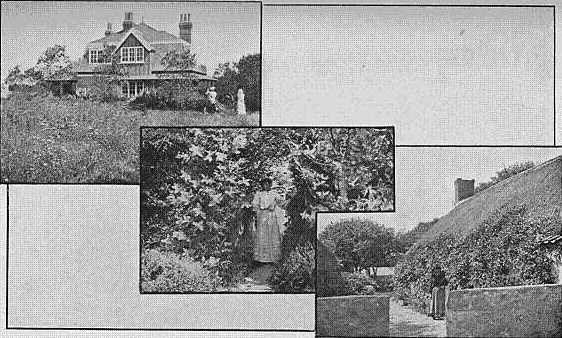
In the gap of the tall hedge, where the path led down to the cottage,—ringed in its darkness like a lovely picture in a sombre frame, with a pale eucalyptus rising stately on either side; and behind it all, and gleaming softly through and round it all, the tender glories of the new day,—stood a girl in a dove-coloured dress, bareheaded, holding the dew-pearled branches apart with her two hands, and gazing at him with wide eyes, and parted lips, and startled face.
And the girl was Margaret Brandt.
IV
Graeme's first thought was that he was dreaming. He blinked his eyes to make sure they were not playing him false.
If she had disappeared at that moment, he would have sworn to hallucinations and the visibility of spirits to the day of his death.
But she did not disappear, and Punch proved her no spirit by stalking gravely up to give her welcome. Without taking her startled eyes off Graeme, she dropped one white hand on to the great brown head and the diamonds sprinkled her dove-coloured dress.
"Mr. Graeme!" she said, in a voice which very fully expressed her own doubts as to his reality also.
"Mar—Miss Brandt? ... Is it possible?"
They had both drawn nearer, he along the broad gravel walk, she along the narrow path between the eucalyptus trees.
"Are you quite sure you are real?" he asked breathlessly, and for answer she laughed and stretched a friendly hand towards him.
He took it with shining eyes, and then bent suddenly and kissed it gently, and his eyes were shining still more brightly as she drew it hastily away.
"But whatever brings you here?" she asked abruptly.
"We're just out of the sea,"—and the joy of the sea and the morning, and this greatest thing of all, was in his face.
"But why are you here? What are you doing here?"
"Doing? We're living here."
"Did you know I was here? How——?" she began, with a puzzled wrinkle of the fair white brow, and stopped.
"I did not know. I wish I had."
"If you did not know, how—why——?"
"If I had known perhaps I should not have dared to follow you. On the whole I'm glad I did not know."
"I don't understand.... How long have you been here?"
"Just four weeks," he said, with a smile at thought of the blackness of those four weeks now that he stood in the sunshine.
"Four weeks! Then you mean—you mean that I—that we—followed——"
"In the mere matter of time, yes!—and of place too," he laughed." For you turned me out of my rooms."
"Do you mean to say you are the Bogey-Man?"
"Well,—no one ever called me so to my face before, but I'm bound to say I've felt uncommonly like one for the past four or five weeks."
"Come with me," she said hastily. "I must put this right at once, or Hennie——" and she turned and went through the gap in the hedge.
"Put what right?" he asked, as he followed.
"Oh—you," she said hastily.
"I'm all right—now. And who is Hennie?"
"My friend Miss Penny—"
"I beg your pardon. I thought you said Hennie."
"Henrietta Penny. She was at school with me. We are taking care of one another."
They had come to the forecourt of the cottage.
"Hen!" cried Margaret. The window was wide open, but the blind was discreetly down.
"Hello, Chum!" came back in muffled tones. "What's up now? Been and got yourself lost again?"
"Come out, dear. I want you."
"Half a jiff, old girl. Give a fellow a chance with his back hair. You had first tub this morning, remember." At which Graeme's eyes twinkled in unison with Margaret's.
"There's a gentleman waiting to see you, dear," said Margaret, to prevent any further revelations.
"A what?"—and there followed a clatter of falling implements as though a sudden start had sent them flying. "Wretch!—to upset one like that! It's that big brown dog, I suppose. I know you, my child!"
Then the blind whirled up and a merry face, in a cloud of dishevelled hair, looked out, a pair of horrified eyes rested momentarily on Graeme, and the blind rattled down again with something that sounded like a muffled feminine objurgation.
And presently the inner door opened and Miss Penny came forth demurely, and bowed distantly in the direction of Margaret and Graeme.
She was of average height but inclined to plumpness, and so looked smaller than Margaret; and she had no great pretensions to beauty, Graeme thought—but then he was biassed for life and incapable of free and impartial judgment—save such as might be found in a very frank face given to much laughter, a rather wide mouth and nice white teeth, abundant dark hair and a pair of challenging brown eyes which now, getting over their first confusion—and finding herself at all events fully dressed, wherein she had the advantage of him—rested with much appreciation on the young man in front of her.
The salt water was still in his hair, and the discrepancies in his hasty attire were but partly hidden by the damp towel round his neck. Nevertheless he was very good to look upon. His moustache showed crisp against the healthy brown of his face; his hair, short as it was, had a natural ripple which sea-water could not reduce; and his eyes were brimming with the new joy of life and repressed laughter. Miss Penny liked the looks of him.
"Margaret Brandt, I will never forgive you as long as I live," said she emphatically.
"All right, dear! This is Mr. Bogey-man whose rooms we have appropriated. He wished to be introduced to the other malefactor. Miss Henrietta Penny—Mr. John Graeme! Mr. Graeme and I have met before."
If Mr. John Graeme had had more experience of women, the flash that shot across from the brown eyes to the dark blue ones might have told him stories—for instance, that his name and would-have-been standing towards her friend were not entirely unknown to Miss Penny; that, for a brief half second, she wondered—doubted—and instantly chid herself for such a thought in connection with Margaret Brandt.
But Margaret herself, being a woman, caught the momentary challenge and repelled it steadily.
"I am very pleased to meet you, Miss Penny—in such a place, and in such company. I have heard of you from Miss Brandt," said Graeme.
"Never till five minutes ago," laughed Margaret.
"Yes, if you will pardon me—once before, at Lady Elspeth Gordon's. Unless I am mistaken, Miss Penny had just been across to Dublin to take a degree which Cambridge ungallantly declined to confer upon her."
"Quite right!" said Miss Penny. "M.A. They're misogynists at Cambridge."
"Will you oblige me by informing Miss Penny, Mr. Graeme, that this meeting is purely accidental? I caught a spark in her eye and I know what it means. Had you the very slightest idea that we were coming to Sark?"
"Not the remotest. When I saw you standing in the hedge there, with the morning glories all about you, I first doubted my eyes, then I thought you a vision—"
"And do you think it possible that I knew of you being here?"
"I am certain you did not. Nobody knows. I left no address, and I told no one where I was going. I have not had a letter since I left London. I have been buried alive in this heavenly little place."
"There now, Mademoiselle," said Margaret, with a bow. "Are you satisfied now?"
"I was satisfied before you opened your mouth, my dear. The possibility inevitably suggested itself, but it was stillborn. Has not our friendship passed its seventh birthday?"
"Thank you, dear. But the coincidence of our coming to bury ourselves in Sark, and Mr. Graeme's coming to bury himself in Sark, was almost unbelievable."
"Not at all," said Miss Penny. "If you could both trace back you would probably find the same original spring of action—a chance word from some common friend, or some article you have both read. Then, when circumstances loosed the spring, you both shot in the same direction. What was it loosed your spring, Mr. Graeme?"
"Well,—I wanted to get away out of things. I'm busy on a book, you see, and I'd heard of Sark—"
"Same here!" said Miss Penny—"less the book. We wanted to get away out of things—and people, and we'd heard of Sark, and here we are. Was it you suggested Sark, or I, Meg?"
"I'm sure I don't know, dear. You, I should think."
"I will take all the credit of it."
Just then Mrs. Carré, who had been down to John Philip's for bread, turned in out of the road with a loaf under each arm. At sight of all her guests fraternising, her face lit up with a broad smile, and Scamp, who had whirled in after her, twisted himself into hieroglyphics of delight and rent the air with his expression of it, and then launched himself at Punch and taxed him with perfidy in going off to bathe without him.
"Ah, you have med friends with the leddies," she said to Graeme. "Scamp! Bad beast, be qui-et! A couche!"
"I'm doing my best, Mrs. Carré."
"That iss very nice."
"Very nice, indeed!" And Miss Penny asserted afterwards that he was looking at Margaret all the time.
"I told them you were a nice quiet gentleman and wouldn't disturb them at all," said Mrs. Carré.
"I'll do my very best not to. So far the disturbance has been all on their side, but I'm standing it very well, you see. You'll let me show you the sights, won't you?" he said to Miss Brandt. "I've been here a month, you see, and I know it all like a book. I've done nothing but moon about since I came—"
"I thought you were busy on a book," said Miss Penny.
"Er—well, you see, you have to do a lot of thinking before you start writing. I've been thinking," and perhaps more than one of them had a fairly shrewd suspicion as to the line his thoughts had taken.
"Now, if I don't cut away and dress, and get my breakfast and clear out, I shall be in the way of the ladies, and Mrs. Carré will never forgive me," he said. "I do hope you will include me in your plans for the day."
His bow included them both, and he sped off up the path through the high hedge, with the two dogs racing alongside.
"Meg, my child, we will go for a little walk," said Miss Penny.
V
The salt Sark air is uplifting at all times. The sea-water has a crisp effervescence of its own which tones and braces mind and body alike. Add to these the wonder of Margaret's unexpected presence there and, if the gift of large imagination be yours, you may possibly arrive—within a hundred miles or so—of the state of John Graeme's feelings as he raced up that path and bounded up the stairs of the Red House four at a time.
He looked out of the wide-open window across the fields, while the dogs, as usual, took the opportunity of appeasing their thirst at his water-jug,—for water lies at the bottom of deep cool wells in Sark, and sensible dogs take their chances when they offer.
Was this the room he had left an hour ago in the fresh of the dawn—a man whose gray future was just beginning to lift its bruised head out of the shadows?
Were those gleaming emerald fields the dim wastes he had sped across with his dumb companion, feeling as friendly towards him as towards anything on earth?
Were those trees over there, with the glow of spring-gold in their tender green leaves, the gloomy guardians of the churchyard where ghosts walked of a night?
Was that streak of blue away beyond the uplands, with the purple film along its rim, only the sea and a hint of Jersey, or was it a glimpse of heaven?
Was he, in very truth, that John Graeme who, for thirty days past, had been striving with all his might to root the thought of Margaret Brandt out of his life—and succeeding not at all?
It was the face of a stranger—a stranger with new joy of life in his sparkling eyes—that looked back at him out of the glass, as he plied his brushes, and tied his neck-tie with a careful assiduity to which the John Graeme of the past thirty days had been a stranger indeed.
It was amazing. It was almost past belief. Yet this was himself, and there was the gap in the dark hedge—never dark again to him so long as one twig of it lived—the gap where he had come upon her standing like a goddess of the morning with the glories of the dawn all about her. And somewhere not far away, under this same heavenly blue sky, was Margaret. And there was no sign or hint of Jeremiah Pixley in her atmosphere—nor of Charles Svendt.
What could it possibly all mean?
Miss Penny—Hennie Penny! What a delightfully ludicrous name! And what a delightful creature she was!—Miss Penny, unless he had been dreaming, had said they had come to get away from things—and people! Now what did she mean by that—if she really had said it and he had not been dreaming?
Was it possible Margaret had come to get away from Jeremiah Pixley and Charles Svendt? On the face of it, it seemed not impossible, for Graeme's only wonder was that she could ever have borne with them so long.
His brain was in a whirl. The eyes of his understanding were as the eyes of one immured for thirty days in a dark cell and then dragged suddenly into the full blaze of the sun. If he had just drunk a magnum of champagne he could not have felt more elevated, and he would certainly have felt very different. For his eye was clear as a jewel, and his hand was steady as a rock, though his heart had not yet settled to its beat and the red blood danced in his veins like fire.
"Jock, my lad," he said to himself, as he got the knot of his tie to his liking at last,—"keep a grip of yourself and go steady. Such a thing is enough to throw any man a bit off the rails. Ca' canny, my lad, ca' canny!"
VI
"Meg, I rather like young men with rippled hair," said Miss Hennie Penny, as they passed the Carrefour and strolled between the dewy hedges towards La Tour, with larks by the dozen bursting their hearts in the freshness of the morning above them.
"In the freshness of the morning"—
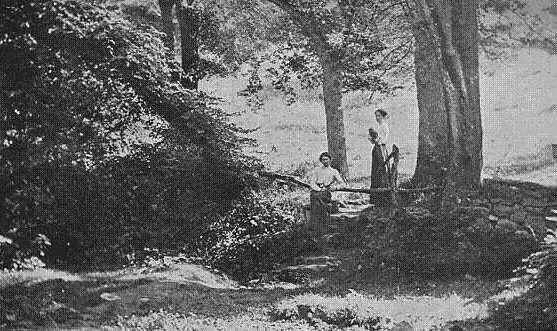
"Do you, dear? I thought you scorned young men?"
"As a class, yes!—Especially the Cambridge variety. But not in particular. I make an exception in this case."
"So good of you!" murmured Margaret in her best company manner.
"Why did you never tell me how nice he was?"
"Tell you how nice he was? I don't remember ever discussing him with you in any shape or form whatever."
"Not to say discussed exactly, but you can't deny that you've mentioned him occasionally."
"So I have William Shakespeare and Alfred Tennyson—"
"And Charles Pixley!"
"That's quite different—"
"You're right, my dear. This is a horse of quite another colour. An awfully decent colour too. I'm glad you appreciate it. He's as brown as a gipsy and not an ounce of flab about him. Charles Pixley is mostly flab—"
"Don't be rude, Hen. You don't know Charles. And do drop your school slang—"
"Can't, my child. It's part of my holiday, so none of your pi-jaw! If you want me to enjoy myself you must let me have my head. You can't imagine how awfully good it tastes when you've been doing your best to choke girls off it for a year or two. It's one of the outward and visible signs of emancipation. This is another!" and she sprang up the high turf bank of the orchard of La Tour and danced a breakdown on it, and then jumped back into the road with ballooning skirts, to the intense amazement of old Mrs. Hamon of Le Fort, who had just come round the corner to draw sweet water from the La Tour well.
"People will think you're crazy," remonstrated Margaret.
"So I am, and you're my keeper, though it's supposed to be the other way about. The air of Sark has got into my head. What a quaint bonnet that old lady has! I wonder what colour it was in its infancy. Good-morning, ma'am! Isn't this a glorious day?" And old Madame Hamon murmured a word and passed hastily on lest worse should befall.
"Hennie, be sensible for a minute or two. I want you to consider something seriously."
"Sensible, if you like, Chummie, for 'tis my nature to. Serious?—Never! How could one, with those larks bursting themselves in a sky like that? And did you ever see hedges like these in all your life? What's it all about?—Ripply-Hair?"
"Yes. Don't you see how awkward the whole matter is—"
"Awkward for Charles Pixley maybe. I don't see that anybody else need worry themselves thin about it."
"I'm not thinking of Mr. Pixley. It's—"
"Ripply-Hair? Well, that's all right! Jolly sight nicer to think about him. I like his eyes too. There's something in them that seems to invite one's confidence. Perhaps you haven't noticed it? If I had a father-confessor—which, thank's-be, I haven't, and a jolly good thing for him!—I should stipulate for him having eyes just like that. Ripply hair too, I think. Yes. I should insist on his having hair just like Mr. Graeme's."
They had strolled along past Le Fort till the road lost itself in a field above Banquette, and there they came to an involuntary stand and stood gazing.
Before them, the long, broken slopes of the Eperquerie swept down from the heights to the sea, one vast blaze of flaming gorse—a tumultuous torrent of solid sunshine stayed suddenly in its course. And, in below the sunshine of the gorse, where rough Mother Earth should have been, there lay instead a soft sunset cloud, the tender cream-yellow and green of myriads of primroses and the just uncurling fronds of the bracken—primroses in such unbroken sheets and masses as to give a weird effect of remoteness and impalpability to that which was solid and close at hand.
"Wonderful!" murmured Margaret.
"Glorious!" murmured Miss Penny. "Is it really old Mother Earth we're looking at?"
"No, dear! It's a bit of the sky fallen down there and the sun has rolled over it into the sea. See the bits of him in the wavelets! And did you ever in your life see a green like that water below the rocks?"
"Sky and sun above, sun and sky below!—with trimmings of liquid emerald and sapphire, shot with white and gold. Meg, my child, this is a long way from No. 1 Melgrave Square."
"A long, long way!" assented Margaret thoughtfully. And then, to take advantage of her companion's comparative soberness through the stirring of her feelings,—"Hennie, do you think we ought to stop?"
"Stop?" and Miss Penny fronted her squarely. "Stop? Why, we've only just come. What's disgruntling you, Chummie?"
"Can't you see how awkward it is?"
"Well,—that depends—"
"No one would believe it was all pure accident."
"Perhaps it isn't," said Miss Penny oracularly.
"Why, what do you mean?" said Margaret, bristling in her turn.
"Oh, I'm imputing no guile, my child. I'm miles away up past that kind of thing. What I mean is this—perhaps it was meant to be, and you couldn't help yourselves. Now if that should be the case, it would be flying in the face of Providence to go and upset it all. What are your feelings towards him?"
"Feelings? I have no feelings—"
"Oh yes, you have, my child. You're not made of marble, though you can look it when you try. Why, I have myself. I like him—the little I've seen of him—and in spite of the fact that he caught me doing my hair, which is enough to turn anyone against anyone. I shall probably like him still more the better I get to know him. What have you against him?"
"I've nothing whatever against him. I—"
"Then, my dear, we'll sit tight. If anyone should go it's he, since he's been here a month, and we've only been one day. But if he goes it will only be because you make him. You've no ill-will towards him?"
"I've no feeling at all about him, except that it's awkward his being here."
"Then we'll just put the blame on Providence, and sit tight, as I said before. I'll see you come to no harm, my child. I could make that young man, or any young man, fly to the other end of the island by simply looking at him."
"Think so, dear?" and Margaret, the issue being decided for her, came back to equanimity.
"Sure!" said Miss Penny.
VII
He was sitting on the low stone wall that shut off the cobble-paved forecourt from the road, with his back towards them, when they sauntered through the open door after breakfast. He was smoking the choice after-breakfast pipe of peace, legs dangling, back bent, hands loosely clasped between his knees. He was very beautifully dressed as regards tie and collar—for the rest, light tweeds and cap of the same, and shoes which struck Miss Penny as flat. But these things she only noticed later. At present all she saw was a square light-tweed back, and a curl of fragrant smoke rising over its left shoulder.
Below him in the dust were his two friends,—Punch, gravely observant of his every movement, and occasionally following the smoke with an interested eye; Scamp, no less watchful, but panting like a motor-car, and apparently exhausted with unrewarded scoutings up and down every possible route for the day's programme.
In the hedge, on the opposite side of the road, sat a very small boy bunched up into an odd little heap, out of which looked a long sharp little face and a pair of black eyes as sharp as gimlets and as bright as a rat's, and beside him sat a big black cat busy on its toilet, which it interrupted in order to eye the ladies keenly when they appeared.
"Now, see you here, my son," they heard from the other side of the broad tweed back, "if you don't make it fine for the next thirty days you and I will have words together. If you want it to rain, let it rain in the night. Not a drop after four A.M., you understand. If you turn it on after four in the morning there'll be another rupture of diplomatic relations between you and me, same as there was last night."
The small boy's beady eyes twinkled, and he squeaked a few words in Sarkese.
"You have the advantage of me, Johnnie. And I've told you before it's not polite to address a gentleman in a language he's not familiar with, when you're perfectly acquainted with his own. The only word I caught was 'Guyablle!' and that's not a word for young people like you and me, though it may suit Marielihou. I'm very much afraid I'll have to speak to the schoolmaster about you, after all, and to the Vicar too, maybe. What? A Wesleyan, are you? Very well then, it's Monsieur Bisson I must speak to."
Here the small boy, with his face crumpled up into a grin, pointed a thin grimy finger past the young man, and he turned and saw the ladies. He doffed his cap and jumped down and tapped out his pipe, and the dogs sprang up expectant;—Punch, grave as ever but light on his feet for instant start; Scamp twisting himself into figure-eights, and rending the air with such yelps of delight that not a word could they pass.
"Johnnie! Stop him!" shouted Graeme. The small boy in the hedge flung out his arm with a sudden threatening gesture, and the circling Scamp fled through the gateway and up the garden with a shriek of dismay, and remained there yelping as if he had been struck.
"Odd that, isn't it?" said Graeme. "Johnnie's the only person that can stop that small dog talking; and, what's more, he can do it a hundred yards away. If the dog can see him that's enough, and yet they're good enough friends as a rule. Look at Punch!"
The big brown fellow was standing eyeing the small boy with an odd expression, intent, expectant, doubtful, with just a touch of apprehension in it, and perhaps of latent anger.
"Can you do it with Punch?" asked Miss Penny.
The small boy shook his head. "Godzamin, he'd eat me if I tried," he said, and lifted his eyes from the dog's, and the dog walked quietly up to Margaret and pushed his great head under her hand.
"He's a fine fellow," she said, caressing him.
"A most gentlemanly dog," said Miss Penny. "His eyes are absolutely poetical,—charged with thoughts too deep for words."
"Yes, he's dumb," said Graeme, stooping to pull a long brown ear.
"Really?" asked Margaret, looking into his face to make sure he was not joking.
"We've been close friends for a month now, and I've never heard his voice even in a whisper, nor has anyone else. I've an idea Johnnie here has put a spell on him."
"Poor old fellow!" said Margaret, fondling the big brown head.
"Oh, he's quite happy—bold as a lion and graceful as a panther, and Scamp talks more than enough for the two of them."
"And what a fine big cat you have, Johnnie!" said Miss Penny, and stretched a friendly hand towards Marielihou. "What do you call it?"
"Marrlyou," growled Johnnie; and Marielihou bristled and spat at the advancing white hand, which retired rapidly.
"The nasty beast!" said Miss Penny, and Marielihou glared at her with eyes of scorching green fire.
"Marielihou is not good company for anyone but herself," said Graeme. "Now, where would you like to go?"
"We were up that way before breakfast," said Miss Penny, nodding due north.
"Been to the Coupée yet?"
"No, we've been nowhere except just along here. We were afraid of getting lost or tumbling over the edges."
"Then you must see the Coupée at once. And we'll call at John Philip's as we pass, to get you some shoes."
"Shoes?" and each stuck out a dainty brown boot and examined it critically for inadequacies, and then looked up at him enquiringly.
"Yes, I know. They're delicious, but in Sark you must wear Sark shoes—this kind of thing"—sticking up his own—"or you may come to a sudden end. And, seeing that you're in my charge—"
"Oh?" said Margaret.
"Come along to John Philip's," said Miss Penny. And as they turned down the road with Punch, the hedge opened and Scamp came wriggling through, with white-eyed glances for Johnnie Vautrin and Marielihou sitting in the bushes farther up.
VIII
Miss Penny and Graeme did most of the talking. Margaret was unusually silent, pondering, perhaps, her friend's utterances of the early morning, and still wondering at the strange turn of events that had so unexpectedly thrown herself and John Graeme into such close companionship that he could actually claim to be in charge of her, and had proved it beyond question by making her buy a pair of shoes which she considered anything but shapely.
Graeme understood and kept to his looking-glass promise.
His heart was dancing within him. It was impossible to keep the lilt of it entirely out of his eyes. They were radiant with this unlooked-for happiness.
It was Margaret's shadow that mingled with his own on the sunny road—when it wasn't Miss Penny's. It was Margaret's pleated blue skirt that swung beside him to a tune that set his pulses leaping. Miss Penny's skirt was there too, indeed, but a thousand of it flapping in a gale would not have quickened his pulse by half a beat.
And Miss Penny probably understood—some things, or parts of things—or thought she did, and was extremely happy in that which was vouchsafed to her. Oh, she knew, did Miss Penny! She had not, indeed, had much—if put into a corner and made to confess to bare and literal truth, not any—experience, that is personal and practical experience, of such matters,—if, indeed, such matters are capable of being brought to the test of such a word as practical. But she had read much about them—in search of truth, and right and fitting books to be admitted to the school library—and she knew all about it. And here, unless she, Henrietta Penny, was very much mistaken, was a veritable live love-affair budding and blossoming—at least she hoped it would blossom—before her very eyes. Budding it undoubtedly was, on one side at all events, and blossom it certainly should if she could help it on; for he had ripply hair, and deep attractive eyes, and a frank open face, and she liked him.
They were suddenly in the shade, threading a narrow cutting between high gorse-topped banks of crumbly yellow rock. Then, without any warning, the rock-walls fell away. They were out into the sunshine again, and in front stretched a wavering rock path, the narrow crown of a ridge whose sides sank sharply out of sight. From somewhere far away below came the surge and rush of many waters.
"This is the Coupée," said Graeme, as the dogs raced across. "Over there is Little Sark."
"It is grand!" said Margaret, gazing at the huge rock buttresses whose loins came up through the white foam three hundred feet below.
"It's awful!" said Miss Penny. "You're never going across, Mr. Graeme?" as he strolled on along the narrow ridge.
"Surely! Why not? It's perfectly safe. There was a wooden railing at this side, but it fell over about a fortnight ago, and at present the good folks of Little Sark and Big Sark are discussing who ought to put up a new one. I happened to be sitting over there when it fell. A party of visitors came down the cutting here, and one was just going to lean on the railing, to look down into the gulf there, when he had the sense to try it first with his foot and it went with a crash, and they got a scare and went back to the hotel to eat lobsters. It was really useless as protection, but it made one feel safer to have it there."
"It's horrible," said Miss Penny emphatically.
"Safe as London Bridge, if you'll only believe it. It's a good four feet wide. The school children used to trot over when it was not more than two and a half."
"And none of them fell over?"
"Never a one. Why should they?"
"Meg, my dear," said Miss Penny, with a sudden flash of incongruity," this is truly a very great change from Melgrave Square."
"It is," laughed Margaret. "Are you coming, Hennie?"
"I'll—I'll risk it if Mr. Graeme will personally conduct me. He's in charge of us, you know."
"Certainly!" and he held out his hand to her, and then looked at Margaret. "Will you please wait here till I come back for you?" And catching, as he thought, a sign of mutiny in her face,—"Although it's perfectly safe it's perhaps just as well to have company the first time you cross."
"Very well," she said, and Miss Penny clung convulsively to the strong unwavering hand while she gingerly trod the narrow way, and the dogs raced half-way to meet them.
"Go away!" she shrieked, and the dogs turned on their pivots and sped back.
"Now, you see!" he said, when she stood safe on the rounded shoulder of Little Sark. "Where was the trouble?"
"It's perfectly easy, Meg," cried Miss Penny, uplifted with her accomplishment.
He wondered whether she would vouchsafe him her hand or attempt the passage alone. But she put her hand into his without hesitation, and thenceforth and for ever the Coupée held for him a touch of sacred glamour. For the soft hand throbbed in his, and every throb thrilled right up into his heart and set it dancing to some such tune as that which sang in David when he danced before the Ark. But his hand was firm, and his head was steady, for that which he held in charge was the dearest thing in life to him.
Three hundred blessed feet was the span of the Coupée. How fervently he wished them three thousand—ay, three million! For every step accorded him a throb, and heart-throbs such as these are among the precious things of life.
Neither of them spoke one word. Common-places were very much out of place, and the things that were in his heart he might not speak—yet.
"Didn't I say so?" cried Miss Penny, as they stepped ashore on Little Sark. "It's as easy as winking."
"I never said it wasn't," said Margaret, with a deep breath. "But I doubt if you'd have come across alone, my child."
"It was certainly pleasanter to have something to hold on to," said Miss Penny.
And Graeme thought so too.
IX
Little Sark provides ample opportunity for the adventurous scrambler, and Graeme, having tested the novel sensation of those delicious heart-thrills, was eager for more.
They prowled round the old silver mines, and sat on the great rocks at Port Gorey which had in those olden times served for a jetty, while he told them how Peter Le Pelley had mortgaged the island to further his quest after the silver, and how a whole ship-load of it sank within a stone's throw of the place where they sat, and with it the Seigneur's hopes and fortunes.
They peered into the old houses and down the disused shafts, lined now with matted growth of ivy and clinging ferns,—the bottomless pits into which the Le Pelley heritage had disappeared. Then he took them for mild refection to Mrs. Mollet's cottage; and after a rest,—and with their gracious permission, a pipe,—he led them across to the wild south walls of the island, with their great chasms and fissures and tumbled strata, their massive pinnacles, and deep narrow inlets and tunnels where the waves champed and roared in everlasting darkness.
The dogs harried the rabbits untiringly, Punch in long lithe bounds that were a joy to behold; Scamp in panting hysterics which gave over-ample warning of his coming and precluded all possibilities of capture.
Graeme led them down the face of the cliff fronting L'Etac, the great rock island that was once a part of Little Sark itself.
"Once upon a time there was a Coupée across here," he said. "Some time our Coupée will disappear and Little Sark will be an island also."
"Not before we get back, I hope," said Miss Penny.
"Not before we get back, I hope," said Graeme, for would he not hold Margaret's hand again on the homeward journey?
Down the cliff, along white saw-teeth of upturned veins of quartz, with Margaret's hand in his, then back for Miss Penny, till they sat looking down into a deep dark basin, almost circular: lined with the most lovely pink and heliotrope corallines: studded with anemones, brown and red and green: every point and ledge decked with delicately-fronded sea-ferns and mosses: and the whole overhung with threatening masses of rock.
"Venus's Bath," he told them. "Those round stones at the bottom have churned about in there for hundreds of years, I suppose. The tide fills it each time, as you will see presently, but the stones cannot get out and they've helped to make their own prison-house,—wherein I perceive a moral. It's a delicious plunge from that rock."
"You bathe here?" asked Margaret.
"I and the dogs bathe here at times. There's one other thing you must see, and I think you may see it to-day. The tide is right, and the wind is right, and there's a good sea on."
They waited till the long waves came swirling up over the rocks and filled the basin and set the great round stones at the bottom grinding angrily. Then off again along the splintered face of the cliff, one by one, that is two by two over the difficult bits, till he had them seated among some ragged boulders with the waves foaming white below them, and swooking and plunking in hidden hollow places.
The wind was rising, and the crash of the seas on the rocks made speech impossible. He pointed suddenly along the cliff face, and not twenty yards away, with a hiss and a roar, a furious spout of water shot up into the air a rocket of white foam, a hundred feet high, and fell with a crash over the rocks and into the sea.
THE SOUFFLEUR IN LITTLE SARK
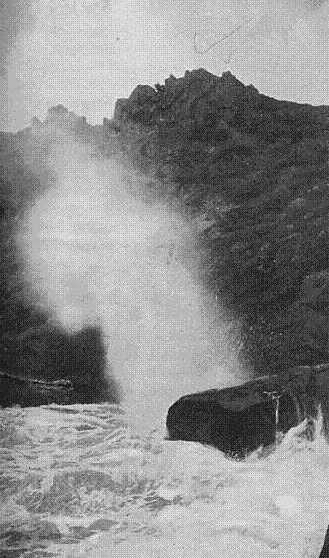
Twenty times they watched it roar up into the sky, and then they crawled back up the face of the cliff, wind-whipped and rosy-faced, and with the taste of salt in their mouths.
"That is a fine sight," said Margaret, with sparkling eyes and diamond drops in her wind-blown hair. He thought he had never seen her so absolutely lovely before. He had certainly never seen anyone to compare with her.
"That's the Souffleur—the blow-hole. There's a bigger one still in Saignie Bay, we'll look it up if the wind gets round to the north-west. I'm glad you've seen this one. It was just a chance."
"I'm blow-holed all to rags, and, Meg, your hair is absolutely disgraceful," said Miss Penny. So differently may different eyes regard the same object, especially when the heart has a say in it. He would have given all he was worth for an offered lock of that wind-blown hair.
As Margaret turned she caught his eye, perhaps caught something of what was in it.
"Am I as bad as all that?" she laughed in rosy confusion.
"You're"—he began impetuously, but caught himself in time.—"You're all right. When you go to see the Souffleur you must expect to get a bit blown."
"It's worth it," she said. "And I'm sure we're much obliged to you for taking us. We could never have got there alone."
"We'd never have got to Little Sark, to say nothing of the Souffleur," said Miss Penny very emphatically.
"And now perhaps you'll forgive me for making you buy those shoes."
"My, yes! They're great," said Miss Penny, looking critically at her feet. "But decidedly they're not beautiful."
X
They loitered homewards, chatting discursively of many things, in a way that made for intimacy. Miss Penny and Graeme, indeed, still did most of the actual speaking, as he remembered afterwards, but Margaret was in no way outside their talk, and if she did not say much it is probable that she listened and thought none the less.
The Coupée afforded Graeme another all-too-short span of delight, while Margaret's hand throbbed in his and she entrusted herself to his protection.
He took them home by the Windmill, and through the fields and hedge-gaps into the grounds of the Red House, and in his heart's eye saw Margaret standing once more in the opening of the tall hedge with the morning glory all about her—just as he would remember her all his life.
"Time?" demanded Miss Penny, as they passed along the verandah.
"Half-past seven."
"Then you are half an hour late for your dinner. I propose that we ask Mrs. Carré to serve us all together to-night," said Miss Penny, "or we may all fare the worse."
"I shall be delighted," began Graeme exuberantly, "unless—" and he snapped a glance at Miss Brandt.
"We shall be glad if you will join us," she said quickly.
"I will be there in two minutes," he said, and sped up the Red House stairs to make ready.
"I hope to goodness he won't," said Miss Penny, as they passed through the hedge. "Now don't you say a word to me, Margaret Brandt. It was you invited him"
"Oh!"
"'We shall be glad if you will join us.' If that isn't an invitation I'd like to know what it is. And I heard you say it with my own two ears,—moi qui vous parle, as we say here."
"You know perfectly well that I could not possibly do anything else, Hennie. I believe you just did it on purpose. I don't know what's come over you."
"John Graeme. I like him. And after all he'd done for us—that Coupée, and Venus's Bath, and the Souffleur, and he like to lose his dinner over it all! What could a kind motherly person like me do but suggest—simply suggest, in the vaguest manner possible—"
"Yes?—" as she stopped in a challenging way.
"I merely threw out the suggestion, I say, in the vaguest possible way, that as we were nearly dying of hunger he should allow us to ask Mrs. Carré to let us have our dinner half an hour earlier than usual—"
"Oh!"
"And then you struck in, in your usual lordly fashion, and begged him to join us. And I'm bound to say he took it very well, not to say jumped at it."
"Hennie, you're a—"
"Yes, I know. And if I live I'll be a be-a, and perhaps more besides,"—with a cryptic nod.
"Now, what do you mean by that?"
"Wait patiently, my child, and you'll see."
"I believe the Sark air is affecting your—whatever you've got inside that giddy head of yours."
"Of course it is. That's what I came for, and to keep you out of mischief, you infantile law-breaker."
XI
Graeme's two minutes were each set with considerably more than the regulation sixty seconds—diamond seconds of glowing anticipation, every one of them. And, to his credit, be it recorded that he allotted several of them to the invocation of most fervent blessings on Miss Penny, who, at the moment, was vigorously disclaiming any pretension thereto.
But, quite soon enough for his hosts, as he considered them,—his guests, according to Miss Penny,—he appeared at the cottage, bodily and mentally prepared for the feast, and showing both in manner and attire due sense of the honour conferred upon him.
It was a festive, and for one of them at all events, a never-to-be-forgotten meal. The strong Sark air had got into all their heads, and whatever prudish notions might have been working in Margaret, she had bidden them to heel and took her pleasure as it came.
Her mood, however, for the moment was receptive rather than expressive. Miss Penny and Graeme still did most of the talking, and Margaret sat and listened and laughed, not a little astonished at finding herself in that galley.
"What is the penalty for aiding and abetting a criminal in an evasion of the law, Mr. Graeme?" chirped Miss Penny one time, and took Margaret's energetic below-table expostulation without a wince.
"It would depend, I should say, on the particular dye of criminal. What has your friend been up to, Miss Penny? Is he a particularly black specimen?"
"In the first place he's a she, and in the next place her complexion has a decided tendency towards blonde. As to dye—I am in a position to state on oath that she does not."
For a moment he was mystified, then his eye fell on Margaret's face, full of glorious confusion at this base betrayal by her bosom friend.
"The Sark air does get into people's heads like that at times," he said diplomatically. "It's just in the first few days. But you soon get used to it. I felt just the same myself—losing faith in things and thinking ill of my friends, and so on. You'll be quite all right in a day or two, Miss Penny,"—with a touch of sympathetic commiseration in his voice.
"Oh, I'm quite all right now," said Miss Penny enjoyably. "I thought it only right and proper to let you know where you stand. At the present moment you are as likely as not aiding and abetting a breaker of the British laws and her accomplice. You may become involved in serious complications, you see."
"If that means that I can be of any service in the matter I shall be only too delighted,—if you will not look upon me as an intruder." He spoke to Miss Penny but looked at Margaret.
"Ah-ha! Qualms of conscience——"
"Hennie is a little raised, Mr. Graeme," broke in Margaret. "Please excuse her. A good night's rest will make her all right."
"Never felt better in my life," sparkled Miss Penny. "But seriously, Mr. Graeme, it is only right you should understand, for we don't quite know where we are ourselves, and I'm going to tell you even though Margaret kicks all the skin off my leg in the process. In a word,—we've bolted."
"Bolted?" he echoed, all aglow with hopeful interest.
"Yes—from Mr. Pixley and all his works. And as he had been threatening to make us a Ward of Court, you see—well, there you are, don't you know."
"I see," he said, and there was a new light in his eyes as he looked at Margaret, and his soul danced within him again as David's before the Ark.
"For reasons which seemed adequate to myself, Mr. Graeme,"—began Margaret, in more sober explanation.
"They were, they were. I am sure of it," sang his heart. And his brain asked eagerly, "Had Charles Svendt anything to do with it, I wonder?"
"—I thought it well to remove myself from the care of my guardian Mr. Pixley——"
"Splendid girl! Splendid girl!" sang his heart.
"—And as I have still some of my time to serve——"
"How long, O Lord, how long?" chaunted his heart, with no sense of impropriety, for it was sounding pæans of joyful hope.
"—You see——" said Margaret.
"I see."
"Do you think they could make me go back to him?" she asked anxiously.
"To Mr. Pixley? Certainly not—that is if your reasons for leaving him seemed adequate to the Court, as I am sure they would."
She offered no explanation on this point. All that she left unsaid, and that he would have given much to hear, seemed dancing just inside Miss Penny's sparkling eyes, and as like as not to come dancing out at any moment.
"You see," said Graeme, "I happen to have been making some enquiries from a legal friend on that very point——"
"Oh!" said Margaret, and Miss Penny's eyes danced carmagnoles.
"In connection with a story, you know. One likes to get one's legal points all right. In any case, as I was just about to tell Miss Penny for the benefit of her criminal friend, there would be lots of red tape to unwind before they could do anything, and this little isle of Sark is the quaintest place in the world in the matter of its own old observances and their integrity, and the rejection of new ideas. Mr. Pixley does not know you are here, of course?"
"Not much, or he'd have been over by special boat long since," said Miss Penny. "We managed it splendidly."
"And how long?" began Graeme, in pursuance of his train of thought, but stopped short at sound of the words, since they bore distant resemblance to a curiosity which seemed to himself impertinent.
But Miss Penny knew no such compunctions. She did not want to miss one jot or tittle of her enjoyment of the situation.
"About six months," said she quickly.
"Well, I should think we"—how delightful to him that "we," and how Miss Penny rejoiced in it!—"could hold them at bay for that length of time. The machinery of the law is slow and cumbersome at best, and in this case, I imagine, it would not be difficult to put a few additional spokes in its wheels."
If his face was anything to go by there were many more questions he would have liked to put—judicial questions, you understand, for a fuller comprehension of the case. But he would not venture them yet. He had got ample food for reflection for the moment, and his hopes stood high.
Never for him had there been a dinner equal to that one. Better ones he had partaken of in plenty. But the full board and the quality of the faring are not the only things, nor by any means the chief things, that go to the making of a feast.
The nearest approach to it had been that dinner with the Whitefriars, at which he first met Margaret Brandt, and that did not come within measurable distance of this one.
XII
"Will you be pleased to tek your dinner with the leddies again to-night?" asked Mrs. Carré, as she gave Graeme his breakfast next morning.
"I would be delighted," he said doubtfully. "But are you quite sure they would wish it, Mrs. Carré."
"But you did get on all right with them," she said, eyeing him wonderingly. "They are very nice leddies, I am sure."
"Oh, we got on first rate. We didn't quarrel over the food or fall out in any way. But——"
"Well then?"
"Will it be any easier for you?" he asked thoughtfully.
"Well, of course, it will be once setting instead of twice, and that iss easier——"
"Then suppose you put it to them on that ground, Mrs. Carré, solely on that ground, you understand. And if they are agreeable, I—well, I shall not raise any objections."
And so, presently, Mrs. Carré said to the ladies, "You did get on all right with the gentleman last night, yes?"
"Oh, quite, Mrs. Carré," sparkled Miss Penny.
"I wass wondering if it would please you to dine all at once together again each night. You see, it would save me the trouble of setting twice. I did ask him and he said he didn't mind if you didn't. He iss a very nice quiet gentleman, I am sure."
"I'm sure it's very good of him," said Miss Penny. "By all means serve us all at once together, Mrs. Carré. I guess we can stand it if he can."
"That iss all right then," said Mrs. Carré, and the common evening meal became an institution—to Graeme's vast enjoyment.
XIII
When the girls went into their room after breakfast to put on their hats and scrambling shoes, they saw Graeme sitting on the low stone wall, as usual, smoking his after-breakfast pipe, and they caught a part of the conversation in progress between him and Johnny Vautrin.
"I see five crows 's mawnin'," they heard in Johnnie's sepulchral voice.
"Really, now! Catch any?"
"There wuss five crows."
"Ah—five? That's an odd number! And what special ill-luck do you infer from five crows, Johnnie?"
"Someone's goan to be sick," said Johnnie, with joyous anticipation.
"Dear me! That's what five crows mean, is it?"
"Ouaie!"
"They didn't go into particulars, I suppose,—as to who it is likely to be, for instance, and the exact nature of the seizure?"
"They flew over to church there and settled in black trees."
"Vicar, maybe, since they went that way."
"Mebbe!"—hopefully.
"Well, well! Perhaps if we gave him a hint he might take some precautions."
"Couldn' tek nauthen 'd be any use 'gainst crows. Go'zamin, they knows!"
"You're just a confirmed old croaker, Johnnie."
"A'n't!" said Johnnie.
"Where's our old friend Marielihou?"
"She's a-busy," said Johnnie, wriggling uncomfortably.
"Ah,—killing something, I presume. Is it going to keep fine for the next three or four weeks?"
"I don' think."
"You don't, you little rascal?"
"You might do your best for us, Johnnie," said Miss Penny, as they came through the gap in the wall. "And if it keeps fine all the time I'll give you—let me see, I'll give you a shilling when we go away."
Johnnie's avidious little claw reached out eagerly.
"Godzamin!" said he. "Gimme it now, an' I'll do my best."
"Earn it, my child," said Miss Penny, and they went on up the road, leaving Johnnie scowling in the hedge.
"Well, where would you like to go to-day?" asked Graeme. "Will you leave yourselves in my hands again?"
"I'm sure we can't do better," said Miss Penny heartily. "Yesterday was a day of days. What do you say, Meg?"
"It looks as though we were going to occupy a great deal of Mr. Graeme's time," said Meg non-committally.
"It could not possibly be better occupied," he said exuberantly.
"And how about your story, Mr. Graeme? Is it at a standstill?" asked Miss Penny.
"Not at all. It's getting on capitally."
"Why, when do you work at it?"
"Oh,—between times, and when the spirit moves me and I've got nothing better to do."
"Is that how one writes books?"
"Sometimes. How do you feel about caves?"
"Ripping! If there's one thing we revel in it's caves, principally because we know nothing about them."
"Then we'll break you in on Grève de la Ville. They're comparatively easy, and another day we'll do the Boutiques and the Gouliots. Then we can get a whole day full of caves by going round the island in a boat—red caves and green caves and black caves and barking-dog caves—all sorts and conditions of caves—caves studded all round with anemones, and caves bristling with tiny jewelled sponges. Sark is just a honeycomb of caves."
"Spiffing!" said Miss Penny. "If Mr. Pixley gets on our track we'll play hide-and-seek in them with him."
"Then we ought to spend a day on Brecqhou—"
"A day on Brecqhou without a doubt!"
"And if we can get the boat from Guernsey to call for us at the Eperquerie, and can get a boat there to put us aboard, we might manage Alderney."
"Sounds a bit if-fy, but tempting thereby. Margaret, my dear, our work is cut out for us."
"And Mr. Graeme's cut out from him, I'm afraid."
"Oh, not at all, I assure you. It's going ahead like steam," and they began to descend into Grève de la Ville, the dogs as usual ranging the cliff-sides after rabbits, disappearing altogether at times and then flashing suddenly into view half a mile away among the gorse and bracken.
Sark scrambling requires caution and constant asistance from the practised to the unpractised hand, and Graeme omitted none of the necessary precautions. Whereby Margaret's throbbing hand was much in his,—so, indeed, was Miss Penny's, but that was quite another matter,—and every convulsive grip of the little hand, though it was caused by nothing more than the uncertainties of the way, set his heart dancing and riveted the golden chains still more firmly round it.
There are difficult bits in those caves in the Grève de la Ville,—steep ascents, and black drops in sheer faith into unknown depths, and tight squeezes past sloping shelves which seem on the point of closing and cracking one like a nut; and when they crawled out at last into a boulder-strewn plateau, open to the sea on one side only, they sighed gratefully at the ample height and breadth of things, and sank down on the shingle to breathe the free air and sunshine.
He amused them by telling them how, the last time he was there, he found an elderly gentleman sitting with his head in his hands, on that exact spot. And how, at sight of the new-comer, he had come running to him and fallen sobbing on his neck. He had been there for over an hour seeking the way out, and not being able to find it, had got into a panic.
"I wonder if you could find the place we came in, now?" said Graeme. "Scamp, lie down, sir, and don't give me away!"
"Why, certainly, it's just there," said Miss Penny, jumping up energetically and marching across, while the dogs grinned open-mouthed at her lack of perception. For it wasn't there at all, and she searched without avail, and at last sat down again saying, "Well, I sympathise with your old gentleman, Mr. Graeme. If I was all alone here, and unable to find that hole, I should go into hysterics, though it's not a thing I'm given to. I suppose we did get in somehow."
"Obviously! And that's where the advantage of a guide comes in, you see."
"I, for one, appreciate him highly, I can assure you. Where is that wretched hole?"
"Here it is, you see. It's a tricky place. I shall never forget the look of relief on that old fellow's face at sight of me. I believe he thinks to this day that I saved his life. He stuck to me like a leech all the way through the further caves and till we got back to the entrance."
"We're not through them yet then?"
"Through? Bless me no, we're only just starting, but there's no use hurrying. Tide's right, and we have plenty of time."
"I feel as if I'd been lost and found again," said Miss Penny. "If Mr. Pixley comes along we'll induce him in here and leave him to find his way out."
"It would take more than you to get Mr. Pixley in here, Hennie," said Margaret quietly. "He'd never venture off the roads, even if he risked his life in reaching Sark. He's much too careful of himself."
"He thinks a good deal more of himself than I do," said Miss Penny. "With all deference to you, Meg, since he's a relative, I consider him a jolly old humbug."
XIV
The days were packed with enjoyment for Graeme; not less for Miss Penny; nor—illuminated and titillated with a conposed expectancy as to whither all this might be leading her—for Margaret herself.
Graeme took the joyful burden of their proper entertainment entirely on his own shoulders. He reaped in full now the harvest of his lonely wanderings, and compared those former gloomy days with these golden ones with a heart so jubilant that the light of it shone in his eyes and in his face, and made him fairly radiant.
"That young man grows handsomer every day," was Miss Penny's appreciative comment, in the privacy of hair-brushing.
Margaret expressed no opinion.
"I thought him uncommonly good-looking as soon as I set eyes on him, but he's growing upon me. I do hope, for his sake, that I shan't fall in love with him."
And at that a tiny gleam of a smile hovered for a moment in the curves of Margaret's lips, behind the silken screen of her hair.
No trouble was too great for him if it added to their pleasure. He provisioned their expeditions with lavish discrimination. He forgot nothing,—not even the salt. He carried burdens and kindled fires for the boiling of kettles, and saw to their comfort and more, in every possible way. He assisted them up and down steep places, and Margaret's hand grew accustomed to the steady strength of his. She came to look for the helping hand whenever the ways grew difficult. At times she—yes, actually, she caught herself grudging Hennie-Penny what seemed to her too long an appropriation of it.
IN DERRIBLE BAY
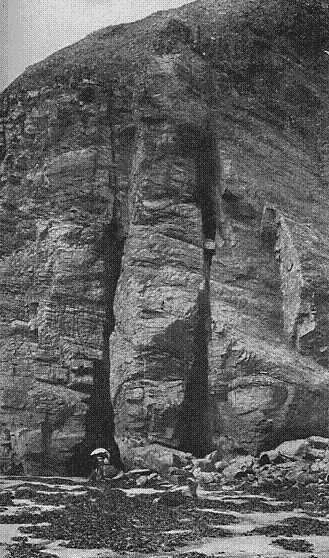
Never surely were the beauties of Sark seen under happier auspices, or through eyes attuned to more lively appreciation. For love-lit eyes see all things lovely, and no more perfect loveliness of sea and rock and flower and sky may be found than such as go to the making of this little isle of Sark.
He guided their more active energies through the anemone-studded and sponge-fringed caves under the Gouliots; through the long rough-polished, sea-scoured passages of the Boutiques; down the seamed cliffs at Les Fontaines and Grande Grève; along the precarious tracks and iron rings into Derrible; with the assistance of a rope, into Le Pot. And for rest-times they spent long delightful afternoons sitting among the blazing gorse cushions of the Eperquerie, and on that great rock that elbows Tintageu into the waves, and looks down on the one side on Port du Moulin and the Autelets, and on the other into Pegane Bay and Port á la Jument.
This high perch had a peculiar fascination for Margaret. She could have sat there day after day with perfect enjoyment. She never tired of it all—the crisp green waters below, with their dazzling fringe of foam round every gray rock and headland; the gold-tipped pinnacles of the Autelets, with their fluttering halos of gulls and sea-pies and cormorants, and their ridi-fringe of tawny seaweed and foamy lace; the rounded slopes of the Eperquerie; the bold cliffs behind, with their sprawling gray feet in the emerald sea, and their green and gold shoulders humping up into the blue sky; beyond them the black Gouliot rocks and foaming Race, and the long soft bulk of Brecqhou with its seamy sides and black-mouthed caves.
And here one day they had a novel experience, and Margaret learned something—got fullest proof, at all events, of something her heart had already told her.
THE GREAT ROCK BEHIND TINTAGEU
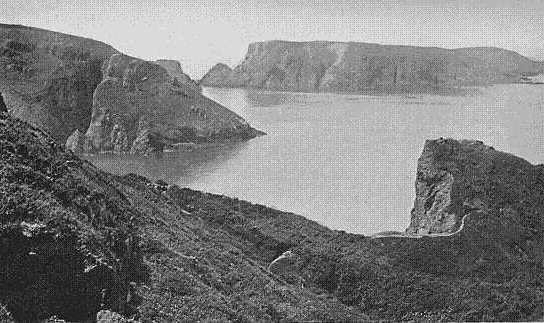
They were sitting in the sea-ward cleft of this great rock behind Tintageu, one afternoon, and Graeme had just succeeded in getting the kettle to boil by means of an armful of old gorse bushes, when, straightening up for a rest, he said suddenly,—"Hello! Look at that now!" and pointed out towards Guernsey.
And there they saw a low white cloud, lying on the sea as though it had just dropped solidly out of the sky. Sea and sky were vivid vital blue, the sun shone brilliantly, Guernsey, Jethou, and Herm gleamed like jewels, and the white cloud lay between the upper and the nether blue like the white ghost of a new-born island not yet invested with the attributes of earth.
And, as they watched, it crept quickly along the blue-enamelled plain. It swallowed up the southern cliffs of Guernsey. Its creeping nose was level with the tall Doyle column. It crept on and on, till Castle Cornet disappeared and Peter Port was lost to sight. On and on—Jethou was gone, and bit by bit the long green and gold slopes of Herm were conquered, and its long white spear of sand ran out of the low white cloud. And still on, till all the outlying rocks and islands vanished, and where had been the glow and colour of life was nothing now but that strange pall-like cloud.
The blue of the sea in front had whitened, and suddenly the sentinel rocks at the tail of Brecqhou disappeared, and the white cloud came sweeping towards the watchers on the rock by Tintageu.
"We're in for it too," said Graeme, hastily emptying his kettle and packing up the tea-things. "Seems to me we'd better get ashore."
But the cloud was on them, soft films of gauzy mist with the sun still bright overhead. Then quickly-rolling folds of dense white cloud blotted out everything but the path on which they stood. The gorse and blue-bells and sea-pinks at their feet drooped suddenly wan and colourless, as though stricken with mortal sickness, and wept sad tears. They stood bewildered, while the pallid folds grew thicker and thicker, lit from above with a strange spectral glare, and coiling about them like the trailing garments of an army of ghosts. From the unseen abysses all round came the growl and wash of wave on rock and shingle, from the cliff above Pegane came the frightened bleat of a lamb, and an invisible gull went squawking over their heads on his way inland.
With an instinct for safer quarters, Miss Penny had started off towards the path which led precariously across the narrow neck to the mainland. The neck itself, with white clouds of mist billowing on either side, and streaming raggedly across the path, looked fearsome enough. She gave a startled cry and stood still.
"Stay here!" said Graeme to Margaret. "Don't move an inch!" and he felt his way, foot by foot, towards the causeway.
And Margaret, who had been regarding it all simply as a curious experience, felt suddenly very lonely and not very safe.
She heard him speak to Miss Penny, but she could not see two feet in front of her.
Then, after what seemed a long time, she heard above her—
"Miss Brandt? Margaret? Oh, good God!"—and there was in his voice a note that was new to her. Sharp and strident with keenest anxiety, it set a sudden fire in her heart, for it was for her.
"I am here, Mr. Graeme," she cried, and he came plunging down to her through the dripping gorse and bracken.
"Thank God!" he said fervently. "Why ever did you move?"
"I have not stirred."
"I must have got wrong. It is blinding. It will be safest to wait here, I think. Will you hold on to my arm?"
And as she slipped her hand through it she felt it trembling—the arm that had always been so strong and steadfast in her service—and she knew that this too was for her.
"Where is Hennie?" she asked.
"She's all right. I made her sit down among the bushes and told her she'd surely get smashed if she moved."
It was a good half-hour before the cloud drew off and they saw Guernsey, Herm, and Jethou sparkling in the sun once more.
Then they crossed the narrow path over the neck, and Margaret was glad they had not attempted it in the fog.
They picked up Miss Penny, damp but cheerful, and went home. For everything was dripping, and the pleasures of camping out were over for that day, but there were fires about that all the fogs that ever had been could not begin to extinguish.
XV
As the girls sat basking in the window-seat for a few minutes after breakfast one morning, they surprised a private conversation between their cavalier and Master Johnnie Vautrin. Graeme, with his back to them, sat smoking on the low stone wall. Johnnie was, as usual, bunched up in the hedge opposite.
"Basking in the window-seat"
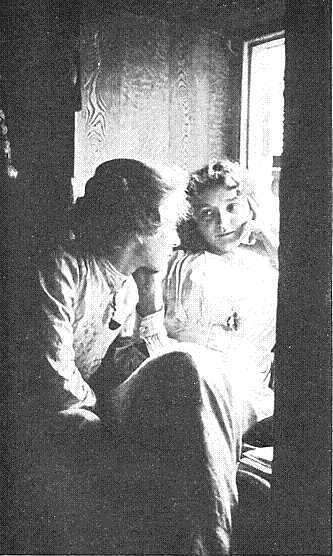
"Well, Johnnie?" they heard. "Seen any crows this morning?"
"Ouaie!"
"How many then, you wretched little croaker?"
"J'annéveu deu et j'annéveu troy."
"Ah now, it's not polite—as I've told you before—to talk to an uneducated foreigner, in a language he does not understand. How many, in such English as you have attained to, and what did they mean according to your wizardry?"
"Pergui, you, too, are not polite! Your words are like this"—measuring off an expanding half yard in the air,—"they are all wind."
"Smart boy! How many crows did you see this morning?"
"First I saw two and then I saw three."
"Two and three make five. Croaker! Five crows mean someone's going to be sick. And which way did they go this time?"
"Noh, noh! First it wass two, and when they had gone then it wass three more."
"I see. And two black crows—what might they mean now?"
"Two crows they mean good luck."
"Clever boy! Continue! Three black crows mean——?"
"Three crows—they mean a marrying,—ouaie, Dame!"
"Ah, a marrying! That's better! That is very much better. It strikes me, Johnnie, that two lucky crows are worth twopence, and three marrying crows are worth threepence. And as luck would have it I've got exactly five pennies in my pocket. Catch, bearer of good tidings! Here you are—one, two, three, four, five! Well caught! Is it going to keep fine?" and Marielihou stopped licking herself to look at Graeme, and then went on again with an air of,—"I could tell you things if I would, but it's not worth while,"—in her ugly green eyes.
"I don' think," said Johnnie, jumping at the chance of ill news.
"You don't, you little rascal? Here, give me back my hard-earned pence! You're a little humbug."
"What's Johnnie been up to now?" asked Miss Penny, as she came out into the open.
"He's giving me lessons in necromancy and the black art of crows. He declines to pledge his honour on the continued brightness of the day."
"Oh, Johnnie! And we're going to Brecqhou!"
"I cann'd help."
"But you might send us on our way rejoicing."
"Gimme six pennies an' I will say it will be fine."
"I'm beginning to think you're of a grasping disposition, Johnnie. If you don't take care you'll die rich."
"Go'zamin, I wu'n't mind."
Then Graeme came out again, with the hamper he had had packed in the kitchen under his own supervision, and their cloaks, which, thanks to Johnnie, he had picked off the nails in the passage, and they set off for Havre Gosselin and Brecqhou.
XVI
"You'll not forget to come back for us about eight," Graeme shouted to the boatmen, as they pushed off from the fretted black rock on which their passengers had just made precarious landing.
"Nossir!" and they pulled away to their fishing.
"If it should be a fine sunset," he explained to the ladies, "the view of the Sark cliffs from Belême there, opposite the Gouliots, is one of the finest sights in the island."
The place they had landed was a rough ledge on the south side just under the Pente-à-Fouaille, some distance past the Pirates' Cave, and the ascent, though steep, was not so difficult as it looked. Graeme, however, in his capacity of chaperon, insisted on convoying them separately to the top—whereby he got holding Margaret's hand for the space of sixty pulse-beats—and then went down again for the cloaks and provisions.
Brecqhou, at the moment, was uninhabited. Its late occupant had thrown up his post suddenly, and gone to live on Sark with his wife, and a new caretaker had not yet been appointed. So they went straight to the house, deposited their belongings in the sitting-room, and then started out for a long ramble round the island.
First they struck west to Le Nesté, and scrambled among the rough rocks of the Point, stepping cautiously over the gulls' nests which lay thick all about, some with eggs and some with young.
The wonders of the sea-gardens in the rock-pools of Moie Batarde, and the entrancing views of Herm and Jethou and Guernsey, gleaming across the sapphire sea, with a magnificent range of snowy cloud-mountain breasting slowly up the deep blue of the sky behind, and looking solid enough to sit on, as Miss Penny said, absorbed them till midday.
Then they returned to the house, lit a fire of dried gorse, filled their kettle at the well and set it to boil, and carried out a table and chairs, for eating indoors was out of the question with such beneficence of sunshine inviting them to the open.
All the afternoon was occupied with the wonders of the Creux-à-Vaches, with its bold scarps and rounded slopes draped with ferns and enamelled with flowers, and the crannies and indentations of the northern side of the island. They sat for a time on Belême cliff entranced with the wonderful view of the bold western headlands of Sark, unrolled before them like a gigantic panorama from Bec-du-Nez to the Moie de Bretagne,—a sight the like of which one might travel many thousand miles and still not equal. And they promised themselves a still finer view when the setting sun washed every cliff and crag and cranny with living gold.
But as they turned to tramp through the ragwort and bracken towards the house, intent on cups of tea, the sight of the western sky gave them sudden start. The solid range of snow-white cloud-mountains had climbed the heavens half-way to the zenith, and was stretching thin white streamers still further afield. And its base in the west had grown dark and threatening, with pallid wisps of cloud scudding up it like flying scouts bearing ill tidings.
"Wind, I'm afraid," said Graeme, "and maybe thunder—"
And as he spoke a zigzag flash ripped open the dark screen, and a crackling peal came rattling over the lead-coloured sea and bellowed past them in long-drawn reverberations.
"Johnnie was right after all, the little monkey."
"I'm sorry now I didn't give him that sixpence," said Miss Penny.
"I don't suppose it would have made much difference—except to Johnnie. However, I hope it will soon blow over. Good thing we've got a shelter, and we can enjoy our tea while the elements settle matters among themselves outside."
The storm broke over them before the kettle boiled. The rain thrashed the house fiercely under the impulse of a wild south-west wind, which grew wilder every minute, and the thunder bellowed about them as though the very heavens were cracking.
"This is a trifle rough on inoffensive pilgrims," said Graeme. "I'm really sorry to have got you into it."
"You didn't do it on purpose, did you, Mr. Graeme?" asked Miss Penny, with pointed emphasis.
"I did not. I devoutly wish you were both safe home in the Rue Lucas."
"All in good time. Meanwhile, we might be worse off, and this tea is going to be excellent. Margaret, my child, do you know that tea under these conditions is infinitely preferable to tea in Melgrave Square, under any conditions whatsoever?"
"It is certainly a change," said Margaret.
"And a very decided improvement. It's what some of my young friends would call 'just awfully jolly decent,'" said Miss Penny.
"We're not out of the wood—that is to say, the island—yet," suggested Graeme.
"Or we shouldn't be here enjoying ourselves like this. Brecqhou is sheer delight."
"On a fine day," said Margaret quietly.
"Or in a thunderstorm," asserted Miss Penny militantly. But Margaret would not fight lest it should seem like casting reflections on their present estate.
The thunder rolled over the wide waters with a majesty of utterance novel to their unaccustomed city ears, the rain drew a storm-gray veil over everything past the well, the wind waxed into hysterical fury, tore at the roof and gables, and went shrieking on over Sark. And above the rush of wind and rain, in the short pauses between the thunder-peals, the hoarse roar of the waves along the black bastions of Brecqhou grew louder and louder in their ears.
Graeme's face grew somewhat anxious, as he stood at the window and peered westward as far as he could see, and found nothing but fury and blackness there. He had a dim recollection of hearing of outer islands such as this being cut off from the mainland for days at a time. He could imagine what the sea must be like among the tumbled rocks below. And he had seen the Race of the Gouliot in storm time once before, and doubted much if any boat would face the whirl and rush of its piled-up waters.