PART THE FIFTH
Reading edition
I
"But yes, I can marry you in the church," said the Vicar, blowing out smoke, and laughing enjoyably across at Graeme, who sat in another garden chair under the big trees in front of the Vicarage.
"In spite of the fact that we are aliens?"
"Oh, it is not so bad as that. We ab-sorbed you by conquest and so you are really a part of us. We are all one family now."
"And such a marriage would be perfectly legal and unassailable?"
"I shall marry you more firmly than if you were married in Cant-er-bury Cath-edral," laughed the Vicar.
"That should suffice. But why more firmly? How improve on perfection?"
"I will tell you," said the Vicar, with increased enjoyment, as he leaned forward and tapped Graeme's knee. "It is this way.—If you are married in Cant-er-bury Cath-edral you can be divorced,—n'est-ce pas? Oui! Eh bien!—If you are married in my church of Sark you can never be divorced. C'est ça! It is the old Norman law."
"We will be married in your church of Sark," said Graeme, with conviction.
"That is right. I shall marry you so that you shall never be able to get away from one another."
"Please God, we'll never want to!"
"Ah yes! Of course. C'est ça!"
II
"We have never had a case of the kind, as far as I know. Certainly not in my time," said the Seigneur, smiling quizzically across the tea-table at Graeme. "But you gentlemen of the pen are allowed a certain amount of license in such matters, are you not?"
"We sometimes take it, anyhow. But one likes to stick as close to fact as possible."
A CORNER OF THE SEIGNEURIE GARDEN
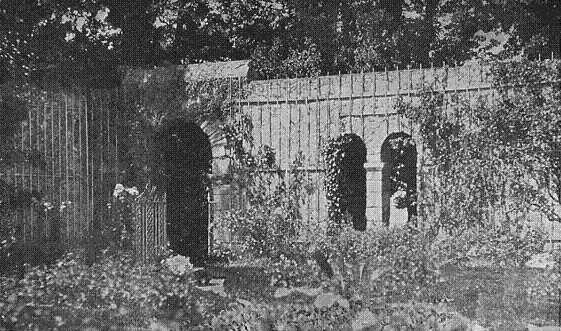
They were sitting in the shady corner in front of the Seigneurie, with four dogs basking in the sun beyond, and beyond them the shaven lawns and motionless trees, the leafy green tunnel that led to the lane, and a lovely glimpse into the enclosed gardens through the ancient gateway whose stones had known the saints of old.
Graeme had put a certain proposition to the Lord of the Island, nominally in connection with the story he was busy upon, but in reality of vital concern to the larger story in which Margaret and he were writing the history of their lives.
"Sark, you know, is a portion of the British Empire, or perhaps I should say the British Empire belongs to Sark, but we are not under British law. We are a law unto ourselves here," said the Seigneur.
"And the authority of a British Court would carry no weight with you? In the case I have put to you, if the Court of Chancery ordered you to surrender the young lady, you would refuse to do so?"
"I could refuse to do so. What I actually would do might depend on circumstances."
"I see," said Graeme musingly, and decided that the Seigneur's goodwill was worthy of every possible cultivation both by himself and Margaret. For he did not look like one who would help a friend into trouble.
III
"I've been thinking a good deal about it, and I really don't see any reason why we should wait,"—said Graeme, looking at Margaret.
And Miss Penny said "Hear! Hear!" so energetically that Margaret laughed merrily.
"We are both of one mind in the matter, an life is all too short at its longest, and most especially when it offers you all its very best with both hands—"
"Hear! Hear!" said Miss Penny.
"And time is fleeting," concluded the orator.
"And that kettle is boiling over again," and Miss Penny jumped up and ran to the rescue.
They were spending a long day in Grande Grève—the spot that had special claims upon their liking since their landing there after that memorable trip to Brecqhou. They had brought a full day's rations, prepared with solicitous discrimination by Graeme himself, and a kettle, and a great round tin can of fresh water from the well at Dixcart, and a smaller one of milk.
So high were their spirits that they had even scoffed at Johnnie Vautrin's intimation that he had seen a magpie that morning, and it had flown over their house. But magpie or no magpie they were bent on enjoyment, and they left Johnnie and Marielihou muttering black spells into the hawthorn hedge, and went off with the dogs down the scented lanes, through the valley where the blue-bells draped the hillsides in such masses that they walked as it were between a blue heaven and a blue earth, and so by the meadow-paths to the Coupée.
Their descent of the rough path down the side of the Coupée with all this impedimenta had not been without incident, but eventually every thing and person had been got to the bottom in safety.
Then, while the dogs raced in the lip of the tide and Scamp filled the bay with his barkings, the girls had disappeared among the tumbled rocks under the cliff, and Graeme had sought seclusion at the other end of the bay. And presently they had met again on the gleaming stretch of sand; he in orthodox tight-fitting dark-blue elastic web which set off his long limbs and broad shoulders to great advantage; Hennie Penny in pale blue, her somewhat plump figure redeemed by the merry face which recognised all its owner's deficiencies and more than made up for them all; Margaret, tall, slim, shapely, revealing fresh graces with every movement,—a sea-goddess in pale pink—a sight to set the heart of a marble statue plunging with delight.
Hennie Penny persisted in wearing an unbecoming cap like a sponge-bag, which subjected her to comment.
Margaret's crowning glory was coiled in thick plaits on top of her head, and if it got wet it got wet and she heeded it not.
Both girls had draped themselves in long towels for the walk down to the water, and Graeme's heart sang with joy at the surpassing beauty of this radiant girl who had given her heart and herself and her life into his keeping.
Dainty clothing counts for much in a girl's appearance. Not every girl shows to advantage in bathing costume. But when she does, she knows it, and the hearts of men are her stepping-stones.
Hennie Penny was a cautious swimmer. She preferred depths soundable at any moment by the dropping of a foot, and if the foot did not instantly touch bottom she fell into a panic and screamed, which added not a little to the hilarity of their bathes.
Margaret and Graeme, however, were both at home in the water. They delighted to set their faces to the open and breast steadily out to sea, rejoicing in the conquest of the waves. But he always watched over her with solicitous care, for there are currents, and cross-currents, and treacherous undertows round those coasts, and the wary swimmer is the wiser man.
And the dogs always swam with them, Punch lunging boldly ahead with the ease and grace of a seal, looking round now and again to see if they were coming, and turning the moment they turned. While Scamp, away in the rear, thrashed along spasmodically, with a yelp for every stroke, but would not be left out of it. The sight of his anxious little face and twisting nose more than once set Margaret laughing, so that she had to turn on her back and float till she got over it, greatly to the small dog's satisfaction.
Full of life and the mighty joy of it, they found the going unusually easy that day. The water was like the kiss of new life, crisp, tonic, vitalising. There was no more than a breath of wind, no more than a ruffle on the backs of the long blue rollers that came sweeping slowly in out of the West.
Graeme, as he glanced round in his long side-strokes at the lovely eager face gemmed with sparkling water-jewels, took full deep breaths of delight and gratitude to the All-Goodness that had vouchsafed him such a prize.
The kiss of the life-giving water had induced a tender flush of colour in the soft white neck, as though the pink of her bathing-suit had spread upwards. He could see the pulsing blue veins in neck and temple as she rose to her stroke. A tiny tendril of water-darkened hair lifted and fell on her neck like a filament of seaweed on a polished rock. Her eyes were very bright, and seemed larger than usual with the strenuous joy of it all. The wonder of her beauty absorbed him. He could hardly turn his face from it. He would have been content to go on swimming so for ever.
But, glancing past the sweet face one time, he saw that they had gone farther than he knew, and Scamp had turned long since and was yelping towards the shore.
"Better turn now," he said quietly, and she floated for a moment's rest, then turned and they headed for the shore, and Punch passed them noiselessly.
They ploughed along in good cheer for a time, and then, of a sudden, it seemed to him that they were making but poor progress.
He fixed his eyes on a rock on the shore and swam steadily on.
They had been opposite it. Twenty strokes, and the rock, instead of facing them, had swung slowly to the north. They were making less than no progress. They were drifting. They were in the grip of a current that was carrying them towards the black fangs of Pointe la Joue.
A cold sweat broke out among the sea-drops on his brow. Pointe la Joue is an ill place to land, even if they could make it, and the chances were that the current would carry them past.
How to tell her without undue upsetting? A panic might bring disaster.
He looked round at her. The bright face was high and resolute. She was not aware of the danger, but from that look on her face he did not think she would go to pieces when he told her.
The rock he had been watching stood now at an angle to their course.
"Are you tired, Meg?" he asked.
"I'm all right."
"Turn on your back and float for a minute or two," and he set the example, and Punch saw and came slipping back to them.
"We're in a cross current," he said quietly. "And we're making no way—"
"I know. I was watching a rock on the shore. What's the best thing to do?"
"We'll rest for a few minutes and then go with the tide round Pointe la Joue. We can land in Vermandés. You're not cold, are you?"
"Not a bit."
When he lifted his head the Coupée was shortened to a span, and the southern headland folded over it as he looked. They were drifting as fast as a man could walk at his fastest. They were abreast the black rocks of La Joue.
"Now, dearest, a little spurt and we shall be in the slack. If you get tired, tell me," and they struck out vigorously on a shoreward slant in the direction they were going.
There should have been a backwater round the corner of Vermandés. He had counted on it. And there was one, but so swift was the rush of the tide round the out-jutting rocks of La Joue, that for some minutes, as they battled with the rough edge of it, it was touch and go with them.
At a word from her his arm would be at her service. But she fought bravely on, and could admire Punch's graceful action even then. The waves smacked her rudely in the face. Great writhing coils came belching up from below and burst under her chin and almost swamped her. One, as strong as a snake, rose suddenly under her, flung her off her stroke, rolled her over, made her for a moment feel utterly helpless.
"Jock!"
He had been watching her closely. His arm flashed out in front of her.
"Grip!" and she hung on to it and it felt like a bar of steel.
"Now!"—when she had recovered herself somewhat. "Grip the top of my suit."—She hooked her fingers into it and he struck out through the turmoil.
It was a tough little fight. She struck out vigorously behind to help him. And, though the losing of the fight might mean tragedy and two white bodies ragging forlornly along the black teeth of Little Sark, she still had time to notice the mighty play of muscles in his back and arms, and the swelling veins in his sunburnt neck, and the crisp rippled hair above, and she rejoiced mightily in him. And—while possible deaths lurked all about them—her soul grew large within her at thought of the brave heart in front, and the strenuous will, and the shapely body, and the powerful muscles—all battling for her—all hers—and she theirs. What matter if they were beaten, if they but went out together! What matter Death so long as he did not divide them! So uplifted was she with the joy of him.
And then, with a final wrestle, they were in slack water, and she loosed her hold and struck out alongside him.
And presently he was helping her carefully up a seamed black rock, and the hand she gripped was shaking now, and she knew it was not for himself.
"Thank God!" said Graeme fervently, as he sank down heavily beside her, and panted while the water ran out of them, and Punch scrambled up and lay quietly alongside. "Meg,—we were in peril."
"Jock," she said jerkily, for her heart was going now quicker than usual, "I do not believe I would have minded—if we'd gone together."
"Ay—together, but, God be thanked, it did not come to that!"
They sat in silence for a time, finding themselves, while the green seas swelled up to their feet, and sank out of sight below, and their rock was laced with cascades of creamy foam.
"How shall we get back?" asked Margaret at last. "Hennie will be in desperation. She will think we are drowned."
"We can climb the head and round into Grande Grève, but it would be pretty rough on the feet. Or we can wait till the tide turns and swim in again—"
"When will it turn?"
"It's full at noon," he said, studying the waters in front. "But how that affects matters here none but a Sarkman could say. Tides here are a law unto themselves, like the people."
"How would that do?" asked Margaret, as a black boat came slowly round the rocks from Les Fontaines, sculled by an elderly fisherman.
"It is old Billy Mollet after his lobster-pots," and he stood up and coo-eed to the new-comer, and waved his arms till Billy saw them and stared hard and then turned leisurely their way.
"Guyablle!" said the old man, as he drew in. "What you doin' there now?"
THE SANDS OF GRANDE GRÈVE
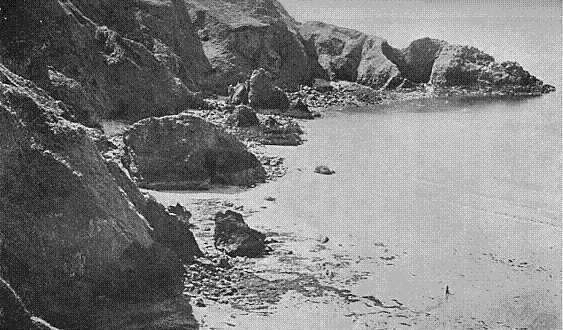
"Got carried out of Grande Grève by a current, Mr. Mollet. Will you take us back in your boat?"
"Ay, ay!" and he brought the boat as near to the rock as he dared, and his weather-stained old eyes settled hypnotically on the fairest burden his old tub had ever carried, as Graeme handed her carefully down and helped her to spring into the dancing craft, and then sprang in himself with bleeding feet and shins, while Punch leaped lightly after him and crawled under a thwart.
"Ye must ha' been well out for tide to catch ye," said Billy, with no eyes for anything but the vision in clinging pink.
"Yes, we were too far out and couldn't get back."
"Tide runs round them rocks."
He dropped his oar into the rowlock and Graeme took the other, and in five minutes they were speeding across the sands of Grande Grève—Margaret to cover, Graeme to his pocket for Billy's reward.
Miss Penny had a driftwood fire roaring among the rocks, and the kettle was boiling.
"Where on earth have you two been?" she cried, at sight of Margaret skipping over the stones to her dressing-room, and got only the wave of a white arm in reply.
And presently Graeme came along in easy piratical costume of shirt and trousers and red sash, and sat down and lit a pipe.
"We went a bit farther than we intended," he explained, but did not tell her how nearly they had gone out of bounds altogether.
"You'll enjoy a cup of tea. You look as if you'd been working hard."
"There is a bit of a current round that point."
"Ah, you should follow a good example and keep within touch of the bottom. Here you are, Meg—fresh made for every customer. Help yourself, Mr. Graeme. I've had mine, I couldn't wait. Tea never tastes so good as when you're half full of salt-water, and I got right out of my depth once and swallowed tons. I screamed to you two to come and save me, but you never paid the slightest attention, and for all you cared I might have been drowned five times over."
"One would have been quite once too many," said Graeme, holding out his cup. "For then you couldn't have lighted that fire and made this tea. And I'm half inclined to think we wouldn't be enjoying it a quarter so much if a little blue corpse lay out there on the shining sand, and we'd had to turn to and make it ourselves."
"Horrible!" said Miss Penny, with a little shiver. "With your little blue corpses! It's all very well to joke about it, but I assure you, for a minute or so, I thought I was done for. The bottom seemed to have sunk, and I was just going after it when my foot came on a rock and that helped me to kick ashore."
"A narrow escape," said Graeme, with a sympathetic wag of the head. "You've no right to risk your life that way. We still need you. What do you say to being bridesmaid at a Sark wedding?"
"It is the hope of my life," said Miss Penny, sparkling like Mars in a clear evening sky.
"I really don't see any reason why we should wait"—said Graeme, looking very earnestly at Margaret, and behind the look was the thought, born of what they had just come through together, that life spills many a full cup before the thirsty lips have tasted it. "What do you say, Margaret?"
And she, knowing well what was in him, and being of the same mind, said, "I am ready, Jock. When you will."
"I'll call on the Vicar to-morrow," he said joyfully. "It would be such a pity to disappoint the hope of Miss Penny's life,"—as that young person came back with the merry kettle.
"I am indebted to you," said Hennie Penny. "What about dresses, Meg?"
IV
It was that same night, as they were sauntering home from a starlight ramble, that they came on Johnnie Vautrin crouched in the hedge with Marielihou, and Marielihou had her hind leg bound up in a piece of white rag.
"Hello, Johnnie! What's the matter with Marielihou?" asked Graeme. And Marielihou turned her malevolent yellow-green eyes on him and looked curses.
"Goderabetin! She've got hurt."
"Oh! How was that?"
"I d'n know. Wisht I knowed who done it;" and just then, as luck would have it, old Tom Hamon came sauntering along in the gloaming, smoking a contemplative pipe with long slow puffs.
And at sight of him Marielihou ruffled and swelled to twice her size, and raked up most horrible and blood-curdling oaths from away down in her inside into her black throat, and spat them out at him, as he came up, in a fusillade that sounded like ripraps, and her eyes flamed baleful fires.
"Cuss away, y'ould witch!" said old Tom, with a grin through his pipe-stem. "How's the leg?" and Marielihou with a final volley disappeared among the bushes, and Johnnie crawled after her.
"What on earth does he mean?" whispered Meg.
"Mr. Hamon has an idea that Marielihou and old Mme. Vautrin have something in common. In fact I believe he goes so far as to say that they are one and the same. Black magic, you know,—witchcraft, and all that kind of thing."
"How horrid!"
"B'en!" chuckled old Tom again. "You find out how 'tis with th' old witch. We know how 'tis with Marrlyou. 'Twere the silver bullet did it. If sh' 'adn't jumped 'twould ha' gone through 'er 'ead," and he went off chuckling through his pipe-stem.
And the next evening, as they were sauntering slowly through the darkening lanes to the windmill, to see the life-lights flash out all round the horizon, it happened that they met the doctor just turning out of his gate.
"Hello, doctor! How's old Mme. Vautrin to-day?" asked Graeme.
"She's going on all right," said the doctor, with a touch of surprise. "There seems a quite unusual amount of interest in that old lady all of a sudden. How is it?"
"What is it's wrong with her?"
And the doctor eyed him curiously for a moment, and then said, "Well, she says she hurt her leg ormering, slipped on a rock and got the hook in it. But—Well, it's a bad leg anyway, and she won't go ormering or anything else for a good long time to come."
Which matter, in the light of old Tom Hamon's silver bullets and evident knowledge of Marielihou's injury, left them all very much puzzled, though, as Graeme acknowledged, there might be nothing in it after all.
V
It was just after the second lesson, the following Sunday, that the Vicar stood up, tall and stately, his youthful face below the gray hair all alight with the enjoyment of this unusual break in the even tenour of his way, and soared into unaccustomed and very carefully enunciated English.
"I pub-lish thee Banns of Marrr-i-ache between John Cor-rie Graeme of Lonn-donn and Mar-garet Brandt of Lonn-donn. If any of you know cause, or just im-ped-i-ment, why these two pair-sons should not be joined to-gether in holy matri-mony, ye are to de-clare it. This is thee first time of as-king."
Margaret and Miss Penny and Graeme heard it from their back seat among the school-children, and found it good.
There were not very many visitors there. Such as there were felt a momentary surprise at two English people choosing to get married in Sark, though, if it had been put to them, they must have confessed that there was no lovelier place in the world to be married in. They also wondered what kind of people they were.
Some few of the habitants knew them and turned and grinned encouragingly, though even they were not quite certain in their own minds as to which of the two ladies was the one who was to be married. The children all smiled as a matter of course and of nature.
And Margaret felt no shadow of regret at thought of the gauds and fripperies of a fashionable wedding which would not be hers. In John Graeme's true love she had the kernel. The rest was of small account to her.
And that little church of Sark, plain walled and bare of ornament, always exerted upon her a most profoundly deepening and uplifting influence. It epitomised the life of the remote little island. Here its people were baptized, confirmed, married, buried.
And here and there, on the otherwise naked walls, was a white marble tablet to the memory of some who had gone down to the sea and never returned. And these she had studied and mused upon with emotion the first time she went there, for surely none could read them without being deeply touched.
"A la memoire de John William Falle, âgé de 37 ans, et de son fils William Slowley Falle, âgé de 17 ans, Fils et petit fils de William Falle, Ecr. de Beau Regard, Sercq. Qui furent noyés 20'eme jour d'Avril 1903, durant la traversée de Guernsey a Sercq. 'Ta voie a été par la mer et tes sentiers dans les grosses eaux.'"
"A la memoire de Pierre Le Pelley, Ecuyer, Seigneur de Serk, noyé près la Pointe du Nez, dans une Tempête, le 13 Mars, 1839, âgé de 40 ans. Son corps n'a pas été retrouvé; mais la mer rendra ses morts."
"In memory of Eugène Grut Victor Cachemaille, second son of the Revd. J.L.V. Cachemaille, Vicar of Sark. Born Jan. 14, 1840, and lost at sea in command of the Ariel, which left London for Sydney, Feby. 1872, and was heard of no more. 'He was not, for God took him.'"
Yes, she would sooner be married in that solemn little church than in Westminster Abbey, for there there would be mighty distractions, while here there would be nought to come between her and God and the true man to whom she was giving herself with a full heart.
VI
"This is the second time of asking."
"This is the third time of asking."
And so far none had discovered any just cause or impediment why John Corrie Graeme and Margaret Brandt should not in due course be joined together in holy matrimony.
On the occasion of the third asking, however, one in the congregation, a casual visitor and in no way personally concerned in the matter, found it of sufficient interest to make mention of it in a letter home, and so unwittingly played his little part in the story.
Meanwhile, the glorious summer days between the askings were golden days of ever-increasing delight to Graeme and Margaret, and of rich enjoyment to Miss Penny.
Never was there more complaisant chaperone than Hennie Penny. For, you see, she took no little credit to herself for having helped to bring about their happiness, and the very least she could do was to further it in every way in her power.
In her own quaint way she enjoyed their "lovering," as she called it, almost as much as they did themselves. And that being so, they would have felt it selfish on their part to deprive her of any portion of her rightful share in it.
And that was how Miss Hennie Penny became so very knowing in such matters, and also why she lived in a state of perpetual amazement at the change that had come over her friend.
For Margaret, affianced to the man who had her whole heart, was a very different being from Margaret harassed and worried by Mr. Pixley and his schemes for her possession and possessions.
Charming and beautiful as she had always been, this new Margaret was to the old as a radiant butterfly to its chrysalis,—as the glory of the opening flower to the promise of the bud. And Hennie Penny's quickened intelligence, projecting itself into the future, could fathom heights and depths and greater glories still to come.
But even now, when they went along the lanes festooned as for a wedding with honeysuckle and wild roses, the faces of those they met lighted up at sight of them, and few but turned to look after them when they had passed, and Miss Penny's truthful soul took none of the silent homage to herself.
Margaret was supremely happy. She could not have hidden it if she had tried. She made no attempt to do so. She gave herself up to the rapturous enjoyment of their "lovering" with all the naïve abandon of a delighted child. The little ties and tapes and conventions, which trammel more or less all but the very simplest lives, fell from her, snapped by the expansion of her love-exalted soul. She was back to the simple elementals. She loved Jock, Jock loved her. They were happy as the day was long. Why on earth should they not show it? If she had had her way she would have had every soul in all the world as happy as they two were.
"I feel like an elderly nurse with two very young children," said Miss Penny to the pair of exuberants.
"O Wise Nurse! We shall never be so young again," laughed Graeme.
"But we are never going to grow any older inside," laughed Margaret.
"Never!" said Graeme, with the conviction of absolute knowledge, and carolled softly—
"O it's good to be young in the days of one's youth! Yes, in truth and in truth, It's the very best thing in the world to be young, To be young, to be young in one's youth."
"Very apropos!" said Miss Penny. "Did you make it on the spot?"
"In anticipation," he laughed. "It's the opening song in a very charming comic opera I once committed. But it was too good for the present frivolous age, and so I have to perform it myself."
"I would like to give all the children on the island—" began Margaret.
"All the other children—" corrected Graeme.
"All the children—including Hennie and you and me—the jolliest feast they've ever had in their lives, the day we are married."
"Of course we will, and the doctor shall get in an extra supply of palliatives. They shall look back in after years and say—'Do you remember that feast we had when the loveliest of all the angels came down from heaven and was married to that delightful Englishman?'—Briton, I ought to say! I do wish our dear old Lady Elspeth could be here. How she would enjoy it!—'That feast,' they will say, 'when we were all ill for a month after and the doctor died of overwork.' They will date back to it as ancient peoples did to the Flood. It will be a Great White Stone Day to generations to come. Let us hope there will be no new white stones over yonder"—nodding in the direction of the churchyard—"in commemoration of that great day."
"We will draw the line short of that," said Margaret seriously.
"We'll give them all the gâche they can eat—home-made, and such as their constitutions are accustomed to,—and fruit and frivolities from Guernsey. I'll go across the Saturday before—"
"We will go across," said Margaret.
"Of course we will. We older children will go, and we'll take Nurse with us,"—with a bow towards Hennie Penny,—"and we'll make a day of it, and have ices again at that place in the Arcade, and then we'll go round the shops and clear them out for the benefit of Sark."
"Ripping!" said Miss Penny.
VII
They had already made one trip to Guernsey, crossing by the early Saturday boat and returning the same evening.
But that was a strictly business affair.
"We're feeling frightfully fossilised at having bought nothing, except what we absolutely needed, for nearly a month," said Miss Penny. "From that point of view I should imagine the Garden of Eden may have been just a trifle slow—"
"Ah, you see, Mother Eve hadn't had the advantages of a superior education," said Graeme.
"And there are some fripperies we simply must have," said Miss Penny, "even for a runaway wedding like this. You see, when we decided to come here we had no idea how much farther we were going, and so we couldn't possibly provide. Of course if we had known you were here—"
At which Margaret laughed.
"You would have provided accordingly," said Graeme. "Well, you must put all the blame on to Mr. Pixley. I wonder what he would say if he knew all about it."
"He would use language unadapted to prayer-meetings and public platforms," said Miss Penny. "He can, you know, when he tries hard."
"I imagined so. It will be rather amusing to see what he'll do when he finds out."
"He'll do the very nastiest thing that is open to him, whatever that is, and poor Mrs. Pixley will have an exceedingly bad time. And he'll probably have a fit on his own account."
"Oh, we can hardly expect him to be so kind as all that—"
"The only one I'm sorry for is Charles Svendt. He's really not half a bad sort, in his way, you know," said Miss Penny.
"I'm sorry, but I'm afraid, under the circumstances, I can't squeeze out any sympathy even for Charles Svendt."
Arrived at St. Peter Port, the ladies permitted him to attend them to the door of the largest drapery establishment they could find, and then told him he was at liberty to go and enjoy himself for a couple of hours.
"Two hours? Good Heavens! What can you want in there for two hours?"
"Usual thing!" sparkled Miss Penny. "Tablecloths!"—with which cryptic utterance he had to be satisfied.
"And where do we meet again—if ever?"
"Hauteville House—Victor Hugo's. It's part of your honeymoon—a bit on account."
"And whereabouts is it?"
"No idea. If we can find it, you can. Au revoir!"
He went first to get his hair cut, since the practice of the tonsorial art in Sark is still in the bowl-and-scissors stage.
Then he sought out a lawyer of repute, whose name he had got from the Vicar, and gave him instructions for the drawing of a brief but comprehensive deed of settlement of all Margaret's portion on herself absolutely and entirely. While this important document was being engrossed, he sought out the Rector of St. Peter Port, in George Place, and in a short but pleasant interview was accepted as tenant of the whole of the Red House in Sark for the month of July, with the option of a longer stay if he chose.
Then back to the lawyer's, where he signed his deed, paid the fees, and took it away with him.
After that, to fill in the time occupied elsewhere by the purchase of mythical tablecloths, he rambled up and down the quaint foreign-flavoured streets till he found a jeweller's shop of size, in the Arcade, and decided, after careful inspection from the outside, that it would answer all requirements.
For he had a ring and half a ring to buy for Margaret, and he thought he would buy one also for Hennie Penny, as a pleasant reminder of their good days in Sark.
So utterly unconventional had their proceedings been, so thoroughly had the spirit of the remote little island possessed them, and so all-sufficient had they been to one another, that the thought of an engagement ring had troubled his mind as little as the lack of it had troubled Margaret's. But the absolute necessity of a wedding ring had reminded him of his lapse, and now he would repair it on a scale remotely commensurate with his feelings. Remotely, because, if his pocket had borne any relation to his feelings, he would have bought up the whole shop and lavished its contents upon her, though he knew that the simple golden circlet would far outweigh all else in her mind.
He was waiting placidly for them in the shade of the dark trees of Hauteville, when they came panting up the steep way, flushed with victory and the joys of purchase after long abstinence.
"Well, has the proprietor of that big shop retired with a competence?" he asked, as he threw away the end of his cigar.
"Can you lend us our boat-fares home?" gasped Miss Penny.
"So bad as all that? I can't say yet. I've not begun my own purchases. We'll see when I'm through. If I'm cleaned out too we'll offer to work our passages."
"You can pawn your watch. Meg and I haven't got one between us. We left them at home on purpose."
"Thoughtful of you. Now let us into the treasure-house."
They enjoyed the wonders of Hauteville immensely,—objectively, the wonderful carved work and the tapestries, the china and the furniture,—the odd little bedroom with the bed on the floor, so that the Master could roll out to his work at any moment of inspiration, and the huge balconies, and the glass eyrie on the roof whence he surveyed his wide horizons, and where, above the world, he worked;—and subjectively, the whole quaint flavour and austere literary atmosphere of the place.
"No wonder he produced masterpieces," said Graeme, delighting in it all. "The view alone is an inspiration."
Then he took them up to Old Government House for lunch and a rest in the garden, and then away to the Arcade to the jeweller's shop, which proved adequate to all his demands;—for Margaret, a half-hoop of diamonds which the jeweller, with an air of sincerity, assured them were as fine stones as he had ever seen in the course of a long and prosperous career. Which ring Margaret would thenceforth value before all her others, though in the simple matter of intrinsic worth her jewel-case could beat it hollow.—And a plain gold circlet which, when she got it, would be more precious to her than all the rest put together.—And for Miss Penny, in spite of her protestations, a handsome signet ring which, when cornered, she chose in preference to a more feminine jewel, and which was left to be engraved with her family crest and motto.
"I have never adopted the habit of rings," she said, as they drifted towards the ice-shop. "Chiefly, perhaps, because I never had any worth wearing. But I've always thought I would like to wear a crest signet. I shall prize this, Mr. Graeme, as the very greatest treasure I have—"
"Until someone gives you a plain gold one, Hennie, and that will put all the rest into the shade," said Margaret.
"Ah!" said Miss Penny.
VIII
Their journey home—that is, to Sark—that day was not entirely without incident. For when they got down to the quay, Sark had disappeared completely, and Herm and Jethou were no more than wan ghosts of their natural selves, in a dense white mist.
"Ah-ha! Here is our old friend of Tintageu," said Graeme jovially. "Well, I must confess to bearing him no ill-feeling—if he doesn't land us on a rock this time. Going, captain?"
"Oh yess, we go. I think it will lift," said Captain Bichard.
"Don't run us on a rock anyway."
"I won'd run you on no rock. I coult smell my way across;" and they started, feeling their way cautiously past Castle Cornet, into the open, where black jaws lined with white teeth lie in wait for the unwary.
And just as they got to the south of Jethou they saw a sight the like of which none of them had ever seen before, nor, from the exclamations about them, had any of the rest.
The mist in front was like a soft white curtain, and upon it, straight ahead of their bows, appeared suddenly a mighty silver bow, not a rainbow, because there was no rain and so there were no colours. But, like the bow they had seen from Belême Cliff, this also was a perfect circle, all but a tiny segment where it appeared to rest upon the sea, and its only colour was a dazzling silvery sheen which waxed as they watched it in breathless silence. Then it waned, bit by bit, till at last it was gone, and only the white mist curtain remained.
"How very lovely!" murmured Margaret.
"A good omen for certain," said Miss Penny. "Even Johnnie Vautrin couldn't make any ill news out of that. It was your wedding arch, Meg."
"Well, that's the first time I ever saw a white rainbow," said Graeme to the captain.
"First time I ever saw one myself, sir."
"Not very common then."
"Never heard of one before."
"We're evidently in luck."
"Mebbe, but we won't crow till we've made the Creux. Kip your eyes skinned, lads!"
"Ay, ay, zur!" and the crew lined the bulwarks on their knees, with their chins on the rail, their eyes peering into the puzzling veil in front, and their ears alert for the wash of wave on rock.
They were going slow, hardly moving in fact at times, waiting to pick up their course as any possible mark should come into view, with muttered comments from the puzzled lookouts, and an occasional growl of dissent from views propounded by the younger members, while the passengers all stood in silent discomfort as though ready for contingencies.
For the tides and currents in those seas are strange and gruesome. Even as they lay, apparently motionless, with the sea as smooth as oil all round them, there came a sudden turmoil, and they were in a wild race of waters, with bubbling coils and swirls and frothing gouts of foam from rocks that lay fathoms deep below.
"La Grune," growled one of the keen-eyed watchers, and was discounted at once by doubtful growls from the rest.
Then a black ledge loomed through the mist and faded again before they had more than a glimpse of it.
"Les Dents," ventured one.
"Hautes Boues,"—so divergent were their views.
A sound of waters and another dark loom of rock.
"Sercul," said one.
"L'Etac," said another.
Then the engine bell tanged sharply, and they went ahead. The captain had seen more than the rest and knew where he was, and they all breathed more freely. And presently, with a wide berth to the dangers of the south-east coast, they nosed slowly in again, picked up La Conchée without dissentients, and so into Creux Harbour in a way that seemed to Graeme little short of marvellous.
"Fogs at sea are beastly—there is no other word for it—but all the same I'm glad we saw the Wedding-Bow," said Miss Penny.
IX
They had fixed on the Wednesday following the last time of asking, for their wedding-day. But when they came to discuss the matter with Mrs. Carré, it was found that an alteration would be necessary.
"Ah, but that will not do," said their landlady, who was in high feather at so unique an event taking place in her cottage, so to speak, though, as a matter of fact, the festivities were to be carried out within the ampler precincts of the Red House. "You see, old Mr. Hamon he iss died very sudden—"
"Not old Tom surely?" asked Graeme.
"He iss old Tom's father, and they will bury him on Wednesday, and you would not like to be married the sem day—"
"No, indeed," said Margaret. "We will wait."
"And, you see, all them that would be coming to the wedding would be at the funeral, for efferybody belongs to efferybody else here."
"Must be a bit awkward at times," suggested Graeme.
"Oh noh!" with a touch of airy aloofness. "I haf been at a wedding and a funeral and a baptism all in one week all among the sem people. And I was at one young man's wedding one day last year and at his funeral the same day the next week after."
"That was dreadful," said Margaret. "Do you think it would be safe to fix it for the following Wednesday, Mrs. Carré?"
"Oh yes, I think! There iss no one very sick. Mr. Hamon he wass a very old man and he died very sudden. He wass just knocking a nail in the pigsty and he drop down and died."
"Poor old man!"
"He wass very old and he wass a good man. No one ever said any harm of old Mr. Hamon."
"Then if no one else dies we'll say the following Wednesday," said Graeme. "And if—well, if anything happens to prevent it, then we must go across to Guernsey and get Mr. Lee to marry us."
"Oh, but that woult not do. We will keep them all alive till you are married. It woult neffer do to disappoint them all when we are all looking forward to it here."
"Very well then, see you all keep alive."
"And you will come to old Mr. Hamon's funeral?"
"H'm! I don't know. We'll see, Mrs. Carré. We'd sooner be at our own wedding, you know, than at anybody else's funeral."
"They woult like it iff you woult. And he was a goot old man. They tell me to ask if you woult be pleased to come."
"If they would like us to come we will come, Mrs. Carré," said Margaret.
And so it came about that instead of kneeling before the altar that Wednesday they stood by the graveside.
X
The Red House and the cottage were centres—nay, whirlpools—of mighty activities for days beforehand.
Mrs. Carré insisted on cleaning down the Red House from top to bottom for the home-coming of the bride, though, to Graeme's masculine perceptions, its panelling of polished pitch pine from floor to ceiling, in which you could see yourself as in a mirror, had always appeared the very acme of cleanliness and comfort, with the additional merit of a tendency towards churchwardly thoughts.
But when he ventured on a mild remonstrance anent the necessity for so gigantic an upsetting, Mrs. Carré laughingly said, "Ach, you are only a man. You woult neffer see"—and whirled her broom to the endangerment of his head.
For Margaret's honeymoon—that, is, such of it as she had not enjoyed before her marriage—was to consist of a change of residence from the cottage, and a walk up the garden and through the hedge of gracious Memories, to the wider—ah, how much wider!—as much wider and larger and more beautiful as wifehood at its best is wider and larger and more beautiful than maidenhood at its best—to the wider accommodation of the Red House. And Mrs. Carré was determined that it should be speckless and sweet, and fit in every way for the coming of so beautiful a bride.
She had found them a young girl, Betsy Lefevre, a niece of her own, to serve as handmaid during their occupancy of the house, but insisted herself on acting as cook and general housekeeper. Miss Penny was to reside at the cottage for a week after the wedding, but was to go up the garden to her meals, and at the end of that time she was to join them at the Red House as an honoured guest.
And the kitchen at the cottage, and the kitchen at the House, and several other kitchens in the neighbourhood, were baking gâche enough apparently to feed a regiment, and as the day approached, roasts of beef and mutton, and hams and other substantial fare, were much in evidence. And the kitchens were thronged with ladies in sun-bonnets, which had originally been black but were now somewhat off-colour with age and weather, and all the ladies' faces were as full of importance as if they had been Cabinet ministers in the throes of a crisis.
Among these concentric energies, Margaret and Miss Penny completed their own simple preparations, and Graeme busied himself with the details of the children's feast which was to take place in an adjacent field.
THE HARBOUR, FROM LES LÂCHES
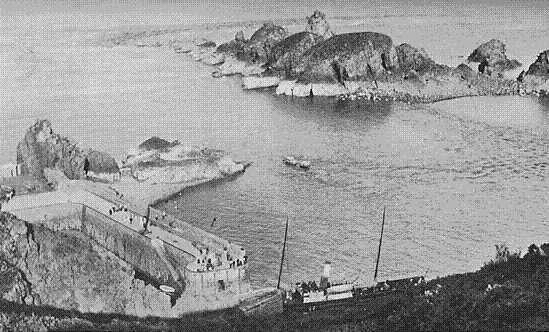
He went down to the harbour to meet the Tuesday morning's boat which was to bring over the fruit and frivolities ordered from Guernsey—strawberries enough to start a jam factory, grapes enough to stock a greengrocer's shop, chocolates, sweets, Christmas crackers and fancy biscuits, in what he hoped would prove sufficiency, but had his doubts at times when he saw the eager expectancy with which he was regarded by every youngster he met.
He was just starting out when Johnnie Vautrin hailed him from his lair in the hedge.
"Heh, Mist' Graeme! I seen—"
"Better not, Johnnie!" he said, with a warning finger. "If it's anything uncomfortable I'll come right over and jump on you and Marrlyou."
"Goderabetin, you dassen't!"
"Oh, dassen't I? If you don't see everything good for this week, and fine weather too, you little imp, I'll—"
"Qué-hou-hou!" croaked Johnnie, and Marielihou yawned and made a futile attempt to wash behind her ears but found it discomforting to a sore hind-leg, so gave it up and spat at him instead.
"And, moreover, I won't have you at my party."
"Hou-hou! I'm coming. Ma'm'zelle she ask me."
"I'll tell her to send you back-word."
"She wun't, she wun't. Where you goin'?"
"To the harbour, to see if all the good things have come for the other little boys and girls."
"Oh la-la! Good things and bad things come by the boat. Sometime it'll sink and drown 'em all."
"Little rascal!" and he waved his hand and went on.
"Late, isn't she, Carré?" he asked, as he leaned over the sea-wall with the rest.
"She's late, sir."
"I hope nothing's happened to her. I'll never forgive her if she's made an end of my sweet things for the kiddies."
"She'll come."
And she came. With a shrill peal she came round the Burons and made for the harbour.
And Graeme, wedged into the corner of the iron railing where it looks out to sea, to make sure at the earliest possible moment that that which he had come to meet was there, met of a sudden more than he had looked for.
"Well ... I'll be hanged!" he jerked to himself, and then began to laugh internally.
For, standing on the upper deck of the small steamer, and looking, somehow, very much out of place there, was a tall but portly young gentleman, in a bowler hat and travelling coat and a monocle, whose face showed none of the usual symptoms of the Sark lover. To judge from his expression, the little island impressed him anything but favourably. It offered him none of the relaxations and amusements to which he was accustomed. It looked, on the face of it, an uncivilised kind of a place, out of which a man might be ejected without ceremony if he chose to make himself objectionable.
Graeme kept out of sight among the other crowders of the quay till the bowler hat came bobbing up the gangway. Then he smote its owner so jovially on the shoulder that his monocle shot the full length of its cord and the hat came within an ace of tumbling overboard.
"Hello, Pixley! This is good of you. You're just in time to give us your blessing."
"Aw! Hello!" said Charles Svendt, agape at the too friendly greeting. "That you, Graeme?"
"The worst half of me, my boy. Margaret's up at the house. You'll be quite a surprise to her."
"Aw!" said Charles Svendt thoughtfully, as he readjusted his eyeglass. "Demned queer place, this!" and he gazed round lugubriously.
"It is that, my boy. Queerer than you think, and queerer people."
"Aw! Is there any—aw—place to stop at?"
"Thinking of stopping over night? Oh yes, several very decent hotels."
"Aw! Which are you at yourself now?"
"I? Oh, I'm a resident. I've got a house here."
"Dooce you have! Well, now, where would you stop if you were me?"
"Well, if I were you I should stop at the Old Government House—"
"Right! Whereabouts is it?"
"It's over in Guernsey. Boat returns at five sharp."
"Aw! Quite so! Very good! But I've got—er—business here, don't you know."
"Oh? Thinking of opening a branch here? Well, there's Stock's—but I doubt if you'd fit in there—"
"Fit? Why not fit? Stocks are my line."
"I think I'd try the Bel-Air if I were you—"
"Which is nearest?" asked Charles Svendt, looking round depreciatively.
"Bel-Air. Just along the tunnel there—"
"Good Lord! Along the tunnel—"
"Excuse me for a moment. I've got some things coming by this boat. I must see to them," and Graeme sped away to attend to his frivolities.
XI
"And what special business brings you to Sark, Pixley?" asked Graeme, as they passed through the tunnel of rock and climbed the steep way of the Creux—its high banks masses of ferns, its hedges ablaze with honeysuckle and roses, its trees interwoven into a thick canopy overhead,—a living green tunnel shot with quivering sunbeams. All of which was lost on Charles Svendt, whose chest was going like a steam-pump and whose legs were quivering with the unusual strain. Graeme regretted that he had not been landed on the ladders at Havre Gosselin, where he himself came ashore. He would dearly have liked to follow the portly one up those ladders and heard his comments.
In reply to Graeme's question he shook his head mutely and staggered on—past the upper reaches, where the corded roots of the overhanging trees came thrusting through the banks like twisting serpents; past the wells of sweet water that lay dark and still below, and ran over into the road, and trickled away down the sides in little streams; out into the sunshine and the quickening of the breeze;—till he dropped exhausted into a chair outside the door of the Bel-Air.
He sat there panting for close on five minutes, with unaccustomed perspiration streaming down his red face, and then he said "Demn!" and proceeded to mop himself up with his handkerchief.
Then he held up a finger to a distant waiter in the dining-room, and when he came, murmured, "Whisky—soda—two," and fanned himself vigorously till they came.
"Better?" asked Graeme, as they nodded and drank.
"Heap better! What a demnable place to get into!"
"There are one or two other entrances—"
"Better?"
"No, worse."
"Demn!"
"Now," he said presently, when his heart had got back to normal and he had lit a cigarette. "Let's talk business. Am I in time?"
"For the wedding? Just in time. It's tomorrow."
"Aw—er—you know what I've come for, I suppose?"
"I can imagine, but you may as well save yourself useless trouble. You can't do anything."
"Think not?"
"Sure. English—I should say, British—law doesn't run here, and you've no locus standi if it did."
"She's under age and her guardian objects. I represent him."
"He can object all he wants to, and you can represent him all you want to. It won't make the slightest difference."
"I can appear at the ceremony and show cause why it should not proceed."
"What cause?"
"Her guardian objects. The parson would hardly proceed in face of my objection."
"I think you'll find he would. However, we'll go and ask him presently. We'll pay a visit to the Seigneur also."
"Who's the Seigneur?"
"Lord Paramount of the island. His word goes. If he chooses, as he probably will, to tell you to go also, you'll have to go."
"Demn'd if I will!"
"He'll see to that. He'll put the Sénéchal and the Greffier and the Prévôt and the two constables and the Vingténier on to you, and bundle you out like a sack of potatoes."
"Oh, come, Graeme! This is the twentieth century!"
"That's another of your little mistakes, my friend. I can't tell you just exactly what year it is here, but it's somewhere between 1066 and, say, 1200 A.D."
"Afraid I don't quite catch on."
"Exactly! That's why you'll be off in this scene. We're under feudal law here, with a mixture of Home Rule. We don't care twopence for your English courts, and as for English lawyers, they're not much liked here, I believe."
"Rum hole!" mused Charles Svendt.
"Rum hole to make yourself a nuisance in. Jolly place to be happy in."
"H'm!" And presently he asked, "Where are you stopping?"
"I'll go along and tell the girls you're here—"
"Girls?"
"Miss Penny came with Margaret—"
"Aw—Miss Penny!"
"You'd better have your lunch here. They'll give you lobsters fresh from the kettle, and I'll stroll round later on and we'll get this matter settled up. So long!" and he went away up the Avenue and across the fields home.
And he went thoughtfully. It was annoying this man cropping up like this at the eleventh hour. Nothing, he felt sure, would come of his interference, but it might disturb Margaret and the general harmony of to-morrow's proceedings.
Her wedding-day is a somewhat nervous time for a girl, under the best of circumstances, he supposed. And though Margaret was as little given to nerves as anyone he had ever met, the possibility of a public attempt to stop her wedding might be fairly calculated to upset her.
Feudal as were the laws of the island, he could hardly knock Pixley on the head, as would have happened in less anachronistic times. And so he went thoughtfully.
XII
Margaret and Miss Penny were lying in long chairs on the verandah when he came over the green wall into the Red House garden, by the same gap as he had used that first morning when he came upon Margaret standing in the hedge.
They were resting from labours, joyful, but none the less tiring.
"Jock, we were just wanting you!" said Margaret, sitting up. "Have all the things come all right?"
"All come all right," and he wondered how she would take his next announcement. "In fact more came than we expected."
"I guess we can use it all," said Miss Penny. "You've no idea of the capacity of children. I know something about it, and these children are more expansible even than school-girls."
"I was surprised to meet a gentleman down there who says he has come across on purpose for the wedding."
"A gentleman—come for the wedding?" and both girls eyed him as pictured terriers greet the word "Rats!"
"I'll give you three guesses."
"Mr. Pixley," said Miss Penny.
"Bull's-eye first shot! Clever girl!"
"Not really, Jock!" said Margaret, with a suspicion of dismay in her voice.
"Well, Charles Svendt anyway—as representing the old man, he says."
"But what has he come for, and how did he get to know?"
"I didn't ask him. It was quite enough to see him there. He says he's going to stop it,"—and Margaret's cheeks flamed,—"but I've assured him that he can't, and I'll take jolly good care that he doesn't, if I have to knock him on the head and drop him off the Coupée."
"It would be shameful of him if he tried," cried Miss Penny. "Just let me have a talk with him, Mr. Graeme, and I'll make him wish he'd never been born. He's really not such a bad sort, you know. Where is he?"
"I left him at the Bel-Air about to tackle lobsters. My idea is to take him to the Vicar, then to the Seigneur. They both understand the whole matter. I explained it fully when I told them we intended getting married here. When they understand that this is the gentleman who would like to occupy my place, and that he has no legal grounds for interfering, I think they will open his eyes—"
"I do hope he won't make any trouble in the church," said Margaret, with a little flutter.
"I'll promise you he won't."
"I'm sure he won't, if you can make it quite clear that it could not possibly accomplish what, I suppose, his father sent him to try to do," said Miss Penny. "Charles Pixley is no fool, though he has his little peculiarities."
"It would be a wonder if he hadn't some, after his daddie," said Graeme lightly. "I'm sorry he's come, Meg, but I'm certain you don't need to worry about him. If I could have knocked him on the head and dropped him in the sea and said nothing to nobody—"
"Don't be absurd, Jock," said Margaret, and her voice showed that the matter was troubling her in spite of his assurances.
"After lunch I shall call for him and take him for a little walk. If you'd seen him when he got to the Bel-Air after toiling up the Creux Road! He was nearly in pieces. I'll trot him round to the Vicarage, and then to the Seigneurie, and then I'll bring him here and turn him over to you and Hennie Penny. He'll be as limp as a rag by that time, and as wax in your hands."
Nevertheless, Margaret could not quite get rid of the feeling of discomfort which the news of Charles Pixley's arrival had cast over her, and Graeme anathematised that young man most fervently each time he glanced at her face.
XIII
After lunch Graeme went back to the hotel, and found Pixley lolling on the seat outside, in a much more contented frame of mind than on his first arrival.
"You were right as to their lobsters, anyhow, Graeme," he said. "They're almost worth coming all the way for."
"All right. Now if you're rested we'll go for a stroll, and I'll set your mind at rest as to to-morrow. Then you'll be able to enjoy your dinner in a proper frame of mind."
"How far is it?"
"Just up there and round the corner. We'll see the Vicar first and you can try your hand on him."
The Vicar received them with jovial bonhomie.
"Ah-ha! The bridegroom cometh out of his chamber! And your friend? He is the best man—no?"
"He's not quite made up his mind yet, Vicar. Perhaps you can persuade him to it."
"But it is an honour—n'est-ce pas? To attend so beautiful a bride to the altar—"
"Well, you see, the fact is—Mr. Pixley would have preferred reversing the positions. He would like to have been bridegroom and me to be best man."
"Ah—so! Well, it is not surprising—"
"Moreover, he would like to stop the wedding now if he could—"
"Ach, non! That is not possible," said the Vicar wrathfully, the southern blood blazing in his face. "What would you do, my good sir, and why?"
"Miss Brandt is my father's ward," said Pixley sturdily. "My father objects to this marriage. He has sent me over to stop it."
"I understand," said the Vicar. "He wished his ward to marry you, but Miss Brandt made her own choice, which she had a perfect right to do, and, ma foi—" leaning back in his chair and regarding the two faces in front of him, he did not finish his sentence in words, but contented himself with cryptic nods whose meaning, we may hope, was lost upon Charles Svendt's amour propre.
"And what would you do?" asked the Vicar presently.
"Well, if necessary, I can get up in the church and state that there is just cause for stopping the marriage—"
"What just cause, I should ask you?"
"I have told you. My father—"
"I would not listen. I would order them to put you out—to carry you out, if necessary, for making dis-turb-ance in my church. I would tell them to sit on you in the churchyard till the wedding was over. What good would you do? Ach, non! Be advised, my good sir, and re-linquish any such in-tention. It will ac-complish nothing and only lead to your own con-fusion."
"My father is applying to have Miss Brandt made a ward in Chancery—"
"By that time she will be Mrs. Graeme, and I am sure very happy," shrugged the Vicar. "Non—you can do nothing, and, if you will be guided, you will not try."
And Charles Svendt lapsed into thoughtfulness.
XIV
"This is the Seigneurie," said Graeme, as they turned off the road, through the latched gate, into the deep-shaded avenue.
The Seigneur came to them in the Long Drawing-Room, where once upon a time the peacocks danced on the Queen's luncheon.
"Your time is getting short, Mr. Graeme," he said, with a quiet smile. "I hear of great doings in preparation at St. Magloire"—which was the official title of the Red House. "Have you given the doctor fair warning?"
"Oh, we'll try to keep them within bounds, Seigneur. My friend, Mr. Pixley here,"—the Seigneur made Mr. Pixley a seigneurial bow,—"has it in his mind to stop the proceedings if he can—"
"Oh?" said the Seigneur, with a glower of surprise. "And why?"
"Well, you see," said Pixley, "Miss Brandt is under age. She is my father's ward and he has other views for her—"
"Which obviously do not agree with Miss Brandt's."
"That is as it may be. But she is acting absolutely in opposition to his expressed wishes in this matter, and until she is of age she is under his authority."
"Just as far as he is in position to exert it, I presume."
"He is now applying to have her made a ward in Chancery, when, of course, she will be under the jurisdiction of the court."
"If you come to me, Mr. Pixley, when Miss Brandt is a ward of court, I will tell you now what my answer would be. I should tell you that your English court has no jurisdiction here. Miss Brandt is out of bounds and is quite free to do as she pleases. I have had the pleasure of making her acquaintance and Mr. Graeme's, and I should be sorry—for you—if you did anything to annoy them. In fact—" and he looked so fixedly at Charles Svendt, while evidently revolving some extreme idea in his mind, that that young gentleman's assurance fell several degrees, and he found himself thinking of dungeons and deportation.
It was to Graeme, however, that the Seigneur turned.
"If you have any reason to fear annoyance in this matter, Mr. Graeme, perhaps you will let me know as early as possible, and I will take measures—"
"Thousand thanks, Seigneur! Mr. Pixley will, I hope, think better of it. If not—well, I will send you word."
XV
Pixley was very silent as they walked back along the road to the Red House.
The ladies had tea ready on the verandah.
"Well, Charles," said Margaret, as he bowed before them, and Graeme nodded and smiled reassuringly at her over his back, "I won't pretend that I'm glad to see you. Why did you undertake so foolish an errand?"
"Perhaps Mr. Pixley could hardly help himself," said Miss Penny, sympathising somewhat with the awkwardness of his position.
"That is so," he said, with a grateful glance at her. "You see, the governor is crazy wild over this matter. It was only Sunday night he heard of it. A friend of young Greatorex wrote him that he'd heard your banns put up, and Greatorex congratulated the governor after church, and the governor nearly had a fit. He came over to my place like a whirlwind and practically ordered me to come across instanter and stop it. I may say," he said, looking at Margaret, "I tried to reason with him. I told him he must know that if you'd gone that length I was out of it, and nothing he could do would alter matters. But he would not hear a word. He simply raved until I promised to come over by first boat and see what could be done."
"You've only done your duty, Mr. Pixley," said Miss Penny. "But you simply can't stop it, so is it any good making any trouble? Put it on the highest grounds. You have had warmer feelings for Meg than she could reciprocate. You can possibly make some disturbance at her wedding, which would be painful to her and utterly useless to yourself. Is it worth while?"
"No, I'm dem—er—hanged if it is! I see I can do no good, and I'll be hammered if I'll play dog in the manger, even to oblige the governor. It's a disappointment to me, you know,"—he was looking at Miss Penny's bright face, surcharged with deepest sympathy.
"Of course it is," she said gently. "But a strong man bears his disappointments without wincing. I think you're acting nobly."
"Say, Graeme, will you have me as best man?"
"Delighted, my dear fellow. Miss Penny has been breaking her heart at thought of having no partner at the ceremony."
"Right! Then we'll say no more about it. How did you all come to meet here? Put-up job?"
"Not a bit of it," said Graeme. "Pure coincidence—or Providence, we'll say. You remember that Whitefriars' dinner, when Adam Black sat opposite to us? He was just back from Sark, and he said, 'If ever you want relief from your fellows—try Sark.' Well, later on, I had no reason to believe there was anything between you and Margaret, and I called on your father at his office. He sliced me into scraps with his eye-glass and flung the bits out into Lincoln's Inn,"—at which Charles Svendt grinned amusedly, as though he were familiar with the process.—"I wanted to get away somewhere to piece up again. Sark came into my head, and I came. A month later my landlady told me she had let my rooms to two ladies, as she had understood I was only stopping for a month, and I had to turn out and come up here. And, to my vast amazement, the two ladies proved to be Margaret and Miss Penny. How is that for coincidence?"
"I was standing in the hedge there," said Margaret, "early in the morning of the day after we got here, and Jock came leaping over the dyke there with a great brown dog, and stopped as if he'd been shot—"
"I thought you were a ghost, you see."
"And I couldn't believe my eyes. Then I asked him what he meant by following us here, and it turned out that it was we who had followed him, and turned him out of his cottage moreover."
"Deuced odd!" said Charles Svendt, screwing in his eye-glass and regarding them comprehensively. "Almost makes one believe in—er—"
"Telepathy and that kind of thing," said Miss Penny.
"Er—exactly—just so, don't you know!" and his glance rested on her with appreciation as upon a kindred soul.
XVI
Charles Svendt dined with them that evening, and in the process developed heights and depths of genial common-sense which quite surprised some among them.
IN THE COOL OF THE GLOAMING
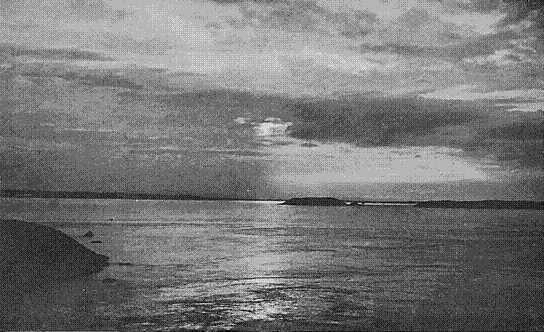
They took him for a stroll up to the Eperquerie in the cool of the gloaming, and showed him more shooting stars than ever he had seen in his life, and a silver sickle of a moon, and a western sky still smouldering with the afterglow of a crimson and amber sunset, and he acknowledged that, from some points of view, Sark had advantages over Throgmorton Street.
In the natural course of things, Margaret and Graeme walked together, and since they could not go four abreast among the gorse cushions, Charles Svendt and Miss Penny had to put up with one another, and seemed to get on remarkably well. More than once Graeme squeezed Margaret's arm within his own and chuckled, as he heard the animated talk and laughter from the pair behind.
"I'm very glad he's taken a sensible view of the matter," said Margaret.
"Oh, Charles Svendt is no fool, and he certainly would have been if he'd done anything but what he has done. He saw that he could do no good and might get into trouble. The Seigneur scowled dungeons and gibbets at him, and he looked decidedly uncomfortable."
"I will tender the Seigneur my very best thanks the first time I see him."
When the men had seen the ladies home, they strolled up the garden to the Red House for a final smoke.
"Say, Graeme, I've been wondering what you'd have done if I'd played mule and persisted in kicking up my heels in church. I asked Miss Penny—and, by Jove, I tell you, that's about as sensible a girl as I've met for a long time—"
"Miss Penny is an extremely clever girl and an exceptionally fine character. Good family too. Her father was the Brigadier-General Penny who was killed in Afghanistan."
"So?"
"She's an M.A., and she's worked like a slave to educate her brothers and sisters, and they're all turning out well. I don't know any girl, except Meg, of whom I think so highly as Hennie Penny."
"Henrietta?"
Graeme nodded.
"Well now," said Pixley presently. "As a matter of information, what was in your mind to do if I'd gone on?"
"You'd never have got as far as the church, my boy."
"No? Why?"
"If the Seigneur hadn't stopped you, I would. But I'm inclined to think he'd have seen to you all right."
"By Jove, he looked it! What would he have done?"
"Confined you as a harmless lunatic till the ceremony was over, I should say, and then sent you home with the proverbial insect in your ear."
"And if he hadn't?"
"Then I should have taken matters into my own hands and bottled you up till you couldn't do any mischief. You could have hauled me before the court here, and I'd probably have been fined one and eightpence. It would have been worth the money, and cheap at the price, simply to see the proceedings."
"It's an extraordinary place this."
"It's without exception the most delightful little place in the world."
"Jolly nice house you've got here too. Think of stopping long?"
"Some months probably. The curious thing about Sark is that the longer you stop the longer you want to stop. It grows on you. First week I was here it seemed to me very small—felt afraid of walking fast lest I should step over the edge, and all that kind of thing. Now that I've been here a couple of months it is growing bigger every day. I'm not sure that one could know Sark under a lifetime. We'll take you round in a boat and show it you from the outside."
"I'll have to get back, I'm sorry to say. You see, I started at a moment's notice. Things are duller than a ditch in the City, but I'd no chance to make any arrangements for a stay. But I'll tell you what. If you're stopping on here and like to send me an invitation for a week or two, I'd come like a shot. I'll take a carriage up that road from the harbour, though, next time. Jove! I felt like a convict on the treadmill."
"You have the invitation now, my boy, and we'll be delighted to see you whenever it suits you to come."
"That's very good of you. Miss Penny be stopping on with you?"
"As long as she will. She'd got a bit run down and it's done her a heap of good."
"Well, if you'll show me how to go, I'll toddle off home now. I haven't the remotest idea where my digs are."
And Graeme led him through the back fields among the tethered cows, who stopped their slow chewing as they passed, and lay gazing after them in blank astonishment, into the Avenue and so to the Bel-Air.
"I'll come round then a bit before eleven and we'll all go along together," was Charles Svendt's parting word.
"Right! Au revoir!" and Graeme went home across the fields smiling happily to himself.
XVII
When Graeme came swinging over the green dyke in the early morning, with his towel round his neck and his two dogs racing in front, he found the Seigneur sitting in a long chair in the verandah, with four aristocratic dogs wandering about, who proceeded to intimate to Punch and Scamp that they were rather low fisher-dogs and not of seigneurial rank.
"Well, what about your would-be breaker of the peace?" asked the Seigneur, with a smile.
"He's come to his senses. I was going to bring you word as soon as I thought you'd be up. He's promised to be best man, and I'm hoping to get him to play heavy father also and give the bride away."
"Capital!"
"He was very anxious last night to know what would have happened if, as he put it, he'd persisted in playing mule and kicking up his heels in church."
"We'd have tied his heels so that he couldn't kick much," said the Seigneur, with his deep quizzical smile.
"That's what I told him. He seemed to think Sark a decidedly odd kind of place. But he's getting to like it, and I've invited him to come and visit us later on."
"That's all right as long as he behaves himself."
"Oh, he's a very decent chap. The only thing I had against him was that he wanted to marry my wife."
"Then all the ways are smooth now?"
"All smooth now, thanks to your assistance!"
"Well, all happiness to you both!" said the Seigneur as he rose. "My wife sends all good wishes"—for the Lady of the Manor lay sick in the great house among the trees and he would not leave her.
XVIII
As Graeme proposed, they talk still of that wedding in Sark.
Everything went smoothly. The Vicar had coached himself, by wifely tuition and much private repetition, into a certain familiarity with the Wedding Service in English, but would still have been more at home with it in French.
The church was more crowded than it had been within the memory of woman. Margaret looked charming, and Miss Penny absolutely pretty. Charles Svendt could hardly take his eyes off her, and caught himself wondering what the dooce she had done to herself since last night. For, by Jove! she's as pretty almost as Margaret herself—he said to himself.
And if Jeremiah Pixley could have seen his son, in fatherly fashion give away the bride that should have been his, he would without doubt have had fits—if the first one had not been of such a character as to obviate the necessity for any additional ones.
The habitants, old and young, had made holiday, donned their best as if it were Sunday, and crowded the church as if it were all the Sundays of the year rolled into one.
The Vicar had serious thoughts of improving so unique an occasion, but wisely decided to confine himself to the intricacies of the English language as displayed in The Form of the Solemnisation of Matrimony.
Mrs. Vicar presided at the harmonium, which had been specially tuned for the occasion, and the choir enjoyed to the full their privileges of position and observation and made ample use of them.
And when his friends knelt before the chancel rail,—to the exceeding scandal of the Vicar and Mrs. Vicar and the choir and all who saw, and to the vast enjoyment of Miss Penny and Charles Svendt and all the other youngsters in the place,—Punch walked solemnly up the aisle and stood behind them, with slow-swinging tail and a look of anticipation on his gravely interested face, while outside, Scamp, in the hands of some enterprising stickler for forms and ceremonies, rent the air with sharp cries of disappointment.
But John Graeme's soul, uplifted mightily within him at this glorious consummation of his hopes, and ranging high among the stars, saw none of these things. He held Margaret's hand in his, and looked into her radiant and blushing face, and vowed mighty vows for her happiness, and thanked God fervently for bringing this great thing to pass.
And Margaret's eye caught the marble slab, placed in the side wall of the chancel by the late Seigneur who built it, and prayed in her heart that the temple of their two lives might equally be builded—"to the Glory of God and with much care."
XIX
The small girls from the school, all specially arrayed in fancy white pinafores with knots of pink ribbon, burst out of the church like a merry bombshell while the less picturesque final ceremonies were being completed. When Graeme and Margaret came smiling down the aisle, the busy little maids were still vociferously strewing the path outside with green rushes and wild iris, and as they passed, those who had emptied their baskets ran back and picked up hasty armfuls of the scattered flowers, and ran on in front and strewed them again, so that for quite a long way their progress was one of gradually diminishing splendour.
But past the gap in the road, which led across country to the Red House, no flower-strewers came. For there the excited chatterers broke and whirled through like a flight of sea-pies, and made straight for the field of more substantial delights lest the boys should secure all the best places.
The wedding-party, however, having disdained the use of carriages for so short a distance, strolled quietly along the scented lanes, past the Boys' School, and by the Carrefour, with no apprehension of the feast beginning until they arrived, or of being relegated to back seats if they were late.
The cottage and the Red House had been buzzing hives since dawn, Mrs. Carré handling her forces and volunteers and supernumeraries with the skill of a veteran, and with encouragement so shrill and animated that it sounded like scolding, but was in reality only emphatic patois.
She had, indeed, left matters in the hands of certain tried elders while she sped across the fields to the church for a few minutes, just to see that everything there was done properly and in order. But she was back in the thick of things before the wedding-party reached home, and everything was ready and in apple-pie order for a merry-making such as Sark had not seen for many a day.
First, the children were settled at their long tables in the field behind the house, with good things enough in front of them, and active assistants enough behind them, to keep them quiet for a good long time to come.
Graeme and Margaret went round bidding them all enjoy themselves to their fullest, which they cheerfully promised to do, and the eager youngsters gave them back wish for wish, with one eye for them and one for the unusual dainties on the tables.
"Hello, Johnnie!" said Graeme to that young man, gorging stolidly, with a palpable interval between him and his neighbour on either hand, but with no other visible signs of wizardry about him. "Getting on all right?"
But there was no room for speech in Johnnie's mouth just then. He winked one black eye solemnly and devoted himself to the business in hand.
And Punch and Scamp, accepted favourites of the host and hostess, tore to and fro in vain attempt to keep pace with all the attentions lavished upon them by the guests as soon as their own desires had been satisfied. They devoured everything that was offered and attainable before it was withdrawn, and had no need to ask for more unless in the matter of storage-room.
Everybody was very happy and very excited, for no such feast had been in Sark within the memory of the oldest child present. And if Charles Svendt's Stock-Exchange friends could have seen him—merrily circling the tables and exhorting already distent youngsters to still greater and greater exertions; poking them in the ribs to prove, against their own better judgment, but in accordance with their inclinations, that there was assuredly still room for more; bidding them "Mangez! Mangez!" in the one word of French he could recall as specially applicable at the moment—it is certain they would not have known him.
And Miss Penny, too, looked as if she had never enjoyed herself so much in her life, and backed him up in all his endeavours right heartily. And now and again, when Charles Svendt looked at her, he said to himself, "By Jove, she's as good-looking a girl as I know, and as clever as they make 'em!"
For there is no greater beautifier in the world than happiness, and Hennie Penny was completely and quite unusually happy.
To the actual wedding-feast, Graeme had asked the Vicar and his wife, and such of the neighbours as he had come to know personally, especially not forgetting his very first friend in the island, whom he still always called Count Tolstoi, and Mrs. De Carteret. For the rest, he had given Mrs. Carré carte-blanche to invite whom she deemed well among her friends, and she had exercised her privilege with judgment and enjoyment.
The Sénéchal was there, and the Greffier, and the Prévôt and the members of the Court, ex officio, so to speak, and the Wesleyan minister who was on excellent terms with the Vicar, and the Post-Master and his jovial white-haired father, who built the boats and coffins for the community, and had supplied the tables for the feast; and many more—a right goodly company of stalwart, weather-browned men and pleasant-faced women, all vastly happy to be assisting at so unusual an event as an English wedding.
They drank the health of the bride and bridegroom in the special mulled wine thereto ordained by custom and prepared according to the laws of the Medes and Persians. And Graeme, on behalf of himself and his wife, assured them that there was no place in the world like Sark, and that they had never enjoyed a wedding so much in all their lives, and that if they had to be married a hundred times they could wish no happier wedding than Sark had given them.
And of all that company, none beamed more brightly, nor enjoyed himself more, than Charles Pixley, who, having come to curse, had, in most approved fashion, stayed to bless, and had even beaten the prophet's record by giving away to another the treasure he had desired for himself.
In the usual course of things, after the feasting would have come games and songs until dark. But that had been adjudged too much of an ordeal by the ladies, and the onus of it was laid upon the youngsters outside. While Margaret and Miss Penny rested from their labours, and Mrs. Carré and her helpers cleared the rooms for the festivities of the evening, and prepared the milder and more intermittent refections necessary thereto, Graeme and Pixley and the Vicar and others set the children to games and races, for which indeed their previous exertions at the tables had not best fitted them, but which nevertheless, or perhaps on that very account, were provocative of much laughter and merriment.
Then, when it grew dark, and the reluctant youngsters had been cajoled and dragged and packed off to bed, the hitherto-unprovided-for section—the young men and maidens, all in their best and a trifle shy to begin with—came flocking in for their share in the festivities, and Orpheus and Terpsichore held the floor for the rest of the night.
And they did dance! Margaret and Miss Penny and Graeme and Pixley thought they had seen dancing before, but dancing such as this it had never been theirs to witness.
If it lacked anything in grace—and far be it from me to say so—it more than made up for all by its inexhaustible energy and tireless enjoyment. The men had brought their own music in the shape of a concertina, which passed from hand to hand and with which they all seemed on equally friendly terms.
Jokes, laughter, round dances, refreshments, interludes of smokings and gigglings in the darkness of the verandah, occasional more intellectual flights in the shape of songs and recitations,—mostly of a somewhat lugubrious tendency, to judge by the faces of the auditors, but being mostly in patois they were unintelligible to the British foreigners,—more dances,—coats off now, to reduce the temperature of the performers,—more refreshments, more dances,—dances with broomsticks held between the partners, over which they slipped and skipped to the tune of caustic comments by the onlookers,—dances between caps laid on the floor and which must on no account be touched by the dancers. And always the cry to the musician of the moment was,—"Faster! Faster!"—and the race between Orpheus and Terpsichore—between the music and the flying feet, grew still more fast and furious.
Now Charles Svendt, as we know, did not look like a dancing man, but dancing was one of the superficial accomplishments in which he excelled.
Miss Penny, also, through much experience with girls, was lighter of foot than she looked.
They stood for a time watching, and presently both their feet were tapping to the quickstep of the rest.
"Let's have a shot at it," said Charles. "Will you?" and he looked down at her.
"I'd love to," and in a moment they were whirling in the circle with the rest, but with a grace that none there could rival,—gallant dancers as the Sark boys and girls are.
"Delightful!" murmured Charles Svendt. "You dance like an angel, and we fit splendidly," and Hennie Penny found a man's arm about her decidedly and delightfully more inspiriting than all the arms of all the schoolgirls in the world, and danced as she had never danced before.
So swift and light and smooth and graceful was their flight that before long the rest tailed off and all stood propped against the walls to watch them.
"We've got the floor all to ourselves," murmured Miss Penny at last, as she woke to the fact.
"We've licked them into fits on their own ground," he laughed in her ear. "You can dance and no mistake. It's a treat to dance with a really good dancer."
"I think we ought to stop. We're stopping their fun," said Hennie Penny, and when he led her to a seat the rest of the room all clapped their enjoyment.
Graeme and Margaret danced a round or two to endorse the festivities, but they were not in it with Pixley and Hennie Penny, and they soon dropped out and clapped heartily with the rest.
When Charles Svendt, later on, suggested another dance, Miss Penny bade him go and dance with one of the Sark girls.
"But I don't want to dance with any of them. Besides, I don't know any of 'em, and I couldn't talk to her if I did."
"Oh yes, you can. They all speak English."
"Do they now? It don't sound like it. Come on, Miss Penny. They wouldn't enjoy it and I wouldn't enjoy it, and I never enjoyed anything so much in my life as that last round."
So Hennie took pity on him, and they danced many times amid great applause.
"Awfully good of you!" said Charles Svendt, as the dawn came peeping in through the east windows and the open front door; and Mrs. Carré, as Mistress of the Ceremonies, and a very tired one at that, bluffly informed the company that it was time to go home.
"I've enjoyed it immensely," said Hennie Penny, and if her face was any index to her feelings, there was no mistake about it.
XX
None of them will ever forget that great day.
Still less is any of them likely to forget the day that followed.
As dancing only ceased when the sun was about rising, before-breakfast bathing was declared off for that day, and they arranged to meet later on and stroll quietly down to Dixcart Bay during the morning and all bathe together there. Charles Svendt laughingly prepared them for an exhibition of incompetence by stating that his swimming wasn't a patch on his dancing, but that he could get along. Miss Penny gaily gave him points as to her own peculiar methods of swimming, which, as we know, demanded instant and easy touch of sand or stone at any moment of the halting progression. He confessed to a like prejudice in favour of something solid within reach of his sinking capacity, and they agreed to help one another.
They called for him at the hotel about eleven o'clock, and went joking through the sunny lanes of Petit Dixcart, crossed the brook that runs out of Hart's-Tongue Valley, and followed it by the winding path along the side of the cliff, among the gorse and ferns, down into the bay.
They had a right merry bathe with no grave casualties. Miss Penny, indeed, got out of her depth twice, to the extent of quite two inches, and shrieked for help, which Charles Svendt gallantly hastened to render; while Graeme and Margaret swam across from head to head, watched enviously by the paddlers in shallow waters.
They went home by the climbing path up the hillside, rested on The Quarter-deck while Charles Svendt got his breath back, and so, by the old Dixcart hotel, and the new one nestling among its flowers and trees, and up the Valley, to the Vicarage.
The Vicar was basking in the shade of the trees in front of the house.
"Ah-ha—Mr. and Mrs. Graeme! Good-morning! You are none the worse for being married? Non?" as he shook hands joyously all round, with both hands at once.
"Not a bit," laughed Graeme. "We're all as happy as sandboys."
"Comment donc—sandboys? What is that?"
"Happy little boys who dispense with clothes and paddle all day in the sand and water."
"Ah—you have been bathing! What energie! And you danced till—?"
"About four o'clock, I suppose. The sun was just thinking of rising as we were thinking of retiring."
"But it is marvellous! And you are not tired?"
"The bathe has freshened us all up," said Margaret.
Then Mrs. Vicar came out at sound of their voices, and felicitated them, and begged them to rest a while in the shade. But they were all hungry, and Charles Svendt laughingly asserted that he had swallowed so much salt-water, in rescuing Miss Penny from a watery grave, that his constitution absolutely needed a tiny tot of whisky, or the consequences might be serious.
So they went laughingly on their way, and Charles tried his best to get Miss Penny to go and show him the way to the Bel-Air, pleading absolute confusion still as to the points of the compass and the lie of the land.
He was to lunch with them at the Red House, but insisted on going home first to straighten up and make himself presentable. So they led him to the Avenue, and set his face straight down it, and bade him follow his nose and turn neither to the right hand nor to the left, and then they turned off through the fields by their own short-cut, and went merrily home.