Volume 18 — COMMENCEMENT OF THE EXPEDITION (continued 4)
Reading edition
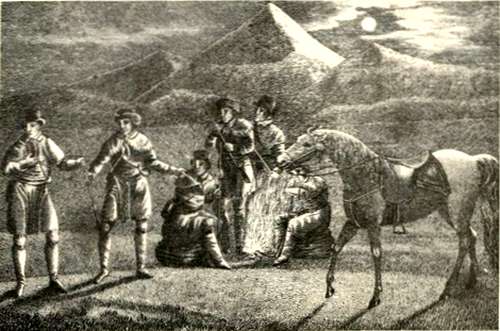
Shooting Mr. Pattie's Horse
[136] It was now the 15th of November, and while the horse flesh lasted, we built a canoe, so that we could trap on both sides of the river; for it is here too broad and deep to be fordable on horseback. One of our number had already been drowned, man and horse, in attempting to swim the river. A canoe is a great advantage, where the beavers are wild; as the trapper can thus set his traps along the shore without leaving his scent upon the ground about it.
On the 17th, our canoe was finished, and another person and myself took some traps in it, and floated down the river by water, while the rest of the company followed along the banks by land. In this way, what with the additional supply which the canoe enabled our traps to furnish, and a chance deer or wolf that Providence sometimes threw in our way, with caution and economy we were tolerably supplied with provisions; and the company travelled on with a good degree of union and prosperity, until the 26th.
Here the greater part of the company expressed disinclination to following our contemplated route any longer. That is, they conceived the route to the mouth of the Helay, and up Red river of California too long and tedious, and too much exposed to numerous and hostile Indians. They, therefore, determined to quit the Helay, and strike over to Red river by a direct route across the country. My father reminded them of their article. They assured him they did not consider themselves bound by it, and that they were a majority, against which nothing could be said. My father and myself still persevered in following the original plan. Two of the men had been hired on my father's account. He told them he was ready to pay them up to that time, and dismiss them, to go where they chose. They observed, that now that the company had commenced separating, they believed that in a short time, there would be no stronger party together than ours; that they had as good a disposition to risk their lives with us, as with any division of our number, and that they would stay by us to the [137] death. After this speech four others of the company volunteered to remain with us, and we took them in as partners.
On the 27th, we divided the hunt, and all expressing the same regret at the separation, and heartily wishing each other all manner of prosperity, we shook hands and parted! We were now reduced to eight in number. We made the most solemn pledges to stand by each other unto death, and adopted the severest caution, of which we had been too faithfully taught the necessity. We tied our horses every night, and encamped close by them, to prevent their being stolen by the Indians. Their foot-prints were thick and fresh in our course, and we could see their smokes at no great distance north of us. We were well aware that they were hostile, and watching their opportunity to pounce upon us, and we kept ourselves ready for action, equally day and night. We now took an ample abundance of beavers to supply us with meat, in consequence of our reduced numbers. Our horses also fared well, for we cut plenty of cotton-wood trees, the bark of which serves them for food nearly as well as corn. We thus travelled on prosperously, until we reached the junction of the Helay with Red river.—Here we found the tribe of Umeas,94 who had shown themselves very friendly to the company in which I had formerly passed them, which strongly inspired confidence in them at present. Some of them could speak the Spanish language. We made many inquiries of them, our object being to gain information of the distance of the Spanish settlements. We asked them where they obtained the cloth they wore around their loins? They answered, from the Christians on the coast of the California. We asked if there were any Christians living on Red river? They promptly answered, yes. This information afterwards proved a source of error and misfortune to us, though our motive for inquiry at this time was mere curiosity.
It was now the 1st of December; and at mid-day we began to see the imprudence of spending the remainder of the day and the ensuing night with such numbers of Indians, however friendly in appearance. We had a tolerable fund of experience, in [138] regard to the trust we might safely repose in the red skins; and knew that caution is the parent of security. So we packed up, and separated from them. Their town was on the opposite shore of Red river. At our encampment upwards of two hundred of them swam over the river and visited us, all apparently friendly. We allowed but a few of them to approach our camp at a time, and they were obliged to lay aside their arms. In the midst of these multitudes of fierce, naked, swarthy savages, eight of us seemed no more than a little patch of snow on the side of one of the black mountains. We were perfectly aware how critical was our position, and determined to intermit no prudence or caution. To interpose as great a distance as possible between them and us, we marched that evening sixteen miles, and encamped on the banks of the river. The place of encampment was a prairie, and we drove stakes fast in the earth, to which we tied our horses in the midst of green grass, as high as a man's head, and within ten feet of our own fire. Unhappily we had arrived too late to make a pen for our horses, or a breast work for ourselves. The sky was gloomy. Night and storm were settling upon us, and it was too late to complete these important arrangements. In a short time the storm poured upon us, and the night became so dark that we could not see our hand before us. Apprehensive of an attempt to steal our horses, we posted two sentinels, and the remaining six lay down under our wet blankets, and the pelting of the sky, to such sleep as we might get, still preserving a little fire. We were scarcely asleep before we were aroused by the snorting of our horses and mules. We all sprang to our arms, and extinguished our little fire. We could not see a foot before us, and we groped about our camp feeling our way among the horses and mules. We could discover nothing; so concluding they might have been frightened by the approach of a bear or some other wild animal, some of us commenced rekindling our fires, and the rest went to sleep. But the Indians had crawled among our horses, and had cut or untied the rope by which each one was [139] bound. The horses were then all loose. They then instantly raised in concert, their fiendish yell. As though heaven and earth were in concert against us, the rain began to pour again, accompanied with howling gusts of wind, and the fiercest gleams of lightning, and crashes of thunder. Terrified alike by the thunder and the Indians, our horses all took to flight, and the Indians repeating yell upon yell, were close at their heels. We sallied out after them, and fired at the noises, though we could see nothing. We pursued with the utmost of our speed to no purpose, for they soon reached the open prairie, where we concluded they were joined by other Indians on horseback, who pushed our horses still faster; and soon the clattering of their heels and the yells of their accursed pursuers began to fade, and become indistinct in our ears.
Our feelings and reflections as we returned to camp were of the gloomiest kind. We were one thousand miles from the point whence we started, and without a single beast to bear either our property or ourselves. The rain had passed. We built us a large fire. As we stood round it we discussed our deplorable condition, and our future alternatives. Something was to be done. We all agreed to the proposition of my father, which was, early in the morning to pursue the trails of our beasts, and if we should overtake the thieves, to retake the horses, or die in the attempt; and that, failing in that, we should return, swim the river, attack their town, and kill as many of the inhabitants as we could; for that it was better to die by these Indians, after we had killed a good number of them, than to starve, or be killed by Indians who had not injured us, and when we could not defend ourselves.
Accordingly, early in the morning of the 2d, we started on the trail in pursuit of the thieves. We soon arrived at a point where the Indians, departing from the plain, had driven them up a chasm of the mountains. Here they had stopped, and caught them, divided them, and each taken a different route with his plundered horses. We saw in a moment that it was impossible to follow them farther to any purpose. We abandoned [140] the chase, and returned to our camp to execute the second part of our plan. When we arrived there, we stopped for a leisure meal of beaver meat. When we had bestowed ourselves to this dainty resort, a Dutchman with us broke the gloomy silence of our eating, by observing that we had better stuff ourselves to the utmost; for that it would probably, be the last chance we should have at beaver meat. We all acquiesced in this observation, which though made in jest, promised to be a sober truth, by eating as heartily as possible. When we had finished our meal, which looked so likely to be the last we should enjoy together, we made rafts to which we tied our guns, and pushing them onward before us, we thus swam the river. Having reached the opposite shore, we shouldered our rifles, and steered for the town, at which we arrived about two in the afternoon. We marched up to the numerous assemblage of huts in a manner as reckless and undaunted as though we had nothing to apprehend. In fact, when we arrived at it, we found it to contain not a single living being, except one miserable, blind, deaf, and decrepid old man, not unlike one that I described in a hostile former visit to an Indian village. Our exasperation of despair inclined us to kill even him. My father forbade. He apparently heard nothing and cared for nothing, as he saw nothing. His head was white with age, and his eyes appeared to have been gouged out. He may have thought himself all the while in the midst of his own people. We discovered a plenty of their kind of food, which consisted chiefly of acorn mush. We then set fire to the village, burning every hut but that which contained the old man. Being built of flags and grass, they were not long in reducing to ashes. We then returned to our camp, re-swimming the river, and reaching the camp before dark.
We could with no certainty divine the cause of their having evacuated their town, though we attributed it to fear of us. The occurrences of the preceding day strengthened us in this impression. While they remained with us, one of our men happened to fire off his gun. As though they never had heard [141] such a noise before, they all fell prostrate on the earth, as though they had all been shot. When they arose, they would all have taken to flight, had we not detained them and quieted their fears.
Our conversation with these Indians of the day before, now recurred to our recollections, and we congratulated ourselves on having been so inquisitive as to obtain the now important information, that there were Spanish settlements on the river below us. Driven from the resource of our horses, we happily turned our thoughts to another. We had all the requisite tools to build canoes, and directly around us was suitable timber of which to make them. It was a pleasant scheme to soothe our dejection, and prevent our lying down to the sleep of despair. But this alternative determined upon, there remained another apprehension sufficient to prevent our enjoying quiet repose. Our fears were, that the unsheltered Indians, horse-stealers and all, would creep upon us in the night, and massacre us all. But the night passed without any disturbance from them.
On the morning of the 3d, the first business in which we engaged, was to build ourselves a little fort, sufficient for defence against the Indians. This finished, we cut down two trees suitable for canoes, and accomplished these important objects in one day. During this day we kept one man posted in the top of a tall tree, to descry if any Indians were approaching us in the distance. On the morning of the fourth we commenced digging out our canoes, and finished and launched two. These were found insufficient to carry our furs. We continued to prepare, and launch them, until we had eight in the water. By uniting them in pairs by a platform, we were able to embark with all our furs and traps, without any extra burden, except a man and the necessary traps for each canoe. We hid our saddles, hoping to purchase horses at the settlements, and return this way.
We started on the 9th, floating with the current, which bore us downward at the rate of four miles an hour. In the evening we passed the burnt town, the ruins of which still threw up [142] smouldering smoke. We floated about 30 miles, and in the evening encamped in the midst of signs of beavers. We set 40 traps, and in the morning of the 10th caught 36 beavers, an excellent night's hunt. We concluded from this encouraging commencement, to travel slowly, and in hunters' phrase, trap the river clear; that is, take all that could be allured to come to the bait. The river, below its junction with the Helay, is from 2 to 300 yards wide, with high banks, that have dilapidated by falling in. Its course is west, and its timber chiefly cotton-wood, which in the bottoms is lofty and thick set. The bottoms are from six to ten miles wide. The soil is black, and mixed with sand, though the bottoms are subject to inundation in the flush waters of June. This inundation is occasioned by the melting of the snow on the mountains about its head waters.
We now floated pleasantly downward at our leisure, having abundance of the meat of fat beavers. We began in this short prosperity, to forget the loss of our horses, and to consider ourselves quite secure from the Indians. But on the 12th, at mid-day, by mere accident, we happened, some way below us, to discover two Indians perched in a tree near the river bank, with their bows and arrows in readiness, waiting evidently until we should float close by them, to take off some of us with their arrows. We betrayed no signs of having seen them, but sat with our guns ready for a fair shot. When we had floated within a little short of a hundred yards, my father and another of the company gave them a salute, and brought them both tumbling down the branches, reminding us exactly of the fall of a bear or a turkey. They made the earth sound when they struck it. Fearful that they might be part of an ambush, we pulled our canoes to the opposite shore, and some of us climbed trees, from which we could command a view of both shores. We became satisfied that these two were alone, and we crossed over to their bodies. We discovered that they were of the number that had stolen our horses, by the fact, that they were bound round the waist with some of the hemp ropes with which our horses had been tied. We hung the bodies of the thieves [143] from a tree, with the product of their own thefts. Our thoughts were much relieved by the discovery of this fact, for though none of us felt any particular forbearance towards Indians under any circumstances, it certainly would have pained us to have killed Indians that had never disturbed us. But there could be no compunction for having slain these two thieves, precisely at the moment that they were exulting in the hope of getting a good shot at us. Beside they alarmed our false security, and learned us a lesson to keep nearer the middle of the river.
We continued to float slowly downwards, trapping beavers on our way almost as fast as we could wish. We sometimes brought in 60 in a morning. The river at this point is remarkably circuitous, and has a great number of islands, on which we took beavers. Such was the rapid increase of our furs, that our present crafts in a few days were insufficient to carry them, and we were compelled to stop and make another canoe. We have advanced between 60 and 70 miles from the point where we built the other canoes. We find the timber larger, and not so thick. There are but few wild animals that belong to the country farther up, but some deer, panthers, foxes and wild-cats. Of birds there are great numbers, and many varieties, most of which I have never before seen. We killed some wild geese and pelicans, and likewise an animal not unlike the African leopard,95 which came into our camp, while we were at work upon the canoe. It was the first we had ever seen.
We finished our canoe on the 17th, and started on the 20th. This day we saw ten Indians on a sand bar, who fled into the woods at the sight of us. We knew them to be different people from those who had stolen our horses, both by their size and their different manner of wearing their hair. The heads of these were shaved close, except a tuft, which they wore on the top of their head, and which they raised erect, as straight as an arrow. The Umeas are of gigantic stature from six to seven feet high. These only average five feet and a half. They go perfectly naked, and have dark complexions, which I imagine [144] is caused by the burning heat of the sun. The weather is as hot here at this time, as I ever experienced. We were all very desirous to have a talk with these Indians, and enquire of them, how near we were to the Spanish settlements; and whether they were immediately on the bank, for we began to be fearful that we had passed them.
Three days passed without our having any opportunity of conversation with them. But early on the morning of the 24th, we found some families yet asleep in their wigwams, near the water's edge. Our approach to them was so imperceptible and sudden, that they had no chance to flee. They were apparently frightened to insanity. They surrendered without making any further effort to escape. While they stared at us in terrified astonishment; we made them comprehend that we had no design to kill, or injure them. We offered them meat, and made signs that we wished to smoke with them. They readily comprehended us, and the ghastliness of terror began to pass from their countenances. The women and children were yet screaming as if going into convulsions. We made signs to the men to have them stop this annoying noise. This we did by putting our hands to our mouths. They immediately uttered something to the women and children which made them still. The pipe was then lit, and smoking commenced. They puffed the smoke towards the sky, pointed thither, and uttered some words, of course unintelligible to us. They then struck themselves on the breast, and afterwards on the forehead. We understood this to be a sort of religious appeal to the Supreme Being, and it showed more like reverence to him, than any thing we had yet seen among the Indians; though I have seen none but what admit that there is a master of life, whom they call by a name to that import, or that of Great Spirit.
When the smoking was finished, we began to enquire of them by signs, how far we were from the Spanish settlement? This we effected by drawing an image of a cow and sheep in the sand and then imitating the noise of each kind of domestic animals, that we supposed the Spaniards would have. They appeared [145] to understand us, for they pointed west, and then at our clothes, and then at our naked skin. From this we inferred that they wished to say that farther to the west lived white people, as we were. And this was all we could draw from them on that subject. We then asked them, if they had ever seen white people before? This we effected by stretching open our eyes with our fingers, and pointing to them, and then looking vehemently in that direction, while we pointed west with our fingers. They shook their heads in the negative. Then stretching their own ears, as we had our eyes, striking themselves on the breast, and pointing down the river, they pronounced the word wechapa. This we afterwards understood implied, that their chief lived lower down the river, and that they had heard from him, that he had seen these people.
We gave the women some old shirts, and intimated to them as well as we could, that it was the fashion of the women to cover themselves in our country, for these were in a state of the most entire nudity. But they did not seem rightly to comprehend our wish. Many of the women were not over sixteen, and the most perfect figures I have ever seen, perfectly straight and symmetrical, and the hair of some hanging nearly to their heels. The men are exceedingly active, and have bright countenances, and quick apprehension. We gave them more meat, and then started. They followed our course along the bank, until night. As soon as we landed, they were very officious in gathering wood, and performing other offices for us. They showed eager curiosity in examining our arms, and appeared to understand their use. When my father struck fire with his pistol, they gave a start, evidencing a mixture of astonishment and terror, and then re-examined the pistol, apparently solicitous to discover how the fire was made. My father bade me take my rifle, and shoot a wild goose, that was sitting about in the middle of the river. He then showed them the goose, and pointed at me, as I was creeping to a point where I might take a fair shot. They all gazed with intense curiosity, first at me, and then at the goose, until I fired. At the moment of the report, [146] some fell flat on the ground, and the rest ran for the bushes, as though Satan was behind them. As soon as the fallen had recovered from their amazement, they also fled. Some of our company stopped them, by seizing some, and holding them, and showing them that the goose was dead, and the manner in which it had been killed. They gradually regained confidence and composure, and called to their companions in the bushes. They also came forth, one by one, and when the nature of the report of the gun had been explained to them, they immediately swam into the river and brought out the goose. When they carried it round and showed it to their companions, carefully pointing out the ball hole in the goose, it is impossible to show more expressive gestures, cries and movements of countenances indicative of wonder and astonishment, than they exhibited. The night which we passed with them, passed away pleasantly, and to the satisfaction of all parties. In the morning their attention and curiosity were again highly excited, when we brought in our beavers, which amounted in number to thirty-six. After we had finished skinning them, we left the ample supply of food furnished by the bodies of the beavers, in token of our friendship, to these Indians, and floated on. On the 27th, we arrived at the residence of the chief. We perceived that they had made ready for our reception. They had prepared a feast for us by killing a number of fatted dogs. As soon as we landed, the chief came to us, accompanied by two subordinate chiefs. When arrived close to us, he exclaimed, wechapa, striking himself on the breast, pointing to our company, and repeating the same phrase. We understood from this, that he wished to know who was our captain? We all pointed to my father, to whom the chief immediately advanced, and affectionately embracing him, invited us to enter his wigwam. We shouldered our rifles, and all followed this venerable looking man to his abode. There he had prepared several earthen dishes, in which the flesh of young and fat dogs was served up, but without salt or bread. We all sat down. The pipe was lit, and we, and the thirty Indians present began to smoke. While we were smoking, they used many gesticulations and signs, the [147] purport of which we could not make out, though, as they pointed often at us, we supposed we were the subjects of their gestures. The pipe was then taken away, and the chief arose, and stood in the centre of the circle which we formed by the manner in which we all sat around the fire. He then made a long harangue, and as we understood not a word, to us rather a tedious one. We took care to make as many gestures indicative of understanding it, as though we had comprehended every word.
The oration finished, a large dish of the choice dog's flesh was set before us, and signs were made to us to eat. Having learned not to be delicate or disobliging to our savage host, we fell to work upon the ribs of the domestic barkers. When we had eaten to satisfaction, the chief arose, and puffing out his naked belly, and striking it with his hand, very significantly inquired by this sign, if we had eaten enough? When we had answered in the affirmative, by our mode of making signs, he then began to enquire of us, as we understood it, who we were, and from whence we came, and what was our business in that country? All this we interpreted, and replied to by signs as significant as we could imagine. He continued to enquire of us by signs, if we had met with no misfortunes on our journey, calling over the names of several Indian tribes in that part of the country, among which we distinctly recognized the name of the Umeas? When he mentioned this name, it was with such a lowering brow and fierce countenance as indicated clearly that he was at war with them. We responded to these marks of dislike by an equal show of detestation by making the gesture of seeming desirous to shoot at them, and with the bitterest look of anger that we could assume; making him understand that they had stolen our horses. He made signs of intelligence that he comprehended us, and made us sensible of his deep hatred, by giving us to understand that they had killed many of his people, and taken many more prisoners; and that he had retaliated by killing and taking as many Umeas. He pointed at the same time to two small children, and exclaimed Umea! We [148] pointed at them with our guns, and gave him to understand, that we had killed two of them. Some of our people had brought their scalps along. We gave them to him, and he, looking first towards us, and then fiercely at them, seemed to ask if these were the scalps of his enemies? To which we replied, yes.—He then seized the hair of the scalps with his teeth, and shook them, precisely as I have seen a dog any small game that it had killed. He then gave such a yell of delight, as collected all his people round him in a moment, and such rejoicing, yelling, and dancing ensued from both men and women, as I shall forbear to attempt to describe. Their deportment on this occasion was in fact much nearer bestial than human. They would leave the dance round the scalps in turn, to come and caress us, and then return and resume their dance.
The remainder of this day and the ensuing night passed in being in some sense compelled to witness this spectacle. In the morning of the 28th, when we brought in the contents of our traps, we found we had taken twenty-eight beavers. When my father enquired this morning anew for the direction of the Spanish settlements, and how far they were distant, we could make out from the signs of the chief no information more exact than this. He still pointed to the west, and then back at us.—He then made a very tolerable imitation of the rolling and breaking of the surf on the sea shore. Below he drew a cow and a sheep. From this we were satisfied that there were Spanish settlements west of us; and our conclusion was, that they could not be very distant.
At mid-day we bade these friendly Indians farewell, and resumed our slow progress of floating slowly down the stream, still setting our traps, whenever we found any indications of beavers. We met with no striking incident, and experienced no molestation until January 1st, 1828. On this day we once more received a shower of arrows from about fifty Indians of a tribe called Pipi, of whom we were cautioned to beware by the friendly Indians we had last left. I forgot at the time to mention the name of that people, when speaking of them, and [149] repeat it now. It is Cocopa.96 When the Pipi fired upon us, we were floating near the middle of the river. We immediately commenced pulling for the opposite shore, and were soon out of the reach of their arrows, without any individual having been wounded. As soon as our crafts touched the shore, we sprang upon the bank, took fair aim, and showed them the difference between their weapons and ours, by levelling six of them. The remainder fell flat, and began to dodge and skulk on all fours, as though the heavens had been loaded with thunder and mill stones, which were about to rain on them from the clouds.
We re-loaded our guns, and rowed over to the opposite, and now deserted shore. The fallen lay on the sand beach, some of them not yet dead. We found twenty three bows and the complement of arrows, most of them belonging to the fugitives. The bows are six feet in length, and made of a very tough and elastic kind of wood, which the Spaniards call Tarnio. They polish them down by rubbing them on a rough rock. The arrows are formed of a reed grass, and of the same length with their bows, with a foot of hard wood stuck in the end of the cavity of the reed, and a flint spike fitted on the end of it.—They have very large and erect forms, and black skins. Their long black hair floats in tresses down their backs, and to the termination of each tress is fastened a snail shell. In other respects their dress consists of their birth-day suit; in other words, they are perfectly naked. The river seems here to run upon a high ridge; for we can see from our crafts a great distance back into the country, which is thickly covered with musquito and other low and scrubby trees. The land is exceedingly marshy, and is the resort of numerous flocks of swans, and blue cranes. The rackoons are in such numbers, that they cause us to lose a great many beavers, by getting into our traps and being taken instead of the true game. They annoy us too by their squalling when they are taken.
From the junction of the two rivers to this place, I judge to be about a hundred miles. We find the climate exceedingly warm, [150] and the beaver fur, in accommodation to the climate, is becoming short. We conclude, in consequence, that our trapping is becoming of less importance, and that it is our interest to push on faster to reach the settlements. A great many times every day we bring our crafts to shore, and go out to see if we cannot discover the tracks of horses and cattle. On the 18th, we first perceived that we had arrived on the back water of the tide; or rather we first attributed the deadness of the current to the entrance of some inundated river, swollen by the melting of the snow on the mountains. We puzzled our brains with some other theories, to account for the deadness of the current. This became so entirely still, that we began to rig our oars, concluding that instead of our hitherto easy progress of floating gently onward, we had henceforward to make our head-way down stream by dint of the machinery of our arms.
We soon were thoroughly enlightened in regard to the slackness of the water. It began to run down again, and with the rapidity of six miles an hour; that is, double the ordinary current of the stream. We were all much surprised, for though I had seen the water of the Pacific at Ymus, none of us had ever felt the influence of the tides, or been in a craft on the ocean waters before. People of the same tribe, upon which we had recently fired, stood upon the shore, and called loudly to us as we passed, to come to land, making signs to us, that the motion of the water would capsize our crafts. They showed a great desire that we might come to shore, we had no doubt, that they might rob and murder us. We preserved such a distance from them, as to be out of the reach of their arrows, and had no intention to fire upon them. Had we wished for a shot, they were quite within rifle distance. We floated on, having had a beautiful evening's run, and did not come to land, until late; we then pitched our camp on a low point of land, unconscious, from our inexperience of the fact, that the water would return, and run up stream again. We made our canoes fast to some small trees, and all lay down to sleep, except my father, who took the first watch. He soon aroused us, and called on us all [151] to prepare for a gust of wind, and a heavy rain, which he thought betokened by a rushing noise he heard. We realized in a few moments, that it was the returning tide. Still, so strongly impressed were we, that a shower was approaching, that we made all the customary arrangements of preparation, by stretching our blankets to keep out the water from above. But our enemy assailed us from another quarter. Our camp was inundated from the river. We landsmen from the interior, and unaccustomed to such movements of the water, stood contemplating with astonishment the rush of the tide coming in from the sea, in conflict with the current of the river. At the point of conflict rose a high ridge of water, over which came the sea current, combing down like water over a mildam. We all sprang to our canoes, which the rush of the water had almost capsized, though we held the fasts with our hands. In twenty minutes the place where we lay asleep, and even our fire place was three feet under water, and our blankets were all afloat. We had some vague and general ideas of the nature of the tide, but its particular operations were as much unknown to us, as though we never had heard of it at all. In the consternation of our ignorance, we paddled our crafts, as well as we could, among the timber, not dreaming that in the course of a few hours, the water would fall again. As it was, we gathered up our floating blankets, got into our canoes, and held fast to the brushes, until the water fell again, leaving us and our canoes high and dry. We were now assailed by a new alarm, lest the Indians, taking advantage of this new position in which we were placed, would attack and murder us.
In such apprehensions we passed the night, until the morning shone upon us with a bright and beautiful sun, which enabled us to dry all our wet things, and re-animated us with the confidence which springs from the view of a bright firmament and a free and full survey of our case. When the tide returned we got into our crafts, and descended with it, still expecting to find Spanish settlements. We continued in this way to descend, when the tide ran out, until the 28th, when the surf came up the [152] river so strong that we saw in a moment, that our crafts could not live, if we floated them into this tumultuous commotion of the water.
Here we were placed in a new position, not the least disheartening or trying, among the painful predicaments, in which fortune had placed us. The fierce billows shut us in from below, the river current from above, and murderous savages upon either hand on the shore. We had a rich cargo of furs, a little independence for each one of us, could we have disposed of them, as we had hoped, among the Spanish people, whom we expected to have found here. There were no such settlements.—Every side on which we looked offered an array of danger, famine and death. In this predicament, what were furs to us? Our first thought was to commit our furs to the waters, and attempt to escape with our lives. Our second resolve was to ascend the river as far as we could, bury our furs, and start on foot for some settlement. We saw that the chances were greatly against us, that we should perish in the attempt; for the country yielded little to subsist on, and was full of Indians who are to the last degree savage and murderous, and whom nothing can subdue to kindness and friendship. We had no idea of ever putting ourselves in their power, as long as one of us could fire a pistol, or draw a knife.
We now began to ascend with the tide, when it served us, and lay by when it ran down, until we arrived at the point where it ceased to flow. We then applied our oars, and with the help of setting-poles, and at times the aid of a cordelle, we stemmed the current at the rate of one, and sometimes two miles an hour, until the tenth of February, when we met a great rise of the river, and found the current so strong, that we had no power to stem it in any way. So we concluded to abandon our canoes, come to shore, bury our furs, and make our way across the peninsula to the coast of California, which we thought from the information of the Indians, could not be very distant.
On the 16th, we completed the burying of our furs, and started on foot with our packs on our backs. The contents of these [153] packs were two blankets for each man, a considerable quantity of dried beaver meat, and a rifle with the ammunition. Our first day's journey was through a country to the last degree trying to our strength and patience. It was through the river bottom, which was thick set with low, scrubby brush, interwoven with tall grass, vines and creepers. The making our way through these was excessively slavish and fatiguing. We had a single alleviation. There was plenty of fresh water to drink. We were so fatigued at night, that sleep was irresistible. The weather was warm, and we kindled no fire, through fear of the savages. We started on the morning of the 18th, all complaining much of stiffness and soreness of our limbs. We had been unused to walking for a great length of time; and this commencement was a rude experiment of resuming the habit. At two in the afternoon, we reached the edge of a large salt plain, which runs parallel with the river. Here we struck a north west course, and travelled the remainder of this hot and fatiguing day without finding any water. We began to suffer severely from thirst. The earth, also, was so loose and sandy, that at every step we sank up to our ankles, the sun beaming down a fierce radiance the while; which made it seem as if the heavens and the earth were on fire. Our tongues became so parched, that not a particle of moisture flowed into our mouths. In this miserable and forlorn condition, abandoned by strength, courage and hope, we found some little alleviation of our misery, when the blaze of the sun was gone, and the cool night enabled us to throw down our weary and exhausted bodies under its dewy shade.
We made an early start in the morning, and pushed on as men, as thirsty as we were, naturally would, in the hope of finding water, until two in the afternoon. What a sight of joy! I have no words to express our delight at the sight of a little lake before us. We sprang greedily to it. The water was salt, too salt to be drank! Not the slightest indication of any other water course, or any omen of fresh water was any where in view. Far in the distance a snow-covered mountain glittered in the [154] sun, and on the opposite shore of this salt lake, and at a distance of three or four miles from it, rose some hills of considerable height. We thought that from the summit of these hills we might possibly discover some water. We gathered dry flags, of which there was a great abundance about us, and made a kind of raft, on which each one of us put his pack, and swam the lake, pushing the little rafts that carried our packs, before us. The lake is about two hundred yards wide, and contains a great variety of fish. In length the lake stretches north and south, bounded on each shore with high, level and well timbered land, though apparently affording no fresh water.
When we reached the west shore of the lake, we saw fresh Indian foot-prints in the sand. This assured us, that there was water at no great distance. One of our company and myself started and ascended the highest peak of the hills in our view. We were not long in descrying a smoke in the south, at the distance of about ten miles. This sight gave us great courage and hope; for we felt assured that there must be water between us and the Indian camp. In a moment we started back with a vigorous step, to inform our companions, who were resting themselves under the shade of a tree. The information re-animated them, as it had us. We all shouldered our packs with a degree of alacrity, and pushed on toward the smoke.—We arrived about three in the afternoon on a small mound, within a quarter of a mile of the Indians. We could distinctly number them, and found them between forty and fifty in number, and their women and children were with them.
Here again was anxious ground of debate, what course we should pursue? should we attempt the long and uncertain course of conciliation, before the accomplishment of which we might perish with thirst? or should we rush among them, and buy the delicious element which we had full in view, at the hazard of our lives? Men as thirsty as we were, would be likely to fix upon the latter alternative, and we did so. We examined our arms to see that we were prepared to attack, or repel, according to circumstances, determined to fire upon them, if they [155] showed either a disposition for fight, or to keep us from the water.
We were within a hundred and fifty yards of them before they perceived us. As soon as they saw us they all fled to the bushes, men, women and children, as though satan was behind them. We had no disposition to arrest them, but rushed forward to the water, and began to slake our burning thirst. My father immediately cautioned us against drinking too much, pointing out at the same time the hurtful consequences. But men have always proved themselves slow to resist their appetites at the command of their reason. Most of us overloaded our empty stomachs with water, and soon became as sick as death. After vomiting, however, we were relieved. My father told us that we had better stand to our arms; for that the Indians had probably only fled to hide their women and children, and prepare themselves to return and fight us.
Scarcely had he finished these remarks, when we discovered them bearing down upon us, painted as black as a thunder cloud, and yelling like so many fiends. Some of them were armed with clubs, some with bows and arrows. We all arranged ourselves to receive them, behind the top of a large fallen tree. When they were within rifle shot, we made signs to them to halt, or that otherwise we should fire upon them. They comprehended us, halted and ceased yelling, as though they wished to hear what we had to say. We made signs that we were friendly. At this they gazed in apparent confusion of thought, and seemed to be questioning each other, touching the meaning of our signs. These signs we continued to repeat. At length one of them called aloud in Spanish, and asked us who we were? How delightful were these sounds! We answered Americans. They repeated the name, asking us if we were friendly and Christians? To these questions we made a ready affirmative. They then proposed a treaty with us. Nothing could be more agreeable to us. At the same time we perceived that only eight of their people came to us, and the remainder of their company kept back. These eight that seemed to be their chief [156] men, advanced to us, while the rest, with extreme anxiety painted upon their countenances, stood ready for action. We all sat down on the ground, and commenced talking. They enquired with great precision, who we were, whence we came, how we arrived here, what was our object, and whether we had met with any misfortunes? We answered these questions to their satisfaction; and soon the pipe was lit, and we commenced smoking. They then dug a hole in the ground, in which they buried their war axe, and professed to deposite all ill feelings with it. The Indian of their number, who spoke the Spanish language, was a fugitive from the Mission of St. Catherine.—Threatened with the punishment of some misdemeanor, he had fled from the establishment.
After we had finished smoking, they asked us if the remainder of their number might not come and converse with us. This we objected to, unless they would bring their women and children with them. To this order they expressed great reluctance. This reluctance by no means tended to allay our previous jealousy of their pretended friendship. We asked them their reasons for being unwilling to bring their women and children? They answered promptly that they did not feel it safe to put their women and children in our power, until they were more acquainted with us. There seemed reason in this. We observed, that their men might come, provided they would leave their arms behind. To this they readily assented, and called out to their men to come on, leaving their arms behind. A part of them seemingly much delighted, threw down their arms and came on. The remainder equally dissatisfied, wheeled about, and walked moodily away.
The new comers sat down in a circle round us. The pipe was again lit and circled round. Again the terms of the treaty were repeated, and they all expressed their satisfaction with them. They observed, that their head chief was absent, at the distance of two day's journey to the south, that in three or four days he would come and see us, desiring us to remain with them until he should come. Nothing could be more opportune for [157] us, for we were all excessively fatigued, and needed a few days rest. After this they went and brought their women and children, who, like the other Indians we had seen, were all stark naked. At first they were excessively shy of us. This shyness wore off, and in the course of the day changed to an eager curiosity to examine us, and an admiration of our red flannel shirts, and the white skin under them; for little show of whiteness was to be seen in our faces. They soon ventured close to us, and with their own hands opened our bosoms, uttering exclamations of curiosity and admiration, especially on feeling the softness of our skins, in comparison of theirs. They certainly seemed to prefer our complexion to theirs, notwithstanding it had not the stamp of their fashion.
At length they made up to one of our companions, who was of a singularly light complexion, fair soft skin, and blue eyes. They wanted him to strip himself naked that they might explore him thoroughly, for they seemed to be doubtful of his being alike white in every part of his body. This, but as mildly as possible, he refused to do. They went off and brought a quantity of dried fish of excellent quality, and presented him. We persuaded him to oblige these curious and good natured women, by giving them a full view of his body. He was persuaded to strip to his skin. This delighted them, and they conversed and laughed among themselves, and they came one by one and stood beside him; so as to compare their bodies with his. After this, as long as we staid, they were constantly occupied in bringing us cooked fish and the vegetables and roots on which they are accustomed to feed. On the 25th, the head chief came. He was a venerable looking man, whom I judged to be about fifty years old. His countenance was thoughtful and serious, and his hair a little gray. At his return his people greeted him with an acclamation of yells, that made the wild desert echo. The pipe was lit, and we all sat down by him and smoked again. He was a man of but few words, but of sound judgment. After the smoking was finished, he asked us the same questions which had been asked us before. We [158] made him similar answers, adding, that we wanted to travel to the Spanish settlements and purchase horses, upon which we might ride home to our own country, and that we would pay him well if he would send some of his men to guide us to those settlements. He asked us in reply, what we had to give him? We showed him our blankets, and he expressed himself delighted with them, observing at the same time, that he would have preferred to have had red cloth. On this we pulled off our red shirts and stripped them into small pieces like ribbons, and distributed them among the people. They tied the strips round their legs, arms and heads, and seemed as much overjoyed with these small tatters of worn red flannel, as we should have been, to have brought our furs to a good market among our own people. In giving away our red shirts, we gave away, what in this warm climate was to us wholly unnecessary. To carry our blankets on our backs was a useless burden. We gave two of them to the chief. The two guides that he was to send with us we were to pay after our arrival at the Spanish settlements. These points of contract between us were settled to the mutual satisfaction of all.
We started on the 26th, with our two guides, neither of whom could speak Spanish, and of course we had nothing to do but follow them in silence. We struck off a south west course, which led in the direction of the snow covered mountain, which still loomed up in its brightness before us. Our guides made signs that we should arrive at the foot about midnight, though the distance appeared to us to be too great to be travelled over in so short a time. We were yet to learn, that we should find no water, until we drank that of the melted snow. We perceived, however, that their travelling gait, worn as we were, was more rapid than ours. We pushed on as fast as we could a league further, when we were impeded by a high hill in our way, which was about another league to the summit, and very precipitous and steep. When we reached the top of it we were much exhausted, and began to be thirsty. We could then see the arid salt plain stretching all the way from the foot of this hill to the snow covered mountains.
[159] We thought it inexpedient to enquire of our guides, if there was no water to be found between us and the mountain. It appeared but too probable, that such was the fact. To know it to a certainty, would only tend to unnerve and dishearten us. If there was any, we were aware that we should reach it by travelling no more distance than as if we knew the fact. We found it best to encourage the little hope that remained, and hurried on through the drifted sand, in which we sank up to our ankles at every step. The cloudless sun poured such a blaze upon it, that by the scorching of our feet, it might have seemed almost hot enough to roast eggs in. What with the fierce sun and the scorching sand, and our extreme fatigue, the air seemed soon to have extracted every particle of moisture from our bodies. In this condition we marched on until nearly the middle of the day, without descrying any indication of water in any quarter. A small shrubby tree stood in our way, affording a tolerable shade. We laid ourselves down to get a few minutes rest. The Indians sternly beckoned us to be up and onward, now for the first time clearly explaining to us, that there was no water until we reached the mountains in view. This unseasonable and yet necessary information, extinguished the last remainder of our hope, and we openly expressed our fears that we should none of us ever reach it.
We attempted to chew tobacco. It would raise no moisture. We took our bullets in our mouths, and moved them round to create a moisture, to relieve our parched throats. We had travelled but a little farther before our tongues had became so dry and swollen, that we could scarcely speak so as to be understood. In this extremity of nature, we should, perhaps, have sunk voluntarily, had not the relief been still in view on the sides of the snow covered mountains. We resorted to one expedient to moisten our lips, tongue and throat, disgusting to relate, and still more disgusting to adopt. In such predicaments it has been found, that nature disburdens people of all conditions of ceremony and disgust. Every thing bends to the devouring thirst, and the love of life. The application of this [160] hot and salt liquid seemed rather to enrage than appease the torturing appetite. Though it offered such a semblance of what would satisfy thirst, that we economized every particle. Our amiable Dutchman was of a sweetness of temper, that was never ruffled, and a calmness and patience that appeared proof against all events. At another time, what laughter would have circulated through our camp, to hear him make merry of this expedient! As it was, even in this horrible condition, a faint smile circulated through our company, as he discussed his substitute for drink. 'Vell, mine poys, dis vater of mein ish more hotter as hell, und as dick as boudden, und more zalter as de zeas. I can't drink him. For Cod's sake, gif me some of yours, dat is more tinner.'
Having availed ourselves to the utmost of this terrible expedient, we marched on in company a few miles further. Two of our companions here gave out, and lay down under the shade of a bush. Their tongues were so swollen, and their eyes so sunk in their heads, that they were a spectacle to behold. We were scarcely able, from the condition of our own mouths, to bid them an articulate farewell. We never expected to see them again, and none of us had much hope of ever reaching the mountain, which still raised its white summit at a great distance from us. It was with difficulty that we were enabled to advance one foot before the other. Our limbs, our powers, even our very resolutions seemed palsied. A circumstance that added to our distress, was the excessive and dazzling brightness of the sun's rays, so reflected in our eyes from the white sand that we were scarcely able to see our way before us, or in what direction to follow our guides. They, accustomed to go naked, and to traverse these burning deserts, and be unaffected by such trials, appeared to stand the heat and drought, like camels on the Arabian sands. They, however, tried by their looks and gestures to encourage us, and induce us to quicken our pace. But it was to no purpose. However, we still kept moving onward, and had gained a few miles more, when night brought us shelter at least from the insupportable radiance of the sun, and something of coolness and moisture.
[161] But it was so dark, that neither we or our guides could discover the course. We stopped, and made a large fire, that our companions, if yet living, and able to move, might see where we were, and how to direct their own course to reach us. We also fired some guns, which, to our great relief and pleasure, they answered by firing off theirs. We still repeated firing guns at intervals, until they came up with us. They supposed that we had found water, which invigorated their spirits to such a degree, that it aroused them to the effort they had made. When they had arrived, and found that we had reached no water, they appeared to be angry, and to complain that we had disturbed their repose with false hopes, and had hindered their dying in peace. One of them in the recklessness of despair, drew from his package a small phial, half full of laudanum, and drank it off, I suppose in the hope of sleeping himself quietly to death. We all expected it would have that effect. On the contrary, in a few moments he was exhilarated, like a man in a state of intoxication. He was full of talk, and laughter, and gaiety of heart. He observed, that he had taken it in hopes that it would put him to sleep, never to wake again, but that in fact, it had made him as well, and as fresh, as in the morning when he started; but that if he had imagined that it would prove such a sovereign remedy for thirst, he would cheerfully have shared it with us. We scraped down beneath the burning surface of the sand, until we reached the earth that was a little cool. We then stripped off all our clothing and lay down. Our two Indians, also lay down beside us, covering themselves with their blankets. My father bade me lay on the edge of one of their blankets, so that they could not get up without awakening me. He was fearful that they would arise, and fly from us in the night. I implicitly conformed to my father's wish, for had this event happened, we should all undoubtedly have perished. But the Indians appear to have meditated no such expedient, at any rate, they lay quiet until morning.
As soon as there was light enough to enable us to travel we started, much refreshed by the coolness of the night, and the [162] sleep we had taken. We began our morning march with renewed alacrity. At about ten in the forenoon we arrived at the foot of a sand hill about a half a mile in height, and very steep. The side was composed of loose sand, which gave way under our feet, so that our advancing foot steps would slide back to their former places. This soon exhausted our little remaining strength; though we still made many an unavailing effort to ascend. The sun was now so high, as to beam upon us with the same insufferable radiance of yesterday. The air which we inhaled, seemed to scald our lungs. We at length concluded to travel towards the north, to reach, if we might, some point where the hill was not so steep to ascend. At two in the afternoon we found a place that was neither so steep nor so high, and we determined here to attempt to cross the hill. With great exertions and infinite difficulty, a part of us gained the summit of the hill; but my father and another of our company, somewhat advanced in years, gave out below, though they made the most persevering efforts to reach the summit of the hill with the rest. Age had stiffened their joints, and laid his palsying hand upon their once active limbs, and vigorous frames. They could endure this dreadful journey no longer. They had become so exhausted by fruitless efforts to climb the hill, that they could no longer drag one foot after the other. They had each so completely abandoned the hope of ever reaching the water, or even gaining the summit of the hill, that they threw themselves on the ground, apparently convinced of their fate, and resigned to die. I instantly determined to remain with my father, be it for life or death. To this determination he would by no means consent, as he remarked it would bring my destruction, without its availing him. On the contrary, he insisted, that I should go on with the rest, and if I found any water near at hand, that I should return with my powder horn full. In this way he assured me, I might be instrumental in saving my own life, and saving him at the same time. To this I consented, and with much fatigue gained the summit of the hill, where my companions were seated waiting for us. They seemed undetermined, [163] whether to advance onward, or wait for my father, until I related his determination. My purpose was to proceed onward only so far, as that, if the Almighty should enable us to reach water, I might be able to return with a powder horn full to him and Mr. Slover, (for that was the name of the elderly companion that remained with him.)
This resolution was agreed to by all, as a proper one. Being satisfied by our consciences as well as by the reasoning of my father and his companion, that we could render them no service by remaining with them, except to increase their sufferings by a view of ours; and aware, that every moment was precious, we pushed on once more for the mountain. Having descended this hill, we ascended another of the same wearying ascent, and sandy character with the former. We toiled on to the top of it. The Eternal Power, who hears the ravens when they cry, and provideth springs in the wilderness, had had mercy upon us! Imagine my joy at seeing a clear, beautiful running stream of water, just below us at the foot of the hill! Such a blissful sight I had never seen before, and never expect to see again. We all ran down to it, and fell to drinking. In a few moments nothing was to be heard among us, but vomiting and groaning. Notwithstanding our mutual charges to be cautious, we had overcharged our parched stomachs with this cold snow water.
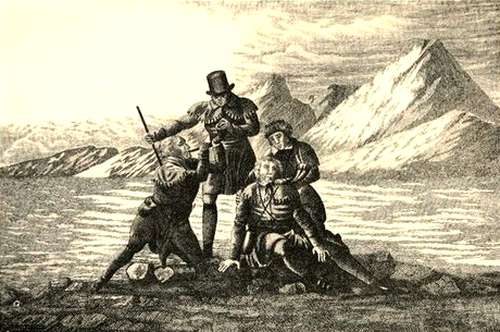
Messrs. Pattie and Slover rescued from Famish
Notwithstanding I was sick myself, I emptied my powder horn of its contents, filled it with water, and accompanied by one companion, who had also filled his powder horn, I returned towards my father and Mr. Slover, his exhausted companion, with a quick step. We found them in the same position in which we had left them, that is, stretched on the sand at full length, under the unclouded blaze of the sun, and both fast asleep; a sleep from which, but for our relief, I believe they would neither of them ever have awakened. Their lips were black, and their parched mouths wide open. Their unmoving posture and their sunken eyes so resembled death, that I ran in a fright to my father, thinking him, for a moment, really dead. But he easily awakened, and drank the refreshing water. My companion [164] at the same time bestowed his horn of water upon Mr. Slover. In the course of an hour they were both able to climb the hill, and some time before dark we rejoined the remainder of our company. They had kindled a large fire, and all seemed in high spirits. As for our two Indians, they were singing, and dancing, as it seemed to us, in a sort of worship of thankfulness to the Great Spirit, who had led them through so much peril and toil to these refreshing waters. We roasted some of our beaver meat, and took food for the first time in forty-eight hours, that is to say, from the time we left our Indian friends, until we reached this water. Our Dutchman insisted that the plain over which we passed, should be named the devil's plain, for he insisted, that it was more hotter as hell, and that none but teyvils could live upon it. In fact, it seemed a more fitting abode for fiends, than any living thing that belongs to our world. During our passage across it, we saw not a single bird, nor the track of any quadruped, or in fact any thing that had life, not even a sprig, weed or grass blade, except a single shrubby tree, under which we found a little shade. This shrub, though of some height, resembled a prickly pear, and was covered thick with thorns. The prickly pears were in such abundance, that we were often, dazzled as our eyes were with the sun's brightness, puzzled to find a path so as neither to torment our feet or our bodies with the thorns of these hated natives of the burning sands. This very extensive plain, the Sahara of California, runs north and south, and is bounded on each side by high barren mountains, some of which are covered with perpetual snow.
On the 28th, we travelled up this creek about three miles, and killed a deer, which much delighted our two Indian guides. At this point we encamped for the night. Here are abundance of palm trees and live oaks, and considerable of mascal. We remained until the 3d of March, when we marched up this creek, which heads to the south, forming a low gap in the mountain. On the 7th, we arrived at the point, and found some of the Christian Indians from the Mission of St. Catharine. They were roasting mascal and the tender inside heads of the [165] palm trees for food, which, when prepared and cooked after their fashion, becomes a very agreeable food. From these Indians we learned that we were within four days' travel of the mission mentioned above.
Here we concluded to discharge our guides, and travel into the settlement with the Christian Indians. We gave them each a blanket, and they started back to their own people on the morning of the 8th. At the same time we commenced our journey with our new guides, and began to climb the mountain. This is so exceedingly lofty, as to require two days' travel and a half to gain its summit. During this ascent, I severely bruised my heel. We none of us wore any thing to shield our feet from the bare and sharp rocks, which composed almost the whole surface of this ascent, but thin deer skin moccasins. Obliged to walk on tip toe, and in extreme anguish, the severe fatigue of scrambling up sharp stones was any thing, rather than agreeable. But I summoned patience and courage to push on until the 12th. My leg then became so swollen and inflamed that it was out of my power to travel farther. The pain was so severe as to create fever. I lay myself down on the side of a sharp rock, resigning myself to my fate, and determined to make no effort to travel further, until I felt relieved. My companions all joined with my father, in encouraging me to rise, and make an effort to reach the mission, which they represented to be but three miles distant. It was out of the question for me to think of it, and they concluded to go to the settlement, and obtain a horse, and send out for me. I kindled me a fire, for I suffered severe chills. The Indians gave me the strictest caution against allowing myself to go to sleep in their absence. The reason they assigned for their caution was a substantial one. The grizzly bear, they said, was common on these mountains, and would attack and devour me, unless I kept on my guard. I paid little attention to their remarks at the time. But when they were gone, and I was left alone, I examined the priming, and picked the flints of my gun and pistol. I then lay down and slept, until sometime in the early part of the night, when [166] two Indians came out from the settlement, and informed me that the corporal of the guards at St. Catharines97 wished me to come in. Being feverish, stiff, sore and withal testy, I gave them and their corporal no very civil words. They said that the corporal only wanted me to come in, because he was afraid the grizzly bears would kill me. I asked them why they did not bring a horse for me? They informed me, that the Mission had none at disposal at that time, but that they would carry me on their backs. So I was obliged to avail myself of this strange conveyance, and mounted the back of one of them while the other carried my arms. In this way they carried me in, where I found my companions in a guard house. I was ordered to enter with them by a swarthy looking fellow, who resembled a negro, rather than a white.
I cannot describe the indignation I felt at this revolting breach of humanity to people in suffering, who had thrown themselves on the kindness and protection of these Spaniards. We related the reasons why we had come in after this manner. We showed them our passport, which certified to them, that we were neither robbers, murderers, nor spies. To all this their only reply was, how should they know whether we had come clandestinely, and with improper views, or not? Against this question, proposed by such people, all reasonings were thrown away.—The cowardly and worthless are naturally cruel. We were thrown completely in their power; and instead of that circumstance exciting any generous desires to console and relieve us, their only study seemed to be to vex, degrade, and torment us.
Here we remained a week, living on corn mush, which we received once a day; when a guard of soldiers came to conduct us from this place. This mission is situated in a valley, surrounded by high mountains, with beautiful streams of water flowing from them. The natives raise sufficient corn and wheat to serve for the subsistence of the mission. The mission establishment is built in a quadrangular form; all the houses forming the quadrangle contiguous to each other; and one of the angles is a large church, adjoining which are the habitations of [167] the priests; though at this time there happened to be none belonging to this at home. The number of Indians belonging to the mission at this time, was about five hundred. They were destitute of stock, on account of its having been plundered from them by the free, wild Indians of the desert. The air is very cool and temperate, and hard frosts are not uncommon. This cool temperature of the atmosphere I suppose to be owing to the immediate proximity of the snowy mountains.
On the 18th, we started under the conduct of a file of soldiers, who led us two days' travel, over very high mountains, a south west course, to another mission, called St. Sebastian, situated near the sea coast, in a delightful valley, surrounded, like the other, by lofty mountains, the sides of which present magnificent views of the ocean. This mission contains six hundred souls. This mission establishment, though much richer and neater than the other, is, however, built on a precisely similar plan. Here they have rich vineyards, and raise a great variety of the fruits of almost all climates. They also raise their own supplies of grain, and have a tolerable abundance of stock, both of the larger and smaller kinds.
A serjeant has the whole military command. We found him of a dark and swarthy complexion, though a man of tolerable information. He seemed disposed to conduct towards us with some courtesy and kindness. He saluted us with politeness, conducted us to the guard house, and begged us to content ourselves, as well as we could, until he could make some more satisfactory arrangements for our comfort and convenience. To put him to the proof of his professed kindness, we told him that we were very hungry. They soon had a poor steer killed, that reeled as it walked, and seemed sinking by natural decay. A part of the blue flesh was put boiling in one pot, and a parcel of corn in the other. The whole process reminded me strongly of the arrangements which we make in Kentucky, to prepare a mess for a diseased cow. When this famous feast was cooked, we were marched forth into the yard, in great ceremony, to eat it. All the men, women and children clustered round us, and [168] stood staring at us while we were eating, as though they had been at a menagerie to see some wild and unknown animals.—When we were fairly seated to our pots, and began to discuss the contents, disgusted alike with the food, with them, and their behaviour, we could not forbear asking them whether they really took us to be human beings, or considered us as brutes? They looked at each other a moment, as if to reflect and frame an answer, and then replied coolly enough, that not being Christians, they considered us little superior to brutes. To this we replied, with a suitable mixture of indignation and scorn, that we considered ourselves better Christians than they were, and that if they did not give us something to eat more befitting men, we would take our guns, live where we pleased, and eat venison and other good things, where we chose. This was not mere bravado, for, to our astonishment, we were still in possession of our arms. We had made no resistance to their treating us as prisoners, as we considered them nothing more than petty and ignorant officers, whom we supposed to have conducted improperly, from being unacquainted with their duty. We were all confident, that as soon as intelligence of our arrival should reach the commanding officer of this station, and how we had been detained, and treated as prisoners, we should not only be released from prison, but recompensed for our detention.
This determination of ours appeared to alarm them. The information of our menaces, no doubt with their own comments, soon reached the serjeant. He immediately came to see us, while we were yet at our pots, and enquired of us, what was our ground of complaint and dissatisfaction? We pointed to the pots, and asked him if he thought such food becoming the laws of hospitality to such people? He stepped up to the pots, and turning over the contents, and examining them with his fingers, enquired in an angry tone, who had served up such food to us? He added, that it was not fit to give a dog, and that he would punish those who had procured it. He comforted us, by assuring us that we should have something fit to eat cooked for us. We immediately returned quietly to the guard house. But a [169] short time ensued before he sent us a good dish of fat mutton, and some tortillas. This was precisely the thing our appetites craved, and we were not long in making a hearty meal. After we had fed to our satisfaction, he came to visit us, and interrogated us in what manner, and with what views we had visited the country? We went into clear, full and satisfactory details of information in regard to every thing that could have any interest to him, as an officer; and told him that our object was to purchase horses, on which we might return to our own country; and that we wished him to intercede in our behalf with the commander in chief, that we might have permission to purchase horses and mules among them, for this purpose. He promised to do this, and returned to his apartment.
The amount of his promise was, that he would reflect upon the subject, and in the course of four days write to his commander, from whom he might expect an answer in a fortnight.—When we sounded him as to the probability of such a request being granted, he answered with apparent conviction, that he had no doubt that it would be in our favor. As our hopes were intensely fixed upon this issue, we awaited this answer with great anxiety. The commander at this time was at the port of San Diego. During this period of our suspense, we had full liberty to hunt deer in the woods, and gather honey from the blossoms of the Mascal, which grows plentifully on the sea shore. Every thing in this strange and charming country being new, we were continually contemplating curiosities of every sort, which quieted our solicitude, and kept alive the interest of our attention.
We used to station ourselves on the high pinnacles of the cliffs, on which this vast sea pours its tides, and the retreating or advancing tide showed us the strange sea monsters of that ocean, such as seals, sea otters, sea elephants, whales, sharks, sword fish, and various other unshapely sea dwellers. Then we walked on the beach, and examined the infinite variety of sea shells, all new and strange to us.
Thus we amused ourselves, and strove to kill the time until the 20th, when the answer of the commander arrived, which [170] explained itself at once, by a guard of soldiers, with orders to conduct us to the port of San Diego, where he then resided. We were ordered to be in immediate readiness to start for that port. This gave us unmingled satisfaction, for we had an undoubting confidence, that when we should really have attained the presence of an officer whom we supposed a gentleman, and acting independently of the authority of others, he would make no difficulty in granting a request so reasonable as ours. We started on the 2d, guarded by sixteen soldiers and a corporal. They were all on horseback, and allowed us occasionally to ride, when they saw us much fatigued. Our first day's journey was a north course, over very rough mountains, and yet, notwithstanding this, we made twenty-five miles distance on our way.
At night we arrived at another mission, situated like the former, on a charming plain. The mission is called St. Thomas.98 These wise and holy men mean to make sure of the rich and pleasant things of the earth, as well as the kingdom of heaven. They have large plantations, with splendid orchards and vineyards. The priest who presides over this establishment, told me that he had a thousand Indians under his care. During every week in the year, they kill thirty beeves for the subsistence of the mission. The hides and tallow they sell to vessels that visit their coast, in exchange for such goods as they need.
On the following morning, we started early down this valley, which led us to the sea shore, along which we travelled the remainder of the day. This beautiful plain skirts the sea shore, and extends back from it about four miles. This was literally covered with horses and cattle belonging to the mission. The eye was lost beyond this handsome plain in contemplating an immeasurable range of mountains, which we were told thronged with wild horses and cattle, which often descend from their mountains to the plains, and entice away the domesticated cattle with them. The wild oats and clover grow spontaneously, and in great luxuriance, and were now knee high. In the evening we arrived at the port of Todos Santos, and there passed the night. Early on the 23d, we marched on. This day we [171] travelled over some tracts that were very rough, and arrived at a mission situated immediately on the sea board, called St. Michael.99 Like the rest, it was surrounded with splendid orchards, vineyards and fields; and was, for soil, climate and position, all that could be wished. The old superintending priest of the establishment showed himself very friendly, and equally inquisitive. He invited us to sup with him, an invitation we should not be very likely to refuse. We sat down to a large table, elegantly furnished with various dishes of the country, all as usual highly seasoned. Above all, the supply of wines was various and abundant. The priest said grace at the close, when fire and cigars were brought in by the attendants, and we began to smoke. We sat and smoked, and drank wine, until 12 o'clock. The priest informed us that the population of his mission was twelve hundred souls, and the weekly consumption, fifty beeves, and a corresponding amount of grain. The mission possessed three thousand head of domesticated and tamed horses and mules. From the droves which I saw in the plains, I should not think this an extravagant estimation. In the morning he presented my father a saddle mule, which he accepted, and we started.
This day's travel still carried us directly along the verge of the sea shore, and over a plain equally rich and beautiful with that of the preceding day. We amused ourselves with noting the spouting of the huge whales, which seemed playing near the strand for our especial amusement. We saw other marine animals and curiosities to keep our interest in the journey alive. In the evening we arrived at a Ranch, called Buenos Aguos, or Good Water, where we encamped for the night.
We started early on the 25th, purchasing a sheep of a shepherd, for which we paid him a knife. At this Ranch they kept thirty thousand head of sheep, belonging to the mission which we had left. We crossed a point of the mountain that made into the water's edge. On the opposite side of this mountain was another Ranch, where we staid the night. This Ranch is for the purposes of herding horses and cattle, of which [172] they have vast numbers. On the 26th, our plain lay outstretched before us as beautiful as ever. In the evening we came in sight of San Diego, the place where we were bound.100 In this port was one merchant vessel, which we were told was from the United States, the ship Franklin, of Boston. We had then arrived within about a league of the port. The corporal who had charge of us here, came and requested us to give up our arms, informing us, it was the customary request to all strangers; and that it was expected that our arms would be deposited in the guard house before we could speak with the commander, or general. We replied, that we were both able and disposed to carry our arms to the guard house ourselves, and deposite them there if such was our pleasure, at our own choice. He replied that we could not be allowed to do this, for that we were considered as prisoners, and under his charge; and that he should become responsible in his own person, if he should allow us to appear before the general, bearing our own arms. This he spoke with a countenance of seriousness, which induced us to think that he desired no more in this request than the performance of his duty. We therefore gave him up our rifles, not thinking that this was the last time we should have the pleasure of shouldering these trusty friends. Having unburdened ourselves of our defence, we marched on again, and arrived, much fatigued, at the town at 3 o'clock in the evening. Our arms were stacked on the side of the guard house, and we threw our fatigued bodies as near them as we could, on the ground.
An officer was dispatched to the general to inform him of our arrival, and to know whether we could have an immediate audience or not? In a short time the officer returned with an answer for us, that we must remain where we were until morning, when the general would give us a hearing. We were still sanguine in seeing only omens of good. We forgot our past troubles, opened our bosom to hope, and resigned ourselves to profound sleep. It is true, innumerable droves of fleas performed their evolutions, and bit all their pleasure upon our bodies.—[173] But so entire was our repose, that we scarcely turned for the night. No dreams of what was in reserve for us the following day floated across our minds; though in the morning my body was as spotted as though I had the measles, and my shirt specked with innumerable stains of blood, let by the ingenious lancets of these same Spanish fleas.
On the 27th, at eight a.m., we were ushered into the general's office, with our hats in our hands, and he began his string of interrogations. The first question was, who we were? We answered, Americans. He proceeded to ask us, how we came on the coast, what was our object, and had we a passport? In answer to these questions we again went over the story of our misfortunes. We then gave him the passport which we had received from the governor of Santa Fe. He examined this instrument, and with a sinister and malicious smile, observed, that he believed nothing of all this, but considered us worse than thieves and murderers; in fact, that he held us to be spies for the old Spaniards, and that our business was to lurk about the country, that we might inspect the weak and defenceless points of the frontiers, and point them out to the Spaniards, in order that they might introduce their troops into the country; but that he would utterly detect us, and prevent our designs.—This last remark he uttered with a look of vengeance; and then reperused the passport, which he tore in pieces, saying, it was no passport, but a vile forgery of our own contrivance.
Though amazed and confounded at such an unexpected charge, we firmly asserted our innocence in regard to any of the charges brought against us. We informed him that we were born and bred thorough and full blooded republicans; and that there was not a man of us who would not prefer to die, rather than to be the spies and instruments of the Spanish king, or any other king; and that but a few years since, we had all been engaged in fighting the forces of a king, allied with savages, and sent against the country of our home; and that on this very expedition we had been engaged in a great many battles with the Indians, hostile to his people, redeeming their captives, [174] and punishing their robberies and murders. In distress, and in want of every thing from the robbery of these hostile Indians, we had taken refuge in his country, and claimed its protection. We told him we considered it an unworthy return for such general deportment, and such particular services to their country, that we should be viewed as spies, and treated as prisoners. He stopped us in the midst of our plea, apparently through fear that representations, which must have carried conviction to his prejudiced mind, might tend to soften his obdurate heart, and unnerve his purpose towards us. He told us he did not wish to hear any more of our long speeches, which he considered no better than lies; for that if we had been true and bona fide citizens of the United States, we should not have left our country without a passport, and the certificate of our chief magistrate. We replied that the laws of our country did not require that honest, common citizens, should carry passports; that it did not interfere with the individual business and pursuits of private individuals; that such persons went abroad and returned unnoted by the government; and in all well regulated states, sufficiently protected by the proof that they were citizens of the United States; but that there were in our country two classes of people, for whom passports were necessary, slaves and soldiers; that for the slave it was necessary to have one, to certify that he was travelling with the knowledge and permission of his master; and for the soldier, to show that he was on furlough, or otherwise abroad with the permission of his officer. As we spoke this with emphasis, and firmness, he told us that he had had enough of our falsehoods, and begged us to be quiet. He ordered us to be remanded to our prison, and was immediately obeyed.
As we were driven out of his office, my father, who was exceedingly exasperated, observed, 'my boys, as soon as we arrive in the guard house, let us seize our arms and redress ourselves, or die in the attempt; for it seems to me that these scoundrels mean to murder us.' We all unanimously agreed to this advice, and walked back with a willing mind, and an alert step. [175] But our last hope of redressing ourselves, and obtaining our liberty was soon extinguished. On entering the guard house, our arms had been removed we knew not where. They had even the impudence to search our persons and to take from us even our pocket knives. The orderly sergeant then told us, that he was under the necessity of placing us in separate apartments. This last declaration seemed the death stroke to us all. Affliction and mutual suffering and danger had endeared us to each other, and this separation seemed like rending our hearts. Overcome by the suddenness of the blow, I threw my arms round the neck of my father, burst into tears, and exclaimed, 'that I foresaw, that the parting would be forever.' Though my father seemed subdued, and absorbed in meditation, he reproved this expression of my feelings, as weak and unmanly. The sergeant having observed my grief, asked me, pointing to him, if that was my father? When he learned that it was, he showed himself in some degree affected, and remarked, that it seemed cruel to separate father and child, and that he would go and explain the relationship to the general, and see if he could not obtain permission for us to remain together. On this he set off for the general's office, leaving me in the agony of suspense, and the rest gazing at each other in mute consternation and astonishment. The sergeant returned, informing me, that instead of being softened, the general had only been exasperated, and had in nothing relaxed his orders, which were, that we must immediately be put in separate confinement. He accordingly ordered some soldiers to assist in locking us up. We embraced each other, and followed our conductors to our separate prisons. I can affirm, that I had only wished to live, to sustain the increasing age and infirmities of my father. When I shook hands with him, and we were torn in sunder, I will say nothing of my feelings, for words would have no power to describe them. As I entered my desolate apartment, the sergeant seemed really affected, and assured me, that neither my companions nor myself should suffer any want of food or drink, as far as he could prevent it, for that he did not consider us guilty, nor worthy of such treatment.
[176] My prison was a cell eight or ten feet square, with walls and floor of stone. A door with iron bars an inch square crossed over each other, like the bars of window sashes, and it grated on its iron hinges, as it opened to receive me. Over the external front of this prison was inscribed in capital letters Destinacion de la Cattivo. Our blankets were given us to lie upon. My father had a small package of medicines which he gave in charge to the sergeant, binding him on his word of honor not to part with it to any one. My door was locked, and I was left to reflect upon our position and my past misfortunes; and to survey the dreary walls of my prison. Here, I thought, was my everlasting abode. Liberty is dear to every one, but doubly dear to one, who had been from infancy accustomed to free range, and to be guided by his own will. Put a man, who has ranged the prairies, and exulted in the wilderness, as I have for years, in a prison, to let him have a full taste of the blessings of freedom, and the horror of shackles and confinement! I passed the remainder of the day in fierce walking backwards and forwards over my stone floor, with no object to contemplate, but my swarthy sentinel, through the grate. He seemed to be true to his office, and fitly selected for his business, for I thought I saw him look at me through the grate with the natural exultation and joy of a bad and malicious heart in the view of misery.