Volume 18 — COMMENCEMENT OF THE EXPEDITION (continued 3)
Reading edition
We pushed on as rapidly as possible, fearful that these red [95] children of the desert, who appear to inherit an equal hatred of all whites, would follow us, and attack us in the night. With timely warning we had no fear of them by day, but the affair of the destruction of the French company, proved that they might become formidable foes by night. To prevent, as far as might be, such accidents, we raised a fortification round our camp every night, until we considered ourselves out of their reach, which was on the evening of the 12th. This evening we erected no breast-work, placed no other guard than one person to watch our horses, and threw ourselves in careless security round our fires. We had taken very little rest for four nights, and being exceedingly drowsy, we had scarcely laid ourselves down, before we were sound asleep. The Indians had still followed us, too far off to be seen by day, but had probably surveyed our camp each night. At about 11 o'clock this night, they poured upon us a shower of arrows, by which they killed two men, and wounded two more; and what was most provoking, fled so rapidly that we could not even give them a round. One of the slain was in bed with me. My own hunting shirt had two arrows in it, and my blanket was pinned fast to the ground by arrows. There were sixteen arrows discharged into my bed. We extinguished our fires, and it may easily be imagined, slept no more that night.
In the morning, eighteen of us started in pursuit of them, leaving the rest of the company to keep camp and bury our dead. We soon came upon their trail, and reached them late in the evening. They were encamped, and making their supper from the body of a horse. They got sight of us before we were within shooting distance, and fled. We put spurs to our horses, and overtook them just as they were entering a thicket. Having every advantage, we killed a greater part of them, it being a division of the band that had attacked us. We suspended those that we had killed upon the trees, and left their bodies to dangle in terror to the rest, and as a proof, how we retaliated aggression. We then returned to our company, who had each received sufficient warning not to encamp in the territories [96] of hostile Indians without raising a breast-work round the camp. Red river at this point bears a north course, and affords an abundance of the finest lands. We killed plenty of mountain sheep and deer, though no bears. We continued our march until the 16th, without seeing any Indians. On that day we came upon a small party, of whom the men fled, leaving a single woman. Seeing herself in our power, she began to beat her breast, and cry Cowera, Cowera; from which we gathered, that she belonged to that tribe. We treated her kindly, and travelled on. On the 23d, we came to a village of the Shuena Indians. As we approached it, they came out and began to fire arrows upon us. We gave them in return a round of rifle balls. In the excitement of an attack, we laughed heartily to see these sons of the desert dodge, and skulk away half bent, as though the heavens were falling upon them. From their manner we inferred, that they were in fact wholly unacquainted with white people, or at least they never before heard the report of a gun. The whole establishment dispersed to the mountains, and we marched through the village without seeing any inhabitants, except the bodies of those we had killed. We had received more than one lesson of caution, and we moved on with great circumspection. But so much of our time was taken up in defence and attacks, and fortifying our camps, that we had little leisure to trap. In order that our grand object should not be wholly defeated, we divided our men into two companies, the one to trap and the other to keep guard. This expedient at once rendered our trapping very productive. We discovered little change in the face of the country. The course of the river still north, flowing through a rich valley, skirted with high mountains, the summits of which were white with snow.
On the 25th we reached a small stream,66 emptying into Red river through the east bank, up which we detached three men, each carrying a trap, to discover if beavers abounded in that stream. They were to return the next day, while we were engaged in shoeing our horses. The next day elapsed, but none returned. We became anxious about their fate; and on the [97] 27th, started to see what had become of them. At mid-day we found their bodies cut in pieces, and spitted before a great fire, after the same fashion which is used in roasting beaver. The Indians who had murdered them, saw us as we came on, and fled to the mountains, so that we had no chance of avenging the death of our unfortunate companions. We gathered the fragments of their bodies together and buried them. With sadness in our hearts, and dejection on our countenances, we returned to our camp, struck our tents, and marched on. The temperature in this region is rather severe, and we were wretchedly clad to encounter the cold.
On the 28th, we reached a point of the river where the mountains shut in so close upon its shores, that we were compelled to climb a mountain, and travel along the acclivity, the river still in sight, and at an immense depth beneath us.67—Through this whole distance, which we judged to be, as the river meanders, 100 leagues, we had snow from a foot to eighteen inches deep. The river bluffs on the opposite shore, were never more than a mile from us. It is perhaps, this very long and formidable range of mountains, which has caused, that this country of Red river, has not been more explored, at least by the American people. A march more gloomy and heart-wearing, to people hungry, poorly clad, and mourning the loss of their companions, cannot be imagined. Our horses had picked a little herbage, and had subsisted on the bark of shrubs. Our provisions were running low, and we expected every hour to see our horses entirely give out.
April 10th, we arrived where the river emerges from these horrid mountains, which so cage it up, as to deprive all human beings of the ability to descend to its banks, and make use of its waters. No mortal has the power of describing the pleasure I felt, when I could once more reach the banks of the river.—Our traps, by furnishing us beavers, soon enabled us to renew our stock of provisions. We likewise killed plenty of elk, and dressed their skins for clothing. On the 13th we reached another part of the river, emptying into the main river from the [98] north. Up this we all trapped two days. During this excursion we met a band of hostile Indians, who attacked us with an unavailing discharge of arrows, of whom we killed four.
On the 15th, we returned to the banks of Red river, which is here a clear beautiful stream. We moved very slowly, for our beasts were too lean and worn down, to allow us to do otherwise. On the 16th we met with a large party of the Shoshonees,68 a tribe of Indians famous for the extent of their wanderings, and for the number of white people they had killed, by pretending friendship to them, until they found them disarmed, or asleep. One of our company could speak their language, from having been a prisoner among them for a year. They were warmly clad with buffaloe robes, and they had muskets, which we knew they must have taken from the white people. We demanded of them to give up the fire arms, which they refused. On this we gave them our fire, and they fled to the mountains, leaving their women and children in our power.—We had no disposition to molest them. We learned from these women, that they had recently destroyed a company of French hunters on the head waters of the Platte. We found six of their yet fresh scalps, which so exasperated us, that we hardly refrained from killing the women. We took from them all the beaver skins which they had taken from the slain French, and five of their mules, and added to our provisions their stock of dried buffaloe meat. We had killed eight of their men, and we mortified the women excessively, by compelling them to exchange the scalps of the unfortunate Frenchmen for those of their own people.
We resumed our march, and ascended the river to the point where it forked again, neither fork being more than from twenty-five to thirty yards wide. On the 19th, we began to ascend the right hand fork, which pursues a N. E. course.69 On the 23d, we arrived at the chief village of the Nabahoes, a tribe that we knew to be friendly to the whites. We enquired of them, if we could cross the Rocky Mountains best at the head of this fork or the other; and they informed us, that the mountains [99] were impassable, except by following the left hand fork. Knowing that they were at war with the Shoshonee, we let them know how many of them we had killed. With this they were delighted, and gave us eight horses, one for each man we had slain. They sent with us, moreover, ten Indians to point out to us the route, in which to cross the mountains.
On the 25th, we started up the left hand fork, and arrived on the 30th, in the country of the Pewee tribe,70 who are friendly to the Nabahoes. Their chief village is situated within two days' travel of the low gap, at which we were to cross the mountains, at which gap we arrived on the first of May.71 The crossing was a work, the difficulty of which may be imagined from the nature of the case and the character of the mountains.—The passage occupied six days, during which we had to pass along compact drifts of snow, higher than a man on horseback. The narrow path through these drifts is made by the frequent passing of buffaloes, of which we found many dead bodies in the way. We had to pack cotton-wood bark on the horses for their own eating, and the wood necessary to make fires for our cooking. Nothing is to be seen among these mountains, but bare peaks and perpetual snow. Every one knows, that these mountains divide between the Atlantic and Pacific Oceans. At the point where we crossed them, they run in a direction a little north of west, and south of east, further than the eye can reach.
On the 7th, we struck the south fork of the Platte, near Long's Peak,72 and descended it five days. We then struck across the plain to the main Platte, on which we arrived on the 16th. In descending it we found the beavers scarce, for all these rivers had been thoroughly trapped. The river is skirted with only a few small willows, and the country is open prairie, entirely destitute of trees. We saw immense droves of elk, buffaloes, and white bears, which haunt the buffaloe range to prey upon those noble animals. We had the merriest sport imaginable, in chasing the buffaloes over these perfectly level plains, and shooting them with the arrows we had taken from the Indians [100] we had killed. I have killed myself, and seen others kill a buffaloe, with a single shot of an arrow. The bows are made with ribs of buffaloes, and drive the arrows with prodigious force. On the 20th, we left this river and started for the Big Horn,73 a fork of the Yellow Stone, itself a considerable river of the Missouri. We reached the Big Horn on the 31st, and found but few beavers. June 2d, we struck over towards the main Yellow Stone,74 and on the 3d entered the country of the Flat Heads, who were entirely friendly.75 We purchased some furs of them. They are Indians of exceedingly handsome forms, were it not for the horrid deformity of their heads, which are transversely from ear to ear but a few inches in diameter, and in the other direction monstrous, giving them the appearance of wearing a military cap with all its plumage. This plumage is furnished by their matted tresses of hair, painted and skewered up to a high point. This monstrosity is occasioned by binding two pieces of board on each side of the head of the new-born infant, which is kept secure with bandages, until the child is three years old, at which time the head bones have acquired a firmness to retain their then shape during life. On the 11th, we reached the Yellow Stone, and ascended it to its head; and thence crossed the ridges of the Rocky Mountains to Clarke's fork of the Columbia.76 But all these streams had been so much trapped, as to yield but few beavers. Clarke's fork is a hundred yards wide, a bold, clear, pleasant stream, remarkable for the number and excellence of its fish, and most beautiful country of fertile land on its shores. We ascended this river to its head, which is in Long's Peak, near the head waters of the Platte. We thence struck our course for the head waters of the Arkansas, on which we arrived July 1st. Here we met a band of the Grasshopper Indians, who derive their name from gathering grasshoppers, drying them, and pulverizing them, with the meal of which they make mush and bread; and this is their chief article of food. They are so little improved, as not even to have furnished themselves with [101] the means of killing buffaloes. At sight of us, these poor two-legged animals, dodged into the high grass like so many partridges.
We marched up this stream, trapping for the few beavers which it afforded. Its banks are scantily timbered, being only skirted with a few willows. On the 5th, we met a war party of the Black Foot Indians,77 all well mounted. As soon as they saw us, they came fiercely upon us, yelling as though the spirit of darkness had loaned them the voices of all his tenants. We dismounted, and as soon as they were within shooting distance, we gave them our fire, which they promptly returned. The contest was fierce for something more than 20 minutes, a part of the time not more than 50 yards apart. They then retreated, and we mounted our horses, and gave them chase, though unavailingly, for their horses were as fleet as the wind, compared with ours. We soon desisted from so useless a pursuit, and returned to the battle ground. We found sixteen Blackfeet dead, and with infinite anguish, counted four of our own companions weltering in their blood. We buried them with sorrowful hearts, and eyes full of tears. Ah! Among those who live at home, surrounded by numerous relations and friends, in the midst of repose, plenty and security, when one of the number droops, and dies with sickness or age, his removal leaves a chasm that is not filled for years. Think how we must have mourned these brave men, who had shared so many dangers, and on whose courage and aid we had every day relied for protection. Here on these remote plains, far from their friends, they had fallen by the bloody arrow or spear of these red, barbarous Ishmaelites of the desert, but neither unwept nor unrevenged. Having performed the sad task of depositing the bodies of these once warm hearted friends in the clay, we ascended to the head of this river, and crossed the mountain that separates its waters from those of the Rio del Norte, which river we struck on the 20th. We began to descend it, and on the 23d met a band of the Nabahoes, who accompanied us [102] quite to their chief village. It will be seen, that all these streams upon which we have been trapping, rise from sources which interlock with each other, and the same range of peaks at very short distances from each other. These form the heads of Red river of the east, and the Colorado of the west, Rio del Norte, Arkansas, Platte, Yellow Stone, Missouri and Columbia. The village of these Indians is distant 50 miles from the Rio del Norte. We remained at it two days, and rested our horses, and refreshed ourselves. This tribe some years since had been at war with the Spanish, during which they plundered them of great numbers of horses, mules and cattle, which caused that they had now large stocks of these animals, together with flocks of sheep. They raise a great abundance of grain, and manufacture their wool much better than the Spanish. On the first of August we arrived at Santa Fe, with a fine amount of furs. Here disaster awaited us. The Governor, on the pretext that we had trapped without a license from him, robbed us of all our furs. We were excessively provoked, and had it not been from a sense of duty to our own beloved country, we would have redressed our wrongs, and retaken our furs with our own arms.
Here I remained until the 18th, disposing of a part of my goods, and reserving the remainder for a trip which I contemplated to the province of Sonora. I had the pleasure once more of receiving the affectionate greeting of Jacova, who gave me the most earnest counsels to quit this dangerous and rambling way of life, and settle myself down in a house of my own. I thanked her for her kindness and good counsel, and promised to follow it, after rambling another year in the wilderness.—Thence I went to the mines, where I had the inexpressible satisfaction again to embrace my dear father, whom I found in perfect health, and making money rapidly. I remained there three days, and, accompanied with one servant, arrived in Hanas on the first of September. This is a small town situated in the province of Biscay, between the province of Sonora and New Mexico, in a direction S. W. from the copper mines.78 [103] The country is generally of that character, denominated in Kentucky, barren. The soil is level and black. These people raise a great quantity of stock, such as horses, cows, sheep and goats. Their farming implements are clumsy and indifferent. They use oxen entirely in their agriculture. Their ploughs are a straight piece of timber, five feet long and eight inches thick, mortised for two other pieces of timber, one to be fitted to the beam, by which the oxen draw, and another to the handle, by which the man holds the plough. The point that divides the soil, is of wood, and hewed sloping to such a point, that a hollow piece of iron is fastened on it at the end. This is one inch thick, and three inches broad at top, and slopes also to a point.
Their hoes, axes and other tools are equally indifferent; and they are precisely in such a predicament, as might be expected of a people who have no saw mills, no labor saving machinery, and do every thing by dint of hard labor, and are withal very indolent and unenterprising.
I amused myself at times with an old man, who daily fell in my way, who was at once rich and to the last degree a miser; and yet devotedly attached to the priests, who were alone able to get a little money out of him. He often spoke to me about the unsafeness of my religion. Instead of meeting his remarks with an argument, I generally affronted him at once, and then diverted myself with his ways of showing his anger. I told him that his priest treated him as the Spanish hostlers do their horses. He asked me to explain the comparison. I observed, 'you know how the hostler in the first place throws his lasso over the mule's neck. That secures the body of the beast. Next the animal is blindfolded. That hinders his seeing where he is led. Next step he binds the saddle safe and fast. Then the holy father rigs his heels with spurs. Next come spur and lash, and the animal is now restive to no purpose. There is no shaking off the rider. On he goes, till the animal under him dies, and both go to hell together!' At this he flew into such a violent rage, as to run at me with his knife. I dodged out of his [104] way, and appeased him by convincing him that I was in jest. The rich, in their way of living, unite singular contrasts of magnificence and meanness. For instance, they have few of the useful articles of our dining and tea sets, but a great deal of massive silver plate, and each guest a silver fork and spoon. The dining room is contiguous to the kitchen. A window is thrown open, and the cook hands a large dish through the window to a servant, who bears it to the table. The entertainer helps himself first, and passes the dish round to all the guests. Then another and another is brought on, often to the number of sixteen. All are savored so strong with garlic and red pepper, that an American at first cannot eat them. The meat is boiled to such a consistency that a spoon manages it better than a knife. At the close of the dinner they bring in wine and cigars, and they sit and smoke and drink wine until drowsiness steals upon them, and they go to bed for their siesta. They sleep until three in the afternoon, at which time the church bell tolls. They rise, take a cup of chocolate, and handle the wine freely. This short affair over, they return and sit down on the shaded side of the house, and chatter like so many geese till night, when they divide, a part to mass, and a part to the card table, where I have seen the poor, betting their shirts, hats and shoes. The village contains 700 souls.
On the 6th, I departed from this town, travelling a west course through a most beautiful country, the plains of which were covered with domestic animals running wild. On the 8th I arrived at the foot of the mountain, that divides the province of Sonora from Biscay. I slept at a country seat, where they were making whiskey of a kind of plantain, of which I have spoken before, which they called Mascal (Maguey). Here were assembled great numbers of Spaniards and Indians. They were soon drunk, and as a matter of course, fighting with knives and clubs. In the morning, two Spaniards and one Indian were found dead. Late in the morning, a file of soldiers arrived, and took the suspected murderers to prison.
In the morning I commenced climbing the mountain before [105] me, and in the evening arrived at a small town in Sonoro, called Barbisca;79 situated on the bank of a most beautiful little stream, called Iago, which discharges itself into the Pacific ocean, near the harbor of Ymus. Its banks are not much timbered, nor is the soil uncommonly good. The morning of the 9th was a great religious festival, or famous Saint's day, which collected a vast crowd of people. After breakfast and mass, the image of the virgin Mary was paraded round the public square in solemn procession, during which there was a constant crash of cannon and small arms. Then an old priest headed a procession, bearing the image of Christ, nailed to a cross. After these images were returned to their church, they brought into a square enclosure, strongly fenced for that purpose, a wild bull, which they threw down, tied and sharpened its horns. The tops of the houses were all covered with people to see the spectacle that was performing. The bull was covered with red cloth, and two men entered the enclosure, each holding in the right hand a bundle of sky rockets, and in the left a red handkerchief. The rockets were lashed to a stick a foot long, in the end of which was a small nail, a half an inch long, with a beard at the end, like that of a fish hook. They then untied the fierce animal. No sooner was he on his feet, than he sprang at one of his assailants, who avoided his attack, by dextrously slipping aside, and as the animal darted by him, stuck in his neck two small rockets, one on each side. The other assailant then gave a sharp whistle to draw the infuriated animal upon him. The bull snorted and dashed at him. He dodged the animal in the same manner, as the other had done, and left sticking in his forehead, as he passed, a garland of artificial flowers, made of paper, beautifully cut and painted, and large enough to cover his whole forehead. In this way they kept alternately driving him this way and that, sticking rockets in him as he dashed by them, until he was covered with eight or ten, clinging to his neck and shoulders. They then touched the crackers with a lighted match. Words would not paint the bull's expressions of rage and terror, as he bounded round the enclosure, covered with fire, [106] and the rockets every moment discharging like fire arms. After this, a man entered with a small sword. The bull bellowed and darted at him. As the bull dropped his head to toss him, he set his feet upon the horns, and in a twinkling, thrust his sword between the shoulder blades, so as to touch the spinal marrow. The animal dropped as dead as a stone. The drum and fife then struck up, as a signal for the horsemen to come and carry off the dead animal, and bring in a fresh one. All this was conducted with incredible dispatch. In this way seven bulls were successively tortured to death, by footmen.
After this, four men entered on horseback, equipped with spears in the shape of a trowel, and a handle four feet long. With this spear in the one hand, and a noose in the other, they gallopped round the bull. The bull immediately made at the horsemen passing him, who moved just at such a pace, as not to allow the bull to toss the horse. The horseman then couched his spear backwards, so as to lay it on the bull's neck. The bull instantly reared and tossed, and in the act forced the spear between his fore shoulders, so as to hit the spinal marrow. If the spear is laid rightly, and the animal makes his accustomed motions, he drops instantly dead. But to do this requires infinite dexterity and fearlessness. If the man be clumsy, or of weak-nerves, he is apt to fail in couching the spear right, in which case, as a matter of course, the horse is gored, and it is ten to one that the man is slain. In this way fourteen bulls were killed, and with them, five horses and one man, during this festival. At night commenced gambling and card playing, and both as fiercely pursued as the bull fighting. This great feast lasted three days, during which, as the people were in a very purchasable humor, I sold a number of hundred dollar's worth of my goods.
On the morning of the 12th, I left this place, and in the evening arrived at a small town called Vassarac, and remained there one day. The country in the vicinity is well timbered and very hilly. The woods are full of wild cattle and horses. On the 13th, I travelled through a fine rich country, abounding with cattle, and arrived in the evening at a town called Tepac, [107] situated on a small creek, near a mountain, in which there is a gold mine worked by the Iago Indians,80 a nation formerly under the protection of an old priest. He attempted to practice some new imposition upon them, and they killed him some years ago. On this the Spaniards made war upon them, and the conflict was continued some years. They lost the best and bravest of their men, and the remnant were obliged to submit to such terms as the Spaniards saw fit to impose. They were either condemned to the mines, or to raise food for those who wrought them.
I remained in this town three days, and purchased gold in bars and lumps of the Indians, at the rate of ten dollars per ounce. The diggings seldom exceed twenty feet in depth. Most of the gold is found on the surface after hard rains. Their mode of extracting the gold from the earth with which it is mixed, or the stone in which it is imbedded, is this. The stone is pulverised or ground, still keeping the matter wet. It is carefully mixed with mercury, and kneaded with the hands, until the water is separated from the mass, and the mercury is perfectly incorporated with it. This process is repeated, until the water runs off perfectly clear. They then grind or triturate the mass anew until all the particles of earthy matter are washed away. The remaining matter is amalgam, of the color of silver, and the consistency of mush. They then put it into a wet deer skin, and strain the mercury by pressure through the pores of the skin. The gold is left, still retaining enough mercury to give it the color of silver. The coarse way of managing it afterwards, is to put it in the fire, and evaporate all the mercury from it, and it is then pure virgin gold. There is a more artificial way of managing it, by which the mercury is saved.
This province would be among the richest of the Mexican country, if it were inhabited by an enlightened, enterprising and industrious people. Nothing can exceed the indolence of the actual inhabitants. The only point, in which I ever saw them display any activity, is in throwing the lasso, and in horsemanship. In this I judge, they surpass all other people. Their great [108] business and common pursuit, is in noosing and taming wild horses and cattle.
On the 15th, I left this place and travelled through a country well timbered and watered, though the land is too broken to be cultivated, and in the evening arrived in a town called Varguacha. This is a place miserably poor, the people being both badly fed and clothed. But their indolence alone is in fault. The land in the immediate vicinity of the town is good, and the woods teem with wild cattle. But they are too lazy to provide more meat than will serve them from day to day. On the 17th I continued my course through a beautiful country, thinly settled by civilized Indians, who raise sugar cane and abundance of stock. They are obviously more enterprising and industrious than the Spaniards. Approaching the shore of the great Pacific, I found the country more level and better settled. Some rich and noble sugar farms lay in my view.
On the 22d I arrived in Patoka, which is a considerable town, and the capital of this province.81 It is two day's travel hence to Ymus. The people here seemed to me more enlightened, and to have a higher air of civilization than any I had seen in the whole country. It probably results from the intercourse they have with foreigners, from their vicinity to the Pacific. Most of them are dressed in the stile of the American people. Their houses are much better furnished, and the farmers are supplied with superior farming utensils, compared with any thing I saw in the interior. The chief manufactures are soap and sugar, the latter of an inferior quality, I imagine, in consequence of the clumsy mode of manufacturing it. From the port of Ymus they also export considerable quantities of tallow and hides, for which the farmers are repaid in merchandize at an enormous advance. A great many horses and mules are driven from the interior to this port. Many also are taken to the American states. The price of mules in this province is from three to four dollars a head.
I remained here until I had disposed of all my goods. On the 26th, I left this town, and travelled on to port Ymus, at which [109] I arrived on the 28th, and first saw the waters of the vast Pacific.82 I spent a day here on board an American ship, the master of which was surprised at the account I gave of myself, and would hardly believe that I had travelled to this place from the United States. I was equally amazed at hearing him relate the disasters which had befallen him at sea. On the 29th, I left this port, and travelled a N. W. course, through a country full of inhabitants, and abounding in every species of fruit. Snow never falls, although the general temperature is not so warm but that woollen garments may be worn. To add to its advantages, it is very healthy. On the 7th of October, I arrived at a town called Oposard. The population amounts to about 8000 souls. I here became acquainted with one of my own countrymen, married to a Spanish woman. He informed me, that he had been in this country thirty years, eight of which he had spent in prison. The sufferings he endured from the Spaniards were incredible; and I internally shuddered, as he related, lest I, in travelling through the country might fall into similar misfortunes. As some palliation of their cruelty, he observed, that he was made prisoner at the period when the revolution was just commencing in that country.83 At that time the Inquisition was still in force, and committed many a poor mortal to the flames, for his alleged heresy. He assured me, that he should have met the same fate, had he not become a member of their church. He afterwards married a lady, who had gained his affections by being kind to him in prison.
I remained with this man two days, and on the third resumed my journey, travelling an easterly course, and part of the time over a very rough country. I met no inhabitants, but Indians, who were uniformly friendly. On the 10th, I arrived at the mines of Carrocha,84 which were in the province of Chihuahua, situated between two mountains, and considered the richest silver mines in New Mexico. There are about 800 miners working this mine, and they have advanced under ground at least half a mile. On the 12th, I started for the capital, and reached it on the 16th, passing over great tracts of good and bad land, all [110] untilled, and most of it an uninhabited wilderness. This city is the next largest in New Mexico.85 It is the largest and handsomest town I had ever seen, though the buildings are not so neat and well arranged as in our country. The roofs are flat, the walls well painted, and the streets kept very clean. Here they smelt and manufacture copper and silver, and several other metals. They have also a mint. The terms of their currency are very different from ours. They count eight rials, or sixteen four pence half pennies, to the dollar. Their merchandize is packed from Ymus, or Mexico.
I have heard much talk about the Splendid churches in this city. It is for others, who think much of such immense buildings, wrung from the labors of the poor, to describe them. For my part, having said it is a large and clean town, I present a result of their institutions and manners, which I considered the more important sort of information. During a stay of only three days here, ten dead bodies were brought into town, of persons who had been murdered in the night. Part of the number were supposed to have been killed on account of having been known to carry a great deal of money with them, and part to have had a quarrel about some abandoned women. This last is a most common occasion of night murders, the people being still more addicted to jealousy, and under still less restraints of law, than in old Spain, in the cities of which, assassinations from this cause are notoriously frequent.
I asked my informant touching these matters, if there was no police in the city? He answered, that the forms of the law were complete, and that they had a numerous guard, and that it was quite as likely they committed the murders themselves, as not. I came to the same conclusion, for in a small and regular city like this, it was impossible that so many guards, parading the streets by night, should not be aware of the commission of such deeds, and acquainted with the perpetrators. No inquest of any sort was held over the bodies. They were, however, paraded through the streets to beg money to pay the priests for performing funeral rites at their burial. This excited in me [111] still more disgust, than the murders. I expressed myself in consequence, with so much freedom, in regard to this sort of miserable imposition, as to give great offence to my host, who, like most of the people, was rigidly devoted to the religion of the church. On the evening of 16th, I left this city, and travelled through a fine country, thickly inhabited by shepherds, who live in small towns, and possess a vast abundance of stock. It is well watered, but thinly timbered. The most magnificent part of the spectacle is presented in the lofty snow covered mountains, that rise far in the distance, and have their summits lost in the clouds, glistening in indescribable brilliance in the rays of the rising and setting sun.
The road at this time was deemed to be full of robbers, and very dangerous. I was so fortunate as to meet with none. On the 18th, I arrived at a small town, called San Bueneventura,86 which is surrounded with a wall. In fact, most of the considerable villages are walled. They are called in Spanish, Presidio, the English of which is, a garrison. In the forenoon, I crossed a small river called Rio Grande,87 and travelled down this stream all day, the banks of which were thickly settled, and in high cultivation, with wheat, corn and barley. On the 22d, I arrived at a village called Casas Grandes, or the Great Houses.88 On the 23d, I pursued an east course towards Passo del Norte, situated on the banks of the Rio del Norte. I travelled over a very rough country with some high mountains, inhabited by a wandering tribe of the Appache Indians, that live by seizing their opportunities for robbery and murder among the Spaniards, riding off upon the stolen horses, to the obscure and almost inaccessible fastnesses of their mountains, where they subsist upon the stolen horseflesh.
I know not, whether to call the Passo del Norte, a settlement or a town.89 It is in fact a kind of continued village, extending eight miles on the river. Fronting this large group of houses, is a nursery of the fruit trees, of almost all countries and climes. It has a length of eight miles and a breadth of nearly three. I was struck with the magnificent vineyards of this place, from [112] which are made great quantities of delicious wine. The wheat fields were equally beautiful, and the wheat of a kind I never saw before, the stalks generally yielding two heads each. The land is exceedingly rich, and its fertility increased by irrigation.
On the 28th, I started for the Copper mines, wrought by my father. This day my course led me up the del Norte, the bottoms of which are exceedingly rich. At a very short distance from the Passo, I began to come in contact with grey bears, and other wild animals. At a very little distance on either side are high and ragged mountains, entirely sterile of all vegetation. I had no encounter with the bears, save in one instance. A bear exceedingly hungry, as I suppose, came upon my horses as I was resting them at mid-day, and made at one of them. I repaid him for his impudence by shooting him through the brain. I made a most delicious dinner of the choice parts of his flesh. My servant would not touch it, his repugnance being shared by great numbers in his condition. It is founded on the notion, that the bear is a sort of degenerated man, and especially, that the entrails are exactly like those of human beings.
On the 30th, I struck off from the del Norte, and took my course for the Copper mines directly over the mountains, among which we toiled onward, subsisting by what we packed with us, or the product of the rifle, until the 11th of November, when I had once more the satisfaction of embracing my father at the Copper mines. He was in perfect health, and delighted to see me again. He urged me so earnestly to remain with him, though a stationary life was not exactly to my taste, that I consented from a sense of filial duty, and to avoid importunity. I remained here until the first of December, amusing myself sometimes by hunting, and sometimes by working in the gold mine, an employment in which I took much pleasure.
In a hunting excursion with a companion who was an American, he one morning saw fit to start out of bed, and commence his hunt while I was yet asleep in bed. He had scarcely advanced a league, before he killed a deer on the top of a high ridge. He was so inadvertent, as to commence skinning the animal, before [113] he had re-loaded his rifle. Thus engaged, he did not perceive a bear with her cubs, which had advanced within a few feet of him. As soon as he saw his approaching companion, without coveting any farther acquaintance, he left deer and rifle, and ran for his life. He stopped not, until he arrived at the mines. The bear fell to work for a meal upon the deer, and did not pursue him. We immediately started back to have the sport of hunting this animal. As we approached the ridge, where he had killed the deer, we discovered the bear descending the ridge towards us. We each of us chose a position, and his was behind a tree, which he could mount, in case he wounded, without killing her. This most ferocious and terrible animal, the grizzly or grey bear, does not climb at all. I chose my place opposite him, behind a large rock, which happened to be near a precipice, that I had not observed. Our agreement was to wait until she came within 30 yards, and then he was to give her the first fire. He fired, but the powder being damp, his gun made long fire, whence it happened that he shot her too low, the ball passing through the belly, and not a mortal part. She made at him in terrible rage. He sprang up his tree, the bear close at his heels. She commenced biting and scratching the tree, making, as a Kentuckian would phrase it, the lint fly. But finding that she could not bite the tree down, and being in an agony of pain, she turned the course of her attack, and came growling and tearing up the bushes before her, towards me. My companion bade me lie still, and my own purpose was to wait until I could get a close fire. So I waited until the horrible animal was within six feet of me. I took true aim at her head. My gun flashed in the pan. She gave one growl and sprang at me with her mouth open. At two strides I leapt down the unperceived precipice. My jaw bone was split on a sharp rock, on which my chin struck at the bottom. Here I lay senseless. When I regained recollection, I found my companion had bled me with the point of his butcher knife, and was sitting beside me with his hat full of water, bathing my head and face. It was perhaps an hour, before I gained full recollection, [114] so as to be able to walk. My companion had cut a considerable orifice in my arm with his knife, which I deemed rather supererogation; for I judged, that I had bled sufficiently at the chin.
When I had come entirely to myself, my companion proposed that we should finish the campaign with the bear. I, for my part, was satisfied with what had already been done, and proposed to retreat. He was importunate, however, and I consented. We ascended the ridge to where he had seen the bear lie down in the bushes. We fixed our guns so that we thought ourselves sure of their fire. We then climbed two trees, near where the bear was, and made a noise, that brought her out of her lair, and caused her to spring fiercely towards our trees. We fired together, and killed her dead. We then took after the cubs. They were three in number. My companion soon overtook them. They were of the size of the largest rackoons. These imps of the devil turned upon him and made fight. I was in too much pain and weakness to assist him. They put him to all he could do to clear himself of them. He at length got away from them, leaving them masters of the field, and having acquired no more laurels than I, from my combat with my buffaloe calf. His legs were deeply bit and scratched, and what was worse, such was the character of the affair, he only got ridicule for his assault of the cubs. I was several weeks in recovering, during which time, I ate neither meat nor bread, being able to swallow nothing but liquids.
The country abounds with these fierce and terrible animals, to a degree, that in some districts they are truly formidable. They get into the corn fields. The owners hear the noise, which they make among the corn, and supposing it occasioned by cows and horses that have broken into the fields, they rise from their beds, and go to drive them out, when instead of finding retreating domestic animals, they are assailed by the grizzly bear. I have been acquainted with several fatal cases of that sort. One of them was a case, that intimately concerned me. Iago, my servant, went out with a man to get a load of [115] wood. A bear came upon this man and killed him and his ass in the team. A slight flight of snow had fallen. Some Spaniards, who had witnessed the miserable fate of their companion, begged some of us to go and aid them in killing the bear. Four of us joined them. We trailed the bear to its den, which was a crevice in the bluff. We came to the mouth and fired a gun. The animal, confident in his fierceness, came out, and we instantly killed it. This occurred in New Mexico.
This stationary and unruffled sort of life had become unendurable, and with fifteen Americans, we arranged a trapping expedition on the Pacos.90 My father viewed my rambling propensities with stern displeasure. He had taken in a Spanish superintendent, who acted as clerk. This person had lived in the United States from the age of 18 to 30, and spoke English, French and Spanish. This man arranged the calculations, and kept the accounts of my father's concerns, and had always acted with intelligence and fidelity. The concern was on the whole prosperous; and although I felt deep sorrow to leave my father against his wishes, I had at least the satisfaction to know, that I was of no other use to him, than giving him the pleasure of my society.
On the 7th, our company arrived on the del Norte, and crossed it in the evening to the eastern shore. On the evening of the 8th, we struck the Pacos about twenty miles above its junction with the del Norte. This day's travel was through a wild and precipitous country, inhabited by no human being. We killed plenty of bears and deer, and caught some beavers. On the 9th, we began to ascend the river through a rich and delightful plain, on which are to be seen abundance of deserted sheep folds, and horse pens, where the Spanish vachers once kept their stock. The constant incursions of the Indians compelled this peaceful people to desert these fair plains. Their deserted cottages inspired a melancholy feeling. This river runs from N. E. to S. W. and is a clear, beautiful stream, 20 yards wide, with high and dry bottoms of a black and rich soil. The mountains run almost parallel to the river, and at the distance of [116] eight or ten miles. They are thickly covered with noble pine forests, in which aspen trees are intermixed. From their foot gush out many beautiful clear springs. On the whole, this is one of the loveliest regions for farmers that I have ever seen, though no permanent settlements could be made there, until the murderous Indians, who live in the mountains, should be subdued.
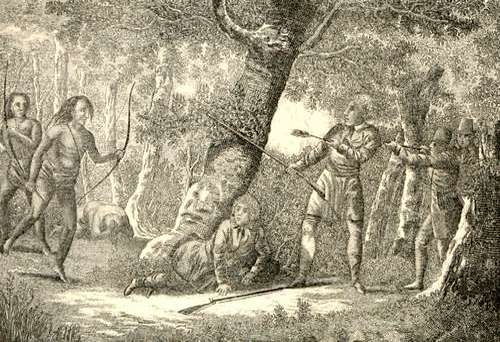
Mr. Pattie wounded by an Indian Arrow
We advanced slowly onward, until the 15th, without meeting any Indians. At day break of this day, our sentinels apprized us, that savages were at hand. We had just time to take shelter behind the trees, when they began to let their arrows fly at us. We returned them the compliment with balls, and at the first shot a number of them fell. They remained firm and continued to pour in their arrows from every side. We began to find it exceedingly difficult to dodge them, though we gave them some rounds before any one of our men was struck. At length one man was pierced, and they rushed forward to scalp him. I darted from behind my tree to prevent them. I was assailed by a perfect shower of arrows, which I dodged for a moment, and was then struck down by an arrow in the hip. Here I should have been instantly killed, had not my companions made a joint fire at the Indians, who were rushing upon me, by which a number of them were laid dead. But the agony of my pain was insupportable, for the arrow was still fast in my hip. A momentary cessation of their arrows enabled me to draw out the arrow from my hip, and to commence re-loading my gun. I had partly accomplished this, when I received another arrow under my right breast, between the bone and the flesh. This gave me less pain than the other shot, and finding I could not by any effort extract the arrow, I snapped it off, and finished loading my gun. The Indian nearest me fell dead, and I hobbled off, glad to be once more sheltered by a tree. My companions were not slow in making their rifles crack, and in raising mutual cheers of encouragement. The Indians were vastly our superiors in numbers, and we found it convenient to slip under the river bank. We were now completely sheltered [117] from their arrows. After we had gained this security, they stood but a few shots more, before they fled, leaving their dead and wounded at our mercy. Truth is, we were too much exasperated to show mercy, and we cut off the heads of all, indiscriminately.
Our loss was one killed, and two wounded, another beside myself though neither of us dangerously. The Indians had 28 killed. Luckily our horses were on an island in the river, or we should have lost every one of them. Our only loss of property was a few blankets, which they took, as they fled by our camp. During the 20 minutes that the contest lasted, I had a fragment of an arrow fast in my breast, and the spike of the other in my hip. I suffered, it may be imagined, excruciating pain, and still severer pain during the operation of extraction. This operation, one of my companions undertook. He was some minutes in effecting it. The spike could not be entirely extracted from my hip, for being of flint, it had shivered against the bone.
The Indians that attacked us, were a tribe of the Muscallaros,91 a very warlike people, although they have no other arms except bows and arrows, which are, however, the most powerful weapons of the kind. They are made of an elastic and flexible wood, backed with the sinews of a buffaloe or elk. Their arrows are made of a species of reed grass, and are very light, though easily broken. In the end is stuck a hard piece of wood, which is pointed by a spike of flint an inch in length, and a quarter of an inch in width, and ground to the sharpest point. The men, though not tall, are admirably formed, with fine features and a bright complexion inclining to yellow. Their dress is a buckskin belt about the loins, with a shirt and moccasins to match. Their long black hair hangs in imbraided masses over their shoulders, in some cases almost extending to the heels. They make a most formidable appearance, when completely painted, and prepared for battle.
On the 16th, having made our arrangements for departure, I applied my father's admirable salve to my two severe wounds, [118] and to my companion's slight wound in the arm, and we both felt able to join our companions in their march. We travelled all this day and the following night a west course, and the following day, without stopping longer than was necessary to take a little food. After this we stopped and rested ourselves and horses all night. I need not attempt to describe the bitter anguish I endured, during this long and uninterrupted ride. It will be only necessary to conceive my situation to form a right conception of it. Our grand object had been to avoid another contest with the Muscallaros. In the evening we fell in with a party of the Nabahoes, who were now out on an expedition against the Muscallaros, who had recently killed one of their people, and against whom they had sworn immediate revenge. We showed the manifest proof of the chastisement they had received from us. Never had I seen such frantic leaps and gestures of joy. The screams and yells of exultation were such as cannot be imagined. It seemed as though a whole bedlam had broke loose. When we told them that we had lost but one man, their screams became more frantic still. Their medicine man was then called, and he produced an emollient poultice, the materials of which I did not know but the effect was that the anguish of our wounds was at once assuaged. By the application of this same remedy, my wounds were quite healed in a fortnight.
The scalps, which some of our number had taken from the Muscallaros, were soon erected on a pole by the Nabahoes. They immediately commenced the fiercest dancing and singing I had yet seen, which continued without interruption three days and nights. During all this time, we endured a sort of worship from them, particularly the women. They were constantly presenting us with their favorite dishes, served in different ways, with dried berries and sweet vegetables, some of which, to people in our condition, were really agreeable.
In size and complexion these people resemble the Muscallaros, and their bows and arrows are similar; though some of the latter have fire arms, and their dress is much superior.—[119] Part of their dress is of the same kind with that of the former, though the skins are dressed in a more workmanlike manner, and they have plenty of blankets of their own manufacturing, and constituting a much better article than that produced by the Spaniards. They dye the wool of different and bright colors, and stripe them with very neat figures. The women are much handsomer, and have lighter complexions than the men. They are rather small in stature, and modest and reserved in their behaviour. Their dress is chiefly composed of skins made up with no small share of taste; and showily corded at the bottom, forming a kind of belt of beads and porcupine quills.—They are altogether the handsomest women I have seen among the red people, and not inferior in appearance to many Spanish women. Their deportment to our people, was a mixture of kindness and respect.
On the 21st, we started back to the river, accompanied by the whole party of Nabahoes, who assured us that they would guard us during the remainder of our hunt. We returned to the river through a beautiful and level country, most of it well timbered and watered. On our return we killed several bears, the talons of which the Indians took for necklaces. On the 26th, we arrived at our battle ground. The view of the bodies of the slain, all torn in pieces by wild beasts, inexpressibly disgusting to us, was equally a spectacle of pleasure to our red friends. We pointed out the grave of our companion. They all walked in solemn procession round it, singing their funeral songs. As they left it, every one left a present on the grave; some an arrow, others meat, moccasins, tobacco, war-feathers, and the like, all articles of value to them. These simple people believe that the spirit of the deceased will have immediate use for them in the life to come. Viewing their offerings in this light, we could not but be affected with these testimonies of kind feeling to a dead stranger. They then gathered up the remains of their slaughtered enemies, threw them in a heap, and cut a great quantity of wood, which they piled over the remains. They then set fire to the wood. We struck our tents, [120] marched about five miles up the river, set our traps, and encamped for the night. But the Nabahoes danced and yelled through the night to so much effect, as to keep all the beavers shut up in their houses, for, having been recently trapped, they were exceedingly cautious.
On the morning of the 27th, we informed them why we had taken no beavers, and during the following night they were perfectly quiet. We marched onward slowly, trapping as we went, until we reached the Spanish settlements on this river. On New Year's eve, January 1st, 1827, the Spaniards of the place gave a fandango, or Spanish ball. All our company were invited to it, and went. We appeared before the Alcalde, clad not unlike our Indian friends; that is to say, we were dressed in deer skin, with leggins, moccasins and hunting shirts, all of this article, with the addition of the customary Indian article of dress around the loins, and this was of red cloth, not an article of which had been washed since we left the Copper Mines. It may be imagined that we did not cut a particular dandy-like figure, among people, many of whom were rich, and would be considered well dressed any where. Notwithstanding this, it is a strong proof of their politeness, that we were civilly treated by the ladies, and had the pleasure of dancing with the handsomest and richest of them. When the ball broke up, it seemed to be expected of us, that we should each escort a lady home, in whose company we passed the night, and we none of us brought charges of severity against our fair companions.
The fandango room was about forty by eighteen or twenty feet, with a brick floor raised four or five feet above the earth. That part of the room in which the ladies sat, was carpetted with carpetting on the benches, for them to sit on. Simple benches were provided for the accommodation of the gentlemen. Four men sang to the music of a violin and guitar. All that chose to dance stood up on the floor, and at the striking up of a certain note of the music, they all commenced clapping their hands. The ladies then advanced, one by one, and stood facing their partners. The dance then changed to a waltz, each [121] man taking his lady rather unceremoniously, and they began to whirl round, keeping true, however, to the music, and increasing the swiftness of their whirling. Many of the movements and figures seemed very easy, though we found they required practise, for we must certainly have made a most laughable appearance in their eyes, in attempting to practise them. Be that as it may, we cut capers with the nimblest, and what we could not say, we managed by squeezes of the hand, and little signs of that sort, and passed the time to a charm.
The village, in which was this ball, is called Perdido, or the lost town, probably from some circumstances in its history. It contains about 500 souls and one church. The bishop was present at this ball, and not only bestowed his worshipful countenance, but danced before the Lord, like David, with all his might. The more general custom of the ladies, as far as I observed, is to sit cross legged on the floor like a tailor. They are considerably addicted to the industry of spinning, but the mode has no resemblance to the spinning of our country. For a wheel, they have a straight stick about a foot long, rounded like the head of a spool. In the middle of the stick is a hole, through which the stick is fastened. Their mode of spinning with this very simple instrument reminded me strongly of the sport of my young days, spinning a top, for they give this spinning affair a twirl, and let it run on until it has lost its communicated motion to impart it anew. This shift for a spinning wheel they call necataro. They manufacture neither cotton nor wool into cloth, and depend altogether on foreign trade for their clothing. The greatest part of this supply comes over land from the United States. On the 2d, we started for San Tepec, through a country generally barren, though abounding in water. We saw plenty of bears, deer and antelope. Some of the first we killed, because we needed their flesh, and others we killed for the same reason that we were often obliged to kill Indians, that is, to mend their rude manners, in fiercely making at us, and to show them that we were not Spaniards, to give them the high sport of seeing us run. We arrived in the above named town [122] on the 5th, and sold our furs. Here I met again some of the companions who came with me in the first instance from the United States. I enquired about others, whom I held in kind remembrance. Some had died by lingering diseases, and others by the fatal ball or arrow, so that out of 116 men, who came from the United States in 1824, there were not more than sixteen alive. Most of the fallen were as true men, and as brave as ever poised a rifle, and yet in these remote and foreign deserts found not even the benefit of a grave, but left their bodies to be torn by the wild beasts, or mangled by the Indians. When I heard the sad roll of the dead called over, and thought how often I had been in equal danger, I felt grateful to my Almighty Benefactor, that I was alive and in health. A strong perception of the danger of such courses as mine, as shown by the death of these men, came over my mind, and I made a kind of resolution, that I would return to my home, and never venture into the woods again. Among the number of my fallen companions, I ought not to forget the original leader of our company, Mr. Pratte, who died in his prime, of a lingering disease, in this place.
On the 10th, I commenced descending the Del Norte for the Copper Mines, in hopes once more to have the pleasure of embracing my father, and relate to him what I had suffered in body and mind, for neglecting to follow his wise and fatherly counsel. I now travelled slowly and by myself, and on the 12th, arrived at the house of my old friend the governor, who met me at his door, and gave me such an embrace, as to start the blood from my scarcely healed wound. I did not perceive at the moment, that his embrace had produced this effect, and entered the house, where I met Jacova, who received me with a partial embrace, and a manner of constrained politeness. She then sat down by me on the sopha, and began asking me many questions about my adventure since we had parted, often observing that I looked indisposed. At length she discovered the blood oozing through my waistcoat. She exclaimed, putting her hand on the wound, 'and good reason you have to look [123] so, for you are wounded to death.' The look that accompanied this remark, I may not describe, for I would not be thought vain, and the stern character of my adventures forbids the intermixture of any thing of an entirely different aspect. I was not long, however, in convincing her that my wound was not really dangerous, and that I owed its present bleeding to the friendship of her father, a cause too flattering to be matter of regret. This drew from me a narrative of the occasion of my wound, which I related in the same simple terms and brief manner in which it is recorded in my journal. A long conversation of questions and replies ensued, of a nature and on subjects not necessary to relate. On the 20th, imploring God that we might meet again, we parted, and I resumed my journey, travelling slowly for my father's residence at the Copper Mines. I paused to rest and amuse myself in several of the small towns on my way. On the 26th, I had the high satisfaction once more to hold the hand of my father, and to find him in health and prosperity, and apparently with nowise abated affection for me, though I had rejected his counsels. This affection seemed to receive a warmer glow, when he heard my determination not to take to the woods again. I then in return wished to make myself acquainted with the true state of his affairs. He had established a vacherie on the river Membry92 where he kept stock. He had also opened a farm on the land which the old Appache chief had given him, which enabled him to raise grain for the use of his own establishment at the mines. He had actually a supply of grain in advance for the next year. He had made similar improvements upon every thing appertaining to the mines. The result of the whole seemed to be, that he was making money rapidly.
He still retained the Spaniard, of whom I have spoken before, as clerk and superintendent, believing him to be a man of real stability and weight of character, and placing the most entire reliance both upon his capacity and integrity. I was less sanguine, and had my doubts, though having seen no decided facts, [124] upon which to ground them, I did not deem myself justified in honor to impart my doubts to my father.
On the 10th of February, my father requested me, on his account, to take a trip to Alopaz, to purchase for his establishment some wine and whiskey, which articles sell at the mines at a dollar and a half a pint. I started with one servant and six pack mules, each having a couple of small barrels fastened over their saddles, after the manner of our panniers. On the 16th, I reached the place, and purchased my cargo, but the weather was so inclement, that I thought it best not to return until it softened. I became acquainted with an American, married in this place. He was by pursuit a gunsmith, and had been up the upper Missouri with Col. Henry,93 and an old and noted trader on that river. The mutual story of what we two had seen and suffered, would probably appear incredible, and beyond the common order of things, to most people, except those who have hunted and trapped in the western parts of this continent, among the mountains and savages, and has nothing upon which to depend, but his own firmness of heart, the defence of his rifle, and the protection of the all present God. To such persons, the incidents which we mutually related, would all seem natural.
I remained here until the 1st of April. Spring in its peculiar splendor and glory in this country, had now wakened the fields and forests into life, and was extending its empire of verdure and flowers higher and higher up the mountains towards their snowy peaks. On this day I commenced my journey of return to the mines, with my servant and my cargo bestowed on my mules. Though the face of the country was all life and beauty, the roads so recently thawed, were exceedingly muddy and heavy. One of my mules in consequence gave out the second day. My servant packed the load of the tired mule upon his riding one, and walked on foot the remainder of the day. During the day we discovered fresh bear tracks in the wood, and my servant advised me to have my gun loaded. At this remark I put my hand in my shot pouch, and found but a single ball, and [125] no lead with which to make more. At this discovery I saw at once the uselessness of self reproach of my own carelessness and neglect, though it will be easily imagined, what anxiety it created, aware that I had to travel through a long and dreary wilderness, replenished with grizzly bears and hostile Indians. Neither did I dare disclose a particle of what was passing in my mind to my servant, through fear that he would be discouraged, in which case, I knew his first step would be to turn back, and leave me to make the journey alone. It would have been impossible for me to do this, as we were both scarcely able to arrange the affairs of the journey. We advanced cautiously and were unmolested through the day. But I passed a most uncomfortable night through fear of the bears, which, thawed out, were emerging from their winter dens with appetites rendered ravenous by their long winter fast. We and our mules would have furnished them a delicious feast, after the hunger of months. No sleep visited my eyes that night.
At ten o'clock of the 3d, we met a Spaniard on horse back. I accosted him in the usual terms, and asked if he had met any Indians on his way? He answered that he had, and that there was a body of friendly Appaches encamped near the road, at a distance of a little more than a league. I was delighted with this information, for I supposed I should be able to purchase a horse of them, on which I might mount my servant. While I was reflecting on this thought, my servant proposed to purchase his horse, and offered him a blanket in exchange. He instantly dismounted, took the blanket, and handed over the horse. Happy to see the poor fellow once more comfortably mounted, we bade the easy Spaniard adieu, and gaily resumed our journey. In a short time, according to his information, we saw the Indian camp near the road, from which their smokes were visible. We were solicitous to pass them unobserved and pushed on towards a stopping place, which we might reach at twelve o'clock. Here we stopped to enable our horses to rest, and eat, for the grass was fine. I ordered my servant to spancel the mules, and tether the horse to a shrub by a long rope. [126] My gun reclined upon the packs. We ate a little ourselves, and afterwards I spread my blanket on the grass, close by the horses, and lay down to repose myself, though not intending to go to sleep. But the bright beams of the sun fell upon me in the midst of the green solitude, and I was soon in a profound sleep. A large straw hat on the side of my face shaded my head from the sun.
While enjoying this profound sleep, four of the Appaches came in pursuit of us. It seems our Spaniard had stolen his horse from them, a few hours before. They came upon us in possession of the horse, and supposed me the thief. One of them rode close to me, and made a dart at me with his spear. The stroke was aimed at my neck, and passed through my hat, nailing it to the ground just back of my neck, which the cold steel barely touched. It awakened me, and I sprang to my feet. Four Indians on horse back were around me, and the spear, which had been darted at me, still nailed my hat to the ground. I immediately seized the spear and elevated it towards the Indian, who in turn made his horse spring out of my reach. I called my servant, who had seen the Indians approaching me, and had hidden himself in the bushes. I then sprang to my gun, at the distance of ten or fifteen paces. When I had reached and cocked it, I presented it at an Indian who was unsheathing his fusil. As soon as he discovered my piece elevated, he threw himself from his horse, fell on his knees, and called for mercy. What surprized me, and arrested my fire, was to hear him call me by my Christian name. I returned my rifle to my shoulder and asked him who he was? He asked me, if I did not know Targuarcha? He smote his breast as he asked the question. The name was familiar. The others dismounted, and gathered round. An understanding ensued. When they learned the manner in which we came by the horse, their countenances were expressive of real sorrow. They had supposed me a Spaniard, as they said, and the thief of their horse. They begged me not to be angry, with a laughable solicitude, offering me the horse as the price of friendship. Above all, they were [127] anxious that I should not relate the affair to my father. They seemed to have an awe of him, resembling that due to the Supreme Being. This awe he had maintained by his steady deportment, and keeping up in their minds the impression, that he always had a large army at command, and was able, and disposed at the first insult, or breach of the treaty on their part, to bring it upon them to their utter destruction.
To all their apologies and kind words and excuses, I answered that I knew them as well as any other man, and that they were not to expect to atone for a dastardly attempt to take my life, and coming within a hair's breadth of taking it, by offering me a present, that I believed that they knew who I was, and only wanted an opportunity, when they could steal upon me unarmed, and kill me, as they had probably committed many other similar murders; that they were ready enough to cry pardon, as soon as they saw me handling my rifle, hoping to catch me asleep again, but that they would henceforward be sure to find me on my guard.
At this the Indian who had darted the spear at me, exclaimed that he loved me as a brother, and would at any occasion risk his life in my defence. I then distinctly recollected him, and that I had been two months with the band, to which he belonged, roving in the woods about the mines. Targuarcha had shown a singular kind of attachment to me, waiting upon me as if I had been his master. I was perfectly convinced that he had thrust his spear at me in absolute ignorance, that it was me. Still I thought it necessary to instil a lesson of caution into them, not to kill any one for an imagined enemy, until they were sure that he was guilty of the supposed wrong. Consequently I dissembled distrust, and told him, that it looked very little like friendship, to dart a spear at the neck of a sleeping man, and that to tell the plain truth, I had as little confidence in him, as a white bear. At this charge of treachery, he came close to me, and looking affectionately in my face, exclaimed in Spanish, 'if you think me such a traitor, kill me. Here is my breast. Shoot.' At the same time he bared his breast with his hand, with such a [128] profound expression of sorrow in his countenance, as no one was ever yet able to dissemble. I was softened to pity, and told him that I sincerely forgave him, and that I would henceforward consider him my friend, and not inform my father what he had done. They all promised that they would never attempt to kill any one again, until they knew who it was, and were certain that he was guilty of the crime charged upon him. Here we all shook hands, and perfect confidence was restored.
I now called again for my servant, and after calling till I was hoarse, he at length crawled from behind the bushes, like a frightened turkey or deer, and looking wild with terror. He had the satisfaction of being heartily laughed at, as a person who had deserted his master in the moment of peril. They are not a people to spare the feelings of any one who proves himself a coward by deserting his place. They bestowed that term upon him without mercy. All his reply was, sullenly to set himself to packing his mules.
Now arose a friendly controversy about the horse, they insisting that I should take it, as the price of our renewed friendship, and I, that I would not take it, except on hire or purchase. They were obstinate in persisting that I should take the horse along with me, and finally promised if I would consent, that they would return to camp and bring their families, and escort me to the mines. To this I consented, though I had first taken the precaution to procure some rifle balls of them. We then resumed our journey, and travelled on without incident till the 5th, when they overtook us, and we travelled on very amicably together, until we reached the Membry, which runs a south course, and is lost in a wide arid plain, after winding its way through prodigious high, craggy mountains. It affords neither fish nor beavers, but has wide and rich bottoms, of which as I have mentioned, they gave my father as much as he chose to cultivate.
From the point where the road crosses this river to the mines, is reckoned 15 miles. Here we met the chief of this band of the Appaches, with a great number of his people. They were [129] all delighted to see us, and not the less so, when they discovered that we had spirituous liquors, of which they are fond to distraction. There was no evading the importunities of the chief to stay all night with him, he promising, if I would that he would go in next day with me to my father. I had scarcely arrived an hour, when I saw the Indian, that had darted his spear at me, come to the chief with shirt laid aside, and his back bare. He handed the chief a stout switch, asking him to whip him. The chief immediately flayed away about 50 lashes, the blood showing at every stroke. He then asked me, if the thing had been done to my satisfaction? I told him that I had no satisfaction to demand. The chief who had whipped him, was positively ignorant of the crime, for which he had suffered this infliction. But he said, when one of his men begged a flogging, he took it for granted, that it was not for the good deeds of the sufferer, and that he deserved it. When I learned that it was a voluntary penance for his offence to me on the road, I felt really sorry, and made him a present of a quart of whiskey, as an internal unction for the smart of his stripes, a medicine in high esteem among the Indians in such cases.
When we arrived at the mines, the old chief enquired what had been done to me on the road? As soon as he was informed, he sprang up, tore his hair, and seized a gun to shoot the poor culprit. I interposed between them, and convinced him, that Targuarcha had not been really to blame in any thing but his haste, and that if I had really been the thief, he would have done right to kill me, and get back his horse, and that not even my father would have thought the worse of him, but that we should both now like him better, as well as his people, for what had happened.
On the 15th, my father proposed to give me a sum of money, with which to go into the United States to purchase goods for the mines. The laborers much preferred goods, at the customary rate, to money, and the profit at that rate was at least 200 per cent on the cost. I was reluctant to do this, for my thoughts still detained me in that country. It was then concluded to [130] send the before mentioned Spanish clerk on the commission, with sufficient money to pay for the goods, consigned to merchants in Santa Fe, to be purchased there, provided a sufficient quantity had recently arrived from the United States to furnish an assortment, and if not, he was recommended to merchants in St. Louis, to make the purchases there.
On the 18th, he started under these orders, under the additional one, that on his arriving at Santa Fe, and learning the state of things there, he should immediately write to the mines to that effect. In the customary order of things, this letter was to be expected in one month from the day he left the mines. After he was departed, he left none behind to doubt his truth and honor, nor was there the least suspicion of him, until the time had elapsed without a letter. A dim surmise began then to grow up, that he had run off with the money. We were still anxiously waiting for intelligence. During this interval I had occupied the place of clerk in his stead. It was now insisted that I should go in search of the villain, who had obtained a good start of a month ahead of us, and 30,000 dollars value in gold bullion to expedite his journey. On the 20th, I started in the search, which I confess seemed hopeless, for he was a man of infinite ingenuity, who could enact Spaniard, which he really was, or Russian, Frenchman or Englishman, as he spoke the languages of these people with fluency. Still I pushed on with full purpose to make diligent and unsparing search.
On the 30th, I arrived at Santa Fe. I made the most anxious and careful enquiry for him, and gave the most accurate descriptions of him there. But no one had seen or heard of such a person. I sorrowfully retraced my steps down the Rio del Norte, now without a doubt of his treachery, and bitterly reflecting on myself for my heedless regard of my father's request. Had I done it, we had both secured an affluence. Now I clearly foresaw poverty and misfortune opening before us in the future. For myself I felt little, as I was young and the world before me; and I felt secure about taking care of myself. [131] My grief was for my father and his companions, who had toiled night and day with unwearied assiduity, to accumulate something for their dear and helpless families, whom they had left in Missouri; and for the love of whom they had ventured into this rough and unsettled country, full of thieves and murderers. My father in particular, had left a large and motherless family, at a time of life to be wholly unable to take care of themselves, and altogether dependent on him for subsistence. There is no misery like self condemnation; and I suffered it in all its bitterness. The reflections that followed upon learning the full extent of the disaster, which I could but charge in some sense upon myself, came, as such reflections generally come, too late.
I arrived at the Passo del Norte on the 10th of May, and repeated the same descriptions and enquiries to no purpose.—Not a trace remained of him here; and I almost concluded to abandon the search in despair. I could imagine but one more chance. The owner of the mines lived at Chihuahua. As a forlorn hope I concluded to proceed to that city, and inform the governor of our misfortune. So I pushed to Chihuahua, where I arrived on the 23d.
I found the owner of the mines in too much anxiety and grief of mind on his own account, to be cool enough to listen [to] the concerns of others. The President of the Mexican republic had issued orders, that all Spaniards born in old Spain, should be expelled from the Mexican country, giving them but a month's notice, in which to settle their affairs and dispose of their property. He being one of that class, had enough to think of on his own account. However, when he heard of our misfortune, he appeared to be concerned. He then touched upon the critical state of his own affairs. Among other things, he said he had all along hoped that my father was able and disposed to purchase those mines. He had, therefore, a motive personal to himself, to make him regret my father's loss and inability to make the purchase. He was now obliged to sell them at any sacrifice, and had but a very short time in which to settle his [132] affairs, and leave the country. He requested me to be ready to start the next day in company with him to the mines.
Early on the 24th, we started with relays of horses and mules. As we travelled very rapidly we arrived at the mines on the 30th, where I found my father and his companions in the utmost anxiety to learn something what had happened to me. When they discovered the owner of the mines, whose name was Don Francisco Pablo de Lagera, they came forth in a body with countenances full of joy. That joy was changed to sadness, as soon as Don Pablo informed them the object of his visit. They perceived in a moment, that nothing now remained for them but to settle their affairs, and search for other situations in the country, or return to the United States in a worse condition than when they left it. My father determined at once not to think of this. Nothing seemed so feasible, and conformable to his pursuits, as a trapping expedition. With the pittance that remained to him, after all demands against the firm were discharged, and the residue according to the articles of agreement divided, he purchased trapping equipments for four persons, himself included. The other three he intended to hire to trap for him.
On the 1st of July, all these matters had been arranged, and my father and myself started for Santa Fe, with a view to join the first company that should start on a trapping expedition from that place. On the 10th, we arrived at Santa Fe, where we remained until the 22d, when a company of thirty men were about to commence an expedition of that sort down Red river. My father joined this company, and in the name of the companions made application for license of safe transit through the province of Chihuahua, and Sonora, through which runs the Red river, on which we meant to trap. The governor gave us a passport in the following terms:
[133] Custom House of the frontier town of Santa Fe, in the territory of New Mexico.
Custom House Certificate.
Allow Sylvester Pattie, to pursue his journey with certain beasts, merchandize and money, in the direction of Chihuahua and Sonora; to enter in beasts and money an amount equal to this invoice, in whatsoever place he shall appear, according to the rules of the Custom House, on his passage; and finally let him return this permit to the government of this city in days. Do this under the established penalties.
Given at Santa Fe, in New Mexico.
RAMON ATTREN
September 22d, 1827.
On the 23d, my father was chosen captain or commander of the company, and we started on our expedition. We retraced our steps down the del Norte, and by the mines to the river Helay, on which we arrived on the 6th of October, and began to descend it, setting our traps as we went, near our camp, whenever we saw signs of beavers. But our stay on this stream was short, for it had been trapped so often, that there were but few beavers remaining, and those few were exceedingly shy. We therefore pushed on to some place where they might be more abundant, and less shy. We left this river on the 12th, and on the 15th reached Beaver river. Here we found them in considerable numbers, and we concluded to proceed in a south course, and trap the river in its downward course. But to prevent the disagreement and insubordination which are apt to spring up in these associations, my father drew articles of agreement, purporting that we should trap in partnership, and that the first one who should show an open purpose to separate from the company, or desert it, should be shot dead; and that if any one should disobey orders, he should be tried by a jury of our number, and if found guilty should be fined fifty dollars, to be paid in fur. To this instrument we all agreed, and signed our names.
[134] The necessity of some such compact had been abundantly discovered in the course of our experience. Men bound only by their own will and sense of right, to the duties of such a sort of partnership are certain to grow restless, and to form smaller clans, disposed to dislike and separate from each other, in parties of one by one to three by three. They thus expose themselves to be cut up in detail by the savages, who comprehend all their movements, and are ever watchful for an opportunity to show their hatred of the whites to be fixed and inextinguishable. The following are some of the more common causes of separation: Men of incompatible tempers and habits are brought together; and such expeditions call out innumerable occasions to try this disagreement of character. Men, hungry, naked, fatigued, and in constant jeopardy, are apt to be ill-tempered, especially when they arrive at camp, and instead of being allowed to throw themselves on the ground, and sleep, have hard duties of cooking, and keeping guard, and making breast-works assigned them. But the grand difficulty is the following. In a considerable company, half its numbers can catch as many beavers as all. But the half that keep guard, and cook, perform duties as necessary and important to the whole concern, as the others. It always happens too, in these expeditions, that there are some infinitely more dextrous and skilful in trapping and hunting than others. These capabilities are soon brought to light. The expert know each other, and feel a certain superiority over the inexpert. They know that three or four such, by themselves, will take as many beavers as a promiscuous company of thirty, and in fact, all that a stream affords. A perception of their own comparative importance, a keen sense of self interest, which sharpens in the desert, the mere love of roving in the wild license of the forest, and a capacity to become hardened by these scenes to a perfect callousness to all fear and sense of danger, until it actually comes; such passions are sufficient to thicken causes of separation among such companions in the events of every day.
Sad experience has made me acquainted with all these causes [135] of disunion and dissolution of such companies. I have learned them by wounds and sufferings, by toil and danger of every sort, by wandering about in the wild and desolate mountains, alone and half starved, merely because two or three bad men had divided our company, strong and sufficient to themselves in union, but miserable, and exposed to almost certain ruin in separation. Made painfully acquainted with all these facts by experience, my father adopted this expedient in the hope that it would be something like a remedy for them.
But notwithstanding this, and the prudence and energy of my father's character, disunion soon began to spring up in our small party. Almost on the outset of our expedition, we began to suffer greatly for want of provisions. We were first compelled to kill and eat our dogs, and then six of our horses. This to me was the most cruel task of all. To think of waiting for the night to kill and eat the poor horse that had borne us over deserts and mountains, as hungry as ourselves, and strongly and faithfully attached to us, was no easy task to the heart of a Kentucky hunter. One evening, after a hard day's travel, my saddle horse was selected by lot to be killed. The poor animal stood saddled and bridled before us, and it fell to my lot to kill it. I loved this horse, and he seemed to have an equal attachment for me. He was remarkably kind to travel, and easy to ride, and spirited too. When he stood tied in camp among the rest, if I came any where near him, he would fall neighing for me. When I held up the bridle towards him, I could see consent and good will in his eye. As I raised my gun to my face, all these recollections rushed to my thoughts. My pulses throbbed, and my eyes grew dim. The animal was gazing at me, with a look of steady kindness, in the face. My head whirled, and was dizzy, and my gun fell. After a moment for recovery, I offered a beaver skin to any one who would shoot him down. One was soon found at this price, and my horse fell! It so happened that this was the last horse we killed. Well was it for us that we had these surplus horses. Had it been otherwise, we should all have perished with hunger.