Front matter (continued 3)
Reading edition
XV.
In the long-range scanner, the Loard-vogh fleet were but shapeless blobs. In the past hours, they had become detectable, and now were spreading out as the terrific velocity of the Terran fleet dropped down upon them.
"Now?" asked Downing.
"Better wait another minute," suggested Cliff.
"O.K. The judgment of when is best is tough, sometimes."
"Better we should blitz eight or nine of them for sure than to try and get fifteen but miss all but six. And don't forget that we're in the lead. The boys in back will have more time to spread out and get the outlying ships."
"I'd like to stay running free as long as I can," said Stellor.
"It makes us just that harder to detect when we are not radiating," agreed Lane. "Too bad we can't run right on through this way."
"Yeah, but we've got to use echo-ranging for the ordnance directors. We can't just use their radiation as a means. And if we use echo-ranging, that means squirting out the prime signal. That means detection anyway, and we might as well use power, too."
"What's our speed?"
"Point seven nine light."
"Fast enough," grunted Downing. "O.K., let 'em have it!"
At seventy-nine percent of the speed of light, the free-running ships came to life. The drivers went to work at the same time that the first pulse from the ordnance directors went out. The turrets, already trained by hand, moved only seconds of arc to correct for speed, when the pulse-echo returned with the data. And with the return of the second echo, reducing the error, the projectors belched energy.
In the Loard-vogh, detectors screamed and flared. Turrets, directed at random or stowed for travel, whipped around, the projectors rising in elevation. Defensive equipment went to work—but not soon enough.
For a dymodine crossing a dymodine will stop both, but they must be operating simultaneously. The Terran ships fired first, and they hit.
The sky had been serene. There was the star, blazing as a sun should blaze, the only thing in view against a stellar curtain. The ships of both fleets were black, and minutely invisible against the sky. The planets of this star were as much a part of the stellar backdrop as any planets are, even on Earth, and the appearance was just that of a very distant disk, half-dollar size, blinding white, poised against a vast, never ending wall of twinkling points.
Thirty seconds later, man had passed through—and left his mark.
Dymodines flashed incandescent spots that erupted in flaming gases. Snatchers sliced backbone from the ships of the Loard-vogh and they crumpled; some exploding. Three atomic sphere projectors found their mark and three of the Loard-vogh blasted themselves to bits, leaving only expanding masses and hard radiation—against the sky were moving flecks of death; the Universe was spreckled with novae that spread as they were watched.
Death, silent and unspectacular from a distance, struck.
And the Terran ships were through the Loard-vogh fleet and gone.
But not unscathed. Trailing lines of whispy, incandescent vapor from their intrinsic velocity, nine Terran ships traced their lives across the sky.
"Made it! Call base and tell 'em," said Downing.
The connection was already established. "Thompson? We got twenty-two. Thirteen definites and nine more-than-probables. Seven with light damage. Lost nine."
"Good, Stellor. Now don't try it again. They're wise and they'll clean you out."
"I'd like to take my chance on one more run."
"Don't do it. You'll be cleaned."
"But they'll make a base here."
"They'll make it anyway. How's their numbers?"
"Terrific. They've got everything."
Thompson grunted. "I'm not surprised. After all, they have a quarter of the Galaxy full of them, and even though slave labor isn't the best, a planet full of slaves is better than half a planet of free men if you accept that a slave is fifty percent efficient."
"I'm beginning to see futility ahead," said Lane.
"Well, don't. Terra has a secret weapon that will win for us, you know."
"I know, but you can't swing it yet. It's the waiting and the back-breaking fight that must come first."
"Too bad we can't just let 'em roar in close enough to use it all at once."
"Wouldn't work. We've got to wait until the psychological moment. Then—we'll swing it."
"O.K., now what?"
"Don't toss away any more ships. Not right now. Let the Loard-vogh establish their base," explained Billy. "We can't stop 'em anyway. Let them come on in. I want them close enough so we can get at them without having to go all the way out to get them." He thought a moment. "Tell your boys not to use the atomic sphere any more than necessary. You know why."
"We got a few with it."
"All right," answered Thompson. "At that time it was expedient. We had to dent them to make them cautious."
Lane said: "I don't see why we just don't let 'em roar on in close and then use Plan One on them."
"Wouldn't work that way. They are too numerous. Before Plan One is efficient, we must give them a tough fight. Otherwise they will not understand that we mean business. We'll win only after we convince the Loard-vogh that we are worthy opponents in their own type of fighting. Otherwise they will wipe us out by sheer weight of numbers despite Plan One."
"I know," grumbled Lane. "We've been through all that."
"Well, then you know that Plan One will work only after a certain number of them have reason to fear our arms."
"O.K., Billy, we're coming in."
"No—not yet. Head in for Procyon IV and wait for them there. Give them as good a fight as you can."
Inward swept the grand fleet of the Loard-vogh. The other six planets of Procyon were push-overs; the Loard-vogh hit the planetary defenses, knocked them down by outnumbering them, and landed. The colonial population headed for the hills and hid out. And as the mop-up squads beat the bush, many of them did not come back. Yet it was futility, for Vorgan's vicious minions held the planets eventually.
But on Procyon IV, they had trouble.
The fleet came down in a multiple line and encircled IV. Terran forces fought back.
Up-shooting beams crossed with the Loard-vogh weapons and made the air a seething hell. Snatchers ripped the bellies out of ships, and from the ships there came answering snatchers that gouged spheroidal chunks out of the planet along with the projector crews and hurled them aside.
Nuisance weapons—air torpedoes and space mines—floated freely and exploded, filling the air with flying slabs of metal.
And then forty of the finest made a landing. They forced their way to the defended surface, scoured the ground beneath them with a solid curtain of energy, and scarred the countryside until nothing was left to stop them. They landed, set up a vast circle, and into the center of the circle there poured a constant stream of Loard-vogh transports.
"All right!" barked Lane. "Get the heavies over!"
"Heavies on the way!"
"And bring up the atomic spheres."
Twenty of the atomic sphere projectors came zooming over, suspended on tractors. They dropped on the circle and the tractors anchored them to the solid core of IV.
The paraboloids swung over and gouged pieces out of the center of the Loard-vogh camp and let them blast loose with their atomic fire. The Loard-vogh died like flies under the terrible energy—and like flies they came on, replacing those gone.
The air above the camp was seething. The ground below bubbled molten in spots. The periphery was a raving, solid mass of sheer energy. The bubble between the Loard-vogh forces and the Terrans was shimmering energy that pulsated in and out like the beating of an irregular heart.
And in spite of the utter madness of trying to enter that holocaust, the Loard-vogh poured in. One man made the safety of the inner shields to every hundred that came, and that one in a hundred multiplied, added to those already there, until the shell of murderous energy swelled of its own incompressible contents of Loard-vogh material and men.
The shell expanded, moved outward against the fire. The atomic spheres moved backwards, and as they moved they were silent. The Loard-vogh took advantage of the silence to shove farther. A salient fingered out—
"Cut it!" snapped Downing.
"With what?" asked Hayes, the commander.
"Drive in there—they're cutting off projector seven."
The salient swept out, forcing Terran arms back. It curved around, swept back, and had Number Seven within the loop. The pocket closed and the bitterly contested area was a wide bulge on the edge of a circle.
Another landing took place.
And another, not more than a mile away.
And then across the plains of Planet IV, of Procyon, there rolled endless, countless mile after mile of ground equipment. The heavy portables started to hurl their might as soon as they came in sight, and the Terrans were pinched.
Pinched between an embattled circle and a closing circle. The inner circle expanded, the outer circle contracted.
Downing's ship roared into the concentric fire, its turrets whipping back and forth and spitting sheer energy. Behind him there sped the twenty-four ships of his command. Into the holocaust they drove, piercing the Loard-vogh line momentarily. The hole widened briefly, and then closed down behind them. Englobed, the flight pressed close together and fought outward.
It was stalemate—and yet nine of them dropped as inert, flaming masses.
"Enough!" called Stellor. "Back!"
And his flight formed, was forced apart, and reformed. They drove for the inside again and ran up against a solid wall of ships.
Downing's flight dwindled. Pressing close, the Loard-vogh fired their torrents of energy into Downing's ships at projector-burst range. One by one the ships flamed and went down in a smoke-trailing comet.
"Help?" snapped Lane over the sub-communicator.
"Stay out—" started Downing. He was cut off as his command burst into flaming, violent death.
Thompson's voice came over the interstellar band. "Better retreat now," he said.
Lane answered. Here in the scanning-ship, the torrent of energy and deafening sound was gone, and only peaceful quiet reigned. Save for the constantly swirling fire in the battle plotter globes and the everlasting flicker of pilot lights, there was no evidence of the swift, concentrated hell that went on in the space between spheres that approached one another.
"Downing tried it," he said.
"Get many?"
"Swapped his entire twenty-five for forty-one of the Loard-vogh before they got him."
"Not at all bad," answered Thompson.
"I'd like to try it—?"
"Nope. Better collect Downing and the rest and haul tail for Terra. We're about due for the big show."
"Downing is—"
"Back," answered Stellor, opening the door. "I'm sorry to be late, fellas. They asked me about the fight out there in the hall and I stopped to chat. I didn't know you were on the line, Billy."
"Well, how was the fight?"
"Fierce. I'd hate to get into one like that, for real. Billy, will the personnel snatcher save enough of our men to lick them?"
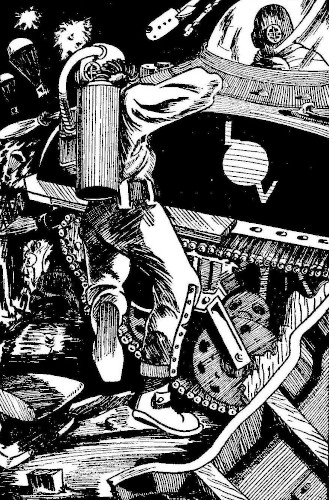
"Saving every man aboard a doomed ship at the moment of destruction with the individual snatcher globes is a good way of not losing a man," explained Billy. "But it doesn't save materiel. They've got both, in plenty. We'll have to fall back on the secret."
"But when?" asked Lane.
"When the time is ripe. And not one moment before."
Thompson rang off. And then with a concentrated effort, the Solarian forces drove upward in a piercing needle of ships. They broke through, not without loss, and made their escape into the sky. When they landed on Terra, every ship was crammed to discomfort with men from stricken ships—literally snatched from the jaws of death with the personnel snatcher.
In numbers enough to take a whole planet, the Loard-vogh landed on Umbriel and overran it in an hour. Inward they swept to Titan and the Saturnian colonies. Inward they came to overrun Callisto and Ganymede.
Downward they dropped to Phobos and Deimos, where they set up vast projectors and hurled the attack upon Mars. Simultaneously they fell upon Venus—a monstrous horde of ships. Systematically they went through the Evening Star taking area after area, and they held Mars in their grip at the same time that Venus fell to their hordes.
"God—their numbers," groaned Cliff Lane. "I'd hoped that they might find it tough to hold everything and still hurl fresh equipment into Sol."
"They are numberless," said Hotang Lu.
The Loard-vogh swept into Terra.
Terra, the home of man. Terra, the mighty. Terra, defended as few planets were defended against the legions of Vorgan, Lord of All.
Despite the humans on Venus and Mars, they were still colonies compared to the home planet. Knowing that massed energy might hold out, all Solar defenses had been moved to Terra. Let Terra hold out and eventually mankind would recover, expand, and then drive the enemy back.
And when the Loard-vogh came to Terra, they found it defended against them.
Nowhere on Terra was there a place to land in safety. They took dead Luna easily and hurried to set up a long-range beam. Atomic spheres of unheard-of size reached upward from Terra and Luna sparkled with mighty atomic storms. Whole detachments of the Loard-vogh flamed into incandescence as the super-atomics bit fifty-foot spheres out of the face of Luna, compressed the matter itself, and let it explode.
They made a landing in Siberia and the encampment burst with a roar that shook the earth.
Overhead they roared, raining down energy that never reached through the upthrust beams. The cities were fortresses that hurled power into the sky, and though the shattered wrecks of the Loard-vogh dropped like rain, none of them reached Earth in large enough pieces to do any damage. The air took on a metallic smell, and ozone fixed out as the stratosphere shimmered in the grip of a torrent of energy beams that crossed and nullified one another.
Across the face of Terra, the high-power transmission beams hurled energy back and forth. Energy to feed the projectors that fenced with the ships of the Loard-vogh. Beams that ran on sublevel energy and could not be cut.
In the master room, there was a huge globe, wired with multicolored lights. And as the battle swept back and forth over the face of Terra, the lights changed from dark red to violet, depending upon the power drain of that district. Master technicians, making lightning calculations in a mathematical medium adapted for power work, viewed the globe and pressed buttons that hurled relay-impulses across Terra to switch and divert power for the needy locations. Their hope was to maintain a medium red all over instead of bright violet here and almost-black red there.
The Mongolian sector flamed violet after the Siberian attempt was made. Power was switched from Africa, raising the dark continent higher into the red and lowering the dangerous violet of the Mongolian sector. A sortie hit Africa, and the area pulsed briefly into the yellow and died before the technician could hit his button.
North America caught it next, and power came from Antarctica to drive the invaders away. The Mongolian effort stopped and the map died into black. The extra power went into North America and it became a less dangerous color.
And then the Panamanian district flared up. Into the violet it went, and the switches flew to drive power into the isthmus. Spreckled all over the globe were minor flarings, and they all increased as the Panama Zone took more and more power and still crept upward and upward.
It was all very much like a game of chess here in Terra's Master Power Distribution Center. But on Panama, another scene was taking place.
Four thousand of the Loard-vogh dropped to ground, driven by sheer power and as they landed, they anchored themselves to the crust of Terra.
A super-atomic reached over and its sphere of energy clutched—another atomic sphere.
Their inflexible beams strained against one another. Wrestling in subelectronic space, pulling and straining against one another. The crust of Terra groaned and the fault-lines rubbed and heaved. The inflexible beams pulled, trying to up-root the other—and both were anchored to the crust of the planet.
Luckily, the beams broke before the very surface of Terra gave. The backlash shook Terra to the core and the tidal waves lashed out against the shorelines. The ground shook, and the resulting quakes did what the Loard-vogh had not been able to do. The quakes shook earthly damage into the cities of Terra.
The energy continued to pour into the Loard-vogh planethead. The air shimmered and burst away from the hemisphere of terror, and the resulting convections drew fresh air in to be heated to almost-incandescence and driven upward.
Hotang Lu faced Billy Thompson bitterly. "This secret weapon of yours," he demanded, "it was to win for us?"
"It is," said Billy.
"IS? Is it not time that it be used? The Loard-vogh are upon the planet itself. Death looks us in the face."
"It is not yet time."
"Once before you were under their control," said Hotang Lu sharply. "Your actions now—and for the past weeks of terror—lead me to believe you are again."
"I am not."
"And who can prove it?" argued Hotang Lu.
Kennebec shook his head. "He is the one who might prove it—if you cannot trust him, who can be trusted?"
"For this, Toralen Ki died," said Hotang Lu bitterly. "My friend—dead! He died in the hope that this very thing would not happen. He met death quickly, even argued with you for the chance. A friend walked into the valley of the shadow for Terra, and Terra sits by and spits on his life by doing nothing. I would—"
"Stop it," snarled Billy Thompson. "You and your ideas. You simple fools. To think that you believed that one small system could come up ten thousand years of evolution in a year and beat a quarter of the Galaxy! I'm fighting your battle, and yet I curse you all! Have you ever stopped to think that if it were not for you and Toralen Ki, we would not be in this killing battle? To die for an ideal is all right. Toralen Ki died happy, at least! He believed that he had done his part, and no more could he do. Fine! The Loard-vogh would have ignored us for another three thousand years if you had not come here and stirred us up. Now we reap the seed of your foolishness.
"Terra writhes under the energies poured out by more ships than we have men! Gone and lost are our hopes, and our peaceful future. Our secret weapon? Our secret weapon will be successful—and from then on Terra must ever be alert and on guard. Think you the Loard-vogh will bow to us? Our secret weapon must be used from now on, every day, every minute of every day from the time we unleash it to the end of eternity.
"And if you hadn't stirred us to it, peace would reign on Terra for another three thousand years."
Hotang Lu stepped back a pace, but faced the angry Terran firmly. "And your children's children, three thousand years removed would have this fight to make."
"So what? Does that bother me? Can I grow anxious over the certain knowledge that the Universe may end ten to fifty years from now? Who can predict? Perhaps three thousand years more of evolution and science would bring forth a weapon far superior to their best. And if we remained in mental ignorance, well—is the worm unhappy? Does the beetle miss the trappings of civilization? Does the ant know of Earth moving machinery? Does the bee employ electricity?
"So we fight another race's lost battle for them, brought about by them, hurled upon our shoulders by them, and you, their representative, question my motives. The secret weapon will be unleashed in time."
"Be careful lest you cut the line too fine," warned Hotang Lu. "You are my mental superior in capability, but not in training."
"Showing the fallacy of your actions," snapped Thompson. "Had you been wiser, you would have known that the untrained ability to be a genius is less important than a normal man working at high intensity. Question your own judgment, Hotang Lu. And worry—in retrospect!"
XVI.
The Loard-vogh expanded their sphere. And like the attack upon Procyon IV, another globe of Loard-vogh dropped upon the planet. The power distribution center fought against itself and sapped power dangerously to drive off this new invasion.
A third invasion turned the trick. Power distribution failed; fell apart despite attempts to hold the network together.
"Your secret!" screamed Hotang Lu to Thompson.
Billy shook his head. "It is not yet time."
The Tlemban appealed to Kennebec.
The Co-ordinator of the Solar Combine agreed with Billy. "You still do not understand," he told Hotang Lu.
He faced Lane and Downing. "They will conquer us!"
Lane spoke for the pair of them. "You needn't appeal to us. I had partial foresight before—you said so. He had the ability to make lightning plans." He turned to Downing. "Or was it the other way around?"
"No matter," answered Stellor Downing. "Foresight is no good when planning is a part of the psyche. Instinctive and impetuous action do not match well with a planning nature. Since the transformation, we have both been slower—and quite bewildered, most of the time. No, Hotang Lu, all you can get from us is resentment over losing our ability to lead. Now, we no longer decide anything for ourselves. We cannot make up our minds."
Hotang Lu went to Patricia. "And you?"
"I am not a ruling voice."
"Prevail upon them."
"It is not my place. Besides, you do not understand."
"I understand this!" exploded Hotang Lu. "You are invaded. You will be conquered. You will join the slaves of the Loard-vogh. They will strip you from your homes and make you work for them. You will be driven and killed, for they have no compassion. They have no need of frugality in slaves. Terra will die."
"It is not yet time."
"Your judgment is faulty!" shouted Hotang Lu.
He hurled himself from the house and into his tiny spacecraft. He paused for only an instant to view the grave of Toralen Ki on the broad green lawn, and then he drove upward in superdrive. His size and his speed got him through, and Hotang Lu headed for Tlembo—alone and a beaten man.
Lindoo picked up the communicator and spoke to the operator. The connection beamed across the light-years and found Vorgan.
"Lord of All, it is going well."
"Give me the details. I was afraid of their secret weapon."
"Lord of All, the phrase 'secret weapon' is an old Solarian trick. It is meaningless."
"Go on."
"We landed on the isthmus that connects the two areas of land on the Second Hemisphere of Terra. The going was very hard, Vorgan. They drew power out of their sun like a torrent and we caught it all. It was terrible, and it was glorious. Our brave men died like flies—and not even the rock itself could stand against the energy turned loose. But we outnumbered them. We invaded again and again, and divided their power. Now we are screening the sun to run down their power intake. The globe expands, and we are holding most of the southern Land Area. From the northern pole, an invasion circle is spreading to meet the one on the isthmus."
"The other planets?"
"All taken."
"Terra is about through," breathed Vorgan.
"They are."
"I was deeply afraid," admitted Vorgan. "They are a vicious threat."
"Once conquered, though, they will be most useful."
"Yes, indeed. A race with the will to live is far superior to a race with a will like a bunch of cattle. They will rise high."
"Vorgan, you may have my throat for this, but I feel that it is a shame that we could not have them as equals."
"That would never work."
"I know it wouldn't. But it is a shame. I feared the landing here, Vorgan. The place is rife with spores, fungi, and bacterial death. But their weapons scoured the area."
"The fools."
"I know—but we are safe now. Terra is conquered."
"Then as soon as possible, bring me the ones I want."
"Lord of All, you will have them."
The air above Terra grew less turbulent, the energy died. Loard-vogh ships found less opposition as they landed at will on the former Planet of Terror. By hundreds and by thousands they landed—and by thousands they died as they tried to flip back their helmets and breathe the air of Terra. They turned black, they fell down, and the growths of ravaging microscopic life raced and built into horrid green mold and whispy hair as the growths of fungus found absolutely no opposition.
But with better direction, the Loard-vogh roamed the planet without death, though fungus-spores drifted freely. Their suits grew cultures, and the lubricants teemed with growing life—and if the inhabitant stayed too long in the suit, he died as fungi grew in the lubricant and was carried inside of the suit by mere action.
Air-tight to seventy pounds they were, those spacesuits. Seventy pounds inside or outside—and yet the insidious growths slipped inside and killed them.
But their numbers! As they died, so they were replaced. And the roadways thundered to the treads of their portables; the sky roared with the passing of their planes; and the cities echoed and re-echoed to the tramp of their feet. The sky was dark with their light spacers, landing, and the air was roiled mechanically with the landing craft that dropped from the spacecraft in never-ending streams.
Lindoo, arrayed as a conquering hero of the Loard-vogh should, awaited in the grand spacecraft of the Loard-vogh at Panama. The area had been scourged by fire and by sheer energy. Yet the tropical climate seemed to spawn trouble for the Loard-vogh.
Behind a triple sheet of reflectionless glass, Lindoo sat, outwardly triumphant, but inwardly afraid. He hoped that the powerful, color-less antiseptic mixtures between the sheets of glass would keep him safe.
Hurled in to the other side of the room were Kennebec and his daughter. Thompson followed, and Lane and Downing were hurled in lastly. They stood up defiantly.
Kennebec faced Lindoo. "You are the emissary of the Loard-vogh?"
"You know me—and my language?"
"Why not?" asked Kennebec. "Your speech is not difficult."
"No matter. You have this ability with all alien tongues?"
Downing smiled. "I spent one month among your planets, mingling with your people. They did not suspect."
"All alien tongues?" insisted Lindoo.
"Any, and all, can be learned by us in a matter of hours."
"Your race will be useful. Do you now accept defeat?"
"It was forced upon us?"
"Accept it!" exploded Lindoo, "or die!"
"A dead slave is useless," reminded Kennebec.
"And a dead malcontent is no trouble," snapped Lindoo. "Do you accept defeat?"
"As I said, defeat was forced upon us. Yes, we must accept defeat."
"Then broadcast the order to cease firing. Order Terra to drop its arms and submit."
"Will the integrity of our people be preserved?"
"Unconditional surrender does not permit terms."
"I will surrender unconditionally—but I demand the right to be treated as a worthy opponent."
"Your defeat at our hands was inevitable."
"We know that."
"Then why did you fight?"
"Only to gain your respect as an enemy."
Lindoo bowed his head briefly. "You have our respect. You have had our respect enough to cause a major change in the Master Plan. You will not be treated with contempt. There will be no looting, no pillage. Not if you will submit without further fight."
"Your terms I accept."
And Kennebec picked up the communicator and snapped the switch to General Broadcast.
And on Procyon IV, four survivors clustered around a crude, haywired receiver picked up the message. When it was through, they left their hidden cave full of Loard-vogh souvenirs. Openly they walked to the nearest encampment and knocked on the stockade.
And across the Galaxy to Vorgan, Lord of All, went the final word:
"The Solarian Sector is complete. All Solarians are being tested for adaptability, and upon completion will be trans-shipped to the proper situations in the Loard-vogh empire. Terra, Sol, and the entire Mutation Area will be left devoid of life."
Within hours, Lindoo was working on the problem of displacement. He—and all of the Loard-vogh—worked madly to complete this project. For all of them wanted to leave, forever, the former Planet of Terror.
Terra—conquered, completely!
XVII.
Lindoo's return from the Solar Sector was that of a conqueror. There were speeches and parades, and public demonstrations; and the hours wore by interminably. Lindoo knew just how important his victory had been, and yet how obvious had been his chances of winning. Even the Head of Strategy of a proud and tyrannical race could feel within him the seeds of discontent. He suffered the publicity because such propaganda was necessary, and as soon as he could, he sought private audience with Vorgan.
"Hail the conquering hero," greeted Vorgan, as Lindoo entered. The tone was slightly sarcastic.
Lindoo was not hurt. "How many know?" he asked the Lord of All.
"Very few—thanks to a pleased fate."
"But we know," said Lindoo bitterly. "What a victory. A bulldozer crushing an ant hill; a pile driver smashing eggs; an elephant warding off mosquitoes."
"And yet," Vorgan told him, "unlimited freedom would build the ant hill beyond the ability of the bulldozer, and the mosquitoes could smother the elephant if their numbers filled the atmosphere. It was necessary."
Lindoo nodded. "We lost seventeen million of our first-line fighting men. They were bitter opponents."
"Think of what might have happened if they'd expanded for another two thousand years."
"That would be double their scientific history, I think," agreed Lindoo. "They've been expanding on a high order exponential curve. Another two thousand years would have put a barrier across the Galaxy with the Solar Sector at the center, and the Loard-vogh might never complete their plan. We acted rightly, Vorgan. But in spite of seventeen million men lost, and in spite of the danger to our plans, I feel that there is something strictly awry. They are an intelligent race. They must have known their inability to win—yet they fought like demons. We could well afford to lose seventeen million expendables. They could not, yet—?"
"Did they?"
"They must have. Our forces may have been overeager. An attacking force usually loses more than the defending force. Our fighter psychology is more battle-minded than theirs, for our soldiers are trained to think only in terms of battle. But even so, Vorgan, the tacticians and statisticians estimate that we could have lost no more than two to one. And granting that, it means a loss of eight and one half million men lost from the Solar Sector."
Vorgan thought that over. "They could ill afford to lose that many of their prime citizens."
"And knowing that, and knowing that they are of a high order of intelligence, I ask again: Why did they fight?"
"Could it have been sheer desperation?"
"There was calculated strategy in their battle plan. There was a purpose, I tell you. It is obscure to me, but there was a definite plan, and no plan is executed without a purpose."
"Could they have hoped to hold us off?"
"Never. They knew our strength. They knew our plan. They understood our purpose, and they recognized our determination. Does the weakling, knowing all factors, fight against his superior?"
"It might have been the determination—knowing they must lose—to take as many enemies with them as possible."
"The cornered rat technique?"
"It has been done before," observed Vorgan.
Lindoo agreed. "You were not there," he told the Lord of All. "Their plan bore the stamp of a superior strategist who had some purpose in mind. A purpose that required him to fight a losing battle for other reasons than the cornered rat technique. You see, Vorgan, the cornered rat technique presents a rather peculiar psychological problem. It is a suicide-fighter's psychology. And suicide fighters operate in a vastly different manner than a man who is fighting for something beyond the abstract concepts of a victory for his contemporaries and his descendants. Even the most vicious and well-trained of suicide fighters is inferior to a reasonably well trained man wrested from his home and impressed for service. The psychology of the suicide fighter evolves into a seeking-for-death technique, which lessens his survival factor over a man fighting to preserve his integrity—and fighting to get the battle over with so that he can go home and resume his daily life. We know that. That is why the Loard-vogh fighter is supreme. He is no suicide fighter. He is vicious because he has been wrested from his home and family, and his tenure of service depends upon his ability. Since a victorious soldier is mustered out of arms and sent home sooner than a lax one, it urges all men to perform great deeds, act in a superior manner, and to be victorious in the shortest time so that he may return to his daily life. The Terrans are far from suicide fighters, Lord of All. Their theories of warfare are similar to ours. In fact," smiled Lindoo thoughtfully, "every race that offers us a stiff resistance seems to have come to that conclusion."
"Then what was their purpose? Seems to me that they must have been fighting for something."
"I don't know. They will fight if outnumbered, of course. The entire Solar Sector is composed of forms of life with a bitterly high value of survival factor. That, coupled with high intelligence, should indicate that surrender offers the greater number of survivals."
"Perhaps you do not understand their psychology."
Lindoo admitted this. "I have with me their mental leader—the former susceptible Billy Thompson. Perhaps we may get some idea by questioning him."
"Have him brought in," agreed Vorgan.
He pressed a button.
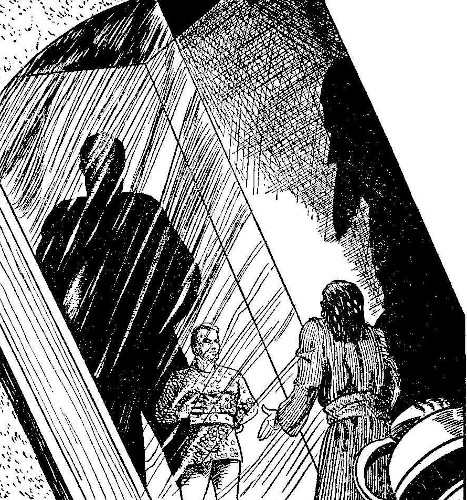
A crack opened in the ceiling, and down from above there dropped a reflection-free sheet of perfect glass. It slid in fitted slides, and sealed off the room into two sections.
The section occupied by Lindoo and his emperor was large and roomy, but the other section was small, a sort of cove, off of the main room. A man-at-arms moved an ornate chair that stopped the descent of the glass, and when the sheet of glass reached the floor, men-at-arms went around the edges and sealed it with a gluey mixture that came from portable pressure-guns. This was done on both sides, and as those on the small side left the room through the tiny square door, one of them snapped a button on the wall. The invisible and soundless atomizer-vents in the ceiling filled the air with a gentle spray of the best bactericide known to the Loard-vogh.
The tiny door opened again, and Billy Thompson entered, leaving his glass case attached to the door frame on the other side.
His nose wrinkled at the smell of the bactericide, but he grinned at the precautions. He, the vanquished, still held sway over their fears.
Thompson advanced and saluted. Then he waited.
"Arrogant, to boot," snapped Vorgan to Lindoo. His voice came to Billy out of the speaker in the ceiling, and Thompson stifled the natural impulse to face the position from which came the voice. He faced Vorgan.
"Not arrogant," he said quietly. "I merely request the respect shown to a vanquished, but adequate adversary."
"Our adversaries are always vanquished," snapped Lindoo. "And they become our slaves."
"A slave you may consider me," nodded Billy. "That I can not change. But the self-respect I have for having been vanquished only after a bitter fight requires me to consider myself more than a voiceless slave. You can not change that."
Vorgan looked at Lindoo. "Was that your reason for fighting?" asked the Lord of All.
"The basic reason for all strife," said Billy, "is to impose your will upon your adversaries."
Vorgan and Lindoo nodded impatiently.
"We fought to impose our will upon you. Our will is that we of the Solar Sector gain your respect, slaves though we must be."
"And you were willing to lose eight and one half million men to gain that respect?"
"Your estimate is wrong. We lost but seven thousand souls—five thousand of which were civilians caught in the backwash and splash-over from our fighting."
"Seven thous—" exploded Vorgan, visibly shaken.
"Seventeen million—" cried Lindoo hoarsely.
"Your losses?" asked Billy of Lindoo.
The Head of Strategy nodded.
"It is deplorable. I am sorry—"
"How dare you!" thundered Vorgan. "How dare you, a slave, to feel sorry for your masters?"
Thompson smiled wanly. "Would I get better treatment if I claimed to be glad of your losses?"
"I'll have your throat—"
"Careful, Lord of All, you are not being fair. I am damned for being sorry and equally damned if I feel glad. Do you prefer my sympathy or my hatred?"
"You brazen, arrogant—"
"Vorgan, I and all of the Solar Sector are at your mercy. We fought you to prove our ability, and to gain your respect. Had we surrendered without a fight, we would have gained your contempt. Also," smiled Thompson, "it is foreign to our psychology to give up easily. But the main reason for fighting was to extract from you a modicum of respect. That we have done."
"You assume—"
"I know. You are puzzled by my temerity, amused by my position, and completely baffled by my purpose. Were it not so, I would be dead instead of here, behind this protecting glass. For otherwise you wouldn't bother with a race so dangerous to your very lives. Am I correct?"
"Assume so. And proceed."
"The thing that makes us dangerous to you is the same thing that will make us useful to you."
"A moment. At this point I can wait no longer," said Lindoo. "Before this bold Terran leads us too far from the subject, I must know: How did you preserve your forces in that bitter fighting where your ships fell like hail?"
"We ran out of ships, not men," smiled Thompson. "We adapted a phase of the snatcher beam to personnel-protection. Each man carried a focal attractor in his clothing. Ship-destruction triggered a fast time-constant multi-driver circuit that inclosed each man in the incompressible spheres of the atomic crusher principle. They were withdrawn from the stricken ship while it was still exploding and brought back safely to a redistributing station where they re-entered the battle in a new ship."
"We'll make a note of that," rumbled Vorgan. Lindoo looked a bit ashamed of himself for not having thought of it before.
"Now, Terran," said Lindoo, "there was talk of a secret weapon. What was it and why was it not used?"
"As a means of destruction," explained Thompson, "nothing of that nature exists. Terra's secret weapon in this case lies within your own minds. We were fighting for survival, and the retention of our integrity. Our secret weapon is the respect we extracted from you in fighting valiantly and losing necessarily. Our secret weapon is our minds and our ability to employ logic and data to a problem and come up with an answer. The personnel snatcher is but one phase of this weapon we possess. You admire it. It is, of course, yours by right of conquest. Other developments will be yours, also. But they would be lost if we had been merely trampled over and our interesting facets ignored by the high councils of the Loard-vogh. You have a horde of problems, Lord of All. A myriad of problems that we of Terra may solve. I offer you the Solar Sector as a research area!"
"You offer?" asked Vorgan, puzzled. "You infer that we have not taken?"
"Permit us our integrity. Sol is our home. Sol is unfit for you, and Terrans are not well liked in your empire because of the living death we carry. Permit us to remain in the Solar Sector and we will be your research area."
"And free to breed discontent?" asked Lindoo.
"Are we fools? Our battle was to impress you with our ability to be recognized as worthy. Another fight would prove our lack of intellectual grasp of the truth. Permit us to live as we were, and you will have all of the benefits of our rather harsh environment to aid you in your plan. Were you of another psychology, I'd offer alliance, but being what you are I can but offer allegiance."
"Offers!" scorned Vorgan impatiently. "We demand."
"You cannot force mental activity," reminded Thompson. "You can drive a slave to fetch and carry, to become agricultural, to be menial. But you can never drive a man into mental activity. The subconscious mind will block. The subconscious mind will divert, and will work against those who drive, and the result will be complete loss of Sol's children and the benefits of a violent heredity. Permit us to remain as we are. Put overseers there, communications offices. We will solve your problems."
Lindoo whispered to Vorgan for a moment. The Lord of All snapped off the communicator, and he and the Head of Strategy spoke for an hour while Billy waited in silence, wondering what they had in mind. Finally Vorgan turned the communicator on again and said:
"Terran, if what you say is true, you are correct in your assumption that Sol will be of value as she is. I offer you a chance to prove it. Sscantoo is against all forms of alliance. Sscantoo will ally herself with any other race temporarily to fight us. The entire Galaxy may spring against us if Sscantoo can not be subdued. We must attack Sscantoo in the due course of time.
"There is one difficulty, however. The Sscantovians are not a gregarious race. Eventually we shall have the same trouble with Sscantoo as we have had with Tlembo. The catmen will seek a worthy adversary, and cause us to attack some sector long before our plan calls for it. Your premature battle was but one in several caused by Tlembo, all of which bring the Loard-vogh out of line and off balance like a runner careening downhill. Numberless though we may seem, we cannot overrun the Galaxy until our numbers permit it. It must be taken slowly and with definite pattern.
"Now, Terran, we can wait one year before we hit Sscantoo. I'll give you that one year, Terran. In that year, you must devise a means of gathering Sscantoo into the Loard-vogh empire. It must be done without battle. It must be done without losing a man—no, that is expecting too much," smiled the Lord of All nastily, "it must be done without losing more than one hundred men! That does not include Sscantovians, of course."
"Within one year," said Billy Thompson, "we will hand you Sscantoo as a willing part of the Loard-vogh empire. It will be done without battle, without losing more than one hundred men in the process. What will happen to the Sscantovians I will not presume to care, but I shall destroy as few as possible. During that year, of course, we will be free to work?"
"I will countermand the order displacing all Solar Persons save a small percentage willing to act as data clerks and research co-ordinators," said Vorgan. "That is my will."
"You will be more than amply repaid," said Thompson. "And one research we will make to provide the Galaxy with adequate protection against visiting Terrans, and protection for those visiting the Solar Sector. That, too, is a promise."
Within an hour, Thompson was on his way back to Terra. A year, he had. And four months would be gone ere he landed on Terra, and another long period of time would pass before he could get to Sscantoo. All in all, Billy felt that he had too little time.
Yet he smiled. For even in defeat, Terra would not lose her integrity. And how bad is slavery when the master prefixes his request with "Please"?
XVIII.
Billy Thompson fretted for four long months in the confines of the returning spacecraft. He was not idle. Daily he spent his time in the communications room, talking and conferring with his laboratory staff on Terra.
The order freeing the Solar Sector of its displacement of peoples took about ten days to clear, and another ten days to settle. It was swift; no Loard-vogh wanted to remain in that section of the Galaxy anyway. And though most of the worlds were cleaning up the shambles of the bitter struggle, the laboratory staff and research organizations went to work with a will. Let the others clean up the mess; it was their job to make the cleaning worth while by coming up with the answer to Billy's problem.
For only the right answer would leave Terrans around to inhabit a cleaned-up Terra.
So Billy fretted because he had to confer by voice alone. It did not matter that the secondary radiation from his subtransmitter, exciting bands in the electromagnetic spectrum near forty megacycles, would not reach Sol for hundreds of years, and that relative to his ship, the beams were hurled out backwards instead of coming forward toward Sol. But the four months were not entirely wasted. By the time that Billy landed, conferred with Kennebec on the future, discussed the major problem with a few Terran scientists, and then took off and finally arrived at the stellar laboratory on VanMaanen's Star's only, God-forsaken planet, they knew several hundred things that would not work.
Hendricks, the chief of staff, smiled wearily as Billy entered the safety dome and flipped back his space helmet.
"Hi, Billy. I hope you have a few new ideas."
"Nope. Not right now. I've been busier than the devil for the past seventy hours."
"So've we, on the last seventeen suggestions. We ran out of ideas when you ran into Terra. Now what?"
Billy grinned. "I'd like to see the quake area."
Hendricks blinked, blanched briefly, and then smiled wanly. "I thought so. Nothing to see, though. We do have a slow-action movie of the debacle. Reminds me of something out of a superthriller, shot in miniature. We had the sphere beam set up in duplex, one taking power out of the star, supplying the other beam which was clutching about five thousand miles of the star's core. The projectors were anchored to the crust of Brimstone, here, and we started pulling. We pulled like a dentist working on an impacted wisdom tooth. Unlike the dentist, the tooth stayed. We broke several beams, each one doing a bit of crust-cracking when the pressure let up. Then we took a big bite and heaved for all we were worth. A slab of crust about seven miles square heaved up, tilted like a poorly-trimmed raft in a heavy sea, and slid sidewise into the semi-plastic inner core of Brimstone."
"I'll bet it was bad, huh?"
"We all got away. The planet heaved and gurgled for a week before it settled down. But Brimstone is less strained than Terra and aside from a few scattered quakes now and then, she's quiet. Made a mess of that district, though. Horrible roaring, clouds of boiling steam, and all the trimmings out of a 'Birth of Terra' animated moving picture."
"Try it with an anchor set in the planet's core?"
"Yeah, but that's too much like anchoring a towline in a cup of custard. Too plastic. We might do it if stars weren't so confounded far apart. Beams get awfully thin on that projection even if we could make it, which I doubt."
"And if we could," said Billy, "we'd have to wait a few years while the beams got to our stars. They propagate at the speed of light, you know."
"Wonder if we could drop a beam from close by, go into superdrive and race for the other star, stretching—"
"What causes the traction?"
"The ... ah ... I see what you mean. It's the fact that the beam itself is ponderable and unyielding. Superdrive or no, the beam would propagate at speed of light and the superdriven ship would either be held back or the beam would break because of the space between excitation pulses. O.K., Billy, how do we jerk a hunk out of a star core?"
"We can't do the Samson Trick," said Billy, "but—"
"Samson Trick?"
"Samson was supposed to have brought the temple down about his ears by taking two of the main pillars and pulling one against the other. Well, we can't pull one star core against another, but why can't we set up a tripod, anchored in the stellar core, and then use that as a base for hauling with another beam? And feed power for the gadget from other stellar intake beams right from the star itself."
"In other words a sort of reflex Samson Trick? You make the star pull itself apart, with the aid of mankind and a few thousand years of technical development. I'll have the boys get to work."
"Did you get any compression?"
Hendricks shook his head.
"That was a vain hope. The stellar core is under hard compression already. O.K., Jim. Oh, Hello, Cliff."
"Hi, Billy. So you sold them a bill of goods?"
"Unless we get results, Lane, it'll be a bill of goods. If we come through, we're not bad off. Where's your sidekick?"
"Stellor? He'll be along directly. But look, Billy, what do you intend to do with this dingcrank when you get it working? Tear the guts out of the Sscantovian System?"
"Nope. Just insurance."
"We'll need it," grinned Lane. "You cut out a large hunk of selling when you ask Linzete and his gang of rugged, predatory individualists to form an alliance with the Loard-vogh."
"Trouble is that 'alliance' isn't the right word. I'm offering the grand and glorious opportunity of becoming willing subjects to the Loard-vogh."
"Huh. Never was a cat that took to being ordered around. Gosh, they're worse than we are. We'll take orders if it will do us any good. But Sscantovians? Phoooo."
"Well," said Billy, "when a lion tamer enters a cage full of cats he gets results. But most of them are well equipped with a revolver, a whip, and a four-legged stool. I'll walk in easily, tell the catmen to be nice, and wave my whip. But the whip has got to be loaded. Linzete wouldn't fall for a bluff. Cats don't. You've got to show 'em the stuff, and then you get your answer. Well, we've a couple of other things to try."
"We aren't licked yet," nodded Lane cheerfully. "But look, Billy, I'm still befuddled by Downing's stinking slow, methodical way of doing things. As I get it, Toralen Ki and Hotang Lu told us that we'd all be increased in mental stature after the Transformation."
"Sure. We are."
"I don't notice anything."
Thompson grinned. "You won't. You never will. No Terran ever will. We'll all go on just the same as we were, apparently. It is a Terran characteristic that a personal change always seems to be an opposite change in the rest. We'll all go on as we are and the rest of the Galaxy will appear to get stupider. The change is and has been—and will continue—to be gradual enough so that you will believe that you've always been possessed of a near-perfect memory. But play chess with your pals, and you find that you are still even because the other guy can lay just as complicated traps as you can with your increased ability to reason. But you see, it is like that old analogy. If the entire Galaxy and everything in it were increased by one hundred times, you would not be able to detect the change. That's because your yardstick changes, too."
"Relativity, speaking," grinned Lane.
"Classification: Pune. Definition: Pun that needs an oxygen tent. Or better, the perpetrator a half-hour immersion in liquid helium." He looked around and saw Stellor Downing, leaning against the door with a half-amused expression on his face. "Hello, Stellor."
"Howdedo. A nice job of selling you did on Vorgan."
"Yeah, and a nice pinch he put me in."
"Maybe you shouldn't have niggled him so far."
"I was a little rough on him," agreed Billy. "But I pushed him right to the limit of my safety. I applied all the traffic will bear. I had to, to show my boldness and to intrigue his fancy, since I knew that in all their victorious twenty thousand years of conquest they had never hit a race that stood up and told him off, face to face."
"You knew what you were doing, as usual," admitted Downing. "But I came to tell you that Hendricks has the tripod beam and the associated junk is set up and ready for the job of jerking the guts out of VanMaanen's Star."
It was not too impressive on the surface. Brimstone was cold and forbidding and airless, the only planet to the runaway star known as VanMaanen's Star. A useless system save for experiments of this nature, but excellently adapted for such.
The solar intake beams were operating efficiently. The torrents of power they would drag out of the star and use to develop the unthinkable pressures necessary to move the core of the star would come into the acceptor tubes. Foot-thick superconductors connected the intake beams to those to be used for the tearing process. And these superconductors were maintained at the temperature of liquid helium by a liquid-cooling system. Liquid helium needed no circulation, since its heat-conducting properties were such that no local heating in a bath of liquid helium is possible. Normal evaporation from the open bath at one side kept the system cold, all the way through to the superconductors.
"Good thing they don't have to use switches or breakers, otherwise I don't know how they'd handle the energy," said Lane. "A sort of grid-controlled intake—swell stuff. Well, fellers, let's get in the control room and see what gives."
Hendricks handed Billy a small chromium-plated case the size of a cigarette pack.
"We're putting personnel snatchers on all of us. If this blows—in fact if the whole planet blows, we all end up a couple of thousand miles in space, all canned up in incompressible spheres. Safety first, I say."
"That's how you saved the gang in the earthquake experiment, isn't it?"
"Uh-huh," admitted Hendricks.
"Well, let's take off. We've got everything nailed down tight."
Hendricks advanced the power. The meters read up, and the anchoring tractors moved slightly in their gimbals and became immobile. The projectors forming the tripod of inflexible beams took up all the remaining slack in the beam system. Not one piece of unprotected matter was left to form a weak link. Beams of sheer energy, efficient to within a fraction of a percent of the ideal one hundred percent, linked the beams invisibly. A system of inflexible energy, driven and maintained by the energy output of a star—driven to rip the core out of the star itself.
The beams thickened as the automatic control advanced in timed steps. Evaporation from the lake of liquid helium increased as the superconductors warmed slightly from the terrible load.
A wrenching—feeling—came to them.
A meter indicated that one of the beams—the sphere beam clutching a five thousand mile sphere of stellar center—indicated a movement of point one seven four inches.
The automatic controller went up another stepless interval, and the wrenched—feeling—increased.
Through the viewport, the small flaming disk of VanMaanen's Star blazed at them. It looked as though it were quite ignorant of the cosmic forces that were tearing at its vitals. There was an air of saucy disregard in its placid, immobile brightness.
The pressure increased.
"At this point we jerked up a slab of Brimstone's hard crust," remarked Hendricks.
But Brimstone was not in the link. Brimstone was not even present. The inflexible tripod of energy would scorn to move with the planet. The control room and the main development housing connected to the high base of the projector network were depending upon the invisible tripod of energy, deep in space. Brimstone was a large moon, a gibbous last quarter, out through one side window.
The automatic control went higher. And as the pressure increased between the limbs of the tripod, even so increased the power intake from the star itself.
Did a star have within it enough energy to cause its own destruction?
They did not find out.
The feeling of a wrenching increased, and then leaped into full being. Nausea, sheer instantaneous torture, a pulsed wave of pain, a shattering sensation of intolerable noise, a blinding light that came though the eyes were closed.
But these things were merely the physical and mental effects caused by—
By what?
There had been no grinding crash. There had been no failure of the beams.
Yet the meters read zero. Both intake and output. Test power and operation perfect registered on the string of indicators.
Nothing wrong—
—but the flaming disk of VanMaanen's Star was gone.
Something had failed, but it hadn't been the equipment.
Something had failed, but it hadn't been the star.
And the station and the control room was drifting aimlessly in space. Inspection showed that no star was close enough to be VanMaanen's Star. There were no stars within a couple of light-years from them. Above their heads, the projectors were idling in their slack gimbals, the tie-beams were off. The solar intake beams were taking in no power. The lake of helium, a twenty-foot open bath on the roof of the housing, was lying quiescent.
The entire assembly and assemblage was as it had been before the initial surge of power, excepting that Brimstone and his bright primary were nowhere to be seen.
XIX.
"Well, what happened?" asked Lane.
"You tell me," Downing said.
"Obviously something gave—but quick," remarked Billy. "The question is: What could give?"
"The star didn't. We weren't on the planet. Whatever gave—we are a long way from where we started, at any rate." Hendricks scratched his head in puzzlement. "You don't suppose we have gone and warped ourselves right out of space, do you?"
"That sounds like a comic book plot. I'm not taking any odds-on bets, though. Have you got an air condenser and a resistance-capacity bridge? Not the kind that compares a standard condenser against the unknown in terms of the resistance ratio arms, but one of the cheap varieties that merely compares the resistance ratio arms against the ratio of resistance versus capacitive reactance."
"Uh-huh."
"Is it calibrated to within an inch of its eyebrows?"
"Yup."
"Well, the dielectric constant of space is calculable. Measure up your air condenser and see if it comes out even. Get the boys to measure the radiation resistance of this space. It should be three hundred and seventy-seven ohms. That is—if we are still in our original space. Also you might get the standing wave ratio on some of the microwave transmission lines. They depend upon the characteristic impedances of space, the permeability and dielectric constant."
"O.K.," smiled Hendricks.
"Why the smile, Jim?"
"I was merely recalling a story like this. The hero proved it by determining that Planck's Constant was not the same as back at home. I was wondering how we'd measure it."
"How did they do it?"
"They didn't say."
"Good thing. Well, I like my method better. By measuring the capacity of an air dielectric condenser, the dielectric constant of space will be evident—but only if it is measured on the resistance type of bridge. Comparing it to a standard condenser would result in both of them shifting at the same time. Whereas the resistance of a metal wouldn't change. That does not depend upon the vector analysis factors of space, whereas capacitive reactance does."
"We might measure the speed of light, too."
"Not until we get this barge to a planet so we can get a decent base line."
"We're not ill-equipped as all that," objected Hendricks. "This barge, as you call it, is fully equipped with drivers."
"Why didn't the snatchers work when we took out after the devil?" asked Lane.
"Nothing blew, in the first place," said Thompson. "And in the second place, if we've warped ourselves out of our original space, the snatchers might have had a tough time focusing on something heading out of space through a warp in the continuum."
"Spectral lines do not mean anything in particular," said Downing, who had been peering through a solar spectrometer at some of the nearer stars. "More proof."
"Well, sure. Among items like having a different set of elements and physical laws, the impedance of space is all tied up in the speed of light, wave length, is a function of that, and so forth. Show me one item lying in the field pertaining to the angular vector-pattern of this space that agrees with that back home and the rest will probably match too, and we'll be back home but displaced by God-knows-what."
"Ralph Welles claims that the radiation resistance of space is about two hundred and seventeen ohms," reported Hendricks. "And Al Forbes reports that the dielectric constant of space here is about twenty micromicrofarads per meter less than back home. And the boys in the microwave group claim that the quarterwave stubs in their pet transmission line demand a new fundamental frequency of operation. O.K., fellows. We started to bust up a sun and busted ourselves right out of space and into another. Well, let's find a nice solid planet somewhere and get there so we have solar power. Then we can start thinking of ways to get back."
"So we couldn't pull the insides out of a sun, even using the sun's own stellar atom factory for power," smiled Thompson, "but we did manage to pull ourselves right out of space. Sort of a case of the sun pulling first, I guess."
"Yeah," agreed Lane plaintively. "But how many different spaces are there in the cosmos?"
"Probably an infinite number infinitesimally separated," answered Downing.
"In which case," returned Lane, "how many spaces did we skip between back home and right here?"
"I doubt that the separation between different space continuums is infinitesimally small," objected Hendricks. "More like a matter of a sort of quanta-separation. If the separation were not reasonably large, the energy necessary to break through would not be so great. I predict that we are in the space next door to our own."
"And if we take hold of another sun and pull—do we go one more space away or back again?"
"I dunno. There isn't a space-theorist among us. I'll tell you one thing, though. By the time we pull ourselves back and forth a few times, we'll know which valve to hold down in order to drive up instead of down."
Billy nodded. "If, as, and when we get back, let's see if we can devise a method of tilting a hunk of stellar center into this space from there. Better, probably, than just jerking it loose."
"Far better," observed Hendricks dryly. "If we can tilt ourselves into a new space whilst pulling on a stellar core, obviously it is easier to warp something into a new space than it is to rip the innards out of a star."
"Is this the point to suggest that we have a brand new galaxy to work on?" suggested Downing.
"Nope. We'll tell the Loard-vogh about it, though, and they may decide to do something about it."
Perhaps never before has a stranger object traversed interstellar space. Not by a stretch of the imagination could any race have designed a spacecraft resembling the squat housing adorned above with the battery of projectors. In the first place, it was all wrong for spacecraft design, being built to sit flat on a planet where the normal gravitic urge was down—or rather normal to the flat bottom. Spacecraft are tall, ovoid shells that travel vertically, parallel to their long axis, and the decking extends from side to side, at right angles to the ship's course. And the projectors should not be all on one side. That would leave the strange craft at the mercy of an attacking enemy from below. Spacecraft armaments consist of one turret in the top, or nose, one similar turret below, and several at discrete intervals about the center of the ship for side protection.
Of infinitely more trouble than the problem of traversing space in superdrive with an engineering project instead of a spacecraft was the decision of which way to go.
Being lost in the depths of interstellar space without a star map and with no idea of their position, and no one to call for a "fix," there was no way of determining which of the stars were the closer. They all stood there, twinkling against their background of stellar curtain, and one looked as close as the next. Brightness was no criterion. Deneb, four hundred light-years from Terra is brighter than Alpha Centaurus, four light-years away.
Yet, with superdrive, they could cross quite a bit of space in a short time. Hitting it off in any direction might bring them to within deciding distance of a star in a short time or it might be that the course went between stars for many hundred light-years.
It was Hendricks who solved the problem. "Get a hemisphere picture—and we'll superdrive for one hour and take another. Superimposing them one a-top the other should give us a reasonable parallax on the nearer stars. One that we could see with the naked eye."
With the fates obviously laughing up their sleeves, the second plate was never exposed. At fifty-one minutes of superdrive, the stellar detector indicated stellar radiation within one quarter light-year.
Planet-locating plates were exposed as the project swept through the star's neighborhood. There was quite an argument as to which of the seven planets to choose, and for no other reason than sentimental reasons—and the fact that the physical constants were right for them—the group finally fixed their desire on the third planet.
The engineering project started to head for Planet III.
"Better name it, Billy," smiled Hendricks. "You found it."
"I found it? O.K.," grinned Thompson, "we'll call it Eureka."
"Eureka III?"
"Too cumbersome. Since we'll possibly not chart the system let's just call the planet Eureka and forget about the stellar classification."
"Well, Eureka it is."
Jack Rhodes opened the door. "Better call it Money," he suggested.
"Why?"
"Because you fellows are going to find out that it is the hardest thing you've ever tried to hold."
"Huh?" asked Hendricks.
"We're right close and there isn't the faintest shred of gravitic field."
"Oh, no. Newton's Law—"
"Is valid right up to the last decimal place. 'Every object in the universe attracts—' and we just ain't a part of this universe."
"Doesn't seem right."
"May be of exceptionally low density."
"Must be zero then," grinned
Rhodes. "And if so, how does it hold itself together?"
"You answer that—it's your question."
"How long before landing?" asked Hendricks.
"Half hour. Look, chief, d'ye suppose we might find it to be contraterrene matter?"
"Um. What do you think, Billy?"
"If the matter here is the same as the matter back home, we'd have a fifty-fifty chance of it being contraterrene. It might even be something that was neither terrene or contraterrene for all we know."
"Interesting possibility. You mean something that is neutrally charged so far as we're concerned, but which in this universe consists of oppositely charged items?"
Billy nodded. "We'll find out."
"It has atmosphere, and the test shell didn't result in a contraterrene indication," called the pilot of the project.
"An atmosphere of what?"
Rhodes grinned. "God-knows-what," he said. "If Stellor can't make head nor tail out of the spectrograph, the chances are that the atomic stuff here might not jibe with ours at all."
"There is really no reason for our planeting at all," said Billy. "But I'm just curious, that's all."
"We'll be there soon."
The project approached the planet, and was forced to drive all the way. By the time that they had matched the angular velocity of the planet's rotation, the project was inverted with respect to the surface—though to the men it seemed as if they were driving up to a ground-surface. It gave them an eerie feeling.
"I can see myself visiting a psychiatrist by the time we get back," grunted Hendricks. "We're landing—upward—and I'm getting the screaming terrors already from that feeling of falling upward into the sky."
"What you're suffering from is the shattering of your basic faith in the solidity of solid ground," remarked Billy. "Well, the project will land upside down, and we'll take hold tight with the anchor-projectors. Long enough, at least, to scrape a sample off of Eureka, here, to take back and analyze."
"If this whole space is made of the same stuff, I can see a minor industry springing up, gathering metal and stuff for gravity-proof gadgets."
"Wonder—probably good for something. Well, we're as close as we can go, all of us standing with our heads pointing at the planet and held to the floor of our project by centrifugal force caused by the planet's rotation. We won't stay long. None of us can stand the mental strain of looking out of the window and seeing solid ground a few feet above our heads and a million million miles of sky to fall down into if we step out of the door. Brrrrr."
"Close the sun proof shutters and don't look," suggested Billy. "I'm taking a nice large bromide to chill off a few screaming nerves and then I am going out and take me a shovelful of that dirt and rock up there. Gosh, it's going to feel funny digging down something that wants to rise. Let's make it quick."
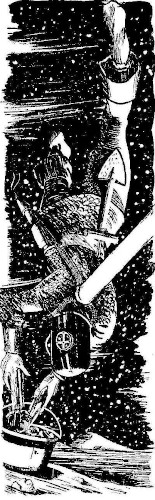
Billy emerged from the lock completely clad in spacesuit. He took air samples, and then, with the catch-knob between his shoulder blades firmly in the focal sphere of a tractor-pressor beam, Billy was shoved up to the surface of the planet. Reaching up over his head, Billy pulled down a few stones and dropped them upward into the bucket he held inverted. They fell upward to the surface of the planet, and the bucket was held by their weight.
They never did know whether there were any Eurekans, but if there were, and the Terrans were watched, it was a strange sight they saw. A sixty-foot rectangular building of steel, one story high, resting upside down with the planet-side to the sky. Projectors dug into the ground, pulled by the anchoring tractors that pulled the upside-down building even tighter to their planet.
From a spacedoor, a pale green beam was fastened to the knob on the creature's back. He was head down, suspended on the beam, and carrying a bucket that must have been filled with antigravity material for the bail was free and the bucket actually hung upward!
The creature was lowered, still head down, to the surface of Eureka. He reached down below his head and lifted a few stones, dropping them into the bucket, which he held right-side up. Naturally the bucket dropped properly enough to the ground.
Working by digging down, Billy filled the bucket and was returned down to the door.
"Cut 'em!" he said hoarsely.
They cut the anchors and the project was thrown from the surface of Eureka by centrifugal force. And as they left Eureka, and headed for the Sun, they held a council and decided that another attempt—blind though it would be—to warp space would be in order.
XX.
"Get every recording gadget we've got on the thing," said Billy. "Maybe we can find out something that will give us a directional trend. And anybody who thinks he won't be struck by lightning if he makes a prayer, go to it. We could use a bit of Divine Assistance."
The detectors were set up and the recorders started. The tripod of anchors set themselves in the star's core. The solar intake beams worked well and the torrents of power increased as the automatic control slid up the scale.
"The stuff may be different," observed Hendricks, "but we can still get power from their stars."
"Darned good thing, too," said Thompson. "I don't know how else we'd swing it."
Again came that feeling of wrenching. And it increased as before.
"Does it feel left-handed or right-handed?" asked Lane nervously.
"I don't know and if I did I wouldn't remember which way it was the last time," grumbled Downing.
And then the warp formed, and there was the impression, just before it snapped-quick, that the stars in that universe were flowing like spots on a watery surface.
And they emerged into a space completely devoid of anything. Not a star, not a speckle in the complete sphere of utter blackness.
"Obviously went the other way again," grunted Lane.
Jack Rhodes looked up from his calculations. "We had a fifty-fifty chance, according to the Law of Probabilities. But tossing one head does not make the next toss any better than fifty-fifty chance for tails. In fact," mused Rhodes, "tossing a hundred coins may bring you forty heads and sixty tails—plus or minus ten percent of the true chance. Tossing a thousand coins may give you four hundred seventy against five hundred thirty—a three percent error. But though the latter is more to the true division, the numerical deviation from zero is only ten in the first case but thirty in the second."
"I hate mathematicians," grunted Downing. "They're all pessimists. So the longer we try the more distant we get, huh?"
"Unless we can get something to upset the Law of Probability."
"And," added Hendricks sourly, "something to pull against. This universe is completely devoid of anything material."
"Let's put that as a matter of our being able to detect it at present. It might be teeming with suns indigenous to this universe and completely invisible to us."
"We're wasting time," said Thompson. "What's with the detectors and recorders?"
"About the only thing I can determine from here is a definite lengthening of the wave length that the puller-sphere propagates on."
"Huh?" asked Billy.
"Definitely."
"When did it lengthen?"
"Its wave length increased on an exponential curve to the time of warp—"
"Well, now we know—I think—how to get back."
"How?"
"Instead of pulling, we'll push."
Hendricks shook his head. "I think I get you, but I'm not too certain. Has to do with the wave length-propagation factor, hasn't it?"
"Sure," grinned Billy. "For a given frequency, and a given velocity of propagation, there will be only one possible wave length to suit the conditions. That, essentially means that a given distance will have a definite number of wave lengths so long as the frequency and speed of propagation is maintained. The puller-sphere we were using is propagated on a tractor beam. The characteristics of a tractor beam are that once established, the number of wave lengths between projector and object remain the same. Then the projector presents a leading signal phase, and the phase of the tractor beam moves toward the projector to bring the two waves into zero phase difference. The projector maintains the leading phase all the time, and thus draws the object. It is just like turning a nut on a threaded rod, sort of. The wave length is analogous to the distance between the threads, and the frequency is the number of threads that pass a point when the rod is moved at the velocity of propagation.
"Now, suppose we consider the threaded rod as being fixed at the far end, and pulling at the projector end with sufficient power to stretch the rod. The frequency happens to be definitely fixed by the primary standard in the control rack. The distance between remains the same by the constants set up in the tripod and puller beams. The wave length-factor, striving to satisfy the demands of the tractor beam, and maintain the correct number of wave lengths as the beam pulls, will cause the wave length to lengthen. But that tends to change the frequency-velocity factors. Result, if I'm getting obscure again, return to the thread analogy. A standard ten thirty-two screw has thirty-two threads per inch. Stretch it evenly, and disregard the distortion, and you have, say twenty-four threads per inch. Our pulling against the sun resulted in a distortion of the wave length-frequency-velocity factor, and we pull ourselves into the next notch in space that fits the increased wave length-frequency-velocity argument.
"So," concluded Billy, "by pushing instead of pulling, we can cram the wave length down again, and warp space in the other direction. Think?"
"I'll buy it—if you can find something to push against," said Hendricks.
"Shucks," grinned Billy. "Shove out your tripod a short distance, but focus them all together. Then shove against that field of focus."
"Said is as good as done," said Hendricks. "Better work, too. Right now it is raining gold coins and we're wearing a pair of boxing gloves."
"And while we're on the way back—I hope—we might consider this: Suppose we take two tractors and face them at one another, hold 'em apart with a trio of pressors, and let the thing go to work. That's providing that we find any use for this subspace stuff. It might—"
The wrenching took place at that point. It was much as before; as far as physical evidence went there was no means of telling whether this again was "up" or "down." There was apparently no drift between universes, for their subspace star was not far away.
"This might not be too good," said Billy nervously. "What happens if we land in the middle of a star?"
"We have a far better chance of landing in the royal middle of intergalactic space," observed Hendricks. "We may have been in that position in the sub-subspace. Well, Billy, it is obvious that you hit the right answer. Shall we take hold of Eureka's sun there and shove?"
"Why bother. Let's be independent."
Rhodes nodded. "The thing is still set up."
"Well, give it the works."
The space warp started again, and again the project was wrenched through the barrier.
"VanMaanen's Star must be that one back there," observed Hendricks. "Hard to say, but we hit it up about that far to get to Eureka."
Rhodes looked up from the sub-radio. "That's them," he said. "And they want to know how in the name of the seven devils we got out here so far in such a short time."
"Short time? Nonsense. They flew in subspace for an hour, it took us a half hour to land on Eureka, and Billy spent another half hour digging pay-dirt. After which we raced off for, say a half hour or maybe an hour before we went into space two. Our stay in space two was about fifteen minutes, and the passage through space one was made in less than a minute. Call it a total of three hours."
Rhodes checked his chronometer. "We've been gone about three hours," he said into the set. The answer came back immediately, for all to hear. "Like the devil. You've been fifteen minutes since you fastened on to the star and were jerked off of VMS I."
"What's your nav-chronometer say?" asked Billy.
"Seventeen-forty-three."
"And we left the scene about seventeen twenty-eight?"
"Approximately."
"Well, chew this over. Our nav-chron says twenty fifty-one."
"Snap on the differential timer," suggested Hendricks.
Microsecond pulse signals crossed space, both ways. The timer started counting. Three hours and twenty-three minutes and eleven seconds went by before the timers stopped. There Hendricks and Thompson went into another conference.
"We have the following observations regarding subspace: One is that the matter is unlike Terrene matter. The other is that there is a differential in time passage. The latter may be quite useful. We'll have the gang check everything possible, of course, and probably even set up a laboratory in the lower spaces. This lack of gravity—has me stopped cold," said Hendricks.
"Excepting for the observation that Newton's Law mentioned every particle in the universe—"
"I don't think Newton was trying to be snobbily semantic," laughed Hendricks. "Besides, his Law is a translation from the Latin, and at that time they weren't even sure of space, let alone subspace and space two, et cetera."
"I've always wondered about the conservation of energy and the problem of how gravitic attraction couples into that. It could be, of course, that the universal attraction comes from the fact that all the universe was once a single body that exploded because of its own mass-warp. Energy driving the mass apart during the formation of the universe—which is still expanding—and because it took work to separate one body from another, the conservation of energy dictates that they undo that work to get them back together. Since our project was not a part of subspace, no expanding work had been done on it, and therefore no potential energy had been stored which would be released by gravity taking place."
Hendricks smiled. "It's as good a theory as the next," he said. "But is it solving the Sscantovian problem?"
"No, but I have an idea that may. We can set up our warping beam and transfer the resultant forces in the same manner as we transmit other energy. We can't jerk the insides out of a star, nor can we compress the matter there. But there is nothing that says that we cannot change the physical constants prevailing in a certain sphere of influence, and thus warp anything within that sphere into subspace."
"Sounds good. So instead of pulling the middle out of a star we'll just rotate the middle into subspace. Well we have our work cut out for us," smiled Hendricks. "I'll get a corps of techs on subspace, and a gang working on the space two. We'll run up a couple of spaces, too, just in case. I'll have a crew go to work on the subspace matter, and we'll eventually have a crew working on admixtures of extra spatial matter with spatial matter. We have enough work for ten lifetimes. Y'know, Billy, I'm going to set a slew of brand new college kids to tinkering with the subspace problem under the direction of a hand-picked crew of elders. They've got a field that isn't over-crowded, anyway."
Billy scratched his head. "Look, Jim, I have an idea. Superdrive is fine stuff for batting around the Solar Sector. A run of fifty light-years, though, is a reasonable jaunt, and Sscantoo is off about a hundred and fifty light-years. Now if this time-difference in subspace is workable, we might be able to get to Sscantoo in jig time."
"I suppose so. But remember that this jig time you speak of is real time to you. To someone in space, you'll make the hop in record time, but to someone on the ship with you, the same time of a spatial trip will ensue."
"It's no great advantage as goes time or power," agreed Billy, "but when you're fighting a time limit, as we are, time in this space is what counts and if we have to go into subspace and study until we are a hundred years old before we find the answer, to come back with only a year gone, that's it. So see what you can do about tacking a warper into a spaceship, will you? And take another swing at the core of VanMaanen's Star. As soon as you have something, drop everything and bring it to Terra. I've got to get back, but quick."
Hotang Lu's return to Tlembo was hailed with silence. It was the silence of defeat, the sympathetic attitude for one who has tried, succeeded in his attempt, and found that his attempt lacked a vital factor. Hotang Lu had done his part. It was Terra that failed. Tlembo had guessed wrong. Yet Tlembo must try again and again until they became successful. The Little People were tenacious. They wanted their liberty, not slavery to the Loard-vogh.
And they would fight to the last Tlemban for it.
Not for Hotang Lu were parades and hordes of people to cheer him on his march up the broad avenue of his home city. He was whisked to the temple of government almost invisibly, yet the mental rapport of all Tlembans told them that Hotang Lu had returned—unsuccessfully.
Indan Ko, their ruler, gave Hotang Lu immediate audience.
"I've mentioned none of our plans," said the ruler, "because I fear interception."
"Plans?" asked Hotang Lu bitterly. "With success in our grasp, they throw it away. What more can we ask?"
"Your tone is that of defeat. We must not admit it, even to ourselves."
"Self-delusion," spat Hotang Lu.
"Not at all. We know a set-back when we see one. But we must not dwell upon it, lest we become single-minded and believe that our cause is doomed."
"Is there a better bet in the Galaxy than Terra?"
"There must be. Terra seemed a best bet. Yet perhaps their survival factor was so great that they prefer slavery to extermination. Is that rational?"
Hotang Lu nodded dumbly.
"We have Sscantoo."
"But they are almost at the pinnacle of their culture," objected the emissary. "We cannot energize their minds."
"Agreed. But they are an ungregarious race. They cling together only because civilization demands tribe-protection. They are fierce fighters. They hate every alien being. They dislike even contact between themselves, yet prefer that to traffic with an alien culture. Go to Sscantoo, Hotang Lu, and convince Linzete that his race is in danger of slavery at the hands of the Loard-vogh. Tell him, if he does not know already, that the Loard-vogh have conquered Terra. Perhaps Linzete knows what Terra's secret weapon is. Was it ever disclosed?"
"The end came too soon. It was never used. Nor—and I cannot understand—did I see anything of its manufacture."
"Linzete has most of Terra's secrets by mutual agreement. Perhaps he has also that secret."
"Again I fight time," growled Hotang Lu. "Time—and I feel, the inevitable."
"I'd suggest a consultation with Norvan Ge, the psychiatrist. He will enable you to conquer that defeatist attitude of yours."
"I shall see him," said Hotang Lu. "I admit that the shock of being plunged all the way from almost-certain victory to utter defeat in a few short minutes has shaken my faith in even myself. I shall see him. Then I shall go to Sscantoo."
"Tell me," said Indan Ko, "what was the Terran attitude?"
"They accepted defeat as the inevitable. Their statement was that they fought to gain the respect of the Loard-vogh only; they did not hope to win. This I cannot understand. If you know that you cannot win, why fight?"
Indan Ko shook his head.
"It is my belief that they are rationalizing. No one accepts defeat. They have forced themselves into the belief that since victory is impossible for them, they must bow to the Loard-vogh or die."
"They may have some deep-seated purpose."
"Name it."
"Visit your psychiatrist," smiled Indan Ko. "Then consider. You were once their mental superior. It is hard to admit inferiority to one that was one time inferior to you. Accept their mental superiority and consider that they may have some plan."
"Plan?" asked Hotang Lu bitterly. "How can they plan? How can they execute any plan? Planning and building is for a free race, without the shackles of an overseer on their people or the restrictions placed upon a servile race. Could they build a modine without the Loard-vogh knowing? Could they hope to instigate a ten thousand year plan of expansion to eventually crowd the Loard-vogh out of the Galaxy?"
"I admit your point. I was hoping against hope. Clutching at straws. Perhaps we should both go to Norvan Ge. Tlembo will stop counting on Terra and fix our hopes on Sscantoo."
"I will be in Sscantoo within seven months. It will take that long in constant flight—and with your permission I shall take Norvan Ge with me. In seven months, the psychiatrist can aid me, and give me the self-confidence necessary to convince Linzete of his danger."
"Seven months," muttered Indan Ko. "And I will wager that Vorgan has his fleet poised for a blow at Sscantoo right now."
"So long as any Tlemban lives," said Hotang Lu, with a momentary return of his determination, "we will never stop hoping and fighting to preserve ourselves and all the Galaxy from the conquering hordes of the Loard-vogh. I curse them, their name, and what they represent."
"I'll join you in that curse."
They lifted the slender tubes, inhaled deeply, and sipped the fluid. Indan Ko waved Hotang Lu farewell. "Go in haste and good fortune," said the ruler of Tlembo—the fourteenth Tlembo since the start of the Loard-vogh conquest.
XXI.
Vorgan scowled at Lindoo. "Dead, you say?"
"Starvation."
"Come now," said Vorgan derisively. "Sezare would hardly die of starvation. Assassination, yes. Overindulgence, without a doubt. Even sheer boredom I will admit. But starvation? Never."
"Deny your own medical corps, then."
"I admit it," snapped Vorgan. "But I am perplexed."
"There were no drugs."
"That I know. But look, Lindoo, Sezare was a fool, a stinking voluptuary if ever a Loard-vogh was. As sector overseer his palace rivaled mine. He carried on with a high hand. I recall my last visit. Frankly, I was slightly abashed. If Sezare had not been profitable, I'd have dropped him. He produced, therefore the lush palace and life he led were none of my business. I am not chicken-hearted, Lindoo, but to select the favorites of the home race as personal servitors to his own idea of sensuality seemed too self-indulgent. Select his choice, certainly. I can understand that." Vorgan's hard eyes softened at the memory. "But the concept that any that served him were then exalted, and must not be touched by a member of the slave race again—that was feudal."
"How did he enforce that?"
"There was seldom a need. Sezare was a voluptuary, almost a sadist. No servitor he ever had lived in health after the year he demanded. Broken in mind and in spirit and in body, they were disposed of as merciful terminations. His final act of vanity was to peacefully end the victim's life, giving the first rest in a year. Starvation, you say?"
"Yes."
"Sezare's palace ran red with wine, and the pillars groaned with the richest food that the sector bore. Overindulgence I will understand. Gout, autointoxication, acute alcoholism, drugs, or anything that comes of living in the lush manner. But starvation—how?"
"He was in complete starvation. He had dropped from three hundred and seven pounds to a scant sixty-three. He had locked himself in his suite and was constantly under the influence of a machine devised by ... by—"
"Oho!" exploded Vorgan. "A machine! Devised by—?"
"A Terran."
"A Terran! Is he here?"
"Yes—he and his machine. Partially destroyed."
"Why?"
"Terror."
"Bring in the Terran. I'll see him. And if he cannot explain to perfection, I'll see him burn!"
The prisoner entered. No glass separated them, for the Terran was sterile. He was forced to his knees, but if terror wracked the man, it was not evident.
"Your name?" thundered Vorgan.
"Edward Lincoln."
"Your trade?"
"Technician. Research co-ordinator for His Exalted Highness, Sezare."
"Sezare died of starvation."
"I know—it was deplorable. I fear that I was his unwitting murderer."
"You admit it?"
"I must. It is true. Had I but known—"
"Explain. Your life depends upon it."
"Sezare the Exalted directed me to devise for him a means of gaining greater sensual stimuli. Apparently the law of diminishing returns—you permit my personal opinions and observations?"
"Proceed. As you will."
Lindoo nodded and whispered: "His observations are a measure of his attitude. It is his attitude that will save or kill him, not his words."
The technician continued. "Sezare had indulged himself in every sensual manner. He was constantly on the search for something new, something more searing, something more thrilling. He directed me to devise some means of satisfying his demand for greater pleasure. That was most difficult, Lord of All, for Sezare had the entire resources of a galactic sector to provide his voluptuous demands.
"I succeeded in devising a machine that would give him dreams as he slept. Then, you see, when asleep he could indulge in his sensuous pleasures. That removed the necessity of stopping his round of pleasure to gain needed sleep; his round of lush living could go on continuously. I requisitioned the finest of artists, writers, and weavers of song to record the pleasures of life from the most fertile imaginations of the sector. Sezare, Lord of All, was imaginative, but not originally so. Soft living had made him lazy in thought, as well, and he preferred that any pleasurable thoughts be provided for him. So in having the most imaginative writers weave his dreams for him, I gave him a sensual pleasure far greater than the flesh was capable of enjoying. The power of the mind is greater than the flesh, Lord of All, and in my ambition to please Sezare, I overdid it."
"Overdid it? How?"
"I overlooked the fact that Sezare might find more pleasure in sleeping and dreaming than he would in waking and doing. He closeted himself with the machine. I ... was nearly destroyed because I breached his chamber and tried to turn the machine off."
"True?" asked Vorgan.
"True," nodded Lindoo.
"He spent all of his time under the influence of the dream machine," said Lincoln plaintively. "He scorned the best efforts of his cooking staff, and he scourged the collectors of his—women. None of them could provide for his pleasure like the machine. He retired to it, and in his strange acceptance of its pleasures, came to feel that sleep, under the machine, was real, whereas life, with its disappointments, must be sleep with bad dreams. Since the dream machine could provide only dream food, Sezare starved—his body starved, but his mind was content."
"Continue."
"Continue? There is no more. I had been trying to turn off the machine for weeks. I was denied, even threatened. Finally imprisoned so that I could not appeal for help. Sezare died, and I was sent here. In terror that some other of the Loard-vogh might fall victim, I have ruined the machine, and I shall die before I rebuild it. It ... is worse ... than the most entangling of drugs."
"Dismissed," said Vorgan dryly. The technician was led away, not guilty.
"Lindoo, what of Sezare's sector?"
"In charge of Sezare's underling, Narolla. Narolla has full control and he is competent. Narolla is not a voluptuary; he has seen too much of the dissolution of Sezare. And, Vorgan, it may be interesting to note that Narolla's productive output has increased."
"Already?"
"Sezare has been on the trail of starvation for weeks. Narolla took charge as of Sezare's withdrawal into dream-seclusion. Regardless of the Terran's act, or motive, the Loard-vogh benefits by the change."
"I agree. That is why I freed him."
"I am beginning to feel that Terrans can be trusted," said Lindoo.