Front matter (continued 2)
Reading edition
"Your race," continued Toralen Ki, "has never been able to use its full mental power. That is because of the suppressor. True, you are a long way from the suppressor, but its power is fearsome and its effect is lasting. It passed through your system thousands of years ago and it held sway over your mental ability to now.
"Your race," said Toralen Ki, "is best equipped to fight the Loard-vogh."
"I don't feel any more intelligent than I did before," objected Thompson.
"No, because you have been under the influence of the suppressor for countless generations. It has become an inherited trait. It will remain an inherited trait until the mentality of the human race is energized, or triggered by a rather powerful wave of mental energy.
"The Loard-vogh will enslave the Galaxy if they are not stopped. Our original home was overrun three thousand years ago, and fourteen times they have caught up with us. Again, Tlembo is being attacked, or perhaps it has not started yet. Fourteen planets named Tlembo lie in our history, and fourteen times have we combed the Galaxy waiting and seeking a race with the proper mental power and technical ability. It would have been useless to energize your minds a thousand years ago, Solarian, for you had not the technical skill to accept it. The shock would have made you all mad. You believe me of superior intellect and knowledge because I have been able to make this machine. I am acknowledged the highest intellect among the Tlembans. I intend to sacrifice my intellect for humanity. The energizing will destroy me."
The meter in Lane's ship read forty. Forty miles per second. Dead ahead was the lacery of the star field, clustered around the tininess of black that was the meteor of the machine. Somewhere in the invisibility of space was Stellor Downing, coming this way.
He knew, because his detector said so.
This was not only a test of operator's skill, but of technical superiority, too. Detectors were not calibrated to the last foot of distance, and he who had the best capability in the art of tuning a detector knew better where the other man was at any time.
But it was also necessary to judge your opponent's error. For a single error would destroy both.
Downing's ship came. It was there and it was gone. Missed by a matter of feet.
And yet not a bead of sweat came. Neither had given ground. Lane grinned inwardly as his ship slowed for the turn. Dead ahead was the sealed door to the machine. He touched the button on his drive-rod, and the dymodine flared forth, boring down the shaft and driving great scintillating clouds of super-heated gases up from the bowels of the meteor. The machine was blasted.
"You stinking opportunist," snarled Downing.
"Mad?"
"That was—"
"One step ahead of you."
"You haven't won—"
"Only succeeded. Now we can fight this out for good. Really want to play, Stellor?"
"I'll run you right into that hole in the meteor," snarled Downing.
The two tiny ships approached on a converging course. Collision course, it was, and somewhere far ahead there was the meteor again. Downing was on the spaceward side, and edging sidewise into Lane's course. Lane was pinched between meteor and Downing; edging outward into Stellor's course and calculated to miss the meteor by several yards—if he did not give.
At fifty miles per second they rocketed forward, approaching one another, and telling each other what was going to happen next.
The communicator in Thompson's ship told the story. Thompson heard it, and Toralen Ki understood it from Thompson's mind.
"They—Stop them!"
"I cannot," replied Thompson, with a smile.
"You must. They are necessary to our plan."
"Plan?"
"I am going to give up my intellect. Lane and Downing are emotional and psychological opposites. In one great burst of mental energy, my intellect will be expended. The shock wave from my mind will energize their minds. Their intellects will merge, making them emotional twins and psychological equals, each with the double power gained by joining with the other. They must willingly submit to this mental combining, for then the wave of energy from their minds in twin transfer will awaken every human in the Solar sector of the Galaxy."
"You're asking them to give up their identities."
"I am. And they must."
"They will never do it."
"You are stalling for time. Order them to cease. If either of them is killed, our plan may fail completely. Both of them are of the highest order of intellect—and of opposite psychology. That is necessary—order them to stop—immediately!"
Thompson laughed.
"I am willing to die for civilization. They should—" Toralen Ki looked at Thompson, and his eyes widened in wonder, fear, and finally horror.
"You are under control—the Loard-vogh!"
Thompson smiled affably. "The Terran known as Billy Thompson left this body when the machine was blasted," he said. "Previously I could but urge and draw him into agreement with me. And you, Toralen Ki, are also necessary to the plan."
Thompson's one hundred and eighty pounds of fine body came forward. Thirty-seven pounds of Little Man shrank back in fear. Not fear of life—but fear for civilization.
And as Thompson's body reached for Toralen Ki, the radiation alarm blared. It registered; dymodines had been fired and simultaneous hits had been made.
Toralen Ki's free hand snapped the power of the telementor over full. Physical weakling though he was, he was aided mentally by the power in the mental transfer machine. He invaded Thompson's mind and fought the Loard-vogh intelligence that he found there.
Waves of mental energy spewed forth, and Hotang Lu came running to aid his friend. Stricken rigid, Thompson almost ceased to breathe; his heart faltered. For Toralen Ki and the alien Loard-vogh were using all of Billy Thompson's mind against each other, trying to drive the other out, calling upon more and more, even to the point of short-circuiting some of the voluntary sectors. It was battle, silent and fierce.
And the waves of mental energy spread in a vast radiation pattern as Toralen Ki and the Loard-vogh fought for the possession of Billy Thompson's mind and body.
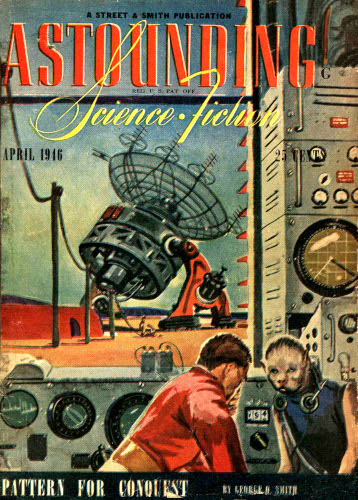
VIII.
Lindoo entered the crystal palace proudly. Not for Lindoo was the belly-crawling approach to the mighty Vorgan, Lord of All. Lindoo was not a mere stripling; Lindoo was the head of the Board of Universal Strategy, and Lindoo had not only permission, but orders to enter but quickly, and tell but swiftly, anything that might possibly affect the future plans of the Loard-vogh.
Vorgan lifted a hand to silence the one upon the floor, his wish was conveyed by a man-at-arms, since the one on the floor was flat on his face, as befitted one of the lower caste.
"Urgent?" asked Vorgan.
"Perhaps urgent, but informative at least," explained Lindoo. "Kregar has made full contact with the Susceptible One."
"Susceptible One? Who may that be? Of what importance?"
"His thoughts are confused. His name is not pronounceable from the mixed thought-pattern. He is important. He was sent to maintain order between the Extremes."
"Ah—and Kregar has succeeded?"
"He has. But not without incident."
"Trouble?"
"Some. The Little Men of Tlembo have, in part, been successful. I curse them as you do, Lord of All. Yet the Loard-vogh must prepare and be always prepared for resistance. It is written that smooth sailing is a vain hope. The Little Men have carried out their intent. They have succeeded in harnessing the Extremes together—for a time. They have succeeded in destroying the suppressor—which is why Kregar was able to control the mind of the Susceptible One. Kregar is brilliant, Lord of All. Kregar deserves attention."
"If Kregar earns it, he will get it. I am not unjust, nor has any Loard-vogh been unjust. Tell me—his brilliancy?"
"Kregar learned of the rivalry through the Susceptible One. Through the latter, Kregar was able to set one Extreme against the other, fighting a mad duel to ascertain the better man. The intellectual apex, the Little Man known as Toralen Ki, the key to their future, is now being attacked by the Susceptible One, through Kregar's control."
"Excellent. And the outcome?"
"Obvious. Toralen Ki will die. So will his cohort Hotang Lu. Thus dies those who understand their intellectual limitations and the will to lift others above them. The Extremes, upon whom the Little Men pinned their hopes, will be split forever. One will certainly die—perhaps both."
"It is best. Shall we then attack the Planet of Terror?"
"It will not be necessary. Their possible danger to us is over."
Vorgan smiled, and he looked almost benign. He was a tall man, bearded, with a full head of hair that tufted white in patches. His ancestry? His classification? It is hard to say. He was vertebrate. He was warm-blooded. He was intelligent and he was more than dextrous with his hands. Both hands. He was also dextrous with his mind. The Lord of All had not become Lord of All because of his heritage, his faith in deity, or his sheer ruthlessness. All helped, but the Lord of All was ruler because of his ability to rule.
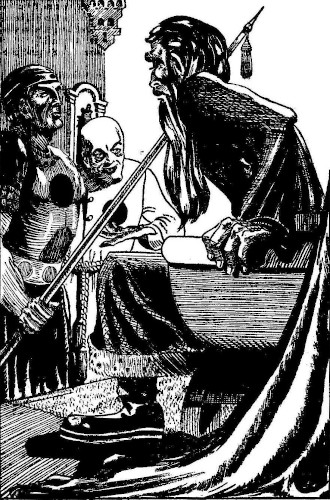
"I'll witness the final act," he said.
"The reason I came—" nodded Lindoo. "Kregar is working madly, and yet there is interest there. It will be enlightening. For even the Susceptible One is most difficult."
The Loard-vogh at the instrument was sweating profusely. His hands were clenched, and blood ran from the center of the right fist where his fingernails had pierced his palm. His entire frame was tense, and his eyes were half-closed.
Vorgan looked, nodded, and spoke freely to the recorder beside Kregar. The Lord of All knew that the operative was concentrated beyond all physical stimuli. "The details, Neckal?"
"Lord of All, the battle progresses favorably. The Extremes—they are fighting each other. As you entered, the Susceptible One's mind indicated that there might have been a culmination to their feud. Two of their weapons have been discharged in a location that makes us believe that simultaneous death may have taken place. Toralen Ki is fighting for his life—"
Vorgan laughed. "Thirty-odd pounds against six times that mass! Lindoo, your operator has done well."
"Naturally," said Lindoo proudly. He could afford to be proud; he had picked Kregar.
"Yet I feel that we should do something about the Planet of Terror."
"You think—?"
"Sending out another suppressor will do no good."
"You are certain?"
"Not entirely. I just fear them. It is good sense to fear a strong enemy, Lindoo. We, of course, shall conquer, but far better to find them easily beaten than to lose ten billion of Loard-vogh's finest."
"The master plan does not call for invasion of that sector for twenty-four hundred years."
"I should hate to have my ultimate offspring cast slurs at my memory—and perhaps erect a statue to throw excrement at."
"But one cannot cover all dangers—"
"I know. Yet let us wait. It will depend upon Kregar's success."
Neckal spoke: "The battle progresses."
Vorgan frowned. "Why or how can one so small defend himself against one of the Planet of Terror?"
"The Little Man is agile and the Terran is clumsy."
Lindoo nodded. "We may both curse and praise that. If the Terran were less clumsy, he might well be more difficult for Kregar."
"Toralen Ki also has mental amplification."
Kregar's hands opened and closed convulsively. Once they clutched at a space near his belt, but closed as though in futility—what he sought was not there. He reached forward, and only Neckal's quick action in turning Kregar around slightly prevented the Loard-vogh from clutching a delicate adjustment of the instrument through which Kregar worked.
Lindoo smiled. "It is written that a good big man will always conquer a good small man, my Lord of All."
"What lies between the Loard-vogh and the Planet of Terror?"
"Ten thousand light-leagues of space."
"A most dangerous spearhead—is it not?"
"It might be more than dangerous. To fight a war on many fronts is death. To warn a thousand races between the Loard-vogh and Terra might be the balance."
"Then we must hope," said Vorgan. "And only as a last resort will we drive forward."
"Face the fact," smiled Lindoo. "Kregar has—will have soon—the Little Man in his power. The cohort of the Little Man comes next. Dispose of them and the Planet of Terror will never know what it missed, in spite of the destruction of the suppressor. If nothing more than that happens, we are still safe. The Extremes fight one another—or fought one another. One or both of them may be dead. Grant the impossible and assume that Kregar is not successful and that Toralen Ki and Hotang Lu escape. Without the Extremes, releasing the mental torpor of the Planet of Terror will be most difficult.
"Now," continued Lindoo, with a very superior smile, "we grant the complete failure of our plans. All escape. Toralen Ki explains his plan to the Extremes. Have you any idea of sheer rivalry? Then consider your own attitude upon being asked to relinquish your identity to your most bitter rival."
Vorgan nodded. "How simple it would have been to wipe out all Tlembans so many hundreds of years ago instead of permitting those few to escape. I curse Mangare and I think I will erect a statue to his dishonor, that all Loard-vogh may spit at he who was not thorough."
Kregar's muscles tensed, wrapped him in knots, and his head jerked to one side in a spasm of pain. His eyes opened, glazed. They stayed open—wide and glassy.
Slowly he started, and with accelerated motion, he toppled to the floor. His frame went into one spasm, and he curled convulsively over his stomach. Then he stretched out straight and stiff.
"Dead," said Neckal, frantically.
"Dead?" echoed Lindoo.
"What happened?" asked Vorgan in a hollow voice.
"He failed."
"Failed?"
"How?"
"We may never know. But the failure was complete."
The Lord of All scowled. "Lindoo, plan the attack upon the Planet of Terror!"
"Yes, Lord of All. We shall strike Terra as soon as our forces can be deployed. It will take time, but we shall move with high speed."
"A word of caution, Lindoo. If they do not embark upon the Plan of the Little Men, merely hold our spearhead force in everlasting readiness. I dislike this attack, though our numbers permit it. I'd prefer to stay closer to the Master Plan. But—if they change, attack!"
Vorgan returned to his throne room, to ascend his crystal seat. He waved for the serf upon the floor to continue, and the man-at-arms conveyed the Lord of All's desire because the serf still had his face to the floor.
IX.
Hotang Lu came at the call of his fellow. He saw the tableau. Thompson stricken rigid with mental effort, and Toralen Ki, tense and firm, before him. The Little Man's eyes were closed lightly, and his hands were clenched tight. Every muscle was tight in the mental effort, trying to drive the Loard-vogh out of Thompson's mind.
The waves of mental energy spread. Invisible and silent, they were not undetectable, for the men in the ships felt the waves of mental bleakness and strife and knew a deep and unreasoning fear.
Toralen Ki fought—and Hotang Lu stood by. To connect himself into the mental hookup at this point might destroy the balance. To destroy the balance might permit the hated Loard-vogh to enter, and no matter how brief the entry, it would be fatal.
So he waited, alert and ready to snap the transmentor over his head if Toralen Ki failed. He would give the Loard-vogh no chance to get set again; he would strike quickly while the Loard-vogh was still recovering from the headlong success. For in the moment of mental victory, the Loard-vogh's mind would be reeling forward like a man forcing a door that suddenly gives way before him.
Thompson's frame was rigid, his eyes open but glassy and—but they were not vacant. They were ablaze with an unreal light, the conflict in the helpless mind behind the eyes energized them.
But—the machine was destroyed.
And—there were waves of mental energy in the Terran's mind.
The conflict raged, and despite the helplessness of the Terran's mind and control, there was the untouchable subconscious that told him that he must fight for the beliefs he had always held.
His faltering breath strengthened. His rigid muscles freed, slightly, and the creases of sheer pain left his forehead. Still in fog, his mind scanned the mental data. Two forces struggled for control—of his mind. The thought came:
Hurl them out!
But one was—friendly—fighting for him.
The other was alien, inimical.
And with an effort of will, Thompson set his mind against the Loard-vogh, and with the efforts of Toralen Ki and Hotang Lu, plus their mental amplifier, Thompson hurled his weight of mind against the invader.
Thompson was annoyed, confused and not too logical. To his mind, this was sheer pain, caused by the Loard-vogh. He hurled his hatred at the distant alien.
And the pressure of the conflict died. Thompson's body resumed its natural looseness, and the light of reason returned to his eyes. He smiled his usual smile and relaxed, breathing hard, and rubbing his temples with the palms of his hands.
The severe headache was leaving with noticeable rapidity. He faced the Little Men with an attitude of power and great will.
Hotang Lu stood in amazement.
Toralen Ki relaxed slightly also. They still faced one another, Little Man and Terran. But in their attitude was a vague feeling that they were fighting side by side.
And Hotang Lu understood. Toralen Ki intended to excite the minds of Lane and Downing by forcing them, psychological opposites, into mental contact. And he, Toralen Ki, was right now in bitter conflict with his own mental opposite—the Loard-vogh. The mental energies released in Thompson's mind had given the Terran the full and perfect control of his own mental ability.
They opened their eyes, both of them.
"Won," said Thompson, wiping his brow.
Toralen Ki inspected the Terran carefully. "You know, now?"
Billy nodded. "The rest of Terra and Sol must be excited. Wait—I must order Lane and Downing to stop."
The planetoid loomed larger and larger, and Downing crowded Lane closer. On approaching courses, it was becoming evident that the conjunction of courses would occur simultaneously with their arrival at the huge meteor. And yet Downing was the better off, for if he and Lane kept their courses doggedly true, Lane's ship would hit the meteor first. The carom, of course, would drive the flaming remnants of Cliff Lane's craft upward into Stellor Downing's ship, with the resulting injury to the latter.
Downing jacked up the magnification of his course-scanner with a twitch of his free hand. A rounded knoll of rock covered the scanner plate, and the cross-hairs that marked Stellor's course were just above and just to the left of the top of the knoll. A full-power shot with the dymodine in the right place—
And the caroming ship would deflect sidewise instead of straight up!
Stellor Downing trained the dymodine projector until the tiny circle in the course-scanner was still farther to the left of the top of the knoll than his ship's course.
The course-scanner in Cliff Lane's ship told him that he was heading for the knoll of rock. It would be a slicing blow, with Cliff's ship bounding up into Downing's craft. That much he knew.
Unless he did something.
He could drive up into Downing's ship right now. But that would be no solution as to whom was the better man. That would get Terra two corpses, but finely divided ones.
He could swerve.
And give Stellor Downing the right to say that he, Cliff Lane, had been bluffed?
Now if he were Stellor—?
Cliff Lane's dymodine sight was centered on the cross-hair of the scanner. He trained it slightly to the right and down, and then he touched the trigger.
Both dymodines blasted at once. Both beams raved out from positions one above the other, and both beams hit the knoll of rock in slightly different places. The splatter of energy from the coruscation ahead blinded both men, and set up shock-interference in the scanners.
A gout of flaming gas burst from the hit.
And within a few milliseconds of the hit, Cliff Lane arrived, with Stellor Downing almost on top of him.
Downing's ship hit the gout of flaming gas, and the velocity of ship was high. It deflected upward slightly, bending the spine of the little fleeter, rending a few plates, and dazing the Martian.
Lane's ship hit the flaming gas—which was almost homogenous where Lane passed through. The Venusite's nose plates dinged in slightly from the metal-to-gas impact. Right into the hit went Cliff Lane.
And out through the scar on the far side went the Venusite, roaring off in a halo of gases from the explosion.
They snapped radio sets.
"Well?" grinned Cliff saucily.
"Wise, aren't you?" grunted Downing.
"Try it again," advised Cliff. "I'm still spaceworthy."
"I'm buckled, but still capable," snorted Downing. "I'll be around—"
The ringing of the emergency alarm interrupted them. Thompson's voice came through. "Stop—at once!"
"Why?" asked Lane insolently.
"Don't even answer," scorned Downing.
"Stop, you fools. Stop—or Patricia Kennebec may die!"
Downing and Lane came around in tight arcs. As one they met on adjoining courses and raced like madmen for Thompson's command. They magnetted their ships beside the spacelock, breached it with the outside controls, and entered. They sent the door to Thompson's cabin slamming back against the wall and strode in.
"What's all this about Pat Kennebec?"
Thompson smiled. "It was about the only way I could stop that foolishness."
"Look, Billy, you've been interfering—"
"Don't be an idiot, Lane. Frankly I'm sick and tired of that schoolboy bickering of yours. As far as I'm concerned you can both go out and kill one another. But this is bigger than I am and it should be bigger than you are. Your job isn't through. We thought it was, but it is not. You, in fact, are just beginning."
"Quit talking in riddles and tell us what goes on."
"That machine restricted mental energy. It has been restricting mental ability for this entire sector of the Galaxy for twenty thousand years. It has been destroyed. But until the minds of Solarians are excited by a shock wave of mental energy, they will not have the use of their intellects fully and freely. You two are mental and psychological opposites, and the shock excitation of your minds in mental contact will excite the minds of all men." He turned to Toralen Ki and said: "I'm puzzled. There was sufficient mental conflict between you and the Loard-vogh to give me my release. Why hasn't it taken care of these two wildmen?"
"You mean the re-radiation from your mind operating on theirs as their radiation will free the minds of the rest?"
"Right. Why?"
"Lack of sympathetic tuning," explained Toralen Ki. "Your mind is unlike mine, and unlike the Loard-vogh known as Kregar, the one we fought and killed. Yet since you were at the focal point of the mental strife, your mind, untuned as it was, was excited by sheer brute force, so to speak. Selectivity could not keep out such sheer power. But selectivity would and did prevent re-radiation of the mental energy. You, therefore, have been freed, but no one else."
"Too bad," said Thompson critically. "It might have shoved some sense into their thick skulls."
"Hey!" exploded Lane. "He's talking to the Little Guy."
"How come, Billy?"
"You mean talking to him? Well, I was given mental release by a bit of a battle between Toralen Ki, here, and one of the Loard-vogh who was trying to control my mind."
"Give us more. You sound like a synopsis."
Thompson explained.
"Well, but how can you speak with him?"
Billy turned and asked Toralen Ki.
"You're surprised? Just as Lane and Downing will become mental twins, you, Billy Thompson, have gained twinship with my mind. Also that of Kregar, the dead Loard-vogh."
Billy smiled. "Simple enough," he explained to the pair. "After your minds are given release, you'll be able to understand him, too."
Thompson did not explain the twinship idea. Co-operation was one thing to explain, but the concept of accepting one another's personality would have to be given to them by someone who outranked them. Let them wonder—or even better, let them remain in ignorance, on the basis that what they did not know wouldn't harm Terra.
Toralen Ki shook his tiny head and looked puzzled, as well as shamefaced. "I didn't expect this," he said. "The concept of mental struggle between myself and another never occurred to me."
"It saved my neck," grinned Billy.
"And the collective necks of most of the Galaxy. And it is just as well that we didn't energize them, too. The main release for the solar sector must come when they go into the change. Had they gone into the change out here, in Sscantoo, the mental radiation would not have been strong enough to trigger the minds of your fellows near Sol."
Thompson nodded and turned to Lane and Downing. "You two are going to have something to fight—but against, not over. That's been a private fight of yours for years. If you'd like to continue it, you'd better knock off the battle long enough to stop the Loard-vogh cold. Then you can resume personal hostilities and be damned."
"What about this Sscantoo?" asked Lane.
"They have some stuff that'll come in handy in fighting the Loard-vogh," nodded Thompson. "But we're not running off half-cocked. We're heading back to Sol right now, to make plans."
X.
Stellor Downing's hard fist came down on the table with a shattering crash. "I will not!" he said in a powerful tone.
"And I agree," echoed Cliff Lane.
Kennebec smiled patiently. "So far as I know it is the first time you've ever agreed on anything."
"The future—?" pleaded Toralen Ki.
Kennebec nodded at the Tlemban. "He's willing to die. He thinks enough of the future to die for it. You two might sublimate your lives just a little for it."
"Get a couple of others!"
"There are none suitable."
"What a stinking set-up," grunted Lane. "I've got to forget my identity and become a sheer hyphen."
"Look," snapped Downing, "it happens that you're sneering at my personality, remember?"
"I wouldn't have your personality for a gift."
"You couldn't—it's too big for the like of you!"
"All right," said Kennebec. "Stop it."
Toralen Ki said, sorrowfully: "I might have been dishonest, Co-ordinator Kennebec. I should have told them that the mental transformation would prove who was the better man."
"A convincing lie for the benefit of mankind is often better than the disquieting truth," observed Kennebec.
Thompson looked up. "What they need is to have their heads knocked together," he said sourly. "A fine rotten pair."
"Look," started Downing.
"Now listen," grated Lane.
"Shut up!" snapped Thompson. "You've both heard what Toralen Ki said. You know what's heading this way. You are aware of just what can happen on Sol if Sol isn't smart. And you sit there like a pair of flat-headed imbeciles, prating about your own petty fight. Patricia was right. It is a sorry day for civilization when it must depend upon the likes of you. Why don't you get smart? Where is your good sense?"
"You've no right—"
"Shut up!" snapped Thompson. "I have every right in the world and by thunder I'm going to use it! It was funny, for years now, that you two were running all over your respective worlds, crowing like a pair of bantam roosters. The Favorite Son of Mars and the Pride of Venus! A bright pair of grown-up juvenile delinquents! Well, bright boys, civilization still depends on you."
Stellor Downing turned on Thompson and snarled: "No one is asking you to give up your identity. I haven't noticed any passion for anonymity in you, Thompson."
"You won't find any," gritted Thompson. He turned to Toralen Ki and asked: "Is there any way in which I may take either of their places?"
"Mine," offered Stellor Downing.
"Over my corpse!" shouted Cliff Lane.
"That I can arrange," ground Downing at Lane.
Toralen Ki shook his head, part in negation and part in the hopelessness of the situation. "No, on two counts," he said slowly. "One, your mind is not of an extreme nature. Second, your mind is already energized."
"Hm-m-m," mused Thompson. "Energized but still slumbering, I gather. Thanks for the tip, Toralen Ki."
He turned and bore his gaze on the battling pair.
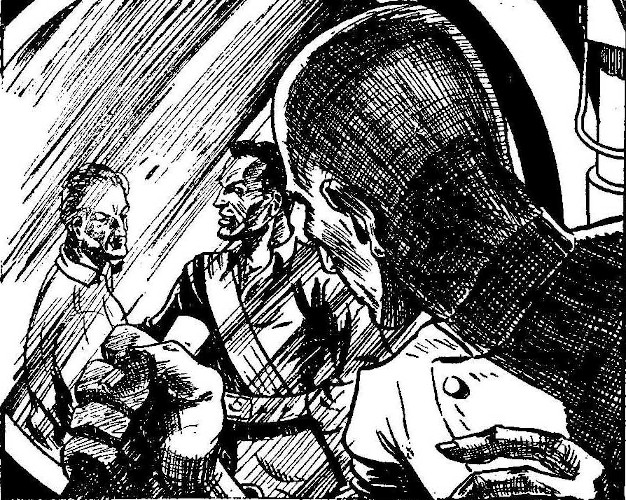
"Listen—and carefully," he said.
"Why?"
"Because I tell you so," he said in a hard voice. "I'm tired—as everyone is—of your foolishness. I'll say no more about it. I've said my last." He opened his eyes slightly, and caught their gaze. He said nothing, but held their eyes as though what they saw must not be lost from sight lest disaster follow. For minutes he held them, and then he said in a quiet, low voice: "You will become mental twins. The battle for supremacy between you will and can become one of sheer mental force. You will each have that which you sneer at in the other. With all factors in the mind, you will struggle. Whichever of you is best fitted for existence under such circumstances will emerge victor. Understand. There will never be a public admission of mediocrity on the part of either one of you, for you will both change toward the one that is victorious. Now if you really want to finish that fight, this is a way to do it."
He turned to Kennebec. "At this point, they'll do it or I'll strap 'em both down—"
Toralen Ki interrupted. "They must enter it willingly."
Thompson looked the pair over. "Shall I call in the Interplanetary Press?"
Downing had been thinking deeply. He looked up and shook his head. "Lane, I'm willing to bet my mind against yours. Put up or shut up."
"Anything you can do I can do better—and faster!"
"Baloney. Toralen Ki can start right now, if the other half isn't afraid."
"Afraid—!"
"Well, are you?" sneered Downing.
"That doesn't even rate an answer. I'll take your mind over."
"Uh-huh. This time we'll have an answer. O.K., Billy. Bring on your devil-gadget and we'll play ball."
Toralen Ki looked about him, his face a mask. Stonily silent, he walked to the greenhouse and looked out over the landscape. He basked in the warm sunshine, and thought how much it reminded him of the bright sunshine of Tlembo. The buildings on the edge of the clearing were vast; Toralen Ki felt dwarfed by them, and he felt all alone and utterly alien in this world of giant beings.
A phonograph was playing somewhere, a piece of Terran music that suited the Tlemban fancy, and Toralen Ki was drinking it in.
The greenhouse was slid open in one section, and mingled with the soft phonograph were the myriad sounds of living. Faintly there came the raucous rattle of a rivet gun, the rumble of a sky train passing overhead on its way to the antipodes. He slid the section shut, closing the sounds of this alien world of monsters from his ears. He pressed a button and the steel shutter closed off the light that was so much like his own Tlemban sunshine.
It seemed wrong that such a familiar sun should shine down upon buildings of such vastness, glint against skycraft of such magnitude, and give warmth and life to a race so huge and so very, very young.
He turned and ran his hand over a bookcase. He touched a favorite volume, but did not remove it from its place. He had not the time.
He ran his hand over the tiny controls of his little craft. It had carried him so many light-leagues of space faithfully and well, following the dictates of his hands on the worn plastic handles.
End of quest!
This was it. He had come to the end of his search, the answer to his desire. This race would carry on where he and his race could not. The flaming torch—
Toralen Ki broke off with a bitter laugh. He was sounding slightly overdramatic to himself.
He faced them. Hotang Lu, who was looking at the blank wall with intent stare, and the Extremes, Lane and Downing, whose huge frames were cramped in the tiny control room.
Even here, they were. He could not escape them—and he admitted that he did not want to escape them. Yet he felt the touch of resentment. Unthinkable light-years from his home, surrounded and overwhelmed on every side with utter bigness—slumbering giants, all of them, awaiting the touch of his mind to awaken them to their rightful place.
It might have been Tlembo's rightful place were it not for sheer size and other natural factors. Why couldn't fate have given Tlembo that gift instead of this race?
But, time went on. And there was so little time—
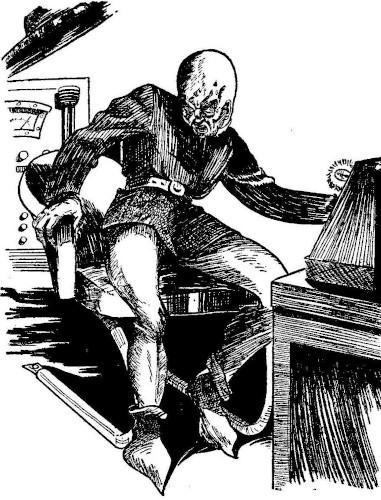
Toralen Ki went to his desk and took a quick drink from the tall tube, and then inhaled the aroma deeply. It had no smell to Terrans, nor taste, but Toralen Ki loved it for its powers—not too much, Toralen Ki, you have a job to do!
He went over and slipped the headset on.
"I'm sorry," he said. "I did want this last minute—"
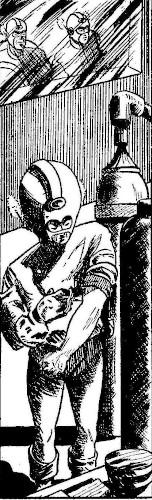
He took up the hypo, inserted the needle in the vein of his arm, and pushed the plunger home.
Countless light-years away, Lindoo watched his meters rise higher and higher as he increased the penetration. Ever seeking, ever tuning, Lindoo strove to find another man whose mind was at balance and receptive. Given time—
And with a rush, all meters hit zero. A backlashing surge of power drove Lindoo back from his position. He turned and faced Vorgan.
"As with Kregar—" he started.
"Kregar died," said the Lord of All, ominously.
"Kregar died of mental overload. I received no such punishment. Kregar, recall, was in charge of the mind of the Susceptible One who thought of himself as Tawmpsahn. He was forced out and away, and pursued by Tawmpsahn and the Toralen Ki himself."
"So—?"
"Toralen Ki is dead."
"Good!"
Lindoo shook his head. "He did not die in vain."
Vorgan blinked. "They—?"
"I have failed. I have been trying to find another one to control. Those who may be controlled were in no political position to do any good—I found several others."
Vorgan nodded. "Time was short."
"I did not locate one controllable among those who might have done some good. And now I never will. The Extremes have joined!"
"And the shock wave?"
"Has undone all the good our suppressor did for twenty thousand years."
"Order the attack."
"Yes, Lord of All. The logisticians indicate a short period of mobilization and preparation. The Enilode Sector is being stripped of our men—they're not too hard to handle now—and a tenth of the men in all other sectors not actively fighting are being sent to the spearhead sector. I hate time. It takes so much of it to handle thirty million men and the supplies necessary for their support."
"That," grumbled Vorgan, "and the inoculations. A man undergoing them is a sick Loard-vogh for a week."
"Our initial attack may be some time in coming. But it will be complete, throughout that entire sector. We'll destroy the menace immediately, and from then on, all we'll have to do is to hold that sector against any possible enemy."
"A long and dismal prospect," said Vorgan. "But we must not give them time."
"They will have no time to do more than plan," said Lindoo. "It takes time to put a new skill into practice. We shall conquer them!"
"We shall conquer them," echoed Vorgan, the Lord of All.
"And we shall have to force the catmen, too, Lord of All."
"Why?" thundered the Lord of All.
"Because the catmen of Sscantoo are unsympathetic to all forms of alliance."
"They need never know."
"They will be told. Sol will ask their help."
"But ... I see," agreed Vorgan. "Being against all forms of alliance means that they will form an alliance, temporarily, in order to keep from being included in an everlasting tie. Yes, you are right. We may have to force them. But let us conquer Sol at any cost. And soon."
"As soon as we can prepare."
"Better cut the preparation somewhat. Let the initial attack come before full preparation. Only in that way will we gain time."
"It is a gamble."
"I know it is a gamble," agreed Vorgan. "But one must gamble if the Galaxy is worth the fight."
"I wonder if we could convince the Sscantovians that our interests—No, it would not work. I like not that idea."
"Sscantoo would demand proof. It is far easier to prove that we have been all-conquering than otherwise. An alliance with them could not be made. To do so would require that we give them full confidence. And we cannot control a quarter of a galaxy of Loard-vogh slaves so well that they must not speak. And their weapons are less efficient than ours—we could gain nothing but manpower which we do not need.... No, Lindoo, we must go forward alone as we always have."
Lindoo smiled. "We must be on the everlasting lookout for spies."
"We shall. I wonder if it would not be best to exterminate them completely."
"I could do it alone."
"I know. I wonder. They are a hardy race, though, and ambitious workers. Extermination—"
"Merely eliminates one menace."
"I don't think it would work."
"May I try?"
"May I have your head if you fail?" snarled Vorgan.
"Then I shall not try, Lord of All."
Vorgan nodded cryptically. "Losing faith in your own ability?"
"No. I merely have reason to respect your judgment."
"You are a true diplomat, Lindoo. Someday it will get you into trouble."
"When it does, that is a sign that I am not as good a diplomat as I thought I was."
"Or that someone has exceeded you, Lindoo."
"I might wear out—"
"No. When you fail, Lindoo, it will be because you have confronted yourself with your superior."
"And then?"
"Then the Lord of All will have a new Head of Strategy."
Lindoo laughed. "At that time I shall expect you to need one. Well, I must start preparation. I have much to do."
"You have," nodded Vorgan.
Throughout the lands and planets of the Loard-vogh there started a slow and gradual crawl. The forces of the Loard-vogh began to move slowly, like the rivers of the ocean. They could be felt; slowly and inexorably, though they could not be seen. Throughout a thousand suns the soldiery left their billets in twos and threes. They bade good-by to their temporary homes, kissed their slave-lovers and serf-women farewell and faced new fields. They collected along the frontier, planets full of brawling Loard-vogh that swarmed like the all-consuming locusts. They fought among themselves. They stole and they looted, and they took souvenirs of value. Native women—some of them the intellectual superiors of the Loard-vogh—were not safe on the streets, and the fighting was not without its overwhelming toll of innocent bystanders.
Somehow it was very few of the Loard-vogh that got hurt.
And the planets began to pile deep with equipment. It was a real springboard, this planet frontier. Like a storm cloud collecting electrons, they would pile up to the bursting point and then with a crackle and a flash of lightning, they would hurl themselves across space to blast the focal point.
Terra!
XI.
Cliff Lane and Stellor Downing faced one another. They had spent hours in complete slumber after the incident, and their awakening had been almost simultaneous. They were both in a mental tizzy; they knew that Something Must Be Done but were slightly foggy as to what. Their former animosity seemed gone, or at least secondary to the urgency of the present situation.
They did not ask the usual question upon awakening, they knew that they had been removed from Toralen Ki's ship and hospitalized.
They did not mention Toralen Ki—not openly. But they felt it. Perhaps it was a sort of mental maturity, this Transformation. They kept their counsel until they could discuss it together—and they seemed to know that the other preferred it that way.
They sought the eyes of the people in the room and asked, almost simultaneously: "Can this be explained now?"
Hotang Lu nodded agreeably. He explained the story in full, and completely. As he concluded Hotang Lu smiled again. "Before—you had not the ability to understand, nor had I the ability to express myself in your terms. The Transformation has made it possible for all of us to partly speak in the other's language, and partly convey thoughts."
"That should be helpful."
"You will find it so. No matter which race of whatever sun you visit in the future, you will find that faculty helpful. You will even be able to mingle with the Loard-vogh."
"'Mangle' sounds better," gritted Lane.
"That will come in time."
"Well, let's hit it," said Lane. "What do we do first?"
"First," said Hotang Lu, "is to beware. The Loard-vogh are warned. Knowing their psychology, attack will be imminent."
"Then we'd best prepare to repel boarders?"
"Yes."
"Hotang Lu has the right idea," said Lane. "If they're warned, they'll clip us first."
Kennebec objected. "Why?" he asked. "Why do you expect them to hit us? After all, they're swarming through the galaxy in this direction. If they are that powerful, why should they attack Terra?"
"We constitute a threat," said Downing. "We are a powerful threat, or I miss my guess."
"Terra is a most powerful threat," said Hotang Lu. "Terra, well, it is known to the Loard-vogh as the Planet of Terror."
"Gratifying in a nice, lethal way," smiled Kennebec. "Mind telling us why?"
"Not at all. Terra is the center of the mutation area."
"Meaning what?"
"Sol is one of a vast trinary, astronomically speaking. Or was once. It is now one of an extended binary. You have no reference to this?"
"Not that I know of," said Lane. "And I've been a student of astronomy."
"Well, it is so vast that you may probably not come to the astronomical proof for thousands of years. Sol, however, is one of a binary that used to be a trinary. The third sun was alien—contraterrene. Thirty million years ago it was struck by a stellar wanderer—of terrene matter. The explosion was mighty. It was vast. It scattered particles of the third member far and wide. A great swarm of bits of contraterrene matter range this sector of the Galaxy. They fall into Sol, into Alpha, into Procyon, into Sirius, into the other stars within thirty to forty light-years from Sol. Even Arcturus, forty light-years away, has his small share, and so it goes.
"The resulting radiation from this drift of contraterrene matter falling into the star dispersion of this sector has bathed this entire portion of the Galaxy in hard radiation. Mutation has been rapid, and evolution has taken swift advances."
"Meaning exactly what?" demanded Stellor Downing.
"I can tell you that one," laughed Thompson. "We are tougher than hell."
"Terra's evolution has been vicious and swift," said Hotang Lu. "The natural enemies of life have also evolved rapidly. Clifford Lane destroyed one of the minor animals of Sscantoo by merely holding it—so did Stellor Downing. The things that Terrans live with in peace—or even symbiosis—are feared by the rest of the Galaxy. Insect life—many thousands of kinds of insects. Fungus—a myriad of types, all hardy. I've heard of a mollusk that secretes strontium metal for a shell rather than the usual calcium, and micro-animalcules that thrive in a bath of chemically pure sulphuric acid. Terrans drink a most foul poison—ethanol—for pleasure, and inhale the combustion-products—tar and worse—of a dried weed as a fairly common habit. This habit, by the way, seems to have absolutely no effect upon life or mentality. Terrans go anywhere with immunity, and those who come here must prepare to die."
"You're not dead," objected Lane.
"No, but I expected death. I was prepared. I was innoculated and sterilized and given all sorts of treatments. I irradiate myself daily with the micro-organism killing radiations known to our doctors and scientists. Otherwise I would—well, in your slang terms—grow green hair in an hour.
"In fact," continued Hotang Lu thoughtfully, "Toralen Ki and myself were the last of several expeditions to contact Terra. We sent a first to investigate and sample the upper stratosphere. They did—and they died painfully. But they succeeded in preparing artificial antimeasures against the bacteria and fungus-spores that roam that altitude. The second expedition landed, but took only samples of the surface-atmosphere. They died, learning the secrets of the mutant microlife of Terra. They prepared antimeasures for the third expedition who emerged from the ship, protected against air-borne death, and gave their lives learning how to control the microlife that abounds and is transmitted by contact.
"The fourth expedition came to roam the planet at will, and they died because there had been a mutation in one form of spore in the years between the third expedition and the fourth. The fifth came and were safe.
"Toralen Ki and myself were the fifth expedition."
"Um-m-m, what a nice bunch of little stinkers Terrans must be," smiled Lane.
"Terrans and Venusites," amended Downing.
"Don't be bitter," laughed Lane. "You're tarred with this brush too, you know."
Kennebec smiled. "I'll be afraid of myself from now on."
Hotang Lu looked at Kennebec seriously. "That is your main concern," he said. "You—and all Solarians—have but that to fear."
"What?"
"You need fear only yourselves. All your other enemies fall like the wheat before the scythe. From the most minute to the most gigantic. Micro-organisms that defy your best instruments can not defy your evolution. Giants that defy your imagination can not defy your science. The cold and forbidding planets themselves bow to Terran domination. Lane, born on Venus; a world of violent insect life and rife with micro-organisms is populated by Terrans. Downing was born of Mars. Mars is cold and forbidding. Life cannot survive there. Life cannot, gentlemen. Oh, life in the sense that regeneration and self-sustenance is life, can. After all, Mars is bathed in the same radiation that produces hardy mutations. But Terran life is intelligent. Martian life can not be—"
"See?" chortled Cliff Lane.
Hotang Lu swung upon the Venusite. "Stellor Downing is Terran," he said stoutly. "Venus can not support intelligent life either," he added in a mollifying tone.
"They do," objected Kennebec.
"By support I mean spawn," said Hotang Lu. "To support does not mean to 'be converted to'."
"Oh."
"Terra controls. Terra takes over. Terra is the Planet of Terror. Her minions rule the Galaxy, her mutants are the fear and the death of all. Linzete of Sscantoo capitulated because of two things. One was Lane's ability to carry, without self-destruction, microlife that destroyed their minor animals in a matter of minutes. The other was Downing's ability to read the radiation of their weapons and return in less than a month with an improvement on them. And what is your favorite dish?" he asked Kennebec.
"Filet mignon with mushrooms."
Hotang Lu shivered visibly. "Tender, of course?"
"Tender and very, very rare."
Hotang Lu shivered again.
"Why?"
"What makes a steak tender?" he asked with an air of innocence.
"Brutally speaking, it is a matter of semiputrefication."
"Precisely. You hang it in a warm, smoky, damp place until it 'grows hair'. Then you partially cook it—not really enough to destroy the enzymes—and smother it with one of the most pernicious forms of fungi. It is served hot—a condition that enhances most chemical reactions. And you fall to, eating this deadly mixture with appetite, relish, appreciation, and, by the most holy, you complain bitterly if the tenderness is not right. You object if the micro-organisms have not had their chance to break down the toughness of the meat. About the only disease that Terrans really need fear is the ulcer, which is a case of the adaptable beginning to eat itself, or perhaps carcinoma, where local mutation takes place."
"That makes us feel very good," said Kennebec dryly. "But from what you've told us, we are on the brink of invasion by a super-race that is slowly engulfing the Galaxy."
"The Loard-vogh must be defeated."
"I should think so," remarked Kennebec.
"Our work is through," said Hotang Lu. "Tlembo is surpassed. Sscantoo was one hope of Tlembo, but the catmen are almost at the peak of their evolution, and cannot be increased in mental stature more than twice or thrice. Tlembo reached their mental ultimate ten thousand years ago and were far surpassed by the Loard-vogh. Terra now surpasses the Loard-vogh. But remember, Co-ordinator Kennebec, you have mental ability not real mentality. You have the capability to increase a thousandfold above your present mental stature. But you have not increased in fact."
"I do not follow."
"Your infants have the ability to become the mentally great. Until that ability is exploited, they are mentally lower than the most unintelligent of animals. They cannot even feed themselves without help.
"Terra now has the ability," he continued. "If Terra is to rule the Galaxy—and well she might for her adaptability—she must exploit the latent mental capability."
"And the next plan?" suggested Kennebec.
Thompson looked at Hotang Lu. "What's yours?" he asked.
"You will be the co-ordinator. The Extremes will co-operate in gathering information and you will direct them, and all of Sol, in this effort."
Kennebec frowned. "You must know what you're doing," he said. "But I was under the impression that Lane and Downing—?"
Hotang Lu nodded. "That was the original plan. But due to a rather peculiar set of circumstances out near Sscantoo, Thompson now has the superior mind of all Solarians. You see, he did not achieve twinship with a Terran. He achieved a ... er ... tripletship with Toralen Ki, and the Loard-vogh known as Kregar, who was high in their councils. Since he is aware of the Loard-vogh mind, his decisions can be expected to take into account what they are likely to do."
"One of the main jobs in fighting an alien culture is to try to outguess them," added Thompson. "Having a bit of Loard-vogh psychology for inspection will enable me to handle the outguessing process somewhat better."
"Reasonable," agreed Kennebec. "My job now will be to convince the superior officers of these three that their ability warrants giving orders instead of taking them."
"It should be easy. Their ability will speak for itself. Besides, you may issue statements to the effect that mental activity between these three have placed them—"
"Hotang Lu, a thousand years from now we might. But you told us that all we now have is the mental ability without the training necessary to use it."
"Yes?"
"My small friend, all that means is that men will now be able to use the whole of their minds to indulge in power-grabbing, connivery, and politics."
Hotang Lu smiled. "I know," he said. "The end-product of it all will be that little change is visible. You see, the avaricious of your race will be of greater mental power, true enough. But those of you who try to see that things are run right will have the same increase in mental stature. When I spoke of the human race as a slumbering giant, I meant that all facets of human nature were equally smothered."
"Hm-m-m. I see what you mean. But jealousy isn't good, and if I make a statement to the effect that the minds of these three are superior, every mother's son on all three planets and nine colonies a-stellar will be sharpshooting for them. Ah-hah," he finished, shaking his head.
"Their ability will take hold. Their individual characteristics will show. Let it be known that Lane and Downing are each doubly capable because of the mental twinship. That all Solarians know now. Let it also be known that Toralen Ki and the Loard-vogh Kregar fought the same type of mental battle for Thompson's mind—and that he has the triple ability. Regardless of jealousy, they will come out on top."
"Well," said Thompson, "at this point I think we'd best be thinking about our skins, Cliff, like to scout the catmen again?"
"What for?"
"Take a look at their stuff. That snatcher they had might be the stuff for trouble in a large scale. Might see what they've got, and what you can make of it."
"Think there's any chance we might grab a hunk out of the middle of a sun and hurl it at the enemy?"
"Yes, but it is remote, and wasteful to boot."
"Why?
"Anything you might grab out of any sun would be more difficult than grabbing the planet itself—the one you want to annihilate, I mean. Better do it directly by just taking the planet, stopping it in its orbit, and hurling it to its sun itself. The forces present in a sun would be more difficult to handle. And besides, what would you anchor it to?"
"Space itself," suggested Downing. "With a driver beam."
"You'd end up by warping space. Nope, I can think of easier ways of beating out my brains. But Cliff, if you'll see what they have, we can use it, perhaps. Stellor, any suggestions you'd like to make?"
"Someone better start converting the manufacturers. Hotang Lu's picture isn't at all good, you know. The Loard-vogh have conquered about a quarter of the Galaxy now. Their numbers are legion and they are a conquistadorial outfit at best. They'll fight to the last one, and they outnumber us thousands to one."
"Millions," corrected Hotang Lu.
"Looks futile right there."
"Let's not quit before we're licked," snapped Thompson. "Before they collect Sol in their list, they're going to have to kill each and every Terran."
"Um-m-m—not a bright prospect."
"Makes us as tough as they are," mused Kennebec.
"Tough, but not as nasty," offered Billy. "They want conquest for the sake of conquest. They'll die to the last man fighting for the sake of fighting. We'll die to the last man fighting for peace."
"Right."
"So," offered Downing, "I'll take a scout of the Loard-vogh if you want."
"O.K.," said Thompson. "This is going to keep us all busy for a long time. We'd best relax tonight—tomorrow we can all leave."
"You'll take my crew?" asked Stellor Downing.
"Since spying can't be done with twenty-five ships at your back, I will," agreed Lane.
"You can handle 'em," said Downing. "After all, you do have my ability now."
Lane smiled cheerfully. "O.K. I'll see you later."
"Right," said Downing.
"And keep this under your hat, fellows. Terra has one great secret weapon that the Loard-vogh can never get nor use. It is a weapon that must wait until the time is ripe. It must never be disclosed, until it is in use. Then—it will be too late for the Loard-vogh to stop it."
"What is it?"
"If you don't know, I'll not tell you yet."
"But why tell us at all?"
"The idea of fighting a race that has conquered the Galaxy is staggering. Especially a race that, until lately, has been Terra's mental superior. The knowledge of a secret weapon of definite capability tends to make our battle less foolish. We will win."
XII.
Patricia Kennebec peered out of the window at the screech of brakes on the pavement. Then, to avert open hostility, she ran to the door and out upon the sidewalk.
She faced them, and was slightly baffled to hear them speak:
"Well?" asked Lane.
"You didn't beat me."
"It was a dead heat," smiled Lane.
"We're two minds with but a single thought, these days," Stellor told Patricia. "Every time I find myself thinking of something, I discover that he has been considering the same thing, too."
"You'd better split your personality—and/or your body," suggested Lane. "Or become twins. I can foresee difficulties with the theological and civil authorities if this goes on."
Patricia smiled. "I can't possibly marry you both. Not at the same time, anyway."
"Toss coin?" offered Lane. "We'll take turns—"
"You will not!" stated Patricia. "I'm old-fashioned enough to go into it wanting permanency. I don't really expect it, but I can and will hope. I will not enter marriage with any split in mind. That's ... that's—"
"Sorry," said Cliff. "I was joking."
"Love may be somewhat amusing," she said seriously. "But marriage is no joke. So let's forget it. Oh—look! Here comes Billy!"
Lane and Downing looked, and then whistled.
Patricia squinted at the pair of them, and then took another look at Thompson. "Did you two swap minds—or was he in on it?" she asked with a laugh.
"He wasn't—but why?" asked Lane.
"Billy is pulling your favorite trick," she told Lane. "He's got a glamor-puss on each elbow."
"And he can pick 'em, too!" said Downing approvingly.
Patricia looked at him in puzzlement.
Lane caught the look. "That's my line," he told Stellor.
"So it is. 'And your line shall be my line, and your ideas shall be mine. For whitherso thou goest, there—' and so on, Cliff."
"This is getting bad," smiled Patricia to Billy. "I've often thought that it would be perfect if I could take these two and boil 'em down into one man. Instead, I've got the boiling process done but the outcome is two men both with all of the things I've liked about each—or am I getting involved in my own words?"
"I knew they'd not think of furnishing enough femininity to make a full party," he laughed. "Patricia, smile and be nice to all of us. Kids, Patricia Kennebec. Virginia Thompson, my sister, and Tania Lake, her erstwhile college chum. Gals, the redheaded wildman is Stellor Downing and the dark, sunkissed Adonis is Clifford Lane. Take it from there."
Lane blinked at Virginia. "You're his sister? By adoption, no doubt. No blood relation of Billy could be—" Lane stopped at precisely the right point, and looked just the right amount of confusion. His act went over, and Virginia smiled back. "He talks, too," he said seriously.
Patricia Kennebec looked at Billy. "This has the earmarks of conspiracy," she told him. "What gives?"
"Nothing in particular," he said with a slight smile. "Ginger and Tanny were sitting around the house as usual when I got home this evening, and both of them looked hungry. Seems to me they're always that way—at least as far back as I can remember."
"You mean you've been concealing assets like these?" demanded Downing.
"I'll inspect this conspiracy a little better after I find out how it's working," Patricia whispered to Billy. "You treat them both like sisters."
"Tania has lived next door to us for most of her life," said Billy honestly.
"Hm-m-m—girlhood sweet-heart?"
"Nope. We didn't even scrap over the back fence."
"There's one thing about Billy," said Downing, diverting his attention briefly. "He doesn't ever scrap for anything."
"He never seems to lose anything he wants," offered Tania.
"He doesn't," affirmed Lane. "Trouble is with that kind of guy, he'll never win the Solar Citation. Billy, why in the name of sin don't you make something look hard, just for once."
"I claimed that any man who could spend a couple of months as referee between you two would have a job big enough to win the Solar Citation," said Patricia.
"He made a breeze of it," said Lane, and Downing nodded and added: "Every time we got to the shooting-point, Billy was there with a crisis to solve, a mission to perform, or a detail to handle. And when the rivet-cutting really got going, he thought of the one short statement that stopped us both—cold."
"I still say getting in between you two is bravery above the consideration of personal safety, or even the safety of any individual, for the benefit of mankind. If that doesn't rate a Solar Cit, I don't know what does."
Billy grinned brazenly. "It all comes of one idea," he told them. "And that's the little proposition of making the best of what you know. I—know people. So I can make 'em tick. I'll admit it, I'm brilliant. Now let's forget my obvious touch of genius and go somewhere and try out our own individual superiority against a steak. We'll weigh the remains and the largest leavings is a loser."
From the front steps, Co-ordinator Kennebec called: "A good idea, fellows. I was about to call out the Guard. I was beginning to think that a mass meeting was going on right on the Presidential Grounds."
They waved good-by, and drove off in Billy Thompson's car.
And it was about four o'clock in the morning that Hotang Lu retired after hours of discussion with Kennebec. The co-ordinator of the Solar Combine nodded the Little One to his door, and then decided to raid the presidential icebox. He stopped at the door.
Co-ordinator Kennebec had a large and healthy respect for Patricia's judgment, though she was but a youngster according to his standards and those of his contemporaries. Perhaps the combination of Irish impulsiveness with the Canadian-Scotch horse sense had resulted in something with a better grasp on human nature—or perhaps it was that still-unknown intuition that women all claimed. Anyway, Kennebec had been talking to Hotang Lu with four tenths of an ear cocked to the doorway. He'd wanted to get Pat's side of the details.
He'd missed her, apparently.
For if any icebox were raided, especially the austere icebox of the co-ordinator's presidential home, it would be done en trio.
Kennebec grinned. He hoped they'd leave some for the nominal ruler of the Solar Combine.
The idea of ordering out an aide didn't occur to him; an aide could produce anything at any time, but Kennebec wasn't the type to impose. He'd do his own icebox raiding!
But he was not beyond a bit of diplomatic eavesdropping. He'd thought of Pat's problem, too. Twin minds between the men she preferred impartially. That—and he didn't like to consider it—reduced her selection to the sheer animal. He was not euphemistic, nor blind, and he recognized that men and women will be men and women and that physical attraction was a major factor. But he was of an intelligent race, and he knew also that sheer physical attraction without a simultaneous mating of mind usually resulted in trouble.
He wondered—which of the pair of worthies had the greater physical attraction for his daughter.
So, with no feeling of shame about it, Co-ordinator Kennebec, nominal ruling head of three planets; elected by popular vote; empowered to act by the Solar Combine Congress; commander in chief of all armed forces of three worlds—eavesdropped on his daughter.
"Just a keyhole listener," he thought. "I wonder which—"
"That was a neat piece of business," Pat laughed.
"Was it?" answered her companion.
"It was. And you know it. A neat bit of skullduggery."
The laugh that followed was very masculine—and there was no mistaking the originator.
"May I ask what the idea was?" asked Pat.
Billy Thompson's well-modulated voice answered: "Sure, I'll tell you. Do you want it right off the shoulder or will you take it by degrees?"
"I can take it," said Patricia. Her tone was light, but under-tones of softness were there. "Can you dish it out?"
Kennebec swallowed. Billy Thompson! Whatever he had done, he'd done it well. Kennebec smiled wistfully. Any man who could cut Patricia out of the tight-pack between Lane and Downing was either overly wise or—
"I'm dishing," said Billy. "I've been wondering how it would be to have you all to myself."
"Have you found out yet?" asked Patricia lightly.
"Not yet—it might take a long time."
"It's four o'clock," she told him.
"So what?" he said hotly. "If I get a card to this game, it's going to be a hard-held one."
"You mean that now I'm confronted with the idea of deciding between three of you?"
"Patricia, this is big-league stuff. Sit around and get as egotistical as you want. I don't think you are. I think a lot of your confounded superciliousness is just an act—and I intend to find out!"
"An act, Billy?"
"Pat, I hope it is. How long has your dad been co-ordinator?"
"About seven years."
"And you're twenty-four."
"Been reading my mail?" she asked, raising an eyebrow.
"I can—and often do—read newsprint."
"Oh, you read, too?"
"Shut up," he snapped, "and stop sounding like a character out of a bum play. You know what I'm trying to tell you. You've been the high priestess of this chateau ever since you were seventeen. D'ye know any seventeen-year-old that has any sense?"
"Ah—"
"I know," he grinned cheerfully. "Patricia Kennebec at seventeen."
"I've not been here—"
"No, you've been to college, and stuff like that where people have been kowtowing to you. Well, either you have that glazed-personality for self-protection or I wouldn't have you on a bet!"
"Huh?" asked the girl. And her father swallowed, took a deep but silent breath and wondered what next?
"Wonderful woman," he laughed. "Three of the top men in the Solar Guard chasing after you. Gives you quite a feeling of superiority, doesn't it?"
"I—"
"Don't answer, Pat, you're about as responsible for the antics of that pair of concentric idiots as anything else."
"Look, Billy, Cliff and Stellor at least were honest with me. I knew them before I ever met you. Years and years ago. They fought over me for the junior prom in high school. They ganged up and took me, en trio, to the graduation party from grammar school. And both of those were before dad was mentioned as co-ordinator-possible. That, Billy, was before I became a possible key to the co-ordinator's office. All right. I sound jaded. I'm a stinking little headstrong, egocentric brat that sits around dangling men from a nylon ribbon, playing hearts. Billy—how can YOU prove that YOU don't want something?"
"Huh?"
"How is a nonomniscent human being in my position to know a protestation of affection from a pure and perfect act—the purpose of which to gain something?"
Kennebec, standing in the silver closet, bit his lip. He'd see this thing out, for he wanted to ask Patricia a question. For once in his life, he was not certain of the rightness of his ambition. Patricia would know. Was all ambition foolish? Is this what they meant when they said: Of what use to gain the world if only to lose a soul? Had he in his ambition to give his motherless daughter the best of everything, deprived her of that one thing that no one could do without? To have friends, even lovers, whose protestations of affection were honest; whose need of her was as personal as her need of them? How had she learned, at a tender twenty-four, that there were those who would present false face for position—and take, perhaps, that which—?
Kennebec smiled shyly, in the darkness. She had learned. Apparently it had been hard, but not too hard, that learning.
"Patricia," said Billy. "Patricia, listen to me. I've not known you long, compared to the—wildmen." He laughed shortly, but it was forced and she knew it. So did the man behind the door.
"I've not known you long, Patricia. I did a bit of trickery tonight. I dropped two red herrings across the trail—"
"Make it good," whispered Patricia, "or I'll tell the girls what you called them."
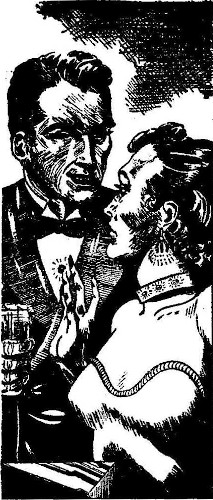
"Basically, I'm honest," said Thompson in a cheerful voice. "I bribed them well. Their known and accepted jobs were to sidetrack the un-heavenly twins. Both Ginger and Tanny swore that nothing short of open seduction would prevent them from leaving the aisle clear for my frontal attack."
"Hm-m-m—so Pat Kennebec was Target for Tonight?"
"Do you dislike me for being honest?"
"Is that honesty a cover for deeper dis—"
"Pat, please. Don't say it."
"Then what shall I say?"
"Tell me—did you like it?"
Patricia looked up at Billy Thompson. "Now I'm asking. Can you take it?"
"I can take it," said Billy. "Tell me to go and jump in the lake, if you want. I did what I did because—"
"Billy, it was rather nice."
"It—?"
"I liked it."
"Ah ... er—"
"Billy?"
"Yes?"
"Best you can do?"
The silence was significant. Kennebec, eavesdropping, swallowed deeply, and left quietly.
"Billy?"
"Patricia?"
"You always call me by my full name?"
"I like to hear it."
"Billy, what do we do now?"
"We do nothing. As far as I'm concerned, Patricia, we've just met. From here on, we do all we can to know one another better."
"I—"
The beer and sandwiches were growing warm.
"—won't be able to know—"
And it was getting later.
"—if you keep my eyes closed all the time."
Billy took a deep breath. "The better to keep you from finding out all about me, my dear."
She held his face back between her hands. "Do you realize?" she asked. The head between her hands shook. "You have really known me for less than ... than six hours. And you're making protestations—"
"You forget," he reminded her carefully, "that I'd been contemplating Patricia Kennebec for a long time. There are some things that are worth waiting for; things that require planning. I didn't know what the score would be at the end of this evening, Patricia, but I wanted so to find out. I've known you for a long time, Patricia. And, remember, little lady, that one need not fight bitterly for what he wants—sometimes it comes better if one bides his time and lets the fighters run themselves out of wind. From here, Patricia, let no man get in my way, lest he get his legs clipped out from under him."
"Supposing that I like him?" said Patricia.
"I'll only be fluffed off once," warned Billy. "There's one thing that I have that few other people have, Patricia. I can't really read minds, but I've discovered, ever since that little battle out there near Sscantoo, that I feel, and deeply, the truth of any man's feelings. But enough of that. We'll have time to quarrel later. Right now, Patricia—"
That night, the old adage died. The head that wore the crown of the Solar Combine slept like a kitten. And the only thing that bothered Co-ordinator Kennebec was that usual irrelevant wonder that crops up in the most trying of circumstances, though this was not trying, as circumstances go. Yet, Kennebec thought, it was like an hysteria almost; the unfunny joke that sends chief mourners off into gales of laughter. Incongruous and irrelevant, immaterial and inconsequential.
But why in the name of Sol didn't they go into the living room, and do their necking on the love seat where it belonged instead of sitting on the cook's tall stool in the kitchen?
XIII.
The scene at the proving grounds was a bustle of activity. In the center of the area stood a huge machine with a paraboloid reflector, pointing skyward on gimbals. Supporting the projector was a girdered and trussed platform, with tractor beams on each corner, pointing down to the center of Terra. Vast was the machine; no telescope in the Solar Combine was half as solid as the trunnions and bars that rigidized the setting of the relatively small, ten-foot bowl of the projector.
A line of portable telephone poles, strung with portable wiring, led from the housing below the projector. Off across the proving ground they went to a master-control office almost lost in the horizon and the haze.
But the projector would not be studied from the remote position. That was just a clearing house—a veritable telephone exchange—that fed terrestrial data from all of the research laboratories of Terra to the monster on the proving ground.
Inside the housing was Cliff Lane, directing the technical staff. There, too, was Linzete, the catman, brought back to Terra by Lane's doubly convincing mind. Linzete did not like primates; he avoided them and went out of his way to keep a two-foot clear space between himself and the primates as he moved around in the crowded housing.
The Terrans, warned beforehand, did their best to honor his dislike of them. They respected his preference in contact, though they, at this point, tended to use his mind and his experience as something presented to them. For they—and he—knew that their mental ability exceeded his and he was there only because his experience had been greater than theirs.
Out on the trestles and the catwalks of the machine stood Stellor Downing, directing the final touches of the monstrous mechanical system.
The operator called to Lane: "The sounding-boat is over the Mindanao Deep, sir. Ready and waiting."
"How's the terrestrial laboratory at Washington?"
"Ready for an hour. And Cal Tech has been chewing their fingernails for two hours."
"Call Downing and ask him how long?"
"Calling Stellor Downing—"
"On the roger," answered Downing, grabbing a phone from its rack on a catwalk.
"How much more greasing are you going to give that mecanno set?" asked Cliff.
"Oh, any time you're ready, we are."
"I know but—"
"Until the bell rings, we'll sort of pick curls of dust out of the bearings, put a drop of oil here and there, and see that the stuff is shiny—and as slippery as the devil."
The operator plugged into a ringing line. "Lane," he called after listening, "the crew just dropped the drone."
"Get the detector gang and tell 'em."
The operator unplugged and shoved the plug into another jack. He spoke, and listened for several minutes.
"Detector gang has picked up the drone," he announced to Lane.
"Ring the warning bell!"
The clangor of the warning bell shattered the air. Over the tactac of machinery and the rumble of heavy generators, it fell on waiting ears, and from all parts of the great projector there was a general rush to hit solid ground. A huge ring of men formed a hundred yards from the machine, and Downing entered the housing.
"Can we see better in here or out there?" he asked.
"In here," said Cliff. "The drone won't be within a ten light-sec range when we hit it. The celestial globe, here, has been juggled up to show both drone and projector. It's rough, but the lack of definition won't bother us. We can understand what's happening—and if it happens as we expect, we'll see it go blooey and be able to reconstruct the event. Stick around."
Linzete came and stood beside them. "I think the sawtooth is not of the proper shape," he suggested.
"Perhaps not," agreed Lane. "But to put any sharper break on it will require another high-power driver stage. I'm hoping it will be adequate."
"The recovery time may seem slow," added Downing. "But remember how much distance it controls."
Linzete nodded dubiously. He was not the type to argue. If these gadget-mad Terrans were going to ruin a second-rate ship on the first try, well, they'd find out soon enough. He hoped they had a stock of radio-controlled drones. They'd need them.
They had—and they probably would need them.
"On target!" came the cry.
Above, the platform swung around. The projector bobbled over in its gimbals and centered on something invisible in the blue sky. The tractor beams took hold invisibly and there was a grunting of the bearings as the whole mechanism anchored itself to the core of the planet.
Then the projector jumped perceptibly. It seemed to gather itself together and pounce. Then the system relaxed, apparently, for the tractor beams died and the bearings resumed their freedom.
Down in the housing, the celestial globe showed a small, outdated cruiser. Speed was apparently zero, for the globe and its detecting and scanning circuits was following it, mile for mile and second by second. A range and velocity computed below the globe gave the data: Nine light-sec range, velocity sixty-six MPS.
The cruiser faltered in flight and the scanners almost passed ahead of it. It faltered momentarily—that was during the time that the projector seemed to gather its energy. As the pounce came, something inside of the cruiser exploded very slowly. It expanded the cruiser slightly here and there; a plate blew off; five or six of the greenhouses shattered in puffs of mild fire; and then the cruiser staggered and continued on at a lower velocity.
"Send out the word," called Lane. "General coverage. That was the first shock."
Laboratories marked the time all over Terra. It would take hours for the shock—if any—to reach the antipodes. What Lane was more interested in was the report from Cal Tech, only a few hundred miles away.
"Linzete, you were right," said Lane. "It'll take time, and we'll need it. But—Hey! Fellows! Get the high-power stage rigged and see what can be done about increasing the sharpness of the sawtooth generator."
The period of waiting was filled with activity. The reports started to come in:
"Cal Tech reports very mild shock."
"Washington indicated almost zero—just a trace."
"O.K., we can stand it," said Lane. "How's the target?"
"Circling Terra. Radius seven light-sec. Velocity fifty-three MPS."
The projector was ready when the drone returned. Again the projector gathered itself together, and the pounce was quite visible. Beneath them, the ground shook violently, and the projector and its mighty platforms rattled in the bearings, held as they were by tractors to the core of Terra.
In the celestial sphere, the cruiser faltered again, and then exploded in a wild blast of sheer flame, white and violent. The radiating gases expanded, passed out of the scope of the scanner, and then the scanner fell away from the scene and roamed aimlessly across the sky, showing a mad whirling pattern of uninteresting stars.
"What happened?" asked Linzete.
"Main target blew up completely. Nothing massive to focus on, so the finders and scanners just roam at will. That's it, Stellor."
"Wait until we get the seismographic reports," cautioned the Martian. "Maybe we can blast a ship to bits at two million miles, but so what if California slides into the San Jacinto fault?"
"Well, there'll be no more attempts until the returns are all in from the labs," said Lane. "I'm taking no more chances." He turned to Linzete. "You'll want the plans, of course?"
The Sscantovian nodded. "I will not require the main circuits, of course. The snatcher portion is just an oversized version of our own invention. What I shall need is the details of the compressing sphere. We were content to tear a section out of the ship. You made a precision slicing operation out of it which pleased us greatly. But this problem of taking the spherical cut and actually compressing the matter inside—then releasing it instantly to create an atomic explosion is far beyond me. We can copy it, but no Sscantovian would ever hope to develop it from the facts here unless he had detailed plans. We—could not understand its operation."
"You did understand the main principle, though. You were the one who predicted that the release-time was not fast enough and suggested sharpening the sawtooth generator."
"One may make suggestions without understanding the whole process," purred Linzete. "Your weapon seems to be a success."
"We'll know that when the seismographic reports are all in. Hurling a beam of this kind, doing what we do, may well shake the planet's crust. We hope to extend our range to ten million miles, and we'll know if we can in a few months. If you have any deities, Linzete, you might burn a prayer to 'em."
It was thirty-six hours before the returns were all in. All along the fault-lines of Terra came reports of very mild temblors. Nowhere was there any severe slippage of Terra's crust: the seismographs could find no epicenters, the uncounted tons of rock, under unknown tons of pressure, had slid uniformly, creating a general, little shock.
And Lane grinned. "With little slippages," he said, "we may do away with all severe earthquakes. Releasing the crust-pressures before they build up to a disaster-quantity should help, not hinder. We might continue hitting small targets like this until the distribution of fault-pressures is even all over. Then we can swing the Big Beam."
"What I'm interested in at this point," said Downing, "is the countermeasures group. What if the Loard-vogh get this thing?"
"Billy says that they can't miss getting it eventually. And Billy also says that the countermeasures gang is working on another development. Has something to do with a similar gadget, only the sphere of force can be made to pierce the snatcher—or any other field of force—and remove smaller items inside. Sort of grab the stuff out from the contracting sphere and toss it outside. It might save a lot of the crew, especially since the atomic sphere is necessarily small."
Linzete purred and asked: "Couldn't you compress a whole section of the ship?"
Lane turned. "Billy says we could, but why? Takes that much more power, and the ultimate explosion would do little harm. This way we can grab a hunk the size of a baseball and make quite an atomic blowup out of it. Takes much less power, and the explosion is great."
"I think you'll find," offered Downing, "that it takes just as much power to wreck a ship by crushing it physically as it does to compress a small sphere and then let it explode."
"The atomic explosion takes more," said Lane.
"Then why?"
"Projector-size. We're getting away with swinging a ten-foot bowl around. If we wanted to inclose a whole ship, we'd require a paraboloid about forty times the longest diameter of the ship, just as the ten-foot bowl is forty times the diameter of the compressible sphere. And cutting a section out—well, that's the weapon we had before and decided against because it left a chance for a well-designed ship to lose a section and still carry on, or be repaired. Complete destruction is the only answer."
"In other words, the power input is greater, but the operational power—?"
"The overall power requirements of the atomic sphere projector are about even this way to just crumpling a ship."
"That's what I said," objected Downing.
"I thought you meant just the crushing factor. The difference is made up in the projector elements. Well, that's those. Billy says we can turn this over to the secondary crew, now."
"Then what?"
"I'm going to get six of these made up for each planet. We'll also mount some on the outer planets; and the colonials of Alpha, Procyon, and the rest."
Hotang Lu pounded the table with his little fist. "That weapon might have stopped them!" he snapped. "Why did you stop production?"
"Are you questioning my motives?" asked Thompson quietly.
"Yes!"
"Have you any doubts as to my loyalty?"
"I ... ah ... no."
"And you do not understand my intent?"
"No."
"He's not alone, Billy," put in Kennebec. "What do you intend to do?"
"The use of Terra's secret weapon is critical. It must be employed at exactly the opportune moment, and not one minute before and not one minute after. There must be, for psychological reasons you all know, a certain amount of normal, mine-run fighting before we employ our secret. But I do not want them to be defeated by our might and our weapons. That would be disastrous, for they would return in a few years, and they would return and return, until finally they succeeded in conquering us. We must fight this as I have planned, and when the time is exactly ripe, we shall employ our secret weapon and from that time on, there will be no more carnage, and the Loard-vogh will be conquered."
"When you're dealing with the Loard-vogh, there's no better way to skin a cat than to grab the skin at the neck and pull," scowled Downing. "Choking them to death with cream will not work. I spent three weeks there, remember, and I tell you, Billy, you can not temporize with them!"
Kennebec shook his head at Billy, "I wonder if your practice of getting what you want without fighting for it mightn't be carried too far."
"We are a million million in population," said Billy. "That's counting the Solar Combine plus the colonial outposts. This fight we're facing can not be won in another way. They outnumber us a million to one—think of that! To win, every Solarian must kill one million Loard-vogh! And that," he concluded bitterly, "makes us all come out even!"
"There isn't a man in this sector that wouldn't prefer to die protecting his own than to knuckle under Loard-vogh rule."
"I know—"
"Billy, I can not permit this order to continue," said Kennebec. "We must not permit them to take Terra!"
"Then you're overriding my order?"
"I am—and I pray that the procrastination isn't fatal."
Downing frowned. "Look, Billy, remember this: The Loard-vogh fear us as we are! Otherwise they would not be mobilizing against us. Despite the million-to-one ratio, they fear us and our heredity. We can and will win!"
"We'll win, never fear," said Billy. "But we'll win only if we play it properly."
"And properly means to fight with every weapon that we have."
"Spore bombs?"
"That's but one thing."
"They'll help—only to make the other trillion Loard-vogh mad. Douse a few planets and thousands of others will muster."
Billy Thompson thought for a moment and then answered: "Really, it makes little difference how we fight. We'll win anyway. Go ahead and build your gadgets."
He left, and Hotang Lu nodded. "I pray there is time left. Time to build smaller ones, too, that will fit the ships of the Solar Guard. Time to manufacture the necessary fighting equipment. Time to ... ah, always we are fighting time. I curse the lack of time."
And then the Tlemban added: "I am mystified. In my cosmos, if a secret weapon is worthy of use, it is worthy of use from the time it is discovered. I am puzzled—but then, I do not understand your secret weapon. It sounds foolish to me."
Kennebec spent the next three hours trying to make the Tlemban understand, and finally gave up.
XIV.
Lindoo strode into the presence of Vorgan, Lord of All, and handed an aide a scroll for the record. The Lord of All nodded and said nothing. Nor was there anything to say that had not been said previously. Any further discussion would be merely re-contemplation of ideas. The proof was four months off.
It would take four long months between this day—when Lindoo handed Vorgan's aide the scroll, giving the official date and time of I-second, when the invasion spearhead of the Loard-vogh blasted upward from the locus and headed for Sol—to the time when the first of the advance flight reached the Solar Sector.
Four months of just sheer waiting. Four months which the gadget-mad Terrans would use in preparation after the grand fleet of the Loard-vogh was a-space, and growing flight-weary.
Four months, full of intership bickerings and man-to-man fights because the quarters were too confined.
For the Loard-vogh were a quarrelsome race, and their fighting men trained to viciousness. It is not strange that with four months, cooped up in shells of steel, they should take to fighting among themselves. It was strictly against the regulations, of course, because the Lord of All wanted his fighting men to kill the enemy. Yet a fighting man will fight if he has nothing else to do, and for four long months there would be absolutely nothing to do. The Loard-vogh fighting man knew little else but battle. Trained from youth to be hard, vicious, and ruthless, he knew nothing of the art of killing time. Confinement made him more vicious when released, and the officers overlooked a given percentage of fights among the men. It was better that the ultimate viciousness be great than to have their men soft with other arts.
A goodly supply of other arts among the Loard-vogh would cause less casualties. Had they been mentally and physically trained to carve ivory, play chess, tie knots, or build spacecraft in bottles, their lives would have been less violent, including the madness with which they drove forward their attack.
Forward went the grand fleet. In the lead were the fleet fighter ships, and following them were the second wave craft. Third came the heavy supercraft, the backbone of the grand fleet of the Loard-vogh. A day behind came the mop-up transports, crammed to the space cocks with fighting men, their nerves already on edge after a short day or two of flight.
And bringing up the rear were the myriad upon myriad of supply ships, replacement carriers, machine-shop craft, and even space-going foundries. Heavy ships laden with munitions and generating equipment; craft that could anchor to the sunward side of an inner planet and hurl megawatt after megawatt of power to the fighting ships for their power-coffers. Huge—frameworks—with the equipment exposed to space. Planet docks for the repair of ships damaged in fight.
Forward drove this horde; forward into the Solar Sector. An all-conquering mass.
Silently and invisibly they sped in a long, cylindrical space pattern.
Object, Terra.
Not unmindful of danger, Sol was working furiously. Factories, their dies rusting the yard, were turning out parts for the atomic sphere. Dymodines fairly rattled off of production lines and were installed in the minor ships. Modines, the personal side-arm miniature of the dymodine, came with a rush down the production-line conveyors and slid into wrapping machines; were wrapped against all destructive, natural forces and then were packed in boxes for shipment.
Planet-mounted snatchers came to location by skytrain in parts and were assembled on the spot by skilled technicians.
The vast machines that generated the atomic sphere were being assembled and shipped to the several places. Here they went together, fitted bit by bit by machinists and technical men who worked furiously against time to complete the job before the Loard-vogh came.
They were many years building the original Palomar telescope, but this was war, and the techniques of fabrication had advanced since then. Perhaps the experience gained in that monstrous job—and in other mighty projects, some war-driven, some peace-measures—gave Sol the technical skill she needed. There would be no matter of years, this time. It was a matter of four very short months.
One hundred and twenty days. Just one small third of a year. And there is a saturation point in the manpower curve; just because one man can dig a well in sixty days, it is no sign that sixty men can dig the well in one day. They could, mathematically, but you can't get sixty men with shovels in a three-foot circle either mathematically or physically.
So time bore on relentlessly. Time that for the Loard-vogh seemed endlessly droning by was racing like fury for the laboring Terrans.
For at the same instant that Vorgan was groaning about the four-month wait, Thompson was complaining about the utter impossibility of getting anything done in four months.
What hurt Vorgan's sleep most of all was the fact that he feared that Terra knew of the imminent invasion.
Terra knew, and that spoiled their sleep, too.
But they did not tell Vorgan that they knew. If the Lord of All had known for certain, he would have slept better, for the uncertainty would have been removed.
For four long months, Vorgan's vicious crew of Loard-vogh warriors drove through space, and then they deployed in battle array. Their nerves tautened, and the personal fighting ceased, for the chances of battle with a legal enemy stayed their hands against their fellows.
They knew that they were approaching enemy territory. Their first glimpse of trouble would be a mushrooming blast in the sky—or even several simultaneous explosions.
The first that went up would be a deadly signal that near by, or dead ahead, their hated enemy was making his advance stand. That was the gamble. They each pinned their hopes on being the watcher. Let another ship go up in fire and flame. In this game, where no man could help another, none even considered the idea of wanting death in preference to another. For one man's life was exactly as good as any other man's at this point—for until the initial shock wave hit, neither was doing a thing.
They were on the offensive, the Loard-vogh. They were breaching a system that their leaders feared enough to break the Master Plan and send forth a full grand fleet to take this sector that lay more than a thousand light-years from the frontier of Loard-vogh conquest.
As the Loard-vogh was on the offensive, the first move had been taken—by them. The next move was up to Sol. And that retaliation would take place soon was not doubted by any man.
Fifty light-years from Sol they slowed and alerted. They wondered, those leaders of that invasion, when the blow would fall. Was it wiser to wait until the enemy was alert? To wait until the enemy was waiting for the first detector alarm seemed brash. The Loard-vogh method was to strike like a hidden snake, and beat the enemy to the ground before he knew what was waiting for him.
It made them nervous.
And a psychologist who had studied both the Loard-vogh and the Terran minds from a dispassionate standpoint made the observation that the Loard-vogh might have been better equipped to cope with a slashing surprise attack, but were completely baffled by the obvious foolishness of waiting.
Three days Terran went by, and the secondary waves of Loard-vogh came up, adding to the general confusion. Orders rang through space and the following waves of the grand fleet slowed so that utter confusion would not hamper their action.
Then, eight days after the first arrivals, and still with no attack, the Loard-vogh decided to move in another ten light-years. A star twinkled there. It had been this stellar outpost that the Loard-vogh feared. Their methods of defense would have been to arm every planet of this star with energy enough to reach three light-years into space and crush any oncomer. They were wise. They gave a three-times plus safety factor just because their Lord of All was afraid of Terra.
And they admitted that they, too, feared Terra.
With slow care, the spearhead moved forward. The grand fleet moved in waves once again. Slow, overcautious waves, and they worried all the way. They knew. They knew that it would come any minute now.
But nothing came at five light-years from the star. And at three light-years there was not a sign in their detector systems. A single light-year gave them the same indication, and they swarmed about the star—now a blazing sun, and searched the heavens about them for the sign of enemy activity. They gave the seven planets a wide berth, and would stay away until they were very certain—
So this was the feared and hated Solar Sector? Not even an outpost. Not a scout. Not a sign of activity!
The Loard-vogh took a deep breath and sighed in relief. And while they were letting their breath out, Sol struck—and hard!