PASSED BY THE CENSOR (continued 3)
Reading edition
The word "prepare" was always on his lips. His command of language is forcible, as his "orders of the day" have shown. In one of his early addresses to the students of the École Polytechnique, his closing words, uttered with a vigor that simply burned into the students, were: "May God forgive France if she is not ready."
And so when the war drums indeed began to roll—when a military régime was declared throughout France, and the politicians entered either into retirement or uniform—France suddenly learned that she had a regular czar on the job. The dismissal of five generals at maneuvers was not a patch on what was about to happen to the gold-laced brigade—after the battle of Charleroi, for instance. Joffre has retired so many generals that the public has lost track of the number. Usually he does it with an utterly disconcerting lack of comment or explanation. Only occasionally does he assign that General Blank has been dropped from active service "for reasons of health."
But he is just as quick with promotions. The brilliant de Maud'huy, for instance, who was only a brigade commander in the battle of the Marne, now commands an entire army.
I asked a high officer concerning the war councils at the "Grand Quartier General." His reply was brief. "The war council," he said, "is Joffre. He just tells everybody what to do—and they do it." That is Napoleonic enough, isn't it? Not even the President of France may go to the front without Joffre's permission—and if the Minister of War entered the zone of operations without a laisser-passer from the Grand Quartier General he would very likely be arrested. Only Joffre would call it "detention"—not arrest.
And as for journalists in that forbidden zone of operations—well—has not enough been written already concerning journalists going to jail? But even to journalists Joffre is entirely fair—only journalists must play the game according to Joffre's rules.
I happen to know that Joffre has a thoroughly organized press clipping bureau at the Ministry of War and every week marked papers—particularly those of neutral nations—are presented to him. One of my proud possessions is a letter that I received from an officer of this bureau stating that one of my cables to the New York Times had been favorably commented on by the Commander-in-Chief.
"Is this man a great military genius?" is still a question often asked—despite the fact that he has a hold on the army such as no man has had since Napoleon Bonaparte. The war is not over. The Germans are still in France. Nevertheless all military observers and critics with whom I have talked agree on one point. That is that the two weeks' retreat which culminated in the battle of the Marne showed Joffre to be a strategist of the very highest order. And any man who could direct the retreat of an army, especially a French army, for two weeks and so preserve that army's morale that he could then turn it around to victory, must have great qualities of genius.
Ever since, Joffre has given ample evidence of his quality as a master in the art of war, but he has forsaken the code of war known as the Napoleonic strategy which was in brief: "Go where your enemy does not expect you to go." Joffre knows perfectly well that in modern war, over such a vast front, such tactics are impossible; he knows that ninety-nine times out of one hundred your enemy, through his aeroplanes and spies, will know where you are going.
Joffre indicated his idea of modern strategy some months after the war began when he said, "I am nibbling at them." The nibbles have gradually become mouthfuls.
Joffre thinks all war is too useless for unnecessary sacrifice of men. He saves them all he can. That is why he would not send reenforcements when the Germans attacked in front of Soissons, in the presence of the Kaiser. The Germans were vastly superior in numbers at that point. The weather was frightful. Joffre figured that the French losses would be too heavy in a general battle there. He knew too that the swollen river Aisne would quite as effectively prevent a German advance. And it did. Joffre did not send reenforcements to Soissons in face of both appeals and public opinion.
Nothing moves him, when he is convinced that he is right. And a general of a combination of armies who doggedly does what he wants to do, whatever any one else thinks about it—who dismisses all opposition with a very quiet wave of the hand, as Joffre does, undoubtedly possesses an overpowering personality.
Joffre is the last man on earth to hold his enemy lightly. No man knows better than he how strong the Germans are. But he will keep up that steady hammering, first at this point—then at that point—then simultaneously all along the line, pressing them back one mile here and two miles there, until the German army is beaten and out of France. That is what has been going on now, although a large scale map is necessary to note just how steadily and how gradually the Germans have been pressed back everywhere by the advancing French wall of steel.
Let us go back a moment to that sunny August dawn of the beginning of the war. I said to my friend as we stood looking at the tomb of Napoleon Bonaparte: "I wonder what that man would do if he could come out of that block of granite and command this army?"
My friend replied:
"I think he would shut himself up in a room and read all night the history of all wars from his day to now. Then in the morning he would call in a few generals and hear them talk. After that he would take lunch with some manufacturers of arms and ammunition. He would take tea with some boss mathematicians and scientists. He might then go for a walk alone. By dinner, I believe he would be on to the job of modern military strategy and ready for work."
Whether General Joseph Joffre is the reincarnation of Napoleon Bonaparte, I am unable to even discuss. He is the perfect antithesis of the little Corsican in many ways, and he has tackled a bigger job than Bonaparte ever dreamed of. But the heart of a nation never beat more hopefully than that of the new and united France.
"When the war is over—and if Joffre is the conqueror—what will he do then?"—is another question asked nowadays. I have heard it remarked that private life with comparative oblivion may not be easy for the great military hero who now has both a Belgian king and a British field marshal taking his orders.
And I have already heard comment on what a great show Paris will have when the war is over—how the Grand Army of France headed by Father Joffre will march under the Arch of Triumph and down the Champs-Elysées—while the applauding world looks on.
Perhaps so. I do not know. I have already said that two things Joffre loves best in all the world, next to his family, are peace and fishing. I have a private suspicion that once peace is declared, Father Joffre may turn his back upon Paris and go fishing.
CHAPTER XIV
THE MAN OF THE MARNE AND THE YSER
It was a drippy day—a day when winter overcoats were uncomfortable but necessary to protect against a wind that swept over the plateau of Artois. A party of newspapermen were beginning a war-corresponding de luxe program arranged by the French war office. The Paris-Boulogne express had been commanded to stop at Amiens, where limousines were waiting in charge of an officer of the Great General Staff.
I knew Amiens of old. As an ambulance driver at the beginning of the war, when the unpopularity of correspondents reached the maximum, I had brought wounded to the Amiens hospitals. So I knew the roads in all directions.
I pushed the raindrops from the automobile window. We were not going in the direction of the battle lines but parallel with them, and then bending into a road toward the rear. I communicated this intelligence to my companions. One of them, an old-timer, yawned and said:
"Oh, it is usually this way on the first day of a trip. We are probably on the way to visit some general. It takes a lot of time but we must act as though we liked it."
"But if the general is a Somebody, it will be worth while, especially if we can interview," suggested another.
"We cannot," the old-timer said composedly, "and he probably will not be a Somebody. This is a long battle line. They have a lot of generals. We are probably calling on only a general of brigade. It is possible that we will not remember his name. He will tell us that we are welcome. It is a drawback of modern war corresponding, especially if he invites us to dinner."
"Why, what would be the matter with that?"
"The dinner will be excellent," was the answer. "The dinner of a general begins with hors d'œuvres and ends with cordials—two or three different brands. There will be speeches and there will be no visit to the trenches—there will be no time."
There was no response and our car sloshed along in the rain.
We stopped before a little red brick cottage set back from the road in the midst of a grove of pines. A gravel walk led to the steps of a small square veranda where a sentry stood at salute. We were in the country. No other houses were near.
A young lieutenant ran down the walk and greeted us.
"I don't know how you will be received inside," was his strange utterance. "He said he wanted to see you. That is why we sent word to Amiens. But it doesn't matter whether you are journalists or generals. He treats all comers the same—that is, just according to how he feels. He will either talk to you or he will expect you to do all the talking. I just wanted to tell you in advance to expect anything."
I climbed out of the car, wondering. I followed the young lieutenant into the building. I stood with the others in a little reception hall where an orderly took our hats and coats. Facing us was a door. On it was pinned a white page torn from an ordinary writing pad. Scrawled in ink, were the words, "Bureau du Général."
The party was curiously silent. I felt that this visit to a general would be different from anything I had experienced before. We all became a little restless and nervous. I turned toward a table near the wall. On it was a French translation of Kipling's "Jungle Book." I picked it up thinking how curious it was to find such a book at the headquarters of a general. I gasped with surprise as I saw the name of the general written on the first page.
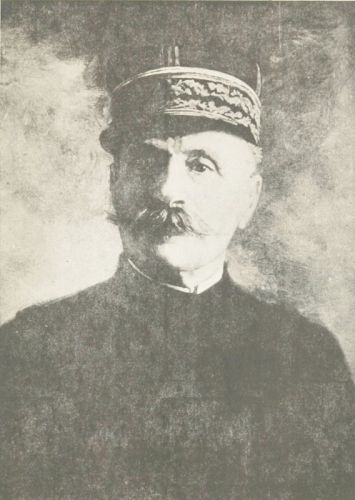
GENERAL FOCH "The Man of the Marne and the Yser"
A buzzer sounded and an orderly bounded in from the veranda, threw open the door marked with the white writing page, turned to us, saying, "Entrez, Messieurs."
We entered a large room with many windows, all hung with dainty white lace. Despite the gloomy day the room seemed sunny, for there were at least a dozen vases filled with yellow flowers. Between two dormer windows opening upon a garden was stretched a great yellow map, dotted with lines and stuck all over with tiny tricolored flags. Before this map and studying it closely, with his back half turned toward us, stood a little man. A thick stump of unlighted cigar was between his teeth. His shoulders were thrown back, his hands clutched tightly behind him. He wore the full uniform of a general, with long cavalry boots and spurs. At the sound of our entrance, he swung about dramatically, on one heel. We caught sight of the Grand Cross of the Legion of Honor blazing on his breast. He wore no other decorations, and I noted the absence of a sword. The light fell full upon his handsome, but ravaged and aging face. The memory of all that I had heard about him raced across my mind in the short time before I felt him seize my hand, saw his blue eyes boring into mine, heard him asking questions and stating facts directly to me. For this was the man who sent the famous message to General Joffre at the critical moment of the battle of the Marne, that inasmuch as his left was crushed and his right thrown back, he proposed to attack with his center. This was the man who later stemmed the German tide at the Yser, and saved Calais and the Channel ports. This was the man who has ever since commanded the Group of Armies of the North, Belgian, English and French, driving the enemy inch by inch through the Labyrinth and out of Artois. This man, the dashing beau ideal of the French army, the great strategist of the École de Guerre, the nearest of all Frenchmen to approach the "man on horseback" picture of the military hero, this man who was talking to me, and frankly telling me of important things was General Foch.
I found myself answering his questions mechanically. I told him the name of the paper that I represented, also that this was my third visit to the battle front in Artois.
"Ah, yes. I know your paper," he said. "I read it. It has been one of the great forums for the discussion of the war. You have printed both sides of the question."
"But we are in favor of the Allies!" I interrupted.
"I know that also—that is why you have come a third time to Artois."
The next correspondent in the line was a Spaniard. Foch eyed him for a moment. "I know you," he said. "I met you in Madrid six years ago." The correspondent bowed with amazement at the general's memory. He passed along the line, shaking hands. He stopped before a tall Dutchman, the representative of a paper in Amsterdam.
"Ho! Ho!—the big representative of a little nation." The Dutchman was poked in the ribs with the genial index finger of the General's right hand. "Don't you know that if Germany wins, your country will be swallowed up? You have developed a great commerce and valuable industries. Germany will never be your friend. As of old, the big fish will eat the little one." Then he swung back down the line, in my direction.
"You have already been twice on my battle front. You have seen a great difference between the first and second trips. You will see another great change now. Perhaps you will come here still again—for the last great offensive,—in Artois."
"What do you mean, mon general?" I asked.
The little man was silent for a moment, chewing the end of his cigar and looking steadily, first at one and then at another of us. I shall never forget his words. They revealed the cardinal necessity for waging modern war.
"We have shown," he said slowly, "that we can go through them any time we like. The great need is shells. The consumption of shells during the last offensive was fantastic. But still we did not shoot enough." He stopped, then said still more slowly: "The next time we will shoot enough."
"And then, mon general?" asked the Spaniard. "And then?"
"And then," Foch replied, "and then we shall keep on advancing, and the Germans will have to go away."
He again swung dramatically on his heel, until his back was turned to us. "Au revoir, Messieurs," he said, and as we filed silently and somewhat dazedly from the room, he was again standing before the huge map, chewing the cigar, his shoulders thrust back, and his hands clasped tightly behind him.
The young lieutenant climbed into our car. He explained that the general had delegated him to the party. He went with us through the trenches on succeeding days and said good-by only when we took the train for Paris. He was a brilliant young officer and before the war had been a foreign correspondent for Le Temps. For that great newspaper he had "covered" campaigns in Asia and Africa. Now he explained that he was to be official historian of the campaigns of General Foch.
"I am the latest comer on his staff," the lieutenant said, "so there was not much room for me and he has given me a holiday with you. He has not a large staff, but the house as you see is very little. So I have the room that a baby occupied before the war." The young man smiled and looked down at his stalwart frame. "There was only a little cot and a rocking horse in the room. I sleep on the floor. I shall keep the cot for the baby."
This conversation took place on the last day of our trip, amidst the ruins of Arras. The lieutenant talked continually of his general. He explained how the general had told him in detail, and illustrated by making a plan with matches, the great movement of troops during the battle of the Marne that started the German retreat.
"The general broke all his own rules of war," he explained; "all those rules that he taught so long in the École de Guerre. He moved an entire division—half of the famous Forty-second Corps, while it was under fire—he stretched out the remainder of the corps in a thin line across its place, and moved the division behind his entire army, then flung them against the Prussian Guard as it was beginning the attack on the center. The moving of troops already engaged with the enemy had never been done in any war before."
"But he staked his whole reputation—his military career on it?" I asked.
The Lieutenant smiled. "Oh, yes," he replied, "but after he gave the order, he went for a long walk in the country with a member of his staff, who told me afterwards that not once was the war mentioned, and they were gone three hours. All that time they talked about Spanish art and Spanish music. When they returned to headquarters, the general merely asked if there was any news, knowing well that perhaps he might hear news which would make his name hated forever. He was told the tide had turned and we were winning the battle. He merely grunted and lighted a fresh cigar."
We all remained silent and then a number of desultory questions were asked about the position of the troops. The lieutenant again explained with matches. "The general showed it to me with matches, as I have already shown." He spoke reverently, his voice almost a whisper. "And I have those matches that the general used."
In Arras there was just one house left where we could take luncheon—a fine old mansion belonging to a friend of our guide from the Great General Staff. We brought our food and soldiers served it in a stately room with a massive beamed ceiling and stags' antlers decorating the walls. A tapestry concealed one wall. The officer pulled it aside to show that we sat in only half a room; the other half had been entirely destroyed by shells. From the cellar an orderly brought some of the finest burgundy in France. There was a piano in one corner of the room. When coffee was served, our Captain sat at the instrument and played snatches of Schubert, Mozart and Beethoven.
The discussion at the table turned to music. At the same moment a shell burst a few hundred yards down the street.
"Play Wagner," some one asked.
A member of our party who had been in Russia said:
"Do you permit German music? In Russia it is forbidden."
The officer replied:
"How stupid! Things which are beautiful remain beautiful," and he played an air from "Tristan" as a shell went screaming overhead.
The young lieutenant, handsome and debonair, turned to me:
"This is fine," he said. "Here we are in the last house in Arras where this scene is possible, and perhaps to-morrow this place will all be gone—perhaps in ten minutes." He laughed and the piano was silenced by the explosion of another shell.
We climbed into our automobiles and hurried out of town along a road in plain sight of the German guns. I thought of what General Foch had said: "We can go through them any time we desire." I got out my military map and looked at the German line, slipping gradually from the plateau of Artois into the plain of Douai—the plain that contains Lens, Douai and Lille and sweeps away across the frontier of Belgium. That was the place to which General Foch referred when he said the Germans "must keep on going away." I turned to an officer beside me in the car. I said: "When the French guns are sweeping that plain it means the end of the Germans in Northern France?" He smiled and nodded, while I offered a silent prayer that on that day I might be permitted by the military authorities to make my fourth visit to Artois, to see the decisive victory of French arms that I believe will take place there under the command of General Foch, and that will help largely to bring this war to a close.
CHAPTER XV
THE BATTLE OF THE LABYRINTH
This is a story about what, in the minds of the French military authorities, ranks as the greatest battle in the western theater of operations, following the battle of the Marne.
So far as I know the battle has never received an official name. The French communiqués have always vaguely referred to it as "operations in the sector north of Arras."
I cannot minutely describe the conflict; no one can do that now. I can, however, tell what I saw there when the Ministry of War authorized me to accompany a special mission there, to which I was the only foreigner accredited. I purpose to call this struggle the Battle of the Labyrinth, for "labyrinth" is the name applied to the vast system of entrenchments all through that region, and from which the Germans have been literally blasted almost foot by foot by an extravagant use of French melinite. This battle was of vital importance because a French defeat at the Labyrinth would allow the Germans to sweep clear across Northern France, cutting off all communication with England.
The battle of the Labyrinth really began in October, 1914, when General de Maud'huy stopped the Prussian Guard before Arras with his motley array of tired territorials, whom he had gathered together in a mighty rush northward after the battle of the Marne. These crack Guards regiments afterward took on the job at Ypres, while the Crown Prince of Bavaria assumed the vain task of attempting to break de Maud'huy's resistance and cut a more southward passage to the sea.
All winter de Maud'huy worried him, not seeking to make a big advance, but contenting himself with the record of never having lost a single trench. With the return of warm weather, just after the big French advance in Champagne, this sector was chosen by Joffre as the place in which to take the heart out of his enemy by the delivery of a mighty blow.
The Germans probably thought that the French intended to concentrate in the Vosges, as next door to Champagne; so they carted all their poison gases there and to Ypres, where their ambition still maintains ascendency over their good sense. But where the Germans think Joffre is likely to strike is usually the place furthest from his thoughts. Activities in the Arras sector were begun under the personal command and direction of the Commander-in-Chief.
I doubt whether until the war is over it will be possible adequately to describe the battle, or rather, the series of battles extending along this particular front of about fifty miles. "Labyrinth" certainly is the fittest word to call it. I always had a fairly accurate sense of direction; but, it was impossible for me, standing in many places in this giant battlefield, to say where were the Germans and where the French, so confusing was the constant zigzag of the trenches. Sometimes when I was positive that a furious cannonade coming from a certain position was German, it turned out to be French. At other times, when I thought I was safely going in the direction of the French, I was hauled back by officers who told me I was heading directly into the German line of fire. I sometimes felt that the German lines were on three sides, and often I was quite correct. On the other hand, the French lines often almost completely surround the German positions.
One could not tell from the nearness of the artillery fire whether it was from friend or foe. Artillery makes three different noises; first, the sharp report followed by detonations like thunder, when the shell first leaves the gun; second, the rushing sound of the shell passing high overhead; third, the shrill whistle, followed by the crash when it finally explodes. In the Labyrinth the detonations which usually indicated the French fire might be from the German batteries stationed close by but unable to get our range, and firing at a section of the French lines some miles away. I finally determined that when a battery fired fast it was French; for the German fire became more intermittent every day.
I shall try to give some idea of what this fighting looks like. Late one afternoon, coming out of a trench into a green meadow, I suddenly found myself backed against a mud-bank made of the dirt taken from the trenches. We were just at the crest of a hill. In khaki clothes I was of the same color as the mud-bank; so an officer told me I was in a fairly safe position.
Modern war becomes a somewhat flat affair after the first impressions have been dulled.
We blotted ourselves against our mud-bank, carefully adjusted our glasses, turned them toward the valley before us, whence came the sound of exploding shells, and watched a village dying in the sunset. It was only about a thousand yards away—I didn't even ask whether it was in French or German possession. A loud explosion, a roll of dense black smoke, penetrated at once by the long, horizontal rays of sun, revealing tumbling roofs and crumbling walls. A few seconds' intermission; then another explosion; a public school in the main street sagged suddenly in the center. With no pause came a succession of explosions, and the building was prone upon the ground—a jagged pile of broken stones.
We turned our glasses on the other end of the village. A column of black smoke was rising where the church had caught fire. We watched it awhile in silence. Ruins were getting very common. I swept the glasses away from the hamlet altogether and pointed out over the distant fields to the left.
"Where are the German trenches?" I asked the Major.
"I'll show you—just a moment!" he answered, and at the same time signaling to a soldier squatting in the entrance to a trench near by, he ordered the man to convey a message to the telephone station, which connected with a "seventy-five" battery at our rear. I was on the point of telling the officer not to bother about it. The words were on my lips; then I thought: "Oh, never mind! I might as well know where the trenches are, now that I have asked."
The soldier disappeared. "Watch!" said the officer. We peered intently across the fields to the left. In less than a minute there were two sharp explosions behind us, two puffs of smoke out on the horizon before us, about a mile away.
"That's where they are!" the officer said. "Both shells went right into them!"
Away to the right of the village, now reduced to ruins, was another larger village; we squared around on our mud bank to look at that. This town was more important; it was Neuville-Saint-Vaast, which was occupied by both French and Germans, the former slowly retaking it, house by house. We were about half a mile away. We could see little; for strangely, in this business of house-to-house occupation, most of the fighting is in the cellars. But I could well imagine what was going on, for I had already walked through the ruins of Vermelles, another town now entirely in French possession, but taken in the same fashion after two months' dogged inch-by-inch advances.
So, when, looking at Neuville-Saint-Vaast, I suddenly heard a tremendous explosion and saw a great mass of masonry and débris of all descriptions flying high in the air, I knew just what had happened. The French—for it is always the French who do it—had burrowed, sapped and dug themselves laboriously, patiently, slowly, by torturous, narrow underground routes from one row of houses under the foundations of the next row of houses. There they had planted mines. The explosion I had just witnessed was of a mine. Much of the débris I saw flying through space had been German soldiers a few seconds before.
Before the smoke died away we heard a savage yell. That was the French cry of victory; then we heard a rapid cracking of rifles. The French had evidently advanced across the space between the houses to finish the work of their mine. When one goes to view the work of these mines afterward all that one sees is a great round, smooth hole in the ground—sometimes 30 feet deep, often twice that in diameter. Above it might have been either a château or a stable; unless one has an old resident for guide it is impossible to know.
It takes many days and nights to prepare these mines. It takes correct mathematical calculation to place them. It takes morale, judgment, courage, and intelligence—this fighting from house to house. And yet the French are called a frivolous people!
A cry from a soldier warned us of a German aeroplane directly overhead; so we stopped gazing at Neuville-Saint-Vaast. A French aeroplane soon appeared, and the German one made off rapidly. They usually do, as most German war planes are too light to carry anything but rifles and bombs; French machines, while slower, all have mitrailleuses. A fight between them is unequal, and the inequality is not easily overcome.
Four French machines were now circling above, and the German batteries opened fire on them. It was a beautiful sight. There was not a cloud in the sky, and the sun had not yet gone. We could not hear the shells explode, but little feathery white clouds suddenly appeared as if some giant invisible hand had just put them there—high up in the sky. Another appeared; then another. Several dozen little white clouds were vividly outlined against the blue before the French machines, all untouched, turned back to their own lines.
The soldier with us suddenly threw himself face down on the ground; a second after a German shell tore a hole in the field before us, less than a hundred yards away. I asked the officer if we had been seen, and if they were firing at us. He said he did not think so, but we had perhaps better move. As a matter of fact, they were hunting the battery that had so accurately shown us their trenches a short time before.
Instead of returning to the point where we had left our motors by the trench, we walked across an open field in a direction which I thought was precisely the wrong one. High above us, continually, was a rushing sound like giant wings. Occasionally, when a shell struck near us, we heard the shrill whistling sound, and half a dozen times in the course of the walk great holes were torn in our field. But artillery does not cause fear easily; it is rifles that accomplish that. The sharp hissing of the bullet resembles so much the sound of a spitting cat, seems so personal—as if it was intended just for you.
Artillery is entirely impersonal; you know that the gunners do not see you; that they are firing by arithmetic at a certain range; that their shell is not intended for any one in particular. So you walk on, among daisies and buttercups. You calculate the distance between you and the bursting shell. You somehow feel that nothing will harm you. You are not afraid; and if you are lucky, as we were, you will find the automobiles waiting for you just over there beyond the brow of the hill.
CHAPTER XVI
"WITH THE HONORS OF WAR"
It was just dawn when I got off a train at Gerbéviller, the little "Martyr City" that hides its desolation as it hid its existence in the foothills of the Vosges.
There was a dense fog. At 6 A.M. fog usually covers the valleys of the Meurthe and Moselle. From the station I could see only a building across the road. A gendarme demanded my credentials. I handed him the laisser-passer from the Quartier Général of the "First French Army," which controls all coming and going, all activity in that region. The gendarme demanded to know the hour when I proposed to leave. I told him. He said it would be necessary to have the permit "viséd for departure" at the headquarters of the gendarmerie. He pointed to the hazy outlines of another building just distinguishable through the fog.
This was proof that the town contained buildings—not just a building. The place was not entirely destroyed, as I had supposed. I went down the main street from the station, the fog enveloping me. I had letters to the town officials, but it was too early in the morning to present them. I would first get my own impressions of the wreck and ruin.
But I could see nothing on either hand as I stumbled along in the mud. So I commented to myself that this was not as bad as some places I had seen. I thought of the substantial station and the buildings across the road—untouched by war. I compared Gerbéviller with places where there is not even a station—where not even one house remains as the result of "the day when the Germans came."
The road was winding and steep, dipping down to the swift little stream that twists a turbulent passage through the town. The day was coming fast but the fog remained white and impenetrable. After a few minutes I began to see dark shapes on either side of the road. Tall, thin, irregular shapes, some high, some low, but with outlines all softened, toned down by the banks of white vapor.
I started across the road to investigate and fell across a pile of jagged masonry on the sidewalk. Through the fog I could see tumbled piles of bricks. The shapes still remained—specters that seemed to move in the light from the valley. An odor that was not of the freshness of the morning assailed me. I climbed across the walk. No wall of buildings barred my path, but I mounted higher on the piles of brick and stones. A heavy black shape was now at my left hand. I looked up and in the shadow there was no fog. I could see a crumbled swaying side of a house that was. The odor I noticed was that caused by fire. Sticking from the wall I could see the charred wood joists that once supported the floor of the second story. Higher, the lifting fog permitted me to see the waving boughs of a tree that hung over the house that was. At my feet, sticking out of a pile of bricks and stones, were the twisted iron fragments of a child's bed. I climbed out into the sunshine.
I was standing in the midst of a desolation and a silence that were profound. There was nothing there that lived, except a few fire-blacked trees that stuck up here and there in the shelter of broken walls. Now I understood the meaning of the spectral shapes. They were nothing but the broken walls of the other houses that were. They were all that remained of nine-tenths of Gerbéviller.
I wandered along to where the street turned sharply. There the ground pitched straight to the little river. Half of a house stood there, unscathed by fire; it was one of those unexplainable freaks that often occur in great catastrophes. Even the window glass was intact. Smoke was coming from the chimney. I went to the opposite side and there stood an old woman looking out toward the river, brooding over the ruin stretching below her.
"You are lucky," I said. "You still have your home."
She turned a toothless countenance toward me and threw out her hands. I judged her to be well over seventy. It wasn't her home, she explained. Her home was "là-bas"—pointing vaguely in the distance. She had lived there fifty years—now it was burned. Her son's house, he had saved thirty years to be able to call it his own, was also gone; but then her son was dead, so what did it matter? Yes, he was shot on the day the Germans came. He was ill, but they killed him. Oh, yes, she saw him killed. When the Germans went away she came to his house and built a fire in the stove. It was very cold.
And why were the houses burned? No; it was not the result of bombardment. Gerbéviller was not bombarded until after the houses were burned. They were burned by the Germans systematically. They went from house to house with their torches and oil and pitch. They did not explain why they burned the houses, but it was because they were angry.
The old woman paused a moment, and a faint flicker of a smile showed in the wrinkles about her eyes. I asked her to continue her story.
"You said because they were angry," I prompted. The smile broadened. Oh, yes, they were angry, she explained. They did not even make the excuse that the villagers fired upon them. They were just angry through and through. And it was all because of those seventy-five French chasseurs who held the bridge.
Some one called to her from the house. She hobbled to the door. "Any one can tell you about the seventy-five chasseurs," she said, disappearing within.
I went on down the road and stood upon the bridge over the swift little river. It was a narrow, tiny bridge only wide enough for one wagon to pass. Two roads from the town converged there, the one over which I had passed and another which formed a letter "V" at the junction with the bridge. Across the river only one road led away from the bridge and it ran straight up a hill, when it turned suddenly into the broad national highway to Lunéville, about five miles away.
One house remained standing at the end of the bridge, nearest the town. Its roof was gone, and its walls bore the marks of hundreds of bullets, but it was inhabited by a little old man of fifty, who came out to talk with me. He was the village carpenter. His house was burned, so he had taken refuge in the little house at the bridge. During the time the Germans were there he had been a prisoner, but they forgot him the morning the French army arrived. Everybody was in such a hurry, he explained.
I asked him about the seventy-five chasseurs at the bridge.
Ah, yes, we were then standing on the site of their barricade. He would tell me about it, for he had seen it all from his house half way up the hill.
The chasseurs were first posted across the river on the road to Lunéville, and when the Germans approached, early in the morning, they fell back to the bridge, which they had barricaded the night before. It was the only way into Gerbéviller, so the chasseurs determined to fight. They had torn up the street and thrown great earthworks across one end of the bridge. Additional barricades were thrown up on the two converging streets, part way up the hill, behind which they had mitrailleuses which could sweep the road at the other end of the bridge.
About a half mile to the south a narrow footbridge crossed the river, only wide enough for one man. It was a little rustic affair that ran through the grounds of the Château de Gerbéviller, which faced the river only a few hundred yards below the main bridge. It was a very ancient château, built in the twelfth century and restored in the seventeenth century. It was a royal château of the Bourbons. In it once lived the great François de Montmorency, Duc de Luxembourg and Marshal of France. Now it belonged to the Marquise de Lamberty, a cousin of the King of Spain.
I interrupted, for I wanted to hear about the chasseurs. I gave the little old man a cigarette. He seized it eagerly—so eagerly that I also handed him a cigar. He fondled that cigar for a moment and then placed it in an inside pocket. It was a very cheap and very bad French cigar, for I was in a part of the country that has never heard of Havanas, but to the little old man it was something precious. "I will keep it for Sunday," he said.
I then got him back to the seventy-five chasseurs. It was just eight o'clock in the morning—a beautiful sunshiny morning—when the German column appeared around the bend in the road which we could see across the bridge, and which joined the highway from Lunéville. There were twelve thousand in that first column. One hundred and fifty thousand more came later. A band was playing "Deutschland über Alles," and the men were singing. The closely-packed front ranks of infantry broke into the goose step as they came in sight of the town. It was a wonderful sight; the sun glistened on their helmets; they marched as though on parade right down almost to the opposite end of the bridge.
Then came the command to halt. For a moment there was a complete silence. The Germans, only a couple of hundred yards from the barricade, seemed slowly to consider the situation. The Captain of the chasseurs, from a shelter behind the very little house that was still standing—and where his men up the two roads could see him—softly waved his hand.
Crack-crack-crack-crack-crack-crack-crack-crack-crack! The bullets from the mitrailleuses whistled across the bridge into the front ranks of the "Deutschland über Alles" singers, while the men behind the bridge barricade began a deadly rifle fire.
Have you ever heard a mitrailleuse? It is just like a telegraph instrument, with its insistent clickety click-click-click, only it is a hundred times as loud. Indeed I have been told by French officers that it has sometimes been used as a telegraph instrument, so accurately can its operator reel out its hundred and sixty shots a minute.
On that morning at the Gerbéviller barricade, however, it went faster than the telegraph. These men on the converging roads just shifted their range slightly and poured bullets into the next ranks of infantry and so on back along the line, until Germans were dropping by the dozen at the sides of the straight little road. Then the column broke ranks wildly and fled back into the shelter of the road from Lunéville.
A half hour later a detachment of cavalry suddenly rounded the corner and charged straight for the barricade. The seventy-five were ready for them. Some of them got half way across the bridge and then tumbled into the river. Not one got back around the corner of the road to Lunéville.
There was another half hour of quiet, and then from the Lunéville road a battery of artillery got into action. Their range was bad, so far as any achievement against the seventy-five was concerned, so they turned their attention to the château, which they could easily see from their position across the river. The first shell struck the majestic tower of the building and shattered it. The next smashed the roof, the third hit the chapel—and so continued the bombardment until flames broke out to complete the destruction.
Of course the Germans could not know that the château was empty, that its owner was in Paris and both her sons fighting in the French army. But they had secured the military advantage of demolishing one of the finest country houses in France, with its priceless tapestries, ancient marbles and heirlooms of the Bourbons. A howl of German glee was heard by the seventy-five chasseurs crouching behind their barricades. So pleased were the invaders with their achievement that next they bravely swung out a battery into the road leading to the bridge, intending to shell the barricades. The Captain of chasseurs again waved his hand. Every man of the battery was killed before the guns were in position. It took an entire company of infantry—half of them being killed in the action—to haul those guns back into the Lunéville road, thus to clear the way for another advance.
From then on until 1 o'clock in the afternoon there were more infantry attacks, all failing as lamentably as the first. The seventy-five were holding off the 12,000. At the last attack they let the Germans advance to the entrance of the bridge. They invited them with taunts to advance. Then they poured in their deadly fire, and as the Germans broke and fled they permitted themselves a cheer. Up to this time not one chasseur was killed. Only four were wounded.
Shortly after 1 o'clock the German artillery wasted a few more shells on the ruined château and the chasseurs could see a detachment crawling along the river bank in the direction of the narrow footbridge that crossed through the château park a half mile below. The Captain of the chasseurs sent one man with a mitrailleuse to hold the bridge. He posted himself in the shelter of a large tree at one end. In a few minutes about fifty Germans appeared. They advanced cautiously on the bridge. The chasseur let them get half way over before he raked them with his fire. The water below ran red with blood.
The Germans retreated for help and made another attack an hour later with the same result. By 4 o'clock, when the lone chasseur's ammunition was exhausted, it is estimated that he had killed 175 Germans, who made five desperate rushes to take the position, which would have enabled them to make a flank attack on the seventy-four still holding the main bridge. When his ammunition was gone—which occurred at the same time as the ammunition at the main bridge was exhausted—this chasseur with the others succeeded in effecting a retreat to a main body of cavalry. If he still lives—this modern Horatius at the bridge—he remains an unnamed hero in the ranks of the French army, unhonored except in the hearts of those few of his countrymen who know.
During the late hours of the afternoon aeroplanes flew over the chasseurs' position, thus discovering to the Germans how really weak were the defenses of the town, how few its defenders. Besides the ammunition was gone. But for eight hours—from eight in the morning until four in the afternoon—the seventy-five had held the 12,000.
Had that body of 12,000 succeeded earlier the 150,000 Germans that advanced the next day might have been able to fall on the French right flank during a critical battle of the war. The total casualties of the chasseurs were three killed, three captured, and six wounded.
The little old man and I had walked to the entrance of the château park before he finished his story. It was still too early for breakfast. I thanked him and told him to return to his work in the little house by the bridge. I wanted to explore the château at leisure.
I entered the place—what was left of it. Most of the walls were standing. Walls built in the twelfth century do not break easily, even with modern artillery. But the modern roof and seventeenth century inner walls were all demolished. Not a single article of furniture or decoration remained. But the destruction showed some of the same freaks—similar to that little house left untouched by fire on the summit of the hill.
For instance, the Bourbon coat of arms above the grand staircase was untouched, while the staircase itself was just splintered bits of marble. On another fragment of the wall there still hung a magnificent stag's antlers. Strewed about in the corners I saw fragments of vases that had been priceless. Even the remnants were valuable. In the ruined music room I found a piece of fresh, clean music (an Alsatian waltz), lying on the mantelpiece. I went out to the front of the building, where the great park sweeps down to the edge of the river. An old gardener in one of the side paths saw me. We immediately established cordial relations with a cigarette.
He told me how, after the chasseurs retreated beyond the town, the Germans—reduced over a thousand of their original number by the activities of the day—swept over the barricades of the bridge and into the town. Yes, the old woman I had talked with was right about it. They were very angry. They were ferociously angry at being held eight hours at that bridge by a force so ridiculously small.
The first civilians they met they killed, and then they began to fire the houses. One young man, half-witted, came out of one of the houses near the bridge. They hanged him in the garden behind the house. Then they called his mother to see. A mob came piling into the château headed by four officers. All the furniture and valuables that were not destroyed they piled into a wagon and sent back to Lunéville. Of the gardener who was telling me the story they demanded the keys of the wine cellars. No; they did not injure him. They just held him by the arms while several dozen of the soldiers spat in his face.
While the drunken crew were reeling about the place, one of them accidentally stumbled upon the secret underground passage leading to the famous grottoes. These grottoes and the underground connection of the château were built in the fifteenth century. They are a half mile away, situated only half above ground, the entrance looking out on a smooth lawn that extends to the edge of the river. Several giant trees, the trunks of which are covered with vines, half shelter the entrance, which is also obscured by climbing ivy. The interior was one of the treasures of France. The vaulted ceilings were done in wonderful mosaic; the walls decorated with marbles and rare sea shells. In every nook were marble pedestals and antique statuary, while the fountain in the center, supplied from an underground stream, was of porphyry inlaid with mosaic.
The Germans looked upon it with appreciative eyes. But they were still very angry. Its destruction was a necessity of war. It could not be destroyed by artillery because it was half under ground and screened by the giant trees. But it could be destroyed by picks and axes. A squad of soldiers was detailed to the job. They did it thoroughly. The gardener took me there to see. Not a scrap of the mosaic remained. The fountain was smashed to bits. A headless Venus and a smashed and battered Adonis were lying prone upon the ground.
The visitors of the château and environs afterward joined their comrades in firing the town. Night had come. Also across the bridge waited the 150,000 reenforcements, come from Lunéville. The five hundred of the two thousand inhabitants who remained were herded to the upper end of the town near the station. That portion was not to be destroyed because the German General would make his headquarters there.
The inhabitants were to be given a treat. They were to witness the entrance of the hundred and fifty thousand—the power and might of Germany was to be exhibited to them. So while the flames leaped high from the burning city, reddening the sky for miles, while old men prayed, while women wept, while little children whimpered, the sound of martial music was heard down the street near the bridge. The infantry, packed in close formation, the red light from the fire shining on their helmets, were doing the goose step up the main street to the station—the great German army had entered the city of Gerbéviller with the honors of war.
CHAPTER XVII
SISTER JULIE, CHEVALIER OF THE LEGION OF HONOR
A little round apple dumpling sort of woman in nun's costume was bobbing a curtsy to me from the doorway. In excited French she begged me to be seated. For I was "Monsieur l'Américain" who had come to visit Gerbéviller, the little community nestling in the foothills of the Vosges, that has suffered quite as much from Germans as any city, even those in Belgium. It was her "grand pleasure" that I should come to visit her.
I stared for a moment in amazement. I could scarcely realize that this plump, bobbing little person was the famous Sister Julie. I had pulled every wire I could discover among my acquaintances at the Foreign Office and the Ministry of War to be granted the privilege of making the trip into that portion of the forbidden "zone of military activity" where Sister Julie had made her name immortal. I carried a letter from one of the great officials of the Quai d'Orsay, addressed to the little nun in terms of reverence that one might use toward his mother. He signed himself "Yours, with great affection," after craving that she would grant me audience. And there she was, with the letter still unopened in her hand, telling me how glad she was to see me.
I confess I expected a different type of woman. I thought a different type necessary to handle the German invaders in the fashion Sister Julie handled them at Gerbéviller. I imagined a tall, commanding woman—like Madame Macherez, Mayor of Soissons—would enter the little sitting room where I had been waiting that sunny morning.
In that little sitting room the very atmosphere of war is not permitted. There is too much close at hand, where nine-tenths of the city lies in ashes as a result of the German visit. So in that room there is nothing but comfort, peace and good cheer. Potted geraniums fill the window boxes, pretty chintz curtains cover the glass. Where bullets had torn furrows in the plaster and drilled holes in the woodwork the wounds were concealed as far as possible. It was hard to realize that the deep, rumbling roars that shook the house while we talked were caused by a Franco-German artillery duel only a few kilometers away.
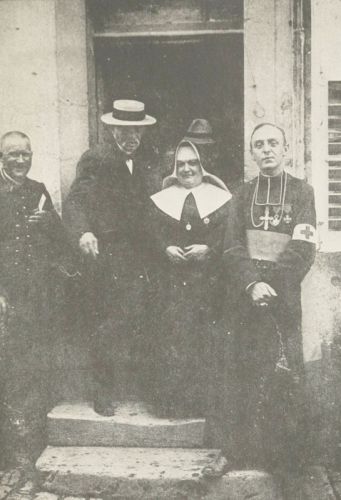
SISTER JULIE IN THE DOOR OF HER HOSPITAL
The little woman drew out chairs from the center table and we seated ourselves, she talking continuously of how glad she was that one from "that great America" should want to see her and know about her work. Ah! her work, there was still so much to do!
She got up and toddled to the window, drawing aside the chintz curtains. "Poor Gerbéviller!" she sighed as we looked out over the desolate waste of burned houses. "My poor, poor Gerbéviller!"
Tears stood in her brown eyes and fell upon the wide white collar of the religious order that she wore. She brushed them aside quickly and turned to the table, again all smiles and dimples. Yes! dimples, for although Sister Julie is small, she is undeniably plump. She has dimples in her cheeks and in her chin—chins I might say. She even has dimples on the knuckles of her hands, after the fashion of babies. Her face is round and rosy. Her voice low and mellow. She looks only about forty of her sixty years—a woman who seems to have taken life as something that is always good. Evil and Germans seem never to have entered her door.
Then I remembered what this woman had done; how all France is talking about her and is proud of her. How the President of the Republic went to the little, ruined city, accompanied by the Presidents of the Senate and the Chamber of Deputies, and a great military entourage, just to hang the jeweled cross of the Legion of Honor about her neck. I wondered what they thought when she bobbed her curtsy in the doorway.
For it took a war to distinguish this little woman from the crowd. Outside her order she was unknown before the Germans came to France. But it did not matter to her. She just went placidly and smilingly on her way—"doing the Lord's work," as she told me. Then the day arrived when the Germans came, and this little round apple dumpling woman blew up. That is just the way it was. I could tell it from the way her brown eyes flashed when she told the tale to me. She was angry through and through just from the telling. She just exploded when the Germans entered her front door. And then her name was written indelibly on the scroll of fame as one of the great heroines of the war.
The Germans wanted bread, did they?—such was the way the story began—well, what did they mean by coming to her for it? They burned the baker's shop, didn't they, on the way through the town? Well, how did they expect her to furnish them bread? Her bread was for her people. Yes, she had a good supply of it. But the Germans could find their own bread.
The German officer pointed a revolver at her head. She reached out her hand and struck it from his grasp. Then she waved a plump finger under his nose. Her voice was no longer low and mellow. It was commanding and austere. How dared he point a revolver at her—a "religieuse," a nun? He could get right out of her house, too,—and get out quick.
The officer's heavy jaw dropped in astonishment. He backed his way along the narrow hall, not stopping to pick up his weapon, and kicking backward the file of soldiers that crowded behind him. At the door Sister Julie put a detaining hand on his shoulder.
"You are an officer," she said—the man understood French perfectly. "Well, while your soldiers are setting fire to the town, you just tell them to keep out of this end of the street. This is my house; it is for me and the five Sisters with me. Now we have made it a hospital. You barbarians just keep out of here with your burning."
Barbarians! The officer raised his fist to strike. Something that was not of heaven made Sister Julie's eyes deadly black. The man lowered his fist, quailing. "The devil!" he said. Yes, barbarians! She almost shouted the word at him—and it was quite understood that his men were not to burn the hospital or the houses adjoining.
The crowd cleared out of the house rapidly and the breadth of Sister Julie's form filled the doorway. It was night and the burning was progressing rapidly, the Germans methodically firing every house. Some soldiers came to the house next to the hospital, and broke open the door. Sister Julie left her position in the hospital doorway and advanced upon them.
"Go away from here," she ordered. "Don't you dare set that house afire. It is next to the hospital. If it burns the hospital will burn, too. So go away—your officers have said that you are not to burn this end of the street."
The soldiers gazed at her stupidly. She advanced upon them, waving her arms. Several, after staring a moment, suddenly made the sign of the cross, and the entire party disappeared down the street to continue their destruction elsewhere.
The little nun then left her post at the door. She went to see that her food supplies were safe. She had a conference with the other Sisters, and visited the beds of the thirteen wounded that the house already contained. Six of the wounded were of the band of seventy-five chasseurs who had held the Gerbéviller bridge against the Germans—twelve thousand Germans for eight hours—until their ammunition gave out. The others were civilians who were shot when the Germans finally entered the town.
After visiting her wounded, Sister Julie went out the back door of the house accompanied by two of the Sisters. The three carried large clothes baskets, kitchen knives, and a hatchet. Through the gardens and behind the burning houses they passed down the hill to the part of the city near the river, which was already smoldering in ashes. They went into the ruined barns, where the cows and horses were all burned alive. I was shown a bleached white bone, a souvenir of one of the cows.
With the hatchet and knives they secured enough bones and flesh from the dead animals to fill the two great baskets. Then they climbed painfully up the hill, behind the burning buildings, to the back door of their home. Water was drawn from their well, and a great fire built in the old-fashioned chimney in the kitchen. The enormous kettle was filled with the water, the meat and the bones, and soon the odor from gallons of soup penetrated the outer door to the street. Again a German officer headed a delegation into the hall.
"You have food here," he announced to Sister Julie.
"We have," she snapped back. She was very busy. She waved the butcher knife under his nose. She then told him that the soup was for the people of Gerbéviller and for her wounded. She expressed no regret that there would be none left for Germans.
The officer said that the twelve thousand who entered Gerbéviller that afternoon was the advance column. The main body, with the commissariat, was coming shortly. Meanwhile, they were hungry. They would take Sister Julie's supply. They would take it—eh? Take it? They would only do that over her dead body. Meanwhile, they would leave her kitchen instantly. They did—the butcher knife making ferocious passes behind them on their way to the door. Sister Julie was still doing her "work for the Lord."
She then ordered all the wash tubs filled with water and brought inside the hall. The fire was coming into the street. Dense smoke was everywhere. Even the Germans now seemed willing to save that particular part of Gerbéviller. It was the portion near the railway station and the telegraph. A substantial building near the gare would make an excellent headquarters for their General, who was due to arrive shortly. The civilians (only a few of the 2,000 inhabitants remained) were all herded into a field just on the outskirts of the town. Sister Julie, with Sister Hildegarde, sallied forth with their soup, and fed them. The next day she would see that the Germans allowed them to come to the hospital for more.
When she returned, a number of soldiers who had discovered a wine cellar were reeling up the street. They stopped in front of the hospital, but turned their attention to the house opposite. They would burn it. It had evidently been forgotten. They broke into the place, and in a moment flames could be seen through the lower windows.
Sister Julie called to the soldiers. They stared at her from the middle of the road. She motioned for them to come to her. They came. She told them to follow her into the hall. There she showed them the wash tubs full of water. They were to carry those tubs across the street and put out the fire they had started, and which would endanger the hospital. This was according to orders given by the officers. After putting out the fire they were to bring the tubs back and refill them from the well in the back yard. The work was too heavy for the Sisters.
When these orders were obeyed, Sister Julie carried a little camp chair to the front steps and began a vigil that lasted all night long and half the next day. She saw the great German army of a hundred and fifty thousand march by, the band playing "Deutschland über Alles," the infantry doing the goose step as they passed the burning houses. Four times during the night the tubs of water in the hall were emptied and refilled when the flames crept close to her house.
At dawn next morning four officers approached her where she sat upon the doorstep. One of them informed her that, inasmuch as she was concealing French soldiers with arms inside the house, they intended to make a search.
"You are telling a lie," she informed them calmly, and did not budge. Two of the officers drew revolvers. Sister Julie sniffed contemptuously. The first officer again spoke. But his tone altered. It was less bumptious. He said that, inasmuch as the house had been spared the flames, at least an investigation was necessary.
Sister Julie arose and started inside. The officers stopped her. Two of them would lead the way. The other two would follow. The pair, with drawn revolvers, entered first and tiptoed cautiously down the hall. Then came the little nun. The second pair drew poniards and brought up the rear. She directed them to the rooms on the first floor, the sitting room, dining room and the kitchen, where Sister Hildegarde was busy over the fire. Then they went upstairs to the beds of the wounded. The first officer insisted that the covers be drawn back from each bed to make sure that the occupants were really wounded. Sister Julie remained silent at the door. As they turned to leave, she said with sarcasm, but with dignity: "You have seen. You know that I have spoken the truth. We are six Sisters of Mercy. Our work is to care for the sick. We will care for your German wounded, as well as our French. You may bring them here."
That morning the invaders began battle with the French, who had finished their entrenchments some kilometers on the other side of the town. At night the Germans accepted Sister Julie's invitation, and brought two hundred and fifty-eight wounded to her house. They completely filled the place. They were placed in rows in the sitting room, the dining room, and the hall. They were even in the kitchen and in the attic. The weather was fine and they were stretched in rows in the garden. The few other houses undestroyed by fire were also turned into hospitals, and for fourteen days Sister Julie and her five assistants scarcely slept. They just passed the time giving medicine and food and nursing wounds. By the fourteenth day, the French had made a considerable advance and were dropping shells into the town, so the Germans decided to take away their own wounded.
During all this time daily rations were served to the civilian survivors, on orders secured by Sister Julie at the German headquarters. The civilians were ill-treated, but they were fed. Sister Julie gave me concrete instances of outrage. Many were killed for no reason whatever; some were sent as hostages to Germany. During fourteen days they were herded in the field. Afterward ten were found dead, with their hands manacled. Sister Julie told me one instance of an old woman, a paralytic, seventy-eight years old, who was taken out in an automobile to show the various wine cellars among the neighboring farms. The old woman had not been out of her house for years and did not know the wine cellars. So the Germans killed her. Sister Julie went out at night and found her body. She and Sister Hildegarde buried it.
On the morning of the fifteenth day, the battle was fiercer than ever. The French had taken a hill near the outskirts, and mitrailleuse bullets frequently whistled through the streets. Several times they entered the windows of Sister Julie's house and buried themselves in the walls. But none of the Sisters was hurt.
There was a lull in the fighting for the next few days. The French were very busy at something—the Germans knew not what. They became more insolent than ever, and drank of the wine they had stored at the gare. In the ruins of the church they found the grilled iron strong box, where the priest, who had been sent to Germany as a hostage, had locked up the golden communion vessels, afterward giving the key to Sister Julie. The lock was of steel, and very old and strong. They tried to break it, but failed. They came to Sister Julie for the key, and she sent them packing. "I lied to them," she said softly. "I told them I didn't have the key."
Through the grilled iron of the box the soldiers could see the vessels. They were of fine gold, and very ancient. They were given to the church in the fifteenth century by René, Duc de Lorraine and King of Jerusalem. The strong box was riveted to the foundations of the church with bands of steel and could not be carried away. They shot at the lock, to break it. But it did not break. Instead the bullets penetrated the box, a half dozen tearing ragged holes in the vessels. The wine finally became of greater interest than the gold, and the soldiers went away. That night Sister Julie went alone into the ruins of the church, opened the box, and took the vessels out.
She paused in her story, got up from her chair, and unlocked a cabinet in the wall. From it she brought the vessels wrapped in a white cloth. I took the great golden goblet in my hands and saw the holes of the German bullets. Sister Julie sat silent, looking out through the chintz curtains into the street. Then she smiled.
She was thinking of the eighth morning after the wounded had been taken away. That was the happiest morning of her life, she told me. At 5 o'clock that morning, just after daybreak, Sister Hildegarde had come to her bed to tell her that the Germans stationed near the gare in that part of the town all seemed to be going to the ruined part, near the river, in the opposite direction from the French. A few minutes later Sister Julie got up and looked from the window. Then she almost fell down the stairs in her rush to get out of doors. About fifty yards up the street was a watering trough. Seated on horseback before that trough, watering their animals, laughing and smoking cigarettes, were six French dragoons.
"I cried at the blessed sight of them," she said. "They sat there, so gay, so debonair, as only Frenchmen know how to sit on horses." Sister Julie hurried to them. They smiled at her and saluted as she approached.
"But do you know the Germans are here?" she anxiously inquired. "You may be taken prisoners."
"Oh, no, we won't," they answered in chorus. "There are thirty thousand more of us just behind—due here in about two minutes. The whole French army is on the advance."
Then came thirty thousand. After the thirty thousand came more thousands. All that day the street echoed to the feet of marching Frenchmen. Their faces were dark and terrible when they saw what the Germans had done. Most of the day Sister Julie sat on her doorstep and wept for joy. Since that morning not a German has been seen in Gerbéviller.
Sister Julie ceased her story and wiped the tears that had been running in streams down her cheeks. We heard the rattle of a drum outside the window. It was the signal of the town crier with news for the population. Sister Julie opened the window and looked out. It was the announcement of the meeting to be held that afternoon, a meeting that she had arranged for discussion of plans for rebuilding the town. Five hundred of the population had returned. There was so much work to do. The streets must be cleared of the débris. The sagging walls must be torn down and new buildings erected. It would be done quickly, immediately almost; aid was forthcoming from many quarters. The new houses would be better than the old. The streets were to be wide and straight, not narrow and crooked. Gerbéviller was to arise from her ashes modern and improved. And only a few miles away the cannon still roared and thundered.
I asked her about the Cross of the Legion of Honor given her by President Poincaré. I asked why she did not wear it. A pleased flush deepened the color in her rosy cheeks. I shall always remember the grace and dignity of her answer.
"I do not wear it because it was not meant for me alone," she said. "It was given to the women of France who have done their duty."
"Not the little red ribbon of the order," I persisted. "You should pin that on your dress."
But Sister Julie shook her head. She is a "religieuse," she explained. Nuns do not wear decorations. They are doing the work of the Lord.
CHAPTER XVIII
THE SILENT CANNON
On a hill commanding a valley stretching away toward the Rhine is a dense pine forest. From its edge I looked far across the frontier of Germany.
In a little clearing a French artillery Major came to meet me and my guide. Then we walked for miles, it seemed, through dense shade over paths thick with needles, until we came upon an artillery encampment. From the conversation between my guide—a Captain of the General Staff—and the artillery Major I learned that we were about to see something new in cannon.
I am always eager to see something new in cannon. Since my visit to the great factories at Le Creusot, when I was permitted to cable carefully censored descriptions of the new giant guns France was preparing against Germany, I have always been looking for these guns in operation. So, when I saw that here was no ordinary battery, I began the molding of phrases to use in cabling my impressions. I did not realize then that I was to have the most poignant illustration since the war began of the mighty fundamental differences between the Teutonic and Latin civilizations.
On a gentle slope, where the tops of pine trees below came up level with the brow of the hill, there was a great excavation, such as might have been dug for the foundations of a château. The front part, facing the valley, was all screened with barricades and covered with evergreens.
We entered the excavation from the rear, down winding steps lined on either side with towering trees. These steps were all concrete, as was also the entire bottom of the excavation. The air was very fresh and cool as we descended. Up above the breeze gently swayed the trees, which closed over us so densely, dimming the daylight. I was reminded of a dairy I knew on an up-State farm in New York. I almost looked for jars of butter in the dim recess of the cool concrete cellar. I could almost catch the odor of fresh milk.
But in the center of our cavern was a huge piece of mechanism that I recognized as the "something new in cannon." Above the great steel base the long, ugly barrel stretched many yards through an aperture in front, and was covered over with evergreens. The Major described the gun in detail—its size, range and weight of its projectiles.
I walked to the front of the aperture to look at the barrel lying horizontally on the tops of the pine trees growing on the slope below. The branches had been carefully cut from the higher trees to give a view over the valley. I got out my field glasses and fixed them on the horizon many miles away—just how many miles away I am also not allowed to say. For a long time I studied that horizon just where it melted into mist. Then the sun's rays brightened it, and I could see more clearly.
"Looks like a city out there," I said aloud.
"It is," said the artillery Major behind me.
I looked again and could dimly make out what appeared to be the spires of churches.
"Look a little to the right; you can see a much larger building over there," the Major said.
I looked, and a huge gray mass loomed out of the mist.
"That's a cathedral," he said.
I put the glasses down and walked around to the open breech of the giant cannon, the mechanism of which another officer was explaining. He gave a lever a twist, and the huge barrel slowly moved from right to left over the tops of the pine trees.
The officer was saying in answer to a question:
"No, we are quiet now. We are just waiting."
"Waiting for what?" I asked.
"Oh, just waiting until everything is ready."
"Then what will you do?"
"Oh, destroy the forts, I hope. This fellow ought to account for several," and he patted the side of the barrel.
"Will you destroy the city?" I asked.
"What for?" he asked. "What good would that do? If we expect to occupy a city we do not want it destroyed. Besides,"—he shrugged his shoulders expressively—"we are not Germans."
I walked up to the gun and stared into the breech. I adjusted my glasses again and through them looked down the barrel. Out on the horizon I could see the huge gray mass that the Major said was a cathedral. The gun was trained directly upon it—this silent gun.
"It could hit that cathedral now," I thought to myself. Then I thought of the Cathedral of Rheims. Again I stared through the glasses into the barrel of the gun. The light was better now, and the tops of the spires were visible above the bulky gray mass.
It was the Cathedral of Metz.
CHAPTER XIX
D'ARTAGNAN AND THE SOUL OF FRANCE
I met d'Artagnan in a forest of Lorraine. Perhaps Athos, Porthos and Aramis were there too, somewhere in the shadows. I saw only d'Artagnan and talked with him as long as it takes to tell the story. I had forgotten how he looked to Dumas père, but I knew him at once by his bearing and his spirit. His swashbuckling manners are just as arrogantly gay now in the forest of Lorraine and in the trenches of the Vosges as they were long ago in old Paris and on the highroad. He swaggers just as buoyantly with the "poilus" of the Republic as with the musketeers of the Cardinal.
D'Artagnan is a captain now; when I met him he was attached to the staff of a General of Brigade. He is always your beau ideal of a man. He looks just what he is—a fine French soldier.
My first glimpse of him was from the automobile in which I was riding with an officer from the Great General Staff whose business it was to conduct press correspondents to the front. D'Artagnan was walking towards us on the lonely forest road, and signaled with a long alpenstock for our driver to stop. He wore the regulation blue uniform, with the three gold stripes of a captain on his sleeve. He had no sword. I find that swords are no longer the fashion with the "working officers" at the front. They are in the way.
Our car slid to a stop. D'Artagnan's free hand came to salute. It was an imposing salute—one that only d'Artagnan could have made. His heels snapped together with a gallant click of spurs; his arm swept up in a semi-circle from his body; his rigid fingers touched the visor of his steel helmet—one of the new battle helmets, very light, strong and painted horizon blue to match the uniform. The chin strap was of heavy black leather instead of the brass chain of ante-bellum parade helmets.
D'Artagnan, from the center of the road, roared out his name and mission. His name, in his present reincarnation, is known throughout the French army, in fact throughout France. It is known to the Germans too, but correspondents are not permitted to give the names of their officers until the war is over. Anyway I immediately recognized him as d'Artagnan.
His mission, announced with gusto, was to guide us along the lines held by his brigade. He leaped to our running-board and ordered our chauffeur to advance.
He was an impressive figure, even clinging to the side of the jolting car. His body lithe and powerful; his hands lean and strong; his face, under the visor of the helmet, was d'Artagnan's own. A forehead high and bronzed. Eyes blue and both merry and ferocious. Cheeks high but rounded. His hair, only a little of it showing under the helmet, was black, but just enough grizzled to proclaim him in middle age. His mustache—it was a mustache of dreams and imagination—his mustache stuck out inches beyond the cheeks, and was wondrously twisted and curled.
His medals proved him the survivor of many hard campaigns. Most officers when at the front wear only the ribbons of their decorations, if they have any, and leave the medals at home. But not d'Artagnan. He wore all of his medals, in a blazing row across his chest. And he had all that were possible for any man in his position to win. First came the African Colonial medal, then the medal for service in Indo-China. Next was the Médaille de Maroc. In the center was the Legion of Honor and then the Croix de Guerre, with four stars affixed, indicating the number of times during the present war, d'Artagnan has been mentioned in despatches for courage under fire. Finally came the only foreign medal—the Russian Cross of St. George—given by the Czar during the present war to a very few Frenchmen, and only "for great bravery."
As d'Artagnan again stopped the car and we climbed out into the road, which had narrowed to a forest path, my companion pointed to the medals.
"Our captain is a professional soldier, you see," he said. "He has fought all his life—didn't just come back when his class was called for this war."
But I already knew that. How could d'Artagnan be anything but a soldier—a professional, if you please—but fighting for the love of it, and the glory?
He tramped along in front of us, the spurs of his high boots jingling, and twirling the ends of his fierce mustaches. I glimpsed soldiers through the trees. Some came out to the path and saluted. To all d'Artagnan returned a salute with the same wonderful joy in it, as though it were the first salute of the day, or as if he were passing a general. There was the same swing outward of the arm, the same rigid formality of bringing his hand to the helmet. The pomposity of the salute he may have learned from Porthos, but the dignity, the impressiveness of it, belonged to d'Artagnan.
His soldiers adored him; we could see that as we followed. Their eyes smiled and approved. And the stamp of great admiration was in their faces.
"They would go through hell with him," said my companion. "A good many of them have. He is the favorite of his brigade."
"He ought to be," I replied. "He is d'Artagnan."
"D'Artagnan!" my companion cried. "Why, so he is. I never thought of it. But he is d'Artagnan—alive and fighting."
He was a little distance ahead of us, among the trees. A sergeant approached him to make a report. D'Artagnan leaned back grandly on one leg, his chest forward, his chin tilted up, his hand, as usual, twisting the mustachios.
"He loves it," I said. "He loves everything about it—this war. When peace comes his life will lose its savor."
My officer of the Great General Staff nodded; d'Artagnan returned jauntily, swinging his stick, and in ringing tones told us all that he had arranged for us to see.
We followed him through a program that has been described many times by correspondents since the war began—the encampments, the batteries and the trenches. But never before did a correspondent have such a guide. It was not my first trip to the front; but d'Artagnan led me into advanced trenches, closer to the Germans than I had ever been before. We crawled on hands and knees and spoke in whispers. But I was fascinated because d'Artagnan, just as Dumas might have shown him, crawled ahead, waved his hand in quick, impatient gestures for us to hurry, looked back to laugh and point through a loophole to great rents in the wire entanglements showing where a recent German attack had failed.
Only once, at a point where a road separated two trench sections, and always dangerous because of German snipers, did he order us to pass around behind in the safety of a boyau or communication trench. He leaped across the barrier with a derisive yell of triumph and a catlike quickness too astonishing to draw the German fire.
Otherwise he let us take far bigger chances than usually permitted visitors—and he made us like them. We squinted carelessly through risky loopholes because d'Artagnan did it first. We talked aloud because he did, and at times when ordinary guides would have made us keep silent. He stood up on a trench ledge and looked through a periscope, then jumped down laughing, holding out the periscope to show where a bullet had drilled a hole on the side only a few inches above his head. It was a game of follow the leader, and we followed because the leader was d'Artagnan.
"They will get him some day—he takes such chances," an officer remarked.
"They haven't got him yet and he has had more war than any of us," another replied.
On our way back, behind the line encampments, we met several soldiers carrying tureens of soup. D'Artagnan halted them, solemnly lifted the covers and tasted the contents. Then he passed the spoon to us.
"It is good," he pronounced, and patted the soldiers on the back, as we hurried on.
He now took us to his own quarters, in a dense grove of pines. His house was of pine boughs, half above and half underground, with a bomb-proof cavern at the rear. Its furniture was a deal table and a bed of straw. We sat around on camp stools and an orderly brought in tea.
D'Artagnan then changed the subject for a few minutes from war. He had visited nearly all the world, including America. He turned to me, and to my surprise spoke in English. It was a very peculiar English, but it was not funny coming from the lips of d'Artagnan. He told me about his trip to America—how he did not have much money at the time, so he went as a lecturer to the French Societies in the big cities of the United States. It was hard to picture this big, weather-beaten soldier in such a rôle, until he told me the subject of his lecture. It was "The Soul of France"—always the Soul of France, a soul chivalrous, grand and unconquerable, that would forever make the world remember and expect.
In Boston he had tried to speak in English, at the Boston City Club. He pronounced the letter "i" in city, as in the word "site." He told me the lecture in English was very funny. Perhaps it was; but the Boston City Club had not seen their lecturer in the forest of Lorraine. They did not know that he was d'Artagnan.
After tea he showed us the park made by his soldiers in front of his "villa," as the semi-underground hut was called. A sign painted on a tree announced the "Parc des Braves." Little well-groomed paths wound among the pine needles; rustic seats were built about the trees. A dozen little beds of mountain flowers made gay stars and crescents that would not have disgraced the Tuileries. The "Parc des Braves" had even an aviary, made of wire netting (left over from the barricades) built about a tree. D'Artagnan proudly pointed out a great owl and a cowering cuckoo in different compartments of this unique cage.
But the chef d'œuvre of the Parc was the reconstructed tableau of one of the brigade's heroic episodes. A tiny rustic bridge spanned a miniature brook; beside the brook was built a mill and beyond was an old farm-house and orchard. Seven tiny French chasseurs, of wood and painted blue, were holding the bridge against a horde of wooden Germans painted gray.
On a great tree shading this story of a glorious hour in the history of his "little braves," d'Artagnan had fixed a wooden slab, telling its details in verse.
"Il y avait sept petits chasseurs Qui ne connaissaient pas la peur." (There were seven little chasseurs Who knew no fear.)
That is the way the story began; and each verse began and ended with the same words. I wish I could have copied it all; but d'Artagnan, the author, was impatient to move on.
So we left the Parc and followed into the gloom of the forest and up the steep slope of the mountain. It faced the enemy's trenches. From the top one could look across the frontier of Germany.
D'Artagnan was silent now, plunging along through the deepening twilight. Suddenly we emerged on the edge of a clearing still bright with sunshine: a clearing perhaps several hundred feet square, lying on the steep hillside almost at an angle of about forty-five degrees.
D'Artagnan stopped, took off his helmet, then walked slowly into the open. We took off our hats and followed him.
The clearing was a military cemetery—it held the graves of d'Artagnan's dead. A tall white wooden cross at the top rose almost to the tops of the pines growing above it. On the cross-piece was written:
"To our comrades of the —th Brigade, killed by the enemy."
At the foot of the great cross, stretched in military alignment over the clearing were hundreds of graves headed by little crosses. So abrupt was the slope the dead soldiers stood almost erect—facing Germany. Narrow graveled walks separated them, and on each cross hung festoons of flowers kept always fresh by the comrades who remained.
We followed d'Artagnan across the silent place and stood behind him as he faced, with bared head, the great cross. He made the sign of the cross upon his breast. There was not a bowed head: we all lifted them high to read the words written there.
No one spoke; the wind rustled softly in the tops of the pines that pressed so densely about us. It was dark among the trees, but the clearing was still mellow with the fading sunlight.
"The sun always comes here first in the morning," d'Artagnan said softly, "and this is the last place from which it goes."
He swung around with his back to the great cross and flung out his alpenstock in a gesture that swept the valley before us. His voice rose harshly:
"Over there is the enemy," he thundered. "Those who rest here look at them face to face!"
His arm dropped; his voice sank.
"They didn't get over there. But their souls remain here always to urge us and to point the way which we must go."
He stopped and seemed to listen. The wind had died; even the tree tops were still. The sun had gone; the dark began to sweep up over the graves. D'Artagnan leaned upon his alpenstock; his eyes were closed.
We did not stir, nor hardly breathe. D'Artagnan was in communion with the soul of his beloved France.
PART FIVE
THREE CHAPTERS IN CONCLUSION
CHAPTER XX
A REARPOST OF WAR
After a year or more of war, even a latter-day war correspondent who gets a personally restricted war office Cook's tour to the front semi-occasionally, may yearn for peace. This is especially true in the case of a regular correspondent with the French army, because to France there come so many senators, statesmen and "molders of neutral opinion," bearing letters from President, King or Prelate, that the regular correspondent has hard work to edge in even his legitimate number of tours.
One morning I awoke early, far from the firing line, safe in my Paris flat. Before breakfast I read the hotel arrivals listed in the newspaper. The names of several molders were there. I knew that all their letters stated definitely what whales they were. I knew that the tour directors would not be able to resist them and that my seat in the next front-going limousine would probably be held in another name. So in the words of the ancient British music-hall classic I decided that "I didn't like war and all that sort of thing."
Twelve hours later I was standing on an old stone jetty that runs out to meet the forty-foot tides on the north coast of Brittany. It was as far away as I could get and still retain an official connection as correspondent with the French army. The tiny hamlet at the end of the jetty has an official name. The name does not matter. There is no railroad, no post office, no telegraph. But the place is known because it was there that Pierre Loti wrote his great story of the Iceland Fisherman. There was nothing to disturb the thoughts, nothing to jar the nerves. All was quiet and peace; of war there was not the slightest suspicion.
The water at the end of the jetty was thirty feet deep, but so clean that one could see through it as through air. I watched a crab waddle along the bottom and disappear under a rock. Then I got out my army glasses and swept the coast. For miles tremendous headlands stuck out in the sea, rolling over treacherous rocks. Before me was the Ile de Bréhat, the ancient home of the pirates, which thrusts an arm far out into the Atlantic—an arm that holds a lighthouse to tell mariners returning from Iceland that they are almost home.
Between the island and the mainland the outgoing tide swirled along at a rate of twelve sea miles per hour. I turned the glasses to the coast where the tiny Breton stone cottages were tucked behind rocks and hills that shelter them from storms and the long and terrible winter. Now they were bowers of color; clusters of roses and geraniums bloomed on garden walls, tall hollyhocks stood sentinel before the doors.