PASSED BY THE CENSOR (continued 2)
Reading edition
A score of men stood about the front of the car where the chauffeur was busy handing out apples and pears. My companions were busy on the opposite side with a dozen French infantrymen, telling the latest news from Paris and giving out newspapers. I leaned over them, the box of cigarettes still in my hand. A tall Senegalese standing back from the group caught sight of the box and called out, "Cigarette, eh!" I motioned him to my side of the car. He came running weakly, followed at once by fifty others. I handed out until that box and several others that I dug from my valise were exhausted. I called several times that I had no more, but still they crowded about, stretching out their arms and crying, "Cigarette, eh?" One of my companions warned me that we might ourselves feel the want of tobacco—that money would not buy it in the country we were traversing, because it did not exist.
We still had a box of cigars and I had several loose in my pocket. The black face of a Turco appeared at the car window. One arm was in a sling and a bandage was wound about his brow. But his eyes shone brightly at the thought of tobacco, and at the smell of it now arising on all sides. He was tobacco hungry. He was more than that. He was tobacco starving. He poked his other arm into the car. I motioned him to crowd his entire bulk into the window so that the others would not see. Then I gave him a cigar. He hung over the car frame as I held out the lighted tip of my own cigar. He puffed a cloud into the interior. He looked at the cigar fondly and seemed to measure its length. It was a good cigar. If it had been a miserable cheroot his regard would have been the same. He took another puff, and drew a complete mouthful into his lungs. His cheeks bulged and his eyes glinted inwards as though he looked at the tip of his nose. I wondered how long he could keep that huge mouthful of smoke within him. Again he held the cigar close to his eyes and seemed to measure its length. It burned perfectly round and the ash was white and solid. Finally he poured forth the smoke from nose and mouth and ejaculated the only English word he knew—"good." I nodded and asked in French where he had been fighting. He cocked his head toward the fore part of the car and took another puff. I asked him where he had been wounded and he replied that he did not know but that it occurred in the trenches "là bas." I asked him how long he had been fighting in France—how long since he had left Africa, and he spread his arm far out to indicate that the time had been long. I asked him where he was going; he rolled his eyes to the rear of the car and said he did not know.
I sank back in my seat and he climbed down into the road. Most of the troop had limped off. To the few still lingering we indicated that our stock of things to give away was exhausted. They eyed us wistfully, then passed on.
The chauffeur asked if he should start the car, but some one said, "No, let's wait until they all pass." The rear guard straggled up; many were ready to drop with fatigue and pain and loss of blood. I asked a Britisher how long they had been on the road. He replied "since sunrise" and plodded stolidly on. It was then noon. Several sank down for moments under the trees by the roadside. A chasseur stopped and asked our chauffeur to tighten a thong of his bandage, which was stained with fresh blood. We asked him where they were going and he replied vaguely, "To the rear." "And what then?" one of us asked. "Oh! I hope we will all be fighting again soon," he replied. They were all like that. They wanted to be fighting again soon. They were not happy. They were not unhappy. They were indifferent; more or less, made so by utter fatigue and the pain of their wounds. But they all wanted to be fighting again soon.
We watched them top the rise of the hill to disappear down the long road "to the rear." The last straggler, his head bound with white and red, vanished. They were all privates—all common men of all the world from Scotland to Hindustan. The majority were coming from and going they knew not where, and wanting to fight again for they knew not what—except possibly the men of France, who began to hear about this war in their cradles.
We cranked up the car.
(C) A Lull in the Bombardment
The sentry just outside the town advised us to right about face and travel the other direction. But he only advised us. Our credentials appeared in order and he did not feel that he could issue a command on the subject. In fact our credentials were very much in order. The sentry saluted us most respectfully; but his advice was wasted. We argued to ourselves that if we went to "the front" we must take a few chances.
So we entered Soissons—one of the most beautiful and historic towns in Northern France. It has now become even more historic; but its beauty has changed from the crumbling medieval. It is a ruin—more—a remnant of the Great War.
We did not notice this so much as we rode down the winding road to the outskirts. We did notice the unusual fall of autumn foliage. We commented on the early season; the preceding night had been frosty, following rain. Then we noticed many branches lying across the road. Many trees were chipped as with an ax, but the chipped places were high up—out of reach. We wondered why the trees were chipped so high. Then we skirted a great hole in the center of the road. A tree further on was cut off close to the ground. The truth came to us. The fallen leaves and the chipped places were the work of bullets—a multitude of bullets. The hole in the road and the fallen tree were the results of shells.
We saw horses lying in the fields. Their legs stuck rigidly into the air. Horses were lying along the roadside. Insects were crawling over them. Fallen trees lined the way into the town.
We turned into the main street and rattled over its cobblestones. We met no one. Crossing an open square we saw that over half the trees were down. Up a side street a house had fallen forward from its foundations and settled in a crumbled heap in the center of the road. The sun which had been shining brightly went behind a cloud. We stopped for a moment. We could hear the wind sighing in the tops of the remaining trees. Some one asked, "Is this Sunday?" and was answered, "No. It's Friday. Why?" He replied, "Because it is so still. Did you ever see a place where people live that is so completely silent?" "It reminds me of London on Good Friday—everybody gone to church," said another.
We drove on. A block along the main street a soldier in the French uniform of the line lounged in a doorway. His long blue overcoat flapped desolately over his baggy red trousers. His rifle leaned in the corner. We asked if any hotel remained open. He replied, "I don't know. Have you a cigarette?" I drew out a box and he ran to the car, seizing it as a hungry animal snatches food. He settled back into his doorway, smiling; then said in French argot which translated into American best reads: "Do you guys know you ain't safe here?" We smiled and waited explanation. But he merely shrugged his shoulders. We started the car.
More French soldiers lounged in doorways. Once we saw the white and frightened face of a woman peering at us from a window. She was entirely incurious. Her gaze was dispassionate. She appeared to have not the slightest interest either in us or our big car, which surely was a rare sight in the streets of that town on that day. But the fright upon her face was stamped.
Several villagers stood at the next corner. They exhibited interest. We again asked about a hotel and one pointed to a building we had just passed. We noted that its doors and windows were barred; but we thought they might open up.
We asked, then, when the firing on the town had ceased. The man laughed. Anything so normal as a laugh seemed out of place in that ghastly silence. It grated. But it seemed that after all one might observe the function of laughing even during war. He informed us that the German gunners were probably at lunch. We asked the position of the French batteries, and as he pointed vaguely toward the south we realized that we were then in an advance position on the firing line—that the force of soldiers was only an outpost. The same man told us that the town had been under fire for eight days, that the French had shifted the position of their heavy guns and that the Germans were now trying to locate them. We returned to the hotel, stabled our automobile and ordered luncheon, which the landlord informed us would be ready in half an hour. So we continued the exploration of the town on foot.
The chauffeur did not accompany us, for there was a captured German automobile in the barn that interested him greatly. Under the seat he found the army papers of the German driver. He advised us not to touch them. They were dangerous. If found in our possession we might be arrested as spies. So we dropped them back under the seat, and went out into the market place.
As is usual in small French cities the market consisted of a large building entirely open at the ends and fronting on a large square paved with cobbles. We walked into the building; it was deserted and our footsteps echoed. In the center was a pile of masonry, beneath a large hole in the roof torn by a shell. The explosion had cracked the side walls. In one of the cracks was jammed the top of a meat table, forcibly caught up from the floor and hurled there. A little further on a shell had passed through both side walls, leaving clean holes large enough for a man to stand.
I stood in one of them and saw where the shell had spent its force on a residence across the square. It had caught the house plumb on a corner and at the floor of the second story, so that the floor sagged down into the room below. The room above had been a bedchamber. The entire side wall was gone, so all that remained of the intimacies of the room were exposed. The bed with the covers thrown back as though the occupant quitted it hurriedly had slipped forward until stopped by a broken bit of the wall. From another jagged piece of masonry that formed part of the wall the blue skirt of a child flapped desolately over the sidewalk. We left the market building and stood in the center of the square looking down the six streets that emptied into it. They were narrow, winding streets, and we could not see far. But in all we could see the ruin—the crumbled masonry and walls blackened by fire.
We looked at our watches and hurried toward the hotel. Entering the street, about half a block distant, we stopped to look down a side alley. As we looked we heard what seemed to be a shrill whistle, pitched high and very prolonged. It seemed like the shriek of a suddenly rising wind; but it was followed by a dull boom and the crash of falling masonry. We looked behind us and saw clouds of smoke and dust rising a short distance beyond the market place. We ran toward the hotel. At the entrance we again heard the high-pitched screaming whistle, ending in a crash much more acute. "That struck nearer," one of us observed. But we did not wait to see. As we entered the hall, the landlord remarked, "Ça commence encore."
We filed into the dining room in time to see him carefully place the soup upon the table.
CHAPTER IX
"DETAINED" BY THE COLONEL
We had just passed a sentry on the outskirts of a village. He had brought his rifle to an imposing salute as he read the name upon our military credentials. One of my companions, smiling fatuously, remarked:
"Well, fellows, this is a real pass. It gets us anywhere."
At that very instant the Colonel leaped on the running board of our automobile.
He too was smiling, but not fatuously. Although he was French he was sufficiently an Anglophile to affect a monocle, and this gave a chilling, glassy effect to his smile.
"Your pass!" he said, stretching out his hand, at the same time signaling the chauffeur to stop. The pass was given him, one of us explaining that we had just shown it to a sentry, who had permitted us to enter the town.
"Ah, quite so," he murmured. He carefully read the pass, screwing his monocle into his eye. "Ah, quite so. But you will please follow me." He signaled us to get out of the car and directed the chauffeur to turn to the side of the road and to remain there. Then he led the way down a narrow lane. At the door of a small house he told us to wait. He left the door open and we saw him pass down the hall and into a rear room. Then came a burst of laughter.
"More 'journalistes Américains,'" we heard; and then another peal of merriment. We stood about the doorstep and wondered.
The Colonel reappeared and again directed us to follow. This time he led the way to a barn a short distance along the road. A cow yard surrounded the barn, enclosed by a high stone wall. At the gate stood a soldier with fixed bayonet. On the gate-post was written a single word.
I had been suspecting for several minutes that a hitch had occurred in our plans for going war-corresponding. My companions had similar ideas, but we had kept silent. Now, as we stared at this word written on the wall, I turned to the chap who had spoken so confidently about our pass.
"You were right about the pass," I said. "It gets us anywhere."
For the word written on the wall was "Prison."
The Colonel stopped at the gate of the cow yard, twirled his mustache, and screwed his monocle. He bowed. We bowed. Then we preceded him through the gate.
A derisive yell greeted us from a quartet seated on a wooden bench outside the door of the barn. The quartet arose and came towards us laughing.
"You know these men?" asked the Colonel.
Oh, yes, we knew them. They too were newspaper men, at least three of them. Two represented Italian papers, one an Amsterdam journal. The fourth was an Italian nobleman whose name was frequently in the social columns because of his dinners at the Ritz and Armenonville. He explained that he had accompanied the others as their gentleman chauffeur, driving his own big car. It had been requisitioned for the army at the same moment they themselves were escorted into the cow yard three days before. The Colonel stood by during our greetings, still twirling his mustache. He addressed the quartet.
"Since you know these men," he said, indicating us, "you will please explain to them where they will sleep and the arrangements for food."
Then he turned to us, at the same time pointing to a corner of the building nearest the wall gate. He said:
"You are permitted to remain out of doors as much as you like, but you are not to pass that corner. If you do—well—" a shrug and the monocled smile, "the soldier at the gate will probably shoot."
The sage of our party became sarcastic.
"I presume that the soldier's gun is loaded," he remarked.
"Oh, yes," the Colonel still smiled. "The gun is always ready—also the bayonet—it would be regrettable—" again he shrugged his shoulders.
"But why are we prisoners," the sage one demanded, "and where is our pass? If we cannot go on we will go back to Paris. What right have you to keep us here?"
The Colonel raised his eyebrows and spread out his hands. His tones were so polite as to be almost apologetic.
"Right?" he questioned. "My dear fellow, it is simply a question of the force majeure. And besides you are not prisoners."
"Not prisoners?" we shouted in unison. "If we are not prisoners, then what are we?"
"You are not prisoners," the Colonel insisted. "You are simply detained. You can neither go forward nor back until I receive further instructions concerning you. For the moment you are my guests."
He bowed politely and gracefully.
"And the soldier with the rifle? And the dead line at the corner of the building?"
"Ah, quite so—quite so," murmured the Colonel; then bowed again to us and went out the gate.
"Consequential little cuss," sputtered one of our trio.
"Better play up to him," advised one of the Italians. "We have been here three days. Come see where we sleep—"
They led the way to a stone outhouse near one end of the stable. A soldier with loaded rifle sat in the door. We peered within. Two cow stalls heaped with filthy straw. One of the stalls was empty; in the other we could dimly discern some huddled forms.
"We sleep in the empty one," our confrères informed us. "You will sleep there too."
"And those in the other stall?" I asked.
"Oh, those! They are German spies captured during the day. They take them out every morning—they don't come back—fresh ones take their places."
I shuddered. "What becomes of them?" No one answered and the other Italian said: "Don't talk about such things. We too are prisoners, you know."
"Oh, no," said some one. "We are not prisoners—we are merely detained—guests of the Colonel."
That evening the Colonel clattered into the yard on horseback. About twenty of his men were loafing about. On his appearance there was a great to-do. They sprang stiffly to attention in lines on either side of the horse. I learned later that this was the regular evening ceremony when the Colonel returned from his ride. I had to admit that he cut a fine figure on a horse. His body was slender and very straight. His hair slightly grizzled, his face grim, but with always that glassy, haughty smile. He wore high boots of the finest leather. His spurs jingled. His uniform was immaculate. His cape swung jauntily over one shoulder. His sword clanged. His medals were resplendent. His head was held high as he rigidly returned the salutes. At every moment I expected to hear the orchestra's opening bars, and the Colonel proclaim in a fine baritone, "Oh, the Colonel of the regiment am I," with the soldier chorus echoing, "the Colonel of the regiment is he."
However, the Colonel dismounted into very real pools of mud and manure.
"Les correspondants Américains!" he shouted.
We lined up—hopefully—before him.
"Your automobile," he informed us curtly, "has become the property of the army. I have directed that your overcoats and other belongings, and the food you carry with you, be brought to you here. You may eat this food and also draw your daily ration of the army fare."
This was a concession; and one of the Italians, who had drawn near, immediately asked for another.
"Now that there are seven of us," he asked "can't we have an audience with the commanding general of this division?"
The Colonel considered, then said: "If you ask an audience for only one of your number, you may draw up a petition."
The Italian, having made the suggestion, wrote the petition, we all signed it and an hour later he was led away between files of soldiers to see the General. Returning, after only a few minutes, he said the General had received him courteously but would give him no satisfaction, saying that he was waiting for instructions concerning us from General Joffre.
There was nothing to do then but make the best of it.
At six o'clock the Colonel's cook informed us that we could go to the great open oven in the cow yard and draw our evening rations. It was lucky that we had our aluminum plates, for there were no others for us. We filed across the yard with the soldiers and got a mixture of beans and beef that was decidedly unpalatable even though we flavored it with our own wine and bread. As we finished it, our chauffeur, a trench "reformë," appeared in the kitchen. He told us he was not a prisoner but was "detained" in the town with the car. He asked for a bottle of our wine, which we gave him, with a cake of chocolate, and a bottle of our water.
My two friends and myself then discussed our sleeping problem. We had resolved not to sleep in that outhouse with the Germans. When the Colonel next came into the yard we tackled him, asking if we might not have the freedom of the town under parole, in order to find beds.
He said he could not consider it.
"Then," said our spokesman, "rather than sleep in the outhouse may we stay here in the yard?"
The Colonel stiffened with sudden resentment at our making so many difficulties. He strode fiercely to a door of the stable and threw it open, showing piles of straw on the earthen floor.
"There I sleep with my officers," he said with dignified reproach.
"But," we explained, "it is not the hardship to which we object. We do not wish to be classified and kept in the same place with German spies."
"Ah," said the Colonel. He stared a moment, then smiled. He was human after all. He could appreciate that point and liked us the better for making it.
He said we might stay in the yard and then, after stamping about the room a few minutes, he pointed to a ladder to a loft above his quarters and said:
"You may use that place if you like. It is not occupied. The others can sleep there too if they like."
We quickly scaled the ladder and discovered a large, bare room that had evidently been used as a granary, for there were piles of grain and some farm implements lying about. A small window, which the Colonel had evidently overlooked, opened on to the street and also a great door on the courtyard.
At eight o'clock we stumbled up into our loft, lighted a candle and fixed up our beds. We had bought some straw for two francs, from a farmer one of the soldiers found for us. The beds were hard and uncomfortable. Naturally we slept in all our clothes and with our coats over us also; but by morning we were chilled through, for the wind howled through all the cracks, and several panes of glass in the window were broken. So at least we had fresh air.
All through the previous afternoon we had heard the constant booming of heavy artillery, which the Colonel said was about twelve miles away, and was the bombardment of Rheims, which he very openly stated was then in process of destruction, chiefly by fire. At four in the morning this cannonade again started, waking us up. We rose and descended to the yard followed by the sleepy Italian quartet. We found the Colonel, very wide awake, spick and span. He fixed the Italians with his monocle.
"I understand that one of them is a prince," he said. "Tell me which one."
We pointed out the nobleman, who was the smallest and the most dispirited of the lot.
The Colonel grunted:
"A prince, eh? Well, I like his automobile quite well."
That day we got another bench to sit on and a box that we transformed into a dining table. With some candles we rigged up a lantern. For a table-cloth we had some old canvas maps. These were furnished by the Colonel himself. In fact after we once got behind that monocle we came to like our Colonel immensely. It was plain that he liked "les Américains" better than the others. Although he could not officially recognize all that we did, it was understood that we were permitted to bribe his cook. So we had real coffee for breakfast. We had vegetables not included in the army menu; and on one great occasion we secured enough apples and pears to make a magnificent compote in our little alcohol stove.
We got up the second morning about 6.30, greatly discouraged, although the Colonel's cook, to whom we had given twenty francs the night before, brought us coffee. There was no water to be had until the soldiers had finished at the pump, and we did not have moral courage enough to shave or wash anyhow; we just stood around the courtyard in a drizzle of rain, cursing everything and everybody, chiefly our captors. We argued over and over again that it was ridiculous to arrest us; if our pass was no longer valid the thing to do was to send us back to Paris, under guard if necessary.
That morning one of the Italians dropped a letter out of the window of our loft opening on the street, to a soldier, who said he would post it in Paris. It was addressed to the "Gaulois" and contained a note from us to the American Ambassador, which I learned later never saw its destination. The first news of our whereabouts reached Paris in a message that our chauffeur sent by hand to the automobile company, merely saying that the car had been requisitioned; and we did not know about this until we returned to Paris.
We also drafted a long letter to the Commanding General, asking to send an enclosed telegram to Ambassador Herrick. The telegram stated that the three of us were detained at that point, and asked him to notify our offices in Paris. The Colonel took this letter and said he would deliver it to the General; but the telegram enclosed never reached Paris.
At five o'clock the third morning we were awakened by a soldier coming into the loft and waving a lantern over us as we lay on the floor. He called out the names of the quartet and told them to follow him. They did so, and that was the last we saw of them. I confess it gave us rather an extra chill, even though we were all chilled to the bone from the weather, to see them led out in that fashion and at that ghastly hour. It was still very dark. We heard them clatter out into the courtyard. I peered out of the loft door and dimly saw a file of soldiers. I heard one of our late companions complaining about the loss of his hat.
At breakfast our fears were set at rest by the Colonel explaining that as the quartet had been arrested before us their case had been settled first, and that they had been taken to Paris. He had found the missing hat, which he gave to me, and asked anxiously whether I would search out the owner when I returned to Paris. Inasmuch as this was some indication that I really might see Paris again, I gladly promised.
The weather cleared and we passed considerable time in the yard. A small enclosed orchard lay adjoining the courtyard, and one afternoon the Colonel gave us permission to walk there. We found some wild flowers and put them in our buttonholes. This touch of elegance called forth the admiration of the Colonel when we again saw him.
"C'est comme à Paris," he said.
We even got up enough courage to shave and scrape the mud off our clothes and boots, and clean up generally as well as we could. We had given the cook another twenty francs and he heated some water for us.
At noon the next day the Colonel told us that arrangements had been made for us to return to Paris at three o'clock and in our own automobile; inasmuch as his soldiers did not like it, it was to be turned over to the authorities in Paris. He asked us what had become of our French chauffeur. We insisted that no one could know less about this than we; and a detail of soldiers was sent out to rake the town for him. After the midday meal we noticed that the guard at the gate had been withdrawn, so we suggested that perhaps we could pass our "dead line" and look out at the world. As we reached the gate four men in civilian dress accompanied by a soldier entered. The soldiers in the cow yard and ourselves burst into a mighty laugh. "More American correspondents," was the shout that greeted the newcomers.
Two of them were special correspondents for American and English papers, one was a "famous war correspondent," the fourth was an amateur journalist whose claim to war corresponding lay in his former experience as an officer in the New York militia. Also he was the relative of a wealthy politician.
No credentials were found on the person of any one of the quartet; but they were making a great fuss about the "injustice" that was being done them. Our Colonel, to whom they addressed their remarks, became bored. He left them still talking and came over to us.
"They go to Paris at the same time as you," he announced. "They are fortunate. I should have liked to entertain them for a few days." He shrugged his shoulders and grinned sardonically.
He then asked us for our cards. He shook our hands. The monocle dropped from his eye and he let it dangle on the silken cord.
"I shall call on you in Paris when the war is over," he said, "er-er, that is—if I am still here." He hastily jammed the monocle back into its proper position.
The automobiles for the party were now in the yard, and a captain who was to conduct them told us to take our places. As we drove out our Colonel was standing beside the gate. He was twirling his mustache. As we passed, his free hand came to a friendly salute.
CHAPTER X
THE CHERCHE MIDI
In the automobile which brought us back to Paris, we were guarded by a phenomenon of nature—a taciturn French soldier. His rifle dangled handily across his knee; he gazed at the passing scenery and was dumb to all questions. He was even downright mean; for when a tire blew up, causing half an hour's delay, he would not allow us to stretch our cramped legs in the road.
He would not even let us talk English among ourselves. Once when some one was relating a tale of German atrocity he had heard, our guard scowled blackly at us, lifting his rifle from his knee; and I whispered hastily: "Quiet, or we may become atrocities ourselves!"
We halted before the headquarters of the Military Governor in the Boulevard des Invalides; before the war it had been a school for girls. Although it was late in the evening when we arrived the sidewalk was crowded, as usual, with civilians. The chauffeur waited while the gates into the courtyard were opened. The crowd caught sight of the armed escort and as we moved forward we caught murmurs of "prisoners of war" and "spies."
We smiled at that—for in a few moments, thought we, this foolishness would all be over, we would be free again. Our "detention" by the jolly Colonel was already a memory, listed in among our "interesting experiences." Speaking in French to pacify our guard, we blithely planned a belated dinner at a boulevard restaurant. We were ravenous; we decided upon its menu from hors-d'œuvres to cheese and were settling the question of wine when some one said:
"We seem to be waiting here a long time. Do you suppose they'd keep us prisoners until morning?"
Our soldier, who by this time had evidently become a little tired of his silence, told us curtly that the Captain in charge of the party, who had preceded us in another car, was conferring as to our fate with officials inside. We were so surprised at this gratuitous information that we offered one of our few remaining cigarettes, which was promptly accepted.
The Captain finally ran down the steps of the building. The other prisoners, who rode in the car with him, had been given some liberty, and were walking about the courtyard. He called to them and said something which seemed to throw them into fits of rage and dismay.
Then he came to our car, and we knew at once that our dinner, like the Kaiser's, was indefinitely postponed. The Captain did not speak to us at all. He merely ordered the chauffeur to follow the car ahead, then retraced his steps. All the other prisoners but one had reseated themselves.
This one, the amateur journalist who had at one time been an officer in the American militia and was also the relative of a rich man, was standing beside the car. The Captain curtly motioned him to enter; he shook his head vigorously. We could not hear all of the conversation that followed, but it was brief. Finally the Captain raised his voice: "So you will not get into the automobile?" "No," replied the American. "I am an ex-army officer and decline to be treated in such fashion." He also mentioned his influential relative.
I admit that at the moment my sympathies were somewhat with my fellow countryman; but even then I could not help feeling how utterly futile was his objection, on whatever ground it was based. Throughout our entire period of arrest, we—the two friends with whom I had left Paris and myself—had followed but one rule. Inasmuch as we had suddenly found ourselves in a situation where the chief argument was a rifle and cartridge, we always did exactly as we were ordered. To rebel against soldiers and officers who were only following the orders of their superiors seemed mere folly. The fate of the ex-militia man who declined to enter the automobile proved this point.
The Captain apparently had never heard of his wealthy relative, for he silently signaled to a soldier standing on the steps. The soldier placed the point of his bayonet gently against the stomach of the prisoner, who forthwith backed up the steps of the car and fell across the knees of his companions, who had been cursing him audibly for "playing the fool." The Captain seated himself beside his chauffeur and both cars started out into the night.
We traversed many streets, but I kept peering out of my window and knew our general direction. In a few minutes we drew up in a side street leading from the Boulevard Raspail, before a grimy old building. A soldier with a rifle at salute stood beside its heavy doors. I knew that building. I had passed it every day during many months, for it was just a few blocks from my house and on the direct route to my office. I had glanced at it curiously as I passed. I had read its history. I wondered if it were as bad on the inside as some of the history depicted.
The doors opened, and I confess I shuddered as we slipped softly into the thick blackness of the courtyard. There was not a sound for a moment, after the chauffeurs cut off the engines. Then a door to the right opened, throwing out a shaft of light. The Captain descended from the car ahead. At the same moment the doors closed with a depressing crash of iron. In that moment my sensations were of an entirely original character.
We all got out of the cars, the prisoners ahead joining us, and stood together in an angry group.
"Where are we?" asked some one.
"Don't you know?" the ex-militia man snarled. "They've landed us at Saint Lazare!"
"Saint Lazare!" cried several in unison.
One of my friends snorted. "Don't be silly. St. Lazare is the prison for women, not war correspondents."
I roused from my gloomy meditations to break into the conversation.
"I'll tell you where we are if you really care to know," I said. "We're in the Cherche Midi—the foremost military prison of France. This is the place where Dreyfus awaited his trial. This is the place of the historic rats, etc."
I ceased abruptly. Here I was, a bare ten minutes' walk from my home—and I might as well have been a thousand miles. The clang of those doors had shut off all the world. How long did they expect to keep us there? A night? A week? A month? Perhaps until the war was over? What could we do about it? Nothing. Those doors shut off all hope. We could get no word to any one if our captors did not desire it. We would remain there exactly as long as they wished. No matter what we thought about it—no matter how innocent we were of military misdemeanor. We were prisoners of war in the Cherche Midi—and I understood the Dreyfus case better.
Just before we filed into the examination room whence came the shaft of light, the sage of our party, who had suggested back in the courtyard that we be good prisoners until the right moment arrived, tapped me on the shoulder and spoke in my ear:
"Now's the time," he said. "We must kick now or never. I will begin the rumpus and you follow—and kick hard."
They lined us up in the tiny office where a lieutenant duly inscribed our names and nefarious profession in the great register. He slammed the book shut, and began directions to an orderly about conducting us to our cells—when the sage spoke.
"What about dinner?" he began.
"Too late," said the officer. "It's midnight."
"Not too late to be hungry," was the reply. "We have had nothing to eat since noon. Do you want it printed that prisoners are starved in the Cherche Midi?"
The officer reflected. He then consulted with several orderlies and finally stated that there was no available food in the prison, but that he would permit us, at our expense, to have dinner served from a hotel near-by. We agreed to this and the orderlies departed.
This arranged two things which we desired: food—for we were really famished—and time to plan our campaign for liberty before being separated into cells. While the orderlies were gone we made an argumentative onslaught on the Lieutenant in his little cubby-hole office, separated by a low partition from the big gloomy hall where we were told to await our dinner.
We told him in detail who we were, how we happened to be there, all the time insisting on the injustice of our treatment. He replied that although he could not discuss the merits of our case, it might interest us to know that his orders were to keep us for eight days in solitary confinement, not allowing us to even talk with each other, after that dinner which the orderlies were now spreading on a big table.
Eight days!—and we had already been there a year—or so it seemed. Eight days! Why it was an eternity. And we would not stand it. The fight in all of us was finally aroused. They could drag us to cells and keep us; yes, but dragging would be necessary. We assured him of that.
And then the eagle began to scream. I have often wished when traveling in Europe that so many American tourists would not so constantly keep America and Americanism in the foreground of everything they thought and said and did—but on that night in the Cherche Midi I was as blatant and noisy and proud an American as ever there was. We waved the Stars and Stripes and shouted the Declaration of Independence at the now bewildered officer until he begged us to desist. Earlier in our conversation we had discussed the mighty effects of journalism and how it visited its pleasures and its displeasures. Now we quoted the Constitution of the United States and produced our passports. We demanded an immediate audience with the American Ambassador.
Our dinner was waiting, and the officer declared finally that if we would only eat it he would see what he could do for us, to the extent of telephoning to the Military Governor. We could hear his part of the telephone conversation as we attacked our food. We never learned with whom he was talking, but he made it strong. He never had such persons as ourselves inside his prison and he would be devoutly thankful to be rid of us. And besides—this was whispered but we caught the drift of it—they were Americans, these prisoners, and perhaps it might be just as well to send some word about them to the American Embassy.
There was more that we could not hear, but finally he informed us that an officer was coming from headquarters to talk with us; that we were to wait where we were.
I do not know what influence, aside from the telephone conversation, intervened in our behalf that night. But I am sure that conversation had little to do with it beyond perhaps securing an immediate rather than deferred action. Perhaps it was an accident, perhaps a change of opinion at the Military Governor's headquarters as to the sentence that had been passed upon us. At any rate, at the moment we were paying for our dinner and demanding a receipt dated from inside the prison walls (every one of us kept an eye open to newspaper copy in demanding the receipt in such fashion) the door was flung open and a high Government official whom most of us knew personally, entered the room.
His first act was to fling the money from the hands of the hotel servant back upon the table—snatch the receipts, and tear them in pieces.
"Gentlemen, the dinners are on me," was his greeting.
A few hours later the military attaché of the American Embassy who had been roused from his bed, explained that Mr. Herrick would undertake the personal responsibility for our parole. The gates of the Cherche Midi opened. The heavy arm of military authority had lightened; but the free road to the battle front was still closed.
CHAPTER XI
UNDER THE CROIX ROUGE
I never expected to drive a motor ambulance, with badly wounded men, down the Champs Elysées. But I did. I have done many things since the war began that I never expected to do;—but somehow that magnificent Champs Elysées—and ambulances—and groans of wounded seemed a combination entirely outside my wildest imaginations.
This was a result of the eight days' parole, after my release from the Cherche Midi; I was forbidden to write anything concerning my trip to the battle fields.
During those eight days I came to the conclusion that the popularity of journalism in France had reached its lowest ebb. In the ante-bellum days newspapermen were rather highly regarded in the French capital. They occasionally got almost in the savant class, and folks seemed rather glad to sit near their corners of the cafés and hearken to their words. I found that now, in popular estimation, they were several degrees below the ordinary criminal, and in fact not far above the level of the spy. Also the wording of my parole was galling. I could not even write private letters to my family, without first obtaining permission at headquarters of the Military Governor.
We had "run into an important turning movement of troops on that trip to the front" was the final official reason assigned for our particular predicament. We were dangerous; we might tell about that turning movement. Therefore the eight days' parole.
Nevertheless, for eight days my activities for my newspaper were suspended, and even then the hope of getting to the front seemed more vague than ever. I thought over every plan that might produce copy, and finally I called on the Ambassador—which was the usual procedure when one had an idea of front-going character.
"I am weary of the reputation that has been bestowed upon me," I told Mr. Herrick. "I am tired of being classified with the thugs and yeggmen. I am tired of being an outcast on the face of Paris. In other words, for the moment I desire to uplift myself from the low level of journalism. I desire to don the brassard of the Red Cross."
"Yes," said the Ambassador, "I don't blame you."
"All right," I rejoined, "but as a journalist they won't have me—unless you give me a bill of health. If you tell them I am not so bad as I look nor so black as I am painted, I stand a chance. I confess frankly that I am actuated by the low motives of my profession. I am first and last a newspaperman and I believe that a Red Cross ambulance may get me to the battle front. However, I am willing to do my share of the work, and if I go into the service with my cards face up and your guarantee—why—"
"Yes," replied Mr. Herrick. "And that goes, provided you will not use the cable until you leave the service."
I promised. The Ambassador kept his word. A week later, vaccinated and injected against disease of every character, clad in khaki, with the coveted badge of mercy sewed on the left sleeve, I was taken into the ranks of the Croix Rouge as an ambulance orderly. I remained for two months—first hauling wounded from great evacuation stations about Paris to hospitals within the walls. Most of our wounded went to the American Ambulance, when we broke all speed laws going through the Champs Elysées, en route to Neuilly. Later I was stationed at Amiens with the second French army, at that time under the command of General Castelnau. We slept on the floor in a freight station and we worked in the black ooze of the railway yards. The battle front was still many miles away.
One morning when the weather was bleakest (it was now December) and the black ooze the deepest, and the straw from where I had just risen was flattest and moldiest, I received word from Paris to get back quick—that at last the War Office would send correspondents to the front, and that the Foreign Office was preparing the list of neutrals who would go.
I resigned my ambulance job and took the next train. But I kept my brassard with the red cross upon it. I wanted it as a proof of those hard days and sometimes harder nights, when my profession was blotted from my mind—and copy didn't matter—I wanted it because it was my badge when I was an ambulance orderly carrying wounded men, when I came to feel that I was contributing something after all, although a neutral, toward the great sacrifice of the country that sheltered me. I shall keep it always for many things that I saw and heard; but I cherish it most for my recollection of Trevelyan—the Rue Jeanne d'Arc and those from a locality called Quesnoy-sur-Somme.
(A) Trevelyan
The orderly on the first bus was sitting at attention, with arms folded, waiting for orders. It was just dawn, but the interior of his bus was clean and ready. He always fixed it up at night, when the rest of us, dog tired, crept into the dank straw, saying we could get up extra early and do it.
So now we were up "extra early," chauffeurs tinkered with engines, and orderlies fumigated interiors; and the First Orderly, sitting at the head of the column, where he heard things, and saw things, got acquainted with Trevelyan.
The seven American motor ambulances were drawn up with a detachment of the British Red Cross in a small village near B——, the railhead where the base hospital was located, way up near the Belgian frontier. The weather was cold. We had changed the brown paint on our busses to gray, making them less visible against the snow. Even the hoods and wheels were gray. All that could be seen at a distance were the two big red crosses blinking like a pair of eyes on the back canvas flaps. The American cars were light and fast and could scurry back out of shell range quicker than big lumbering ambulances—of which there was a plenty. Therefore we were in demand. The morning that the First Orderly met Trevelyan our squad commander was in conference with the fat major of the Royal Army Medical Corps concerning the strenuous business of the day.
Both the First Orderly and Trevelyan were Somebodys. It was apparent. It was their caste that attracted them to each other. The First Orderly was a prominent figure in the Paris American colony; he knew the best people on both sides of the Atlantic. Now he was an orderly on an ambulance because he wanted to see some of the war. He wanted to do something in the war. There were many like him—neutrals in the ranks of the Croix Rouge.
The detachment of the Royal Army Medical Corps to which Trevelyan belonged arrived late one night and were billeted in a barn. The American corps were in the school house, sleeping in straw on the wood floor. A small evacuation hospital was near where the wounded from the field hospitals were patched up a little before we took them for a long ambulance haul.
Trevelyan was only an orderly. The American corps found this "quaint," as Trevelyan himself would have said. For the orderly of the medical corps corresponds to the "ranker" of the army. In this war, at a time when officers were the crying demand, the gentlemen rankers had almost disappeared. Among the American volunteers, being the squad commander was somewhat a matter of choice and of mechanical knowledge of our cars. We all stood on an equal footing. But Trevelyan was simply classed as a "Tommy," so far as his medical officers were concerned.
So he showed a disposition to chum with us. He gravitated more particularly to the First Orderly, who reported to the chauffeur of the second bus that Trevelyan had a most comprehensive understanding of the war; that he had also a keen knowledge of medicine and surgery, with which the First Orderly had himself tinkered.
They discussed the value of the war in several branches of surgery. The chauffeur of the second bus heard Trevelyan expounding to the First Orderly on the precious knowledge derived by the great hospital surgeons in Paris and London from the great numbers of thigh fractures coming in—how amputations were becoming always fewer—the men walked again, though one leg might be shorter.
Trevelyan, in his well fitting khaki uniform, seemed from the same mold as hundreds of clean built Englishmen; lean face, blond hair. His accent was faultlessly upper class. The letter "g" did not occur as a terminating consonant in his conversation. The adjectives "rippin'" or "rotten" conveyed his sentiments one way or the other. His hand clasp was firm, his eye direct and blue. He was a chap you liked.
At our midday meal, which was served apart for the American contingent, the First Orderly asked the corps what they thought of Trevelyan. "I've lived three years in England," said the chauffeur of the second bus, "and this fellow seems to have far less 'side' than most of his class."
The First Orderly explained that this was because Trevelyan had become cosmopolitan—traveled a lot, spoke French and Spanish and understood Italian, whereas most Englishmen scorned to learn any "foreign" tongue.
"Why isn't he in a regiment—he's so superior!" wondered the chauffeur of the second bus. The First Orderly maintained stoutly that there was some good reason, perhaps family trouble, why his new friend was just a common orderly—like himself.
The entire column was then ordered out. They hauled wounded from the field hospitals to the evacuation camp until nightfall. After dusk they made several trips almost to the trenches. But there were fewer wounded than usual. The cold had lessened the infantry attacks, though the artillery constantly thundered, especially at nightfall.
New orders came in. They were:—Everything ready always for a possible quick advance into L——, which was then an advance post. An important redistribution of General French's "contemptible little army" was hoped for. At coffee next morning our squad commander, after his customary talk with the fat major, admonished us to have little to say concerning our affairs—that talk was a useless adjunct to war.
That day again the First Orderly's dinner conversation was of Trevelyan. Their conversation of that morning had gotten away from armies and surgeons and embraced art people, which were the First Orderly's forte. People were his hobby but he knew a lot about art. This knowledge had developed in the form of landscape gardening at the country places of his millionaire friends. It appeared that he and Trevelyan had known the same families in different parts of the world.
"He knows the G's," he proclaimed, naming a prominent New York family. "He's been to their villa at Lennox. He spoke of the way the grounds are laid out, before he knew I had been there. Talked about the box perspective for the Venus fountain, that I suggested myself."
The corps "joshed" the First Orderly on that: asked him whether Trevelyan had yet confided the reason for his position in the ranks. The First Orderly was indifferent. He waved a knife loaded with potatoes—a knife is the chief army eating utensil. "He may be anything from an Honorable to a Duke," he said, "but I don't like to ask, for you know how Englishmen are about those things. I have found, though, that he did the Vatican and Medici collections only a year ago with some friends of mine, and I'm going to sound them about him sometime."
There were sharp engagements that afternoon and the corps was kept busy. At nightfall, the booming of the artillery was louder—nearer, especially on the left, where the French heavy artillery had come up the day before to support the British line. The ambulance corps was ordered to prepare for night work. They snatched plates of soup and beans, and sat on the busses, waiting.
At eight o'clock a shell screamed over the line of cars, then another, and two more. "They've got the range on us," the fat Major said. "We'll have to clear out." Eighteen shells passed overhead before the equipment and the few remaining wounded got away and struck the road to the main base at B——.
The American squad was billeted that night in the freight station—dropping asleep as they sank into the straw on the floor. At midnight an English colonel's orderly entered and called the squad commander. They went out together; then the squad commander returned for the Orderly of the first bus. The chauffeur of the second bus waked when they returned after several hours, and heard them through the gloom groping their way to nests in the straw. They said nothing.
It was explained in the morning at coffee. "Trevelyan" had been shot at sunrise. He was a German spy.
(B) The Rue Jeanne d'Arc
We were sitting in a café at the apéritif hour—an hour that survives the war. We were stationed in a city of good size in Northern France, a city famous for its cathedral and its cheese. Just now it was a haven for refugees, and an evacuation center for wounded. The Germans had been there, as the patronne of the café Lion d'Or narrated at length to every one who would listen; but now the battle lines were some distance away. If the wind came from the right direction when the noise of the city was hushed by military order at nightfall, the haunting boom-boo-o-m of heavy artillery could be faintly heard. No one who has heard that sound ever forgets it. Dynamite blasting sounds just about the same, but in the sound of artillery, when one knows that it is artillery, there seems the knell of doom.
The café was crowded at the apéritif hour. The fat face of the patronne was wreathed in smiles. Any one is mistaken who imagines that all Northern France is lost from human view in a dense rolling cloud of battle smoke. At any rate, in the Café d'Or one looked upon life unchanged. True, there were some new clients in the place of old ones. There were a half dozen soldiers in khaki, and we of the American ambulance column, dressed in the same cloth. In a corner sat a young lieutenant in the gorgeous blue of the Chasseurs d'Afrique, drinking vermouth with a grizzled captain of artillery. Other French uniforms dotted the place. The "honest bourgeois" were all there—the chief supports of the establishment in peace or war. They missed the evening apéritif during the twelve days of German occupation, but now all were in their accustomed places. For the places of oldtimers are sacred at the Lion d'Or.
Madame la patronne acted in place of her husband, who was now safely serving in the cooking department of the army, some kilometers from the firing line. Madame sat contentedly at the caisse superintending the activities of two youthful, inexperienced garçons. The old waiters, Jean and André, vanished into the "zone of military activity" on the first day of the war. After several post cards, Jean had not been heard from. André was killed at the battle of the Marne.
We had heard the garrulous tale of the German occupation many times. It was thrillingly revealed, both at the Restaurant de Commerce and the Hotel de Soleil. At the Lion d'Or it was Madame's absorbing theme, when she was not haranguing the new waiters or counting change. Madame had remained throughout the trouble. "But yes, to be sure." She was not the woman to flee and leave the Lion d'Or to the invaders. Her ample form was firmly ensconced behind the caisse when the first of the Uhlans entered. They were officers, and—wonder of wonders—they spoke French. The new waiters were hiding in the cellar, so Madame clambered from her chair with dignity, and placed glasses and drink before them. And then—would wonders never cease?—these Germans had actually paid—even overpaid, ma foi—for one of them flung a golden half louis on the counter, and stalked from the place refusing change. Of course at the Hotel de Ville, the invaders behaved differently. There the Mayor was called upon for one million francs—war indemnity. But that was a matter for the city and not for the individual. Madame still had that golden half louis and would show it if we cared to see. Gold was scarce and exceedingly precious. The sight of it was good.
Now the Germans were gone—forced out, grace à Dieu, so the good citizens no longer lived in the cellars. They were again in their places at the Lion d'Or, sipping vermouth and offering gratitude to the military régime that had the decency to allow cafés open until eight o'clock. Outside the night was cold and a fine drizzle beat against the windows. Several newcomers shivered and remarked that it must be terrible in the trenches. But the electric lights, the clinking glasses on the marble tables, the rattling coins, soon brought them into the general line of speculation on how long it would take to drive the Germans from France.
For a hundred years the cafés have been the Forum of France. The Lion d'Or had for that entire period been the scene of fierce verbal encounters between members of more political and religious faiths than exist in any other nation of the world. Every Frenchman, no matter how humble in position or purse has decided opinions about something. But now the voices in the Lion d'Or arose only in appellations concerning les Boches. There was unanimity of opinion on the absorbing subject of the war.
The members of the American ambulance column sat at a table near the door. Our khaki always brought looks of friendly interest. Almost every one took us to be English, and even those who learned the truth were equally pleased. We finished the apéritif and consulted about dinner. We were off duty—we might either return for the army mess or buy our own meal at the restaurant. We paid the garçon and decided upon the restaurant a few doors away. Several of the men were struggling into their rubber coats. I told them that I would follow shortly. I had just caught a sentence from across the room that thrilled me. It held a note of mystery—or tragedy. It brought life out of the commonplace normality of apéritif hour at the Lion d'Or.
The speakers were two Frenchmen of middle age—fat and bearded. They were dressed in ordinary black, but wore it with a ceremonial rather than conventional manner. The atmosphere of the city did not seem upon them. They might rather be the butcher and the grocer of a small town. One of the pair had sat alone for some time before the second arrived. I had noticed him. He seemed to have no acquaintances in the place—which was unusual. He drank two cognacs in rapid succession—which was still more unusual. One drink always satisfies a Frenchman at apéritif hour—and it is very seldom cognac.
When the second man entered the other started from his seat and held out both hands eagerly. "So you got out safe!" were the words I heard; but our crowd was hurrying toward the door, and I lost the actual greeting. I ordered another vermouth and waited.
The two men were seated opposite each other. The first man nervously motioned to the waiter and the newcomer gave his order. It was plain that they were both excited, but the table adjoining was unoccupied, so they attracted no attention. The noisy waiter, banging bottles on the table, drowned out the next few sentences. Then I heard the second man: "So I got out first, but you managed to get here yesterday—a day in advance."
The other replied: "I was lucky enough to get a horse. They were shelling the market place when I left."
The second man gulped his drink and plucked nervously at the other's sleeve. "My wife is at the hotel," he almost mumbled the words, "I must tell her—you said the market place. But how about the Rue Jeanne d'Arc?—her sister lived there. She remained."
"How about the Rue Jeanne d'Arc?" the other repeated. He clucked his tongue sympathetically. "That was all destroyed in the morning."
The second man drew a handkerchief from his pocket and mopped the sweat from his forehead.
(C) Those from Quesnoy-sur-Somme
They were climbing out of the cattle cars into the mud of the freight yards. They numbered about fifty,—the old, the halt, the blind and the children. We were whizzing past on a motor ambulance with two desperately wounded men inside, headed for a hospital a half mile away. The Medical Major said that unless we hurried the men would probably be dead when we arrived. So we could not lessen speed as those from Quesnoy-sur-Somme descended painfully from the cattle cars. Instead, we sounded the siren for them to get out of our way. The mud from our wheels splattered them. But it was not mud—not regular mud. It was black unhealthy ooze, generated after a month of rain in the aged layers of train soot. It was full of fever germs. Typhoid was on the rampage.
As we passed the sentinels at the gates of the yards we were forced to halt in a jam of ammunition and food wagons. To the army that survives is given the first thought. The wounded in the ambulance could wait. We took right of way only over civilians—including refugees.
We asked a sentinel concerning those descending from the cattle cars, "là bas." He said they came from a place called Quesnoy-sur-Somme. It was not a city he told us, nor a town—not even a village. Just a straggling hamlet along the river bank—a place called Quesnoy-sur-Somme.
The past tense was the correct usage of the verb. The place was that; but now—now it is just a black path of desolation beside a lifeless river. The artillery had thundered across the banks for a month. The fish floated backs down on the water.
When the ammunition and food wagons gave us room enough, we again raced through the streets and delivered our wounded at the hospital—alive. Then we returned to the freight yards for more. Several ambulance columns had worked through the night from the field hospitals to the freight yards. There the men were sorted and the less desperate cases entrained.
We plowed our way carefully through the ooze of the yards, for ahead of us walked those from Quesnoy-sur-Somme on their way to the gare. They walked slowly—painfully, except the children, who danced beside our running board and laughed at the funny red crosses painted on the canvas sides of the ambulance. It was raining—as usual. The sky was the coldest gray in the universe, and the earth and dingy buildings, darker in tone, were still more dismal. But one tiny child had a fat slab of bread covered thickly with red jam. She raised her sticky pink face to ours and laughed gloriously. She waved her pudgy fist holding the bread and jam, and shouted, "Vive la France!"
We were now just crawling through the mire. The refugees surrounded us on all sides. The mother seized the waving little arm, and dragged the child away. The woman did not look at us. She just plodded along, eyes fixed on the mud that closed over her shoes at every step. She was bareheaded and the rain glistened in great drops upon her hair. The child hung back. The mother merely tightened her grip, doggedly patient. She was past either curiosity or reproof.
Our car ran so slowly that accidentally we killed the engine. I got out to crank her up and meantime the forlorn mass surged by. Two soldiers herded them over the slippery tracks to a shed beside the gare where straggled some rough benches. We lined our car up behind the other ambulances. Then we went to look at the refugees.
They had dropped onto the benches, except the children. The littlest ones tugged fretfully at their mothers' skirts. The others ran gleefully about, fascinated by the novelty of things. It was a holiday. Several Red Cross women were feeding the crowd, passing about with big hampers of bread and pots of coffee. Each person received also a tin of dried meat; and a cheese was served to every four. We helped carry the hampers.
Most of the refugees did not even look at us; they did not raise their eyes from the mud. They reached out their hands and took what we gave them. Then they held the food in their laps, listless; or staring out across the yards into the wet dusk.
One or two of them talked. They had been hustled out at sunrise. The French army thought they had occupied that dangerous place long enough. There was no longer hope for any living thing remaining. So they came away—bringing nothing with them, herded along the line by soldiers. Where they were going they did not know. It did not matter where. "C'est la guerre! It is terrible—yes." They shrugged their shoulders. It is war!
One old man, nearly blind and very lame, sat forlornly at one end of the line. He pulled at an empty pipe. We gave him some tobacco—some fresh English tobacco. He knew that it was not French when he rolled it in his hand. So we explained the brand. We explained patiently, for he was very deaf. He was delighted. He had heard of English tobacco, but had never had any. He stuffed the pipe eagerly and lit it. He leaned back against the cold stone wall and puffed in ecstasy. Ah! this English tobacco was good. He was fortunate.
We glanced back along the line. As we looked several of the women shrank against the wall. One covered her eyes. Two French ambulances passed, carrying a wounded Zouave on a stretcher. A yard engine went shrieking across their path and the ambulanciers halted. The huddled figure under the blankets groaned horribly. Then the procession proceeded to our first ambulance. The men were on the seat, ready for the race against time to the hospital.
After a few minutes the soldiers who had herded the refugees into the shed came again to herd them out—back to the cattle cars. I asked one of the soldiers where they were going. He waved his hand vaguely toward the south. "Là bas," he muttered. He didn't know exactly. They were going somewhere—that was all. There was no place for them here. This station was for wounded. And would they ever return? He shrugged his shoulders.
I looked at the forlorn procession sloshing across the yards. The rain beat harder. It was almost dark; the yard lamps threw dismal, sickish gleams across the tracks. The old man with the tobacco brought up the rear, helped along by an old woman hobbling on a stick.
We heard the voice of the Medical Major bawling for "les ambulances Américaines." We looked behind into the gloom of the gare; a procession emerged—stretchers with huddled forms under blankets. As far down the yards as we could see—just on the edge of the night, those from Quesnoy-sur-Somme were climbing slowly into the cattle cars.
PART FOUR
WAR-CORRESPONDING DE LUXE
CHAPTER XII
OUT WITH CAPTAIN BLANK
"Grand Quartier Général!" The sentry barring the road jerked his rifle instantly to rigid salute. The speaker sat beside the chauffeur of a big limousine. He wore a wonderful new horizon-blue captain's uniform, but on his left arm was the colored silken brassard of the Great General headquarters staff. It meant that the wearer was the direct agent of Père Joffre, and though sentries dotted our route the chauffeur never once brought the car to a full halt.
Two other neutral correspondents were in the car with me. The tonneau was comfortably heated and electrically lighted. Our baggage was carried in other cars behind us, in charge of orderlies. Still other cars carried an armed escort, in case of sudden attack on the lines.
For at last we were going forth officially to the front. No sentry could stop us. No officer could "detain" us—there was no fear of prison at our journey's end. It had been decided by Père Joffre himself; and "Himself" had appointed the Captain, whose orders were to remain with us even after our return to Paris, where he would wait to place the magic visé of the État Major upon our despatches, thus preventing any delays at the regular Bureau de Censure.
Comfortable rooms had been reserved in hotels of little villages behind the trenches. Far in advance meals had been commanded to be ready at the hours of our arrival. Every detail of each day's program had been carefully arranged. And in case we did become accidentally separated from our Captain, each of us carried a pass issued by the Ministry of War bearing our photographs and in dramatic language fully accrediting us as correspondents to the armies of the Republic.
So we lighted our cigars and lolled at our ease, feeling our own importance just a bit as each sentry saluted respectfully the Captain's silken brassard.
In the company of Captain Blank I have secured the greatest part of the cable copy that the war has furnished me, but on that first ride through the snow fields of Northern France, I little realized that on my return to Paris I would send America the most important cable that I had ever filed in my life: for it was the first detailed description of the French army permitted for publication after the battle of the Marne. Many times during that trip we asked each other what "news" there was in all that we saw that was worth cabling, when a five-cent postage stamp would carry it by letter. It was all interesting, some of it decidedly exciting; but not once did we witness a general engagement of the army. There was no storming of forts, no charges of the cavalry, no capitulation of troops. It was just the deadly winter waiting in the trenches, with the sentries who never slept at the port-holes and the artillery incessantly pounding away at the rear. I decided that there was nothing worth cabling in the story.
When I returned to Paris, and a steam-heated apartment, the reaction on my physical forces was so great that I went to bed for several days with the grippe. As I impatiently fumed to get to work on the story of my trip, it suddenly dawned upon me that it was a cable story after all. Why, it was one of the biggest cable stories possible—it was the story of the French army. I had just been permitted a real view of it, the first accorded any correspondent in so comprehensive a manner. I had followed a great section of the fighting line, had been in the trenches under fire, and had received scientific, detailed information regarding this least known of European forces.
True, we correspondents knew what a powerful machine it was. We knew it was getting stronger every day. But America did not, and Germany meanwhile was granting interviews, taking correspondents to the trenches and up in balloons and aeroplanes in their campaign for neutral sympathy. Now France, or rather General Joffre—for his was the first and last word on the subject of war correspondents—had decided to combat the German advertising. Captain Blank was still waiting in Paris for my copy—cable copy marked "rush"—which I dictated in bed.
"This army has nothing to hide," said one of the greatest generals to me, during the trip. "You see what you like, go where you desire and if you cannot get there, ask."
While our party did all the spectacular stunts the Germans had offered the correspondents in such profusion, such as visiting the trenches, where once a German shell burst thirty feet from us, splattering us with mud, where also snipers sent rifle balls hissing only a few feet away, our greatest treats were the scientific daily discourses given by Captain Blank, touching the entire history of the first campaign, explaining each event leading up to the present position of the two armies. He gave the exact location of every French and Allied army corps on the entire front.
On the opposite side of the line he demonstrated the efficiency of the French secret service by giving full details of the position and name of every German regiment, even to the date of its arrival.
Our Captain explained the second great German blunder after their failure to occupy Paris. This was their mistake in not at once swinging a line across Northern France, cutting off Calais and Boulogne, where they could have leveled a pistol at England's head. He explained that the superior French cavalry dictated that the line should instead run straight north through the edge of Belgium to the sea. And he refuted by many military arguments the theory that cavalry became obsolete with the advent of aeroplanes.
Cavalry formerly was used to screen the infantry advance and also for shock purposes in the charges. Now that the lines are established, it is mostly used with the infantry in the trenches; but in the great race after the Marne to turn the western flanks it was the cavalry's ability to outstrip the infantry that kept the Germans from possession of all Northern France. In other words, the French chauseurs, more brilliant than the Uhlans, kept that northern line straight until the infantry corps had time to take up position.
Once, on passing from the second line to a point less than a hundred yards from the German rifles, I came face to face with a general of division. He was sauntering along for his morning's stroll, which he chose to take in the trenches with his men rather than on the safer roads at the rear. He smoked a cigarette and seemed careless of danger. He continually patted his soldiers on the back as he passed and called them "his little braves."
I could not help wondering then and since whether the German general opposite was setting his men the same splendid example. I inquired the French general's name; he was General Fayolle, conceded by all the armies to be one of the greatest artillery experts in the world. Comradeship between officers and men always is general in the French army, but I never before realized fully the officers' willingness to accept the same fate as their men.
In Paris the popular appellation for a German is "boche." Not once at the front did I hear this word used by officers or men. They deplore it, just as they deplore many things that happen in Paris. Every officer I talked to declared the Germans were a brave, strong enemy; they waste no time calling them names.
"They are wonderful, but we will beat them," was the way one officer summed up the general feeling.
Another illustration of the French officer at the front: the city of Vermelles, of 10,000 inhabitants, was captured from the Germans after thirty-four days' fighting. It was taken literally from house to house, the French engineers sapping and mining the Germans out of every stronghold, destroying every single house, incidentally forever upsetting my own one-time idea that the French are a frivolous people. So determined were they to retake this town that they fought in the streets with artillery at a distance of twenty-one feet, probably the shortest range artillery duel in the history of the world.
The Germans before the final evacuation buried hundreds of their own dead. Every yard in the city was filled with little crosses—the ground was so trampled that the mounds of graves were crushed down level with the ground—and on the crosses are printed the names, with the number of the German regiments. At the base of every cross rested either a crucifix or a statue of the Virgin or a wreath of artificial flowers, all looted from the French graveyard.
With the German graves were French graves, made afterward. I walked through this ruined city where, aside from the soldiers, the only sign of life I saw was a gaunt, prowling cat. With me, past these hundreds of graves, walked half a dozen French officers. They did not pause to read inscriptions; they did not comment on the loot and pillage of the graveyard; they scarcely looked even at the graves, but they constantly raised their hands to their caps in salute, regardless of whether the crosses marked a French or a German life destroyed.
Another illustration of French humanity:
We were driving along back of the advance lines. On the road before us a company of territorial infantry, after eight days in the trenches, were now marching back to two days of repose at the rear. Plodding along the same road was a refugee mother and several little children in a donkey cart; behind the cart, attached by a rope, trundled a baby buggy with the youngest child inside. The buggy suddenly struck a rut in the road and overturned, spilling the baby into the mud. Terrible wails arose; the soldiers stiffened to attention. Then, seeing the accident, the entire company broke ranks and rescued the infant. They wiped the dirt from its face and helped the mother to bestow it again in the cart.
Our motor had halted; and our captain from the Great General Headquarters, in his gorgeous blue uniform, climbed from the car, and discussed with the mother the safety of a baby buggy riding behind a donkey cart; at the same time congratulating the soldier who had rescued the child.
I took a brief ride at the front in an ante-bellum motorbus,—there being nothing left in Paris but the trams and subway. Busses have since been used to carry fresh meat, to transport troops and also ammunition. We trundled merrily along a little country road, the snow-white fields on either side in strange contrast to the scenery when last I rode in that bus, in my daily trips from my home to the Times office in Paris. The bus was now riddled with bullets, but the soldier conductor still jingles the bell to the motorman, although he carries a revolver where he formerly wore the register for fares.
Trench life was one of the surprises of the trip. Every night since the war began I had heard pitying remarks about "the boys in the trenches," especially if the nights were cold. I was, therefore, prepared to find the men standing in water to the knees, shivering, wretched, sick and unhappy. I found just the contrary—the trenches were clean, large and sanitary, although, of course, mud is mud. The bottoms of the trenches in every instance were corduroy-lined with modern drains, which keep the feet perfectly dry. In the large dugouts the men, except those doing sentry duty, sleep comfortably on dry straw. There are special dugouts for officers and artillery observers.
Although the maps show the lines of fighting to be rather wavy, one must go to the front really to appreciate the zigzag, snake-like line that it really is. The particular bit of trenches we visited covered a front of twelve miles; but so irregular was the line, so intricate and vast the system of intrenchments, that they measured 200 miles on that particular twelve-mile fighting front.
Leaving the trenches at the rear of the communication boyaux, it is astonishing how little of the war can be seen. Ten feet after we left our trenches we could not see even the entrance. We stood in a beautiful open field having our pictures taken, and a few hundred yards away our motor waited behind some trees. Suddenly we heard a "zip zip" over our heads. German snipers were taking shots at us.
With all considerations for the statement that the Germans have the greatest fighting machine the world has ever seen, the French army to me seemed invincible from the standpoints of power, intelligence and humanity. This latter quality, judging from the generals in command to the men in the trenches, especially impressed me. I did not and I do not believe that an army with such ideals as the French army can be beaten.
So I wrote my cable and sent it to Captain Blank. He viséd it, at the same time sending me a letter which I cherish among my possessions. He thanked me for the sentiments I had expressed and told me that a copy of the story would be sent to General Joffre.
A few days later I met the doyen of war correspondents, Frederick Villiers, in a boulevard café. He was out with me on that trip. But he began war-corresponding with Archibald Forbes at the battle of Plevna. This is his seventeenth war. I said to him:
"Mr. Villiers, what did you do with the story of this trip to the front; you who have been in so many battles; you who have had a camel shot under you in the desert; you who escaped from Port Arthur; you who have seen more war than any living man? What do you think of this latest edition of war?"
He answered: "It is different, very different, in many ways; but this trip from which we have just returned is the biggest war spectacle that I've ever had!"
Villiers, too, had seen the French army.
CHAPTER XIII
JOFFRE
"Give the French a leader and they can do anything." Before the war and since I have heard this thought more than any other expressed in cafés, homes and political assemblies.
Forty-four years before the present war, almost to a day, France discovered that her last Napoleon had only the name of his great ancestor, and none of his genius. During all that time she had prayed for a new leader—not of the name, for Bonaparte princes may not even fight for France—but for genius sufficient to restore her former military prestige among the nations.
General Joffre, at the beginning of the war, had been head of the army for only three years. He had received his supreme command as a compromise between political parties. No one knew anything about him—he had a good military record and was considered "safe." But at the last grand maneuvers he had given the nation a sudden jar by unceremoniously and without comment dismissing five gold-laced generals.
On one of the first days of the war, at four in the morning, I was walking home—all taxis were mobilized—after a night passed in writing cable copy for my newspaper concerning the momentous tragedy that faced the world.
I was accompanied by a journalistic confrère; our route led along the Quai d'Orsay, past the Foreign Office, where the Cabinet of France had been sitting all night in war council. It was just daybreak. The sun was beginning to glint on the waters of the Seine. We walked up the Boulevard des Invalides and halted, without speaking, but in common thought, before the tomb of Napoleon Bonaparte. The sun suddenly broke in splendor over the golden dome.
"It seems like a good omen," I said to my friend.
"Yes—if France had a Napoleon to-day ..." was his reply.
He was a newcomer to Paris.
"Tell me about the Commander-in-Chief," he asked me. "Who is Joffre, anyway?"
I told him what everybody knew, which was almost nothing.
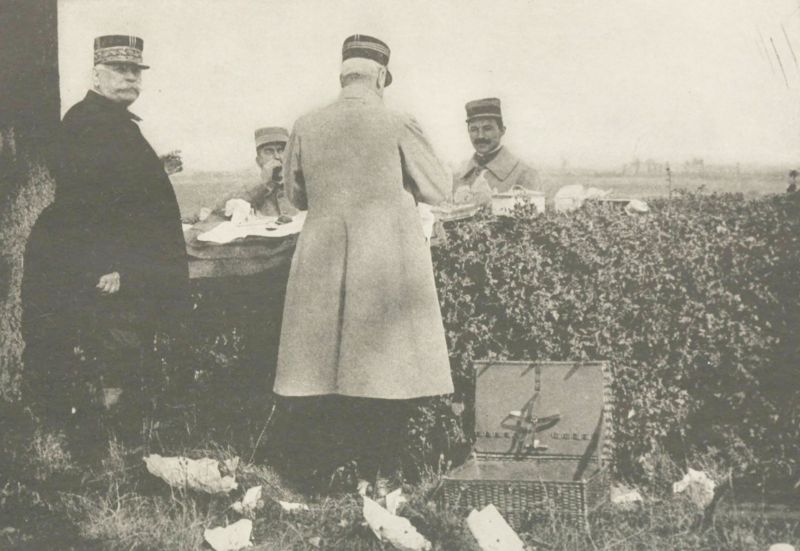
GENERAL JOFFRE LUNCHING JUST BEHIND THE FIGHTING LINE IN CHAMPAGNE
Now let me shift the picture from the tomb of Napoleon on a sunny morning in August. It is a bleak day on the undulating plains of Champagne—a few kilometers to the rear of the battle-lines, where the French had been steadily gaining ground for several weeks. Only the week before they brilliantly stormed the hills where the Germans had entrenched after the battle of the Marne, and they captured every position.
A fine drizzle had been falling since early morning, making the ground soggy and slippery. Along the roads the crowds of peasants and inhabitants of near-by villages are sloshing toward the great open plain. But all the roads are barred by sentries and they are turned back. No civilian eyes except those of a half dozen newspapermen may see what is to happen there. Yes, something is to happen there—something impressive—something soul-stirring—but there are to be no cheering spectators, no heraldry and no pomp.
It is to be a military pageant, without the crowd. It is a change from the ante-bellum military show at Longchamps on the fourteenth of July, when the tricolor waved everywhere, when the President of the Republic and the generals of the army in brilliant uniforms reviewed the troops of France, and all the great world was there to see.
This is to be a review of the troops who took the hills back there a little way, sweeping on and up to victory while a murderous German fire poured into them, dropping them by thousands. Through that clump of trees sticking up in the mud, are little crosses marking the graves of the dead.
Fifteen thousand of the victorious troops will pass in review to-day before the Commander-in-Chief of the Allied armies. Down across the field you can hear the distant notes of a bugle. They are taken up by other buglers at various points. Then across the field comes a regimental band. The players have been in the charge too—with rifles instead of musical instruments. This is their first chance to play in months—and play they do. You hear the martial notes of the Marseillaise floating across the field, played with a force that must have been heard in the German lines.
The regiments take up their positions at one side of the field. General Langle de Carry, commander of the army that did the Champagne fighting, with only a half dozen officers, take positions at the reviewing stand. The reviewing stand is a hillock of mud. Both general and officers wear the long overcoats of the light "horizon blue," the new color of the French army.
A man emerges from the line of trees behind the group and plows his way across the mud. He is large and bulky. He plants his feet firmly at each step—splashing the mud out in all directions. He wears a short jacket of the "horizon blue" and no overcoat. He wears the old red trousers of the beginning of the war. His hat, around which you can see the golden band of oak leaves signifying that he is a general, is pulled low over his eyes. Drops of rain are on his grizzled mustache. A leather belt is about his powerful body, but he wears no sword.
Langle de Carry and his officers whirl about quickly at his approach. Every hand is raised in salute. The bulky man touches the visor of his hat in response—then plants both his large ungloved fists upon his hips. His feet are spread slightly apart. He speaks to de Carry in a low voice. As you have already guessed, this big man is Joffre.
You were told at the beginning of the war that Joffre was a little fat man—like Napoleon. That is not true. Joffre is a big man. He is even a tall man, but does not look so because of his bulk. Few men possess, at his age, such a powerful or so healthy a body. That is why he can cover so many miles of battle front in his racing auto every day. That is why he shows not the slightest sign of the wear and tear of war.
No time is lost in conversation. The bugles blew again and the regiments of heroes began their march past the muddy reviewing stand. Even in their battle-stained uniforms, every regiment looked "smart." When they came abreast of Joffre, stolidly and solidly standing a step in advance of the others, the long line of rifles raised in salute is as straight as ever that of a German regiment on parade at Potsdam, despite deep and slippery mud.
After the infantry came the famous "seventy-fives" with the same machine-like precision that before the war we always associated with Germans. The review ends with a regiment of heavy cavalry—cuirassiers—coming at full charge, rising high in their stirrups, with swords aloft, and breaking into a battle yell when they passed "Father Joffre," as he is called by his soldiers.
Through it all he stands motionless, feet apart, one hand planted on his hip, raising the other to the visor of his hat, peering beneath it straight ahead with unblinking eyes. As the men pass this general without a sword, with no medals, no gold braid, no overcoat—and in old red trousers—the rain pelting upon him, the look on their faces is one of adoration. It matters not to them that there are no cheering crowds, no crashing bands, no gala atmosphere. The one eye in France that they care about is upon them.
The long line then forms facing him, and the men to receive decorations advance. One of them—a private—is to receive the médaille militaire, the greatest war decoration in the world, for it can only be given to privates, or to generals commanding armies who have already received the Grand Cross of the Legion of Honor. Joffre himself only won it after the battle of the Marne.
The private now to receive the medal is brought before the Commander-in-Chief, who pins it upon his breast. Joffre throws both his great arms about the private's shoulders and kisses him on both cheeks. The long line of soldiers remains perfectly quiet. But in the eyes of many of them are tears.
The program is ended. Father Joffre gets into his low, gray automobile and disappears in a swirl of mud, to some other part of the "zone of operations."
The army now knows it has the real leader that it waited for so long. To the general public of France Joffre is still a mystery. But they are content with their mystery—they have faith in him. That is the spirit of the new France—a quiet faith and determination that certainly has deceived the rest of the world, especially Germany. It is the spirit of a nation that has found itself, and Joffre typifies it.
A few books have appeared giving some information about the Commander-in-Chief. They deal chiefly with his march to Timbuctoo and his career in Indo-China. For the rest, Parisians know that before the war he lived quietly in a little villa in Auteuil, and that next to his love for his family, the things he regarded as best in all the world are peace and fishing. Recently it was learned that he commandeered a barge on one of the rivers near the battle line—and there he sometimes sits and quietly fishes while thinking out new army plans. His only other recreation at the front is reading at night before going to bed from his favorite authors, Balzac, Dumas and Charles Dickens. Joffre understands English and reads it but will not speak it. "It is that he has an accent which he likes not," explained one of his officers.
What Parisians cannot understand is how it was that this quiet, perfectly unemotional man came into being in the Midi—as Southern France is called. From the Midi, as from Corsica, come the hotheads and the firebrands. The crowd certainly expected, when this war came, that the Commander-in-Chief of the army would give Paris a real treat before going forth to battle—that he would parade the boulevards in dress uniform at the head of his troops. Alas! Paris has scarcely heard a band play since the war began.
All the time that Joffre lived in the little villa in Auteuil he was planning and waiting for the day when he should go forth to battle. He was a fatalist to the extent that he felt by reason of his appointment to office three years before that he was the chosen man to administer "the revenge"—that he would lead the armies of France against Germany. He never forgot it for an instant. It was Joffre who did everything that a human being could do before the war, to prepare for the day. It was Joffre who perfected the scheme of mobilization, so that France was not caught entirely unprepared.