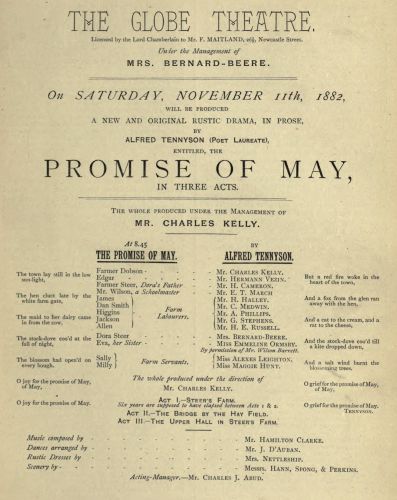
Part 1 — THE GLOBE THEATRE.
Reading edition
Licensed by the Lord Chamberlain to Mr. F. MAITLAND, 26½, Newcastle Street.
Under the Management of
MRS. BERNARD-BEERE.
On SATURDAY, NOVEMBER 11th, 1882, WILL BE PRODUCED A NEW AND ORIGINAL RUSTIC DRAMA, IN PROSE, BY ALFRED TENNYSON (POET LAUREATE), ENTITLED, THE PROMISE OF MAY, IN THREE ACTS.
THE WHOLE PRODUCED UNDER THe MANAGEMENT OF
MR. CHARLES KELLY.
At 8.45 BY
THE PROMISE OF MAY. ALFRED TENNYSON.
The town lay still in the low sun-light, Farmer Dobson Mr. CHARLES KELLY. But a red fire woke in the heart of the town,
Edgar Mr. HERMANN VEZIN.
Farmer Steer, Dora's Father Mr. H. CAMERON.
Mr. Wilson, a Schoolmaster Mr. E. T. MARCH.
The hen cluct late by the white farm gate, James } {Mr. H. HALLEY. And a fox from the glen ran away with the hen,
Dan Smith } {Mr. C. MEDWIN.
Higgins } Farm Labourers {Mr. A. PHILLIPS.
The maid to her dairy came in from the cow, Jackson } {Mr. G. STEPHENS. And a cat to the cream, and a rat to the cheese,
Allen } {Mr. H. E. RUSSELL.
The stock-dove coo'd at the fall of night, Dora Steer Mrs. BERNARD-BEERE. And the stock-dove coo'd till a kite dropped down,
Eva, her Sister MISS EMMELINE ORMSBY.
By permission of Mr. Wilson Barrett.
The blossom had open'd on every bough. Sally} Farm Servants. {Miss ALEXES LEIGHTON. And a salt wind burnt the blossoming trees.
Milly} {Miss MAGGIE HUNT.
The whole produced under the direction of
O joy for the promise of May, of May. Mr. CHARLES KELLY. O grief for the promise of May, of May,
ACT I.—STEER'S FARM.
O joy for the promise of May. Six years are supposed to have elapsed between Acts 1 & 2. O grief for the promise of May. TENNYSON.
ACT II.—THE BRIDGE BY THE HAY FIELD.
ACT III.—THE UPPER HALL IN STEER'S FARM.
Music composed by Mr. HAMILTON CLARKE.
Dances arranged by Mr. J. D'AUBAN.
Rustic Dresses by Mrs. NETTLESHIP.
Scenery by Messrs. HANN, SPONG, & PERKINS.
Acting-Manager—Mr. CHARLES J. ABUD.
Assuming that Mrs. Bernard-Beere, as Dora Steer, speaks these lines, we have the counterpart of the villainously seductive Earl in Philip Edgar, a thankless part, which was admirably played by Mr. Hermann Vezin. This Edgar, having ruined and abandoned one sister, returns, after an interval of five or six years, to the scene of his former conquest, and lays siege to the heart of the other sister; confidentially informing the audience that he intends to marry Dora as an atonement for the injuries he has inflicted on the luckless Eva. The shouts of derisive laughter with which this announcement (the culmination of absurdity), was met on the first night, led Mr. Hermann Vezin to somewhat modify his language on the following evenings, but he was still compelled to inflict on the audience the most tedious and extraordinary soliloquies touching Communism, Free-love, Agnosticism, and other wholly undramatic topics. For Tennyson had, with characteristic bigotry, chosen to assume that a Freethinker must necessarily be a villain; and with a view of generally condemning opinions distasteful to him, had burdened poor Edgar with the task of proclaiming himself at once as a seducer, a hypocrite, a liar, a coward, a Freethinker, an Agnostic, a Secularist, a Democrat—and all this in speeches of a contradictory and decidedly tiresome description.
On the third representation of the drama the Marquis of Queensberry, who occupied a seat in the stalls, rose, and loudly protested against the Laureate's misrepresentation of the principles of freethought as a gross caricature, especially in regard to Edgar's sentiments about the law of marriage.
He subsequently addressed a letter to The Globe, containing the following explanation:—
"THE PROMISE OF MAY."
TO THE EDITOR OF THE GLOBE.
"SIR,—In reply to Mr. Hermann Vezin's letter, which appears in your issue of to-day, may I be allowed to make a few remarks? He says that on the first night 'some one started a hiss, which soon grew into a storm,' &c., and he continues to say, 'it is to be presumed that this opposition came from professing orthodox Christian people. On the third night the Marquis of Queensberry, a professed Freethinker, rose in his stall, and loudly protested against what he considered a caricature of his own sect.' Not a caricature against my own sect, Sir, which is Secularism, but against an infamous libel to the whole body of people who have been designated by that name of Freethinkers. Mr. Hermann Vezin says, here we have a curious spectacle of the most outspoken opposition from both extremes, and that neither party has quite caught Mr. Tennyson's meaning. Whether two separate parties spoke (or only one, as I expect is the case) it would be as well if Mr. Tennyson himself would explain what his meaning is; for, coming so soon after the poem, which he issued to the public a short time ago, entitled 'Despair,' we Freethinkers can have but one opinion as to what his meaning is, and that is to caricature and to misrepresent what the outcome of freethought has led to in its secession from orthodoxy. My object the other night in causing an 'interruption' at the theatre was not only to make a public protest against the supposed sentiments of a Freethinker (on marriage), but to attract public attention to that protest, and I consider that the end justified the means, considering the difficulty that we have in getting a hearing from those who oppose us, and not only who oppose us, but who misrepresent us. Freethinkers may not be satisfied with the present marriage law—as I explained the other day in my letter to the Daily News—but that is no reason that they should not respect marriage, and we cannot be attacked on a more tender point, from the very delicacy there is to speak on the subject.—Yours faithfully,
"QUEENSBERRY.
"45, Half Moon-street, Piccadilly, November 20, 1882."
This led to a discussion in the newspapers on Tennyson's muddled metaphysics and absurd theories; public curiosity was thus aroused, and the management was enabled to run the play much longer than could have been expected from its original reception.
Punch (November 25, 1882) had a long and elaborate criticism of the play, giving a humorous analysis of the plot. The opening and closing paragraphs are much to the point, especially as they include two amusing parodies.
NEITHER RHYME NOR REASON;
Or, Promise of May, and Performance of November at the Globe.
"THE sources of literary ambition are proverbially obscure, and it is scarcely worth while to enquire why the Laureate, who has spent a lifetime in filling the world with his verse, should, at the eleventh hour, have conceived the idea of emptying the Globe with his prose. If there could be any doubt that he had not only done so, but also had set himself to the business with a right good will, the hearty and sympathetic jeers of the not unkindly audience that attended the first performance of his Promise the other evening must have settled the matter. Indeed, some of the Poet's own lines—or something like them—seemed to occur to everybody. Even his staunchest admirers could be heard in the lobbies between the acts respectfully quoting to each other—
'I hold it truth that he who flings His harp aside, to try the bones, Will somehow find that paving stones, Are levelled at his neatest things.'
By the way, the management might even now take a hint from a rival establishment, and try this on a poster.
"The plot of the piece is simplicity itself, and if the talented author had merely contented himself with working out his pretty little idyl in some ordinary and unpretentious fashion, there could hardly have been any doubt about the result. But he went further than this, and in some inspired moment appears to have conceived the brilliant and happy idea of spicing his whole story, from beginning to end, with the wildest and most boisterous fun.
"Not that his purpose was distinctly apparent on the first go off of his piece in a Lincolnshire farm; for the serious utterances of several gloomy rustics for a few moments filled the house almost with awe.
"However, with so much genuine pantomime go for the finish in reserve, very possibly the author knew what he was about. And he was not at fault. He must have realised what depths of quiet fun would be stirred when placing Mrs. BERNARD-BEERE over the dead body of Eva, he made her, in so many words, courteously request Farmer Dobson and the comic agnostic Edgar to consider themselves quite at home, and not mind the corpse, as she had a few general remarks to make that wouldn't take her much more than five-and-twenty minutes.
"But there,—the matter really defies sober criticism, and, taking his own charming lines from the bill, the story is soon told:—
'The Town booked well for the opening night, The Pit was full, an evident pull, The Grand Old Man had a box of his own, And VEZIN behind said it looked all right, And the critics in front took an excellent tone. There's a chance for The Promise of May, of May, There's a chance for The Promise of May. 'But a sly wink woke in the eye of the Town, And a frivolous fit got hold of the Pit, And KELLY a pitchfork, and VEZIN a roar, And the stock chaff followed the Curtain down; And the Critics they did—as they've done before— They slaughtered The Promise of May, of May, They slaughtered The Promise of May!'
"The Laureate cannot write a playable play. The Falcon at the St. James's was saved by the acting; Queen Mary, nothing could save; The Cup was the success of Miss ELLEN TERRY, Mr. IRVING, the scene-painter, and the stage management.
"But The Promise of May must be an Utter Frost, with, we are sorry to think, no Promise to Pay in it; and nothing, except the spasmodic curiosity of the Public to see what the Laureate can't do, can set this unfortunate Humpty-Dumpty up again."
THE LAUREATE'S LATEST.
The "town" ran off to the Globe one night, For a play was played then from the Laureate's pen; But they soon said, "How dare he?" and kicked up a "row," And pooh-poohed the drama—and serve it right, For that it deserved it I think you'll allow. Yea, they jeered at "The Promise of May,"—of May— Annoyed at "The Promise of May." But stay; we'd better, maybe, leave that song, Yea, leave its "hen," its "fox," its "cat," and "cheese"— For where is he who can burlesque burlesque? And this strange playwright, mystic, wonderful, Loved stage plays with a love that was his doom! For lo! this "Promise" played by Bernardbeere Has gained, at least, this very doubtful fame— Hereafter, through all ages—"'Twas no good!" The critics, o'er its threadbare plot, Ere long grew "crusty"—one and all. Said they, "'Twill fail; such awful rot Will on the public quickly pall. The leading character is strange, The rest are all a prosy batch, The audience they'll never catch— The programme they must shortly change. "A. T.," they said, "'tis weak and dreary. A lot of bosh," they said. "It makes the audience aweary; Soon it will be dead!" Besides the forced and feeble plot, Full soon did men discover The scientific "snob" was not A pleasant sort of lover. Of speech he had an awful flow— Which Tennyson thought clever— And he soliloquised as though He meant to jaw for ever! And then unto the critics and reviewers, Irresponsible critics and reviewers, Thus, Alfred (not in metre of Catullus— But more in "In Memoriam" sort of measure): "The critics prattle on amain— That envious and grumbling race Declare my play is commonplace, And rather full of chaff than grain. "I hold it true—although they bawl, And I may heavy find the cost— 'Tis better to produce a 'frost' Than ne'er to write a play at all." And then unto the Queen (s'berry) he hymned This little lay; for he, the noble "Q.," Cried out at Edgar's "Maxims of the Mud." Then Alfred and fair Bernardbeere were glad, And rested well content that all was well. "You jeered, O, "Q," and you were bold To treat my great prose-play with mirth; But your advertisement was worth No end of praise and lots of gold. "For now the town will haste to see My 'Edgar' that made you so ill; And so they'll keep it in the bill Since that advertisement from thee." * * * * * Shall it not be scorn for me to harp upon this mouldy thing? For surely in a week or two it will have taken wing. "Weakness to be wroth with weakness"—that this play is weak, 'tis plain. I have seen much better dramas founded by a shallower brain. From the programme of the Globe, then, sweep this foolish thing away. Better fifty Meritt-mixtures than this sickly, stupid play! CARADOS.
The Referee, November 19, 1882.
A DREAM OF GREAT PLAYERS.
I read one night, while lying on the down, In L. T. Annual[11] of the current year— Tho' unpretending volume, bound in brown— Great deeds recorded were. At length, methought that I had wandered far Through the long path that runs beside the line, And found myself before the entrance-door, And knew I was in time. I knew the stands, I knew the nets, I knew The smooth, green level of the well-rolled lawn, And thought, "Here many an athlete anxious grew, Dreading the fateful dawn." A voice from out the ticket-office came— From overworked collector in his prime— "Pass quickly through, the seats are all thine own Until the end of time." Close by a player, leaning on the rail, Clasping a racket, Tate-made, in his hand— A champion among men, who made me hail, And led me to the stand. His cigarette from out his mouth he drew: Blew out white clouds, then said, with courteous smile— "Hast come to see great players? Good! Then you Had best stay here awhile. "I am the champion! ask thou not my name; Not to know me argues thyself unknown. Many played here, and fell; whene'er I came All men were overthrown." "No marvel," I made answer; "In fair field Myself before such skill had doubtless quail'd, As all men must." Then, turning, I appealed To one who merely wailed— As he with forced perpetual smile averse, To his full height his stately figure draws— "My youth," he said, "is blighted with a curse— This stripling is the cause. "For seven years The Cup I strove to win, But ever, when it seemed within my grip, He, rising o'er all others, entered in, And dashed it from my lip." His words of grief fell idly on my ear, As thunderdrops fall on a sleeping sea. Sudden I heard a voice that cried—"Come here, That you may look on me. "I am ex-champion, now three years displaced, And since that time I find it very slow; I have no men to conquer in this waste, I war with fairer foe." He paused in gloom, and towards the others faced, To whom the Smiler—"Oh! you tamely died; You should have stood well to the back, and placed The ball along the side." "Alas! alas!" a low voice, full of care, Murmured beside me—"Champion I might be, But for this injured member which I bear I had gained victory." I gazed upon him, then became aware Of some one coming hastily in wrath, Reminding his twin-brother—"We're the pair Chosen to play the North. "Do hurry up, our foes await us there; The stem, black-bearded form, the referee, Ejaculating, as he tears his hair, 'Where can the players be?'" Then seized his arm, and drew him from the spot. I, feeling tired and thirsty, strolled away; The day becoming most extremely hot, I cared to see no play. Pastime, February 13, 1884.
THE LORD OF BURLEIGH.
Listen to the doleful story Of a juvenile M.P., He was but a voting Tory, And a farmer's daughter she. Spake he in his wisest manner (Whereat people often smiled), "You must give up your piano, You are but a farmer's child. "Straight forget each foreign tongue, dear, And, to further my desire, All the songs you ever sang, dear— For a tenant is your sire." So she sells her dear piano; With the cash her bargain yields Buys she Gibbs's best guano, Which she scatters o'er the fields. Then forgets each well-bred accent, Foreign, native, just the same, All her modern books are back sent To the stores from whence they came. Then he marries her and makes her Thus a lady of renown, And with condescension takes her To his house by Stamford town. From the gate his crest depended, Which the owner's breeding shows; Hand with fingers wide extended Stretching from a lordly nose. Waves the flippant owner's pennant O'er the keep's embattled brow, Though her sire was but a tenant She is Lady Burleigh now. Long she lived in stately manner 'Mid the highborn and the grand, But she pined for her piano Scattered on the teeming land. Then she grew and ever thinner, And she murmured, "O that he, At that agricultural dinner, Had not ever counselled me." So she drooped and drooped before him, And at last, with anguish bent, To his freedom did restore him, Following her dear instrument. He survived in state and bounty, Lord of Burleigh, young and free, Not a lord in all the county Was so great a fool as he. CECIL.
The Kettering Observer, March 21, 1884.
When Lord Burghley, M.P. (son of the Marquis of Exeter), took the English farmers to task for allowing their daughters to play the piano, and to learn a few of the polite little accomplishments of the day, his remarks were generally resented as impertinent, and his name lent itself irresistibly to the ridicule contained in the preceding parody of Tennyson's "Lord of Burleigh." Inasmuch as Tennyson's poem was founded on incidents connected with the courtship and marriage of the first Marquis of Exeter, to Sarah Hoggins, the daughter of a small yeoman farmer at Bolas Magna, in Shropshire. The marriage took place in October, 1791, and the lady died in January, 1797, leaving two sons, of whom the elder became the second Marquis of Exeter, and was the grandfather of the Lord Burghley above referred to.
THE FAITHLESS PEELER.
SKULKING slily down the area, He to her his mind doth tell— "I feel somewhat dry, my Mary, And some beer would be as well." She replies, by way of feeler, "La, who'd thought of seeing thee?" He is but a smart young peeler, And a maid-of all-work she. He to lips that do not falter, Raises up the half-pint mug; Vows his love will never alter— Eyeing hard the empty jug. "I can pick that bone of pheasant, Little care I for a knife— Love, it makes our duty pleasant, Luncheon love I dear as life." He across the kitchen going, Sees two lordly bottles stand; "India pale" within them glowing, And he grasps one in each hand. From deep thought himself he rouses, Says to her that loves him well, "I could pop these in my trousers' Pocket, and no one might tell." This he doth by her attended, And they lovingly converse Of the toothsome things that tended To bind so close his heart to hers. Leg of pork, with sauce of apple, Fowl and bacon and broad beans; cold roast beef, with which he'd grapple, Sooner than with warmed-up greens. What she gives him makes her dearer, Such she hopes to be the case; Hopes his beat will still be near her, Should she ever change her place. Oh! but he doth love her truly; He shall have a cup of tea— She will bring it to him duly, Some time after half-past three. And her heart rejoices greatly, Whenever peeler she discerns, Past the small boys pacing stately, While they mimic him by turns. Thinks he looks far more majestic Than he ever looked before— Fears he winked at the domestic Higher up at Number Four; Hears him speak in gentle murmur, Knows he's answering her call, While he treads with footstep firmer, Leading past the garden wall. All at once the colour flushes His false face from brow to chin; As it were with shame he blushes, While she vows she's "been took in." Then unable to conceal her Love, she murmurs, "Oh, that he Were once more that faithful Peeler, Which did win my heart from me." He but begged she'd no more bore him, When she falls flat at his side; Gathered soon a crowd before him, Whilst to lift her up he tried; And one came to raise her bonnet, And he looked at him and said, "Bring a chair, and place her on it, For I fear she's hurt her head." Home they took her, and next morning, By her mistress she's addressed, "Mary, you have a month's warning— This time, mind. I'm not in jest. The Puppet Show, July 29, 1848.
THE LORD OF BURLEIGH.
(Slightly altered from the Poet Laureate).
To the Bill he whispers gaily, "Land Bill, I the truth must tell— You're a nuisance; but believe me That I really love you well!" She replies, that Irish Maiden, "No one I respect like thee." He is Lord of ancient Hatfield, And a simple Land Bill she. So most kindly he receives her Merely with two hours' reproof, Leads her to the Lords' Committee, And she leaves her GLADSTONE'S roof. "I will strive to guard and guide you, And your beauty not impair; Only add a few amendments, Prune a section here and there. Let us try these little clauses Which the wealthy Lords suggest; No connection with FITZMAURICE, Or with HENEAGE and the rest!" All he tells her makes her queerer, Evermore she seems to yearn For her Commons and her GLADSTONE, And the moment of return. And while now she wonders wildly Why she feels inclined to sink, Proudly turns the Lord of BURLEIGH, "I have drawn your teeth, I think!" Then her countenance all over Pale and (emerald) green appears, As he kicks her down the staircase, 'Mid their Lordships' wicked jeers. But her GLADSTONE looked upon her, Lying lifeless, worn, and spent, And he said, "Your dress is ragged— These must be arrears of rent." Deeply mourns the Lord of BURLEIGH, No one more distressed than he, When the PREMIER moved the Commons With the Peers to disagree. And they gathered softly round her, Did the Commons, and they said, "Bring the dress we sent her forth in— That will raise her from the dead!" Punch, August 13, 1881.
The Figaro of January 22, 1873, contained a long parody (eleven verses), entitled, "The Lord of Burleigh," but it is not now of sufficient interest to warrant its reproduction.
A BURLINGTON HOUSE BALLAD.
(With Apologies to Our Lordly Laureate).
In her ear he whispers sadly, "I've a grief upon my soul, And I want you very badly Just to take a little stroll." She replies, in accents fainter, "Anywhere, my love, with thee." He is but a budding painter, And his fair fiancée she. To her chamber straight she scurries, Lest delay should bring reproof, Pops her bonnet on and hurries With him from her father's roof. So she goes, by him attended, Hears him absently converse, As with spirits all unmended He controls his steps to hers. Faring thus, she wonders greatly, Till a gateway she discerns With armorial bearings stately, And beneath the gate she turns. Sees a building most majestic In a simple maiden's eye; Pays he then a smug domestic, And the turnstile clicks them by. All around are paint and glitter High and low upon the wall, While he treads with feelings bitter, Leading on from hall to hall. And as now she freely utters Rapture it were vain to hide, Fiercely turns he round and mutters, "There's my picture—it is 'skyed!'" Funny Folks, May, 1884.
THE MAY QUEEN OF 1879, AS SHE MIGHT HAVE BEEN.
WELL, you waked and call'd me early on the first, my mother dear, As though't had been the jolliest time of all the glad new year, For as you were aware, mother, in spite the wretched day, I had to be Queen o' the May, mother, I had to be Queen o' the May. You did your best for me, mother, I must say that of you; You had my waterproof prepared, and my goloshes too; You lent me your own muff, mother, my chilblains were so sore, And made dear Robin bring the cover'd cart close to our door. And yet the May-day games, mother, were not a great success; And I, for I was Queen, alack!—got in the greatest mess; The mud was over all our boots—it hail'd, too, as it chanced, And I fell in a puddle, mother, while I with Robin danced. (Five verses omitted). "So, on the whole, I cannot say I'm glad—no more can you, You call'd me early on the first, though then I begg'd you to; In truth, could I have known, it would have been so cold and wet, I'd have told the lads and lasses, mother, another Queen to get. "But, there, it is too late to fret—the thing is over now, But not again will your poor child thus play the fool, I vow; Another year, if spring is late, I'll stay in bed all day, Rather than get up early, mother, and be the Queen o' the May." Truth, May 22, 1879.
YOU ask me why, tho' ill at ease, Within this region I subsist, Whose spirits falter in the mist, And languish for the purple seas? * * * * TENNYSON.
THE NEW UMBRELLA.
You ask me why, though ill at ease, And chilled with rain, my gentle Stella, I stand beneath the dripping trees, With shivering hands and shaking knees, But do not use my umbrella. The reason I can soon explain, Succinctly, simply, and precisely: If once I used it in the rain, I could not fold it up again, Or roll it up so smooth and nicely. No, precious slender staff! no hand of mine, With ruthless hate or foolish gaming, Shall mar thy symmetry divine— The curved diagonal of line That circles round thy wooden stamen. The skill that wrapped thee up so tight And fastened up the ring and button Is rarer far than second-sight, The art of catching fish at night, Or carving any joint of mutton. * * * * (Two verses omitted). The Cambridge Meteor, June 13, 1882.
"OF old sat Freedom on the heights, The Thunders breaking at her feet: Above her shook the starry lights: She heard the torrents meet." TENNYSON.
PAM UPON THE HEIGHTS.
[Lord Palmerston was appointed Lord Warden of the Cinque Ports, March, 1861].
NOT old, stood Pam upon the Heights, The Commons roaring at his feet, And Beadledom, with antique rites, Did him the homage meet. Punch, in his place did much rejoice, Not for the title then assigned, But glad to hear the brave old boy's Name shouted on the wind. Admiring much his British pluck, His ready tongue, his cheery jest, His never downing on his luck, But hoping for the best. His hate of humbug, saving such As should to humbugs still be flung, His speeches, void of artist touch, Yet suiting English tongue. His deeper hatred for the gang, Who, prating of some Right Divine, Doom freedom's friends to starve, or hang, Or in foul dungeons pine. Cheer for the Constable! Our foes Find him the nightmare of their dreams; We, the wise Englishman, who knows The Falsehood of Extremes. Punch, 1861.
LORD BEACONSFIELD AS TITHONUS.
THE Whigs decay, the Whigs decay, and fall, The Obstructives drag our Senate through the mire; Parliaments cumber earth, then pass away; E'en this one, after many a session, dies; While I, secure of immortality, Take my calm saunter, propped by Monty's arm, Along the highways of the busy world, A noted figure, roaming, in my dream, All sorts of places in my Favourite East, The gleaming halls and splendours of Lothair. Alas for that grand piece of statesmanship, That glorious work, the Berlin settlement! So highly lauded by my chosen print The Daily Telegraph. Almost I seemed To its great heart none other than a god! Bulgaria asked for independency; 'Twas granted with a few strokes of the pen. Some people really don't care what they grant. But the strong Russ, indignant, worked his will, Pared down and minimised my settlement; And though he could not end it, left it maimed, The veriest of hashes. Can fine words From Salisbury make amends? Though even yet Our faithful organs in the daily press Are tremulous with praise, weep tears of joy To hear us. Come, let's go; we've had enough Of Government. How can a man desire To mix with Irish members, rowdy lot, Who never mind the ruling of the Chair, But pass beyond the Speaker's ordinance, Which all obey—or ought to, if they don't? A black cloud hovers o'er the Cape: there come Glimpses of dark men we have made our foes. Once more I hear the rumour steal abroad Of an election-time approaching near; And who can tell the upshot? Will the rout Whom I enfranchised not so long ago Shake off the yoke of Tory Government, And bring the Liberals in instead? Who knows? Fain would I get me to the gorgeous East! I wonder how my constitution stands The rigours of this chilly English clime, This so-called summer, wretched, cold, and wet. I shiver by the fireside, while the steam Floats from the damp fields round my country seat, And racks my agèd bones with rheumatism. Place me upon some Asiatic throne, Give me an empire in the realms of morn, Thither I'd hasten from this bourgeois court On a triumphal car with silver wheels. V. A. C. A.
The World, July 30, 1879.
WHAT LOCKSLEY HALL SAID BEFORE HE PASSED HIS OXFORD RESPONSIONS,
(Vulgo SMALLS).
OH the misery of "Smalls!" the cark, the turmoil, and the grind! Oh the cruel, cruel fetters which are wreathing round my mind! There is grammar, there is Euclid, and far worse than all of these, Arithmetical refinements, with their stocks, and rules of threes, With their discount and their practice, and their very vulgar fractions, Smashing up the one ideal into many paltry factions. Square root makes the head to ache, the decimals the tear to start, For they're ever circulating round the fibres of my heart— Learning grammar is like putting water in a leaky pot, And its memory is only like the days remembered not; Verbs in "M I" are aggravating, Euclid makes the foot to stamp, Only lucid when enlightened by a moderator lamp, The old spider and his cobwebs! would that I could sweep them out From the dust and must of ages with a triumph and a shout; Shall I spurn him with my foot, or shall I scorn him with mine eye? Shall I tear him into pieces? SOUTHEY burnt him—so will I. C. C.
B. N. C. College Rhymes, 1861.
These lines also appeared in Punch.
There was also an early parody of "Locksley Hall" in Punch, describing the Railway Mania of 1845. This parody was rather technical in its language, not very amusing, and is now quite out of date.
BATTUE SHOOTING.
Gather round, my noble comrades; hardy sportsmen, gather where, Placed in yonder shaded corner, stands for each an easy chair; Close behind are well-packed hampers, and attendants duly wait To reload your deadly weapons while you sit and shoot in state. Amply fed and reared, my pheasants—tame they'll answer to your call, But, like whirling leaves in winter, soon you'll see them thickly fall. Hark, the beaters drive them forward. Now, prepare—the time is nigh, We shall soon reduce their numbers. Peste! they're far too fat to fly! See the startled hares and rabbits vainly shelter safe have sought, Headlong rushing, mad with terror—surely this is noble sport! Eh! what say you? Let go at them, now's the time to try your skill; Crawling wounded, lame and fluttering, down they go the bag to fill. Warmish work, and quite fatiguing—let's refresh ere we renew. Vulgar hinds may sneer and welcome. Vive, say I, the good battue! * * * * * Surely those who so love slaughter might, when close time comes for grouse, Find congenial occupation if they donned the butcher's blouse. D. EVANS.
The Weekly Dispatch, August 31, 1884.
GODIVA.
(A Pose Plastique, by Madame Warton, before the forthcoming picture by Edwin Landseer, R.A.)
OR, THE PEEPING GENT OF COVENTRY STREET.
I waited in the street named Coventry; I hung outside the 'bus from Putney Bridge, To watch the three short fares; and there I shaped The last new "Tableau Vivant" into this. NOT only we, the smartest blades on Town, Fast men that with the speed of an express Run down the slow, not only we, that prate Of gents and snobs, have loved the genus well, And loathed to see them unamused; but she Did more, and undertook, and overcame, The Venus of the Tableaux Vivans—Madame Warton, Queen of the Walhalla, near the street Of Coventry: for when there was nought up To take the Town, the Gents all came to her, Clamouring, "If this last, we die of slowness!" She sought a painter, found him where he strode About the room, among his dogs, alone, His beard shaved close before him, and his hair Cropped short behind. She told him the Gents' fears, And prayed him, "If this last, they die of slowness!" Whereat he stared, replying, half-amazed, "What would you have me do—an animal painter— For such as these?" "A Tableau paint," said she. He laughed, and talked about Sir Peter Laurie.[12] Then chucked her playfully beneath the chin; "O, ay, ay, ay, you talk!" "Talk! yes!" she said. "But paint it, and prove what I will not do." And with a sly wink there was no mistaking, He answered, "Ride you as the famed Godiva," And I will paint it," she nodded, and in jest They parted, and a cabman drove her home. All was arranged. The boardmen in the street, As curs about a bone, with snarl and blow Made war upon each other for a board: The best man won. She sent bill-stickers forth, And bade them cover over every hoarding With large placards, announcing she would please Her favourite gents; who, as they loved her well, From then till Monday next, in crowds should come And gaze at her,—each one his shilling paying For seats within the public promenade. Then went she to her dressing room, and there Unhooked the wedded fastenings of her gown, Some soft one's gift; but every now and then She lingered, looking in her toilette glass, Rougeing her cheek: anon she shook herself, And showered the rumpled raiment 'neath her knee; Then clad herself in silk; adown the stair Stole on; and like a bashful maiden slid Through passage and through passage, until she reached The platform; there she found her palfrey trapt With pewter logies and mosaic gold. Then rode she forth, clothed all in silken tights: The fiddles played beneath her as she rode, And the reserved seats hardly breathed for fear. The little wide-mouthed heads beyond the stalls Had cunning eyes to see: the crimson rouge Made her cheek flame: a fast man, winking, shot Light horrors through her pulses: the saloon Was all in darkness; though from overhead The flickering gas-light dimly flared: but she Not less through all bore up, till, last she gave The signal to the workmen in the flats, And round upon the pivot slow she turned. Then rode she back, clothed all in silken tights: And one low Gent, decked out in Joinville tie, The certain symbol of a Gentish taste, Using an ivory opera-glass he'd hired, Peeped—but the glasses, ere he had his fill, Were shivered into pieces, and the curtain Was dropt before him; so that the deposit Left on the glass was forfeit to the Jew; And he that knew it grieved: Now all at once, With twelve great shocks of sound, the interlude Was scraped on cat-gut from a dozen fiddles, One after one, for neither did keep time, Nor play in tune: and Madame Warton gained Her chamber; whence re-issuing, as "Venus Rising from the Sea," the ennui passed away, And she made everlasting lots of tin. The Puppet Show, April 1, 1848.
THE VOYAGE.
WE hired a ship: we heaved a shout: We turned her head towards the sea; We laugh'd and scull'd, and baled her out, We scream'd and whistled loud for glee: We scull'd, we scream'd, we laugh'd, we sang, Beneath the merry stars of June: Went flute tu-tu, and banjo bang: We meant to sail into the moon! Far off a boatman hail'd us high: "My boat is named the Bonny Bess; Old Jack will charge you more than I, For I will charge you sixpence less: My boat is strong, and swift, and taut, But Jack's—she is not worth a cuss." We held his terms in scorn, for what Was sixpence or a crown to us? We bang'd; we baled; we scull'd; we scream'd; The water gain'd upon us fast. We looked upon the moon: she seem'd As far as when we saw her last. We look'd: no terror did we show; We did not care a button, we; We knew the good ship could not go Beyond the bottom of the sea. But one—at best he was a lout— The same, we guess, was short of chink— Exclaim'd in terror, "Let me out, I am quite sure the ship will sink. The leak is quickly gaining height; 'Twill soon be half-way up the mast." And through the hatch that starry night We let him out, and on we pass'd. Slight skiffs aslant the starboard slipt, And jet-black coal-boats, stoled in state, And slender shallops, silvern tipp'd, And other craft both small and great. But we nor changed to skiff or barge, Or slender shallops, silvern-peak'd; We knew no vessel, small or large, Was built by mortal hands, but leak'd. Beyond the blank horizon burn'd; The moon had slid below the main; About the bows we sharply turn'd, And scull'd the good ship home again. Before us gleam'd the hazy dawn; We scull'd, but ere we shockt the lea, And paid old Jack, the ship had gone Down to the bottom of the sea. Above the wreck the sad sea breaks, And many a pitying moonlight streams; And o'er the yeasty water flakes The snow-white sea-gull, sliding screams. If any goods be wash'd ashore, Or cash—if any cash be found— To us, and not to Jack, restore: But then—you cannot; we were drowned. S. K. C.
Kottabos (William McGee), Dublin, 1875.
"BREAK, break, break, On thy cold gray stones, O sea! And I would that my tongue could utter The thoughts that arise in me." * * * * TENNYSON.
It seems hard to believe that the weather was even hotter in New York during last June than it was in London during certain days of July and August. An American poet thus records his impressions:—
HOT, hot, hot, Is the blistering breath of June, And I would that my throat could utter An anti-torridness tune. O well for the Esquimau That he sits on a cake of ice! O well for the Polar bear That he looks so cool and nice! But the scorching heats pours down And blisters both head and feet! And O for a touch of vanished frost, Or the sound of some hail and sleet!
THE LAY OF THE DRENCHED ONE.
(Time, 11.45 P.M.)
PELT, pelt, pelt, On the cold wet earth, thou Rain! While my tongue is about to utter The anger that swells in my brain. Oh, well for the waterproof'd gent, As he walks in his shiny array: Oh, well for the dandified swell, As he drives in his cabriolet. And the last lone 'bus rolls on, As full as its guard can fill; But oh for the sight of a vanish'd cab, And the sound of a wheel that's still! Pelt, pelt, pelt, On the damp, drench'd streets, O Rain; But the tender bloom of a dress-coat spoilt Will never return again. JOHN COLLETT.
"But, says the Sporting Times, Calcutta is a rough place for a 'stony-broke,' for there is no comfortable workhouse for Europeans, such as would remind one of Tennyson's well-known 'Workhouse Song.'"—
"Break, break, break, All these cursed stones I see, For that is the task they've set me, And I wish that I wasn't me."
WAKE! wake! wake! In thy Northern land so free, And our eloquent leader utters A protest for you and me. Oh, well for Midlothian's sons That they shout with him in the fray, Oh, well for our British lads, For we know he will gain us the day. And the Franchise war goes on, Though the Lords would have us be still; But, O for our triumph, thou Grand Old Man, When the people have their bill. Wake! wake! wake! To the war-cry of "Liberty!" And slav'ry's old despotic days Shall never return to thee. RICHARD H. W. YEABSLEY.
The Weekly Dispatch, September 14, 1884. (Parody Competition).
———♦———
RHYME FOR ROGERS.
Howe'er it be, it seems to me A House of Peers can be no good: Mob caps are more than coronets, And Hyde Park crowds than Hatfield's brood. Punch, September 6, 1884.
———♦———
Tennyson's "Enoch Arden" has been less frequently parodied than most of his poems; some years ago the Australian Punch had a clever burlesque of it, and a "continuation" of Enoch Arden was privately printed in 1866. This very scarce little pamphlet consisted of twelve pages, in a blue wrapper, and had no printer's name or place on it. As it is now eagerly sought after by collectors of Tennysoniana, it is here given in full:—