Front matter (continued 5)
Reading edition
Christobel said it was rather windy; she did not want tea out of doors, it was too public. That settled it, because Miss Lasarge understood.
Everything went as is usual until the middle of the meal, when outside subjects of conversation had been exhausted; then Crow said:
"Little Pilgrim, I'm come really to ask you to help us----"
"Us?" questioned Miss Anne, undisturbed.
"Well, it affects us all, so I'd sooner say us. We are in a strange kind of morass--I don't know what to call it. We've never had such a horrible state of things in the family before; you know how happy we are?"
"I know," agreed Miss Anne; "and so something has happened to spoil it! Suppose you begin at the beginning and tell me. 'Trouble shared is trouble spared', isn't it?"
"I'm trying to remember when this trouble actually started," said Christobel, leaning her head back on the cushion, and gazing at the flowers on the table with unseeing eyes.
"It was about the time Mollie went. The first we knew of it was when Pam saved little Ensor. She said, and they said, that she did it alone--you remember. Adrian said it was impossible. Some days afterwards he went to look at the place, and he found a most lovely diamond brooch with two 'A's' for initials and a coronet over them----"
Miss Anne stirred in her chair. Crow paused.
"Go on dear," said Miss Anne.
Crow went on, she told the whole story of the brooch, with scrupulous accuracy, adding one after the other the appearances of Pamela in places where she should not have been at such hours. She went on, without interruption, through the very strange story of Adrian's vision at four in the morning, and the even stranger relation of the condition in which the yawl and the dinghy were found. Finally there was the discovery of the handkerchief on board the yawl, and this latest affair of the picnic at Champles Creek and Pamela's amazing behaviour, followed so quickly by Badger's accusation.
Crow was very deliberate; she did not forget the episode of Timothy Batt even, bringing the whole relation up to the present moment, as it were. Then she ceased to speak.
Miss Anne was leaning her cheek on her hand, and her elbow on the arm of the chair; she did not look at Christobel, but very intently out at the lawn and flowers.
"What do you think, Crow?" she presently asked. "Have you any interpretation of your own?"
Christobel shook her head rather despondently; then she said:
"Anyway, I'm absolutely sure Pamela hasn't done anything dishonourable. I don't understand what's happening, but I do know Pam, and I've sometimes thought she might be aiming at some--well--some rather cranky sort of noble deed----" Crow flushed and looked at her companion in a deprecating manner. "She's simply wild about the Girl Guide business; she's only waiting till she gets to school to be one. She reads it up, and soaks it in, and she's awfully set on doing a good deed every day, and helping people whatever it costs. Don't you see how it might lead to--to things, perhaps? One can't tell how, exactly."
"She might be shielding somebody?" suggested Miss Lasarge.
"Yes; if there was anybody to shield. Besides," added Christobel in a more matter-of-fact tone, "a lot of it is sheer muddle--the Badger business, I mean, that's sinful nonsense."
Miss Anne laughed; the fierceness in Crow's way of saying "sinful nonsense" pleased her very much.
After that they talked it all over quietly, and the upshot was that one thing especially seemed to puzzle Miss Lasarge, namely the surprising vision Adrian saw at four o'clock in the morning.
"He could hardly have been mistaken in Hughie," she said.
"Or in Pam," added Crow.
To that Miss Anne made no reply.
When Christobel had taken her leave, greatly comforted, though nothing had happened so far to lift the burden, Miss Lasarge looked at the clock; it was half-past five. She hesitated, then made up her mind--and a very firm mind too--because though Miss Anne was small and pale she had a great soul in that small body, and she realized that she must help innocent folk who were suffering through no fault of their own.
She put on a grey cloak and little close bonnet with a grey veil, and slipped across the road to Woodrising gates like a grey shadow. It was a cloudy day, and the very young new moon was "lying on her back", as country folk say, which is a sign of tiresome weather. Miss Anne, looking up, saw the silver sickle, pale and slim, for the first time.
Mrs. Trewby opened the gate, sighing; she was more bilious than usual by reason of Mrs. Chipman's company, and a large housekeeping allowance. Mrs. Chipman liked what she called "a good table", meaning, of course, the things on it, not the table. Therefore, in doing her best to keep Mrs. Chipman in countenance, Mrs. Trewby had upset herself for weeks, probably months. It was a pity, because it made her very unhappy and darkened her life.
"I wish to see the Countess, Mrs. Trewby," said Miss Anne.
"Well, miss, I dunno'----"
"It's very important," continued Miss Anne, quietly passing inside; "I will answer to Sir Marmaduke."
When Miss Lasarge spoke in that voice she was always obeyed, and so she presently found herself within the hall, and Mrs. Chipman discussing the matter with many creakings of the tight bodice.
"I assure you, Miss Lasarge, that I have agitated in vain," cried Mrs. Chipman; "coercion has been attempted in vain; the temperament of the Countess is opposed to isolation, therefore----"
"I am afraid we cannot discuss that, Mrs. Chipman; the point is that Sir Marmaduke left orders which must be carried out. Now, if you please, I wish to see the Countess."
Mrs. Chipman was for the time suppressed--like the guinea-pigs in Alice in Wonderland--she was rather like a guinea-pig when you come to think of it. She ushered Miss Lasarge into the drawing-room where Pamela had seen the Countess, but nobody was there, and Miss Anne detected in a moment that Mrs. Chipman really was not sure whether she could produce her very self-willed charge. It was a matter of luck!
In that moment they both saw the girl in question going swiftly across the lawn towards a shrubbery lower down. Miss Anne did not hesitate; she opened the window--which was of the "French" kind--passed out quickly, and called.
The girl stopped, and stood looking to see who had summoned her; saw Miss Lasarge and remained, hesitating. Had it been Mrs. Chipman she would have walked away, that was obvious.
Miss Anne went over the grass towards her.
"I want to have a little talk with you, Countess," she said, without the least asperity. "Won't you come back and entertain me?"
They came back together, into the drawing-room, and Miss Anne shut the window, because she preferred to keep the conversation private.
She did not find this task at all easy, chiefly because the girl's attitude--in every sense--was so antagonistic.
Sir Marmaduke Shard had given her and Major Fraser a sort of partnership as watch-dogs over this girl--chiefly because one was a first-class hospital nurse, and the other a doctor--yet they had no actual authority, only moral authority. He wanted someone on the spot to oversee Mrs. Chipman, and be ready supposing her charge should be ill. He fancied that he had arranged for every contingency in a most complete manner, but being a man as well as a great lawyer, he had of course missed entirely the main points--the practical points--with results already shown.
Miss Anne and Major Fraser both had a reason for helping; this came to light afterwards; but even so they would probably have declined all association with the business had they realized how perfectly untamable Sir Marmaduke's ward was going to be.
Things had come to a head, though, and Miss Lasarge felt herself on firm ground when she began to talk. She told the girl that she knew everything--including the brooch business and the wanderings over the countryside.
The Countess watched her shrewdly--to see how much she really did know--and quickly realized that nothing was said about the night visit to the yawl. Miss Anne did not mention it, because she could not make up her mind about that. How could little Hughie be connected with this girl in such an excursion? It was not possible to understand it, and the Countess decided she did not know, and triumphed.
She excused herself about the brooch, saying it was her own; she had dropped it on the cliffs.
"When you met Pamela Romilly?" suggested Miss Anne.
"Was there any wickedness in helping to carry the farm boy?" said the Countess.
"Of course not, my dear; but you should not have been out. You promised Sir Marmaduke in my hearing that you would keep to these grounds for the short time you are staying--you break your word, and, if I am not mistaken, you induced Pamela Romilly to keep your secret, and so have involved her in all sorts of grief and misunderstanding."
"She need not keep her promise," said the Countess, with a little smile.
"But she would, of course. And you knew she would, didn't you?"
The girl gave that little shrug with which she met objections she despised, and, as Miss Anne looked at her handsome face and her arrogant supercilious expression, she found herself wondering how, when, and where it would ever be possible to teach this untaught soul a code of honour.
CHAPTER XIX
The Trick
Miss Anne's visit at Woodrising lasted nearly an hour, which annoyed the Countess extremely, but she made little way on the road she had hoped to gain. She tried to awaken some sympathy for Pamela, but the girl appeared to find amusement in Pam's trouble. Because she had been brave over the cliff affair, Miss Anne hoped she felt for little Reuben, but she was in no wise interested, the farm people were "common".
At the end of the hour Miss Lasarge realized that the chief hold she had was in the fact that the Countess was afraid of Sir Marmaduke--of anyone in power, perhaps. It was a weapon Miss Anne could not bear to use, but she had to protect her beloved children at the Bell House.
"Well," she said, "then I'll say good night, and you will be wiser, my child, if you do as Sir Marmaduke wishes. You are making a mistake in acting as you do. I am obliged to say that I shall tell him if it does not cease."
The Countess looked down at the little grey person who presumed to interfere with her amusement. It did not occur to her that she could not shield herself behind a lie. It would be quite easy to tell Sir Marmaduke that the girl who ran about in the evenings was Pamela Romilly. He would believe her, of course. She recalled with satisfaction that Miss Ashington was sure she had been visited by Pamela. There was nothing--nothing to prove in any single instance that it had not been Pamela Romilly. Mrs. Chipman would be silent for her own sake.
As the little grey lady stood watching her face she read the thought. Perhaps the Countess did not try to conceal it; perhaps she was not so well practised in deceit as to hide it all--after all, fourteen years is not a long time. In either case Miss Anne saw it quite plainly, and she said:
"You might deny all sorts of things, but you would have to explain to Sir Marmaduke how you came to leave your handkerchief on his yacht--on Tuesday night. It is a thing that cannot be denied."
The girl stiffened, and stood rigidly still.
Then she said suddenly.
"It is a lie--you invent it to frighten me."
"No," answered Miss Anne, looking at her with the clear grey gaze that seemed the essence of truth, "it is quite true. My dear child, you know it is true. There is your initial, and the little coronet--quite unmistakable. Now good night again--be wise, and be good, and you will be happy too. I tell you frankly that I have your handkerchief, but I shall not use any evidence against you unless you make me."
Seldom in her life had the grey lady felt so much pain as when she left the Countess standing in the Woodrising drawing-room with that expression of fear and anger together on her pretty face. Miss Anne had been used to girls as friends always, and had started by treating this girl in the same way as others. The Countess on her part started by pretending friendliness, and cheated! That was the difficulty--kindness, in her eyes, was weakness.
Miss Lasarge went home, and on the way made up her mind to write to Sir Marmaduke if there was any further trouble, but she did not wish to bother him needlessly, because she knew he was very busy at work on a Government Commission. Also, it did seem rather absurd that several women could not keep one girl of fourteen within bounds.
Left alone, the Countess sat down with some force and cried furious tears. Then she took her hat off and threw it on the floor--flung her gloves one way and her shoes another. Then she rang the bell violently, ordered Mrs. Chipman to pick the things up--and marched upstairs in her stockings with high held chin.
She would not go out--to-night--or to-morrow--perhaps not for one or two more days, but wait. She had plenty of money; she would not be trammelled by these common people--after all what could they do to her? That was the point naturally--what they could do that mattered? She had been in England a long time. Quite long enough to understand that nobody would hurt her, whatever she did; but not long enough to appreciate kindness at its true value--which was sad, in many ways. Therefore she settled her own plan, in her own way, went to bed and slept soundly.
At the Bell House life assumed something of the old peace. Nothing happened in the Badger line--having cast his bolt, the wily master of Champles Farm was not quite certain what to do next.
Christobel smiled on Pamela, who in her turn summoned up courage to ask what she had done with that handkerchief.
"Gave it to the Little Pilgrim," said Crow.
"What did she say?"
"Nothing."
"Didn't she say one word? Didn't she know anything?" persisted poor Pam, disappointed.
"She looked at the initial, and I don't think she was surprised. I don't know why, but my feeling said she wasn't surprised. I told her about the brooch and--and a few things I'd noticed," went on Crow, turning a little pink under her sister's anxious gaze. "She nodded, and listened--that was all; but one felt she'd do something--quietly, without fuss! I don't know why one should always expect her to, but one does."
Pamela was thinking: "She'll help. She knows----"
Her face cleared a little.
"Pam," began Christobel with a sudden impulse to get nearer this isolated little sister, "I don't like asking if you don't--I mean if you've something private. But do you mind telling me if you went on the yawl that Tuesday night--before our sail?"
Pamela looked startled, hesitated a moment, and then said:
"No--I was never out of bed."
Christobel, seeing a disturbed look in her eyes, answered with a questioning:
"Truly, Pam?"
"On my honour, Crow. Honour bright! I was asleep, and I never knew anything about it. I didn't know things had been disarranged, till afterwards."
"But Hughie?" Christobel brought out the two words as half exclamation, half question.
"I'd rather you didn't ask me about anyone else, Crow," said Pam imploringly; "I can only tell you that you needn't think Midget naughty. He is absolutely wonderful. His pluck and his sense too. I don't believe there's a child to equal him in England! If you only----" she checked herself, and added in rather a choky tone, "Least said soonest mended, I suppose! 'Wait till the clouds roll by', dear old thing; they will, some day."
The weather began to be tiresome just about now, never two days alike, never morning and afternoon alike. Probably the old saying about an intoxicated moon had something to do with it. The crew of the Messenger were not deterred, however; they sailed in fits and starts, gaining excellent experience of management and a lot of good exercise and salt air.
"Sooner them than me," said Keziah, shivering ostentatiously as she closed a rain-spattered casement with a bang. "Every man to his taste, but however anybody can look to a sailor's life----"
"I'm going to be a sailor," said Hughie from a kneeling position before a chair, on the seat of which he was preparing a diminutive brush, and equally small pot of varnish for use upon "blocks" no bigger than young green peas. "It's as good as any other way of living, Keziah. If you're drowned you can't be smashed in a railway accident, or die of small-pox. Even soldiers have to be buried--we don't. It's much the tidiest way."
Keziah departed in haste with a "Go on, Master Hughie, tidy indeed!" and told Mrs. Jeep that "the sayings of that child were past all knowledge".
Hughie chuckled to himself, well aware he had shocked Keziah, and went upstairs to wash his hands for lunch. He was looking forward to an afternoon after his own heart--nasty weather out of doors, and peaceful hours in the cave, finishing "rigging".
Pamela was rather distraite at lunch. After days of peace and ordinary "old-fashioned" life, as she called things as they were, a little letter had reached her that morning, not by hand--not thrown in at the window--posted the day before in Bell Bay probably, postmark Ramsworthy, the nearest office.
It was from the Countess. Its tone was kind, was friendly, was even a little humble. She was very lonely and unhappy, she had no one to speak to, and would Pamela please meet her for only ten minutes in the wood behind Crown Hill next day? She suggested half-past five--allowing time for Pamela's tea, she said--and declared that she would go in any case, just in the hope of seeing Pamela. She asked if Pam would wait till six o'clock if no one appeared, because it wasn't always easy to get out. Finally she asserted that she had been very patient and very miserable for a long, long time--nearly two weeks--and it couldn't hurt anybody if Pamela came and talked to her for ten minutes.
There is small doubt, perhaps, that Pam should not have considered such a proposition. But it must be remembered that she knew nothing at all about Miss Anne's strict injunction, or the importance of the rules set for the Woodrising household.
It was true that the Countess had remained a quiet prisoner through nearly a fortnight of dreary, windy, gusty, sunless weather, and Pamela's soft heart was melted towards her. After all, she was only fourteen, there was such an odd bond in the likeness and the age. Again, no one had been told but Pam that her father was killed, and she had been bandied about from house to house like a portmanteau of clothes left behind. Pamela did not know who she was, but guessed her of considerable importance, not that that mattered in her eyes, but it accounted for things. Pam's theory was that somehow "Government was responsible", in which belief she was "very warm", as people say in hide-and-seek. That explained Sir Marmaduke, who was always on Commissions, and cloaked in official secrecy--and blindness.
Anyway it would not matter if she met the girl once; she would soon see if the Countess was "getting nicer", as Pamela said to herself. So she decided to go, and talk to her for ten minutes, also, to tell no one, as she was adjured in the letter; no one, not even Hughie.
From that moment dated a most amazing adventure, one that might easily have cost the lives of several people, including this weighty charge of the great K.C.
Adrian and Christobel went out for a short sail as usual, came back, moored the yawl--she was safe enough on her strong holding ground--pulled up the dinghy, and appeared at tea saying the weather looked beastly.
There had been over a fortnight of this horrible broken-up outlook, and according to Adrian there might be a month. Long sails had been abandoned. The persistent pair got a run out and back most days, either morning or afternoon, for two hours at the outside just for experience and exercise, as has been said already. They had never once remained out to tea; hardly ever for lunch. It was not tempting enough. They came in, on this particular day, before four o'clock, having gone out at two.
"No good," said Adrian; "silly ass the weather is. I say, Crow, why not racquets in the garage after tea--there is no car as it's gone to be done up--we shan't hurt the walls. Ask Mother."
Mrs. Romilly agreed placidly; she preferred it to sails in ugly weather, even if the plaster came down!
Hughie retreated again to the cave.
Pamela disappeared by herself. That was just about ten minutes past five.
One hour later Pamela was still up in the wood beyond Crown Hill park. She had gone through the grounds, reached the copse about the time fixed, and waited, sitting on a fallen tree in the glade. The place was sheltered from wind and all sound but the far away murmur of surf on rocks. Pamela waited at first in a strained sort of way, rather nervous, and wondering how she and the Countess would get on together after their one and only meeting at Woodrising. Then, when the girl did not come, she guessed there must have been some obstacle, and stayed from minute to minute, because she pictured the Countess arriving breathless, having run all the way, and being dreadfully disappointed at finding the place empty and chance lost. Pamela strolled up and down and gazed through the leafy tree-tops at the drifting clouds. They seemed to be going surprisingly fast, and there was a lot of vapour about; the intoxicated moon was invisible, but where she might be was a tiny misty patch, and away low down in the west was a veiled eye with a ring round it.
Presently Pamela realized that it was after half-past six; she could not wait. She went along in the Woodrising direction for some little way; no one appeared. She turned back and went off on the homeward track, looking over her shoulder every few moments just to see if the Countess was arriving at the eleventh hour.
Out of the wood she came, through Crown Hill park, down the drive to the lodge, and reached the gate at the bottom of the slope on to the horn above the bay. The road turned sharply here, of course, almost dropping to the sea-wall and Bell House lawns, but on the rugged exposed bit of cliff was Mainsail Cottage, Penberthy's domicile, which had once been the coast-guard station. Part of this was let to Major Fraser, who was at the moment away in London.
Mrs. Penberthy, a little vague woman rather like "Mrs. Jellaby", was standing behind the white low wall of the wind-blown garden, looking out to sea with hands shielding her eyes. She was alone; no doubt Penberthy was working overtime at Crown Hill as usual. As Pamela reached the corner, the elbow of the turn, she forgot Mrs. Penberthy's interest in the sea, and stood looking down puzzled--very puzzled indeed.
On the sea-wall terrace, leaning over, stood Mrs. Romilly, with a handkerchief tied over her blowing hair; beside her was Mrs. Jeep, stout and dignified in starched cap.
Down on the edge of the rocks was a group: Hughie, Miss Chance, and Keziah--all staring out to sea with hands shielding eyes from the drizzly gusts that blew into the bay, not with violence, but nastily. The evening had closed in surprisingly early for seven o'clock; it might almost have been nine. So far as Pamela could see, there was not a sail in sight, yet at moments she thought she saw something grey and ragged rise and fall, far out.
Then she started off running down the hill, and half-way was checked by a cry from her mother. Pamela stopped and stared--they were waving--all were waving and calling out! Why? She waved back, and went on running, noting as she got nearer and nearer what an extraordinary state of excitement seemed to prevail. She remembered also that Adrian, Crow, and the yawl were not there.
Somehow or other she had not seen that in the first surprise. Now that she did see it, it came as a shock--a shock with dismay. But even now she did not in the least realize what had happened.
She hurried to her mother, and was greeted with--"Oh, my little Pam!" and an almost passionate clasp of arms.
"Mummy darling, what is the matter? Why is everybody----"
"I can*not* understand," Mrs. Romilly interrupted, urgently talking. "I am worried about the others, of course, but the yacht is nice and solid--one feels they are really all right--but who on earth? It's like witchcraft!"
"What is?" demanded Pamela, looking to Hughie, who had come up with Keziah, and was the only person not chattering.
"You, in the dinghy!" said Hughie, returning her inquiring gaze with eyes so full of meaning that gradually a dawning dread took possession of her mind. She turned to Mrs. Romilly.
"Mother, I never went in the dinghy."
"Dear child, I see now, of course, but we all thought you'd gone off in her."
"Gone off in her! At this time! In such beastly weather--why?"
"But, Pam, we saw you go!"
"Saw me go!" Pamela echoed the words almost stupidly.
"To be strictly accurate, dear, no one saw you put off," said the Floweret; "had we done so, of course, we should have interfered, realizing how very unsuitable all conditions are. But Keziah saw you rowing out of the bay in the dinghy, and came running down--she was turning down the beds in yours and Hughie's room----"
"You could have knocked me down with a touch, I was so taken up," put in Keziah. "I screeked out, 'It's never Miss Pamela', and off I went. Mr. Adrian'd come in by then, so I banged on his door and I said----"
"Where is Addie?" put in Pamela anxiously.
"Darling, they are gone after you; you see--" said Mrs. Romilly, trying to smile in a scared sort of way--"the thing is, I don't understand. They'll be all right, of course. They were out after lunch to-day and came back to tea, as you know. The thing that startles me so is----"
"But how did they get on to Messenger without a boat?" demanded Pamela. "I beg your pardon, Mummy--how rude of me to cut in--but I really am so awfully surprised."
"Swam," announced Hughie, with a spring that landed him side-saddle on the top of the sea-wall; then he laughed.
Pamela looked from one to the other with wide eyes; then she suddenly remembered Hughie's plan for catching the Countess.
"Who thought of it?" she asked quickly; "was it you, Midget?"
"Well, you see," explained that young person, "when Addie came down and saw you right out there in the dinghy, he said, 'How in thunder am I to get to the yawl?' and Crow said nothing at all, and I said 'Swim'. Then Addie thought and thought and said 'How's that?' to Crow, and Crow rushed up home to get a bathing-dress----"
"Oh but, Mother," cried Pamela in distress, "what on earth can Crow do on the yawl with no dress--she hasn't got any clothes on board."
"No, but Addie has, dear. Crow will do all right. Addie has two sets of flannels on the yacht always, often more. Crow will have one set and Addie the other, and they've got the oilskins, you see. Really," reasoned poor Mrs. Romilly, trying to pretend it was all very amusing--"really, it is quite an adventure--and an awfully good idea of Midget's. I don't think Addie would have thought of it himself, somehow. It is very--well--unusual."
"Horribly cold and rough," said Pamela, shivering as she looked at the grey water surging restlessly in the pretty bay.
"Rough water isn't always cold," said Mrs. Romilly; she was using every possible argument to make herself think this business was nothing.
Pamela asked how long ago the yawl had started, and was told that she sailed about half an hour since. Of course the swim, the dressing, and the start had all taken time. When had they seen the boat leaving the cove? Nobody seemed very sure. All that was mazy. The excitement had been so great, and the fear about Pamela so acute, that time had not been counted or noticed. Probably it was somewhere about six o'clock when the retreating dinghy was first seen.
A feeling of intense indignation gripped Pamela body and soul. She had never been so angry in her sweet-tempered life.
It was vile, it was treacherous!
The Countess had written that perfidious letter to draw her safely away and out of sight. That was all--not one word of honesty in the pretended loneliness and friendly overture. Pamela saw through the move clearly, now it was too late.
The girl calculated that she could pass down through Bell Bay grounds to the cove, and reach the dinghy without interference--under the guise of her double--Pamela. If the servants saw her on the beach no one would trouble.
Pamela realized also that she had satisfied herself of the fact that the yawl went out for short runs and back--her chances of finding the dinghy, and no one about, on such a day was a hundred to one, therefore--and as for the one chance against her, had Adrian been on the yawl and the dinghy in use, she would have strolled off--pretending to be Pamela--and tried again another day, no doubt.
Having been baulked in her plan of hiding on the Messenger, she had stolen the dinghy. Ignorant of weather conditions outside, no doubt she thought she could get to Peterock--anywhere.
Time went on. Eight o'clock. Nine. Ten. Then Pamela begged her mother to send for Miss Anne. She would have to explain; perhaps it would take off Mrs. Romilly's mind from the agony of waiting for the yawl.
Nobody went to bed. Every hour the wind grew stiffer--it had backed down into the south-west and settled to blow--dark as pitch, with horribly squally gusts. Pamela remembered that awful night as long as she lived, and the grey dawn that followed--when the wind screamed in the chimneys, and spray blew up the valley.
CHAPTER XX
The "Messenger" to the Rescue
When Christobel came back to the shore after getting ready for that strange swim, she felt as though she was in a dream and the events happening to somebody else. To be starting out in such uncanny fashion when the day was closing in and night--very threatening night--begun, seemed too unnatural. She did not like the notion of sailing into that uneasy grey waste beyond the cliff gates of the cove, but apart from the discomfort she was hardly afraid. Both she and Adrian had become practised in the last two weeks of choppy sea and gusty breezes.
The predominating idea, though, was the madness of Pamela.
Both Crow and her mother were absolutely dazed by this amazing act on the part of the younger girl. Why? Why? What was the use and what was the sense? Could it be anything to do with Badger? She had seemed so happy during this fortnight past. At tea-time there was no appearance of worry.
"Well, Mummy--I'm not sure. She was very quiet and absent at tea."
"So she was--yes----" Then Mrs. Romilly went over the whole ground again, tearing her own heart with doubts, dreads, and misgivings.
But the upshot of the whole thing seemed to be that Pamela was demented. No sane girl would go off at that hour, and in such a sea, rowing an open dinghy with small sculls.
The swim was nothing--rather jolly in fact. Adrian climbed up first and let down the short white steps for her.
"What's the tide doing?" asked Crow, and she stood a moment on the counter looking round.
"On the turn, I think; however, considering we don't know which way she's gone----"
"No; but won't she be forced to go the way the tide goes?" suggested Crow from the companion-way.
"I suppose so. What raving insanity it all is! I can't see a glimpse of her anywhere. You see, we don't know how long a start she had."
"Keziah said----"
"Oh, I know--but Keziah's an idiot. Did you ever know her tell you a thing accurately?"
It will be seen that Adrian was cross. He was, very. Expecting a wet night, he had housed the mainsail and the mizzen in their covers, and now all was to undo, and do over again. It really was maddening. Also he had made up his mind to tell Pamela his opinion when they found her. Having restrained his tongue on the Champles Creek event, he believed it was now time to let go.
When the two were ready, they looked very business-like and fit sailor-men. Crow in flannels and oilskins, with sou'-wester tied down, and steady grey eyes looking from beneath the peak of it, was a most alluring personality. Addie looked big and square, and very much in earnest.
The first question to answer was, how much sail should be allowed. They had gone out that day with one reef down; the weather demanded that. Adrian now decreed two reefs down, foresail and storm jib, no mizzen. The jib had to be changed, and reefs taken down; they both worked, but it took a little time, as everyone knows who has done these nail-breaking jobs in the circumstances that usually attend them--namely, drizzly rain, salt spray, and wind in aggravating gusts.
"We shall have to have the lights," said Adrian, groaning.
"If only it were morning instead of seven in the evening," murmured Crow.
"My good girl, what is the use----"
Crow laughed.
"No use, Addie, only for goodness' sake let's buck up. We've got to go and search the briny main, so we may as well be cheerful. By the way, I believe Mother is going to send a messenger somewhere, too."
"How do you mean somewhere?"
"Ramsworthy."
"No earthly use. What could they do? I believe there is an old crank----"
"The lighthouse men have a boat, haven't they?"
"Daresay--yes, believe they have. But you're not going to get them out ploughing the coast vaguely. They might go to pick someone off a wreck they could see, or hear. Mum might just as well save her trouble. Too late to wire. No one to wire to! It's up to us, old lady; we've got the only thing that's any chance--a sound, fast, sailing boat. There, that's done."
It was the last reef.
Then the mainsail went up, jerking and rattling, looking absurdly small, and quite useless. Also the wrong shape.
"We shan't capsize, anyway," said Crow, inwardly pleased at the small amount of canvas showing.
"No, but we might be pooped."
"Waves aren't big enough, child."
"You wait!" Adrian gave a "hollow" laugh; he noticed it himself. "I've often wondered what a 'hollow laugh' was, in books," he said; "now I've done it myself! Next time I shan't jeer at the miserable chaps who do it when they are hanging by one finger-nail to a crag five thousand feet above a torrent."
"They don't," corrected Crow; "they set their teeth till their jaws look like granite rocks. The person who gives the 'hollow laugh' is the villain who lured them to the crag, and is peeping over just before he goes back to marry the best girl."
Both laughed, not a "hollow one".
"Right-o," said Adrian; "let's sing the 'Marseillaise', Crow, and run up the White Ensign--we've no earthly right, but no one will dispute with us just now. I'll batten the fore-hatch, then 'Westward ho, with a rumbillo--and it's----'" Adrian gave a shout that could be heard right up the valley and made Crow jump, ending with "'my mariners all--O----'" in a fantastic falsetto.
Then he cast off the mooring-buoy.
Hand-waving from the shore and the sea-wall wished them success. The white yawl, lying down to her work in a steady-going fashion, looked very business-like--no frills at all, sheer labour.
Christobel was steering, while Adrian watched the sails; the red and green lights made rays on wave-tops sometimes, and then the situation took on an eerie kind of feeling, very dramatic.
"I feel as though we were doing a film play," said Crow; "one might, you know, but it would be desperately difficult."
So they talked, and the Messenger ploughed her way, out and out, making a long tack, really for want of a better idea. Christobel hoped they would presently see the dinghy. The tide appeared to be rising--that would be going towards Salterne--but the wind was strongly from the south-west; consequently this went some way to nullify the force of the tide, and a small light boat might be expected to be affected much by the wind.
"What would she do; row, or drift?" said Crow.
"To tell the honest truth, I shouldn't be a bit surprised if she had landed at Champles," answered Adrian.
"Could she?"
"Why not? The tide is rising, and wind on the shore. She's the sense to know that the creek is sheltered by the Bell cliff."
"But, Addie, why go out, and then go back to Champles?"
"Don't ask me any more riddles, my dear child. Why go at all? The point seems to be that, as the whole proceeding is insane, we've got to calculate with perfectly impossible proceedings."
After this they talked in low voices, sitting close together in the well. Reasonably sheltered, comfortable after a fashion, but anxious and strained; going out and out, and always watching. At least once every few minutes one or other of them thought they saw something dark--on a wave--in a hollow--against a creaming smother of foam; yet always it was nothing.
They heard the thump of engines on the wind coming from the thick distance, and thought they saw a long trail of black smoke blowing forwards, as a steamer went out west by north. Also they certainly saw an old barque, close hauled, jamming away into the heart of the dirt.
"Evidently tide is rising," reasoned Adrian. "That old thing wouldn't be going up if it wasn't; she's tacking. They always use tides, whatever the weather is. Ripping sailors those fellows are."
About an hour from then it was dark as possible; the wind was fairly hard, and kept the rain off, of course. Christobel tried not to think of her mother. The point was to get Pamela, and the likelihood pointed to the swamping of the dinghy. It sickened Crow to remember how probable that was, and to hearten herself she called up the memory of the little boat on the day of the big thunderstorm--whether towed or free, she had lived, anyway--and was this sea any worse? Christobel thought it was about the same, "Much of a muchness," she murmured; and Adrian asked: "What's that you are saying?" Crow told him what she was thinking.
"Oh, this is worse," said Adrian decisively; "we've had ten days of ups and downs to ruffle it, and the wind you get in a thunderstorm isn't the same as a bad turn like this. Crow, I'll get the night-glass. We might see something." Christobel gripped his arm, and suggested a change of direction.
If they made a course towards Peterock, they would have a fair wind, strong--but a tough tide against them. That would keep them from getting too fast--to nowhere in particular. Keep them neutral, as it were.
Adrian liked the idea, also said he: "Please remember we've had nothing to eat, my dear girl. I'm hollow, dying of hunger."
"So am I," agreed Crow, "and our strength must be kept up, whatever happens. Addie, why not lie-to?"
Adrian laughed, because he knew this was always the end and aim of Crow's manoeuvres in bad weather, and especially at food-times. The comfort of being able to do things while your craft managed herself was indescribable.
"I'll have a look round first," he said.
He had got out the night-glass, to which he was not well accustomed, and the result of using it was that he felt sure he saw something to leeward--something dark and small showing up on the foam.
They let out the mainsail and jib, kept the yawl away, and ran off in the direction indicated. Messenger strained through the tossing water, dipping her bowsprit till the little jib was drenched.
It was fruitless. Whatever it was, it had gone. After that they went on again in pursuit of another delusion, and, by the time a third black patch had disappointed them, Crow believed there was something the matter with the glass. Perhaps there was. Anyway, these things were snares.
About that time they really were very hungry and tired. Neither would betray anxiety, and both spoke of Pamela and the dinghy with calm certainty, as though the latter was an ironclad. Christobel would not confess her real handicap, because Addie laughed at such things. It was sheer fright of the depth and power of the water in such circumstances. On fine, sunny days this is forgotten and enjoyment reigns, because you feel that you are not helpless--but when darkness is added, and tossing, hungry wave-crests go and come everlastingly under gleams of red or green light, the dread is apt to grow and grow till it becomes overwhelming. The victim begins to feel about as small and utterly useless as a spent match, and imagination forces her to realize the acres and fathoms, the miles of green, awful depth, cold, heavy, and supremely terrible, that, shifting always, and always, lie below the coppered keel.
"I won't think about it," Crow was saying to herself, and went on thinking all the time; so, of course, the best thing was to get busy over commonplace things, and she requested Adrian to haul the foresail across and prepare to wait awhile.
Just about then the siren from the lighthouse began to shriek. The regular "hoots", short and long, came across the wild waste in husky screams--immensely distant, so it seemed, to the brother and sister. They had expected the winking light, but had not seen it, no doubt because of the thick dark, which could only be pierced for a certain radius. The wail of the siren made everything more fearsome, and the only way to revive drooping courage was with food and hot cocoa.
They went below, trying to forget the outside horrors in the warmth and glow of the little saloon.
Crow was on tenterhooks, dragged all ways by anxiety and thoughts of her mother, but she tried not to show it, though she realized that Adrian's manner had changed in the last hour. He was feeling the same--and would not show it.
Suddenly an impulse to rush on deck seized Christobel. A thrill of excitement ran through her veins; she set her cup down and listened.
"What's the matter?" asked Adrian, watching her.
"Didn't you hear a--wait a bit, Addie, I must----" She was up and through the door with a swift run. Adrian followed, not understanding.
The blackness seemed to strike their eyes at the instant--blackness and grey shapes moving up and down--across and across--flashes of white foam and with that douches of cold spray.
Christobel was up on the counter holding to the mizzen, and trying to see; the stem of the yacht rose and fell in nasty pitches.
"Come down, Crow," called Adrian; "you'll slip!"
The answer was an excited cry from his sister:
"Addie, Addie, quick--the boathook! Get her, get her, don't let the boat go--it's Pam!"
Adrian saw--to leeward of the yawl--quite close, too, something dark rise on a wave from under the stern almost. Someone gave a call which was blown away by the wind, only a faint echo of it reaching them.
Christobel held on to the mizzen and shouted directions.
"Row, row, Pam--come up to the red light; we'll get you--don't be afraid."
Adrian hurled himself forward with the boathook, and dropped the steps into the hooks.
The figure in the boat was pulling. They could see a white patch of face, and--the hair.
Two minutes, and they had got hold of her.
Christobel did not know what she was saying; she was sobbing--yet not crying--a perfect frenzy of joy in feeling, actually feeling Pamela's arm--not a dream, a solid flesh and blood arm--and dragging her up the steps. She was drenched and speechless, and clung to Crow's hands with a frantic clutch.
"Oh, Pam--darling old Pam--it's all right now--don't be afraid--it's all right--you're safe!"
Crow was saying all sorts of things while Adrian was dealing with the dinghy--as far as he could see there was water washing about in her, nothing dangerous, but enough to cover the floor boards. However, he could not stop to bale now, unless it was absolutely necessary. Pam was safe! His hands shook as he knotted the painter with sharp tugs. No getting away this time! No time to be lost! He thought of his mother's face when they left, of how she would look when they got back--and brought Pam! He choked as he realized that a miracle had happened, and God had sent the dinghy across their path in that wild waste of confusion.
Having secured the dinghy, he plunged down the cabin steps just to have one joyous moment of triumph with old Crow before starting on the voyage--well, back. As he entered, his sister turned round; the hanging lamp shone on her face, and he saw, looking at her first, a curious scared expression; not shocked--amazed!
On the bunk-seat by her side sat a girl--not Pamela! Adrian was conscious of her good looks in a second, but also that she looked terribly ill, quite ghastly.
There was a moment or two of tense silence--from words, when the pitching of the yawl seemed more violent, and the noises of rattling, bumping, dashing, splashing, and creaking--the scream of the wind, and the monotonous jar of Messenger's bows as she crashed down on each succeeding wave--appeared louder than ever before in the memory of the Romilly pair.
"I say," said Adrian, sitting down, "what's up? Excuse me, but who on earth are you?"
"Yes, who are you--where's Pamela?" Christobel backed up her brother once he had spoken, almost fiercely.
The girl looked from one to the other. At first hardily, then her lips quivered, and she stared at the table, blinking back tears.
"I wish I was dead," she said.
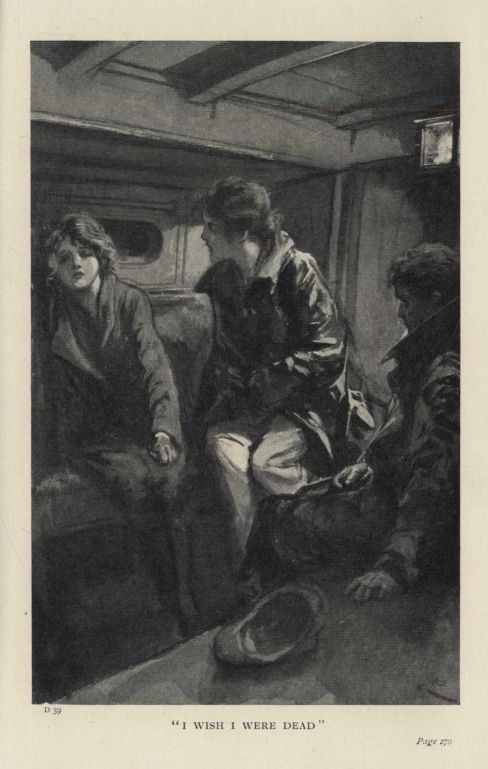
"I WISH I WERE DEAD"
"Oh, is that what you came out for?" Adrian retorted, with something like exasperation. "Well, you jolly nearly were dead. As you say you wish to be, I suppose you wouldn't have minded, but you seem to forget that you've risked our lives too--let alone the fearful anxiety to my mother, and----"
"Don't, Addie," urged Crow; "what's the good--we'll settle all that afterwards. The point is, where's Pam?" Then speaking directly to the girl she asked: "Where is Pamela, my sister?"
"Oh, quite safe--on land--in the Crown Hill wood, I expect."
"How do you know?" suspiciously.
"I asked her to meet me. To come at half-past five. I asked her particularly."
"Why?" asked Adrian.
There was silence; the girl looked sullen; her eyes seemed sunken almost, so deep were the shadows round them.
"Why?" demanded Adrian again. "What was your object? If you wanted to borrow our dinghy why didn't you come and ask for it--not that we should have let you have it this weather," he added sotto voce, in an Adrian-like aside.
"Don't ask any more till she's had something to eat and drink," said Crow. "Here, take off your coat; you're awfully wet."
She pulled the coat off with a firm hand. There, fastening the silk blouse in front, was the diamond safety-pin. The light made it glitter with a hundred tiny rays.
"Addie!" exclaimed Crow.
"Well, it is my own," said the girl.
"Just so. We are beginning to see light--at least I am," retorted Adrian stiffly. "You've been posing as my sister Pamela, haven't you? Was it you who went to Miss Ashington and asked for that brooch?"
"It is mine!" flamed the girl. "Cannot I have my own?"
Adrian shrugged his shoulders.
"You don't seem to see that there are two ways of getting one's own," he said, "a decent way--and, well--a rotten one. Did you by any chance happen to let out Badger's sheep and his horses, and come along to the cliff above Champles cove the other day?"
"How can I tell? Perhaps I did. I think you are rude and unkind," said the girl in an aggrieved voice.
"Great Scot!" ejaculated Adrian. "Well, of all the extraordinary females----"
Christobel was putting food on the table while this curious conversation took place. She now interrupted it by ordering this surprising visitor to eat, which she did, heartily and hungrily. Afterwards Crow ordained that she was to take off her skirt, shoes, and stockings, and they could be dried at the stove.
"You can roll up in a blanket," she said, "and stay where you are; you'll soon be warm all through down here. Adrian and I have got to get home now."
"I don't want to go home," said the girl, untying her shoes.
"Why not?"
"I am not happy. If I go back I shall be very uncomfortable."
"It looks as though you thought of no one but yourself," said Crow. "I dare say you don't mean it, but it sounds so."
The girl took off her shoe and felt the wet foot. Then she glanced up at Crow, and said with more strength in her voice--she was revived by the food:
"But, of course, I mean it. Everyone is the most important person in the world to himself. You must think of yourself first, of course."
Christobel was so startled at this point of view that she said nothing at all. She was not very ready with words at a crisis. So she contented herself by helping this young person into the bunk, with cushions and blankets; then she left the saloon, closing the door all but an inch or two; as it slid in a groove this arrangement was easy enough.
Adrian was outside; she could hear him on deck, settling matters ship-shape, stowing down all loose ends and gear that might get free. The "tug of war" was coming; she knew that well enough; they had got to get home.
"Hullo, old lady," said Adrian cheerfully, coming down beside her, "we've got to get home now. It's a straight-forward job, anyway, no side issues! 'All is safely gathered in'," he laughed, so did Christobel.
"I wonder where we are--about," she said.
"Oh, can't be far off. We shall soon know when we've had a shot or two," declared Adrian easily.
The idea of "taking shots" at a lee shore, mainly consisting of rocks, in pitch darkness, with a strong wind behind you, would no doubt have been new and interesting to most sailors.
CHAPTER XXI
Ladders of Light
"Pay off, pay off," cried Adrian; "we'll run for it! The wind should be on our quarter, considering where it comes from; when we pick up the siren from Ramsworthy lighthouse--or better still, the light--we shall know how to get into Bell Bay."
Christobel suggested that the bay would be too rough. As it was not possible to see to pick up the mooring-buoy, she proposed Salterne. It would be safe and calm within the estuary.
"Oh, rather--of course," Adrian agreed warmly; he did not intend to tell his sister all he thought about their position, but he assumed the tiller.
Christobel protested eagerly.
"Truly, Addie, I'm not tired."
"All right, you're not, old lady; but we've got a stiffish time ahead, you know. We're going to take this in turns, so save yourself for your watch. Why don't you go in and take an easy now?"
But Crow refused. She preferred the frenzied turmoil and Addie's company, outside, to the warm ease within, and the neighbourhood of this strange girl.
Brother and sister sat shoulder to shoulder in the spray-wet darkness holding the tiller between them, for it took one man's strength at least to keep it steady.
The white yawl ran like a terrified deer pursued by hounds. With her wet sheets straining hard as steel, she tore through, and over, the black cauldron of leaping water. Wherever sea is, there must be a little lessening of darkness, for dim reflection comes from somewhere in the sky. It is only darkness made faintly visible, just enough to show up its terrors. Masses of torn cloud raced above them with a mad speed that dazzled; heavy sea thundered along below. Walls of dread closed them in, shut them down, tried to force them back, opened for them below. And there was no sight or sound of human company, no possibility of a human hand to cling to, no chance of a word of human sympathy. Christobel had had some experience, but, she owned to herself, never one like this--and she prayed that, if they came through it alive, she might never see it again. It was so cruel.
In "running free" as they were, the strain on vessel and steersman is greatest. The ship, whatever her rig, does not run without using every mite of her power to escape from the pressure to which she is held. Her natural motion is, of course, to sweep clean round, because of the weight on the mainsail, but the rudder holding her to a straight line is in the power of the helmsman, and with all that force will she rush ahead to get away, as it were, from the drive of it. In this headlong flight, too, the least variation of the tiller causes her to swoop in a terrifying way, while she leaves behind her a path of bubbling foam as white as the wake of a steamer.
Once Christobel began to speak about the girl asleep in the saloon; she thought it would distract them both from the dread monotony; also she was curious about her. But Adrian refused.
"Let's cut her out, Crow," he said. "I think there isn't an ounce of doubt that she's a young Hun. How she comes to be here we shall know in time--but her manners and customs are--well--you know. It does not beseem me as a male Briton to abuse a female, even a Hun female, so, if you don't mind, we'll cut her out. One thing I'll say, I'm taking off my hat to old Pam all the time. She had a rotten time over that brooch, and over Badger too--while--oh, never mind!"
"Let me tell you one thing, Addie," urged Crow, "then I'll not say one word till we are home." She told him about the handkerchief, letting in the light instantly upon the identity of the person who had raided Messenger.
Adrian nearly loosed the tiller in his excitement.
"Crow, don't you see now who it was the Midget was escorting out of our grounds at four in the morning? Good old Midget! I say, Crow, that kid has been sharpening his wits on other folks' business; he's certainly coming along! Wonder why he didn't speak."
"Probably Pam told him not to--then he wouldn't, and I expect this girl appealed to Pam to hold her tongue. You know what she is--Pam, I mean--at any time, and just now she's full up with notions about helping all the world--the Girl Guides' profession. She'd bear anything, of course," so said Crow, understanding her sister.
"And this young person would let----" Adrian checked the comment. "Hold up, Crow, let's talk about the weather! Jolly fine for the time of year, isn't it? Who was it said 'We've been having a lot of weather lately?' We are to-night, about a month of weather in twelve hours!"
So these two laughed and "carried on" through the bleak storm, while the one who had caused it all lay sleeping soundly among her pillows.
After a bit they fell silent, just doing their work, they were tired, of course, and talking against the howlings of the night was exhausting work.
An hour passed; it seemed a whole night; it seemed as though the horror had been going on through endless ages. Crow stood up and stretched.
"I'm going to make you some cocoa," she said.
"Right-o!" agreed Adrian cheerfully.
Presently she came back with a big cup and two stout bacon sandwiches, a thing Adrian greatly liked.
"Now I'll fetch mine," said Crow; and did so, planting herself firmly. "Can you manage your cocoa without spilling?" she said.
"I've drunk it," answered her brother promptly. "Addie, it was boiling!"
"Well, it's boiling still for all I know. Ever so much warmer in the region of the waistband! Sandwiches don't spill, thank goodness. Awfully decent grub this, Crow."
When all the "grub" had gone the way of the boiling cocoa, the pair felt more conversational.
"We don't seem to pick up the lighthouse, Addie," said Crow tentatively.
Adrian agreed; he also said that by all his calculations they ought to have run bang on to Bell Bay beach about half an hour ago.
"We've nothing to steer by but the wind," he allowed, "and that may change. One never knows. What time is it, Crow?"
Christobel said it was after twelve o'clock.
"I wish we could hear that siren. But, Addie, we may be going the wrong way!"
"Probably are, my child. I tell you honestly I'm not sure of anything in the wind line--and I'm not sure whether we are going with the tide or against it--well, naturally, considering I don't know where we are going. It's about the rummest old stunt I ever played up to--quite a new experience, in polite language."
"I wish day would come," said Christobel. "Addie, do you remember the thunderstorm?"
Adrian looked round to see what the dinghy was doing. Crow laughed; then she said in a warning voice:
"And you quite understand that if you even dared to get out and bale her, I'll scream. I'll begin, and not stop. It would be worse than the lighthouse siren."
"I won't bale her out now, but I think I ought to shorten the painter," said Adrian thoughtfully; "the thing will snap--just look at that."
That was a lightning forward swoop of Messenger on the back of a wave, followed by a check as she met the force of a curling crest; the dinghy checked also--in the trough behind. Then as the yawl leaped again the tow-rope tightened with a jar that sent out a perfect Catherine wheel of dazzling spray.
"Here, just a moment," said Adrian, surrendering the tiller to his sister; "I'd better just give it a----"
"Don't--Addie, don't!" cried Christobel, with a sudden sense of desperation--it was the breaking-point of nerves, only she did not realize it.
Adrian jumped up on the counter, and stooping above the rail got hold of the tow-rope. At that instant, a long black wave-head swept after them out of the dark, carrying the dinghy on its crest.
The little boat nearly came on board, striking hard with her sharp bows; there was a sudden lift of the counter as the wave roared under their keel; Adrian lurched, fell over and rolled. Christobel let go the tiller, sprang up with a shriek so piercing that she did not recognize her own voice, and flung her whole weight on Adrian's legs. It steadied him for the instant, and getting his balance he flung an arm round the mizzen, and directly after righted himself.
But Messenger had got her head! With the tiller loose she was free.
There was one appalling moment when she drove broadside on, heeling over almost at right angles. The water poured along the leeward rail, and she was almost buried to the mast in seething foam. It streamed into the companion--down to the saloon--everywhere. The noise was perfectly indescribable, one riot of roar, rattle, and storm. Then the white yawl finished her mad dash for freedom and suddenly righted on a level keel, gasping, as it were, while other sounds were lost in the rush of water pouring away through the scuppers.
Christobel did nothing. She was shaking from head to foot and sobbing in a distracted manner. Adrian, utterly amazed, patted her back, the while he seized the kicking tiller.
"Hullo, old lady--what's up? Get a holt on it. Why--nothing's happened, only this beastly row."
"Oh, Addie--Addie--Addie!" choked poor Crow, "if you'd--gone. I thought--I thought----"
"No harm done. Miss is as good as a mile any day," shouted Adrian cheerfully above the din. "I say, Crow, look! If it isn't Miss Hun, come to inquire after our health!"
The Countess had pushed open one door, and was standing on the step looking about--evidently she could see nothing, her eyes being dazzled by the lamp within.
"Everything is falling down," she said in her deliberate voice. "What is the matter?"
"Nothing at all," answered Adrian. "My sister and I are playing hockey to warm ourselves."
"That is an untruth. Do you suppose I should believe it?" retorted the girl.
"Not at all. Why should you?" Adrian's tone was the essence of courtesy.
"Why do you say so then?"
"Ah--there you have me, Miss A.," said Adrian, leaning his head back and looking at her from under the peak of the sou'wester.
"Don't, Addie," urged Crow, on the verge of a fit of giggles, though tears still stood on her lashes; "it's no use. She can't understand, poor thing." Then she went to the door and suggested to their visitor that she should stay inside. She told the girl it was very rough, very uncomfortable, and they did not know where they were.
The Countess saw this was the truth.
"But I'm not afraid," she said. "I can come out too."
"You'll get wet," warned Crow.
The Countess shrugged her shoulders.
"If we must drown," she said, "I prefer to see. Also I can swim. I learned in the swimming baths at----" she broke off. Crow guessed why. She was put into an odd mackintosh coat, and sat outside. Adrian did not want her at all; he hated it; also she was in the way if anything happened. However, she just asserted herself as she always did, and there she was.
Hours went by--hours of black monotony, in which the lost voyagers hardly realized that the wind was harder and the sea rougher. They ceased to talk, but every now and then Adrian and Crow changed places. Also they took hot cocoa at intervals, and "hoped for the day", like St. Paul and his wrecked companions; it was their only hope. The girl was no trouble. She seemed to have courage and endurance; she did not complain, and said "thank you" when they gave her cocoa. The only remark she made in several hours was that she "did not understand why people did all this dirty work for amusement". She said she liked a big yacht with plenty of servants, but a small one was "menial work".
Adrian agreed; then he looked sideways at Crow, who was close to him, with such an absurd face, that she nearly burst into giggles again.
It must have been three o'clock in the morning when they two became aware of a sound in the air, a sound that was not wind or waves--a steady pulsing sound, rapid and regular, growing also in distinctness.
Christobel and Adrian looked at each other; they tried to locate it, but the dark smother and eternal driving of the tireless wind baffled them. It was something that steamed, for the swift beat of the engines was now clearly defined--louder, louder, drumming against the howling gusts.
Adrian was steering, head up and listening keenly; Crow was seized with sudden panic--her imagination leaped to the thought of collision, of being run down there--helpless and unseen.
Adrian realized, and said "Lights are all right." She felt easier--they all listened, staring into the black confusion as well as the stinging spray would let them. The air was full of the throb.
Then, all in a moment, a towering black shape materialized from the darkness, and bore down upon them with the rush of a railway train--out of the night, without lights, without warning, it passed. To them, as the yawl wallowed in the wake of its seething track, there seemed to be inches only to spare! Of course there was very much more, but the nearness was rather staggering all the same.
The three on the little yacht saw the keen knife edge of the bows speed by with high fountains of water flung up either side the cutting line.
It was a moment of tense excitement. Adrian gave a suppressed shout.
"Oh, Crow, did you see her--the beauty! A destroyer! I say, how awfully alive they are--isn't one jolly proud of them?"
"It was rather a near thing, wasn't it?" murmured Christobel, holding on as the yawl leaped.
"Jolly well worth it, though. I've never seen a destroyer pass so close, on her 'lawful occasions'," answered Adrian, quoting a certain well-known story; "nothing can take that from one."
The drumming faded away down wind, and the Romilly pair settled again to wait for the slow-coming dawn, when suddenly Adrian gave a whoop--a positive wild Indian screech.
"Oh, I say, Crow, look--look! Of all the crowning luck, this is----"
Moving over the "face of the waters", over the black tossing waste, was a ladder of dazzling white light. It searched in miles, it searched in inches, like some living, busy, sensing creature. Christobel thought of the fingers of light in the "Martians", that hunted for the victims. It was thrilling. Dumb, dazed, they watched the brilliant feelers creeping over the water.
Crow hardly breathed; she was standing, just petrified.
Suddenly Adrian slammed his hand down on the tiller.
"They're looking for us!" he cried. "Great Scot! Of all the----"
"Oh, but, Addie, how could they have----"
"My good girl, do you suppose anything escapes the Navy? The look-outs saw our little bit of a blink; they want to know who we are--they know everything--they are simply It."
Adrian's rhapsody was cut off on his lips; the dazzling feeler had found them. It rested on the white yawl, and stayed. He waved his arm wildly; Crow waved both arms. The Countess sprang to her feet, shielding her face with her sleeve, and the white light glinted upon her golden hair plait.
Under the searching brilliance Adrian and Crow put Messenger up in the wind, and she lay-to--wet, ragged, battered, shaken, most disreputable, with her drenched mainsail, her flapping storm-jib no bigger than a towel, while the poor little dinghy reeled alongside drunkenly, the water washing over her floor boards.
Before her crew had recovered from this visitation a splendid boat, as long as Messenger, if not longer, swept up alongside with a precision that never even touched the fenders of the yawl, which Adrian had rushed to throw out. He said to his mother afterwards, in a perfect passion of admiration, "The bo'sun just hooked on--no fuss--no bother--and Messenger jumping like a mad-horse."
The boy in charge was perhaps a year older than Christobel. His fair face was beaming with satisfaction. He was enjoying himself to the full! With engaging courtesy he put the two girls in the stern sheets and held a short parley with Adrian, who refused to leave the yawl.
"You see, sir, I'm responsible--she's Sir Marmaduke Shard's Messenger, and he----"
"Your brother sent me to fetch you off, and two of our men will take over the yawl," explained the boy.
"My brother!"
"Mr. Romilly, yes. We are destroyer Spite, and the men will see the yawl safe into Bell Bay; they are instructed."
Orders flew, while Christobel gasped out "Malcolm" in a choked voice as Adrian came down beside her.
"There's any amount of grub on board," said Adrian hurriedly, "cocoa and coffee. Please tell your men to----"
"Thanks very much, sir; they'll enjoy themselves." Mr. Rodney Vane passed on the information, and the big galley swept away, along the ladder of light, towards the waiting destroyer.
"I suppose," ventured Christobel, recovering speech, "that Bell Bay is close by."
"Not so very close, Miss Romilly," answered Mr. Vane. "You see, you're in the Bristol Channel. We saw your lights, of course, and couldn't make you out, as you weren't a fishing-boat, and were--ahem--flying the White Ensign."
Adrian became crimson.
"That was a rag, sir," he explained hastily. "You see, my sister and I went off at a moment's notice on a funny sort of mission; we didn't think anyone would see--we ran it up for a rag--and forgot it."
Mr. Vane noticed my "sister" in the singular. He wondered about the tall girl with a golden pigtail, but of course made no remark.
Malcolm, in all the state of authority and gold lace, received them at the gangway.
"Hullo, Crow, this is awfully decent. Hullo, Pam----"
There was a moment's pause as he and the tall girl with arrogant eyes looked at each other.
"Come along down to my cabin," he said. "I expect you want to rest."
At the earliest possible moment Adrian and Crow explained the meaning of this eccentricity on their parts, also all they knew, so far, about the strange girl they had rescued in place of Pamela.
"Poor little Pam," said Malcolm. "That reminds me, I've got three days leave due, and I'm coming along to look up the Bell House. How's Mum?"
"She'll be all right when we get back," answered Crow sagely; "just this moment I expect she's not over bright."
In course of time the white yawl lay on her moorings in Bell Bay, none the worse for this wild adventure.
In the same course of time the galley put in against the rocks--which were used as a quay--under the charge of Mr. Hedderwick, the bo'sun, while the wanderers carried Mr. Vane and Malcolm off to the Bell House to see Mrs. Romilly. That was in the morning early; no one had been in bed, or wished to go; everybody was pale and shadowy about the eyes, and poor Mrs. Romilly had to meet her two recovered children alone first, before she could see Mr. Vane, and admire the wonders of the galley. The sight of Malcolm was the finest tonic of all.
Miss Lasarge was there. She had been there all night with Mrs. Romilly, and during that time had told her the story of the Countess--all she knew--no one knew everything but Sir Marmaduke.
White-faced Pam was hugged by Crow and even by Adrian. All was understood--all was forgiven.
Hughie went down to the cove to take the pattern of the galley and make friends with Mr. Hedderwick; when that resplendent person asked him if he was coming in Our Service, Hughie answered: "Of course, sir," and won Mr. Hedderwick's heart once and for all.
That evening, very late, Sir Marmaduke arrived from London. A wire, sent from Salterne very early in the morning of despair, brought him away on the instant. He came first to the Bell House, and talked to Mrs. Romilly and Miss Anne.
It was not his profession, or his nature, to cast aside reserve and tell secrets. Besides, it was Government business, and he was only an agent. However, the ladies understood that Pamela's double was a German, not only of good birth, but actually related to the Hohenzollern family. Her father was a brave soldier, and a gentleman, and had met his death early in the battle of the Marne.
He died in a British hospital, as it happened the one in which Miss Lesarge and Major Fraser were working. In this way they saw at least one German gentleman, and for that reason were ready to befriend his child when the need arose.
Her mother was very much a Prussian, and supposed to be in hiding owing to the revolution--she was not a popular lady. The girl had been at school in England, because her father wished it, then the War came. She was shifted from one German family to another. When trouble and internment came she was moved. Being a young person of importance, she became a perfect white elephant to the powers that be, and was finally handed over to the wardship of Sir Marmaduke Shard, who thought that he had solved the riddle when he sent her to Woodrising in the charge of Lady Shard's old servant.
It was manifestly impossible to let her go about or to let her identity be known; the country people would have been furious. Until she could be sent back to her own people, she must be put in some quiet place.
The result of Sir Marmaduke's clever plan has been told in this story. He took the Countess and Mrs. Chipman away with him next day. Woodrising knew them no more, and Mrs. Trewby became less bilious, but no one was told what happened to the Countess, even Lady Shard never knew, and as for Auntie A., she had forgotten about the matter. Charles had a fit, and when he recovered she had a plan for making hens all lay their eggs at the same hour every day, being of course an immense saving of labour for everyone. Mrs. Ensor had "no opinion" of it; she was extra busy, as Reuben was just beginning to walk again on his mended ankle.
When this strange hurricane cloud passed, it left the sky of the Bell House family blue and clear again. Peace came back, and the days were the same as before that stormy petrel disturbed life.
Pamela returned joyously to the study of Girl Guide rules, but admitted that it is perhaps as well to be careful about the nature and extent of your "good turns".
She often wondered about the "Countess", and would immensely have liked to know her eight names, and what the double "A" stood for. She never did. Mollie Shard knew nothing; she heard the story from the Romillys when she came down, and the only time she ever saw the Countess was that morning, very early, when she mistook her for Pamela.
So that is the story of Pam and the Countess, from first to last, with its grief, misunderstanding, and danger. Whether anything more will ever be known, or whether Pam will ever meet her "double" again, of course no one can say. For the present, the story has ended happily.