Front matter (continued 4)
Reading edition
"So it is--so it is--lovely hair. I'm very fond of that child. I hope she has not caught cold. I fancied she was a little hoarse to-night, quite likely if she runs about like this in such a heavy dew. I think I'll come in now, Farr, if you will kindly carry Charles' basket."
CHAPTER XIV
"If anybody dies, it'll be her," said Hughie
It must have been about a week after that when Hughie, passing by Pamela's door with a view to making himself tidy for lunch, heard a sound of stifled sobbing. He stood still, quite shocked. Here was an unprecedented state of things, and one outside his experience, because Pam was a cheerful interested person, always busy, never morbid. It was horrible.
Hughie had been in "the cave" since breakfast and was on his way to his room rather "delicately" like King Agag, because he knew his mother would wish him to be out of doors, and he had shirked the boat and the bay to finish some particular job of his own devising. Meanwhile something had been happening, obviously. But what?
He opened the door which was not locked, and put his head into the room. Pamela was lying on her bed face downwards, crying bitterly.
Hughie shut the door, then he walked close up to the bed, and very very gently pulled the heavy plait of hair that fell across her shoulders and on to the counterpane. Immediately there was a change in the tone of the sobs. A choke--then silence--then a faint cough, then a sigh--Pamela changed her position a little, and felt for a lost handkerchief. Hughie, noting the missing article on the pillow, put it into her hand. A minute after that she raised herself into a sitting posture, and looked at him; her pretty eyes were heavy and swelled, and her lips trembled.
"Pam," said Hughie, cut to the heart yet reserved, "I expect it's that woman?"
Pamela nodded and blew her nose.
"Well, what's she been doing now?" To show that he was come to stop, Hughie dropped noiselessly to the floor and sat cross-legged, clasping an ankle in either hand.
Pamela cleared her throat and said in a tone that tried hard to be indifferent and casual.
"Mother thinks--I've stolen that brooch--and told a lie--because----" stifled silence ensued.
"Well," said Hughie, "that's very ridiculous."
"Not when you hear--what it's about----" again there was a pause, then starting on a lower note altogether Pamela said:
"Mother wanted to hear about the brooch, Addie made her. So, after a week, you see, she wrote to Miss Ashington and asked what had happened and if it was hers--I mean if the brooch was. This morning Auntie A. sent down a note--all scrawly and covered with blots and half the words left out as usual," this description was emphasized bitterly, "and she said--she said that I fetched the brooch on the same evening you and Miss Chance took it--you remember, Midget, a week ago to-day."
"I know," agreed Hughie, "the morning Charles ate the laurel water."
"Yes, well she says, I came in the evening about nine, or half-past nine, and said Mother sent me for the brooch, and she gave it to me--she says a good deal more; something about her work-basket being upset; but anyway I took the brooch away, and there's an end to it."
"Why, it was the girl--my goodness, she's a funny person!" said Hughie.
"She's a beast. She's a perfect beast without any decency or sense of honour," declared Pamela in a stormy burst of indignation. "I told her to write to Sir Marmaduke and ask him to claim it from Auntie A. It was perfectly simple. Then she goes and plays this low trick again."
"You'd better tell about her," suggested Hughie with interest.
"I said I wouldn't. She said it would get her into awful trouble."
"Well, she gets you into trouble."
"I know, but, Midget, she's all alone--her mother seems to be dead; her father was killed in the War. Fancy being shut up with Chipman and no one decent to speak to! You see, I don't blame her for trying to get her brooch back--she might do that----"
"It was rather clever," Hughie chuckled suddenly, "a sort of short cut, Pam."
"I daresay, but people oughtn't to use short cuts that hurt other people so awfully."
"She's selfish," said Hughie gravely, "fearfully selfish, she doesn't care when the others get hurt."
There was a long pause; then Pamela announced that she wasn't coming down to dinner; she told him that Mrs. Romilly had gone off to Crown Hill to see Miss Ashington.
"What did Mum say to you?" asked Hughie.
"Nothing. Not a word--she gave me the letter to read."
"What did you say?"
"I was feeling so sick and awful, I don't know what I said--except that I didn't go at all. It sounded so helpless in the face of that letter."
"I think I'll go to dinner," announced Hughie suddenly, and he picked himself up, dusting himself in an incomplete manner.
"You can have my brush and comb, Midget, if you like," suggested Pamela, lying down again in a languid manner. "Oh dear, I wish I was dead. People say when there are two of a person one always dies. I hope it'll be me."
This was very gloomy. Hughie gazed at her from under his brows as he brushed his hair. Then he looked at his hands, appeared satisfied that their condition would pass the eagle-eyed inspection of the Floweret, and walked to the door. From there he said:
"If anybody dies it'll be her," and went, closing the door quietly behind him. Pamela felt comforted.
Dinner was proceeding in the dining-room, in a horribly uncomfortable manner, because the three persons present all knew of this amazing state of things, and not one knew what to say. Hughie slid into his chair and was helped to mince without comment. Miss Chance was doing her best to keep up a pretence that nothing was the matter, and welcomed her youngest pupil as an ally, but Hughie was glum.
"Now," said the Floweret hopefully, "do let us settle about a picnic. I am sure Hughie will side with me. Adrian, what about an alliance between boats and pedestrians--to Ramsworthy Cove, for instance--or farther; the sands at Netheroot looked so inviting when we passed the other day, I always contend there are no such sands anywhere. Come now, what do you say?"
Adrian was talking to Crow in a low voice. He glanced up.
"Beg your pardon, Miss Chance, I didn't hear what you said;" then, dropping his voice,
"It's not a bit of good shutting one's eyes to facts, Crow. I confess I don't understand this latest business--it sounds insane--but Pamela's hiding something up her sleeve; besides, I'll swear she never got little Ensor up the Beak by----"
"Oh, don't go on about that, Addie. I'm sick of the very name of that cliff. If the Ensors say she did, and Reuben declares she carried him--he told me so again when I went yesterday--it's idiotic to keep on nagging about it. Let's drop the Beak once for all, and as for this latest business, as you call it, I won't believe it. I refuse to believe it on the authority of Auntie A.; she's so--well--perhaps I'd better not say what I think."
It was seldom that Crow was heard to speak thus savagely. She was quite unlike herself, just as Pamela appeared to be! But she was angry, chiefly with circumstances, and in any case nothing should induce her to believe such a thing about dear old Pam. It was outrageous. Pam, who was the soul of generosity and straightforwardness, to go to Miss Ashington and tell a lie to get hold of a valuable brooch! The thing was a glaring insult to her character and to the whole Romilly family. That was Crow's opinion.
Hughie looked up at his eldest sister with approval. Christobel was so gentle that an attack from her was an event.
"What do you think, Hughie?" she asked.
"It's silly," was the brief answer, "and can I have some gooseberry pie, Crow?"
"What does it matter what Hughie thinks?" said Adrian, feeling a little injured.
Hughie ate gooseberries and spoke not, but he wondered what they would say if they knew what he knew!
However, matters got worse instead of better. Mrs. Romilly came back sooner than they expected; she had not had lunch at Crown Hill, she had declined it saying she must go home. However, she would not eat, but went off to the drawing-room with Crow and Adrian. Hughie took the opportunity to collect food for Pamela. Tartlets, cake, and a tempting little veal pie from the sideboard. Laden with this he retired upstairs and entered Pamela's room again with difficulty, putting the plate on the floor while he opened the door.
"There was mince, and gooseberry pie as well, Pam," he said, setting the plate down on the bed, "but I couldn't bring it, because it was loose, these things are hard--it's rather a comfort there was some hard stuff about--but, any way, Jeepy would give me some."
"Jeepy" was Mrs. Jeep--cook, house-keeper, and adorer-in-chief amongst Hughie's train of admirers.
"That child's intelleck is beyond telling," was a favourite assertion of Mrs. Jeep's, and one with a good deal of truth in it.
The servants had, of course, picked up the rumour of strange behaviour on the part of Miss Pamela, and Keziah, keeping Patty out of it, of course, with sharp injunctions about "little pitchers" and "long ears", had whispered to Mrs. Jeep that there certainly was something in it.
"Times and times," asserted Keziah, "I've seen her lately. Well, out of my window one night; she was going along the terrace, here near eleven and after. I must say it's not pretty behaviour. And I'm not the only one neither. When I went up to Badger's for eggs, he said to me: 'One of your young ladies seems to take her walks abroad.' 'Well, Mr. Badger,' I said, 'and why not? I suppose the country is made for walks. I'm walking myself,' I said, 'and so are you.' I said----" she stopped, breathless.
"Glad you was brief with him," said Mrs. Jeep in a slow comfortable voice, "I don't hold with such folks being so free with gentry's names. They ought to know better, but there's a many don't know their places these times. The mistress is put out though; upset she is, and I don't like to see it, for you never see no bad feeling nor goings on in this house--nice children they are, and have been from babies--the lot of them. Mr. Malcolm just such another as Master Hughie, very inventive in his ways, always some notion in his head."
There was sympathy and curiosity too in the kitchen, though Patty Inglis the between-maid was allowed to ask no questions, and sharply reprimanded by Mrs. Jeep and Keziah for the least appearance of interest.
Meanwhile Mrs. Romilly sat in her chair in the drawing-room resting her cheek on her hand. Christobel on a stool close by patted the other hand reassuringly. Adrian looked out of the window, for of all things he could least bear to see his mother unhappy.
"I see no way out of it," said Mrs. Romilly after relating Auntie A.'s story, "of course she was vague and wandering, and repeated herself as usual--that's nothing--the thing that matters is perfectly clear--Pamela went there about half-past nine--she had gone to her room we all know--she stayed only a few minutes and seemed in a hurry. She would have been in a hurry naturally. Miss Ashington said she seemed nervous and unlike herself, and her voice was husky, or low--well, not quite the same. That also we can account for easily enough, because Pam is by no means a practised deceiver----"
"I don't think it is proved that she is a deceiver at all, Mother, let alone practised!"
So said Christobel in a low voice, unshaken by evidence.
"Dear old Crow," murmured Mrs. Romilly in rather a choked voice, "I like you to feel so; but, well Farr saw her too, and remarked how tall she was growing and how lovely her hair is--so it is, lovely." Mrs. Romilly gave a little cough, and hastily changed her position; then suddenly a tear fell with a tiny splash on the back of Christobel's stroking hand.
"Oh, Mummy!" she exclaimed.
"How silly of me, darling. I didn't mean to--but I don't understand, and I can't bear to be--well--outside with you children--we've always got on so well, and had no secrets. This----"
There was a tense silence.
Adrian, having spoken no word up till now, had been growing more and more angry with the world in general.
"It's a jolly old muddle," he declared suddenly. "Honestly, Mother, it's not reasonable to suppose Pamela would be such a silly ass as to march up to Crown Hill and publicly say you sent her for a diamond brooch, and then swear she hadn't been! I ask you now, is it feasible? It's sheer blazing idiocy. If she did she's mad and ought to be put in an asylum. It isn't even criminal, it's drivelling. As for Auntie A.--now she is mad. Always has been. Well, I should say she'd dreamed the whole business if Farr was out of it. You say Farr saw Pamela; did Farr tell you, or did Auntie A. speak for Farr?"
"Oh, Miss Ashington told me what Farr remarked about Pam's----"
"There you are then. Bet you the whole thing is some mad vision of Auntie A.'s! Sure of it. She was asleep on the verandah and when you asked for the brooch, having lost it, she says this----"
"But, darling boy, she wouldn't invent----"
"Not intentionally, Mother, but she's got a roving imagination, we see that every week. One time she's teaching pigs to kill themselves in order to save the butcher's feelings! Another time she wants to train calves to drive the sheep to market in order that land girls need never get up! Don't believe her, Mother dear, and for any sake don't sorrow about her rotten fairy tales. They'll find that brooch in Charles' stomach when he dies of over-eating--if she hasn't been wearing it all the while herself. Oh, I say, do let's shut up all this misery, Mum. An atmosphere of crime and sorrow is enough to make one ache to be back. Let's cut it out, and cease persecuting wretched Pamela, because Auntie A. is a lunatic."
If it did nothing else, this speech made Mrs. Romilly "sit up and take notice", as her son said cheerfully a few minutes later. Presently she went upstairs; and fortified by a "nice cup o' tea" made and brought up, and administered by Mrs. Jeep herself, really did begin to think there might be something in what Adrian said.
"Men are very level-headed," thought Mrs. Romilly, "they are not so emotional and impressionable as we are; after all, of course, poor Auntie A. is very vague."
Out of doors Crow and the level-headed one went down to the bay in company. Sisters are given to a certain clearness of vision not always vouchsafed to mothers. Said Christobel:
"Addie--do you really think all that you said to Mother about Miss Ashington and Pam?"
"Of course I don't," promptly answered the shameless Adrian, "Miss Ashington is mad, right enough--raving--ought to be chained up before she drives all the farmers dotty, but she saw Pam right enough--so did Farr."
"But, Addie----"
"Oh, I know--you're going to say one ought not to believe the evidence of one's own sight if it is against people you love. You must--till one's got something more reliable to see with than eyes. All the same life's not worth living if Mother is in a distraught condition--and nobody comes to meals except the Floweret trying to draw us all together by bonds of family love. If she's 'bright' again at tea-time I shall take the yawl to Salterne and stay there. If Pam has got the thing it's her look-out, she won't enjoy having it--as I said before, she's been awfully queer lately."
In order to check another allusion to the Beak, Christobel suddenly proposed bathing from the yacht.
"Time for a heavenly one before tea," she suggested.
Adrian forgot all the sorrows of the household in an instant and received the plan with a cheer; they two went with a rush, which carried them breathless and giggling on to the sands among the seaweedy rocks and the anemone-peopled pools. Here was Hughie--testing secretly a storm or wind anchor that he had invented. Adrian upset him into a sea pool--which Hughie did not mind, because it diverted attention from the wind anchor--then the two elders proceeded to haul the dinghy down and make preparations.
"Whole day since we came," remarked Adrian regretfully, "what waste!"
"She wants washing inside," commented Crow, rubbing certain dirt marks with her fingers. "Look, this isn't a tennis shoe--it's a heel!"
"I'd like to catch anybody messing about with her," said Adrian wrathfully, then Christobel suggested it might be the Floweret.
"She sits in the dinghy with a book sometimes you know, Addie, when the rocks are extra wet. I don't know why; probably it makes her feel adventurous and buccaneering."
They got the little boat down, and rowed off into the bay--lovely it was, warm and smooth, with a faint swell coming in from outside, the swell that causes a rushing ripple to rise over the hard ridged sand, filling the tiny rock ponds and making the littlest crabs wave their legs about and scamper for the shelter of miniature weed forests. It was a divine day, and a divine scene; brother and sister felt it and cast off the dreariness that had clouded the morning.
They reached the yawl in an utterly joyous frame of mind, and whirled on board anyhow. Then Adrian said in rather a startled voice:
"Hullo, Crow, didn't we leave that door open? Surely, surely we did, because we both said it was whiffy inside--who shut it then?"
"Wind, of course," said Crow indifferently.
"My good girl----"
"Oh don't, Addie--hurry up--get into the fore-cabin or where you like, but hurry, or we shan't have half a swim. I won't say 'time flies', because it's too copy-book--but I'll remind you that tea is half-past four. Get on."
So saying, Christobel took possession of the saloon--"according to plan", as we used to hear in the days of the War, and Adrian disappeared down the fore-hatch. This was the standing arrangement for bathing--as the whole party of Romilly boys and girls could swim like ducks; they learned when babies almost--it was family law.
Christobel did not take long to get ready as a rule, but she took longer than she meant because several small matters seemed to her to be differently placed, or untidy. As everyone knows who inhabits a yacht of say six to eight tons, there must be a place for everything, and everything in that place. It had always been so on the Messenger. Every shining hook had its cup, or jug. Every plate or saucer fitted into its own groove. Kitchen things--polished like looking-glasses--were placed along barred shelves, and kettles sat in wells made to fit them.
To-day something was a little wrong. Crow frowned at the hooks and racks, as she pinned her hair up under a rubber cap--this and that seemed to have changed places--or she thought so. The cushions on the settees in the saloon were certainly wrong--all on one side. Adrian must have been right about the door; that was perhaps part of the invasion. She thought of calling out to her brother and then decided not to, because if she said anything Addie would make a point of locking up the yawl every night, and the result would be that peculiar something in the stuffiness that always made her feel sick.
Christobel was not a perfect sailor like Adrian and Hughie--neither of them could be swept off their balance, but Christobel could. So much so, that she had at times borne agonies in silence rather than spoil Adrian's day. She was seldom actually sick, but she felt a horrible nausea and faintness, and the one thing that would precipitate this condition was that mixture of paraffin, varnish, cushion stuffing, and station-waiting-room-stale-sandwich smell, that came up from the saloon when the closed doors were opened; for once locked up there could be no ventilation naturally--without water getting in also; not in so small a boat, for the fore-hatch must be battened down and bolted inside before the companion door was locked outside.
All this occurred to Crow in time to stop her making remarks on her suspicions. After all, she could not remember who came out of the cabin last. Again Penberthy might have gone on board--he might even have taken Major Fraser with him, which would account for the gravel and dirt marks on the dinghy.
Just as she came to this conclusion she heard Adrian's dive and a few seconds after his shout for her, so she ran up, and went over the side with the clean sweep of a first-rate swimmer. That was the end of questionings--for the time.
CHAPTER XV
In which Hughie takes Action
It has been said, even in this story, that important situations often arise from ridiculously small happenings. Everybody knows it so well that one apologizes for such a stale reflection.
However, in the present instance the thing that led up to the very small happening was tea at Fuchsia Cottage, to which all four were invited, and all four went. The Little Pilgrim's teas were "things of beauty, and joys for ever", the pleasure never palled, because she had particular scones, buns, cakes and jams that other people knew not of, and her table decorations were as original as they were lovely. She held a theory that people ought to eat a great deal at tea, which was delightful when it fell in with the idea of the guests. There was no "company" about it, from first to last it was sheer satisfaction.
This day was no exception to the rule, and for reasons that can be well understood the young Romillys positively jumped at the invitation. It would be freedom from the atmosphere that seemed to spoil everything at the Bell House.
True to Adrian's suggestion, Mrs. Romilly had ignored the mystery of the diamond brooch. She treated Pamela as always--or tried to. But she was pale and absent in manner, and it was a daily stab to poor Pam to look up suddenly and find her mother's eyes watching her with a sort of appeal in their blue depths. Pamela on her part was obviously unhappy, her small face was smaller still, and her grey-blue eyes looked darker. In spite of the heroic efforts of the elder pair, who pulled the business of life along like a pair of well-matched horses, it was not the same perfectly happy life that it had been in the spring and always before in the memory of the children.
Miss Lasarge saw there was something the matter, but the Romilly family had the sense to wash its own linen at home. No one in the house "confided" woes outside. Also, Miss Lasarge had, at the time, considerable anxiety on her own shoulders, which she kept to herself, of course; the sympathy being no less for everybody.
So she asked them to tea, and they came. And the party was one of the most perfect she had ever invented, with rose petals in all shades of pink making a pattern round the delightful dishes. Tongues were loosened by the sense of festivity, even Hughie talked; everybody talked, except Pamela, who looked tired.
They stayed until after six o'clock, and then the Little Pilgrim walked down to the gate with them. Outside in the road they stood talking over the gate, as people do loath to go. Adrian was talking about the yawl, he and Christobel laughing over some of the adventures.
"We go out most days," he said.
Miss Lasarge looked towards the west and the clear sky over the sea.
"It is promising for to-morrow?" she asked; her gaze wandered to the white wall over the road, that high glass-topped wall that enclosed Woodrising.
"Oh, rather!"
"Don't you think you are very lucky?" She asked this question suddenly of Addie, in the soft hesitating tone natural to her.
"Lucky, I should think so! It's awfully jolly of Sir Marmaduke to let us have Messenger."
"I was thinking of something bigger than that--I mean, wider--than just a yacht. It's the freedom, Adrian. Of the sea, of the shore, of the woods--that's what I meant. You see, there are prisoners."
"Oh, not now, Little Pilgrim," Christobel expostulated, "we've got them all home, thank God, by this time."
"Ours! Oh, yes, I hope we have, I believe we have; but I was thinking----"
"Miss Anne, please don't ask us to feel--well, sentimental--about German prisoners," said Adrian in rather a hard voice; he was digging a hole in the road with his stick, as a vent for his feelings, "they've had a good time in England."
"Oh no, dear, it was something quite different that was in my mind, I assure you. Only, what one feels is--value freedom--it is so wonderful really."
"Expect it is, one jolly well takes it for granted though, doesn't one, Crow?" Adrian strongly objected to strenuous remarks, whatever the subject. "Well, Miss Anne, thanks awfully, we've had a ripping time, your party was simply top-hole. Think of Crow and me enjoying freedom. Oh, by the way, it's 'the freedom of the seas', isn't it? Early to-morrow, all being well, we want to go to Salterne."
"For the day, or what?" asked Miss Lesarge, smiling.
"For the day," agreed Crow. "As usual, Addie wants his hair cut, and the only man he approves of is in Union Street. We anchor the yawl and come back late; the tides have come round by now, to a nice useful arrangement. Miss Anne, you know Mother doesn't mind now if we sleep on board, as long as we are inside the estuary. That gives us a grand long time to do things."
All this was said in the road, you will remember. Adrian and Christobel possessed clear voices that carried; they did not modulate them to any great extent; lastly the white wall was only the width of the road from this conversation.
Neither Pamela nor Hughie spoke, yet they two realized with a sort of shock what the meaning was behind Miss Anne's little eager protest about "prisoners". She knew, she must know! She was just thinking out loud her own gentle pity for the girl behind the white wall. Pamela saw it so on the instant, and with a flash of memory recalled the large dull old-fashioned drawing-room at Woodrising, and the girl sitting alone, trying to be interested in a book. And she can climb, thought Pam suddenly, perhaps she was used to mountains; why not? Anyway, she must be accustomed to great possessions, to woods and parks, to great estates! A new view of the case brightened Pamela's mind. Miss Anne was looking at her, their eyes met and the girl smiled, then turned pink, and looked away.
"I wonder!" thought the Little Pilgrim.
Pam was wondering also. Hughie had made up his mind, undoubtedly Miss Anne knew about the girl; that was interesting, but Hughie's estimate of the situation was not like his sister's; there was no sentiment, and no pity in it. He was purely practical. "She might have to stop inside Woodrising," he thought, "then it would be different. But she tells lies and comes out on the sly; she steals things and lets Pam bear the blame. Miss Lasarge doesn't know."
So he looked at Miss Lasarge with a shrewd pitying gaze as he lifted his cap for good-night, and made no remark on the way home.
The evening was uneventful, and a voyage to Salterne was planned for next day as Adrian suggested. Pamela was asked to go and said she would; Hughie refused, he had his own scheme.
Then the household went to bed, and to sleep, but let it be understood that the small matter, namely that little talk outside Miss Anne's gate, had set in motion a far more important event, which was yet to happen.
Hughie slept with his window open, of course; he was a very light sleeper, indeed he said he could hear the crabs' toes clatter as they ran out of one pool into another. This statement might have been exaggerated, but the fact remains that he could hear most things; therefore, when he woke up in the night he realized that a noise from outside had been the cause. He lay still and listened for sounds in the house.
All was still; also all was dark, because the moon did not rise till early morning, and at present was giving her best moonshine in the day-time.
Hughie waited with a sense of growing alertness, and presently slid out of bed, climbed on the window-seat, and looked towards the bay. Soft, velvety darkness, ripple of water, and faint reflected shine on the sea, was all he heard and saw.
"Tiresome!" considered Hughie, not reassured by all this peace. He felt trouble afoot.
Motionless he sat, as some small wild thing of the jungle; motionless, but alive in every muscle.
From the bay came a sudden knock of wood on wood, just the noise a person recognizes who understands boats and would never mistake it for anything else.
"Dinghy," thought the Midget, and, without more ado, he slid from his seat and put on some clothes that would not be conspicuous; so careful was he, indeed, that he got out stockings, articles he hated in summer; but bare white legs show in the dark. Presently he was complete. Serge knickers and sweater, blue stockings and sandshoes. Then he opened his door and looked out. No sound, a pitch dark, silent house.
Hughie's mind was intent on the garden door. The big front door was bolted and barred and would make a noise if opened. The back door possessed a terribly stiff key that turned with a shriek. Jeepy would not have it oiled; she would not have it touched for mysterious reasons of her own connected with the possible bad conduct of Patty Ingles! It was a far-fetched idea, but it kept the key rusty, so that was no good. There remained the children's door, as it had always been called, the door into the garden, just beyond Pamela's window. It would not do for her to hear. Hughie wanted to do this business entirely off his own bat, so to speak, and of all things he did not wish to have "people making a row", so he hoped the door would not betray him.
As it happened, poor Pam was sleeping rather heavily. She had had many restless nights, but something in those words of Miss Anne's had made a difference. Things were not so hopelessly unjust; she did not feel so ill-used quite. So she slept soundly, and Hughie, moving like Sherlock Holmes and "Raffles" rolled into one, as only he could, got out of the house without a creak or a scratch, closed the door, and found himself on the end terrace under Pam's window close to the sea-wall.
Every stone being familiar, he went straight from there along the grass border of the walk, guiding himself by the wall. Once he stopped and listened intently, when he heard that little bump again--it was a slightly grinding bump at irregular intervals. Hughie knew now what it was--the dinghy against the rocks. It might mean that the little boat had got loose and was being shifted this way and that by the tide. There was nothing exciting about that, of course, but Hughie was convinced that something more was being enacted--there was human agency at work.
He came to the end of the wall, went through the gate, round, and then down towards the rocks. Now here was necessity for careful going, because of the darkness, and he wished heartily he had stayed to get the little electric torch that stood on the library writing-table. However, knowing the bay by heart made it easier, and every minute his eyes were more used to the dark.
The sand felt cool and hard; there was plenty of it, because the tide was just starting to rise steadily and creep into the pools. Hughie knew this must be so, of course--partly because he understood tides, but particularly in this instance owing to Adrian's plan for the morning.
They were to start early for Salterne, while there was still enough of the tide to take them. It could not have been long since the tide turned; he tried to calculate, and succeeded in realizing that the faint greyness that lay in the night was not "moon", but morning coming. And that was what made a chill, fresher than a night wind.
Presently he found the dinghy, and felt all over her with understanding hands. The sculls were there--rolling a little, improperly placed. She was broadside on to the beach, heaving up a little on the wash.
"She simply never went down by herself," decided Hughie, and thought over the matter deeply.
Her normal position was a good way up the shore. In stormy weather well above high-water mark--but last night in a comfortable position for loading a basket and oddments--on the sand, with her little anchor fixed between two rocks. The anchor had been lifted and was put in the bows. The dinghy could not have done that to herself! No need to argue; the question was answered.
Someone had taken the boat out, and sent her adrift! When you come to think of it, this was an odd thing to happen in the night--more than odd in Bell Bay. Almost unbelievable, because you might leave anything about and all your doors and windows open in such a garden of friends as the valley.
The conclusion Hughie came to was that no native of Bell Bay had done it. He had little doubt who was the offender, and stood still considering his next move.
Why should Pam's double want to go out aboard the yawl at such an hour? Crow having said nothing at all to anyone about her suspicions with regard to meddling in the saloon; of course Hughie knew nothing about that, and the idea came to him in all its startling freshness. However, having convinced his reason, he quickly decided on the next action.
"I'd better go and find her," said Hughie to himself in the low murmur with which he held "doll" conversations.
As the tide was rising he had small difficulty in pushing the dinghy down; she was the lightest make, varnished--a first-rate little craft with the power of standing much more than her slight appearance suggested. A very fortunate thing, as it proved afterwards.
The little boy got in, balanced himself in the stern to lighten the bows, and pushed off deftly; then he sat down, took the sculls, and looked about him into the dark. The sculls, small as they were, were too big for his hands, but he was strong and amazingly tenacious--he never gave up what his heart was set on.
"She can't get away," he murmured again, and, as the idea took his fancy, he gave a sudden little wriggle of amusement.
Then he sculled out to the Messenger with very short light strokes, wonderfully noiseless. He went into the thick of the dark, thick because the mistiness of dawn was there--it was what people called "the darkest hour before the dawn", starless, moonless, softly thick. Having gone a short distance, Hughie turned the dinghy round gently by rowing one oar, and, having got his craft stern first, he began to push steadily with both sculls. He knew he would soon find the yawl--but all in a moment, and he must be prepared not to bump.
To his quick ear came a sound; he stopped and listened. It was water--rippling against an obstacle--the incoming tide driving past the bows of the yacht. He had not far to go, because Messenger was pulling the length of her chain cables inshore--a very different position from the one she would have held in a strong ebb, as she lay then almost under the shadow of the Bell Ridge point, the height to the north of the cove.
Hughie pushed his craft cleverly up to the counter, shipped his sculls, and gripped the stern rail as he stood up. It was neatly done. He pushed the dinghy a little farther, holding on till he got the bows in position, then he bent the towing rope--the painter--on to the rail, and climbed up. Being there he made sure of the painter--he never left things to chance like Adrian did, and he possessed in a remarkable degree the quick neatness of the born sailor's handling of things.
Having finished, he stood still and looked about.
The deck showed white. The mainsail was not stowed, but just let down and lightly lashed, ready to haul up quickly in the morning: there was nothing to hurt it but dew--dew was everywhere and the footing slippery. As he stood looking along the shadowy white outline against which the mast rose oddly black, and the rigging seemed like black spiders' web, Hughie again wished he had the torch. Then an idea struck him entirely to his taste. It was better certainly to be in the dark, especially as he knew where the matches were kept. All was well.
He stepped off the counter down into the well and looked at the companion doors--open half-way. Hughie gave a cursory examination to that, and then went along the deck to find out the state of the fore-hatch. That was lifted sideways an inch or two--Adrian had slipped a marline-spike under the edge of it to insure a draught. Without question this had not been touched. She was inside, and she had entered by the companion.
Hughie crept back along the side of the deck-house roof, let himself down, and took a seat on the companion steps. He wanted to listen, also he was reviewing the position and the probabilities. What would this girl do? He had never been at close quarters, or even near her, but when one is only seven and small, without being a coward it is reasonable to calculate chances of warfare with a person double that age and strong.
Hughie considered the black, silent interior that showed through the opening, then he murmured in the faintest whisper--under cover of the tide-rush rippling against the bows.
"If she kills me she'll be hung." It was a comforting thought to have British law on his side. Sir Marmaduke would see justice done undoubtedly, in spite of his mysterious dealings with the stranger. "She's his prisoner," thought Hughie, which seemed simple enough.
He was as noiseless as a cat, and as wiry--he slipped through the gap into the darkness within and proceeded on all fours. In his mind was a certain small and neat lantern belonging to Adrian--it was plated, and fitted with a bit of candle in such a way that nothing disturbed its flame. He proposed to light this, and the thought occurred that some day, when this business came out, he would ask Addie to give it to him--when he went back to school. Surely the labourer was worthy of some sort of hire, and that lantern would add extraordinary joy to "the cave" in dull winter days to come.
Thinking all these matters over, Hughie achieved a noiseless passage through the saloon into the store pantry. He reasoned that the girl was more likely to be in the fore-cabin--as a more remote hiding place; at the same time she might easily be asleep on one of the saloon bunks; these formed cushioned seats in the day-time, and, when the lids were lifted, hammocks within, for which the cushions were used. She could not know about that, so she would lie down on the outside, and it made him tingle to realize that she might be within a few inches of him. He reached the pantry, amidships, without hearing or seeing anything, and there sat down again, his back against the partition, to listen and locate her whereabouts if possible before he betrayed himself by lighting the lantern.
The silence was profound; he could hear the water rippling along the hull underneath. Then he thought it might be wise to creep through into the fore-cabin; to that end he felt along the shelf for the admired lantern, could not find it, and realized that Adrian might have moved it; he could not find the matches either. It was tiresome, for he began to want light, and time was getting on without tangible results. Then the faint greyness along one side of the raised fore-hatch reminded him that he could mount the steps of the little ladder, push the hatch aside, and see better, without much trouble. It was still dark outside, but that was nothing to the profounder dark inside, where the only means of seeing at all was through the thick ground glass, double, along the top of the saloon above deck.
He went through into the fore-cabin, found the steps, mounted softly, and pushed the heavy hatch by inches from the deep rim over which it fitted. He had to put out all his strength, but he made very little sound.
CHAPTER XVI
A Duel before Dawn
When Hughie had shoved the hatch far enough aside to allow his head and shoulders to pass, he went up one step higher and looked out. It was lighter. He could distinguish things on the deck for what they were, and see the water. He had hardly realized that, when he also realized something else.
A figure was standing on the counter holding to the little mizzen-mast, and pulling in the dinghy.
There was not a doubt of it. There she was. She must have been in the saloon when he passed in the dark. She had bided her time, slipped out and up the companion while he was shifting the hatch.
Hughie was exasperated; at the same time he generously admired her quickness of resource. She must not be allowed to succeed all the same. He squeezed up through the opening, got his woolly sweater caught on the big hook that clinched the fastening outside, released himself, losing valuable seconds, was on his feet and speeding along the deck in a few more--just too late!
He saw the slim dark figure descend into the dinghy with a reckless spring, and the boat drifted away as he reached the counter. It was an odd, shadowy drama, played out in the thick haze of dawn from which the night darkness was gradually peeling.
"Come back!" ordered Hughie with decision.
The girl was putting the sculls into the rowlocks quite deliberately; she knew she was safe, or, let it more truly be said, thought she was safe. The boat was rocking softly on a smooth heave, and going shorewards all the time.
The girl appeared to be surprised at Hughie, for she fingered the sculls in an uncertain manner while she gazed back at the small active figure poised on Messenger's graceful stern.
"You will stay there now," she said, with an emphasis on the last word. She spoke rather low, but there was a triumphant ring in the tone.
"Why?" asked Hughie, watching her, and rather attracted by her voice, because of the measured way of speaking.
"Because I shall not fetch you."
"How unkind!" said Hughie drily.
The girl in the dinghy did not quite like his tone. She expected a complete surrender and an anxious appeal. She thought she heard a very low chuckle, which was odd.
"You have no right to follow me," she said, playing with the oars; "it is very ill manners."
"What about you trespassing?" retorted Hughie. "I suppose you know I can give you in charge. You may have stolen any amount."
"How dare you!" this fiercely.
"Stealing off yachts is awfully common, you know," went on Hughie; "that's why people keep them locked. We don't lock up the Messenger, because Bell Bay people are honest--I mean they always have been up till now."
The girl appeared not to hear; she was looking over her shoulder towards the shore to which she was drifting. Her mind was turning over rapidly what course to adopt. Would it be wiser to take this child off and make friends with him, or to go home and leave the affair to chance? The latter impulse prevailed, solely because she was angry at being stopped in her intention, and the desire to vent her spite was very strong. She would leave him just as he was for the others to find, and they could think what they liked.
She began to row; then stopped, for Hughie spoke again.
"It's awfully silly of you to take the boat, because then everybody knows," he commented. "Come back; what's the good of being an idiot?"
"You are a rude little child," said the Countess angrily. "Now I shall punish you; you shall stay there."
Hughie laughed. Then, to her utter amazement, he made a clean dive from the counter, hands over head, heels up, cutting the water with hardly a splash, and presently came up only a couple of yards astern of the dinghy. Then he shook the water out of his eyes and said blandly:
"I told you you were an idiot--now I think you are a full-sized one. You'd much better have come back when I told you."
He turned over on his back, and splashed mocking heels at her, then started off homeward; and when the Countess pulled the boat inshore he was there first, and, running in, seized the painter.
"Get out, Madam," he requested, "and help pull the boat up; you are too heavy for me to drag, and the tide's coming up pretty fast."
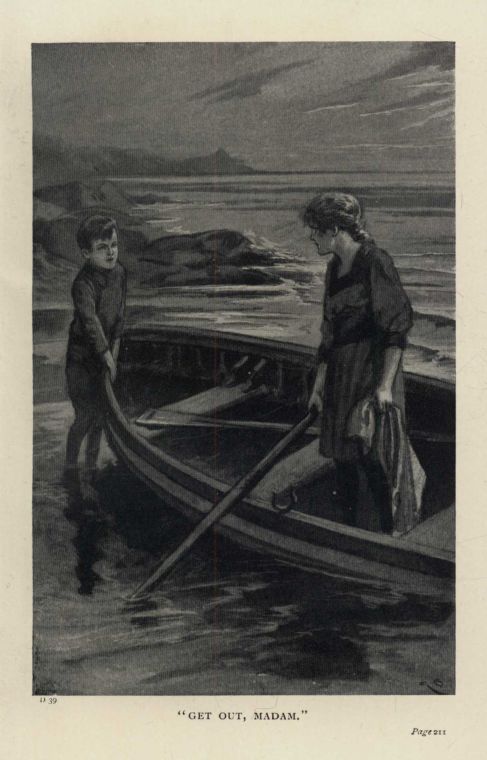
"GET OUT, MADAM."
His tone was absolutely polite, at the same time the Countess had seldom felt less happy. He was so small, and so good-tempered over it all! She certainly felt rather like a "full-sized idiot"!
The dinghy was secured, Hughie fixing the anchor between two rocks.
The whole valley was wrapped in thick grey haze, but there was no light. The east being behind the high Downs made morning late in Bell Bay.
The Countess looked on at Hughie's efforts; then she said, almost against her will:
"You are very wet."
"Well, one is when one's been in the sea; you can't help it."
The girl coloured, but she pursued amicable tactics.
"I hope you will not catch cold."
"Oh, thanks," said Hughie, and he looked at her so expressively that she could not fail to remember it was her fault that he was wet.
"You'd better come through our garden," he went on; "it's shorter. I expect you know the way all right."
"I did not pass through your grounds," said the Countess quickly; "I came along the road," she pointed in the direction of Crown Hill lodge.
"How do you get out of Woodrising without the people knowing?" asked Hughie, as they climbed the beach among the rocks.
"You have no business to ask," said the Countess haughtily.
Hughie looked at her sideways.
"I think you are awfully funny; you'd amuse anybody," he declared thoughtfully.
"Amuse--I!"
"Yes, there you go again. You do such ridiculous things, and when people can't help smiling you cut up rough. You look like Pam on the outside--except your face," went on Hughie critically; "but you aren't a patch on Pam really--she's a sport."
"'Sport', how? Does she shoot then? I can shoot," said the Countess sharply. It was plain she did not wish to be thought inferior to Pamela.
"Can you, oh--that's all right. No, I meant Pam was awfully decent; she plays the game always."
"You English think of games and nothing else," said the Countess scornfully. "My father had a little gun made for me, and I could kill when I was--oh--as small as you."
"I'm seven," said Hughie, "and a good bit of eight as well."
There was a pause as they passed through the gate on to the terrace walk; the house was visible now, looking large and sleeping, with its shuttered eyes.
"We'd better walk on the grass, because of gravel noises," advised Hughie. "I shouldn't make it, but you do. And look here, it's no use you trying to get on the yawl again, because she'll be locked up."
"Why?"
"I shall tell Addie to lock her. He'll see the dinghy has been shifted; he's simply bound to."
Now this was obvious. The girl could not deny it, and an angry light made her brown eyes look reddish as she turned a quick glance on the boy. She checked speech though.
Hughie looked back at her curiously.
"What did you want to do?" he asked.
It appeared that she considered whether to answer or not, and then took the resolution to say something anyway.
"I wanted to go somewhere."
"Where?"
"It does not matter. Anywhere. Salterne, or what is another place--Peterock. I am sick and weary of this place--I wish to see a new one. Surely there is no harm in that?"
She said this innocently enough, but in her eyes lay a something that was not so honest as her words.
"Why don't you ask Sir Marmaduke?" asked Hughie. "He'd let you go to Salterne or Peterock with Mrs. Chipman in the car. Why shouldn't he?"
"He would not; it is verboten (forbidden)," said the Countess sharply.
"It's what?" asked Hughie, frowning; he half recognized the sound of the German word, for he had heard Miss Chance helping Christobel with German holiday tasks.
"Nothing," answered the Countess quickly.
They had crossed in front of the sleeping windows, along the turf edge of the lawn borders. Hughie avoided a straight crossing, because the track on the grey wet spread of grass would be apparent to the whole house. Along the narrow border he scrubbed it out as they went, walking behind his charge for that purpose.
When they came to the front door end of the house, and the drive, he told the girl to hurry, and hurried himself--always on the turf edge, this time to avoid the noise of footsteps on the gravel.
"You see," he explained, "those open windows up above the front door are Addie's and Crow's. We are only in view about two seconds, but you never know."
The Countess asked why they couldn't go out by the kitchen garden door. It seemed that she knew the geography of Bell House grounds.
"We can't get out. Old Hennery Doe takes the keys away when he goes, and let's himself back when he comes in the morning at half-past six. He doesn't hold with eight-hour days--he calls it 'silly muck'," said Hughie, adding sagely, "so do I--what's the sense of stopping just because it's eight hours, when the fruit is rotting and mice eat the peas. Look at my father--his work is never done. Nobody can stop in the Navy and the Army--how could they? Fancy if the battleships did that sort of thing!" the scorn conveyed by Hughie's tone was indescribable, and let it be said that on this point the Countess was entirely in sympathy.
Hughie opened the gate for her, and, being bare-headed, made a little gesture of salute as she passed through.
"I hope you will not catch cold," said the girl; her tone was patronizing, and Hughie recognized it--a sentence culled from Mrs. Jeeps' conversation came aptly to his mind.
"If you will be advised by me, you will remain in your own garden," said he gravely; "and thank you for your good wishes."
This ended the interview. Hughie shut the gate with care, murmuring as he did so: "We prefer your absence to your company," again Mrs. Jeep--and then he started off running at top speed down the turn to the stables and backyard, round the house and in at the garden door. That he locked inside. Then he pulled off his soaked shoes and stockings on the mat--rubbing stone-cold feet energetically to dry them well--sped along the passage, up the back-stairs, and away down to his own room, leaving no mark or faintest trace with his bare feet. Arrived "at home", he dragged off the wet garments--knickers and woolly sweater, not even a vest in addition--bundled the things up and put them with the stockings under his bed--as the shoes were always wet, more or less, they did not count; then he rubbed himself energetically with a rough towel, assumed the striped pyjamas, dived into bed, and was asleep within three minutes.
For Hughie the episode was successfully closed. For some others it had just begun.
It was said that when the two entered the drive from the terrace walk, Hughie hurried the pace in order to get his charge out of range of Adrian's and Christobel's windows. There was just about a minute in which that curve of the drive was in full view from the house. There were surely a thousand chances to one that the pair would not be seen at such an hour--not much after four o'clock in the morning. But as it happened, Adrian had waked--perhaps some odd instinct of doings on board the yawl had pricked him--the thousandth chance was against Hughie, and Adrian got up at that instant to look at the weather and see what sort of day was going to favour his project. His plan the night before had been a seven o'clock start and breakfast on board. It would be heavenly in the early morning, and nearly three hours tide to Salterne river would be theirs. He wanted to be off at half-past six, but Mrs. Jeep was firm about seven--she "didn't hold" with depriving people of their rest, she said. So seven it was to be--and Adrian, on the alert at 4.20, saw something that surprised him so immensely that he was nailed to the floor, gazing.
The disappearing figures of Pamela and Hughie just rounding the curve of the drive towards the big gates. Hughie bare-headed--otherwise as usual. Pamela just as usual.
Dawn was piercing the "darkest hour", and the pair were fairly distinct in the mist. Distinct enough to remove all doubt as to who they were. Adrian gazed as they went out of sight, gazed at the empty drive; then he leaned from his casement and listened. No sound but here and there a faint "tweet" from a tentative bird, asking if it was time to get up.
Three or four minutes passed, then Adrian opened his door, hurried down to Christobel's room and knocked--once--twice--no answer; she was asleep; he went in.
"Is that you, Keziah?" murmured Crow--sleepily: "is it five?"
"I say, Crow," said Adrian in an energizing whisper, "wake up for any sake. I've seen about the rummest thing you ever heard of."
"Oh," Christobel answered thickly, "what a pity."
"Pity! How do you mean?"
"Because I want to go to sleep--it's rather early, isn't it?"
"It's soon after four; but look here, Crow, this isn't a false alarm--or a mare's nest--it's simply the most amazing eye-opener."
"Oh, is it?" Christobel roused herself to look at her excited brother; from long experience she felt sure that he would not be quiet till he had got the news "off his chest". She raised herself a little on the pillow and tried to be interested. "Go on," she said; "what is it?"
"Well, what do you say to Pam and Hughie walking up the drive to the front gate."
"Oh, Addie--what rot! Four in the morning!"
"My good girl, I stared at them till my eyes nearly dropped on the window-seat. I just happened to wake, and went to see what sort of a day it seemed--the window was open--there they were."
"Why didn't you hear them on the gravel first?" asked Crow in an unbelieving tone; she realized that here was another attack on Pam, only this time Hughie was included. She refused to believe a word on the spot; she made up her mind against this tale.
Adrian said the two walked on the grass-edge border--Pamela first, Hughie following; they did not seem to be talking, they went fast.
"Why didn't you call?" asked Crow.
"I was simply knocked out of time. I just stared, and they were gone round the turn. Then I came to you."
"Hum," Christobel sniffed sceptically; "how were they dressed?"
"I told you--I don't know, I'm sure--same as usual--the kid no hat. I said so. Look here, Crow--what are we to do?" this in an urgent tone.
"Do? Oh, nothing; what could we do? Go to sleep again till we have to get up."
"I must say, Crow, you are most awfully casual," said Adrian in an offended voice. "The thing's about as strong as it can be, and you won't move. Pamela has been behaving like a lunatic for weeks, and now she is taking her walks abroad at four in the morning and dragging the kid with her."
"Well, you see, Addie, I don't admit that Pam has been doing anything different from ordinary," argued Crow in her sober, level way. "I don't believe it, and you can't make me. As for this. I think the mist has deceived you."
Adrian rose indignantly from his seat on the bed foot.
"Of course if you're going to----"
"Stop a minute, Addie. Here, give me my dressing-gown." She sat up and put her arms in the sleeves, talking as she did so. "How long did you say it was--you've only been here a few minutes--they were going out, not coming in. Well, it's perfectly simple. I'll go and see; if they were walking away up the drive ten minutes ago at the outside, they can't be in bed now."
Christobel flitted away like a shadow, down the long corridor, round into the cross passage at the end, and stopped outside Pamela's door. She heard the sound of regular breathing in the stillness, and went in. There was Pam, sound asleep. Christobel's experienced eye ran over the neatly-folded garments on a chair, the blouse hung deftly over the bed foot, sleeves inside out. The room was neat and in order.
"Absurd," muttered Crow with emphasis.
Pamela stirred, turned over, and started up on her elbow, rubbing her eyes.
"What--what is it, Crow; am I late? Is it half-past six?"
"Oh no, half-past four. Don't worry--I just came to look out of your window----" Crow suited action to the excuse, lamely made, for she was not used to excuses.
"It's going to be fine, Pam; there's a mist----" she laughed softly with a little sense of triumph, and slipped out of the room.
Pamela vaguely wondered, but it was obvious that her sister was "not cross"--Christobel seldom was; she meant there was a very sympathetic atmosphere, which was true.
Crow went on and peeped in at Hughie. A small heap in the bed, the top of a sleek head, and absolute slumber, with the room just as usual.
She fled back down the passage and arrived in her own room rather inclined to giggle.
"Both in bed, both sound asleep, not foxing, but simply sound. I woke Pam; she was perfectly foggy, and wanted to know if it was time to get ready. When I said 'no' she was practically asleep before I came away."
"I suppose they bolted back," said Adrian, though he was plainly surprised.
"Bolted! My dear Addie! Pam's clothes were all as neat as a Chinese puzzle, her shoes put together, her blouse hanging out to air! Hughie's room was the same--you know how tidy those two are; they beat us hollow. It's not a scrap of use reasoning that they could have done all that in the time, because it isn't possible, especially as you say they were going away, not coming in! After all, Addie, one must be reasonable."
Adrian was reasonable. He went off in silence. He saw the force of what his sister said, but he had the evidence of his eyesight against it. The whole thing was staggering. It was part of the strange and complicated way that life had been behaving for weeks.
After that he slept fitfully, being worried, and at half-past six left the house to get things ready on the yawl, leaving the girls dressing. Pamela had come along the passage to Crow with a beaming face and her lovely hair like a bronze shawl over her shoulders; she wanted Christobel to plait her tail as Keziah was busy packing a basket. Adrian saw his sister, and was bound to admit she looked like a guiltless person who had slept soundly.
She said Hughie was asleep; as he was not going there was no need to wake him.
Crow was dressed and putting one short pin in a nice little close hat, when she heard Adrian come back. He came into her room, hardly waiting for the answer to his knock, shut the door, and leaned his back against it.
Christobel, instantly aware of something new, turned round; her brother was breathing rather fast, and there were sparks in his hazel eyes.
"Something is up, Crow--no question."
"Why--what?"
"Oh, the dinghy has been used--she's full of gravel and footmarks--sculls messed up--anchor shifted--painter wet and muddled up--whole thing anyhow, and up in a new place, not where I put her."
Christobel exclaimed softly; Adrian went on:
"Someone's been on board the yawl. The fore-hatch is hauled off! there are any amount of wet footmarks and gravel prints inside, on deck, especially on the counter. The companion door is wide open. Besides that, one of the bunks, the one you use, was all untidy--all the cushions were on that side--and sort of messed up. Once before I had a dim idea someone had been on board----"
"So had I," murmured Crow softly.
"You never said so."
"Well, I thought I was mistaken. It was so unlikely."
"It's obvious," said Adrian drily, "that very unlikely things are the order of the day. In fact, it's just as well not to say 'all things are possible'. Also there's no use in pretending Penberthy or Fraser would do it, because it's out of their line altogether. Somebody has been on board who doesn't understand boats--I mean, that's my impression."
"Then it can't be Pam," interrupted Christobel hastily
Adrian saw the argument in her mind.
"Don't ask me--don't say 'can't be', anyway. I feel inclined to say 'I'm mad, you're mad, we're all mad' like the cat in Alice. Anyway, it'll take me an hour to clean up."
"Oh, Addie, what about Salterne?"
"Never mind, we'll go to Peterock instead; tide's A1 for Peterock after nine o'clock."
CHAPTER XVII
In which Amazing Things Happen
The only thing confided to the general public about this surprising development was that Adrian considered the allowance of tide all too short for reaching Salterne, which was true, and had decided therefore to make a day at Peterock. For the latter place everything was convenient, the out-going tide would begin to ebb soon after nine o'clock, and turn between three and four in the afternoon; could anything be better?
"I wonder you didn't settle on that in the first place," said Mrs. Romilly, a most reasonable remark. She did not know that Adrian cherished a secret hope to anchor out all night again in Salterne river, whereas Peterock was not the kind of harbour for such pleasures. It was not a harbour at all, in fact, but a lovely watering-place with a pier; within the pier was a makeshift mooring-ground, choked up with various craft. No born sailor would go to Peterock for enjoyment. However, these matters were not within Mrs. Romilly's knowledge, and Peterock would do quite well for hair-cutting.
On finding the start was not immediate Mrs. Romilly made out a list of commissions, and Christobel was too busy hearing about these things to have any more time for the mystery. When she and Pamela went off there was a serene atmosphere.
"Doesn't the dinghy look clean," exclaimed Pamela in warm admiration. "Addie, you've scrubbed the whole thing. She's lovely!"
Adrian, who was rowing, looked at his sister quickly. The sincerity of her face was unquestionable.
Thus the mystery grew, but Adrian was not ruffled as he had been in the morning. Then, Crow had him at a disadvantage; he could not prove anything; he was forced to feel even foolish in the face of the evidence Christobel brought about the peaceful slumber of the supposed culprits. Now it was different. He was justified by his startling discoveries, and good temper was the result.
Christobel looked round as they boarded the yawl, but saw no signs of disorder. All was neat as usual. She and Pamela packed the food into the pantry shelf and set about helping to get the sails up.
Poor Pam was very happy. She felt freer than she had done for a long time. Nothing could happen out here. The sea was glorious, and Crow was always the same to her; nothing could come between them, she thought.
The breeze was off shore--what is called a "soldier's wind", which means that it serves without tacking. The tide was strong, the sea, with such a breeze, of course was smooth; it was all as perfect as possible.
"The Floweret could have come to-day without being sick," said Pamela, gazing over the shimmering waste with half-shut eyes; "what a pity Midget is left behind."
"He looked rather tired," said Crow from her place at the tiller.
"Did he; I wonder why. He slept sound enough; he never woke till Keziah called him, and then he went to sleep again," said Pam.
Christobel smiled. This was exactly what she had felt sure of, and there was no effort at all in her sister's way of speaking.
The start was excellent, the sailing was perfect; "dull care" seemed to have been left behind in Bell Bay--but one never knows!
Lunch being planned for rather an early hour, the two girls went down to get things in order about twelve o'clock. Adrian took the tiller, and, steering with his eyes half shut, whistled softly to himself. Christobel began setting the swing table in the saloon--the plan was to lay-to upon the wind and have a proper lunch, as there was time; Peterock cliffs were already in sight, and they would be moving towards their destination all the while on the drift of the tide.
Pamela went through to light the stove--hot water would be wanted for washing up, which was never left indefinitely. She had just put the kettle on when she heard Christobel say something, and called out.
"What's that, Crow?"
"How funny!"
"What's funny?" Pamela set a saucepan close to the kettle--with a view to egg-boiling--and then swooped through the low door full of curiosity. "What's funny?" she asked again.
Crow was sitting on the bunk seat which was generally called hers, holding something in her hand--a handkerchief. Not one of Adrian's "tablecloths", nor one of the girls' strong linen hem-stitched articles with the name letter in the corner. It was small and fine and lace-edged. Crow began turning it round slowly through her fingers, looking for some mark.
A spasm passed through Pam's mind. She was beginning to be accustomed to that sudden sick shock, that meant "danger ahead", but it was none the less unpleasant.
Christobel came to a corner, and stayed.
"Goodness!" she murmured. "I say, Pam, look here!"
Pamela had no need to "look here", she guessed.
"How extraordinary!" went on Crow with emphasis; "the same letters that were on the safety-pin brooch--and a tiny little coronet. It's awfully pretty, but--who on earth!"
She looked up at Pamela; their eyes met, and Christobel was acutely conscious that Pam knew something. She flushed scarlet; then the colour fled and left her very pale; her clear eyes shifted from Crow's gaze, and in their depths was an uneasy, deprecating shadow.
"Do you know anything about this?" asked Christobel.
"About the handkerchief, no. Oh no, I don't. How could it come here?"
It was perfectly true that she had no idea how the handkerchief came there, but it was not the sort of truth that was natural to Pamela Romilly, and as she said the horrid words she felt sick with herself. In a lightning moment she resolved to go to the Countess and tell her that she intended to state the whole position to Christobel--she would do it; she would warn the girl and have it all above-board.
Silence fell like a stone between the sisters. Christobel realized that Pamela had some secret; Pamela saw that she did.
Slowly the elder girl folded up the handkerchief and put it in her skirt pocket.
"What shall you do--about it?" asked Pamela nervously.
"I shall give it to Mother, I suppose. When one considers that the letters and the coronet are the same--well----"
Her tone was cold--she was hurt because Pam would not speak.
A sudden strange inspiration came to Pamela in that desperate moment. Desperate, because Crow had backed her up and fought her battle right through--she could not bear this last misunderstanding.
"Crow," she said, leaning forward; her voice shook a little, and her eyes looked suspiciously limpid--"Crow--do you mind my saying something--about it?"
"Why should I?"
"Don't say anything to Mother, yet. Take it to Miss Anne."
"Miss Anne--Little Pilgrim?" Christobel checked her work, and gazed back startled. "Why?"
"I can't tell you why--but do. I am sure it would be the best thing to do."
The elder girl considered this, not with much sympathy it seemed; then she said:
"Oh well, perhaps. I don't know. Anyway, we may as well put lunch; Addie is awfully hungry."
So it passed, with a very heavy cloud left behind to darken the clear holiday sky!
Lunch was eaten and greatly enjoyed by Adrian. The two girls using a self-control such as only girls know how to call up when necessary, Addie saw no difference in either--but they saw it--in each other.
Then came the arrival at Peterock, the smart picking up of moorings, the convenient man doing nothing in a large clinker-built boat close by, with a pipe between his teeth, willing for a consideration to "oblige" and give advice.
Then the three went ashore with the afternoon before them, and to make it all more complete they decided to have tea at a gay and joyous tea-shop on the biggest esplanade, and start for home about five-thirty or six; even so with such a wind and the splendid flow-tide they would have ample time. Adrian had his hair cut, while the girls--more or less constrained--looked into shop windows. When they met again Christobel said she did not like the idea of waiting so long in the town, "suppose the wind dropped"--it was lighter. Adrian was disappointed, but he realized that they were not allowing themselves much time for possible accidents.
"Let's get off at four--about--and have tea on board," said Crow. As a matter of fact the "snap" in the day had gone out for her since that odd conversation with Pamela.
"Tell you what we'll do," cried Adrian suddenly, as a new move occurred. He loved new moves. "We'll get off about four; we'll sail down to the cove this side Bell Ridge--you know Champles Creek. We'll drop anchor there and have tea on shore. We shall be home then practically, as we've only got Bell Ridge between us and the bay, and can walk over if the worst comes to the worst."
"Why should there be any 'worst'?" asked Crow, not quite convinced.
"No reason, but one ought to have a bolt hole--always. All wild animals do, and their instincts are--hullo, there's old Timothy Batt--Peterock day, I suppose."
Timothy Batt's "van" was drawn up at the curb, bulging with parcels of all shapes. He sat under the canvas hood, while people in shops came out and handed him more things. He was very well known.
As the Romilly trio came up he leaned out and made a gesture of summons to Pamela, who stepped forward to meet it.
Timothy explained that her bicycle was ready, "if so be" as she would be content to risk a probable collapse of the tyre at an early date.
"Them at the works," explained Mr. Batt, "can't make no job of it. A new tyre is what 'e wants--they don't take no 'sponsibilities."
"They've been such an age over it already," said Pamela, annoyed, "weeks--I must ask about the tyre--I wish I'd known, Timothy."
"Well, missie, 'twasn't for want o' me tellin' of you. 'Tis a matter of two weeks or more--us coming up along Folly Ho Road--pretty near dark it were, and that I marked because I says to the missus 'twas a lone place for you that hour. I called out, and stopped be roadside right enough to told you what they says down works. 'Thank 'e', says you--nobbut that, and on you goes. Bein' as I was home goin' and I didn't stop. There 'twas----"
"Oh," said Pamela uncertainly. "Oh, I see----" She moved on a step, then she turned back to the cart and told Timothy she would write to the works, "or Mother would".
Timothy Batt informed the missus that evening that "Miss Pamela looked 'pined'," and "she'd a lost way with her--happen she's growed too tall to be hearty," said the carrier.
Pamela certainly felt both "pined" and "lost" as she walked on with the others. She had no doubt whatever that this was another case of her "double", and glancing sideways at Adrian, as he walked along balancing neatly on the curb, saw the look on his face that she had begun to know now. Crow remained perfectly stolid, changing the subject at once to something far removed from bicycles and Timothy Batt.
In old days, both would have said to her at once, "What were you doing on the Folly Ho Road at that time?" Now, nobody spoke, and to poor Pamela it was a sort of brand proclaiming her outlawed from the family confidence.
On the top of the handkerchief affair it was rather shattering, and she felt a lump rise in her throat. However, she called up her resolution to hearten herself, swallowed the pain, and tried to take it all philosophically. After all, it would be explained presently, and in the meantime she was doing what she thought right by the girl who had asked for her silence.
Sails do not always turn out "according to plan", but this one did--as far as getting to the creek below Champles Farm was concerned. It was the loveliest place, though hardly worthy to be called a creek when it came to an anchorage. On such a day, with an off-shore wind, the place was perfection. And once more the spirits of the three recovered the usual level. Adrian dropped the anchor, and the white yawl lay on the smooth sea exactly like "a painted ship upon a painted ocean", while her crew went ashore.
A stream came down through a glorious cleft in the rugged height. There were trees and ferns, the former a bit stunted from sea-wind; but Bell Ridge was a barrier on one side, and on the other, the coast-line trending outward made a shield.
Two thermos flasks and a weighty basket went ashore with the crew in the dinghy. It was some while after five then; but, as Adrian said the tide would be in their favour till half-past nine, the feeling of ease was delightful. No hurry. No bother about wind or tide. Home was just round the point by sea, and perhaps a mile by land, as the crow flies. More, of course, if climbing is allowed for.
Soon after six Adrian said he should bathe. Crow unearthed a magazine, and Pamela said she would climb to the top and look at the view.
Everybody agreed that it "was all right", and became absorbed in their different occupations. Time passed so swiftly that it had presently reached the hour of half-past seven. Then Adrian, who had become busy on the yawl in some unexpected direction, came ashore and said it was time to be lifting anchor.
Christobel shut the magazine, wishing next month was due to-morrow, and gazed at him with vague eyes.
"Wake up, old lady; we ought to be getting back. Where's that idiot Pam?"
"Oh, isn't she on the shore?" said Christobel, stretching. "How heavenly it looks!"
"Yes, I know, but it's about eight o'clock--or soon will be. We'd better get things on board; I can come and take her off."
"Whistle--call," suggested Crow, getting up from her fern seat.
Adrian did his best, which was something to be proud of, in the noise line. Christobel had to tell him to stop; she said the lighthouse at Ramsworthy would send the boat up, thinking it was a ship in distress. They both stood on the edge of the rippled sea, looking up at the cliff and the wooded gully that cut it from top to the rocky base.
"There!" exclaimed Crow.
"Pam--e--la, hullo--o!" Adrian's strong voice woke echoes that called and called again.
Clear of the bushes, on the summit stood the person they wanted, looking down at them apparently, but never a word said she, nor did she make sign or gesture. She just stared.
Christobel waved her handkerchief, waved her hat, joined in Adrian's shout:
"Go--ing!"
Anyone could have heard much farther off than the cliff top. True, it was high, but the scene was so still, the waves but a ripple, and the wind a breath.
"She's mad," announced Adrian; "she's raving, Crow. I told you she was. If she isn't coming, why can't she answer? I must say this positively passes--well, never mind--get in--we'll go. If she comes down I'll fetch her off, but I shall certainly tell her what I think. Otherwise she can walk home."
"I don't understand," said Crow.
"Of course you don't. People are not expected to understand lunatics." Adrian said that and a few more things more pointed than flattering on the way out to the yawl.
Meanwhile Pamela sat down on the edge of the cliff and watched them with apparent interest.
By that time the light was beginning to turn into shadow.
"I suppose it couldn't be anyone else!" ventured Christobel, twisting round in the stern seat to look up at the motionless watcher.
"Anyone else! My good girl, ask your own senses! Look at her hair! Look at everything! Besides, where is Pamela? Didn't we see her go up to that very place?"
"Addie, don't you think I'd better go back, and up to her and see if anything is wrong?"
"How could there be anything wrong? She looks perfectly healthy--there, she's going away. Well, of all the blazing bits of cheek----"
It was true. Pamela got up, stood clear against a bit of bare ground so that they saw her figure distinctly; then she turned and walked away, disappearing on the instant from view.
Adrian gave a snort--it was nothing less--and boarded the yawl in silence.
The voyage home from the creek and the finish up took perhaps half an hour. Adrian left nothing to chance that night: he locked the companion door, he fastened the fore-hatch.
"You'll have to put up with stinks, Crow," he said bitterly, being most horribly cross; "with the whole of Bell Bay one seething mass of lunatics one has to take precautions."
Crow said nothing. She saw it must be so, also she was very much puzzled; there was the handkerchief of course, in addition, from her point of view; Addie knew nothing about that. However, amazements were not yet a thing of the past. When they two got in supper was just beginning--everybody was collected round a cosy, well-filled table, everybody, and--Pamela, who was cutting bread. She looked hot and rather tired.
"We're just about equal," she said. "I was so sorry to be late."
"Late!" came from the two elders in voices of amazed indignation.
"You were just off. I never saw anything so lovely as Messenger, just leaning over, and spinning along, with the dinghy streaming behind. It was no good then, of course, so I just went back through the gorse ridge and came down the usual way."
"Do you mean to say we were sailing when you first saw us, Pam?" said Christobel, in a shocked voice.
"Sailing, yes--streaking along awfully fast. Have some bread, Addie?"
"But, my dear girl, we were on the shore when we first saw you," persisted Christobel. "We called and shouted till we were afraid of attracting public attention and being had up for nuisances."
"Did you see Pam then, dear?" asked Mrs. Romilly.
"See her, of course, Mummy, but she wouldn't answer. We called--we waved--we were on shore waiting by the dinghy, wondering why on earth she was so late. Then we saw her come to the cliff edge and look down at us. Addie made an awful noise, but she never answered. She just seemed to be staring straight at us. At last we couldn't wait any longer and we put off to the yawl. She watched us reach the yawl and then she turned away and went off. That's what we saw."
"How very odd," said Mrs. Romilly uncertainly. "Tell them just what happened to you, darling."
"I went up the cliff to the top," Pamela answered, speaking rather quickly, "then I thought I'd just go to Champles and fetch a few eggs, as it was easy to carry them by the boat. And coming away from Champles I went round above the church, because it was so lovely--and there was a most awful bother going on--Crow, you know where Mr. Badger has all those sheep penned, and the field where the mare and the foal are in with those calves. Well, all the sheep were out--hundreds--the whole place was covered, the mare had got into the cornfield where the young corn is just coming up green--and the calves had gone. I started to get the mare out, it took ages; then I saw the calves had gone into the field that's nearly hay. It was particularly trying for Mr. Badger, because I knew he would be at Salterne market to-day and not back. Everyone else was gone home, of course. I got the mare back, and the calves, and some of the sheep. It took ages and ages; when I got to the cliff edge there was Messenger sailing away. Certainly I didn't blame Addie for a second. I only went to look on the off-chance of her being still in the creek--it was very late."
Adrian made no remark from first to last. He hardly appeared to listen, but ate his supper in absorbed silence. Frankly, he did not believe a word of the story, but he did not know what to think. How his sister could dare to assert that they never saw her, and that the yawl was on her way home, was past understanding.
Mrs. Romilly had come to the conclusion--from Adrian's manner and Pam's nervousness--that there had been some tiff on board, and the separation was due to disagreement. She changed the subject, and peace prevailed on the surface.
CHAPTER XVIII
Mr. Badger calls at Bell House; and Christobel at Fuchsia Cottage
Hughie most tactfully refrained from saying one word to add to Pamela's weariness that night. It was plain she was very tired--plain to her mother, who, for that reason perhaps, was a little inclined to be biased against the elder pair.
It was not kind to leave the child alone at Champles Creek, when by their own story they had seen her and called to her.
"After all, one of you might have gone up to see what was the matter, darling," she said to Crow later.
"But, Mother, she says we'd started."
"I think she is saying it to shield you both; Pam is very generous," suggested Mrs. Romilly.
"I suppose you mean that either way we are wrong," answered Crow, a little wounded.
"Well, do you think it was quite kind to leave her all alone? After a long tiring day? But never mind--a night's rest will put it right, and certainly Pam bears no malice."
That was how the affair looked to Mrs. Romilly. Christobel said no more. She was a wise, kind girl--moreover, she was becoming aware of some strange mesh of misunderstanding that had entangled them all. Pamela had had to bear the brunt of that horrible brooch affair--now she was accused of this!
The handkerchief was in her possession still, of course, and, as she examined it that night, Pamela's odd suggestion came back to her with new force. At any rate Miss Anne would bring another mind and imagination to bear on these entanglements.
Hughie, then, waited till next day, when he conveyed a secret invitation to Pamela to meet him in "the cave" at a certain hour for important conversation. Pamela went, and, curled up happily behind the barricade with her long legs doubled up under her, she heard the story of the Countess' raid on the yawl and the way she had been circumvented.
"Now what did she want to do?" said Pamela thoughtfully, her head against the big trunk.
"I rather guess----" said Hughie.
"What?"
"She wants to escape from Bell Bay. If I was her," he went on, clasping his ankles as he sat cross-legged--"if I was her, I should escape, but in a more sensible way, of course."
"I see, escape to Salterne. I wonder if she has any money," considered Pamela.
"Sure to--lots."
"I wonder," went on Pam, "if Addie found out things on board; he never said a word to me."
"Of course he did. The dinghy was all filthy mess, and there must have been a whole field on the yawl! I couldn't stop to clean up. There was that girl, and besides, I was so wet."
"Midget, you haven't caught cold, have you?" asked Pamela anxiously.
"No. I say, Pam--because Addie found out the mess was why you didn't go to Salterne, don't you see? It made things late--then you went to Peterock. I guessed that was it."
Pamela saw also, in an instant. Then she told Hughie about the handkerchief; he nodded gravely.
"Well, if Crow takes it to Miss Lasarge, perhaps she'll go and tell Sir Marmaduke. I wish they'd take that girl away--she spoils all our fun." Hughie sighed, then he remarked, "I told her it's no use her raiding the yawl any more--I said Addie would lock her up. I said I'd tell him to, but he'll do it jolly well without me telling."
Pamela remained deep in thought as she reviewed this situation.
"I wonder what that girl will do next," she said at last, and sighed.
"Well, I wish she'd put her head in a bag," remarked the Midget with quite unexpected coarseness; "she doesn't seem to be any use."
Now if anybody is thinking that the trouble at Champles Farm began and ended with poor Pamela's anxious efforts, "he is deceived by his own vanity", as Mrs. Jeep would have said. The day was not ended before that worthy woman sent in a message by Keziah to know whether she could speak to mistress for a few moments. Mrs. Romilly departed to the housekeeper's room, and presently left that comfortable sanctum more confused in mind than ever.
It appeared that Mrs. Jeep considered it her duty to mention what "they" were saying about Miss Pamela. It was "all over the village" that Miss Pamela had removed the hurdle and had caused Mr. Badger's sheep to wander like the Israelites in the desert: some having been found at Peterock, one been run over on the main road to the station, and several still lost. That Miss Pamela had opened the gates at both ends of Spill land--the senseless name of the field in which the mare and the heifers were pastured--and let the animals out.
"They will have it as Badger's mare is so bad with the colic that she won't get over it. Green corn's shocking food for a horse--well, serve her right, the greedy creature--but the heifers, five of them, have trampled the field he'd laid by for hay something cruel. I'm repeating what they say, ma'am--there may be an ounce of truth to a barrel of lies--we know how they talk. But anyway, it's laid to Miss Pamela. In my opinion, that Badger's trying to make a case for himself. He thinks he knows where the money lays! I don't hold with that Badger, ma'am; never did, he's too free with his gossip. What I say is, Miss Pamela knows the rights of a field just as well as them Badgers. She was never one for mischief--not from a child. It's silly nonsense, that's what it is, ma'am, but I thought I'd tell you in case that feller comes round making out a case for damage."
Mrs. Jeep stayed, breathless; she had been fighting the family battles since the milk came from Paramore's in the morning. It was the milkman that first brought the tale; followed shortly by the postman and the baker. Hennery Doe had "known ove night", he admitted, but, as he disapproved of gossip just as decidedly as of eight-hour days, the story had remained with him.
"Oh dear, oh dear," said Mrs. Romilly, "it really is too absurd. Poor little Pamela seems to be in the wars all round. What is the matter? Why are people so hopelessly idiotic?"
Mrs. Jeep sympathized respectfully. She intended to uphold the family whatever turn the matter took, though in her secret heart she thought it not an impossible contingency that Pamela might have left a gate open.
"Unluckily she was there--in the evening," allowed Mrs. Romilly; "if only I could say she was at home!"
There it was.
Mr. Badger first of all wrote a letter to Mrs. Romilly. This he followed up by a visit, next morning, and poor Pamela was sent for to the library. She was pale and worried; there was an anxious look in her grey-blue eyes, for the situation was so entirely new to all her experiences that she felt like a convict.
Mrs. Romilly said:
"Pam dear, tell Mr. Badger what you saw, and what you did."
Pamela told, in rather a breathless way, and one strong point in her favour was her visit to Champles to fetch the eggs that were always welcome at the Bell House. Mr. Badger admitted that she had reached Champles before seven o'clock--about a quarter to seven in fact. Badger's contention seemed to be that she had opened the gates before that--soon after six, because witnesses had seen sheep wandering at half-past six.
"I didn't go that way, Mr. Badger," said Pamela with decision; "I began to climb up from the creek somewhere about six, and went straight to Champles. I came back round the farm and the field where the mare was. No one was about, and I tried for an hour to get the animals home--the mare couldn't have eaten a great deal; I got her out, but the calves wouldn't go."
"I dunno," said Mr. Badger, with a twinkling eye fixed on the cornice--one on the cornice, that is, one on Mrs. Romilly--"I dunno as I can save that mare; she's a turrable loss. If she dies the foal's sure to foller; he's full young. As for the hay, an' them sheep----"
Mr. Badger believed he had a strong case. He said he could bring witnesses to swear that they saw Pamela about six o'clock going through the Spill land. The witnesses were vague rumour, really, but supposed to be people walking out from Peterock to Bell Ridge and back--these people "had passed a remark" on the subject when the sheep were all over the roads, and remembered a young lady in blue with a long tail of hair, walking in the direction of Peterock.
"How could I be going to Peterock, Mother? You do see how improbable it is, don't you?"
Mrs. Romilly was firmer than Mr. Badger had hoped. He had planned a "walk over", and pictured himself returning home with a cheque for at least twenty pounds in his pocket! The fact is that Mrs. Romilly was so convinced of Pamela's truth herself that she refused to be shaken.
"I'm sorry, Mr. Badger," she said; "at the same time, if, as you allow, people were walking out from Peterock to the ridge and back why should not one of them have left your gate insecure? Strangers are careless, we know. As for the young lady in blue with long hair whom they say they saw on the spot--the story is not convincing. They had heard the description of my daughter, and are shielding themselves behind it. I don't think we need say any more."
Mr. Badger went, dismissed icily by Keziah, who upheld the honour of the Bell House as first lieutenant to Mrs. Jeep; at the same time she remarked, in privacy:
"I've no opinion of Badger, Mrs. Jeep, as you know, but it takes some explaining to see why ever Mr. Adrian and Miss Pamela tell such different tales. Mr. Adrian's ever so gruff, won't hardly speak to Miss Pamela, nor Miss Christobel neither, so far as I can see. He is put out."
Keziah spoke truly, for Christobel could get no opinion from her brother either way. He refused to discuss Badger, or his woes. When Christobel said it was all a story--a fairy tale of gossip--didn't he think so? Adrian said:
"My dear Crow, did we see Pamela, or did we not see Pamela! You know what we did, and you know what she did? Well, what's the good of talking."
It was conclusive enough to drive Crow into her own room and a consultation with her own mind as to the best course. There was still that suggestion of Pam's about Miss Lasarge. Crow sat in her wicker armchair and gazed up the carriage drive, on which Adrian still declared he had seen the younger pair at four o'clock in the morning. Madness--of course, yet, what about that queer invasion of the yawl? The whole thing was delirium of improbabilities; the more Christobel thought about it, the simpler it seemed to go and ask Miss Anne for advice.
So, about four o'clock on the day of Mr. Badger's visit, Christobel announced she was going for a walk, and "made tracks" for Fuchsia Cottage. Miss Anne was at home; she usually was at that hour; and she received the girl with pleasure visible in every line of her small pale face.
"Now of course you'll have tea with me, Crow; do you know, I was just beginning to pity myself for being all alone, and so you've saved me from a contemptible state of mind. I'll tell Lizzie--and what about the lawn?"