THE VEGETABLE KINGDOM. (continued 2)
Reading edition
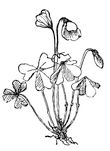
This completes the orders of Thalamifloræ, which, with the following sub-class, Calycifloræ, contain all our star-like flowers, or those in which the corolla forms a whorl or open ring of petals. The third sub-class contains those chiefly in which the flowers form cups or bells.
Orders of Calycifloræ.
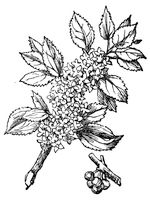
1. Celastraceæ (Euonymus Europæas) Spindle Tree.
Spindle Tree. This order consists of shrubs or small trees growing in the temperate regions of most parts of the world, and some of the species, as Celastrus venatus, are said to be poisonous; the seeds of the South African species are used to express oil from.
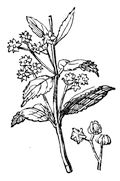
2. Rhamnaceæ (Rhamnus catharticus) Buckthorn. (Rhamnus frangula) Black Alder.
Buckthorn. Buckthorn berries afford a juice which, when made into syrup with sugar, is a popular purgative medicine; the juice precipitated with lime produces the green pigment known to artists as "sap green." The "French Berries" used as a yellow dye-stuff are procured from a species of Rhamnus.
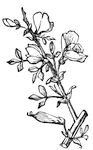
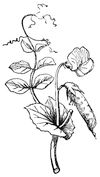
3. Fabaceæ, or } (Cytisus scoparius) Broom. Leguminosæ } (Pisum sativum) Garden Pea. (Faba vulgaris) Garden Bean.
Broom. Garden Pea. The plants producing pods or legumes are among the most important of the orders of this class, giving us very many useful and nutritious plants, which, for the most part, are climbers, as Peas, Beans, &c. The Tamarind and Cassia trees belong to this order, also those which produce gum-arabic, catechu, logwood, and indigo. There are between six and seven thousand species of the Leguminosæ.
4. Rosaceæ (Rosa centifolia) Hundred-leaved Rose. (Fragaria vesca) Wood Strawberry. (Rubus fruticosus) Bramble. (Pyrus communis) Pear Tree.
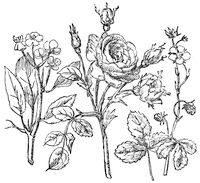
Pear Tree. Rose. Strawberry.
This important order yields us our most beautiful flower, the Rose, of which there are a great many varieties, among which the Dog-rose—that beautiful ornament to our hedges—deserves to hold a conspicuous place, also the Sweetbriar or Eglantine. The rose is used in Turkey and Persia for obtaining that most valuable and delicious perfume, "Otto of Roses." It is made by distilling a portion of water from several quantities of fresh roses, until it becomes saturated with the volatile oil. This water is then exposed to the open air, and, in the cool night time, drops of the otto collect on the top, from which it is carefully gathered, and the same water again distilled from a fresh quantity of roses. Besides the Rose tribe, this order contains some of our most valued fruits. The Apple, Pear, and Strawberry belong to it, also the Almond.
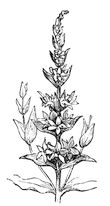
5. Lythraceæ (Lythrum salicaria) Purple Loose-strife.
Loose-Strife. The Purple Loose-strife is indigenous to England, bearing a purple flower, and is also found in Australia. There are several varieties of this plant; an Indian species, Lythrum Hunteri, bearing a red flower, has been used by the natives as a red dye.
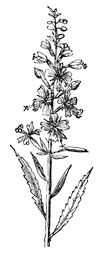
6. Onagraceæ (Epilobium angustifolium) French Willow.
French Willow. This order contains some very beautiful flowering plants, as the Evening-primrose (Enothera biennis), Fuchsia, &c. of which there are a great many varieties; they abound plentifully in America, of which country the Evening-primrose is said to be a native.
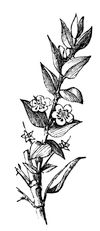
7. Myrtaceæ (Myrtus communis) Myrtle.
Myrtle. The Myrtles are, for the most part, inhabitants of the warmer climates. They are shrubs or trees, and sometimes of great size and beauty; the flowers and leaves of many species are odorous. There are upwards of fifty species of Myrtle, and they are found in most of the warmer parts of the Old and New Worlds.
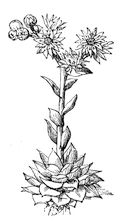
8. Crassulaceæ (Sempervivum tectarum) House-leek. (Sedum Acre) Stone-crop.
House-leek. The species of this order have, most of them, thick succulent leaves. The Sedums, Stone-crop, and House-leek, are among the most common, growing in dry, earthy matter, on walls or housetops; they, nevertheless, are full of a milky juice. The juice of Houseleek mixed with cream has been a long time a popular remedy for various external complaints, but, like most popular remedies, does neither good nor harm.
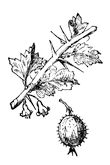
9. Grassulariaceæ (Ribes rubrum) Red Currant. (Ribes grassularia) Gooseberry.
Gooseberry. The Gooseberry and Currant are members of this order. They are useful plants for the kitchen-garden, and afford a grateful and wholesome fruit, although unripe gooseberries (eaten raw) are extremely unwholesome, as the acid they contain is the "oxalic."
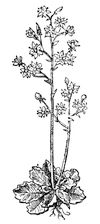
10. Saxifragaceæ (Robertsonia umbrosa) London Pride.
London Pride. These are plants growing, for the most part, in mountainous regions, and in the crevices of rocks. The London Pride and Hydrangea are the best known, the latter producing very large corymbs of flowers. They occur in temperate climates in most parts of the world.
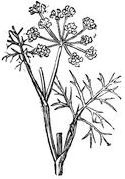
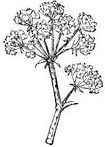
11. Apiaceæ, or } (Fœniculum officinale) Fennel. Umbelliferæ } (Conium maculatum) Hemlock. (Apium graveolens) Celery. (Petroselinum sativum) Parsley.
Fennel. Hemlock. Contains many of our useful vegetables, as the Carrot (Daucus Carota), Parsnip (Pastinaca), &c. The Celery also, and many of our aromatic seeds, are produced by the Umbelliferæ, as Anise, Carraway, Dill, Coriander, and Fennel. Some members, however, are poisonous, as Hemlock (Conium Maculatum), and Cow-bane or Water Hemlock (Cicuta Virosa).
Orders of Corollifloræ.
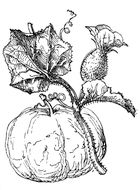
1. Cucurbitaceæ (Cucurmis melo) The Melon. (Elaterium agreste) Spirting Cucumber.
Melon. The Cucumber (Cucurmis Sativa), the Melon (Cucurmis Melo), both esteemed as delicacies, are of this order. Also the numerous tribe of Gourds (Cucurbita), as the Pumpkin, Large Gourd, Bottle Gourd, Squash, &c., also the Vegetable Marrow. Gourd-shells form the most common vessels for holding liquids, in many parts of Asia.
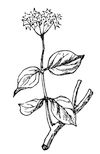
2. Cornaceæ (Cornus Sanguinea) Dogwood.
Dogwood. These plants are chiefly shrubs or trees, growing in most temperate regions, and especially in America. The Cornelian Cherry (Cornus muscula) produces a berry somewhat resembling a cherry. Some species are used in America as a tonic medicine.
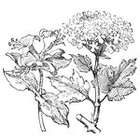
3. Caprifoliaceæ (Sambucus nigra) Elder Tree. (Viburnum tinus) Laurustina. (Caprifolium perfoliatum) Honeysuckle.
Honeysuckle. Guelder Rose. This order contains few plants of any importance. The Honeysuckle is a very favourite ornamental plant, and the fruit of the Elder produces the Elderberry-wine so much used on Christmas Eve, with toasted bread, in many parts of the country.
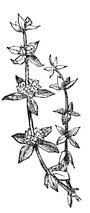
4. Galiaceæ (Galium cruciatum) Cross Wort. (Rubia tinctorum) Madder.
Cross-wort. The root of the Madder is one of our most important "dye-stuffs," producing the most permanent reds and browns used in dyeing. It is a native of the south of Europe and of Asia. Animals fed upon madder are found to have their bones tinged of a red colour.
5. Valerianaceæ (Valeriana officinalis) Valerian. (Cetranthus ruber) Red Valerian.
Valerian. Red Valerian.
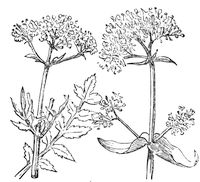
Valerian is indigenous, growing by ditches, and bearing a pink flower; the root is used in medicine, and has a most disagreeable odour. Several species are cultivated as ornamental garden flowers; there are about 125 species.
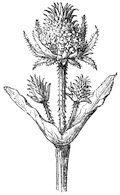
6. Dipsacaceæ (Dipsacus fullonum) Teasel.
Teasel. The heads of the Teasel were formerly used, to an enormous extent, for carding cloth, and were cultivated largely in some parts for that purpose—wagon-loads of them were brought to the cloth-dressers—but their use is now, to some extent, superseded, the process called "teaselling" being frequently performed by machinery.
7. Asteraceæ (Tussilago Farfara) Coltsfoot. (Helianthus annuus) Sunflower. (Chrysanthemum Leucanthemum) Ox-eye Daisy.
Coltsfoot. Ox-eye Daisy. The members of this family have a star-like inflorescence, as the Sunflower, China Aster, &c.; the centre part or eye, being composed of undeveloped florets, is frequently, by cultivation, almost lost, forming florets which are added to the ray.
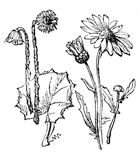
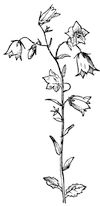
8. Campanulaceæ (Campanula rotundifolia) Hare-bell. (Campanula media) Canterbury-bell.
Harebell. Comprise the various "Bells," which form of inflorescence is characteristic of the Corollifloræ. There are about 500 species of this order, the flowers of which are for the most part of a blue or purple colour; the Hare-bell is also known as the "Bluebell of Scotland."
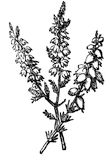
9. Ericaceæ (Calluna vulgaris) Heather. (Erica cinerea) Grey Heath.
Grey Heath. The Heaths are, for the most part, social plants, growing in great numbers on waste ground, and giving great beauty to scenery. The Heather gives a peculiar aspect to the hills of Scotland. Humboldt observes, "It is curious that, out of more than 300 species of Erica, one only should be found throughout the whole American continent."
10. Gentianaceæ (Gentiana campestris) Field Gentian. (Menyanthes trifoliata) Buck Bean.
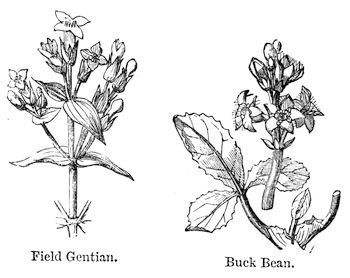
This order contains no member of great importance; the Gentian-root, much used as a tonic, is the product of the "Gentiana Lutea."
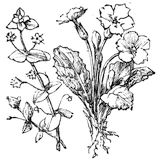
11. Primulaceæ (Anagallis arvensis) Pimpernel. (Primula veris) Cowslip. (Primula acaulis) Primrose.
Pimpernel. Primrose. These well-known and beautiful flowers form ornaments to our meadows, hedgerows, and gardens; the Oxlip, Polyanthus, and Auricula belong to this order, of which many varieties are produced by cultivation.
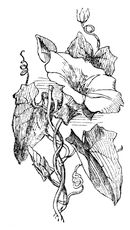
12. Convolvulaceæ (Calystegia sepium) Bindweed.
Bindweed. The Bindweeds are gay and beautiful flowers, and besides being used for ornamental purposes, many of this order have medicinal properties of great importance. The Jalap root is from the Convolvulus Jalapæ, which comes from Xalapa, in Mexico, of which name Jalap is a corruption. Scammony, another medicine much used, is a resin procured from a species of this order.
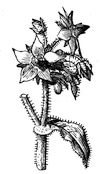
13. Boraginaceæ (Borago officinalis) Borage.
Borage. The members of this order have most of them rough hairy leaves, they contain a certain amount of nitrate of potash in their juices, and it is this which gives them the peculiar taste which has gained for them the name of "Oyster plants;" the common Borage has been used as a remedy for coughs.
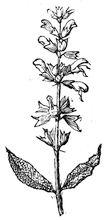
14. Liniaceæ, or } (Salvia officinalis) Sage. Labiates } (Thymus vulgaris) Thyme. (Mentha viridis) Spear Mint.
Sage. The name Labiates has been given from the form of their infloresence, which is generally "Labiate" (having lips); they frequently possess aromatic properties, and are mostly of a strong smell. Although not commonly used as food, yet most of them are employed to flavour it, as Mint, Thyme, Sage, and many more.
15. Solanaceæ (Atropa belladonna) Deadly Nightshade. (Solanum tuberosum) Potato. (Capsicum annuum) Capsicum. (Hyoscyamus niger) Henbane. (Nicotiana Tabacum) Tobacco.
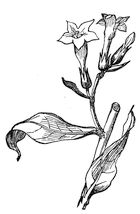
Tobacco.
A great many members of this order are poisonous, among which the Deadly Nightshade (Atropa Belladonna) is the most virulent, there are also Henbane and Tobacco, both strong poisons; but, to compensate for this bad character, the order contains one of the most useful vegetables used in Europe—the Potato. This is the tuber of the "Solanum tuberosum." The following account of the introduction of the Potato into England is from the "Penny Cyclopædia":—
"Queen Elizabeth, in 1584, granted a patent 'for planting and discovering in new countries, not possessed by Christians,' and, under this sanction, some ships, principally equipped by Sir Walter Raleigh, sailed with him to America. Thomas Harriott (afterwards known as a mathematician) who accompanied the adventurous squadron, transmitted to England the description of a plant, called Openawk by the natives of that part of America, which the courtier-like gallantry of Raleigh had named 'Virginia.' Harriott described the Openawk as having the roots round, and 'hanging together as if fixed on ropes, and good for food either boiled or roasted.' Girarde in his Herbal a few years subsequently, distinguished the plant by a plate, and not only confirmed the assertion that it was an indigenous production of Virginia, whence he himself had obtained it, but supplied some curious details of its qualities, and of the various modes in which it might be dressed for the table. But the Potatoe had been known in Spain and Portugal at an earlier period, and it is from the latter country that we most directly derive the name by which we know it. This is easily shown; although the natives of South America called the plant by the name 'Openawk,' those of the South, more particularly the inhabitants of the mountains of Quito, called it 'Papas,' which the Spaniards corrupted into 'Battata,' this again their neighbours in Portugal softened into 'Ba-ta-ta' (da terra), to which 'potato' is a very close approximation."
This plant, the tubers of which for a long time were a luxury obtainable by the rich only, now yields the support of the poor, and furnishes the cheapest food known; the peasantry of Ireland almost subsist upon Potatoes, and the poor of most parts of Europe find it indispensable to their living.
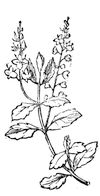
16. Scrophulariaceæ (Digitalis purpurea) Foxglove. (Veronica officinalis) Speedwell.
Speedwell. Some of the members of this order were formerly considered useful in scrofulous complaints, especially the Scrophularia nodosa, a common plant growing by the sides of ditches, and whose tuberculated roots were considered to resemble scrofulous tumours, and therefore to be the natural remedy for them. The Foxglove is used as a medicine and is highly poisonous.
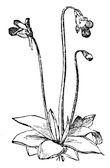
17. Lentibulariaceæ (Pinguicula vulgaris) Butterwort.
Butterwort. This order includes the Butterworts, which are herbaceous indigenous plants, growing in ditches and wet places; they are divided into the Pinguicula and the Urticularia. The example given is the most common and characteristic of the order.
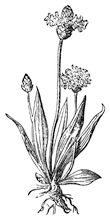
18. Plantaginaceæ (Plantago lanceolata) Plantain.
Plantain. The common Plantain or Way-bred is found by roadsides, the leaves form a sort of star on the ground, from the centre of which a tall stalk arises, forming a "spike" of flowers. The seeds of plantain are much in request by bird fanciers, cage-birds being fond of them. The leaves were once in great repute as a styptic, or application for stopping the bleeding of wounds.
19. Plumbaginaceæ (Armeria maratima) Thrift. (Ilex aquifolium) Holly.
Thrift. Holly.
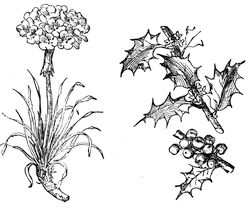
The most characteristic of this order are the two examples given, especially the Holly, which is universally known and admired for the decorative uses to which it is applied in our churches and houses at Christmas time.
Orders of Monochlamydeæ.
1. Sanguisorbeæ (Alchemilla vulgaris) Ladies' Mantle.
Ladies' Mantle. Some species of this order, especially the Greater Burnet (Sanguisorba officinalis), were once much cultivated as food for cattle, but it is now superseded by other plants, especially Sainfoin.
2. Chenopodiaceæ (Beta vulgaris) Beet. (Spinacia oleracea) Spinach.
Beetroot.
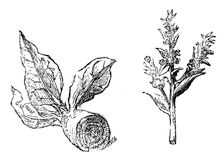
The most important species of this order is the Beetroot, employed in France for the production of sugar. Its variety, Mangold-wurzel (Beta altissima), is also extensively used as food for cattle.
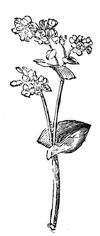
3. Polygonaceæ (Polygonum Fagopyrum) Buckwheat. (Rumex obtusifolius) Dock.
Buckwheat. Buckwheat is used as food in America and other places, and the root of the "Rheum palmatum" furnishes the Rhubarb of commerce. It is brought from Turkey; but is grown in China, and thence passes through the hands of Russians to Turkey. Other species of Rhubarb, as "Rheum compactum," are cultivated here for the sake of the leaf-stalk, which has an agreeable acid taste, and is much used for making tarts and puddings.
4. Elæagnaceæ (Elæagnus angustifolia) Oleaster.
Oleaster. Some foreign species of the Oleaster are extremely fragrant, and others, especially those of India, produce a fruit of a pleasant taste and is there eaten. The Sea Buckthorn (Hippophæ Rhamnoides) is the only English species.
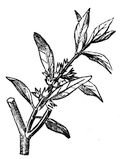
5. Thymelaceæ (Daphne pontica) Spurge Laurel.
Spurge-Laurel. Some species of this order are cultivated in gardens and are very fragrant, others partake of a poisonous quality; the Daphne mezerium, the bark of which is very acrid, is used in medicine, and forms one of the ingredients in the celebrated compound decoction of Sarsaparilla.
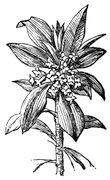
6. Corylaceæ (Castanea vesca) Sweet Chestnut. (Quercus pedunculata) Oak. (Corylus avellana) Hazel Nut.
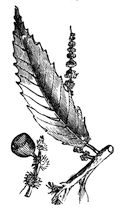
Sweet Chestnut.
This order contains some of our finest trees; the Oak, that prince of trees, is of this order. It attains a great age and size, and there are some celebrated specimens existing which have stood many centuries. Oaks constitute the greater part of the forest trees, both on the Continent and in England; great numbers are cut in France for fire-wood, and in both countries for ship-building. The roof-timbers of our old churches and halls are nearly all oak. The bark of the oak is largely used for tanning leather. About 30,000 tons are imported into this country yearly for this purpose, besides the product of our own trees. The bark of the Cork-oak (Quercus suber) is used for making corks, some 2,000 tons of this are imported annually. Moreover, the Gall-nut used in tanning, and also to make black dye, is the product of an oak. The Chestnut is a fine tree, the nuts of which are commonly eaten by the peasantry of Spain and Italy as food; the tree grows to a great age and to an enormous size.
7. Euphorbiaceæ (Buxus sempervirens) Box.
Box. Many species of this order are acrid and poisonous, and have been used for poisoning arrows. The Castor-oil plant (Ricinus palma-christi), and the plant that yields that most violent purgative, Croton-oil (Croton tiglium), are of this species; also the Box-tree, from which that useful wood, known as box-wood, is obtained.
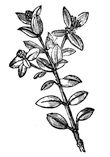
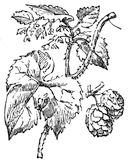
8. Urticaceæ (Urtica urens) Stinging Nettle. (Humulus lupulus) Hops.
Hop. The Nettle in Australia grows to the size of a tree; the Hop also belongs to this order, and is largely cultivated in Kent and Sussex for the use of brewers, as it communicates an agreeable bitter to beer which no other plant seems to be able to substitute.
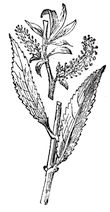
9. Salicaceæ (Salix alba) White Willow. (Populus nigra) Black Poplar.
White Willow. The most characteristic of this order are the examples given; the Willows are well-known trees, growing by the margins of water and in damp places. The Poplar is one of our tallest trees, specimens being known 100 feet high; its peculiar tall form distinguishes it from all other trees.
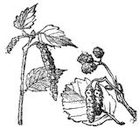
10. Betulaceæ (Betula alba) Birch. (Alnus glutinosa) Alder.
Birch. Alder. The Birch and Alder are both well known trees in our plantations, the Alder is often confounded with the Elder. The bark of the Birch tree contains tannin; it is used to tan skins in Russia, and gives to Russian leather its peculiar qualities.
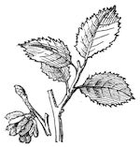
11. Ulmaceæ (Ulnus campestris) Elm.
Elm. The Elm is one of our largest and noblest trees, growing to 80 or 90 feet high, it has often a girth of 10 to 11 feet, and forms a very fine tree with a broad crown; the wood is much used for making coffins.
12. Pinaceæ (Taxus baccata) Yew. (Abies larix) Larch. (Laurus nobilis) Bay. (Pinus sylvestris) Scotch Fir.
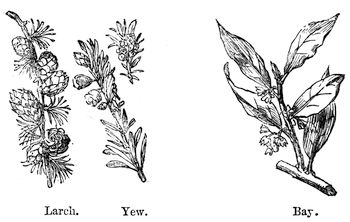
This order contains the various Pines and Firs, together with the Yew and Bay trees, and is sometimes called the "Coniferæ," as they all bear cones. In their general aspect many of these somewhat resemble endogenous trees, growing perfectly straight in the stem, and giving off branches in whorls at regular distances; some, as the Norfolk Island Pine, form perfectly regular figures by the interlacement of their branches. The Firs have their thin narrow leaves starting off singly from the branch, and always on the upper side, like the teeth of a comb, while the Pines have their leaves grouped together, starting off in fours or fives from the same spot. The Conifera furnish the longest and straightest timber of all trees, they commonly grow to 100 feet high, and in New Zealand and California to more than 300. The Wellingtonia Gigantea is the tallest species known, and the Araucaria Excelsa (Norfolk Island Pine), perhaps, the next. The trees of this order are amongst the most useful to man, supplying a number of useful articles, such as turpentine, resin, &c., besides the most valuable timber. Pines, like the Palms, serve as a screen against the severity of the weather, but, while the palms keep off the burning rays of the sun, the pines defend us from the cold of the mountain blasts; they are indeed used as nurses, and as such, in our oak plantations, serve to screen the young saplings which are planted among them from the effects of cold until strong enough to bear exposure; when the pines are cut down, and what before appeared to be a pine-wood, appears as a plantation of oaks. The pine-trees furnish those straight stems largely used by builders under the name of "scaffold poles." They also make the best wood for rending into laths for building purposes, their straight and open grain allowing of their being easily split.
It is from the vegetable kingdom that most of the medicines in use are derived, but many of these, in improper doses, act as violent poisons; indeed, the most rapidly fatal of all poisons, prussic acid, was originally distilled from the Laurel-cherry, and strychnine, which is hardly less rapid, is the produce of the Nux vomica (Strychnos nux vomica).
The following is a list of the principal poisonous plants found growing wild in England:—
* 1. Monk's-hood (Aconitum Napellus). Wolf's-bane (Aconitum lycactonum).
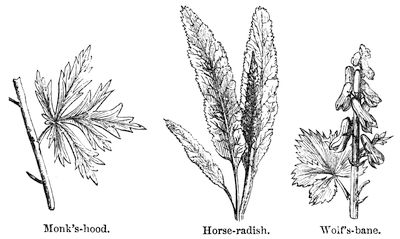
All parts of Monk's-hood and Wolf's-bane are extremely poisonous; the root of Monk's-hood has often been mistaken for that of Horse-radish, of which an example is therefore given, to show that it is impossible for this mistake to be made, if the least attention be paid to the leaves, as they are totally dissimilar.
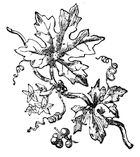
* Bryony (Bryonia dioica).
Bryony. The whole of this plant is poisonous, and, as the berries are red and tempting, it is dangerous to trust children with them. The root is large and succulent, and is known by the name of Mandrake; it is very purgative and acrid.
* Green Hellebore (Heleborus viridus). * Stinking Hellebore (Heleborus fœtidus).
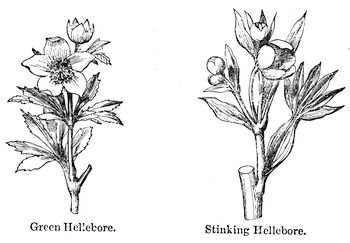
Both poisonous in every part of the plants.
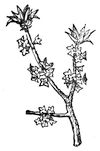
* Mezerium (Daphne mezerium).
Mezerium. The bark of this plant is acrid and poisonous, producing a burning sensation in the throat if chewed, and blistering the skin if applied, for which purpose it was often formerly used medicinally.
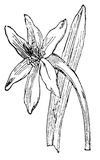
* Meadow Saffron (Colchicum autumnale).
Meadow Saffron. The corm (root) and seeds of this plant are poisonous. Meadow Saffron is also called Colchicum, it is much used in medicine, and although a good and useful one in small doses for gouty affections, yet in over-doses it produces violent purging and vomiting.
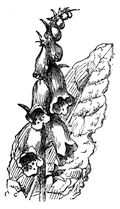
Foxglove (Digitalis purpurea).
Foxglove. This plant is very poisonous and dangerous, the leaves are the most active part. It is frequently used medicinally, but requires great care, as it lowers the action of the heart, the effect of many small doses accumulating and at last acting like one large one.
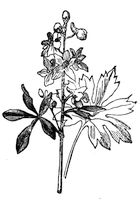
* Staves-acre (Delphinium Staphisagria).
Staves-Acre. The Ranunculaceæ are, most of them, poisonous, and this order includes the Larkspurs, of which the Staves-Acre is a species. The seeds are to a certain extent poisonous, and when ground into meal and mixed with flour have been often used by farmers to destroy vermin of various kinds, such as rats, mice, beetles, &c.
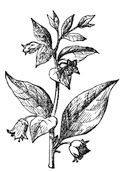
Deadly Nightshade (Atropa Belladonna).
Deadly Nightshade. The Deadly Nightshade is also called Belladonna. Both leaves and berries are a deadly poison. The berries have been mistaken for black currants by children, as they much resemble them. There are several species, of which the Solanum nigrum, or Common Nightshade, very much resembles the "Deadly."
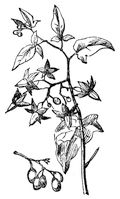
Woody Nightshade (Solanum Dulcamara).
Woody Nightshade. This plant, also called Bitter-sweet, from its taste, produces the bright red berries so often seen in hedges, and which from their pretty appearance frequently tempt children to eat them. They are poisonous, but not so much so as the twigs of the plant, which are very acrid and narcotic.
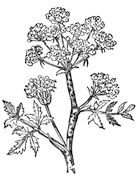
Hemlock (Conium maculatum).
Hemlock. The Hemlock is an umbelliferous plant growing by road-sides and under hedges, and flowers in June and July; it has been mistaken for Parsley, but may be known by the stems being spotted with black; the leaves are of a dark green colour, the upper ones bi-pinnate and the lower ones large and standing on long channelled foot-stalks.
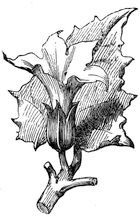
Thorn-Apple (Datura strammonium).
Thorn-Apple. The Thorn-Apple is a native of America, but has become almost indigenous, and is frequently found growing in waste places. The whole of the plant is poisonous, and is narcotic when smoked, like tobacco. It is an annual, bearing a funnel-shaped white flower, the fruit is a four-celled capsule covered with sharp spines or thorns, hence its name.
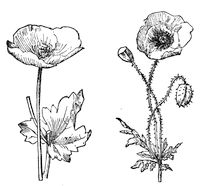
Poppy, Red (Papaver Rhœas). Poppy, White (Papaver somniferum).
White Poppy. Red Poppy. The unripe capsules of both of these species of Poppy are narcotic and poisonous, but chiefly those of the White Poppy, from which, the opium of commerce is procured. The leaves are but very slightly narcotic, and the seeds not at all.
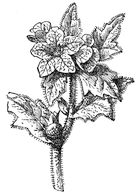
Henbane (Hyoscyamus Niger).
Henbane. This plant is an indigenous annual growing in waste places, especially in chalky soil, bearing flowers in July, which are of a yellowish green colour and nauseous odour; the stalk, leaves, and indeed the whole of the plant is covered with hairs. It is very narcotic, and is much used medicine; in over-doses it is poisonous.
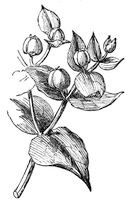
Caper (Euphorbia Lathyris).
Caper. The Caper is a biennial often found in gardens; the seeds are very purgative, and to some persons poisonous. This plant bearing the name of Caper, many persons have erroneously thought the seeds to be the ordinary "Capers" sold at shops for making "Caper-sauce." These, however, are the flower-buds of quite another plant, known as "Capparis spinosa."
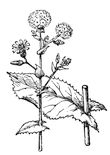
Wild Lettuce (Lactuca virosa).
Wild Lettuce. The Wild Lettuce is a biennial plant flowering in July and August; it is found growing on the banks of ditches, and is sufficiently narcotic to be called poisonous. The dried juice has been used as a substitute for opium, but by cultivation the narcotic property is nearly or altogether lost.
Mushrooms, Toadstools, and Other Fungi.
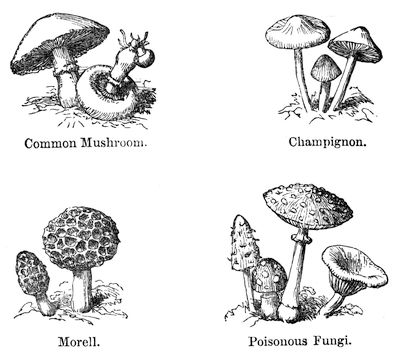
The only kinds of Mushroom which can be eaten with safety are the common Mushroom (Agaricus campestris), the Champignon (Agaricus oreades), and the Morell (Marchella esculenta). Those which are of very bright colours, or have spots on the cap, those with thin caps, or those which are moist—have a film like a cobweb about the stalk, or have the stalk coming from one side of the cap—are poisonous.
Those marked (*) in the foregoing list are acrid poisons, and the remainder are narcotic.
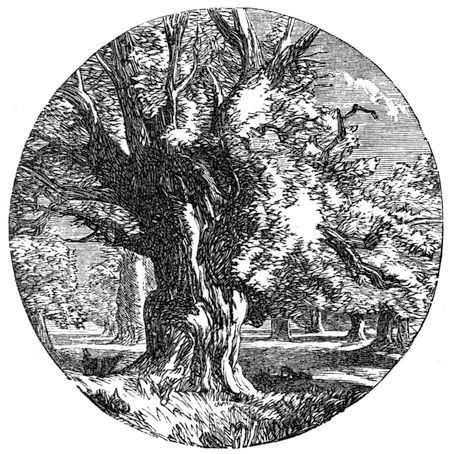
OAKS.
Out of these three great families of plants, in their almost endless variety of size, form, and colour, it has pleased the Great Author of Nature to form all the vegetation which beautifies this earth, from the lofty Palm—which, from its grateful freshness and the beauty of its structure, seems almost as if possessed of more than vegetative life, to the Algæ, which form "the pool's green mantle"—from the gigantic and "storm-defying" Oak, with its green foliage spreading out far above, and throwing its welcome shade around, to defend from the sun's rays the gentle deer who pasture on the herbage beneath—to the grass and clover, and the sweet-smelling wild flowers at their feet—
"Daffodils That come before the swallow dares, and take The winds of March with beauty; violets dim But sweeter than the lids of Juno's eyes, Or Cytherea's breath,—pale primroses That die unmarried, ere they can behold Bright Phœbus in his strength"—
form inexhaustible themes on which to exercise our faculties of admiration, and which serve admirably to minister to those wants which, without doubt, were given to us that we might derive pleasure from their being thus beautifully gratified—themes for the pencil of the artist, who "holds, as it were, the mirror up to nature," and the architect, when he designed his vistas of slender columns spreading out into and supporting roofs of tracery, might well be supposed to have had in his "mind's eye" some beautiful recollection of the arcades of Nature's palaces in the sombre forests, where the twisted trunks of the trees, the fretwork of their branches, and the leafy covering formed by their leaves, supply all the requisites of a grand and lofty temple, fit for the worship of that great First Cause who formed them.
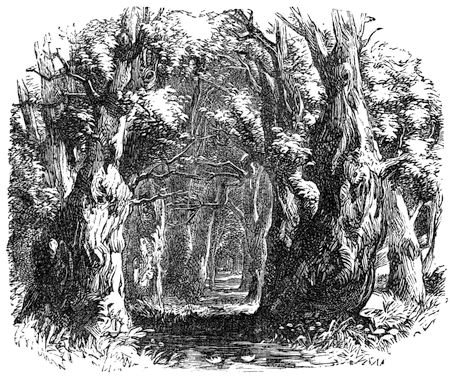
FOREST SCENE.