THE ANIMAL KINGDOM. (continued 2)
Reading edition
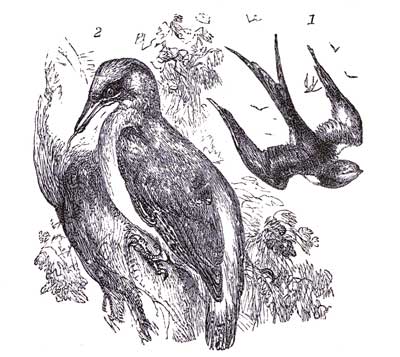
FIG. 54.—1, SWALLOW (Hirundo rustica); 2, WOODPECKER (Picus viridis).
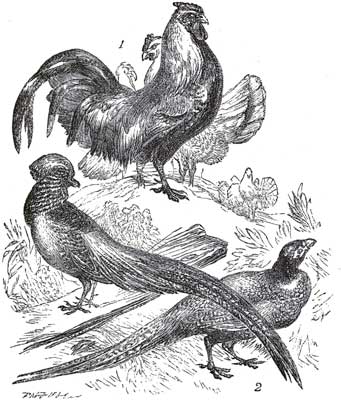
FIG. 55.—1, DORKING FOWLS (Gallus Domesticus); 2, PHEASANTS (Phasianus colchicus)
3. The Rasores include the common Fowl (fig. 55), Pheasant (fig. 55), Partridge, Turkey, &c.; they feed principally on grain, but occasionally on insects and worms, which they scrape up with their feet; they live chiefly upon the ground, on which they build their nests, but generally roost on trees. Most of this order supply excellent food, the Turkey is famous as a Christmas dish, and is often of a great size; this bird is very plentiful in Central and South America in a wild state, and often attains a large size, weighing 30 or 40 pounds; the natives have a simple and curious method of catching these birds, which are extremely shy, never allowing any one to approach near to them. A sort of cage is built of twigs, large enough to contain many, and having holes close to the ground all round, of a size just sufficient to admit a Turkey when its head is bent down; leading to each of these holes a train of corn is placed, but none within, the birds coming to pick the corn, follow up the line of corn with their heads down, till they are within the inclosure, when finding no more, they raise up their heads and cannot get out, for they have not the sense to stoop their heads, so as to allow of their exit.
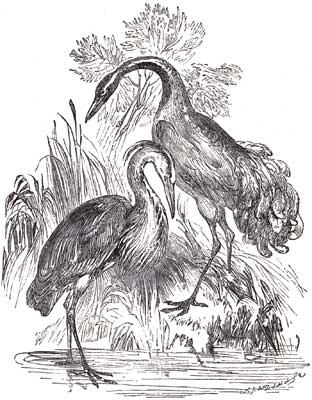
fig. 56.—1, HERON (Ardea cinerea); 2, CRANE (Megalornis cinerea).
4. The Grallatores include the Herons and Cranes (fig. 56), which wade into streams and catch fish; these are furnished with long legs, neck, and beak, and when they have gone into the water as far as their long legs permit, they stand still and wait with the head resting on the shoulders and the eyes fixed on the stream, till an unlucky fish approaches near enough, when with a quick stroke they dart at it, and catch it; they are very picturesque objects, standing on one leg (as they commonly do) in some lonely pool or stream.
5. The Natatores, a very large class of Birds, live almost entirely in the water, they are web-footed and swim beautifully, as the Swans, Geese, Ducks, &c. (fig 57); these feed in general upon the vegetation growing in, and on the margin of the water, also on worms, larvæ, &c.; they have a beautiful mode of rising and flying in a line, when disturbed from their haunts, and this line is maintained for a long distance, and is sometimes double like the letter V, one bird leading and the others following in single file.
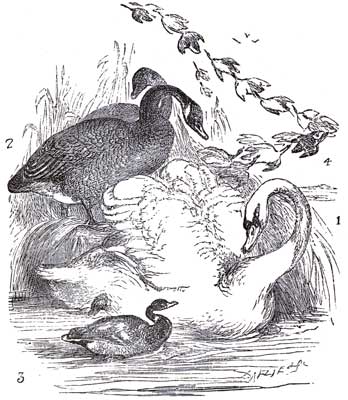
FIG. 57. 1, SWAN (Cygnus mansuetus); 2, GEESE (Anser ferus); 3 and 4, DUCK and WILD DUCKS (Anas Boschas).
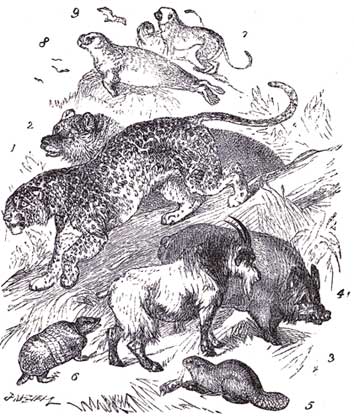
FIG. 58. GROUP OF MAMMALIA. 1, Leopard (Leopardus varius); 2, Bear (Ursus arctos); 3, Goat (Hircus aegagrus); 4, Boar (Sus scrofa); 5, Beaver (Castor fiber); 6, Armadillo (Dasypus); 7. Monkeys (Semnopitheci); 8, Seal (Phoca vitulina); 9, Bat (Plecotus auritus).
THE MAMMALIA.
This class is divided into twelve orders:—
1. Marsupiata (Pouched) Kangaroo. 2. Monotremata (Having but one vent) Platypus. 3. Rodentia (Gnawing) Beaver, Rabbit. 4. Edentata (Toothless) Anteater. 5. Ruminantia (Chewing) Ox, Deer, Sheep. 6. Pachydermata (Thick skinned) Horse, Elephant. 7. Cetacea (Whale-like) Whale, Porpoise. 8. Carnivora (Flesh-eating) Lion, Tiger. 9. Insectivora (Insect-eating) Mole, Hedgehog. 10. Cheiroptera (Hand-winged) Bat. 11. Quadrumana (Four-handed) Monkey, Ape. 12. Bimana (Two-handed) Man.
These twelve orders of the class "Mammalia," of the division "Vertebrata," (as their names imply), have their peculiarities, such as fit them to their modes of life, as, the medium in which they live, the climate, the food they eat, and the manner of obtaining it. They have all the five special senses, sight, hearing, smell, taste, and touch, but very differently developed in respect to power. Yet, as a whole, they maintain a similitude. They have all internal skeletons, and each part of this skeleton exists in all, but modified to suit different purposes. They have all the peculiar attributes of the "Mammalia," such as suckling their young, being born alive, having four extremities, warm blood, respiration by lungs, and a heart with two auricles and two ventricles.
A general description of the anatomy and some of the functions of Man will be given hereafter, and will apply equally to all the Mammalia; always bearing in mind that the difference in structure of every animal, although making it inferior to Man, does not do away with any of the essential qualities, which constitute it one of the members of the highest group; for, although immensely inferior to Man, yet the Mammalia are for the most part greatly superior to all the classes below it, the capability of being educated, being in itself a vast step beyond mere instinct, wonderful though this may be, and developed to an extraordinary degree, as in some of the insects; yet, in these, there is no possibility of improving it, while in some of the Mammalia, as the Dog, Horse, Elephant, and Monkey, there is an evident tendency to progressive improvement when aided by the example and tuition of Man.
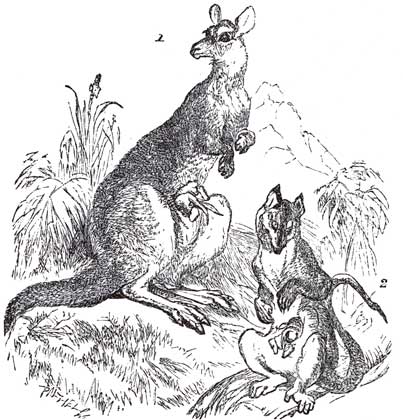
FIG. 59. 1, KANGAROO (Macropas major); 2, OPOSSUM. (Didelphus Virginiana)
1. The Marsupiata include the Kangaroos and Opossums (fig. 59). They are characterised by the possession of a pouch at the lower part of the abdomen, into which the young enter as soon as born, for they are born in a very imperfect state, and when in the pouch they adhere to the teat of the mother, where they remain till more fully developed. In these animals the hind legs are greatly developed, and the fore legs but little. They progress by enormous leaps, resting on the hinder legs and tail, both of which are very strong. They belong exclusively to Australia, which appears to produce many forms having peculiarities not met with elsewhere, and among the lowest of their type; this and the next order appear somewhat to partake of the form of the Bird, the undeveloped state of the young in the Marsupiata, being an approach to the egg of the Oviparous animals.
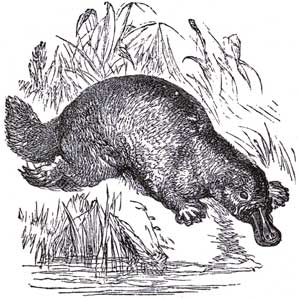
FIG. 60.—PLATYPUS, OR DUCK-BILL (Ornithorynchus).
2. The Monotremata includes the Duck-bill, called also "Platypus," and "Ornithorynchus paradoxus," (fig. 60), a most singular combination of the forms of the mammal and the bird. It has a mouth resembling the bill of a Duck, and several other peculiarities, which lead to the consideration of it as one of the connecting links between the forms of the Mammalia and Birds.
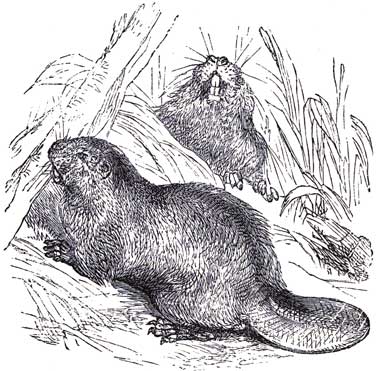
FIG. 61.—BEAVERS (Castor fiber).
3. The Rodentia comprise the Rat, Beaver, Rabbit, Hare, Mouse, &c. They live upon almost any kind of vegetable matter; the Rat and Mouse will eat anything they can get. Their incisor teeth are two in front of each jaw, and are chisel-shaped and very sharp; they are so constructed that they shall be kept sharp by being used, which is effected by the hardest part or enamel being in front in a thin layer, so that it is not so easily worn away as the bony part. If these animals be fed on soft food, their teeth continue to grow nevertheless, and protrude from their mouths in a most singular way. The Beaver (fig. 61) is almost aquatic in its habits, it gnaws through the stems of trees, and uses them to dam up the water of the stream they inhabit, so as to secure a constant supply. They build houses or huts of wood, mud, and stones, which they unite in constructing. These houses have their entrances beneath the water, so that the Beavers dive to enter them; they have two divisions or rooms in them, and are sufficiently large to lodge several families. The Rat is too well-known to need much description. The brown or Norway Rat has only been an inhabitant of this country about forty years, the black Rat being before that time the usual house Rat, but it is now almost exterminated, specimens being very rare. There are several other species of Rats; the best known is the Water Rat, who burrows in brooks and ditches, and partly lives in the water. Of the Mouse there are also several species. Besides the usual house Mouse, there is the wood Mouse, which forms a magazine of grain and nuts underground for winter store; and the harvest Mouse, which builds a little round nest between the stalks of corn. The Squirrel is also of this order. This pretty little creature lives in the trees, chiefly feeding upon nuts; can leap well, and run up the branches of trees with surprising agility. The Flying Squirrel has a broad expansion of skin between the fore and hind legs on each side, so that when stretched out, they form a sort of parachute; this enables the creature to leap to a great distance from tree to tree, and supports it in the air as it goes. The Porcupine (Hystrix cristata), so celebrated for its quills, which supply a sort of defensive armour, is of this order.
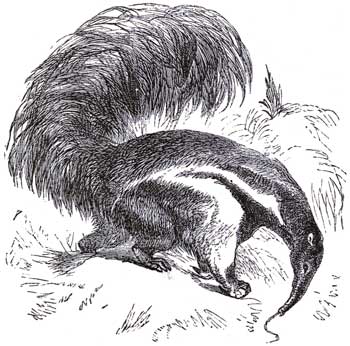
FIG. 62. ANTEATER (Myrmecophaga jubata).
4. The Edentata, or Anteaters, have no teeth, but a peculiarly shaped tongue, which is covered with viscid mucus, and which they project and retract with great rapidity, causing the Ants and Termites, on which they feed, to adhere to it, and be carried into their mouths. The Great Anteater (Myrmecophaga jubata, fig. 62) is a very extraordinary animal in appearance; it has an enormously prolonged nose, and the back is covered with a sort of mane; the tail, also, is of prodigious size, and very bushy; when this curious animal lies down to sleep, the long snout is thrust under it, and the tail laid across the back, the end of the snout projecting behind. In this position, it would lead anyone to suppose that the head was where the tail really is, and that when looking at the creature's hinder part, they were looking at its head; and the sudden reversal of the position of these parts, when it gets up quickly, is certainly extremely ridiculous.
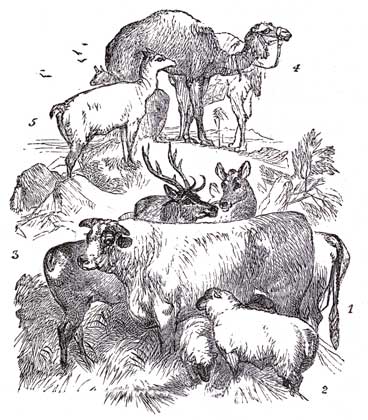
FIG. 63.—GROUP OF RUMINANTS. 1, Ox (Bos taurus); 2, Sheep (Ovis aries); 3, Red Deer (Cervus elaphus); 4, Camel (Camelus Arabicus); 5, Llama (Pacos).
5. The Ruminantia.—The Ruminating animals (fig. 63) are those which chew the cud. There are a great many species, and their members are also very numerous. The Ox, and its varieties, the Buffalo, Bison, Yak, &c.; the Deer, Antelopes, Gazelles, &c.; the Sheep, Goat, Giraffe, and Camel, all belong to the Ruminants. These all have hoofs, cloven into two parts; have no incisor (or front) teeth in the upper jaw; and are essentially grazing animals. They have stomachs made up of four compartments; into the first of these (the Rumen) the crude grass enters, and is afterwards returned to the mouth, and again chewed at leisure; the molar teeth, or grinders, are flat, and roughened, so as to effect this purpose; and, that they may not become smooth by wear, the enamel (or hard part) of the teeth is so disposed in various layers, that it is always projecting above the bony part, which wears down first. The Ruminants are gregarious, associating in herds of enormous numbers. Cumming, describes the herds of Springboks, in South Africa, as being in countless thousands, continuing to pass for hours together; and covering the plain as far as the eye could reach. Cattlin, also, describes the American Bison of the Prairies as being congregated in the most surprising numbers. Some of the members of this order are very large and heavy animals. The Cape Buffalo is of enormous strength, and very fierce when attacked.
Dr. Livingstone, in his Travels in South Africa, speaking of the Lion, says:—"He seldom attacks full-grown Buffalos; but frequently, when a Buffalo-calf is caught by him, the cow rushes to the rescue, and a toss from her often kills him. One we found was killed thus, and on the Leambye, another, which died near Sesheke, had all the appearance of having received his death-blow from a Buffalo. It is questionable if a single Lion ever attacks a full-grown Buffalo; the amount of roaring heard at night, on occasions when a Buffalo is killed, seems to indicate there are always more than one Lion engaged in the onslaught."
The Ruminants are the only members of the Mammalia furnished with horns, and some of these are of enormous size; the Elk, Buffalo, and Steinbok, are instances. In the Deer tribe they are shed yearly, and increase in size and in the number of their branches at each fresh growth. The flesh of the Ruminants forms the chief animal food of Man, and some tribes of the American aborigines live exclusively on it.
The Camel, next to the Horse, is the most useful beast of burthen. The Arabs greatly prize these creatures, and from their power of carrying a supply of water in their stomach, they are very useful in crossing the desert; their hoofs are also spread out so as to enable them better to walk on the soft and yielding sand; there are two kinds of Camel, the Bactrian, with two humps, and the Arabian Camel with but one. The Dromedary is a small agile breed of the Arabian Camel, celebrated for its swiftness.
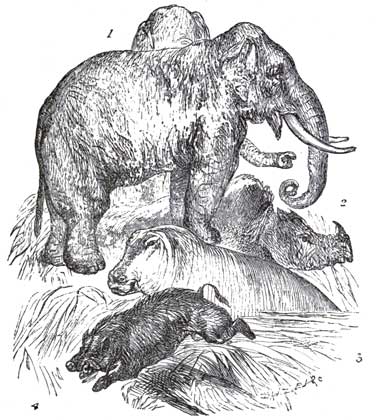
FIG. 64.—PACHYDERMATA. 1, Elephant (Elephas Indicus); 2, Rhinoceros (Rhinoceros unicornis); 3, Hippopotamus (Hippopotamus amphibius); 4, Wild Boar (Sus scrofa).
6. The Pachydermata or thick-skinned animals (fig.64) include the Elephant, Rhinoceros, Horse, Ass, and its varieties; Hog, Tapir, Hippopotamus, &c.; these have many of them a single solid hoof on each foot, as in the Horse and Ass tribe, others have separate toes clothed with a hoof, as in the Elephant. In nearly all the Pachydermata there is a prolongation of the nose or upper lip, the Horse even has some power of prehension in this part; the Rhinoceros is able to bring the upper lip into so fine a point as to pick up a crumb, and in the Tapir there is a considerable prolongation of the nose, while the Elephant has this part developed into a complete prehensile organ.
The Elephant, Rhinoceros, and Hog are fond of wallowing in the mud, with which they completely besmear themselves, and seem to derive great satisfaction therefrom. There are two kinds of Elephants, the Asiatic, or Indian, and the African, the chief distinction between them is the size of the ear, that of the African Elephant being of very great size; there is a very young specimen of this kind in the British Museum, but a full-grown African Elephant has never been brought to England. The Elephant is furnished with a pair of enormous tusks proceeding from the upper jaw, these are composed of solid ivory, and often weigh nearly a hundred pounds each; with the trunk, the Elephant is able to gather food in the form of grass and herbage, and put it into its mouth, it can also draw up a considerable quantity of water, and this being poured down its throat from the trunk, constitutes its usual mode of eating and drinking, as the neck is too short for the animal to reach the ground except by the trunk. The Indian Elephant is much used as a beast of burthen, and for various other purposes; they are very docile and sagacious.
The Horse has been subjected to the service of Man from the earliest records, indeed it is not known when this beautiful animal was first trained to be his useful servant and companion; he is mentioned, in the Scriptures, as being subjected to the Bit, and in the sculptures brought from the ruins of Nineveh by Layard; the Horse is constantly sculptured, decked in the most gorgeous trappings and driven by reins and a bit, almost in the same manner as in the present day, and these sculptures are among the earliest records of Man's hands. There are several breeds of Horses; the chief are the Arabian (from which stock proceed our race horses), the Flanders or Cart-horse, and the Sheltie or Shetland horse. The Horse is nowhere found in a state of nature, yet many wild Horses graze on the plains of America, but it is known that these are not native, but proceed from those placed there to graze, and which have bred and run wild. The Ass is distinguished from the horse by the tail having short hair on it, except at the extremity, and the mane being short and upright.
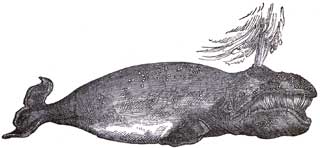
FIG. 65.—WHALE> (Balena mysticetus).
7. The Cetacea, or Whale kind, inhabit chiefly the colder latitudes, they are entirely aquatic, but breathe air; the Whale, Narwal, Dolphins, and Porpoises are the chief members.
In Whales (fig. 65) the anterior extremities are so developed as to form a sort of fin called a "flipper," but in which all the usual bones of an extremity exist; the posterior extremities are modified so as to completely resemble the tail of a fish; they have smooth skins devoid of hair. All these tribes have a considerable thickness of fat or blubber (as it is called) beneath their skin; this protects them from the cold, for most of these creatures live in the very coldest climates, the oily matters acting as a non-conductor; it is for the oil yielded by this blubber that they are chiefly caught. The Cachelot or Sperm-whale (Phyceter macrocephalus) also yields spermaceti, which crystallizes from the oily matter contained in its head, and the Greenland-whale yields baleen or whale-bone, which is a substance forming a sort of sieve in the mouth, through which they draw the sea water and catch all it may contain for food, this consists of all small fish, but principally a small mollusc called the "Clio Borealis," which inhabits the northern seas in great numbers; a whole shoal of these is taken in by the Whale at a draught. The Whale often measures 60 or 70 feet in length, and the Razor-back Whale sometimes 100; a large Whale will yield 20 tuns of oil. The Narwal or Sea Unicorn is from 20 to 30 feet long; it has but one tooth, which is developed to a prodigious length, and projects in front in a straight line like a sort of horn, there are however sometimes two of these, one being always much larger than the other; this horn is 8 or 10 feet long, perfectly straight and twisted, it is used by the animal to break the ice so that it may breathe, and also to spear and capture fish, on which the Narwal lives. This horn produces beautiful ivory.
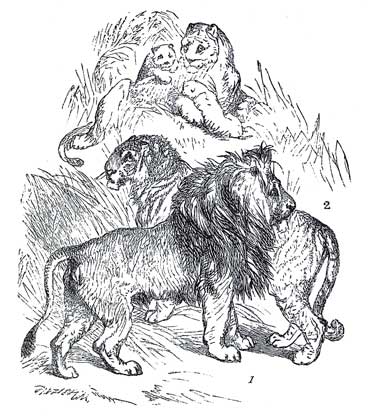
FIG. 67.—CARNIVORA.
Lion (Leo Barberus); 2, Tiger (Tigris regalis).
8. The Carnivora, or Flesh-eaters (fig. 67), include the Feline tribe, as the Lion, Tiger, Jaguar (fig. 68), Leopard, &c.; the Canine, as the Hyena, Wolf, Jackal, Dog, Fox, &c., the Ursine, which includes the Bears, and the Phocine, including the Seal kind. The Feline tribe are formed to spring upon, hold, and rend other animals which they kill for food, and have teeth and claws suitable to this purpose, and great activity and strength to enable them to contend with, and overcome their prey. They are, for the most part, nocturnal in their habits, seldom seeking their prey but in the night, and then mostly frequenting the drinking-places where other animals come for water. They attack by gradually stalking after the animal, getting nearer and nearer, till at last a well-directed spring brings them on to it at once. That these animals may better surprise their prey, they have eyes so extremely sensitive to light that they can see well when it would appear to Man to be quite dark, hence the saying, "cats can see in the dark." The Iris (or coloured part of the eyes) in this tribe is made so as to close up into a slit (1, fig. 66), and thus exclude the light of the day to a great extent, which would otherwise be too powerful, and injure the extreme sensibility of their vision. Their claws (2, fig. 66) are made to retract by a tendon, so as to keep their points from being worn by walking. This accounts for the silent, stealthy tread of the domestic cat; it enables them to creep quietly upon their prey, and at the moment they are about to seize them, the claws are extended. The pointed or flesh-teeth of the Carnivora are greatly developed, and are very sharp. Their molars (3, fig. 66) are pointed, and suitable to the food they are intended to masticate. The tongue of the feline tribe is very rough, and is used to rasp off the flesh from bones. When closely examined, the surface of their tongues present a series of horny hooks, all bending in one direction, and forming a sort of rasp.
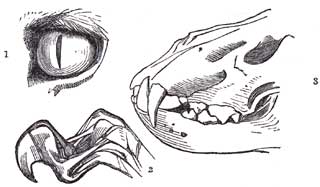
FIG. 66.—1, EYE OF LION. 2, CLAW. 3, TEETH.
The Lion is usually placed at the head of this race, but it is questionable whether he is so powerful as the Bengal Tiger, and combats between the two, generally give the mastery to the Tiger.
Dr. Livingstone, in his description of the Lion, takes off a good deal of the poetical nobility and imaginary superiority with which the Lion has been commonly invested. The following selections will show what are Dr. Livingstone's impressions from personal experience:—"When a Lion is met in the day-time, a circumstance by no means unfrequent to travellers in these parts, if preconceived notions do not lead them to expect something very 'noble' or 'majestic,' they will see merely an animal somewhat larger than the biggest Dog they ever saw, and partaking very strongly of the canine features. When encountered in the day-time the Lion stands a second or two gazing, then turns slowly round and walks as slowly away for a dozen paces, looking over his shoulder, then begins to trot, and when he thinks himself out of sight bounds off like a greyhound. By day, as a rule, there is not the smallest danger of Lions which are not molested attacking Man, nor even on a clear, moonlight night, except at the breeding-time.
"So general, however, is the sense of security on moonlight nights that we seldom tied up our Oxen, but let them lie loose by the wagons; while, on a dark, rainy night, if a Lion is in the neighbourhood, he is almost sure to venture to kill an Ox. His approach is always stealthy, and the least appearance of a trap is enough to cause him to refrain from making the last spring.
"Lions never go near any Elephants, except the calves, which, when young, are sometimes torn by them. Every living thing retires before the lordly Elephant, yet a full-grown one would fall an easier prey than the Rhinoceros. The Lion rushes off at the mere sight of the latter beast."
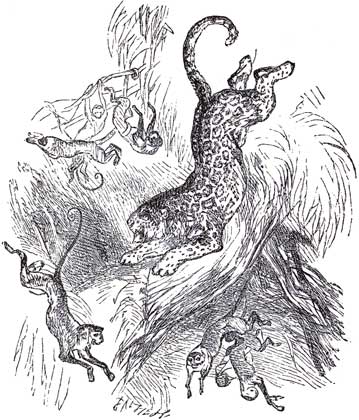
FIG. 68.—JAGUAR (Leopardus onca).
The Bengal or Royal Tiger is the largest of the Feline tribe, being generally 8 feet long and 4 high. It is, however, often found much larger. It would appear from the most correct accounts that the Lion is hardly a match for this formidable creature. The Tiger is as beautiful as dreadful; its colour is of a bright orange-buff, with white face and under parts, the back and legs being beautifully striped with black. The Tiger has no mane, but is of a sleek, graceful make, though terribly powerful. It inhabits India chiefly, and will prowl for hundreds of miles by the sides of rivers, secreting itself in the jungle and sleeping by day. Sometimes traces of a Tiger will be seen in the locality of villages or towns, and stray Sheep or Bullocks disappear from time to time, but it will destroy any human being who unluckily approaches its haunts, and having once tasted human blood, appears afterwards to prefer this kind of food to all others, and will pick out a cow-herd in preference to the cattle he is driving; in all probability this preference is really owing to the ease with which the capture can be made; and the small resistance Man is capable of offering; be this as it may, the Tiger having once destroyed a man is called a "man-eater," and a reward is offered for his head; when this occurs near any of the stations of the East India Company, the officers generally make it a point to sally forth and endeavour to capture this terrific beast; this they do on foot, as it is impossible to depend on any Horse, their natural fear of the Tiger being so great that all Horses either shy, or at once retreat. The officers, armed with guns, take with them a number of natives, who with long canes beat the jungle and generally start out the monster, at whom there are a few deadly rifles pointed, which invariably bring him at once to the ground.
The largest of this tribe inhabiting the New World, is the Puma or Cougar, which is much inferior to the Lion both in size and strength, although very fierce and dangerous, it is of a pale drab colour inclining to grey; it climbs trees and stretches itself along their branches, waiting for some unlucky animal to pass, when it drops quietly upon its shoulders and quickly destroys it. The Leopard tribe includes several varieties, as the Jaguar, Panther, Ounce, Ocelot, &c., they are all more or less spotted with black, and possess all the ferocity and much of the strength of the nobler species of their tribe, the smallest of them being more than a match for a man without weapons.
The Canine tribe of the Carnivora includes Dogs, Wolves, Jackalls, and Foxes. The Dogs are greatly altered from their wild nature by being domesticated, resembling in their wild state a small Wolf; the Dog in its domesticated state is too well known to need any description here. The Jackals and Wolves generally hunt in packs, and devour all kinds of offal, flesh and bones, which their strong jaws and teeth appear to crush and break up without difficulty.
The Bears form the next tribe, these are often very large animals; the Grisly Bear of the Rocky Mountains (Damis ferox) is the largest of the Brown Bears, it often measures eight feet long and is extremely powerful, the Brown Bear (Ursus arctos) is smaller, but still a powerful animal, the Polar Bear (Thalarctos maratimus) is white and is the largest of all the Bears, measuring eight or nine feet long, it is coated with long shaggy hair, and even its feet are clothed with hair underneath, that it may not slip on the ice, and to defend it from the cold; this Bear is found in the Arctic Regions among the ice, and feeds upon Fish and other marine animals. Bears in general are carnivorous, but eat many other kinds of food; they are very fond of honey, and are never contented if they smell it, until they get at it, for this purpose they will often gnaw a hole in a tree and thrust in their head. Advantage is taken of this predilection to entrap the animal, the natives of the Rocky Mountains often baiting Bear traps with honey.
The Seals and Walrus (fig. 69) form the next, or Phocine tribe; they are amphibious, and feed chiefly on Fish, inhabiting the colder regions of the North; their hinder extremities are but little developed, and serve the purposes of a tail. They are covered with a close fur, and the canine teeth of the Walrus are so largely developed in the upper jaw as to form tusks, by means of which they hook on and attach themselves to the blocks of ice.
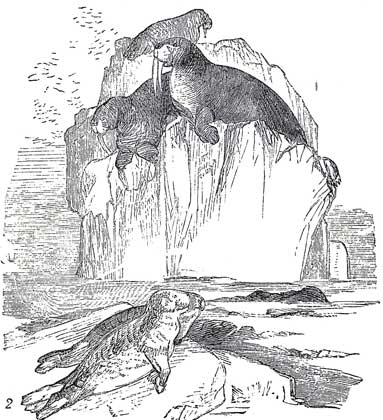
FIG. 69.—WALRUS (Trichicus rosmarus); SEAL (Phoca vitulina).
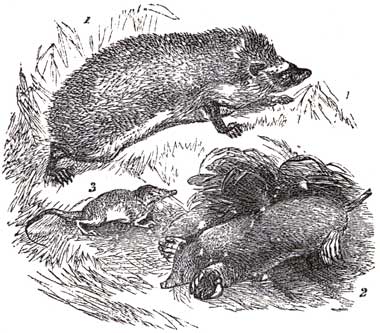
FIG. 70.—INSECTIVORA. 1, Hedgehog (Erinaceus Europæus); 2, Mole (Talpa Europæus); 3, Shrew-mouse (Sorex araneus).
9. The Insectivora, such as the Mole, Hedgehog, and Shrew-mouse, (fig. 70), live entirely on insects, the Mole burrows for them in the earth, and the fore paws are so made as to dig out and throw the earth behind it, and it burrows in this way with the greatest rapidity. As it is nearly always beneath the surface of the earth, and consequently in the dark, so a sense of vision is not required, it is therefore blind, but the senses of touch and smell, being very acute enable it to find its food. The Hedgehog and Shrew-mouse are furnished with pointed noses, with which they dig up the earth in search of insects, and when found they devour them with amazing rapidity. The Hedgehog has the power of rolling itself up into a ball and defying the attacks of almost anything, for its bristles are so stiff and sharp that they prick like thorns, and make a capital defensive armour; the Hedgehog is eaten by many, especially by the Gipsies, who esteem it a dainty.
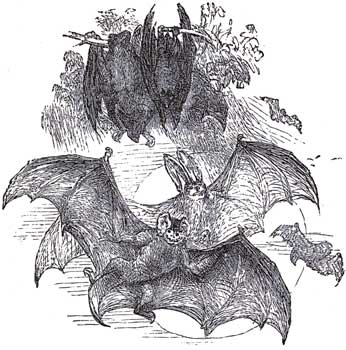
FIG. 71.—BATS (Plecotus auritus).
10. The Cheiroptera (Bat tribe, fig. 71), have fore feet so modified as to serve as wings, with which they fly with tolerable swiftness, producing a peculiar flapping sound. These wings are formed by a membrane which is stretched out between the fingers, which are exceedingly elongated, and which reaches from the fore feet to the hind feet. The Bat tribe all feed upon insects, especially moths; they rest in the day time head downwards, clinging to rough places by means of the claws of their hind feet, coming out at night to seek their food; their sight, which is very quick, enabling them to see their prey when almost dark. Some of the larger species of this tribe, inhabiting America, are called Vampire Bats, they live by sucking the blood of various animals, such as cattle and horses, thereby inflicting dangerous wounds.
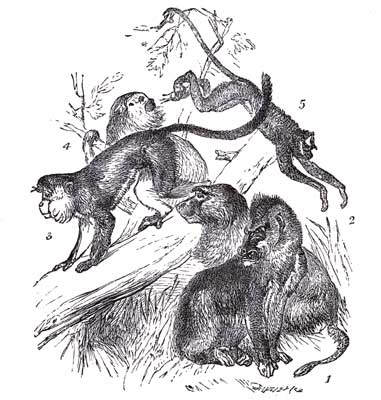
FIG. 72.—QUADRUMANA. Baboons.—1. Mandrill (Papio maimon); 2. Chacma (Chacma Porcarius). Monkeys.—3. Mona (Cercopithecus mona); 4. Howler (Mycetes); 5. Spider (Ateles).
11. The Quadrumana (fig. 72), so called from their hind and fore feet both having thumbs, and being developed into hands, includes the Monkeys; they may be divided into two tribes, those inhabiting the Old World (Simiidæ), and those inhabiting the New (Cebidæ), these include what were formerly called Apes, Baboons, &c. These animals approach the most nearly to the form of the human being, the Chimpanzee being considered the nearest in formation to Man; there are, however, many very broad distinctions between the two, especially in the foot and head. The Quadrumana are very clever, but their actions seem to have more meaning in them than they in reality possess, owing to the resemblance of these creatures to the human being. There are many surprising accounts of these beings, such as their arming themselves with sticks and stones to defend themselves; but no act of reason has ever yet been perceived in them, nor any tendency towards improvement, except that which has been given them by Man. "The Monkey who had seen the world," and went home and taught his companions, is a fable in both senses of the word. The Monkey tribe are formed to pass their lives in the trees among the branches, their hands being formed to suit this kind of life. None of them walk well, but when they are among the branches, swinging themselves from bough to bough, few creatures are more active; their food is fruit and nuts of all kinds. The Chimpanzee, certainly, is the nearest approach to Man in the lower animals, and walks better in an upright position than does the Ourang-outang, whose whole life is spent in the trees, while the Chimpanzee often inhabits holes in the earth and rocks. In the "Penny Cyclopædia" is the following account of one, by Captain Payne:—
"It shook hands with some of the sailors, but refused its hand with marks of anger to others, without any apparent cause. It speedily, however, became familiar with the crew, except one boy, to whom it was never reconciled. When the seamen's mess was brought on deck it was a constant attendant, would go round and embrace each person, while it uttered loud yells, and then seat itself among them to share the repast."
Some of the Monkey tribe (the Spider-monkeys) have the power of holding fast with the end of the tail; it, in fact, forms a sort of hand, and they swing from the boughs by it, and it is said that several will attach themselves in this way, forming a long chain, and swing themselves from the topmost bough of a tree when they wish to cross a stream, the lowest catching hold of the boughs on the opposite side, and the uppermost of them letting go his hold, they are all thus conveyed across.
12. Bimana (two-handed). This order includes Man alone. Man has been placed in a separate class, and not as the first order of the Mammalia, but, as will be presently noticed, although he has many attributes which no other animal has, yet in bodily construction, and all the functions of his material part, he so nearly resembles the other orders of his class that it is deemed better to place him at their head under the designation of "two-handed;" although indeed he is the only animal who can be said to possess hands, properly so called, for those of the Monkey tribe are so imperfectly developed that they have but little claim to the name.
In his circulation, respiration, digestion, &c., Man exactly resembles the other Mammalia, also in the organs of locomotion and special sense, modified slightly in form; but to these purely animal attributes, he has superadded faculties which raise him above them, and show him to be the last and most perfect of God's creatures, one step further, in fact, than any other living being; and it is a curious circumstance, and one showing the accuracy of detail, with which the Mosaic account of Creation in the Bible abounds, that this very superiority is not only mentioned in many ways, but recorded as the result of a special act of God over and above his formation as an ordinary animal, in which state he was created, for we find the words, "and breathed into his nostrils the breath of life, and man became a living soul," this especial act was not performed for any other being which God had created, of which it is stated simply "male and female created He them."
Man is possessed of sentiments (or those feelings which prompt him to believe in, look forward to, and hope for a higher state of existence, than that which he enjoys here) which none of the lower animals have, and of reason in place of instinct. There is certainly a vast difference between the two, although many would have us believe the one is the same as the other, but of a higher order; instinct causes its possessor to act from innate impulse without consciousness of the result, while reason points out "the why and the wherefore." Man is conscious of his own identity, this is also peculiar to him; moreover, all the performances of man can be improved by practice, none of the instincts can, but are as perfect at first as at last; the Bee makes the comb, and the Bird the nest, as well the first time as the last, and although the higher animals, as the Dog, Horse, Elephant, &c., can be taught to perform various clever and useful acts, yet it is by Man's instrumentality and not by their own powers; in fact there is not an animal which left to itself has the slightest power within itself of deviating one iota from those peculiar instincts which were given it by God. But Man at every effort rises higher than he was before, till he arrives at such a knowledge of the great works and designs of his Creator that he bows his head in awe and admiration of the wonders permitted to appear to his comprehension. With respect to his bodily structure, Man undoubtedly stands first in the race of beings, although, in some particulars, such as the acuteness of the senses, he may be inferior to some.
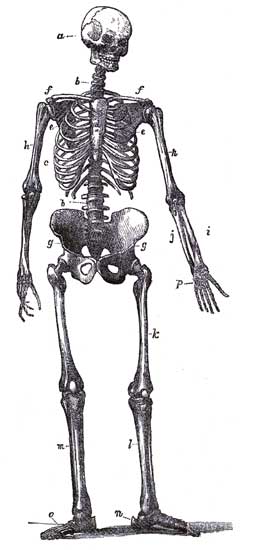
FIG. 73.—THE HUMAN SKELETON.
a. Skull. b. b. Vertebral column or Spine. c. Ribs. d. Sternum or Chest bone. e. e. Scapulæ or Blade bones. f. f. Clavicles or Collar bones. g. g. Pelvic or Hip bones. h. h. Humeri or Arm bones. i. Radius } } Bones of fore-arm. j. Ulna } k. Femur or Thigh bone. l. Tibia or Large bone of leg. m. Fibula or Small bone of leg. n. Calcaneum or Heel bone. o. Tarsal bones or Bones of the foot. p. Carpal bones or Bones of the wrists.
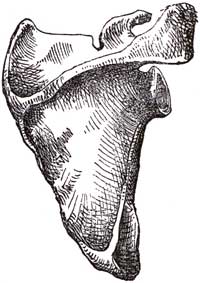
FIG. 74.—FLAT BONE (Scapula).
The Human frame consists of a skeleton (fig. 73) formed of hard and unyielding bone, having joints to admit of motion in certain directions; this skeleton performs certain great and important offices, it forms strong boundaries or protecting cases for most of the vital parts, so as to shield them from external violence, such as the brain and spinal cord, the lungs, heart, &c., it also furnishes a series of levers to be acted on by the muscles, for the purposes of motion, and a firm support for the soft parts of the system. The skeleton is divided into the head, trunk, and extremities; the head is again divided into cranium and face; the trunk is divided into spine, thorax, and pelvis; the extremities into the upper and lower, the upper consisting of arm, fore-arm, and hand; the lower of thigh, leg, and foot. The bones are divided into "flat bones" (fig. 74) and "long bones" (fig. 75), the flat bones (as a general rule) form the boundaries of the cavities, and the long bones the levers.
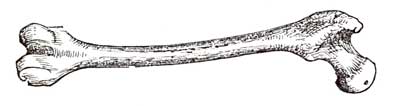
FIG. 75.—LONG BONE (Femur).
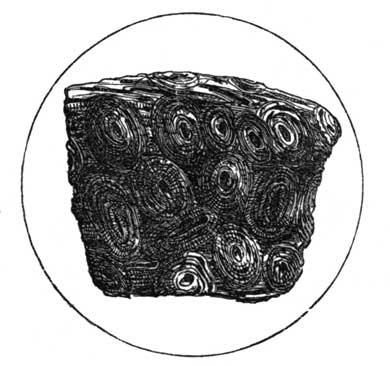
FIG. 76.—SECTION OF BONE, MAGNIFIED.
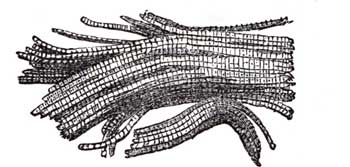
FIG. 77.—FIBRILS OF VOLUNTARY MUSCLE, MAGNIFIED.
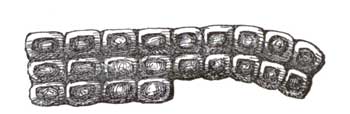
FIG. 78.—THE SAME, MORE HIGHLY MAGNIFIED.
The bones consist of earthy matter, chiefly phosphate of lime, held together by a sort of cartilage, and arranged in fine scales or plates forming interstices or cells (fig. 76), these are large in the centre of the bone so as to make it nearly (and in some instances quite) hollow, and very small at the surface, so as to make it there nearly solid; this arrangement is found to be the very best to secure strength and lightness, together with a very slight degree of flexibility. The general form of a long bone is that of a shaft, having an enlargement at either extremity, the shaft is generally curved slightly so as to give elasticity, and is more solid than the ends, which are expanded to give size and firmness to the joints, and porous to keep them light; the shaft is small and close in its texture, that there may be plenty of room for the muscles which lie on and cover it. The skeleton then, consists of bony cases which enclose the viscera, a series of levers covered with, and moved by the muscles, and the whole forming a solid framework to support the soft parts. All the various motions of the body, from the winking of the eyelid and the wonderfully adjusted motions of the eye itself—which are so accurate, that a certain perceptible motion is required to look alternately at one side and the other of a pin's head—to the most powerful stroke of the arm, are performed by the contraction of the muscles. But there are several actions which would at first appear to be produced by elongation instead of contraction, such as the protrusion of the tongue, the winking of the eyelids, and the closure of the lips; but the first of these is produced by the contraction of a muscle which is attached at one extremity to the under part of the root of the tongue, and at the other to the inner part of the lower jaw, which, when it contracts, draws the whole tongue forwards, causing a part of it to protrude; the eyelids and lips are closed by circular muscles surrounding them, which, by contraction, draw together those parts.
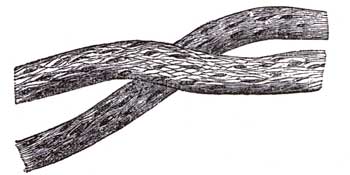
FIG. 79.—INVOLUNTARY MUSCULAR FIBRE.
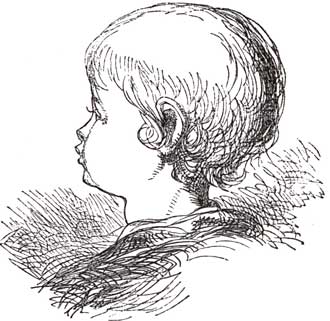
FIG. 80.—HEAD OF AN INFANT.
The muscles form the flesh of an animal, or that part which is of a red colour, and which is called lean (in contra-distinction to fat), they are composed of fibres, each fibre made up of a number of fibrils, and the whole bound up together by means of a fine membrane, called areolar tissue. Each of these fibrils consists of a number of cells pressed closely together and having a peculiar bearded appearance (figs. 77, 78). It is by the sudden approximation and flattening of these cells that the muscle is shortened during contraction, but the contraction of each fibril is only for an instant, and then a relaxation and elongation of the cells takes place, which is followed by a second contraction, and so on. Now, the way in which a muscle keeps in a state of permanent contraction is this: the various fibrils or strings of cells relieve each other instead of all contracting and all relaxing together, and in this way a part only of the fibrils are in a state of contraction at any given time, while the others are relaxed, and as one begins to relax another contracts, and so keeps up a state of contraction in the muscle up to a certain point, when the contractions become gradually more feeble, and finally cease altogether; the muscle is then exhausted, but, if allowed to rest awhile, it again obtains its contractile power. This peculiar contractile power is a physical one, and exists for a short time after death, that is, until its perfect structure is altered by the beginning of decomposition; and what is a curious fact, the muscles of a dead body stimulated to contraction by pricking or galvanism, will tire and again obtain their contractility by rest, just as in the living body. The nature of the stimulus which causes the muscles to contract during life is not known; but, whatever it may be, it is conveyed from the spinal cord and brain, through the medium of a set of nerves, called the "motor nerves," or nerves of motion, to the muscles, to every fibre of which they are distributed. There is, however, another set of nerves which have nothing to do with motion, although exactly similar in appearance and generally associated and bound up in the same sheath with them; these are the nerves of sensation. They take their origin from every part possessed of sensibility or feeling—more especially the skin—and convey every impression of feeling to the brain. The muscles are not all under the control of the will, for the muscles of the heart, bowels, &c. are quite out of our control. Those which are subservient to our will are called "voluntary" muscles, or the "muscles of animal life," while those out of the control of the will, are the "involuntary" muscles, or "muscles of organic life" (fig. 79). These last have a structure different to the voluntary muscles, being composed of flattened fibres containing granules and overlapping each other. The tendons are the cord-like extremities of the muscles which connect them to the bones; they are fibrous and slightly elastic, flexible, and exceedingly strong; while moist they have a splendent appearance, somewhat like mother-of-pearl.
The ligaments are the strong fibrous bands which connect the bones together. Cartilages are substances of a white colour, smooth in their texture, and not very flexible; they are connected to the bones which they sometimes serve to prolong, and are themselves often converted into bone in old people, by the deposition of earthy matter within their structure, in fact, they may be considered as bone in an undeveloped state; for, in the infant, many parts are cartilaginous, which, in the adult, are bony; such as the ends of the long bones, the bones of the nose, &c.
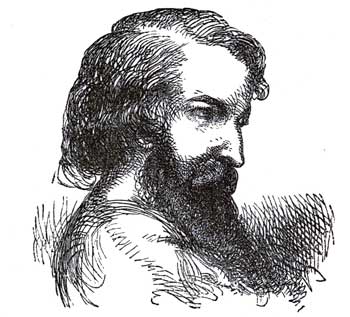
FIG. 81.—HEAD OF AN ADULT.
With respect to the development of the form of the human body, there are two chief conditions which influence it, namely, age and sex. With respect to age, the proportional magnitudes of the different parts, early and late in life, vary very considerably. In the infant (fig. 80) the hand is by far the most completely developed (in size), next to this the abdomen, then the chest and upper extremities, and, finally, the lower extremities. In the adult (fig. 81), the largest measurement is round the chest and shoulders, but in the infant it is round the head; in the adult the lower extremities weigh one half of the whole body, but in the infant not one quarter. The infantile face has many peculiarities, so also has the face of old age (fig. 82). In the infant the lower part of the face is but little developed, the lower jaw is small, the chin scarcely at all prominent, and the distance from the nose to the chin very short, owing to the absence of the teeth, or (when formed) their smallness. The bones of the nose are scarcely formed, and this organ has therefore no bridge, properly so called; the nostrils are small, the lower part of the forehead small, smooth, and rounded, and the arches of the eyebrows but little prominent. The cheek-bones are small, and so are the bony arches which join them to the temples; the cheeks are full of fat, and the angles of the jaws rounded. In middle age the lower part of the forehead becomes more fully developed, the bony edges which support the eyebrows project and overhang the eyes, the bridge of the nose and the nostrils become more fully formed, the space from the nose to the chin is greater, the teeth cause the lips to be pushed more forward, the lower jaw is larger, and the cheek-bones show more plainly. In old age the whole upper part of the face becomes more marked, the nose and eyebrows still more prominent, the cheeks hollow from absorption of the fat, the space from the nose to the chin (as in infancy) shortens from loss of teeth, but the chin, being more fully formed, projects as the jaw rises to fill the space occupied by the teeth. The angles of the jaw are also very sharp and square, the eyes sunk in the head, and the whole skin of the face loosened and wrinkled from loss of substance beneath. With respect to sex, in the Male the facial bones are more fully formed, the shoulders broader and higher, the collar-bones longer and more curved, the chest wider, the hips narrower, and the legs longer, and every bone has its processes or markings more fully developed, and is more contorted from the action of the muscles, which are larger and more powerful than in the Female. In the Female (fig. 83) there is a greater deposition of fat, and, in many other respects, a tendency to a child-like conformation.
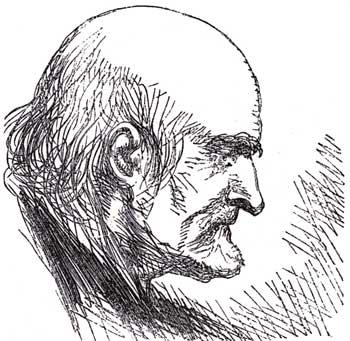
FIG. 82—HEAD OF AN OLD MAN.
The body is everywhere covered by a common integument called the skin, beneath which is a layer of areolar and adipose tissue, which last has its cells filled with fat, which during life is in a liquid or oily state; this serves to protect the parts beneath both from cold and violence, fills up the hollows and irregularities between the muscles, and gives the body a more rounded and graceful appearance.
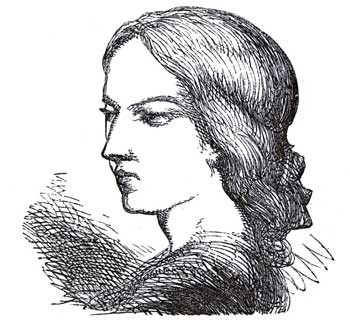
FIG. 83.—HEAD OF A FEMALE.
Man, in common with all the higher animals, is possessed of the five "special senses," namely, sight, smell, hearing, touch, and taste, the organs of which are the eyes, nose, ears, skin, and mouth; but these are developed in very different degrees in different animals.
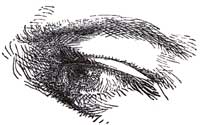
FIG. 84.—FRONT VIEW OF EYE.
Sight is the sense by which we take cognisance of those external objects which either give out or reflect light. The eye (fig. 84) is an optical instrument of great beauty and perfection, and by its help an image of everything we look at is produced in miniature on the expanded optic nerve called the "retina," as an image is produced in the "camera," which instrument is made in imitation of the eye; this image by some unknown power is perceived by the mind, and produces the sense of vision. By the sense of sight we recognise all forms, colours, and gradations of light and shade, and also (assisted by the experience gained by the sense of touch) the qualities of surface, such as roughness, smoothness, &c.; for instance, we know by touch that a piece of glass is smooth, that a piece of velvet has a different kind of smoothness, &c., and the mode in which these surfaces reflect the light, teaches us to recognise them so that we could predict from touch what appearance an object would have, or by the look how it would feel. Our knowledge of the solidity of bodies is known to the sense of sight by (unconsciously) looking at them with each eye alternately, so as to see to a certain extent round them, or somewhat on either side alternately. By this fact the principle of the stereoscope is explained, the pictures looked at through it, consist of two views of the same object, taken at points of sight a short distance apart (corresponding to the distance between the eyes) and they give us, when steadily looked at, the same result that real objects do when looked at with each eye, alternately. It is a curious fact, but one which has been clearly demonstrated by optical experiments, that the picture represented on the "retina" is inverted, but from habit we refer things to their natural position, and how naturally and easily this is done, may be ascertained by holding the head down close to the floor, and looking at objects through one's legs, in this position they are all inverted; but we naturally make ourselves satisfied that they are still as they were before, so that they really do not appear to be inverted. The impression formed by objects upon the retina is not immediately destroyed upon their removal, but remains for an instant permanent; this gives rise to a great many curious phenomena, among which the most familiar is the circle of light produced by the rapid evolution of any luminous body, as the red-hot end of a stick. This is also shown by a toy, called the "Thaumatrope," which consists of a piece of card having a small wire attached to the upper part by which it may be turned rapidly round by the thumb and finger. On one side of the card is painted an object, such as a parrot, and on the other a cage; when the card is turned round, first the bird and then the cage is presented to the eye, but the image of the one has not left the eye before the other is presented to it, and the result is the uniform appearance on both sides of a parrot in a cage.
The structure of the eyes in Man and the higher animals is very nearly alike, so that the same description will serve for both, but those of insects and the lower orders of animated beings are very different.
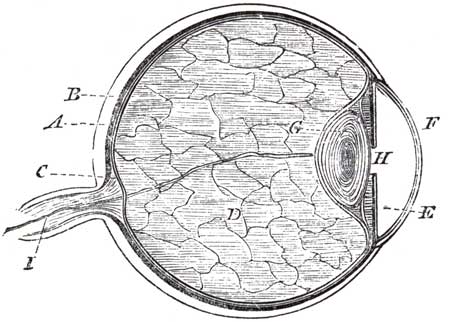
FIG. 85.—SECTION OF HUMAN EYE.
A. Sclerotic.D. Vitreous humour.G. Crystalline lens.
B. Choroid.E. Aqueous humour.H. Pupil.
C. Retina.F. Cornea.I. Optic nerve.
The eye consists of various humours of different densities enclosed in membranes (fig. 85); the human eye is spherical for the posterior four-fifths of its circumference, but the front part projects a little, being formed of part of a smaller sphere. The globe of the eye, all but this front part, is enclosed in a firm fibrous coat called the "sclerotic," within which is a membrane full of blood-vessels called the "choroid," this on its inner side is covered with a black substance called the "black pigment," and within this (lining the ball) is the nervous coat or retina, it is the optic nerve so expanded as to form a lining to the membranes of the ball of the eye for the greater part of its extent. The ball of the eye is filled with a transparent fluid, somewhat glutinous, called the "vitreous humour;" stretched across the front part of the ball of the eye is a membrane having a round hole in its centre, called the "iris," coated (like the choroid) with black pigment on its back surface; this membrane (the iris) is the coloured part of the eye, and its transparency or opacity determines the colour of the eye. The pupil is the hole in its centre, it looks black because the black pigment which covers the inside of the ball of the eye (for the retina is transparent) is seen through it; behind the iris and in front of the vitreous humour, is the crystalline lens, it is just the shape of a very thick lens, but is more convex behind than in front, it is quite transparent, and of a density almost approaching to solidity. The front fifth of the ball of the eye is covered in by a dense transparent substance called the cornea, of the form of a watch-glass and quite transparent, between this and the crystalline lens there is a small space called the anterior chamber, filled with a clear watery fluid called the aqueous humour. The eye is moved by six muscles, four straight and two oblique, these turn it in every direction with the greatest accuracy; the front of the eye is defended by the eyelids, which by winking and being moistened by the tears, keep the eye always moist and free from dust.
The eyes of insects and several other classes of animals are called compound eyes, and the image they produce must resemble objects depicted in mosaic, or made up of small spots of distinct colours; they consist of hundreds of small tubes, radiating and forming part of a sphere on each side of the head, each of these tubes admits the light from objects at which they point. Some of the animals still lower in the scale have simple spots of transparent membrane with an expansion of optic nerve beneath them; in such creatures the power of vision is probably limited to distinguishing light from darkness.
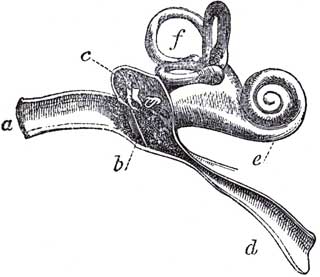
FIG. 86.—SECTION OF THE HUMAN EAR. a, external opening; b, tympanum; c, small bones; d, Eustachian tube; e, cochlea; f, semicircular canals.
Hearing.—Sound is conveyed to the mind by the vibration of air, and this vibration is communicated to a membrane within the ear, called the "tympanum;" this is in connection (by means of three minute bones) with the expanded auditory nerve, which ramifies within the "vestibule," which is filled with a fluid, so that the vibrations of the air are thus communicated to the nerve of hearing (fig. 86).
Smell.—The interior of the nose is lined by a fine moist membrane, on which the olfactory nerve is distributed. The cause of odour is quite unknown; though, as most volatile substances are odorous, it is supposed to be some volatile matter which comes in contact with the olfactory nerve, or nerve of smelling. The quantity given off in some instances must be exceedingly small, for one grain of musk placed on a piece of glass will give out scent for months, and at the end of that time weigh still one grain. Some animals, as Dogs and Birds of prey, have this sense so acute that it serves them instead of almost every other; the Vulture will scent carrion miles away, and the Dog will track his master by the power of scent.
Taste.—The sense of taste resides chiefly in the tongue, but to some extent in the palate or roof of the mouth; it appears to be a modified sense of smell, combined with common sensation or touch, and is much diminished by loss of smell.
Touch, next to sight, is the most important of the senses. The whole skin possesses this sense, but in some parts far more than others, the finger-ends being the most perfectly endowed with it; and in the lower animals the parts which are used as prehensile organs, are in them the most acutely sensitive to touch, as the end of the proboscis in the Elephant, and the lips of most other quadrupeds. In the Feline tribe, the smellers or hairs from the side of the face, appear to be true organs of touch, and enable them to feel their way in the dark. By the sense of touch we are informed of the amount of resistance of matter (and consequently its weight), of hardness, smoothness, roughness, and other qualities of surface, and by the amount of extension of the hand to reach them of their distance from us, and also of the form and size of things.
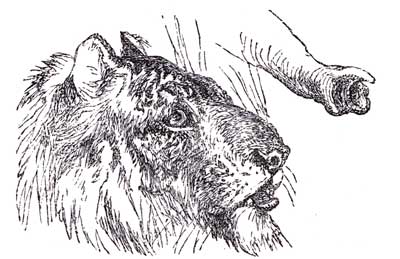
FIG. 87.—TIGER'S HEAD AND ELEPHANT'S TRUNK.
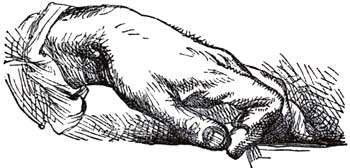
FIG. 88.—HUMAN HAND.
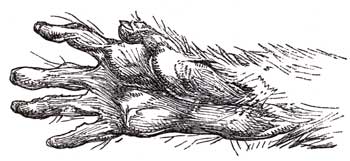
FIG. 89.—MONKEY'S HAND.
The human hand is the most perfect organ of prehension possessed by any animal, for although Monkeys have hands, yet these are so imperfect as to serve chiefly for clinging to, and climbing amongst the branches, they cannot take any small substance between the thumb and finger, while the human hand, besides enabling its possessor to grasp firmly with all the fingers and thumb, each can individually be approximated to the thumb so as to hold the very smallest substance, and as Man is so constituted that he can stand firmly on his feet, his hands can be solely appropriated to the acts of prehension. It has been said that Man owes much of his superiority to the lower animals, to the possession of hands which can take, examine, and compare everything within his reach; but it seems more probable that these hands have been given him because he, only, has the faculties of examining and comparing. The Lion and Tiger would be no better off, had they Man's hands instead of their feet with claws—probably much worse.
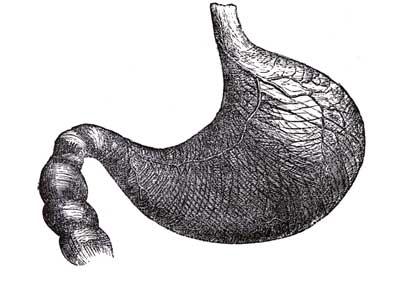
FIG. 90.—HUMAN STOMACH.
Animals do not feed upon unorganised matter, as do vegetables, but merely appropriate to their own use those organic principles which are ready formed in the vegetable or animal, such as albumen, fibrine, starch, gum, sugar, &c., and assimilate them into their substance.
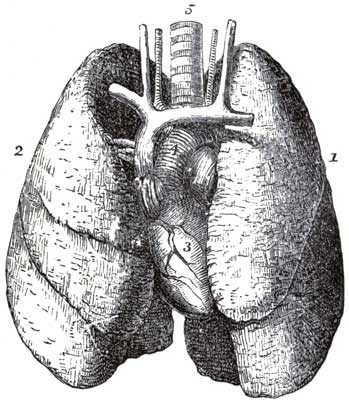
FIG. 91.—LUNGS, HEART, AND LARGE VESSELS. 1 and 2, Right and left Lungs; 3, Heart; 4, Aorta; 5, Trachea.
When food enters the mouth of an animal it there meets with a fluid (the saliva) which is capable of converting starchy matters into sugar, thus rendering this aliment (which is presented in a state of a nature quite insoluble at the heat of the stomach) not only soluble, but nutritious. This ensalivation takes place while the food is being masticated; when in the stomach (fig. 90) it meets with the "gastric juice," a fluid capable of dissolving both fibrine and albumen (the two other chief aliments), even when coagulated; thus all kinds of food when they have been a short time in the stomach are reduced to a liquid, and so far fitted to enter the system. The stomach is a membraneous bag, communicating at the upper orifice with the mouth, and at the lower with the intestines; its internal (mucous) coat is smooth, and contains many absorbents; its outer coat is muscular, and capable of contraction, so as to roll together its contents, thus bringing every portion into contact with the gastric juice; this mass of dissolved food has received the name of "chyme." By admixture with the bile (a fluid excreted by the liver) and other juices, it separates (like curds and whey) into a liquid and partially solid matter; the liquid part is like milk, and is called "chyle," and it is taken up by absorbent vessels, by "endosmose," a peculiar power which membranes have of allowing liquids to pass through them when there is a more dense liquid on the other side (as described in the experiment at page 123, "Vegetable Kingdom,"), and, passing through the vessels called "lacteals," is mixed there with the impure blood as it is about to be returned to the heart, and from thence to the lungs, where impurities are got rid of in the form of carbonic acid. The lungs (fig. 91), in performing this office, expose the blood (contained in thousands of minute blood-vessels) to the air which enters the windpipe at every inspiration or breath, the windpipe divides into two, and these each into two more (the bronchial tubes), and so on until they are no larger than a hair; at the end of each tube is a little "air-cell," on the membraneous walls of which the vessels containing the blood are distributed as a network. The blood when it enters the lungs is of a dark purple or blackish colour, and is loaded with carbonic acid; this blood is received by the heart from the great veins, which pour it into the right auricle, this contracting, sends it into the right ventricle, which, in turn, sends it through the pulmonary arteries into the lungs; while there, it is exposed in the network of vessels which ramify on the walls of the air-cells; another process of endosmose takes place, and the carbonic acid passes through the walls of the vessels into the air-tubes, and escapes by the breath; at the same time that this carbonic acid is cast off, an equal bulk of oxygen is absorbed from the air, so that the air which enters the lungs, and that which passes out, are the same in bulk—plus watery vapour—although what enters is pure air, and what is expelled, is loaded with carbonic acid. The blood, having exchanged carbonic acid for oxygen, is now altered from a black to a bright scarlet colour, and is in a condition to be circulated through the system. On leaving the lungs by the "pulmonary veins," it enters the left auricle of the heart, and passes from thence to the left ventricle, which is very powerful, and forces it by compression upwards into the "aorta" (the first great artery), and thence through the other arteries, which divide, and become smaller and smaller until it arrives at every part of the body, forming a network of fine vessels which are called capillaries; so perfectly are these vessels distributed, that it is almost impossible to cut or prick any part of the body without wounding one of them, and thereby drawing blood. When these capillaries have supplied this pure blood to repair and renovate every part of the system, and received for the new material, that which is worn out or spoiled, they urge it onwards to where they unite into small veins, and, as these continue to unite, they form large trunks, and pour the blood, now black and impure, into the right auricle of the heart, together with the fresh material (chyle) derived from the food, again to be sent through the lungs and purified for fresh circulation. This description applies as well to the other Mammalia as it does to Man, for these classes do not differ from Man in their physical structure, except in form and size, and the alteration in the proportion of the various parts to adapt each to its peculiar purpose.
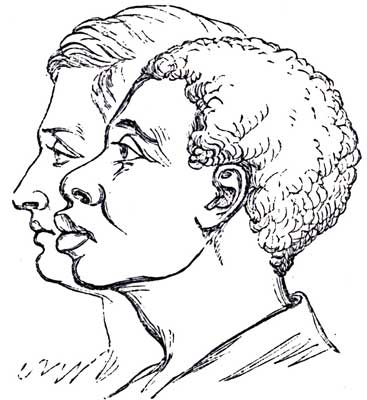
EUROPEAN AND NEGRO.
Man is, without doubt, the only animal possessed of reflective and reasoning faculties, and the possession of these has raised him immeasurably above all the rest. He has also physical capabilities suitable to a dominant being whose race is destined to people the earth in every part. Were his constitution formed like that of the Chimpanzee or the Ourang, he could only live in the very hottest of climates; but it is found that Man is healthy and happy through ranges of temperature, which would prove fatal to most other animals. In the frigid regions of the north, the Laplander enjoys many comforts which he fancies could never be obtained in any other latitude, and the Bushman of Africa, following the wild animals of that region, and needing no covering to shield him from the burning rays of the sun, deems his lot the happiest that can be. The human race are gradually increasing in number, and there is scarcely a spot capable of being inhabited at all, but they are found there; and, wherever Man comes, the wild animals of the region retire or become entirely extinct, excepting those which serve him as food, such as the Ruminants.
The difference between the highest of the lower animals and Man, is so distinct, that no more need be said about it; but among men themselves, there is a great difference; between the European, and the Negro or the Hottentot, there is a vast distinction, but the most simple would at once say they are both men, and possessed of the essential qualities of men; and there can be no doubt that all men of every kind form one species. This is a point pretty well settled among all who have written on the subject; and indeed, great as the difference is among men, it is not half so great as that which exists between the Bull-dog and Italian Greyhound, and yet they are both dogs; or between the Race-horse and the Dray-horse, and yet who is there can doubt of these both being of the same species.
Blumenbach made out five varieties—namely, 1, Caucasian; 2, Mongolian; 3, American; 4, Malay; 5, Ethiopian or Negro. Pickering2 describes eleven varieties, and arranges them as follows:—
WHITE.BLACKISH-BROWN.
1.Arabian.6.Papuan.
2.Abyssinian. 7.Negrillo.
8.Indian or Telingan.
BROWN.9.Ethiopian.
3.Mongolian. BLACK.
4.Hottentot.10.Australian.
5.Malay.11.Negro.
In this arrangement the "Arabian" corresponds with the "Caucasian" of Blumenbach; both names are given from the supposed country of the original members of the race; the appellation "European," used by Dr. Latham is, however, a much more appropriate one than either, both the Caucasian and Arabian being now limited to the inhabitants of the localities from which their names were derived. The Arabian, Caucasian, or European family occupy the chief part of Western Europe, the British Isles, and the United States of America, and is fast spreading in other parts of the American Continent and in Australia. It is characterised by a fair complexion, arched nose, ruddy cheeks, thin lips, and the frequency of blue eyes and light hair. Its members are at this present time the highest and most civilised classes in the world, being further advanced in religion, arts, sciences, and literature; also their capacity for enterprise and speculation, and their love of novelty, is far beyond that of any other variety of the human race; anything new that offers the smallest chance of being beneficial is at once adopted by them and carried out. This is, perhaps, the great secret of their advancement, for the other most numerous variety of the human family, and which exceeds the European in numbers (the Mongolian), has but little capacity for change of any kind, in fact, appears to admire and adhere to those matters only, which have the most undoubted stamp of antiquity—such a mode of feeling especially obtains among the Chinese. Dr. Latham divides the European family into—
1. The Basks.4. The Greeks and Latins.
2. The Skiptar.5. The Sarmatians.
3. The Kelts.6. The Germans.
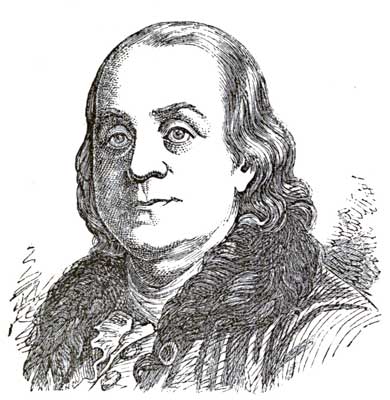
EUROPEAN.
The Basks appear to have been the original inhabitants of Spain and Portugal, which have abandoned their former habitation and now dwell in the mountains of Navarre and Gascony, just as the American Indians may be supposed to dwell at some future time in the Rocky Mountains.
The Skiptar are the inhabitants of Albania, much resembling in personal appearance the Turks and Sclavonians, but having a language derived from a different source. The following is a description of the Albanian, from the "Penny Cyclopædia:"—
"The Albanians are about five feet and a half high, muscular and straight in their persons. Their activity, and the tight girdles which they wear, render them small round the loins; they have full broad chests, long necks, long oval faces with prominent cheek bones, and flat raised foreheads, arched eyebrows, blue or hazel (rarely quite black) lively eyes, thin straight noses, thin but open nostrils, and small mouths furnished with good teeth. Their complexions are white in youth, but become tinged a dusky hue in old age."
The Kelts (or Celts) were the former inhabitants of both France and England, they are now to be found chiefly in Ireland and the Highlands of Scotland, and are called Gaelic Celts; the English are a mixture of these with Saxon and German, but still retain a good deal of the blood of the Celts; in Wales the Celts are derived from the ancient British branch. The English retain more of the Germanic language, while the Welsh retain most of the original British; the French are Celtic mixed with Roman, and have therefore a great admixture of Latin in their language. The Kelts appear to have been a race above the usual height, with red or light hair, ruddy complexion, and of a fierce and impetuous disposition.
The Greeks and Latins.—Of this stock, the inhabitants of Italy and Greece are the purest descendants, but it is extended with more or less contamination to Spain and the Danubian Principalities. Italy was probably the original seat of both races.
The Sarmatians.—This stock inhabits Russia, Poland, Bohemia, Hungary, and Servia, all speaking the Sclavonic languages.
The Germans.—This race inhabits Germany, Holland, Denmark, Sweden, and Norway, and its immediate branch the English, forming the Anglo-Saxon family, are extended to America, Canada, Australia, and other parts of the world by colonisation.
Dr. Pickering calls the European race Arabian, and makes it extend through the whole of Europe, India, Arabia, and the northern parts of Africa, believing all these to have been derived from the same stock, and forming variations of the same family. The language spoken by the Europeans of all classes has been called Indo-European, hence Pickering classes with them the Hebrews, Armenians, Parsees, and many more, all derived from a stock supposed to have migrated from Asia into Europe and Africa.
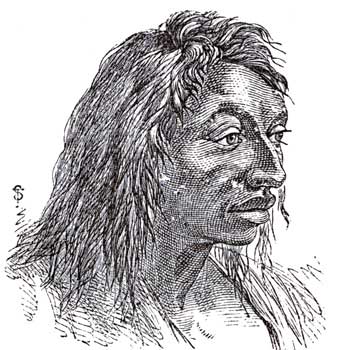
ABYSSINIAN.
The Abyssinian.—This race inhabits the table lands of Abyssinia, and its extension into the interior. Dr. Pickering thus describes the appearance of three individuals of this race whom he met at Singapore—
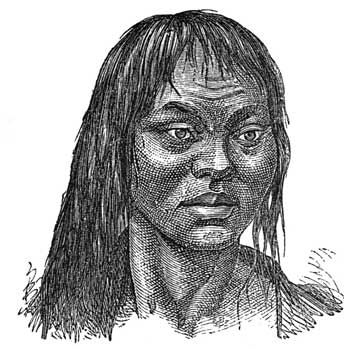
MONGOLIAN.
"The hair was much alike in all three, and was crisped and fine, neither coarse enough nor in sufficient quantity to form a resisting mass. The beard of one individual was in pellets absolutely like the close wool of the Negro, but the prominence of nose, greater even than usually occurs in the white race, bore sufficient testimony to his purity of descent. The second individual had the face very much elongated, but the nose was not particularly prominent. The third had a straighter beard, which was black and grey in regular stripes. The complexion was the same in all three, and though very light, was by no means of a sickly hue, and indeed these persons might readily have been passed in the streets as belonging to the white race."
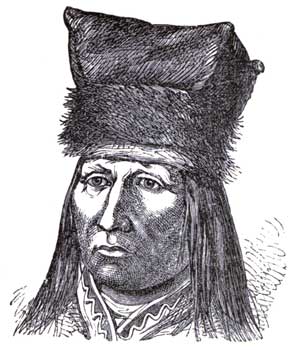
ESQUIMAUX.
The Mongolian race, according to Pickering, includes the inhabitants of part of China and all the north-eastern parts of Asia, also the aborigines of North and South America, with the exception of a tract of land on the south-western coast, including what is now California, and part of the United States. This race is probably the most numerous in the world. The complexion of the Mongolian is decidedly yellowish brown, but rather pale withal (it is well seen in the Chinese); the head is flattened from before to behind, and expanded from side to side, so that in some well-marked cases the head is as broad as it is long, the eyes are drawn upwards at the outer angles, and appear wide apart, from the inner angle, being but little prolonged inwards, the cheek-bones are prominent; the eyes black, and the hair black and straight. The best specimens of this family are the Tartars and Chinese. The Chinese are highly skilful in most of the useful arts, especially in agriculture. Their history extends very far back, and probably the longest series of recorded events in existence, being continuous for a period of about 4,000 years, during the whole of which time they have been in a state of civilisation nearly the same as they are at the present time.
The aboriginal tribes of America belong to this family. Dr. Latham derives their origin from the Esquimaux (or Eskemo), and their migration from north-eastern Asia, Kamschatka, and the Aleutian Islands, to the eastern or Pacific shores of America.
The Chinese and Tartars are of a decidedly yellow tint. The Americans are of a dark copper-coloured hue, hence their designation "Red Indians."
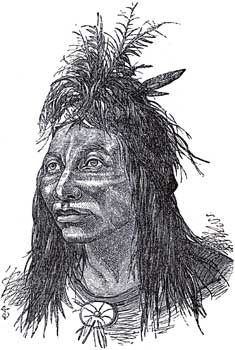
AMERICAN INDIAN.
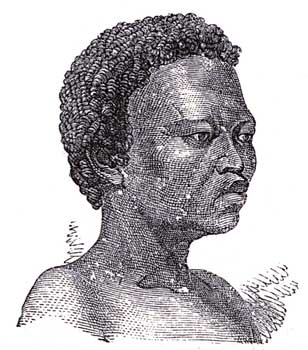
HOTTENTOT FEMALE.
The Hottentot. This race inhabits the south of Africa, and parts extending thence into the interior; they are of a yellowish-brown complexion, small in stature, with hair consisting of small black knobs of a crisp sort of wool, separated from each other in such a way that the skin of the head may be distinctly seen between them. They are strictly nomadic, scarcely ever remaining in any fixed spot, but following the animals they hunt and kill for food, upon the flesh of which, with a few roots, they live.
Dr. Livingstone denies that they are very small in stature; speaking of the Bushmen, a tribe of the Hottentot family, he says:—"They are the only real nomads in the country, they never cultivate the soil, nor rear any domestic animals, save wretched dogs; they are so intimately acquainted with the habits of the game, that they follow them in their migrations from place to place, and prey upon them, and thus prove as complete a check upon their inordinate increase as the other carnivora. The chief subsistence of the Bushmen is the flesh of game, but that is eked out by what the women collect of roots, beans, or fruits of the desert."
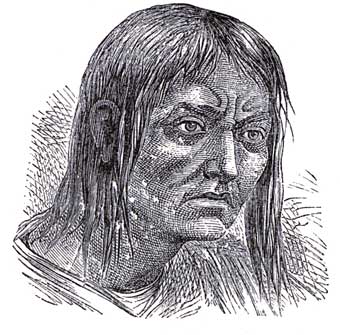
MALAY.
The Malay family are a coast-dwelling people, delighting in the water, and never found very far removed from it; they inhabit the southernmost coast of China, from Siam southwards, and all the adjacent islands. They are of a dark rich brown colour, with straight, coarse, black hair and scanty beard, which in some is quite wanting. Some of the members of this family are above the usual standard of height, such as the Polynesians and Tahitians. The moral character of the Malays, generally speaking, is of an inferior order. They are a race differing much, in some respects, from the Negro and Red Indian, being of peculiarly active temperaments; they exhibit considerable intellectual capacity, and are an ingenious people. It is extremely probable, from the fact of their being found in islands surrounded by others in the hands of the Ethiopic race, that they have pushed out the less active variety, and, in short, annihilated them; and it is likely that they will in turn suffer extinction at the hands of a superior variety, or a variety rendered superior by civilisation.
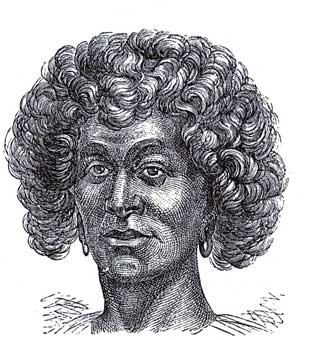
PAPUAN.
The Papuan race inhabit the Feejee Islands and the coasts of New Guinea; they are almost black, with a rough skin and thick woolly hair, which grows much longer than in the Negro, and which they wear curled up so as to form a resisting mass, and no bad protection against the blow from a club (their national weapon). Their height is above the average of Europeans. Fish and yams are their chief food.
The Negrillo are nearly black in colour, short in stature, with projecting jaws and thick woolly hair, the nose not so flat as the Negro, nor the lips so thick; they inhabit the interior of New Guinea and a few islands in its locality, of which they appear to have been the aborigines, the central parts only being occupied by them; the coasts are inhabited by the Papuan and Malay races, who have driven the Negrillo aborigines from their former abode to the central mountains.
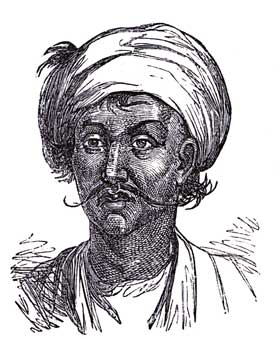
HINDOO.
The Indian or Telingan race inhabit the whole of Hindostan, and parts of Persia. The complexion is much the same as in the two preceding races (Negrillo and Papuan), and is so decidedly darker than in the Malayan, that by common consent it is called black, although, on comparison, the two differ widely from that of the unmixed Negro. The greater part of Hindostan is, however, inhabited by a mixed race, partly Persian, partly Arabian.
Pickering describes them as follows:—"The features approximated very closely to those of the White race, but in general the mouth appeared to be wider, the nose rather less prominent, and the lips sensibly thicker. The profile was less vertical than in the surrounding Malays, the lower part of the face projecting with a regular arch, as in the Mongolian, and there was a further correspondence with the latter race in the frequent instances of the arched nose. The beard occurred more frequently, and was more copious than in the Malay race; the hair was straight and fine, and I have never seen it any other colour than black."
The Ethiopians inhabit the central and north-east part of Africa, Nubia, and the upper districts of the Nile. They are black, but their features are not far removed from the European, except in the fulness of the lips, and they are in some cases extremely handsome. The hair is black and crisp, but not completely woolly, and grows sufficiently long to be plaited, which is the usual mode in which it is worn by the females of this race.
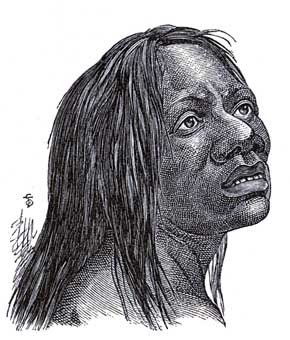
AUSTRALIAN.
The Australians.—The natives of Australia are quite black, and have the nose and mouth very wide; the lips are thick, but not so much so as in the Negro; the hair is black and curly, but not woolly; the eyes are very small, deeply set, black, and keen; the lower part of the face does not project like that of the Negro. These make a wide distinction between the two races, although they have been confounded with each other.
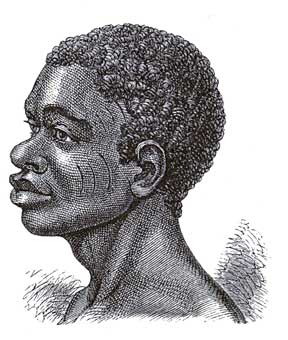
NEGRO.
The Negro.—This race appears to differ from the European more than any other. The skin of the Negro is quite black and shining, the hair black, closely crisped into a sort of wool, and never growing to any great length; they have but little beard, the nose is flat and broad, and the lips very thick and protruding, as is also the whole lower part of the face; the front teeth also project outwards, and the whole contour of the face and head is backwards, forming a gradually receding outline. They inhabit the interior and eastern parts of Africa conjointly with the Hottentot.
The preceding is a slight outline of the various races of men which inhabit the earth; their numbers are in the gross somewhere about a thousand millions, and it has been computed as follows, bearing in mind that these numbers are but a rude approximation to truth:—
European350,000,000
Mongolian400,000,000
Malay100,000,000
Telingan80,000,000
Negro50,000,000
Ethiopian10,000,000
Abyssinian30,000,000
Papuan3,000,000
Negrillo3,000,000
Australian500,000
Hottentot500,000
In examining the various tribes of animated nature, there is one great fact which impresses itself irresistibly upon our minds, namely, that they all form the handiwork of one Creator, and His Autograph is stamped everywhere. His care is also shown in the way in which animals are made to feed on all kinds of organic matters, and on each other; this has been the means of economising all the nutriment which exists on the earth, for, although it may not always be apparent, yet there is not a scrap or crumb ever wasted in nature; not a decayed leaf or blade of grass, not a leg of a fly, nor the wing of a gnat, nor any part or portion of organic matter, from the smallest animalcule to the huge carcass of the dead elephant, or the trunk of the giant pine tree which the hurricane has uprooted, but forms a feast for some of the smaller tribes of animated beings there placed by Providence to eat it. Millions of these, after devouring the waste-matters of organic existence, whether embedded in the soil or elsewhere (not accessible to larger creatures), themselves form the food for creatures of larger growth, as birds, fishes, &c.; these again form the food of Man, so that
"Nothing is wasted."
THE END.
Cloth, Gilt, Price Five Shillings.
UNIFORM WITH "OUTLINES OF CREATION."
THE BOY'S BOOK OF INDUSTRIAL INFORMATION.
By ELISHA NOYCE. AUTHOR OF "OUTLINES OF CREATION."
ILLUSTRATED WITH THREE HUNDRED AND SIXTY-FIVE ENGRAVINGS, BY THE BROTHERS DALZIEL.
OPINIONS OF THE PRESS.
Examiner, July 3. 1858.
"This book contains a brief and very clear summary of information for young readers upon the natural products used in the arts, and the arts by which they are converted to Man's use. It tells the main facts that relate to every manufacture, and describes the various kinds of apparatus and machinery—chains, cranks, valves, wheels, steam and other engines, fire-arms, stills, thermometers and barometers, ploughs, thrashing-machines, &c., as well as the more notable kinds of engineering work. To make the brief descriptions as effectual as full ones, they are very freely illustrated with good woodcuts by the Brothers Dalziel. Whatever is described is shown not only by plans and diagrams, but frequently also by little pictures that are very interesting and effective. The illustrations, we should add, are not copies of copies, but new and direct sketches from the things they represent. Among efforts to produce cheap volumes of useful information for the young, we account this one of the most successful."
Art Journal, August.
"This is just the book to place in the hands of an intelligent boy or girl—for why should the useful information it contains be limited to sex?—who desires to know something about those things from which so much of his comfort and enjoyment is derived. Every youth in Prussia, whatever be his condition—the prince and the peasant alike—is, we believe, compelled by the laws which apply in that country to education, to learn some trade or handicraft. Mr. Noyce's book will serve to initiate every boy in the United Kingdom who reads it, into the theoretical art and mystery of the material and manufacturing world. He divides his teachings into six sections, under the respective heads of Natural Products, Manufactured Products, Products of Skilled Labour, Arts and Trade Processes, Apparatus and Machinery, and Engineering Works, bringing into notice more than one hundred and fifty different subjects. The explanations and descriptions are, as they should be, simple and untechnical, as far as possible; concise, yet sufficiently demonstrative; a multum in parvo, to which Messrs. Dalziel's clear and well-executed engravings give great additional value. Such a volume is worth a hundred story-books as a present to the juveniles."
Illustrated London News, July 3.
"This work, by Elisha Noyce, with 365 illustrations by the Brothers Dalziel, is calculated to do much good. The object is not only to please, but to instruct; and, although written ostensibly for the young, it may be read with advantage by all who desire to possess a knowledge of things in everyday use. The information throughout is conveyed in a clear and understandable form; this, combined with its pictures on every page, is well calculated to make the mind familiar with many objects that as a rule have hitherto been but imperfectly realised to the young. The book is admirably adapted to assist those who are about to make choice of an occupation, and this of itself would make it a welcome addition to the numerous works written for the information and guidance of the rising generation. The book is published by Ward and Lock."
Dispatch, July 4.
There is really a great deal to recommend this book to the attention of the public as one especially adapted for the entertainment and the instruction of the young. The subjects themselves embrace the whole arcana of the material universe, the mineral and vegetable products of the earth, their properties, manufacture, and varied convertibility to the service and uses of man. Three hundred and sixty-five first-class engravings, from the pencils of the Brothers Dalziel, and most of these being illustrative of the finished machinery of Woolwich Arsenal, and drawn by permission of the authorities, add to the value of the matter incorporated in these pages, while in almost all other forms the industrial arts, with their varied apparatus and machinery, are ably and fully described. It is a true "Boy's Book," and merits the amplest circulation possible for it to attain.
Daily Telegraph, July 20.
The title of Mr. Noyce's book sufficiently explains its object, and we have only to say that it answers its purpose. It is clearly and amusingly written, and embraces a large variety of useful subjects, which it treats in a full, though, at the same time, a concise manner. The book is illustrated with three hundred and sixty-five excellent engravings by the Brothers Dalziel.
Leeds Times, July 31.
The author's object in the elegant-looking issue before us, as described by himself, is to convey to the youthful reader a knowledge of the materials, processes, and apparatus made use of in the various examples of industry and skill constantly before our eyes. No fewer than 365 wood-cuts by the Brothers Dalziel are appropriately interspersed with the letterpress, thus enabling the reader to clearly understand what otherwise would of necessity, in some cases, be almost incomprehensible. The work is clearly and ably written, and even the intelligent adult must possess a large fund of general knowledge who can truthfully affirm that he has derived no information from its pages.
Norfolk News, Aug. 7.
The title of "The Boy's Book" has been applied to more than one, two, or three subjects; but to none more appropriately than to this, which is really and truly "The Boy's Book of Useful Knowledge." The author has observed the happy medium of saying neither too little nor too much—of neither wearying the patience of his young readers by long and needless details, nor of disappointing their curiosity by unnecessarily brief and insufficient descriptions. If we are not greatly mistaken, the book will soon become a general favorite with the young, and we should strongly recommend it as a text-book of general information to Educational establishments. It is beautifully got up, and its value is considerably enhanced by the superior wood engravings of the Brothers Dalziel, which speak the language of explanation as plainly to the eye as does the letterpress to the understanding.
LONDON: WARD & LOCK, 158, FLEET STREET.