OUR TRIP TO BLUNDERLAND (continued 3)
Reading edition
“It’s Jaques’ business to kill him,” said Ranulf, solemnly. “It’s a good thing he has got long enough arms.”
Jaques did not seem to see it, and the whole three were anything but comfortable in their minds.
A GREAT BORE.
It was somewhat reassuring, however, to notice that the news of the arrival of Blunderbore appeared to distress none of the rest of the company. The ladies were all looking through their opera-glasses, with faces which showed that he had no terrors for them. The gentlemen seemed, on the whole, to be rather disgusted, as the announcement of the giant’s approach appeared to throw them entirely into the shade so far as the fair sex were concerned, and they looked at one another with glances of pique and contempt, as the ladies twittered away in eager conversation—eyes sparkling, lips smiling, and that curious buzz that always heralds a great arrival running through the whole assemblage.
HE STOOPS TO CONQUER.
“Any room for me?” said a voice (which, though evidently kept as mild as possible, made a sound very like the Westminster chimes striking the first quarter), as a face about three yards long, below a three-cornered cocked-hat, made its appearance under the fern-leaf fringe of the tent of flowers. Blunderbore had been compelled to stoop down so low in order to look in that his face was level with his knees, and as it was very round, the effect was ludicrously like a circular clock on pillars. The moment the face became visible, all strange and unpleasant thoughts began to fade from the boys’ minds, for it was the picture of jolly good-nature. His eyes, the balls of which were larger than a Christmas plum-pudding, fastened themselves specially on Ranulf, and putting out a vast hand, he shook a forefinger as large as a bolster at him, saying—
“Now, I know you are expecting me to say Fe-fo-fum, something about grinding bones, and all that.”
“Y-e-e-e-e-s, sir,” said Ranulf, half frightened, but only half; for the jolly face was so good-humoured that it was almost impossible to be afraid.
INVITING A LARGE PARTY.
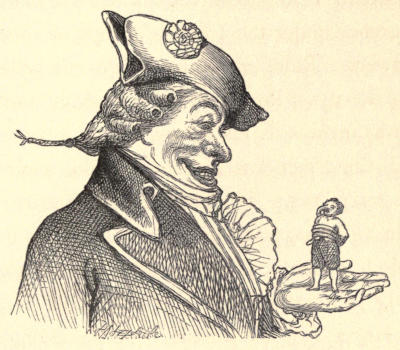
“Well,” said Blunderbore, taking him up on his vast hand, “giants in Blunderland don’t talk rubbish of that kind, and they are not such geese as to grind bones when they want to make bread.”
“Come in, Blunderbore; we will make room for you,” came in a surging ripple from hundreds of fair lips, while, with many a rustle of silk and velvet, they cleared a large space on one side of the amphitheatre, the seats of which rose in tiers one above the other.
BEETLE-CRUSHERS.
A GREAT SWELL.
“Well, but your ceiling is so low. However, perhaps old Blunderbore can cure that for you,” said the giant, as, pushing his head in below the ombrelle of flowers, he placed his forefinger in the centre of the white lily at the top, and, apparently without an effort, raised the canopy aloft. Showers of diamond drops fell thick and fast from between the fern-leaves as the gorgeous ceiling rose, faster and ever faster, till at every leaf there stood a glassy pillar, glittering and sparkling with wondrous lustre, and in a twinkling the bower became a crystal floral palace, to which that of Covent Garden is but a dingy, dull, depressing dungeon. Blunderbore then made his way through the crowd with great care, of which there was much need, his feet being nearly as big as the dingies of a ship of the line, and seated himself on the side of the hall that had been vacated for his accommodation. He certainly was very unlike the old kind of Blunderbore, from the top of his three-cornered hat down to the red heels of his buckled shoes. A magnificent single-breasted coat and long flap-waistcoat, with golden stripes, separated by lines of rich maroon-coloured velvet, took the place of the short armless blouse, and the great belt with a buckle like a wicket-gate, that are supposed generally to be the orthodox costume of gentlemen more than eight feet high. And instead of the gnarled club or grievous crab-tree cudgel of the story-books, our Blunderbore carried a most elegant cane with a golden top. It is true that the cane was as thick as an ordinary lamp-post, but still it looked quite neat and tiny, appearing slight enough in Blunderbore’s vast hand to suit the most foppish taste. His breeches were of yellow satin, below which were stockings of silk of the same colour, and his curly hair was of a golden tint. Altogether, he made a most presentable-looking giant, and seemed to be a special favourite with the ladies, to whom, as he sat down, he kissed his hand right gallantly. This done, he produced from his waistcoat-pocket a snuff-box, larger than a full-sized trunk, and took a pinch out of it, giving his hand an elegant shake—in fact, quite à la Cox-comme il faut of the last century, sending a shower of snuff from his fingers like the stream from the rose of a watering-pot. This, the boys expected, would set every one sneezing; but such snuff was not likely to get into any one’s nostril by accident, the particles being as large as ordinary peas, and no one seemed inclined intentionally to make his nose a pis aller for what the giant threw away. As what remained between his fingers would have stuffed an ordinary pillow, it proved that Blunderbore was anything but a bad fellow at a pinch, and completely allayed the fears of our little men, so that they were not the least alarmed when he gave a terrific sneeze, like a squall of a north-easterly gale—a perfect Blunder Boreas.
NOTES ON DEMAND.
“Now, then,” said he, “what can I do to promote the harmony of the meeting?”
“Give us some music; let’s have a Monstre Concert,” was the cry that rose on every side.
“All right,” said Blunderbore; “will you have the Jolly Waggoner?”
“No, no! no Wagner, please; we don’t want the music of the future; no promissory notes for us.[11]
“Well, I daresay you are right,” replied Blunderbore; “the music of the future is no pastime. What do you say to a present of Chopin Morceaux?”
“The very thing,” arose in a shout of delight from every side.
“All right, then; here goes,” said the giant; “and I am sure you will admit that I give you admirable concerted pieces.”
60 TO 1.
The ladies seemed to know what was going to happen, for about 60 of them at once clustered round Blunderbore.
“Are you ready?” said the giant.
“Yes,” rippled in feminine tones all around him.
AN ORGANIC CHANGE.
A VIGOROUS BREAKDOWN.
NO STRINGS NO CHORDS.
HARPEGGIO.
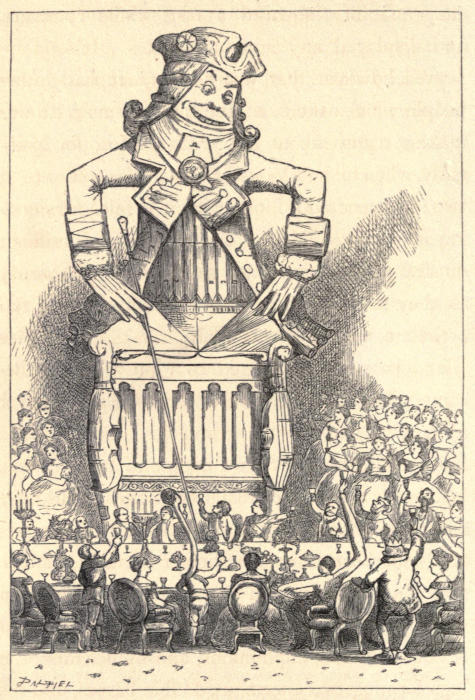
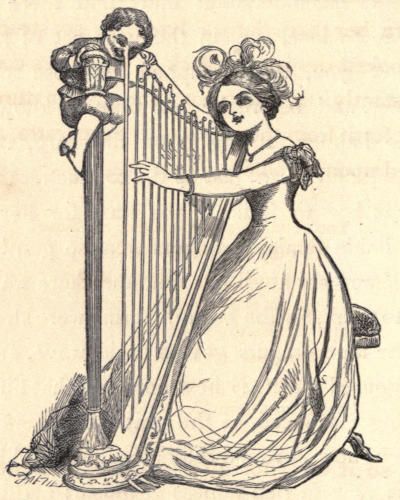
Blunderbore at once stiffened up, in a manner that formed a marked contrast to his previous easy affability, squared at the whole company, and displayed any amount of brass. It soon appeared, however, that, just like a great many other people when asked to give a little music, he was making a fuss about the preliminaries, for presently, when he had looked stuck-up for a minute or two, he executed a most elegant breakdown, ending in a thoroughly organic change and brilliant musical parts, which latter the ladies caught neatly as they fell, and there, in a moment, stood a full orchestra, with a monster organ in the middle, as Blunderbore’s gold-striped coat and waistcoat became gilded pipes, his curly locks fell in a shower of cornets and French horns, his stock made a full-sized drum, his cuffs a couple of brass drums, his cheeks a pair of cymbals, the bones of his nose naturally became a group of trombones; the fingers and nails scattering in a shower of violins, flutes, piccolos, clarionets, and oboes, and the thumbs in violas and bassoons; his arms making a splendid set of sax-horns, euphonions, and ophicleides; the legs forming two enormous double basses, and his feet dividing into two pairs of violoncellos; while the pin at his breast dropped down as a neat jewel-mounted conducting-baton, the cane bent itself into a magnificent harp; and, to crown all, his hat settled on the top of the organ, forming an elegant carved screen over it. Tap, tap, went the baton in the lovely hand of the conductress, as the gentlemen formed themselves into animated music-desks, which, in the case of the ladies who held the different classes of violins, reversed the usual saying, by giving them two bows to their strings. Wave, wave, wave, swept the baton—one, two, three, and off they went in a grand overture, the fair performers playing their parts (of Blunderbore) to perfection. The lady with the harp was the only disconcerted one, for, unfortunately, Blunderbore had lost the cords and tassels of his walking-cane, so when formed into a harp the instrument was stringless, and the lady holding it, who had a solo to play, was in despair. Ranulf, seeing her distress, mounted the orchestra, saying, as he looked and fumbled among the confused mass that forms the proper contents of a boy’s pocket, “Here is something that will perhaps do.” The lady, seeing the coils over his shoulder, misunderstood him; and there being no time to lose, she, in the very act of saying, “Thank you, dear,” slipped his nose off his shoulder, and before he had time to know what was to happen, strung it on the harp, up and down, up and down, just as the conductress turned towards her to indicate the time for her solo. Her nimble feminine fingers were so gentle that Ranulf was not at all put out, and there was little time to think, for the beautiful arms were stretched out, the taper-fingers gave a rapid wave, and the harp poured out its richest notes, so that all stood listening entranced, as the graceful fingers made it speak, now in round rolling roughness, like the storm; now in rich fulness of music; and now in gentle brilliant trills, like the birds in a distant wood. Ranulf himself, who had a good ear, drank in the sweet sounds with eager delight, wondering as nothing since he left home had made him wonder. But, in an evil moment, forgetting his good manners, which forbid speaking when a solo is going on, he exclaimed—
“Oh, how awfully jolly!”
THROUGH THE NOSE.
Terrible was the result. Everybody knows how horrid the sound is when a person speaks holding his nose; but then he only grasps it at one place. Now Ranulf’s, of course, was held at about a hundred places on the harp, and so it sounded 100 times over the fearful twang, making everybody put hands to ears; and the lady harpist, whose sweetest notes had been made so false as to turn her harp into a lyre, was so struck that she looked despair as black as blue eyes could.
ANOTHER STYLE OF ORGAN.
Instantly, an indignant but good-natured cry burst forth from the ladies of the orchestra, as they turned upon Ranulf and sang[12]—
You’ve made a pretty mess, Sir Nose; Why did you try to chatter? A check you give to all our bows, Our notes of hand you scatter; Our organ’s drown-ed in a C From nasal organ vile, Which now by us shall punished be In most pertickler style.
And so it was; for all the ladies that were immediately round the harp, arming themselves with feathers from their hair, or flowers from their bouquets, rushed off in a chorus and down upon Ranulf, to tickle his long nose, singing—
DEFENDING THE BRIDGE.
Little rogue, ha! ha! I’ll make you pay The false notes you have forced on us in this offensive way. I’ll strike you with a feather, I’ll stab you with a rose, For making of our harp a liar, By talking through the nose.
TWO TOO MANY.
And, suiting the action to the utterance, the feathers and the roses were thrust forward in a score of dainty hands to tickle poor Ranulf’s offending organ. But the lady who had strung him on her harp, though she was shocked at the nasal twang he had brought out of her and his instruments combined, did not forget the aid he had given when she was in a difficulty; so, as the merry group came to the attack, taking Ranulf up in her arms, she seated him on the very top of the harp out of reach (where, though not gilded, and in knickerbockers, he did very well for a Cupid), and did all in her power to protect him from the thrusts of the feathers and roses. She succeeded pretty well while only her own sex were engaged, for, being a harpist, she could move her hands rapidly over the strings and wave off the attack in all directions. But what was Ranulf’s horror to see Norval and Jaques, like a pair of rogues as they were, unable to resist the temptation to join the fun, thrust their long neck and arms over the bevy of fair ladies who surrounded him—Norval with a rose in his mouth, and Jaques with a feather in his hand. Ranulf knew at once that he must go off into fits, for the lady could not protect him from the wild flights of the long neck and hands as they flew about tickling his poor nose in all directions. He resigned himself to his fate, slid down to the ground, and went off in screams of laughter, while the merry chorus round him sang—
Lazy dog, ha! ha! wake up, I say, You surely don’t intend to sleep upon the rug all day. I’ll strike you with a feather, I’ll stab you with a rose, Unless you stop that horrid snore, That’s groaning through your nose.
CHANGE ARMS.
And as he lay, the arms were still out to protect him, only, instead of their being uncovered except by handsome bracelets at the wrist, they seemed to get grown over with something very like brown merino; and when a voice spoke, saying, “Now, boys, leave him alone, will you?—stop tickling him at once,” it was that of his nurse (for whom his pet name, appropriately, was Harpin); and there he lay, sprawling on his back on the rug, as she kept his brothers off him.
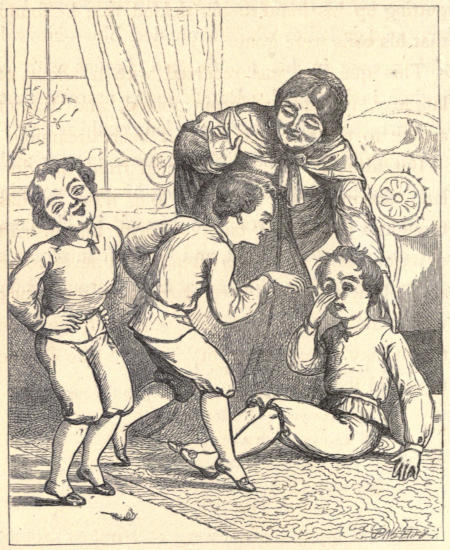
“But where’s my nose?” he exclaimed, as on putting up his hand to his tickled face he found that his coils were gone.
This question was received with a shout of laughter, in which Harpin joined, and Ranulf awoke to the fact that he had been dreaming.
ABOUT THE END OF IT.
But although he has returned from Blunderland, leaving behind him his long nose, he has brought a pretty long tail home with him instead of it; and now, as he was often taught never to be a tale-bearer, it has been carried to the Black woods, and hid away in these leaves, in the hope that it may amuse other little people who chance to unfold it.
THE END.
PRINTED BY WILLIAM BLACKWOOD AND SONS.