OUR TRIP TO BLUNDERLAND (continued 2)
Reading edition
“No,” said Norval.
SCARCELY APARIENT.
“That’s a pity; there’s no bumper like an old Tom; he’s a noble spirit, always ginoowine.”
“I can’t follow you,” said Norval.
“And did I say I wanted you to follow me? Gals have no followers here; I only wanted my regular bump.”
Norval having a grandfather who was fond of phrenology, had picked up a smattering, and was just going to say that he thought it was only silly people that wanted regular bumps, when suddenly the old lady called out, “Where are my pears? there were four of them.”
Jaques and Ranulf, who had picked up the apples, had been standing ready to hand them back to her ever so long.
“I beg your pardon,” said Jaques, “they are apples.”
“I say they’re pears,” said the old lady, testily. “How many have you?”
“Eight,” said Jaques.
“Well, and isn’t that four pairs? I always like to buy them pared; it saves knives and trouble,” said she. “It’s a pity that a boy like you should be a beggar.”
“I’m not a beggar,” said Jaques.
“Didn’t you beg my pardon?”
“Yes.”
“Those who beg are beggars, that’s sure,” said she.
COURTEOUS.
Just at this moment a policeman came up. He took off his helmet, and making a low bow, said, “I heard the word beg. May I take the great liberty of inquiring whether any one has thought proper to beg? and if so, from whom, and for what? If for anything real, good and well; but if merely from politeness or courtesy, then to be visited with the utmost severity of the law.”
Jaques, who had always been taught fearlessly to speak the truth, said at once, “I begged the old lady’s pardon,” half doubting what would happen. To his great surprise the policeman turned round sharp on the old lady, and asked, “Did this boy beg your pardon?”
“Yes,” said she.
“Then, madam, with peelings of the deepest fain, it is my duty to inform you that you must at once be led to the court.”
“The court!” screamed the old lady; “it has been my ambition for fifty years to be courted, and now it has come at last.”
“It has, madam; you are now about to be presented at court by the aid of the police. Will your Majesty deign to proceed?”
XPLAINING.
“Majesty!” said she; “I can’t understand it.”
“Let me endeavour to make it plain,” said the constable, with a wave of his hand like a professor lecturing. “Will your gracious Majesty deign to inform me whether I am correct in saying that this boy begged your pardon?”
“Yes.”
“And would your Highness further permit me to inquire whether it is or is not a fact that begging is contrary to law?”
“Yes.”
“May I also be suffered humbly and respectfully to put the question, whether anybody can pardon people for breaking the law, except the Queen?”
EVERY INCH A QUEEN.
“No.”
“Then I reverentially request permission of your gracious Majesty to point out that as you were asked to pardon when he broke the law, you must be the queen.”
“But I’ve got no crown,” said she, quite puzzled.
“I must be condescendingly excused for venturing to differ from your Serene Highness. If you will feel for it, you will find you have a crown to your head.”
“Why, so I have,” said she, and suddenly drawing herself up, and assuming an air of most ridiculous dignity, added, “What, ho! bring hither my sceptre.”
The boys could scarcely keep in their laughter, and the difficulty increased when the policeman produced his baton, and going down on one knee handed it to the old lady, who immediately aimed a fierce blow at his head, crying,—
“Down with every one that has a crown except myself!”
The policeman mildly replied, “Your Majesty, I haven’t got a crown in the world; my missus doesn’t allow me more than 4 and 9 a-week for pocket-money.”
A BOUNDING JOY.
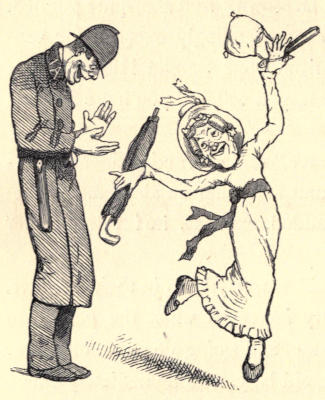
“Just as well for you; those who are limited to four and ninepence can feel proper respect for a sovereign,” said the old lady; “now for our court.” So saying, she began to perform a most wild minuet de la cour, the policeman beating time with his hands. Then ordering him to take off his greatcoat, she fastened it on as a train, and set off for the court.
RUNNING MELODY.
The policeman went first, playing a grand march on a Jew’s harp, which he produced from his pocket. It was as big as a fire-shovel, but this did not matter, as he had a mouth reaching from ear to ear. The old lady followed, holding her baton-sceptre up, and with her long, sharp chin cocked so high in the air that you could have hung a hat upon it. The policeman’s music made her quite lively, and she began to sing, with a chorus to each verse, which ran thus,—
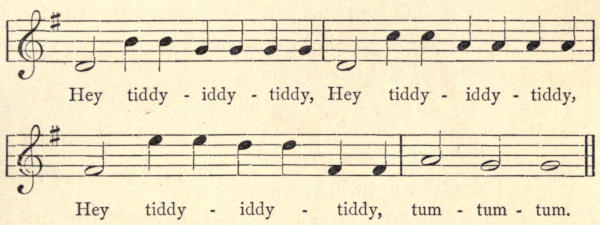
[Audio content is not currently supported on your device. [MusicXML]
Hey tiddy-iddy-tiddy, Hey tiddy-iddy-tiddy, Hey tiddy-iddy-tiddy, tum-tum-tum.
during the singing of which she skipped about from one side to the other in a most lively manner.
SOVEREIGN SPECIFICS.
I never thought to see The day I queen should be; It’s come at last, however, You well may cry—“I never!” Hey tiddy iddy tiddy, &c., &c. Nor I, but still it’s poz, However strange, because Policeman says ’tis so; X is ’xact, you know. Hey tiddy iddy tiddy, &c., &c. Our reign shall last so long, You’ll need umbrellas strong; Woe to the minion’s skin Who sports a gingham thin! Hey tiddy iddy tiddy, &c., &c. A sovereign we shall be, Ruling land and sea In straighter lines than youc Ould find in copy-book. Hey tiddy iddy tiddy, &c., &c. We’ll have a Parliament Cake and wine event Every day or two, Invites select and few. Hey tiddy iddy tiddy, &c., &c. To have a feast of rea Son at our royal tea; Likewise a flow of soul, By Punch from royal bowl. Hey tiddy iddy tiddy, &c., &c. And nominate a Prime Minister of rhyme; Pros and Cons shall banished be, Except conundrums after tea. Hey tiddy iddy tiddy, &c., &c. Look out for famous sport, For we are going to court; So bachelors beware, And let no caitiff dare Hey tiddy iddy tiddy, &c., &c. Refuse our royal suit Of livery, and put On his own airs instead, Or off shall go his head. Hey tiddy iddy tiddy, &c., &c.
BAND-DITTY.
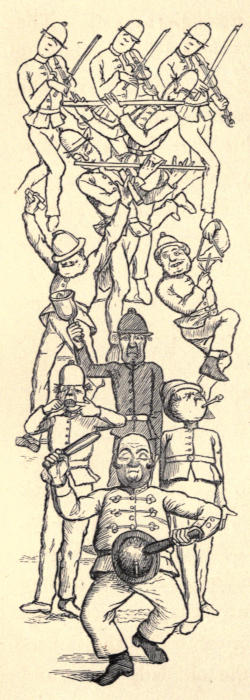
Each time the old lady took up the chorus, she skipped about from one side to the other with a briskness that did her credit; and as she marched and tripped along the street, the policemen she passed joined the procession, each producing an instrument from his pocket, so that soon the old lady had a band before her, playing most vigorously on the following:—
A Jew’s Harp.
A Penny Trumpet.
Three Threepenny Fiddles.
A Handbell.
Two Twopenny Flutes.
A Mouth Accordion.
A Triangle.
A Pair of Bones;
BATONS D’ORCHESTRE.
and the inspector led the band, with his hat fastened to his waist-belt, keeping them to their beat by drumming in a spirited manner on the crown of it with a pair of batons.
DECIDED HITS.
The boys tried very hard to find out what the tune of the verses was, but could make nothing of it. All the melody seemed to rest in the chorus instead of running through the song. The people in the streets, however, were evidently greatly delighted with it, as, the moment the procession came within hearing, they all stood still and began gravely to beat time with their sticks and umbrellas, those who had none wagging their heads up and down, like China mandarins. The boys laughed heartily when they saw several dozen umbrellas, sticks, and heads solemnly waving about, while the policemen squeaked and croaked, banged and tinkled, on their instruments, and the people slowly turned round their backs and bowed low to the houses as the old lady passed. Whenever she, in skipping about, came near any of the people who were bowing, she took a rise out of them by administering a sound whack with the baton-sceptre, which knocked them down, shouting, “Rise, Sir What’s-your-name Thingammy,” which the poor fellows did with a very beknighted look. Presently they arrived at a large building, at the door of which the policemen turned aside to let the old lady enter, and having played a final flourish, repocketed their instruments. The old lady on reaching the door turned round, and finding the policeman who had given her the baton waiting, she grasped it firmly, saying—
A THUMPING GAL.
“I’ll give it to you,” and, suiting the action to the utterance, she brought it down bang as hard as she could, as he bowed low, so that he fell flat on the pavement.
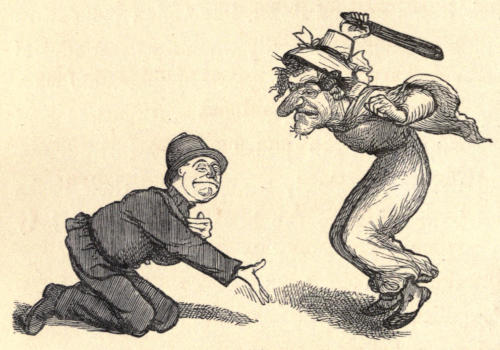
“Rise, Sir Charle——”
“Stop, stop!” he cried; “don’t turn a day constable into a knight.”
GIVE AND TAKE.
“Back to your beat,” said she, majestically.
“I think it’s rather beat to my back,” replied he, although, curiously enough, he did not appear at all discomposed or hurt.
“Take yourself up.”
“We take others up, not ourselves; besides, you’ve battened me down.”
“Oh, you downy fellow!”
“Yes, you can’t get a rise out of me, that’s plain.”
“X plain yourself,” said she.
“No pretty Bobby-she should say,” said he.
“Move on!” cried she—“move on, siree!”
“Peeler of the State, I stands,” said he.
Suddenly some one rushed out at the door (knocking the old lady so that she tumbled over the policeman), and coming up to the boys said, “Are you judges of sweet things?”
“I should rather think so,” replied Jaques.
GETTING A WIGGING.
“Then come along at once,” said he; and before they had time to think, he hurried them upstairs into a room where three pompous-looking attendants in white coats and enormous black neckcloths dressed them up in grand robes, put immense full-bottomed wigs on their heads, and opening a door, pointed to three large chairs. The boys went in and sat down on the chairs, while everybody in the court rose up, making a low bow, and a crier called out—
“All persons, without any further ado before my Lords the Justices of Assize so small Boyer and Determiner, and Jug ale Delivery, draw beer and give to attendants.”
This announcement about beer might have appeared to be an aberration on the crier’s part, had it not been that, as is usual in criminal courts, there were plenty of queer mugs among the people in the building.
COURT BEAUTY.
The boys hardly knew what to think of their new position. Norval and Jaques were rather overawed by their robes. Ranulf had got between his brothers, and so was seated in the Lord Chief Justice’s chair. At first he looked as grave as a judge, which was just what he ought to have done in the circumstances; but after a little he glanced round at Norval, and seeing him in his wig, which came down to his waist, was just on the point of bursting out laughing, when the Clerk of Court, who wore green goggles as large as macaroons, peered over the Bench from below, saying, “If yer Ludship pleases,” and sat down again.
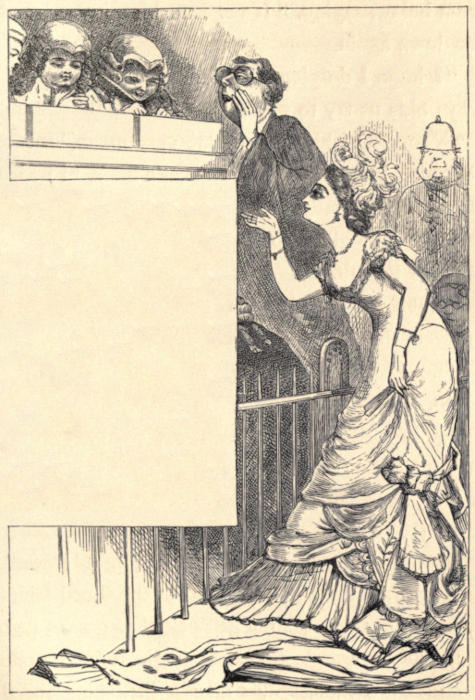
“I hope I do please,” said Ranulf. “Papa always bids us try to please.”
A SWEET THING.
“Your Lordship pleases me very much,” said a charming voice from the prisoner’s dock, in which stood a lovely lady, dressed in full Court costume, feathers and all, who kissed her daintily-gloved hand to Ranulf.
“But I thought we were brought here as judges of sweet things,” said Jaques.
The Clerk of Court peering over the bench again, said, “’Xac’ly so, m’ Lud; the sweetest thing in prisoners we’ve had for a long time, m’ Lud,” and sat down again.
“What is she charged with?” said Norval.
“P’tty lasseny, m’ Lud.”
“Pretty lasseny!” said Jaques aside to Norval. “I am sure she is guilty of that.”
“But,” said Norval, “what is she charged with doing?”
“Stealing a heart, m’ Lud.”
Norval, who had once been in court at a trial, thought the right thing to do was to take a note; so, seizing an enormous pen that was on the bench, he wrote, repeating aloud as he went on, “Prisoner charged with stealing a tart.”
QUEER QUERIES.
“The person who stole tarts was a knave, and I thought a knave was a man?” said Ranulf.
“Yes,” said Norval; “but you know the women want to do what the men do nowadays.”
“I’ve heard of their wanting rights,” said Jaques; “but stealing isn’t a right, it’s a wrong, isn’t it?”
“Never mind,” said Norval; “it won’t do to appear not to understand. Ranny, you’re the old judge, you know, because you’re in the middle, so you must ask the questions. You had better ask what the prisoner’s name is. Now, look grave,” said he, as he observed the dimples in his brother’s cheeks beginning to show again.
Ranulf pursed his lips up very tight, and then said, “I want to know what the pretty lady’s name is?”
“No, no,” said Norval; “prisoner.”
“I want to know the pretty prisoner’s name?” said Ranulf.
STEAK TART.
“No, no—just prisoner,” said Norval; “say it again.”
“Well, then, I want to know the just prisoner’s name?” said Ranulf.
“Just so, m’ Lud,” said the Clerk, bobbing up; “prisoner’s name is Victoria Lawsenj. Yer Ludship had better ask her to plead.”
Norval whispered to Ranulf, “Tell her she’s charged with stealing a tart. Ask whether she is guilty or not guilty.”
Ranulf looked as grave as he could, and said “Victoria Lawsenj, you are charged with stealing a tart——”
“Beg pardon, m’ Lud,” said the Clerk, starting up; “some m’stake, my Lud——”
Ranulf began again, “Victoria Lawsenj, you are charged with stealing a tart and some steak.”
“Must pray yer Ludsh’p t’ excuse me ’gain; yer Ludship said tart and steak.”
“Was that the wrong order?” said Ranulf, meekly; “then I’ll say steak and tart.”
NOTA DOUBT OF IT.
“But, m’ Lud, the steak is a mistake, and the tart is another.”
“Very well,” said Ranulf; “I’ll say that she is charged with stealing a female steak—cow-beef—and that the tart was not really a tart but a beefsteak pie.”
“But, m’ Lud,” said the Clerk; “really, m’ Lud, yer Ludship knows best, m’ Lud, of course; but, m’ Lud, I would suggest that your Ludship said tart instead of heart.”
Here Norval, remembering what he had seen in court, broke in, “But tart is right; it must be right—I’ve got it in my notes.”
This completely flabbergasted the Clerk, who gasped a feeble “M’ Lud,” and sank down in his seat in despair.
Jaques, practical as usual, whispered to Ranulf, “Never mind whether it’s a tart or a heart; just say, ‘You are charged with stealing a tart, or a heart, or something. Are you guilty or not guilty?’”
Ranulf took this advice; and turning to the lady, who was gracefully fanning herself, he asked her the question, only he got confused towards the end, and made it—“Are you gilded or not gilded?”
“Oh, my Lord,” said the lady, “there’s no gilt about me; I’m as true as steel.”
Up started the Clerk.
“Take down, m’ Lud, that she says it’s true she stole.”
“No, I didn’t; I only steeled,” said she.
“Steeeled!” said the Clerk, contemptuously; “how do you spell ‘steeeeled’?”
“S-t-e-e-l-e-d, you old goose!”
WHOLESALE SLAUGHTER.
“Yer Ludship sees how bad she is; her manner’s bad, her grammar’s bad, and her spelling’s bad. Your Ludship had better add another count for murder.”
“Murder of what?” said Jaques.
“The Queen’s English, m’ Lud.”
“That would be a great many murders, for there are more than thirty million English,” said Jaques, who had learned the population in his geography book; “how could she murder so many?”
The Clerk was quite puzzled at this, and tried to look as wise as he could, which was not very wise, but otherwise. There was a long pause, during which the prisoner ate an ice and drank a cool beverage that were brought to her by a powdered footman, after which she looked brighter and lovelier than ever, while everybody else in court was miserable with stuffiness and heat.
“Could not we have ices too?” said Ranulf, eyeing the tray eagerly.
The footman said nothing, but turning round made a low bow, walked up to the bench, and as the boys held out their hands for ices, gravely shook his head, made another low bow, and walked out.
BRUTAL BOXING.
By this time the Clerk had recovered himself, and a jury having been called, they were got into the jury-box. This was a matter of some difficulty, as the box was made without any door, and the jurymen were seized by ushers and thrown over the partition, tumbling in a confused heap. When the whole twelve had been thrown over, they presented a sorry spectacle of torn clothes and dusty faces. There were no seats in the box, but the ushers threw in some chairs on the top of the jurymen, who appeared to take all as a matter of course. The plaintiff was then called forward, and a large wooden box placed over him by the ushers, who padlocked it down and then sat on the top of it.
CASE FOR PLAINTIFF.
“Why do you lock him up?” said Jaques.
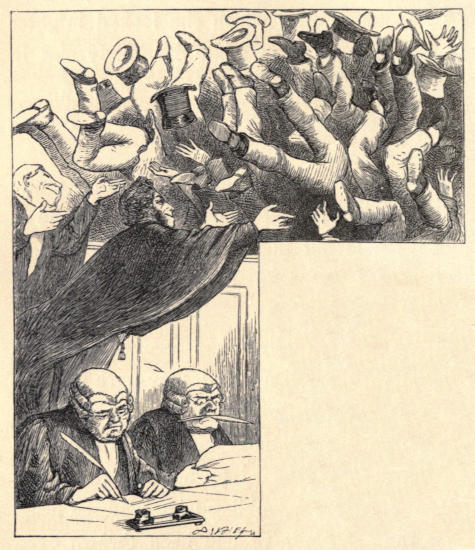
JACK IN THE BOX.
“Shall ’ave to beg yer Ludship’s pardon,” said the Clerk; “we don’t lock him up, we lock him down.”
“But why do you put him under a case?” said Jaques.
“To prevent him getting up case, m’ Lud.”
Jaques himself seemed rather shut up at this, and Norval, moved again by what he had once seen at a trial, said, “What is your name?”
“John,” said the voice, out of the box.
“It should be Jack, when he’s in a box, shouldn’t it?” said Ranulf; “and he ought to start up, oughtn’t he?”
“Oh, he will be sure to do that,” said the lady; “he always was an upstart, indeed he was, my dear—Lord, I mean,” said she, correcting herself with a smile.
“John What?” Norval went on.
“No, my name’s not John What,” said the voice from the box; “it’s John Doe.”
“That’s strange,” said Jaques; “I thought the case was about a heart, not about a doe.”
LONGITUDE.
“Yes, my Lud, but the charge is that she stole a Doe’s heart,” said the Clerk.
“Doe and hart, hart and doe; I don’t think I’ll ever understand it,” said Ranulf, with a sigh.
“P’raps if yer Ludship would keep in mind that in Doe versus Roe——”
“Oh dear, oh dear! here’s a roe now; that’s another staggerer,” cried Jaques.
“Never mind,” whispered Norval—“look solemn, and make believe you know all about it.”
The examination of John Doe then began.
“How long have you known the prisoner?”
“Various lengths. I have known her from 2 feet 3 inches long to 5 feet 7½ inches long, as she is now. But even now she is sometimes pretty short with me. I’ve known her so long, in short, that the longer I knew her the more I got to long after her.”
“Well, I don’t want to know anything about long after; I mean, when did you first come across her?”
“I cross her! I never crossed her in my life. She had her own way as long as I knew her; it was she that was cross with me.”
A TROUBLESOME TIME.
“But I want to know the length of your acquaintance?”
“Some of my acquaintances are long and some short.”
“How shall I put it? Tell me, once for all, when you first met her.”
“When I first met her? I met her when I least expected it.”
“Really this is intolerable. I want you to tell me what was the time at which your first meeting took place.”
“Wild thyme, I think; but I’m no botanist, you know.”
“Tut, tut! At what period of time was it?”
“It wasn’t a period of thyme, it was a bank of thyme.”
“Will you answer, sir? Give me the date of your first meeting.”
“We had no dates at our first meeting, only raisins; and we ate them all, so I cannot give you any.”
PUNY JUDGES.
“A fig for your dates and raisins! I wish I could get at the raison d’être of your answers. How can I put the question?”
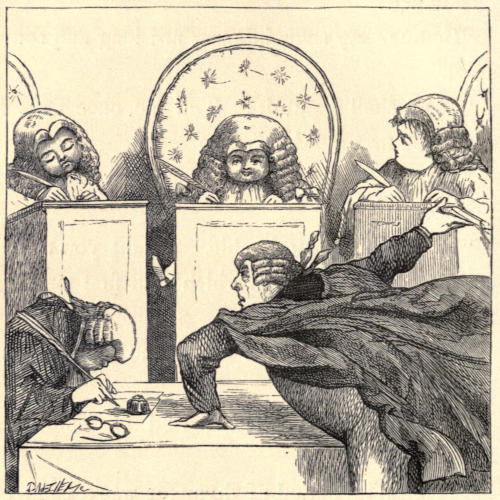
“That’s just what I want to know. How can you put such stupid questions?”
LOUD LAUGHTER IN COURT.
“M’ Lud, what am I to do? I can make nothing of this witness.”
Norval, who had learned a little Latin, replied, “Do you mean that you can annihilate him?”
“No, m’ Lud, but I can’t make head or tail of him.”
“Never mind his head, and let him manage his own tail. Perhaps he’s a bit of a wag.”
“Very well, m’ Lud. Now, then, tell your story.”
“I’m not a story-teller. I always tell the truth.”
“Yes, yes, but come on with your own tale.”
“Tail! I haven’t a tail. I’m not one of your Darwin monkey-people.”
The lady in the dock gave such a merry laugh at this, that she infected the whole court. Ranulf went into such fits, that his wig slipped down to his chin, and an usher had to come up to the bench and slap him on the back to bring him round. Norval recovered first, and putting on as grave a face as he could, said to Jaques and Ranulf, “Don’t be silly; judges are always stern and grumpy, so we must be too;” and turning to John Doe, said, “What is your complaint against her? Did she steal your heart?”
“No, my Lord; it was her own heart.”
O’ER ME STEELING.
“Her own heart! How can that be? How could her own heart be stolen by her?”
“I never said it was stolen, my Lord, I only said she steeled it.”
“Surely that’s bad grammar, again,” whispered Jaques.
“But I want to know,” said Norval, “how could she steal what was her own?”
“Well, my Lord, you see I gave her my whole heart.”
“Gave it her? I thought you charged her with stealing it?”
“No, my Lord, never! It was her own she steeled.”
“Well, well,” said Norval, “go on; try to explain it in your own way.”
“This was the way, my Lord; I wanted her to be my sweetheart.”
OFFERING AMENDS.
“That’s right, my Lord,” said the lady; “and I was tart without the sweet, I admit.”
“Yes, my Lord, a regular Tartar; when I gave her my whole heart, she steeled hers against me.”
“True,” said the prisoner; “your Lordship must know he came with so much brass, that I could only meet him with irony, particularly as I fancied he was after the tin.”
Practical Jaques here broke in once more, saying, “Would it not put the matter all right if she gave you back your heart?”
“Oh, but, my Lord, I gave her my whole heart, and she’s broken it.”
“That need not be a difficulty,” said the lady; “I’ll soon put it together; I’m very good at a patchwork quilt.”
The Clerk, who had been dozing, wakened up once more at this, and said, “She admits her guilt, m’ Lud.”
“You make a Qurious mistake,” said the lady; “I said quilt, not guilt.”
THE BOUNDING DOE.
The Clerk was off to sleep again, so made no answer.
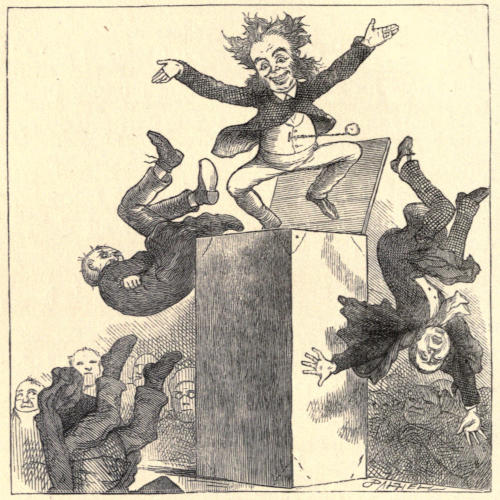
“My Lord,” said the lady, “here is his heart; I have offered it back to him often, but he always said he did not want it, he wanted mine.”
FROM BOX TO BOX.
So saying, she pulled out of a neat little chatelaine bag which hung at her side a small bundle wrapped up in silver paper.
“Are you willing to give it back to him?” said Jaques.
“With all my heart,” said she.
No sooner were these words uttered than a tremendous hurrah rang out from the box in which the witness was enclosed, and John Doe proved the upstart character Victoria had given him, by bursting the lid of the box open and starting up in the air, sending the ushers upon it flying, and, jumping out on the floor, he rushed up to the dock and gave the prisoner a great hug.
To this she replied by giving him a tremendous box on the ear.
“What!” said he, “did you not say you would give me all your heart with my own?”
“Well, you have me there,” said she; “but you must take the whole or none. When you asked for my heart, you asked for my hand as well, and you must take the one with the other,”—giving him another box on the ear.
OH GOODY!
The curious thing was, that from each box a number of little round things fell with a clatter and scattered themselves on the floor.
The noise woke the Clerk, who, starting up, called out, “Silence in the court!”
The hubbub still continuing, he shouted, “What is all this?”
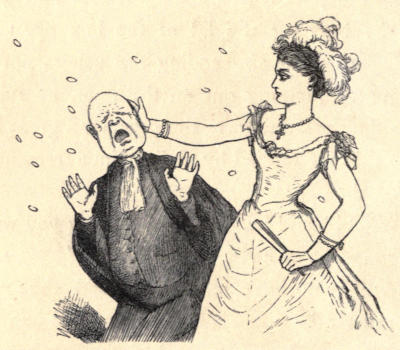
“Oh, nothing,” said the lady, skipping out of the dock, and administering a box on the ear to the Clerk; “only boxes of Victoria Lawsenj’s.”
“Lozenges!” shouted the jury. “Oh, give me some!” cried everybody.
BEST MIXTURES.
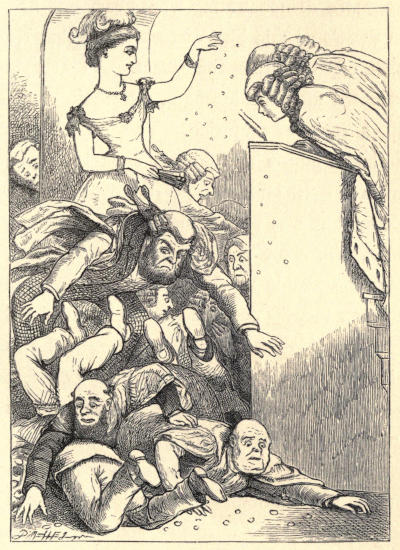
VICTORIA’S RAIN.
“Certainly,” said she; and before you could count 10, the whole of the jury, counsel, ushers, and spectators were sprawling on the ground, showers of lozenges falling in all directions,—thus once more demonstrating what every one knows, that there’s no rain like Victoria’s, and that Royal Boxes often contain the sweet. As everybody scrambled after the lozenges, the whole court became a scene of confusion. The boys, however, who had a notion that judges must be dignified, remained quite still, only peering over their desks to see what was going on. As the boxes continued, the court got ankle-deep in lozenges, in which the people tumbled about, cramming them into their mouths and pockets by handsful. The pile rose so high that Ranulf could resist the temptation no longer, but with his long pen drew a lozenge towards him, and keeping as grave as he could, stooped down and picked it up. As he had been taught not to be selfish, he broke it in three and handed two of the pieces to Norval and Jaques. They were just going to eat them, when the lady called out—
“Oh, boys, surely you would not eat what was picked up off the floor! that would be being bad judges of sweet things.”
VIRTUE REWARDED.
They stopped at once. Ranulf could not help casting a wistful eye at his bit of lozenge, but getting the better of himself, he threw it down, and the others did the same.
“That’s right,” said the lady; “so now you will not get a Victoria Lawsenj box on the ear, like the other stupid people tumbling about there: here are some nice clean sweetmeats for you.” So saying, she handed each of the boys a lovely little box, made of chased gold and blue enamel, and marked out in diamonds on the lid, “Genuine—our own manufacture.” A prompt “Thank you” came from each judge’s desk; and on the boxes being opened, the boys found in them, not the common lozenges that were flying about the floor, but most lovely bonbons, which tasted more delicious than any they ever had before.
Meanwhile the scene in court baffled description. Everybody was cramming himself with lozenges, which, strangely enough, set them coughing furiously.
PREPARE TO CHARGE.
“Don’t you think we had better get out of this Babel?” said the lady.
“I think so,” said Ranulf; “but how can we do it?”
“Oh, well,” said she, “I will manage it; I will even charge the jury, if necessary.”
So saying, she took little Ranulf up in her arms, and telling the other boys to keep close behind her, turned and said to the jury—
“Now it is quite evident you have agreed, by the way you are over-eating yourselves, so you can return your verdict.”
“No,” said the foreman, “don’t hurry us; we are not ready.”
“Oh, come, that’s nonsense; surely you can give it tout de suite, after swallowing so much sugar.”
“Well, we must be charged first.”
“Oh, I’ll charge you.”
“But how?”
“At ever so great a rate.”
CHARGING THE JURY.
“Stop a minute!” cried one.
“I seconds that motion,” said another.
“The motion of seconds is too fast for minutes to be stopped; besides, they don’t belong to us, not being hours, so we have no right to stop them.” So saying, she charged across the court, tumbling the jury over on the top of John Doe in the middle of the lozenges.
“Don’t do that,” gasped the jury, “and we will pay you whatever your charge may be.”
“Oh, there’s nothing to pay for the lozenges. We don’t sell ourselves, we only sell other people! Ta, ta” said the lady, and led the boys out at the door. On reaching the entrance, she bid them good-bye, at which they looked rather blank, as they had hoped she would stay with them; and seeing this, she said—
“My dear boys, I cannot come with you, as it is time for afternoon tea, and I must have that. T comes before U, does it not?” So saying, she kissed them, and passed them out at the door.
OMINOUS BUS.
As they stepped into the street a voice shouted,
“Take your seats, take your seats! Blunderbus just going off!”
The boys turned round and saw a short fat gun, evidently an infant of the Woolwich infant. On a sign on the wall opposite it was painted “DOUBLE ACTION BLUNDERBUS CO𐞲. (unlimited).”
“Why does it point up so much?” asked Jaques.
“Well, ye see, sir, the street ’ere is pretty steep; that’s how it’z erranged mortar-like.”
“Which way is it going?” asked Norval, not wishing to return by the street they had already walked along.
“Both ways,” said the conductor. “Hinside passengers one way, houtside t’other.”
“How do you manage that?” asked Norval.
“Himproved happlication of Mongrieff’s recoil utilizer. When we goes hoff, hinside passengers blown to Hattems, houtside recoils with shock and ’orrer in hopposite d’rection.”
MISS MANAGE MEANT IT.
The boys at once resolved they would not go inside, but from curiosity ran round to look into the gun. They found, packed very tight in it, three wooden soldiers, a grate party with two brass dogs at his feet, a dancing nigger, a Miss Manage—who, being on her way to an archery meeting, had a beau by her side—a dumb-waiter, and a snob.
This reassured the boys, who, not wishing to go up the steep street towards which the gun pointed, clambered on to the top. They were scarcely seated, when a clown with a red-hot poker rushed out of the coach-office, and applied the end to the touch-hole. Immediately there is a fearful bang, and the Blunderbus starts backwards. The inside passengers fly down the street helter-skelter, except Miss Manage, who keeps herself collected, shooting out gracefully à la Zazel, being, alas! a sell for her beau, who wishes to cut his stick; but she, without a quiver even in her eyelid, holds on to him as he talks of flight, turning ashy pale at such a narrow escape. Not having forgotten the excellent rule to have two strings to your beau, she had made a bolt impossible.
AGUNNY.
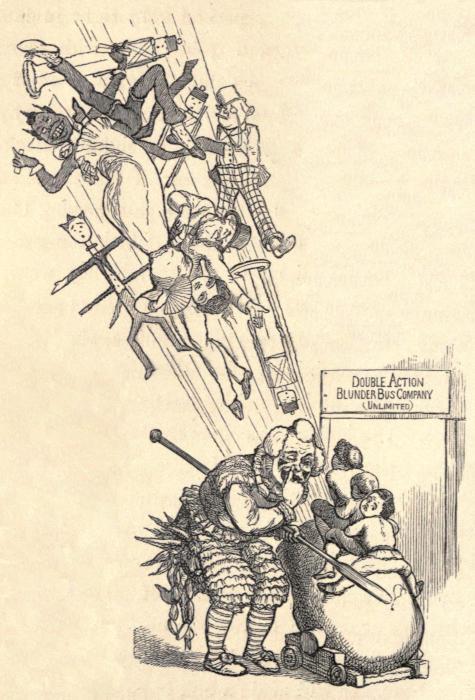
The dumb-waiter, cured by what would make most people speechless (a proof of the truth of homœopathy), flew in all directions, shouting “Yessir, yessir!” The wooden soldiers pulled themselves together for a moment to salute an officer who was passing, which they did with the wrong hand, and then sped on in more fragments than before. The grate party was smashed so small that even his dogs did not know him; the nigger’s nether limbs went off down the street by themselves, and were at once apprehended as black-legs by the police, while the rest of him formed a kind of Black’s Atlas upon the pavement. The snob, as was natural, disappeared in any number of vulgar fractions.
HEAVY BACKING.
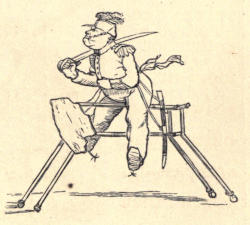
The Blunderbus ran back at a great pace for a mile, butting over two Papal bulls, sending spinning mules without number, and ended by knocking ten feet out of a square yard, in which a regiment of soldiers was being drilled.
SUCH A STATE.
Our trio, who had been rather alarmed during their ride, jumped off the gun the moment it stopped, and, as boys will always do, ran off to look at the soldiers. On getting near they were surprised to see that each man had a nigger lady beside him. While they were wondering what this could mean, the Colonel, who wore a shell jacket, and had a husky voice, rode up on a clothes-horse, and handed Norval a parade state, which was as follows:—
Twoty-tenth Boshshire Ruffs, 37th Marchuary 7718.
Present with Leave. Present without Leave. Absent in Mind. Absent in Body. Tea Tottles.
Kernels, 0 1½ 1½ 0
Ragers, 0 2¾ 2 ¾
Catpins, 0 7.09 5 2.09
Bluelandlords, 0 10 10 0
Scar Gents, 0 15.4 0 15.4
Noodlers, 0 11 11 0
Fank and Rile, 0 550.7 550.7 0
T Tottles, Add them up for your self.
A. NUTT, Kernel of the Core.
BROWN BESSIES.
“How is it,” said practical Jaques, who observed that the men had only wooden guns, “that your men have no rifles?”
“Well, sir, we don’t go in for new-fangled notions here,” said the Colonel; “we hold on to our Brown Bessies, as you see.”
All the nigger ladies grinned tremendously at this, and called out, “Ya! ya! dat all right, Massa Kurnel.”
“Will you keep those brown Bessiers stock-still?” shouted the Colonel to the men; “if you don’t, you shan’t have any ball.”
At this everybody looked very blank, and the Brown Bessies became suddenly immovable. The Colonel then gave the word of command—
“Boshshire Roughs, ’Shun.”
All the men at once turned away, and put their hands in their pockets, displaying the most contemptuous indifference to the brown ladies, who now were all attention and smiles, trying to coax the men to turn to them again.
GREAT SHAKES.
“Will you inspect the corps?” said the Colonel.
The boys walked down to the end of the line, whereupon the band, which consisted of one fife and 29 triangles, struck up—
Tinkle, tinkle, little Shah, Did you ever see a nigger with a white papa? Pickaninny here and pickaninny da, You’ll never find a single darkey, ha, ha, ha!
As they came near the line, the Colonel took from his pocket a magnifying-glass as big as the crown of a hat, and handed it to Norval, who asked—
“What am I to do with it?”
HE LIKE A SOLDIER FELL.
At this question the entire regiment burst into a tremendous guffaw, laughing till the tears ran down their cheeks, and the whole line was a scene of pocket-handkerchiefs, each being as big as a Turkish-bath towel, and as there was a high wind, of course this caused a great fluttering and shaking. The boys thought this very unlike the soldiers they had been accustomed to see, particularly as the officers and sergeants laughed and shook more than the men, and the Colonel, going off into a broad grin, laughed and grew so fat that his very steed became infected, and losing half its understanding and all its breeding, indulged in a horse-laugh, which shook it so that when the rider fattened, it sank under his weight, bringing him plump to the ground. A fatigue party had to come to his assistance, and when he had been propped up by two long crutches, one on each side of his horse, he tried to speak, but could scarcely get on for laughing.
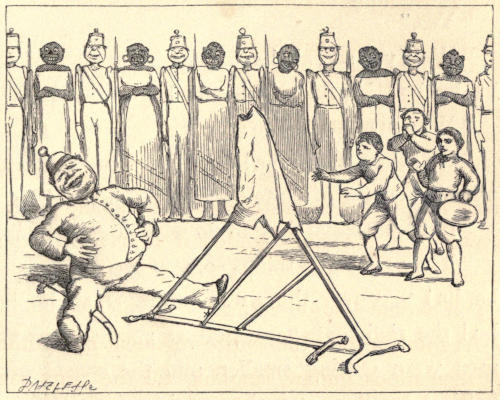
“You want, ha, ha, ha! to know, ho, ho, ho! what the big glass is for?”
“Yes.”
“Well, you see, ah, ha, ha, ha! it’s because of, ha, ha, ha, ha! Mr Sadpebble and Lord Guardsell.”
“Who are they?”
“Oh! they, ha, ha, ha! were the mime primister and skekentary of skate for raw, ho, ho, ho!”
“But what have they to do with the glass?”
SMALL BY DEGREES, ETC.
“They managed things so, you see, ha, ha, aha, ha, ha! that everything was getting small, ho, ho, ho! the regiments were getting smaller, and the men were getting smaller, and the chests were getting smaller, and the efficiency was getting smaller, and the contentment was getting smaller, ha, ha, ha, ha! so they, ha, ha! they, ha, ha, ha! they, ah, ha, ha, ha! they took to military spectacles to make things look better.”
“But surely no one would be deceived by that?”
A LAME HALT.
“Oh yes, ha, ha, ha! they deceived the general.”
“Which general?” said Jaques.
“Oh, we’ve only one general here—General Public—he’s the boy for mobilisation, oh, haha, haha, ha!”
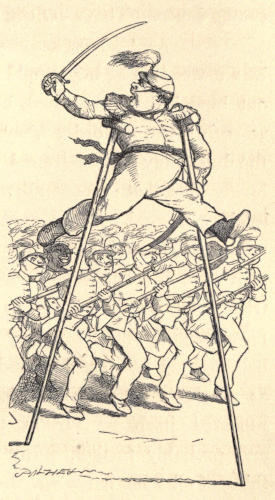
He laughed so loud and shook so much that the crutches, trembling under him, stuck in the ground, and his horse, walking off, left him up in the air between the crutches. This did not seem to disconcert him at all, but brandishing his sword, he shouted—
“Battalion, halt!”
As the regiment was standing still already, the boys thought this a very funny order to give; but they were more surprised still when they saw the whole line set off marching, all limping as if they had blistered feet.
“Very well, very steadily done,” said the Colonel, as they came bobbing and limping towards him, like a lot of ducks in a thunder-storm. Presently, on their coming close to him, he shouted—
PUSSIAN TACTICS.
“Double!”
At this they all turned round and went off in the opposite direction, limping slower and slower.
“Surely that’s wrong,” said Jaques; “that’s right about turn; they should have gone straight on and faster.”
“Not at all,” said the Colonel; “in our movements we follow Levrett’s manœuvres.”
“But that’s not the way to double march,” said Jaques.
“Oh yes, it is. Did you ever see a March hare double? Well, we double just as he does. Pussian tactics, you know.”
Without waiting for an answer he cried—
“Discharge!”
and gallantly going at the head of his men on his crutches, shouted “Victory!” After they were brought to a stand at one end of the ground, he gave the order—
“Stand a tease!”
Upon this the Brown Bessies turned round upon the men and began to plague them most horribly, pulling their hair, poking fingers into their ears, and pricking them with pins. The men stood it for some time wonderfully, but at last began to bawl out.
LOOK TO YOUR DRESSING.
“No bawl practice without my orders!” shouted the Colonel; and then tremendously loud—
“All dress!”
Everybody immediately stopped. The Brown Bessies at once produced combs and brushes, and commenced a vigorous hair-dressing, and the men began putting on white kid-gloves.
“What is the meaning of that?” said Ranulf.
PRESTO! CHANGE!
“Preparing for ball practice,” said the Colonel. “In our tactics we go in for leading the enemy a pretty dance. That’s far the best way.”
“Change ranks!”
he shouted. The boys could not afterwards make out how it had happened, but the Colonel had scarcely given this order when, instead of being on the dull, dingy parade-ground, they stood on a most lovely floor that seemed all to be made of ivory inlaid with gold. The Brown Bessies were brown no longer, but fair ladies beautifully dressed; the men were in splendid costumes; the band had no triangles, but discoursed most lovely music. The boys, looking round, saw they were in an immense hall, lighted by ten thousand wax candles; and as all the walls were mirror, the brilliant scene repeated itself as far as the eye could see, and probably further. But the most beautiful thing of all was, that when the ladies and gentlemen began to dance, instead of bouncing about in a crowd, bumping and knocking one another, each couple floated from the ground, gliding along in the air smoothly and gracefully; and as the music rose and fell, fast and then slow, they flew, now in joyous bounds, now gracefully circling in soft dreamy waves, now whirling with birdlike speed, anon wafted along like a gossamer borne on the almost motionless air of a summer day; the measure having always such grace and ease in its fury, such firm-swept curve in its calm, that the little fellows stood gazing in rapt delight.
SOMETHING LIKE DANCING.
When the dance was over, half the mirrors on the walls folded back, moved by unseen hands, and the ladies and gentlemen strolled out to a lovely terrace, rich with flowers of every hue, where fountains threw water in sparkling diamonds to the sun. As each couple emerged from the building, a flower that grew on the parterre detached a lovely blossom, which, floating in the air towards them, growing ever larger and larger, moved wherever they turned their steps, shading them from the sun, and surrounding them with its perfume. Strange, too, that it did not appear to be matter of chance which flower performed formed this friendly office, for the blossom that floated over the heads of each pair that roamed the garden, was always of a colour harmonising admirably with the costume beneath. A couple dressed in pale blue were attended by a primrose; two that wore green had a lovely snow-white lily for their shade; a third pair, who were in white, rejoiced in the protection of a scarlet geranium; and a fourth, in a pearly grey, had a most delicate pink blossom for their attendant.
HARMONY OF COLOURS.
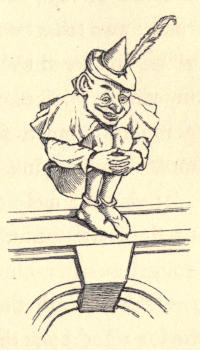
It was a lovely sight, but small boys soon get tired of the beautiful unless there is some fun going; so after our trio had gazed for a time on the people with their varied dresses, they began to long for something more exciting. Looking about, they saw at one end of the lawn a large gateway, and started off at a run to see whither it led. On getting near the gate, they observed a funny little man sitting on the arch above it, who, the moment they came up, said, “Put them down.”
“We don’t carry anything,” said Norval.
WHAT’S HE UP TO.
“Yes you do, though,” said the little man. “What names do you bear?”
The boys told him, at which he gave a triumphant sniff, and said, “If you bear names, look at your dictionary and see what bear means. My dictionary says it means carry. Don’t carry them any longer; put them down.”
“What is he up to?” said Jaques, bewildered.
“Up to the top of the door, don’t you see, stoopid?” said the little man. “Sometimes I’m up to anything, but just at present I’m only up to the top of a door. Why do you make me a contradiction of myself?”
“But we don’t,” said Norval.
DOWN, DOWN, DERRY DOWN.
“Oh yes, you do. Here I am up at the top of the door, and yet you make me be down upon you at the same time. It’s very inconvenient to be put in two places at once; so don’t do it again, that’s all.”
“But you can’t be in two situations at once,” said Jaques.
“But I say you can,” said the little man, “and more than two. You can be in the heat of an argument, in the middle of a cold audience, in the wrong box, and in the hope of getting out of it, and in a great mistake in thinking so, all at once. So once more I say, put them down.”
“But what are we to put down, and where are we to put them, whatever they may be?” said Norval.
“Didn’t I say your names (everybody visiting towers should put down their names)? and where would you think of putting names down but in a book, I should like to know?” said the little man.
“But where is the book?” said Jaques; “I don’t see any.”
“Oh, most ill-informed little boy! in the visitors’ book, to be sure.”
WRITING UP THE BOOKS.
“But where is it?”
“You know that best. Surely you know where your own book is?”
“But you said the visitors’ book.”
“Well, and are you not a visitor? so if you put it down in your book it will be in the visitor’s book, won’t it?”
This seemed to be nothing short of downright nonsense to the boys; but to please the little man, they took out their pocket-books, and gravely wrote their own names in them.
“Now, let me see,” said the little man, producing a pair of spectacles with eyes as big as saucers.
They held up their books, and the little man took a glance through his spectacles. The moment he saw the writing he gave a start of surprise and disgust, and nearly tumbled off his perch.
“Woe is me!” he exclaimed, wringing his hands. “Is this the effect of Education Acts and School Boards? Why, they are upside up, when I told you it was down they were to be.”
ON THE KEY VIVE.
“But they are down in the book,” said Norval.
“No,” said the little man, sorrowfully, “they are not even that. They are up at the very top of the page, all of them. Oh dear! it upsets me completely,” he added, as, bending down, he raised his legs in the air and stood upon his head.
“Ah, now,” he said, “it is all right! they are down now. You see if I were standing on ceremony I could not have let you pass, but standing on my head heals up the difficulty. It’s a pate-nt way of my own. Now you may pass on.”
“But the gate is not open,” said Jaques.
“Well, open it,” said the little man.
“But we have not got a key.”
“Well, then, if you have not got A key, try the key of B.”
Jaques looked puzzled, and said, “I don’t understand.”
STACCATO PASSAGE.
“There,” said the little man, pointing to a rope attached to the bolt of the gate—“you’re A flat; B E sharp now, and C what F-ect ten or a dozen treble G-erks applied altogether to the bar at the base there may have in the D-velopment of a passage.”
This speech made the boys look at one another, and laugh. “Well,” said the little man, “passages generally do open with a chord seem funny as it may; so just try.”
At this, Norval seized the rope, and, tugging it vigorously, the gate swung slowly on its hinges.
“Ah! what lovely opening bars!” cried the little man, beating time with one leg; “there never was a passage better done on the P an’ O.”
The remark may be made here, in passing, that a match against time with both legs is common, but to beat time with one leg! extraordinary feat!!! The passage must have been very legato, or it could not have been done.
When the gate was fully open, the boys all said, “Thank you.”
“Oh, never mind thanking me; it’s been a case of stuck-at-a passage long enough; get through it in treble quick time, and be happy.”
THE TALK OF THE HOUSE.
No second bidding was needed, and the little fellows, running through the gateway, found themselves in a courtyard in which stood a high tower, whose stones looked like transparent green glass, and the lines between them as if raspberry-jam had been used for lime.
After looking at it for a few moments, Jaques exclaimed, “I wonder what the tower is for?”
“Nothing at all at present, thank you; I’m not ’ungry,” replied a forte voice, in somewhat stony accents.
“Why, it can speak,” cried Jaques, quite astonished.
“Of course I can. If ’ouses may talk, why should not I?”
“But houses don’t talk,” said Ranulf.
BIGGARLY ARGUMENTS.
“’Ouses don’t talk, don’t they? Ha, ha, ha!” shouted the tower, till its sides shook so that the boys were afraid it would tumble, and its tiers would have fallen, only they had not the cheek to run down. “Ha, ha, ha, ha! So you think ’ouses can’t talk. Now I’ve ’eard it said they talk too much. Look at the ’Ouse of Commons, and you’ll see that you never made a Biggar mistake; it seems to do nothing but talk.”
“Ah, but,” said Jaques, “that’s different; it’s not a great high stone thing, like you.”
“Not stone, and not ’igh! Is that all you know? Isn’t a glad stone always getting up in it, and ain’t the dizzy ’ights at the top? But I shan’t talk to you hany more.”
“Why not, please?” said Jaques, timidly.
“Why not! you are not a purpose, nor a heffect, nor a hend,—are you?”
“No,” said Jaques.
“Then I shan’t talk to you. When I talk I always talk to some purpose, or to some heffect, or to some hend. I like the last best. Give me some hend to talk to, and I’ll talk no hend.”
“Some end of what?” asked Norval; “is it the end of a stick, or a cigar, or what?”
“Oh, to the hend of time, or hanything. Make a hend of yourself, and you will see how I’ll talk to you then.”
FORTITER.
The boys did not quite see that to be the talk of a tower was a sufficient temptation to suicide, so remained silent.
“Well, I’m glad, at all hevents, you’ve made a bend of something; making a hend of speaking is better than making a hend of nothing. Now that you’ve made a hend, I can talk to it, if you will promise that the bend will attend to the hend, that the bend in view may in the bend be brought to a hend, and that——”
“Why,” said Norval, interrupting, “I beg your pardon, but you said you would talk no end, and it seems to me it is all end together.”
REVIEWING EXTRAORDINARY.
At this the tower completely forgot itself, indeed went off into a towering passion, and stormed away for ever so long. Some people may think that it is strange a tower should storm itself, instead of being stormed; but the fact was that its mortar being ill tempered, it exploded spontaneously. The way in which a tower flies into a passion is very difficult to describe, and it will not be attempted here. Suffice it to say, that of course it used its wings. Its rage was so great as to make it speechless, which, from the rubbish it had been talking on end before, was just as well, for though it kept on end, it did so silently. The boys began to walk round it, and on getting to the other side, they found a very low door, over which was a large placard:—
VISITORS WHO HAVE NO VIEWS OF THEIR OWN WILL FIND SOME AT THE TOP OF THIS TOWER.
Those who change their views charged extra.
FRAMES OF MIND FOR THE VIEWS MAY BE HAD AT MODERATE PRICES.
ADMISSION FREE. ON WHOLEYDAYS HALF-PRICE.
N.B.—Whatever goes in at the bottom must come out at the top.
By Order.
A. B. FEATER, Custodier.
MUST I, THOUGH?
Now “must” is a word that people are constantly telling little boys not to use, but are just as constantly using themselves in speaking to them. Accordingly it is not very surprising that when boys see the word “must” painted up in large letters, they should feel inclined to resist. When Norval, and Jaques, and Ranulf saw “must go out at the top” on the placard, their bump of combativeness at once became irritated; and, after a short conference, they resolved they would go into the tower, and would not go out at the top. Norval’s idea was that there was some one inside to catch anybody that entered, and force him to the top, so he told Jaques and Ranulf that he would peep in, if they would be ready to pull him back should any one try to take hold of him. He then advanced cautiously, and put his head in at the door. The moment he did so, he called out—
“OH H O L D M E!”
A NECKSCRESCENCE.
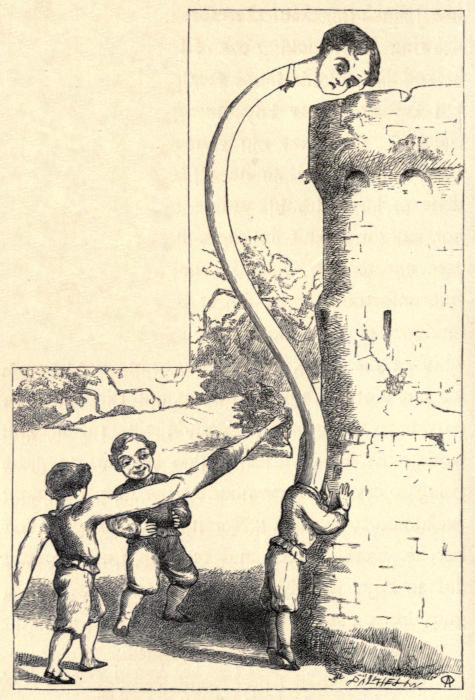
The “oh” was very loud, but the “hold” sounded more distant, and the “me” was so far off as to be difficult to hear. Jaques and Ranulf held on stoutly to Norval’s legs, but found they could not haul him out, though pulling with all their might. While they were still struggling, Norval’s voice behind them said, “It’s no use, you had better let them go.” On looking round they were amazed to see Norval’s head upside down just at their backs, hanging by a long neck, not thicker than a sausage, from the top of the tower.
In ordinary circumstances this would have shocked them horribly, but then wonders began to come almost as matters of course, and Norval’s head drooping down like a ball at the end of a string had such an irresistibly comical appearance, that they both burst into a loud fit of laughter, in which Norval himself joined most heartily. But when they had enjoyed their laugh, and began to look matters and Norval in the face, the puzzle was what to do; for they saw that to resist going out at the top would be useless, and feared that if Norval’s legs were released, his body would go out at the top and be smashed. After thinking a little, Jaques asked Ranulf for his top-cord, proposing to tie it to Norval’s legs, and let him down quietly. “Oh, but,” said Ranulf, “the cord would never reach so far.”
EXTENDED ARMS.
THE MISSING BOX.
EXTENSION MOTIONS.
PULLING, BUT NO PULING.
“Oh yes,” said Jaques; “don’t you see that whatever goes in at the bottom must come out at the top? so the string will get long if we hold it, just as Norval’s neck did.” This proved to be correct; for on tying the cord to Norval’s legs and letting them go, they flew up at once, and Jaques and Ranulf holding on prevented Norval tumbling over. But while Jaques was easing the cord down, by moving his hands forward, he thoughtlessly brought them within the doorway, when at once his arms flew up the tower, and Norval had in his turn to assist Ranulf to hold Jaques, whose hands shot out at the top of the tower, and hung down behind them as Norval’s head had done before. Norval and Ranulf began to get the cord ready to let Jaques down safely in his turn, but Jaques (mechanical again) relieved them from the trouble by making use of his long arms. He seized each of his heels firmly in one hand, and bidding the other boys let go, eased his body gently up the tower, out at the top, and down to the ground, and then drew his hands out. The sight of him, with his monstrous arms, produced another burst of laughter, which increased when Jaques, wanting to give Ranulf a box on the ear[6] for laughing, found that his hand, instead of touching him, flew into a rhododendron bush ever so far down the garden-walk. Although neither he nor his brother could shorten their drawn-out members to their original size, still these were so far elastic, that they could draw them in to about half their enormous length, and throw them out again as they pleased. After they had experimented a little with their unwieldy projections, making them perform all sorts of antics, so that the three screamed with laughter, Norval took it into his head that he would like to have a look into the tower; for on his previous journey through it, he had been so hurried that he saw nothing—in fact, had gone through like winking. He therefore raised his head, drawing in his long neck, till he and the tower looked like a gigantic pewter pot with its handle. On getting his nose to the edge, he at once exclaimed, “Oh, what a jolly smell!” This excited Ranulf’s curiosity, so he at once rushed to the door to have a sniff, and to make sure he was not caught as his brothers had been, he took care not to put even his hands in at the door. But unfortunately he forgot the slightly Roman tendency of his nose, which, as he tried to get a whiff of the scent, flew up the tower, nearly poking out Norval’s eye at the top, and ran down the outside to the ground. Ranulf, who did not like having his nose pulled in this fashion, was just going to cry, but remembering the fairy’s caution, exclaimed to himself, “Not if I knows it,” pulled out his handkerchief, and turning round gently did as boys usually do when they have had to gulp down a sob.
“Now, then, get on,” cried Jaques.
“But what shall I do?” said Ranulf.
BRIDGING THE DIFFICULTY.
“Do! follow your nose, to be sure. Why don’t you come down by your bridge?”
“What bridge?”
“Why, the bridge of your nose. I’ll hold it steady for you.”
YOU BE BLOWED.
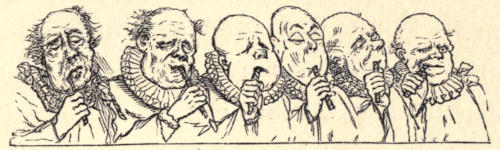
Jaques accordingly seized Ranulf’s nose in his long arms, and giving it a hitch round the lightning-conductor at the top of the tower, held the end slanting, making it hang like the rope for the terrific ascents of tight-rope performers, and down this improvised bridge Ranulf slid successfully to the ground, after which Jaques removed the hitch from the lightning-conductor, and Ranulf, who had a taste for the sea, coiled his nose neatly upon the ground, like a hawser on board ship, and taking the coils in his hand, threw them over his shoulder. His brothers seeing this, stowed away their slack also, and had scarcely done so, when there was a tremendous flourish of trumpets, and a being that might have passed for a pantaloon, as he was clothed entirely in golden trouser-legs (the Blunderland substitute for coats of arms) entered the gate. In reality he was a herald, although you would not have guessed it, as he wore no ruff round his throat Behind him strode six stalwart trumpeters, each of whom, instead of blowing his own trumpet—as is too common nowadays—held his instrument to the mouth of his left-hand neighbour. There was an awkwardness about this arrangement, however, for the man at the right end of the line had no trumpet for his mouth, and the man at the other end had no mouth for his trumpet. But in Blunderland, difficulties which elsewhere would be thought insurmountable are soon overleapt. Accordingly, the sixth trumpet was managed thus: The moment the others were raised, trumpeter No. 1, who had no instrument, looked hard along the line, and called out, “No. 6, you be blowed!” and as obedience is the rule in Blunderland, as opposed to what occurs elsewhere, this command was quite enough to make trumpet No. 6 tootle-ootle away as loud as the rest.
TRUMPERY OBSTRUCTION.
It seemed to be the business of these trumpeters to make as much noise as they could whenever the unfortunate herald opened his lips to make his proclamation. The sort of thing that went on was this: The herald, having unrolled his paper, cleared his throat, of which there was much need; for if there was no ruff outside, that was more than could be said of the interior. If he had had colera he could not have been more nekroky.[7] Having given a hem, long enough to go round the skirt of a lady’s dress, even of modern proportions, he began to read—
“Roy——”
Instantly his thread was broken by tra ta ta, ti ta ta, tatata ta tum, tatatraratatata, from all the trumpets at once.
Another attempt to go on—
“—al.”
Tra ta t’t’t’a, t’t’a—tra ta ta ti ta ti tati ta tum ta tum ta, ta, ta.
TRUMPET STOPS.
A BLOWING UP.
When this had happened over and over again, the tra-ta-ta-ing getting louder and longer each time, the herald calmly sat down on the ground, laid aside his proclamation, produced from his pocket a gilt bladder, which he quietly proceeded to blow up till it was full of air, and fastened to the end of his baton by a string about a foot long. Having carefully tested its strength by giving it a few thumps on the ground, he rose, and recommenced reading his proclamation. Instantly behind him began once more the braying of trumpets; but before one tra-ta could escape, bang, b’ng, b’ng, b’ng, bang, bang came the bladder down upon the heads of the six trumpeters. This stopped five of the too-toos[8] coming from them, the whole six trumpeters being knocked out of time. But as there was nobody to take the blow for No. 6 trumpet, it was brazen enough to go on all by itself, as if it would be blowed if it would stop. The herald, however, evidently knew what he was about, for he ran to No. 6 trumpet and gave it such a blowing up, up its mouth, that nothing could get out for ever so long; indeed the air was too much for it, and it could not give it off even in parts; as for the bass, it could not get so low; treble X ecution was quite as impossible; the third part was ten or more notes beyond it; and the only remaining one was altogether so.
Having thus succeeded in obtaining silence, the herald proceeded to read his proclamation, and got through some lines before the trumpeters recovered sufficiently to commence their noise once more; when seeing them about to begin, he repeated the bang bang bang, bang bang, process with most excellent effect—and making about fifteen pauses to perform this operation, he managed to read the whole. In order not to try the reader’s patience, it is thought better to give it without the interrupting bangs—in fact, bang off.
WHEREAS, ETC.
By the King—
A Proclamation.
WHEREAS it is our will and desire to maintain a clear course, so that we may be kept placed in the races of the earth, and that our people may continue to have a handy capacity for all athletic sports, likewise to avert the risk of the mussels of our subjects getting limp at the end of our royal line by any shellfish a’baiting (after the barb’rous manner of the fishy policy of the Angles) of the care bestowed by it on generations yet unborn—
We have thought it would fit, with or without the advice of our Prating Council, and the Cakes of our Parliament, to appoint and declare, and we do hereby, by and with, or passing by and without the said advice, appoint and declare, that immediately, or even sooner, all who hear or do not hear of this proclamation, shall assemble without delay on a spot to be fixed by us at some future time, there to hold our annual games.
ODD JOBS.
And our will and pleasure further is, that prizes be awarded to those of our subjects who display the greatest skill in performing any of the following feats of agility and strength:—
I. Running up a bill with spears and ponds.
II. Taking a spring from a well in dancing pumps.
III. Carrying 6 Woolwich infants in an estimate.
IV. Handling a weighty argument, and hurling it at an adversary.
V. Knocking down a five-storey house by one blow of a hammer at the bidding of the purchaser.
VI. Carrying a measure with a Committee sitting upon it through two Houses.
VII. Keeping a gentleman in your eye when you have a stye in it already.
VIII. Carrying a crowded house along with you for three hours.
IX. Running a tremendous risk, and beating it.
X. Keeping time for the human race.
And such others as we may appoint.
GIVEN AT OUR COURT AT LUCKINGHAM ON THE 32ND OF APRIL 8177, IN THE ONE HUNDRED AND THIRTY-NINTH YEAR OF OUR REIGN.
A BLOW FOR NO BLOW.
STICKY.
AN EXTRA HAND.
HONOUR BRIGHT.
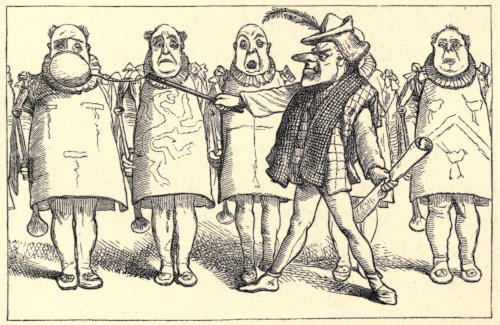
The herald having completed the reading of the proclamation, evidently expected that, the proper time having now arrived, his trumpeters would blow a vigorous flourish, as in duty bound; but instead of this there was dead silence, all the trumpeters standing stock-still, with their hands hanging at their sides, and mouths wide open. At this the herald got white with passion, the choler rose so at his throat that he could bear it no longer, but cut up rough, the cuffs flying from him in showers, till at last he burst the bladder with a terrific bang on the nose of No. 1, who took no more notice than if he had been made of gutta-percha. The herald calmed down as suddenly as he had flared up, and after looking at the motionless figures for a moment, quietly remarked, “Oh, I’m in no hurry, I can wait,” produced from the pocket of one of his many trouser-legs a copy of ‘Enquire within upon Everything’—a book much studied in Blunderland—and commenced reading, evidently in the hope that he might in course of time come upon a receipt that would enable him to settle the hash of his saucy attendants. The trumpeters could have borne any amount of violence, but the herald’s tactics were too much for them; so before he could get his spectacles adjusted to commence reading, they all placed their trumpets to their mouths, and blew a most elegant tootle-ootle, at which the herald, smiling sweetly, turned and said, “Thanks, thanks, my children!” and producing a box from another pocket, handed each of them a stick of barley-sugar. Now no one will think it surprising that the sight of a free distribution of barley-sugar should be rather exciting to three small boys like our heroes. And although they had been well taught that little men should not thrust themselves on people to ask for things, still, being in Blunderland, it is not strange that they should be a little infected by the character of the country, and do what would have been not at all good manners anywhere else. So Jaques, taking advantage of his long arms, unwound one of them, and passing it round to the back of the trumpeters, thrust it out between two of them. The herald, quite unsuspecting, placed in it a stick of barley-sugar, when it was instantly withdrawn, and Jaques handed the barley-sugar to his elder brother. Repeating the process, he succeeded in getting sticks for Ranulf and for himself, the herald being in great astonishment, as he found that though he had given out more than six sticks, and the trumpeters were all sucking away furiously, there was always an empty hand stretched out from some quarter or another for more. Looking behind the trumpeters, all he could see was what he took to be a garden watering-pipe lying on the ground, but which was in reality Jaques’ arm. Not to be beaten, he muttered to himself that he would go on till he found it out; so, to the boys’ great delight, kept putting sticks into Jaques’ hand, until his box was empty and their pockets full. They felt, however, when all was over, that while it might not be of great consequence, still, to be little gentlemen as they ought, they must not leave matters unexplained; so, after a short consultation how it was to be done, Jaques’ hand again appeared between the trumpeters holding all the sticks of barley-sugar, minus one little bit that Ranulf, with a haste excusable at six years, but no longer, had nibbled off, and a voice behind the herald said, “Please sir, may we have them?” Turning round, he saw the three boys, and gazing at them with their coils, exclaimed in amazement—
“Why, you must be three rolls of endless wax-taper out for a walk!”
WHAT’S YOUR LITTLE GAME?
“Oh no; we aren’t tapirs,” said Ranulf, who, having a recollection of a beast with a long snout in his animals-book, thought this was a reflection on his nose. He felt very much inclined to put his fingers to it; but a sense of propriety, and a difficulty in finding the point of it among the folds, combined to restrain him.
“Then if you’re not tapers,” said the herald, “you must be sons of a gun, built on the coil system—Armstrong’s patent, eh? or perhaps you are in the still line?”
“Nurse never thinks so,” said Jaques. “She says she would like to see a little more of the still about us—that we are too full of good spirits.”
A POSER.
“And what is the still business for, except to produce good spirits; but,” said the herald, suddenly assuming a tremendous air of official dignity, “we must tarry no longer; the games are about to commence.”
“Oh, but please, sir, may we keep the barley-sugar?”
“Yes,” said he, and was going to add “but” something, only he did not get time, for his Yes was instantly followed by three Thank-yous, and three enormous bites at the barley-sugar.
“Stop, stop, stop!” he cried. “I thought you wanted to keep it.”
The boys knew that they should not speak with their mouths full; and having as much in them as good manners allow, they were compelled to nod.
“And how can you both eat your lollypop and keep it? There’s a poser for you,” said the herald, folding his arms, throwing back his head, and planting his right foot forward in a manner which plainly meant, “I poses for a reply.”
CONFLICTING DUTIES.
It was a poser in one way, for no answer could be given to it by nod or shake; and as the mouths were still full, it remained unanswered, the boys wavering between—
“Speak when you are spoken to” and “Don’t speak with your mouth full.”
The herald’s notion of his own dignity seemed to be greatly increased by there being apparently no answer to his question, which was just as well, for as he got full of importance he got empty of everything else (on the well-known principle of natural philosophy, that two things cannot occupy the same space at the same time), and so forgot all about his question.
While he was still posing, a mounted disorderly galloped on to the ground, shouting—
“Here, hi, hollo, you there! What’s yer name? How long d’ye mean to keep the king waiting?”
TAKEN ABACK.
In a moment all the herald’s dignity was gone. He trembled till his trouser-legs were fluttering all round him, like a cock’s feathers when he shakes himself, and cried—
“The king waiting! oh, oh dear!” gathered his trouser-legs about him, and fled through the gateway, like an old woman running in a shower of rain.
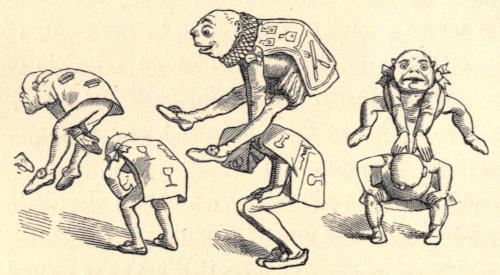
The trumpeters, thus relieved of the dread of the gilded bladder, blew a tremendous flourish, threw their trumpets in the air, and then the end one giving a back, they set off in leap-frog after the herald.
RACE-COURSE NOT COARSE.
DELICATE SHADE.
The boys made after them as fast as they could, soon outstripping them with their young legs, and on passing through the gate found the people assembled for the games. It was indeed a lovely sight. Unlike such gatherings among those who do not blunder, there were no thimble-riggers; no dismal niggers; no men with two black cards and a red; no shouts of four to one, bar one; no little girls with careworn faces and work-worn tights, faded and patched, performing on stilts to a consumptive drum and a time-defying flageolet; no display of paint, false hair, and falser smiles; no pouring in of sparkling gooseberry; no pouring out of wild and wicked words; no reeling and staggering; no shouting and brawling; no fingers in other people’s pockets, and fists in other people’s eyes. Such things are only to be witnessed in countries where the people have grown out of the condition of blundering, and have reached an advanced stage of civilisation and intelligence. Here in this yet unenlightened country things were quite different. The sight was lovely. The ladies and gentlemen whom the boys had seen before on the lawn, were here assembled, along with a host of other people of humbler rank, the rich costumes of the ladies and gentlemen contrasting with the less costly dresses of the lower classes, grouped as they were with the most charming harmony and accommodation of colours too beautiful for description, forming a sight never to be forgotten. The effect was made still more charming by the flowers that had sheltered the groups on the lawn being formed into a vast sun-shade above—a gigantic white lily, with its bell turned downwards, being the centre, and the circles going out from it in the most delicate gradations of colour through all the tints of the rainbow; the edges of this gigantic and gorgeous ombrelle being formed of enormous bright fern-leaves, the points of which, bending towards the ground, were by some unseen means kept gently waving, wafting the air charged with the fragrance of the flowers in delicious coolness over the whole assemblage.
In rather incongruous contrast to the elegance and luxurious refinement of the scene was the conduct of one individual, who, although he had a crown on his head, was rushing about with an apron on and a napkin under his arm, carrying dishes and bottles in all directions.
WEIGHTY.
“Waiter!” shouted a voice on one side.
The King. “Yessir.”
“Four sausage rolls, a hice, and three pops.”
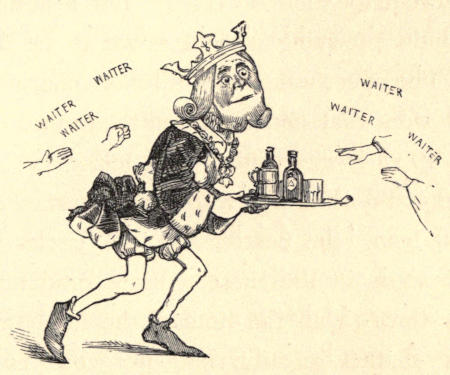
The King. “Yessir.”
“Waiter!” cried another.
The King. “Yessir.”
“Two ’alfs ’alf-and-’alf, an’ ’alf a sandwich.”
THE CORRECT TIP.
The King. “Yessir.”
“Waiter!” roared a third.
The King. “Yessir.”
“Cold beef and pickles, two brandies, and a split.”
The King. “Yessir.”
“Come along, king,” said a fourth, “attend to the comforts of your subjects.”
The King. “Yessir.”
“Two churchwardens and a screw of tobacco.”
The King. “Yessir.”
The poor king did his very best, and rushed about most energetically. He managed, like a good waiter, to keep up a considerable fire of chaff. A man having offered him a tip of 2s. 6d., he exclaimed, “Oh, sir, you cannot give a king less than a crown!” To a party who gave him 15s., he objected, “This won’t do, sir; I must have five more.”
“Why?”
“Three crowns is the Pope’s allowance. It takes four to make a real sovereign, sir.”
NO SPEAKING BACK.
But although trying to be as merry and lively as possible, he found it very hard work, and the moment the herald appeared, dropped his napkin, six plates of lamb and salad and eight pewter pots he was carrying, tore off his apron, changed a crown, and picking up his robe of state and his sceptre and ball, gave a royal wave of his hand.
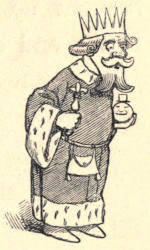
The herald was at once seized and brought forward, and, addressing him, the king said, “What, ho, thou caitiff! say, how hast thou dared so long to keep thy sovereign waiting?”
10 CARRIED FORWARD.
If the herald had been a log, he could not have remained more stolidly immovable. There was dead silence for a few moments, and then the king again spoke, “’Tis well thou knowest thou shouldest not dare to answer back to a king, for this is half thine offence pardoned. Canst thou bring forward anything why punishment should not overtake thee for the other half?” At this the herald did bring something forward, for he brought up one hand, and placing the thumb to the end of his nose, he slowly extended the fingers as far out as he could, and waggled them about, then he placed the thumb of the other hand to the little finger already stretched out, and extending his other fingers, waggled them too. The boys were aghast at thus seeing a subject making a long nose at a king, and still more when he finished by bringing his hand sharply up against his open mouth, producing a sound like the popping of a well-fitted cork.
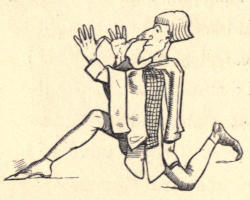
The king, however, seemed not at all struck in the way they were by the herald’s conduct, but turning to an attendant said, “Bring forward the whys man, that we may get the interpretation of these heraldic emblems.”
VERY QUEER EH?
The whys man was, as might have been expected, the querist man that ever was seen. Nobody could fail to see that he was a man of mark of interrogation, for when you looked at him you saw a great deal of curl at the head, and when you reached his feet he came to a stop.[9]
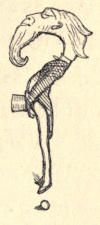
“Your Majesty, come and I obey,” said the seer.
The boys thought this bad grammar, and very rude on the part of a subject (not knowing that he meant, “Command, I obey”); for, as Norval said to Jaques, a subject giving dictation, instead of a subject being given in dictation, was contrary to all their school experience. But they were beginning not to be surprised at anything.
“Didst thou behold the mysterious signs just made by our herald? What mean they?” said the king.
AVERSE TO PROSE.
“Will your Majesty deign to say whether you desire to be answered with rhyme and reason or without rhyme or reason?”
“Whichever seemeth best unto thee, oh seer!”
“Then, seriously speaking, I would say that if a point of view be taken, such as those who take points of view, with a view to getting the point of view, that brings best into view the true view of the point, which ought to be kept in view, in the view of getting at the point——”
“Oh, stop, stop, stop!” cried the king; “which is that—‘with’ or ‘without’?”
“‘Without,’ sire,” answered the seer.
VAIN SOOTHE SAYING.
“Then, for pity’s sake, let us have with, if it will save us from being compassed with so many points. I feel pricked all over.”
Your Majesty shall be obeyed, Although in sooth I am afraid, A pointless rhyme is not the thing To lay before so great a king. You fain would know why herald’s nose By aid of fingers longer grows, And why by slap upon his mug He makes a hollow sound like “jug.” Methinks he by these signs would say, ’Twas well he stayed so long away. By sound of cork he first would tell, How waiting long, you waited well. Fired by desire for subjects’ weal, You ran about with plates of veal And ham, hot kidneys, bottled stout; In short, you wildly flew about, The slave of all, though monarch great, Good lesson in the cares of state. He next the royal attention draws, To all the tips on nose and paws, By which he plainly means to in dicate how ’twould have been a sin Had he by quick return to you Deprived you of the tips you drew, While you were waiting on your p- eople drawing corks and serving tea. Indeed he’d say, by him your pop ularity is now tip-top. He therefore claims a pardon free. The seer hath spoken.
WHINES FROM LOW SPIRITS.
“Fiddle-dee-dee!” cried the king; “to such defence I cannot listen. It may be with rhyme, but is certainly without reason. If it comes to anything it comes to this, that he kept me waiting so long in order that I might get tips, eh? That is seeking to give the king the sack. I would be mad ere I accepted such a mumm sham penitence. I declare it brand’ed as a shabbily-concocted whine; so turn from it, and laugh it to scorn. He shall have his mead. Summon the headsman, and let him whisk it off.”
The executioner at once appeared, set his block in front of the throne, felt the edge of his axe, advanced to the herald, and began to drag him forward.
“Friend,” said the herald (he had turned quaker at the sight of the block), “why dost thou draw this way?”
“Because my business is funny cuts,” said the executioner, giving him a sudden pull.
“Don’t ketch me up so if thou art a Jack in the box wood way; thou shouldst not put such hard lines on a fellow.”
“I call you rather knave than fellow,” replied the executioner, getting somewhat surly, “I don’t need you to tell me how to make the cuts on my block.”
HEADS OR TAILS.
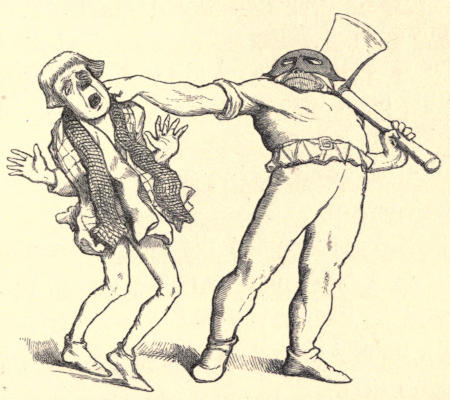
The boys began to feel rather uncomfortable at the idea of seeing a head cut off. They were somewhat relieved, however, to notice that the executioner and attendants, on getting the herald to the block, did not apply his neck to it, but made him sit down. They then began searching among the many trouser-legs that hung behind him, and were so long at this operation that Jaques, who, being a schoolboy, had an impression of his own as to what they were after, suddenly exclaimed—
“Instead of fumbling that way, why don’t you take dow——”
But care-taker Norval stopped Jaques’ mouth with his hand before he could get anything unmentionable out.
“We can’t find them, your Majesty,” said the executioner.
“Nonsense!” replied the king; “Darwin has put it in a book, and therefore there must be. Besides, the Family Herald has lots of tales; and what a Family Herald has, surely a Royal Herald can have too!”
TAIL-KETCHING.
At last they found them—two very small swallow tails indeed—one of which was duly chopped off, but the other spared, as the king had forgiven half the fault; and the executioner, taking his stand on the form used at Charles the 1st’s execution, lifted up the tail and solemnly said, “This is the end of a cratur.”
ONE LEFT ON, THE OTHER RIGHT OFF.
The herald looked very disconsolate, and the executioner, clapping him on the shoulder as he sat on the block, said to him—
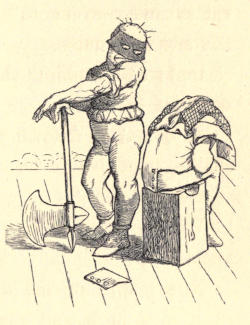
“How do you feel now, old boy?”
“No thanks to you for axing; your chop’s a very cruel kind of cut let’s say no more about it.”
“Pooh, my good fellow! you’re not so badly off; you’ve one all right.”
“No, I’ve one left—it’s the right one that’s gone.”
“Well, well, but you don’t need to have it left so; they’ll right you at any retail place in no time.”
“Enough of chops, and cutlets, and tails,” suddenly shouted the king; “now for the royal stakes—is that course ready?”
RACY ENTREES.
“Yes, your Majesty,” said the Secretary of Steak; “the entries are just over, and so the beef-eaters can come on now.” They soon got through the removes necessary, and the game course cleared; whereupon the king’s and queen’s suites were set in their places, including the cream of society, and a following which was quite the cheese.
“Now,” said the king, “every man shall have his desert. Go on with the heats,”—heats being apparently the Blunderland substitute for ices.
VERY DISTONGUEE.
This injunction made the officials warm to their work, so that all was quickly ready, and the competitors came running up to take their places. They were a funny-looking set altogether. There was a fast young gentleman, who looked as if he had not been in bed all night, but had just come out of a bandbox. There was a scarlet-runner, who was the pink of condition; a post-runner, who of course was clad in a mail suit; a fore-runner, who went sometimes on his fore legs, and sometimes on his four legs; and an old woman, who said she would warrant her tongue to go faster, and to run on longer, than anybody on the ground. A solemn discussion arose among the judges, upon the question whether a tongue could be allowed to enter for the race; and it was at last decided that it must not, as the race was a flat one, while the old woman’s tongue was more than usually sharp.
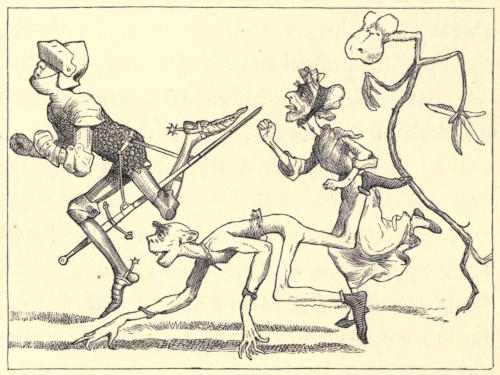
The aged dame was very angry at this, her much-despised member going on at such a rate, that she, when told to hold it, excused herself on the ground that it was going too fast to be caught up without a stretch of imagination, which, at her age, was quite beyond her powers. So, as her tongue could not be stopped, the police took a homœopathic process, and simply ordered her and the offender to “move on;” whereupon, with female contradiction, she did the very opposite, and moved off.
“That woman’s tongue is equal to any two,” said the clerk of the course; “so, if a couple more would like to come forward and take its place, they may do so.”
A PAIR OF SCREWS.
Thus invited, Norval and Jaques stepped out. Their appearance, with their coils wound round them, was that of a pair of screws, and this led the other competitors to look on them with contempt, apparently thinking that such well-hooped casks could never run.
But the boys paid no attention to the sneers. They intended to run for the sport of it—to win if possible, and to take it cheerfully if they could not; which is the proper spirit for all boys, young or old, when they are going in for a contest.
ELONGATED PROJECTILE.
OVERREACHING.
On the start taking place, the fore-runner was soon left behind, the post-runner found his mail suit rather heavy, the scarlet-runner proved to be only a creeper, and there were none left except the fast young man and the two boys. At first Norval and Jaques with their young legs got a good start, as the fast youth, not having been in bed, had forgotten to wind up his watch, and being unaccustomed to get on without tick, had to stop till he got it wound. But as the race was a long one, he soon made up for lost time, and it looked as if the boys would get the worst of it, for at the third round of the course, Jaques was many yards behind, and his brother also losing ground; when, to the surprise of everybody, Norval suddenly shouted “Neck or nothing!” uncoiled his neck, and collared his opponent by shooting it out to the winning-post. This feat was received with deafening cheers, which were redoubled when Jaques, taking the hint, threw his long arms out over the head of the fast young man, and vaulting on his hands, flew over him, far past the winning-post, and got in a second before him.
LOUD YET DISALLOWED.
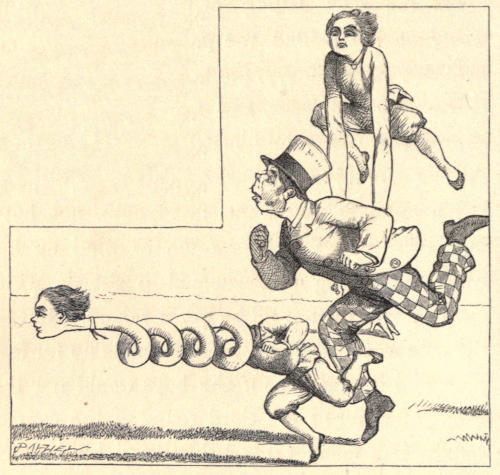
The fast young man lodged a protest, maintaining, in a style even louder than the style of his trousers, that Norval had won by neck-romantic arts; and that Jaques, instead of going on foot, had taken a fly, and so cabalistically over-reached him by craft. After the judges had looked very wise for ever so long—in fact, as long as Norval’s neck itself—they decided that the neck being a neck, it did not matter whether it was romantic or not; and as it could not be alleged that Jaques had used any other craft than handicraft, his using feats of arms for feats of feet was quite allowable, he having only availed himself of his own handy capacity; and that as to his taking a fly, it was not a handsome thing to call it cabalistic, and an argument that only a for weal or woe begone growler would think it fair to take his hackneyed stand on. Norval was therefore declared first, and Jaques second, amid loud applause; and the fast young man, with his views dissipated, went off a bad third.
The next race was a blindfold one. The competitors having their eyes tied up at the winning-post, were led back to the scratch, and started; the rule being that, if any one wandered to the side of the course and fouled the ropes, or went beyond the post without touching it, he was out of the race. Now Ranulf, who came forward to run, kept wondering to himself what he should do to win.
“You see,” he said, speaking to himself, “I’ve not got anything but a nose; and how can a long nose help me to see? and it’s the blindfolding that is the bother. If I only had an eye at the tip, that would be jolly, only it wouldn’t be fair not to tell them to tie it up too. What am I to do?”
A SWEET IDEA.
BACKER STOPPER.
Now Ranulf had still some of Victoria’s sweetmeats in his pocket, and Ranulf was a boy; so it fell out that when he felt perplexed and did not know where to turn, he, as a matter of course, thrust his hands into his pockets, and it followed naturally that the sweetmeats got into his hand, and that his hand set off on a journey to his mouth. They had a most delicious perfume, so strong that though Ranulf’s nose was wound round him so many times, the scent got through it into his head in a jiffy, or rather in a sniffy. The moment this happened, he began to rub his head very hard, as if something had struck him. He was struck, as it so happened; and although it was only by an idea, it had got so firmly into his head that it must have struck him pretty forcibly. He immediately set himself to work it out. When the competitors were ready to start, Ranulf shot his nose out up the course, sniffing for the first thing he had noticed lying on the side of it that could be discovered by smelling. It looked so funny to see this projection waving about, like some dozens of those long wooden serpents that they have at the toy-shops put end to end, that the whole crowd set up a tremendous shout of laughter. One man, however, did not seem to like it at all. He was the backer of another competitor, and rushed up in a very forward manner (particularly for a backer), shouting—
“I object; it’s not fair!”
ANTITIPATHY.
Upon this the umpires were at once summoned; and after being told what the matter was, one of them addressed the backer, and said—
“We understand you have some objection to this gentleman’s nose; state your proposition.”[10]
“He’s got his nose out in front of him; it’s not the correct tip.”
The referees again looked very wise, pursing up their mouths, as if the words that were to come from them were gold; and after comparing notes, one of them solemnly said—
“While it seems to the referees that it is scarcely their province to sit upon long noses, these not being matters of course, we think we are justified in holding that a gentleman who wishes to follow his own nose, and trust to his own tip, instead of getting a tip from anybody else, is entitled to do so.”
The backer at this got very excited, and shouted, “Nay, nay, but you surely won’t go so far——”
“Sir,” said the referee, sternly, “this is a foot-race, so you need not mount your high horse, neighing at us in that way. The referees have carefully considered the length of the gentleman’s nose, and, long as it is, their opinion goes that length. So let there be an end of it.”
The backer, seeing he could make nothing of it, marched off, muttering, “End of it, indeed! it’s no end of a nose that fellow’s got. There’s one comfort, it can’t be called a straight tip.”
SCENTENTIOUS.
All this wrangling had served Ranulf’s purpose, for it gave him time to con over his lesson. And a very funny lesson it was. He had observed all the smelly things on the sides of the course that the people in taking their refreshments had thrown on the grass inside the ropes; so his lesson went thus:—
Right side, Peppermint-drop.
Left side, Ginger-beer bottle.
Right side, Cigar-end.
Left side, Skin of onion.
Right side, Orange-peel.
Left side, Nosegay.
NASAL TACTICS.
The winning-post was opposite the place where the ladies and gentlemen sat, and of course they did not throw orange-peel, or anything of that kind, about. Ranulf had been greatly puzzled how to find his way there; but, luckily, a lady had put a splendid nosegay on one of the posts, and Ranulf, in going forward to be blindfolded, had a good sniff of it, so that he was sure he would find it all right.
At last the race began, and a very queer business it was; for the runners, in trying to avoid coming against the ropes, wandered about in the most extraordinary fashion. But Ranulf’s performance was quite irresistible, and it would have cured the worst fit of sulks in all the world just to see him for a minute, stretching out his nose, and working it from side to side, like an elephant’s trunk. He first found the peppermint-drop, up to which he rushed, winding up his nose on the ground like a coil of rope in a ship, then throwing it out again he found the ginger-beer bottle, and so on. He was rather put out by coming upon orange-peel just after passing the cigar-end; and when this happened, the puzzled look of his nose, as it caught scent of the peel at the wrong place, made the crowd roar again. The truth was, that some one in the crowd was throwing orange-peel; but, fortunately, a piece hit him on the nose, so that he guessed what was wrong, and with a bold sweep caught scent of the onion-skin from afar, and on he went, winning easily by a nose. The ladies were so delighted with this performance, that they all wanted to kiss him at once, and for a couple of minutes his nose was in great requisition.
WINNING A PONY.
In the distribution of prizes, Norval was made merry as a cricket by the gift of a golden bat; Jaques being declared entitled to an armful of toys, was able to claim enough to fill a bazaar by the aid of his long arms; and Ranulf, whose greatest delight was horses, rejoiced in a real Lilliputian pony of 25 pounds, the proper figure for a pony gained at races. When the prize distribution was over, the boys were led to the king’s table, on which an elegant feast was spread.
While they were enjoying it, there was a sudden flutter, and every eye turned one way.
BIG MAN—BIG FRIGHT—BIG WORDS.
“Oh, here he comes! here’s Blunderbore!” was the cry that rose on all sides.
“Blunderbore?” said Ranulf, turning rather pale; “that’s the giant with the awful teeth and the big club. I thought Jack had killed him. Oh dear, what shall we do?”
Norval did not feel quite comfortable either, but, seeing little Ranulf’s pale face, he forgot himself, and, trying to cheer him, said as bravely as he could—
“Never mind, Ranny; you know with my long neck I can make myself as big as he is, and I will brandish my bat as a club—perhaps that will frighten him.” He was not very confident of this, but put on as much appearance of being at ease as he could, so as to encourage his little brother.