Part 1 — CHAPTER III.
Reading edition
DIFFICULTIES OF EARLY ADMINISTRATIONS.
Meeting of First Parliament.—Amendment on Address in Reply defeated by Speaker's Casting Vote.—Adoption of Address in Reply.—Compromise between Parties Indispensable.—Successful Inauguration of Responsible Government.—The Governor's Egotism.—Mr. Herbert's Retirement.—Mr. Macalister Succeeds.—Financial and Political Crisis.—Proposed Inconvertible Paper Money.—Governor Undeservedly Blamed.
On the 22nd of May the session opened, and after members had been sworn in Sir Charles Nicholson, for some years Speaker in the Sydney Parliament, was elected President of the Council, and Mr. Gilbert Eliott—formerly an officer of the Royal Artillery—the member for Wide Bay, Speaker of the Assembly. Both Houses then adjourned for a week.
The Governor's Speech, which was of great length, having been delivered, the Address in Reply was moved in both Houses. In the Council the leadership had been entrusted to Captain Maurice Charles O'Connell, Minister without portfolio, who had long been in the Port Curtis district as a trusted official of the New South Wales Government, and in early life had served with great distinction as a British soldier in Spain. In the Council no difficulty arose in adopting the Address. But in the Assembly an amendment moved for the adjournment of the debate at an early stage was only defeated by the Speaker's casting-vote, one member being absent. It thus appeared that the Assembly was almost equally divided. This was a dangerous position to be faced by a new Premier without a day's previous experience in Parliament, and with the two most formidable debaters in the House, Mr. Macalister and Mr. (afterwards Sir) Charles Lilley, in active opposition. Mr. Herbert made a diplomatic speech, however, and the Address passed without much further contention. The division list showed that, despite the efforts of the Governor and his Premier to avoid identification with the squatters, the votes of the latter were essential to the existence of the Ministry, since the members of the Opposition consisted almost exclusively of town representatives. The following day (30th May) the Government nominee for the Chairmanship of Committees, Mr. C. W. Blakeney, was defeated by 15 votes to 7, and Mr. Macalister, who was nominated by the Opposition, was thereupon elected on the voices. The division of parties evidently made compromise indispensable to the passing of much-needed legislation. But much had been gained by the Government. All its members had been elected by the constituencies, and the Assembly had practically acknowledged that it was entitled to a fair trial. Seeing that for nearly six months Ministers had held their portfolios without parliamentary sanction, and had naturally made many executive mistakes during that time, it may be held that the first session of the first Parliament had been inaugurated successfully from the Ministerial standpoint. In his official despatches, as well as in private letters to friends in England, Sir George Bowen revealed himself as a genial though apparently unconscious egotist. His assumption of what must strike the discriminating reader as a dominating influence in the political and executive affairs of the colony was scarcely consistent with his position as a ruler representing the Queen, and competent to act only on constitutional advice. An impartial survey of Mr. Herbert's six years of office as Premier leads to the conclusion that chiefly to his judicious counsel and incomparable tact in the management of men the Governor owed the exemplary success attained in the organisation and government of the colony.
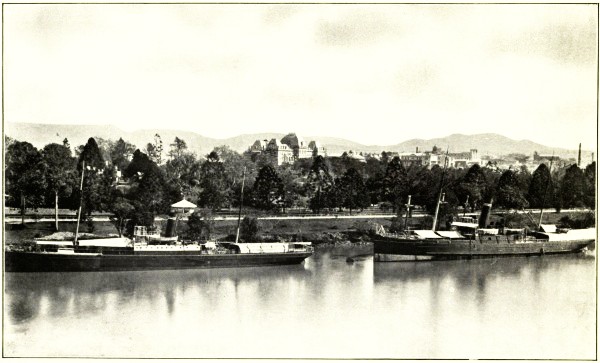
VIEW FROM RIVER TERRACE, BRISBANE
The Governor's complete if rather florid reports to the Colonial Office, however, justly evoked cordial responses from the Secretary of State. Sir George Bowen was a most capable man, but sometimes betrayed want of both reticence and dignity. He was enthusiastic as well as optimistic, and his retention in Queensland for the unusually long period of eight years is an unanswerable certificate of his official merit. Yet it is undoubted that when bad times overtook the colony in 1866 both the Governor and his Premier appeared to have outlived their popularity, though their combined action at that time for restoring the public credit was perhaps the most eminent service that either of them had ever rendered. Mr. Herbert had formed no ties in Australia; he had exercised supreme influence in the local Legislature; but now that there were several members with both natural capacity and parliamentary experience aspiring to the Premiership, believing that he had better prospects of preferment in the Imperial service, he determined to return to England. His subsequent long career at the Colonial Office justified his anticipations, and it may be safely said of his departure from Queensland that the colony's loss was the Empire's gain.