Front matter (continued 3)
Reading edition
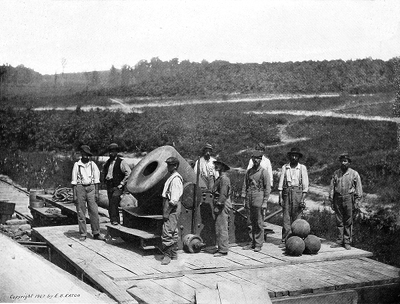
PHOTOGRAPH TAKEN ON GRANT'S MILITARY RAILROAD WHEN THE 13-INCH MORTAR "DICTATOR" OR "PETERSBURG EXPRESS" WAS THROWING SHELLS INTO PETERSBURG IN 1864
THE last days of 1864 closed with the Army of the Potomac and the Army of the James maintaining the siege about Petersburg. Nearly every hour of the day and night the air was filled with the roar of siege cannons and mortars. Brady and Gardner had several of their cameras at the siege of Petersburg. Many rare negatives are to-day witnesses of this great event. The picture shown on this page was taken during the siege. It shows the thirteen-inch "Dictator," known as the "Petersburg Express," mounted on a flat freight car made strong for this purpose. It was on the military railroad outside of Petersburg and moved continually along the line, throwing its huge death-dealing bombs into the city. Some of the mortars were mounted on very strong, special-made cars, protected with roofs of railroad iron. Grant's line was twenty-five miles long, but with its parallels extending over ninety miles. The two forts nearest the city of Petersburg were known by the soldiers as Fort Hell and Fort Damnation. From their casemates the movements of the soldiers of the beleaguered city were distinctly visible. The guns of these two advanced forts were never silent. At nightfall, the pickets, with one hundred and fifty rounds of ball cartridges, left for the outposts, and many of them never returned. The night was made hideous by the roar of huge siege guns, the sudden crashes of musketry and the crack of rifle shells. The openings of the breastworks were so filled with shot during this siege that in time of truce the soldiers would dig the narrow openings out with their fingers. On the next page is shown a photograph taken April 2, 1865, in Confederate trenches at Petersburg just after their capture by the daring Union troops.
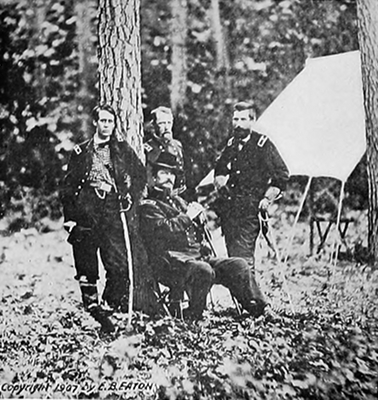
GENERALS HANCOCK, BARLOW, BIRNEY AND GIBBON
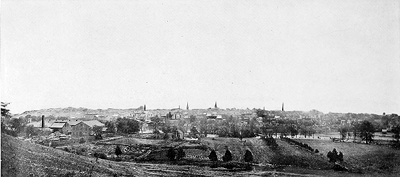
SIEGE OF PETERSBURG, VIRGINIA—PHOTOGRAPH TAKEN JUST BEFORE ITS FALL IN 1865
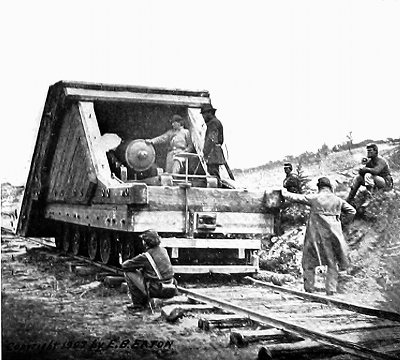
RAILROAD BATTERY IN FRONT OF PETERSBURG DURING SIEGE
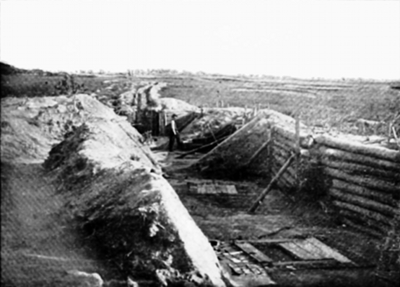
EARTHWORKS IN FRONT OF PETERSBURG—FEDERAL LINES AT FORT MORTON
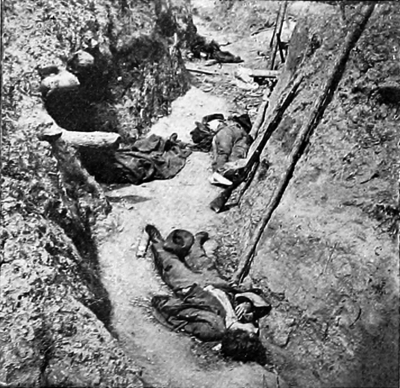
DEAD CONFEDERATES IN TRENCHES AT PETERSBURG
DEEDS of valor on the battlefield have been sung from the earliest ages, but there is no epoch in the world's history when men have shown more magnificent courage, or greater devotion to principle, than in the Civil War of the United States. The days of ancient knighthood never saw more gallant fighters, no lancer ever met a worthier foe. It was the grandest spectacle of heroism that eyes have ever witnessed. At the battle-front, in prison pit, in hospital, or wounded on the field—no men ever endured more intense suffering.
The only National debt we can never pay is the debt we owe to the men who offered their lives that the United American Nation might live to become the greatest power in the human race. The heroic sacrifices will never be known. It has been variously estimated from three hundred thousand to a million lives. The Government records 44,238 men as having been killed in battle; 49,205 dying of wounds and injuries; 186,216 succumbing to disease; 24,184 expiring from unknown causes; and 526 suicides, homicides and executions. Thousands of men disappeared during the conflict and have never been heard from since. The surgeon-general's records give 280,040 wounded in battle; 184,791 missing or captured; 26,168 dying while prisoners of war. The medical records state that 6,049,648 cases were brought into the hospitals, great numbers of whom were sent home to die. The Confederate losses can never be ascertained but it is very probable that the price that America paid for the preservation of the Union was a million of its manhood.
The crisis of 1865 held not only the future of the United States in the balance, but threatened to change the political divisions of the world. The American Nation, which is the "freest, richest and most powerful" nation under the skies, would have been divided into two weakened republics, each struggling for existence, disputing the ownership of rivers and coast, engaged in continual border uprisings, and finally becoming the prey of the powerful nations of Europe—only to be soon devoured by encroaching monarchies of the Eastern Hemisphere.
"When 'Greek meets Greek' the tug of war Is sure to follow fierce and strong; What wonder that the bloody strife 'Twixt North and South was four years long! Four hundred thousand of our brave Gave up their lives that we might be A Nation, powerful and great, The fitting home of Liberty. America will surely stand The first and foremost of the earth: The Queen of Nations she shall be, And all her sons have royal birth.
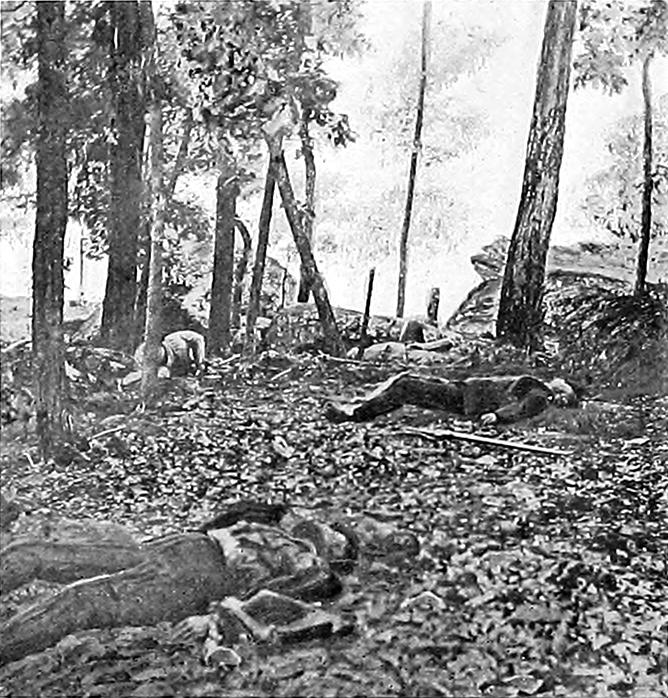
FOR THE SAKE OF THEIR COUNTRY—Photograph taken by Brady on the battlefield during the Civil War
"The Goddess of sweet Liberty Still smiles upon her gallant knights Who bravely sprang to her defense, And fearless fought to keep our rights. Then cheer our heroes, grim and old, And let them feel while yet alive, We honor them for what they did From sixty-one to sixty-five. All honor to our sacred dead, And honor well the living, too, Our Veterans of the Civil War, These noble boys who wore the blue."
The problem was settled for all ages in 1865. The American Nation rose from the ruins of War like a young giant. Grasping the hand of the North and the South, it clasped them together with the grip of brotherhood and the sacred pledge, "United we stand; divided we fall." Long live America, the Land of the Free and the Home of the Brave! The vast armies, "strong enough to have conquered a hemisphere, vanished like a vision and the men who fought side by side through the perils of four years of Civil War, laid down their arms, changed their uniforms of blue and gray for the apparel of everyday life, and took up once more the peaceful occupations they had abandoned to serve their country."
The Spring of 1865 can never be forgotten by the men who went through it. It was a time of intense excitement and overflowing enthusiasm which carried itself almost to pandemonium. The war cameras, which had perpetuated the last wonderful scenes of the conflict, were taken to Washington and New York, and the Summer fell upon a peaceful people.
It is the avowed mission of these pages to lay before the present generation the vision of War in all its horror that those who look upon them may pledge themselves to the furtherance of the day "when a cannon will be exhibited in public museums, just as an instrument of torture is now, and people will be amazed that such a thing could have been;" the day when "those two immense groups, the United States of America, and the United States of Europe," and the United States of Asia and of Africa, "will be seen placed in the presence of each other, extending the hand of fellowship across the oceans, exchanging their produce, their commerce, their industries, their arts, their genius; clearing the earth, peopling the desert, improving creation under the eye of the Creator, and uniting for the good of all, these two irresistible and infinite powers—the fraternity of men and the power of God!"
THE first days of 1865 around Petersburg were a hard strain on the soldiers. The winter's siege had been severe. The Confederates were desperate. Unable to break the Federal lines at Dinwiddie, Five Forks, or any of the many combats that were continually taking place, defeat and annihilation awaited them. On the first of April the entire artillery forces in the trenches before Petersburg began a tremendous cannonading which continued until dawn. The Union troops during the night tightened their lines around Petersburg until the following morning, which was Sunday. At daylight, on Monday, the third of April, Lee evacuated Petersburg and the Union forces entered the city about nine o'clock. Cameras were soon taken through the gates and during the day several photographs were taken, including a negative of the trenches containing the dead. This photograph shows a company of colored infantry. There were 186,097 colored troops enlisted in the Civil War. In many conflicts they showed great bravery, especially during the siege of Petersburg. An instance of their great courage was the attempt to break through the Confederate lines by tunneling under one of the fortifications and blowing it up with the charge of eight thousand pounds of powder. In the smoke of the explosion the colored troops charged through the crater and up the slope beyond, only to meet with a terrific fire in which hundreds of colored heroes were mown down like grass, with no hope of anyone reaching the crest, but they held to the charge until ordered to retire. The engagements around Petersburg during its last nine months cost the Union Army more than thirty thousand men.
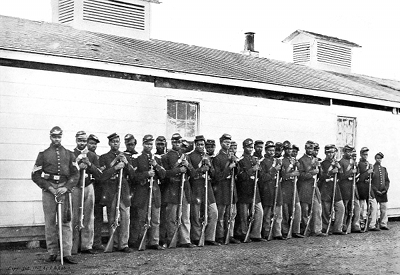
PHOTOGRAPH TAKEN WHILE COLORED INFANTRY WAS MOVING TO THE BATTLEGROUND
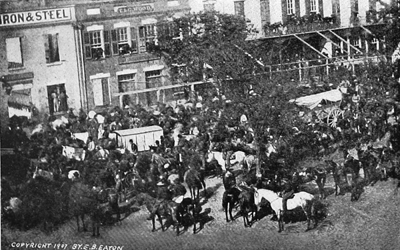
THIS witness of a remarkable sight is so old that it will be noted that the tree at the right of the picture is being eaten away from the original negative. It lays before the eyes of all generations the view of the first wagon train entering Petersburg with provisions for the starving inhabitants after one of the greatest sieges in history. It was on Sunday night, about ten o'clock, the second day of April, in 1865, that the resolute Lee marshalled his troops for the evacuation of Petersburg. At three on the following morning the stronghold of the Confederacy was left to the Union forces. At nine on the same morning General Grant rode into the deserted city. The remaining inhabitants were panic-stricken and in a destitute condition. Many of them had escaped with their beloved leader while others, in abject terror, secluded themselves in their homes. Grant, with his staff, rode quietly through the streets until he came to a comfortable-looking brick house, with a yard in front, where he dismounted and took a seat on the veranda. The gentle manner of the great general found a response in the hearts of those who had feared him. Citizens soon gathered on the sidewalk and gazed with curiosity on the Union commander. News of the hunger of the people was hurried along the line. Great wagon trains of provisions struggled for miles through roadways choked with prisoners, stragglers and wounded. This photograph was taken as the first division, loaded with barrels of flour, pork, coffee, sugar, and other necessaries, rolled into Petersburg. With the brotherly affection that even the madness of war cannot destroy, the men in blue came to those devoted to the gray, not as enemies, but as fellowmen ever willing to relieve the suffering. The humanity of war is here exemplified.
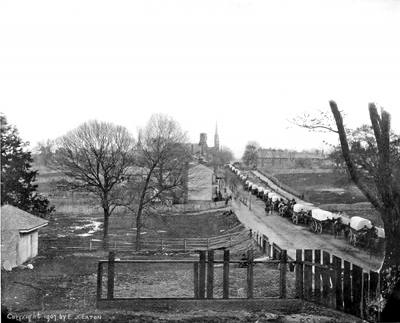
PHOTOGRAPH TAKEN WHILE GOVERNMENT PROVISION TRAINS WERE ENTERING PETERSBURG AFTER EVACUATION IN 1865
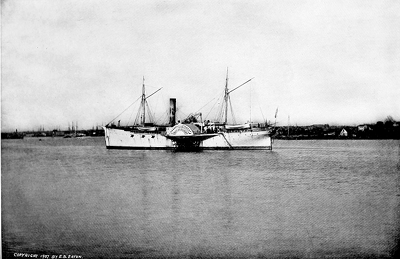
PHOTOGRAPH TAKEN AS GUNBOAT "SANTIAGO DE CUBA" SAILED ON THE FORT FISHER EXPEDITION
THE largest fleet that had ever been assembled under one command in the history of the American Navy concentrated before Fort Fisher, North Carolina, late in 1864. It included nearly sixty vessels, of which five were ironclads, and the three largest United States steam frigates, "Minnesota," "Colorado" and "Wabash," and was accompanied by one of the war cameras. The total number of guns and howitzers of the fleet were over six hundred, and the weight of projectiles at a single discharge of all the guns, both broadsides, was over twenty-two tons. The Atlantic and Gulf coast were almost entirely in the Government possession and the Navy was prepared to strike its decisive blow. Fort Fisher was now the most important Confederate naval position. The first attack took place in the night of December twenty-third, when a powder-boat was exploded under the towering walls of the old fort. It was believed that it was leveled to the ground, but in the morning the grim fort stood absolutely uninjured with its flag floating defiantly. An attack was then led by the ironclads, followed by the monitors and frigates. A naval officer in describing it says: "Their sides seemed a sheet of flame, and the roar of their guns like a mighty thunderbolt." The enemy took refuge in their bomb-proofs. Owing to misunderstanding between army and navy the fort was not taken. An excellent photograph was secured of one of the gunboats in the Fort Fisher expedition—the "Santiago de Cuba," and the negative is one of the finest naval pictures ever taken.
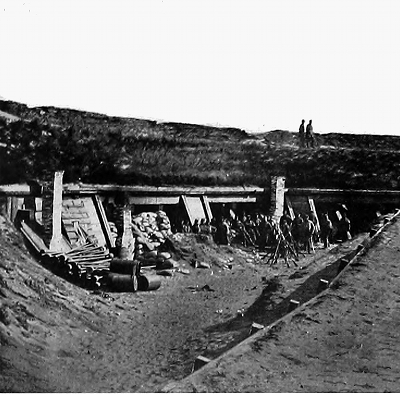
INTERIOR VIEW OF FORT FISHER IN 1865
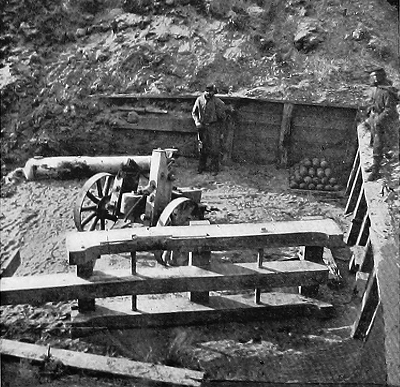
DISMANTLED GUN AT FORT FISHER IN 1865
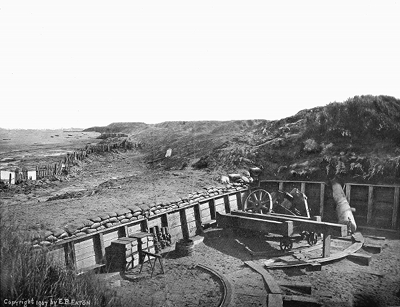
PHOTOGRAPH TAKEN AT FORT FISHER, NORTH CAROLINA, SHOWING DESTRUCTION OF GUN CARRIAGE IN 1865
THE last stronghold of the Southern Confederacy on the Atlantic Coast fell early in 1865. On the twelfth of January operations were agreed upon for the final assault on Fort Fisher and a photograph was taken of the fleet as it lay off the coast. On the morning of the thirteenth the ironclads opened a terrific fire. Fort Fisher was at this time much stronger than at the first attack. Troops had reinforced the garrison. Damages from the first bombardment had been repaired and new defenses added. In describing the downfall of the fort one who participated says: "I believe there had never before been such a storm of shell in any naval engagement. At noon on the fifteenth the attempt was made for the sailors and marines to land. From thirty-five of the sixty ships of the fleet boats were lowered, and with flags flying, pulled toward the beach in line abreast, a most spirited scene. The sailors were armed with cutlasses and pistols. The great land battery, the artillery and a thousand rifles opened fire from Fort Fisher. The daring sailors found themselves packed like sheep in a death pen, under a most galling fire." The army pressed forward under General Terry's command, fighting its way from traverse to traverse, overpowering the garrison, and finally driving the Confederates from their last refuge. Fort Fisher fell on the fifteenth of January. The casualties in the fleet amounted to 309, while Terry's command lost 110 killed and 536 wounded—a total of nearly 1,000 men. With the fall of Fort Fisher and its seventy-five guns, the Confederates abandoned Fort Caswell and all the works on Smith's Island; all those between Caswell and Smithville up to the battery on Reeve's Point on the west side of the river. This photograph of the fleet that took Fort Fisher shows the ships assembling off the coast. The negative was secured under much difficulty.
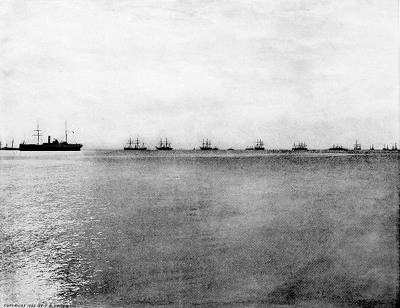
PHOTOGRAPH TAKEN AS GREATEST FLEET CARRYING AMERICAN FLAG WAS PREPARING TO ATTACK FORT FISHER IN 1865
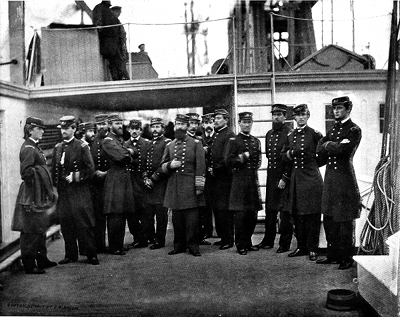
PHOTOGRAPH TAKEN WHILE ADMIRAL PORTER AND STAFF WERE ON FLAGSHIP "MALVERN" IN FORT FISHER EXPEDITION IN 1865
THE Civil War was a great practical demonstration of naval vessels propelled by steam. The whole system of naval tactics had undergone a great change. The guns had become vastly more powerful; war ships were now protected by a light armor, and the torpedo had found its way into successful employment. The normal strength of the Navy at the beginning of the war was ninety vessels; fifty of these were sailing ships, worthy vessels in years gone by, but now left behind by progress. There were forty vessels propelled by steam and many of these were scattered on the high seas. As the war progressed, the Navy was increased and at its close had nearly six hundred ships, including every variety of merchantman and river steamboat roughly adapted in navy-yards for war services. There were built or projected during the war nearly sixty ironclads. At the beginning of the war the total number of officers of all grades in the Navy was 1,457, and during its progress the number was increased to 7,500, chiefly from the merchant marine. The normal strength of seamen, which was 7,600, rose during the war to 51,500. The South entered upon the war without any naval preparation and with very limited resources, but by purchases and seizures equipped a considerable fleet. Toward the close of the conflict the war photographers secured a large number of negatives during naval demonstrations. Among those here presented is Admiral David D. Porter and staff on his flagship, "Malvern," on the Fort Fisher Expedition. The gallant admiral may be seen standing in the center of the group. A picture is on the following page of Major-General A. H. Terry and staff, in command of the land demonstrations around Fort Fisher, and on whom special honors were conferred by Congress for his courageous leadership in the attack. These photographs witness the last great naval demonstration of the war.
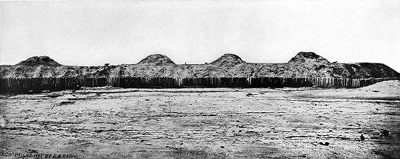
PANORAMIC VIEW OF FORT FISHER, NORTH CAROLINA, IN 1865
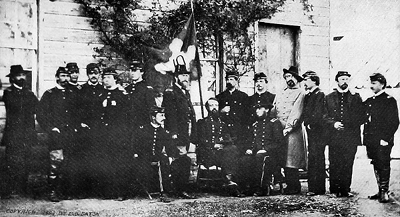
MAJOR-GENERAL ALFRED H. TERRY AND STAFF AT FORT FISHER
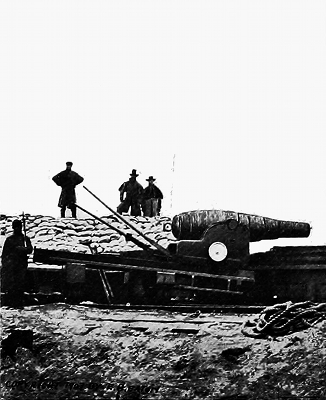
ENGLISH ARMSTRONG GUN IN FORT FISHER
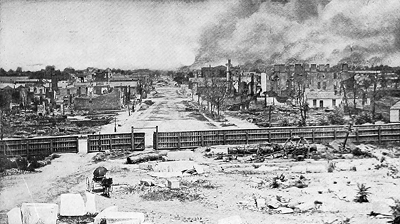
RUINS OF COLUMBIA, SOUTH CAROLINA, FROM THE CAPITOL—SHELLED BY SHERMAN, FEBRUARY 16, 1865—PHOTOGRAPH TAKEN BY BRADY WHILE RUINS WERE SMOKING
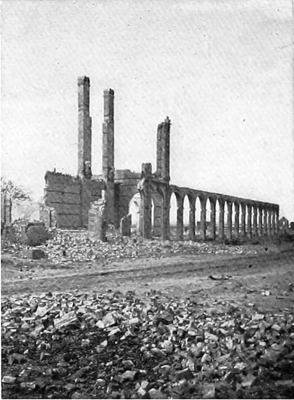
RUINS OF DEPOT WHERE TWO HUNDRED PERSONS WERE BLOWN UP ON EVACUATION OF CHARLESTON
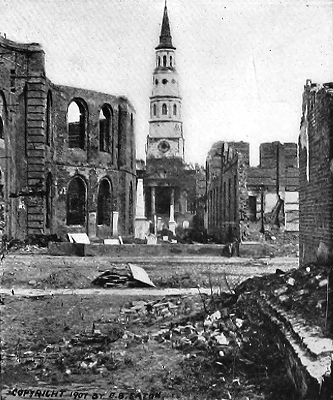
RUINS OF SECESSION HALL AT CHARLESTON AFTER SURRENDER, FEBRUARY 18, 1865
THE final blows of the Civil War came quick and sharp. Grant had taken Petersburg; Thomas had annihilated the Confederate forces under Hood along the Mississippi River; Sherman had swept through Georgia and overrun the Carolinas. Exactly four years after the inauguration of Jefferson Davis as President of the Confederacy, historic Columbia and Charleston, South Carolina, surrendered. The closing days sowed flame and devastation. The war cameras followed Sherman's Army into Columbia and the old negatives tell the tragedy of the destroyed Confederate cities. One of them here reproduced is historic Secession Hall in ruins. It was here that the first Ordinance of Secession was passed. This view shows the historic edifice as it appeared when the Union troops took possession of the city. Adjoining the Hall are the ruins of Central Church, and in the background is St. Phillips Church. The fall of Columbia occurred on February 12, 1865. Charleston surrendered the following day, and the Federal Government took possession. One of these photographs shows the ruins of the Northeastern Railroad Depot at Charleston where two hundred persons were blown up on the day of evacuation, February 17, 1865. Sherman moved on through North Carolina and fought his last battle at Bentonville, where the National loss was 1,604 men and the Confederate loss 2,342. During these last days of the war occurred a disaster on the Mississippi River. The "Sultana" was on her journey from New Orleans to St. Louis, receiving on board 1,964 Union prisoners from Columbia, Salisbury, Andersonville and other Confederate prisons. Anxious to proceed North, little heed was given that the ship was already carrying a heavy load of passengers on board, occupying every foot of available space on all the decks to the tops of the cabins and the wheelhouse, and on the twenty-seventh of April, when about eight miles above Memphis, one of her boilers blew up. The dead at the scene numbered 1,500.
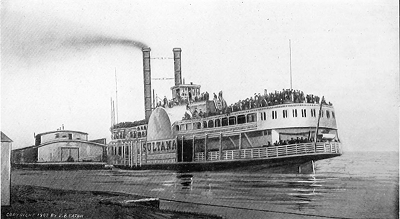
STEAMER "SULTANA" CONVEYING EXCHANGED UNION PRISONERS—DESTROYED IN MISSISSIPPI RIVER IN 1865
IN the hospitals of the army during the Civil War 6,049,648 cases were treated by the officers of the Medical Department. The medical skill of the surgeons and physicians is evidenced by the fact that only 185,353 of these patients died during their detention in the hospitals. While a large number of these soldiers suffered from gunshot wounds, the disease of chronic diarrhœa was nearly as fatal, and its deadliness was closely followed by the ravages of typhoid fever and lung diseases. It is estimated that 285,245 men were discharged during the war for disability. A tribute should be paid to the nobility of the hospital corps. Many noble men and women did great service to their country in relieving the sufferings that followed the battles. After many of the terrific conflicts the ground was strewn with the dead and dying. The wounded, in whom there was a hope of life, were given immediate care and hurried on stretchers to nearby houses and barns from which floated the yellow flag of the Medical Department. Large hospital tents were erected near the scene of battle. At times all the rooms in the surrounding farmhouses were full of wounded; the injured men were laid on cornstalks and hay in the barns. Sometimes it was impossible to find shelter for them all and they were laid on boards inclined against fences. Many of the large trees formed a shelter for a temporary hospital, where the men were laid in rows while the attendants administered to their wants. In no previous war in the history of the world was so much done to alleviate suffering as in the War of 1861-1865. But notwithstanding all that was done, the wounded suffered horribly. After any great battle it required several days and nights of steady work before all the wounded men were gathered.
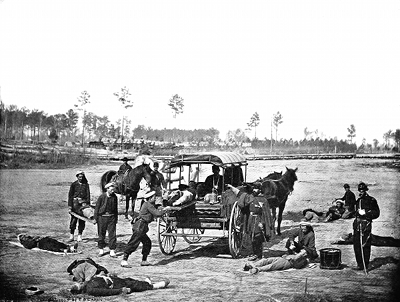
PHOTOGRAPH TAKEN WHILE AMBULANCE CORPS WERE REMOVING WOUNDED SOLDIERS TO THE FIELD HOSPITAL
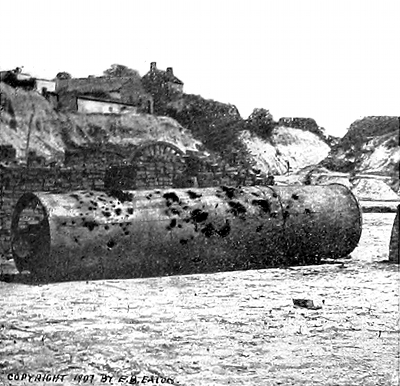
SMOKESTACK OF EXPLODED RAM "VIRGINIA" IN 1865
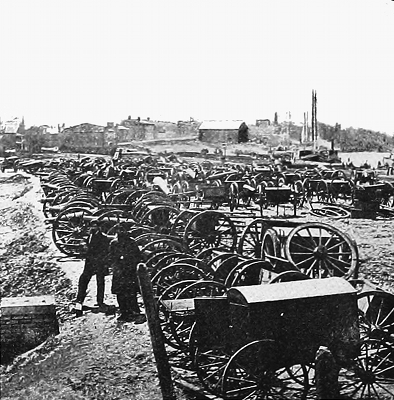
CONFEDERATE ARTILLERY ON WHARVES NEAR RICHMOND
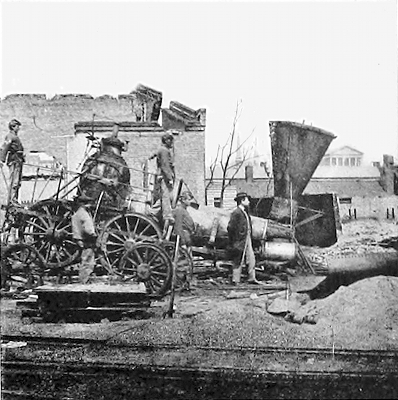
RUINED LOCOMOTIVE AFTER FALL OF RICHMOND IN 1865
AMBULANCE CONVEYING JEFFERSON DAVIS AFTER HIS CAPTURE—PASSING THROUGH THE STREETS OF MACON, GEORGIA
JEFFERSON DAVIS was at St. Paul's Church, in Richmond, at the usual hour of Sunday morning worship when he received the message that Petersburg was being evacuated and Lee's lines were irreparably broken. The sexton walked up to Davis's pew and whispered a few words in the President's ear. The members of the Cabinet received similar calls. From church to church the note of warning was communicated. By two o'clock everybody in Richmond knew that the city was to be abandoned. The Presidential party with difficulty made its way through the excited crowd which thronged and blocked the streets. Davis began his flight by boarding a train and went as far as Danville where, on April 4, 1865, he began to establish a new seat of government. The following day he issued a proclamation to his people, only to again flee to Greensborough, North Carolina, where he remained in a railroad car. On reaching Charlotte, he threw off the semblance of authority and planned to reach Texas. The flight was continued through South Carolina and into Macon, Georgia. In the meantime, a reward of $100,000 was offered for the apprehension of Davis. He was finally captured in a camp in the woods near Irwinsville, Georgia, while trying to escape in a lady's waterproof coat, gathered at the waist, with a shawl thrown over the head, and carrying a tin pail. This remarkable photograph was taken while the Confederate President was being carried as a prisoner in an ambulance through the streets of Macon. He was conveyed to Fortress Monroe, for safe keeping, on May 22, 1865, and was finally allowed his freedom on bail and never brought to trial. Brady entered Richmond with his cameras a few hours after the departure of Davis and these negatives witness the ruins. The great tobacco warehouses had been destroyed and the ironclad rams on the river had been blown up. The city was being pillaged. The Union troops entered as conquerors and immediately set to work with a will to extinguish the flames which wrought great destruction and havoc.
RICHMOND was a mass of flames on the third of April, in 1865. As the Federal forces entered the city it was a scene of terrible splendor. The explosion of magazines caused the earth to rock and tremble as with the shock of an earthquake. The flames were leaping from building to building until thirty squares were ablaze, consuming over one thousand structures. Prisoners were liberated from the penitentiary and the torch was applied to it. Men, women and children, faint from hunger, fled from their homes. The provision depots were battered at the doors and forced open in the demoniacal struggle against starvation. The gutters ran with whiskey, and men fell to their knees and lapped it as it flowed through the streets. The clatter of the hoofs of the horses added to the tumult as the Union troops entered the city. At daylight the approach of the Federal forces could be plainly discerned. The war cameras came into Richmond with the army. The Union soldiers began to fight the flames, blowing up houses to check their advance. There was a cavalry rush for Libby prison to bring freedom to the Union soldiers confined within its walls, but upon reaching it not a guard nor an inmate remained. The doors were wide open. An old negro placidly remarked: "Dey's all gone, massa!" The day following a mighty cheer was heard near the abandoned residence of Jefferson Davis. President Lincoln walked down the street with his usual long, careless stride. After viewing the situation and impressing upon the officers his desire that they exert the most humane influences, Lincoln returned to Washington. One of the most valuable negatives in the Civil War collection is the ruins of Richmond on the day that Lincoln inspected the condition of the city.
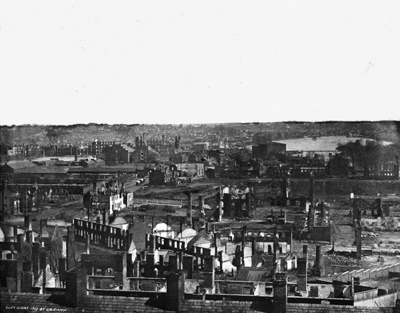
PHOTOGRAPHS TAKEN OF THE RUINS AT RICHMOND THE DAY AFTER ITS EVACUATION IN 1865
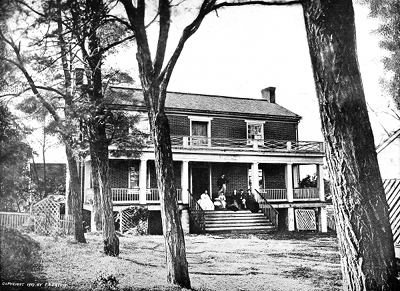
PHOTOGRAPH TAKEN AT THE MCLEAN HOUSE AT APPOMATTOX THE DAY THAT LEE SURRENDERED TO GRANT, APRIL 9, 1865
WHEN Lee, with the remnant of his army, fled from Richmond and Petersburg, he was closely pursued by Grant and attacked vigorously at every approach. For seventy miles it was a race that was marked by a long track of blood. There were collisions at Jestersville, Detonville, Deep Creek, Paine's Cross Roads, and Farmville. At Sailor's Creek the Confederate lines were broken by Custer. The Confederate General Ewell, with four other generals and his entire corps, were captured and on the eighth of April the Southern Army, under Lee, was completely surrounded. Lee had but 28,000 men left and his brave dead were lying in heaps along the route of his retreat. Hemmed in at Appomattox Court House a last desperate effort was made to cut through the Federal cavalry. He was gaining ground when Sheridan's bugles rang out the signal for a general charge and a halt was called under a flag of truce. The two historic armies never exchanged another shot. General Lee left his camp on the morning of April 8 and was conducted to the McLean house, where he found General Grant awaiting him. The actual surrender took place on April 12, 1865. The Confederate officers and men were paroled. Lee returned to his men and bade them farewell. The scene was one of the most pathetic in the records of war. The Confederate veterans wept like children as they looked upon the face of their beloved leader. His last words to his men were: "You will take with you the satisfaction that proceeds from the consciousness of duty faithfully performed. I earnestly pray that a merciful God will extend to you His blessing and protection." A few hours after Lee's surrender this photograph was taken at Appomattox.
IT is here in these closing pages the sad duty of these wonderful old negatives to record one of the deepest tragedies in the history of the world. In it the greatest Republic of the earth, at the close of the most terrific conflict ever waged by fellow countrymen, saw its champion of Liberty fall at the hands of an assassin. The great Lincoln looked forward to years of peace among a re-united people. On the night of April 14, 1865, he was murdered at Ford's Theater. The bitter tidings swept the country. The American Nation was bowed down with grief. The rendezvous of the conspirators was found to be the house of Mrs. M. E. Surratt, located in the very heart of Washington. Mrs. Surratt, her daughter Anna, Miss Fitzpatrick and a Miss Holahan were arrested. George A. Atzerott, and one named Powell, were later captured. The principal assassin, John Wilkes Booth, was found eleven days after the murder and was shot when he refused to surrender. His companion, Harold, who had been a fugitive with him, was taken prisoner. The trial of the conspirators took place in Washington before a military commission. On July 6, 1865, sentence was pronounced and on the following day the four conspirators—Harold, Atzerott, Powell and Mrs. Surratt—were hanged. Two of Brady's cameras were taken into the prison yard and placed near the scaffold. When the warrant was being read one camera was used and the historic view is now in the Eaton Collection. When the drop was sprung, the second negative was exposed and the tragic scene is here recorded. Mrs. Surratt is hanging at the left. The ghastliness was such that many of the guards turned their heads. It is believed to be the first time that the camera has been used to perpetuate the execution of political conspirators. The negatives are in excellent condition and their historic value is beyond purchase.
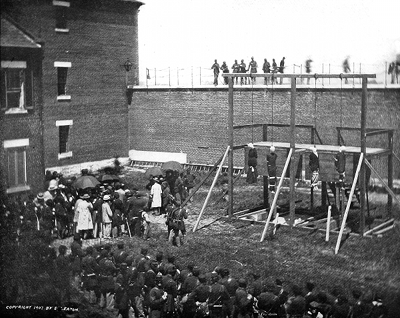
PHOTOGRAPH TAKEN IN PRISON YARD IN WASHINGTON AT HANGING OF MRS. SURRATT AND THE LINCOLN ASSASSINATION CONSPIRATORS IN 1865
THE funeral procession of Lincoln as it passed through New York was witnessed by nearly a million people. The body was taken to Springfield, Ohio, his old home town to which he had not returned since he left it to go to Washington as President of the United States. Lincoln was buried at Oak Ridge Cemetery, about two miles from Springfield. Immediately after the close of the war the Government began inquiry into the cruelties alleged to have taken place in many of the prisons. The result was the arrest of Captain Henry Wirtz, the jailor at Andersonville. He was given trial before a military commission and convicted of brutally murdering Union prisoners. Wirtz was sentenced to death and hanged on the tenth of November, 1865. The execution took place in Washington within short distance of the National Capitol, and Brady's cameras were taken into the prison yard. The negative was taken as the condemned man stood on the scaffold, with head bowed, listening to the reading of his death warrant. Another negative was secured after the noose had been tightened around his neck and the drop had been sprung. The photographs perpetuate a tragic moment. It will be seen that the soldiers on guard were standing at "attention." The evidence against Wirtz was overwhelming. Many witnesses testified to the cruelty of the accused man and the horrors enacted within the dead lines at Andersonville. Prisoners were forced to go forty-eight hours without food. Many of them became insane; others committed suicide. There were deliberate, cold-blooded murders of peaceable men. No opportunities were afforded for cleanliness and the prisoners were covered with vermin. The execution of Wirtz met public approval and this photograph shows him in his last moments of life.
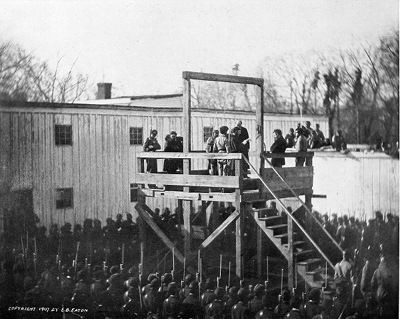
PHOTOGRAPH TAKEN WHILE DEATH WARRANT WAS BEING READ TO WIRTZ, THE KEEPER OF ANDERSONVILLE PRISON IN 1865
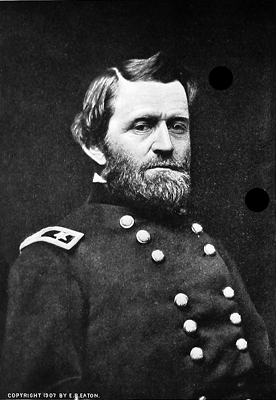
HERO OF THE AMERICANS WHO WORE THE BLUE
Ulysses Simpson Grant—Born at Point Pleasant, Ohio, April 27, 1822—Died at Mt. Gregor, New York, July 23, 1885—Graduated from West Point in 1843 and fought gallantly under the Stars and Stripes in the War against Mexico—Commander-in-chief of the victorious Union Army in the Civil War in the United States—This photograph was taken when he was forty-two years of age, during the Civil War, and was never before published—It is protected by copyright
AMERICANS—true to the blue or true to the gray—bow in reverence to the memory of these two great fellow countrymen—the greatest leaders that mankind has ever followed. Under the same beloved flag they fought in their early days, only to stand arrayed against each other as foes in their latter days, and to finally die as loyal Americans. Never before has the public looked upon these photographs, which were taken by the war cameras at Appomattox at the end of the war. When Lee offered his sword to Grant it was courteously returned to him. The two gallant generals lifted their hats and parted forever. Grant mounted his horse, and started with his staff for Washington. Lee set out for Richmond, a broken-hearted man. The armies returning from the field were brought to Washington for a grand review and mustered out of service. The news of Lee's surrender passed from army to army through the South and West, and six weeks later the last gun had been fired and musket laid down in the Civil War of the United States. In closing these pages, acknowledgment is made to the many eminent historians whose scholarly works have been consulted and quoted in narrating the incidents surrounding these photographs. Mr. Edward B. Eaton, who has prepared this remarkable presentation from his valuable collection; Mr. Francis T. Miller, the editor and writer of this book; and Mr. George E. Tracy, associated with Mr. Eaton in placing this volume before the public, wish to express their appreciation for the cordial interest taken in the work by the department commanders of the Grand Army of the Republic, many of whom testify to having seen the Brady cameras on the battlefield when these negatives were being taken. To these men—and to all who witnessed the scenes herein perpetuated—this book is dedicated with the benediction of the victorious Grant:
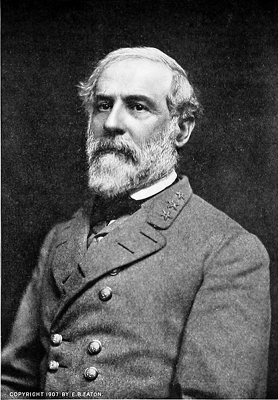
HERO OF THE AMERICANS WHO WORE THE GRAY
Robert Edward Lee—Born at Stratford, Virginia, January 19, 1807—Died at Lexington, Virginia, October 12, 1870—Graduated at West Point in 1829 and fought gallantly under the Stars and Stripes in the War against Mexico—Commander-in-chief of the vanquished Confederate Army in the Civil War in the United States—This photograph was taken when he was fifty-seven years of age, during the Civil War, and was never before published—It is protected by copyright
"LET US HAVE PEACE"
the associated publishers of american records
press of the dorman lithographing company
new haven, connecticut
halftone engravings by robert weller, hartford, connecticut
THE EDWARD B. EATON COLLECTION OF ORIGINAL PHOTOGRAPHS OF THE CIVIL WAR
PARTIAL LIST OF THE SEVEN THOUSAND NEGATIVES TAKEN UNDER THE PROTECTION OF THE SECRET SERVICE BY MATHEW B. BRADY AND ALEXANDER GARDNER ON THE BATTLEFIELDS OF THE CIVIL WAR IN THE UNITED STATES DURING THE YEARS 1861—1862—1863—1864—1865—AND NOW SAFELY STORED IN THE PRIVATE VAULT OF THE OWNER AT HARTFORD, CONNECTICUT
THE Eaton Collection of Original Photographs of the Civil War, the full history of which is given in the introductory to this Volume, is now for the first time unveiled to the public. In presenting the reproductions in this book the owner of this remarkable collection has protected them fully by copyright and warns the public against infringers. Mr. Eaton is the sole owner of these original negatives, which are valued at $150,000, and henceforth, any other reproduction must be with his written authority or it is an infringement. That the public may become fully acquainted with the negatives in this official collection, experts are now at work drawing two prints from each negative, protecting them under copyright, and identifying, arranging and preparing them for a complete catalogue. In several instances the label which the photographer placed on the negatives when he made the photograph, over forty years ago, has been lost. These are being carefully identified by veterans of the Civil War who offer affidavits to having been on the scene. At present there are still many views that are labeled "unknown." It is nearing a half century since the sun painted these real scenes of that great War, and some negatives have undergone chemical changes which make it difficult to secure "prints" from them. There can be no substitution, as the scenes represented on the old glass plates have passed away forever. The great value of these pictures is apparent. Several negatives are entirely past printing and all of them require retouching by old-time photographers who understand the process. Even to the thinning ranks of heroes of the Civil War the scenes of 1861-1865 are but a fading memory; cherished, it is true, and often called up from among the dim pictures of the past, but after all, only the vision of a dream. Artists have painted and sketched and engraved, with more or less fidelity to fact and detail, those "scenes of trial and danger." Their pictures can be but imaginary conceptions of the artist. Fortunately, our Government authorized courageous photographers to skillfully secure with their cameras the reflection, as in a mirror, of the thrilling scenes of the conflict. These views vividly renew the memories of the war days. The camp, the march, the battlefields, the forts and trenches, the wounded, the prisoners, the dead, the hurriedly-made graves, and many other of those once familiar scenes are photographically portrayed and perpetuated.
As a record of a crisis in the history of the world, these negatives are worth their weight in gold. Their value is such that they cannot be handled, except with great care, or removed for exhibition purposes. They are in a vault in Hartford, Connecticut, where the owner is very willing to allow the public, especially the Veterans of the Civil War, to examine them. It is desired to have the old negatives become of as much service to the public-at-large as possible and for this purpose is compiled this partial catalogue from the collection. Whenever the condition of the negative permits, Mr. Eaton is willing to allow the privilege of printing a proof. This is especially granted to Old Soldiers or Grand Army Posts who desire certain original photographs of scenes in which they participated. The service of this collection, inasmuch as it pertains to commendable purposes, is here extended to the American People who are no longer "Federal" and "Confederate."
THIS is a partial list of the negatives in the Eaton Collection of Original Negatives taken on the Battlefields during the Civil War of the United States, under the protection of the Secret Service. They include all phases of army life. The cameras followed, not only the Eastern Army and the Army of the West, but accompanied the Naval Fleets and were present in many demonstrations. Veterans of the Civil War are cordially invited to visit Hartford and inspect these negatives. Proofs will be taken from any negative here registered, for Grand Army Veterans or Posts, providing sufficient reasons are given with the request, which should be sent direct to the owner of the collection, Mr. Edward B. Eaton, Hartford, Connecticut.
ARMY OF POTOMAC
April, 1861, to August, 1861.
Three Months' Campaign.
Long Bridge. Washington, D. C., L.7824. Christ church, Alexandria, where General Washington attended, S.2301. Marshall House, Alexandria, Va., S.1189. Slave-pen, Alexandria, Va., L.7264. S.1003, S.1174. Ruins of Norfolk navy-yard, 8.984. Ruins of Harper's Ferry arsenal, S.655. Ruins of bridge across Potomac River at Berlin, S.658. Fairfax court-house, S.298. Fairfax seminary, S.2322. Fairfax church, S.2323. Taylor's tavern, near Fall's Church, S.2320. Cub Run, S.307. Bull Hun, S.1111. Battlefield of Bull Run, S.1046. Ruins of stone bridge, Bull Run, L.7082, S.310, S.312. Sudley church, S.315, S.316, S.1017, S.1148. Sudley Ford, Bull Run, S.313, S.314. Thorburn's house, Bull Run, S.317. Matthews's house, Bull Run, S.318. Robinson's house, Bull Run, S.319, S.1176. Ruins of Henry's house, Bull Run, S.320. Headquarters of General Beauregard (confederate) at Manassas, S.327. Stone church, Centreville, S.302. Mrs. Spinner's house, near Centreville, S.308, S.309. Grigsby House (Stevens's house), near Centreville, S.1163, S.303. Soldier' graves, Bull Run, S.321. Dedication of monument on battlefield of Bull Run, L.7362, L.7363, L.7364. Monument on battlefield of Bull Run, L.7532, S.1193, S.1194.
ARMY OF POTOMAC.
August, 1861, to March, 1862.
Headquarters of General McClellan at Fairfax Court House, Va., (also used by General Beauregard) L.7142, S.299. Camp of Tenth Massachusetts Infantry, S.2421. Signal tower near camp of Fourteenth New York Infantry, S.2352. Camp of Thirty-fifth New York Infantry, S.2422. Camp of Seventy-first New York Infantry, S.2413, S.2415. Camp of Thirty-first Pennsylvania Infantry, Queen's farm, near Fort Slocum, Virginia, S.2409, S.2410, S.2412. Camp scenes in camp of Thirty-first Pennsylvania Infantry, S.2405, S.2406. Review of Dwight's brigade, 8.2419, S.2420. Newspaper dealer in camp, C.1378. Sunday services in camp of Sixty-ninth New York Infantry, S.3713. Professor Lowe's balloon, S.2349, S.2350.
ARMY OF POTOMAC.
March, 1862, to July, 1862.
Peninsula Campaign.
Battery No. 1, in front of Yorktown, L.7094, S.361, S.362, S.363, S.364, S.365. Battery No. 4, in front of Yorktown, S.373, S.374, S.375, S.376, S.377, S.378, S.379, S.380. Naval battery in front of Yorktown, S.463. Battery Magruder (confederate), Yorktown, S.2360, S.2361, S.2362. Confederate fortifications, Yorktown, S.450, S.451, S.452, S.453, S.458, S.1026, S.2364, S.2365, S.2366, S.2367, S.2368, S.2369, S.2425. Confederate fortifications, Yorktown, with exploded gun, S.455. S.2370. Ravine at Yorktown in which confederate magazines located, S.447. Confederate water battery at Gloucester Point, S.454, S.457, S.460, S.461. Yorktown Landing, S.2383. Artillery park at Yorktown Landing, S.2358. Wagon park at Yorktown Landing, S.2357. Sally-port at Yorktown, S.2371. Street view in Yorktown, S.2372. Court-house, Yorktown, S.2375, S.2376. Church, used as Second Corps hospital, Yorktown, S.2374. Baptist church and hospital of Third Division, Sixth Corps, Yorktown, S.2373. Cornwallis's headquarters during Revolutionary war, S.2336. Headquarters of General Magruder (confederate), Yorktown, Va., S.449. Cornwallis Cave, Yorktown, used by confederates for magazine, S.2379, S.2380. Captain Perkins's "Secesh," horse captured at Cornwallis Cave, Yorktown, S.2381. Confederate winter quarters near Yorktown, S.2377. Camp scene in front of Yorktown—quarters of Dr. Grant and Dr. Dwight, of French's brigade, S.2378. Farnhold's house, near Yorktown, May, 1862, S.360. Moore's house, near Yorktown, S.462. Clark's house, near Yorktown—used as hospital, S.371. House used by General La Fayette during Revolutionary war as Headquarters, S.369, S.372. Tabb's house, Yorktown, L.7413. Camp Winfield Scott, headquarters Army of Potomac, in front of Yorktown, May, 1862: —views of camp, S.350, S.367, S.368. —Prince de Joinville, Duc de Chartres, Comte de Paris, English army officers, and officers of General McClellan's staff, S.352, S.353, S.354. —staff and foreign officers at General McClellan's headquarters, S.429, S.355. —Prince de Joinville, Duc de Chartres, and Comte de Paris at mess table, S.356, S.358. —group of staff officers at General McClellan's headquarters, S.388. —group of English officers at General McClellan's headquarters, S.638. —topographical engineers, S.366. —group at photographer's tent, S.349. —Captain Custer, U. S. A., and Lieutenant Washington, a confederate prisoner, May, 1862, S.428. —orderlies and servants, S.359, S.444. Camp at General Andrew Porter's headquarters in front of Yorktown, May, 1862, S.370. General Andrew Porter's staff, May, 1862, S.389. Generals Franklin, Slocum, Barry, and Newton, and staff officers, May, 1862, S.381, S.382. Embarkation at Yorktown for White House Landing, S.2363. Encampment of Army of Potomac at Cumberland Landing: —view of camp, L.7597, L.7598, L.7519, L.7648, S.1180. —views making panoramic view, S.1076, S.1186, S.1212, S.1213, S.1214, S.1219. —views making panoramic view, S.1215, S.1216, S.1217, S.1218. —seven views making one panoramic view, S.1220, S.1221, S.1222, S.1223, S.1224, S.1225, S.1226. Foller's house, Cumberland Landing, S.385. Contrabands at Foller's house, Cumberland Landing, S.383. White House Landing, S.2485. Conway Landing, S.2490. View of river below White House Landing, S.2489. The White House, former residence of Mrs. Custis Washington, S.384. Ruins of the White House, S.2486. Camp of Christian Commission, at White House Landing, S.2487. Ruins of bridge across Pamunkey River, near White House Landing, S.386. Saint Peter's church, near White House, where General Washington was married, S.2302, S.2303. Headquarters Army of Potomac, at Savage Station, June, 1862, S.468. Field hospital, at Savage Station, after battle of June 27, 1862, S.491. Battlefield of Fair Oaks: —house used as hospital for Hooker's division during the battle, S.478, S.479. —house used as hospital, S.480. —house near which over four hundred soldiers were buried, S.470. —Sickles's brigade coming into line in distance, S.471. —Quarle's house, S.474. —earthworks at extreme front, S.472. Fort Richardson, near Fair Oaks Station, June, 1862, S.473. Fort Sumner, near Fair Oaks Station, June, 1862, S.476. Camp Lincoln, near Fair Oaks, June, 1862, S.430. Battery,—First New York Artillery Battalion, near Fair Oaks, June, 1862, S.443, S.640. Robertson's Battery of Horse Artillery, Battery B, Second United States Artillery, near Fair Oaks, June, 1862, S.642, S.439. Benson's Battery of Horse Artillery, Battery M, Second United States Artillery, near Fair Oaks, June, 1862, S.433, S.641. Gibson's Battery of Horse Artillery, Battery C, Third United States Artillery, near Fair Oaks, June, 1862, S.431. Officers of Brigade of Horse Artillery, near Fair Oaks, June, 1862, S.434, S.639. General Stoneman, General Naglee, and staff officers, near Fair Oaks, June, 1862, S.436, S.438, S.445. Gun captured by Butterfield's brigade, near Hanover Court House, S.2353, S.2354. Mechanicsville, Va., S.909. Elliston's Mill, battlefield of Mechanicsville, S.920. Gaines's Mill, Va., S.932. Battlefield of Gaines's Mill, Va., unburied dead, S.914, S.916. Engineer Corps making corduroy roads, June, 1862, S.656. Bridge across Chickahominy River, built by Fifteenth New York Engineers, S.489. Grape Vine Bridge across Chickahominy River, L.7383. Bridge across Chickahominy River, S.930. Bridge across Chickahominy River, Mechanicsville Road, S.913. Telegraph station, Wilcox's Landing, S.2351. Westover House, James River, S.2334, S.2335. Westover Landing, James River, S.620. Officers of Third and Fourth Pennsylvania Cavalry, Westover Landing, S.623, S.629. General W. W. Averell and staff, Westover Landing, S.635. Headquarters of Signal Corps camp at Harrison's Landing, S.621. General Sedgwick, Colonel Sackett, and Lieutenant-Colonel Colburn, Harrison's Landing, August, 1862, S.653. Group of officers that graduated in class of 1860, United States Military Academy, Harrison's Landing, August, 1862, S.624. Major Myers, Lieutenant Stryker, and Lieutenant Norton, Harrison's Landing, August, 1862, S.626. Group of officers belonging to Irish brigade, Harrison's Landing, July, 1862, S.627. Lieutenants Jones, Bowen, and Custer, May, 1862, S.387.
ARMY OF POTOMAC.
July, 1862, to September, 1862.
Pope's Campaign.
Centreville, after its evacuation by confederate army in March, 1862: —confederate barracks, L.7212, S.331, S.332, S.648, S.1045. —confederate fortifications, S.305, S.334, S.333, S.1144, S.1145. —headquarters of (confederate) General Johnston, S.303. Manassas, after its evacuation by confederate army in March, 1862: —destruction of railroad, L.7197. —confederate fortifications, L.7171, S.323, S.543, S.544, S.545, S.546. Yellow hospital, Manassas, July, 1862, S.650. Headquarters of General McDowell, near Manassas, July, 1862, S.646, S.647. Our photographer, near Manassas, July, 1862, S.651. Battlefield of Cedar Mountain: —general views, S.500, S.506, S.511. —west view of the field, S.504. —dead horses, S.510. —house in which General Winder (confederate) was killed, S.501, S.502. —house used as confederate hospital, S.507. —Mrs. Hudson's house, S.505. —Slaughter's house, position of confederate battery, S.508. Federal battery fording a tributary of the Rappahannock River on day of battle of Cedar Mountain, S.520. Hazel River, S.521. Culpeper, Va.: —general views of town, S.216, S.527, S.530. —court-house, S.523. —railroad depot, S.528, S.529. —street views, S.524, S.525, S.526. Troops building bridge across north fork of Rappahannock River, near Fauquier Sulphur Springs, S.512, S.513, S.515. Fugitive negroes fording Rappahannock River, escaping from advance of confederate army, S.518, S.519. Fauquier Sulphur Springs hotel, S.537, S.542. Rappahannock station, S.522. Rappahannock bridge, S.514, S.517. Warrenton, Va.: —street views, S.532, S.534. —court-house, S.533. —railroad depot, S.535, S.536. —church, S.736. Catlett's Station, August, 1862, S.594. Destruction of railroad rolling stock on Orange & Alexandria Railroad, S.593. Battlefield of Manassas: —ruins of Mrs. Henry's house, S.320. —Thorburn's house, S.317. —Matthews's house, S.318. —Robinson's house, S.319, S.1176. Bridge across Bull Run, built by Engineers of McDowell's corps, August, 1862, S.547. Picket post near Blackburn's Ford, Bull Run, S.645. Sudley Ford, Bull Run, S.313, S.314. Sudley church, S.315, S.316, S.1017, S.1148. Ruins of stone bridge, Bull Run, L.7082, S.310, S.312. Ruins of bridge at Blackburn's Ford, Bull Run, S.2338. Bull Run, S.1111. Cub Run, S.307. Stone church, Centreville, S.302. Mrs. Spinner's house, near Centreville, S.308, S.309. Grigsby House (Stevens's house), near Centreville, S.1163, S.303. Fairfax court-house, S.298. Monument on battlefield of Groveton, L.7299, S.1193.
ARMY OF POTOMAC.
September, 1862, to November, 1862.
Antietam Campaign.
Battlefield at Antietam: —view of part of the field on the day of the battle, S.671. —view on Antietam Creek, S.597. —signal station on Elk Mountain, L.7270, L.7563, S.633. —Antietam bridge, S.1178, S.1179. —Antietam bridge, looking up stream, L.7214, S.578. —Antietam bridge, looking down stream, L.7093, S.609. —Antietam bridge, southeastern view, S.608. —Antietam bridge, northeastern view, S.607. —Antietam bridge, eastern view, S.583, S.610, S.614. —Burnside bridge, looking up stream, S.584. —Burnside bridge, northeastern view, S.615. —Burnside bridge, southeastern view, S.600, S.601. —Burnside bridge, southwestern view, S.613. —Burnside bridge, northwestern view, S.612. —Miller's house, L.7019. —Newcomer's mill, S.582. —Sherrick's house, S.598. —Rullet's house, S.575. —Ruins of Mumma's house, S.574. —Real's barn, S.591. —General Hooker's headquarters during the battle, S.576. —Dunker church, S.573, S.1196. —bodies of dead confederate soldiers alongside the fence on Hagerstown road, S.559, S.560, S.566, S.567. —bodies of dead confederate soldiers near Sherrick's house, S.554, S.555, S.571. —views on the field where Sumner's corps charged, S.552, S.562, S.564, S.568. —views in the ditch on the right, showing many dead confederates, S.553, S.563, S.565. —bodies of dead confederate soldiers, S.325, S.326, S.567. —burying the dead, S.551, S.557, S.561, S.569. —graves of federal soldiers at Burnside bridge, S.585. —a lone grave, S.570. —confederate wounded at Smith's barn after the battle; Dr. Hurd, of Fourteenth Indiana, in attendance, S.588, S.589, S.590, S.592. President Lincoln in General McClellan's tent at headquarters Army of Potomac, October, 1862, S.602. General Marcy and other officers at headquarters Army of Potomac, October, 1862, S.603. Blacksmith's forge and horse-shoers, at headquarters Army of Potomac, September, 1862, S.587. Group at secret-service quarters, headquarters Army of Potomac, October, 1862, S.631. Major Allen Pinkerton, at secret-service quarters, October, 1826, S.618. Sharpsburg, Md., September, 1862, S.595, S.599. Lutheran church, Sharpsburg, Md., September, 1862, S.596. Pontoon bridges and ruins of stone bridge across Potomac River at Berlin, October, 1862,L.7437, S.616. Harper's Ferry, W. Va.: —general views, L.7443, L.7649, S.654. —Maryland Heights, L.7132, L.7441, S.1002. —Loudoun Heights, L.7072. —Maryland and, Loudoun Heights, L.7133. —Bolivar Heights, L.7187.
ARMY OF POTOMAC.
November, 1862, to June, 1863.
Fredericksburg Campaign.
Generals of the Army of the Potomac, November 10, 1862, L.7380. General A. E. Burnside and staff, Warrenton, Va., November, 1862, L.7186, L.7379, L.7382, S.1049. Acquia Creek Landing: —distant views, S.673, S.674, S.681. —wharves, L.7014, L.7446, L.7643, S.682. —quartermaster's office, L.7108, S.176. —commissary depot, S.680. —group at hospital, L.7355. —clerks at commissary depot, L.7322, L.7533. —employees at quartermaster's wagon-camp, L.7323. —Lieut.-Col. Sawtelle, Captain Forsyth, Dr. Wright, Lieut.-Col. Porter, and others, at Acquia Creek Landing, L.7320. Phillips's house, near Falmouth, S.677. Lacey's house, near Falmouth, S.697, S.698.
Fredericksburg: —view taken from Tyler's battery, S.676. —panoramic view, S.683, S.1191. —lower end of town, S.178. —houses, showing effect of shelling on December 13, 1862, S.716, S.717, S.718, S.719, S.2511. Barnard's house, below Fredericksburg, destroyed during battle, L.7141. Marye's house, on Marye's Heights, in rear of Fredericksburg, rifle-pits in front, S.733, S.734. A frame house on Marye's Heights, in rear of Fredericksburg, showing effects of shot and shell, S.735. Embarkation of Ninth Corps at Acquia Creek Landing, February, 1863, S.679. Headquarters Army of Potomac: —group of staff officers, S.693, S.695. —Lieutenant-Colonel Dickinson and other officers, L.7467. —Dr. Letterman, medical director, and other officers, L.7356. —clerks in office of Assistant Adjutant-General, S.177. —post-office, L.7314, L.7396. —mail-wagon, S.296. General Alfred Pleasonton and Captain Custer, near Falmouth, April, 1863, L.7551. General J. H. H. Ward and group, Acquia Creek Landing, February, 1863, L.7040. Colonel Graham and other officers, Falmouth, Va., March, 1863, L.7525. Captains Moore, Russell, and Chandler, of General Hooker's staff, Falmouth, Va., April, 1863, L.7552. Major Whitney, Captain Harrison, and Captain Owen, Warrenton, Va, November, 1862, L.7450. Company "I" Sixth Pennsylvania (Rush's lancers), near Falmouth, June, 1863, L.7140. Camp of One Hundred and Fiftieth Pennsylvania Infantry, March, 1863, S.297. Headquarters of Sixty-first New York Infantry, and group of officers, near Falmouth, Va., April, 1863, L.7530, L.7531. Balloon Camp, near Falmouth, Va., March, 1863, S.678. Ambulance train of Engineer Brigade, near Falmouth, April, 1863, L.7523, S.516.
ARMY OF POTOMAC.
June and July, 1863.
Gettysburg Campaign.
Headquarters Army of Potomac, near Fairfax Court House, June, 1863, L.7507. Commissary tent, and Capt Howard and group, at headquarters Army of Potomac, near Fairfax Court House, June, 1863, L.7438, L.7549. Emmettsburg, Md.: —view of the town, S.272. —Farmer's Hotel, S.228. —Mount Saint Mary's College, L.7234, L.7357, S.269, S.270. —Saint Joseph's Academy, L.7473, L.7595, S.271. Gettysburg, Pa.: —view of town from Culp's Hill, L.7360. —view of town from the cemetery, S.273. —college, L.7596. —seminary, S.2393. —office of Sanitary Commission, S.238. —entrance to National Cemetery, July, 1865, L.7248, L.7489. —dedication of monument, S.1159, S.1160. —White's house, near Gettysburg, L.7465. Battlefield of Gettysburg: —General Meade's headquarters, S.259, S.1167. —General R. E. Lee's (confederate) headquarters, S.2394, S.2395. —scene at Trossel's barn, where Ninth Massachusetts Battery was cut up, showing dead horses, S.266. —scene at Trossel's house, near center of battlefield, S.248. —bodies of dead confederate sharpshooters among the rocks in front of Little Round Top, L.7096, S.229, S.237, S.244, S.251, S.258, S.263. —body of confederate soldier disemboweled by a shell, L.7258, S.274. —a shattered caisson, and dead horses, S.226. —bodies of confederate soldiers killed by fire of federal batteries on Round Top, S.236. —bodies of dead in the "wheat field," near Emmettsburg road—scene of fighting on second day, S.227, S.239, S.256, S.257, S.260, S.268. —bodies of dead confederate soldiers of South Carolina Regiment on the left of their line, S.240, S.250. —bodies of dead confederate soldiers who were killed in fight on first day, collected for burial, S.233, S.235, S.245, S.246. —bodies of dead in the woods In front of Little Round Top, S.249, S.252, S.253. —views in the "slaughter pen" showing dead confederates at foot of Little Round Top, S.262, S.265, S.267. —views of temporary intrenchments of federal troops on Little Round Top, S.230, S.231, S.241, S.247, S.255, S.261, S.264. —views of Little Round Top, L.7318, L.7319, L.7491, L.7493. —bodies of dead federal soldiers on the field where General Reynolds was killed, S.234, S.243. Battlefield of Gettysburg,—Continued: —bodies of dead federal soldiers in front of Seminary Ridge, S.242. —Little Round Top, S.2400. —woods on federal left, showing wounded trees, or how the bullets flew, S.2386, S.2391. —breastworks on federal left, S.2387. —old cemetery gate, S.2388, S.2389. John L. Burns, the "hero of Gettysburg," recovering from his wounds, S.2401, S.2402. John L. Burns's cottage, S.2403.
ARMY OF POTOMAC.
August, 1863, to December, 1863.
Gettysburg to Mine Run.
Destruction of Orange & Alexandria Railroad by the confederates on their retreat from Manassas in October, 1863, S.173, S.174. Rebuilding bridge on Orange & Alexandria Railroad, across Cedar Run, near Catlett's Station, S.343. Generals of the Army of the Potomac, Culpeper, Va., September, 1863, L.7329. Headquarters Army of Potomac, Bealeton, Va.: —General Patrick's quarters near Bealeton, Va., August, 1863, L.7120. —sutler's tent, L.7216. —Colonel Sharpe and officers of secret service, S.213. —military telegraph operators, L.7311, L.7312, L.7358. —officers of Signal Corps, L.7374. —Captain Pierce, Captain Page, Captain Howell, Lieutenant Kelly, L.7332, L.7333, L.7375. —wagons and horses of quartermaster's repair shops, S.276, L.7328. —Captain Kimball's tent, S.215. "John Henry" at Headquarters Third Army Corps, staff officers, L.7339. Dr. Murray's house, near Auburn, Va., L.7081, S.224. General Pleasonton's headquarters, near Auburn, Va., S.275. Battery A, Fourth United States Artillery, Culpeper, Va., September, 1863, L.7334. Headquarters of Battery,—United States Artillery, Culpeper, Va., September, 1863, L.7341, L.7342. Officers of Eightieth New York Infantry (Twentieth N. Y. S. M.), Culpeper, Va., September, 1863, L.7071, L.7373. Camp of Ninety-third New York Infantry, near Bealeton, Va., August, 1863, S.212, S.219. Officers of Ninety-third New York Infantry, near Bealeton, Va., August, 1863, L.7515. Officers of regimental staff of Ninety-third New York Infantry, near Bealeton, Va., August, 1863, L.7011, S.284. Commissioned officers' mess, Company D, Ninety-third New York Infantry, near Bealeton, Va., August, 1863, S.218. Non-commissioned officers' mess, Company D, Ninety-third New York Infantry, near Bealeton, Va., August, 1863, S.217. Commissioned officers' mess, Company E, Ninety-third New York Infantry, near Bealeton, Va., August, 1863, S.225. Commissioned officers' mess, Company F, Ninety-third New York Infantry, near Bealeton, Va., August, 1863, S.220. Camp in the woods, near Culpeper, Va., November, 1863, S.223. General Custer and General Pleasonton, Warrenton, Va., October, 1863, L.7371. General Mott, General Ward, Colonels Austin, Brewster, and Farnum, October, 1863, L.7079, S.280. Lieutenant-Colonel Wood and other officers, Culpeper, Va., November, 1863, S.222. Officers of Horse Artillery Brigade, Culpeper, Va., September, 1863, L.7076, L.7078, L.7083, L.7607. Surgeons of Second Division, Third Corps, Culpeper, Va., September, 1863, L.7378. Catlett's Station, S.594. Rappahannock Station, S.522. Ruins of hotel at Fauquier Sulphur Springs, L.7092, S.293, S.1161. Residence of John Minor Botts, L.7123, L.7124, L.7125, S.286, S.287. Warrenton, Va.: —street views, S.532, S.534. —court-house, S.533. —railroad depot, S.535, S.536. —church, S.736. Culpeper, Va.: —general views of town, S.216, S.527, S.530. —court-house, S.523. —railroad depot, S.528, S.529. —street views, S.524, S.525, S.526. —Wallack's house, L.7080. Headquarters of New York Herald in the field, near Bealeton, Va., August, 1863, L.7235, L.7237, S.294. Newsboy in camp, S.617. Headquarters of Christian Commission, Germantown, Va., August, 1863, L.7471. Gimlet, a noted war-horse on the Rappahannock, S.643. Contrabands at leisure, S.221.
December, 1863, to May, 1864.
Winter Quarters at Brandy Station and Vicinity.
View near Brandy Station, L.7624. Headquarters Army of Potomac, April, 1864: —— eastern half of camp, L.7337, L.7495, S.130, S.131. —— western half of camp, S.130, L.7327. —— quarters of chief commissary, L.7325, L.7352. —— officers' winter quarters, L.7126, L.7161, L.7163. —— quarters of chief quartermaster (General Ingalls), L.7621. —— army post-office, L.7587. —— provost-marshal's office, L.7259. —— General Patrick's quarters, S.125. —— Colonel Sharpe's quarters, S.124, S.129. —— Captain Harry Clinton's quarters, L.7326, L.7500, S.128. —— commissary department, S.123. —— camp of Military Telegraph Corps, L.7353, S.126. —— quarters of scouts and guides, S.127. —— quartermaster's repair shops, S.136. Headquarters of General D. B. Birney, L.7628. Headquarters of General J. H. H. Ward, L.7626, L.7627. Headquarters of First Brigade Horse Artillery, L.7157, L.7590, L.7634, L.7637. Headquarters Third Army Corps: —— quarters of Colonel Howard, chief quartermaster, L.7277. —— quarters of Captain Bates, S.133, S.137. A regimental winter headquarters, L.7309. Headquarters Fifth Army Corps, officers' quarters, L.7158. Headquarters Third Division, Cavalry Corps, L.7638. Sutler's tent, First Brigade Horse Artillery, L.7164, L.7165, L.7496. Field hospital of First Division, Second Corps, L.7301. Field hospital of Second Division, Second Corps, L.7305, L.7306. Field hospital of Third Division, Second Corps, L.7146, L.7632. Mail-wagon of Second Army Corps, L.7303. Camp of United States Engineer Battalion, March, 1864: —— general views of camp, L.7310, L.7433, L.7560. —— headquarters, L.7097. —— officers' quarters, L.7109. —— quarters of Co. D, L.7005. Camp of Eighteenth Pennsylvania Cavalry, L.7650. Camp of One Hundred and Fourteenth Pennsylvania Infantry, L.7308, L.7612. Guard mounting of One Hundred and Fourteenth Pennsylvania Infantry, L.7613, S.134, S.135. Camp of Sixth New York Artillery, L.7265. Camp of Fiftieth New York Engineers, near Rappahannock Station, March, 1864,—Winter Camp: —— winter camp, general view, L.7461, L.7276, L.7276, S.138. —— stockade entrance, L.7351. —— sutler's hut, L.7290. —— quarters of field and staff L.7293, L.7604, L.7608. —— quarters of line officers, L.7614. General Meade, General Sedgwick, and staff officers, at headquarters Horse Artillery Brigade, L.7618, S.1228. Major William Riddle and group, at headquarters Army of Potomac, S.139. General Rufus Ingalls and other officers, at headquarters Army of Potomac, L.7497, L.7610. A dinner party at headquarters Army of Potomac, S.132, S.140. General Judson Kilpatrick and staff, Stevensburg, Va., L.7224, L.7516. Captain J. M. Robertson and staff, First Brigade Horse Artillery, L.7555, L.7589. Provost-marshals of Third Corps, L.7088, L.7402. Colonel Sharpe and officers of Secret Service Department, headquarters Army of Potomac, L.7202. Scouts and guides of Army of Potomac, L.7105, L.7294, L.7599. Clerks at headquarters Army of Potomac, L.7184. Clerks in provost-marshal's office at headquarters Army of Potomac, L.7130, L.7291. Canvas pontoon wagon, L.7128, L.7272. Canvas pontoon boat, L.7273. Pontoon wagon and boat (side view), L.7160, L.7181. Pontoon boat (front view), L.7074, L.7584. Pontoon boat (rear view), L.7585, L.7586. Ordnance train of Third Division, Cavalry Corps, L.7640. Military Telegraph Construction Corps, L.7117. Wagon park, near Brandy Station, L.7268.
ARMY OF POTOMAC.
May, 1864, to June, 1864.
Wilderness Campaign.
Belle Plain Landing, Potomac River: —— general view, S.708. —— camp of Second New York Artillery and First Massachusetts Artillery, S.709, S.710. Belle Plain Landing, Potomac River,—Continued: —distant views, S.2476, S.2477. —pontoon wharves, S.705, S.707, S.2480, S.2482, S.2483. —quartermaster's camp, S.704. —camp of Sanitary Commission, S.2484. —Sanitary Commission wagons, S.2478. Headquarters of Sanitary Commission at Fredericksburg, Va., May, 1864, S.737. Store-rooms of Sanitary Commission at Fredericksburg, Va., May, 1864, S.739. Cooking-tents of Sanitary Commission at Fredericksburg, Va., May, 1864, S.742. Officers and nurses of Sanitary Commission at Fredericksburg, Va., May. 1864, S.741. Wounded soldiers from the Wilderness of Fredericksburg, Va., May, 1864, S.740, S.2507. Burial of dead at Fredericksburg, Va., May, 1864, S.2506, S.2508, S.2509. Soldiers filling their water-cart, Fredericksburg, Va., May, 1864, S.2504, S.2505. Soldiers drawing water, Fredericksburg, Va., May, 1864, S.2512. Views of Fredericksburg, from north bank of Rappahannock River, S.178, S.683. Court-house, Fredericksburg, Va., S.713. Wagon-trains crossing Rappahannock River on pontoon bridge, below Fredericksburg, S.715. Battery-wagon of military telegraph corps, S.786. Evacuation of Port Royal, Rappahannock River, May 30, 1864, S.2491, S.2492. Ruins of bridge at Germania Mills, Rapidan River, May, 1864, S.700. Troops crossing pontoon bridges over Rapidan River, at Germania Mills, May, 1864, S.701, S.702. Massaponax church, May 21, 1864, S.729. Council of war, at Massaponax church, May 21, 1864, General Grant leaning over General Meade's shoulder, examining map, S.732, S.730, S.731. Confederate prisoners captured from Johnson's division of Ewell's corps, May 12, encamped at Belle Plain awaiting transportation, S.703. Beverly's house, near Spottsylvania court-house, used as headquarters by General Warren, May, 1864, S.728. View from Beverly's house, looking toward Spottsylvania court-house, May, 1864, S.727. Allsop's house, near Spottsylvania court-house, point of Ewell's attack on the federal right on May 19, (bringing in the wounded,) S.721. Confederate dead of Ewell's Corps on the field near Allsop's house after Ewell's attack on May 19, S.723, S.725, S.726. First Massachusetts Artillery burying the dead at Mrs. Allsop's house after Ewell's attack of May 19, S.722, S.724. Canvas pontoon bridge across North Anna River at Jericho Mills; point at which Fifth Corps crossed, May, 1864: —views from north bank, S.745, S.746, S.747. —views from south bank, S.748, S.750. —Fifth Corps ammunition train crossing, S.751. Fiftieth New York engineers constructing road on south bank of North Anna River at Jericho Mills, May, 1864, L.7304, S.749, S.1079. Chesterfield bridge, North Anna River, May, 1864, S.752, S.753. Confederate fortifications at Chesterfield bridge, North Anna River, captured by Second Corps, May, 1864, S.755, S.756. Destroyed railroad bridge across North Anna River, May, 1864, S.762. Quarle's Mill, North Anna River, May, 1864, S.757, S.758, S.761. Log bridge across North Anna River at Quarle's mill, where portion of Fifth Corps crossed and carried enemy's line of works on crest of hill, May, 1864, S.759, S.760. Pontoon bridges over North Anna River, on which portion of Second Corps crossed, May, 1864, S.763, S.764, S.765. Bethel church, headquarters of General Burnside, May, 1864, S.744. Canvas pontoon bridges over the Pamunkey River at Hanovertown Ferry, May, 1864, L.7395, S.766, S.767. Pontoon bridge over the Pamunkey River at Mrs. Nelson's crossing, May, 1864, S.768. Ruins of bridge over Pamunkey River at Mrs. Nelson's crossing, May, 1864, S.769. Old Church hotel, near Cold Harbor, June, 1864, S.770. Burnett's house, near Cold Harbor, June, 1864, S.771. Camp in the woods at Cold Harbor, June, 1864, S.772. Part of battlefield of Cold Harbor, S.1173. Collecting remains of the dead on battlefield of Cold Harbor, months after the battle, for permanent burial, S.918. Photographer's camp at Cold Harbor, S.2447. Charles City, Va., June, 1864: —views of court-house, June, 1864, S.773, S.774, S.775, S.776, S.777, S.778. —view of jail, June, 1864, S.779. —ruins of town, June, 1864, S.780. Marshes on north bank of James River, at point at which Army of Potomac crossed, June, 1864, S.960. Pontoon bridge over James River, on which Army of Potomac crossed, June, 1864, L.7484, S.781, S.2465.
June, 1864, to April, 1865.
Siege of Petersburg.
Six different views on James River at City Point, S.793, S.798, S.799, S.958, S.2452, S.2453. Seventeen different views on the docks at City Point, L.7044, S.794, S.795, S.796, S.797, S.812, S.813, S.2456, S.2457 S.2458, S.2459, S.2460, S.2449, S.2450, S.2454, 8.2455, S.3332. View on docks at City Point after explosion of ordnance barges, L.7254, L.7255, L.7449. Railroad depot, City Point, S.2461. General hospital, City Point, L.7134, L.7399, L.7664. Hospital landing and medical supply boat Planter, on Appomattox River, near City Point, L.7050, S.1038. Group of staff officers at General Grant's headquarters, S.3401, S.3402. Stable at General Grant's headquarters, L.7004. Cattle corral near City Point, S.2462, S.2463. Generals of the Army of Potomac, L.7100, L.7252. Non-commissioned officers of General Grant's cavalry escort, City Point, March, 1865, L.7445. Group of provost-guard at headquarters Army of Potomac, February, 1865, L.7251. Camp of Third Pennsylvania Cavalry at headquarters Army of Potomac, February, 1865, L.7298. Camp of Oneida Cavalry at headquarters Army of Potomac, February, 1865, L.7112. Camp of military telegraph operators at headquarters Army of Potomac, August, 1864, S.282. Group of officers at headquarters Army of Potomac, August, 1864, L.7135, L.7136. Capt. H. P. Clinton and clerks, at headquarters Army of Potomac, August, 1864, L.7529, L.7537. Military telegraph operators at headquarters Army of Potomac, August, 1864, L.7478, S.1023, S.1025, S.1030, S.1032, S.1033. Assistant engineers and draughtsmen at headquarters Army of Potomac, November, 1864, L.7106, L.7107, L.7116. Officers of First Massachusetts Cavalry at headquarters Army of Potomac, August, 1864, L.7390, L.7490. Officers and non-commissioned officers of First Massachusetts Cavalry at headquarters Army of Potomac, August, 1864 L.7354, L.7391. Company C, First Massachusetts Cavalry, at headquarters Army of Potomac, August, 1864, L.7295. Company D, First Massachusetts Cavalry, at headquarters Army of Potomac. August, 1864, L.7392, L.7476. Detachment of Third Indiana Cavalry at headquarters Army of Potomac, November, 1864, L.7023, L.7068. One Hundred and Fourteenth Pennsylvania Infantry provost-guard at headquarters Army of Potomac, August, 1864: —officers, L.7137, L.7138, L.7316, L.7602. —officers of Company—,L.7144, L.7145, L.7173. —Company F, L.7003, L.7038, L.7143, L.7175, L.7447. —Company G, L.7108, L.7348. —Company H, L.7077, L.7262, L.7263. United States Engineer Battalion, August, 1864: —Company A, L.7062, L.7384, L.7386. —Company C, L.7240, L.7568. —Company D, L.7054, L.7548. —Essayon's Dramatic Club, L.7336, L.7439. —Battalion headquarters, L.7065. Camp of Fiftieth New York Engineers, November, 1864: —colonel's quarters, Colonel Spaulding at the door, L.7059, S.1047. —headquarters, L.7167, S.1028, S.1048. —surgeon's quarters, L.7233. —officers' quarters and church, L.7210, L.7213, S.344, S.3338. —church, L.7151, S.345, S.3339, S.3340. —commissary department, L.7060. Officers of the Fiftieth Now York Engineers celebrating the 4th of July, 1864, S.790, S.791. Camp of Thirteenth New York Artillery, S.2495, S.2496. Sutler's tent, Second Division, Ninth Corps, S.2448. Winter headquarters of Sixth Army Corps, February, 1865, L.7545. Headquarters of General O. B. Willcox, August, 1864, L.7222. Winter quarters of photographers attached to United States Engineer Battalion, March, 1865, L.7347. Winter camp of Second Wisconsin Infantry, February, 1865, L.7543. Camp of chief ambulance officer of Ninth Corps, August, 1864, L.7538, L.7667, S.818. A summer camp in the woods, August, 1864, L.7152, L.7154, S.1037. Execution of Johnson (a colored soldier) for attempted rape, June, 1864, S.783. Troops drawn up to witness execution of a deserter, August, 1864, S.983. Commissary depot at Cedar Level, August, 1864, S.819, L.7182, L.7645. Surgeons of First Division, Ninth Corps, October, 1864, L.7448. Surgeons of Second Division, Ninth Corps, October, 1864, L.7567, L.7575. Hospital stewards of Second Division, Ninth Corps, October, 1864, L.7296, L.7571. Surgeons of Third Division, Ninth Corps, August, 1864, L.7042, L.7063. Surgeons of Fourth Division, Ninth Corps, August, 1864, L.7045, L.7046. Chaplains of Ninth Corps, October, 1864, L.7049. Employees of quartermaster of First Division, Ninth Corps, forage department, November, 1864, L.7569. Employees of quartermaster of First Division, Ninth Corps, mechanics, November, 1864, L.7048. Surgeon Brinton and others, October, 1864, L.7564. Outer line of confederate fortifications captured by Eighteenth Corps on June 15, 1864: —redoubt near Dunn's house, S.784, S.785, S.1027. —redoubt and curtain, S.1137. —interior view, with Cowan's 1st New York battery in occupation, S.787, S.788, S.2343. Confederate camp captured by Eighteenth Corps, June 15, 1864, S.782. The "Dictator"—13-inch mortar, August, 1864, L.7394, L.7463, S.820, S.822. Railroad battery, S.1171, S.1245. Bomb-proof soldiers' restaurant on the lines, S.1051. General view from the signal tower, L.7631. Bomb-proof quarters in federal camp, S.118, S.801, S.802, S.803, S.804, S.805, S.806, S.808, S.809, S.810, S.950, S.1053, S.1065, S.1073, S.3336, S.3337. Fort Sedgwick ("Fort Hell"): —interior views, showing bomb-proof quarters of garrison, L.7534, S.1084, S.1093, S.1094, S.1095, S.3334, S.3335. —officer's bomb-proof quarters in Fort Sedgwick, S.1085. —interior view of the fort, looking south from its center, L.7633. View of federal line, looking from right of Fort Sedgwick to the left, L.7115. Fort Steadman, interior view, S.1086, S.3341, S.3342, S.3343. Crow's Nest battery and lookout, S.2494. Confederate fortifications at Gracie's salient, L.7018, S.1059, S.1060, S.1061. Fort McGilvery, confederate fortifications, S.1050, S.1052, S.1054, S.1057, S.1058, S.1063, S.1064, S.1066, S.1067, S.1068, S.1069, S.1071, S.1072, S.1074, S.1075, S.1091. Fortifications on the lines, not known whether federal or confederate, S.35, S.950, S.1055, S.1062, S.1070, S.1096, S.1097. "High Bridge," across Appomattox River, Southside Railroad, L.7162, L.7179, L.7286, L.7287, S.1013, S.1184. McLean's house, scene of General Lee's surrender, L.7191, L.7292, S.1210. Appomattox court-house, L.7169, L.7189, L.7193, S.1164. First wagon-train entering Petersburg, L.7172, S.951. Petersburg, Va.: —view of gas works, showing effect of bombardment, S.1021, S.1182. —view of planing-mills, showing effect of bombardment, S.1104. —Blandford church, L.7269, S.1089, S.1090. —street views, S.952, S.959, L.7444. —female seminary, L.7315. —Michler's cottage, L.7485. —Brant's house, L.7522. —Appomattox River above city, S.1092. —Johnson's mill, L.7207, S.1102, S.1103. —merchant's mill, L.7113. —cotton mills, S.1081, S.1082, S.1083, S.1087, S.1088, S.1098, S.1100, S.1101, S.1105, S.1106, S.1107, S.1108, S.1110, S.1112, S.1113, S.1114.
ARMY OF THE JAMES.
Bermuda Hundred Landing—distant view, taken from City Point, S.2451. Signal tower on left of Bermuda Hundred lines, near Appomattox River, L.7006, S.1015, S.2500, S.2501, S.2502. Army bridge across James River, near Varina Landing, L.7174, S.953, S.954. Varina Landing, James River, S.10, S.957. Aiken's house, near Varina Landing, James River, S.2464. Signal station on James River, S.2503. Transports and monitors in James River, near Deep Bottom, S.2466. Dutch Gap Canal, L.7482, S.955, S.956, S.1121, S.1122. Federal obstructions in Trent's Reach, James River, S.2475. Confederate gunboat sunk in James River, above Dutch Gap Canal, S.1124. Views on James River between Dutch Gap Canal and Drewry's Bluff, S.22, S.23, S.1128, S.1133. Confederate obstructions in James River, near Drewry's Bluff, S.1116, S.1117, S.3350, S.3351. Fort Darling (confederate), Drewry's Bluff, James River: —exterior views, S.1118, S.1119, S.1123, S.1126, S.3347. —interior views, S.55, S.56, S.1138, S.3344, S.3345, S.3346, S.3352, S.3353. Confederate water battery, Fort Darling, Drewry's Bluff, James River, S.1120, S.3348, S.3349. Confederate battery at Howlett House, Trent's Reach, James River: —general views, S.13, S.14. —traverse and gun, S.15, S.17, S.18, S.19, S.20, S.21. Confederate battery on James River, above Dutch Gap, S.24, S.25, S.26, S.27, S.28, S.32, S.34, S.36, S.38, S.39, S.41, S.42, S.43, S.44, S.45, S.46, S.47, S.48, S.49, S.50, S.51, S.52, S.53, S.54, S.58. Fort Brady, interior view, S.2316. Fort Brady, building winter quarters, S.2315. Fortifications on the lines to the right of Fort Brady, S.2314. Fort Burnham, previously confederate Fort Harrison, S.2498. Headquarters Tenth Army Corps, General Alfred Terry, S.2443. Headquarters Second Division, Tenth Corps, General Birney, S.2446. Headquarters Eighteenth Corps, General Godfrey Weitzel, S.2445. Headquarters of General Adelbert Ames, S.2347. General R. S. Foster's Headquarters, near Fort Brady, S.2317. Camp of Fifth Pennsylvania Cavalry, S.2497. Interior of Surgeon McKay's quarters, S.1024. Surgeon McKay and others, Army of the James, L.7442. Surgeons of Tenth Army Corps, L.7194. Contrabands on Aiken's farm, S.2497.
CITY OF RICHMOND, VA.
In April, 1865.
General views of the city, L.7026, L.7110, L.7159, L.7623, S.875, S.3621, S.3622. Panoramic view of the city, S.881, S.882, S.3619, S.3620. Views in the "burnt district," S.856, S.857, S.858, S.864, S.872, S.900, S.901, S.902, S.903, S.904, S.905, S.906, S.942, S.943, S.944, S.945, S.946, S.3355, S.3356. Ruins of Mayo's bridge, L.7574, S.874, S.1181. Ruins of Richmond & Danville Railroad bridge, L.7646, S.853, S.869. Ruins of Richmond & Petersburg Railroad bridge, S.846, S.870, S.885, S.3361. Ruins of paper mill, S.867. Ruins of arsenal, L.7561, S.848, S.861, S.863, S.879, S.887, S.888, S.889, S.907. Ruins of State armory, L.7030, S.865. Ruins of State armory, and view down James River, L.7111, L.7236, S.883, S.884. Ruins of Gallego flour-mills, L.7031, L.7176, L.7177, S.854, S.886, S.908, S.939. Haxall & Crenshaw flour-mills, S.852, S.880. Ruins of Exchange Bank, S.3357. Ruins of Southern Express office, S.3354. Tredegar iron-works, L.7542, S.847, S.862, S.3358. Views on canal basin, L.7033, S.940, S.947. Views on the canal, L.7617, S.941, S.868, S.940. Libby Prison, L.7557, S.873, S.895, S.3364, S.3365. Kerr's tobacco factory, storehouse for federal supplies for prisoners, S.894. Castle Thunder, L.7616, S.859, S.897, S.3362, S.3363, S.3617. Views on Belle Isle, S.871, S.876, S.891. Pontoon bridge across James River, S.1011, S.3372, S.3373. View of James River from Hollywood Cemetery, S.929. Views of James River during freshet, S.877, S.878. State capitol, S.3359, S.3360. Governor's mansion, S.3378. General Washington's headquarters, S.935. Residence of Jefferson Davis, President of Confederate States, S.911, S.3376. Residence of Alexander H. Stephens, Vice-President of Confederate States, S.912. Residence of General Robert E. Lee, L.7087, S.925, S.3375. Washington Monument, L.7028, S.855, S.919. Henry Clay Monument, S.3383. Monumental Church, S.928, S.3369. First African Church, S.3368. Saint Paul's Church, S.937. Saint John's Church, S.3366, S.3367. Ballard House, S.921. Spotswood House, S.938. City Hall, S.850, S.923. City almshouse, S.860. Street views, S.866, S.926, S.927, S.936. Hollywood Cemetery: —graves of confederate soldiers, S.931, S.1020. —tomb of President Monroe, L.7372, S.910, S.3379. —grave of General J. E. B. Stuart, S.3618. Wagon-train of military telegraph corps, June, 1865, L.7183, L.7239. Operators of military telegraph, June, 1865, L.7481. New York newspaper correspondents' row, S.3370. Headquarters of Christian Commission, S.3371.
ARMY OF THE TENNESSEE.
Chickasaw Bayou, Mississippi, S.394. Battlefield of Chickasaw Bluffs, Mississippi, S.395. Poison spring on battlefield of Chickasaw Bluffs, Mississippi, S.396, S.922. Big Black River Station, Mississippi, S.392. Battlefield of Big Black River, Mississippi, S.1056.
PORT ROYAL EXPEDITION.
Fort Beauregard, Bay Point, Saint Helena Island, S. C., November, 1861, S.203, S.204, S.205. Fort Wallace (or Walker), Hilton Head, S. C., November, 1861, S.207. Siege train, Hilton Head, S. C., November, 1861, S.166. Graves of sailors at Hilton Head, killed during bombardment of forts, S.187. Coosaw Ferry, Port Royal Island, S. C., S.183, S.201. Mock battery at Seabrook Point, Port Royal Island, S. C., built by Seventy-ninth New York infantry, S.161. Natural arch at Seabrook Point, Port Royal, S. C., S.202. Building pontoon bridge near Beaufort, S. C., March, 1862, S.157. Officers' mess, at Beaufort, S. C., February, 1862, S.208. Fiftieth Pennsylvania Infantry, Beaufort, S. C., February, 1862, S.156. General I. I. Stevens, Beaufort, S. C., March, 1862, S.1183, S.164. General I. I. Stevens and staff; Beaufort, S. C., March, 1862, S.163. Signal station at Beaufort, S. C., formerly residence of J. G. Barnwell, February, 1862, S.172. Fuller's house, Beaufort, S. C., February, 1862, S.162, S.168. Rhett's house, Beaufort, S. C., February, 1862, S.155. Boat landing, Beaufort, S. C., February, 1862, S.171. Old tomb on Rhett's plantation, Port Royal Island, S. C., S.158. Smith's plantation, Port Royal Island, S. C., S.151, S.152, S.154. Preparing cotton for the gin, S.159. Mill's plantation, Port Royal Island, S. C., S.169, S.211, S.1177. Dock at Hilton Head, built by soldiers, April, 1862, S.170. Headquarters of General Hunter at Hilton Head, April, 1862, S.209. Army bakery, Hilton Head, April, 1862, S.210.
SIEGE OF FORT PULASKI.
Exterior view of front after bombardment, April, 1862, S.188. Exterior view of rear, April, 1862, S.189. Exterior view of side, April, 1862, S.193. Distant view of breach, April, 1862, S.190. Close view of breach, April, 1862, S.192. Interior view of breach, April, 1862, S.191. Interior view of rear parapet, April, 1862, S.194. Interior view of front parapet, April, 1862, S.198. A dismounted mortar, April, 1862, S.199. The "Jeff Davis" gun, April, 1862, S.196. The "Beauregard" gun, April, 1862, S.197. Interior view of parapet with guns "Jeff Davis," "Beauregard," and "Stephens" in position, April, 1862, S.200.
FORT FISHER EXPEDITION.
Fleet of Fort Fisher Expedition In Hampton Roads, December, 1864, L.7432, S.836. Admiral Porter's flagship Malvern, Norfolk, Va., December, 1864, L.7147. Admiral Porter and staff on board flagship Malvern, Norfolk, Va., December, 1864, L.7227, L.7244, L.7541. Fort Fisher: —panoramic view of land face (part 1), L.7297, (part 2) L.7480, L.7168, (part 3) L.7170, (part 4) L.7242. —views on land face, L.7149, L.7572, L.7635. —first six traverses on sea face, L.7335. —sixth to eleventh traverse on sea face, L.7577. —from tenth traverse to end on sea face, L.7573. —interior view of first traverse, northwest end, showing entrance to fort, L.7196. —interior view of first three traverses on land front, L.7440, S.1229. —interior view of a traverse on land front, L.7056, S.1236. —interior view at southeast end, showing site of main magazine, L.7057. —interior view of first six traverses on sea face, L.7101. —ten different interior views of traverses, showing guns dismounted and destruction caused by bombardment, L.7061, L.7195, L.7243, S.1230, S.1233, S.1235, S.1238, S.1239, S.1241, S.1242. —interior view of "the pulpit," L.7535, S.1240. —Armstrong gun, L.7073, S.1234. Battery Lamb, on sea front of Fort Fisher, L.7119, L.7622, S.1232. Battery Buchanan, near Fort Fisher, S.1231. Quartermaster and commissary office, near Fort Fisher, L.7209.
SIEGE OF CHARLESTON.
Fort Sumter: —Interior views, showing how walls were strengthened, S.3457, S.3458, S.3459, S.3460. —interior views on parapet, S.3461, S.3466. —view from parapet, S.3464. —view from east angle of parapet, facing Morris Island, S.3465. —interior views at time of celebrating raising United States flag S.3454, S.3455, S.3456. —exterior views showing cheveaux-de-frise and wires to protect against assaulting parties, S.3462, S.3463.
Fort Moultrie, interior views, S.3467, S.3468, S.3469, S.3470, S.3473, S.3476, S.3477. Fort Johnson: —interior views, S.3484, S.3485, S.3487, S.3488. —interior view, looking toward Fort Sumter, S.3475. —water battery, Fort Sumter in distance, S.3471, S.3472. Fort Putnam, interior views, S.3474, S.3478, S.3479, S.3480, S.3481, S.3482, S.3483. Fort Marshall, interior view at northeast angle, S.3486. Wreck of blockade-runner Colt, off Sullivan's Island, S.3411. City of Charleston: —view of city from top of orphan asylum, S.3419, S.3420. —view of city from top of Mills House, looking up Meeting Street, S.3440. —headquarters of General Hatch, S.3429. —house on Broad Street in which federal officers were confined under fire, S.3449, S.3450. —Roper's Hospital, S.3434. —ruins on the battery, effects of the bombardment, S.3451. —ruins of Northeastern Railroad depot, S.3452, S.3453. —ruins of Secession Hall, where first ordinance of secession was passed, S.3447. —Hibernian Hall, S.3439. —Circular Church, S.3441, S.3442. —ruins opposite Circular Church, S.3448. —Saint Michael's Church, S.3437. —Unitarian and German Lutheran Churches, S.3436. —ruins of Roman Catholic Cathedral, burned in 1861, S.3443, S.3444, S.3445, S.3446. —ruins of Dr. Gadsden's house, effects of bombardment, S.3438. —city hall, S.3432. —post-office, S.3426, S.3427. —market house, S.3428. —Charleston Hotel, S.3431. —orphan asylum, S.3422, S.3423, S.3424, S.3425. —offices of United States Treasury agent and quartermaster, S.3435. —Governor Aiken's house, S.3433. —grave of John C. Calhoun, S.3421.
NAVY.
Ruins of Norfolk navy-yard, S.984. Steam frigate Pensacola, off Alexandria, June, 1861, S.103. Deck and turret of the original "Monitor," July, 1862, S.486, S.659. Officers of the original "Monitor," July, 1862, S.390, S.487, S.492, S.1077. Crew of the original "Monitor," July, 1862, S.490, S.660. Iron-clad gunboat Galena, after her attack on Fort Darling, July, 1862, S.488, S.652. Gunboat Yankee at Fredericksburg, Va., May, 1864, S.714. Confederate blockade-runner Teaser, captured by the United States gunboat Maritanza, July, 1862, L.7414, L.7426. Gunboat Maritanza, as she appeared immediately after capture of blockade-runner Teaser, July, 1862, S.484. Bow gun on confederate blockade-runner Teaser, July, 1862, S.481. One hundred-pounder gun on confederate blockade-runner Teaser, July, 1862, S.482. Dock of confederate blockade-runner Teaser, showing destruction caused by shell fired by United States gunboat Maritanza, July, 1862, S.483. Gunboat Santiago de Cuba, Hampton Roads, December, 1864, L.7226. School-ship Sabine, Hampton Roads, December, 1864, L.7415. Steamer Malvern, Admiral Porter's flagship on the Fort Fisher expedition, Norfolk, Va., December, 1864, L.7147. Admiral Porter and staff, on flagship Malvern, Hampton Roads, December, 1864, L.7244, L.7227, L.7541. Gunboat Fort Donelson, Norfolk, Va., December, 1864, L.7416. Gunboat Fort Jackson, Norfolk, Va., December, 1864, L.7425. Deck and turret of monitor Kaatskill, Charleston Harbor, S. C., S.3412. Quarter-deck of Pawnee, Charleston Harbor, S. C., S.3408, S.3410. Gunboat Mendota, James River, Va., S.2471. Gunboat Commodore Perry, James River, Va., S.2472. The monitor Canonicus, James River, Va., S.2468, S.2469, S.2470. Officers on deck of Philadelphia, Charleston Harbor, S. C., S.3414. Admiral Dahlgren and staff, on deck of Pawnee, Charleston Harbor, S. C., S.3413.
PORTRAITS OF EXECUTIVE OFFICERS OF UNITED STATES GOVERNMENT.
Abraham Lincoln, President, S.1312. Hannibal Hamlin, Vice-President, S.1429. William H. Seward, Secretary of State, S.1431. Salmon P. Chase, Secretary of Treasury, S.1747. Simon Cameron, Secretary of War, S.1599. Edwin S. Stanton, Secretary of War, S.2208. Charles A. Dana. Assistant Secretary of War, S.2430. Gideon Welles, Secretary of Navy, S.1175, S.1375. John P. Usher, Secretary of Interior, S.1708. Edward Bates, Attorney-General, S.1741. James Speed, Attorney-General, S.2080.
PORTRAITS OF EXECUTIVE OFFICERS OF CONFEDERATE STATES GOVERNMENT.
Jefferson Davis, President, S.1453. Alexander H. Stephens, Vice-President, S.1430. R. M. T. Hunter, Secretary of State, S.1740. Stephen R. Mallory, Secretary of Navy, S.1743. John H. Reagan, Postmaster-General, S.1996.
GRAND REVIEW OF THE ARMY.
Washington, D. C., May 22 and 23, 1865.
Fourteen different views at the reviewing-stand in front of Executive Mansion, L.7694, L.7749, S.1248, S.1249, S.1250, S.1251, S.1252, S.1253, S.1254, S.1255, S.1256, S.3388, S.3390, S.3391. Three different views looking up Pennsylvania Avenue towards Seventeenth Street from opposite reviewing-stand, S.1277, S.1278, S.1283. Fifteen different views looking down Pennsylvania Avenue from corner of Fifteenth Street, S.1257, S.1258, S.1259, S.1260, S.1261, S.1262, S.1263, S.1264, S.1265, S.1266, S.1267, S.1268, S.1269, S.1270, S.1271. Stand for spectators at corner of Pennsylvania Avenue and Fifteenth Street, S.1276, S.1279. The public school children on west front of capitol, L.7748, S.1280, S.1281. Troops marching down Capitol Hill on west side of the Capitol, S.1282. View looking down Pennsylvania Avenue from corner of Ninth Street, L.7907. General John A. Logan and staff, and Army of Tennessee, passing in review, S.3321. General H. S. Wright and staff, and Sixth Army Corps, passing in review, S.3392. General H. W. Slocum and staff, and Army of Georgia, passing in review, S.3393, S.3394. General Jefferson C. Davis and staff, and Nineteenth Army Corps, passing in review, S.3395. Portion of Twentieth Army Corps passing in review, S.3396, S.3397, S.3398.
ASSASSINATION OF PRESIDENT LINCOLN.
Ford's Theater, place of assassination: —exterior view, L.7765. —view of box in which President was assassinated, S.3403, S.3404. —chair occupied by President at time of assassination, S.1939, S.3405, S.3406, S.3407. Howard's stable, place where Booth hired the horse on which he escaped, L.7766, L.7767. Lewis Payne, one of the conspirators, L.7769, L.7770, L.7771, L.7772, L.7773, L.7774, L.7775, L.7776, L.7777. Michael O'Laughlin, one of the conspirators, L.7768, L.7780, L.7783. Samuel Arnold, one of the conspirators, L.7778, L.7779. George A. Atzerot, one of the conspirators, L.7781, L.7782. David E. Harrold, one of the conspirators, L.7784, L.7785, L.7786. Edward Spangler, one of the conspirators, L.7787, L.7788. Unknown persons, arrested on suspicion, L.7789, L.7790, L.7791, L.7792, L.7793. Execution of conspirators: —views of the scaffold before the execution, L.7757, L.7759. —on the scaffold, L.7795. —reading the warrant, L.7796. —adjusting the ropes, L.7797, L.7799. —the trap sprung, L.7798, L.7800. —the graves, L.7760. Funeral procession of President Lincoln on Pennsylvania Avenue, Washington, D. C., S.1272, S.1273, S.1275. Funeral car of President Lincoln, S.1985.
EXECUTION OF CAPTAIN WIRTZ (C. S. A.), THE BRUTAL KEEPER OF ANDERSONVILLE PRISON-PEN.
Reading the death warrant, L.7752. Adjusting the rope, L.7753. Springing the trap, L.7754. Wirtz hanging, L.7755. Newspaper correspondents viewing the execution, L.7756.
CITY OF WASHINGTON, 1861-1865.
Office of Chief Signal Officer: —with Colonel Fisher and officers, L.7814, L.7848. —with group of officers and clerks, L.7695. Central signal station, L.7683. Medical department, L.7811, L.7921. Quartermaster's office (Captain Tompkins), L.7840, L.7918, L.7919. Quartermaster's office (Seventh Street wharf), L.7876. Hospital of quartermaster's department, L.7812, L.7904. Government bakery, L.7859, L.7885. Mess-house at government stable, L.7674, L.7676. Mess-house of quartermaster's employees, L.7901, L.7902, L.7903. Quartermaster's warehouse, L.7013, L.7821, L.7831, L.7858, L.7870. Government horse-shoeing shop, L.7820. Government repair shops: —wheelwright shop, L.7856, L.7878, L.7900. —trimming shop, L.7700. —paint shop, L.7701. —carpenter shop, L.7836. —blacksmith shop, L.7699, L.7864. —ambulance shop, L.7834. —office, L.7923, L.7925. —general view, L.7922. —street in rear, L.7888. General M. D. Hardin's headquarters, April, 1865, L.7883. General Alfred Pleasonton's headquarters, April, 1865, L.7838, L.7920. Old Capitol Prison, S.1019. Forest Hall Prison, L.7867. Park of artillery at arsenal, L.7250, L.7671, S.2283, S.2284, S.2285. Wiard guns at arsenal, L.7246, S.2286. Groups of clerks at War Department, L.7873, L.7899. Groups of clerks at Quartermaster-General's Office, L.7055, L.7826, L.7827, L.7828, L.7829, L.7855, L.7871, L.7872. Group of employees at quartermaster's depot, L.7891. Group of clerks at provost-marshal's office, L.7889. Office of Christian Commission, L.7718, L.7719, L.7720, L.7721. Long Bridge, L.7824. Long Bridge, after its destruction by freshet, L.7819. Fire at which Ellsworth's Zouaves distinguished themselves, S.2293.
DEFENCES OF WASHINGTON.
Headquarters of defences of Washington, south of Potomac, August, 1865, L.7340. Fort Corcoran —guard-house and guard, L.7841. —rear entrance, S.2309 —loading big gun, S.2310 Fort Lincoln, L.7409. Fort Lincoln, detachment manning the guns, Co. "H," 3d Massachusetts Artillery, L.7874 Fort Richardson, view of interior, S.2311. Fort C. F. Smith, views of interior, Co's "F," "L," and "K," 2d New York Artillery, L.7672, L.7673, L.7675. Fort Stevens: —views of interior and 3d Massachusetts Artillery, L.7692, L.7744, L.7803, L.7917. —officers' quarters, 3d Massachusetts Artillery, L.7282, L.7696. —barracks, 3d Massachusetts Artillery, L.7746, L.7897. Fort Slemmer, rear entrance, S.2318. Fort Totten: —sally-port and group of 3d Massachusetts Artillery, L.7021. —views of interior and group of 3d Massachusetts Artillery, L.7249, L.7253, L.7681, L.7687. —officers' quarters, 3d Massachusetts Artillery, L.7261, L.7678. —view of interior, S.2313. Fort Whipple: —headquarters, L.7408. —batteries in No. 2, L.7034. —light battery, L.7669. Fort Woodbury, S.2319. Camp Barry, artillery depot, July, 1863, L.7010, L.7436. Camp Stoneman, Griesboro, Md., cavalry depot: —general views, May, 1864, L.7015, L.7017. —General Gamble, Major Sawyer, and officers, March, 1865, L.7808, L.7349, L.7835, L.7837. —band and quarters, March, 1865, L.7350. Signal Corps camp, L.7724, L.7725, L.7727, L.7730, L.7732. Camp of Thirteenth New York Cavalry, Prospect Hill, L.7218, L.7722, L.7733, L.7736, L.7737, L.7739. Headquarters of General Hardin near Fort Slocum, L.7228, L.7431. Brigade headquarters near Fort Lincoln, L.7908, S.1147. Headquarters of General S. P. Heintzelman, Fort Lyon, S.2305. Roche's house, near Arlington House, S.2306. Headquarters of General Irwin McDowell, Arlington House, S.2307. Headquarters of General W. F. Bartlett, L.7020, L.7221, L.7223, L.7731. Headquarters of General A. McD. McCook, Brightwood, D. C., July, 1804, L.7205. Blair's house, Silver Springs, D. C., S.1012, S.1197. House near Fort Stevens, showing effect of shot during Early's attack on Washington, S.1018, S.1170. Soldiers' cemetery, near Fort Stevens, L.7682. Soldiers' cemetery at Soldiers' Home, S.1188. General A. McD. McCook and staff, Brightwood, D. C., July, 1864, L.7206, L.7660, S.1022. General C. C. Augur and staff, L.7118, L.7869, S.1001. Examining passes at Georgetown Ferry, S.290, S.291. Pontoon bridge between Georgetown and Analostan Island, L.7866. Block-house near Aqueduct Bridge, S.2282. Views of Georgetown, L.7685, L.7846, L.7894, L.7895. Views from Georgetown Heights, L.7823, L.7882. Aqueduct Bridge, Potomac River, L.7817, S.288, S.289, S.2308. Cabin John Bridge, Potomac River, L.7651. Chain Bridge, Potomac River, L.7655, L.7656, L.7657, S.2282, S.2290, S.2291. Foot-bridge, near Chain Bridge, S.2292. View on Cabin John Run, S.2287. Great Falls, Potomac River, L.7652, L.7653, L.7654.
HOSPITALS IN WASHINGTON AND VICINITY.
Quartermasters' Hospital, L.7812, L.7904. Douglass Hospital, L.7816, L.7884. Tent Hospital in rear of Douglass Hospital, L.7924. Stanton Hospital, L.7914. Armory Square Hospital: —chapel, showing dome of Capitol in the distance, L.7916. —interior of Ward K, L.7822, L.7886, L.7887. Harewood Hospital: —general views, L.7825, S.1014. —exterior of Ward B, S.1209. —interior of ward, S.1006, S.1007, S.1008. —interior of mess-room, S.1168. —officers' quarters, L.7663, S.1206. —ambulance train, S.1146. Tent hospital at Kendall Green, S.1208. Ruins of Kalorama Hospital, May. 1865, L.7690. Surgeons at Finlay Hospital, April, 1864, L.7853. Surgeons at Seminary Hospital, April, 1865, L.7875.
CITY OF ALEXANDRIA, VA.
Marshall House, where Colonel Ellsworth was killed, S.1189, S.2294, S.2295. Slave-pen, L.7264, S.1003, S.1174, S.2296, S.2297, S.2298, S.2299, S.2300. Soldiers' Rest: —exterior views, July, 1865, L.7815, S.1039. —interior of kitchen, July, 1865, L.7863. Lodge of Sanitary Commission, July, 1864, S.1203. Lodge of Sanitary Commission at convalescent camp, May, 1863, S.1204. Soldiers' cemetery, L.7256, S.1172. Christ Church, S.2301.
FORT MONROE AND HAMPTON, VA., 1864.
Fortress Monroe: —the sally-port, S.829. —the parade-ground, S.830. —the Lincoln gun, L.7419, S.833. —exterior of officers' quarters in the casemates, S.832. —interior of officers' Quarters in the casemates, S.835. —group of officers and their families, L.7411. —post band, L.7421. —hygeia saloon, L.7420. —quartermaster's office, L.7418, L.7422, S.838. —the beach, S.839. —light-house, S.837. Hampton, Va., L.7029, L.7412, S.841. Ruins of old church at Hampton, Va., S.16, S.459, S.405, S.466, S.467, S.1244. Chesapeake Hospital, Hampton, Va., L.7417, L.7427, S.840. Ammunition schooners in Hampton Roads, Va., L.7424.
SANITARY COMMISSION AND CHRISTIAN COMMISSION.
Sanitary commissioners, S.1816. Central office of Sanitary Commission, Washington, D. C., L.7704, L.7706, L.7708, S.1198. Storehouse of Sanitary Commission, Washington, D. C., L.7709, L.7710. Sanitary Commission, Lodge No. —, Washington, D. C., L.7707. Sanitary Commission, Lodge No. —, Washington, D. C., L.7712. Sanitary Commission, Lodge No. —, Washington, D. C., L.7713. Sanitary Commission, Lodge No. —, Washington, D. C., L.7714. Sanitary Commission, Lodge No. —, Washington, D. C., L.7715. Sanitary Commission, Lodge No. —, Washington, D. C., L.7716. Sanitary Commission, Lodge No. —, Washington, D. C., L.7717. Sanitary Commission, Lodge No. —, Washington, D. C., S.1200. Sanitary Commission, Lodge No. —, Washington, D. C., S.1201. Sanitary Commission, Lodge No. —, Washington, D. C., S.1202. Wagon and outfit of field relief corps of Sanitary Commission, L.7711, S.1199.
Lodge of Sanitary Commission, Alexandria, Va., S.1203. Office of Sanitary Commission, convalescent camp, near Alexandria, Va., S.1204. Office of Sanitary Commission, Fredericksburg, Va., May, 1864, S.737 Storehouse of Sanitary Commission, Fredericksburg, Va., May, 1864, S.739. Cooking tents of Sanitary Commission, Fredericksburg, Va., May, 1864, S.742. Nurses and officers of Sanitary Commission, Fredericksburg, Va., May, 1864, S.741. Wounded soldiers of Kearney's Division at Sanitary Commission, Fredericksburg, Va., May, 1864, S.740. Office of Sanitary Commission, Gettysburg, Pa., S.238. Camp of Sanitary Commission at Belle Plain Landing, May, 1864, S.2484. Wagons of Sanitary Commission at Belle Plain Landing, May, 1864, S.2478. Headquarters of Christian Commission in the field, Germantown, Va., August, 1863, L.7471. Office of Christian Commission, Washington, D. C., L.7718, L.7719, L.7720, L.7721. Camp of Christian Commission at White House Landing, Va., S.2487. Headquarters of Christian Commission, Richmond, Va., S.3371.
MISCELLANEOUS.
Levee at Vicksburg, Miss., February, 1864, S.391. Brazilian steamer, L.7830, S.346, S.347. Dix's autograph letter, "Shoot him on the spot," S.3763. Tomb of Washington's mother, Fredericksburg, Va., S.712. Residence of John Minor Botts, L.7123, L.7124, L.7125, L.7629, S.286, S.287. John Minor Botts and family, L.7121, L.7122. Pateilus's house, L.7745. Agricultural College near Bladensburg, Md., L.7428. Memorial tablet to Lieut. Henry B. Hidden, L.7462. Captain Huff's camp at Gettysburg, L.7231, L.7232, L.7247. Wounded Indian soldiers, S.2312. Manner of removing wounded, L.7285, L.7381, L.7636, S.304, S.1078. General Rufus Ingalls and group, City Point, Va., L.7284, L.7524, L.7619. Military Telegraph Corps, Major Eckert and group, L.7487. Group of artillery officers, Antietam, Md., September, 1862, S.579. Captain Clark and Captain Jane, S.2356. Two officers of General A. A. Humphrey's staff, L.7300, L.7404. Officers of staff of General Pierce, L.7368. Officers of staff of General Gersham Mott, L.7257. Officers of staff of General A. McD. McCook, Brightwood, D. C., July. 1864, L.7070. Officers or Signal Corps camp, near Washington, D. C., L.7266, L.7728, L.7729. General Daniel Butterfield's horse, Falmouth, Va., April, 1863, L.7558. Captain Beckwith's horse, headquarters Army of Potomac, February, 1863, L.7278. General George G. Meade's horse, L.7370. General U. S. Grant's horses, Cold Harbor, Va., June 14, 1864, S.2429. General John A. Rawlins's horse, Cold Harbor, Va., June 14, 1864, S.2431. Captain Webster's horse, headquarters Army of Potomac, March, 1864, L.7307. Lieutenant King's horse, L.7376. Colonel Sharpe's horse, headquarters Army of Potomac, April, 1863, L.7321, L.7536. Major Allen (Pinkerton), of Secret Service Department, L.7468. William Wilson, headquarters Army of Potomac, L.7127. Mr. Talfor, engineer-draughtsman at headquarters Army of Potomac, L.7435. J. Furey, Quartermaster's Department, October, 1863, L.7469. A. R. Ward, artist for Harper's Weekly, L.7164, S.254. Mrs. Tynan and sons, Frederick, Md., L.7190. Captain Huff's clerk, L.7488. Frank C. Tilley (or Filley), S.1624. Discussing probabilities of next advance, S.175. Departure from the old homestead, S.306. A camp kitchen (tasting the soup), S.2416. Inauguration of President Grant, S.1284, S.1285, S.1286. Fifteen-inch gun, L.7909. Big gun, L.7659. Wiard guns, L.7012, L.7102, L.7832, L.7857. Park of artillery, L.7024. Army office wagon, L.7860. Arrival of a negro family in the lines, S.657. A picnic party at Antietam, S.581. A cavalry orderly, S.619. Camp fun, S.694. Mule team crossing a brook, L.7131. An old Virginia family carriage, S.743. And a large quantity of views not yet identified.
PORTRAITS OF ARMY OFFICERS.
Note.— Groups of regimental officers are catalogued under title "Regiments and Batteries." Other groups, except generals and their staffs, are catalogued under campaigns during which taken, or under title "Miscellaneous."
Abbott, Bvt. Brig.-Gen. I. C., S.1469. Abercrombie, Brig.-Gen. J. J., S.1526. Abert, Bvt. Brig.-Gen. W S., S.3178. Adams, Lieut.-Col. A. D., 27th N. Y. Infantry, S.1964. Adams, Bvt. Brig.-Gen. C. P., S.1749. Adams, Bvt. Brig.-Gen. C. (in group), L.7390, L.7490. Adams, Col. J. W., 67th N. Y. Infantry, S.2092. Alden, Bvt. Brig.-Gen. A., Col. 169th, N Y., S.3062. Alexander, Col. C. N., 2d D. C. Infantry S.2155, S.3755. Alexander, Lieut.-Col. T. L., 5th U. S. Infantry, S.1381. Alexander, Capt. T., 80th N. Y. Infantry, L.7605. Allaire, Bvt. Brig.-Gen. A. J., S.1917. Allen, Col., S.1676. Allen, Lieut.-Col. D. B., 154th N. Y. Infantry, S.1444. Allen, Bvt. Maj.-Gen. R., S.3108. Allen, Major W., paymaster, S.3773. Allen, Col. W. H., 1st N. Y. Infantry, S.1735. Alvord, Brig.-Gen. B., C.4506. Ames, Bvt. Maj.-Gen. A., S.1390, S.1728. Ames, Bvt. Maj.-Gen. A. and staff, C.4073. Arnes, Bvt. Brig.-Gen. W., C.4666. Anderson, Bvt. Maj.-Gen. N. L., S.3004. Anderson, Bvt. Maj.-Gen. R., S.1376, S.1753, S.3780. Andrews, Bvt. Maj.-Gen. C. C., S.2076. Andrews, Bvt. Maj.-Gen. G. L., S.1470, S.3732. Antisel, Surgeon T., S.3789. Armstrong, Bvt. Brig-Gen. S. C., Col. 8th U. S., S.1920. Arnold, Bvt. Maj.-Gen. R., C.4667. Arrowsmith, Lieut., 7th N. Y. S. M., S.2116. Asboth, Bvt. Maj.-Gen. A., C.4591. Aspinwall, Lieut.-Col. L., 22d N. Y. S. M., S.3733. Astor, Bvt. Brig.-Gen. J. J., S.1807. Audenreid. Bvt. Lieut.-Col. J. C., aide-de-camp, S.3757. Augur, Maj.-Gen. C. C., S.1400. Augur, Maj.-Gen. C. C. and staff, L.7118, L.7869, S.1001. Averell, Brig.-Gen W. W., S.1655. Averell, Brig.-Gen. W. W. and staff, L.7576, S.635. Avery, Bvt. Maj.-Gen. R., C.4504. Ayres, Bvt. Maj.-Gen. R. B., S.1682. Babcock, Lieut. C. B., 7th N. Y. S. M., S.1586. Babcock, Bvt. Brig.-Gen. O. E., C.4505. Bache, Capt. F. M., 16th U. S. Infantry, S.2439. Bagley, Lieut.-Col. J., 69th N. Y. Infantry, S.1856. Bailey, Col. B. P., 86th N. Y. Infantry, S.1866. Bailey, Bvt. Maj.-Gen. J., S.3235. Bailey, Bvt. Brig.-Gen. S. M., Col. 37th Pa., S.1854. Baird, Bvt. Maj.-Gen. A., S.2115. Baker, Col. E. D., 71st Pa. Infantry, S.1459. Baker, Lieut. J. A., 7th N. Y. S. M., S.1665. Baker, Bvt. Brig.-Gen. L. C., C.4965. Ballier, Bvt. Brig.-Gen. J. F., Col. 98th Pa., S.2027. Banks, Maj.-Gen. N. P., S.1321. Banks, Maj.-Gen. N. P. and staff, C.4527, C.5194. Banta, Lieut.-Col. W. C., 7th Ind. Infantry, S.1794. Barlow, Maj.-Gen. F. C., S.1955. Barnard, Bvt. Maj.-Gen. J. G., S.1568, S.1641. Barnes, Bvt. Maj.-Gen. J. K., C.4477. Barnett, Bvt. Brig.-Gen. J., C.5167. Barney, Col. E. L., 6th Vt. Infantry, S.1083. Barnum, Bvt. Maj.-Gen. H. A., S.2051. Barrett, Maj. O. D., 11th N. Y. Cavalry, S.3832. Barry, Bvt. Maj. R. P., l6th U. S. Infantry, S.3871. Barry, Bvt, Maj.-Gen. W. F., S.1951, S.2018. Barry, Bvt. Maj.-Gen. W. F. and staff, S.429. Barstow, Bvt. Brig.-Gen. S. F. (in group), L.7957. Bartholemew, Bvt. Brig.-Gen. O. A., S.2614. Bartlett, Bvt. Brig.-Gen. C. G., S.3091. Bartlett, Bvt. Maj.-Gen. J. J., S.1487, S.1769, S.2125, S.3716. Bartlett, Bvt. Maj.-Gen. W. F., C.4597. Bartlett, Bvt. Maj.-Gen. W. F. and staff, L.7217, L.7221. Barton, Bvt. Brig.-Gen. W. B., Col. 48th N. Y., S.1604. Bartram, Lieut.-Col. N. B., Ass't Adjt.-Gen., S.3749. Batchelder, Bvt. Brig.-Gen. R. N., S.2600. Baxter, Bvt. Brig.-Gen. D. C., Col. 72d Pa., S.3014. Baxter, Bvt. Maj.-Gen. H., S.3041. Baxter, Surgeon J. H., S.3833. Bayard, Brig.-Gen. G. D., C.4668. Bayles, Surgeon G., 4th N. Y. Heavy Artillery, S.1379. Beal, Bvt. Maj.-Gen. G. L., S.3020. Beatty, Brig.-Gen. J., C.4742. Beaumont, Col. M. H., 1st N. J. Cavalry, S.1943. Beaver, Bvt. Brig.-Gen. J. A., C.4715. Beazell, Major J. W., paymaster, S.1395, S.1412. Beckwith, Bvt. Brig.-Gen. E. G. (in group), C.5194. Bedrer, Major R. P., S.1947. Beecher, Bvt. Brig.-Gen. J. C., S.1466. Belknap, Lieut.-Col. J., S.1841. Belknap, Bvt. Maj.-Gen. W. W., S.2034. Belknap, Bvt. Maj.-Gen. W. W. and orderlies, C.4060. Bell, Lieut.-Col. T. S., 51st Pa. Infantry, S.3737. Bendix, Bvt. Brig.-Gen. J. F., S.3201. Benedict, Ass't Surg. A. C., 1st N. Y. Infantry, S.1458. Benedict, Bvt. Brig.-Gen. L., S.1709. Benham, Bvt. Maj.-Gen. H. W., S.2096. Bennett, Gen. W. T., S.3099. Bensel, Capt. W. P., 7th N. Y. S. M., S.1671. Benton, Lieut.-Col. R. C., 1st Vt. Heavy Artillery, S.1355. Benton, Bvt. Brig.-Gen. T. H., C.4544. Benton, Bvt. Maj.-Gen. W. P., S.3775. Berdan, Bvt. Brig-Gen. H., S.3771. Berry, Maj.-Gen. H. G., S.2224. Berthond, Col. A. P., 31st N. J. Infantry, S.3738. Betge, Col. R. J., 68th N. Y. Infantry, S.2132. Betts, Lieut.-Col. G. F., 9th N. Y. Infantry, S.1635. Biddle, Brig.-Gen. C. J., S.3221. Biddle, Col. G. H., 95th N. Y. Infantry, S.1800. Bidwell, Lieut.-Col., S.1960. Bingham, Bvt. Brig.-Gen. H. H., S.3006. Birdwell, Brig.-Gen. D. D., S.1723. Birge, Bvt. Maj.-Gen. H. W., C.5178. Birney, Maj.-Gen. D. B., S.2216. Birney, Maj.-Gen. D. B. and staff, L.7153. Blackman, Bvt. Brig.-Gen. A. M., S.2042. Blair, Maj.-Gen. Frank P., S.1704. Blair, Maj.-Gen. Frank P. and staff, L.7054. Blaisdell, Bvt. Brig.-Gen. W., S.3111. Blanchard, Lieut.-Col. C. D., quartermaster, S.1475. Bleuker, Brig.-Gen. L., S.1738. Blunt, Bvt. Brig.-Gen. A, P., S.1813. Bogert, Lieut. J. W., 7th N. Y. S. M., S.1588. Bohlen, Brig.-Gen. H., S.2091 Bonneville, Bvt. Brig.-Gen. B. L. E., S.1968. Bostwick, Maj., 12th. N. Y. S. M., S.1767. Bostwick, Lieut. C. B., 7th N. Y. S. M., S.1662. Bostwick, Col. H., 71st N. Y. Infantry, S.1578. Boughton, Bvt. Brig.-Gen. H., S.2035. Bourri, Col. G., 68th N. Y. Infantry, S.1519. Bowen, Bvt. Maj.-Gen. James, S.1952. Bowerman, Bvt. Brig.-Gen. R. N., S.2652. Boyd, Maj. C., 5th N. Y. Infantry, S.1450. Boyle, Brig.-Gen. J. T., S.3078. Brackett, Col. A. G., 9th Ill. Cavalry, S.1649. Bradley, Capt. J., quartermaster, S.1573. Bragg, Brig.-Gen. E. S., 6th Wisc. Infantry, S.1367, S.2036. Brandenstien, Capt. H., 46th N. Y. Infantry, S.1824. Brannon, Bvt. Maj.-Gen. J. M., S.1490. Breck, Bvt. Brig.-Gen. S., S.2663. Brewster, Bvt. Brig.-Gen. W. R., L.7579, S.1842. Brewster, Bvt. Brig.-Gen. W. R. and staff, L.7343, L.7580. Brice, Bvt. Maj.-Gen. B. W., C.4499. Briggs, Brig.-Gen. H. S., S.1707. Britt, Lieut.-Col. J. W., 57th N. Y. Infantry, S.1548. Broadhead, Bvt. Brig.-Gen. T. F., Col. 1st Mich. Cavalry, S.1958. Brooke, Bvt. Maj.-Gen. J. R., S.3046. Brooks, Maj.-Gen. W. T. H., S.3054. Brown, Lieut.-Col., S.3772. Brown, Lieut.-Col. A. C., 13th Vt. Infantry, S.1463. Brown, Brig.-Gen. E. B., S.3228. Brown, Maj. F., paymaster, S.2169. Brown, Bvt. Brig.-Gen. H. L., Col. 145th Pa. Infantry, S.3107. Brown, Col. J. M., 100th N. Y. Infantry, S.2603. Brown, Bvt. Brig.-Gen. N. W., C.4669. Brown. Bvt. Brig.-Gen. O., C.4948. Brownlow, Bvt. Brig.-Gen. J. P., 1st Tenn. Cavalry, S.3077. Brumm, Maj. G. W., 50th Pa. Infantry, L.7271. Brusie, Ass't Surg. L., 3d Ind. Cavalry, S.1889. Buchanan, Bvt. Maj.-Gen. R. C., C.4793. Buck, Surg. E. J., 18th Wisc. Infantry, S.3798. Buck, Lieut.-Col. S. L., 2d N. J. Infantry, S.1706. Buckingham, Brig.-Gen. C. P., S.2175. Buckland, Bvt. Maj.-Gen. R. P., C.4741. Buell, Col. C., 169th N. Y Infantry, S.3740. Buell, Maj.-Gen. Don Carlos, S.1551. Buford, Maj.-Gen. J., S.2171. Buford, Maj.-Gen. J. and staff, C.4061. Buford, Maj.-Gen. N. B., S.1547. Bunting, Lieut. T. B., 7th N. Y. S. M., S.1663. Burbank, Bvt. Brig.-Gen. S., Col. 2d U. S. Infantry, S.3101. Burger, Capt. A. A., S.2237. Burgess, Col., S.3739. Burke, Bvt. Brig.-Gen. J. W., C.5176. Burling, Bvt. Brig.-Gen. G. C., Col. 6th N. Y. Infantry, S.3102. Burnett, Bvt. Brig.-Gen. H. L., Judge Advocate, S.2056. Burnham, Col. G. S., 22d Conn. Infantry, S.1477, S.3736. Burns, Brig.-Gen. W. W., S.3098. Burnside, Maj.-Gen., and Brady, the Photographer, S.2433. Burnside, Maj.-Gen. A. E., S.1625. Burnside, Maj.-Gen. A. E. and staff, L.7186, L.7379, L.7382, S.1049. Burt, Lieut.-Col. E., 3d Me. Infantry, S.3779. Bussey, Bvt. Maj.-Gen. C., C.4643. Busteed, Brig.-Gen. Richard, S.2180. Butler, Lieut. E. K., 69th N. Y. S. M., S.2255. Butler, Maj.-Gen. B. F., S.1406, C.4028. Butler, Maj.-Gen. B. F. and staff, C.4208. Butterfield, Maj.-Gen. D., L.7540, S.1651. Buxton, Surg. B. F., 5th Me. Infantry, S.1389. Cadwalader, Maj.-Gen. G., C.4670. Cake, Col. H. L., 96th Pa. Infantry, S.1817. Cadwell, Bvt. Maj.-Gen. J. C., S.1457. Cadwell, Bvt. Maj.-Gen. J. C. and staff, S.441, S.580. Callis, Bvt. Brig.-Gen. J. B., C.4740. Cameron, Col. J., 79th N. Y. Infantry, S.1637. Campbell, Col. D., 4th Pa. Cavalry, S.1724. Campbell, Bvt. Brig.-Gen. E. L. (in group), L.7957. Campbell, Surg. J., S.3725. Campbell, Bvt. Brig.-Gen. J. A., C.4780. Canby, Maj.-Gen. E. R. S., S.3173. Candy, Bvt. Brig.-Gen. C., Col. 66th Ohio Infantry, S.2181. Capehart, Lieut.-Col. C. E., 1st W. Va. Cavalry, S.1623. Capron, Bvt. Brig.-Gen. H., C.4579. Carleton, Bvt. Brig.-Gen. C. A., S.3003. Carlin, Bvt. Maj.-Gen. W. P., C.4659. Carmen, Bvt. Brig.-Gen. E. A., Col. 13th N. J. Infantry, S.1386. Carpenter, Maj. J. W., paymaster, S.1720. Carpenter, quartermaster, S.1687. Carr, Bvt. Maj.-Gen. J. B., S.2228. Carrington, Brig.-Gen. H. B., S.3060. Carroll, Bvt. Maj.-Gen. S. S., S.1913, S.3866. Carroll, Bvt. Maj.-Gen. S. S. and staff, L.7651. Carson, Bvt. Brig.-Gen. C., S.2620. Carter, Bvt. Maj.-Gen. S. P., S.3056. Carter, Lieut. L., 50th Pa. Infantry, L.7410. Cary, Col. W. H., S.3787. Casey, Maj.-Gen. Silas, S.1710. Casey, Maj.-Gen. Silas and staff, C.4566. Cass, Col. T., 9th Mass. Infantry, S.3774. Cassidy, Bvt. Brig.-Gen. A. L., 93d N. Y. Infantry, S.2187, S.3068. Catlin, Bvt. Maj.-Gen. J. S., C.4501. Chamberlain, Lieut.-Col. G. E., 1st Vt. Heavy Artillery, S.3735. Chamberlain, Bvt. Maj.-Gen. J. L., S.1859. Chambers, Brig.-Gen. A., S.3052. Chandler, Surg. C. M., 6th Vt. Infantry, S.2148. Chapman, Bvt. Brig.-Gen. G. H., S.2441. Chapman, Bvt. Brig.-Gen. G. H. and staff, S.2442. Chapman, Lieut.-Col. A. B., 57th N. Y. Infantry, S.1398. Charles, Col. E. C., 42d N. Y. Infantry, S.2005. Chase, Adjt. D. L., 78th and 102d N. Y. Infantry, S.1779. Cheeseman, Surg. T. M., 7th N. Y. S. M., S.1491. Chetlaine, Bvt. Maj.-Gen. A. L., S.2616. Chickering, Bvt. Brig.-Gen. T. E., S.3092. Childs, Lieut.-Col. J. H., 4th Pa. Cavalry, S.1869. Chipman, Bvt. Brig.-Gen. N. P., C.4500. Christensen, Bvt. Brig.-Gen. C. T., S.3009. Christian, Bvt. Brig.-Gen. W. H., S.2138. Chrysler. Bvt. Maj.-Gen. M. H., S.3051. Church, Surg. W. H., S.1691. Churchill, Bvt. Brig.-Gen. S., S.1460. Chustill, Maj. W. B., S.1959. Cilley, Bvt. Brig.-Gen. J. P., C.5160. Clark, Captain E., 7th N. Y. S. M., S.1684. Clark, Bvt. Brig.-Gen. G., C.4720. Clark, Bvt. Brig.-Gen. G. W., C.4645. Clark, Bvt. Maj.-Gen. W. T., S.1580, S.1880. Clarke, Bvt. Maj.-Gen. H. F., S.1902, C.5194. Clay, Bvt. Brig.-Gen. C., S.3000. Clay, Maj.-Gen. C. M., C.4671. Clayton, Brig.-Gen. P., C.4986. Clitz, Bvt. Brig.-Gen. H. B., Col. 10th U. S. Infantry, S.1521. Cluseret, Brig.-Gen. G. P., S.2219. Cobb, Bvt. Brig.-Gen. A., C.4739. Coburn, Bvt. Brig.-Gen. J., C.4738. Cochran, Brig.-Gen. J., S.1326. Cogswell, Bvt. Brig.-Gen. W., 2d Mass. Infantry, S.2029. Cogswell, Bvt. Brig.-Gen. W. and staff, C.4068. Colburn, Lieut.-Col. A. V., aide-de-camp, L.7043. Cole, Bvt. Maj.-Gen. G. W., S.3076. Colgate, Lieut.-Col. C. G., 15th N. Y. Engineers, S.1923. Collet, Col. M. W., 1st N. J. Infantry, S.1353. Connor, Bvt. Maj.-Gen. P. E., S.2124. Connor, Brig.-Gen. Selden, S.1764. Conrad, Bvt. Brig.-Gen. J., S.2661. Cook, Maj.-Gen. A. McD., S.1744. Cook, Bvt. Maj.-Gen. P. St. G., C.4599. Cook, Maj. W. W., 5th N. H. Infantry, S.1929. Cooper, Brig.-Gen. J., S.2066. Cooper, Bvt. Maj.-Gen. J. A., S.3236. Copeland, Lieut.-Col., S.1349. Coppinger, Adjt. J. B., 83d N. Y. Infantry, S.1514. Corbin, Bvt. Brig.-Gen. H. C., S.2617. Corcoran, Brig.-Gen. M., S.2234. Corley, Lieut. C., 7th N. Y. S. M., S.1570. Corse, Bvt. Maj.-Gen. J. M., ("Hold the Fort,") C.4497. Coster, Col. C. R., 134th N. Y. Infantry, S.3193. Couch, Maj.-Gen. D. N., S.3768. Coulter, Bvt. Maj.-Gen. R., C.4724. Covode, Col. G. H., 4th Pa. Cavalry, S.1848. Cowdin, Brig.-Gen. R., S.2217. Cox, Maj.-Gen. J. D., C.4672. Cox, Bvt. Brig.-Gen. R. C., C.4713. Cozzens, Sergt. F., S.1591. Cradlebough, Col. J., 114th Ohio Infantry, S.1775. Crandall, Surg. W. B., 16th N. Y. Infantry, S.2156. Crane, Bvt. Brig.-Gen. C. H., S.1911. Crane, Maj. F. W., paymaster, S.1895. Crawford, Capt. J. S., 114th Pa. Infantry, L.7037. Crawford, Bvt. Brig.-Gen. S. J., C.4784. Crawford, Bvt. Maj.-Gen. S. W., S.2095, S.3718, S.3807. Creiger, Lieut.-Col. J. A., 11th N. Y. Infantry, S.1627. Crittenden, Maj.-Gen. T. L., S.1730. Crocker, Bvt. Brig.-Gen. J. S., S.630. Crocker, Brig.-Gen. M. M., C.4646. Crook, Maj.-Gen. G., C.4498, C.5121. Cross, Col. E. E., 5th N. H. Infantry, S.1983. Cross, Bvt. Brig.-Gen. O., S.1606. Croxton, Bvt. Maj.-Gen. J. T., C.5096. Cullum, Brig.-Gen. G. W., S.1712. Cummings, Lieut.-Col. C., 17th Vt. Infantry, S.1468. Cummins, Lieut.-Col. F. M., 124th N. Y. Infantry, S.1366, S.1621. Cunningham, Capt., L.7483.