Front matter (continued 2)
Reading edition
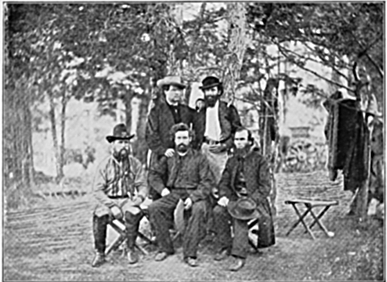
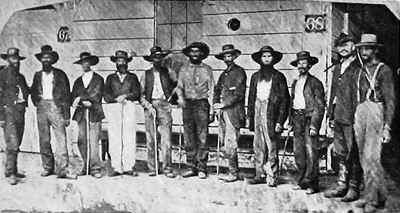
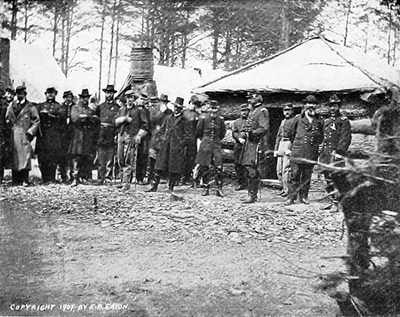
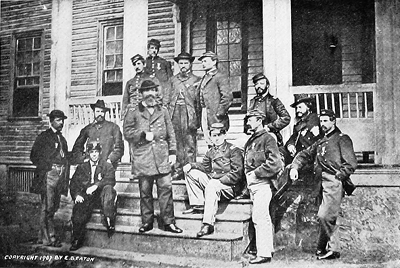
OFFICERS OF IRISH BRIGADE AT HARRISON'S LANDING IN 1862
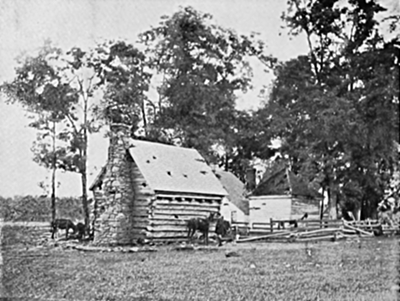
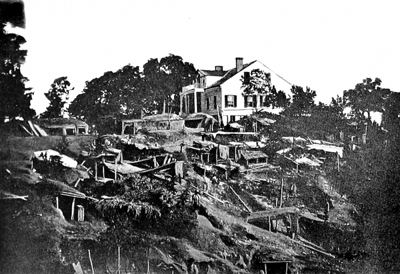
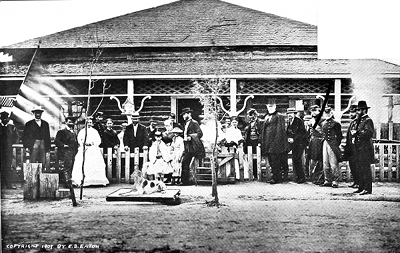
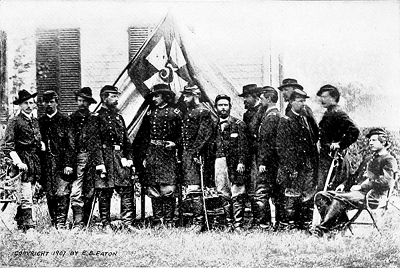
HOUSE AT CEDAR MOUNTAIN WHERE GENERAL WINDER DIED
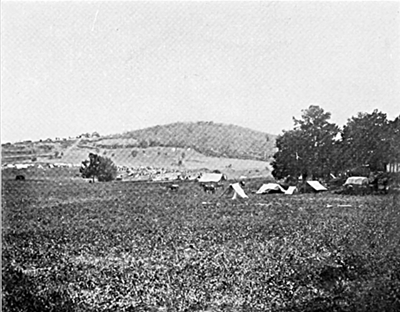
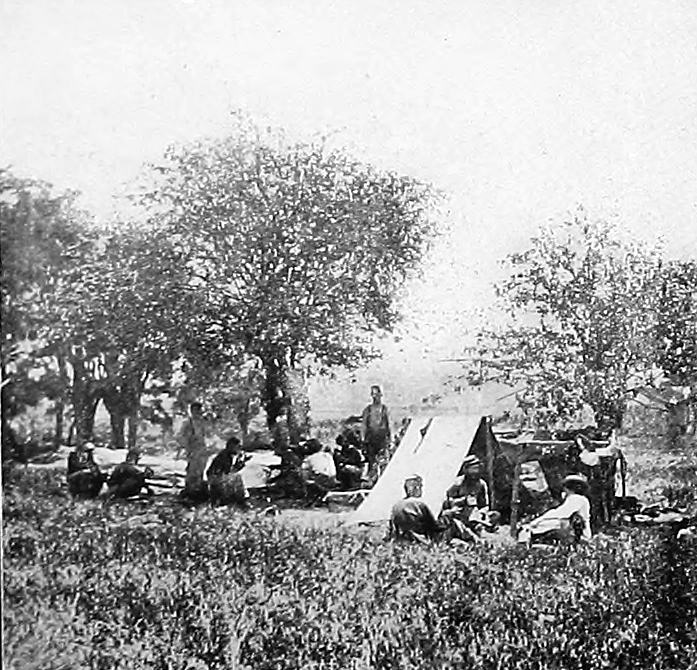
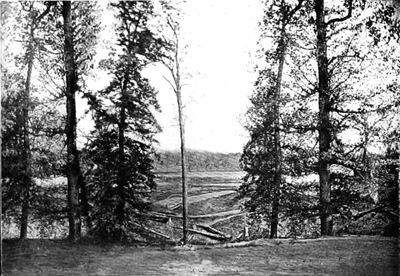
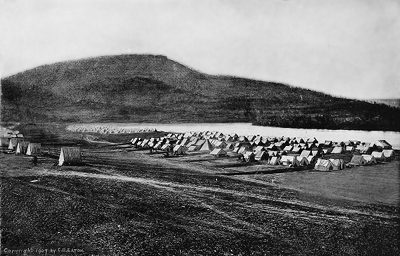
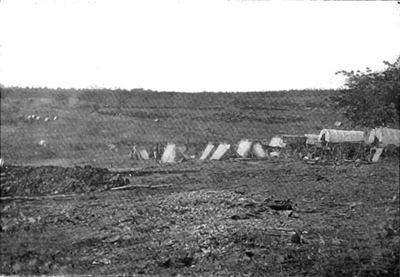
CAMP AND BATTLEFIELD ON CEDAR MOUNTAIN IN 1862
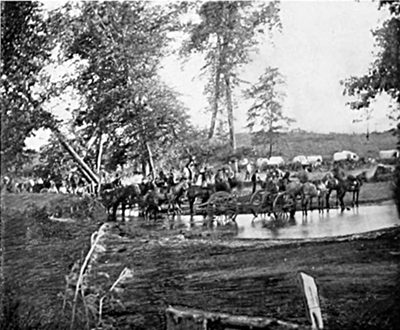
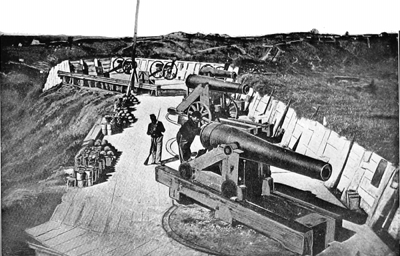
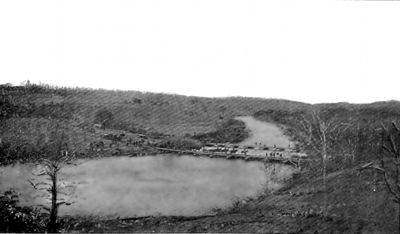
BATTERY FORDING STREAM NEAR CEDAR MOUNTAIN IN 1862
ONE hundred and sixty thousand men fought in the Union lines in the Peninsula campaign. When Lincoln reviewed the army at Harrison's Landing, in 1862, he saw only eighty-six thousand men. The remainder had been removed by casualties on the field or disease. Fifty thousand had fallen victims to fever or malaria. The president and his cabinet were dissatisfied with the conditions and General Henry Wager Halleck, who had been showing much ability in the West, was summoned to Washington and appointed commander-in-chief. McClellan was practically deposed from the Potomac. The Army of Virginia, under command of General John Pope, was instructed to cover Washington and guard the Shenandoah entrance to Maryland. In taking command of this division, Pope said to his men: "I have come to you from the West, where we have always seen the backs of our enemies." The Confederates were mapping routes on a large scale. Bragg was to advance on Louisville and Cincinnati; Lee was to invade Maryland and march upon Washington, Baltimore and Philadelphia. The capture of these three cities was to assure the Independence of the Confederacy. Lee had 150,000 men and two-thirds of them were to be taken on this invasion. This is the scheme that was being worked out when the two armies met on the thirtieth day of August at Manassas. The Confederate troops poured onto the Federal lines and forced them back beyond Bull Run until the darkness of the night stopped the pursuit. Bridges were burned and railroads destroyed by the Union Army as they withdrew toward Washington, making brave stands to hold back the enemy, only to be driven back to the banks of the Potomac with 7,800 missing and dead, while the Confederate lines had 3,700 vacancies.
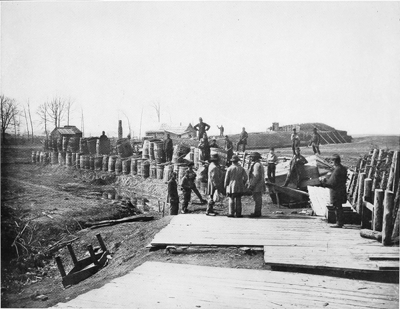
PHOTOGRAPH TAKEN BEHIND CONFEDERATE FORTIFICATIONS AT MANASSAS IN 1862
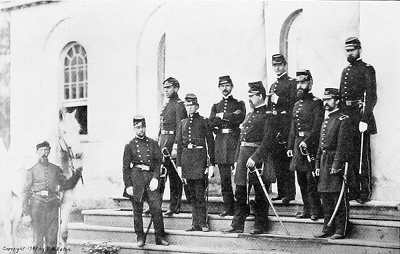
GENERAL IRVIN MCDOWELL AND OFFICERS IN 1862
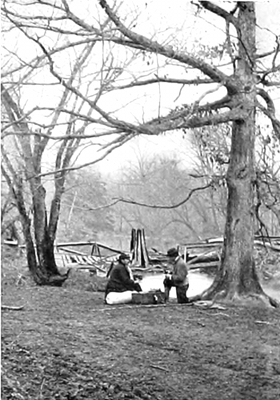
RUINED BRIDGE AT MANASSAS
CONSTERNATION was caused in Washington by the terrible slaughter at Manassas, on the thirtieth of August, in 1862. The Federal Army was driven from the Virginia valley. The mighty Confederate generals Lee, Jackson, and Longstreet, renewed their hopes of entering the National Capital and pushing into Pennsylvania and Maryland, and as one enthusiastic Southerner exclaimed: "The Confederate flag will yet wave over Faneuil Hall in Boston." It was but thirteen months since the Union Army met a fearful defeat along this same stream of Bull Run. After a three weeks' campaign, the Federals, under Major-General John Pope, were forced to retire and hastened to the defense of Washington which they believed to be in instant danger of attack. It was in a volley of heavy fire that General Phil Kearney fell dead from his saddle. Kearney and Lee had been personal friends before the war and Lee sent the body of his old friend back to the Union headquarters under a flag of truce. During this campaign, Brady secured an excellent photograph of Major-General Irvin McDowell and staff, who had been in the first battle of Bull Run and now commanded the Third Army Corps. He also made the acquaintance of General Robert E. Lee, who had assumed command of the Confederate Army in Virginia in the second battle, two months before. Standing at Lee's right is Major-General G. W. C. Lee and on his left Colonel Walter Taylor of the Confederates.
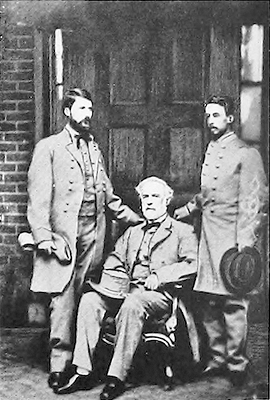
GENERAL ROBERT E. LEE AT MANASSAS
TIRED and hungry, the Federal soldiers were driven from the Virginia Valley. The cutting off of supplies had placed them in a precarious condition. There was nothing left for them to do but retreat to the nearest provisions. Even the 4,000 horses in the cavalry were so broken down and footsore that not more than 500 of them were fit for riding. The only considerable depot of supplies was at Manassas Junction and it had fallen into the hands of the Confederates. A strong body of cavalry under "Jeb" Stuart, with 500 infantry, had raided it during the night three days before the battle. These stores were destroyed by the Confederates as a safer way to force back the Federals by starvation. While they brought little succor to the rank and file of the Confederate army they left the Union soldiers without food. One of Brady's cameras reached Manassas Junction shortly after the destruction and this is the negative that was taken. The railroad train is wrecked, the engine is derailed, and the cars have been looted. 50,000 pounds of bacon, 1,000 barrels of corned beef, 2,000 barrels of salt pork, 2,000 barrels of flour, two train loads with stores and clothing, large quantities of forage, 42 wagons and ambulances, 200 tents, 300 prisoners, 200 negroes, eight pieces of artillery with their horses and equipments, and 175 horses other than those belonging to the artillery fell into the possession of the enemy. Immense quantities of quartermasters' and commissaries' stores were burned. Only rations enough for a single day were saved by the captors. The conflict was too hot and the action too swift to allow carrying them along on the movement into the North. With these provisions gone the Union army was in dire want.
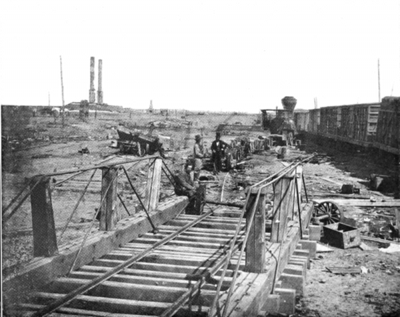
PHOTOGRAPH TAKEN AT RUINS OF MANASSAS JUNCTION, VIRGINIA, IN 1862
THE pursuit by the Confederates toward the very gates of Washington, after the route of the Union army along Bull Run, was stopped only by the thoughtfulness of the retreating Federals in destroying their bridges. Lee, in his report after the battle, says: "After a fierce combat, which raged until after nine o'clock, Pope's Union Army was completely defeated and driven beyond Bull Run. The darkness of the night, his destruction of the Stone Bridge after crossing, and the uncertainty of the fords, stopped the pursuit." This photograph is an actual verification of the truth of Lee's excuse. Brady arrived on the following day and this picture shows the ruins as he found them. It would have been foolhardy for an army in the blackness of night to have attempted to tramp through wreckage, the extent of which they knew nothing, and water the depth of which was questionable. Bull Run was a treacherous stream with its rocks and holes. Moreover, the Confederate soldiers, after the fearful struggle through which they had passed, were not in a condition to travel through the night in drenched and mud-soaked clothing. The Union forces at the fierce battle of Manassas were: Army of Virginia, under Pope—1st Corps under Major-General Franz Sigel; Third Corps under Major-General Irvin McDowell; Second Corps under Major-General Nathaniel P. Banks; Army of the Potomac—Third Corps under Major-General S. P. Heintzelman; Fifth Corps under Major-General Fitz John Porter; Ninth Corps under Major-General Jesse L. Reno.
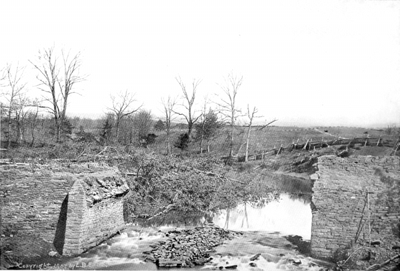
PHOTOGRAPH TAKEN AT RUINS OF STONE BRIDGE OVER BULL RUN IN 1862
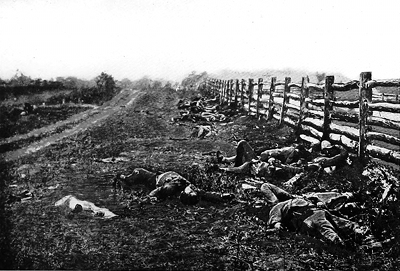
THE DEAD ALONG HAGERSTOWN ROAD AFTER BATTLE OF ANTIETAM
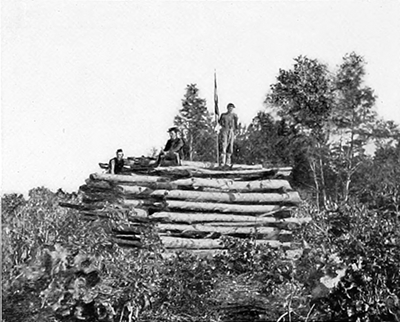
SIGNAL CORPS WATCHING BATTLE FROM HILLSIDE AT ANTIETAM
THRILLED with the victory at Manassas, the second Bull Run, the leader of the Confederacy, Jefferson Davis, ordered an immediate movement to the North with all the chances of glorious triumph in his favor. It was conceded even by the military tacticians of the Government that Lee could march to Washington with probabilities of entrance. He was aware that a direct attack was feasible, but he desired to cross the Potomac into Maryland and enter the National Capital from the north, thus giving him a free route to the great municipalities of the North. It is probable that he even had visions of the capture of New York. While developing this military stratagem he met the Federals in the open at Antietam. It was the seventeenth of September in 1862. General McClellan was in command and Lee's fondest dreams were blasted. The men of both armies fought as they never fought before. Brady's cameras were soon on the scene and secured many negatives of this bloody day. The one above reveals the west side of Hagerstown Road after the battle. The bodies of the dead are strewn thickly beside the fence, just as they fell. The guns succeeded in getting an excellent range of this road, and slaughtered the enemy like sheep. This view of some of the men just as they fell, is only a glimpse of many groups of dead in that terrible combat. Brady "caught" the Independent Pennsylvania Battery E, well known as Knapp's Battery, shortly after the battle.
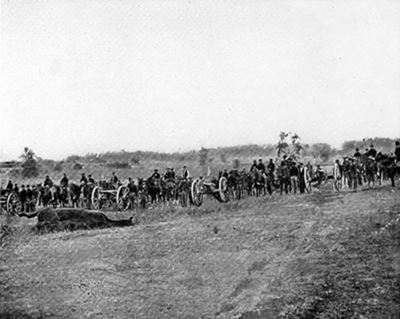
ARTILLERY AFTER THE BATTLE OF ANTIETAM
THIS is believed to be the first photograph ever taken of armies in battle on the Western Continent. The historic negative was taken from the hill overlooking the battle of Antietam. It shows the artillery in terrific conflict and the fire belching from the cannon's mouth. The clouds of smoke rising from the valley tell the fearful story of that seventeenth day of September, in 1862, when 25,899 Confederates were killed, wounded and captured at the cost of 12,469 Union men. On the left of the lines stand the reserve artillery waiting for the call to action. One can almost hear the voice of "Little Mac" urging his men on to victory. The defeat at Manassas, and the destruction of Pope's trains, with the hot haste in which the troops had passed through Washington, gave no time for the issuance of shoes, socks or other necessaries. The men who had tramped through the Chickahominy swamps and down the Virginia Valley were ragged and bleeding, but when the order rose above the tumult: "Give ground to the right," a mighty cheer swept along the lines as a cavalry of horsemen galloped madly to the front, for the men in the ranks knew that McClellan was coming. There was not a man at Antietam who did not know that it was a last desperate chance to thwart the great Lee from marching on to Washington, and possibly Baltimore and Philadelphia. The people in the North eagerly awaited the news. The National Capital was almost in a state of panic. It was the hardest fought and bloodiest single day's battle of the war and more men were killed than in any single day's fight during the conflict.
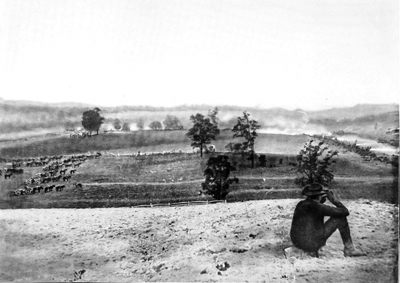
PHOTOGRAPH TAKEN DURING THE BATTLE OF ANTIETAM IN 1862
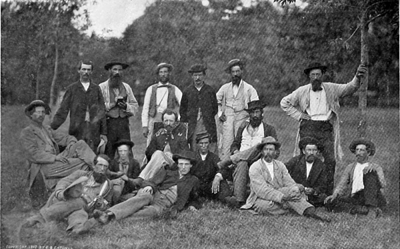
SCOUTS AND GUIDES WITH THE ARMY OF THE POTOMAC
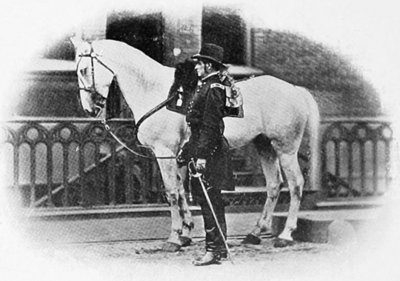
GENERAL JOSEPH HOOKER AND HIS FAVORITE HORSE AT ANTIETAM
PICKETS IN THE LEAD OF THE ARMY IN 1862
THE scouts and guides of the Civil War saved the armies from many defeats by their shrewdness and bravery. Upon them rested the great responsibility of leading the soldiers through the unknown country to advantageous and safe positions. During the Peninsula campaign in 1862 a group of these men sat before one of Brady's cameras. A photograph was also secured at a reserve picket station near the Potomac. The advance picket was a short distance ahead and upon the approach of the enemy began firing, and gradually fell back on these reserves, who keep up a continuous fire as they retire slowly, fighting as they go, giving time for the army to form into line for battle. About this same time an excellent picture was secured of "Fighting Joe" Hooker standing beside his horse. Hooker was seriously wounded at Antietam and borne from the field. Still another photograph shown here is the "Sunken Road" or "Bloody Lane" at Antietam, in which the Confederate dead lay three deep for a distance of half a mile. This ditch was used by the Confederates as a rifle pit. A Union battery succeeded in getting an excellent range of the road and this view, taken the day after the battle, shows the dead just as they fell. It is a scene of slaughter that few men have ever seen and its horrors are here preserved in detail by the camera.
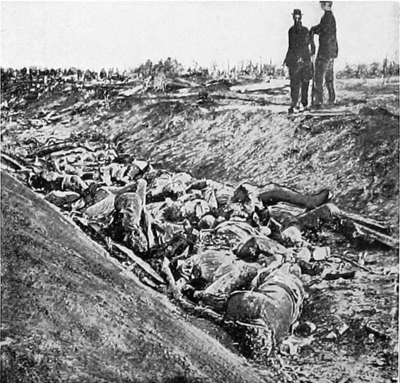
DEAD IN SUNKEN ROAD AFTER BATTLE OF ANTIETAM
STONEWALL JACKSON, in speaking of the battle of Antietam, said: "The carnage on both sides was terrific. The hottest fight seemed to center about Dunker Church, where there were no less than four charges and counter-charges. Each army had taken and retaken the ground until it was literally carpeted with dead and dying men." The Confederates posted a battery of light artillery outside of the little building used for religious services by the sect known as the Dunkers. This photograph shows where one gun of the battery stood. The dead artillerymen and horses, and the shell-holes through the little church, prove how terrible a fire was rained onto this spot by the Union batteries. Another view on this page shows the dead collected for burial after the battle of Antietam. The wounded were taken from the battlefield to an improvised hospital which consisted of canvas stretched over stakes driven into the ground. A view is here given of one of these hospitals in which wounded Confederate prisoners are being relieved of their suffering. One of the most interesting of these photographs is Burnside Bridge. With fixed bayonets the Union soldiers started on their mission of death, rushing over the slope leading to the bridge, and engaging in fierce combat with the enemy. The fire that swept it was more than they could stand and they were obliged to retire. Two heavy guns were placed in position and aimed upon the Confederates. In a maddening charge, the bayonets again flashed in the light and the Union soldiers swept everything before them, planting the Stars and Stripes on the opposite bank. Five hundred of their men lay dead behind them. By this time Burnside had crossed the stream and after a quick encounter the battle was ended with both armies severely punished and neither inclined to resume the fight.
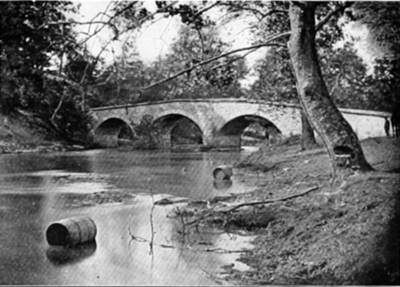
BURNSIDE BRIDGE AT ANTIETAM IN 1862
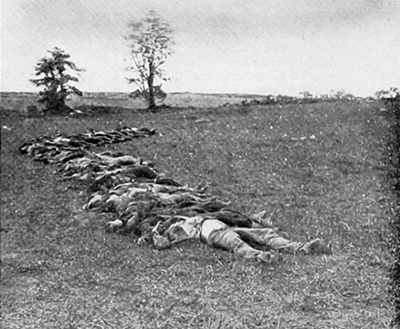
THE DEAD COLLECTED FOR BURIAL AFTER BATTLE OF ANTIETAM
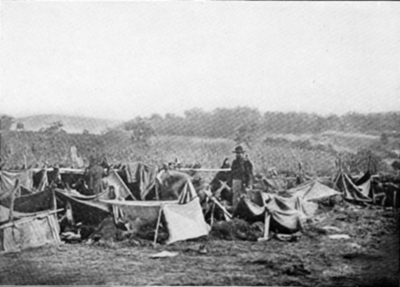
FIELD HOSPITAL AT ANTIETAM BATTLEFIELD IN 1862
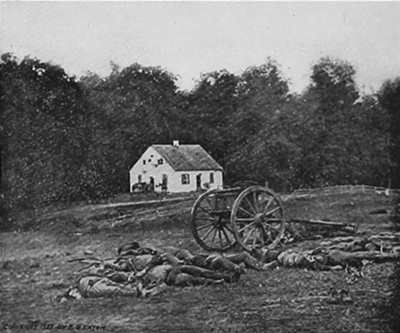
DEAD ARTILLERYMEN AT DUNKER'S CHURCH, ANTIETAM
THE last echo of the guns of Antietam had hardly died away when the great Lincoln and the cautious McClellan stood literally at swords' points at the very instant when the Confederacy was repulsed and weakened. Lincoln was positive that this was the opportune moment to take the offensive and drive the Confederates into the South. McClellan insisted that his soldiers were suffering; that they needed shoes and supplies; that the cavalry horses were fatigued. He felt that the Government had been saved by his men and that the administration should now provide them with proper clothing and food before they plunged again into the wilderness. President Lincoln hurried to the battlefield of Antietam on the first of October, in 1862, to learn the real condition. While the president and "Little Mac" were seated in General McClellan's tent about noon on the third of October, with maps and plans on the table before them, discussing the situation, Lincoln submitted to having this photograph taken. The silk hat of the president lies on the table over which is thrown an American flag. It is a remarkable likeness of the great American and the negative is treasured as one of the most valuable contributions to our National records. In speaking of this visit, McClellan said: "We spent some time on the battlefield and conversed fully on the state of affairs. He told me that he was entirely satisfied with me and with all that I had done; that he would stand by me. He parted from me with the utmost cordiality. We never met again on this earth." On the following morning Lincoln returned to Washington. Two days later McClellan received an order from Washington to immediately move onto the enemy and engage them in battle. The breach between the two men was now irreparable. McClellan believed that it was the influence of Stanton whom he had accused of working deliberately against him. It was nineteen days before he began the movement and on the fifth of November, Lincoln issued this order: "By direction of the president it is ordered that Major-General McClellan be relieved from the command of the Army of the Potomac, and that Major-General Burnside take command of that army."
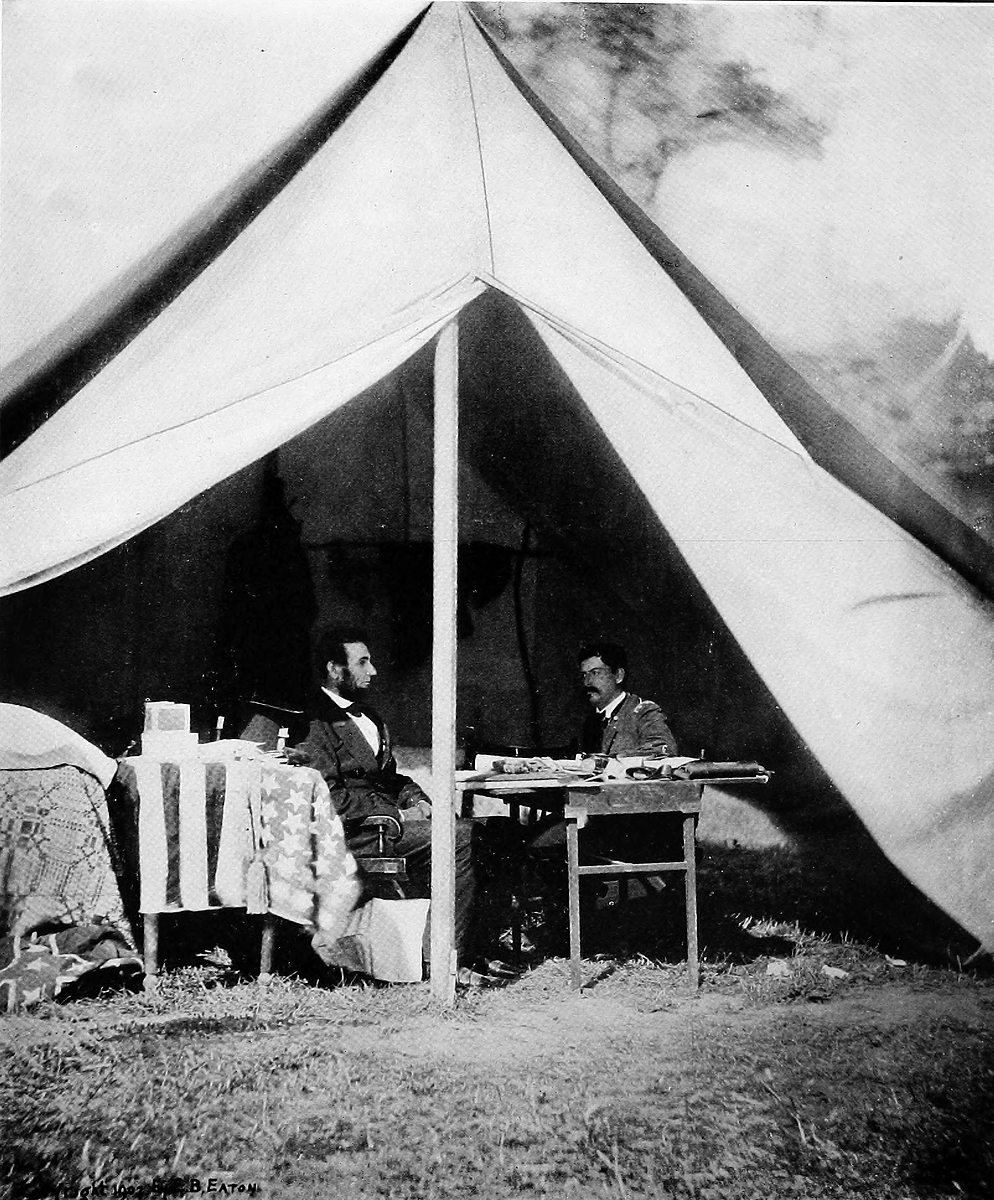
PHOTOGRAPH TAKEN WHILE LINCOLN WAS CONFERRING WITH McCLELLAN ON BATTLEFIELD OF ANTIETAM
WHEN Lincoln visited the battlefield of Antietam, he was accompanied by Allan Pinkerton, chief of the Secret Service, known under the alias of Major Allen. On the morning of the third of October, 1862, when he was leaving McClellan's tent to look over the army in camp, he again stood before one of the war cameras and this rare photograph is the witness. Comparatively few of this generation have any clear idea of how the real Lincoln looked as he passed through the heart-rending ordeal from 1861 to 1865. This photograph shows him in his characteristic attitude. At his right stands Pinkerton, one of the shrewdest detectives that the world has produced. The officer in uniform is Major John A. McClernand, who was appointed to command the Army of the West and fought at Fort Donelson, Shiloh and Vicksburg, but who was in the East at this time. From Lincoln's visit resulted McClellan's deposal. Never before or since has such a scene been witnessed in any army as the one when McClellan took leave of his officers and soldiers. Seated on a magnificent steed, at the head of his brilliant staff, he rode down the lines, lifting his cap as the regimental colors fell into salute. Whole regiments dropped their muskets to cheer their hero. The tears came to McClellan's eyes and the vast army shook with emotion. As he was boarding the train troops fired a salute. Impassioned soldiers wildly insisted that he should not leave them, and uttered bitter imprecations against those who had deprived them of their beloved commander. It was a moment of fearful excitement. A word, or a look of encouragement, would have been the signal for a revolt, the consequences of which no man can measure. McClellan stepped to the platform of the car. He spoke slowly but appealingly: "Stand by General Burnside as you have stood by me, and all will be well!" A calm fell over the soldiers and they bade farewell to their idolized commander. McClellan, upon reaching Washington, remained less than an hour and proceeded at once to Trenton. From that time he never again saw Lincoln, or Stanton, or Halleck.
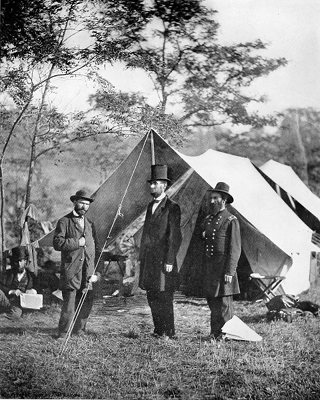
PHOTOGRAPH TAKEN WHILE LINCOLN WAS PASSING THROUGH CAMP AT ANTIETAM IN 1862
A FEW days after Burnside replaced McClellan in command of the Army of the Potomac, this photograph was taken while he was with his staff at Warrenton, Virginia, in the middle of November, in 1862. Burnside is here seen in the midst of his officers, with one hand characteristically tucked into his coat and the other holding a written military order. Burnside was a graduate of West Point and when twenty-four years old helped to take the Capital in the Mexican War. He had also been an Indian fighter and during those days made a journey of over a thousand miles across the plains in seventeen days, accompanied by only three men, to carry dispatches to President Filmore. At twenty-nine years of age he resigned from the United States Army and invented the Burnside rifle. He was one of McClellan's intimate friends, and while a civilian he was engaged with him on the Illinois Central Railroad. Burnside was in New York when the Civil War broke out and hurried to the front in command of the First Rhode Island Volunteers. He fought at the first battle of Bull Run and commanded an expedition that stormed the North Carolina coast. He was in the famous Battle of Roanoke Island and Newbern and as a reward for these successes he was given the rank of major-general. He later fought the Battle of Camden, attacked and reduced Fort Macon, and during the Peninsula Campaign fought at the Battle of South Mountain and Antietam. When Lincoln first offered Burnside the command held by McClellan it is said that he refused it three times. Not until he knew that his friend must go did he concede to the wishes of the president. When Burnside took command of the Union forces he was but thirty-nine years old, but an experienced warrior.
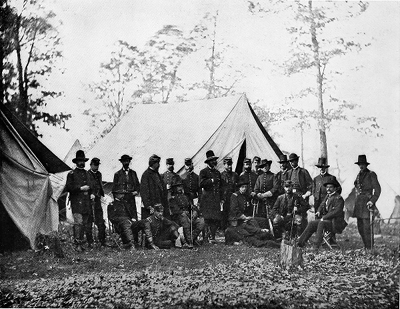
PHOTOGRAPH TAKEN WHILE MAJOR-GENERAL AMBROSE E. BURNSIDE WAS ENCAMPED WITH HIS STAFF IN 1862
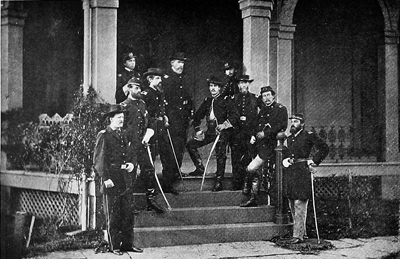
GENERAL EDWIN V. SUMNER AND STAFF IN PENINSULA CAMPAIGN IN 1862
SHORTLY after the battle of Antietam this photograph was taken of General Sumner, who was distinguished for gallantry on that bloody field. Sumner is seen standing on the steps in the center of a group of officers. At this time he was a warrior sixty-six years of age and had seen a long life of hard fighting. He was born during the first days of the American Republic, in the year 1796. When twenty-three years old he became a second lieutenant in the United States Infantry and served with distinction during the Black Hawk War. He later had command of a cavalry school and at the outbreak of the Mexican War he led an attack against five thousand lancers and was breveted colonel. With the cessation of this conflict he took charge of the Department of New Mexico, and was later ordered to Europe on official business. Upon his return he entered into border warfare and defeated the Cheyenne Indians. When Lincoln was elected president, Sumner was selected to accompany him from Springfield to Washington and was promoted brigadier-general. Sumner was active in the Peninsula Campaign and was promoted to major-general. He fought through the Maryland Campaign, and at Antietam his corps made one of the fiercest charges over the field, carrying destruction and death. He commanded the right wing at the battle of Fredericksburg and was ordered to the West, but while preparing to depart he died suddenly.
WHILE the campaigns against Richmond and Washington were being waged, hard fighting was taking place in the Southwest. Grant was in command of the Army of the Tennessee. Buell was near Chattanooga, facing Bragg who threatened Louisville. Rosecranz was at the head of the Army of the Mississippi and occupied Alabama and Northern Mississippi. Terrific engagements had taken place at Fort Donelson and Shiloh, Tennessee. The Guerilla Campaign was being waged in Missouri. There were frequent clashes in Kentucky and Arkansas, but Mississippi seemed to be the battle-ground. Corinth, in that state, was considered the military key to Tennessee. It was in the conflict for the control of this coveted position that the Confederates made one of their bravest charges. A photograph is here shown of Fort Robinette which was protected by Federal guns. The Southerners charged almost to the cannon's mouth, only to be swept back by the murderous shower of lead. The second charge stands as a wonderful example of human courage. Colonel Rogers of Texas, led the column, and scaled the breastwork, falling inside. Three charges were made, but the Confederates were finally forced to retreat. The Federal loss at this battle of Corinth in killed, wounded and missing was 2,359; the Confederates left behind them 9,423.
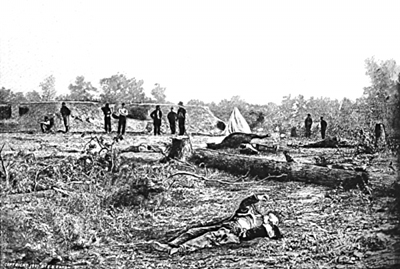
IN FRONT OF THE EARTHWORKS AT FORT ROBINETTE IN CORINTH, MISSISSIPPI
WITH colors flying, armament in first-class condition, and soldiers well-clothed and fed, the Union lines under the new command of Burnside began offensive operations against Virginia. This had been Lincoln's long desire. The scene of action was now to be forced away from the National Capital. On a bright morning in November, the men who had served under McClellan marched in three grand divisions to their new campaign. The Rappahannock was reached on the seventeenth, but the bridge across the river had been destroyed by the Confederates who were intrenched in Fredericksburg on the opposite bank. Pontoons promised by the Government had not yet arrived. "Where are my pontoons?" wired Burnside. "They will start to-morrow," came the reply from the War Department. It was the tenth of December before the engineers could build their bridges and in the meantime ill-feeling had arisen between Burnside and the Government. The fatal delay had enabled Lee to concentrate his army on Marye's Heights, overlooking Fredericksburg. The work of building five bridges across the Rappahannock was begun under a drawn musketry fire from the opposite bank of the river. Nearly every blow of a hammer cost a human life. Burnside ordered his artillerymen to open fire on the city. Fredericksburg became a mass of ruins. This photograph shows abutments of the destroyed bridge. The trees are cropped short by the artillery fire from the Union guns. The Confederate sharpshooters were concealed in the buildings on the opposite river front. Burnside ordered his men to cross the river on a line of pontoon boats. The sharpshooters were driven from their shelter while the bridge building was completed. The river was crossed. At dawn, the twelfth of September, both armies stood ready for combat.
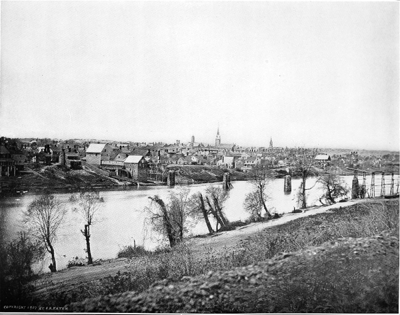
PHOTOGRAPH TAKEN ON THE RAPPAHANNOCK RIVER AFTER DESTRUCTION OF BRIDGE TO FREDERICKSBURG IN 1862
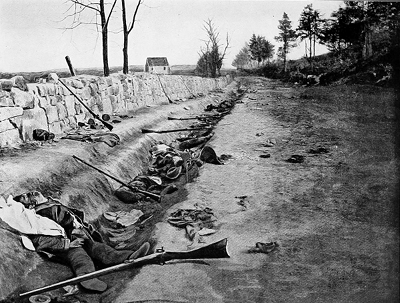
PHOTOGRAPH TAKEN ALONG THE SUNKEN ROAD AT FREDERICKSBURG AFTER THE BATTLE IN 1862
CONFRONTED by sheets of flame, the Union Army made its attack on Fredericksburg on the morning of the thirteenth of December, in 1862. The Confederates occupied the Heights with a line five and a half miles long and fortified with earthworks and artillery. The Federals moved through the town under a heavy fire of Confederate batteries. Marye's Hill was protected at its base by a stone wall, back of which was a sunken road, occupied by two brigades of Confederate infantry. The charging columns of the Union Army were rushing across the open ground under a fierce artillery fire when suddenly they were confronted by a rain of lead from the sunken road back of the stone wall. Nearly half of the charging column was shot down and the remainder fell back. Five thousand more charged in the same manner. Some of them approached within twenty yards of the wall, but fell back, leaving two thousand of their number on the field. Twelve thousand men were again charged against Marye's Heights, but scarcely four thousand returned. The Union ranks were depleted by 12,355, while the Confederates held their position with a loss of but 4,576, and the Federal Army withdrew across the Rappahannock and Lee held Fredericksburg.
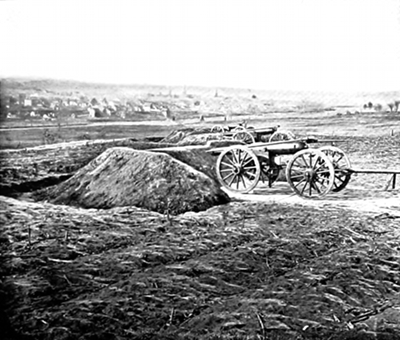
ARTILLERY DEFENSES ON THE BATTLEFIELD OF FREDERICKSBURG IN 1862
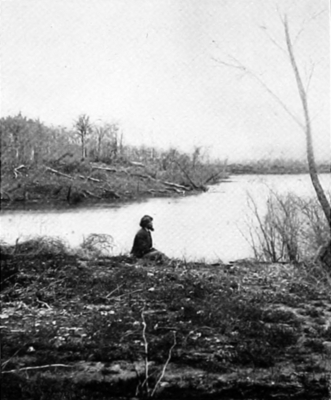
FIGHTING GROUND ALONG THE CHICKASAW BAYOU
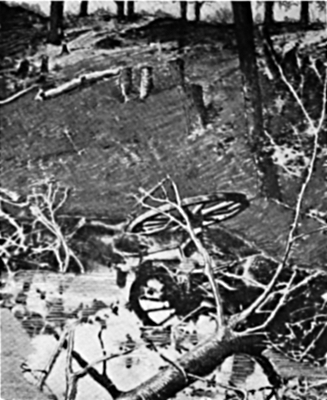
POISONED SPRING OF CHICKASAW BAYOU
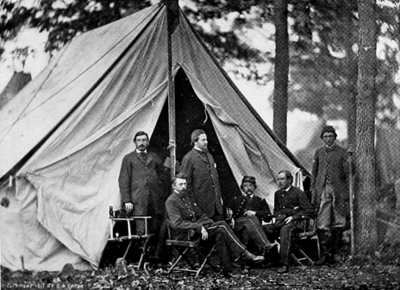
MEDICAL CORPS OF ARMY OF POTOMAC IN CAMP UNDER SURGEON JONATHAN LETTERMAN
THE end of 1862, in the Civil War, found the army in the East in camp at Falmouth, Virginia, after severe reverses. In the Southwest a vigorous campaign was being waged by the heroes of Iuka and Corinth, Mississippi. Grant was in supreme command of the Federal corps in northern Mississippi. A movement was in operation against Vicksburg. Sherman was attempting to get into the rear of the city by the Chickasaw Bayou road which ran from the Yazoo battlefield to the Walnut Hills, six miles above the city. His column of thirty thousand men was defeated and driven back with dreadful slaughter on the twenty-eighth and twenty-ninth of December. Rosecranz was established at Nashville, while Bragg was putting his men into winter huts at Murfreesboro, Tennessee. The Federal troops enjoyed Christmas in camp and on the following morning, in a cold rain, the Army of the Cumberland advanced to Stone River where it enters the Cumberland River just above Nashville. At sunrise on the last day of 1862, Rosecranz's army met Bragg's forces with a deafening roar of artillery and musketry that fairly caused the earth to tremble. The fighting on both sides was of a determined character. The fields were literally covered with dead and dying men. Victory was claimed by both the Federals and the Confederates. Photographs are here shown of Chickasaw Bayou and the deadly Poison Spring on the battlefield; also an excellent portrait of the medical corps of the Army of the Potomac, in camp under charge of Dr. Jonathan Letterman, a prominent battlefield surgeon.
EVERY AMERICAN citizen pledges his "life, fortune and sacred honor" to the truth that "all men are created free and equal," and that they are endowed by their Creator, with certain "unalienable rights." It was fidelity to this oath, as sacred as life itself, that led the American people to rush "to arms" to defend it.
The mobilization of a volunteer army, of freemen born and bred in the arts of peace, never was known until the new Republic of the Western Hemisphere championed the cause of Liberty and common manhood. Battle-trained monarchies declared that it could not be maintained; that the hundreds of thousands of men who were offering their services to their country could never stand the severe exposures and deprivations of warfare. The tongues of the Nations knew not what they were talking. These men were fighters, not by training or nature, but by an honest impulse of the heart they were patriots. It was not love of adventure that urged the strongest men of the North to leave home and family and shoulder a musket under the Stars and Stripes; nor was it a brutal love of combat that marshalled the best manhood of the South to the flag of the Confederacy. It was an impulse that no people had ever before felt. It was a sense of justice that was early kindled in the American Heart with the first tidings of the Declaration of Independence.
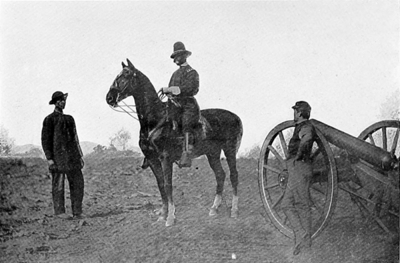
MAJOR-GENERAL AMBROSE EVERETT BURNSIDE ON HIS HORSE ON THE BATTLEFIELD IN 1863
One day during the interval between the defeat at Fredericksburg, Virginia, and the siege at Knoxville, Tennessee, General Burnside was mounted on his favorite charger, viewing his army maneuvers in the distance, when one of the Brady cameras was brought into focus and, with the General's permission, the negative was secured—General Burnside valued this photograph highly
While the anguish of the Civil War was brooding over the Nation, mountain and valley, plain and forest, farm and factory—from ocean to ocean—offered its strongest manhood in defense of the country. New York, the largest state in the Western World, sent the greatest number of men to the line of battle—448,850; then came Pennsylvania with 337,936; Ohio with 313,180, and Illinois with 259,092. Indiana came to the front with 196,363; Massachusetts with 146,730, and Missouri brought 109,111.
Wisconsin offered 61,327 of her sons; Michigan, 87,364; New Jersey, 76,814; Iowa, 76,242; Kentucky, 75,760; Maine, 70,107, and Connecticut, 55,864.
Maryland marched under the Stars and Stripes with 46,638; New Hampshire with 33,937, Vermont with 33,288; West Virginia, 32,068; Tennessee, 31,092; Minnesota with 24,020; Rhode Island, 23,236, and Kansas, 20,149.
From the Pacific Coast, California answered with 15,725; District of Columbia contributed 16,534 to the support of the Government; Delaware furnished 12,284 men; Arkansas, 8,289; New Mexico, 6,561. The Southern State of Louisiana, dear to the heart of the Confederacy, came to the support of the Union with 5,224; Colorado with 4,903; Nebraska, 3,157; North Carolina, 3,156; Alabama, 2,576. The border state of Texas sent 1,965; far-away Oregon, 1,810; Florida, 1,290; Nevada, 1,080; Washington gave 964; Mississippi, 545, and Dakota, 206. These are the contributions of the states. The Negro Race, the freedom of which was one of the results of the War, supported their cause with 186,097 troops, while the Indian Nation sent 3,530. In the regular army there were enlisted during the War about 67,000 men. There were thousands of brave soldiers who fought in the Civil War, claiming no Commonwealth as their home, but who joined the ranks as Common Americans.
The spirit which animated the American People is shown by several occasions when troops were needed to avert impending disaster, and they poured into the army from remote states with incredible speed. The year 1863 witnessed the battles of Chancellorsville and Gettysburg, of Vicksburg and Chickamauga and Chattanooga. It was the turning point in the struggle and Brady's cameras caught many of the most dramatic scenes worthy of reproduction.
"FIGHTING Joe" Hooker is one of the notable figures of the Civil War. When a boy of fourteen years, he entered West Point and served in the Mexican War in the same regiment with "Stonewall" Jackson. His early life was crowded with hard fighting and when thirty-nine years of age he resigned from the army and went to California, where he became superintendent of the National Road and also entered into agriculture. He answered the call to arms in 1861 and entered into the defense of Washington. During the battles around Fair Oaks, Hooker led his men courageously into many daring positions. His bravery at Malvern Hill gave him the rank of major-general, and at Antietam he fell wounded before the Confederate guns while trying to force the army into a complete surrender. He commanded the center at Fredericksburg. On the twenty-sixth of January, 1863, he was appointed to the command of the Army of the Potomac and began its thorough reorganization. On the twenty-eighth of April he crossed the Rappahannock and arrived at Chancellorsville two days later. On the second of May, a fearful onslaught was made by "Stonewall" Jackson—his old comrade of the Mexican War as a foe. "Stonewall" Jackson was wounded by one of his own sentinels. His men, who were devoted to him, lost heart, and, after a battle of three days, Hooker succeeded in withdrawing his army in safety, after losses in killed, wounded and missing of 16,030 against a Confederate loss of 12,281. This photograph of Hooker and his staff was taken shortly after this battle at Chancellorsville. Hooker may be seen sitting in the second chair from the right. This is considered an excellent likeness of the warrior.
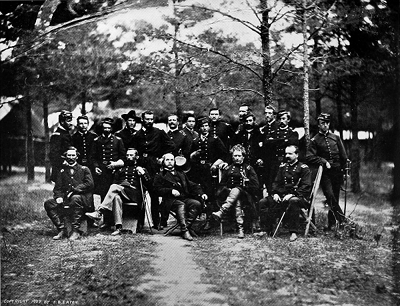
PHOTOGRAPH TAKEN SHORTLY AFTER THE BATTLE OF CHANCELLORSVILLE IN 1863—MAJOR-GENERAL JOSEPH HOOKER AND STAFF
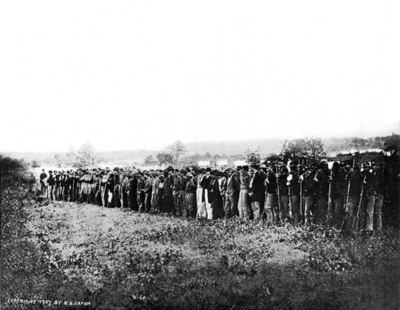
PHOTOGRAPH TAKEN ALONG LINE OF CONFEDERATE PRISONERS AFTER CAVALRY CHARGE IN 1863
THE retreat from Chancellorsville began on the fourth of May, in 1863. In the midst of a pouring rain, with ammunition wagons and cavalry struggling hub-deep through the mud, the Federals moved back to the Rappahannock. The ponderous batteries, with heavy wheels wrapped in blankets, passed over the road. Then came the ordnance supply trains, swathed in strips of cloth, followed by columns of hurrying infantry. During the remainder of May, neither of the armies assumed an offensive attitude. Lee, now in high hopes, began preparations for a second invasion in Maryland. Panic again seized the people of the North. Lincoln called on Pennsylvania for 50,000 militia; Ohio, 30,000; New York, 20,000; Maryland and Virginia, 10,000 each. The Army of the Potomac had lost all of its two years' service men and its strength did not reach 100,000. The Confederacy had been endeavoring for months to induce England to recognize it as a separate nation, but learned that it must first conquer Northern territory. Lee's movements began early in June and resulted in frequent skirmishes as he approached the Potomac. This photograph was taken immediately after one of these encounters at Aldie, Virginia, on the seventeenth of June, 1863. The Confederate cavalry, under "Jeb" Stuart, was guarding the passes of the Bull Run mountains and watching Hooker's Army. There was a succession of cavalry combats and many Confederates were taken prisoners. This view shows a group of Confederates under a Union guard composed largely of negro soldiers.
IN the stirring scenes of war there is nothing more exciting than to see a battery take position in battle. On the sixth of June, in 1863, this picture was secured by the government photographers just as the artillery was going into action on the south bank of the Rappahannock River. It is one of the earliest attempts to secure a photograph at the instant of motion and was taken at a strategic moment during Sedgwick's reconnaissance. An artilleryman who remembers the day says that while a battery has not the thrill of the cavalry charge, nor the grimness of a line of bayonets moving to slaughter, there is an intense emotion about it that brings the tears to the eyes and the cheers to the throats of battle-scarred veterans. Every horse on the gallop, every rider lashing his team and yelling; through ugly clumps of bushes; over fallen logs and falling men—the sight is one that can never be forgotten. The guns jump from the ground as the heavy wheels strike a rock or lunge from a ditch, but not a horse slackens his pace, not a cannoneer loses his seat. Six guns, six caissons, sixty horses, eighty men race for the brow of the hill. Boom! Boom! The ground shakes and trembles. The roar shuts out all sound from a line several miles long. Shells shriek through the swamps, cutting down great trees, mowing deep gaps in regiments of men. It is like a tornado howling through the forest, followed by billows of fire. There are men to-day who will look upon this picture and live again the scenes which it recalls. Artillery is the great support of armies and often saves them from defeat.
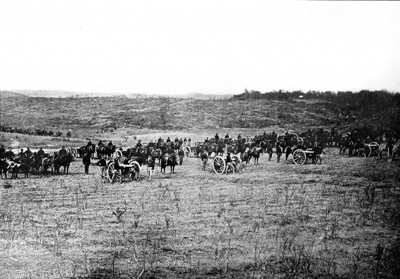
PHOTOGRAPH TAKEN AS ARTILLERY WAS GOING INTO ACTION ON THE RAPPAHANNOCK IN 1863
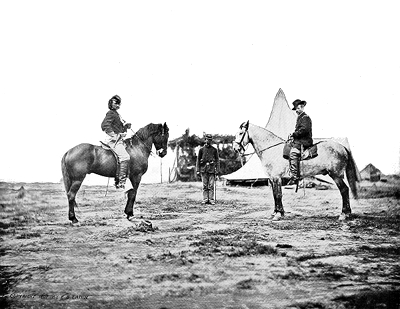
PHOTOGRAPH TAKEN WHILE CAPTAIN GEORGE A. CUSTER AND MAJOR-GENERAL ALFRED PLEASONTON WERE AT BRANDY STATION, VIRGINIA, IN 1863
THERE have been few men in American wars more daring than General George A. Custer. As a cavalryman, he won a place in military history by his bravery. Custer was a captain on the staff of General Pleasonton during the operations early in 1863. This photograph was taken near Brandy Station, Virginia, in June, 1863. It shows Custer on his black war-horse conferring with Pleasonton who is astride a gray charger. The Confederate cavalry had succeeded in breaking a part of the Federal rank. Pleasonton turned in his saddle and called to Custer: "Ride to our right and get the battery in position to reply to these infernal guns." Custer spurred his horse into the thunder of cannon and the crash of musket and carbine volleys. "The man is lost," muttered Pleasonton. Suddenly, emerging from the bank of smoke, the Union batteries wheeled into view under the rapid fire. Custer dashed across the field. From that moment he became a notable figure in the war. He was then but twenty-three years of age, but was immediately appointed by Lincoln a brigadier-general of volunteers. In speaking of him, General Pleasonton said: "I regard Custer as one of the finest cavalry officers in the world, and, therefore, have placed him in command of what is no doubt the best cavalry brigade in the world." Custer was about six feet tall, with sharp blue eyes, and light hair hanging over his shoulders. He had a slight impediment in his speech and uttered a shrill yell as he rushed like an avalanche at his foe. He wore a black velvet jacket, slouched hat and a red scarf cravat.
THE Army of the Potomac lay massed about the city of Frederick. Lee was rushing toward the Susquehanna. Hooker disagreed with Halleck at Washington regarding his method of attack and resigned his command, requesting instant release from further responsibility. Lincoln accepted the resignation and appointed General George G. Meade to the chief command. In the midst of this momentous campaign the great army changed leaders. This photograph was taken shortly after Meade began his operations. It shows him with his generals of the Army of the Potomac. Meade occupies the chair in the center of the picture. At this time he was about forty-eight years of age. He had graduated from West Point when nineteen years old, but resigned the following year and remained out of the army for the next six years, but returned in the period preceding the Mexican War, after which he was engaged in the survey of the northern lakes. He was one of the first to respond to the call in 1861. He took part in the early engagements of the Army of the Potomac and was in the Battle of Mechanicsville and Gaine's Mills and the Battle of Newmarket Crossroads. When Hooker was wounded at Antietam, Meade took charge of a corps and continued the brave fight during the remainder of the day. He had two horses killed under him and was slightly wounded, but did not leave the field. At Fredericksburg he led his men boldly to the Confederate works. In the Battle of Chancellorsville, Meade's corps carried the earth-works and fought fearlessly. On the twenty-eighth day of June, in 1863, Meade assumed command of the Army of the Potomac. The tide of battle seemed to turn with his appointment and his victories are almost unparalleled.
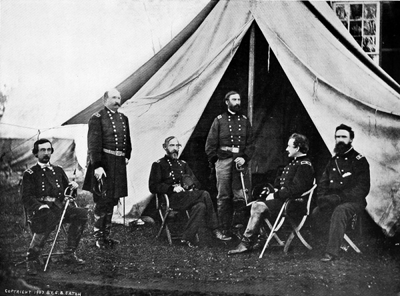
PHOTOGRAPH TAKEN WHEN MAJOR-GENERAL GEORGE G. MEADE COMMANDED THE ARMY OF THE POTOMAC
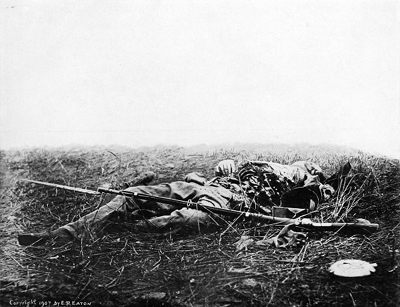
PHOTOGRAPH TAKEN ON THE FIELD OF GETTYSBURG AFTER THE BATTLE IN 1863
THE turning point of the Civil War is the Battle of Gettysburg. From that day the Confederate cause began to wane. Few battles of modern times show such great percentage of loss. Out of the one hundred and sixty thousand men engaged on both sides, forty-four thousand were killed or wounded. Brady's cameras reached the field of battle in time to perpetuate some of its scenes. The ghastliness of the pictures is such that it is with some hesitation that any of them are presented in these pages. It is on the horrors of war, however, that all pleas of peace are based. Only by depicting its gruesomeness can the age of arbitration be hastened. It is with this in mind that this photograph is here revealed. There is probably not another in existence that witnesses more fearful tragedy. The photograph is taken on the field of Gettysburg about nineteen hours after the last day's battle. It shows a Union soldier terribly mutilated by a shell of a Confederate gun. His arm is torn off and may be seen on the ground near his musket. The shell that killed this soldier disemboweled him in its fiendishness. This picture is as wonderful as it is horrible and should do more in the interest of peace than any possible argument. Something of the bloodshed on the battlefield of Gettysburg may be understood when it is considered that the battlefield, which covered nearly twenty-five square miles, was literally strewn with dead bodies, many of them mutilated even worse than the one in this picture. The surviving veterans of Gettysburg have seen war's most horrible aspects. Gallant and daring commanders led those brave men in that three days' inferno, from the first to the third of July, in 1863.
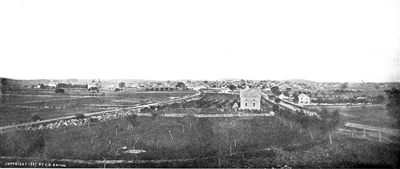
BOROUGH OF GETTYSBURG IN 1863—SCENE OF ONE OF WORLD'S GREATEST CONFLICTS
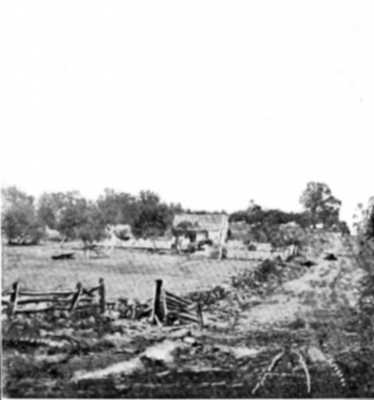
MEADE'S HEADQUARTERS ON CEMETERY RIDGE
GETTYSBURG witnessed some of the hardest fighting that the world has ever seen. This photograph was taken a short time after the battle in 1863. This little borough became a field of carnage. In the surrounding hills occurred the terrific conflict of Big Round Top and Little Round Top, Seminary Ridge and Cemetery Ridge, and Culp's Hill, the Bloody Wheatfield and Peach Orchard. A view is given of the little house in which General Meade made his headquarters. On the first day of battle this house was in direct range of the artillery fire rained by the Confederates on the Union lines just before Pickett's great charge. The horses of General Meade's aides were hitched to the fence and trees near the house. Sixteen of these horses were killed during the artillery fire, and their dead bodies are seen in the road.
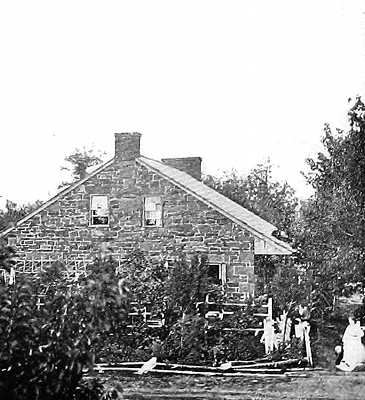
LEE'S HEADQUARTERS ON SEMINARY RIDGE
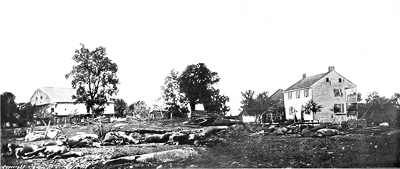
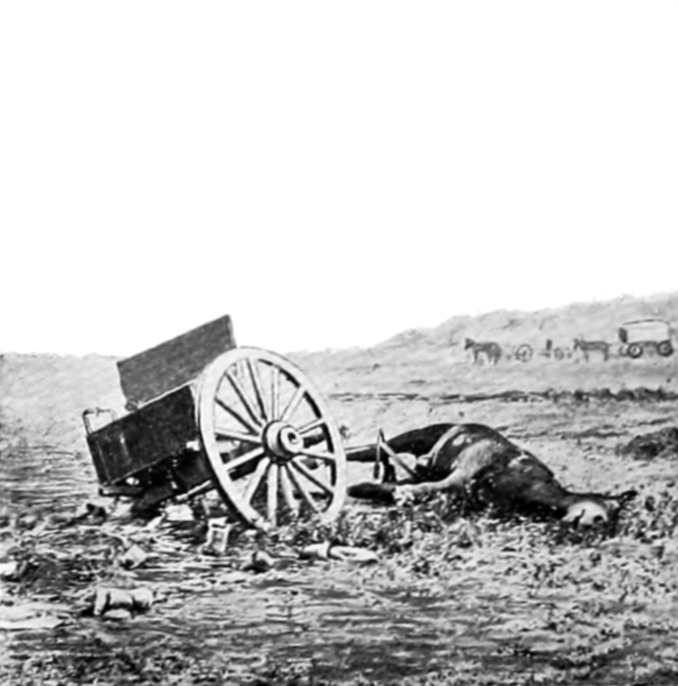
DEAD ARTILLERY HORSES AFTER FIGHT AT TROSTLE'S HOUSE AND BARN IN GETTYSBURG
CONFEDERATE DEAD ON GETTYSBURG "WHEATFIELD"
SOME knowledge of the slaughter of Gettysburg may be gained by this picture of Trostle's house and barn at which was stationed a Union battery of light artillery. This view shows where the guns stood. Sixty-five of the eighty-eight artillery horses were left dead on the field. About this time, on the last day of the greatest battle of the war, Pickett made his fierce charge, which is one of the mightiest in history. It was witnessed by the two great armies in the middle of the afternoon of a summer day—a most spectacular tragedy of magnificent courage. It has been said that Gettysburg was the common soldier's battle and that its great results were due, not so much to military strategy as to the intelligent courage and the magnificent heroism of the brave soldiers.
SHATTERED CAISSON—GETTYSBURG "PEACH ORCHARD"
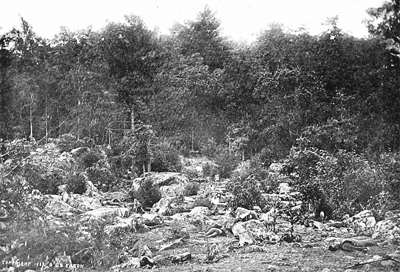
DEAD AMONG THE ROCKS OF LITTLE ROUND TOP ON GETTYSBURG BATTLEFIELD
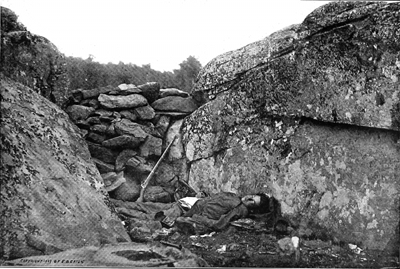
DEAD SHARPSHOOTER IN "DEVIL'S DEN" ON LITTLE ROUND TOP AT GETTYSBURG
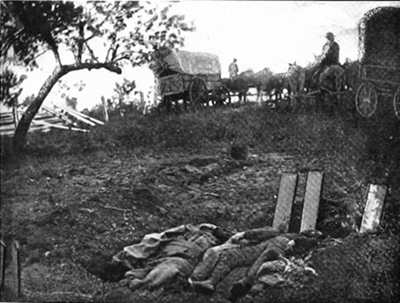
UNCOVERED CONFEDERATE GRAVE AT GETTYSBURG
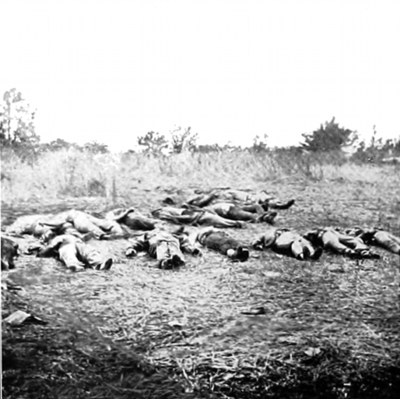
GETTYSBURG is the "Waterloo of the American Continent." A photograph is here shown of the dead soldiers lying on the battlefield. To silence Hazlett's Battery, which was posted on the summit of Little Round Top, the Confederates pushed their sharpshooters among the rocks in the mountain. A few hours before these photographs were taken one of these sharpshooters mortally wounded General Weed, who was directing the movement of his troops from the summit. Lieutenant Hazlett, who was an old schoolmate of the fallen general, was commanding the battery and hastened to take the dying words of his friend and comrade, when he, too, fell dead, pierced by a bullet from the dread sharpshooters. Like a flash the guns of the battery were turned on the "Devil's Den" from which came the fatal shots as this picture attests.
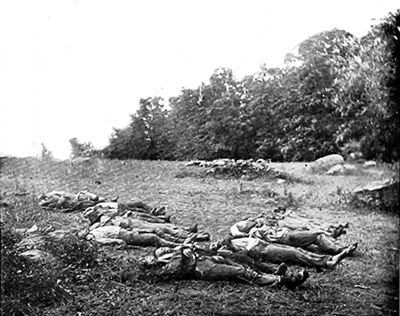
CONFEDERATE DEAD IN "WHEATFIELD" AT GETTYSBURG
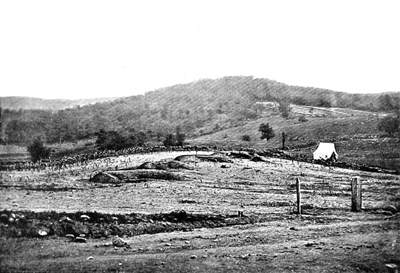
EARTHWORKS AT CULP'S HILL AT GETTYSBURG IN 1863
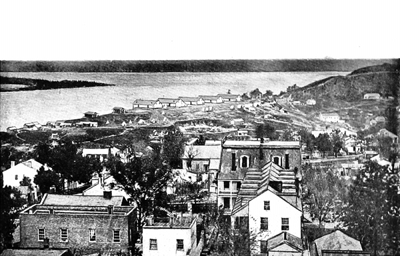
TENTS ALONG RIVER FRONT AT VICKSBURG, MISSISSIPPI, IN 1863
BATTLEFIELD OF BIG BLACK RIVER IN MISSISSIPPI IN 1863
AS the tide of battle drifted to the West in 1863, the war photographers hurried to the region of the Mississippi. Grant had been pursuing his operations toward Vicksburg. With Sherman and McClernand, he was maneuvering to take the key to the South by storm. A photograph is here shown of Champion Hills near Big Black River territory, on the outskirts of Vicksburg, where the armies first met. The Confederates held a strong line of earthworks on the eastern bank of the river. The Federals, before a heavy fire of musketry, crossed a ditch, delivered a terrific volley, and clambered over the breastworks with empty muskets. The Confederates, in falling back, found that their comrades had set fire to both of the bridges and were compelled to surrender. Two thousand prisoners, eighteen pieces of artillery, six thousand stand of small arms, and many commissary stores were captured. General Lawler's Brigade led the charge. The battle lasted four hours. On the eighteenth of May, 1863, the Federals began crossing the Big Black by felling trees on both banks so that they tumbled into the river and interlaced, using bales of cotton instead of boats. On the morning of the twenty-second, with furious cannonading, the last assault on the defences of Vicksburg was made. This campaign is a remarkable military exploit. In twenty days Grant crossed the Mississippi River with his entire force, moved into the rear of Vicksburg, fought and won four distinct battles, captured the State Capitol, and destroyed the Confederate arsenals and manufactories. His troops marched one hundred eighty miles with only five days' rations from the quartermaster, and captured over six thousand prisoners, twenty-seven cannon and sixty-one field pieces. All this was accomplished by forty thousand brave men against sixty thousand.
BOMB-PROOF CAMP IN UNION LINES IN FRONT OF VICKSBURG
BEHIND THE ENTRENCHMENT AT BATTERY SHERMAN BEFORE VICKSBURG
THE Confederate works held by Pemberton at Vicksburg were seven miles long. Grant's lines about the city extended over fifteen miles. Commander Porter brought down all his mortar boats on the Mississippi and began a fusilade of six thousand mortar shells a day, while the land batteries threw four thousand. In the meantime, famine stalked through Vicksburg on the thirty-sixth day of the siege. Mule and dog meat, with bean flour and corn coffee formed the daily fare. The earth trembled under the concussions from the Army and Navy cannon and the entire forest was set on fire. The Confederate general, on the morning of July third, proposed an armistice, preparatory to recapitulation. Grant met the Confederate commander under an oak tree. At ten o'clock on the morning of July fourth, General Logan began a march into Vicksburg and hoisted the American ensign over the court-house. The fall of Vicksburg and the defeat of Lee at Gettysburg occurred on the same day and lifted the hearts of the Northern people to a sense of thanksgiving, for it was believed that the war was now over. During the siege the Confederate loss was fifty-six thousand men. Grant captured more than sixty thousand muskets, light and heavy artillery, with a vast amount of other property, such as locomotives, cars, steamboats and cotton. The Federal loss during the siege was about 9,000 killed, wounded and missing. The war cameras followed the Union Army into the captured city and the old negatives vividly picture the conditions. A camera was taken to the bomb-proof quarters of Logan's Division and into Battery Sherman. These negatives are here reproduced. About this same time several cameras were taken into the far South and one of the first negatives was taken at Big Black River Station in Mississippi and another at New Orleans when the commissioned officers of the 19th Iowa Infantry were being brought in from Camp Ford, Texas, as exchanged prisoners of war.
PRISONERS OF WAR FROM TEXAS
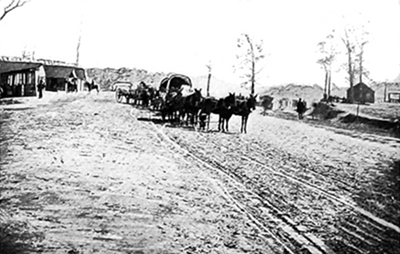
BIG BLACK RIVER STATION IN MISSISSIPPI
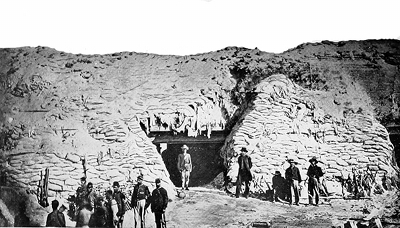
BOMB-PROOF AT FORT WAGNER UNDER HEAVY FIRE IN 1863
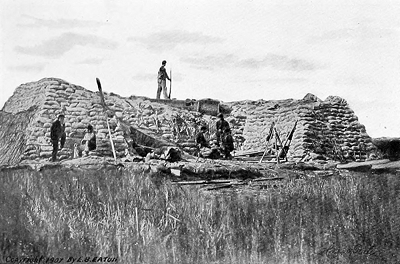
THE Government at Washington believed that it was now time to secure the reparation for the firing on Fort Sumter which had precipitated the War. Sumter, during the entire conflict had been the center of a radius of forts which now had over three hundred guns mostly of the heaviest caliber. It held a strong position on the Atlantic Coast and protected the land movements about South Carolina. Fort Sumter barred the main channel. On Sullivan's Island were Fort Moultrie, Fort Beauregard, Battery Bee and sand bag batteries at the extremity. On James Island stood Fort Johnson, Fort Ripley and smaller forts. Castle Pinckney lay in front of the city, and on Morris Island there were Battery Gregg, Fort Wagner, and a battery on Lighthouse Inlet. All the channels were blocked with huge iron chains, and an immense hawser buoyed with empty casks, extended from Fort Sumter to Fort Ripley, the entire harbor being blocked with torpedoes. Brady's cameras lay in the Union lines and occasionally were ventured toward the Confederate fortifications. Many negatives of exteriors were obtained at a distance. After the forts fell into the Government control the cameras were taken behind the breast-works. These remarkable negatives are now exhibited and reveal the secrets of the Confederates. The picture of the bomb-proof at Fort Wagner, under heavy fire in 1863, reveals the ingenuity of the engineers in both armies in utilizing every available substance in protecting the soldiers. The Confederates constructed many strong fortifications and they fell only under the severest bombardment from the heaviest guns of the Federal troops.
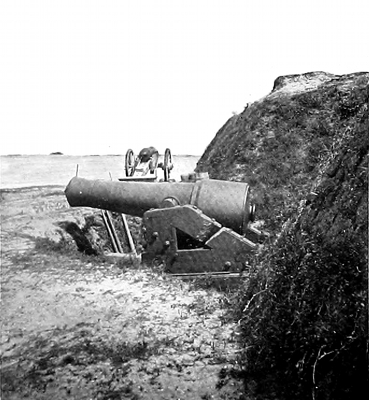
FORT JOHNSON ON JAMES' ISLAND IN 1863
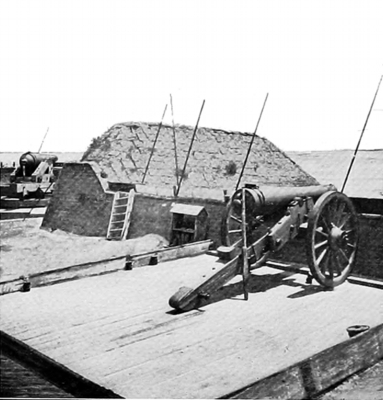
FORT MARSHALL ON SULLIVAN'S ISLAND IN 1863
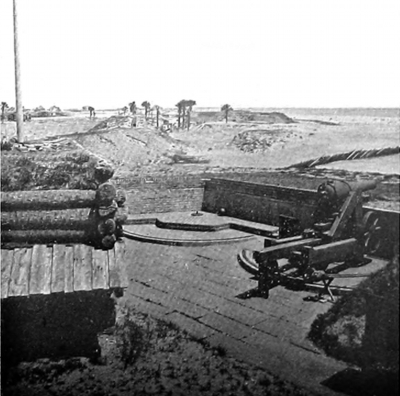
INTERIOR OF FORT MOULTRIE ON SULLIVAN'S ISLAND
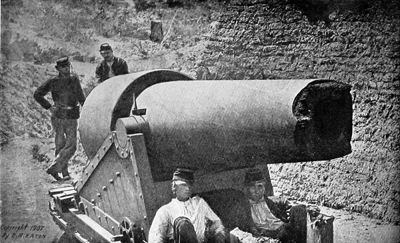
300-POUNDER PARROTT GUN IN BATTERY STRONG AFTER BURSTING OF MUZZLE
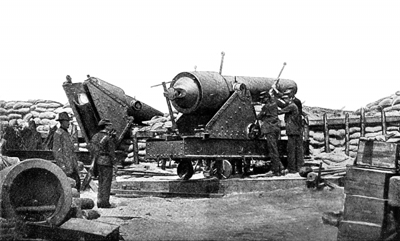
BATTERY BROWN—TWO 8-INCH PARROTT RIFLES, ONE OF WHICH BURST DURING BOMBARDMENT
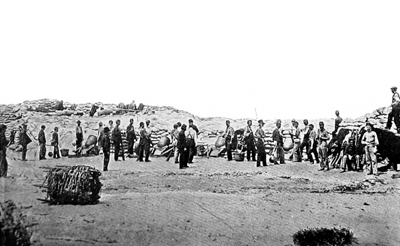
FIVE 10-INCH SIEGE MORTARS IN BATTERY REYNOLDS FIRING AGAINST FORT SUMTER
NAVAL BATTERY OF TWO 80-P0UNDER WHITWORTH'S—BREECHING BATTERY AGAINST FORT SUMTER
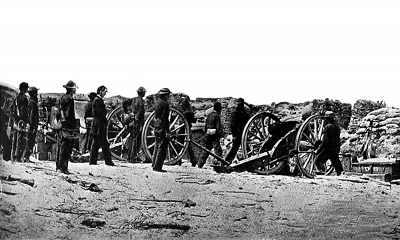
SECTION OF BIRCHMEYER'S BATTERY IN SECOND PARALLEL
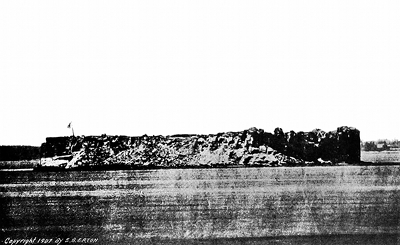
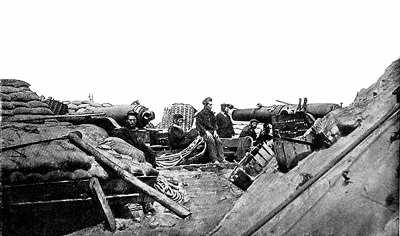
FORT SUMTER IN RUINS AFTER BOMBARDMENT IN 1863
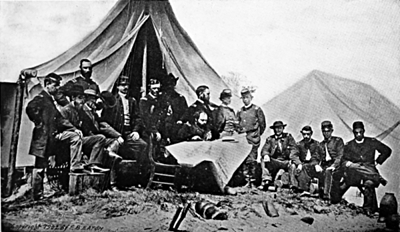
MAJOR-GENERAL QUINCY A. GILLMORE AND STAFF IN 1863
EARLY in 1863 the Government decided that Fort Sumter must be reduced. Admiral Dahlgren was given full charge of the undertaking. On the eighteenth of July, the land forces under General Quincy A. Gillmore began siege. He erected batteries across Morris Island and commenced fire on Fort Wagner while Dahlgren attacked both Fort Wagner and Fort Sumter. Fort Wagner responded with only two guns which led Gillmore to believe that the Confederates were demoralized. The Federal troops were within two hundred yards of the fort before the Confederates opened grape fire. A flash of musketry blazed from the parapet. The daring Federals rushed at the fort and clambered up the exterior slope. It was here that Joseph Alvan Wooster, color bearer for the Sixth Connecticut, performed the valiant deed that cost him his life. He climbed along in advance of the line and triumphantly placed his flag on the parapet. A Confederate soldier sprang forward and placed the muzzle of his musket on Wooster's heart and fired. General Putnam rushed to the rescue with a brigade, only to be killed, with nearly every commissioned officer in his command. The remnants of Strong's and Putnam's command retired, having lost over half of their strength. General Gillmore, and his staff, in charge of the land forces at Charleston allowed the war photographers to turn the lens on them in camp. The general was born in Black River, Loraine County, Ohio, and had graduated from West Point. In 1861 he was placed on General W. T. Sherman's staff on the South Carolina Expedition. During February, 1862, he commenced operations for the attack of Fort Pulaski, on the Savannah River, Georgia. On April 28, 1862, he was promoted to a brigadier-generalship of volunteers. In September, 1862, he was ordered to the West as Commander of the District of Western Virginia, of the Department of the Ohio. He was afterwards assigned to the command of one of the Divisions of the Army of Kentucky. He assumed command of Department of South Carolina June 12, 1863.
THE 8-INCH PARROTT RIFLE GUN. "SWAMP ANGEL" AFTER BURSTING
ON the ninth of August the Federal cannon were within three hundred and thirty yards of Fort Wagner and the guns were trained on Fort Sumter and Battery Gregg. General Gillmore had a small battery placed in a marsh west of Morris Island, on which was an eight-inch Parrott Gun nick-named the "Swamp Angel." It had a range of five miles and threw its enormous shells into the city of Charleston. The Confederate fortifications were reinforced by General Beauregard and maintained a continuous fire from over two hundred guns. On the seventeenth of August, Gillmore had twelve heavy guns on Morris Island, and the simultaneous assault by batteries and infantry was directed against Fort Sumter. For seven days this terrible fusilade continued. Over one hundred thousand shells and shot were thrown into the fort which was battered into ruins. The bombardment of Fort Sumter was begun on the fifth of September and continued for forty-two hours. An assault was planned for the ninth, but when daylight came it was found that several forts were abandoned. It was supposed that Fort Sumter was tenantless. A boat load of soldiers was sent to take possession. As they landed, a terrific volley of musketry was fired. The Confederates fought like tigers from covered positions in the ruins of the fort. The Federals abandoned the attempt without further molestation, satisfied with the destruction they had wrought and the successful blockade of Charleston Harbor. The views engraved by the lens on these pages lay the actual scenes of destruction before the eyes of the world. The "Swamp Angel" was one of the demons of war. Piles were driven, a platform was laid upon them, and a parapet was built with bags of sand, fifteen thousand being required. All this had to be done after dark, and occupied fourteen nights. Then, with great labor, the eight-inch rifled gun was dragged across the swamp and mounted on this platform. It was nearly five miles from Charleston, but by firing with a high elevation was able to reach the lower part of the city. The soldiers named this gun the "Swamp Angel." Late in August it was ready for work, and, after giving notice for the removal of non-combatants, General Gillmore opened fire, and produced great consternation, but at the thirty-sixth discharge the "Swamp Angel" burst, and was never replaced.
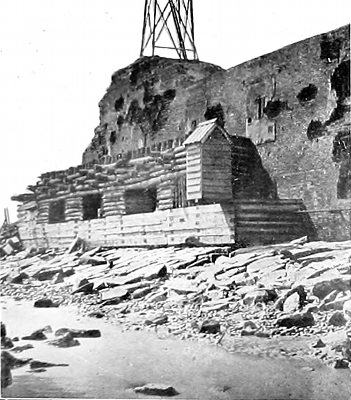
BATTERED EXTERIOR OF FORT SUMTER
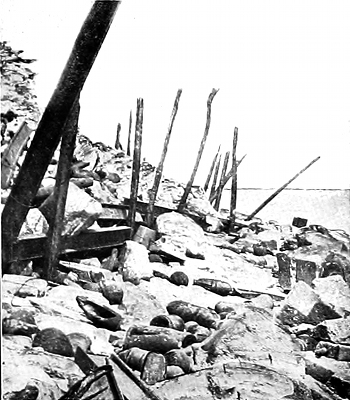
DESTRUCTION AFTER BOMBARDMENT OF SUMTER
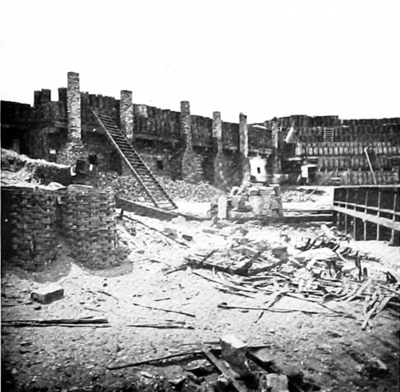
WRECKED INTERIOR OF FORT SUMTER
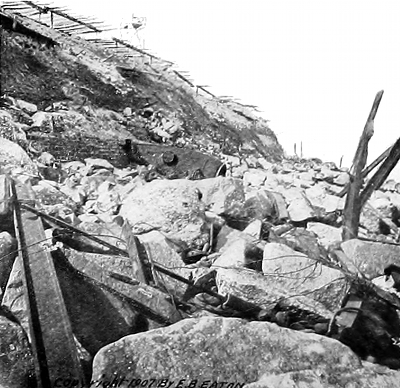
DISMOUNTED CANNON AT FORT SUMTER
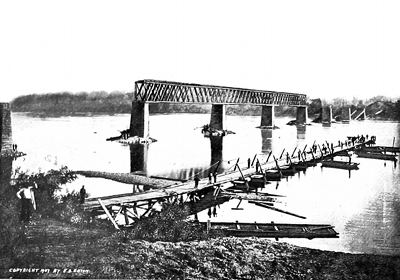
DESTROYED RAILROAD BRIDGE, BRIDGEPORT, ALABAMA—PONTOON IN COURSE OF CONSTRUCTION
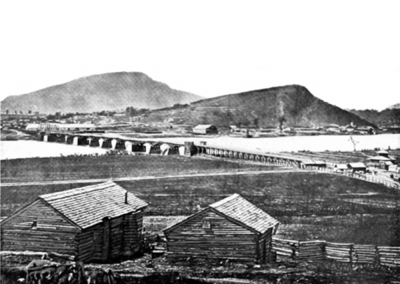
BLOCKHOUSES AND ARMY BRIDGE ACROSS TENNESSEE RIVER NEAR CHATTANOOGA
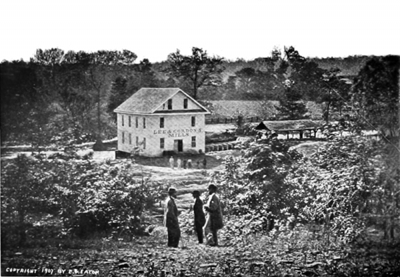
ON BATTLEFIELD OF CHICKAMAUGA CREEK—LEE AND GORDON'S MILLS
WHEN Vicksburg fell, the cheering along the Federal lines in the Mississippi Campaign aroused the attention of the Confederate pickets until it was carried clear through to Louisiana, where the Confederate forces were concentrated at Port Hudson. General Banks had succeeded Butler at New Orleans and was co-operating with Grant on the Mississippi to take possession of the Red River region and expel the Confederate forces from Louisiana and Texas. The siege of Port Hudson had been hard fought. The Confederates under General Gardner agreed that if Vicksburg had fallen their surrender was the only thing left for them. On the ninth of July, in 1863, the Confederate general at Port Hudson with visible emotion tendered his sword. It was declined because his bravery entitled him to retain it. The Federals were now in the entire possession of the Mississippi. While Grant's Army had been pounding at the gates of Vicksburg, Rosecranz was maneuvering with Bragg at Murfreesboro, Tennessee. For six months these two armies stood confronted, but met only in severe skirmishes. Rosecranz compelled Bragg to fall back from one place to another. He was driven through middle Tennessee, to Bridgeport, Alabama, where he crossed the Tennessee River, burned the bridge behind him and entered Chattanooga. The Brady cameras were in the Union lines and arrived in time to secure this negative of the ruined bridge and the pontoon bridge that was being built by the Union forces in pursuit of Bragg. A clash came at Chickamauga, a point about twelve miles from Chattanooga, on the nineteenth and twentieth of September, in 1863. It has been called the greatest battle of the West. The cannonading and the musketry was at close range and the Federal lines were being swept back when General Thomas and his men made the heroic stand that saved the Federal Army from destruction, after a loss of 15,851, killed, wounded and missing. The Confederate victory was gained at the cost of 17,804.
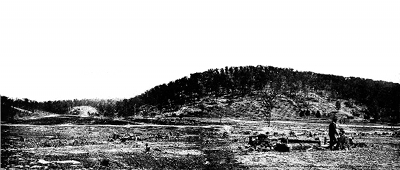
BATTLEGROUND OF MISSIONARY RIDGE NEAR CHATTANOOGA, TENNESSEE, TWO DAYS AFTER BATTLE
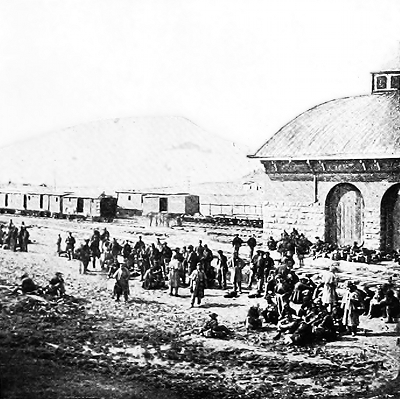
CONFEDERATE PRISONERS AT CHATTANOOGA
CHICKAMAUGA has been called the greatest battle in the West. When the smoke of the conflict had lifted, the war photographers found the Federal Army closed up in Chattanooga. The Confederate general moved to cut off all communication to the Federal lines, seizing roads, destroying the bridges and preventing access to Nashville where the base of supplies had been located. The Army of the Cumberland was reduced to the verge of starvation. Not less than 10,000 horses and mules perished. Grant was given command of the department of the Mississippi, comprising the armies and departments of the Ohio, Tennessee and Cumberland. He telegraphed to Thomas: "Hold Chattanooga at all hazards." The hero of Chattanooga replied: "I will hold the town until we starve."
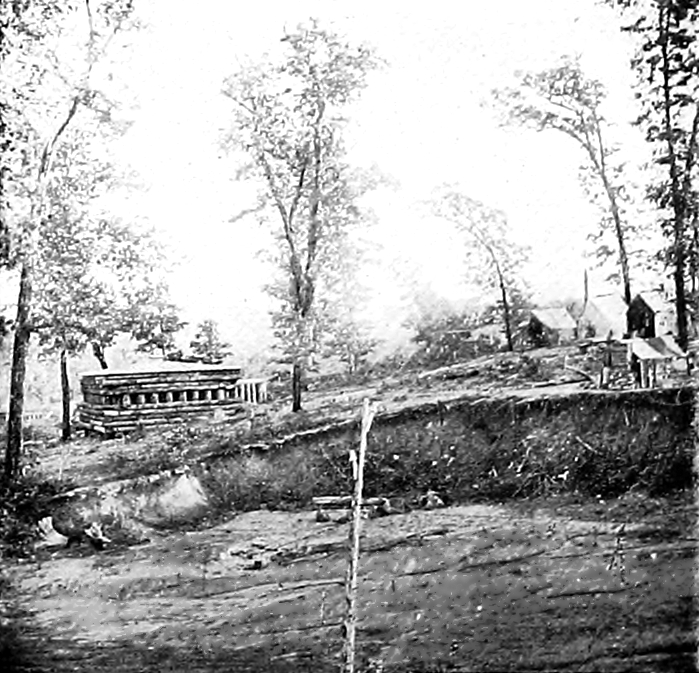
BLOCKHOUSES NEAR CHATTANOOGA
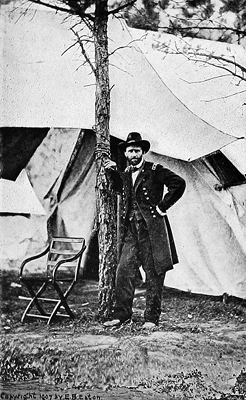
GENERAL ULYSSES S. GRANT IN MISSISSIPPI CAMPAIGN, 1863
"BATTLE ABOVE THE CLOUDS" ON LOOKOUT MOUNTAIN IN TENNESSEE—ENGINEERS OF ARMY OF THE CUMBERLAND IN CAMP
THE war cameras reached Nashville on the same day that Grant entered the city, October 21, 1863, and followed him closely throughout the campaign. Grant hurried to Chattanooga and found the troops without shoes or clothing, and all food exhausted. He telegraphed to Burnside to hold Knoxville and appealed to Admiral Porter at Cairo to send gunboats to convey transports carrying rations from St. Louis for Sherman's Army, which was moving up from the Mississippi. Bragg was entrenched on Missionary Ridge, extending along the crest and across Chattanooga Valley to Lookout Mountain. The Confederate fortifications were very strong and their lines reached over the Raccoon Mountain. The war cameras were taken to the foothills of Lookout Mountain, where an engineers' brigade of the Army of the Cumberland was encamped. Grant succumbed to appeals to stand before the camera and the negative is here reproduced. The haggard expression on his face shows the tremendous responsibility that rested upon him. On the twenty-third of November, in 1863, long lines of infantry moved forward and the heavy guns opened fire. The Federal lines flashed across the valley sweeping everything before them, pushing the Confederate skirmish line from their rifle pits, to the foothills of Lookout Mountain. On the twenty-fourth, Grant stood on the top of Orchard Knob, watching Hooker's men rush to the side of Lookout Mountain, leaping from one rocky ledge to another, scrambling over huge boulders, and through deep chasms in a rain of solid shot and shell. They charged almost to the muzzle of the enemy's cannon, gaining ground foot by foot, until at last they reached the foot of the Palisades, and were finally lost in the mist that veiled the mountain. For three hours the battle raged above the clouds. At sunset the mist disappeared and moonlight fell on old Lookout. The Confederate forces could be seen occupying the summit. Hooker's men scaled the Palisades. The Confederates withdrew into the woods and sought the protection of the night. At sunrise, on the twenty-fifth of November, these Kentucky soldiers unfurled the Stars and Stripes. A great cheer arose from the army in the valley.
THE Battle of Lookout Mountain is the most spectacular in history. It was impossible to carry the war camera over its rugged heights. Had they succeeded in getting to the summit, the mist that enveloped the valley would have made it impossible to have secured a single scene of the great conflict. The Federals occupied a strong position on the mountain, looking across the Chattanooga Valley to Missionary Ridge, where Bragg had concentrated his entire army. The twenty-fifth of November was a magnificent day. Seldom has a battle begun under a brighter sun. The Confederate artillery frowned from the summit of Missionary Ridge. The glittering steel of Hooker's men flashed on Lookout Mountain. The Cumberland veterans under Thomas were a solemn phalanx in the valley while Sherman's compact lines were eager for the charge. On the top of Orchard Knob stood Grant's bugler and the echoes of the "Forward" signal fell into the valley, being taken up by the other buglers in melodious refrain. Hooker's men moved down the eastern slope of Lookout Mountain, sweeping across the valley in grand lines. Bragg's batteries were centered on Sherman, who swept his men heroically forward over a succession of low hills.
GENERALS GRANT, SHERMAN, SHERIDAN, HOOKER, HARNEY, DODGE, GIBBON, POTTER, AT FORT SANDERS
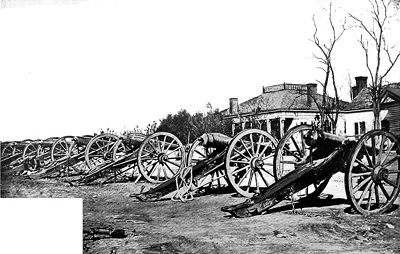
CONFEDERATE ARTILLERY CAPTURED AT MISSIONARY RIDGE—PARKED NEAR CHATTANOOGA
UNDER fire from the Confederates, Corse's Brigade struggled desperately for an hour and a half without gaining advantage, while Generals Loomis and Smith took possession of Missionary Ridge. At two in the afternoon occurred one of the most impressing spectacles ever witnessed on a battlefield. Union soldiers with fixed bayonets rushed into the storm of shell without firing a shot until after the skirmish line had been taken and the Sixth Brigade swept over the Confederate rifle pits. The men flung themselves to the earth to avoid the volleys of canister, grape and musketry that were hurled upon them. At sunset Sherman held Bragg's right in check; Hooker was driving at his left. The final assault on his center was begun and in twenty minutes Missionary Ridge was belching flames. Every Confederate gun and cannon was in action. The Federal soldiers rushed into the very mouth of death, reaching the crest, breaching the Confederate lines until they gave way and retreated. The cannon which they abandoned were swung and turned upon them. The victory had cost the Union Army 5,616, killed, wounded and missing, against a Confederate loss of 8,684.
THE siege of Knoxville, Tennessee, was raised late in 1863. When the news of Bragg's defeat at Chattanooga reached Longstreet, who was besieging Knoxville, he knew that Grant would now send Burnside relief. Bragg decided to carry the city by storm. The attack was to be made on Fort Sanders, a Federal fort of great strength, containing twenty-six guns. The Confederate columns forced their way through a network of wire that had been wound from stump to stump, until they finally reached the parapet. A Confederate officer sprang to the summit with the flag of his regiment and demanded surrender. Pierced by a shower of bullets, his body rolled into the ditch, his hand clutching the flagstaff. The Confederates charged again only to be repulsed. Under a flag of truce the fighting ceased while Longstreet's men carried away their dead, dying and wounded. Grant had ordered twenty thousand men under General Granger to the rescue of the besieged city, but they failed to start, and Sherman hurried to the relief. He reached Knoxville on the fifth of December and found the siege reduced and Longstreet had started for Virginia. Sherman's troops had marched four hundred miles to fight at Chattanooga, then marched one hundred and two miles to compel the Confederates to retire from Knoxville. When the news reached the North, Grant was hailed as the Nation's saviour. Congress bestowed upon him a gold medal, while Bragg, the Confederate general, went down before a storm of indignation in the South. One of the war cameras shortly after the battle was placed on the parapet of Fort Sanders, and this negative of the ruins was taken, showing the University of Tennessee.
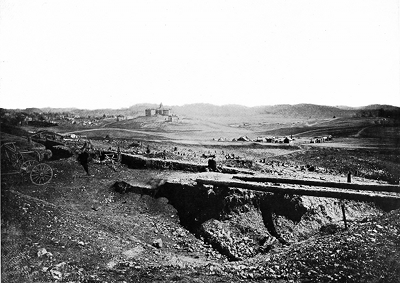
PHOTOGRAPH TAKEN OVER THE RUINS AT KNOXVILLE, TENNESSEE, IN 1863, FROM FORT SANDERS
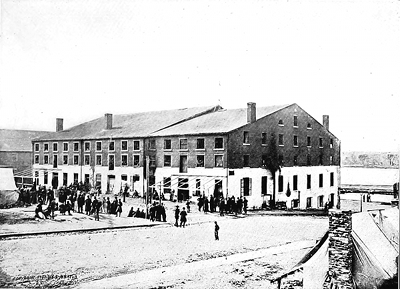
LIBBY PRISON AT RICHMOND CROWDED WITH UNION PRISONERS IN 1864
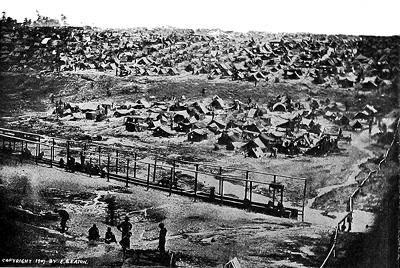
ANDERSONVILLE PRISON WITH ITS "DEAD LINE" AND "BROOK"
IT is estimated that 188,000 Union soldiers and sailors endured the hardships of the sixteen Confederate prisons during the Civil War. In the prison yards are 36,401 graves. 11,599 of those released from prisons died before reaching their homes, and 12,000 after reaching home—making 60,000 lives sacrificed in Confederate prisons. Several estimates place the deaths as high as 80,000. Strange as it may seem, the war photographers succeeded in taking their cameras behind prison walls. Three of these remarkable negatives are here revealed. The first one was taken at Libby prison, Richmond, where most of the commissioned officers were confined. In Libby, men were often shot for approaching near enough to a window for a sentry to see their heads. The other two were secured within the "dead line" at Andersonville prison in Georgia. It was an open stockade with little or no shelter, covering about 30 acres. The palisade was of pine logs 15 feet high, closely set together. Outside of this, at a distance of 120 feet, was another palisade, and between the two were the guards. About 20 feet from the inner stockade was a railing known as the "dead line," and any prisoner who passed it was instantly shot. A small stream flowed through the enclosure and furnished the prisoners their only supply of water. The cook houses and camp of the guards were placed on this stream, above the stockade. Starvation and disease drove many of the prisoners mad and they wandered across the "dead line" to end their misery. Fugitives were followed by horsemen and tracked by a large pack of blood hounds. The crowded condition of the prisons at the beginning of 1864 was appalling. There were as many as 33,000 hungry and dying men confined in Andersonville at one time, which gave a space of about four feet square to each man. Some of the other Confederate prisons were at Salisbury, North Carolina, at Florence, South Carolina, on Belle Island in the James River, at Tyler, Texas, at Millen, Georgia, and at Columbia, South Carolina. At Belle Isle the prisoners were packed so close that when they lay sleeping no one could turn over until the whole line agreed to turn simultaneously. While many imaginary pictures have been drawn from descriptions of Andersonville, it has remained for the lens to to engrave the actual scenes, and they are here perpetuated by the negatives.
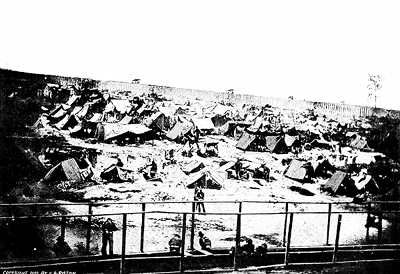
ANDERSONVILLE PRISON WITH ITS STOCKADE AND GUARD TOWERS
AMERICANS are the most loyal people on the face of the earth. Self-government encourages fidelity to Home and Country. In a nation where the citizens are the Government, patriotism cannot die. Unfurl the flag of a monarchy and there will be a dutiful reverence to it. Unfurl the Stars and Stripes of the Republic and there will arise a mighty ovation that thrills from the hearts of men—a spontaneous outburst that has never been heard except under the Emblem of Freedom. Liberty is everywhere the mother of patriots.
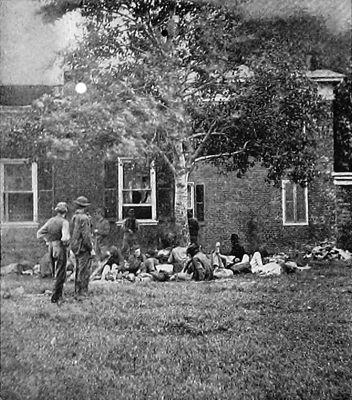
SURGEONS ADMINISTERING TO THE WOUNDED
LIVES SACRIFICED FOR THEIR COUNTRY
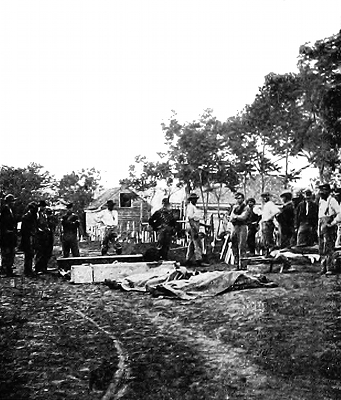
BURIAL OF THE DEAD HEROES
PHOTOGRAPHS TAKEN ON THE BATTLEFIELDS DURING THE CIVIL WAR IN THE UNITED STATES
In the Civil War the heart of American Citizenship was put to the test and it was found "tried and true." The first call for volunteers came on April 15, 1861 for 75,000 militia for three months, and 91,816 men answered. The second call was on May 3, 1861, when Lincoln asked for 500,000 men and the reply was 700,680. The third call on July 2, 1862 for 300,000 troops for three years' service to their country brought 421,465. The fourth call on August 4, 1862, for nine months' service met the response of 87,588 men. Under the fifth proclamation, on June 15, 1863, for militia for six months' service, the ranks were recruited by 16,361 men. The calls of October 17, 1863, and February 1, 1864, brought 369,380 men. Under the call of March 14, 1864, came 292,193 men; between April 23 and July 18, 1864, there were 83,612 mustered into the United States' service. Lincoln's appeal to the manhood of the Nation on July 18, 1864 was met by 386,461 men. The last call for volunteers came on December 19, 1864, and 212,212 patriots marched to the battle ground to help strike the last blow of the conflict. The willingness with which these men offered their lives to their country is the greatest tribute that can ever be paid to American patriotism. After the disasters on the Peninsula over 80,000 troops were enlisted, organized, armed, and marched to the battleground within four weeks. An army of 90,000 infantry came to the front from the five states of Ohio, Indiana, Illinois, Iowa, and Wisconsin, within twenty days. In many instances over 60,000 recruits fell into line in less than a month. At the last moment of the War, and to the very scene of surrender, thousands of men were pouring into the field.
If the world could have looked upon the marvelous spectacle of all the men who took part in the Civil War, marching five abreast, the triumphant procession would have stretched from the Atlantic, across the Continent, to the Pacific—a grand pageant of 1,696 regiments, six companies infantry; 272 regiments, two companies cavalry; 78 regiments, two companies artillery. The boys who wore the Gray could have intercepted this procession by another magnificent pageant reaching from the Canadian borders to the mountains of Mexico.
The war cameras during 1864 were taxed to their utmost. It was the hardest test that had ever been given the new science of photography. The thrilling story of this closing year is told in the rare old negatives in these pages—actual photographs taken at the scene of battle.
THE last days of 1863 were inactive. The armies in the East were going into winter quarters. Brady's men had experienced a hard year with their cameras, but had perpetuated many tragic incidents. One of the cameras was held in winter quarters at Rappahannock Station until early in 1864. It was used in recording conditions in camp and one of its negatives is here reproduced. This camp was occupied by the 50th New York Engineers. It was the duty of these engineers to construct roads, bridges and fortifications, and their services in the Civil War were of great importance. An interesting feature of this photograph is the row of pontoon boats on wheels. These pontoons are vessels, used to support the roadway of floating bridges. The boats were a small, substantial frame of wood, light of weight, and easily transported overland. By stretching them across a river an army could begin its movement to the other side within half an hour on reaching the banks. A pontoon train of the army carries about one hundred yards of pontoon bridge for each army corps, including the boats, roadway planks, etc. Early in the spring of 1864 the skirmishing began for what promised to be the deadliest year of the Civil War. Sherman organized his expedition in February against Meridian, Mississippi, a position of great importance to the Confederacy, as it controlled the railroad communications with Mobile and Wilmington. Banks began his Red River expedition in March. Meade's columns crossed the Rapidan River, in Virginia, in May. Grant was placed in command of all the United States armies in the field on March 1, 1864, while Sherman was given command of Federal armies in the West.
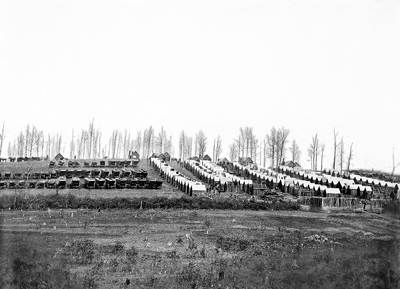
PHOTOGRAPH TAKEN IN WINTER QUARTERS AT RAPPAHANNOCK STATION, VIRGINIA, IN 1864
THE first great conflict of 1864 occurred on the fifth of May when the Army of the Potomac met Lee's forces in the Battle of the Wilderness. It was a virgin forest of oak and pine, choked with dense undergrowth. The Federal soldiers knew nothing of its entanglements, but the Confederates had full knowledge of the roads and wagon paths intersecting the woods. It was so dense that the troops found it necessary at times to move in single file. The artillery and cavalry had great difficulty in getting into the encounter, and in one of the sallies nearly all the men and horses were killed. The battle was deadly. Regiments shot into their own ranks as they fled through forest and undergrowth, becoming separated from the main line. General Longstreet, of the Confederate Army, was shot and severely wounded by his own men. Tremendous volleys of musketry rang through the woods. Dead leaves and branches were swept with flames. Men lost their way and wandered into the enemy's lines. So rapid was the fire that the muskets became hot and blistered the fingers of the soldiers. The losses in this great two-days' battle cannot be stated accurately. One estimate places the Union killed, wounded and missing at 18,387 and the Confederate, 11,400. On the afternoon of the seventh of May, Grant moved his army toward Spottsylvania Court House, fifteen miles southeast of the Wilderness Battlefield, with the intent of getting between the enemy and Richmond and compelling Lee to fight at a disadvantage. It was during these maneuvers that this photograph was taken while the artillery was stationed at the edge of the forest. The negative was taken in the full light of the noonday sun in the Spring of 1864.
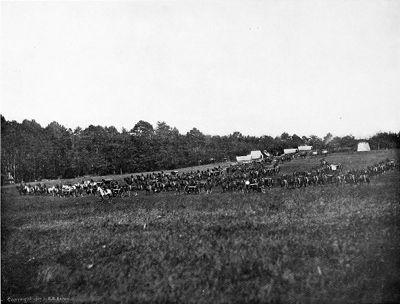
PHOTOGRAPH TAKEN WHILE ARTILLERY WAS AT EDGE OF WOODS NEAR BATTLE OF WILDERNESS IN 1864
GENERAL MEADE AND GENERAL SEDGWICK WITH STAFF OFFICERS AT RAPPAHANNOCK STATION, MARCH, 1864
MAJOR-GENERAL G. K. WARREN AND STAFF AT BEVERLY HOUSE, SPOTTSYLVANIA
LOOKING TOWARDS SPOTTSYLVANIA COURT HOUSE FROM BEVERLY HOUSE, HEADQUARTERS OF GENERAL WARREN IN MAY, 1864
GERMANIA FORD, RAPIDAN RIVER, WHERE TROOPS CROSSED IN GRANT'S CAMPAIGN AGAINST RICHMOND BEFORE BATTLE OF THE WILDERNESS
MAJOR-GENERAL JOHN SEDGWICK AND STAFF—SEDGWICK WAS KILLED AT SPOTTSYLVANIA IN 1864
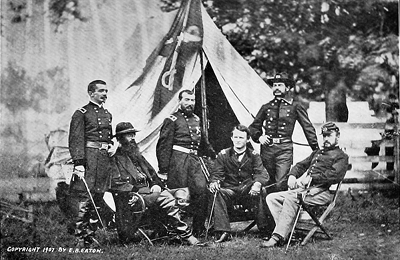
GENERALS OF THE CAVALRY CORPS—SHERIDAN, MERRITT, DAVIS, GREGG, TORBERT AND WILSON
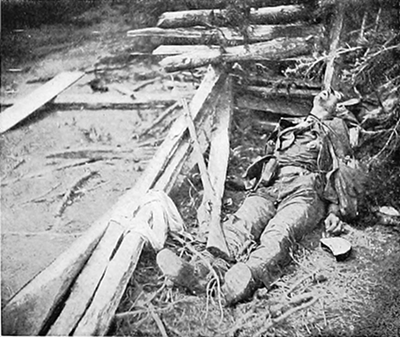
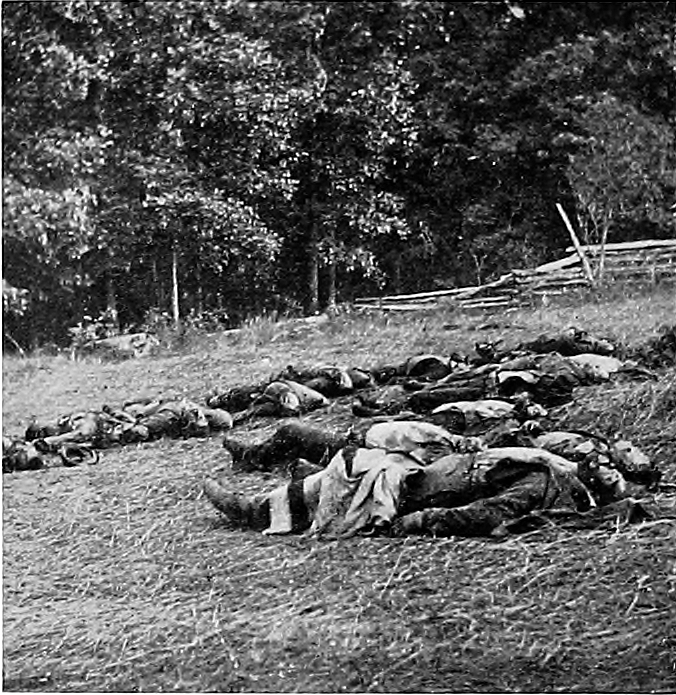
CONFEDERATE DEAD ON THE BATTLEFIELD OF SPOTTSYLVANIA COURT HOUSE IN 1864
BOTH armies faced each other in full force at Spottsylvania Court House in the forenoon of the ninth of May, 1864. The Brady cameras arrived with the Government supply trains and perpetuated the historic scenes. While the Union lines were placing their batteries, they were annoyed by sharpshooters, and General Sedgwick was killed. His death was a great loss to the Federals, just as Jackson's had crippled the Confederacy. During the first day at Spottsylvania the Federals lost fully 10,000 men, while the Confederates' loss was very nearly 9,000. The unburied bodies of 3,000 men lay scattered along the slopes of the ridges and under the trees. Out of the 200,000 Federals and Confederates who rushed into battle on the fifth of May, 43,000 were either dead, wounded, or prisoners, after three days of fighting. During the week the fighting extended along the Fredericksburg road, Laurel Hill and Ny River, reaching to Swift Creek and Cloyd's Mountain. The Army of the Potomac, since it crossed the Rapidan River, had lost nearly one-fourth of its men in the brief space of eight days, and now had a fighting force of only 87,000. The photograph of the Confederate dead was taken near Spottsylvania Court House, May 12, 1864, after Ewell's attack.
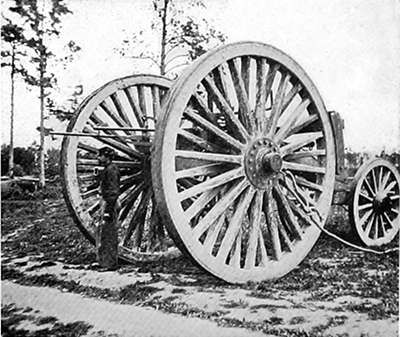
SLING CART USED IN HAULING CAPTURED CONFEDERATE ARTILLERY AT DREWRY'S BLUFF ON THE JAMES RIVER IN 1864
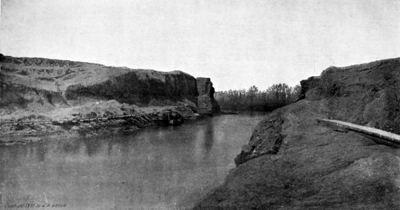
DUTCH GAP CANAL ENTERING JAMES RIVER IN VIRGINIA—BUILT UNDER SEVERE FIRE
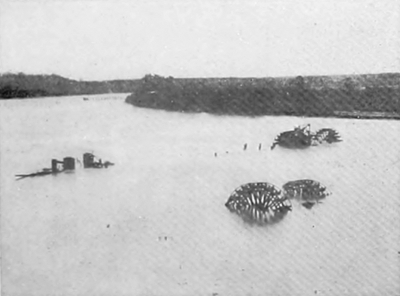
OBSTRUCTIONS IN JAMES RIVER NEAR DREWRY'S BLUFF
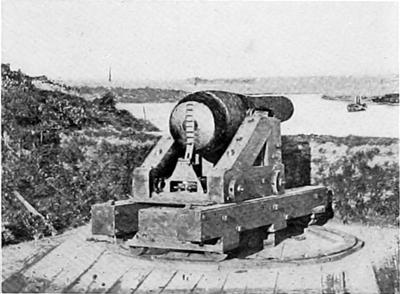
CONFEDERATE FORT DARLING AT DREWRY'S BLUFF
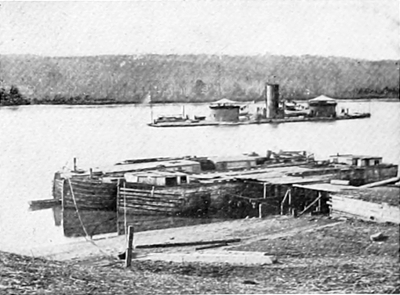
AIKEN'S LANDING, WHERE PRISONERS WERE EXCHANGED
WHILE Grant was moving toward Richmond from the north, Butler was forcing his way from Yorktown on the south, threatening Richmond from the peninsula as McClellan had done two years before. It was at this time that the photographs here shown were taken in May, 1864. Butler succeeded in destroying part of the road from Petersburg to Richmond. He received word that Lee was in full retreat for Richmond, with Grant close upon his heels. One of the extreme southern positions in the defense of Richmond was Fort Darling at Drewry's Bluff. On the thirteenth of May, Butler succeeded in carrying a portion of the outer lines, capturing a considerable amount of artillery, but on the sixteenth he was repulsed and fell back upon Bermuda Hundred. A powerful Confederate battery on the James River barred the bridge toward Richmond. Butler conceived the idea of cutting a canal through the narrow neck of land known as Dutch Gap for the passage of the monitors. A photograph was taken of this canal, which was constructed under a severe and continuous fire. The dredge and steam pump used were bomb-proof. The greater part of the excavation was done by colored troops, who sought cover, from the bombardment of the enemy, in earthen dugouts that covered the site of the work. The canal was only 174 yards long, 43 yards wide at the top, 27 yards at the water level, and 13 5/10 yards at a depth of 15 feet below water level. It cut off 4-3/4 miles of river navigation and the excavation was nearly 67,000 cubic yards. The war photographers secured many negatives of these operations and several of the most important ones are shown on these pages. One of them was taken at Aiken's Landing, where the flag-of-truce boat from Richmond came to discharge her cargo of poor, starved, and often dying Union prisoners, and received in exchange the same number of healthy, well-fed rebels from our guards. Two or three rough old canal boats, and the grim old monitor there at anchor, but above all the glorious old Stars and Stripes, and on the shore the loving hearts and kindly hands of friends. The soldiers called it "the gate into God's country."
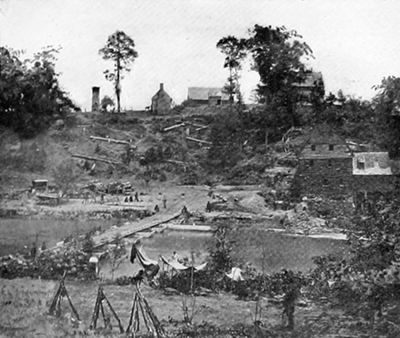
PONTOON BRIDGE AT JERICHO MILLS ON NORTH ANNA RIVER, VIRGINIA
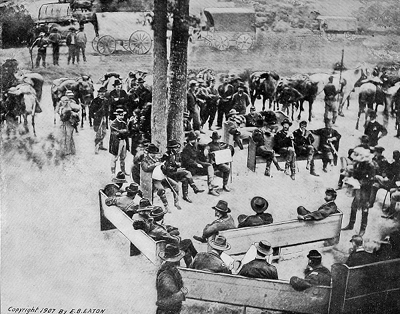
COUNCIL OF WAR AT MASSAPONAX CHURCH, VIRGINIA, IN 1864—GENERALS GRANT AND MEADE, ASSISTANT SECRETARY OF WAR DANA AND STAFF OFFICERS
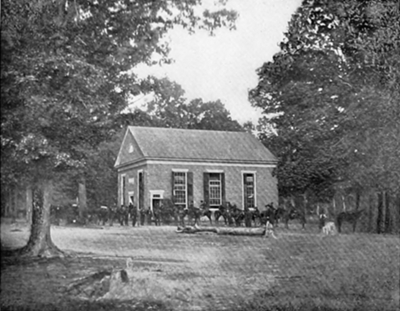
HEADQUARTERS OF GRANT AND MEADE AT MASSAPONAX CHURCH, VIRGINIA
AFTER the battle of Spottsylvania Court House the war photographers exposed many negatives, during the five days that the relative positions of the two armies remained unchanged. Grant and Lee were engaged in brilliant strategy. Grant had thrown out his left until it rested on Massaponax Church. While the great General was in council of war at this place on the twenty-first of May, 1864, a remarkable photograph was taken. In the reproduction on this page it will be seen that the pews have been brought out under the trees and the officers are gathered to discuss the situation. Grant is sitting on the bench against the trees. With him are General Meade, Assistant Secretary of War, Charles A. Dana, and the staff officers. This was a critical time. The Union losses had been heavy and Lee had not yet been outwitted. This photograph is of much historic significance. In advance of Grant's movements, General Sheridan had started on a raid, with 10,000 sabres, and reaching the North Anna River, captured Beaver Dam Station, destroyed ten miles of railroad track and three freight trains containing a million and a half Confederate rations. Here he was fiercely assaulted by "Jeb" Stuart, but he succeeded in crossing the North Anna River by Ground-Squirrel Bridge and proceeded toward Richmond as far as Yellow Tavern, six miles from the Confederate Capital. Stuart fell mortally wounded and died in the city of Richmond. Sheridan then attempted to capture the works around Richmond, and Custer crossed the first line and seized two pieces of artillery and one hundred prisoners. Lee had fallen back from the North Anna River and assumed a position still covering Richmond. A photograph was taken of the pontoon bridge constructed across the North Anna River at Jericho Mills, where General Warren's five corps crossed on the twenty-third of May. The Federal base of supplies was shifted to the White House on the Pamunkey River where the remainder of the Federal Army crossed on the twenty-eighth of May, followed by the war cameras.
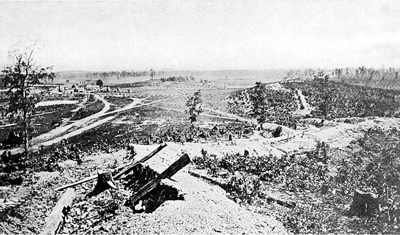
BATTLEFIELD AT RESACA, IN GEORGIA, MAY 13-16, 1864
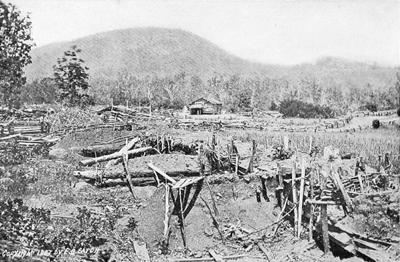
BATTLEGROUND ON KENESAW MOUNTAIN, GEORGIA, IN JULY, 1864
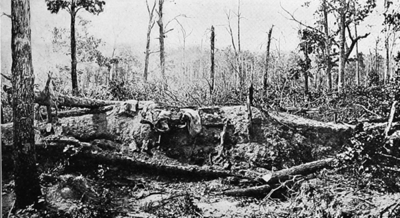
BATTLEFIELD OF NEW HOPE CHURCH, IN GEORGIA, MAY 25 TO JUNE 4, 1864
WHILE Grant was moving on toward Richmond, Sherman's armies of Arkansas, Cumberland, Ohio and Tennessee, with 352,000 men distributed in many garrisons over this wide expanse of territory, was moving against Atlanta, Georgia. Opposed to Sherman was Lieutenant-General Joseph E. Johnston, who commanded all the Confederate troops in the West, including the men of Bragg's old army. Atlanta was of equal importance with Richmond. It was a great railroad center and it contained the Confederate depots, mills, foundries and the manufactories of military supplies. Sherman had moved simultaneously with the Army of the Potomac, on the second day of the Battle of the Wilderness. On the thirteenth of May, Sherman's men met the Confederates at Resaca, Georgia. There was brisk, sharp fighting all along the lines. On the night of the fifteenth the Confederates abandoned the town and crossed the Oostenaula River, setting fire to the bridges. At dawn of the sixteenth the Federals entered Resaca and began a vigorous pursuit, and the camera recorded the scene of the abandoned entrenchments. The fields across which the Confederates withdrew may be seen in the distance. The Confederates concentrated their forces near New Hope Church on the twenty-fifth, and attacked the advancing Union troops but were driven back with heavy loss. The war photographers here secured a photograph of the entrenchments in the woods where there was continuous fighting for six days. The Federal Army forced its way through the mountainous country to the towering peaks of Kenesaw Mountain, Lost Mountain, and Pine Mountain. On all these heights the Confederates had signal towers. The outlying hills were occupied by batteries. The cameras were carried to the heights of Kenesaw Mountain and taken into its entrenchments. Sherman's troops climbed this slope, through its tangled wood and rifle pits, in the face of a steady musketry and artillery fire. This really ended the first movement of Sherman's campaign against Atlanta. Sherman's losses during May and June were over 2,000 killed and 13,000 wounded. Johnston's losses were about 1,200 killed and nearly 14,000 wounded. During the fifty-four days, both armies were depleted by 3,200 killed, 27,000 wounded.
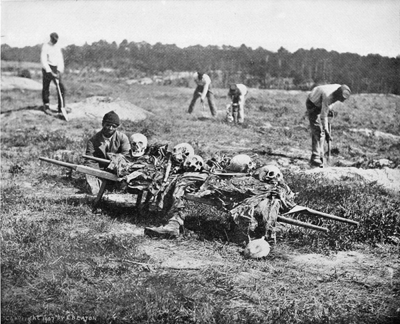
PHOTOGRAPH TAKEN WHILE SKELETONS OF DEAD SOLDIERS WERE BEING REMOVED SEVERAL MONTHS AFTER BATTLE OF COLD HARBOR
GRANT and Lee met at Cold Harbor in a desperate struggle on the first day of June in 1864. The following day was occupied by a general massing for the deadly encounter. Meade's army moved silently on the enemy at daylight on the third and the result was the fiercest battle of the entire war. There was a drizzling rain. The armies could hardly see the faces of their antagonists. Not a shot was fired until they were upon each other. One hundred thousand muskets simultaneously began their murderous work at a range of sixty to seventy yards. Two hundred pieces of artillery added to the deafening roar. It was the tragedy of Fredericksburg and Gettysburg re-enacted. The Union soldiers pressed toward the solid mass of lead and flame from the Confederate entrenchments only to be forced back. At times they swept to the breastworks against the torrents of musketry and mounted the parapets. The assault lasted but twenty minutes and the Union Army lost in killed, wounded and missing over 14,000 men; the Confederate loss has been estimated at 1,700. The two armies stayed at Cold Harbor for ten days, working on their field entrenchments, and fighting whenever either side grew bold. Lee remained immovable in his entrenchments before Richmond and on the afternoon of the sixteenth of June, Grant's army, horse, foot and artillery, had crossed the James River. On the seventh of June the dead were buried and the wounded gathered during an armistice of two hours. This is a ghastly view, showing the process of collecting the remains of Union soldiers who were hastily interred at the time of the battle. This photograph was taken on the battlefield months after the battle, when the Government ordered the remains gathered for permanent burial. The grinning skulls, the boots still hanging on the bones, the old canteen, all testify to the tragedy.
SHERMAN, in his campaign in Georgia in 1864, was much interested in the cameras that followed his army and urged the photographer to take negatives of every movement as his forces pushed the Confederates toward Atlanta. On the morning of July 3, 1864, the Stars and Stripes fluttered on the crest of old Kenesaw Mountain. All the Federal corps were in rapid motion, and on Independence Day Sherman could distinguish the houses of Atlanta only nine miles away. General Johnston withdrew into the city and a storm of indignation swept the Confederacy. Johnston resigned his command and was succeeded by General J. B. Hood. Sherman set his troops in motion for the city on the seventeenth of July. On the nineteenth, the troops were so near Atlanta, and were meeting such feeble resistance that it was supposed the Confederates were evacuating, until they poured out of their entrenchments and opened furious fire on the north side of Peach Tree Creek. The war cameras were busily engaged and one of the negatives is an abandoned Confederate fortification on the road leading to Atlanta. A camera was taken into this fort shortly after its capture by Sherman. It shows the extent to which the Confederates had protected themselves. It is one of the rare pictures in which chevaux-de-frise construction is shown. It is here seen that the defense is a temporary obstruction by placing rails in a row with their pointed ends directed against the enemy. They impeded the advance of the foe and afforded cover for the defenders. During the conquest of Georgia the Confederates were much awed by the Brady "what is it?" wagons. It is the first time that field photography was witnessed in the far South.
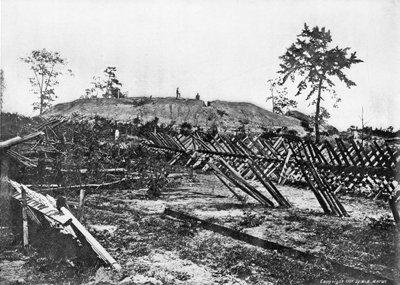
PHOTOGRAPH TAKEN AT A CONFEDERATE FORT ON MARIETTA ROAD, NEAR ATLANTA, GEORGIA, AFTER CAPTURE BY SHERMAN, SEPTEMBER 2, 1864
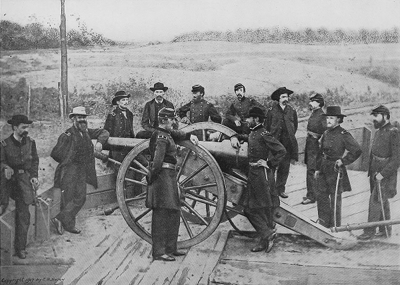
PHOTOGRAPH TAKEN ON THE LINES BEFORE ATLANTA, GEORGIA, IN 1864—GENERAL WILLIAM TECUMSEH SHERMAN AND STAFF
WHILE Sherman's Army was literally standing at the gates of Atlanta, this photograph was taken. The great general was with his staff in a Federal fort on the outlying hills. He was leaning on the breech of the cannon in one of his most characteristic attitudes. At this time Sherman was forty-four years of age. When sixteen years old he had entered West Point as a cadet, through the influence of his father, who was a Supreme Court judge in Ohio. At twenty years of age he entered the United States regular army and during the Mexican War was engaged in service in California. When thirty-three years of age, Sherman resigned from the army and became President of the State Military Institute of Louisiana. At the outbreak of the Civil War he left the South and offered his services to the Union. He was a colonel at the Battle of Bull Run. After that battle, when the Northern Army was reorganized, Sherman was appointed Brigadier-General of Volunteers and commanded the Department of the Cumberland. He demanded 200,000 men to reach the Gulf, but it was refused and he was ordered into Missouri. He was for a time inactive but came to the front again at Shiloh in command of a division under Grant. His bravery secured his promotion to Major-General and he became active in the campaign around Vicksburg. He then entered into the Mississippi Campaign and led the forces against Atlanta, resulting in his famous march to the sea. This photograph was taken on the eighteenth day of July, in 1864, on the lines before Atlanta. Sherman was much interested in the new science of photography and he always protected the cameras.
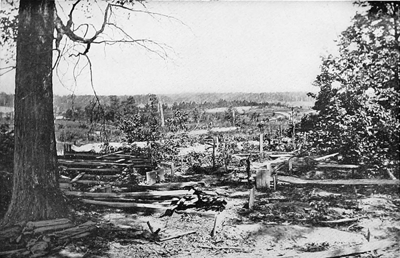
BATTLEFIELD OF PEACH TREE CREEK, GEORGIA, JULY 20, 1864—HOOD'S FIRST SORTIE NEAR ATLANTA
WHERE GENERAL MCPHERSON WAS KILLED, JULY 22, 1864, NEAR ATLANTA—HOOD'S SECOND SORTIE
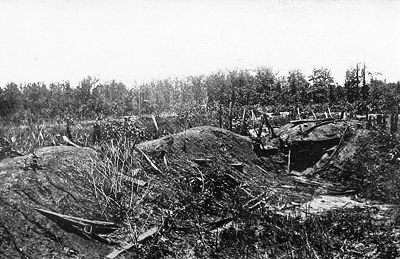
BATTLEFIELD AT ATLANTA, GEORGIA, JULY 22, 1864—HOOD'S SECOND SORTIE
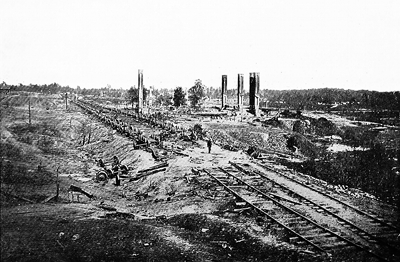
MILL AND RAILROAD DESTROYED BY CONFEDERATES ON EVACUATION OF ATLANTA, SEPTEMBER 2, 1864
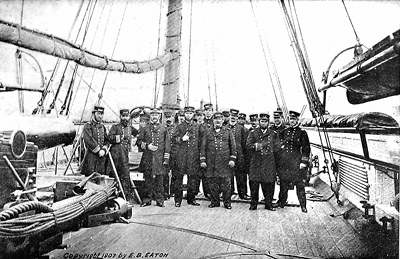
CAPTAIN JOHN A. WINSLOW AND OFFICERS ON DECK OF "KEARSARGE" ON RETURN TO AMERICA AFTER DESTRUCTION OF THE "ALABAMA" IN THE ENGLISH CHANNEL
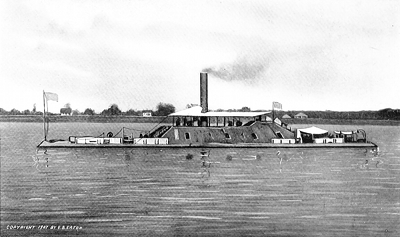
CONFEDERATE IRONCLAD RAM "TENNESSEE" CAPTURED AT MOBILE BAY AUGUST 5, 1864, BY ADMIRAL FARRAGUT
ATLANTA was evacuated by the Confederates on the first day of September, in 1864 after a long, hard siege. The formal surrender was made by the Mayor on September second and the city became a military depot governed by military law. During this campaign of four months the Federals lost 31,680 men; the Confederates 34,986. The war photographers secured many negatives of the battlefields in the siege around Atlanta. A view is here shown of Peach Tree Creek where the Federal loss was 1,710 and the Confederate 4,796. Another camera was taken to the woods where the Union general, McPherson, was killed in Hood's second sortie outside of the city. The daring commander rode directly into the enemy's line, without knowledge of danger. An interesting picture is that of the earth works before Atlanta, during Hood's first sortie, in which the Union losses were 3,641, and the Confederate 8,499. The destruction that was wrought during the siege of Atlanta is perpetuated by many of these negatives. While the armies were making these decisive blows, the "Kearsarge" 3,000 miles away, met and sunk the Confederate ship, "Alabama," in the English Channel on Sunday morning, June 19, 1864. The "Alabama" had been roaming the seas nearly two years, capturing and burning American merchantmen. Another important naval conflict occurred on the 5th of August when Admiral Farragut gained possession of Mobile Bay, Alabama, and the war cameras caught a picture of the rebel ram, "Tennessee," the ironclad captured at that time by Farragut.
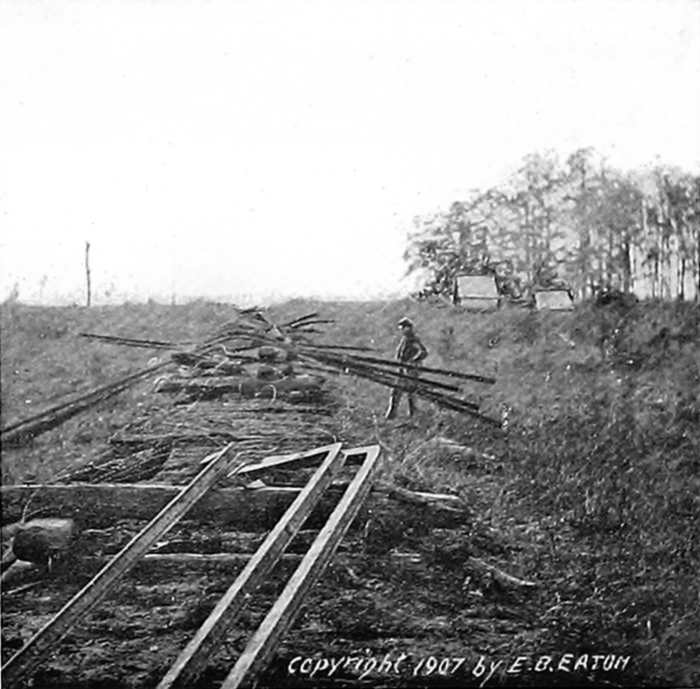
DEVASTATION ON "MARCH TO THE SEA"
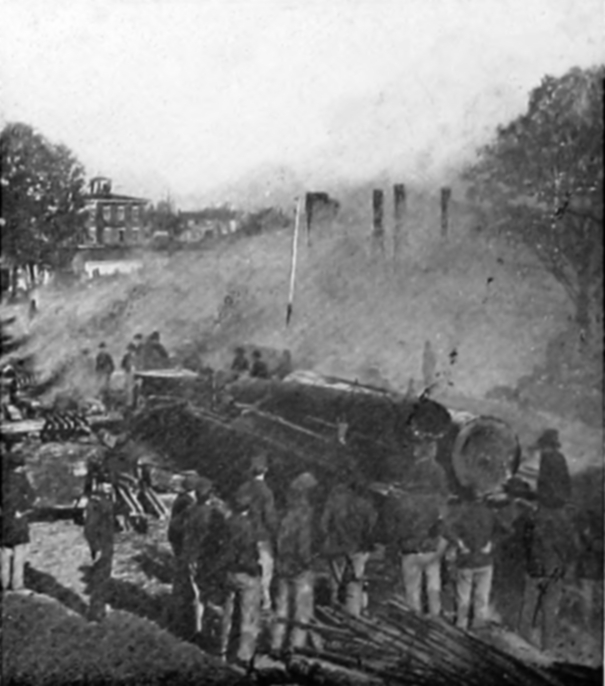
SHERMAN'S MEN DESTROYING RAILROAD
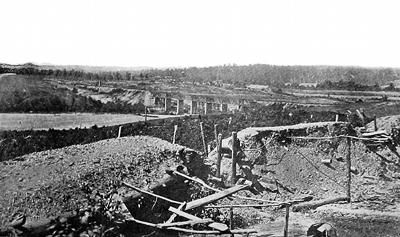
CONFEDERATE DEFENSES AT CHATTAHOOCHIE RIVER BRIDGE, GEORGIA, IN 1864
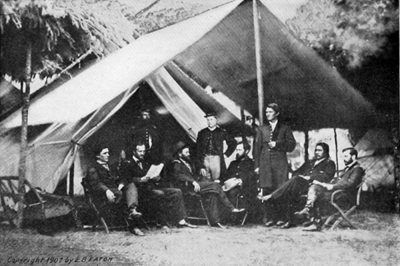
GENERAL U. S. GRANT AND STAFF AT CITY POINT, VIRGINIA, IN AUGUST, 1864
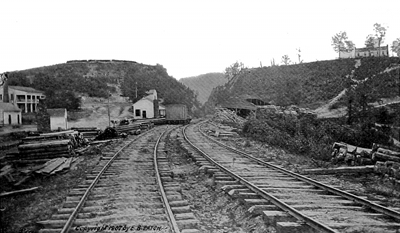
BATTLEGROUND OF ALLATOONA PASS, IN GEORGIA, OCTOBER 5, 1864
WHILE the combined armies under Sherman lay in and around Atlanta until October, 1864, the war photographers were used extensively. Fierce encounters took place early in that month around Kenesaw Mountain and along Allatoona Pass. During this famous encounter Sherman stood on the top of Kenesaw. General Corse, who was leading the Union Division into combat, sent him this message: "I am short a cheek-bone and one ear, but am able to whip all hell yet." It was to this that Sherman made his famous reply: "Hold the fort, for I am coming." Sherman began his famous march to the sea on the fifteenth of November. As the columns left Atlanta the Federal engineers applied their torches to the depot, roundhouse, and the machine shops of the Georgia railroad. The columns extended to the northern part of the city. Stores, warehouses, hotels, and mills, with many private dwellings, were destroyed to the value of more than three millions of dollars. Amid the fierce heat and roar Sherman rode out of Atlanta on the afternoon of November 16th. The great army for five consecutive weeks swept across Georgia. The 62,000 men, 20,000 horses and mules, marched 300 miles in a route from 20 to 60 miles wide. The army captured twenty million pounds of corn and fodder, three million rations of bread and meat, one million rations of coffee and sugar and 350 miles of railroad track were destroyed. Sherman estimated the property losses at over one hundred millions of dollars. The Federal losses during the campaign were but 63 men killed on the field, 245 wounded, and 259 missing. The Confederacy was severed and a decisive step taken toward ending the Civil War.
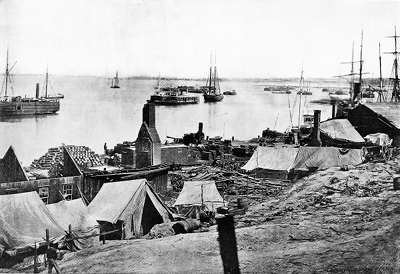
DESTRUCTION FROM EXPLOSION OF ORDNANCE BARGES AT WHARVES AT CITY POINT, VIRGINIA, AUGUST 9, 1864
WHILE Sherman was marching from Chattanooga, Tennessee, to Atlanta, Georgia, on his famous march to the sea, Grant was laying siege on Petersburg, Virginia, twenty-two miles south of Richmond. This was the central point for five railroads, giving communication with the Carolinas and Southern Virginia. Its possession by Federal troops would cut off Richmond and force the evacuation of the Confederate Capital. Lee was strongly intrenched around Petersburg. For a time during the summer there was hot fighting every hour in the day and frequently far into the night. The two armies were ready to fight to a finish. The Union Army was preparing itself for the final stroke and the conflicts were constant. It was during this campaign that the battles of New Market Heights and Cedar Creek were fought and Sheridan made his famous ride down the Shenandoah Valley to Winchester. Grant's base of supplies was at City Point on the James River. On the ninth day of August, in 1864, there was an explosion of the ordnance barges and a war camera was hurried to the scene and secured this negative on the same day. At the same time, while General Grant was in conference with his staff in his tent at the army headquarters, the war photographers secured the picture shown on the preceding page. The general may be seen in the center of the group, sitting in the chair, with his hat characteristically pushed back on his head and his legs crossed. This is an interesting negative.
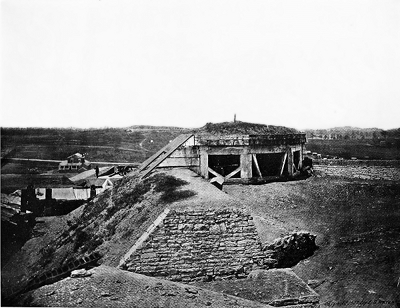
PHOTOGRAPH TAKEN IN FORT NEGLEY AT NASHVILLE, TENNESSEE, SHOWING IRONCLAD CASEMATES, IN 1864
IN the closing months of 1864 events occurred in rapid succession in the southwest. The Confederates, under Hood, driven from Georgia by Sherman, invaded Middle Tennessee. General Price began his invasion of Missouri and destroyed property valued at three millions of dollars and seized a vast quantity of supplies. The Union forces, under General Thomas, were concentrated at Nashville. There were continual skirmishes and at nightfall, on the sixteenth of December, General Thomas ordered his troops into line of battle, with the intent of driving Hood's Army from the territory. In a terrific fire of musketry, grape and canister, the Federals pushed forward. In the next two days the Confederates lost all their artillery. General Thomas took four thousand, five hundred prisoners, nearly three hundred being officers. The fleeing Confederate columns left nearly three thousand dead and wounded on the ground, while the Federal loss was three hundred. The weather was very cold, but Thomas pursued his foe relentlessly. Flood's men were in a desperate condition, barefooted, ragged and disheartened. They were pressed to the Tennessee River where thirteen thousand were taken prisoners, and Hood's great army was practically annihilated, their small arms scattered along the roads, and cannon, caissons and wagons abandoned. Hood took the remnants of his army into Mississippi where he was relieved from command by his own request and retired minus the arm he left at Gettysburg and the leg he left at Chickamauga. On the thirtieth day of December, in 1864, Thomas went into winter quarters. One of the last photographs of the year was taken in Fort Negley, Nashville, Tennessee, showing the ironclad casemates and the interior of the fort.