THE MISERLY MOSLEM PRIEST AND HIS WIFE.
Reading edition
In a village situated on the banks of the Indus, the “Abaseine,” or Father of Rivers as it is called, there dwelt many years ago, an Imam, or “Mullah,” a President of the Mosque, who had come to be much respected by the people for the constant and regular manner in which he officiated, and walked closely in the ways of the Prophet. In his time many used to go to Mosque who never went before. This Imam had his fees of course, for the performance of Nikahs, or marriages, and other rites of the Mahomedan faith, some of which he bestowed on the sick and poor. On festival days, besides an increase of fees, he generally received clothes and other articles from the faithful, so that in point of fact he made a rich harvest.
Towards the latter end of his days, however, this Imam contracted habits of stinginess, yet he never failed to preach liberality to others, and above all, the giving of alms to the sick and poor.
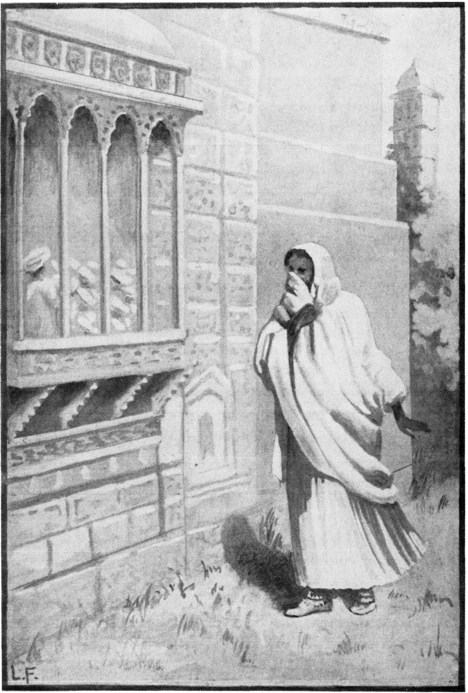
THE MISERLY MOSLEM PRIEST AND HIS WIFE.
He would tell the faithful, “You must always give what you can, and if you have no money, give them of the food you prepare for yourselves, and ever remember” he said, “that those who do this the most exactly will obtain the best blessings, and if you give them dishes 23of a savoury nature, so much the greater merit, and so much the better for you.”
This Imam had but one wife, devoted to his interests in every way, and with the strongest belief in her husband’s sanctity and sincerity, and she looked up to him as her spiritual guide and teacher.
She had noticed for some time, however, how niggardly he was becoming, and her neighbours had also remarked this to her, “But,” they said, “he never ceases to preach to us to give dainty dishes to the poor.”
All this distressed the wife, so she made up her mind that she would try one day to hear what the Imam actually did preach to the people.
Now, the Mosque was situated on the road-side, and there was an open window to that side, and as his wife knew that she could not be admitted to the Mosque, she made up her mind to listen at the window.
One day when she got there quite unperceived, she saw the Imam with his face toward Mecca, and he was telling the people just as the neighbours had told her, viz., “That whatever you do, give alms to the poor, and nice dishes when you can, for this will bring you a blessing at the last.”
When she heard this she said to herself, “If this is so, and I believe it, I make a vow from this day forward to send nice dishes to the poor, for I am not going to be behind others in this duty.” Whereupon she at once prepared and cooked daily such dishes as she could, and then sent them to the poor living round about her; and sometimes she would spend a good deal of money in the 24purchases she made for the cooking of “Pulāo” and “Parātha” (sweet pudding and cake).
This she had continued to do for some time, when one day her husband returned from the Mosque a little earlier than usual, and she was herself a little late, and coming into the house and seeing the dishes ready and on a tray, he thought that they had been sent as a gift. Opening the covers he exclaimed, “Oh! Mother of Mahomed! we are indeed in luck’s way. Who, in the name of fortune, can be the blessed of the faithful who has sent us such a savoury meal? Why! here is Pulāo! and cakes! and I do not know what beside! What a delicious feast!”
“No one, sir,” replied the wife, “has sent this, but I have prepared it for the poor!”
“What!” said he, “of our money? And what have you spent, pray?” He became very angry, and she could only wait till he was quiet; then she said, “Did you not preach to the people, and I dare say do so still, that those who give dainty dishes to the poor shall be blessed hereafter? Did you not say that prayer carries us halfway to Allah, fasting to His palace gates; but only alms-giving gets us in? Yes, I have heard you say so myself!” He replied, “You wretched woman, how and when did you hear this? And if you did hear it, my advice was for others, not for ourselves; I never meant that we were to send to others, but that others were to send to us, and you must stop this waste at once; do you hear me?” “Yes, I hear you, but I cannot stop it now, for I have made a solemn promise and vow that I will continue this 25to my dying day. You have said, and I always believe what you say, that the best blessings attend those who give dainty dishes to the poor; and you don’t want me to be blessed, eh?”
The Imam then said, “If you go on in this way, and spend my money, I shall be ill.” And sure enough, he did not rise the next morning in time to go to the Mosque, a duty he had not failed in for years. His wife went to rouse him, but he would not get up. At last she said, “All the people will be waiting for you.” “I cannot help that,” he replied, “but if you will break your wicked vow, I will at once get up and go to the Mosque.” “No,” she said, “I have already told you I will on no account break my vow, and all your talking will never shake my purpose,” “Well, then,” said the Imam, “I shall certainly take to my bed and die.” “Then die you must,” said she, “but remember that if you do not go to the Mosque, they will put in some other man instead of you, and you will be the loser.”
This, however, had no effect upon him, and when she went again to see him he once more asked her to break her vow, and she as steadily refused. She then left him for the night, and the next morning when she went to see him he was to all appearances dead, and failing to get any response, she called in her friends and neighbours, who pronounced that he had truly passed away; and then they sent up the usual cries and lamentations in such cases. The day following, according to custom, the body was washed (ghussal), covered with a shroud, and laid ready on a bier, and shortly after carried to the Cemetery, or 26“Kaburistān,” under a chorus of mournful voices, saying, “There is no Deity but Allah, and Mahomed is his prophet,” or in their own words, viz., La-il-la-ha. Illul-la-ho. Mahommadoor Rassool-oolahe.
The wife contrived to secrete herself in the procession, for she well knew that no woman could go to the graveside, and when the bier was waiting after the funeral prayers of “takbir” and “dua” had been said, she came to the front, and asked to have one more look at her husband. The funeral service contains four Tukbeers (creeds) and the Dua (blessing). (See Funeral Obsequies in Jaffur Shurreef’s “Qanoon-e-Islam.”) Those round about the body were for moving her away, but others cried, “Let her be! Let her be!” Going near the bier she whispered, “You are just going into the grave; you had better think better of it.” “So I will,” he replied softly, “if you will break your vow.” Drawing her lips tightly together, she gave a final “No!” and then called out at the top of her voice, “Friends and neighbours, this is the time for charity; you see my husband is dead; now go to my house, and take away what things you like. I shall not want them any more, and they are of no further use to your old Imam.”
She had scarcely uttered these words when the Imam rose from the bier like a ghost, scaring away many of the sorrowing mourners near by. “Wait!” he cried out; “release me; I am not dead, but only in a trance. Hear ye! all of you, what this wretched woman says, and mark well her extravagance and waste. When I lived with her she squandered my money, and now, when I was on the 27point of being buried, she gives away my possessions. She shall not, however, have her way now with what I possess at my death, do what she will with the money-bag while I am alive.”
It was some time before the people could be reconciled to the belief that their old Imam had come to life again, but when they were, he was taken back amid much wonder and rejoicing. He appeared again at Mosque, and lived for some time afterwards, determined to defy his wife as to the disposal of his goods after death, while she gained her wicked will in regard to his property while alive, and continued to send her savoury dishes to the poor.
So you see, my friends, it was the woman, after all, who won the day.
EXPLANATORY NOTES.
“Aba-seine.”—The river Indus is so termed in the Pushtu language, and the word comes from the Arabic: Aba, father, and Seine, a river. Pushtu is spoken in the region of Kandahar Kafiristan, and round about Attock, and is said to bear a similarity to the Semitic and Iranian languages.
“Imam.”—From the Arabic, a leader in religious affairs; a priest of the Mahomedan faith; answers to “Mullah,” or “Mulwanah.” In the district round about Ghazi, and in other parts of India, the “Imam,” or “Mullah,” performs many religious offices. He often calls 28to prayer as a “Muezzin,” from the Arabic word “Izn,” and generally this is done from a minaret of the Mosque. After prayers, where with his face to Mecca he leads the worshippers, he collects the boys of the village and teaches them the Koran. He also bathes and washes the deceased male members of the faith, and prepares the body for burial, and puts on the “Kuffun,” or shroud. This Kuffun or shroud consists of three pieces of cloth if for a man, and five if for a woman, and must be white. After shrouding the body, they tie one band above the head, a second below the feet, and a third about the chest. He is present at all marriages, or “Nikahs.”
“Pulāo.”—From a Persian word, and means a kind of sweet pudding of meat with flour, ghee, and sugar, and sometimes raisins mixed with it.
“Parata.”—Or “Parātha,” a kind of bread or cake made from wheaten flour mixed with butter or ghee, and of several layers like pie-crust, and put on a griddle over a slow fire.
“Moslem Grave.”—This is dug down for about five feet or so, north and south. For a woman the depth should be to the height of a man’s chest, if for a man to the height of the waist. At the base a recess is cut out from the soil for the reception of the body, which is laid on its back, and the head is so turned as to be facing Mecca. In ordinary soils after the body has been put in the recess, slates or stones are placed to prevent the filled-in soil from coming in contact with the body. If the soil is sandy it is kept up by the use of chatties, or earthenware vessels, in lieu of slates or stones. There 29is always a stone placed on the surface at head and foot, to indicate the position of the body. These are called “Moonee.” The grave of a female is indicated by a third stone, placed between the others.
In the Ghazi district some of these head-stones are very high, often of five or six feet in height, and of slate, which is readily obtained in the neighbourhood.
On some of these slates used as tombstones it is customary to delineate over the graves of important Mahomedan personages, and known to have been devout men, sketches of the Rosary, or “Thusbee,” the goblet, or “Kooza,” and the tooth-stick, or “Miswak.” This stick, used as a dentifrice, is made here from the root of the “Pilvo” tree. In the village of “Kazeepur,” the names of the deceased are sometimes painted on the slates.[2]
Generally the graveyards of the Mussulmen are near the road-side, that the deceased may receive the benefit of the “Dua Khair,” or solemn prayers of devout passers-by.
Note.—Kazeepur has its local sayings also. Once a very devout man, and a born poet, visited this village and also that of Ghazi; his name was “Peeloh,” and it is currently said that before he quitted the district he ascended the Gundghur Hills, opposite to Harripur, and left the following lines with one of the bards of the village.
Peeloh! cheriya Gundgurh thay
Kias kureh khalo
Agê vagê Sinde Rani
Pichê vagê Haro.
30Chach binah Summundur dhay
Jo gudhê soho
Dhunnie gurray Rungaree
Bhummy baithê ro.
TRANSLATION.
Peeloh ascended the Hills of Gundgurh
Was wrapped in deepest thought.
Before him was the Indus,
Behind him the Haro.
The plains of Chach like a sea are there
Where to plant ’tis sure to sprout,
But to sow your field in the soil of Dhunnie
You may well sit by its side and weep.
Another of their poets, a Pathan, and a man of “Huzro,” beholding Cashmere from the Mountains and the vale of the country stretched out before him, burst, it is said, into the following stanzas:
Kashmere to ajub ja hai
Juthay âp Khudâ râza hai
Kea kishtee! kea howa hai
Yek seir hai Huzrut “Bul” key
Vo tâkht-l-Suleemâni
Kashmere ka thanda pâni.
TRANSLATION.
Cashmere is a wonderful place
Where even God finds pleasure.
Behold the boats! and how sublime is the air!
One excursion is to the Shrine of Huzrut “Bul,”
Another to the Mountain, the “Throne of Solomon.”
Cashmere too! how cool and refreshing is your water!
“Musjid.”—The word is Arabic and from the root Sijdah, to bow; musjid, place of bowing; in the original a corrupted pronounciation is used, as “musseeth.”
Note (see “Imam”).—The natives of the district have 31a rather pithy saying when referring to an incompetent Imam, or Mullah.
Neem Mullâhn Kuthray iman,
Neem Hakeem Kuthray ijan.
TRANSLATION.
Half a Priest endangers your salvation;
Half a Doctor imperils your life.
“Miserly.”—-The word for miser is in the original “Shūm,” an Arabic word. Misers are held in great detestation by the people, and they have many sayings about them. One is the soliloquy of a stingy man to a copper coin which he had held tightly in his hand on a hot day until a drop of perspiration fell from it.
Paisa ne rô
Merah pallay buddhay rô
Mungee, pinnee, Khansâhn
Thookee, na kurchay sânh.
TRANSLATION.
Weep not! my beloved Pice!
You shall not leave the hem of my garment.
I will ask, I will beg, and thus maintain my lot,
And never suffer you to be paid away.
Stories of misers are to be found in every country, and in Chinese Folk-lore it is told of a mean and stingy king that in peace time he caused his cavalry to dismount, that their horses might be used in the Government mills. War came; the horses were returned to the men, but they kept to their habit, and still persisted in going in a circle.—Dennys.
There is a saying also amongst the Punjabis that all misers are wretched, and collect money only for others to 32enjoy. They tell a tale of a miser who was once visited by some friends, and he advanced to meet them, and said:
“Aoo bow sujjeenâh
Ghur bar Toomhâhrâ
Khur. Peeoh apnâh
Burthun Khumbiarrâh
Rul mil Charreeay ‘Kicheree,’
Purr ‘Ghee’ Toomhâhrâ
Heeahn juggâh tung hai
Bâhair Thakur Dhivarrâh.”
TRANSLATION.
“Come in; pray sit down, my friends,
The house and all its contents are yours.
You must, however, provide your own meats and drinks,
and perhaps we’ll share in making some ‘Kicheree,’
though you must contribute the Ghee.
See how narrow, too, my home is, so let us adjourn
outside to the enclosure of the Idol house, where
you can do all the cooking for me.”
Note.—The Rosary[3] is, as has been said, (remarked under “Moslem grave,”) called a “Thusbee” by the Mahomedans; it is also called “Mâllânh” by the Hindus. The aimless counting and turning over of the beads by some is thus denounced by the people of the district:
Dhil dhâ minkâh aik nâh sattaynn
Thay gyn sattaynn panj Veeânh.
You turn not one of the beads of your heart, though you
repeat Five score of them on your rosary.
Note.—It may not be generally known that the “Thusbee” or Rosary consists of 100 beads separated by a long bead called “Shumshah” (from the Arabic, 33meaning “tassels” on a rosary) over which there are ten beads called “Shummâr” (from the Persian, meaning “counting”). When one round of prayers is completed a special short prayer is often added, or the name of Allah is repeated on it one thousand times.
At the completion of the 100 beads, one bead is separated on the Shummâr, and so on each time, in order to count the 1,000 epithets of Allah if it should be so desired. To comprehend the mystic sound of the beads are matters of “Marifat,” or knowledge of Allah!
The beads are made mostly from the “Kaoo” wood, or wild olive, which in some places is called “Zythoon.” Walking sticks are often made of it. There are, however, beads made from the sacred clay found near Mecca and called “Khaka sharreef”; some are also made of glass or agates. Some prefer to have coloured glass beads after every 33 of the wooden beads. In early times frequently almonds and nuts were used for counting.
The Mâllânh of the Hindus consists of 108 beads, independent of one at the top called “Sumer.” As in the Hindu Ghastra there are 108 special letters, 54 of which are written upright and 54 downward, so this number has been fixed for the Mâllânh. The top bead is to indicate the completion of the 108. The special worshippers of “Krishna” (the eighth incarnation of Vishnu) have rosaries made from the “Tulsi” wood (O’cymum Sanctum or Holy Basil). Tulsi was a nymph beloved by Krishna, and by him metamorphosed into this plant. The wood is held in high veneration by all Hindus. Much of this wood comes from Mathra, India. The large bead in a Hindu 34rosary called a “Sumeru” after a high mountain, on the summit of which is supposed to reside the Hindu deities of Vishnu, Siva, and several others of lesser note. This bead remains fixed in the hand, and is not turned over in counting.
The Brahmins, when they repeat their prayers on a rosary, designate them under the term “Gayathri,” the mother of the Vedas, and of which there are five, according to the number of the principal deities. Gayathri is a form of metre, and is repeated inaudibly in the daily morning worship of the Brahmins.
“Nikah.”—This is the name given to marriages amongst Moslems, as “Nikah namah” is the marriage certificate.
The Nikah is the form of words used by the Kazi or Priest, and the Shadi or rejoicings are additional at the will of the relatives. Nikah is the binding ceremony, and Shadi is considered a more respectable form, and is attended with rejoicings,
Nikah is an Arabic word, and Shadi a Persian, meaning pleasure and delight.
35