XI IN THE GHETTOS OF NEW YORK
Reading edition
AT last we are free, although still upon Uncle Sam’s ferry boat, which carries those of us who have passed muster, to the Battery, the gateway into the gigantic city and the vast country which lies beyond where, “sans ceremonie,” we are landed.
Boarding house “Runners” call out the names of their hostelries, express men entreat us to entrust to them our belongings, the voice of the banana peddler is heard in the land, and through the babel of sounds there arise the joyous shrieks of those who welcome their dear ones.
Over in Hoboken, where the cool-blooded Anglo-Saxon awaits his wife, who “toiled not neither did she spin” during her year abroad,—the joy remains unexpressed. She may say to him: “Hello, old man!” and he will reply: “How are you, old girl?” and that is all, so far as the public knows. But here on the Battery, where Jacob meets his Leah, for whom he has toiled and suffered these five years, for whose sake he ate hard rye bread and onions that he might save money to bring her to him;—when Jacob meets his Leah, there are warm embraces and kisses through the tears. Here, men embrace and kiss each other, and children are held up to the father’s gaze,—fathers who left them as infants and now see them grown.
Half a dozen stalwart men and women will almost crush a little wrinkled “Mutterleben,” their mother, coming to them for the sunset of her life, which is to be bright and beautiful after many dark mornings and cloudy noondays.
I attached myself to a young Russian Jew of about my own age, who had no relatives waiting for him, but who had the address of his parents’ friends. They had come here a few years before, and now served as the clearing house for that particular district in Russia, of which their native town was the centre.
We went up Broadway, and after plunging into the whirlpool of its traffic, emerged safe at the City Hall, crossed the Bowery and were at the edge of the great Ghetto, the heart of the largest Jewish community in the world. It numbers now nearly 700,000 souls, scattered through all parts of Greater New York, and massed in four centres, commonly called Ghettos; of which the one through which we are passing is the “Great Original” one. It is less dirty, less suspiciously fragrant than the Ghetto which my comrade has left, and in spite of squalor and visible signs of poverty, a certain air of joyousness pervades its life which is lacking in the old home. The hurdy gurdy grinder lures nimble footed children from block to block, like the “Pied Piper of Hamelin,” and they are happier and more graceful than the much be-starched children of the rich who take lessons in dancing and in conventional deportment.
The sidewalks and driveways are packed by humanity, most of it children, for the Abrahamitic promise that his “seed shall increase like the sands of the sea” has not yet departed from Israel—only the illustration is not quite complete, for while the Ghetto children are as numerous as the sands (I counted almost two thousand in one block), they are not nearly so clean.
The language of the Ghetto is Yiddish, a mixture of German, Hebrew, and Russian; but with enough English mixed with it to make the immigrant halt before such words as “gemovet,” “gejumpt,” “getrusted,” which sooner or later will become part of his own vocabulary.
Street signs are written in Hebrew letters, and the passer-by is invited by them to drink a glass of soda for a cent, to buy two “pananas” for the same sum, to purchase a prayer-mantle or “kosher” meat, to enter a beer saloon or a synagogue. Many of these signs are translated into English, and Rabbi Levinson on Cannon Street has in large English letters, “Performer of Matrimony;” in the same house one finds “wedding dresses for hire,” and can have his “picture photographed,” and also may buy “furnitings for pedrooms and barlours.”
THE GHETTO OF THE NEW WORLD. East of the Bowery in New York City is the heart of the largest Jewish community in the world. Sidewalks, street signs, language, all indicate the process of development.
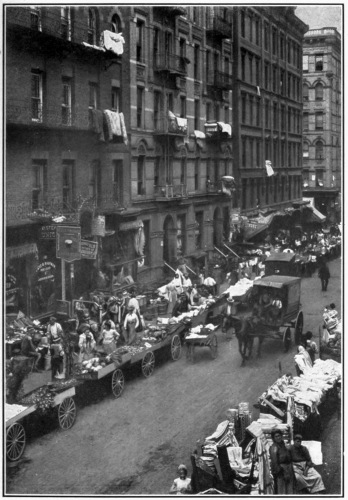
Everything is for sale on the street, from pickled cucumbers to feather beds, and almost all the work done in this Ghetto is done by Jewish workmen. There are Jewish plumbers, locksmiths, masons, and of course tailors; and work and trade are the watchwords of the Ghetto, where, in all my wanderings through it, I have not seen that genus Americanum, the corner loafer.
The prevailing type of dwelling, even after tenement-house legislation, is much too crowded and too dirty. The New York Ghetto looks remarkably decent from the outside, but pharisaic landlords have beautified the “outside of the cup and platter,” while within, the house is poorly prepared for human habitation. A good example is the house into which I lead my friend. It is an old fashioned front and rear tenement with fifty families as residents, and on climbing the stairway to the fifth story to which our address directs, our nostrils are greeted by a fragrance which, compared with the well remembered smells of the steerage, is like unto the odours of Araby the blest.
We come into the kitchen, where the family of nine is just at dinner; two of the number, a husband and wife, are regular boarders. I doubt whether anywhere else, under similar circumstances, we would have received so genuinely hearty a welcome, in spite of the fact that we were practically strangers to them, and that I had no claim whatever upon their hospitality.
One of the children has already been dispatched to the nearest store to buy additional dainties, and room is made at the already crowded table for two very hungry adults.
My Russian friend, amazed as he was at the turmoil of the streets and the height of the buildings, is still more awed by the sight of such abundant and wholesome food, to which he may help himself without stint. There are large sweet potatoes which taste better than cake, and are permeated by the delicate flavour of nuts; they are a greater contrast to the small, gnarly, scant portion of potatoes which it has been his lot to eat, than any forty story sky scraper can be to the tumble-down shanty in which his father kept store. Meat,—a huge piece of meat, on his plate,—and in the memory of his palate, only the soft end of a soup bone, as a special delicacy. What a contrast!
“Last, but not least,” the pie, that apple pie, of which he had a whole one for himself and knew not how to attack it; until finally, following good precedent, he took it into his trembling hands and let his joyous face disappear in its juicy depths. After the dinner, he was catechized, all the inhabitants of the far away town were inquired after, and the record of the living and the dead told to the news hungry hearers.
What a marvellous group this is! and typical of thousands. The father is a cloak presser. He is a small, cadaverous looking man of very gentle mien, who knows not much beyond the fact that to-morrow the whistle will blow, and that he will be on the fifteenth floor of a great cloak factory, “doing his allotted task,” (God willing). The enemies that await him are many; the red-headed Irish “Forelady,” who looks hard after the creases in the cloaks, and who in turn, is suspected by him of all the evils in the catalogue of sin; the cloak designer, a Viennese Jew, who hates all Jews, especially Russian Jews, and more especially this particular one with whom, after the fashion of the Viennese, he quarrels for pastime. His fellow cloak presser, whose name was Elijah and who now calls himself Jack, is an ardent Socialist, who “pesters” my host by his economic theories which are obnoxious to him in the extreme. “I yoost haf to led him dalk,” is the refrain of my host’s complaint. Our hostess is corpulent and somewhat untidy; her horizon is even more limited than that of her husband. She, too, works; she is a skillful operator, and from 8 A. M. until 6 P. M. she hears nothing but the whirr of the machine. She does not even have an enemy to vary the monotony by her Socialistic doctrines. The oldest daughter is called Blanche, although she was named Rebecca; she too works, and has worked for several years, albeit she is not past sixteen. She embroiders in a fashionable dressmaking establishment on Broadway, and likes her place; she sees fine ladies and handles fine stuffs, and, “above all,” she says to me in good English, “I don’t have to associate with Russian Jews.” She reads good books,—fiction, biography, history—everything. The two on her shelf that evening, were “Ivanhoe,” and “The Life of Florence Nightingale.” Other children are growing up and going to work soon; so the family is on the up grade, in spite of the fact that work is not always steady, that the wife’s parents who live with them are old and feeble, that the youngest child is threatened by blindness, and that they have paid much money to quack doctors who advertise and to those who do not. It was pathetic in the extreme to see this family crowd together to make room for us for the night. My friend slept on a sofa, the ribs of which protruded like those of Pharaoh’s lean kine, and I slept soundly on the smoother surface of the floor.
The next day brought to us the momentous task of going out to find work, and before the whistle blew for the night’s rest, my friend was part of a sewing machine, while I being stronger, was assigned to pressing cloaks. My fellow cloak presser told a piteous story of his wife and four children on the other side, who had been almost heart-broken because he had been here two years and been kept by “hard luck” from sending for them. I worked by his side for a day, receiving my first lessons in cloak-pressing from him, and the last letter from his wife was so pathetic, that it drew tears from my eyes and money from my pocketbook towards those tickets. When the day’s work was over, and the possibility of soon seeing his family was almost realized, he said as we parted, “I shall sleep happily to-night;” and so did I, in spite of heat and sore muscles.
Rarely do these clothes pressers rise to a higher place in their trade, although occasionally by strict economy and much hard labour, one may own a shop and “sweat” the “greener” as he has “been sweated.”
In my wanderings through the Ghetto I dropped into a pawnshop on Avenue C one day, and after I made some purchases the proprietor grew friendly and introduced me to his family. He is the happy father of seven sons, all of them “smart as a whip,” and all of them doing well. The youngest one, Charles T., the smartest, is still in school and, like all the Yiddish boys, at the head of his class. Charles T. knows everything, from Marquis of Queensberry rules to the schedule of lectures at the Educational Alliance building. “What are you going to be, Charles?” I asked. “A business man like my father;” and the keen look in his big eyes, the determination of his whole frame and face, showed that he would succeed even better than his father, who is beginning to think of “being at ease in Zion,” and retiring from business. Charles T.’s father began life by buying rags on Houston Street; his sons will sell bonds on Wall Street.
The Ghetto is not all barter and manual labour, for there are many synagogues in which prayers are said every day; although only a few of these synagogues are anything more than halls or large rooms in tenement houses, sometimes above or below a drinking-place and in many instances in ball rooms, which on Saturdays and holy days put off their unholy garb.
If all the population of the Ghetto attended to its religious duties, these one hundred synagogues would have to be increased to a thousand; but on Saturdays many have to work, and increasingly many wish to work, so that not twenty per cent. of the Ghetto population attend religious services. However, on the great feast days, New Year’s day and the day of Atonement, everybody goes; or as Charles T.’s father would say: “I go to the synagogue twice a year and pay my dues, and then I’ll not have a ---- thing to do with them for another year.” Charles T.’s father is a politician.
Most of the Ghetto rabbis are, like Mr. Levinson, “Performers of Matrimony” and not much else; they are professionally pious and not deeply religious; they have no vision and measure a man’s religion by his observances of fasts and feasts; they are ignorant of all literature except the Talmud, that treasure house of Jewish thought and prison-house of Jewish souls. They are as superstitious as their constituency, and often less honest, but in not a few cases truly devout and charitable. There is no ecclesiastical control over these rabbis, and they are in some cases self-made men in the worst sense of the word, while their influence upon the ethical life of the Ghetto is almost “nil.” They are the Jews’ law court and judges in matters which pertain to ritualistic questions, but they are almost nothing to them in life. There is very little preaching, less pastoral visitation, and much useless bending of the back over musty books full of “dry bones” of rabbinical lore.
The one great Jewish intellectual and ethical centre of the Ghetto is the Educational Alliance building, with its various scattered branches; it is everything which a Young Men’s Christian Association is to a Gentile community, only more, inasmuch as it ministers to all, from childhood to old age. Israel’s intellectual hunger is as great as its proverbial greed for wealth, and this gigantic building, covering a block and containing forty-three classrooms, is entirely inadequate to meet the demand. The main entrance is always in a state of siege, and two policemen are stationed there to maintain order and keep the crowding people in line. I visited it on a hot Sunday afternoon in July, and I found the large, well-stocked reading-room uncomfortably filled by young men. The roof-garden is a breathing-place for thousands, and is always crowded by children, who are supervised in their play and who enjoy it eagerly.
The annual report reads like a fairy tale. Many of the lectures and entertainments have to be given a number of times to give all an opportunity to hear and to see, and some of the most difficult subjects discussed find the most numerous and enthusiastic hearers. Baths, sewing and cooking schools, are maintained, and to give even a list of all the agencies employed to lift this population would exhaust my space. There has been marked improvement among its constituency mentally and ethically, and the redemption of New York from Tammany was in no small measure due to the faithful work done by this and other similar centres, not the least among them being the University Settlement.
There are several Christian churches in this district, but what their influence upon the newcomer is I could not determine. In the main it may be said that the churches do not concern themselves greatly regarding this problem around them, although there are a few notable exceptions.
The following letter does not give one a hopeful view of the situation. The gentleman to whom this letter was written, Mr. User Marcus, was actively engaged in the kind of politics in which the churches ought to have an interest. He organized a club, and through one of its members secured a room in the Woods Memorial Church on Avenue A. After the first meeting Mr. Marcus received the following letter:
New York, Nov. 1, 1901.
Mr. User Marcus, 157 Second Ave., City.
Dear Sir—Word has just come to me that your club will mainly consist of Jews, also that you are acting independently of the club already formed. Now you must know that the young men who have the club are the men of our church, and therefore it would not be right to oust them for strangers, and especially Jews. The men are quite worked up about it, and came to see me about it the other night, and this is my decision: that you get another place of meeting other than ours. I have issued orders that you cannot meet again. And another thing: I told you strictly that you must be out by 10 P. M., which you were not, as you kept the room open until eleven o’clock. All these things have determined me on my course, and I hope that you will not take it in a wrong spirit, as I am acting simply for the best interests of my church, and feel that this is the best way for all concerned.
It seems to me that, being Jews, you would scorn to accept any favours from Christians. I should certainly be pretty far gone before I should ask or even accept a favour at the hand of a Jew, knowing as I do the feeling which exists between them and the people of our religion.
Yours respectfully,
The Jew suspects every convert and suspects and hates the missionary. His own religious faith may have little hold upon him, but he is hostile to the attempt to proselyte him and his brethren. He knows Christianity from its worst side, and he does not always see it in these missions from its best side, for all religious work which bends its effort towards making a big annual report must be superficial if not dishonest, and the temptation to make converts is very great, even if the methods employed are above suspicion.
The work of the Jewish Mission in the Ghetto ought to be the interpretation of the spirit of Christianity, so that it might remove suspicion and prejudice, and not increase them. Making converts in that mechanical way used in the revival service of the past is as obnoxious to the sensible Christian as it is to the sensitive Jew; while the coddling of the convert and his exhibition as an example do more harm than good. A true interpretation of Jesus by Christian people in the churches and out of them, a touch of kindness here and there without a thought of definite results, the treating of the Jew as a man and not as a special species, would do more to reach the Jewish soul than any organized missionary effort with which I am acquainted.
The two great social factors of the Ghetto are the Yiddish newspapers and the theatre, each of them in some degree entering into the life of every dweller in the Ghetto, as indeed each of them is a mixture of good and ill; a battle-field of past ideals and modern aspirations. The paper most in evidence on the street is the Jewish Vorwaerts, the Social Democratic organ; if all its readers were adherents of this political faith, its strength would be enormous. A careful examination of this subject shows that there are about three thousand Social Democrats in the Ghetto, and that three hundred of that number are of the extreme type. The politics of the Ghetto used to be very uniform; they were Democratic; years ago a Jewish Republican was a curiosity, to-day he is a very important minority. Tammany had a very strong hold upon this district, and even to-day the Tammany district leader is its political saint.
To “fix and be fixed” used to be considered no crime, and is still winked at with both eyes, although every time that Tammany is defeated, the Ghetto has a few less crooked windings. To evade the law is a vice brought from the lawlessness of Russia, and the political tutelage of the East side of New York has not improved the situation. The Hearst influence is felt here in a remarkable degree, and the New York Evening Journal is a great power for both good and ill.
The Jewish immigrant receives his first training for citizenship in one of the lodges or societies of which there are legions. Here he becomes conscious of himself; and above all, he can talk, and unlock the flood-gates of unexpressed emotion.
I attended a “meetunk” as it is called, of a “Sick and Benefit Society,” and I think it is typical of all of them. The “meetunk” was held on Lewis Street, in a hall on the top story of a rather old and rickety building. Underneath the lodge room is a dance hall, beneath that a synagogue, and a saloon occupies the basement. The occasion was a public installation of officers, and the ladies were invited. To one who has seen these people in their old environment, the change seems miraculous. The men wore the very best and cleanest clothing, and the women were obtrusively stylish.
All the red tape of the American lodge was observed in this society, in which most of the members knew nothing of parliamentary law and had never taken part in debate. Unfortunately for the decorum of the ladies, there was a wedding ball in the room below, and the Polish mazurka kept their feet in motion and did not seal their lips. The President used the gavel freely, and, in spite of stamping feet and wild-measured music, the installation services were carried out. The personnel of this society is of some interest; its eighty members are drawn almost entirely from one district in the old country; with the exception of three or four men, they are all engaged in manual labour. The retiring President is a graduate of a gymnasium, speaks four languages poorly and English very well, is a Republican, is thoroughly Americanized, and, although not active in politics, is an influence for good in their affairs. He neither smokes nor drinks, and manages to save money from his meagre wages. The newly installed President is a wood-turner by trade, earns eighteen dollars a week, is also a Republican, not active in politics, but a conscientious citizen. The newly elected Vice-President is a cloak-presser, a strong Social Democrat, and would die for his political faith. He belongs to the Social Labour wing, and he hates the Social Democratic wing with a desperate hatred; he is a good speaker, honest though fanatical, and one who might be made to see the weakness of his political creed. The Secretary is a Polish Jew, a dealer in plumbers’ supplies, a Democrat not of the Tammany order, a stereotyped Anti-Imperialist and Free-trader, speaks English fluently although only ten years in this country, and is on the road to Harlem—that is, to wealth. The Treasurer is a Russian Jew, an “aprator,” earns eight dollars a week, speaks English very well, has been six years in the country but is not yet a citizen; he will be a Social Democrat first, and a Republican when he has a bank account. Of the eighty men present, fifteen were Republicans, twenty were Democrats, two were Socialists, and the rest were not yet citizens.
Most of them spoke English fairly well, and some could understand a few words although only four months in this country. Of the married women the fewest could speak English, but the young girls knew it well enough—slang, vaudeville songs, and all.
After the installation services there was much useless discussion (under the “good of the order”) upon minor points, so typical of such meetings outside the Ghetto. Characteristic of the “meetunk” was the fact that the leaders were all members of other lodges. Of the women who spoke for “the good of the order,” a “Daughter of Rebekah,” the wife of the President, made a capital speech. The “meetunk” adjourned for a banquet served in the basement, where a Hungarian stew and beer cheered and filled but did not inebriate or cause indigestion. National songs were rendered by the young people as the spirit moved them, and after the banquet the whole “meetunk” invited itself to the wedding ball up-stairs, where in the polka and mazurka they drove time away wildly, and prepared themselves badly for the next day’s hard labour.
In the Ghetto, Friday, the day before the Sabbath, is a day of agitation, of scrubbing, cooking, baking, and merchandizing; Saturday is the day of meditation, when the faces are solemn and the step is slow, and although many must work, there is a perceptible stillness everywhere. With shuffling step and pious mien the rabbis and members go to the synagogue, and with much wailing and lamentation praise and bless Jehovah.
The second generation of the immigrant Jew has lost its adherence to the solemn observance of the day of rest; eats and drinks whenever and wherever opportunity offers, and smokes cigars on the Sabbath (a most heinous sin). Americanization means to the Jew in most cases dejudaizing himself without becoming a Christian. There is a painful eagerness on the part of some of the younger generation especially to cast aside everything which marks it as Jewish, and I have heard some of the severest criticisms of the Jews from the lips of such people. The American Jew becomes over-conscious of the faults of his race, and not seldom hates the word Jew and feels himself insulted if it is applied to him. “I hate them all,” I heard a number of the younger Jews say, and there was no vice in the calendar of Hades which they did not ascribe to their own race.
If, as some people claim, the Jews are discriminated against in New York by the Gentile business firms, I have proof that there are a number of Jewish firms that do not employ any Jews and very many that prefer Gentile help. The Jews who come from various European countries hate one another on general principles, and a Hungarian or a German Jew looks down in the greatest derision on the Pole and the Russian. These latter two nationalities are mentally and physically stronger, their needs are smaller, their wits are sharper, and as getting ahead always starts calumny, the Russian Jew gets a good share of it. His is not a prepossessing nature; his form and face are often repulsive and his habits are none the less so, but he has an abundance of ambition and a superabundance of sharpness, which, when they are led into right channels, become an ennobling talent. East Broadway, the wholesale district of the Ghetto, suffers from overmuch such talent, and its capacity for shrewd trading and quick thinking cannot be excelled anywhere in New York outside of Wall Street.
The Polish and Russian Jews are under strong suspicion of making money out of fires and bankruptcies, and the suspicion must be well founded, for the insurance companies discriminate against them and many of them refuse to take the risks. Great crimes are seldom laid to the charge of the Russian Jew, although too often he lends himself to rather shady business transactions, and the percentage of certain crimes is rapidly increasing. Taking him as a whole, however, he is honest, industrious, and frugal, and has, above all, the making of a man in him. It is true that he works for small wages, but he soon wants more; he lives on little money, but he soon spends more. He does not have as many faults as his enemies assert, and he has as many virtues as one might reasonably expect. He is to be feared, not for his weakness, but for his strength; not for his faults, but for his virtues: he is here to stay, he does not care to return to Russia, and he cannot if he wishes to. The Russian Government sees to that. If he wishes to return home for a visit, he changes his name, puts a big cross around the necks of his children, and says he is a Protestant; but he has a hard time to convince the officials, and often is forced to return without seeing his native village. The Ghetto is not an ideal dwelling-place; its nearness to the Bowery, the crowded condition of its tenement-houses, and its inherited weaknesses and sins are against it; yet I have never seen a drunken man on any of its streets and I have witnessed only one quarrel, but that was worth a great many of its kind in other places.
The Ghetto is a peaceful community if not a united one. For instance, the young man with whom I drifted into New York remained closely attached to the Jews from his own district in Russia, and consequently retained all the prejudices against the Jews who came from more or less favoured portions of the Czar’s domain. He was from Lithuania, and regarded himself and his kind as intellectually keener and more learned in the law than they; facts which were acknowledged by his neighbours, but who added to them less complimentary characteristics, such as exceptional unreliability and trickery in trade.
Not long ago, as I walked slowly up Second Avenue, I was met by a well-dressed man, whose face was shaven and whose trousers were creased after the manner of Americans. In good English although with a strong accent, he called my name and brought back to my memory a journey across the sea, and a start in life together on this side. “And how are you getting along, Abromowitz?” “Getting along like pulling teeth.” “What do you mean?” “I am learning to be a dentist with my father-in-law, who keeps a fine office.” “Where do you live?” “On Rivington Street, and you must come to see me.” I followed him into a tenement house of the better class, and found him rather well situated. The home which consisted of three rooms contained all the hall marks of American civilization. Carpets of various hues were upon the floor, coloured supplements of Sunday newspapers lined the walls, a huge plush album contained pictures of the friends left behind and the new ones made in America, and “last but not least” on the wall hung crayon portraits of himself and his bride in their wedding attire. They also possessed a phonograph on which they played for my special benefit the latest songs current in the variety theatres. The young husband told me of his increasing prosperity, and when I questioned him as to why he did not move into a better locality, he answered, that he had contemplated doing so, even having rented a flat out towards Harlem; but when he and his wife viewed the neighbourhood they found that it was peopled by Russian Jews not of their own native region, so they preferred to remain on Rivington Street. To them that street is only a suburb of Minsk; here the news drifts with every incoming steamer, and although it is almost always sad news, they thus keep in close touch with the weal and woe of their kindred and acquaintances.
I have made it an especial task to follow as closely as possible the career of a hundred Russian Jews with whom I have come in touch during my journeys and investigations. Although they did not pass into my field of observation together, and represent various ages and conditions, the following may be of interest: After five years, about forty per cent. had learned to speak English very well, and about fifteen per cent. could write it almost faultlessly, while more than sixty per cent. could read English newspapers. Of this number seventy-eight per cent. had become wage-earners and only fifteen per cent. of these had not materially improved their lot in life. Eighteen were citizens of the United States, three were Social Democrats of an intense type, five believed that way, but voted the Republican ticket, and the rest were divided on national questions about evenly between the two dominant parties. They voted as they pleased in local affairs, although they were strongly influenced first by Tammany and later by the Hearst movement which more and more dominates the east side of New York. Ninety-one per cent. has ceased to be orthodox in their religious practices, although in thirty-seven per cent. the “spirit was willing but the flesh was weak.” All the Social Democrats with the exception of one, had entirely drifted from their ancient moorings and were avowed atheists. As to their relation to Christianity I asked one of them, “Do you know anything about American Christians?” and he replied, “How shall I know anything about Christians on the East side?” Nearly all of them were saving some money and one of them had grown rich, at least in the estimation of his neighbours, and he was in the real estate business. Among all of them there has been an intellectual awakening. As one of them said: “They have room to think though they have but little leisure.”
Modifications and almost marvellous transformations had taken place in the features of many, and these were the men who had thought themselves most into our life. Whether there was growth in ethical conception it is hard to say, for one cannot easily reach beyond the exterior in sociological observations, and depths do not disclose themselves when one watches people by the hundred. Their business sense certainly has not grown less keen, and making money is as much an object in life as it always was. Perchance even a little more. The scale of things has changed. I find in most of them that they are more honest in little things, which comes from the fact that they need not be penurious. The real estate dealer is an unscrupulous sharper, I know, but in that he merely shares the unenviable reputation of his guild.
I should say that many of the surface vices born of certain economic conditions have disappeared, although I do not see that any great virtues have taken their places or that at the present time any great ethical movement is apparent. The synagogue is sterile in that direction, and the average Rabbi among this class is no ethical factor.
The public schools, which of course reach only the children, are much too crowded and have such a superabundance of raw material to work upon that it is impossible for them to reach deep enough into the crowded life of the Ghetto. Great ethical factors are the Jewish Alliance already mentioned, Cooper Institute, with its many lectures and Sunday afternoon services, and some of the settlements in which many honest attempts are made and splendid results achieved.
But “Salvation is still from the Jews,” still from within, and the best thing which can be done for the Russian Jews of New York, and for all the Jews in America, is to make them more truly Jewish, and that is a task at which happily both Jew and Christian may work, and for that task we all need the larger vision which comes partially, at least, from knowing one another.