IX THE JEW IN HIS OLD WORLD HOME
Reading edition
IT is said of a certain English scientist that he began a work on “Snakes in Ireland” by the sentence: “There are no snakes in Ireland”; and one could easily without seeming to be facetious begin this chapter by saying: “The Jew has no home.”
He is a man without a country, and without a king; he belongs to a nation which, scattered over the face of the earth has yet retained the chief elements of an ancient faith, although no centralized authority guards it. Inheriting the cultural influences of his past, he absorbs the culture of each race which harbours him for a season. Although driven in turn from each insecure habitation, he has not degenerated into a nomad, but begins the task of home and fortune making, wherever a more hospitable people affords a resting place for his weary feet.
In his ancient home in Palestine, in the very citadel of his faith,—Jerusalem, he is the greatest stranger, and people of alien beliefs have built their monuments on the sites of his grandest spiritual conquests, and over the tombs of his prophets and seers.
Weeping, he tears his garments and beats his head against a wall which is all that is left of the temple thrice rebuilt, thrice ruined, and now having upon its ancient foundations a mosque, with crescent crowned minaret, from whose height the Muezzin cries: “Allah ho Akbar,” a sound which vibrates against the ears of the Jew like the mocking of the prophets who seem to say: “I told you so.”
Among the Arabs, his kinsmen, he is a stranger; for although in speech, dress and bearing he is like them, in thought and feeling he is above them; yet the coarsest Mohammedan servant will pronounce the word “Yahudi,” with all the scorn of a superior and all the hatred of an enemy.
His features have not changed since the time when Egyptian artists drew with crude touch on their temple walls the story of the stranger’s coming, his slavery and his exodus.
Wherever you find him, among the Arabs of North Africa or among the Danes of Northern Germany, he still bears the marks of his race, with the flame of Sinai in his look and the fire of the Southland on his cheek.
In Africa he is most numerous in Morocco, where 300,000 souls struggle for daily bread and are hated according to their number; while in Egypt where once he was found in largest numbers, now only about 10,000 Jews live.
The whole number for Africa does not exceed half a million; in Asia he is 200,000 strong or weak, in America above 2,000,000, while Europe has given him room enough to grow into 7,000,000. Between 10,000,000 or 11,000,000 is about the whole number of Jews now in existence, with the city of New York as the largest Jewish centre in the world, having no less than 600,000 of the faithful.
To describe the Jews in their varied environments means to draw many pictures and yet one; for while they differ widely according to the degree of civilization by which they are surrounded, certain characteristics remain the same.
Everywhere the Jew becomes outwardly like his masters—but often remains unlike them in his spiritual life and in those deeper things which express themselves spontaneously and which are too well grounded in his nature to be wiped out entirely by the mere touch of the stranger.
Physically he is usually smaller and weaker, has brown or gray eyes and dark hair, although not seldom it is red and curly. Among the Europeans his head and neck are always large; but his face is the smallest.
There are a vivaciousness in his manner, a rather emphatic and constant gesticulation, and a certain something in his speech which always mark him, and mark him unmistakably, the Jew.
He quickly reciprocates both good and evil, and is regarded with apprehension because of his aggressiveness; for as both friend and foe he is intense. Where an inch of approach is granted he may want an ell, while where he hates he does not hate in moderation. His business shrewdness is proverbial, although it is not his native genius for the proverb current in the Orient: “It takes one Jew to cheat three Christians, it takes one Armenian to cheat ten Jews, it takes one Greek to cheat twenty Armenians,” while no more correct than such generalities are likely to be, proves the assertion that he is not the champion in the chief game of life.
He has had bad environment for the development of business honesty, yet I know of scarcely a community in the world, in which the Jew plays any part, where he would not have a strong representation, if a group of the most trustworthy citizens was called together for any purpose.
The world in which he lives and in which he trades, is the world which he reflects, and he has not always created the conditions which exist there.
To “Jew down,” which is a synonym for beating down in price, is as current in business where he is no factor, as where he is. In Italy it is an economic disease, and in Russia, in those regions closed to the Jewish tradesman, the native haggles with the priest about the price of a funeral or a baptism, with the cab driver over the fare, and even attempts to bargain on the railroad when he buys his ticket.
To generalize about the good or bad characteristics of the Jew is as difficult as it is to portray those of any race. When he judges himself he is either unjustly severe or profusely apologetic, for a people which has lived for so many centuries under abnormal conditions, cannot be known by the stranger, nor can it know itself.
At present the Jew is somewhere between Shakespeare’s Shylock and George Elliot’s Daniel Deronda; and more Shylock where the hate of the middle ages makes it impossible for him to grow into George Eliot’s ideal. He is most uncomfortably felt in those countries where he is in the transition period, when he is apt to be over-bearing and given to sensuous pleasure; even then he is not so grasping as Shylock although not so lovable as Daniel Deronda. He does not need much time to come to his full development. His genius quickly manifests itself, and while he is charged with superficiality, the fact that in all sciences there are accurate scholars of the Jewish race, disproves that accusation, although his emotional nature does not best fit him for the patient task of the investigator.
His neighbours are quickly conscious of his faults because he is not yet schooled in the art of suppressing them, and his virtues are often unrecognized because they shine the brightest in the inner circle, from which the neighbour is usually excluded by mutual consent.
In Northern Africa we find him to-day just as he was thirty-five or forty years ago when Sir Moses Montefiore tried to alleviate his inhuman treatment and his impoverished and miserable condition. The Moors without knowing the prophecy concerning the fate of Israel are actively engaged in fulfilling it with a cruel literalness. In every city and village the Jews have their separate quarters and their own judges.
They are not permitted to study the reading and writing of Arabic lest their eyes defile the sacred pages of the Koran; they are not allowed to ride a horse although they may ride a donkey; and they must walk barefooted before the mosques.
They are prohibited from going near a well when a Mussulman is drinking, and must wear black, a colour despised by the Moors.
The men are all ugly because of the abject fear on their faces; their eyes are always cast down and their walk is unsteady while the whole posture is expressive of the worst kind of slavery.
They may be beaten, kicked and spit upon at any time without being able to protect themselves or even having the spirit to do it.
The women are unusually handsome and some of the homes are splendidly furnished and are hospitably opened to the traveller. The same conditions existed in Algiers until it passed under the rule of France, when the Jews asserted their superiority and became landowners, manufacturers and business men, so that nearly half of the property in Algiers is said to be in their hands, for which they are again beginning to feel hatred and persecution.
The Egyptian Jews are found only in the two cities of Cairo and Alexandria; but they have followed the victorious arms of England and have entered the heart of Africa where in Khartum and the fabled Timbuctoo there are Jewish communities.
In Asia Minor the largest Jewish population outside of Jerusalem is in Smyrna; where there are over thirty thousand in the city and vicinity. These Jews, like those of Morocco, are descendants of Spanish fugitives and are considered, even by their enemies, honest and industrious, performing the commonest and hardest labour.
Jerusalem remains to this day the unhappiest city in the world for the Jew, who sees in it his glorious past and his present shame, and who must feel the pangs of persecution most in the city in which once he was master and lord.
Highly interesting is the story of the Jews in China. That they existed there, was known as early as the sixteenth century when the Jesuit, Ricci, found them in Khai Fung Fu, the old capital of Honan.
How they came to China is not definitely known, but according to Chinese history they came as far back as 58 B. C.
In 1848 they were found by some English missionaries, who reported their synagogues in ruins and the Jews unable to read the one scroll of the law which remained. At present there are only about twenty families left, and but a few years ago, a number of Jews came from the interior to Shanghai, to be taught Hebrew by the English Jews and to have the rite of circumcision performed.
The real Jewish world, and that which touches our own each day is in the eastern part of Europe; in Hungary, Poland, Russia and Roumania.
While most of the Jews in the south of Europe and Asia are the descendants of Spanish Jews, from whom they inherit a peculiar language and certain tendencies of worship and belief,—those of Eastern Europe are nearly all under the cultural influences of Germany, whose language they speak, in a more or less corrupt form. They left Germany because of the persecutions of the middle ages and settled among the Slavs, where they have lived for many centuries; never quite sure of an abiding place, and suffering ever recurring persecutions of varying degrees of intensity.
The Jews of Bohemia, whose spiritual centre was the Ghetto of the city of Prague, as well as the Jews of Hungary, exhibit certain liberal tendencies in their faith, and are midway between orthodox and reformed Judaism. They are generally classed among German Jews, while the Jews of Poland, Lithuania and Bessarabia, are classed with the Russian Jews, by far the largest number, and the one great source of Jewish immigration to this country.
The cause of this immigration is found in the persecutions, not new in the history of Israel, but like death, always holding a new terror.
In Russia the horrors of these persecutions are shared by other non-Russians, yet there is in the Jewish persecutions an element of hatred and contempt which makes them exceptionally galling, and affects not only the Jews’ civic, social and economic condition but their self-respect also. They are classed with the Kalmuks, the Samoyedes, the Kirghese and other aboriginal tribes of low mental capacity and still lower standards of civilization; while not sharing with them their legal status, being as Jews, regarded as outlaws, for whom special repressive legislation is necessary.
Above all else, these laws tend to keep them within the pale, which pale is the old kingdom of Poland, and the western provinces originally belonging to Poland. On this territory which is by far the smaller portion of European Russia, over 5,000,000 Jews are virtually imprisoned, entrance into the larger Russia being permitted only to:
1. Merchants of the first class, who have to pay an annual tax of nearly $500.
2. Professional men who have university diplomas. As, however, of the entire number of pupils admitted to the higher schools only from five to ten per cent. are permitted to be Jews, this class is very small.
3. Old soldiers who have served twenty-five years in the army.
4. Students of higher education.
5. Apothecaries, dentists, surgeons and midwives.
6. Skilled artisans, who have no legal residence outside the pale but who may follow their vocation anywhere, provided they earn their living by their trade, and that they are members of their trade guilds; a privilege rarely granted to Jews.
Worst of all is the element of uncertainty as to the interpretation and operation of the laws, which are now lax, now severe, but always means of extortion and a recognized avenue of income for numerous officials.
The greatest hardship suffered comes from the fact that in the villages, only those residents who were there prior to a certain date, are permitted to remain; while the vast majority is herded together in the city Ghettos, which offer but a scant living to the normal population.
The Jewish part of the city, the Ghetto, is invariably sunk in mud or dust, according as there is rain or sunshine, and is the picture of melancholia. Cadaverous men in long, black, greasy cloaks, countless children and women, who alone carry sunshine; for in the Jewish woman’s heart the hope of giving birth to the Messiah is not yet dead.
All of these people are narrow chested, with the melancholy eyes deep set; they have long bodies and short limbs with which they make ambling strides like the camel in the desert.
It is a haggling, bargaining, pushing, crowding, seething mass; ugly in its environment, hard for the stranger to love, cowed by fear, unmanned by persecution; a thing to jeer at, to ridicule, to plunder and to kill.
This is no apology for the Jew. He carries the faults and the sins of ages; not only his own, but those of his persecutors also. He is himself the keenest critic of racial faults, and once awakened to them hates them and his race most unmercifully. His people are greedy, greasy, and pushing, or doggedly humble; as might be expected of hunted human beings, who for 2,000 years have known no peace, wherever the cross overshadowed them. They could escape torment in a moment by having a few drops of holy water sprinkled over them, for baptism opens to all, the door of opportunity. Whatever else may have died, the ancient fire is not dead in them, and they prefer to suffer, to die, if need be, rather than to enter a so-called Christian church through the door of expediency. Sometimes that door has to be entered, but the Jews who enter it are still Jews, and often they suffer agonies of mind and of spirit, to which persecution might be preferable.
A friend of mine in Moscow, a manufacturer of tobacco, who had lived in that city for thirty years, received sudden notice to dispose of his business and leave the city. He was prosperous, his children were going to school, they knew no home but Moscow, and the town to which they were to go was in the crowded Jewish pale which he had left as a child.
He and his family were baptized, he became a full-fledged Russian, with all the rights of citizenship, and his business went on as usual.
Soon afterwards, however, he became depressed, the depression increasing each time that he had to take part in religious ceremonies which were hateful to him, and it was not long before he grew violently insane.
I have no doubt that as soon as the Jewish disabilities are removed, most of those who have entered the Greek Church will return to the faith of their fathers which they have never really left.
It is said in Moscow of a certain Jew, that after the priest had instructed him in the catechism, he asked: “Now what do you believe?” and he replied: “I believe that now I shall not have to leave Moscow.”
Much more than this, these so-called converted Jews do not and cannot believe.
Most of them prefer to live in dirty little hovels, hungry and wretched, to brood over the ancient lore, the Psalms of David, the prophets’ messages from God, the law of Moses and the sayings of the sages. Day and night, while hunger gnaws and poverty oppresses, they look to Jehovah and fast and mourn and believe.
Minsk, Wilna, Kovno, and Warsaw contain Jewries in which from 80,000 to 200,000 souls are living—no one knows how; two-thirds by manual labour, the commonest and the coarsest, for the lowest wage. To-morrow’s bread is always an unknown quantity, and these people do “Walk by faith and not by sight.” No labour is too heavy or too dirty; and the mournful Jewish face will look out at you from the pit of a mine, from under a burden of wood or water, from the margin of the river as boats are unloaded, or from the seat of a miserable cab, whose horse and driver are alike most pitiable. Because of their weak bodies they are not regarded as good labourers, except at tailoring.
Locked in the city, hampered in their movements by unreasonable laws, groaning under taxes too heavy to be borne, the government, labour, religion—life itself a burden, they are living Egypt over again, waiting and praying for their deliverance. Why are they persecuted? Can any one answer that question? Has any one yet found the reason for blind hate, that blindest of all,—the hate of race? They are hated because they are supposed to be rich; yet seventy-five per cent. of them are poorer than Chinese coolies.
They are hated because they have strange customs, because they hold themselves, in a large measure, aloof from the common life. How can they be anything but strangers to the adherents of a religion who choose a holy day, the day of resurrection, to kill them? Easter time is almost invariably the time of persecution. How can they be other than strangers to a church, the ringing of whose bells marks the carnage of hundreds of thousands—murdered for the glory of Jesus—a Jew.
How can they be anything but strangers to a government whose officials will step among the mobs to encourage them, shouting: “Steady boys, keep it up.”
They are hated by the government because they are supposed to be revolutionists. If only they were! The masses of the Jews are so cowed by fear that they are unmanned. They do not know the use of a weapon. Here and there a Jew, alert and keen, sees his misery and is brave enough to defend himself. Many of them advocate Socialism; it attracts them because it knows no race, because it preaches a certain kind of peace, because it is a brotherhood. The Jew does not find in the orthodox church the meek and lowly Nazarene, because the Messiah whom the church preaches, is masked behind church millinery; because the representative of the lowly Nazarene sits upon the throne of the haughtiest autocrat, and because the cross is an ornament and not an element in the salvation of men.
The Jew in Russia is persecuted because he is supposed to use the blood of Gentile children for his passover. This false accusation has followed him through the years, in spite of the fact that those who promulgated it knew that it was false. The shedding of human blood was never one of Israel’s crimes, and killing is a desire which the Jew lost long ago, having never been a master in this art.
ISRAELITES INDEED. The root of the persecution of the Russian Jew is found in his superior ability to cope with the difficulties of existence, in his thrift and shrewdness which know no bounds.
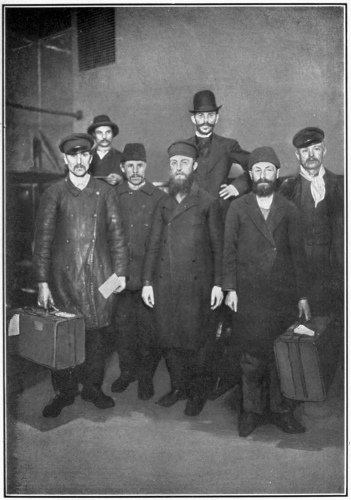
Frankly, the root of this persecution of the Jews is found in their superior ability to cope with the difficulties of existence in Russia, in their thrift and shrewdness which know no bounds and which have almost crushed in them their spiritual longings, making them a byword among the nations.
But a new inspiration has come to the Jews of Eastern Europe through the Zionistic movement; a revival of Jewish nationalism, a desire to win back the lost Palestine,—the Fatherland of their spiritual sires.
The way back to Palestine is a difficult one and neither their Maccabean spirit nor the wealth they accumulate may avail them as a nation, to reach their goal. But the way there is beautiful, the dream is glorious and the spiritual and physical miracles wrought among the wealthiest and the poorest of them are remarkable. A new literature and a new psalmody are being born, a new Maccabean spirit is filling the emaciated bodies of these sons of Israel, and one of them sings and he but one of thousands:
“Arise, and shine, Jerusalem, In costly jewelled diadem; Put off thy ash strewn garb of gray, In glorious dress, thyself array. “Jehovah made thy people free; Now that they long for liberty. At end is all thy suffering night, Jerusalem, send forth thy light. “A note of ancient psalmody Fills heaven and earth with melody; A sacrifice of grateful praise From altars old, we now upraise, “And God looks pleased from glory down, His smile oh! Israel is thy crown. Put off thy ashen garb of gray, Jerusalem, see thy glorious day.”
But for a long time to come, this Jerusalem will have to be New York, and their Palestine, America.
One can but hope that the Jew will so live and act, as to become one with the highest ideals of his new country, and so unwrap himself from ancient faults that in the truest sense, Jerusalem will be the “Bride adorned for her bridegroom,” and the city come down from heaven among men, in whose midst the reign of God will be an acknowledged fact.