English Authors on Gardening. (continued 2)
Reading edition
George Mason. The best edition of his "Essay on Design in Gardening," appears to have been that of 1795, in 8vo. Two Appendixes were published in 1798, which are said to have been written by Mr. U. Price. In Mr. Nichols's fourth volume of Illustrations of the Literary History of the Eighteenth Century, are some particulars of Mr. Mason. He published Hoccleve's Poems, with a Glossary; an Answer to Thomas Paine; the Life of Lord Howe; a Supplement to Johnson's Dictionary: in the ill-tempered preface to which, he thus strangely speaks of that Dictionary:—"this muddiness of intellect sadly besmears and defaces almost every page of the composition." This is only a small instance of his virulence against Johnson in this preface. One would have thought that Mr. Mason's sarcasms would have been softened, or even subdued, by its glowing and eloquent preface, which informs us that this great work was composed "without one act of assistance, one word of encouragement, or one smile of favour." I am sorry to say, that Mr. Mason, even in the above Essay, discovers, in three instances, his animosity to our "Dictionary writer," for so he calls Dr. Johnson. Mr. Boswell, speaking of Johnson's preface, says, "We cannot contemplate without wonder, the vigorous and splendid thoughts which so highly distinguish that performance;" and on the Dictionary he observes, that "the world contemplated with wonder, so stupendous a work, achieved by one man, while other countries had thought such undertakings fit only for whole academies." Linnæus and Haller styled Ray's History of Plants, opus immensi laboris. One may justly apply the same words to this Dictionary. It was well for Mr. Mason that he escaped (what Miss Seward called) "the dead-doing broadside of Dr. Johnson's satire." George Mason omits no opportunity of censuring Mr. Whateley's Observations on Modern Gardening. In the above Essay, he censures him in seven different pages, and in his distinct chapter or division on this book of Mr. Whateley's, (consisting of thirteen pages) there are no less than thirty-three additional sneers, or faults, found with his opinions. He does not acknowledge in him one single solitary merit, except at page 191. In page 160, he nearly, if not quite, calls him a fool, and declares that vanity is the passion to which he is constantly sacrificing.[56] It would be an insult to any one who has read Mr. Whateley's work, to endeavour to clear him from such a virulent and ill-founded attack. Neither Dr. Johnson, with all his deep learning, nor Mr. Whateley, with all the cultivated fancy of a rich scholastic mind, would either of them have been able to comprehend, or to understand, or even to make head or tail of the first half of Mr. George Mason's poem, with which he closes the above edition of his Essay. As he has been so caustically severe against Dr. Johnson, it cannot be ungenerous if one applies to the above part of his own poem, the language of a French critic on another subject:—"Le style en est dur, et scabreux. Il semble que l'auteur a ramassé les termes les plus extraordinaires pour se rendre inintelligible." Percy, Bishop of Dromore, in vol. x. page 602, of the British Critic, has given a critique of Mr. Mason's edition of Hoccleve, in which he chastises its injustice, arrogance, and ignorance. Mr. Mason has been more liberal in warmly praising Kent, and Shenstone, in acknowledging the great taste and elegance of Mr. Thomas Warton, when the latter notices Milton's line of
Bosom'd high in tufted trees,
which picturesque remark of Mr. Warton's could not have been excelled even by the nice and critical pen of the late Sir U. Price; and when he informs us, in more than one instance, of the great Earl of Chatham's "turning his mind to the embellishment of rural nature."
Thomas Whateley, on whose "Observations on Modern Gardening," the Encyclopædia of Gardening (that most comprehensive assemblage of every thing delightful and curious in this art,) observes, "It is remarkable, that so little is known of a writer, the beauty of whose style, and the justness of whose taste, are universally acknowledged." The same work further says, "his excellent book, so frequently referred to by all succeeding writers on garden scenery, ought to be in the hands of every man of taste." And the same work still further observes, that "its style has been pronounced by Ensor, inimitable, and the descriptions with which his investigations are accompanied, have been largely copied, and amply praised by Alison, in his work On Taste. The book was soon translated into the continental languages, and is judiciously praised in the Mercure de France, Journal Encyclopédique, and Weiland's Journal. G. Mason alone dissents from the general opinion, enlarging on the very few faults or peculiarities which are to be found in the book. Wheatley, or Whately (for so little is known of this eminent man, that we have never been able to ascertain satisfactorily the orthography of his name,) was proprietor of Nonsuch Park, in Surrey; and was secretary to the Earl of Suffolk. He published only this work, soon after which he died. After his death, some remarks on Shakspeare, from his pen, were published in a small 12mo." A second edition of this elegant little work was published in 1808, by Parson, Oxford; or Rivington, St. Paul's; in which, the advertisement to the reader informs us, that "the respectable author intended to have gone through eight or ten of the principal characters of Shakspeare, but suspended his design, in order to finish his Observations on Modern Gardening, first published in the year 1770; immediately after which time, he was engaged in such an active scene of public life, as left him but little leisure to attend to the Belles Lettres; and in the year 1772 he died."[57]
His remarks on some of the characters of Shakspeare (whom, in his Observations, he calls the great master of nature) breathe in many of his pages, that fire, which he could have caught only from those of the great poet. Such was his eagerness to complete his Observations, that he for a short while "suspended his design" of examining other characters of the poet, when the bright effusions of his genius "fled up to the stars from whence they came." This elegant little work is merely a fragment, nay, even an unfinished fragment. It must, then, cause deep regret, that death should so prematurely have deprived us of that rich treasure of animated thoughts, which, no doubt, would have sprung from his further tracing the poet's deep and piercing knowledge of the human heart. One may safely apply to Mr. Whateley, what he himself applies to the poet:—"He had a genius to express all that his penetration could discover." The Journal Encyclopédique, Juilliet, 1771, when speaking of the French translation of Whateley's Observations, says, "On ne peut guères se faire une idée de ces jardins, si l'on n'a été à Londres. Accoutumés à la symétrie des nôtres, nous n'imaginons pas qu'on puisse établir une forme irregulière, comme une regle principale: cependant ceux qui sentent combien la noble simplicité de la nature est supérieure à tous les rafinemens symétriques de l'art, donneront peuetêtre la préference aux jardins Anglois. C'est l'effet que doit produire la lecture de cet ouvrage, qui quoique destiné aux amateurs et aux compositeurs des jardins, offre aux gens de goût, aux artistes et sur-tout aux peintres, des observations fines et singulieres sur plusieurs effets de perspective et sur les arts en général; aux philosophes, des réflections justes sur les affections de notre ame; aux poëtes, des descriptions exactes, quoique vives, des plus beaux jardins d'Angleterre dans tous les genres, qui décèlent dans l'Auteur un œil infiment exercé, une grande connoissance des beaux arts, une belle imagination et un esprit accoutumé à penser."
The "bloom of an orchard, the festivity of a hay field, and the carols of harvest home," could not have met with a more cheerful and benevolent pen than Mr. Whateley's; a love of country pervades many of his pages; nor could any one have traced the placid scenery, or rich magnificence of nature, with a happier pen than when he records the walk to the cottage at Claremont, the grandeur and majesty of the scene at Blenheim, or Stowe, Persfield, Wotton in the vale of Aylesbury—the rugged, savage, and craggy points of Middleton Dale, "a chasm rent in the mountain by some convulsion of nature, beyond the memory of man, or perhaps before the island was peopled," with its many rills, springs, rivulets, and water-falls—the vast cliffs of rocks at Matlock, Bath, that "scene of romantic magnificence; from such scenes, probably, was conceived the wild imagination, in ancient mythology, of the giants piling Pelion upon Ossa; the loftiness of the rocks, and the character of the Derwent, a torrent in which force and fury prevail; the cascades in it are innumerable; before the water is recovered from one fall, it is hurried down another; and its agitation being thus increased by repeated shocks, it pushes on with restless violence to the next, where it dashes against fragments of rocks, or foams among heaps of stones which the stream has driven together"—the dusky gloom at the iron forge, "close to the cascade of the Weir, (between Ross and Monmouth) where the agitation of the current is increased by large fragments of rocks, which have been swept down by floods from the banks, or shivered by tempests from the brow; and the sullen sound, at stated intervals, from the strokes of the great hammers in the forge, deadens the roar of the water-fall"—the solitude, the loveliness, and the stillness of Dovedale, "the whole of which has the air of enchantment; grotesque as chance can cast, wild as nature can produce"—the monkish tomb-stones, and the monuments of benefactors long since forgotten, which appear above the green sward, at Tintern Abbey, with its maimed effigies, and sculpture worn with age and weather—his view to the approach to Lord Cadogan's, near Reading—his feeling and enchanting description of the Leasowes—"the wonderful efforts which art has made at Painshill to rival nature;" where the massy richness of its hanging wood "gives an air of grandeur to the whole"—the Tinian, and other lawns, and noble and magnificent views in that vast sylvan scene Hagley, where, in a spot which once delighted Mr. Pope, is inscribed an urn to his memory, "which, when shewn by a gleam of moonlight through the trees, fixes that thoughtfulness and composure to which the mind is insensibly led by the rest of this elegant scene."
His section "Of the Seasons," where he descants on the spirit of the morning, the excess of noon, or the temperance of evening," must strike every one by its felicity of style; and the reader may judge of the rich pages which this book contains, even from what he says of water:—"It accommodates itself to every situation; is the most interesting object in a landscape, and the happiest circumstance in a retired recess; captivates the eye at a distance, invites approach, and is delightful when near; it refreshes an open exposure; it animates a shade; cheers the dreariness of a waste, and enriches the most crowded view; in form, in style, and in extent, may be made equal to the greatest compositions, or adapted to the least; it may spread in a calm expanse to soothe the tranquillity of a peaceful scene; or hurrying along a devious course, add splendour to a gay, and extravagance to a romantic, situation. So various are the characters which water can assume, that there is scarcely an idea in which it may not concur, or an impression which it cannot enforce; a deep stagnated pool, dank and dark with shades which it dimly reflects, befits the seat of melancholy; even a river, if it be sunk between two dismal banks, and dull both in motion and colour, is like a hollow eye which deadens the countenance; and over a sluggard, silent stream, creeping heavily along all together, hangs a gloom, which no art can dissipate, nor even the sunshine disperse. A gently murmuring rill, clear and shallow, just gurgling, just dimpling, imposing silence, suits with solitude, and leads to meditation; a brisker current, which wantons in little eddies over a bright sandy bottom, or babbles among pebbles, spreads cheerfulness all around; a greater rapidity, and more agitation, to a certain degree are animating; but in excess, instead of wakening, they alarm the senses; the roar and the rage of a torrent, its force, its violence, its impetuosity, tend to inspire terror; that terror, which, whether as cause or effect, is so nearly allied to sublimity."[58]
Daniel Malthus, Esq. purchased, in 1759, the Rookery, near Dorking, noted for its beauties of hill, dale, wood, and water; he sold it in 1768. He translated Gerardin, De la Composition des Paysages, 12mo. 1783, to which he prefixed a preface, being, chiefly, remarks on what the gardens of the Greeks and Romans were; a view of Rosseau's tomb is prefixed. Mr. Malthus justly observes, that this Essay "is full of the most insinuating eloquence, that it is wrote by the friend of Rousseau, and from scenes which realize some of its most beautiful descriptions." He further observes, that "trifling as this enquiry will appear in itself, it may add something towards the benevolent purpose of M. d'Ernonville, which is to make men sensible of the exhaustless charms of nature, to lead them back to their simple and original tastes, to promote the variety and resources of a country life, and to unite its usefulness with its embellishment."[59]
John Kennedy published a Treatise upon Planting, Gardening, &c. 8vo. York, 1776.
N. Swinden, "an ingenious gardener and seedsman at Brentford-End," wrote The Beauties of Flora Displayed; 8vo. 1778.
Samuel Fulmer wrote The Young Gardener's Best Companion for the Kitchen, and Fruit Garden; 12mo. 1781.
Charles Bryant published Flora Dietetica; or, the History of Esculent Plants: 8vo. 1785. Also, a Dictionary of Ornamental Trees, Shrubs, and Plants; 8vo. Norwich, 1790.
Joseph Heeley, Esq. author of Letters on the Beauties of Hagley, Envil, and the Leasowes; with Critical Remarks on the Modern Taste in Gardening; 1777, 2 vols. 12mo.
Thomas Kyle, or Keil, "one of the first gardeners in Scotland, of his time," published a Treatise on the Management of the Peach and Nectarine Trees: to which is added, the Method of Raising and Forcing Vines; 8vo. Edinb. 1785. A second edition in 1787.
William Marshall, Esq. who, in his "Planting and Rural Ornament," has very properly transcribed the whole of that masterly production of Mr. Walpole's pen, his History of the Modern Taste in Gardening. He observes, that "a pen guided by so masterly a hand, must ever be productive of information and entertainment, when employed upon a subject so truly interesting. Desirous of conveying to our readers all the information which we can compress, with propriety, within the limits of our plan, we wished to have given the substance of this valuable paper; but finding it already in the language of simplicity, and being aware of the mischiefs which generally ensue in meddling with the productions of genius, we had only one alternative: either wholly to transcribe, or wholly to reject." Mr. Marshall, alluding to the above work of his, says, "Wheatley, Mason, and Nature, with some Experience, and much Observation, are the principal sources from which this part of our work was drawn; it was planned, and in part written, among the magnificent scenes of nature, in Monmouthshire, Herefordshire, and Gloucestershire, where the rich and the romantic are happily blended, in a manner unparalleled in any other part of the island." In this same work is preserved, Mr. Gray's letter on the scenery of Grasmere Water. His descriptions of many trees and shrubs are extremely interesting; and he has rendered them more so by his frequent quotations from Mr. Hanbury. He also published, in 8vo. The Rural Economy of the Southern Counties; 2 vols.—of the Midland Counties, 2 vols.—of Gloucestershire, 2 vols.—of Norfolk, 2 vols.—of Yorkshire, 2 vols.—Agriculture of the Southern Counties, 2 vols.—Minutes of Agriculture—and a Review of the Landscape, a didactic poem—and of an Essay on the Picturesque. The Encyclop. of Gardening, after relating varied information respecting him, says, that he "finally retired to a considerable property he possessed in his native county, in the Vale of Cleveland, in 1808, where he died, at an advanced age, in 1819. He was a man of little education, but of a strong and steady mind: and pursued, in the most consistent manner, from the year 1780 to his death, the plan he originally laid down; that of collecting and condensing the agricultural practices of the different counties of England, with a view to a general work on Landed Property, which he published; another on Agriculture, which he did not live to complete, and a Rural Institute, in which he was supplanted by the Board of Agriculture." His observations on the Larch, in vol. i. of his "Planting and Rural Ornament," and the zeal with which he recommends the planting of it on the infertile heathy flats of Surrey, Sussex, and Hampshire, on the bleak and barren heights of Yorkshire, Westmoreland, Cornwall, and Devon, and on the Welch and Salopean hills; and the powerful language with which he enforces its valuable qualities, merit the attention of every man of property.
William Speechly. He wrote Hints on Domestic Rural Economy; 8vo. On the Culture of the Vine and Pine Apple, with Hints on the Formation of Vineyards in England. On the Culture of the Pine Apple, and the Management of the Hot-House; 8vo. He made a tour in Holland, chiefly to observe the Dutch mode of cultivating the Pine, and the Grape. Mr. Loudon, in his Encyclop. calls him "the Moses of modern British vine dressers;" and in the Gardener's Magazine for January, 1828, has given an interesting and honourable character of him. He died at Great Milton, in 1819, aged eighty-six.[60] Marshall, in his Planting and Rural Ornament, has given us Mr. Speechley's sensible letter on the Duke of Portland's Plantations. Mr. Johnson says "he perhaps surpassed every practical gardener of his age."
Philip le Brocq, chaplain to the Duke of Gloucester, wrote,
1, A Description of Certain Methods of Planting, Training, and Managing all Kinds of Fruit Trees, Vines, &c. London, 8vo. 1786.
2, Sketch of a Plan for making the New Forest, a Real Forest. Stockdale, 8vo. 1793.
Walter Nichol, whom Mr. Loudon, in his Encyclopædia, calls an author of merit, and informs us that Mr. Nichol, "in the year 1810, undertook an extensive journey through England, for the purpose of visiting the principal seats and plantations, with a view, on his return, to compose the Planter's Calendar. This work had scarcely commenced, when he was seized with an illness which carried him off suddenly, in March, 1811." His works appear to be the following:—
The Gardener's Kalendar; or, Monthly Directory of every Branch of Horticulture; 8vo.
The Planter's Kalendar; or, the Nurseryman's and Forester's Guide; 8vo.
The Villa Garden Directory; or, Monthly Index of Work to be done in Gardens, Shrubberies, &c.; 12mo.
Scotch Forcing Gardener; 8vo.
The Practical Planter.
Mr. Johnson says "his works are of the first authority, and rank as the equals of those of Abercrombie, being the result of long practice during an enlightened era of our art."
James Maddock, of the Society of Friends, and commercial florist, at Walworth, where, about the middle of last century, he established the florist garden there, now belonging to Milliken and Curtis. He died about 1806. He published the Florist's Directory, and Complete Treatise on the Culture of Flowers; 8vo. 1792. New editions in 1810 and 1822.
Thomas S. D. Bucknall, Esq. published the Orchardist; extracted from the Society's Trans. for the Encouragement of Arts, &c.; with additions. 8vo. 1797.
I had omitted the following, for which I am indebted to Mr. Johnson's History of English Gardening:—
Richard Richardson. De cultu Hortorum, Carmen. 4to. London, 1669.
Of either of the above enumerated Authors on Gardening, I have not been able to discover any Portrait.
Of the following we have Portraits:—
Leonard Mascall's portrait appears at the bottom of the curious title page to his "Government of Cattle," 4to. and is scarce. He published, in 1572, "The New Art of Planting and Grafting;" 4to. and in 12mo. Another edition in 1652.
Dr. William Bulleyn practised physic at Durham. He died in 1576. He had the misfortune to lose great part of his library by shipwreck. He was thrown into prison for debt, where he wrote a great part of his medical treatises. Bishop Tanner says he was a man of acute judgment, and true piety. He was universally esteemed as a polished scholar, and as a man of probity, benevolence, and piety. I gather the following from Dr. Pulteney:—"Of Dr. Bulleyn there is a profile with a long beard, before his "Government of Health," and a whole length of him, in wood, prefixed to the "Bulwarke of Defence;" which book is a collection of most of his works. He was an ancestor of the late Dr. Stukely, who, in 1722, was at the expence of having a small head of him engraved. He proves that we had excellent apples, pears, plums, cherries and hops, of our own growth, (before the importation of these articles into England), by London and Kentish gardeners. His zeal for the promotion of the useful arts of gardening, the general culture of the land, and the commercial interests of the kingdom, deserved the highest praise; and for the information he has left of these affairs, in his own time, posterity owe him acknowledgments." In a note to his Life, in the Biog. Dict., 7 vols. folio, 1748, is a curious account of many fruits, &c. then in our gardens. The same note is in Kippis. Richardson's portraits to Granger gives us the above profile. Mr. Johnson, at page 51 of his History of English Gardening, pointedly says, "Dr. Bulleyn deserves the veneration of every lover of gardening, for his strenuous advocating its cause, at a time when it had become a fashion to depreciate the products of our English gardens." And at page 57, pays him a further just tribute.
Thomas Hyll, who, in 1574, published, in 4to., "The Profitable Arte of Gardeninge." Another edition in 1593, 4to. His interesting chapter on Bees is annexed to these editions."[61] There appears another edition in small 12mo. imprinted at London, in Flete-strete, neare to St. Dunstone's Church, by Thomas Marshe, 1658. There are other editions, as 1570 and 1574, 4to.; 1568, 12mo.; and 1563 and 1594, 16mo. Bromley thus mentions a portrait of him:—"Thomas Hill, wooden cut, prefixed to his Physiognomie; 12mo. 1571. Aged 42. A friend to Hyll, in a complimentary letter, prefixed to the above book, thus, in part, addresses the reader:—
With painfull pen the writer hath exprest in English plane, The needfull ayd, and mightie force, that doth in hearbes remaine, The time to set, the time to plant, the time to raise again, This man by treble diligence hath brought to light with paine.
The portraits of the Lord Chancellor Bacon are well known; but in Mr. Montagu's late edition of his works, a new or juvenile portrait is added, namely, a most expressive, intelligent, and beautiful miniature of him at his age of eighteen, by Hilyard, of whom Dr. Donne said,
——a hand or eye By Hilyard drawn, is worth a history By a worse painter.
This fine edition of his works is illustrated by five portraits, taken at different periods of his lordship's life; by engravings of his residence, and monument, fac-similes, and other embellishments. In Mallett's edition are two portraits, one by Vertue, finely engraved.[62]
Gerarde's portrait (a fine one) is prefixed to his own edition of his Herbal. Two coats of arms are at the bottom. No painter, or engraver's name, except the initials, W. R. intertwined, which I suppose are those of W. Rogers, the engraver. There is another good head of Gerarde, a small oval one, in the title page to Johnson's edition. A portrait, in oil, of Gerarde, was sold by Mr. Christie, Nov. 11, 1826. Dr. Pulteney reviews both these Herbals. Gerarde is highly extolled by Dr. Bulleyn, and indeed attained deserved eminence in his day. Dr. Pulteney relates that "the thousand novelties which were brought into England by our circumnavigators, Raleigh and Cavendish, in 1580 and 1588, excited a degree of attention, which at this day cannot, without the aid of considerable recollection, be easily conceived. Raleigh himself appears to have possessed a larger share of taste for the curious productions of nature, than was common to the seafaring adventurers of that period. And posterity will rank these voyagers among the greatest benefactors to this kingdom, in having been the means, if tradition may be credited, of introducing the most useful root that Providence has held forth for the service of man. A voyage round the globe, howsoever familiarized in ours, was, in that age, a most interesting and fruitful occasion of enquiry. The return of Raleigh, and the fame of his manifold discoveries and collections, brought over from the continent the celebrated Clusius, then in the fifty-fifth year of his age. He, who added more to the stock of botany, in his day, than all his contemporaries united, visited England for the third time, to partake, at this critical juncture, in the general gratification. At this eventful period, Gerarde was in the vigour of life, and, without doubt, felt the influence, and reaped the advantage of all the circumstances I have enumerated." One of the editions of Gerarde thus appears in a bookseller's catalogue:—"Gerarde's Herball; or Generall Historie of Plants, very much enlarged by Johnson, folio, beautiful impression of the frontispiece by Payne, fine copy, old Russia, gilt back, £3. 18s. 1633.[63]
Walter Blythe's whole-length portrait (exhibiting a pensive and penetrating aspect), is prefixed to his "English Improver Improved;" and which work Professor Martyn terms "an original and incomparable work for the time." Dr. Beale calls him "honest Captain Blithe."
Gervase Markham's portrait is prefixed to his "Perfect Horseman;" 8vo. It is re-engraved for Richardson's portraits to Granger. Markham appears to have been a good soldier, as well as a good scholar. He published in 4to. 1623, "The Country House-Wife's Garden." He wrote Herod and Antipater, a tragedy. Langbaine speaks very much in his praise, and seemingly not without reason. Dr. Dibden, in his "Library Companion," says, "on many accounts does Markham seem entitled to more notice and commendation." He translated Leibault's Maison Rustique, in 1616, in 4to. or small folio, and augmented it with many additions from Oliver de Serres, and others. Weston, in his Catalogue, says he re-printed the editions in 1614 and 1631, of Barnaby Gooche's Husbandry. He published many books on husbandry, on fowling, on angling, on military discipline, on horsemanship. Many of their titles are enumerated in Langbaine, and in Weston, and they appear all to be more fully stated in Watts's Bibl. Brit. Much information, as to Markham, may be seen in vol. ii. of the Censura Literaria; and in Sir E. Brydges's edition of Phillips's Theatrum Poetarum Anglicanorum, appears, perhaps, the best list of his works, with a brief memoir.[64]
Parkinson's excellent portrait, by Marshall, appears in the title page to his Theatrum Botanicum, in 1640. Some one may now possess the original. In his Paradisus, 1635, there is a very scurvy engraving of his healthy, and hearty-looking old countenance. In this miserable cut, which is on wood, the graver, Christopher Switzer, does not seem to have had a strife "with nature to outdo the life." Marshall's head is re-engraved for Richardson's Illustrations to Granger. Parkinson rose to such a degree of reputation, as to be appointed Apothecary to King James. He was appointed herbalist to Charles I. Dr. Pulteney speaks highly of both the above works, particularly of the Theatrum. All the memorials we have of the private history of this most industrious and zealous herbalist, are very scanty. He died about 1645, aged about 78. The curious contents of his Paradisus are diffusively narrated in Johnson's English Gardening. When perusing the pages of either of the above, one may exclaim,
——"not a tree, A plant, a leaf, a blossom, but contains A folio volume. We may read, and read, And read again; and still find something new, Something to please, and something to instruct, E'en in the humble weed."
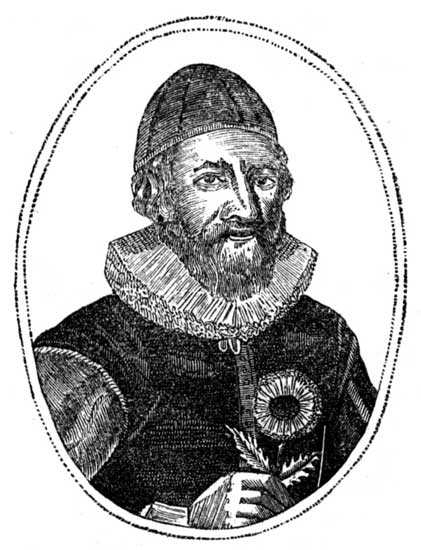
The above is scarcely better than Switzer's. There appears no faithful portrait of Parkinson, but Marshall's, who had the felicity to draw other portraits besides his.
Hollar's striking portraits of the Tradescants, are well known. On their tomb, at Lambeth, the following lines form part of the inscription:—
These famous Antiquarians, that had been Both Gardeners to the rose and lily Queen, Transplanted now themselves, sleep here; and when Angels shall with their trumpets waken men, And fire shall purge the world, these hence shall rise, And change this Garden for a Paradise.
In the Ashmolean Museum, is a portrait of the Son, in his garden, with a spade in his hand. In Mr. Nichols's "Illustrations to Granger," consisting of seventy-five portraits, appear those of the Tradescants, father and son. Smith also engraved John Tradescant, with his son, and their monument, 1793. Mr. Weston, in his Catalogue, fully describes the Museum Tradescantium. Dr. Pulteney observes, that "in a work devoted to the commemoration of Botanists, their name stands too high not to demand an honourable notice; since they contributed, at an early period, by their garden and museum, to raise a curiosity that was eminently useful to the progress and improvement of natural history in general. The reader may see a curious account of the remains of this garden, drawn up in the year 1749, by the late Sir W. Watson, and printed in vol. xlvi. of the Phil. Trans. The son died in 1662. His widow erected a curious monument, in memory of the family, in Lambeth church-yard, of which a large account, and engravings from a drawing of it in the Pepysian Library, at Cambridge, are given by the late learned Dr. Ducarel, in vol. lxiii. of the Phil. Trans."
Sir Henry Wotton, Provost of Eaton. His portrait is given in Isaac Walton's Lives of Wotton, and others. It, of course, accompanies Zouch's, and the other well-known editions of Isaac Walton's Lives. In Evans's Illustrations to Granger, is Sir H. Wotton, from the picture in the Bodleian Library, engraved by Stow. In Sir Henry's Reflections on Ancient and Modern Learning, is his chapter "On Ancient and Modern Agriculture and Gardening." Cowley wrote an elegy on him, which thus commences:—
What shall we say since silent now is he, Who when he spoke, all things would silent be; Who had so many languages in store, That only Fame can speak of him with more.
Isaac Walton published the "Reliquiæ Wottonianæ, or, Lives, Letters, Poems, &c. by Sir Henry Wotton," 12mo. 1654, with portraits of Wotton, Charles I., Earl of Essex, and Buckingham. Sir E. Brydges printed at his private press, at Lee Priory, Sir Henry's Characters of the Earl of Essex and Buckingham. In the Reliquiæ, among many curious and interesting articles, is preserved Sir Henry's delicately complimentary letter to Milton on receiving from him Comus. Sir Henry, when a resident at Venice, (where he was sent on three several embassies by James) purchased for that munificent encourager of painting, the Duke of Buckingham, several valuable pictures, which were added to the Duke's magnificent collection. Isaac Walton's Life of Wotton thus concludes:—"Dying worthy of his name and family, worthy of the love of so many princes, and persons of eminent wisdom and learning, worthy of the trust committed unto him for the service of his prince and country." And, in his Angler, he thus sweetly paints the warm attachment he had for Wotton:—"a man with whom I have often fished and conversed, whose learning, wit, and cheerfulness, made his company to be esteemed one of the delights of mankind. Peace and patience, and a calm content, did cohabit in the cheerful heart of Sir Henry Wotton."
Sir Thomas Browne. Mr. Dallaway, in his Anecdotes of the Arts, mentions the following portrait of Sir Thomas:—"At Devonshire-house is a family groupe, by Dobson, of Sir Thomas Browne. He is smiling with the utmost complacency upon his children, who surround him." His portrait is also prefixed to his works. The Biograph. Dict., folio, 1748, says, "his picture, in the College of Physicians, shews him to have been remarkably handsome, and to have possessed, in a singular degree, the blessings of a grave, yet cheerful and inviting, countenance." The same work farther gives him a most amiable character. Mr. Ray, in his Ornithology, does not omit paying a just compliment to his assistant and friend, "the deservedly famous Sir Thomas Browne." Evelyn, in 1671, mentions Sir Thomas Browne's garden at Norwich, as containing a paradise of varieties, and the gardens of all the inhabitants as full of excellent flowers. Switzer says, "The noble elegance of his style has since induced many to read his works, (of which, that of Cyrus's gardens is some of the brightest,) though they have had little inclination to the practice of gardening itself. There remains nothing that I have heard of his putting gardening actually into practice himself; but some of his last works being observations on several scarce plants mentioned in Scripture; and of Garlands and Coronary garden plants and flowers, 'tis reasonable to suppose he did; and the love he had so early and late discovered toward it, was completed in the delightful practice thereof." He further says, " his elaborate and ingenious pen has not a little added to the nobleness of our subject."[65] His works were published in 1 vol. folio, 1686, with his portrait, engraved by White. His portrait appears also to his "Certain Miscellany Tracts," 8vo. A list of his numerous works may be seen in the Biogr. Dictionaires, or in Watts's Bibl. Britt. To his "Christian Morals," Dr. Johnson has prefixed his Life. It is so masterly written, that it is impossible to give even an abstract. Dr. Kippis has, however, in part, transcribed it. He was chosen Honorary Fellow of the College of Physicians, as a man virtute et literas ornatissimus. In 1671, he received the honour of Knighthood from Charles II., a prince, (says Dr. Johnson) "who, with many frailties and vices, had yet skill to discover excellence, and virtue to reward it with such honorary distinctions, at least, as cost him nothing, yet, conferred by a king so judicious and so much beloved, had the power of giving merit new lustre and greater popularity." Thus he lived in high reputation, till, in his seventy-sixth year, an illness, which tortured him a week, put an end to his life, at Norwich, on his birth-day, October 19, 1682. "Some of his last words (we are told by Whitefoot) were expressions of submission to the will of God, and fearlessness of death." Dr. Johnson observes, "It is not on the praises of others, but on his own writings, that he is to depend for the esteem of posterity; of which he will not be easily deprived, while learning shall have any reverence among men: for there is no science in which he does not discover some skill; and scarce any kind of knowledge, profane or sacred, abstruse or elegant, which he does not appear to have cultivated with success. His exuberance of knowledge, and plenitude of ideas, sometimes obstruct the tendency of his reasoning, and the clearness of his decisions. On whatever subject he employed his mind, there started up immediately so many images before him, that he lost one by grasping another. His memory supplied him with so many illustrations, parallel or dependent notions, that he was always starting into collateral considerations. But the spirit and vigour of his pursuit always gives delight; and the reader follows him, without reluctance, through his mazes, of themselves flowery and pleasing, and ending at the point originally in view. There remains yet an objection against the writings of Browne, more formidable than the animadversions of criticism. There are passages from which some have taken occasion to rank him among deists, and others among atheists. It would be difficult to guess how any such conclusion should be formed, had not experience shewn that there are two sorts of men willing to enlarge the catalogue of infidels. When Browne has been numbered among the contemners of religion by the fury of its friends, or the artifices of its enemies, it is no difficult task to replace him among the most zealous professors of christianity. He may perhaps, in the ardour of his imagination, have hazarded an expression, which a mind intent upon faults may interpret into heresy, if considered apart from the rest of his discourse; but a phrase is not to be opposed to volumes. There is scarcely a writer to be found, whose profession was not divinity, that has so frequently testified his belief of the sacred writings, has appealed to them with such unlimited submission, or mentioned them with such unvaried reverence."
John Evelyn, Esq. His portrait by Nanteuil, and that by Kneller, holding his Sylva in his hand, are well engraved in Mr. Bray's Memoirs. The following remark is from the Quarterly Review, in its review of the same work, in 1818:—"At four years old he was taught to read by the parish school-master, whose school was over the church porch; and 'at six his picture was drawn by one Chanteral, no ill painter.' If this portrait, as is not unlikely, be preserved in the family, it should have been engraved for the present work; it would have been very interesting to compare the countenance of such a person, in childhood, in the flower of years, when his head was engraved by Nanteuil, and in ripe old age, when he sat to Sir G. Kneller." In Aubrey's Surrey, vol. iv. are many interesting particulars of Mr. Evelyn, and his family, and he gives a list of his works. He says "his picture was thrice drawn in oil; first, in 1641, by one Vanderborcht, brought out of Germany at the same time with Hollar, the graver, by the Earl of Arundel; a second time in 1648, by Walker; and the third time by Sir G. Kneller, for his friend Mr. Pepys, of the Admiralty, of which that at the Royal Society is a copy. There is a print of him by Nanteuil, who likewise drew him more than once in black and white, with Indian ink; and a picture, in crayon, by Luterel." Mr. Evelyn lived in the busy times of Charles I., Cromwell, Charles II., James II., and William. He had much personal intercourse with Charles II. and James II., and was in the habits of great intimacy with many of the ministers of those two monarchs, and of the eminent men of those days. Foreigners, distinguished for learning or arts, who came to England, did not leave it without visiting him. His manners we may presume to have been of the most agreeable kind, for his company was sought by the greatest men, not merely by inviting him to their own tables, but by their repeated visits to him at his own house. Mr. Evelyn lived to the great age of eighty-six, and wished these words to be inscribed on his tomb:—"all is vanity that is not honest, and there is no solid wisdom but in real piety."[66] Cowley, in a letter to him, says, "I know nobody that possesses more private happiness than you do in your garden; and yet no man who makes his happiness more publick, by a free communication of the art and knowledge of it to others. All that I myself am able yet to do, is only to recommend to mankind the search of that felicity, which you instruct them how to find and to enjoy." The Quarterly Review thus speaks of his Sylva:—"The Sylva remained a beautiful and enduring memorial of his amusements, his occupations, and his studies, his private happiness, and his public virtues. The greater part of the woods, which were raised in consequence of Evelyn's writings, have been cut down; the oaks have borne the British flag to seas and countries which were undiscovered when they were planted, and generation after generation has been coffined in the elms. The trees of his age, which may yet be standing, are verging fast toward their decay and dissolution: but his name is fresh in the land, and his reputation, like the trees of an Indian Paradise, exists, and will continue to exist in full strength and beauty, uninjured by the course of time." Mr. Loudon, in his Encycl. of Gardening, thus speaks of him:—"Evelyn is universally allowed to have been one of the warmest friends to improvements in gardening and planting, that has ever appeared. He is eulogized by Wotton, in his Reflections on Ancient and Modern Learning, as having done more than all former ages." Switzer calls him "that good esquire, the king of gardeners." His life (says Mr. Walpole) "was a course of inquiry, study, curiosity, instruction, and benevolence. He knew that retirement, in his own hands, was industry and benefit to mankind; in those of others, laziness and inutility."
There appears the following more modern publications respecting Mr. Evelyn:—
1. Sylva, with Notes by Hunter; in 4to, and 8vo.
2. Memoirs and Correspondence of Mr. Evelyn. Edited by Mr. Bray. 5 vols. 8vo. Portraits, and other plates. £3. 10s. Another edition, in 2 vols., 4to.
3. Evelyn's Miscellaneous Writings, collected and edited, with Notes, by Mr. Upcott. Forming a Supplement to the Evelyn Memoirs. 1 vol. 4to. with plates, 1825. £3. 10s.
The Encycl. of Gardening enumerates the whole of Mr. Evelyn's works. So does Dr. Watts in his Bibl. Britt.; and Mr. Johnson in his History of English Gardening.[67]
Abraham Cowley. The portraits of him are well known. That in Bishop Hurd's edition is very neat. This same portrait is also well engraved for Ankars's edition of Cowley; and also in that by Aikens, in 8vo. Dean Sprat has prefixed to his edition of Cowley, his portrait, engraved by Faithorne, and, in his preface, pays a warm and just tribute to his memory. When his death was announced to Charles II., he declared, that Mr. Cowley had not left a better man behind him in England. Cowley addresses his chapter Of Gardens (which strongly paints his delight in them) to Mr. Evelyn. He wrote this epitaph for himself:—
From life's superfluous cares enlarg'd, His debt of human toil discharg'd, Here Cowley lies, beneath this shed, To ev'ry worldly interest dead: With decent poverty content; His hours of ease not idly spent; To fortune's goods a foe profess'd, And, hating wealth, by all caress'd. 'Tis sure he's dead; for, lo! how small A spot of earth is now his all! O! wish that earth may lightly lay, And ev'ry care be far away! Bring flow'rs, the short-liv'd roses bring, To life deceased fit offering! And sweets around the poet strow, Whilst yet with life his ashes glow.
John Rose, head gardener to the Lord Essex, at Essex-house, in the Strand. He sent him to study the celebrated beauties in the gardens of Versailles. He became afterwards the chief gardener to Charles II., at the royal gardens in St. James's Park. His portrait may be seen at Kensington, in an oil painting, where he is presenting a pine to his Majesty, whilst on a visit to the Duchess of Cleveland, at Downey Court, Buckinghamshire. It has lately been engraved in mezzotinto. He was the author of "The English Vineyard Vindicated, and the Way of Making Wine in France;" first printed with Evelyn's French Gardener, in 1672, 12mo. Other editions in 1675, 1676, and 1690, in 8vo. The preface is by Evelyn, as well as The Art of Making Wine. Rose brought to great perfection dwarf fruit trees, in the gardens at Hampton Court, Carlton, and Marlborough House. Switzer thus speaks of him:—"He was esteemed to be the best of his profession in those days, and ought to be remembered for the encouragement he gave to a servant of his, that has since made the greatest figure that ever yet any gardener did, I mean Mr. London. Mr. Rose may be well ranked amongst the greatest virtuosos of that time, (now dead) who were all well pleased to accept of his company while living."
Charles Cotton. He published "The Planter's Manual," 12mo. 1675. There is prefixed to it a rural frontispiece, by Van Houe. Mr. Johnson properly calls him "one of the Scriptores minores of horticulture." His "devoted attachment to Izaak Walton, forms the best evidence we have of his naturally amiable disposition." His portrait is finely engraved in Mr. Major's extensively illustrated and most attractive editions of the Angler; a delightful book, exhibiting a "matchless picture of rural nature." Mr. Cotton's portrait is also well engraved in Zouch's Life of Walton; and in the many other curious and embellished editions of Walton and Cotton's Angler. He translated with such truth and spirit, the celebrated Essays of Montaigne, that he received from that superior critic, the Marquis of Halifax, a most elegant encomium. Sir John Hawkins calls it "one of the most valuable books in the English language." A complete list of Mr. Cotton's works appears in Watts's Bibl. Britt. When describing, in his Wonders of the Peake, the Queen of Scot's Pillar, he thus breaks out:—
Illustrious Mary, it had happy been, Had you then found a cave like this to skreen Your sacred person from those frontier spies, That of a sovereign princess durst make prize, When Neptune too officiously bore Your cred'lous innocence to this faithless shore. Oh, England! once who hadst the only fame Of being kind to all who hither came For refuge and protection, how couldst thou So strangely alter thy good nature now, Where there was so much excellence to move, Not only thy compassion, but thy love? 'Twas strange on earth, save Caledonian ground, So impudent a villain could be found, Such majesty and sweetness to accuse; Or, after that, a judge would not refuse Her sentence to pronounce; or that being done, Even amongst bloody'st hangmen, to find one Durst, though her face was veil'd, and neck laid down, Strike off the fairest head e'er wore a crown. And what state policy there might be here, Which does with right too often interfere, I 'm not to judge: yet thus far dare be bold, A fouler act the sun did ne'er behold.[68]
Plott, in his Staffordshire, calls Mr. Cotton "his worthy, learned, and most ingenious friend." Sir John Hawkins thus speaks of him:—"He was both a wit and a scholar; of an open, cheerful, and hospitable temper; endowed with fine talents for conversation, and the courtesy and affability of a gentleman." He farther thus speaks of one of his poems:—"It is not for their courtly and elegant turn, that the verses of Charles Cotton ought to be praised; there is such a delightful flow of feeling and sentiment, so much of the best part of our nature mixed up in them, and so much fancy displayed, that one of our most distinguished living poets has adduced several passages of his Ode upon Winter, for a general illustration of the characteristics of fancy." He must have possessed many endearing qualities, for the benevolent and pious Walton thus concludes a letter to his "most honoured friend, Charles Cotton, Esq.:"—"though I be more than a hundred miles from you, and in the eighty-third year of my age, yet I will forget both, and next month begin a pilgrimage to beg your pardon: for I would die in your favour, and till then will live, Sir, your most affectionate father and friend, Isaac Walton." One cannot wonder at the good old man wishing to visit the courteous and well-bred Mr. Cotton, and to enjoy the intercourse of hospitable urbanity, near the pastoral streams of the Dove, when he had received such an invitation as the following, addressed to his "dear and most worthy friend, Mr. Isaac Walton:"—
Whilst in this cold and blustering clime, Where bleak winds howl and tempests roar, We pass away the roughest time Has been of many years before; Whilst from the most tempestuous nooks The chillest blasts our peace invade, And by great rains our smallest brooks Are almost navigable made; Whilst all the ills are so improved, Of this dead quarter of the year, That even you, so much beloved, We would not now wish with us here; In this estate, I say, it is Some comfort to us to suppose, That, in a better clime than this, You, our dear friend, have more repose; And some delight to me the while, Though nature now does weep in rain, To think that I have seen her smile, And haply may I do again. If the all-ruling Power please We live to see another May, We'll recompense an age of these Foul days in one fine fishing day. We then shall have a day or two, Perhaps a week, wherein to try What the best master's hand can do With the most deadly killing fly: A day with not too bright a beam, A warm, but not a scorching sun, A southern gale to curl the stream, and, master, half our work is done. There, whilst behind some bush we wait The scaly people to betray,— We'll prove it just, with treacherous bait To make the preying Trout our prey. And think ourselves, in such an hour, Happier than those, though not so high, Who, like Leviathans, devour Of meaner men the smaller fry. This, my best friend, at my poor home Shall be our pastime and our theme; But then—should you not deign to come, You make all this a flattering dream.
In wandering over the lovely scenes, the pleasant brooks, the flower-bespangled meadows, which the moral pages of Isaac Walton so unaffectedly delineate, it is impossible not to recur to the name of the late author of Salmonia, and to reflect, that on these pages he oft unbended his vigorous mind from his severe and brilliant discoveries. We can now only lament the (almost) premature death of this high-ranked philosopher, this great benefactor to the arts, and deep promoter of science, whose mortal remains were consigned to his unostentatious tomb, at Geneva, in one of the finest evenings of summer, followed by the eloquent and amiable historian, De Sismondi, and by other learned and illustrious men. One may apply to his last moments at Geneva, (where he had arrived only one day before) these lines of his own favourite Herbert:—
Sweet day, so cool, so calm, so bright, The bridal of the earth and sky, Sweet dews shall weep thy fall to-night, For thou must die![69]
Samuel Gilbert's portrait is prefixed to his "Florist's Vade Mecum;" 12mo. In his "Gardener's Almanack," is a particular description of the roses cultivated in the English gardens at that period. He was the author of "Fons Sanitatis, or the Healing Spring at Willowbridge Wells." He was son-in-law to John Rea, the author of Flora, and who planned the gardens at Gerard's Bromley. Willowbridge Wells are at a little distance from where these once superb gardens were.
Jacob Bobart, the elder, is an admirable portrait, by D. Loggan, taken at his age of eighty-one, and engraved by Burghers. Granger says it is extremely scarce. Beneath the head, which is dated 1675, is this distich:—
Thou Germane prince of plants, each year to thee, Thousands of subjects grant a subsidy.
It is a venerable countenance, of deep thought. Richardson re-engraved this among his Illustrations to Granger. Granger mentions also a whole-length of Bobart in a garden, dog, goat, &c. 4to. The Encycl. of Gardening says, "Bobart's descendants are still in Oxford, and known as coach proprietors." Do none of them possess the original painting? The munificence of the Earl of Danby placed Bobart in the physic garden at Oxford, in 1632, as supervisor; and this garden flourished many years under his care, and that of his son Jacob, whose zeal and diligence Dr. Pulteney records. The elder Bobart was the author of the Hortus Oxoniensis, 1648. Wood, in his Athenæ, informs us, that "Jacob Bobart died in his garden-house, in February, 1679, whereupon his body was buried in the church of St. Peter, Oxon." He left two sons, Jacob and Tillemant. Tillemant became a master coachman between Oxford and London, but having had the misfortune to break his leg, became one of the beadles of the university. In the preface to Mr. Nicholls's late curious work on autographs, among other albums, in the British Museum, it mentions that of David Krein, in which is the autograph of Jacob Bobart, with these verses;—
——"virtus sua gloria. Think that day lost whose descending sun Views from thy hand no noble action done. Yr success and happyness is sincerely wished by Ja. Bobart, Oxford."
It appears from Ray's History of Plants, that Jacob Bobart, the son, was a frequent communicator to him of scarce plants. It was this son who published the second volume of Morrison's Oxford History of Plants, who wrote its excellent preface, and who engaged Burghers to engrave many of the new plants; which engravings are highly commended by Pulteney. Mr. Johnson, in page 148 of his History of Gardening, thus pays Bobart a high compliment:—"a phalanx of botanists were then contemporaries, which previous ages never equalled, nor succeeding ones surpassed. Ray, Tournefort, Plumier, Plukenet, Commelin, Rivinus, Bobart, Petiver, Sherard, Boccone, Linnæus, may be said to have lived in the same age."
James Gardiner. His portrait is engraved by Vertue, from after Verelst, and prefixed to his translation of Rapin on Gardens, 8vo. second edition; no date. A third edition, 8vo. 1728. I believe he also wrote "On the Beatitudes;" 2 vols. 8vo. Switzer says, that this "incomparable Latin poem was translated by an ingenious and worthily dignified clergyman, and a great lover of gardening, Mr. Gardiner, Sub-Dean of Lincoln." He became afterwards (I believe) Bishop of Lincoln; and a Latin epitaph on this bishop is in Peck's Desid. Curiosa. There is a print of "Jacobus Gardiner, Episc. Lincoln," engraved by George White, from after Dahl.
Sir William Temple. The portraits of this worthy man are numerous. Vanderbane's engraving, from Sir Peter Lely's, is particularly fine. Vertue's engravings, from Sir Peter, in the folio editions of 1720 and 1740, are also fine. This same portrait is neatly engraved in the late Mr. Nichol's Collection of Poems. Houbraken has also engraved the same for Birch's Lives. Sir William Temple, after spending twenty years in negociations with foreign powers, retired in 1680 from public life, and employed his time in literary pursuits. He was ambassador for many years at the court of Holland, and there acquired his knowledge and taste in gardening. He had a garden at Sheen, and afterwards, another at Moor Park, where he died in 1700; and though his body was buried in Westminster Abbey, his heart was enclosed in a silver urn under a sun-dial in the latter garden. His Essay "Upon the Gardens of Epicurus, or of Gardening in the year 1685," is printed in all the editions of his works.[70] These works are published in 2 vols. folio, and 4 vols. 8vo. Switzer, in his History of Gardening, first published in 1715, says, "That he was a great lover of gardening, appears by his own writings, and several kinds of fruit brought over by him out of Holland, &c. as well as by the testimony of his neighbours yet living, the greatest consolation of his life being, in the lucid intervals he had from public employs, in his beloved gardens at Sheen." And, in his Fruit Gardener he says, that "the magnificence and generosity of this great lover of planting, distributed vast numbers of the finest grapes among the nurserymen about London, as well as amongst the nobility and gentry." Lord Mountmorris thus speaks of him:—"The retirement of this great man has bequeathed the most invaluable legacy to posterity. Of the taste and elegance of his writings too much can never be said, illuminated as they are by that probity and candour which pervade them, and those charms which render truth irresistible. Though other writers may be more the objects of imitation to the scholar, yet his style is certainly the best adapted to the politician and the man of fashion; nor would such an opinion be given, were it not for an anecdote of Swift, which I had from the late Mr. Sheridan, who told me the dean always recommended him as the best model, and had repeatedly said that the style of Sir William Temple was the easiest, the most liberal, and the most brilliant in our language. In a word, when we consider his probity, his disinterestedness, his contempt of wealth, the genuine beauty of his style, which was as brilliant, as harmonious, and as pure as his life and manners; when we reflect upon the treasures which he has bequeathed by his example and by his works to his country, which no man ever loved better, or esteemed more; we cannot avoid considering Sir William Temple as one of the greatest characters which has appeared upon the political stage; and he may be justly classed with the greatest names of antiquity, and with the most brilliant characters which adorn and illustrate the Grecian or Roman annals." Mr. Mason, in his English Garden, contrasts Sir William's idea of "a perfect garden," with those of Lord Bacon, and Milton; but he candidly says,
——and yet full oft O'er Temple's studious hour did truth preside, Sprinkling her lustre o'er his classic page; There hear his candour own, in fashion's spite, In spite of courtly dulness hear it own, There is a grace in wild variety Surpassing rule and order. Temple, yes, There is a grace; and let eternal wreaths Adorn their brows who fixt its empire here."
He then, in glowing lines, pays an animated tribute to Addison, Pope, and Kent. Hume records that "he was full of honour and humanity." Sir William thus concludes one of his philosophic essays:—"When this is done, human life is, at the greatest and the best, but like a froward child, that must be played with and humoured a little to keep it quiet till it falls asleep, and then the care is over." His garden was one of his last delights. He knew what kind of life was best fitted to make a man's last days happy. Mr. Walpole, though he censures Sir William's warm panegyric on the garden at Moor Park, yet scruples not doing him full justice, in styling him an excellent man, and an admired writer, whose style, as to his garden, is animated with the colouring and glow of poetry. Mr. Cobbett, in his English Gardener, thus deplores the fate of Moor Park:—"This really wise and excellent man, Sir W. Temple, who, while he possessed the soundest judgment, and was employed in some of the greatest concerns of his country, so ardently, yet so rationally and unaffectedly, praises the pursuits of gardening, in which he delighted from his youth to his old age; and of his taste in which, he gave such delightful proofs in those gardens and grounds at Moor Park, beneath the turf of one spot of which, he caused by his will, his heart to be buried, and which spot, together with all the rest of the beautiful arrangement, has been torn about and disfigured within the last fifty years, by a succession of wine merchants, spirit merchants, West Indians, and God knows what besides." And, in his Woodlands, he says, "I have stood for hours, when a little boy, looking at this object (the canal and borders of beautiful flowers at Moor Park); I have travelled far since, and have seen a great deal; but I have never seen any thing of the gardening kind so beautiful in the whole course of my life." Mr. Johnson, in his History of English Gardening, after noticing many general particulars of Sir William, devotes an interesting page to Sir William's attachment to gardening; and every line in this generous page, betrays his own delight in this art. He thus concludes this page:—"Nothing can demonstrate more fully the delight he took in gardening, than the direction left in his will, that his heart should be buried beneath the sun-dial of his garden, at Moor Park, near Farnham, in Surrey. In accordance with which, it was deposited there in a silver box, affording another instance of the ruling passion unweakened even in death. Nor was this an unphilosophical clinging to that which it was impossible to retain; but rather that grateful feeling, common to our nature, of desiring finally to repose where in life we have been happy. In his garden, Sir William Temple had spent the calmest hours of a well-spent life, and where his heart had been most peaceful, he wished its dust to mingle, and thus, at the same time, offering his last testimony to the sentiment, that in a garden
Hic secura quies, et nescia fallere vita."
John Locke wrote "Observations upon the Growth of Vines and Olives; the Production of Silk, the Preservation of Fruits. Written at the request of the Earl of Shaftesbury; now first printed from the original manuscript in the possession of the present Earl of Shaftesbury, 1s. 6d. Sandby, 1766." Among the many portraits we have of this learned man, the public are indebted to Lord King, for having prefixed to his Life of Mr. Locke, a very fine portrait of him, from after Greenhill. This great and good man possessed, in the highest degree, those virtues that have given him a claim to the highest rank in the admiration of posterity. In Rutter's delineations of a part of Somersetshire, he gives a neat wood-cut of the cottage at Wrington, wherein Locke was born, and he informs us, that in the garden belonging to Mrs. Hannah More, near that village, she has placed an urn commemorative of Locke, which was a gift to her from the justly celebrated Mrs. Montague. He was drawn also by Kneller. Bromley gives a list of many of his engraved portraits. Houbraken engraved one for Birch's Lives. Vertue gave two engravings from Kneller.
William Fleetwood, successively Bishop of St. Asaph and Ely, and who died in 1723, was author of "Curiosities of Nature and Art in Husbandry and Gardening," 8vo. 1707. His portrait is prefixed to his "Sermons on the Relative Duties," 8vo. 1716; and also to his "Essay on the Miracles." His works were published in a collected form in 1 vol. folio, 1737. He was incontestibly the best preacher in his time. Dr. Doddridge calls him "silver tongued." Pope's line of
The gracious dew of pulpit eloquence,
might, no doubt, have been justly applied to him. Dr. Drake, in the third volume of his Essays, to illustrate the Tatler, Spectator, and Guardian, has some interesting pages respecting him. His benevolent heart and exemplary life, added great effect to his persuasive eloquence in the pulpit. "His sermons (says Lempriere), and divinity tracts, were widely circulated; but the firmness of his opinions drew upon him the censure of the House of Commons. His preface to his sermons on the deaths of Mary, the Duke of Gloucester, and of William, and on the accession of Anne, gave such offence to the ministry, that the book was publicly burnt in 1712; but it was more universally read, and even appeared in the Spectator, No. 384." As to this burning, Dr. Johnson remarked, that fire is a conclusive, but not a convincing argument; it will certainly destroy any book, but it refutes none.[71] In an Obituary, preserved in Peck's Desid. Curiosa, it thus mentions the death of a Jeffery Fleetwood, "leaving a wife and six little children behind him. God bless them. One of these little children was the famous William Fleetwood, Bishop of Ely."
Joseph Addison, Esq. There is an original portrait of this eminent man, at Holland House. Another at Oxford. Noble's continuation of Granger enumerates several engravings of him, from Kneller's portraits. Dayl, the painter, also drew him. His portrait appears in the Kit Cat Club. In Ireland's "Picturesque Views on the River Avon," he gives an interesting description of Mr. Addison's house at Bilton, near Rugby, two miles from Dunchurch; with a view of the same. The house "remains precisely in the state it was at the decease of its former possessor, nor has the interior suffered much change in its former decoration. The furniture and pictures hold their places with an apparent sacred attention to his memory. Among the latter, are three of himself, at different periods of his life; in each of which is strongly marked with the pencil, the ease of the gentleman, and the open and ingenuous character of the friend to humanity." From Dr. Drake's Biographical Sketch of Addison, it appears, that these portraits were still remaining in his house in 1797. A copy of the above view is given in the Monthly Magazine for February, 1822, and it there says, that "the spacious gardens retain the fashion of the age of the Spectator." The origin of the modern style of landscape gardening, or the first writers on that subject, were unquestionably Mr. Addison, in Nos. 414 and 477 of the Spectator, and Mr. Pope in his celebrated Guardian. The first artists who practised in this style, were Bridgman and Kent.[72] Mr. Addison's pure taste on these subjects is visible even where he prefers Fontainebleau to the magnificent Versailles, in his paper in the Guardian, No. 101:—"It is situated among rocks and woods, that give you a fine variety of savage prospects. The king has humoured the genius of the place, and only made use of so much art as is necessary to help and regulate nature, without reforming her too much. The cascades seem to break through the clefts and cracks of rocks that are covered over with moss, and look as if they were piled upon one another by accident. There is an artificial wildness in the meadows, walks, and canals; and the garden, instead of a wall, is fenced on the lower end by a natural mound of rock-work that strikes the eye very agreeably. For my part, I think there is something more charming in these rude heaps of stone than in so many statues, and would as soon see a river winding through woods and meadows, as when it is tossed up in so many whimsical figures at Versailles." In No. 414 of his Spectator, he says, "English gardens are not so entertaining to the fancy as those in France, and Italy, where we see a large extent of ground covered over with an agreeable mixture of garden, and forest, which represent every where an artificial rudeness, much more charming than that neatness and elegancy which we meet with in those of our own country." Mr. Murphy thus compares Addison with Johnson:—"Addison lends grace and ornament to truth; Johnson gives it force and energy. Addison makes virtue amiable; Johnson represents it as an awful duty." Addison has been called the English Fenelon. Johnson calls him the Raphael of essay writers. The imposing and commanding attitude of the statue erected a few years since in the Poets' Corner, seems to have arisen, and to have been devoted to his memory, from his Reflections on the Tombs in the Abbey. Those reflections I here subjoin; and I am sure my reader will agree with me, that I could not offer a purer honour to his genius and memory:—"No.26, Friday, March 30.
Pallida mors aequo pulsat pede pauperum tabernas Regumque turres, O beate sexti. Vitae summa brevis spem nos vetat inchoare longam, Jam te premet nox, fabulaeque manes, Et domus exilis Plutonia.—Hor.
With equal foot, rich friend, impartial fate Knocks at the cottage, and the palace gate: Life's span forbids thee to extend thy cares, And stretch thy hopes beyond thy tender years: Night soon will seize, and you must quickly go To storied ghosts, and Pluto's house below.—Creech.
"When I am in a serious humour, I very often walk by myself in Westminster Abbey; where the gloominess of the place, and the use to which it is applied, with the solemnity of the building, and the condition of the people who lie in it, are apt to fill the mind with a kind of melancholy, or rather thoughtfulness, that is not disagreeable. I yesterday passed a whole afternoon in the church-yard, the cloisters, and the church, amusing myself with the tomb-stones and inscriptions that I met with in those several regions of the dead. Most of them recorded nothing else of the buried person, but that he was born upon one day and died upon another: the whole history of his life being comprehended in those two circumstances, that are common to all mankind. I could not but look upon these registers of existence, whether of brass or marble, as a kind of satire upon the departed persons; who had left no other memorial of them, but that they were born and that they died. They put me in mind of several persons mentioned in the battles of heroic poems, who have sounding names given them, for no other reason but that they may be killed, and are celebrated for nothing but being knocked on the head.
Glaucumque, Medontaque, Thersilochumque.—Virg.
"The life of these men is finely described in holy writ by the path of an arrow, which is immediately closed up and lost. Upon my going into the church, I entertained myself with the digging of a grave; and saw in every shovel-full of it that was thrown up, the fragment of a bone or skull intermixed with a kind of fresh mouldering earth that some time or other had a place in the composition of an human body. Upon this I began to consider with myself what innumerable multitudes of people lay confused together under the pavement of that ancient cathedral; how men and women, friends and enemies, priests and soldiers, monks and prebendaries, were crumbled amongst one another, and blended together in the same common mass; how beauty, strength, and youth, with old age, weakness, and deformity, lay undistinguished in the same promiscuous heap of matter. After having thus surveyed this great magazine of mortality, as it were in the lump; I examined it more particularly by the accounts which I found on several of the monuments which are raised in every quarter of that ancient fabrick. Some of them were covered with such extravagant epitaphs, that if it were possible for the dead person to be acquainted with them, he would blush at the praises which his friends have bestowed upon him. There are others so excessively modest, that they deliver the character of the person departed in Greek or Hebrew, and by that means are not understood once in a twelvemonth. In the poetical quarter, I found there were poets who had no monuments, and monuments which had no poets. I observed indeed that the present war had filled the church with many of these uninhabited monuments, which had been erected to the memory of persons whose bodies were buried in the plains of Blenheim, or in the bosom of the ocean. I could not but be very much delighted with several modern epitaphs, which are written with great elegance of expression and justness of thought, and therefore do honour to the living as well as to the dead. As a foreigner is very apt to conceive an idea of the ignorance or politeness of a nation from the turn of their public monuments and inscriptions, they should be submitted to the perusal of men of learning and genius before they are put in execution. Sir Cloudesly Shovel's monument has very often given me great offence: instead of the brave rough English admiral, which was the distinguishing character of that plain gallant man, he is represented on his tomb by the figure of a beau, dressed in a long periwig, and reposing himself upon velvet cushions under a canopy of state. The inscription is answerable to the monument; for, instead of celebrating the many remarkable actions he had performed in the service of his country, it acquaints us only with the manner of his death, in which it was impossible for him to reap any honour. The Dutch, whom we are apt to despise for want of genius, shew an infinitely greater taste of antiquity and politeness in their buildings and works of this nature, than what we meet with in those of our own country. The monuments of their admirals, which have been erected at the public expense, represent them like themselves; and are adorned with rostral crowns and naval ornaments, with beautiful festoons of sea-weed, shells, and coral. But to return to our subject. I have left the repository of our English kings for the contemplation of another day, when I shall find my mind disposed for so serious an amusement. I know that entertainments of this nature are apt to raise dark and dismal thoughts in timorous minds, and gloomy imaginations; but, for my own part, though I am always serious, I do not know what it is to be melancholy; and can therefore take a view of nature in her deep and solemn scenes, with the same pleasure as in her most gay and delightful ones. By this means I can improve myself with those objects which others consider with terror. When I look upon the tombs of the great, every emotion of envy dies in me; when I read the epitaphs of the beautiful, every inordinate desire goes out; when I meet with the grief of parents upon a tomb-stone, my heart melts with compassion; when I see the tomb of the parents themselves, I consider the vanity of grieving for those whom we must quickly follow: When I see kings lying by those who deposed them, when I consider rival wits placed side by side, or the holy men that divided the world with their contests and disputes, I reflect with sorrow and astonishment on the little competitions, factions, and debates of mankind. When I read the several dates of the tombs, of some that died yesterday, and some six hundred years ago, I consider that great day when we shall all of us be contemporaries, and make our appearance together."[73]
Rev. John Lawrence published "The Clergyman's Recreation, shewing the Pleasure and Profit of the Art of Gardening;" 8vo. 1714. Also a poem, called "Paradise Regained, or the Art of Gardening;" 8vo. 1728. The sixth edition of "The Clergyman's Recreation" has "the effigies of the author, engraved by Vertue." I have seen eight copies of this sixth edition, and in neither of them has this portrait been. No doubt the collecting to form Granger's, has deprived each copy of its portrait. This is an expressive portrait, ornamented with a vine wreath, and with a rich cornucopia or clusters of ripe fruit. The original picture from which Vertue's print was taken, was at Pallion, near Durham, the seat of his grandson, John Goodchild, Esq. In Rodd's catalogue of engraved portraits, printed a few years ago, was "John Lawrence, prebend of Salisbury, original drawing by Vertue, price 5s." Mr. Lawrence published also, in folio, in 1726, his System of Agriculture and Gardening. Mr. Nichols, in vol. iv. of his Literary Anecdotes, has given a list of all his works, has preserved a few particulars respecting him, and pays a just tribute to him. A list of his works may also be seen in Watts's Bibl. Brit., and in Mr. Johnson's work. The Encycl. of Gardening informs us that he was "of a hospitable and benevolent disposition, taking great pleasure in presenting a rich dessert of fruit to his friends." He was presented to the rectory of Yelvertoft, Northamptonshire, in 1703, "by the extraordinary uncommon bounty of a generous patron." In 1721, he was presented to that of Bishop's Wearmouth, Durham, where he died in 1732. He was also a prebend of Salisbury.[74]
Mr. Lawrence thus enforces the pleasures of a garden, to his own order:—"to make them happy by loving an innocent diversion, the amusements of a garden being not only most delightful to those that love them, but most wholesome to those that use them. A good man knows how to recapitulate all his pleasures in a devout lifting up of his hands, his eyes and his heart, to the great and bountiful author of nature, who gives beauty, relish, and success to all our honest labours." His pen likewise paints with "soft and tempting colours," the extreme beauty of our fruit-trees, when clothed with their different coloured blossoms, (what Lord Byron calls the sweet and blooming fruits of earth):—"What a pleasing entertainment is it to the eye, to behold the apricot in its full blossom, white as snow, and at the same time the peach with its crimson-coloured blooms; both beginning to be interspersed with green leaves! These are succeeded by the pear, the cherry, and the plum, whose blossoms and leaves make a very beautiful mixture in the spring; and it cannot be a less pleasant sight to see clusters of swelling fruit all the summer, as the earnest of the full gratification of another sense in autumn. And now we have come hither, what painter can draw a landskip more charming and beautiful to the eye, than an old Newington peach-tree laden with fruit in August, when the sun has first begun to paint one side of the fruit with such soft and tempting colours? The apricot, the pear, the cherry and plum, when they appear in plenty as they ought, present themselves to the eye at the time of ripening in very inviting blushes. In short, all the several sorts of fruit trees have such pleasing varieties, that were there no other sense to be gratified but the sight, they may vie with a parterre even of the finest flowers." He thus mentions the month of July:—"How beautiful and refreshing are the mornings and evenings of such days, when the very air is perfumed with pleasant odours, and every thing that presents itself to the eye gives fresh occasion to the devout admirer to praise and adore the Great Creator, who hath given such wisdom and power to man to diversify nature in such various instances, and (for his own use, pleasure, and profit,) to assist her in all her operations." This worthy clergyman might have applied to the delights of a garden, the sacred words of scripture:—"her ways are ways of pleasantness, and all her paths are peace."[75]
Alexander Pope. Numerous are the engraved portraits of this graceful and harmonious poet. Noble's continuation of Granger, gives all, or the greater part of the engravings from his portraits, from which it will be seen, that he was drawn by Kneller, by Richardson, by many others, and particularly by his friend Jervas. As a portrait painter, Mr. Jervas was far from eminent. Pope's attachment to him, however, has enshrined his name in glowing lines to future generations. The portraits of Pope which Jervas drew, were done con amore. Mr. Jennings, of Cheapside, has prefixed to his elegant folio edition of the "Essay on Man," a whole-length of Mr. Pope, from after Jervas. In Dodsley's Collection of Poems, vol. iii. is a very striking bust of Mr. Pope, as an accompaniment to Mr. Dodsley's affecting poem to his memory, which he entitles The Cave of Pope. Surely this bust must have strongly resembled Pope, or Mr. Dodsley would not have inserted it. The profile to Ruffhead's Life, in 4to. 1769, must have been a likeness, or Bishop Warburton would not have permitted its insertion. His age was then twenty-four. It is finely engraved by Ravenet, from Kneller. It is a striking portrait. A copy of this is admirably engraved in Bell's Poets, richly ornamented. A copy from that by Richardson is prefixed to Warton's edition. Among the portraits at Hagley, is that of Pope, and his dog Bounce, by Richardson.[76] Lord Chesterfield thus speaks of Pope:—"His poor, crazy, deformed body, was a mere Pandora's box, containing all the physical ills that ever afflicted humanity. This, perhaps, whetted the edge of his satire, and may, in some degree, excuse it. I will say nothing of his works; they speak sufficiently for themselves; they will live as long as taste and letters shall remain in this country, and be more and more admired, as envy and resentment shall subside. But I will venture this piece of classical blasphemy: which is, that however he may be supposed to be obliged to Horace, Horace is more obliged to him." Mr. Ruffhead (generally supposed to have had his information from Dr. Warburton) thus states:—"Mr. Pope was low in stature, and of a diminutive and misshapen figure, which no one ridiculed more pleasantly than himself. His constitution was naturally tender and delicate, and in his temper he was naturally mild and gentle, yet sometimes betrayed that exquisite sensibility which is the concomitant of genius. His lively perception and delicate feeling, irritated by wretched ill health, made him too quickly take fire, but his good sense and humanity soon rendered him placable. With regard to the extent of his genius, it was so wide and various, that perhaps it may not be too much to say, that he excelled in every species of composition; and, beside his excellence as a poet, he was both an antiquarian and an architect, and neither in an inferior degree.[77] No man ever entertained more exalted notions of friendship, or was ever more sincere, steady, warm, and disinterested, in all his attachments. Every inch of his heart was let out in lodgings for his friends." Lord Orrery thus speaks of him:—"His prose writings are little less harmonious than his verse; and his voice, in common conversation, was so naturally musical, that I remember honest Tom Southern used to call him the Little Nightingale; his manners were delicate, easy, and engaging; he treated his friends with a politeness that charmed, and a generosity that was much to his honour. Every guest was made happy within his doors; pleasure dwelt under his roof, and elegance presided at his table." One may trace Mr. Pope's hospitality throughout his letters. I will merely select one or two instances. In a letter to Swift, he says, "My house is too large; my gardens furnish too much wood and provision for my use. My servants are sensible and tender of me. They have intermarried, and are become rather low friends than servants. Would to God you would come over with Lord Orrery, whose care of you in the voyage I could so certainly depend on; and bring with you your old housekeeper, and two or three servants. I have room for all, a heart for all, and (think what you will) a fortune for all." In another letter to Swift, he says, "I wish you had any motive to see this kingdom. I could keep you; for I am rich, that is, I have more than I want. I can afford room for yourself and two servants. I have, indeed, room enough, nothing but myself at home: the kind and hearty housewife is dead! the agreeable and instructive neighbour is gone! yet my house is enlarged, and the gardens extend and flourish, as knowing nothing of the guests they have lost. I have more fruit trees and kitchen garden than you have any thought of; nay, I have good melons and pineapples of my own growth." In a letter to Mr. Allen, he says, "Let me know your day for coming, and I will have every room in my house as warm for you as the owner always would be." Mr. Mathias, in his Pursuits of Literature, (besides expatiating with fond delight, in numerous pages, on the genius of Pope,) thus speaks of him:—"Familiar with the great, intimate with the polite, graced by the attentions of the fair, admired by the learned, a favourite with the nation, independent in an acquired opulence, the honourable product of his genius, and of his industry; the companion of persons distinguished for their virtue, birth, high fashion, rank, or wit, and resident in the centre of all public information and intelligence; every avenue to knowledge, and every mode of observation were open to his curious, prying, piercing, and unwearied intellect."[78]
One may with truth further apply to Mr. Pope what was said of Buchanan, that his mind was stored with all the fire, and all the graces of ancient literature. Mr. Pope's attachment to gardens, appears not only in his letter to Martha Blount, describing Sir W. Raleigh's seat—but in his own garden at Twickenham, (where, as Mr. Loudon feelingly observes, only the soil of which now remains)—and in his letter to Mr. Blount, describing his grotto—but it also bursts forth in many passages throughout his works—and in his celebrated Guardian (No. 173), which attacks, with the keenest wit, "our study to recede from nature," in our giants made out of yews, and lavender pigs with sage growing in their bellies. His epistle to Lord Burlington confirms the charms he felt in studying nature. Mr. Mason, in a note to his English Garden, says, "I had before called Bacon the prophet, and Milton, the herald of true taste in gardening. The former, because, in developing the constituent properties of a princely garden, he had largely expatiated upon that adorned natural wildness which we now deem the essence of the art. The latter, on account of his having made this natural wildness the leading idea in his exquisite description of Paradise. I here call Addison, Pope, Kent, &c. the champions of this true taste." As Mr. Mason has added an &c., may we not add to these respected names, that of honest old Bridgman? It was the determination of Lord Byron (had his life been longer spared), to have erected, at his own expence, a monument to Pope.[79] We can gather even from his rapid and hurried "Letter on the Rev. W. L. Bowles's Strictures," his attachment to the high name of Pope:—"If Lucretius had not been spoiled by the Epicurean system, we should have had a far superior poem to any now in existence. As mere poetry, it is the first of Latin poems. What then has ruined it? His ethics. Pope has not this defect; his moral is as pure as his poetry is glorious."—"Pope's charities were his own, and they were noble and extensive, far beyond his fortune's warrant."—"I have loved and honoured the fame and name of that illustrious and unrivalled man, far more than my own paltry renown, and the trashy jingle of the crowd of schools and upstarts, who pretend to rival, or even surpass him. Sooner than a single leaf should be torn from his laurel, it were better that all which these men, and that I, as one of their set, have ever written, should
Line trunks, clothe spice, or, fluttering in a row, Befringe the rails of Bedlam, or Soho."
"The most perfect of our poets, and the purest of our moralists."—"He is the moral poet of all civilization; and, as such, let us hope that he will one day be the national poet of mankind. He is the only poet that never shocks; the only poet whose faultlessness has been made his reproach. Cast your eye over his productions; consider their extent, and contemplate their variety:—pastoral, passion, mock-heroic, translation, satire, ethics,—all excellent, and often perfect. If his great charm be his melody, how comes it that foreigners adore him even in their diluted translations?"[80]
Mr. Mason has also farther recorded the resplendent fame of this celebrated man; for in his Musæus, a monody to the memory of Pope, he invokes the shades of Chaucer, Spencer, and Milton, to do homage to his departing spirit:—
——to cheer thee at this rueful time While black death doth on thy heart-strings prey. So may we greet thee with a nobler strain, When soon we meet for aye in yon star-sprinkled plain.
Milton thus begins his homage:—
Thrice hail, thou heaven-taught warbler, last and best Of all the train! Poet, in whom conjoin'd All that to ear, or heart, or head, could yield Rapture; harmonious, manly, clear, sublime! Accept this gratulation: may it cheer Thy sinking soul; or these corporeal ills Ought daunt thee, nor appal. Know, in high heav'n Fame blooms eternal on that spirit divine, Who builds immortal verse."[81]
Sir E. Brydges, in his "Letters on the Genius of Lord Byron," thus characterizes the grace and sweetness of his pathetic powers, in his Eloisa:—"When either his passions or imaginations were roused, they were deep, strong, and splendid. Notwithstanding Eloisa was an historical subject, his invention of circumstances of detail, his imagery, the changes and turns of passion, the brilliancy of hues thrown upon the whole, the eloquence, the tenderness, the fire, the inimitable grace and felicity of language, were all the fruits of creative genius. This poem stands alone in its kind; never anticipated, and never likely to be approached hereafter."
Young uttered this sublime apostrophe when the death of Pope was first announced to him:—
Thou, who couldst make immortals, art thou dead?
Of his Essay on Man, the Nouveau Dict. Hist. Portatif thus speaks:—"Une metaphysique lumineuse, ornée des charmes de la poësie, une morale touchante, dont les leçons pénetrent le cœur et convainquent l'esprit, des peintures vives, ou l'homme apprend a se connoître, pour apprendre à deviner meilleur; tels sont les principaux caracteres qui distinguent le poëme Anglois. Son imagination est également sage et féconde, elle prodigue les pensées neunes, et donne le piquant de la nouveanté, aux pensées anciennes; il embelloit les matieres les plus seches, par la coloris d'une élocution noble, facile, energèque, variée avec un art infini."
In the gardens of Stowe is the following inscription to
ALEXANDER POPE, Who, uniting the correctness of judgment To the fire of genius, By the melody and power of his numbers, Gave sweetness to sense, and grace to philosophy. He employed the pointed brilliancy of his wit To chastise the vices, And the eloquence of poetry To exalt the virtues of human nature; And, being without a rival in his own age, Imitated and translated with a spirit equal to the originals, The best Poets of antiquity.
William Kent, whose portrait appears in Mr. Dallaway's rich edition of the Anecdotes of Painting. Kent, with Bridgman, Pope, and Addison, have been termed the fathers of landscape gardening.[82] Mr. Walpole, after reviewing the old formal style of our gardens, in language which it is painful to me thus only to advert to, instead of copying at length, (for I am fully "aware of the mischiefs which generally ensue in meddling with the productions of genius"); and after stating that when nature was taken into the plan, every step pointed out new beauties, and inspired new ideas: "at that moment appeared Kent, painter enough to taste the charms of landscape, bold and opiniative enough to dare and to dictate, and born with a genius to strike out a great system from the twilight of imperfect essays. He leaped the fence, and saw that all nature was a garden. Thus the pencil of his imagination bestowed all the arts of landscape on the scenes he handled. But of all the beauties he added to the face of this beautiful country, none surpassed his management of water. Thus, dealing in none but the colours of nature, and catching its most favourable features, men saw a new creation opening before their eyes." And again he calls him "the inventor of an art that realizes painting, and improves nature: Mahomet imagined an elysium, but Kent created many." The greatest of all authorities tells us, that in Esher's peaceful grove, both
Kent and Nature vied for Pelham's love.
Mr. Mason, in his English Garden, thus panegyrises his elysian scenes:—
—— Kent, who felt The pencil's power; but fix'd by higher hopes Of beauty than that pencil knew to paint, Work'd with the living lives that nature lent, And realized his landscapes.
Mr. Pope, as well as Kent, would, and Mr. Walpole, and Mr. Mason, must each of them have read with high approbation the following remark of the late Sir Uvedale Price:—"the noble and varied works of the eminent painters of every age and every country, and those of their supreme mistress, Nature, should be the great models of imitation."
Mr. Whateley paints in glowing language, the genius of Kent, both at Stowe, and at Claremont. Mr. George Mason thus honestly and finely pleads for him:—"According to my own ideas, all that has since been done by the most deservedly admired designers, as Southcote, Hamilton, Lyttleton, Pitt, Shenstone, Morris, for themselves, and by Wright for others, all that has been written on the subject, even the gardening didactic poem, and the didactic essay on the picturesque, have proceeded from Kent. Had Kent never exterminated the bounds of regularity, never actually traversed the way to freedom of manner, would any of these celebrated artists have found it of themselves? Theoretic hints from the highest authorities, had evidently long existed without sufficient effect. And had not these great masters actually executed what Kent's example first inspired, them with, the design of executing, would the subsequent writers on gardening have been enabled to collect materials for precepts, or stores for their imaginations? Mr. Price acknowledges himself an admirer of the water-scene at Blenheim. Would it ever have appeared in its present shape, if no Kent had previously abolished the stiffness of canals! If this original artist had barely rescued the liquid element from the constraint of right lines and angles, that service alone would have given him an indubitable claim to the respect of posterity." The Rev. Mr. Coventry, in his admirable exposure of the grotesque absurdities in gardening, (being No. 15 of the World) thus speaks of Kent:—"The great Kent at length appeared in behalf of nature, declared war against the taste in fashion, and laid the axe to the root of artificial evergreens. Gardens were no longer filled with yews in the shape of giants, Noah's ark cut in holly, St. George and the Dragon in box, cypress lovers, laurustine bears, and all that race of root-born monsters which flourished so long, and looked so tremendous round the edges of every grass-plat. The great master above mentioned, truly the disciple of nature, imitated her in the agreeable wildness and beautiful irregularity of her plans, of which there are some noble examples still remaining, that abundantly show the power of his creative genius." Mr. Dallaway, when treating on architecture, in his Anecdotes of the Arts, says, "Kent designed the noble hall at Holkham, terminated by a vast staircase, producing, in the whole, an imposing effect of grandeur not to be equalled in England." Kent died in 1748. He was a contemporary therefore of Horace Walpole. He was buried in the vault at Chiswick, belonging to his friend and patron, Lord Burlington.
Bridgman's portrait was a private plate. It exhibited a kind-hearted, hale old countenance. As he has the honour of being classed with Mr. Addison, and with Pope, and Kent, as one of the champions who established the picturesque scenery of landscape gardening, (which Bacon, and Spencer, and Milton, as hath been observed, foresaw) his portrait must surely be interesting. The engraved portrait which I saw of him more than fifty years ago, made then a strong impression on me. I think it was an etching. It marked a venerable healthy man. I neither recollect its painter nor engraver; and it is so scarce, that neither Mr. Smith, of Lisle Street, nor Mr. Evans, of Great Queen Street, the intelligent collectors and illustrators of Granger, have been able to obtain it. Perhaps it will be discovered that it was a private plate, done at the expence of his generous and noble employer, Lord Cobham. Of this once able and esteemed man, I can procure little information. The Encycl. of Gardening says, "Lord Cobham seems to have been occupied in re-modelling the grounds at Stowe, about the same time that Pope was laying out his gardens at Twickenham. His lordship began these improvements in 1714, employing Bridgman, whose plans and views for altering old Stowe from the most rigid character of the ancient style to a more open and irregular design, are still in existence. Kent was employed a few years afterwards, first to paint the hall, and afterwards in the double capacity of architect and landscape-gardener; and the finest scenes there are his creation." The finest views of Stowe gardens were drawn by Rigaud, and published by Sarah Bridgman, in 1739. The fine and magnificent amphitheatre at the Duke of Newcastle's, at Claremont, was designed, I believe, by Bridgman. When Queen Caroline added nearly three hundred acres from Hyde Park to the gardens at Kensington, they were laid out by him. He also laid out the gardens at Shardeloes, near Amersham. Mr. Walpole thus mentions Bridgman, after alluding to the shears having been applied to the lovely wildness of nature: "Improvements had gone on, till London and Wise had stocked our gardens with giants, animals, monsters, coats of arms, and mottos, in yew, box and holly. Absurdity could go no farther, and the tide turned. Bridgman, the next fashionable designer of gardens, was far more chaste; and whether from good sense, or that the nation had been struck and reformed by the admirable paper in the Guardian, No. 173, he banished verdant sculpture, and did not even revert to the square precision of the foregoing age. He enlarged his plans, disdained to make every division tally to its opposite; and though he still adhered much to straight walks with high clipped hedges, they were only his great lines, the rest he diversified by wilderness and with loose groves of oak, though still within surrounding hedges. I have observed in the garden at Gubbins, in Hertfordshire, many detached thoughts, that strongly indicate the dawn of modern taste. As his reformation gained footing, he ventured farther, and in the royal garden at Richmond, dared to introduce cultivated fields, and even morsels of a forest appearance, by the sides of those endless and tiresome walks that stretched out of one into another without intermission. But this was not till other innovators had broke loose too from rigid symmetry. But the capital stroke, the leading step to all that has followed, was (I believe the first thought was Bridgman's) the destruction of walls for boundaries, and the invention of fosses,—an attempt then deemed so astonishing, that the common people called them ha! ha's! to express their surprise at finding a sudden and unperceived check to their walk.[83] One of the first gardens planted in this simple though still formal style, was my father's at Houghton. It was laid out by Mr. Eyre, an imitator of Bridgman."