ON THE FRONTIER, (continued 3)
Reading edition
In a rural town in Maine lived a Mr. B., an openly irreligious man. His custom was, when his neighbors were at public worship on the Lord's day, to take his fishing-rod or gun, and stroll about the fields and woods in search of amusement. One hot summer day, starting on his accustomed ramble, his course led him by the village church. The pastor, a devoted, godly minister, now in glory, had just risen to name his text. The Sabbath-breaker passed on ere it was announced. But the door of the sanctuary being open on account of the heat, his glance within met that of the man of God. Those calm, unworldly eyes, with their "holy expression," as the transgressor subsequently stated, shot conviction to his heart, and he found no peace till he found it beneath the sin-atoning cross.
A faithful pastor,* who made much of "the lambs," was in the habit of taking a little girl, the daughter of a parishioner, on his knee when he called, and teaching her a hymn to sing. He taught her those lines from Watts, commencing,—
"Earth has engrossed my love too long."
She had a clear, rich voice, and when the family would sing those words her bird-like notes might be heard above all the rest. One day she came in from play, hot and fevered—scarlet fever had seized her, and she soon faded from earth, to be folded in the arms of the "chief Shepherd." Many years passed. With her death the stanzas ceased to be sung and were seldom thought of. An older brother, who had grown to manhood, read infidel books, forsook the house of God, and became a caviller at religion. His business called him to a distant town, and having a taste for music, he became a member of a choir, still unchanged in his feelings towards Christianity. One Sabbath the officiating clergyman gave out the hymn already referred to. While engaged in singing it, suddenly he seemed to hear that child-voice ringing out, in cadences of angelic sweetness, her favorite lines,—
"Earth has engrossed my love too long; 'Tis time I lift mine eyes Upward, dear Father, to thy throne, And to my native skies."
Each word uttered with thrilling distinctness to his ear, he was lifted above his skepticism, heaven became a reality, the gospel a divine power. Overcome by emotion, he sat down before the song had ended,—melted, subdued, humbled, tearful. After his conversion he would often allude to that hour as one of deep and vivid impression. Little did that loving pastor think what he was doing for that brother when the fair-haired girl sat in his lap committing those verses.
A LOST OPPORTUNITY.
I HAD been invited to preach for a few Sabbaths in a pleasant village on the sea-board. During services, on my first Sunday's labors, my attention was attracted to a tall, rough-looking man, of pale countenance, on my right. Each time I glanced in his direction I saw that his eyes were fixed upon me, as if he were intent to hear, and yet with an expression that betokened any thing but sympathy with the truths of the gospel. There was nothing in his personal appearance that would lead one to single him from the throng of strangers in the sanctuary, yet anxiety for his spiritual good arose in my heart, and during the succeeding week I experienced a solicitude in his behalf that could only express itself in prayer. Next Sabbath, on my return, the stranger occupied the same seat, and while preaching I often felt for him an interest so peculiar that I resolved to seek an interview for religious conversation. Lingering to speak with Christian friends, he had retired from the congregation before I had put my resolution in practice.
"Who is the tall man that sat in the third slip on my right?" I asked of a lady resident of the place.
"Oh," she replied, "that's Mr. L., a poor, wretched infidel, who don't believe in the Bible, nor even that there is a God. A fearfully violent and blasphemous opposer of religion, I can't imagine how he happened to come to church to-day; he has not been within a Christian sanctuary for years."
"It is singular, but without any knowledge of his condition, I have felt an earnest desire to speak to him on the subject of his soul's salvation. How do you think he would receive it?"
"He would swear at you terribly, I fear. Why, that man will stand up, and dare God to strike him dead!"
"Is it possible?"
"Yes, and what makes his case worse is, he has a bad cough that may end in consumption. When a coughing-fit comes on it puts him in a rage, that vents itself in the most shocking oaths."
What I heard respecting the man of itself would not have disheartened me. But there was such a thing, I remembered, as casting "pearls before swine," and impressions were so trustless. Therefore, I deferred calling upon him, as I had designed, that week; however, I was unhappy from a conviction of neglected duty that no reasoning could remove. Wherever I went, however occupied, his pale face would haunt me, and mentioning the case to a Christian acquaintance, united prayer was frequently offered for his conversion. I had determined to speak with him the next Sabbath without fail. But he was not in his place. My engagements were such that I could not conveniently visit him at his home. Another week rolled by, and he was still missing.
"Where is Mr. L.?" I inquired, of the friend before alluded to; "I 'must' see him. I believe the Holy Spirit is impressing his case upon my soul, and I shall not find peace till I have one faithful talk with him, whether he repulses me or not."
"Ah, sir," was the reply, "you are too late!"
"Too late! What do you mean?" I asked, tremblingly.
"He is dead!"
"Dead?"
"Yes, his end was dreadful. A week ago last Thursday night he was sitting, conversing with his wife, when, she says, something internal seemed to break, sounding like the running down of a clock. Instantly he sprang to his feet, exclaiming, 'My time has come!' then sinking on his knees, he cried to God for mercy. His shrieks were heard by neighbors living far away. In a few moments all was over,—he had breathed his last!"
The intelligence smote heavily on my heart, filling me with an agony almost too keen to be borne.
"Oh," I cried, "would that I had yielded to the Spirit, and not lingered to question and doubt. Oh, that I had spoken one word to him concerning his need of Christ!" I then related, with shame and confusion of face, all my exercises in relation to the deceased.
"Strange," said my friend; "but that man talked much about you the last week or two, and always in your favor. He uttered not a word against your preaching. I know not but he would have welcomed any thing you might have said to him."
He had heard something of the gospel those two Sabbaths; he had not scorned what he heard; united intercession had been made for him; he had cried for mercy at last; there was a gleam of comfort in these reflections, but oh, what would I not have given to have had some testimony from his own lips that he had renounced atheism, and cast himself on this grace of the compassionate Saviour!
Christian reader, our fathers and mothers in Israel believed in the office-work of the Holy Spirit; believed that he moved on the hearts in which he dwelt to special labor for perishing souls. Have we not wandered away from their simple, scriptural faith, and thus grieved the Holy Comforter, and become unfruitful in the work of the Lord, till it is to be feared that this blood of souls may be found on our garments? Oh, if you would never know the bitter sorrow that to this day overwhelms me, as Memory recalls that poor skeptic, yield to the heavenly guidance, and fear not to speak when the Spirit prompts.
"NOT IN VAIN."
"MY first sermon," said a pastor, "what a vivid recollection I have of it!" A ministerial acquaintance who was to spend the Sabbath from home, on exchange, had invited me to ride with him to his appointment. On arriving, he said,—
"I shall depend on you to preach half the day."
The afternoon was left for me to improve. There was a heavy rain, and few ventured out, for which I felt more and more thankful as the services advanced. My discourse, partly written and partly extempore, sounded to my own ears like the "foolishness of preaching" indeed; and with an inward resolution never again to commit the folly of speaking from the sacred desk, I went home mortified, humbled, and desponding.
Some years afterwards, while settled over a church in Connecticut, an acute bilious attack laid me by for a few weeks from the labors of the pastorate. One day, while lying dejected on the sick-bed, a stranger visited me. He was also a pastor, residing some twelve miles away. After some pleasant, preliminary words, he said,—
"I have come on an errand to you. It is a message intrusted to me by a dying woman. Do you remember spending a Sabbath in H— some years ago, in company with Rev. Mr. F.?"
"I do," said I, while a quick flush passed over my face.
"Do you recollect what a great rain there was, and how thin the attendance?"
"I could not forget it if I would."
"Well," said he, "I was pastor of that church then; we did not meet, however. Two years after you were there, I was sent for to converse with a lady about to die. She was ready for the messenger. 'But,' said she, 'I have a special request to make of you;' then, referring to your sermon, at that time, as being wonderfully blest to her, she added, 'I fear he went away discouraged, supposing he had done no good; and I want you to tell him how God sent home that discourse to my soul, that he may know that his labor was not in vain in the Lord.' And," continued my thoughtful caller, "hearing you were sick, and fearing you might feel low-spirited in being unable to discharge your accustomed duties, I felt it my duty to ride over and deliver my message now, hoping it would cheer you in your afflictions."
"My word shall not return unto me void," says Jehovah. Toil on with courage, all you who cultivate the harvest-field of the gospel here. In a world of clearer light you shall reap in joy!
THE PRAYING BANKRUPT.
SOME twenty-five years since, in a seaport town in New England, there resided a deacon, who was engaged in lucrative business. Although of prudent habits, his benevolence led him to indorse largely for one who had won his confidence as a Christian brother, but afterwards proved to be a designing knave. This issued in the good deacon's failure, when, with scrupulous integrity, every thing that could be claimed by his creditors was given up. A winter of great severity and of general business depression followed. His wife and young children looked to him for a subsistence which he knew not how to furnish, as his most diligent efforts for employment were unsuccessful.
A debt incurred, with no prospect of payment, was, in his estimation, sin; and he sadly saw their little stock of provisions rapidly diminishing, with no way to obtain more. He was a man of prayer as well as action, and carried the case to Him who feedeth the ravens. Yet long, weary weeks passed and no succor came. At length the morning dawned when the last stick of wood was on the fire, and little Hatty told her father that the candles were all gone; "and how," asked she, "shall we take care of dear mamma to-night?"
The question wont to the father's heart with dagger-like poignancy. The vision of his suffering wife, gasping her life away in the last fearful stages of consumption, her comfortless sick-room unwarmed, unlighted, and the thick darkness which he knew would enshroud her mind, when made aware of the extent of their destitution, would have driven him to distraction, were it not that he yet had hope in One mighty to save. He fled to his closet, and there, in an agony of prayer, besought the Lord for help; and, forgetting all other wants, plead and plead again for the two articles now specially needed, specifying them with reiterated earnestness. He arose from his knees in full assurance of faith and with heavenly tranquillity, and went forth, expecting deliverance, looking for it, however, in but one way,—through his own earnings. But after a fruitless day of seeking employment, gloomily he returned home.
He entered his gate, and was startled to see before him a generous pile of wood.
Little Johnny opened the door, clapping his hands, exclaiming,—
"Oh, pa! we've got some wood and some candles!"
"But where did you get them? Are you sure they were not left here by mistake?"
"Oh, no, pa!" interrupted Hatty, "they were not left by mistake. A man knocked at the door with his whip, and when I opened it, he asked if you lived here. I told him you did. Then he said, 'Here are some candles and a load of wood for him.'"
"I asked him if you sent them, and he said, 'I rather guess your pa don't know any thing about it.'"
"Who did send them, then?" said I.
"'Oh,' said he, 'I musn't tell, but you may say to your father that they are a present.'"
But to what instrumentality they were indebted for the relief was a mystery. And what particularly interested Deacon P. was, the character of the anonymous presents; that the very things so much needed, and no others, should be sent, and he was sure he had mentioned his want of them to no human ear.
He questioned the children anew. They described the man who knocked at the door, the horse and truck he drove. A new thought struck him. "Why," said he, "that team belongs to my old enemy, Graff. Can it be possible he is the donor? If so, surely the finger of God has touched his heart." Deacon P. was, however, so convinced that he was their benefactor, that he resolved on an immediate call on that gentleman.
But who was Mr. Graff?
Some years before, the sacredness of the Sabbath was openly violated by a brisk trade in fish. The hundreds of boatmen, sailors, and their friends, engaged in this desecration, were so potent in influence, that nobody thought of risking interference. Deacon P., though a man of peace, was also a man of moral courage. He determined to put a stop to the iniquity. His friends warned him that his life would be endangered; but, at first alone, and afterward with a brother deacon, he would take a walk along the wharves of a Sunday morning to ascertain who broke the laws by traffic on that day. Men swore at him like fiends, fired his dwelling at several different times, and at last "bound themselves with an oath" to kill him. Yet they feared his presence, and at his approach stores would be deserted of customers, and closed with great celerity. This species of Sabbath-breaking was at length broken up, after various hairbreadth escapes on the part of Deacon P. and his compatriot, the authorities being shamed into action by their fearless zeal.
The brutal drunkenness of the sailors, and the degradation and suffering of their families, with which Deacon P. was in this enterprise brought into contact, opened his eyes to the evils of the liquor traffic; and turning over his Sabbath reform to the legal authorities, he became known as a temperance advocate. This also brought him enemies, sometimes changing even friends into foes. Distiller Graff was among the latter, from a warm friend becoming bitterly alienated. In vain did the grieved deacon strive to conciliate by explanation and personal kindness. Even the trifling civility of a bow was rudely unnoticed by Mr. Graff.
Deacon P. entered the distillery of his old friend. For the first time for years its proprietor looked up with a nod and smile of recognition. It was evident something unusual had softened his heart.
"I have called," said the deacon, "to ask if you can tell me who sent some wood and candles to my house to-day?"
"Yes, sir, I sent them."
"You are very kind; but pray tell me how you came to do so?"
"But first, let me inquire if you really needed them?"
"Oh, I can not express to you how much!"
"Well, then, I suppose I must explain," said Mr. Graff. "It's all very singular, and sometimes seems very foolish. This morning, about ten o'clock, as I was busy at my work, suddenly a voice seemed to say to me, 'Send some wood to Deacon P., he is in want!' I was astonished. I could not believe you needed it. And I could not send it to you of all others. I tried to banish the thought, and went to work again more earnestly. But the voice—it seemed within me—said again, with painful distinctness, 'Send some wood to Deacon P., he is in want!' I scouted the idea as weak and silly; a mere phantasy of the brain; but it was of no use; I had to succumb. The more I ridiculed and fought it, the more vivid and irresistible was the impression, until, to purchase peace, and in some awe, I confess, I bade John load his team with wood and leave it at your door.
"For a moment I was at rest; but only for a moment. The imperative whisper came, 'Send some candles!' Said I to myself, this is too absurd; I will not gratify this whim; but again I was so beset with the mandate, and so distressed and baffled in repelling it, that, as a cheap way to get out of torment, I handed John a package of candles also.
"This matter has been in my mind ever since. Sometimes I have thought it almost a freak of insanity, and then again, such was the strange character of the impression, so unexpected, so solemn and powerful, and such the singular peace following compliance with its dictates, that I almost believe it to be supernatural."
"It is, indeed, the doings of Him who is wonderful in working," replied Deacon P. "It was about ten o'clock, I well remember, that I plead with God for the very articles you sent me, in an agony of wrestling I never knew before. It was then too that my soul was filled with the conviction that my prayer was heard and relief would come."
Since hearing a venerated relative relate this incident in his own life, we have often wondered how the skeptic can dispose of such occurrences. While it would be presumption for the believer to expect to live by prayer alone, to be fed without his own cooperation, as was Elijah, yet are there not events happening all along the history of the church, in the experiences of individual members, to be accounted for only on the ground of a special Providence, regardful of the emergencies of the believing, suffering people of God? Surely, "light is sown for the righteous," and to them,—
"The deepest dark reveals the starriest hope."
"A SOFT ANSWER."
IT was in the town of —, Connecticut, in which I began my never-to-be-forgotten labors, distributing religious reading, and urging the messages of salvation on all I met, as I visited from house to house.
"If you wish to see the most discouraging features of your mission at the outset, visit the Northeast District," a clergyman had said to me; "every thing that is bad you will find there. I hope it will not discourage you."
"I had made out, by the aid of Christian friends, a moral and religious chart of the place, by sketching on paper the streets and roads, with the names of the families living on them, together with such information about the spiritual condition of the inhabitants as I needed to guide conversation."
Among the residents was a Mr. D., who was represented to be a bold, swearing man, high-tempered, and abusive to those of evangelical faith. He had once belonged to a Christian church, but getting into difficulty with some of the members, he became imbittered, and ceased to attend the meetings, even on the Sabbath. Ere long he took to drinking, became profane, would work at his trade on the Lord's day, himself and his numerous household becoming openly hostile to the interests of religion, and advocates of the doctrine of Universalism.
Such was the account of him as given me by his grieved pastor, and others of his former friends, who had long since given up all hope of his restoration.
Mr. D. I found at his blacksmith's shop, a brawny, dark-browed man. He was blowing at the bellows. Approaching him with my basket on my arm, I said,—
"I have called, sir, with some choice books and tracts; would you like one?"
The old man turned upon me in a tempest of passion.
"What did you bring your miserable fire-and-brimstone trash here for?" pouring forth a torrent of coarse and insulting appellatives.
Waiting till the ebullition subsided, I gently said,—for a rising pity overpowered all natural resentments,—
"I ask your pardon, sir; I did not design to intrude on you, but knowing that the works I have are the productions of some of the best minds, and that they are intended to benefit those who read them, I ventured to offer them to you."
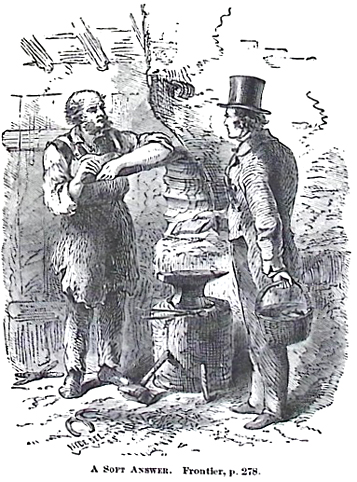
A SOFT ANSWER. Frontier.
He stood silent a moment. Then, softened, said,—
"I will buy one of them;" and taking up the first volume that came to hand,—a work on the Sabbath,—left a piece of silver in its place, and returned to his task.
"I heard that you called on Mr. D. at his shop," said the good minister to me, next day; "how did he receive you?"
I described the interview. By way of comment, he said,—
"Well, the book he purchased was just what he needed. I hope he will read it, but I fear he will not."
Three months after, as I was passing through the place, I called again on the clergyman.
"I have a desire to know," said I, "if you have seen any fruits of my labor in your parish?"
"Yes," he replied, with a pleased smile, "I have. My congregation has been larger since, than for years. And," he added, "do you remember Mr. D., the blacksmith, who treated you so outrageously, but relented, and bought a little treatise on the Sabbath? What was my astonishment, a few Sundays after, to see that man and all his family come into church! They have been regular attendants ever since."
Not long after I was permitted to hear that the blacksmith, reclaimed from his backslidings, had been restored to membership, and that a number of his children had professed Christ before the world.
THAT PROMISE.
AT a recent Sabbath school concert the superintendent said, "We have no speakers from abroad to announce this evening, and therefore we shall have to rely for remarks on our 'home' gifts. I see that brother S. is present. We would like to hear from him."
The person named, a young man, came immediately forward, and said, in substance,—
"Some years ago I made a promise. It was, that whenever I should be invited to speak a word for Christ, in public, I would make no excuses, but do the best I could. That promise I have ever regarded as sacred, because it is a promise, and because it was made to my nearest and best Friend. Once I was in fearful danger. He rescued me from that danger. Once I was wretched, without peace of mind, unhappy, degraded. He raised me up from my low estate, comforted and cheered me. Many times since then I have been in trouble and he has helped me. I have sometimes forgotten that Friend, often grieved him, said and done things that were displeasing to him, slighted and insulted him in ways that no other friend could overlook, and yet he has been constantly kind, forbearing, and generous. All I have that is worth any thing I owe to his love, and all I expect that is desirable and glorious he only can give me. Can you tell me, children, who that Friend is?"
"Jesus! Jesus!" responded a score of voices.
"Yes, dear scholars," he replied, "it was Jesus; and I can not break my promise to such a Friend. Therefore it is that, though called upon unexpectedly, I will try to interest you for a few moments." And as he proceeded with his remarks—apt, sprightly, impressive, it was plain that that Friend was true to his promise, and was furnishing him richly for that time of need.
And in thus redeeming our Christian pledge are we not always blest?
A Christian gentleman, whose "praise is in all the churches," not only for his large-hearted benevolence, but for his excellent gifts in prayer and exhortation, when a young convert, would be so embarrassed, when attempting to speak in conference meeting, as to be obliged to resume his seat almost without uttering a word. But he had resolved to persevere; he kept his resolution and excelled in these services.
A godly deacon, now seventy-five years of age, leads the devotions of the largest assemblies in and out of the denomination, and expounds Scripture with remarkable acceptance. Yet when a young man his speech was awkward and blundering, and his diffidence extreme. He was so illiterate also, that before reading a chapter in the Bible, in the presence of others, his wife had first to read it to him.
"I made a promise," said he, "when the Lord forgave my sins, that I would never refuse to speak for him, or to pray in public, when properly requested to do so, and I have kept my word."
Christian reader, have you made a similar promise? Have you kept it?
AFTER MANY DAYS.
DEACON N. held to both tables of the law, and when an object of charity presented itself, he was quite sure to "lend something" to the Lord. One evening a poorly-dressed sailor called at his door with a story of sorrow. He said he had been shipwrecked, and lost every thing but the scanty clothing he wore; was without money, food, or shelter. He was an entire stranger, and presented an appearance of extreme wretchedness; but the worthy deacon took him in, gave him a comfortable supper and bed, fitted him out with coat, pants, and vest, put some of the needful in his empty wallet, and then setting out with him in search of employment, secured a place for him on board a merchant-ship, and bade him good-by, amid a profusion of blessings and praises. It was a benevolent experiment, and many were the evil prophesyings of neighbors and friends concerning the issue of the case.
"I shall never forget your kindness," said the sailor, "and some day you shall hear from me again, and know that it has not been thrown away."
Years passed. The kind-hearted deacon failed in business, and removed to a distant town. But if worldly reverses had come, the richer blessings of the gospel were lavished with divine generosity on his household. One after another of his children was made the subject of renewing grace, till all were found walking in the commandments and ordinances of the Lord.
Two of his sons entered the ministry. In the providence of God one of them was called to spend a Sabbath in the city of B—. During the evening discourse his attention was attracted to a well-dressed, intelligent looking man, whose eyes were fixed on his with marked interest. After service the stranger said, "May I ask, sir, if your name is N.?"
On receiving an answer in the affirmative, he exclaimed, with deep emotion, "God bless you, sir! I know you from your resemblance to your father. You do not remember me, for you were a little boy when I came to his house, a cast-away sailor, ragged and hungry, without a cent in my pocket. He helped me when others looked at me with suspicion and turned me away unfed. I have never forgotten him, and never shall. Tell him I think of him often, and pray for him, too."
And as the grateful seaman departed, the generous bank-bill that remained in the preacher's hand attested the sincerity of his words.
MY COUSIN.
AMIABLE and engaging, she was the life of the circles in which she moved. In personal attractions few were her equals, and from her kind and genial presence depression and gloom fled like darkness before the footsteps of morning. Her opening years were full of gladness; who could foresee that her "days of darkness would be many?"
George Evans had won her affections, and well do I remember my desire, though then a mere lad, to know the successful competitor for her hand. I first saw him under circumstances which filled me with apprehension. It was the anniversary of our national independence. He was passing with a crowd when a companion pointed him out. I followed him in anxious curiosity; for it seemed to me that he who was to wed my cousin Carrie should be nearly perfect. Many times did I wish myself far away, as, fascinated by a horror-struck interest, I was jostled in that throng, to hear from his lips the language of profanity, and witness proofs of his intemperance. Was she to be the wife of such a man? Friends had warned him of his evil habits, but he was so manly in appearance, and in her presence so correct in language and deportment, her attendant at church, and manifesting there such a reverence for religion, that she entertained no misgivings.
They were married. A year elapsed, during which nothing served to mar the happiness of the young couple, and we had well nigh dismissed our fears, when, one autumn evening, in passing their residence I met them. They had just returned from a walk, and were parting at the door. "You will not stay late, will you, George?" Carrie was saying. I saw that she was pale. The husband gave an evasive reply, and left her. My direction lay with his, and as I followed on, the sorrowful pallor of her face haunted me. Conspicuous on a public corner was one of those gilded hells, which allure to destruction. Evans lingered a moment at the door, then passed hastily down the steps into the "saloon." The power of that infernal magic by which a man of reason is moved to prefer the orgies of such a mystery of iniquity, and the pestilential companionship of bloated, blasphemous wretches, to the society of the fair and pure being to whom he is united in holiest bonds, thank God, I know not; but this I know, that the stricken wife kept vigils of agony through that long night, and when the faithless husband returned, it was with unsteady step and brutal oaths. This was "but the beginning of sorrows." A friend thus gives a glimpse of her eventful history.
"You ask after Carrie Carleton. Poor woman, hers has been a sad lot. Her husband has dragged her down the steeps of misfortune, until worn and weary, Consumption has smitten her, and she weeps on the verge of the grave. Weeps, did I say? Yes, for him, but as for herself, she trusts all in the hands of her Saviour. What a miracle is love when hallowed and refined by piety! Of high family, and nurtured tenderly, yet allied by marriage to a sot and a tyrant, it is impossible to paint what she has so uncomplainingly endured. Some three years since a hollow cough, and frequent bleeding from the lungs admonished that her trials would be short. Physicians gave her up. But see how, at the mercy of circumstances, we are in this world. Evans, under the labors of the Washingtonians, reformed. For a time he seemed a man again, was frugal, industrious, and kind. But, insidiously tempted, he tasted again the enchanted cup, and sank lower than before. During his reformation Carrie became like one raised from the dead; her step regained its elasticity, and her laugh its gladness. She attributed this to a change of medicine, but when George again fell, she declined rapidly. His course in the downward road was fearfully accelerated. His business neglected, his credit gone, his days spent in the tippling-shop, and his nights in haunts of iniquity, on her devolved the sustenance of the family. This she worked hard to provide by taking boarders. But who would long remain to witness her sorrows, and to share her ill-treatment at the hands of her ill-clad, profane, and fault-finding companion? So, in a miserable chamber, Carrie toiled with her needle, solicitous for her husband when away, lest in the helplessness of inebriety, or in some drunken brawl, injury would come to him, or he commit some horrid crime."
It was affecting, amid all these hardships, to see how uncomplaining was the wife. When others censured his conduct she would make excuses for him, striving to make it appear that he was not so bad as they thought, or that his evil deeds were attributable to the influence of others.
Once only did she speak at all freely of her sufferings. It was when visiting at good deacon J.'s. After the family had retired, overburdened with anguish, she poured into the ears of the deacon and his sympathizing wife such a tale of neglect, anxiety, deprivation, and abuse, as well nigh broke their hearts.
"And why don't you leave such a monster forever?" said Mrs. J., her eyes streaming with tears.
"Oh!" she mournfully returned, "you can not tell what you would do as a drunkard's wife." Then added, rising and wringing her hands, "I love George, with all his faults! There's no living with him, and there's no living without him!"
Some time after, when visiting in a sea-board city, incidentally I learned that Mrs. Evans resided there. I found her in an obscure tenement. She welcomed me with a placid smile,—but how changed! so thin and wasted,—while on her cheeks bloomed the fatal crimson. The bare floor and meager furniture bespoke her destitution. In full prospect of death she conversed calmly of her tribulations, anticipating with hope the coming of the last messenger. More than a year previous, her husband deserted her on the pretense of going South for business. No tidings had she heard of him, though she diligently searched the papers and inquired at the post-office; faithful to him, though worse than widowed.
"And how have your little family managed to get along during this hard winter?"
"I have endeavored not to afflict others with our troubles," she replied, "but God has raised us up benefactors. And in the way in which this has been done I have realized how he would learn us, to the last, lessons of charity toward all. I have long been prejudiced against the Friends; but one stormy day, when the streets were blocked with snow, and we were very destitute, one of their number called. I was a little startled when he entered, but beneath his broad-brimmed hat was a face so benign, that I quickly forgot he was a stranger, and before I was aware he knew something of our necessities. Why, he seemed like my buried father! 'Thee mustn't suffer,' said he; and since, in our moments of extremity, when others would not venture to come, through the fiercest storms and the bitterest cold, and just when I had been praying with the most urgent sense of need, he, or his lovely wife, would be sure to happen in with a load of blessings. Now they are to me as angels of mercy, and even their peculiar garb seems beautiful, and their thee and thou are like music to my heart. Thus does our Father teach us to love all his children ere we meet them in his house above. And thus does he cause strangers to be as parents, when the nearest and dearest forsake us."
When the balmy south wind unlocked the frozen earth, and hailed by blithe songsters, the dead plant awoke to beauty and fragrance, Carrie Carleton found the repose of the grave.
"Asleep in Jesus! blessed sleep! From which none ever wake to weep."
Though slain by the treachery of man, through the "Faithful and True," she conquered death, and welcomed the tomb with a smile of joy.
My murdered cousin! I think of thee in the night watches, and weep at the remembrance of thy wrongs. But, alas! thou art not the only victim of the remorseless rum traffic. From many households has it borne away the fair, the good, and all the heart holds precious. Alas, its premature graves disfigure every hill-side and every plain.
When shall this great evil cease? Christians, philanthropists, law-makers, when?
INCIDENT IN A DEPOT.
I WAS pacing the floor, impatiently waiting the arrival of the steamer. The other passengers had come in, till the seats in the "gentlemen's room" were quite filled, when the door again opened and a woman entered. She held in her hands some boxes of blacking, and approaching me, as the person nearest the door, offered them for sale. I had scarcely declined purchasing, when, noticing the woman more closely, regretted not having favored her. Her face was pale, sad, and careworn. Her dross was neat, yet cheap and scant, and her manner timid in the extreme. It was plain that my refusal had well nigh frightened away her small stock of courage, for she stood irresolute a moment, as if fearing a similar repulse from others to whom she might apply; then, summoning resolution, she passed to the man at my right, and asked, faintly, "Will you buy some blacking, sir?"
He also shook his head. She paused once more with a pained look, then mutely tendered the boxes to each person in the room, going unsuccessfully round the entire circle. The last one accosted was a young sailor, in tarpaulin and blue jacket. He sat leaning over a paper, reading, when she found voice to say, despondently, "Won't you take a box?"
By this time the attention of all the persons present was fixed on her with deepening interest. The downcast eyes; the alternate pallor and crimson of cheek, and neck, and brow; the slow, hesitating step, now advancing, now stopping, as if powerless to proceed; utterance overcome by emotion,—impressed us that some great trouble or an inexorable emergency had brought her thus before us.
"I don't want your blacking," said the seaman, heartily; "and if I did, 'twould be of no use to me, for I am more than two hundred miles from home; but if you want money," drawing forth a handful of loose change, "you can have it!" At the first movement of his hand pocketward, before his words had interpreted the action, most of the men present, with evident feeling, were doing the same, and, pouring their united contributions into the apron of the astonished woman, she retired, overpowered with gratitude and joy.
As I stepped aboard the boat I thought, how eloquent is silence! No tale of sorrow did this woman present to excite pity. Her mute appeal was understood. And is not many a good cause injured, rather than helped, by the wordiness of its advocates? Are we not often conscious of internal revolt, as we listen to verbose appeals to our sympathies, whether on behalf of private or public charities? We get accustomed to declamation, to argument, and to peroration, but who can resist sincerity, modesty, sensibility,—the condensed, broken, or speechless plea of a full heart?
And then, too, the power of example,—of frank, disinterested, beneficent action,—do we ponder this as we ought? The generous sailor, in his homely sea-garb, led nearly a score of men that day in the work of mercy, and the lowliest and poorest are never so low and poor as to be without the opportunity and means of influencing others by efficiency in well-doing.
MY STEP-MOTHER.
I WAS six years of age when she came to fill the terrible void caused by the death of my mother. I can well remember how we children drew back from the stranger who had come to take her place. There were seven of us; each an idolater at the shrine of our dear mother's memory. The oldest, who possessed a quick, bright intellect, and was somewhat willful withal, quite resented the idea of a second mother. Her strong hostility was contagious, for she was at the head of domestic affairs. Then some sympathizing neighbor would place her hand on my head and say, compassionately, "Poor boy! You'll have a hard time trying to make a mother out of a mother-in-law. She'll never feel toward you as if you were her own child."
Well, one day I was measured for a new suit of clothes. Other articles of toilet to correspond came ere long. Indeed, there seemed to be a general refurnishing throughout house and household. What it all meant I could not conjecture, and no one told me. Then one afternoon there came a universal scrubbing of the faces and hands of the children, and we were all dressed in our best clothes. There was something unusual about to take place. What could it be? Not a meeting, for no such preparation, that is, in kind and spirit, ever preceded those staid religious gatherings often witnessed in our large, old-fashioned parlor. Still, a hush and a gravity pervaded the busy household, imparting a sort of half-and-half aspect, somewhat festive and somewhat solemn. At length the important secret was condescendingly communicated to me.
"Now," said my eldest sister, as she combed my hair back "a la Maffitt," (for like other sentimentally inclined young ladies of the town, she had been captivated with the Irish preacher's eloquence), "do you behave like a little man this evening, for father's going to be married, and we are all to be at the wedding!"
"Wedding! What do they do there?"
"Why, you little dunce, there'll be a whole parlor full of folks, and the minister will be there and make a speech and pray, and marry father and his bride, and then cake and wine will be passed around to all the company. You'll get a large slice of the best cake you ever ate, and a sip of the wine, and then—why, then you see, you'll have a step-mother to train you up in the way you should go. How will you like that?"
Bolt upright, in an exceedingly uncomfortable position, on a stiff, hard chair, scarcely daring to wink, I sat on that eventful night. Several relatives of the bride spoke kindly to me, without, in the least, relaxing my mental and muscular rigidity, till one of them, since known as the most lovable of aunts, brought me a piece of handsomely frosted cake, and a glass of wine, both of which I supposed were mysterious parts of the mysterious marriage rite. Though how eating and drinking helped to give me a new mother I did not comprehend.
"Take it all, dear!" said she, sinking down before me on the carpet, as I diffidently broke off a crumb of the cake. "It's yours, and you have just as good a right to it as any body, if you 'are' a little boy."
I obeyed, thinking it a part of the ceremony, gazing the while into her black eyes, that were soft, and limpid, and loving.
Our new mother went home with us that night, for the marriage was at "Aunt Abby's." What a prim set we were indeed! What a constraint was on us, knowing a mother-in-law was installed in the home, to reign over us, her unwilling subjects. Very undemocratic it seemed, certainly, for we hadn't cast a vote nor been consulted even! However, the general awkwardness was relieved by her leaving home on a bridal visit. She was to be gone a fortnight. How glad we were!
How we dreaded her return, gossiping about it, hoping it might be protracted. But she came promptly back to her post, and, spite of my suspicions, I couldn't help a warm glow as she kissed us each, and, unpacking her trunk, gave the presents she had brought us. Her cordial, motherly greeting was a shock to our prejudices, from which they did not at once recover. But objections to the step-mother of a more personal nature were soon discussed.
"To think that your father should marry a 'country' woman, farm-born and bred," said one. "She can not have seen any thing of society, and must be coarse and low. And your first mother was a perfect lady!"
"New brooms sweep clean," suggested another, "but look out for black eyes; they are always deceitful!"
Poor, dear woman! little did she know what a burden she was assuming in becoming the wife of a widower with seven children, who had been taught to distrust her noblest actions, and set her authority at defiance. But meagerly could she forecast the toil and anxiety, the heart-griefs and perplexities that were to wait on her footsteps daily; the gloomy hours of sickness and of death; the battlings with pecuniary reverses; the clothing, and feeding, and nurturing of those henceforward to call her mother. But, having put her hand to the plow, she did not turn back from the heavy responsibilities of her lot. With a heroic endurance, a sublime self-forgetfulness, that, a thousand times since assuming manhood's cares have filled me with wonder as I have retraced her history, did she press forward, conquering difficulties, winning triumphs, until, without a peer, she sat enthroned in our love in her beautiful, I had almost said angelic goodness, and costly devotion.
Ah! what would have become of us without "her?" What a marvel of a worker she was! Early and late at her tasks, never lagging, turning off labor with a despatch that few might hope to rival. The sweet breath of the country, its good, honest fare, its healthful scenes,—what would she have done as "our" mother without the firm-toned constitution they had molded. And in her little tripping way, as she almost flew about house, how graceful!
Rarely did she administer chastisement, however richly deserved, for she well know that officious critics would intermeddle. She referred our misdemeanors to father. Though even then, there were those who intimated before us that she loved to find fault with her step-children.
One day an incident laid bare her heart in some measure to my eyes.
I had been perverse, disrespectful, disobedient. As a punishment, she sent me to bed supperless. I knew the punishment was deserved, but went to my room muttering complaints. At length I fell asleep. How long I remained thus I do not know, but suddenly waking I saw her kneeling at the bedside, her face pale, and her eyes mournfully fixed upon me.
"Oh," said she, gently, "I am so glad you awoke. You lay so still I was almost afraid you were not alive; I was listening to hear if you breathed. Are you well, dear? I came in to see you. I know it's hard for you to go without your supper; it was hard for me to punish you, but I 'do' want you to be a good boy, that you may grow up a good and useful man!" Then, after a moment's pause, in eager tones, she continued, "Do you really think, dear child, that I love to find fault with you? or that I wronged you to-night in what I said or did?"
Thus did she yearn after me with a mother's solicitude, and humble herself to plead with me after my wanton disobedience. My heart melted, and I said, "I have been a naughty, selfish boy, and you have been too kind to me. I deserved to be punished. I want you to forgive and love me."
How tenderly she imprinted a kiss upon my forehead, and fervently imploring God's blessing, glided from the room.
Hers was a rugged path for the most part, such as one sees running up a mountain side, over roots, and stones, and brambles. From what secret spring did she derive her more than human strength? Where obtain the patience and fortitude that glorified her daily character? Ah! is there more than one fountain-head? Rising before day, while yet the occupants of the house were wrapped in sleep, she would retire to a little room and pour out her soul in fervent prayer. Sometimes the still air of the morning twilight has seemed to my quickened sensibilities to be pervaded and throbbing, as if her very soul, in its fervent pleadings, filled the space around me. Strangely thrilled, I have listened, wondering at the feeling that oppressed me; awe, sadness, self-dissatisfaction, desires for a better life crowding upon the mind, as the plaintive, tremulous voice could just be heard. When she had left communing with her divine Friend, and we met her at the morning meal, no one would fail to be struck with her aspect; serious, serene, trustful—peace, Christ's peace, impressed upon her brow. You would take knowledge of her that she had been with Jesus.
"Ah!" said one, "when she has children of her own then you'll see a difference!"
Well, Lizzie, with her dark, reflective eyes, came. Afterwards plump little Sarah, with her hazel orbs. And was it not a miracle that half-sisters and brothers grew so into unity as to need to be reminded that the full relation was not theirs!
How often I have collected my scattered faculties, as if to master a new thought, when a visitor remarked, "These are your step-sisters, I suppose?"
"Step-sisters!" I would reply. "Oh, yes, I had forgotten it!" quickly to forget it again.
And what a love was hers! What delicate, far-reaching sympathies! what boundless charity! what intuitive perception of other's rights, and ready, persuasive championship of the unappreciated and the wronged. What genial, winning ways towards the young; how self-denyingly benevolent. And as age enfeebled her step and silvered her head, growing younger and younger in her tastes, responding to the innocent jest, delighting in innocent enjoyments, charming every one with her kind words and kind deeds.
"Grandmother is coming!" Henry, the youngest, would exclaim, as he rushed into the house to be first with the good news.
Sure enough. Feebly tripping along, with a mysterious package, too heavy for her strength, under her arm, she would approach, panting with exertion, her face radiant with affection.
"O mother!" we would say, "you have taken too much pains to see us—the walk is too much for you!"
"Don't say a word!" she would answer, deprecatingly; "I couldn't stay away any longer. I must know how you all do. And here," undoing her bundle, "are some little things I have brought for the children."
Her energetic heart grew in wealth of love marvelously, and her sympathies embraced the world. But specially among her kindred did their quick and active power appear. It was strange to us how soon she became aware of it, if any trouble invaded our ranks.
One night, sudden, evil news, of which none knew but ourselves, kept our little circle sleepless. We lived remote from the maternal roof. Next morning, calling there, mother took me aside and said, "Tell me, my son, if you were unhappy last night. I must know, for I could not sleep—you were on my mind so. It seemed to me that you were in trouble!"
But she's gone. Three weeks ago to-day, over the wires flew the message: "Mother is very sick, and can live only a few hours?"
Then immediately following came the crushing announcement of her death.
But she passed away as she had lived. In usual health she stood by her chair, about to take her seat at the dinner-table, uttering one of her pleasant remarks, when the wing of the death angel touched her; she fell, speechless, unconscious, and never revived. It was as if the loving Saviour designed her last words should be like her, should represent her, and from the family board her spirit went up to the kindred hearts around the feast-table of heaven.
Dear, noble, sainted mother! how can we bear to see thee no more and hear no more thy words of love! But thou art safe, happy, robed in glory.