ON THE FRONTIER, (continued 2)
Reading edition
"Sir!" he answered, with emphasis, "it's my business to FIND OUT WHO TO TRUST. Let infidels say what they will, the stoutest of them, if they had been in my place, would gladly have found refuge with a religious man."
Late in the forenoon, hearing loud voices in the bar-room, I glanced in. The altercation was between the landlord and the man with whom I had walked the morning previous.
"I will not pay so much. Give me back that dollar. It's every cent I've got. I was sick at St. Paul, and have spent every cent I had. I can't get work. I'm so weak nobody will hire me. Give me back the money, I say."
"I'll show you what I'll give you!" said the landlord, with a dreadful oath, "if you are not off mighty quick."
"But," said the other, in pleading tones, "I'm sick, I'm poor, I'm hungry—'hungry as a dog!' Have I eaten a crumb at your table? I've slept in your bed only one night,—last night I lay on the floor here, that you know. And what am I to do if you take the last penny from me?"
The scene moved me deeply. It confirmed me in the opinion I had formed, that the stranger was in some extremity Of trouble, and was not yet a villain. So stepped into the bar-room. On seeing me, the landlord threw a quarter on the counter, and said,—
"There, take that, then, and be off!" The man took the silver, went out, and sat down on the tavern steps. An hour later, and he came to me, and said,—
"I am going to D— now. Won't you go with me? I was going yesterday, but have waited for you."
Avoiding a direct reply, I started with him, and when the confines of the settlement were reached, while yet in sight of inhabitants, I turned, saying,—
"I must leave you now."
"What!" he exclaimed, fiercely; "you going back?"
"Certainly. Why should I go all the way to D— afoot? Besides, I fear the fatigue of such a walk would be a poor preparation for preaching next Sabbath."
His whole demeanor changed.
"Are you a preacher, then?" he ejaculated. "I thought you were a speculator!" and sinking down by the roadside, he looked the picture of wretchedness.
"Friend," said I, "you seem to be in trouble; can I help you?"
"Trouble!" he replied, bitterly, "it's all trouble."
I soon drew from him his story.
"I lived," said he, "in Western New York, and only two years ago thought myself perfectly happy. I had married to my mind. My wife loved me enough to connect herself with me against her parents' wishes—I being a mechanic, dependent on my own labor. They never were cordial to me, but kept themselves aloof, as if of another race. But she was always gentle, affectionate, and true. Ah, sir, she was indeed too good for me—too good for earth.
"My boyhood and youth had been industriously employed, and I had used such means of mental improvement as were within my reach; but religion had always seemed a thing of gloom suited to the aged, or the last moments of life, but having no special claim on my attention. Never shall I forget the first evening after our marriage. Clara placed the Bible on the table, and said,—
"'Will you not read a chapter, dearest, and by prayer, seek God's blessing on our new life?' I know not how to pray, but she did, and kneeling down, with sobs and tears, she besought God, oh, how fervently, to be with us in our journey together, and to enable us to live as he had commanded. She never faltered in her Christian course, never turned back, and was always happy. I looked upon her at times with feelings akin to awe. She influenced me more than any other being did before, and under that influence I was led to make a profession of religion, for I was powerless to resist her gentle persuasions. Still, I do not now think I ought to have taken that step; it was under the compulsion of a human love amounting almost to idolatry. Often I contrasted my hardened worldly nature with hers, and it seemed as if it could not be right that such a being should be united to one so unworthy of her.
"'Are you not an angel in disguise, come to save me from myself and from sin?' I asked one day; and I was sincere in the question, extravagant as it may sound to others. And when, after the labors of the day, as I approached our little cottage I saw her dressed in white, flitting among the flowers in the garden, or coming to meet me with a beautiful smile, the fancy would possess me that some visitant from a brighter world had taken compassion on my weaknesses, and in human form was seeking to lead me to the paths of peace and blessedness.
"After I had joined the church, she always encouraged me to keep up household worship. Were it not for her watchfulness and loving tact, however, often would the service have been omitted. Indeed, sir, it was her faith that I expressed, her desires that were breathed from my lips, I fear, for my heart was often cold and unbelieving, and my feet constantly inclined to stray."
"Did you have no enjoyment, no peace of mind, no real resolution to serve God in all this?" I asked.
"Sometimes it seemed to me that I did. But my life since shows that I was deceived. I loved her better than my heavenly Father, else why have I been tempest-tossed, at the mercy of circumstances, restless, complaining, wicked. Oh, if I had not lost her, I never should have fallen so low!" he exclaimed passionately.
"Then your wife was taken from you?"
"Yes; in a little more than a year she died, and an infant daughter was laid with her in the grave. Oh, the agony of those few last days of her life. I called in the best physicians of the region; they could neither save her, nor relieve her sufferings, while my heart was breaking with fear of the result, and anguish at her sufferings. But she,—why, sir, not a murmur escaped her lips; her peace grew wondrously, like the dawning of heaven, and while her body was racked with pain, her face shone like Stephen's before his murderers. Before her departure she was ever praying for me or praising God, for her soul was filled with heaven. Her last words were, as she pointed upward, 'We shall meet there, George.'
"When she died it was just before daylight one wild tempestuous night. I rushed frantically forth through the streets of the village into the woods beyond, and fell helplessly on the ground, overcome with the terrible emotions of rage, and grief, and wretchedness. I felt that life had now no charms for me, and that God was a hard being, a tyrant, who had remorselessly robbed me of all I loved. Unable to apply myself to work, what little I had got together for her sake was soon gone. At length I came West, hoping that new scenes might help me to forget the old. The change was favorable for a time. I found work, but fell sick. The few acquaintances I had were gone when I got about. I was in debt for board, medical attendance, and other necessary expenses, and have since been unsuccessfully wandering around seeking employment."
Briefly, misfortune had brought him to despair, and well nigh unsettled reason. Hard-hearted treatment had filled him with hatred to his kind. He had even been tempted to self-destruction, and later to commit robbery. His brain, as he expressed it, was "all in a whirl, and his heart hard as stone."
"Ah," said I, "you have been all wrong in your feelings—you have neglected one thing most needful for you in your circumstances."
"What is that?" he asked.
"It is that which your sainted wife found help in,—'prayer.' I also have seen sorrow, and have found it an unfailing refuge."
"Oh," said he, vehemently, "that I could pray!"
Commending to him the case of the publican and the thief on the cross, I added, "One anciently said, 'I am poor and needy, yet "the Lord" thinketh upon me!' If you seek him, he will be found of you, he will sustain you. And he will hear your cries, and open before you, I doubt not, a door of deliverance as it regards your temporal necessities. Will you not thus go to him and trust him?"
Then advising him to keep away from the miasma of the Mississippi and from the large towns, and seek a shelter till he was well among the kind-hearted prairie farmers, and placing in his hand something to help him on his way, we parted.
——————
"That's a dangerous operation," said one, passing, as some months after the incidents just narrated I chanced at a village fifty miles inland, and stood watching a group of men engaged in raising a "liberty pole." It was of great height, and no little enthusiasm attended its erection, for the place had just been made the county-seat, after a spirited contest with rival aspirants for the honor. Being a stranger I could share little in the general joy, but was more concerned for the lives of those who pulled at the ropes by which the huge piece of timber was being elevated, than for the future of the town. Awkwardly enough, it seemed to me, was the raising managed by the gray-haired leader of the enterprise, and as the pole swayed now this way, now that, I shuddered. But a sudden "hurrah" told that the feat was accomplished and I was turning away relieved, when a man touched me, and said,—
"Excuse me, sir, but I believe we have met before."
It was my stranger acquaintance of the Landing. I had observed him, as among the most active in the raising; but in his new garb and new bearing did not recognize him. I had no time to reply to his greeting, ere he grasped my hand and said, tearfully,—
"I took your advice and have been prospered—been blessed;" and, pointing to a building just in sight, "there's my shop—I am a saved man!"
And, as we parted again, he said, "What a gulf I hung over when you rescued me! All the demons of the pit were dragging me to ruin! Thank God I was kept from crime but how narrow the escape! and," he added, "I now think that my dear wife's prayers and labors for me have been blessed. I have a hope, for God did not wholly leave me. He saved me from the snare of the fowler, and set my feet in a large place. The furnace of affliction was seven times heated, but I am not consumed, and by and by I expect to meet her whom I love, and be with her forever, in the presence of the dear Saviour, who loved us and gave himself for us."
A coincidence connected with the facts just related is worthy of record. Our ride to the place was enlivened by a discussion between several of the passengers on the subject of benevolence. Some took the ground that it was the duty of every man to look out for number one.
"But," said another, "we are constituted mutually dependent; our Creator has made us stewards of each other's happiness, and when we assist an unfortunate neighbor we not only discharge a sacred obligation, but always receive in return a generous equivalent."
"In what way?" inquired his opponent.
"Oh, if in no other, in the satisfaction that flows from the performance of a deed of kindness."
"Not quite substantial enough for my use," returned the other. "When I invest money, I want money, or something equally tangible, in return. A consciousness of befriending somebody won't put meat into the kettle nor flour into the barrel."
"But what, after all," it was further urged, "is the motive of our money seeking? Is it not that we fancy that earthly possessions will make us happy? Certainly. But the experience of mankind shows that the soul can not be satisfied with perishable things. The millionnaire may be more wretched than the holiest beggar by the wayside. The pleasure of doing good is, however, pure, ennobling, satisfying; a source of perennial enjoyment, purchased at a cost infinitely below its real value. Besides, our benefactions, bestowed without the expectation of any reward save that found in the pleasant thoughts and emotions which result, often come back to repay us in kind."
"Well, well," said the first, impatiently. "I prefer to invest where there is something positive to be realized. These uncertainties may do for those of a less practical turn of mind. I am a business man, and as such I want some security when my dollars are invested."
"Very well; the apostle says, 'He that giveth to the poor, lendeth to the Lord, and that which he hath given shall he pay to him again.'"
"I suppose," said the business man, "that you practise as you preach."
"Sometimes."
"Very well. When the funds you have disposed of in this way pay a dividend, let us know—that is all!" Our journey just then terminating, and not having proof at hand, the laugh rang against me.
On our return, after meeting the man of the Landing reminiscence, I said,—
"Gentlemen, you may remember our conversation on the subject of benevolence, and that I was requested when any money devoted to charitable purposes pays tangibly, to report. I have such a report to make at this time,"—proceeding to repeat the story of my two interviews with the stranger, then showed the bank-bill that my grateful beneficiary forced into my hand. There was not a dry eye present.
"Well," said my mercantile friend, warmly, "you've got the case, and I frankly own that I envy you your happiness."
A FRONTIER TRAGEDY.
"MR. PETERSON, the Norwegian, wishes to see you," said the lady with whom I was boarding. "Something dreadful has happened, I know," she added, earnestly, "he looks so pale."
Going to the door, I was struck with the appearance of the caller. His cheeks blanched to a deathly hue, his eyes glancing apprehensively about, as he said, in a low voice,—
"You know Callahan, the one-armed Englishman, living near me?"
"Yes."
"He has disappeared; has been murdered, I fear."
"When did you first miss him?" I asked.
"Three days ago," he replied. "He lived alone in the cabin he was building on his claim—which joins mine. Being a single man, my wife had done his baking, for which he always came regularly. She had his bread ready for him last Wednesday, but he didn't come for it. Supposing some unusual business had detained him, she gave herself no uneasiness. But Thursday and Friday passed without bringing him, so she mentioned the circumstance to me. To-day I went over to see what the matter might be, but he was not there. Near his shanty, however, was a great deal of blood, and his hat and coat lying by."
"Did you make inquiries concerning him of the neighbors?"
"I did not dare to, but came away as quickly as possible. I knew he had had trouble with old Ringe. Only last week, he said he was afraid the old man would put him out of the way, and I advised him not to stay alone on his claim. I have no doubt his fears have been realized, poor fellow! I scarcely dared leave home to tell you about it, for if old Ringe, or any of his tribe, suspected my errand, they would serve me in the same manner. Hadn't something ought to be done?"
"Yes. We must call the neighbors together, and search for the missing man."
"When shall we do so?" he asked. "It is now nightfall, and to-morrow will be the Sabbath. Would it be right to attend to it then?"
"Certainly. Human life is sacred. And here, on the frontier, it is necessary to take prompt measures in such a case, or no person will be safe. We do not yet know that the Englishman is dead. Perhaps he is lingering in agony in some place to which, after being assaulted, he was borne for concealment. At any rate, this is, emphatically, 'a work of necessity' and 'mercy,' and steps must be taken at once to ascertain the facts, and if your suspicions are confirmed, secure the person or persons guilty of the deed."
Messengers were accordingly sent in different directions, inviting the settlers to start the next morning at nine o'clock for the scene of the tragedy, seven miles distant.
Some six months before the event I am relating, an aged clergyman who had immigrated to the vicinity, was obliged to go from home to buy hay. He invited me to accompany him. Crossing the open prairie, six miles, we came to a heavy growth of timber belting a sluggish creek. On the verge of the woods stood an unfinished cabin, before which were immense stacks of hay. The owner was a man of small stature, with curly black hair. As he mounted a stack, the winds that careered across the prairie blew off his hat, revealing a good brow and face. He had only one arm, with which he worked with a will, cutting off the hay and weighing it. His crippled condition excited our sympathy, and we helped him at his task, for which he thanked us with a manly gratitude. How strange to see him in the van of civilization, striving to do that with one hand for which many men found two insufficient. Yet he had made, and drawn, and put up that hay for sale (certainly no light proof of his energy and foresight), and for miles around his more able-bodied neighbors were coming daily to him to purchase. Besides this, he had quite a pile of rails split, ready for fencing.
Falling into conversation with him, I learned that he was of Irish parentage, though born in England, and a Roman Catholic. He was candid and thoughtful, and on my friend mentioning that I was to preach at R— River, next Lord's day, he promised to attend. He kept his word, showing much sensibility during service. At subsequent interviews, he expressed desire for religious instruction, and concern for himself as a sinner against God. His ingenuousness and deep feeling led me to hope for a happy result in store for him, and his lonely, disabled state—surrounded by strangers—heightened my desire for his temporal and spiritual prosperity.
As on our first meeting, we stood talking together, an old man, withered yet sinewy and lithe, came and leaned against the rail enclosure that fenced in the hay. His complexion denoted a mingling of races. His wrinkled face wore that sinister impress that, when once seen, is not forgotten; hard, savage, insinuating, a mingling of the wild beast and serpent. I had not heard of him before; knew nothing of his antecedents, but shrunk from him instinctively, as, fixing his leering eye on me, he said, with an odious smile, that displayed in his almost toothless gums an upper and a lower fang on each side of a wolfish mouth,—
"Perhaps the gentleman is land-hunting. I've got a handsome piece of property up here," pointing to a cabin just in sight; "prairie and timber, that I will sell dog cheap."
Replying that I did not wish to buy, as our team started, I said to my companion, with the "invincible assurance of a sudden presentiment," "that man can commit murder. How does that one-armed man dare to live by him?" Those two were "old Ringe" and Callahan.
The following Sabbath saw no small stir in our usually peaceful community. From various quarters men poured forth, afoot and in teams, many heavily armed, for old Ringe was the patriarch of a numerous and motley company, in which French, English, African, and Indian blood intermingled, producing, with their besotted habits, a degraded and desperate band. It was a balmy May morning. The air was fragrant with the scent of fresh grasses and spring blossoms, while the bluebird and the robin made joyous music. Could it be that amid such sights and sounds we were on our way to a scene of blood? On that holy, heaven-blessed morning, too?
"There's the cabin," said a voice at my side, arousing me from the revery into which I had fallen. The same dreamy quiet rested on it, as on the entire landscape. Not a person was to be seen as we drew near, and the birds sang as blithely from the covert of the woods, as out among the flowering hedges and shrubs of the green spreading prairie, away from "habitations of cruelty." On the side of the dwelling at which we stopped there was nothing to denote violence, but passing around it, a sight met the eye that sent a shudder through every spectator. In the hay that littered the ground was a deep sanguinary pool. Beneath the gory mass, the blood was still limpid; the quantity leaving no doubt on our minds as to the fatal character of the deed. A hoe leaned against the building, a pipe, with some partially burnt matches, near it; the dead man's cap and vest were not far off, while scattered around were bits of clotted paper that had been written over. These last I carefully gathered, placing them in a rifled pocket-book I had picked up. From the blood spot to the fence the grass was bent, and the soil disturbed as if the body had been dragged that way. On the rails were crimson stains, while over them, the trail could be traced towards the creek, which ran between us and a tangled grove.
Old Ringe's window, forty rods north, overlooked our group, but not an inmate came to ascertain the cause of the gathering. It was proposed that I should take some of our number with me, and make inquiries there, while the rest hunted after the remains of Callahan. Two good men volunteering, we started on our mission. At the window, as we drew near, was the old man's son-in-law, Shuber, making ready to shave; at his elbow a mulatto woman watching us. Two barking curs disputed the passage as we approached the open door, at which Ringe's wife, also a mulatto, stout and ill-favored, her heavy features badly pitted by the smallpox, came to the door, and called out with a hoarse, savage voice, "Be still, I tell yer!"
The dogs slunk away, while without another word the woman turned her back on us and reentered. Heavy boxes were pulled roughly across the floor to serve instead of chairs for us, as we followed her in. One object, however, fixed our attention. Opposite the entrance, on a narrow bed, his legs pendent from its side, his back against the wall, sat the suspected murderer, as if fast asleep. His lower jaw had dropped down, his hands hung listlessly; no attempt at life-expression on his face to conceal its deformity. His aspect was haggard and revolting in the extreme. Purposely raising my voice to a high key, I said to the son-in-law,—
"Callahan is missing; we wish to know if you can tell us where he is?"
Continuing to strop his razor, he replied, jerking out his words, "Don't know where he is, if he isn't to home! Lives in the shanty down there. I ain't the feller's gardeen. Comes and goes jest when he's a mind ter; perhaps he's gone off a while. He'll turn up safe and sound, I warrant yer."
"When did you see him last, Mr. Shuber?"
"O, as to that, I haven't seen nothing of him since Wednesday morning."
"But haven't you thought it strange that he should be away so long?"
"Don't give ourselves, up here, any trouble about the 'little Irishman,'" the last two words pronounced with a hard sneer. "He takes care of himself, and we take care of ourselves."
"Well," said I, loudly, "perhaps your father can tell us something about him. Won't you ask him?" at which a slight flush tinged the cheeks of the sleeper, then quickly disappeared, while the son-in-law, continuing to ply the razor, replied curtly,—
"He's asleep."
Questioning other members of the household, who returned confused and contradictory answers, I again said to Shuber, "Perhaps Mr. Ringe can give us some information about Callahan."
"Father's asleep," interposed Shuber's wife, "and we don't like to wake him up."
The old man's wife had been uneasily moving about, now going out of the house, now returning, avoiding conversation. Turning suddenly to her, I said, authoritatively, "We wish to ask your husband a question. You must at once wake him up."
Stepping to the bed, she placed her hand lightly on his knee, and ere she had uttered a word, he opened his eyes, stretched up his arms and yawned, saying, confusedly,—"What—what—what do you want?"
"These gentlemen have called to ask about Callahan," said the wife, quickly. "They say he's gone off, or something."
"What, the little Irishman—as I call him? Some folks call him an Englishman, but I say he's an Irishman. O, he's all right. He's often taking a notion to go nobody knows where, and to come back nobody knows when. Can't put no dependence on him. But we never give ourselves any trouble about it; we're used to his tricks. Why, I don't suppose he knows any more about us, or we about him, than if he lived 'tother side of the ocean. We don't hold to meddling with other folks' business. He'll turn up again, I'll warrant. Why, you 'couldn't kill' the little feller if you should try."
"How long has he been away this time?"
"Can't say as to that. The last time we saw him was Tuesday afternoon. He was hoeing his potatoes there—right over there," pointing through the window; "and I said to the folks, guess the little Irishman means to get ahead of us. Soon after I saw him go toward his shanty, to rest, I suppose. You see he's got only one hand, and gets tired pretty easy, and then goes down by the cabin, and stands there and takes a smoke till he feels better. Well, as I was saying, he went down there, and pretty soon I heard a gun go off down that way, and Shuber says to me, 'What does that mean?' and says I, 'O, it's nothing but a wagon jouncing over a root or a stone in the road.' After that he was gone from the shanty, and I spoke to Shuber about it."
"When did you find out that he was gone?"
"Thursday morning. You see Shuber and I were at hunting deer along the creek, and we had to go right close to his house, for the creek is close by, you know. And says I, 'Wonder if the little Irishman's up yet? Let's give him a call, and see!' So I called out 'Callahan, Callahan!' but he didn't answer. And we both hollered, but all was still as death. And, says I, 'The little feller sleeps sound this morning.'"
"Did you go back that way?"
"Yes, but 'twas on 'tother side of the house. And we called to him again, but he didn't say a word, nor show his head."
"When you went after deer, the path led you within a few feet of his dwelling and the fence. Did you see any thing unusual there? any blood on the rails, or on the ground, or any article of clothing?"
"No; it was so dark you couldn't see your hand before your face. Saw his vest, though, kicking about, that's all; but he's a mighty careless feller about leaving his things round."
"Well," said I, "you are a neighbor to him, and acquainted with these woods; we suspect something very serious has befallen him, and we want you and Shuber to go and help find out about it."
They consented; but as they walked, grew excited, and talked fast; and although no charges had been made against them, protested that "they" didn't murder "the little Irishman," that they knew nothing about the matter, that they believed he would turn up alive and well;—ending by stating that he was killed; that they knew who the murderer was; that it was a young German living in the vicinity, and that they could prove it.
"We think the body is in the creek," said a man in a low tone. "The trail ends there—we could follow it no further."
Stepping to where some willows had been felled into the stream, I was searching among them, when I caught sight of a pair of boots floating among the branches. They were fastened together with a rope. Taking hold of this to draw them out, to my surprise I found that they were on the remains of the Englishman. He was naked to the waist; his only hand was lashed to his feet; and as I deposited him on the bank, the blood still stood in what seemed to be deep gashes in the back. I had just stooped down to ascertain the character of the wounds, when, to our horror, old Ringe, officiously gathering a handful of dry leaves and grass, with a grim smile wiped away the blood, saying,—
"That's only where the blood has settled like."
He knew. The marks were indentations caused by the twigs on which the body had rested. Death was inflicted by a heavy charge of slugs shot into the back under the right shoulder.
Old Ringe sat over the ghastly form of Callahan like an ogre, gesticulating with the hand that held the clotted leaves, by turns asserting his innocence, and railing at the unconscious dead.
"'I've' nothing against the little Irishman. We had a little difference, it is true, but I jest taught him his manners, and he's been good enough since then. We haven't had a word together since last spring, when I slapped him, and he's been as quiet as a pig ever since."
His manner and language were horrible.
While waiting for the coroner, some of us went to a spring, a few rods distant, to allay our thirst. Old Ringe and his son-in-law followed, incessantly talking. He reiterated that he was guiltless, and implicated the young German. At length I abruptly said,—
"Mr. Ringe, it is an old proverb that 'murder will out.' I have much faith in that saying, and for this reason: There is a God. His eye is ever on us. He has said, 'Thou shalt not kill.' He can alone give life. It is one of the greatest crimes possible for man wantonly to destroy that life. God is the Governor of the world, and he will punish the murderer. For the safety of society, and that bad men may be deterred from this highest form of sin, he takes special pains to bring to light the murderer. From him there can be no such thing as escape. Man is sometimes deceived and foiled, but God never!"
His countenance grew dark. The clamor of his tongue ceased, and for a few moments we were permitted to think in quiet as we stretched ourselves by the fountain's side.
Returning to the cabin, I had seated myself on a log, Ringe and Shuber by my side,—for they did not lose sight of me,—when the former stealthily left me, and went to the south side of the dwelling. A small ell had been attached to the main building. That only had been occupied by the owner, as the rest of the cabin was unfinished. In front of the ell was a high rail fence, making a snug enclosure a few feet square before the door. Ringe stopped at the little yard, and stood intently looking, now on the ground, now in at the door. Was he afraid that some clew had been left there by the assassin? His manner was eager and shy.
Springing over the fence, I began to pick up fragments of letters thickly scattered among the loose straw, when suddenly it occurred to me that that was the place where the fiend had laid in wait for his victim. The Englishman had been shot on the other side of his house. From the condition of his field, and the fact that his hoe and pipe were near where he fell, it was plain that he had been hoeing, and had left his work in order to rest and, smoke a while. The murderer having crept into his cabin, had no doubt shot him then. But if so, as there was no window on that side of the house, an aperture must have been made in the building, through which to take aim. A bed stood before the open door against the northern wall. Getting upon that, I saw an opening had indeed been made. It looked out over the bloody spot. Calling a neighbor, and directing him to stand by the spot, I found he was in exact range.
Ringe and Shuber were arrested on suspicion.
The justice, before whom the first trial was to occur, resided at a newly-settled town, twelve miles from our place. A friend, who acted as sheriff, invited me to ride over with him. Before the justice's cabin were a large number of persons watching our buggy as we drove up. Old Ringe and his friends were among them, and, as I alighted, he came forward, extending his hand as to an old acquaintance, saying,—
"Welcome! welcome! Glad to see the minister,—was afraid you wouldn't be here. 'You' will want justice done. 'You' won't stand by and see an innocent man like me falsely condemned. Look at my gray hairs and my dim eyes. Why, sir, these poor eyes couldn't 'see' to shoot a man, even if I wished to take the life of a follow-creature. But why should I do such a thing? I am almost in my grave,—have but a few days here at most. No; no, you are a minister of Christ, and I know you can't have an old man like me hung,—I know you can't!"
This appeal, so unexpected, so affecting in its allusion to his advanced years, uttered in the thrilling tones of one who felt that his life was at stake, came near unmanning me. Releasing myself from his grasp, I said, aside to the sheriff, "How is this? Persons arrested for a capital offence at large—prisoners and witnesses mingling freely together! What does this mean? Why, they can agree on any testimony they choose!"
"Oh," replied the easy official, "never mind; the lawyers will pick the witnesses to pieces when they come to the stand!"
At the hotel a mile off, after tea, old Ringe met me again, with the most touching and insinuating appeals. They were hard to withstand, even from him. And when, next morning, he renewed his entreaties, I said,—
"Mr. Ringe, it is useless to appeal to me in this way. You know that I would not wrong you for the world. I shall state, as a witness, only what I have seen and heard, no more, no less. I can keep back nothing. I shall add nothing. This is all I could promise the dearest friend on earth."
As I spoke, a stern, bitter glance shot from his eyes, and a deathly pallor spread over his face. He avoided me from that time.
"Would you like to ride a few miles before court?" asked the sheriff. "I am going for two of Ringe's daughters, who were from home at the time of the murder. He says he can prove by them that the young German intended to kill Callahan. He states that they dropped corn for the German a short time before the murdered man was shot, and that he had tried to hire them to poison Callahan, that he might get his claim.'"
"Well," said I, "there is one request I wish to make; and that is, that the girls shall not be tampered with by the father, or any of his witnesses."
"Don't see the need of that. But if you wish it, I can take them to another house, and keep them there till you see the justice about it."
They were singular enough in appearance. Short, stout, tawny; with large, oval eyes; ears so long as to look inhuman; bold faces, and an oily speech. I had heard that they could lie and steal, and what might they not do, if their own father was ready to testify that their employer had sought to bribe them to poison his neighbor?
"Father didn't kill that man!" said one of them, sharply.
"How do you know that?" asked the officer.
"Because he's almost blind, he's so old. He couldn't see," she added, "if he was here in this wagon, to shoot the tail of that horse!"
"How does that agree with his deer-hunting before daylight?" said the sheriff.
The girls were kept secluded, despite the ravings of the father and the arts of his supporters; and it was significant that they were not summoned as witnesses, nor was the German accused.
During the trial, the State's attorney, taking me aside, said, "Search should be made through time neighborhood in which the murder was committed, for evidence that may serve as a clew to the murderer. I am persuaded that if any thing can yet be found, you can discover it. Would you be deputized for that purpose?"
"Yes, rather than let the criminal escape."
His horse and buggy were placed at my service, and, accompanied by a Frenchman, and a substantial farmer, I soon arrived at our place of destination. Cabin after cabin was visited, boxes and trunks opened, beds stripped, floors taken up, each nook and cranny scrutinized, without avail. Repairing to the creek, I noticed that on the stumps of the willows, that had been felled to conceal the body of the murdered man, gaps in the ax used, had left their impress on the wood. The farmer at once cut off the willow stumps, and taking them with us, we examined the axes in the neighborhood. In Ringe's house was one, the edge of which corresponded perfectly with the impression in the wood. The steel and the helve were also bloody.
"Now look sharp for bloody garments," said I.
A low, unlighted attic, to which access was had by a ladder, held the accumulated cast-offs of the household. Such a dusty, filthy collection! Only the friendship cherished for the inoffensive deceased, deepened by that peculiar interest felt in one for whom the Christian minister has toiled and prayed, and a strong desire that justice should be done, could have borne me through the repulsive task. The search was vain.
"Mr. D., hadn't we better give it up?" cried the farmer. "It's getting late, and we've seen all this house has to show!"
"A moment more," I replied, as I remembered that two beds, lying side by side on the floor, had not been removed. Lifting them up, we found beneath one a man's shirt, the arm and shoulder saturated with blood.
As we reëntered the court-room with the discoveries we had made, a deep silence prevailed. We had brought also another witness, who testified that old Ringe attempted, on one occasion, to burn Callahan to death; and that the old man had repeatedly said in his presence that he meant to kill him yet. The ax, willows, and garment were critically examined, the counsel for the prisoners not being able to explain away the evidence thus presented.
That night I slept in the same room with one of Ringe's lawyers. I shall not soon forget him, and the developments of our interview. He had a calm, keen eye; dark hair thrown back from a finely-turned forehead; a physiognomy sincere and refined. In his address there was a perfect air of good-breeding that inspired respect. He had an acute and logical mind, liberal acquirements, and a well-balanced intellectual and moral character. He realized my ideal of a learned, cultivated, upright lawyer. A "protegé" of Hon. Mr. Giddings, he had come to Minnesota on account of impaired health, and this was his first case in the territory. After retiring to our room, he wished to know the particulars of the terrible tragedy. The narrative impressed him deeply. I soon after fell asleep, but was in a short time awakened by his groaning and restlessness.
"Are you ill?" I asked.
"No," he replied; "but it is so horrible, so horrible—that murder!"
Again, as he turned from side to side, he exclaimed, "Blood cries from the ground for vengeance!"
And this was the man who, in the court-room, was so unimpassioned, permitting nothing to pass that was adverse to his client, without the most searching scrutiny!
Before day broke, he said, "I have been dreadfully harassed by this case." Then, after a few moments, he added, "I have no doubt of the guilt of that old man. He's the murderer; but I can clear him. My partner has proposed a plan, which I am not at liberty to explain, that must be effectual. What shall I do? Help spring the legal trap, and let the criminal loose, and thus succeed professionally, or not?"
"Let me entreat you," said I, "to do right. God will bless you in it, and you will have a clear conscience."
"I will think it over," he replied, "and see what I can do," and he relapsed into his uneasy slumbers.
With eager scrutiny I studied his countenance in court the next day to ascertain his decision. In vain. I trembled for him, so severely loyal did he seem to his client's interests, and true to the pride of success. But his sterling, moral principle prevailed and Ringe and Shuber were recommitted.
He knew my anxiety, and said, as he passed from the court-room, with a happy smile upon his handsome face,—
"'Did I do right?'"
As for myself, procuring a box, I put the ax, willows, and shirt in it, in the presence of suitable witnesses, and committed the whole to the justice for safe keeping.
No jail had been built. The sheriff, therefore, took the accused to his own home. He lived quite a distance from the culprit's place, and it was not long before the cunning old man had so won upon his unsuspecting nature, as to be permitted to hire out as a day laborer. Wherever he went he pleaded his cause so effectually that the public mind became strongly excited in his behalf. He made also another diversion in his own favor. Among his children was one, familiarly called Bill, who was about eighteen years of age. He was the youngest of his boys, as well as the whitest. He was a great rogue, and was well known as such. His father called him half-witted, but he was an adept in villainy. Horse-stealing, robbing trunks, money-drawers, and stores of their goods, were among his exploits. Over the vices of his boy, Ringe whined and groaned among his new friends, and at last accused Bill of being the murderer. The lie was believed. When the witnesses of the State went to the second trial, they found that the settlers at the county-seat and vicinity had prejudged the case. A jury was drawn from the material at hand, and, although on hearing both sides most of them modified their views of the case, such was the previous condition of their minds, coupled with the fact, perhaps, as stated afterward by a juror, that several of their number were "opposed to capital punishment," Ringe and his confederate were cleared.
The terror that this result inspired among those who had been active in endeavoring to bring the perpetrators of the murder to light, can not be described.
The Norwegian went armed. Every night he and his family slept in the wretched attic of his low-roofed cabin, drawing the ladder up after them on retiring. But this state of things could not be endured. A party of resolute men went to the cabin of liberated desperadoes, and warned them off, on pain of forcible ejection. They soon disappeared.
The murdered man's valuable "claim," with its movable property, that his assassins had intended should become theirs, were sold at a good price. The fragments of paper which I had saved, on being put together, proved to be a letter from a brother of Callahan, residing in Lowell, Massachusetts, to whom we had the pleasure of sending the avails of the estate.
Who can predict the next new thing that will transpire on the frontier? One day, some two months after Ringe's final trial, an elderly man called on me, and said,—
"I have come to ask, sir, if you will not make a five o'clock appointment, some Sabbath, to preach at my place. We have a very respectable community there, sir, now. Many new families have come in, and we would like to hear a gospel sermon now and then."
"Where do you live?" I inquired.
"At Slough Creek, seven miles from here."
Assenting to the request, the next Sabbath found me on my way there.
"Can you tell me where Mr. C. lives?" I asked of a well-dressed woman whom I overtook.
"Just through the woods, a few rods, the first house," she replied.
On arriving, what was my surprise to find that the meeting was to be at Ringe's log-house, now in new hands, and refitted and enlarged so as to present quite a neat and comfortable appearance. There was a good attendance and earnest attention. Among the audience, here and there, was one who had been partially of Ringe's company. They listened with no less respect because of the part I had taken in seeking to make the power of the law felt among the lawless dwellers upon our frontier.
FRONTIER WOMEN.
THE gentler traits of womanly character find little expression on the outskirts of civilization. When the wife and mother turns her back on her Eastern home, she enters on scenes which change the whole current of her existence, and often seem to make her a new being. It is interesting to notice how the transition process varies in different persons.
Some are "persuaded" into emigration. They start on the journey reluctantly, clinging to the old, familiar places. They have no day-dreams to lure them—no heart for the transplanting. From regard to others they join the restless tide that sots toward the West. Others take the "Western fever" as readily as their husbands, and clothe the stern realities of removal with a roseate hue, seeing only ease, comfort, competency in prospective. But when, at the end of their journey, they take up their abode in a wild prairie,—
"Alone, alone, all, all alone, Alone on a wide, wide sea"
of vegetation, and dead-level monotony; no churches, no school-houses, scarcely a neighbor to speak to, friends and kindred far away,—how the thermometer of the feelings goes down! how the air-castles vanish!
But if you think either of these classes make poor pioneers, you mistake.
There was Mrs. S., a practical, matter-of-fact person, unsusceptible to the love of adventure or of change. Submit any scheme to her, and, however dazzling it might be to an ardent nature, she looked at it in the light of fact, reckoning up the pros and cons with mathematical coolness. When, therefore, her husband became excited by accounts of the cheap lands, sure to rise, the fertile soil and healthful climate of Minnesota, she was calm. When he suggested emigrating, she was unmoved. Toil, deprivation, disappointment were invisible to his enthusiasm, but to her they stood revealed as verities, and to argue with her was useless. Indeed, looking at their present condition, why should she be in haste to abandon it for a life both new and dubious? Their pleasant home, with its broad acres and fine buildings, they owned. Educational privileges were excellent. Her husband was honored with office in church and state. But the more Mr. S. talked about a removal, the more his zeal was inflamed. The wife saw that his happiness was bound up in the matter, and more than that, his health, perhaps. Often prostrated by acute disease, he had been recommended to try the climate of the Northwest as a remedy. This consideration turned the scale in his favor. The homestead was sold, the furniture, farm implements, &c., advertised for sale at public auction. The avails of these, together with the "first payment" on the house, were to furnish the money for use in the new home.
Mr. S., however, after all his pleading, felt a little disheartened, when, the very night before the appointed sale, his goods took fire and burned up. But the wife had decided to go, and this untoward event did not discourage her. As they were to travel by their own conveyance, the emigrant wagon was made ready, and, with bedding, food, and cooking utensils packed, poultry-crate lashed behind, and the children aboard, they started on their "thousand miles'" journey! The first day all went "merry as a marriage bell," but at night, Mr. S. came down with ague and fever. He was utterly prostrated, and proposed to give up the expedition and return.
"No!" replied the wife, who had assumed the office of driver, "I am not going to drive these horses back again and he laughed at by the neighbors! Besides, if Minnesota will cure you, you need more than ever to go there now, and 'I' shall not give up till we are there."
She kept her word; becoming coachman, doctress, nurse, cook, and guide.
She selected the camping-place at night, groomed the horses, took care not only of the babies, but of her husband. It was she that inquired the route, led the horses safely around "sloughs," and forded bridgeless streams, and, at last Mr. S. being still helpless, she picked out a "claim" on the frontier, and a valuable one it was, combining water, grassland, plowing, timber, and nearness to a young town. She made their temporary shanty comfortable as possible, until, his payments coming in and his land rising, he was able to build a framed house. Not a word of complaint, reproach, or discouragement passed her lips through all this, nor did sickness and danger appall her.
An incident will illustrate her self-possession. There had been occasional depredations by the Indians. Still further on the frontier a bloody massacre of whites had taken place, and women were carried off captives. There were rumors of further trouble, as the savages were concentrating in force, and, mounted on their ponies, they could make a long sweep in a night.
One day alone, Mrs. S. stood before the looking-glass attending to her toilet. The cabin door was open, and her back toward it. Suddenly, she saw in the mirror the reflection of an Indian entering. Before she could turn herself, he had glided across the room in his soft moccasins, and laid hold of her. She gave no sign of terror, however—always the proper conduct in dealing with savages, as they respect courage, and suspect some hidden "power" behind it. He gently seized her long, flowing locks, remarkable for their luxuriant beauty, and measuring them with his arm, uttered an admiring exclamation, then released her, and departed as he came!
Mrs. N., another Western woman, was also quite a heroine. She was hostess of the first tavern at which the stage left me on arriving in Minnesota. It was a rough log-house. There was in process of building a small framed addition to it. Before this was a cellar, dug in anticipation of another "raising." Across this excavation we had to walk on a narrow plank to gain admittance to the house. The doctors I had left behind cautioned me not to sit or sleep in a current of air. That night, in company with a clerical friend, who felt quite merry at the aspect of things, I slept with the stars full in sight through the roof, while the winds sighed, and whistled, and moaned, and frolicked in and out the apartment, as the humor suited them. However, the next morning found us both, to our surprise, invigorated by the air baths we had taken.
At breakfast, I felt a little anxious to know how our merriment over hotel-life in Minnesota had been received by our landlady, who must have heard some of our criticisms. She impressed me as a lady of culture, and took our remarks as a matter of course. We soon learned something of her history. Her husband was from the East, a man of some property. He made his claim where I now found him, when there was scarcely a cabin in the region, confident that the site was a good one for a town. It was a wild, lonely spot, on the margin of a foaming stream, and between huge, shaggy bluffs, crowned with forests, in which the Indian and the wild beast roamed. Aside from the fish and game which abounded, all their supplies were brought from some trading point on the Mississippi. When her husband was on his long journeys for this purpose, she was sometimes left alone.
"Did you not feel discontented under such circumstances?" we asked.
"Not in the least. My husband thought it best to remove here, and that was enough. What was best for him, was best for me!"
"But were you not troubled by the Indians?"
"Yes, at that time, very much. They were afraid of our workmen, and would behave very well when a few white men were around, but they always endeavored to impose on us when unprotected."
"What did you do at such times?"
"Put on a bold face, and let them see that I did not fear them. I am astonished at the nerve I had. One day my husband was away. Quite suddenly a Sioux came into the house, and, without saying a word, took a seat. Another followed, and another, until a dozen had entered. Perceiving that I was alone, they commenced searching the house for plunder; examining boxes, trunks, and barrels. I had, however, by way of precaution, concealed what I could, and they did not find much. But they soon grew saucy and turbulent, and what added to my apprehension was, the fact that the leader of the party was half intoxicated. Still, as they had no arms, I thought I could manage them. After a time the chief chanced to see my husband's rifle, hanging overhead. It was loaded and capped. He started to get it. I divined his object, and started too, and as he was taking it down, I said, sternly,—
"Put that rifle back!"
"He made a taunting gesture, and I attempted to wrest the rifle from him. We struggled,—I with the strength of desperation, for I well knew it would be a dangerous weapon in his hands, besides it was my only protection. None of his followers interfered while we contended for the mastery, but my courage led him to suspect that help was at hand, and, still grasping the gun, he asked,—
"'White man coming back "bime-by?"' A question which meant, Will he be long in coming? I quickly replied,—
"No. White man coming back bime-by 'quick!' This startled him, for he knew he had provoked retaliation, and hastily leaving, followed by his troop, they mounted their ponies, and drove off at full speed.
"I had also," said she, "a little adventure with the wolves. One day, feeling lonely, I spent the afternoon at a neighbor's. On my return at dusk, there had been a light fall of snow. When nearly home, I noticed that a large gray wolf was stealthily following me. I entered the door and closed it instantly; but, would you believe me, that creature, being very hungry, I suppose, sat watching on the door-step all that long winter's night! He fled next morning at the approach of a settler."
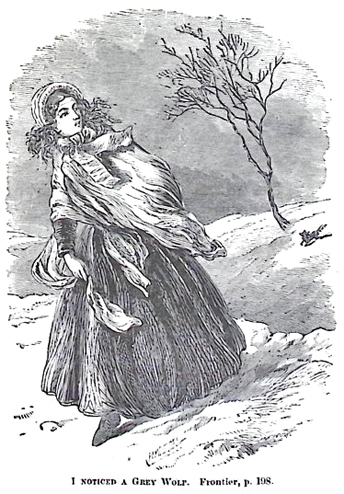
I NOTICED A GREY WOLF. Frontier.
There was Mrs. L., too, a little butterfly of a woman, who had always been happy in New England. Her husband was a hard-working man, and took great pride in beautifying the cottage he had built. It was not paid for, however, and at length he wearied somewhat of the toil needed to clear it of pecuniary encumbrance. Hearing of the cheap lands of the West did not lighten his burden, and he decided to emigrate. She joined in the project with alacrity, for her fancy painted a prairie home as a garden of delights. She reached their El Dorado under most forbidding circumstances. It was in late autumn, when the landscape stretched away bloomless and sear, and the cold rains were falling. It was indeed dismal without, and the cramped, uncouth log-and-mud house which received her as boarder, compared illy with the tasteful dwelling she had left behind. What a revulsion of feeling was hers! She wept for weeks, and refused to be comforted.
Some of the settlers thought her case hopeless—that she would never do for the West, mere New England doll that she was! But she had her cry out; and, like a true woman, when her husband, apparently moved by her grief, and homesick himself,—yet secretly glad of a pretext, offered to give up and return, she resented it!
"Go back!" she exclaimed; "no, I shall not be ready to return until our Massachusetts friends see that we have been successful in coming out, and have been profited by the change." And of all busy women, Mrs. L. became one of the busiest. Henceforth it was smiles and work with her, and her quiet laugh and cheerful face made sunshine of darkest days.
Often her little figure might be seen tugging her baby across the prairie to a neighbor's, to collect rare seeds, or bargain for hens. Her faculties were ever on the alert, devising something to make home comfortable; nor did snow, rain, loneliness, or sickness diminish her zeal. Neuralgia, aggravated by exposure, low diet and miasma, often prevails on the frontier. I have seen the hardiest pioneers writhe in agony, completely unmanned by it—never at such times venturing into the open air. Mrs. L. did not escape the disease. But what was my astonishment, on one of those doleful days in November, when a drizzling rain, driven by a cold wind, "sent mildew into the bones," to see Mrs. L. perched on the top of a load of lumber, drawn by oxen. Her face was bound up as if nursing the toothache, and she told me, with a ringing laugh, that she had ridden twenty-four miles at that snail's pace, and had had three teeth extracted!
Mrs. Myers, too, was another heroine whom I unexpectedly met, leading almost the life of a recluse in the deep gloom of a humble forest home. It was on this wise. Passing through the shaded path of heavy-timbered land, on K— River, in a journey which I made on horseback, I came to the brink of a roaring torrent where stood a mill. As I was looking for a place to feed my horse, a man came forward, extended his hand, and said,—
"How do you do, Mr. D.? What brought you away up here? Don't you know me? My name is Myers, of P—, Massachusetts." But what a change a few months of another climate and new habits had wrought in my old friend. From the pale, almost effeminate dealer in dry goods, he had grown to be bushy-whiskered and portly, his cheeks fairly shaking with fat.
"Do you live here?" I asked.
"Yes; came here last fall, with my wife, and wintered among the bears and wolves, making shingles. You see," said he, alluding to his weighty appearance, "I have been a 'gainer' by it. Never knew what it was to have an appetite before. The cold last winter made me ravenous; and though we had no market, you see we did not exactly starve. But, come, my wife will want to see you; the face of an old acquaintance will be next to going home again."
A low, snug shanty of oaken boards, just large enough to admit in its one room a bedstead, stove, table, and a few home-made chairs, was Mrs. Myers's empire—quite in contrast with her Eastern style. She was a gentle, lady-like person, had been a successful teacher before marriage, and was an accomplished musician. She cordially greeted me, saying,—
"I shall make no apologies. I am too glad to see a human being in these wilds, to care for aught else. Since we came here, not a person has been at our place, save the few who chanced here for shingles, all strangers to me, and such a long, cold winter I never experienced. Until the snow melted, late in the spring, we were quite alone."
"Were you not homesick and gloomy?"
"Only once, and that was the last of February. It had been an almost uninterrupted succession of storms. It was nothing but snow, snow, snow. We could not get out for any purpose, and our supplies were running low. We seemed to be completely shut away from the world—the only living creatures, save a neighbor in the cabin at the extremity of the woods, that we knew of, being a pack of wolves that sometimes swept by. On one occasion, my husband estimated that there were not less than thirty in the pack. That was a dismal time; and one stormy day, when the air was filled with snow, and the winds were sighing through the trees, my heart sank within me. And I rather suspect," said she, archly glancing at her husband, "that Mr. Myers did not feel much bettor than I did. Just then, when I felt like giving up entirely, I heard a little song—a clear, cheerful piping of a bird. You can not tell how it thrilled and cheered me. I looked from the window to see from whence the sound came, and there, right on the corner of our dwelling, sat the tiniest creature, caroling just as if it was June. This gave us both fresh courage. Said I to husband,—
"'If that wee bit of a thing can sing, much more can I!' and I struck up a hymn of praise to God, to which a certain bass voice made an excellent accompaniment. We felt better, and that's the last of the blues with us; though of course we had some hard rubs, and had to endure some things that in New England would have made us cowards. As, for instance, when our house fell down."
"Fell down! how did it happen?"
"You look astonished. I don't wonder at it. You see, when we came, husband could get nothing but green oak boards to build a temporary shelter with. And what with the shrinking, and the wrenching by the winds, and the snapping of the nails by the frost, one dark, stormy night, after we had been asleep some time, we were awakened by a strange noise. Looking about, how were we astonished to find that the boards had fallen apart, leaving us without protection! Hurriedly putting on our clothes, we had to scamper for the cabin I have spoken of for shelter till morning, when husband went to work and put this up, which has served us thus far."
Another case occurs to me.
On the south side of a little grove, at the very outpost of immigration, was Charles Wallace's log-house. He was from a thriving manufacturing town in Massachusetts. His business as a journeyman carriage-maker had enabled him to provide comfortably for his young family, and pay something annually toward the house in which they dwelt. It was true he had to work steadily and hard, and made what some would call slow progress toward competency; still the house was eligible property, neat, commodious, modern, and the little garden back of it yielded a bountiful supply of vegetables for the table. School, also, and religious privileges were all that could be wished.
Mr. Wallace was a thoughtful, reading man, of real worth and Christian principles, but very diffident. Men less well-informed, of sounder intellect, blest with self-esteem, and put-yourself-ahead-ativeness, would cut quite a figure in the eyes of an admiring public, while he, modest soul, was passed by unnoticed, unappreciated by the discriminating crowd. He had, however, a noble, generous heart, and glowing desires to be of use as a disciple of Him who went about doing good. These dispositions and aspirations, however, were repressed by his confirmed habits of self-distrust, and he was therefore often dissatisfied with his manner of life. He had read much of the spiritual destitutions of the great West, and came to think that if he could once be established where calls for laborers in the world's harvest were urgent, and laborers were few, that among new faces he could break the fetters of self-distrust, and do something for God and humanity. Moreover, one dull business season his employer failed, owing him quite a sum, which could not be collected. Now he turned his face towards the setting sun in good earnest. But the wife, how could he bear to tear her away from scenes so dear to her, and kindred more precious than life itself! He well knew the struggle it would cost her to leave New England, with its prized privileges, congenial society, and domestic comforts. She was one of those dear, loving creatures that love on, and love ever; the very trees, rocks, and rivers of her childhood and youth would cling to her affections with a deep grasp, and father, mother, brothers, sisters, how could she part from them for the distant and unknown West! He could scarcely hope for her consent to go, but had it cheerfully, whole-heartedly, yet with irrepressible tears and many forebodings, of which she did not speak.
Mr. Wallace had a clerical relative in Minnesota, who had influenced him in his decision to remove there; and that his family might go at once to some definite point, or home of their own, he wrote to the clergyman, commissioning him to purchase for him a farm. He did so. But on Mr. Wallace's arrival, it fell so far below his expectations that he sold it at a sacrifice, and went forth prospecting, locating at length where this account found them. It was late in the fall ere he could begin to build his cabin; the old settlers' story as to the mildness of the winters in that climate relieved his anxiety, however. The winter, nevertheless, set in early, and proved to be one of the coldest on record. He was overtaken without due preparation as to provisions. Nor was it otherwise with his neighbors, all new comers, like himself. The rigors of the prairie made it perilous to venture from home, and our emigrants, fresh from the abundance of the East, were brought to most wretched fare. Mr. W. was physically rugged, knowing nothing of the horrors of dyspepsia; and if there was only a sufficiency for the table, it mattered not to him what it was. Not so, unfortunately, with the invalid wife. There was little, at best, that she could eat that suited her diseased condition, and those very articles it was impossible to procure. One who was, providentially, an inmate of the household through the terrors and deprivations of that winter, says,—
"I had read of the rigors of the frozen North, and here I had a taste of them. For months, in the most sheltered nooks, and on the sunniest roof-sides, the snow gave no signs of thawing, while from morn till night, on the frosty atmosphere, luminous pillars, and circles, and mock suns witnessed to the intensity of the cold; and the nights,—O, 'such' nights! why, you could 'hear' it freezing, freezing; the swine in their pens piled and crowded together, quarreling for the warmest place, uttering incessantly cries of distress, with which mingled the sharp reports, like the discharge of pistols, of the oaken shingles on the roof, as the nails that secured them burst. I don't know how we got through that winter. Mrs. W. had courage, endurance, was free-hearted to a fault, but the commonest articles had to be dispensed with. The mills were so remote that the corn stored in the attic could not be turned into meal, greatly as it was needed, save by the slow and imperfect process of grinding in a coffee-mill, suspended against the wall. Mr. W. was anxious and low-spirited enough, poor follow, frequently bursting out into bitter reflections on himself for bringing his wife to such a place.
"And, indeed, how she was kept alive was a miracle; certainly she ate nothing, or next to nothing. Then, however, did woman's marvelous self-forgetfulness and fortitude shine out. Not a word of discontent or of depression ever escaped her lips. She was uniformly peaceful and hopeful, at least in the presence of the household, and her mild, sweet voice was often employed in singing some hymn of holy trust and cheer. I was ever admiring her spirit and wondering at her conduct. Yet that she was keenly alive to the situation of affairs, and that she suffered the pangs of unsatisfied hunger,—not having diet suited to her needs,—we were obliged to think. An incident impressed me deeply.
"Once, after retiring to rest, I awoke while yet it was dark, and overheard, in the apartment adjoining mine a low, suppressed whispering. It was Mrs. W. wrestling in prayer for strength according to her day. She had taken that hour to seek 'Him who giveth power to the faint,' that none but God might hear. Night after night did she thus pour out her soul in agonized supplication, yet on her face not a shade of anxiety could be discerned through the day.
"Often did Mr. Wallace, during the trials of that winter, and afterwards, resolve to return to Massachusetts.
"'Not yet, Charles,' she would say, 'not yet, till you have made enough to pay you for coming.'
"And repressing her own earnest yearnings for the faces of loved ones far away, by her gentle firmness she held him to his enterprise, till after some years, a good opportunity occurring to sell out at a fair advance, for his own sake as well as hers, he embraced it, and joyfully they retraced their course to the scenes they had left behind.
"It may not be amiss to add, at the risk of a digression, that Mr. W. was enabled, while dwelling on the prairie, to carry out his plans for being active in the service of Christ. And so did he win the hearts of others by his consistent, useful life, that when he was about to leave the region, an old pioneer, moved by powerful emotions of grief at parting from him, sought him out, and, throwing his brawny arms about the good man's neck, wept aloud. The ice of his reserve once broken, Mr. W. has since taken his place among Christian men at the East."
In the older settled portions of our country, the amenities of the heart, and the gentle fireside graces often bloom in beauty. But on the frontier, the stronger, more valiant traits are developed. Indeed, if it were not for woman, no new country could be civilized: It would be the old story of Adam and the beasts over again. Every thing would end in Crusoe experiments, in hunting and trapping, mining and fishing. Woman, however, has more than her share of work in reclaiming earth's wastes. I have visited many hundred cabin homes on the frontier, and my conclusion is, that to the wife and mother, more than to any other influence, belongs the credit of whatever of advancement is made socially. Encompassed with untold difficulties, she not only does her own work, but aids and encourages her husband in his. She helps build the cabin, "put up the fence," drive home the cows, take care of the crops, "fight the prairie fires," "tend" the store, keep the tavern, and take charge of the post-office.
There was Mrs. C., whom I first saw when going with a friend for family supplies. How I started back on entering "the store," supposing I had blundered into a private room. A bed, neatly covered, stood in a corner, a coffee-mill ready for use hung against the wall. These first met the eye. However, the sight of flour, and other articles of merchandise, reassured me. It was a two-roomed cabin, with a low sleeping apartment overhead. Yet in that little building a brisk trade was carried on, a number of boarders found accommodation, and the post-office was kept; and Mrs. C., to allow her husband leisure to put other "irons in the fire," superintended the whole, respected by all the settlers for her faultless judgment, and kind, dignified bearing.
So also woman's influence is felt in religious matters.
On account of the severity of the winter, our dwelling, being central, was for a time our sanctuary. One Sabbath morning, the mercury being thirty below zero, not a person came save two Christian ladies, who had walked nearly two miles to attend meeting! I had not felt inclined to chide our brethren for their absence, so fierce was the morning, and the courageous zeal of those devoted women filled me with admiration. The incident was characteristic.
And in the fearful national contest now raging, the women of our free frontier will not be found wanting. Their hearts took fire when Kansas was invaded by border ruffians. Not a few Southern ladies, brought up in luxury, have I met with in cabin homes, self-exiled from the places of their birth, by their abhorrence of American slavery. Prairie women, self-reliant, free in spirit as the air they breathe, have no affinity with tyrant traitors. And were it possible that through the sorcery of party politics, or some other fell influence, the fathers and brothers of the Northwest should falter in this struggle, the loyal mothers and sisters could not. Inspired by heroism, nursed by danger and deprivation, they would court any suffering or peril rather than see the fair structure of our civilization and freedom overthrown by the barbarized champions of human bondage.
THE MIDNIGHT CALL.
THE winter of 18— was marked with unusual severity. I remember it the more vividly because of the incident which follows.
One night I sat by the fire, absorbed in reading. It was just the evening to enjoy a good book and home comforts, for the storm, which had been raging through the day, and still whirling the snow against the windows, repressed all desire to go abroad, and shut out intruders. I read on, till, through the roar of the tempest, I heard the muffled tones of a neighboring church clock strike eleven. Another hour had nearly passed when I was aroused by a knock at the door, and, opening it, a woman, clad in a thin shawl covered with snow, came timidly in. Her eyes were swollen with weeping, and her whole appearance expressed deep sorrow.
Standing, and wringing her hands in her anguish, she said,—
"My father is dying! He is in great distress of body and mind. I've called to ask if you won't please come and see him, for there's no one to speak a word to him about his soul, and I fear he can't live till morning."
"But," said I, "I am not a minister, and am afraid I could be of little service. Has your father no experienced Christian friend who would like to converse with him? What church does he attend?"
"We do not go any where to meeting," she replied, with an embarrassed air; "but father had been talking about it some time!"
"Hadn't you better go for a clergyman, then? There's Rev. Mr. E."
"I've been for him," she quickly returned, "but he was not at home, and then I inquired for some one who could pray, and a man sent me to you. Do please go, sir, for father is very anxious that I get some one, and I can't leave him long, he suffers so, and he 'll feel dreadfully if nobody comes to see him."
There was a coincidence in this unexpected call that impressed me. I had been much exercised with the desire to be more actively useful as a Christian, and had felt moved to pray that larger opportunities for doing good might be given. Was this an answer to that prayer? But it did not come in the way I had anticipated, and numberless excuses were ready to present themselves, the most weighty of which was my extreme youth, and consequent inexperience; and (shall I confess it?) I even glanced, with selfish shrinking, out at the driving blast. But the case would admit of no parleying. With pale, imploring face, my caller stood waiting my decision. Strength came, and I said,—
"I will go, and do the best I can for your father;" and, thanking me, she hurried away.
In a distant and disreputable part of the city, alone, on a dreary declivity overlooking the sea, stood the dwelling of the sick man. Entering, I had stepped to the feeble fire that flickered in the grate, to warm me ere speaking to him, when, casting my eyes toward the bed, they met his. Such an expression of wild despair I had never before seen. In the thrilling tones of one consciously approaching eternity unprepared, he exclaimed, stretching out his hand,—
"'I want some one to point me the way!'"
Instantly all diffidence fled; and, grasping his hand, I began to question him about his past life and present feelings. Suspicious of "death-bed repentance," I dealt plainly with him, which was well received. The result was a conviction that his was a case of genuine sorrow for sin. He had been a man of great physical strength and endurance. His business had called him to stand much in the water, as he worked about the vessels in the harbor, experiencing no ill effects from his exposed life till within a short time, when his lower limbs commenced swelling, accompanied by excruciating pain, the torture increasing as the disease crept up toward the vitals. Now his sufferings were well nigh intolerable, and his swollen appearance made him a truly frightful object. His naturally fine mind remained unclouded, however, and its whole vigor was exercised in self-accusing reviews of the past, and hopeless anticipations of the future.
"Oh," said he, "it's not the fear of death that troubles me so much as thoughts of my wasted, godless life. I have lived as if there was no God. What a stupid, ungrateful wretch I have been! And he has been so good, so forbearing, so patient. For fifty years and more I never saw a sick day, and yet no love toward him who made and preserved me! Oh, how can I think of it!"—and he covered his face as if to hide some hideous vision.
"But," I asked, "did you have no concern about these things till you were taken sick?"
"Yes; one day, a few weeks before, I fell to thinking over my past life,—I know not what made me,—and I saw it to be all wrong. Then I resolved to do better. But what a task I found it to overcome evil habits formed through so many years; and then my sins, my sins, they were a load crushing me to despair. One thing, however, I determined on, and that was to attend preaching somewhere. But, delaying to get suitable clothing, I was meanwhile laid up with this sickness. And now," he continued, "what I wish more than any thing else is to be rid of sin and serve God. But how can this be? How can I hope he will have mercy on me, when all the strength of my days has been given to self and sin? What shall I do? what shall I do? It's all dark to me."
Assuring him that salvation was free and ample, that the blessed Saviour invited all who felt their need of it to partake without money and without price, he could not credit the good news, and exclaimed, with moving earnestness,—
"Read it to me from 'the Book.' I want to hear it for myself, that I may know there is no mistake about it!"
Drawing a Bible from my pocket, and lifting up a prayer for guidance, for I knew not where to turn, I opened at this passage: "Jesus stood and cried, saying, If any man thirst, let him come unto me and drink." A divine radiance seemed to rest on the Lord's invitation, and as I was explaining it, he suddenly exclaimed,—
"'I see it!'" He had fallen back on the pillow, a smile surpassingly beautiful irradiating his before distorted features. Those wondrous words of Christ, in which divine majesty blends with perfect human sympathy, through the Spirit's power, had inspired trust. The cloud, the darkness, the storm passed from his soul, and, like a tired infant nestling in his mother's arms, so he found rest in the love of his Saviour.
How blessed to kneel in prayer after such a change! Prayer was turned to praise, and that lowly cot became as the gate of heaven. Nor did his peace abate, for when I called again, three days afterwards, and inquired how he felt,—
"Oh!" said he, with beaming face, "it's so delightful; 'it is peace in the morning, and peace at night.' My mind is so at rest," he continued, "that even my bodily pains, at times, seem all to have left me."
But how can I express the gladness that filled my heart that night, as I left the aged convert to return home! The howling tempest could not drown the melody that came down from angel-harps, to the ear of faith, as in the presence of God there was joy over another repentant sinner. Christian disciple, pray to be a true laborer for Christ. Watch to improve each opportunity the Lord shall give for activity in his vineyard. Charlotte Elizabeth writes, "I asked work of my heavenly Master, and he gave it." None shall ask it of him in vain. Fear not to follow his leadings. The impenitent are more ready to hear on the subject of their eternal interests than is generally supposed. "I have," says Newcomb, "conversed with many hundreds, in almost every variety of states of mind, not excepting avowed infidels, but have rarely met with one who did not receive it kindly, and treat me with courtesy." Since the incident related above, which occurred in my eighteenth year, personal religious conversation with some "thousands" enables me to bear a similar testimony.
THE WORLD-WANDERER.
I WAS visiting in the quiet city of N—. On the street a clerical friend met me, and said,—
"I want you to come to our conference meeting this evening, and hear one of my members talk. It will do you good."
Now I confess to a partiality for those social services, in which young and old, the lettered and unlettered, all turn preachers, and in the freedom of God's family circle make heart-offerings of prayer, and praise, and exhortation. Would that we had less "pulpit" and more "church" in our sanctuaries; at least, I should prefer it.
The good pastor's flock were accustomed to prayer-meeting privileges, and no time was lost.
"That's the man," whispered my friend; "listen."
At that instant a man arose in a side pew, and commenced speaking. Partly bald, his thin, light hair fell from a high forehead, while his sharply cut features, bronzed by exposure to sun and storm, wore a bold, stern look, as of one accustomed to face danger without shrinking. His voice was resonant and full, his manner assured and forcible. A tender smile, like sunlight resting on the jagged rock, played over his face,—a face accustomed more to harsher moods, one would think.
His words—I will not attempt to rehearse them—were wondrously weighty and convincing, as, with a confidence such as the Apostles had after the baptism of Pentecost, he reasoned out of the Scriptures of "righteousness, temperance, and judgment to come." He spoke like one who had consciously emerged from darkness to light; who had been soundly converted from the extremity of ungodliness to a living discipleship. And when he alluded to his own experience, how touching and persuasive!
"Sinner!" he exclaimed; "you who make light of these things, pleased with the trifles of earth, hugging sin, your deadliest foe, to your hearts, rejecting the only good, eagerly pressing on the broad road to destruction, look at me, a monument of God's sparing mercy, a trophy of his grace! Some of you have known me from my childhood. You can remember what a vile, God-defying, blasphemous wretch I was. You have heard me insult the Majesty of heaven and earth; yes, pour out my swearing wrath on Him who died for me. It is but a year since he spoke to me as to Saul of Tarsus, and brought me to his feet. Since then my testimony has been one and the same. I am a new creature; old things have passed away. I have found him of whom Moses and the prophets did write; and in finding him I have found every thing. Sin's strong fetters have been broken; pardon, peace, joy, love, the fellowship of the saints, the communion of the Holy Ghost, heaven, all are mine, and can 'you' stay away?"
Then, plaintively, almost soliloquizing, "Fifty years of my life were wasted in sin, before I saw the great light. I have been all over the world, seen hardships and danger in many a clime, all the while defying the God who made and preserved me. Yes, I have been to Palestine, trodden that sacred soil with a heart harder than adamant, gone over those places hallowed by the weary feet, watered by the tears and blood of Immanuel,—but what was it all to me? Oh, that I could once more see that land, all-glorious! Oh, that I might again look on Jordan and Tiberias, Gethsemane and Calvary, now that he has had pity on a wretch like me, and revealed himself to my soul. How dear, how holy, would be those scenes!—what joy, what rapture would thrill my heart! But this can not be. But, blessed be God, the heavenly Canaan—
"'Stands dressed in living green.'
"I shall see 'that.' I shall behold Him whom I once reviled, but who is now to my soul the chiefest among ten thousand, and the One altogether lovely. Sinner, will you go with me? Come, for there is room for all!"
"What," said the preacher, as we walked home together, "did you think of that?" referring to the exhortation I have meagerly sketched.
"Ah!" I replied, with a sigh, "if we all could speak with that assurance of faith and depth of conviction."
"And yet," he continued, "that man was one of the worst, most hopeless scoffers I ever heard of. The language he would use in expressing his scorn and hatred of the Saviour is too horrible to repeat. But since his conversion not an opposer dares breathe an accusation against his demeanor. Having been forgiven much, he loves much."
"What were the circumstances connected with his conversion?"
"A member of my church and Sabbath school," said he, "was in search of scholars. She was looking for them among the poor and neglected. She had heard of this man—was aware that he was a skeptic of the blackest hue; but knowing that he had children growing up untaught in divine things, her heart was moved with pity; and, repressing her timidity, she begged leave for them to attend Sunday school. Her conciliatory, persevering efforts, were rewarded by her request being granted. The youngest of them, a little girl of five, became religiously impressed, and began the habit of secret prayer. One evening, just at dark, her father chancing to pass the door of her room, thought he heard a voice. It was little Mary offering her childish petitions. Just then she was asking God to bless and save her dear father. The listening parent heard his name thus laid before the mercy-seat. Conviction followed. 'What does this mean?' he ejaculated. 'My little girl praying for me! Am I, then, such a sinner?' His life came up for review; he was plunged in wretchedness, could not sleep, and next morning sent for me. He was walking the room, gloomy and agitated, as I entered.
"'Sir,' said he, 'can you prove that the Bible is true?'
"'Yes, to one who is candid,' I answered.
"'Then let me hear your arguments,' he rejoined.
"I spent the day with him. Ere I left, at his request I prayed for him, and he broke out in earnest supplication for himself. When light dawned, his mind was flooded. No doubts have distressed him since. His testimonies always have power with unbelievers; they don't question the change. But did you observe," he added, "how he yearned to see the Holy Land once more? He often reverts to that, reproaching himself for his indifference and unbelief when there."
The converted infidel died about a year after. His last moments were glorious. Denied another sight of the earthly Canaan, the heavenly soon burst upon his enraptured vision.
Oh, ye laborers in the Sabbath schools of our land, go forth! Go forth into the highways and hedges, into the homes of error, the dens of corruption, and bear thence the tender child where hallowed influences descend, and the knowledge that maketh wise unto salvation is imparted. Save the children, and it may be you will save the fathers and the mothers, who, transformed, shall become champions of the cross.
THE PASTOR'S DREAM.
DEACON G. was a pillar in the church some years since. He was the very embodiment of good deaconly qualities;—bland, zealous, prayerful, efficient. His hospitable doors were ever open to the "pilgrim and stranger," and many a weary man of God, and many a hungry wanderer, was sheltered and fed beneath his roof. And not seldom did some struggling theological student, visiting him of a vacation, have his fundless wallet replenished, and his outer man improved by the exchange of his worn boots and threadbare coat for a more comely and comfortable garb. It was whispered around, however, that with all his virtues, he had one weakness. He was pronounced prodigal in his alms-deeds, by some of the more "prudent," and the pastor inclined to the opinion. He admired the whole-hearted benevolence of the deacon, but being himself more wary, and having his friend's interests really at heart, he became much troubled about the matter. For some time he revolved the subject in silence, until compelled, as he thought, by a sense of duty, he waited on his official helper to express his concern. He laid before him all his fears, endeavoring, with a discriminating hand, to draw the line between a safe and an imprudent generosity.
"Have I not enough for the support of my family? Do I at all distress them by giving away?" asked the deacon.
"This may be true," said the minister, "but many of your brethren fear for the future for you. You know not what reverses may await you. Is it not wise; do you not owe it to your family so to husband your resources as to be prepared for emergencies that may arise?"
His listener duly weighed each word, but was scarcely convinced of the necessity of the caution. It seemed to him that he had only given of his abundance, and that a watchful Providence had granted him to reap liberally as he sowed liberally.
The pastor left; his solicitude somewhat softened, perhaps, by the interview; yet with the consciousness that he had relieved himself of any responsibility in whatever might befall the deacon's worldly affairs, while the latter remained with his large heart uncontracted.
That night the pastor dreamed that, taking his daily walk, he bent his steps to the sea-side. It was a bright day in summer, and he paused to look on the broad expanse. Soft clouds lay dreamily against the horizon. Sea-birds sailed slowly through the air, or darted down upon their finny prey. The white-crested waves flashed back golden rays. While absorbed in the glorious scone, a step behind caused him to turn his head, and he saw Deacon G. approaching. The latter appeared not to notice him, but stepping to the verge of the shore, took from a basket on his arm loaf after loaf of wholesome looking bread, and tossed them into the water.
"Stop! stop!" exclaimed the pastor, in surprise, "why this waste?"
The deacon pointed solemnly into the sea, and said, "Look! observe!"
The former looked, and, to his astonishment, saw that for each loaf thrown in, the returning wave brought back a basketful, and cast them at the donor's feet!
In great wonder he awoke, and the next day calling on the deacon, related his dream, and added, tearfully,—
"Go on, brother! go on! Cast your bread upon the waters—doubtless, after many days, it will be returned to you!"
A SMILE, A GLANCE, A HYMN.
A THOUGHTLESS boy of fifteen, who had heard the Bible and the Christian profession treated lightly, imbibed the poison of skepticism. He had come to think that religion was only a name, and that the followers of Christ were a gloomy people, denying themselves this world's enjoyments and receiving no equivalent. It chanced one day that he was sent on an errand to a lady, of whom his parents would often speak compassionately, as one who had but a little while to live.
"Poor Mrs. S.," they were wont to exclaim, "how dreadful must it be to her to know that she must leave her beautiful home, her babe and husband. But," they would add, "she is a church-member,—wonder of she is sustained in her great trouble."
The son called on Mrs. S. With pleased emotions, for he was a lad of fine taste, he looked at the dwelling and out-grounds. Wealth had here lavished its stores in adorning and furnishing a home where, it would seem, scarcely a wish was ungratified. The garden was a paradise of rare plants and flowers. Within, the foot pressed the richest carpets, luxurious chairs and lounges invited repose, while the elegant library contained the choicest productions in literature. A fair babe, the picture of health, lay sleeping in its pretty cot. He glanced at the costly house and dimpled child, and then at the sick woman, and thought how terrible a thing it is to die amid such scenes. He expected that the countenance of the death-doomed wife and mother would reflect his feelings. But no. That saintly expression, such as beautifies those only who have been purified by suffering, and "look not at the things that are seen and temporal, but at the things that are unseen and eternal," lighted up her face. An ever-present smile, sweet and heavenly beyond any thing he had ever seen, spoke of her deep, spiritual joy. It overwhelmed him with surprise. "This, this," said an inward voice, "is what Christianity does for Death's victims!" There is, there must be, he felt, reality in that which can give happiness under circumstances so forbidding. That smile followed him, an unanswerable witness for Jesus, till he was led to seek the dying Christian's Saviour. "A smile—a simple smile convinced me," he would afterwards say.