WHG Kingston (continued 7)
Reading edition
The night passed quietly away, and the morning light showed us the same scene as that on which the evening had closed, of the far-off forest, and the wide expanse of water, with single trees and tangled masses of underwood floating on it. After we had lighted a fire, and cooked some more fish for breakfast, Duppo put out his lines to try and catch a further supply. Not a bite, however, did he get. He hoped, he said, to be more successful in the evening. We therefore hauled in the lines, and I employed the time in teaching him English. I was sure that Ellen would be greatly pleased, should we ever return, to find that he had improved.
Another day was passing by. The wind had been moderate and the river smooth. Again it came on to blow, and our tree was so violently agitated that I was afraid it would be thrown over, and that we should be washed off it. As we looked round we saw the other masses with which we had kept company tossed about in the same way, and frequently moving their positions. Now we drove on before the wind faster than we had hitherto gone. There was one mass ahead which I had remarked from the first, though at a considerable distance. We were now drifting nearer to it. I had watched it for some hours, when I fancied I saw an object moving about on the upper part. “It must be another monkey,” I said to myself. I pointed it out to Duppo. He remarked that it moved too slowly for a monkey; that it was more probably a sloth. Then again it stopped moving, and I could scarcely distinguish it among the branches of the trees. I hoped that we might drift near enough to get it. It would probably afford us more substantial fare than our fish. After a time I saw Duppo eagerly watching the island. Suddenly he started up, and waved his hand. I looked as keenly as I could. Yes; it seemed to me that the figure on the island was again moving, and waving also. It was a human being; and if so, who else but Arthur? My heart bounded at the thought. Yet, how could he have escaped? How had he not before been seen by us? Again I waved, this time with a handkerchief in my hand. The figure held out a handkerchief also. There was now no doubt about the matter. It was very doubtful, however, whether we should drift much nearer the floating island. The wind increased; a drizzling rain came down and almost concealed it from sight, so that we could not tell whether or not we were continuing to approach it. This increased my anxiety. Yet the hope of seeing my friend safe, once kindled, was not to be extinguished; even should we not drive close enough to the island to join each other, we still might meet elsewhere. All we could do, therefore, was to sit quietly on the tree, and wait the course of events.
One of the most difficult things to do, I have found, is to wait patiently. Hour after hour passed by. The wind blew hard, and often so high did the waves rise that I was afraid we might be swept off. What would become of us during the long, dreary night? I felt the cold, too, more than I had done since we began our voyage. How much more must poor Duppo have suffered, with less clothing! I should have liked to have lighted a fire; but with the rain falling, and the tree tossing about, that was impracticable. We all three—Duppo, True, and I—sat crouching together in the most sheltered part of the tree. Thus the hours of darkness approached, and crept slowly on. Did I say my prayers? it may be asked. Yes, I did; I may honestly say that I never forgot to do so. I was reminded, too, to ask for protection, from feeling how little able I was, by my own unaided arm, to escape the dangers by which I was surrounded. I tried to get Duppo to join me. I thought he understood me; but yet he could scarcely have had the slightest conception of the great Being to whom I was addressing my prayers. I hoped, however, when he knew more of our language, that I should be able to impart somewhat of the truth to his hitherto uncultivated mind.
In spite of the rain, the darkness, and the movements of our tree, I at length fell asleep, and so, I believe, did Duppo and True. I was awoke, after some time, by a crashing sound, similar to that which had occurred when we drove against the floating island. I started up. True uttered a sharp bark. It awoke Duppo. Presently I heard a voice at no great distance exclaiming, “What is that? Who is there?”
“Who are you?” I shouted out.
“I am Arthur! And oh, Harry! is it you?”
“Yes,” I answered. “How thankful I am that you have escaped!”
“And so am I that you have been saved,” answered Arthur. “But where are you? I cannot find my way among the bough. Have you come off to me in the canoe?” I told him in reply how we were situated. “Can you join me?” he asked. “I have hurt my foot, and am afraid of falling.”
“Stay where you are,” I answered; “we will try to reach you.”
I made Duppo understand that I wished to get to where Arthur was. It was necessary to move very cautiously, for fear of slipping off into the water. We could not tell, indeed, whether the butt-end or the boughs of our tree had caught in the floating island; all we could see was a dark mass near us, and a few branches rising up towards the sky. I was afraid, however, that if we did not make haste we might be again separated from it as we had been from the other island. We scrambled first some way along the boughs; but as we looked down we could see the dark water below us, and I was afraid should we get on to the outer ends that they might break and let us fall into it. I thought also of True, for though we might possibly have swung ourselves across the boughs, he would have been unable to follow us. I turned back, and once more made my way towards the root-end, which, by the experience we had before had, I hoped might have driven in closer to the mass we wished to reach. We had to crawl carefully on our hands and knees, for the rain had made the trunk slippery, and we might easily have fallen off. As I got towards the end, I began to hope that it was touching the island. I again called out to Arthur. His voice sounded clearer than before. When I got to the end among the tangled mass of roots, I stopped once more to ascertain what Duppo advised we should do.
I sat some time trying to pierce the gloom. At length I thought I saw a thick bough projecting over the extreme end of our tree. If I could once catch hold of it I might swing myself on to the island. There was one fear, however, that it might give way with my weight. Still I saw no other mode of getting to Arthur. True, I hoped, might leap along the roots, which were sufficiently buoyant to bear his weight, at all events. Having given my rifle to Duppo to hold, I cautiously went on. I got nearer and nearer the bough. With one strong effort I might catch hold of it. I sprang up, and seized it with both hands. It seemed firmly fixed in a mass of floating wood. After clambering along for a short distance I let myself down and found footing below me. I now called to Duppo, and holding on to the bough above my head with one hand, stepped back till at last I was able to reach the rifle which he held out towards me. True sprang forward, and was in an instant by my side. Duppo followed more carefully, and at length we were all three upon the island.
“We shall soon find our way to you,” I cried out to Arthur.
“Oh, thank you, thank you!” he answered.
It was no easy matter, however, to make our way among the tangled mass of trunks and roots and boughs without slipping down into the crevices which yawned at our feet. I could judge pretty well by his voice where Arthur was. Duppo pulled at my arm. He wished that I would let him go first. This I was glad to do, as I had great confidence in his judgment and activity. Following close behind him, we at length got directly under where Arthur was perched.
“Here we are,” I cried out, “on a firm trunk. Could you not manage to come down?”
“I am afraid not,” he answered.
“Stay, then; I will climb up and assist you,” I said.
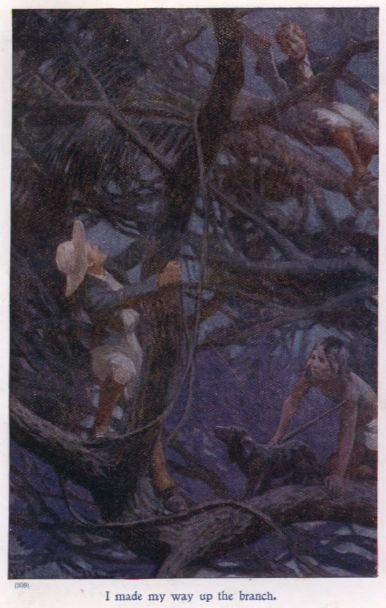
Putting my gun down, I made my way up the branch. Most thankful I was again to press his hand.
“I am somewhat sick and hungry,” he said; “but now you have come, I shall soon be all right.”
“Well, let me help you down first,” I replied. “We have brought some food, and when you have eaten it we will talk more about what has happened to us. I hope we shall manage somehow or other to reach the shore before this island is carried out to sea.”
“Oh yes, I hope so indeed,” he said. “I have never thought that likely.”
I now set to work to help Arthur down. Duppo stood under the branch and assisted me in placing him at length in a more secure position.
“Oh, I am so thankful you have come!” he kept repeating; “my only anxiety was about you. Still I hoped, as I had so wonderfully escaped, that you might also be safe. All I know is, that I was in the water, and then that I found myself clinging to a bough, and that I gradually pulled myself up out of the water. I believe I fainted, for I found myself lying among a mass of boughs; and when I managed at last to sit up, I discovered that I was floating down the river. Not for some time did I feel any sense of hunger. At length, when I did so, I found, greatly to my satisfaction, that I had my wallet over my shoulders, well stored with provisions. They were, to be sure, wet through; but I ate enough to satisfy the cravings of hunger. In the morning I looked about me, hoping to see you on one of the masses of trees which were floating down the stream round me. You may fancy how sad I felt when I could nowhere distinguish you. I knew, however, that it was wrong to give way to despair, so when the sun came forth I dried the remainder of the food, which has supported me hitherto.”
“But did you feel any pain from your wound?” I asked. “That has been one great anxiety to me. I thought you were truck by a poisoned arrow.”
“No,” he answered. “I pulled it out at once, and had forgotten it, till I felt a pain in my shoulder. Then the dreadful thought that it was poisoned came across me, and I expected, for some time, to feel it working within my system. It was perhaps that which made me faint; but as I did not feel any other ill effects, I began to hope that, either in passing through my jacket the poison had been scraped off, or that it has, as I have heard, but slight noxious effects on salt-eating Europeans.”
I agreed with him that this must be the case; indeed, he complained of only a slight pain in the shoulder where the arrow had struck him. In the darkness which surrounded us, I could do no more than give him some of the food we had brought with us. The remainder of the night we sat on the trunk of the tree, Duppo and I supporting Arthur in our arms, while True crouched down by my side. We could hear the water washing round us, and the wind howling among the branches over our heads. The rain at length ceased, but I felt chilled and cold; and Arthur and Duppo were, I feared, suffering still more. Thus we sat on, doing our best to cheer each other. So long a time had passed since Arthur had been struck by the arrow, that I no longer apprehended any dangerous effects from it. Still, he was very weak from the long exposure and the want of food, and I became more anxious to get him safe on shore, where, at all events, he might obtain shelter and sufficient nourishment. Wherever we might be cast, we should, in all probability, be able to build a hut; and I hoped that with my gun, and Duppo’s bow, we should obtain an ample supply of game.
“Now we have found each other, I am afraid of nothing,” said Arthur.
“Neither am I,” I answered. “Still I fear that Ellen and John will be very unhappy when they do not see us.”
We had been talking for some time, when we felt a violent shock. The water hissed and bubbled up below us, and the mass of trees on which we floated seemed as if they were being torn asunder. Such, indeed, was the case. Duppo uttered a cry of alarm.
“What shall we do?” exclaimed Arthur. “O Harry, do try and save yourself. Never mind me. What can have happened?”
“We have driven ashore,” I answered. “I am nearly certain of it. All we can do till daylight is to cling on to this trunk; or, if you will stay here with Duppo, I will try and make my way to the other side, to ascertain where we are.”
“Oh, do not leave me, Harry,” he said. “I am afraid something may happen to you.”
We sat on for a few minutes. Still the crashing and rending of the boughs and sipos continued. At length I was afraid that we might be swept away by the current, and be prevented from reaching the shore. I therefore told Duppo what I wanted to do. He taking Arthur by one arm, I supported him by the other, and thus holding him up we tried to force our way among the tangled mass. Now we had to hang on by our hands, finding no firm footing for our feet. In vain we tried to force our way onwards. In the darkness I soon saw that it was impossible. A thick wall of sipos impeded our progress. It was not without the greatest difficulty that at length we got back to the trunk we had left. Even that was violently tossed about, and I was even now afraid that we might be thrown off it. Once more we sat down on the only spot which afforded us any safety. Gradually objects became more clear, and then I saw, rising up against the sky, the tall upright stems of trees. They could not be growing on our floating island. I now became aware that the mass on which we sat had swung round. It seemed once more to be moving on. There was no time to be lost. Duppo and I again lifted up Arthur, and made our way towards the end of the trunk. Not till then did I discover that it was in actual contact with the shore. We hurried along. A few feet only intervened between us and the dry land. “Stay, I will go first,” I exclaimed, and made a sign to Duppo to support Arthur. I let myself down. How thankful I was to find my feet on the ground, though the water was up to my middle. “Here, Arthur, get on my back,” I cried out. Duppo helped him, and in another minute I was scrambling up the bank on the dry ground. Duppo let himself down as I had done, and True leaped after us. Scarcely were we on shore when the trunk we had left floated off, and we could see the mass, with several detached portions, gliding down the river. Where we were we could not tell, but daylight coming on would soon reveal that to us. We sat ourselves down on the bank, thankful that we had escaped from the dangers to which we should have been exposed had we remained longer on the floating island.
Chapter Sixteen.
Our Return.
Where we had been cast we could not tell. Daylight was increasing. The clouds had cleared off. We should soon, we hoped, be able to see our way through the forest, and ascertain our position. We all remained silent for some time, True lying down by my side, and placing his head upon my arm. While thus half between sleeping and waking, I heard a rustling sound, and opening my eyes, half expecting to see a snake wriggling through the grass, they fell on a beautiful little lizard making its way down to the water. At that moment a pile of dry leaves, near which it was passing, was violently agitated, and from beneath them sprung a hairy monster, with long legs and a huge pair of forceps, and seized the lizard by the back of its neck, holding it at the same time with its front feet, while the others were firmly planted in the ground to stop its progress. In vain the lizard struggled to free itself. The monster spider held it fast, digging its forceps deeper and deeper into its neck. I was inclined to go to the rescue of the little saurian, but curiosity prevented me, as I wished to see the result of the attack, while I knew that it had already, in all probability, received its death-wound. The struggles of the lizard grew feebler and feebler. Its long tail, which it had kept whisking about, sank to the ground, and the spider began its meal off the yet quivering flesh. I touched Arthur, and pointed out what was taking place. “The horrid monster,” he exclaimed. “I must punish it for killing that pretty little lizard.” Before I could prevent him, he had jumped up and dealt the spider a blow on the head.
On examining it I found that it was a great crab-spider, one of the formidable arachnida, which are said to eat young birds and other small vertebrates, though they generally, like other spiders, live upon insects. This spider—the mygagle avicularia—will attack humming-birds, and, indeed, other small specimens of the feathered tribe. When unable to procure its usual food of ants, it lies concealed under leaves as this one had done, and darts out on any passing prey which it believes it can manage; or if not, it climbs trees and seizes the smaller birds when at roost, or takes the younger ones out of their nests. It does not spin a web, but either burrows in the ground, or seeks a cavity in a rock, or in any hollow suited to its taste.
I had never seen any creature of the spider tribe so monstrous or formidable. Under other circumstances I should have liked to have carried the creature with us to show to my companions. As soon as Arthur had killed it, Duppo jumped up and cut off the two forceps, which were as hard and strong as those of a crab; and I have since seen such set in metal and used as toothpicks, under the belief that they contain some hidden virtue for curing the toothache.
The rest had almost completely cured Arthur’s sprained ankle, and on examining his shoulder, I found that the arrow had inflicted but a slight wound, it having merely grazed the upper part after passing through his clothes. This, of course accounted for the little inconvenience he had felt. Still, I believe, even had the wound been deeper, the poison would not have affected him. I was indeed very thankful to see him so much himself again.
We were now aroused, and, getting on our feet, looked about as to settle in which direction we should proceed. We soon found that we were at the western end of an island, and as the distant features of the landscape came into view, we felt sure that it was the very one, near the entrance of the igarape, where we had first landed. We had supposed that we had floated much further down the river.
“The first thing we have to do is to build a raft, and to get back to our friends,” I said to Arthur. “We shall have little difficulty, I hope, in doing that. We must lose no time, and we shall be able to reach them before night.”
This discovery raised our spirits. We had first, however, to look out for a bed of rushes to form the chief part of the intended construction. The experience we had gained gave us confidence. We explained to Duppo what we proposed doing, and set forward along the northern shore of the island. We were more likely to find on that side, in its little bays and inlets, the materials we required. The axe which Duppo had saved was of great importance. We had made our way for a quarter of a mile along the beach, when the increasing density of the underwood threatened to impede our further progress. Still we had not found what we required. “I think I see the entrance of an inlet, and we shall probably find reeds growing on its banks,” said Arthur. “We can still, I think, push our way across these fern-like leaves.”
We pressed forward, though so enormous were the leaves of which he spoke, that a single one was sufficient to hide him from my sight as he made his way among them. Duppo and True followed close behind me, but True could only get on by making a succession of leaps, and sometimes Duppo had to stop and help him through the forked branches, by which he ran a risk every instant of being caught as in a trap.
“I think I see the mouth of the inlet close ahead,” said Arthur. “If we push on a few yards more we shall reach it. Get the axe from Duppo and hand it to me; I must cut away some sipos and bushes, and then we shall get there.”
I did as he requested. I had broken down the vast leaves which intervened between us, when I saw him beginning to use his axe. He had made but a few strokes when a loud savage roar, which came from a short distance off, echoed through the wood. His axe remained uplifted, and directly afterwards a sharp cry reached our ears. “That is a woman’s voice,” I exclaimed. “Where can it come from?” Duppo, as I spoke, sprang forward, and endeavoured to scramble through the underwood, as did True.
“Cut, Arthur, cut,” I exclaimed. “Unless we clear away those sipos we shall be unable to get there.”
Arthur needed no second bidding, and so actively did he wield his axe, that in a few seconds we were able to push onwards. Again the savage roar sounded close to us, but the cry was not repeated. “Oh, I am afraid the brute has killed the poor creature, for surely that must have been a human being who cried out,” exclaimed Arthur.
We dashed on, when, reaching the water, we saw, scarcely twenty yards off, on the opposite bank, a canoe, in which were two persons. One lay with his head over the gunwale; the other, whom I at once recognised as our friend Illora, was standing up, no longer the somewhat retiring, quiet-looking matron, but more like a warrior Amazonian—her hair streaming in the wind, her countenance stern, her eyes glaring, and with a sharp spear upraised in her hands, pointed towards a savage jaguar, which, with its paws on the gunwale, seemed about to spring into the canoe. It was too evident that her husband had been seized, and to all appearance killed. What hope could she have of resisting the savage creature with so slight a weapon. That very instant I dreaded it would spring on her. Poor Duppo shrieked out with terror; but though his mother’s ears must have caught the sound, she did not withdraw her glance from the jaguar. She well knew that to do so would be fatal. Duppo made signs to me to fire, but I feared that in so doing I might miss the jaguar and wound one of his parents. Yet not a moment was to be lost. My rifle, fortunately, was loaded with ball. I examined the priming, and prayed that my arm might be nerved to take good aim. Again the brute uttered a savage growl, and seemed on the point of springing forward, when I fired. It rose in the air and fell back among the foliage, while Illora thrust her spear at it with all her force. Not till then did she seem to be aware of our presence. Then waving to us, she seized the paddle and brought the canoe over to where we were standing. Duppo leaped in and lifted up his father. The blood had forsaken his dark countenance; his eyes were closed, his head was fearfully torn—the greater part of the hair having been carried away. Illora knelt down by his side, resting his head upon her arm. Arthur and I felt his pulse. It still beat. We made signs to his wife that he was alive, for she had evidently thought him dead. I fortunately had a large handkerchief in my pocket, and dipping it in water, bound up his head. He appeared to revive slightly. Illora then made signs to us that she wished to go down the river. We did not even stop to look what had become of the jaguar, convinced that he was killed. No time was to be lost. Having placed Maono on some leaves in the stern of the canoe, she seized one of the paddles and urged it out into the main stream. Duppo took another paddle. Fortunately there were two spare ones at the bottom of the canoe. Arthur and I seized them. Illora paddled away, knowing well that the life of her husband depended on her exertions. However callous may be the feelings of Indians generally, both she and Duppo showed that they possessed the same which might have animated the breasts of white people. Every now and then I saw her casting looks of anxiety down on her husband’s face. He remained unconscious, but still I had hopes that if attended to at once he might recover.
“I am thankful a jaguar did not spring out on us as we were passing through that thick underwood,” observed Arthur. “How utterly unable we should have been to defend ourselves.”
“Yes, indeed; and still more so that we did not take up our abode there,” I remarked. “Probably the island is infested with jaguars, and we should have run a great chance of being picked off by them.”
“I doubt if more than one or two would find support there,” he remarked. “How that one, indeed, came there is surprising.”
“Possibly he was carried there on a floating island,” I answered. “I doubt whether intentionally he would have crossed from the mainland; for though jaguars can swim, I suppose, like other animals, they do not willingly take to the water.” This, I suspect, was the case.
We tried to learn from Illora how her husband had been attacked. She gave us to understand that, after looking about for us, they had put in there for the night, and were still asleep when the savage brute had sprung out of the thicket and seized Maono. She heard him cry out, and had sprung to her feet and seized her lance just at the moment we had found them.
“We should be doubly thankful that we were cast on the island and arrived in time to rescue our friend,” I observed to Arthur.
As may be supposed, however, we did not speak much, as we had to exert ourselves to the utmost to impel the canoe through the water. I was, however, thankful when at last we saw the roof of our hut in the distance. We shouted as we approached, “Ellen! Maria!” Great was our delight to see Ellen and Maria, with Domingos, come down to the edge of the water to receive us. As I jumped out, my affectionate little sister threw her arms round my neck and burst into tears.
“Oh, we have been so anxious about you!” she exclaimed; “but you have come at last. And what has happened to the poor Indian? Have you been attacked again by the Majeronas?”
I told her briefly what had occurred, and set her anxiety at rest with regard to our parents by giving her Fanny’s note, and telling her how we had found it. I need not repeat her expressions of joy and thankfulness. I then asked for John, as he understood more about doctoring than any of us. He had gone away with his gun to shoot only just before, and might not be back for some time. The Indians were at their own settlement, a couple of miles off.
“What can we do with him!” I exclaimed.
“Why not take him to the recluse?” said Ellen. “He will know how to treat him.”
I made Illora comprehend what Ellen proposed. She signified that that was what she herself wished to do.
“Then, Ellen, we must leave you again,” I said. “We must do our best to save the life of our friend.”
Arthur agreed with me, and entreating Ellen to keep up her spirits till our return, we again, greatly to Illora’s satisfaction, jumped into the canoe. “We hope to be back to-morrow morning!” I cried out, as we shoved off.
Though somewhat fatigued, we exerted ourselves as much as before, and having the current in our favour, made good progress. Examining the banks as we went along, I saw how almost impossible it would have been to have effected a landing on that dreadful night of the storm, when we had the raft in tow, for one dense mass of foliage fringed the whole extent, with the exception of a short distance, where I recognised the sand-bank on which Arthur had been nearly killed by the anaconda. Maono every now and then uttered a low groan when his wife bathed his head with water—the best remedy, I thought, she could apply.
The voyage was longer than I had expected, for nearly two hours had passed before we reached the mouth of the igarape, near which the hut of the recluse stood. Having secured the canoe, Illora lifted up her husband by the shoulders, while we put the paddles under his body, and his son carried his feet. We then hastened on towards the hut. As we came in sight of it, Duppo shouted out to announce our approach to the recluse. No one appeared. The door, I saw, was closed, but the ladder was down. We stopped as we got up to it, when Duppo, springing up the steps, knocked at the door. My heart misgave me. The recluse might be ill. Then I thought of the ladder being down, and concluded that he was absent from home. Again Duppo knocked, and obtaining no reply, opened the door and cautiously looked in. No one was within. What were we to do? Were we to wait for the return of the owner, or go back to our settlement? I advised that Maono should be carried within, and proposed waiting till he appeared. We lifted him up and placed him under the shade of the verandah. Meantime Duppo collected a number of dried leaves, with which to form a bed, as he was not in a fit state to be placed in a hammock. I then advised Illora to send Duppo for water, while Arthur and I went out and searched for the recluse, in the hope that he might be in the neighbourhood. We first went to his plantation, thinking that he might be there, but could nowhere find him. It appeared, indeed, as if it had not been lately visited, as it was in a far more disordered state than when we had before seen it. We were afraid of going into the forest, lest we should lose our way; we therefore turned back and proceeded up the igarape, which would serve as a guide to us. It grew wilder and wilder as we went on. At length we reached a spot which we could not possibly pass. The trunks of the mighty trees grew close to the water, their roots striking down into it, while thousands of sipos and air-plants hung in tangled masses overhead, and huge ferns with vast leaves formed a dense fringe along the banks. Near us the trunk of an aged tree, bending over the water, covered with parasitic plants, had been seized by the sipos from the opposite side, and hung, as it were, caught in their embrace, forming a complete bridge across the igarape. I have already described these wonderful air-plants. They here appeared in greater numbers and more varied form than any we had yet seen. Flights of macaws and parroquets flew here and there through the openings, or climbed up and down, cawing and chattering in various tones. Although I should have liked to have obtained some, I saw that, should I kill any, they would have fallen where it would be impossible to get at them, for even True could not have made his way through the wood; and I was afraid that if they fell into the water, he might be snapped up by an alligator who might be lurking near.
We were on the point of turning away, when Arthur exclaimed, “I see something moving high up the igarape, among those huge leaves.” I scrambled down to where he was standing, and presently, amid the dim light, a human figure came into view. At first it seemed as if he was standing on the water, but as he slowly approached we saw that a raft of some sort was beneath his feet. He was hauling himself along by the branches, which hung low down, or the tall reeds or leaves fringing the banks.
“I do believe it is the recluse,” whispered Arthur to me. “What can have happened to him?” We waited till he came nearer. He looked even wilder and more careworn than usual. He had no covering on his head except his long hair, while he had thrown off his coat, which lay on the raft. Slowly and not without difficulty he worked his way on. He did not perceive us till he was close to where we stood.
“Can we help you, sir?” I said. “We came to look for you.”
“What induced you to do that?” he asked. “I thought no human being would care for me.”
“But we do, sir,” said Arthur, almost involuntarily. “You can be of service to one of your friends, a poor Indian, who has been severely hurt.”
“Ah! there is something to live for then!” he exclaimed, looking up at us. “But I must have your assistance too. I have injured my leg; and had I not been able to reach the igarape and construct this raft, I must have perished in the forest. I have with difficulty come thus far, and should have had to crawl to my hut, as I purposed doing, had you not appeared to assist me. My canoe I had left a league or two further away, and could not reach it.”
“Oh, we will gladly help you, sir,” exclaimed Arthur; “and if you will let us, we will tow the raft down nearer to the hut.”
“It is strange that you should have come; and I accept your offer,” answered the recluse.
We soon cut some long sipos, and fastening them together we secured one end to the raft. The recluse sat down, evidently much exhausted by his previous exertions; and while we towed the raft along, he kept it off the bank with a long pole. When we got down opposite the hut, we assisted him to land. He could not move, however, without great difficulty.
“Let me go and call Mora and Duppo, that we may carry you in the litter on which I was brought to your hut,” said Arthur. “No, no; I can get on, with your assistance, without that,” answered the recluse, placing his arms on our shoulders. He groaned several times, showing the pain he suffered; but still he persevered, and at length we reached the hut. We had great difficulty in getting him up the ladder. When he saw Maono, he seemed to forget all about himself.
“My hurt can wait,” he observed. “We must attend to this poor fellow.” Having examined the Indian’s head, he produced a salve, which he spread on a cloth, and again bound it up. “A European would have died with such a wound,” he observed; “but with his temperate blood, he will, I hope, escape fever.”
Having attended to his guest, he allowed Arthur and I to assist him in binding up his leg, and in preparing a couch for him in his own room, instead of the hammock in which he usually slept. He explained to Illora how she was to treat her husband, and gave her a cooling draught which he was to take at intervals during the night. Having slung his hammock in the outside room, Arthur and I lay down, one at each end; while the Indian woman sat up to keep watch, and Duppo coiled himself away on one of the chests.
At daybreak, Arthur, hearing the recluse move, got up and asked him if he could be of any service.
“Yes, my good lad,” answered our host; “you can help me to bind this limb of mine afresh. Bring me yonder jar of ointment!” I heard what was said, though I could not see what was going forward. “Thank you, my lad,” said the recluse. “No woman’s hand could have done it better. Now go and see how the Indian has passed the night.”
Arthur came out, and having looked at Maono, reported that he was still sleeping quietly.
“He must not be disturbed then,” was the answer. “When he wakes I will attend to him. Now, go and see what food you can obtain. My plantations will afford you some; or if not, your brother will be able to shoot some birds. He will find troops of toucans and parrots not far off. Some farinha will be sufficient for me.”
“Harry will, I am sure, do his best to kill some game,” said Arthur; “but you called him my brother. Though he is a dear friend, we are not related. He has father, and mother, and sisters; and the gentleman you saw is his brother; but I have no relations—none to care for me except these kind friends.”
“I know not if you are to be pitied then,” said the recluse. “If you have none to care for you, you are free to take your own way.”
“Oh, but I do care for the kind friends who brought me out here,” exclaimed Arthur. “And I feel that I care for you; and I ought to do so, as you took care of me and nursed me when I was ill.” The recluse was silent, and Arthur came into the larger apartment.
The recluse was sufficiently recovered during the day to be placed in his more airy hammock in the outer room. His eyes, I observed, were constantly following Arthur. “It is strange,” I heard him whispering to himself. “There is a resemblance, and yet, it is so unlikely.”
Maono was going on favourably; and the recluse was able to crawl from his hammock to attend to him as often as was necessary. I was very anxious to get back to Ellen and John; especially to assist in finishing the canoe, that we might at soon as possible recommence our voyage down the river. I proposed, therefore, that Arthur and I should set off at once, as I thought we could find our way through the forest without difficulty. The recluse seemed far from pleased at my proposal.
“I would not deprive you of the society of your friend,” he said, “but he will be of great assistance to me if he can remain; and you can call for him when you come down the river. Instead of him, take the boy Duppo with you. He may be of more use in guiding you through the forest. The Indian woman will probably wish to remain with her husband.”
I found that Arthur was ready to stay with the recluse. “Poor man,” he said, “I may, I think, be of some service in soothing his mind, as well as assisting him as he wishes. I do not like to leave you, Harry; but if you do not object, I will remain. I wish, however, that you would go in the canoe.”
“She is too heavy, I fear, to paddle against the stream,” I answered; “and if I have Duppo as a guide, I would rather return through the forest.”
I explained this to the Indians, who at once consented that Duppo should return with me; while Illora remained to nurse her husband. As there was time to reach our location before dark, I begged to set off at once. Duppo and I stored our wallets with fresh farinha; and I hoped to kill a toucan, or a brace of parrots, on our way, which would afford us sufficient food. As no time was to be lost, we set off at once. Duppo showed some affection when parting from his mother. She was certainly less demonstrative, however, than a European would have been. He was evidently very proud of being allowed to attend on me.
He led the way with unerring instinct through the forest; and I felt that there was no danger of losing the path, as John and I had done when travelling in the same direction. I kept my eyes about me as we proceeded, hoping to shoot some game, as we had but a limited supply of food. I got a shot at a toucan, which was climbing with bill and claws up a tree above our heads. It hung on to the branch for an instant, and I was afraid I should lose it. Its claws and beak, however, soon let go, and down it came, its beautiful plumage shining in the sun as it fell. I could scarcely bring myself to kill it; but I had to confess that necessity has no laws, and should as willingly at that moment have shot the most gaily-coloured macaw or parroquet. It would, however, afford Duppo and I, and True, but a scanty meal; I therefore kept my gun ready for another shot.
Going on a little further, directly in front of us a beautiful deer started up from behind a thicket. True darted forward, and flew at the creature, which turned round and round to defend itself. I thus had the opportunity of having a good aim, and wounded the deer in the neck. Duppo started off in pursuit. He had brought his father’s blow-pipe instead of his own, which he had lost. It was too heavy, however, for him to manage. I thought we should have lost the deer; but kneeling down, he raised it on a hanging sipo, and let fly an arrow, which struck the animal. He had time to send another shaft before the deer got out of sight. Then calling to me, he urged me to pursue it. Away we went through the forest, True at the heels of the deer, and I following Duppo as closely as I could. Still, notwithstanding its wounded condition, there seemed every probability of its escaping. Duppo thought otherwise, and continued the pursuit; though I could not perceive either the animal or its track. He was right, however; for in ten minutes we again caught sight of it, moving slowly. Just as we reached it, it sank to the ground. It was the first deer we had killed; though I had seen several scampering in the distance through the more open parts of the forest, and I believe they are numerous along the banks of the Amazon and its tributaries. We packed up as much of the flesh as we could carry, and hung the remainder on the branch of a tree.
We were walking on with our loads, when a loud crashing sound echoed through the forest. I had never seen Duppo show any sign of fear before, but he now came close up to me, trembling all over. “What is the matter?” I asked. All was again silent for some minutes. Then came from the far distance the melancholy howl, which had often kept us awake at night—the cries, I felt sure, of howling monkeys. They again ceased; and a loud clang sounded through the forest, such as I had read of in that wonderful romance, “The Castle of Otranto.” Duppo grew more and more alarmed; and now caught hold of my jacket, as if I could protect him. I was puzzled to account for the sound; but still I saw nothing very alarming in it. When, however, a loud piercing cry rent the air, coming, I could not tell from whence, I confess that I felt somewhat uncomfortable. Poor Duppo trembled all over, and clung to my arm, exclaiming, “Curupíra! curupíra!” True pricked up his ears, and barked in return. “Do not be afraid, Duppo,” I said, trying to encourage him. “It may have been only the shriek of a monkey, caught by a jaguar or puma.” He, however, seemed in no way disposed to be satisfied by any explanations which I could suggest of the noises we had heard.
As we proceeded, he tried to explain to me that he was sure that that part of the forest was haunted by a spirit, which made the noises. It was like a huge monkey, covered with long shaggy hair. He committed, he said, all sorts of mischief. He had a wife and family, whom he taught to do as much harm as himself; and that, if they caught us, they would certainly play us some trick. I tried to laugh away his fears, but not with much success.
At last he gained a little more confidence, and walked on ahead to show the way. No other sound was heard. He looked back anxiously to see that I was close to him.
Among the fruits I observed numbers of a curious bean-like description. Several species had pods fully a yard long hanging to delicate stalks, and, of course, very slender. Others were four inches wide, and short. While I was looking down to pick up some of the curious beans I have mentioned, I saw the big head of a creature projecting from a hole. For a moment I thought it was a large serpent, but presently out hopped a huge toad in pursuit of some little animal which had incautiously ventured near its den. Presently it gave sound to a most extraordinary loud snoring kind of bellow, when True dashed forward and caught it. I rescued the creature before his teeth had crushed it. On recovering its liberty, it croaked away as lustily as before. On measuring it, I found it fully seven inches long, and as many broad. It had a considerable enlargement of the bone over the eyes, while the glands behind the head were of great size. I knew it thus to be the agua toad—Bufa agua. I had no doubt that he and his brothers produced some of the hideous noises we had heard at night. I have since read that these toads will kill rats, and that a number of them were carried to Jamaica for the purpose of keeping down the swarms of rats which devastated the plantations of that island. I found, indeed, the bones of several rodent animals near its den. It was somewhat remarkable, but a few minutes afterwards I saw another toad lying quietly on the ground. I kept True back, not wishing to let him hurt the creature. I saw some small animals moving on its back, and stooping down, what was my surprise to see a number of little toads scrambling out of holes apparently in its skin. First out came one, and slipping down the fat sides of the big toad, hopped along on the ground. Another little head directly afterwards burst its way through the skin, and imitated the example of its small brother. Several others followed. Even Duppo, in spite of his late fright, could not help bursting out laughing. The colour of the big toad was a brownish-olive and white below; but the head was most extraordinary, as it had a snout almost pointed, the nostrils forming a kind of leathery tube. The creature was, I at once guessed, the Surinam toad—Pipa Americana—which I knew was found, not only in Surinam, but in other parts of this region. It is, though one of the ugliest of its race, one of the most interesting. The male toad, as soon as the eggs are laid, takes them in its paws, and places them on the back of the female. Here, by means of a glutinous secretion, they adhere, and are imbedded, as it were, in a number of cells formed for them in the skin. Ultimately a membrane grows over the cells and closes them up. The eggs are here hatched, and the young remain in them till their limbs have grown and they can manage to take care of themselves. The skin of the back is very thick, and allows room for the formation of the cells, each of which is sufficiently large to contain a small-sized bean placed in it edgeways. As soon as the brood have left the cells, they are again closed, giving a very wrinkled appearance to the back. Duppo made signs to me that the creature was good to eat; but I must say, I should have been very hard pressed for food before I should have been tempted to try it. I succeeded in dragging True away, and prevented him interfering with the family arrangements of the wonderful batrachian.
We met with several other curious frogs and toads, but the creatures which abounded everywhere, and unfortunately surpassed all others in numbers, were the ants—termites. The termites, I should remark, differ from the true ants by appearing out of the egg with their limbs formed, and in the same shape they bear through life. Some we met with in our walk were an inch and a quarter in length, and stout in proportion. The creatures were marching in single file, coming out from a hole formed in the roots of a small tree. I took up one to examine it, and received a sting for my pains, but the pain soon went off. We all suffered much more from the stings of several smaller ants, especially the fire-ants, by which we had on more than one occasion been attacked.
Although I had twice before made the trip through the forest, I still felt certain that we were far from the hut, when Duppo signified to me that we should soon reach it. Just then I heard a shot, and a magnificent macaw fell down a short distance ahead of us. True dashed forward, and directly afterwards I heard John’s voice. I hurried on.
“Yes, we are all well,” answered John to my inquiries, as he took my load of venison and slung it over his more sturdy shoulders. “The canoe is finished, and we were only waiting for your return to set out. No positive news about our parents; but the Indians describe having seen a canoe with white people, women among them, pass down the river several weeks ago Ellen feels sure it was they who were seen; though, as is sometimes the case with her, dear girl, she can give no other reason than her own feelings. I am disappointed at not seeing Arthur; but we must put in to take him on board, and save him the journey through the forest.”
Of course John wanted to know all about our adventures, and I briefly recounted them as we walked homewards.
“It is, indeed, a mercy that your life was saved,” he observed. “I would almost advise you not to tell Ellen all the fearful dangers you went through; it will make her nervous, for she even now sometimes dreads that the Majeronas will again attack us.”
“They will certainly not come so far by water,” I remarked; “and our friends will give us warning should they venture by land. Still, as the canoe is ready, we ought not to delay in commencing our voyage.”
As soon as we emerged from the thick part of the forest, we caught sight of Ellen watching for us in front of the hut. She came running forward, followed by Maria and Oria, and not only by Nimble and Toby, but a whole troop of other creatures. John laughed. “There comes our little sister,” he said, “with her happy family. She and her young companions have not been idle. It is wonderful how they have contrived to tame all those creatures.”
In another minute Ellen and I were in each other’s arms. She looked very well, and glad to see me, but her eye roved about in quest of Arthur. She was satisfied, however, when I told her that he had remained behind to attend to the recluse.
“I am not surprised at it,” she said; “for I could not help fancying that there was some relationship between the two. Our strange friend was evidently more interested in Arthur than in any of us. In spite of his cold and repelling manner, Arthur, too, took greatly to him. However, perhaps I am wrong.”
“Yes; I suspect, Ellen, it is but one of your fancies. You would like it to be the case; it would be so interesting and romantic, and so you cannot help thinking that it must be so,” observed John.
Ellen was eager at once to introduce me to her pets. Nimble and Toby knew me immediately, and climbed up my back without hesitation.
“Here,” said Ellen, “is a dear little bird.” It was a small heron of a very graceful shape. The plumage was variegated with bars and spots of several colours, as are the wings of certain moths. She called it, and it immediately came up to her with a peculiarly dainty, careful gait. An insect was crawling along the ground. It immediately afterwards pierced it with its slender beak, and gobbled it up. It was the ardea helias. John said he had seen the birds perched on the lower branches of trees in shady spots: their note is a soft, long-drawn whistle; they build their nests in trees, of clay, very beautifully constructed.
“Now I must introduce my curassow turkey,” she said, calling another very handsome bird, almost as large as an ordinary turkey. It was of a dark-violet colour, with a purplish-green gloss on the back and breast. The lower part was of the purest white, while the crest was of a bright golden-yellow, greatly increasing the beauty of the bird. John called it the crested curassow—the crax alector.
“See,” she said, “I have greatly increased the number of my feathered friends. Look at this beautiful marianna.”
It was a small parrot, with a black head, a white breast, and orange neck and thighs—a most lovely little creature. As soon as she called it, it came down from its perch and sprang upon her wrist. When she again let it go, off it went, poking its head into the various articles on the verandah, examining a basket of fruits which Oria had just brought in, and the pots of which Domingos had charge; now pecking at one thing, now another. Our Indian friend had brought her another parrot called an anaca. This was also a beautiful bird, its breast and belly banded with blue and red, while the back of the neck and head were covered with long bright-red feathers margined with blue. True approaching it, up went the crest, looking remarkably handsome. From this crest it obtains the name of the hawk-head parrot. It came when called, but quickly retired in rather a solemn fashion to its perch.
“Do you know,” said Ellen, “Oria has brought me that beautiful little duck you described. I would rather take that home with me than all the other pets, and yet I should be sorry to lose any of them.”
“I tell Ellen that her menagerie is a mere bait to jaguars or boas, or other prowling animals of the forest,” observed John. “What a nice breakfast one of them would make if it found its way into our settlement!”
“You shall not frighten me with any such ideas,” she answered; “and I hope before we leave the country that I may add many more to my collection. But I have not shown you my humming-bird yet,” she said. “I keep it in a cage in the house for fear the others should get at it; but it takes a flight by itself every day, and comes back again when it wants a sip of sirrup, or wishes to go to roost. I must show you some nests of the beautiful little birds which have built not far off. Would you like to go and see them at once?”
Knowing it would please her, while Domingos and Maria were preparing our evening meal, I accompanied her to a little distance, where, hanging to some long, pendant leaves, she pointed out two little purse-shaped nests, composed, apparently, of some cottony material bound together with spider-web. A graceful little bird was sitting in each of them, with tails having long, pointed feathers. The upper part of their bodies were of a green bronze, except the tail-coverts, which were of a somewhat rusty red; while the tails themselves were of a bronzed tint, broadly tipped with white. I knew them by the shape of their bills and their nests to belong to the genus Phaëthornis.
“They are quite accustomed to me now,” she said, “and will not fly away even when I go near them.”
While we were looking, the mate of one of the birds came up and perched close above the nest. As we were going away I saw two others pass by us, of the same size, it seemed to me. Another settled on a flower near at hand, when the idea seized me that I could catch it. I struck it with my hat, and down it fell. Ellen uttered a cry of sorrow; but stooping down, what was my surprise to find, instead of a humming-bird, a moth so exactly in shape and appearance like the humming-birds, that it was no wonder I had been deceived.
“You would not have killed a humming-bird so easily,” said Ellen; “but I am sorry for the poor moth.”
The moth, however, though stunned, was not killed. On taking it to the hut I compared it with her tame pet, and was struck by the remarkable similarity in the shape of the head and position of the eye. The extended proboscis represented the long beak of the bird, while at the end of the moth’s body was a brush of long hairs, which, as it flew along, being expanded, looked very much like the feathers of the bird’s tail. Oria, when she saw the moth, told Ellen that it would some day turn into a bird; and Ellen, I believe, did not succeed in persuading her that such would certainly never happen. The resemblance, of course, is merely superficial, their internal construction being totally different. I have not as yet described nearly all Ellen’s new pets; but just then, as I was very hungry, I had something else to think of.
Chapter Seventeen.
Our Voyage Recommenced.
I was awoke the following morning by an unusual commotion among our four-footed and feathered friends. The monkeys were chattering away and running along the rafters, up and down the posts; the parrots were talking energetically together; while True every now and then ran to the door and gave a peculiar bark, coming back again under my hammock. John and Domingos were quickly aroused by his barks. “What can be the matter!” I exclaimed. “Some animal is outside,” answered John, springing out of his hammock. “It has probably been trying to find an entrance into our hut. If a puma or jaguar, we will soon settle him.”
“Oria thinks it is some big serpent, from the way the animals are frightened,” said Ellen, from her room.
“Whether big serpent or savage beast, we need not fear it, my sister,” answered John, going to the door, which we always kept closed at night for safety’s sake.
What was our dismay to see a huge serpent coiled round the post of the verandah, with its head moving about as if in March of prey. Duppo sprang forward and shut to the door, exclaiming, “Boiguaeu!” Even True ran behind us, not liking to face the monster. From the glimpse we got of it, it seemed of enormous size, and might readily have crushed two or three people together in the folds of its huge body. John and I went back and got our guns ready, while Domingos and Duppo kept guard at the door.
“I said those pets of Ellen’s would serve as baits some day for one of those creatures!” exclaimed John. “However, if we can hit it in the head, we need not fear its doing us any harm.”
Having carefully examined the loading of our firearms, we told Domingos again to open the door. He seemed, however, very unwilling to do so, alleging that the serpent might dart in and seize some one before we could kill it. Not till John had insisted upon it would he consent. “Oh, my dear young masters, do take care!” he exclaimed. “If you would but wait, perhaps the creature would crawl away. Suppose you miss it, you do not know what may happen.”
“Now,” cried John, “calm your fears, and open the door.”
Domingos on this pulled open the door, springing back himself at the same time, while John and I stepped forward with our rifles, ready to fire. The serpent was gone. We looked about in every direction. It was not pleasant to know that so dangerous a monster was in our neighbourhood. Domingos said he was sure it was hid away somewhere, and Duppo agreed with him. We hunted about anxiously, but nowhere could we discover it. Believing that it had altogether gone away, we told Ellen and her companions that they might venture out. Ellen came fearlessly, but Maria and the Indian girl were evidently far from satisfied, and I saw them glancing round anxiously in every direction. However, as the snake did not appear, we had breakfast, and then went down to work at the canoe. John told me that he had engaged four Indians to paddle her, and that he expected them that morning. We were working away, when we heard a low cry, and Oria was seen running towards us with looks of terror in her countenance. She uttered a few hurried words to her brother, the meaning of which we could not understand; but he soon showed us by signs that something had happened at the hut. On getting near—for it was concealed where we were at work—we saw, to our dismay, the boa-constrictor coiled as before round one of the outer supports, and evidently intent on making an entrance into the hut. The door was closed. We heard Ellen’s and Maria’s voices calling from within. We had unfortunately left our guns in the verandah, and could not get at them without approaching dangerously near to the huge reptile. Every moment I dreaded to see it break through the slight door. John and Domingos had hatchets in their belts, but we were possessed of no other weapons. How to get rid of the creature was the question. We shouted at the top of our voices, hoping to frighten it away, but our cries had no effect. Every moment we knew, too, that it might come down and attack us. Ellen and Maria were naturally in a great state of alarm. They had secured all their pets, though John suggested that by sacrificing some of them they might possibly satisfy the boa. He shouted out to them a recommendation to that effect. “No, Señor John, no!” answered Maria from within. “Señora Ellen says she would remain here for a week, rather than give up one to the horrid monster.”
As we stood at a respectful distance, the serpent now and then turned his head, as if he would dart at us, when Domingos cried out, “Oh, my young masters! fly! fly! The boiguaeu is coming!”
“We must cut its head off if it does!” exclaimed John, “I have a great mind to dash in and get hold of my gun.”
I entreated him not to attempt so rash an experiment. While we were watching the serpent, the Indians we had been expecting appeared, emerging from the thick part of the forest, Duppo and Oria ran towards them. They seemed to be telling them about the boa. Instead of coming on to our assistance, however, away they started back into the forest.
“The cowards!” exclaimed John; “they have run off and left us to fight the battle by ourselves.”
“I am not quite so certain of that,” I answered.
We waited. Still the boa did not move, but continued watching the door. Probably through one of the chinks its eye had caught sight of Nimble or True, who had also fortunately been inside. After waiting till our patience was nearly exhausted, the Indians re-appeared, carrying between them a young peccary, while others carried long coils of sipos. At some little distance from the hut they stopped, when one of them climbed a tree, to which he secured a loop of sipos, passing through it another long line. At the end of this a loop was formed. With a stake they secured the peccary close to the loop, so that to get at it the serpent must run its head through the noose. The peccary, having its snout tied up, was unable to squeak. As soon as the arrangement was made, they retired to a distance, holding the other end of the line. One of them then unloosed the peccary’s muzzle, when the creature instantly began to grunt. At that instant the serpent turned its head, and, unwinding its huge body, made its way towards the animal. In another moment almost the peccary was struck, and the huge serpent began to fold its body round it. Its own head, however, was meantime caught in the noose, but this it apparently did not feel, and opening its wide jaws, began to suck in the animal. As it did so the Indians pulled the noose tighter and tighter. The teeth of the reptile are so formed that it could not again force the peccary out of its mouth, while the noose prevented it swallowing it. John and I eagerly sprang forward and seized our guns, but Duppo now coming up, told us that there was no necessity to use them, as in a short time the boa would be dead.
As the boa lay on the ground John boldly rushed up and gave it a blow with his axe. The natives now without fear forced their spears into the creature’s mouth, and dragged out the mangled body of the peccary. This done, they hoisted the serpent up by the neck to the branch of the tree, whence it hung down, showing us its full length, which could not have been much less than twenty-five feet. To make sure that it would not come to life again, one of them climbed up, and with his knife split open the body. Even during the short time it had coiled itself round the peccary it had broken every bone in the creature’s body. I observed that it placed coil above coil, as if to increase the force of the pressure, and it had instantly begun to swallow its prey without first lubricating it, as it is erroneously described as doing. The part of the peccary which had entered the mouth was, however, covered with saliva, but this had only been poured upon it in the act of swallowing.
We thanked the Indians for the assistance they had given us in killing our enemy. They had come, they said, to finish the canoe, and also to inquire about Maono and Illora, whose absence had caused the tribe great alarm. They had also brought us some mandioca-flour and a supply of fruits. Farinha or flour, I should say, is produced from the same root—cassava, or manioc—as is tapioca, and is like it in appearance, only of a yellower colour, caused by the woody fibre mixed with the pure starch which forms the tapioca. There were also several cabbage-palms, always a welcome addition to our vegetables. Among the fruit were some pine-apples, which had been procured in a dry treeless district—so we understood—some miles in the interior.
Ellen begged that they would remove the body of the serpent to a distance, as she did not at all like seeing it hanging up to the tree near us. Fastening sipos to it, they accordingly dragged it away. By the following morning not a particle of it remained, it having furnished a feast to several armadillos, vultures, and other birds of prey.
The last evening of our stay had arrived. Our provision were ready for embarking, and all our goods packed up. I was awoke by hearing Domingos cry out—
“Some rats, or other creatures, have got into the hut, and are eating up the farinha.”
On striking a light, we hurried to the corner in which our provisions were stored, intending to drive out the intruders, when, instead of rats, we found a column of ants passing to and fro between the door and our baskets of food. Each of them carried a grain of a tapioca-like substance as big as itself. In vain we tried to drive them off. Though hundreds were killed, others came on in a most determined manner, as if they had resolved to rob us at all cost. At last John proposed that we should blow them up. We called out to Ellen not to be alarmed, and then spread a train of powder across the column, when we set it on fire. This seemed to stagger them, but others still came on. Not till we had performed the operation three times did they seem to discover their danger, when the first coming on turned round and warned those behind, and the whole took their departure. The next morning we traced them to a spot at a considerable distance, where we came upon a mound of earth between two or three feet high, and nearly eleven yards in circumference. This we found was the dome which protected the entrance to the abode of our visitors of the previous night. It was a wonder they had not found us out before. It was of a different colour to the surrounding ground. This was owing to its being composed of the under-soil brought up from below. We perceived a number of small holes in the sides—the commencement of galleries. We discovered, on digging into it, that each led to a broad gallery four feet in diameter. This again led down into the centre of the wonderful habitation.
“Hilloa!” cried Arthur; “here comes Birnam Wood in miniature.”
He was at some distance from us. On going up to him we found what looked like a vast number of leaves moving along over the ground. On examining them, we discovered that each was of the size and shape of a small coin, and carried by an ant. On tracing them back we found the tree at which they were at work. It was covered by vast multitudes. Each ant was working away at a leaf, cutting out a circle with its sharp scissor-like jaws. As soon as the operation was complete, it lifted it up vertically and marched away towards the mound. As one lot of labourers descended, others ascended and took their places, so that in a short time the tree was denuded of leaves. These leaves were used, we discovered, to thatch the domes of their galleries and halls to keep them dry, and protect the young broods in the nests beneath them. One body of workers was employed in bringing the leaves which they cast down on the hillock, while another placed them so as to form the roof, covering them with a layer of earth brought up in single grains with prodigious labour from the soil below. There appeared to be three different classes of workers—some employed entirely below, others acting as masons or tilers, and others entirely engaged in bringing the materials from a distance. There were, besides, soldiers armed with powerful mandibles, who accompanied the workers for defence, and walked backwards and forwards near them without doing anything. They have also a queen-ant, who dwells in the centre of their castle, and is engaged in laying the eggs, not only to furnish broods for the colony, but to send forth vast numbers of winged ants to form new ones. At the commencement of the year the workers can be seen clearing the galleries, and evidently preparing for some important event. Soon afterwards a vast number of winged males and females issue forth, the females measuring two and a quarter inches in expanse of wing, though the males are much smaller. Few of them, however, escape to enjoy existence, for they are immediately set upon by numbers of insectivorous animals and devoured. The few females who escape become the mothers of new colonies.
While digging, we came upon a snake-like creature about a foot long. Directly Duppo saw it he entreated us not to touch it, as it was fearfully poisonous, and called it the mother of the saubas. We, however, knew it to be perfectly harmless. He declared that it had a head at each end of its body. We convinced him, however, that he was wrong, by showing him the head and tail. The body was covered with small scales, the eyes were scarcely perceptible, and the mouth was like that of a lizard. He asserted that the sauba-ants are very much attached to the snake, and that, if we took it away, they would all desert the spot. In reality, the snake found a convenient hiding-place in the galleries of the ants, while, when in want of food, it could at all times make a substantial meal off them. When the ant-eater opens one of these galleries, the workers immediately run off and hide themselves, while the soldier-ants rush forth to attack the intruder, and, of course, immediately fall victims; thus preserving, by the sacrifice of their own lives, the rest of the community. The peculiar motion of the snake we found, scientifically called amphisbaenae, wriggling as it does backwards and forwards, has given rise to the idea of its having two heads. Duppo told us many other stories about it, which I have no space to mention. These ants sometimes form mounds from thirty to forty yards in circumference, and have been known to burrow even under rivers. As they attack fruit-trees, they are a great pest to the inhabitants of the settled parts of the country, and are sometimes destroyed by forcing fumes of sulphur through their galleries. Their chief use in the economy of Nature seems to be the consumption of decayed vegetable matter, as they are exclusively vegetarians.
While the Indians were getting the boat down to the water, and Ellen and her attendants, assisted by Domingos, were packing up, John, Duppo, and I took a ramble into the woods to kill some more game, as we were not likely to have anything but fish for some time to come. As we were going along, I heard the twittering of some dull-plumaged birds in the bushes, and was trying to get a shot at them, when I saw John, who was a little way ahead, jumping about in the most extraordinary manner. Duppo cried out, on seeing him, “Tauoca!” and made a sign to us to run off, himself setting the example. John followed. “I have been attacked by an army of ants,” he exclaimed. “See, here are hundreds sticking to me.” Duppo and I went to his assistance, and we found his legs covered with ants with enormous jaws, holding on so tight to the flesh that, in pulling them off, the heads of many were left sticking in the wounds they had made. We caught sight of the column which was advancing, about six deep, with thinner columns foraging on either side of the main army. Creatures of all sorts were getting out of their way with good cause, for whenever they came upon a maggot, caterpillar, or any larvae, they instantly set upon it and tore it to pieces, each ant loading itself with as much as it could carry. A little in front of them was a wasp’s nest, on a low shrub. They mounted the twigs, and, gnawing away at the papery covering, quickly got at the larvae and the newly-hatched wasps. These they carried off in spite of the efforts of the enraged parents, who kept flying about them. They were ecitons, or foraging ants, of which there are numerous species. They also came upon a bank, in their course, in which was a nest belonging to a large species of white ant. They forced their way in, attacked them, and dragged out the bodies of the slain. These were cut into three or four pieces, each of which was lifted up by an eciton and carried off.
However, a volume could be filled with accounts of the numberless ants and termites of South America, and their curious and varied habits. One species is quite blind; others tunnel as they go, or form ways to enable them to make their attacks in secret. For this purpose the little creatures will form miles of covered ways. Some build their nests of clay in trees, and others hollow out abodes under the bark. They vary, too, in size and form. Some are half an inch long; some white, others red and black; some sting furiously. The ants inhabiting trees are those which commit depredations in houses chiefly. The most annoying of the species is the fire-ant—a little creature of a shining reddish colour. They live in the sand, where they form subterranean galleries covered by a sandy dome. They enter houses, and attack eatables of all sorts. When they attack human beings they fix their jaws in the flesh, and, doubling up their tails, sting with all their might; and a very fearful sting it is. When we met with them we were obliged to smear the ropes of our hammocks with balsam of copaüba. Eatables are suspended in baskets by ropes covered with the same balsam, and the legs of chairs and footstools are also covered to prevent their climbing up and stinging those sitting on them. Villages have sometimes been deserted in consequence of the attacks of these fierce little insects. However, they are only found on the sandy banks of the river and drier parts of the country.
After this digression I must continue my narrative. We shot only two or three birds, and then had to hurry back to prepare for our departure. Our new canoe floated well, but was smaller than we could have wished. Over the centre was an awning of palm-leaves, under which was seated Ellen, with her black and brown attendants and her numerous pets, surrounded by our goods and chattels. Four Indians sat in the bows to paddle, while John and Domingos took it by turns to steer. Duppo had especial charge of the various pets, while I was glad to be relieved from the labour of paddling. I had my gun ready for a shot, and we kept out our books of natural history, which I wished to search through, and two or three others for reading. We were thankful to be once more on our voyage, but still we could not help looking with some interest and regret at the beautiful spot in which we had spent the last few weeks. “All on board?” cried Domingos. “On, boys, on!” and giving a shove with his pole, we left the bank and glided down the stream, our dark-skinned crew keeping time with their paddles to the monotonous song which they struck up. Although the wet season was commencing, the weather promised to be fair for a time; and we hoped soon to have Arthur on board, and to continue our voyage without interruption till we should at length fall in with those dear ones of whom we were in search.
I have already described the broad river, and the wall of strangely varied and lofty trees which border it. We kept along the left bank, not to run the risk of missing the entrance to the igarape of the recluse, as we called it.
“Do you think we shall persuade him to come with us?” asked Ellen. “I should be so delighted if we could draw him out of his strange way of life and restore him to society.”
John thought there was little chance of our doing so.
“If anybody can, I think Arthur may,” I observed.
“Then you agree with me in my notion?” said Ellen.
“It is possible you may be right,” I answered; “but yet it would be very strange.”
The recluse formed the chief subject of our conversation during the day’s voyage. At length we approached his igarape. I almost expected to see him and Arthur standing on the bank, but looked out in vain. To give them notice of our approach, I fired off my rifle. We had already made the canoe fast at our former landing-place. Ellen, John, and I were going towards the hut when Arthur appeared. “O Arthur will he come—will he come?” cried out Ellen.
Arthur shook his head. “I am very glad to see you,” he said; “but if you had delayed a few days longer perhaps he would have made up his mind. However, you must come and try what you can do.”
“And how is Maono?” I asked.
“He is wonderfully recovered, but is still unable to move.”
“I hope he and his wife will not insist on Oria remaining with them!” said Ellen.
“I think not,” answered Arthur. “Were it not for their other children, they would like to come themselves, I suspect, were Maono better. But you must come and see our friend; he has been so kind and gentle, and talked a great deal to me. I have been greatly puzzled to know the meaning of some of his questions. Sometimes he spoke as if he would like me to remain with him; but when I told him that I could not leave you, my old friends, he agreed that I ought not.”
As we entered the open space before the hut of the recluse he advanced to meet us, and courteously invited us to remain till the next day. We had wished to push on, as we had still some hours of daylight; but Arthur begged us so earnestly to remain, that at last John agreed to do so. The Indians built themselves a hut near the canoe, in which Domingos remained to watch over our goods; while we passed the night at the hermitage. Ellen tried her utmost to persuade our host to accompany us; but he declined, saying that he could not abandon his present mode of life, and would not desert his patient Maono till he had recovered. Maono and Illora showed more pleasure at seeing us than is usually exhibited by Indians. His head was still bound up, and both he and his wife appeared clothed in light garments, which, though not so picturesque as their savage want of attire, made them look much more civilised.
The next morning we were on foot before daybreak, and having breakfasted, and bid farewell to the chief and his wife, repaired at early dawn to the canoe, attended by the recluse. Again Arthur entreated him to accompany us, observing that Maono had so far recovered that Illora might attend to him without his aid. He seemed to hesitate, but finally shook his head, saying, “It cannot be; no, it cannot be!”
“Then do you wish me to remain with you?” asked Arthur, looking up in his face.
The recluse seemed to be agitated with contending feelings. “No, boy, no!” he answered. “I cannot allow you to leave friends who have shown that they are interested in your welfare. But take this packet, and do not open it till you have rejoined Mr Faithful’s family. You will, I doubt not, ere long find them, for from the information I have obtained they some time ago proceeded down the river. Where they are settled I cannot tell, but two if not more messengers have been despatched by them in search of you, some of whom have either gone higher up the river, or have fallen victims to the treacherous savages.”
Arthur took the packet from the recluse with a look of surprise.
“It will explain all,” said the latter. “Put it by now, and keep it carefully. I have acted for the best, and you will acknowledge that when you come to notice the contents.”
Saying this, he pressed Arthur’s hand, and assisting Ellen into the canoe, waved an adieu, and turning hastily round, with long hasty strides hurried back towards his abode. The Indians stood up and saluted him with signs of respect, and then, at the command of Domingos, began to ply their paddles, and we once more recommenced our voyage. Arthur watched the recluse till he disappeared among the trees.
“It is very, very strange,” I heard him say to himself; “I cannot understand it.” Several times he pulled out the packet and looked at it wistfully. “I must not disobey him,” he added aloud, “and yet I long to know what he meant by giving me this.”
“So do I,” said Ellen; “but I am sure you ought to obey him.”
Arthur started; he seemed not to be aware that he had been speaking aloud.
John looked at Ellen. “Sister,” he said rather gravely, “do not utter your ideas; whatever they may be, you are likely to be wrong.”
Ellen was silent. Arthur replaced the packet in his wallet, and the subject was not again alluded to. For several hours we glided down the stream without interruption. In the middle of the day we landed to give our crew rest and to cook our dinner. While the men were resting, we rambled through the forest with Duppo. We took Duppo that we might not run the risk of losing our way. We had gone on for some distance, when he exclaimed, “Jacaré tinga!” I called True close to me, knowing that the words meant alligator. Duppo crept cautiously on. Every moment we expected to come up with the monster, though on dry ground we knew we had little cause to fear it. “What is that?” exclaimed John, and he fired his rifle at a creature which went bounding through the forest. For a moment I caught sight of a jaguar, and directly afterwards we came on an alligator which had evidently just been killed by the jaguar. I should have liked to have seen the combat in which the fierce mammal had come off victorious. What mighty strength it must have put forth to kill the huge reptile which lay mangled before us, a considerable portion of the interior devoured. Duppo, on seeing it, began to search about in the neighbourhood, and came before long on a conical pile of dead leaves, from among which he dug out upwards of twenty eggs. They were nearly twice the size of those of a duck, and of an elliptical shape. The shells were very hard, of the texture of porcelain, and extremely rough on the outside. Duppo rubbed them together, producing a loud sound. Then he shook his head, as much as to say, “If the mother were alive that would bring her, but there she lies;” and he then told us that it was the way his people had of attracting alligators when they found a nest, knowing that the female is sure to be near, and will come to see what is the matter with her eggs. We carried them on board as a present to our crew, knowing that they would be acceptable, as the natives are very fond of them. At night we landed on an island, and built our huts in the same style that we had done on descending the Napo. And thus, with various incidents which I have not space to recount, we proceeded on our voyage for several days without interruption.
Chapter Eighteen.
Joyful News.
Day after day we sailed down the mighty Amazon, often the opposite shore appearing like a blue line in the distance, and yet we were upwards of twelve hundred miles from the mouth. Now it again narrowed into more river-like proportions. Sometimes we found ourselves navigating between numerous islands, cut off from the mainland by the rush of waters; but along the whole extent, often for a hundred miles together, not a hut was to be seen, not a sign of a human habitation. Whenever we came near the abode of man we landed, and Domingos or John and one of the natives approached cautiously to make inquiries; but hitherto without success. Here and there we came to a mission establishment of the Portuguese. They consisted generally of the priest’s house, a larger building for the church, and a few huts scattered about, inhabited by natives. As far as we could judge, these so-called Christian natives were but little raised above their still heathen countrymen, while the effect of the religion they had assumed was to make them more idolatrous and superstitious than before. The priests, however, were very civil, but there was nothing to tempt us to remain at their stations; we therefore, after gaining the information we required, pushed on and camped in our usual way. We agreed that our father had probably acted in the same way, for we could gain no certain news of him. We heard, however, what gave us some anxiety—that the country was in a greatly disturbed state, and that the natives had, in several places, risen against the Portuguese, and driven them from their settlements. The poor priests, indeed, seemed unhappy about themselves, and not at all confident that their flocks might not rise and treat them in the same way. One, indeed, gave out strong hints that he would like to accompany us, and would undertake to pilot us down the river; but our canoe had already as many on board as she could carry, while our provisions were so greatly diminished that they would not hold out much longer.
We frequently avoided the main channel, the navigation of which in bad weather is dangerous, and made our way through some of the numerous channels filled by the rising waters on either side. Thus we paddled on through channels sometimes so narrow that the boughs arched almost overhead, at other times spreading out into lake-like expanses. I have already so frequently described the vegetation, the numberless palms and other trees, some of enormous size, with their festoons of air-plants and climbers of all sorts, that I need not again draw the picture. Emerging from a narrow path, we entered a calm and beautiful lake, when there appeared before us, floating on the water, a number of vast circular leaves, amid which grow up the most gigantic and beautiful water-lilies.
“Oh, what flowers!” exclaimed Ellen; “do gather some.”
“Surely those cannot be leaves!” exclaimed Arthur. “See, a bird with long legs is walking over them!”
John fired, and the bird fell in the centre of the leaf on which it was standing, and which still supported it in the water; and taking it off the leaf, alongside which we paddled, we found it to be a jacana, remarkable for the great length of its toes, especially the hinder one, and their spine-like claws. It was a wonderfully light bird also, and these peculiarities enable it to walk over the leaves of the water-plants and procure its food, which consists of worms. The beak was orange colour, but the greater part of the body black, with the back and wing-coverts of a bright chestnut, with a few yellow touches here and there, and the legs of a greenish-ash colour. We heard the shrill and noisy notes of its fellows in the trees near us. “Ah, that is a piosoca!” said Duppo, “and that leaf is its oven;” and so it was in shape like the pans in which the natives roast their mandioca meal.
Ellen had, in the meantime, been examining one of the beautiful flowers which the boatmen picked for her. The outside of the leaves was of a delicate white, deepening in colour through every shade of rose to the deepest crimson, and then fading again to a creamy-yellowish tint at the heart. Many of the leaves were five feet and upwards in diameter, and perfectly smooth on the upper surface, with an upright edge of an inch to two inches all the way round. We managed, though not without difficulty, to pull up some stalks, and found them covered with long sharp spines. The construction of the leaf was very curious, it being supported below by a number of ribs projecting from the stalk, and giving it greater buoyancy and strength. One of the boatmen, plunging down, brought up a young leaf from the bottom. It had the form of a deep cup or vase, and on examining it we discovered the embryo ribs, and could see how, as they grew, their ramifications stretched out in every direction, the leaf letting out one by one its little folds to fill the ever-widening spaces. At last, when it reaches the surface of the water, its pan-like form rests horizontally above it without a wrinkle. This beautiful lily, then unknown to science, has since been called the Victoria Regia.