WHG Kingston (continued 2)
Reading edition
Chapter Three.
A Journey across the Cordilleras.
At length the Inca was at anchor off the city of Guayaquil. I had a faint recollection of its appearance, with Chimborazo’s snow-capped dome towering up in the distance. Ellen, who had forgotten all about being there, was delighted with the scenery. Guayaquil is situated at the mouth of the river Guayas—the largest on the Pacific coast. On going on shore, however, we were somewhat disappointed, as the buildings, though grand at a distance, have a tumbledown appearance, partly owing to the earthquakes to which they are subjected, and partly to the carelessness of the inhabitants in repairing them. We had great hopes of meeting our father, but his correspondents in the city had not heard from him for some time. The country, we found, was in a very unsettled state, owing to which, probably, he had not come down from Quito. We bade farewell to our kind captain and the crew of the Inca.
Some time before, Peru, Chili, and the other Spanish provinces of South America had thrown off their allegiance to the mother country, forming themselves into republics. Their government, however, especially in the northern provinces, had been as yet far from well established. Disturbances were continually occurring, preventing the progress of the country. First one party took up arms to overthrow another in authority, and in a short time those who had been superseded played the same trick to those who had stepped into their places.
We lost no time in making preparations for our journey, the first part of which was to be performed on board a boat,—seventy miles up the river to Bodegas. We were there to engage mules to proceed over the mountains to Quito, of the difficulties of which journey I had some slight recollection.
We spent two days at Guayaquil. Had we not been anxious about our father and the rest of our family, we should have been well amused. From the balcony of our house we had a magnificent view of the towering range of the Andes seen from the east of us, and extending like a mighty wall north and south. Far away on the left, and fully a hundred miles off, appeared the mighty Chimborazo, whose snow-capped summit, rising far above its fellows, formed a superb background to the range of lesser mountains and grand forests which cover the intermediate space. I have before mentioned the delicious fruits that may be found in abundance in the city; and I described the curious balsas, on board of which the natives navigate the coasts and rivers. We all supplied ourselves with straw hats, such as are shipped in great numbers from this place under the name of Panama hats. They are made from the leaves of an arborescent plant about five feet high, resembling the palm called toquilla. The leaf grows on a three-cornered stalk, and is about a yard long. It is slit into shreds, and after being immersed in boiling water is bleached in the sun. The plaiting is very fine, and the hat is so flexible that it can be turned inside out, or rolled up and put into the pocket. It is impenetrable to rain and very durable. The chief export from the place are chinchona, tobacco, orchilla weed, hides, cotton, coffee, and cacao.
Our friends, we found, were anxious about the difficulties we might encounter on our journey, on account of the disturbed state of the country. They advised us, indeed, to postpone our departure till our father’s arrival, or till we should hear from him. The thought, however, that he and our mother and sister might be exposed to danger made us the more desirous of proceeding; and at length our friends—against their better judgment, they assured us—concluded the arrangements for our journey. We were seated taking coffee the evening before we were to start, with the magnificent scene I have described before us, when a stranger was ushered into the room. He wore over his shoulders a gay-coloured poncho, and held a broad-brimmed hat in his hand. His breeches were of dark cloth, open at the knee, and he had on embroidered gaiters, and huge spurs, with rowels the size of a crown-piece. His jet-black hair, which hung over his shoulders, his reddish-olive complexion, dark eyes, and somewhat broad face, though his features were in other respects regular and handsome, told us at once that he was a native Peruvian. Our friends saluted him as Don José. He addressed us in a kind tone, and told us that, having heard we were about to proceed to Quito, as he was also going in that direction, and might be of service, he should be happy to accompany us. Our friends at once replied that we would thankfully accept his offer, and all arrangements were quickly made. We were glad to obtain so intelligent a companion. His kind and gentle manner at once gained our confidence, and though his dress and appearance were those of ordinary Indians of the upper class, he looked like one accustomed to receive the respect of his fellow-men. That he was no common person we were sure. Why he took the interest in us which he evinced we could not tell. John and I talked the matter over, and at length, recollecting that our father’s mother was of Indian descent, we came to the conclusion that besides being a friend of our father, he was connected by the ties of blood with our family. Still, from the way our friend spoke, there appeared to be some mystery about him; but they did not offer to enlighten us, nor could we with propriety ask them, he also was evidently not inclined to be communicative about himself.
Next morning at daylight we went on board our boat. In the centre was an awning, or toldo, which served as a cabin. The crew, consisting of eight native Indians, urged her on with long broad-bladed oars when the wind was contrary, while their chief or captain stood astern and steered with another. When the wind was favourable a large sail was hoisted, and we glided rapidly up the river. The banks are beautifully green, and covered with an exuberant growth of many varieties of trees; indeed, the plains on either side vie in richness of vegetation with any other spot between the tropics. Several times we cut off bends of the river by narrow canals, the branches of the trees, interwoven by numberless creepers, which hung down in festoons covered with brilliant blossoms, forming a dense canopy over our heads. Although the stream is sluggish, we were unable to reach Bodegas that night. We stopped therefore at the house of a gentleman engaged in the cultivation of cacao. The tree on which it grows somewhat resembles a lilac in size and shape. The fruit is yellowish-red, and oblong in shape, and the seeds are enveloped in a mass of white pulp. It is from the seeds that chocolate is prepared. The flowers and fruits grow directly out of the trunk and branches. Cacao—or, as we call it, cocoa—was used by the Mexicans before the arrival of the Spaniards. It was called by them chocolatt, from whence we derive the name of the compound of which it is the chief ingredient—chocolate. So highly was it esteemed, that Linnaeus thought it worthy of the name of theobroma—“food for gods.” The tree is raised from seed, and seldom rises higher than from twenty to thirty feet; the leaves are large, oblong, and pointed. It is an evergreen, and bears fruits and blossoms all the year round. The fruits are pointed oval pods, six inches long, and contain in five compartments from twenty-five to thirty seeds or kernels, enveloped in a white pithy pulp with a sweet taste. These seeds when dried form the cocoa of commerce, from which the beverage is made and chocolate is manufactured. There are three harvests in the year, when the pods are pulled from the trees and gathered into baskets. They are then thrown into pits and covered with sand, where they remain three or four days to get rid of, by fermentation, a strong bitter flavour they possess. They are then carefully cleaned and dried in large flat trays in the sun. After this they are packed in sacks for the market. Our friend in the morning showed us some blossoms which had burst forth from the roots during the night, which happened to be somewhat damp and warm—an example of the expansive powers of vegetable life in that region. An oil is extracted from another species of cacao, the nut of which is small and white. It is called cacao-butter, and is used by the natives for burns and sores and cutaneous diseases. A large quantity of cacao for the manufacture of chocolate is exported to Spain. Among the trees were numbers of the broad-leaved plantain and banana, which had been planted to protect the young cacao trees from the heat of the sun. The fruit of the banana, one of the most useful productions of the Tropics, is eaten raw, roasted, boiled, and fried. It grows in large bunches, weighing from sixty to seventy pounds each.
Continuing our voyage the next day, we passed amid groves of oranges and lemons, whose rich perfume was wafted across the water to us. Here also the mango, bearing a golden fruit, spread around its splendid foliage; while, above all, the beautiful cocoanut palm lifted its superb head. Now and then we saw monkeys gambolling among the trees, as well as many birds of brilliant plumage. Among others, a beautiful bird got up from a bed of reeds we were passing, spreading wide its wings and broad tail directly before us. John shot it, and the small canoe we sent to pick it up. It was about the size of a partridge, with a crane-like bill, a slender neck, and shorter legs than ordinary waders, though a wader it was. The plumage was shaded curiously in bands and lines with brown, fawn-colour, red, grey, and black, which Ellen said reminded her of a superb moth she had seen. It was the caurale, or sun-bird (Scolopax Helios), our books told us, found also in Demerara. Less attractive in appearance were the gallinazos, or vultures, the scavengers of those regions; while frequently on the mud banks we caught sight of alligators basking in the hot sun, often fast asleep, with their mouths wide open.
We reached Bodegas early in the day. It is a large village, built on a flat. In the rainy season it is so completely flooded that the people have to take refuge in the upper stories of their houses. Thanks to our friend Don José, and the exertions of his chief attendant, Isoro, mules were quickly procured; and as the attractions of Bodegas were not great, we immediately set off towards the mountains. John called Isoro Don José’s henchman. He was, like his master, of pure Indian blood, but of not so high a type. Still, he was good-looking, active, and intelligent. His dress differed only from that of Don José in being of coarser materials. We were at once struck with the respect and devotion with which Isoro treated his master, and with the confidence Don José evidently reposed in him. We had a journey before us of two hundred miles, which would occupy eight or ten days. The first village we passed through was built high up off the ground on stilts, for in the rainy season the whole country is completely flooded. After passing the green plain, we entered a dense forest. Road, I should say, there was none. Nothing, it seemed to me, could surpass the rich luxuriance of the vegetation. On either side were numerous species of palms, their light and feathery foliage rising among the other trees; bananas, with their long, glossy, green leaves; and here and there groves of the slender and graceful bamboo, shooting upwards for many feet straight as arrows, their light leaves curling over towards their summits; while orchids of various sorts, many bearing rich-coloured flowers, entwined themselves like snakes round the trunks and branches. Don José told us that in the rainy season this road is flooded, and that then the canoe takes the place of mules.
We put up the first night at a tambo, or road-side inn, a bamboo hut of two stories, thatched with plantain leaves. As the lower part was occupied by four-footed animals, we had to climb into the upper story by means of a couple of stout bamboos with notches cut in them. We here hung up our hammocks, and screened off a part for Ellen and Maria. Next day we began to ascend the mountains by the most rugged of paths. Sometimes we had to wind up the precipice on a narrow ledge, scarcely affording footing to the mules. It was trying to the nerves, for while on one side rose a perpendicular wall of rock, on the other the precipice went sheer down for several hundred feet, with a roaring torrent at the bottom. Wild rocks were before and above us, trees and shrubs, however, growing out of every crevice and on each spot where soil could rest, while behind spread out a wide extent of forest, amid which we could distinguish the river winding its way to the Pacific. Few birds or beasts were to be seen—the monkeys and parrots we had left below us; gallinazos, or black vultures, were, however, still met with, as they are everywhere throughout the continent, performing their graceful evolutions in the air, wheeling round and round without closing their wings, in large flocks, above the watery region we had left. The black vulture (Cathartes atratus), which closely resembles the well-known turkey buzzard in habits and appearance, performs, like it, the duty of scavenger, and is protected therefore by the inhabitants of all parts of the country. It may be distinguished from the latter by the form of the feathers on the neck, which descend from the back of the head towards the throat in a sloping direction; whereas the turkey buzzard has a frill of them completely round the throat. The head and part of the neck of the black vulture are destitute of feathers, and are covered with a black wrinkled skin, on which a few hairs only grow. “See, what grand fellows are these!” exclaimed Arthur. I gazed up. On a rock close above us stood a couple of large birds, which were unmistakably vultures.
“Dreadful-looking creatures,” cried Ellen. “They make me shudder. They seem as if preparing to pounce down on some little innocent lambs to carry them off.”
“It would prefer a dead mule, I suspect,” observed John. “Like other vultures, it is not nice as to the nature of its food. It is called the King of the Vultures (Sarcoramphus papa), properly so, for it is the strongest and bravest of the vulture tribe though inferior in size to the condor. Observe its head and neck, brilliantly coloured with scarlet and yellow to make amends for the want of feathers. On the crown of its head, too, is a rich scarlet patch. Close to the eye there is a silvery blue mark, and above it part of the skin is blue and part scarlet. The bill is orange and black, and those curious lumps or carbuncles on its forehead are rich orange. At the lower part of the neck it wears a black ruff. The wing feathers and tail are black, and the lower part of the body white, and the rest a fine grey satin colour.”
While John was speaking, the birds, spreading out their huge wings, glided off the rock, and then by an imperceptible movement of them soared upwards, and, hovering for a few seconds in the air, they darted downwards into the plain, and were lost to sight.
“You need not be afraid of their attacking any living creature, Señora Ellen,” observed Don José. “They have no relish for meat till it has gained a higher flavour than we should like, and dead lizards and snakes are much to their taste. Even those they discover, I believe, rather by sight than by scent.”
We had been proceeding along a somewhat broader part of the road than usual, though, as it was very steep, we climbed but slowly. Now rounding a sharp point, we came to a spot which made me wonder if those ahead could possibly have got by; and I could not help gazing anxiously downwards, almost expecting to find that some one had fallen over the precipice. Ellen kept up her courage admirably, and never hesitated to follow where others led. I could not help asking once if she did not feel afraid. “No,” she answered. “I always look upwards when I come to a difficult place, and so pass without alarm.” Ellen’s plan is the right one, metaphorically speaking, to adopt in all the difficulties and trials of life: look upwards, and we shall be carried safely through them. On we went till we found ourselves among a chaos of mountains, separated by ravines so deep that the eye could scarcely distinguish the rapid streams which found their way below. On one side rose into the clear blue sky the majestic summit of Chimborazo, while other peaked and round-topped mountains reared their heads proudly around. At length the summit of the sierra was reached, and our mules commenced a descent into the valley, drawing their legs together and sliding down with fearful velocity. I had bean anxious before, I was doubly so now; but the animals with wonderful sagacity kept the centre of the path, and in time I lost all sensation of fear, and could admire the beautiful scenery.
The tambos, or road-side inns, we stopped at were mostly huts of the rudest kind, with mud walls and floors, kept by Indians, and dirty in the extreme. The entertainment provided for us was boiled chicken and potato-soup, called in the mountains locro. Wooden spoons were served to enable us to ladle up the soup, but our fingers had to be used for the chicken, instead of knives and forks.
We seldom had an opportunity while on mule-back of exchanging thoughts except at the top of our voices, as in most places we were compelled to travel in Indian file, one following the other. We were once more ascending the steep side of the mountain, when, on rounding a point, we saw coming towards us a single traveller. As he caught sight of us he stopped his mule, and made signs for us to come on toward the spot where the greater width of the road would allow us to pass him. As we got up to him I saw that he was a negro, dressed in the usual poncho and broad-brimmed hat of the traveller in the Andes. Don José, John, and Arthur had ridden by, when the stranger’s eye fell on Maria.
“It must be, after all!” I heard him exclaim in Spanish. “Maria! yes, it is you! Si, si, and I rejoice greatly.”
“And you are Domingos; I am sure you are,” exclaimed Maria.
“Yes, that is true,” answered the old man. “I have come expressly to find you. I have brought bad news; but it might be worse, so be not alarmed.”
“What is it?” I asked eagerly. “Are my father, or mother, or sister ill?”
“No; they are all well,” said Domingos; “but sad events have occurred at Quito. There has been a great disturbance—a revolution—no new thing unhappily; and your father’s house has been burned down, and they have had to fly, and try to escape from the country. They are safe by this time, I hope. I came on to conduct you to them. I have been riding fast to try and meet you to prevent you taking the direct road to Quito. A body of troops are marching along the road, and if you were to fall into their hands you would be ill-treated. We will descend some distance by the way you have come, and take shelter in yonder forest which clothes the side of the mountain. We shall be safe there, and I doubt not obtain shelter in one of the huts of the chinchona gatherers.”
Domingos had given me this account in a few hurried words. I instantly called to the rest of our party who were ahead, and we were all soon collected in a nook in the side of the mountain, where we held a consultation as to what should be done. We quickly agreed to follow the advice of Domingos. Don José was greatly agitated at hearing what had occurred.
“They would treat me with but scant ceremony, were I to fall into their hands,” he observed; “and I am afraid that you would suffer also were I to be found in your company. However, we may easily escape in the forest should any search be made for us, and therefore let us lose no time in seeking its shelter.”
While he was speaking, I caught sight of some figures high up the mountain, at a point round which the path wound its way. I pointed them out to Domingos.
“They are the soldiers,” he exclaimed; “I see the glitter of their arms! We have no time to lose. Move on, my friends, move on! If we were overtaken it would fare hard with us.”
Don José, who had also been looking towards the point, made us a sign to follow, and rapidly led the way down the side of the mountain, our native muleteers being evidently as anxious to avoid the soldiers as we were. The Indians had, it appeared, taken an active part in the insurrection which had just broken out, and our guides knew, therefore, that, should they be caught, the party in power would very likely wreak their vengeance on their heads.
We descended for a considerable distance along the path by which we had come. Occasionally looking back, I caught sight of the troops as they wound their way in a thin column down the mountain. We, however, appeared to be keeping well ahead of them; and I hoped that our small party might have escaped observation. At length Don José stopped, and getting off his mule, surveyed the side of the hill which sloped away below us. Coming back, he took the bridle of his mule, and made it leap off the path on one side on to what appeared a mere ledge of rock. “Come on,” he shouted; “I will show you the way; but you must all dismount and follow the mules on foot.” We accordingly got off our animals, which were made to leap down to the ledge below us, and willingly followed the first mule, which Don José was leading. John and I took charge of Ellen, while Domingos helped Maria along. The path was very narrow and steep, but where the mules had gone we had little doubt that we could follow. In a short time we found ourselves descending by a zig-zag path among trees which grew out of the side of the mountain, here and there huge blocks of rock projecting among them. Thus we went on for a considerable distance. Once when we stopped I looked upwards, and caught sight of the head of the column of troops just as they were reaching the very place we had left. At length we reached the bottom of the valley, through which a stream went foaming and roaring downwards over a rocky bed. The mountains rose up on either side, completely surrounding us. “This stream will be a safe guide,” observed Don José; “and if we proceed along its banks, we shall reach a spot where we can remain concealed even should a whole regiment come in search of us.” We proceeded on foot some distance, the active mules leaping from rock to rock, while we scrambled on after them. Sometimes we could with difficulty get round the rugged points at the foot of which the stream forced its way, while the cliffs towered up high above our heads. Here and there we caught sight of the snowy pinnacles of the mountains rising towards the sky. At length we emerged into a more open valley, and were once more able to mount our mules. We now entered the forest. Don José led the way by a path which was scarcely perceptible. I observed here and there notches on the barks of the trees, which I concluded served to guide him. Through an opening in the trees I saw the sun setting towards the valley below us; and had I not possessed great confidence in our conductor, I should have been afraid that we were about to be benighted. Directly afterwards we entered a thicker part of the forest. Often it was with difficulty we could see our way amid the dense foliage. Don José, however, did not hesitate. After proceeding for some distance, the sound of a woodman’s axe reached our ears, and we saw through an opening ahead several persons engaged cutting away at the vines which had prevented the tall tree they had just hewn down from reaching the ground. A little way beyond was a hut, and in its neighbourhood several persons were at work. “These are my friends,” said Don José, “and they will willingly afford us shelter for the night, and protect us to the best of their power.”
While he was speaking, the man who appeared to be the director of the party came forward and greeted him. A short conversation ensued.
“We will remain here for to-night,” said Don José, “but it may be more prudent to proceed further into the depths of the forest to-morrow. It is possible that our enemies may discover the road we have taken and come here to search for us, and, besides the risk we ourselves should run, we should bring trouble on our friends.”
Riding up to the hut, our mules were unloaded, and our hammocks and the packages were taken inside. It was a large shed, far better built than many of the tambos we had stopped at, with thick walls and roof to protect the bark from the effects of the weather. It was already about half full of bundles of this valuable commodity. Each bundle was tightly done up, and weighed as much as a man could carry up the steep mountain’s side.
We as usual set to work to form a separate chamber for Ellen and her attendant: this we did with bundles of the bark, leaving a door and window for ventilation. Ellen thanked us for our trouble, saying that she had not had so comfortable a room since the commencement of our journey. John, Arthur, and I slung our hammocks in the building, while the rest of the party were accommodated in the huts of the bark-gatherers. A rough table was soon formed within the large shed, and benches were brought in, and a substantial repast made ready. The chief dishes were the usual potato-soup and some roast meat. We could not at first make out whether it was venison or mutton, but found on inquiry that it was the flesh of a vicuña, which had been shot by the sportsman of the party in the morning. It is an animal resembling the llama, the well-known beast of burden of the ancient Peruvians. Don José and his friend sat down to table with us, and Domingos waited.
“But of what use is this bark!” asked Ellen, looking up at the huge bundles piled up on either side. “Is it for tanning?”
“Oh no,” answered John. “This is the celebrated Peruvian bark, to which the name of chinchona has been given. It was bestowed on it in consequence of the wife of the Viceroy of Peru, the Countess of Chinchona, having been cured of a tertian ague in the year 1638. The count and his wife, on returning to Spain, took with them a quantity of the healing bark; and they were thus the first persons to introduce this valuable medicine into Europe, where it was for some time known as the countess’s bark or powder, and was named by the celebrated naturalist Linnaeus chinchona, in memory of the great service the countess had rendered to the human race. The Jesuits were great promoters also of the introduction of the bark into Europe. Some Jesuit missionaries in 1670 sent parcels of the powder or bark to Rome, whence it was distributed throughout Europe by the Cardinal de Lugo, and used for the cure of agues with great success. Hence, also, it was often called Jesuit’s bark, and cardinal’s bark.”
“Yes, I have heard of that,” observed Don José, laughing; “and I am told that for some time it was in consequence opposed by the Protestants, and especially favoured by the Roman Catholics.”
“Yes,” said John, “I believe that for a very long time a very strong prejudice existed against it; and even physicians opposed its use, considering it at best a dangerous medicine. It is now, however, acknowledged to be a sovereign remedy for ague of all descriptions. I believe the French astronomer De la Condamine, who went to Quito in the year 1735 to measure an arc of a degree, and thus to determine the shape of the earth, was the first person who sent home a full account of the tree.”
“We call it quinquina,” (bark of barks), observed Don José. “Some of its virtues, if not all, were known to the Peruvians long before they were discovered by Europeans.”
“Ah! that is the reason it is called quinine by the English,” observed John. “I did not before know the derivation of the word.”
“Since its use became general in Europe, the export trade of the quinquina has been very considerable,” observed Don José. “Forests containing groves of these trees are found in various regions throughout the northern parts of the Cordilleras. My friend here has been engaged since his boyhood in collecting the bark, as was his father before him. When searching for new districts, it is the custom for the cascarilleros, or bark-collectors, to set forth in parties of a dozen or more men, with supplies of food and tools. They make their way into the unknown forest, where they suppose, from its elevation above the sea and its general appearance, that the chinchona trees will be found. They are always accompanied by an experienced searcher, called the cateador. He climbs the highest tree in the neighbourhood, and searches about till he discovers the manchas, or clumps, of the chinchona trees by their dark colour, and the peculiar reflection of the light from their leaves, which can be distinguished even in the midst of a wide expanse of forest. He then, descending, conducts the party through the tangled brushwood, often for hours together, marking his way with his wood-knife, till he reaches the clump. Here they build rough huts, such as you see around us, and commence their work. The first operation is to cut down a tree, when the bark is carefully stripped off, and kept as free as possible from dirt or moisture, as it easily becomes mouldy, and loses its colour. It is important to cut the tree as close down to the ground as possible, in order that fresh shoots may grow up. There are various species of the quinquina. One is known by the name of grey bark, another as the red bark, which is considered the most valuable. The bark which you see around you is of the latter species; and the men employed in collecting can each make from one to two dollars a day. In the more distant forests, however, they have to undergo great danger in the work. Sometimes they have been known to lose themselves in the forest and having exhausted their provisions, have died of hunger. They are compelled also to carry the load of bark on their own backs, and occasionally a man breaks down under the weight and can proceed no further, when, if he is separated from his companions, he has little hope of escaping with life. There are, besides the species I have mentioned, a vast number of chinchona, though the bark of some yields little or none of the valuable drug.”
As soon as supper was over we retired to our hammocks, that we might be prepared to set out at an early hour to a more secure spot in the forest. John and I lay awake for some time, talking over our prospects. Of course we were very anxious about what might happen to our family; for though Domingos had evidently not wished to alarm us, we saw that he was uneasy about them. We also could not shut our eyes to the difficulties and dangers we should have to undergo; not that we cared much about them on our own account, but on Ellen’s. Though she was a brave girl, we were afraid that she might suffer from the hardships she might have to endure in travelling over that mountain region. What our father had done to draw upon himself the hostility of the Government party we could not tell. He had, however, always shown an interest in the natives, and by his just and kind treatment of them had won their regard. We concluded, therefore, that he was in some way supposed to be implicated in the outbreak which had lately taken place. At length we dropped off to sleep.
The rest of the night passed quietly away. I awoke as the grey dawn was stealing into the hut, and at once turned out of my hammock. I stood contemplating the wild scene for some minutes, admiring the size and variety of the trees which rose up in the forest before me. Some had enormous buttress trunks, which sent down rope-like tendrils from their branches in every direction. There was the gigantic balsam-tree, the india-rubber-tree, and many others. Among them were numerous palms—one towering above the rest with its roots shooting out in every direction from eight feet above the ground, and another slender and beautiful; but the most remarkable of all was the sayal—so Don José called it—the monarch of the palms of these forests. It had rather a short, thick stem, the inner fibres of its stalk being like black wool; but its remarkable feature was its enormous leaves, which grew erect from the stem for forty feet in length. They must be the largest leaves, John and I agreed, in the whole vegetable kingdom. There were many bright and scarlet flowers, and numberless beautiful orchids hanging from the branches of the trees. Beyond the forest rose rugged cliffs, dark black rocks with lofty ranges of mountains towering above them. I was soon joined by my companions, and in a little time Ellen and Maria came forth. As it was almost dark when we reached the spot, we had formed no idea of the wonderful scenery surrounding us Domingos did not appear, and John inquired of Don José what had become of him.
“He has gone to ascertain in what direction the troops have marched,” he answered. “We shall have to take our road accordingly. Besides the high road, there is another by which I can lead you, but it is still more steep and difficult yet, as we shall thus avoid the risk of meeting with enemies, it may be the safest for us.”
A couple of hours passed away, during which we breakfasted on some delicious chocolate prepared by our host. Still Domingos had not returned. The mules, however, were got ready, that we might start, should it be necessary, immediately he appeared.
“I trust the honest man has not been taken prisoner,” observed Don José; “it might fare ill with him. But I am sure he would endure any cruelty rather than betray us; and if he does not soon appear we will proceed on our journey, and my friend here will send a man to show him the road we have taken.”
An hour passed, and as Domingos did not return, we mounted our mules and proceeded through the forest. Had we been on foot we might have followed some paths which the bark-collectors had cut; but many of them would only allow of a person proceeding in a stooping posture under the numberless creepers which were interwoven amid the branches of the trees. We had therefore to make a considerable circuit. At length we came to a less frequented part of the forest, and here we were compelled to use our knives and hatchets to clear away the art-work of creepers which impeded our progress. We all dismounted, and led the mules through the path we had thus formed. In several places we found, after an hour’s toil, that we had not progressed more than half a mile.
“We shall reach more open country by-and-by,” said Don José, “so we need not despair.”
At length we came upon a small party of men engaged in stripping off the bark from a tree which they had lately cut down. Don José spoke to them. They saluted him with marks of respect, and one of them, throwing his arm over his shoulder, led us through the forest to a small hut concealed by the surrounding trees. Its interior was not very tempting, but it would afford us shelter from the night air should we be detained there. It was destitute of furniture, with the exception of several hammocks hung up at one end, and a few pots and other cooking apparatus in the corner. Our attendants, however, at once began to sweep it out, while Ellen and Maria sat down on a log outside.
“The night is likely to be fine, and our friends will gladly give you up their hut,” said Don José.
“We will wait here till Domingos appears. I have made arrangements that we should have ample notice should any enemies come in pursuit of us. We are surrounded by friends, and I have no doubt we shall be able to escape.”
Don José had secured a fresh supply of food, so that in a short time an ample meal was spread on the ground, round which we collected in picnic fashion. We had just concluded it when we heard footsteps approaching. As we looked out, Domingos appeared before us. His countenance exhibited anxiety, and taking Don José aside, he conversed with him for some minutes.
“We must proceed at early dawn by the road I have mentioned to you,” said our friend, returning to us. “Domingos has had a narrow escape of being made prisoner. He tells me that the soldiers are pursuing the patriots and natives in every direction, and treating them with the greatest cruelty, shooting and hanging them whenever they are found. Although they would not venture probably to ill-treat you, you might be subjected to great inconvenience, and certainly detained and prevented from reaching your parents. However, I trust that we shall be able to avoid them, and to reach the eastern slopes of the Andes without interruption. Your father has ever proved my firmest friend, and I rejoice therefore to have the opportunity of showing my gratitude by being of service to his children. We shall be able to remain here during the night, and will recommence our journey by dawn, so as to reach the most difficult pass by mid-day, and I trust before evening to have gained a place of safety.”
“You will do well, my dear masters, to trust our friend thoroughly,” said Domingos to John and me, while Don José was at a little distance. “I know your father has a great regard for him, and whatever he promises he can perform. You are indeed fortunate in meeting with him. He is a cacique, whose fathers once had great power in the country; and though deprived of his lands, he is still looked up to with respect by the natives in all parts of the country.”
“Then how comes he to be called Don José?” I asked.
“That is the name by which he is known to the whites, and it is the safest by which to speak of him,” answered Domingos. “I know not if I ought to tell his real name; but you will be cautious, or he might be displeased with me.”
“Yes; do tell me,” I said; “I am curious to know more about him.”
Domingos looked around. The person we were speaking of was still out of hearing.
“I will tell you, then,” he replied. “His real name is Pumacagua. His father, who headed the last attempt of the Indians to gain their liberty before the revolution, when numerous tribes gathered to his standard, was defeated, made prisoner, and shot. Young José, our friend, after fighting bravely, escaped, and though sought for, was not discovered. Your father had concealed him at great hazard, and afforded him shelter till better times came round. He and I were the only persons in the secret. José Pumacagua has, therefore, reason to be grateful to your father, besides being connected with him by the ties of blood.”
Just then Don José, as I will still call him, came up, and we were unable to ask further questions of Domingos. Ellen was much interested when we afterwards narrated to her what we had heard, and said that she should try and get Don José to tell us his adventures, as she was sure they must be very curious.
We were soon left quite alone; for the cascarilleros, having loaded themselves with the result of their labour, took their way through the forest. Our friend told us that they were carrying the bark to a village out of the forest, where it would be free from damp, and be exposed to the drying influence of the sun. When thoroughly dried it would be conveyed to the town of Guaranda, and then sent down by mules to Guayaquil. I should have mentioned that the chinchona trees surrounding us were very beautiful and graceful. They had large, broad, oval, deep green, shining leaves, with white and fragrant flowers, and the bark was of a red colour. The trees varied in height from forty to sixty feet. There were other trees in the neighbourhood which looked very like them, but Don José showed us the difference. The nature of the bark is known by its splintery, fibrous, or corky texture. The true bark is of the former character.
Having cleaned out the hut, we made our usual arrangements for passing the night. Don José and Domingos, I saw, were somewhat uneasy, and two of the men were sent out as scouts to watch the path by which we had reached the hut.
“It is well to take precautions against surprise,” observed our friend. “However, our enemies, if they do follow us, will not travel during the night, so that we shall be able, by moving early, to have a good start of them.”
At length, two hours after sunset, the Indians returned, reporting that they had seen no one. I was awaked by hearing Don José’s voice—“Up, friends, up! We will be on the road, and not breakfast till we reach a spot where no foe is likely to follow us.” He held a torch in his hand, by the light of which we got ready to mount. The Indians had meantime saddled the mules, which were brought round to the door of the hut. “Follow my example,” he said, producing from a bag which he carried slung over his shoulder, under his poncho, some dried leaves. “This will enable you to travel on for many hours without hunger, and assist in preventing the damp air of the forest from having any ill effect.” Sitting down on the trunk of a felled tree, he placed the bag before him, and put leaf after leaf into his mouth, till he had formed a small ball. He then took out from the bag a little cake, which I have since found was composed of carbonate of potash, prepared by burning the stalk of the quinoa plant, and mixing the ashes with lime and water. The cakes thus formed are called llipta. The coca-bag, which he called his chuspa, was made of llama cloth, dyed red and blue in patterns, with woollen tassels hanging from it. His attendants followed their master’s example, as did John, Arthur, and I. Domingos, however, declined doing so, and speedily prepared some chocolate for Ellen, Maria, and himself. A little time was thus occupied, and mounting, we turned our mules’ heads towards the east, just as the grey light of dawn appeared above the mountain-tops, the stars still shining with a calm light out of the deep blue sky above our heads, not glittering and twinkling as in northern climes. We were thus initiated by our friend in the use of the far-famed coca.
“How do you like it?” he asked.
“I find the smell of the leaf agreeable and aromatic, and now I am chewing it, it appears to give out a grateful fragrance,” I answered. It caused, I found, a slight irritation, which somewhat excited the saliva.
“Ah! you will be enabled to go on if you wish till noon without eating, and then with a fresh supply continue on with active exercise till nightfall,” he observed. “It is with this wonderful leaf that the running chasquis or messengers have from time immemorial been able to take their long journeys over the mountains and deserts. It must not be used to excess, or it might prove prejudicial to the health, yet in moderation it is both soothing and invigorating. It will prevent any difficulty of respiration also as you ascend the steep mountain-sides.”
The coca-plant grows, I should say, at an elevation of about 6000 feet above the level of the sea. It is a shrub from four to six feet high, the branches straight and alternate, and the leaves, in form and size, like tea-leaves. They are gathered three times a year. They are then spread out in a drying-yard and carefully dried in the sun. The dried leaf is called coca. They are afterwards packed in sacks made of banana leaves. It is most important to keep them dry, as they otherwise quickly spoil.
Daylight at length enabled us to see our way along one of the wildest and most rugged paths on which I should think it is possible for animals to proceed. Up, up we went, with a roaring torrent on one side, and a glorious view beyond of mountain above mountain, some snow-covered, others running up into sharp peaks—others, again, considerably lower, clothed even to their summits with graceful palms, whose feathery tops stood out against the sky. Sometimes we had to cross narrow chasms on the fallen stems of trees; now we arrived at a wide one, to be crossed by means of a suspension bridge, which swung frightfully from side to side. It made me giddy as I watched those who first passed along it. It was composed of the tough fibres of the maguey, a sort of osier of great tenacity and strength, woven into cables. Several of these cables forming the roadway were stretched over buttresses of stone on either side of the bank, and secured to stout timbers driven into the ground beyond them. The roadway was covered with planks, and on either side was a railing of the same sort of rope as the rest of the bridge. Light as it appeared, the mules one by one were led over. We followed, not venturing to look down into the foaming torrent, rushing impetuously along a hundred feet or more below us. Soon after this a ladder of rocks appeared in front of us. We were here compelled to dismount, Don José and John helping up Ellen, Domingos assisting Maria, Arthur and I scrambling up by ourselves while the Indians, waiting till we had reached the summit, remained behind to drive on the mules. Every instant I expected to see one of them roll over; but they climbed up more like monkeys than quadrupeds, and at length joined us on a small level spot at the summit.
“A dozen bold men might hold this pass against a thousand enemies,” observed our friend. “Few but our people know it, though. We will proceed yet higher, and cross the most elevated pass before we stop for breakfast, if your sister can endure hunger so long.”
“Oh yes, yes!” exclaimed Ellen. “I would not have you delay on my account. The chocolate I took prevents me feeling any hunger, even though this pure air is calculated to give an appetite.”
On and on we went, at as rapid a rate as our mules could move, upwards and upwards, the scenery if possible growing wilder and wilder at every step. Huge masses of rock rose above our heads, with snow-topped pinnacles peeping out at each break between them. We had gone on some way further, when at a short distance on our left I saw perched on the top of a rock a huge bird, its head bent forward as if about to pounce down upon us. Presently we saw its wings expand. It was of great size, with huge claws, a pointed, powerful beak, a neck destitute of feathers, and a huge comb on its forehead. The feathers were of a glossy black hue, with a white ruff at the base of the neck.
“Do you think he will attack us?” I said to Don José.
He laughed. “No; he is a coward! We can easily drive him off if he make the attempt.”
He shouted loudly. At that instant the condor, for such was the bird near us, spreading out its huge wings, slowly glided into the air. At first the weight of its body seemed to keep it down, but gradually it rose, mounting higher and higher, until it appeared like a mere speck in the blue sky.
“He has gone off to the distant ocean,” observed our companion; “or to seek for prey among the flocks on the plains below. He will not return till evening, when probably we shall see him, or some of his brothers, flying over our heads, and pitching on the lofty peaks amid which they dwell.”
The highest point of the pass was at length reached. We all felt a difficulty in breathing, and even our hardy mules stood still and gasped for breath. We let them proceed slowly, while we had time to admire the magnificent spectacle which the mountain scenery afforded. Around us on every side rose up lofty peaks and rugged heights, prominent among which appeared the snow-capped, truncated peak of Cotopaxi, looking like a vast sugar-loaf. The rocks, too—huge masses of porphyry—were broken into all sorts of shapes, and were of every variety of colour, from dark brown to the brightest lilac, green, purple, and red, and others of a clear white, producing a very curious and beautiful effect, and at the same time showing us to what violent throes and upheavings that region has been subjected. Below our feet was spread out that gloomy plain which has been so frequently devastated by the lava and ashes which the mountain has cast forth.
Descending, we reached a sheltered spot, where grass was found for our tired mules. Our saddle-bags were unpacked, the fires lighted, and in a short time cups of boiling chocolate and a steaming stew, previously cooked, were arranged for us on the grass.
While wandering a little way from our temporary camp, I saw some large pale yellow flowers growing on a low shrub. Presently several small beautiful birds appeared hovering above them, in no way daunted by my presence. As they dipped their long bills into the flowers, I could observe their plumage, and was convinced, though found at so great an elevation, that they were humming-birds. After watching them for some time, I called Ellen and Arthur to look at them.
“Ah, yes, they are worthy of admiration,” exclaimed our Inca friend. “The bird is the Chimborazian hill-star humming-bird. It is found 16,000 feet above the ocean, close to the region of snow, and seldom at a less elevation than 12,000 feet.”
The head and throat of the little creature which had excited our admiration shone with the most brilliant tints, though the rest of the body was of a more sombre hue. The upper parts of the body were of a pale, dusky green, except the wings, which were of the purple-brown tint common to humming-birds in general. The head and throat were of the most resplendent hue, with an emerald green triangular patch on the throat, while a broad collar of velvety black divided the brilliant colours of the head from the sober ones of the body. The hen bird, which was mostly of a sombre olive-green, was flying about under the bushes, and almost escaped our notice.
Don José told us that a similar bird inhabits the sides of Pichincha, with different marks on its neck, and that neither at any time visits the other, each keeping to its own mountain, on which they find the food, flowers, and insects best suited to their respective tastes. It would have been barbarous to have shot the beautiful little birds; but even had we wished it, it would have been difficult to do so. So rapid was their flight, that it was only when they were hovering over a flower that we could have taken aim. Ellen wanted to have one caught to keep as a pet; but Don José assured her that it would not live in the low region of the Amazon, but that we should there find many still more beautiful species of the same family, some of which she might very likely be able to tame. After watching the birds for some time, we returned to the camp.
Domingos was the first to mount his mule, riding on ahead, that he might ascertain if the road was clear, while he promised to return and give us notice should any enemies appear, that we might have time to conceal ourselves. This we hoped to be able to do among the wild rocks which rose up in every direction. We rode on, however, without interruption for the remainder of the day, and stopped towards evening at a small mud hut, inhabited by a Quichua family, who willingly agreed with Don José to conceal and protect us with their lives. In the morning we proceeded in the same way as on the previous day. Thus for several days we travelled on, resting during the night at rude tambos, the inhabitants of which, directly Don José spoke to them, willingly undertook to give us accommodation. The weather was fine, the air pure, bracing, and exhilarating; and in spite of the fatigue we underwent, none of us suffered. Ellen and Maria bore the journey wonderfully. Although we were making our way towards the east, frequently we found ourselves riding round a mountain with our backs to the rising sun. Now we were ascending by the side of steep precipices, and now again descending into deep ravines. At length Don José gave us the satisfactory intelligence that we had left Quito behind us to the north-west, and that we might hope to escape falling in with hostile forces. “Still,” he said privately to John and me, “I cannot promise that we are altogether safe. We must use great caution, and avoid as much as possible the beaten tracks. Parties may have been sent out to the east in search of fugitives; but we will hope for the best.”
As we were ascending a mountain-side, we saw before us, winding downwards, a long line of animals. A couple of Indians walked at the head of the troop, while several other men came at intervals among them. Each animal carried a small pack on its back; and we soon knew them to be llamas, as they advanced carrying their long necks upright, with their large and brilliant eyes, their thick lips, and long and movable ears. They were of a brown colour, with the under parts whitish.
As we approached, in spite of the efforts of their conductors, they scattered away up and down the mountains, leaving the path open to us. The Indians, however, made no complaint; but as we gained a height above them, we saw them exerting themselves to re-collect their scattered cavalcade. They were going, Don José told us, to the coast, to bring back salt—an article without which human beings can but ill support life in any part of the world.
We soon after found ourselves travelling on a wide, lofty plain, bounded by still higher peaks. In several directions we saw herds of llamas, as also a smaller animal of the same species—the alpaca. It somewhat resembles the sheep, but its neck is longer, and its head more gracefully formed. The wool appeared very long, soft, fine, and of a silky lustre. Some of those we saw were quite white, others black, and others again variegated. There were vast herds of them, tended by Indians, as sheep are by their shepherds in other parts of the world.
The following day, descending from the plain and passing through a deep valley, we caught sight of a herd of similar creatures, which Don José told us were vicuñas. Their shape appeared slighter and more elegant than that of the alpaca, with a longer and more graceful neck. The colour of the upper part of the body was a reddish yellow, while the under side was of a light ochre. A peculiar shrill cry reached our ears as we approached, and the whole herd turned, advancing a few paces, and then suddenly wheeling round, off they went at a rapid rate. Don José told us that they are hunted with the bolas, as cattle are in the plains. There is another animal, the huanacu, which is larger than the llama, but resembles it greatly. It is considered by some naturalists to be a wild species of the llama. Huanacus live in small troops. Their disposition is very different from that of the llama. Though easily tamed when caught young, they can seldom be trained to carry burdens.
John reminded me of an account he had read of the llama, which is likened to the dromedary of the desert, the services it is called upon to perform being similar. Though it has not the ugly hump of the dromedary, it possesses the same callosities on the breast and knees; its hoof is divided in the same manner, and is of the same formation. Its internal construction, which enables it to go for a long time without drinking, is also similar. It will carry about one hundred pounds, and proceed at the rate of twelve or fourteen miles a day. When overloaded, however, it lies down, and nothing will induce it to rise till it has been relieved of part of its cargo.
Llamas were the only beasts of burden employed by the ancient Peruvians. Mules and horses were introduced by the Spaniards, and have now in many places superseded the llamas, as mules will carry a much greater weight, and are far more enduring and patient animals.
Chapter Four.
Adventures among the Mountains.
We had been travelling on for many days, yet had made but slow progress. This was not surprising, considering that we had to climb up steep mountains and to descend again into deep valleys, to cross rapid streams and wade through morasses, again to mount upwards and wind round and round numberless rugged heights, with perpendicular precipices, now on one side, now on the other, and gulfs below so profound that often our eyes, when we unwisely made the attempt, could scarcely fathom them. Still almost interminable ranges of mountains appeared to the east. As we looked back, we could see the lofty heights of Pichincha, Corazon, Rumiñagui, Cotopaxi, Antisana, and many others.
We had a mountain before us. Our patient mules slowly climbed up it. The summit reached, the ridge was so narrow that parts of the same rocks might have been hurled, the one down into the valley towards the setting sun, the other in the direction of the Atlantic. We there stood fifteen thousand feet at least above the ocean, our animals panting with the exertion, and we ourselves, though inured to the air of the mountains, breathing with difficulty. Still before us there was a scene of wild grandeur,—mountain rising beyond mountain, with deep valleys intervening, their bottoms and sides clothed with a dense unbroken mass of foliage.
“I fear beyond this we shall find no pathway for our mules,” observed Don José, as we were descending the height; “but we will endeavour to procure bearers for the luggage, and will, in the meantime, encamp in some sheltered spot, and try and ascertain in which direction my friend, your father, and his party have gone.”
We were nearly an hour descending, our mules carefully picking their way among the rocks and lofty trees, and along the edges of yawning chasms, which threatened to swallow us up. Sometimes we passed through wooded regions, where the giant trees, falling from age, remained suspended in the network of sipos or wild vines, which hung from the branches of their neighbours. Now we had to make our way round the trunks, now to pass beneath them. As I looked up, I could not help dreading that the cordage which held them might give way, and allow them to fall at that instant and crush us. At last we reached a level spot or terrace on the mountain-side, but still the bottom of the valley seemed far down below us.
“We will encamp here,” said our friend, “and remain till we can ascertain the direction we must pursue to come up with our friends. We are here above the damp and close air of the valley. From yonder torrent we can obtain the water we require,” (he pointed to a cascade which came rushing and foaming down, at a little distance, through a cleft in the mountain), “while the forest around will afford an ample supply of provision. We are at such a distance from the usual track, that we shall not, I hope, be discovered, should any of our enemies venture in this direction.”
John at once agreed to our friend’s proposal.
“Our mules,” continued Don José, “are of no further use, for it would be almost impossible for them to make their way amid the tangled forest through which we must pass. We will therefore send them back to a solitary rancho or farm, the proprietor of which is my friend, where they will remain in safety till better times, when they can be forwarded to their owners.”
This plan being agreed on, the animals were unloaded, and our native attendants set to work to build huts, which might afford us sufficient shelter for the night. We all helped; but we found that they were so much more expert, that they had erected three huts while we had not finished one. Long stakes were first cut down. Two of them were driven into the ground and joined at their top, and about twelve feet beyond them, other two were driven in, and connected by a long pole. Against this a number of stakes were arranged to serve as rafters. Meantime a quantity of large palm-leaves had been procured, which were attached to the rafters by thin sipos or vines, beginning at the bottom, so that they overlapped each other in the fashion of tiles. They were so neatly and securely fastened, that it was evident the heaviest shower would not penetrate them. In a short time we had seven or eight of these huts up, sufficient to accommodate the whole of the party. The natives then descending into the forest, brought back a quantity of wood, which they had cut from a tree which they called sindicaspi, which means the “wood that burns.” We found it answer its character; for though it was perfectly green, and just brought out of the damp forest, no sooner was fire put to it than it blazed up as if it had been long dried in the sun.
We were still at a considerable elevation, where there was but little of animal life. Even here, however, beautiful humming-birds flew among the bushes. They seemed very like the hill-stars we had seen at Chimborazo—wonderful little feathered gems; but they flew so rapidly about that it was difficult to distinguish their appearance. Now a gleam of one bright colour caught the eye, now another. Now, as they passed, all their hues were blended into one.
“I should so like to have some of those beautiful little creatures as pets,” said Ellen. “I wonder if they could be tamed!”
“No doubt about it,” said Don José. “The difficulty is to catch them first. But, small as they are, they are in no degree timid; and if you could take some of them young, you would find that they would willingly feed off your hand; but, bold and brave, they love freedom, and will not consent to live in captivity. Perhaps Isoro may catch some for you. He knows all the birds and beasts of this region, and trees and herbs, as, at one time, did all the people of our race. The study of God’s works is a truly noble one, and such the enlightened Incas considered it; and therefore it was the especial study of young chiefs in bygone days. But, alas! in these times of our degeneracy, in that, as in many other points, we are grievously deficient compared to our ancestors.”
“Oh, thank you,” said Ellen. “I shall indeed be obliged to Isoro if he can show me how to tame some of these beautiful little birds.”
“I would rather have one of those fellows I see perched on yonder pinnacle,” observed Arthur, pointing to a rock at some distance, whence a huge condor, with outspread wings, was about to take flight. “What a grand thing it would be to get on his back, and make him fly with one over the mountain-tops. He looks big and strong enough to do it.”
“I am afraid that, with all his strength, he would find it a hard matter to lift a heavy youth like you from the ground,” observed Don José. “Yet even a condor can be tamed, and if he is well fed, becomes satisfied with his lot. Large as he is, he is a mean creature, and a coward.”
While Don José was speaking, the condor came flying by. Not a movement of his wings was perceptible. We hallooed and clapped our hands.
“He seems not to hear our voices,” I observed.
“He is too far off for that,” said our companion. “Though we see him clearly, he is at a greater distance than you suppose. In this pure atmosphere, objects appear much nearer than they really are; indeed, even with long practice, it is difficult to ascertain distances by the eye alone. See there, on yonder slope! It would take an active man an hour or more to reach the height over which these vicuñas are bounding, and yet they seem almost within reach of our rifles.”
He pointed to a shoulder of the mountain which projected some distance into the valley, over which several animals were making their way, scrambling up rocks which I should have thought the most agile deer could scarcely have attempted to scale.
Isoro had received a hint from his master; and after being absent from the camp for some time, returned with a beautiful little live bird, which he presented, greatly to her delight, to Ellen. Though its bright, sharp specks of eyes were glancing about in every direction, it remained quietly in her hand, without attempting to escape. The greater portion of its body was light green, bronzed on the side of the neck and face, and the lower part of the back was of a deep crimson red. The wings were purple-brown, and the throat metallic green; but the tail was its most remarkable feature. That was very long, brown at the base, and the greater part of its length of the brightest fiery red, tipped with a velvety black band.
“Why, its tail is a perfect comet,” exclaimed Ellen, who had been for some time admiring it.
She had given it the name by which it is chiefly known—the Sappho comet, or bar-tailed humming-bird. It is a migratory bird, seldom, however, found so far north. It is a native of Bolivia, where it is found in gardens, and near the abodes of men, of whom it seems to have no fear. In the winter it flies off to the warm regions of eastern Peru, so Isoro told us.
“I am afraid that it will not live in captivity,” he remarked. “Shall I kill it for you, señora?”
“Oh no! no!” exclaimed Ellen. “On no account. If I cannot make a pet of it, I would not keep it even as an unwilling captive. Pray, let it go at once.”
Isoro let the bird perch on his finger. It looked about for an instant, and then expanding its glossy wings, off it flew, its long tail gleaming like a flash of lightning in the air, and was in an instant lost to sight. Isoro had, I believe, caught the little creature by the bill, with a sort of bird-lime, placed in the lower part of a flower, where it was held captive long enough to enable him to seize it.
We did not fail to keep up a large fire in the centre of our camp during the night, lest any prowling puma might venture to pay us a visit. The warmth, also, which it afforded in that keen mountain air was grateful.
After Ellen and Maria had retired to their hut, which had been made as comfortable for them as circumstances would allow, we sat up discussing our plans. I found that Don José and John had become anxious at not finding our father. Our friend had sent out several Indians in different directions to search for him, with orders to come back to the spot where we were now encamped. I was surprised to find the influence he possessed among all the natives we had met.
As soon as we had encamped, Isoro and two other Indians set off to forage in the neighbourhood, as well as to obtain information. They came back late in the evening, driving before them three hogs, which they had purchased at a native hut some distance off. A pen was soon built, in which to confine the animals: one of them was destined to be turned into pork the following morning. The mules had already been sent away, and True and the pigs were the only four-footed animals in the camp.
Our whole party had been for some time asleep, when I was aroused by a horrible squeaking, followed by a loud bark from True, who was sleeping under my hammock. The squeaks and a few spasmodic grunts which succeeded them soon ceased. The voices of my companions outside the hut showed me that they were on the alert; and knowing that True would attack our visitor, whether puma or jaguar, I tied him to one of the posts of the hut before I went out—a proceeding of which he did not at all approve.
“Cuguacuara! cuguacuara!” I heard the Indians exclaiming.
“A puma has carried off one of the hogs,” said John, who appeared with his gun ready for action.
“Where has it gone?” I asked.
“That is what we are going to ascertain,” he answered.
We set out with Don José, Isoro, and several of the Indians, the latter armed only with their spears. There was a bright moon, so we had no great difficulty in seeing our way, though in that region of precipices it was necessary to be cautious. Isoro and the Indians led the way, tracing the puma by the blood which their keen sight discovered on the ground. We had not gone far when they stopped and signified that the beast was near. Turning a point of rock, we saw before us, in a hollow on the side of the mountain—a shallow cavern overgrown with shrubs, into which the moon shone brightly—not only one, but two huge pumas, the nearest with its paws on the hog it had just stolen. We had formed our camp close to their lair. The savage brutes, thus brought to bay, and unable to escape, snarled fiercely at us. No animal is more hated by the Indians than the puma, on account of the depredations it commits on their flocks and herds. They had little chance, therefore, of being allowed to escape. I expected, moreover, at any moment to see them spring at us.
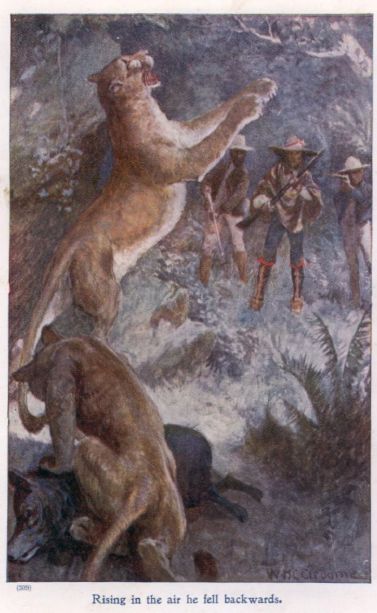
“Do you take the nearest,” said Don José, calmly, to John; “I will take the other. Reserve your fire, Harry, in case one of them should spring.”
He and John fired. The nearest puma gave a tremendous spring forward. I had my weapon ready, and drew the trigger. The bullet struck him, and, first rising in the air, he fell backwards, and lay without moving. The Indians rushed forward, and, with shouts of triumph, soon knocked out any sparks of life which remained in the animals. They then, fastening some sipos round the bodies, dragged them and the hog to the camp.
I had just time to measure one of them, before they were skinned and cut up. It had a body four feet in length; and a tail two and a half feet long, black at the tip, but without the characteristic tuft of the lion. Its limbs were very thick and muscular, to enable it to climb trees and spring a great distance. Its coat was of a light tawny tint, and of a greyish-white below.
The Indians, delighted with their prize, sat up the rest of the night cooking and eating the flesh, and telling anecdotes about the creatures. The puma (Leopardus concolor) will seldom face a man when encountered boldly. It attacks his flocks, however; and hunts deer, vicuñas, llamas, and, indeed, all animals it meets with except its rival, the jaguar. It takes post on the branch of a tree, pressing itself so closely along it as scarcely to be distinguished; and from thence springs down on a passing deer or other animal, seizing it by the head, which it draws back till the neck is broken. I shall have by-and-by to recount another adventure with pumas of a far more terrific character; so will say no more about them at present, except that we found the flesh very white, and much like veal.
We spent three days at the encampment. At length one evening Don José declared his intention of setting forth himself with Isoro. I begged that I might accompany him, and John also seemed anxious to go.
“No, Señor John,” said our friend; “it is your duty to remain and take care of your young sister. But I will consent to take Harry with me, and we will set forth to-morrow morning by daybreak. John, Arthur, and your servants will be sufficient to guard the camp; but do not move out beyond the point which intervenes between this and the pass, lest you may be perceived by any enemy travelling on it. And let me advise you also to be cautious how you receive any stranger who may perchance find his way here. At night be careful to keep a fire burning, and to set a watch. If you strictly follow my injunctions, I shall have no fear. I need not remind you of your young sister, whom it is your duty to watch over; and the consequences to her, as indeed to us all, would be sad through any carelessness.”
John, though evidently disappointed, promised to follow our friend’s advice. Next morning, even before the sun had risen above the tops of the eastern mountains, while the valley was concealed by a dense mist, which looked as if a sheet had been drawn across it, we were on foot, and had finished breakfast. Don José, Isoro, and I were each provided with long, stout staves. Our rifles were slung at our backs; wallets containing our provisions were hung over our shoulders; and our feet were shod with alpargates, which are sandals made of aloe fibres. They are invariably worn by the natives, as any ordinary boots would immediately be cut to pieces by the rocky ground. These, indeed, did not last more than three or four days. We had supplied ourselves, however, with a considerable number at one of the last places at which we had stopped, as well as with axes and wood-knives, and several other articles which we should require in our journey through the forest. We had obtained also two bales of cloth, some clasp-knives, glass beads, and trinkets, with which to pay the Indians for the services we might require of them.
Ellen came out of her hut just as we were ready to start. She seemed very anxious when she heard that I was to be one of the party. Don José, however, assured her that he would run into no unnecessary danger, and that our journey was absolutely necessary to ascertain whether our father had passed by that way, or was still in the mountains behind us. “I, too, am well acquainted with the country,” he added; “and even should any of our enemies come in this direction, I shall easily be able to elude them.”
I wished to take True with me; but Don José said that he would be of more use at the camp,—that he might possibly betray us where we were going, and insisted on his being left behind. Poor fellow, he gazed inquiringly into my face when I tied him up, to know why he was thus treated, and seemed to say, I thought, “You know I shall watch over you better than any one else, and you may be sorry you left me behind.” Our friend was, however, so peremptory in the matter, that I was compelled to yield to his wishes.
Bidding farewell to our friends, we took our way for some little distance along the path we had come, and then, turning off, proceeded northward, by which we should intersect, Don José said, another passage across the mountains. Had I not been in active exercise every day for so long, I should have found great difficulty in scaling those mountain heights; but my nerves were firm, and from so frequently looking down precipices, I no longer felt any dizziness, even when standing on the edge of the deepest.
We travelled on for several days—sometimes through forests, at others along the bare mountain-sides, above the region of vegetation. Some nights were spent in huts, which we erected for ourselves, such as those I have just described. The natives, when we stopped at their abodes, always received our friend with great respect and attention. The accommodation they could afford, however, was but scanty. They were built of reeds thatched with palm, and consisted of but one room.
I have not yet described the natives of this region. They were of a bronzed colour, with a sad and serious expression of countenance. They were seldom five feet high, and the women were even shorter. They had somewhat broad foreheads; their heads covered with thick, straight, coarse, yet soft, jet-black hair, which hung down their backs. Their mouths were large, but their lips were not thicker than those of Europeans, and their teeth were invariably fine. They had large, well-formed chins; cheek-bones rounded; their eyes somewhat small, with black eyebrows; and little or no beard. They had broad chests and square shoulders, and well-made backs and legs, which showed the strength possessed by them. They were pleasant-looking people. The men wore a short kilt, with a poncho over their shoulders; the women, a petticoat of larger dimensions.
They offered us, on entering their huts, cups of the guayusa tea. It is an infusion of the large leaf of a tall shrub which grows wild in that region. We found it very refreshing: though not so powerful a stimulant as coca, it supports the strength, as do the leaves of that plant, and we found it enable us to go for a considerable time without food. The cleanest corner of the hut was assigned us for our sleeping-place at night, with mats and dried leaves in the place of mattresses. Our friend made inquiries as to whether any white people had passed in that direction; and, by his orders, the natives were sent out to gain information. I saw that he was uneasy, though he did not explain to me the reason.
One morning we were on the point of again setting forward, when a native, with a long mountain-staff in his hand, entered the hut. He exchanged a few words with Don José.
“We must hasten away, Harry,” said our friend; “there is not a moment to be lost. The enemy have been tracking us, I find; but I trust that your father has escaped them, and will ere long gain the banks of the Napo, down which he may voyage to the Amazon. We shall be able to reach the same river by a longer route, along which there will be less fear of being followed.”
He made these remarks as we were throwing our wallets over our backs. Taking our staves, he leading, we hurried from the hut, following a narrow path which led up the side of the mountain. We had approached the hut by a lower and more frequented path than we were now taking; but we were, I found, going in the direction from which we had come on the previous day. Don José went first, I followed, and Isoro brought up the rear. Though I exerted all my strength, I had some difficulty in keeping up with my friend. Anxious as I was to obtain more particulars of what had occurred, we could not exchange words at the rate we were going. Every now and then, as we were climbing the cliffs, whenever I happened to look back I saw Isoro turning an uneasy glance over his shoulder. It was evident that we were pursued. We reached the edge of a deep ravine, which appeared to bar our further progress. Don José, however, without making any remark, continued climbing on along it; and at length I saw what appeared to be a rope stretched across the chasm.
“Hasten, master! hasten!” I heard Isoro cry out: I knew enough of the Quichua language to understand him.
We continued on till we reached the end of the rope, fastened to the stump of a tree, and stretched across the chasm to the opposite side, where it was secured in the same manner, a platform being raised to the same elevation as the rock on which we stood.
“Harry,” said my friend, turning to me for the first time, “I have seen your nerves thoroughly tried, and I know your muscles are well-knit, or I would not ask you to pass along this perilous bridge.”
The rope was formed of the tough fibres of the maguey—an osier which grows in the moist ground of that region. It possesses a great degree of tenacity and strength.
“Master, let me go first,” exclaimed Isoro, springing forward. “If it breaks with me it will matter little, and you will have still a chance for life.”
Without waiting for Don José’s answer, Isoro threw himself upon the rope, and, holding on by hands and feet, began to work himself along. I watched him anxiously. It was indeed a fearful mode of crossing that awful gulf; and yet I knew that I must pass as he was doing. I was thankful that the distance was not great, at all events. I breathed more freely when at length I saw him alight on the platform. I entreated Don José to go next. “It will give me more courage,” I said. “As you wish,” he replied. “Let me caution you, only before I go, to shut your eyes, and not to think of the gulf below you. You will then find the passage perfectly easy.”
Saying this, he took hold of the rope, and began to work his way across. Scarcely, however, had he got into the centre, when I saw Isoro pointing in the direction we had come from.
“Hasten! hasten!” he shouted out.
I looked round, and caught sight of two enormous hounds approaching at full speed. I could hear their loud, baying voices as they came on panting up the mountain-side. I did not hesitate a moment, when urged by Isoro to cross at once. “The rope will bear you,” he shouted out—“not a moment is to be lost!”
Seizing the rope, I shut my eyes and began the awful passage; for awful it was, as, in spite of my resolution, I could not help thinking of the deep chasm over which I was making my way. I should be unwilling again to attempt so fearful a passage; and yet, perhaps, once accustomed to it, I should have thought nothing of the undertaking. I was surprised when I felt my friend take my arm.
“You are safe,” he said; “lower your feet;”—and I found myself standing on the platform.
On opening my eyes, and looking towards the cliff from which we had come, I saw two huge blood-hounds, with open mouths, baying at us. Isoro, I should have said, had taken my rifle as well as his own, and placed it against the tree.
“We must get rid of these animals,” said Don José, “or they will betray the road we have taken.”
Saying this, he levelled his piece, and one of the dogs, as it sprung forward on receiving the bullet, fell over the chasm into the depths below. Isoro followed his master’s example. His bullet took effect; but the blood-hound, though wounded, was not killed outright, and retreated a few paces. I was afraid he would have escaped; but before he had gone far, he fell over, and after a few struggles, was dead.
“The animal must not remain there,” observed Isoro, throwing himself upon the rope; and in a few minutes he had again crossed the chasm.
Seizing the dog by the legs, he drew it to the edge, and hurled it after its companion. Then, searching about in the crevices of the rocks for moss and lichens, he strewed them over the ground where the dog had fallen, so as to obliterate the traces of blood. He was some time thus occupied before he had performed the operation to his satisfaction; and then he once more crossed the chasm, with as much unconcern as if he had been passing along an ordinary road. I proposed letting go the rope to prevent our pursuers following.
“That is not necessary,” said Don José. “It would cause trouble to our friends, and I doubt whether our enemies will venture to cross. At all events, the so doing would betray the route we have taken, and they may find the means of crossing some leagues further down the stream.”
We accordingly proceeded as before. We now came to a track, which, had I been alone, I could not have followed, as it was generally, to my eyes, altogether undistinguishable; yet Don José and Isoro traced it without difficulty. It now led us along the edge of a precipice, where, it seemed to me, so narrow was the space between the cliff on one side and the fearful gulf on the other, that we could not possibly get by. Our leader, however, went on without hesitation. At length he appeared to reflect that my nerves might not be as firm as his.
“Here, Harry,” he said, “take hold of the centre of my staff; Isoro will hold the other end, and you may pass without risk.”
I did as he directed, keeping my eyes away from the gulf as much as possible. Now and then the path became somewhat wider; then again it narrowed, affording just space to support our feet. I leaned against the cliff, unwilling to throw more weight than I could possibly help on the staff. I breathed more freely when we were once more ascending the mountain-side. We were making our way round a rugged point of rock, and Don José’s head had just risen above it, when he called to us to stop.
“I see some people coming this way,” he observed. “They may be friends, but they may be foes. Harry, I am sorry to have exposed you to this danger; for it is me they seek, not you. However, they have not seen us, and we have yet time to conceal ourselves. Fortunately I know of a place near here where we shall be able to do so; and unless yonder band have these savage blood-hounds with them, we may yet escape capture.”
Saying this, he began rapidly to ascend the mountain-side among the wild and rugged rocks with which it was covered. After climbing up for some distance, we saw before us a small opening in the rocks.
“This is the spot I was seeking,” observed our friend; “and unless it is known to our pursuers, we shall here remain in security till they have passed by.”
He leading the way, we all entered the cavern. It soon opened out into a large chamber with rugged sides. The passage to it also had several buttresses or projecting rocks, behind which we might take post, and could have fired down without being seen on any one approaching. From the entrance, also, we could watch the pathway by which we had come; and it was so small and overgrown with shrubs that it could not be perceived at any distance. Don José told me to climb up behind one of the rocks, while he and Isoro took post behind others. So completely were they concealed, that I could not discover where they were except by their voices. We waited anxiously, till at length a band of armed men was seen winding round the hill. Already they had passed under the cave.
“We might follow, and without difficulty hurl every one of those fellows into the abyss below,” observed Don José. “But we will spare them; they obey but the orders of their superiors.”
After waiting a little time longer, Don José emerged from the cavern, and looking about, told us that the road was clear. We accordingly descended, though it required great caution to avoid making a rapid descent into the deep ravine below us. For the greater part of the day we continued toiling on, supported by the coca with which we occasionally replenished our mouths. At length, towards evening, we made our way to a native hut, where we were received as usual. Here hammocks were slung for us between the pole on which the roof rested, our hosts undertaking to keep careful watch to prevent surprise.
I had become very anxious about the rest of our party, fearing that they might have been discovered. At the end of two more days I recognised the features of the spot where we had left them. No one was to be seen. My heart sank. Had they been seized and carried off to Quito, or had they made their escape? Great was my satisfaction when, on rounding a rocky point, I caught sight of the huts, and saw Arthur running towards us. “We are all well—very thankful to see you return!” he exclaimed, “for we began to fear that you might have been lost.” Directly afterwards John and Ellen emerged from their huts, and now all the party were gathered round us. Poor dear Ellen welcomed me with tears in her eyes. Her spirits revived when Don José told her he had reason to believe that our parents were in safety. True could not restrain his joy, but kept leaping up and licking my hands and face, and jumping round and round me. Wherever I went he closely followed, determined not again to lose sight of me. At supper he sat by my side watching my face, nor would he leave me even though John and Arthur tried to tempt him away with offers of bits of pork or parrots’ legs.
All the party were eager to set out at once, but it was necessary before we could do so to procure bearers to convey our luggage along the long and intricate path we had to take through the forest. This our friend undertook to do by the following day from a village at no great distance off.
The next morning a dozen stout natives—young, active men—made their appearance. They all had at their backs large baskets bound by withes passing across the forehead and chest. They were but lightly clothed. A small poncho covered their shoulders, and the usual cloth and kilt was worn round the loins, a wisp of leaves preventing their backs being chafed by their burdens. Each man also carried a long staff in his hand, and a bag of roasted corn as provision for the journey. The burdens were soon adjusted. One of them had a sort of chair at his back, which Don José had ordered to carry the señora, as Ellen was denominated. She insisted, however, that she was well able to walk, and not without difficulty we persuaded her to take advantage of the conveyance which had been provided.
We forthwith set out, and descending the mountain, were soon in the midst of the thick forest. Two of the Indians, who carried lighter burdens than the rest, went ahead with axes in their hands to clear the way. It was extraordinary with what rapidity they cut through the sipos, or hanging vines, which threw their serpent-like coils from tree to tree. So quick is their growth in that moist region, that other travellers following in a few weeks would have to perform the same operation, our friend told us. As we advanced the forest became thicker and thicker, the dark foliage forming a lofty vault through which no sunlight can ever enter. The air felt cool and excessively damp, compared to the exposed sides of the mountains. A constant mist seemed to hang on the branches. Not a sound was to be heard; scarcely a bird did we see in the swampy shades. The stillness and gloom, indeed, became almost painful. From the lofty trees hung down thousands of lianas, or air-roots, some forming thick festoons, others perfectly straight, of all lengths, many reaching almost down to our heads, others again touching the ground and taking root in the soft earth. Here and there some giant of the forest, decayed by age, had fallen, to remain suspended in the loops of the sipos. Thus we went on, following in Indian file. I kept near Ellen to cheer her up, while True followed close at my heels, every now and then licking my hands and jumping up, as if to ask me what I thought of the strange region we had entered. We found it rather difficult to converse. Sometimes we walked on for a considerable distance in silence.