The Tale of our Kite.
Reading edition
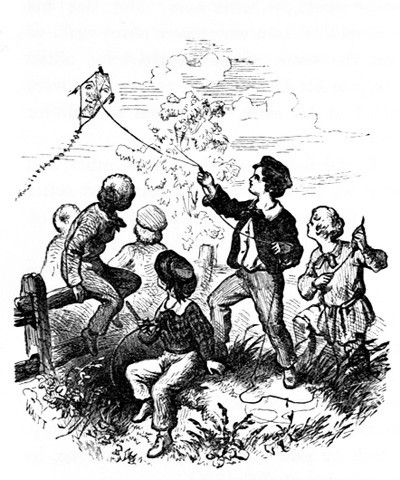
One bright October afternoon, when I was about twelve years old, for some reason there was no school; so half a dozen of us went out into a great field that adjoined our play-ground, to try a new kite which we had hired one of the big boys, who was a great hand at such things, to make for us.
It was a handsome round-headed kite, with a broad jolly face very cleverly painted on it. Because of this face, we gave it the name of "Diddle Diddle Dumpling," in honor of that old rhyme, in which a youth named "John" is said to have gone to bed with "one stocking off and one stocking on."
The first time we tried to raise it, like the negro minstrel's chicken, its "tail" was "too short to fly high," and it went darting and pitching and bobbing its jolly head about in so many directions, and in such queer, drunken ways, that if we had not known Diddle to be a most proper individual, we should have supposed he had been taking something to drink, and it had "gone to his head." But, as I said above, the trouble was not with his head; and besides, although it is the nature of kites usually, to "get high" whenever they have a chance, we knew that Diddle had never got so.
After we had added another bob or two, and pinned (I was half afraid the pin would make him dart about more than ever) a tuft of slashed paper to his tail, we tried him once more.
One boy climbed up on the fence, and held Diddle as high as he could—another held his tail, which was already squirming about, but I think it was the wind and not the pin, that made it—while I held the string and was to do the running. When they cried "Ready!" I started, at the top of my speed, across the field towards the woods, which were about a quarter of a mile off.
At the first bound I made, up shot Diddle like a rocket, with his long, graceful tail streaming behind him;—up, and up, and up, till the distance seemed to rub his jolly face out. First the laughing wrinkles disappeared, then his eyes, then his fat rosy cheeks melted away; and, last of all, his fiery nose went out, and there was nothing to be seen of our kite but a little speck floating like a bird away up in the blue heaven.
By this time we had almost reached the woods, and had climbed up on a fence to rest, and watch Diddle.
We had not sat there long, before bang! went a gun just behind us. We had been so still, and the report was so sudden and so near, that we were nigh tumbling off the fence from the shock. We turned around just in time to see a flock of blackbirds rise out of the woods like a drift of black leaves carried up by a swoop of wind. At first they rose almost straight up into the air, and then swept away over the school-house, directly toward our kite, which they soon hid from our sight entirely.
Some minutes passed before we got sight of poor Diddle again, and very soon after we decided that it was time to get him down and go home. So I began to pull in the string, while the other boys took turns in winding it up.
Nearer and nearer he came; but just as his flaming nose began to show itself clearly, we noticed a black spot which seemed to be almost directly over it. We all wondered what this could be, for we knew it was not there when Diddle went up.
Faster and faster I pulled in the string, and nearer and nearer came the kite, when what should the spot be but a dear little blackbird, perched quietly on the upper rim of it! But what made him sit there? we wondered. Why didn't he fly away and join his companions, that were now just vanishing into the far distance? Nearer and nearer it came, to our very feet.—
He was dead!
One little crimson drop that had rolled down his glossy breast, and fallen upon Diddle's cheek, like a tear of blood, told the story. He had been shot.
Poor little bird! He had flown up with the others, and had tried to follow them; but, faint with pain and bleeding, he could not keep up, and so, as the flock was passing our kite, he had settled down upon that, hoping, may be, that the pain in his little breast would get better soon. But, alas! his gold and crimson wings were never again to beat the sunny air as he piped his blithe gossip to his dusky-winged mate: they were folded at his sides, and would be still for ever.
We did not say much to each other, and what we did say, was in a lower and softer tone than usual; for the piteous history of the little bird had touched our hearts.
At first we decided to make a little coffin and bury him. But, suddenly, I remembered that my uncle, the doctor, sometimes stuffed birds and animals; so I proposed that we should go to him, tell the story, and ask him to stuff our blackbird. Uncle was a kind-hearted man, and, after listening to the story, which he said was a very singular one, he promised to stuff the bird.
In about ten days he gave it back to us, looking almost alive. We took it, fixed its little feet on the kite, just as they had been, and persuaded our teacher to put it up on the top of his mineral cabinet; and there it stood all the rest of the time I went to that school.
May be it stands there yet.