The Stolen Birds' Nest.
Reading edition
"In these summer bushes Listen to the thrushes— Hear the robin and the wren call from tree to tree: Hear how all day long The woods o'erflow with song, And how every leafy branch blooms with melody! Do you not feel sorry, Seeing me in sadness, When the other little birds are so full of gladness?" Clarence Cook.
In one of the sunniest and sweetest countries in the world, the south of France, lived my heroes, two little peasant boys, named Auguste and Leon Duval. Their fathers were brothers, and vine growers on the estate of the Count de Vallence. The little cousins were excellent friends, and almost always seen together, following their fathers through the beautiful vineyards, gathering up the branches which they had pruned away, or helping to pick grapes at vintage-time, or straying through the grand old woods of the chateau, searching after nuts and wild berries. They usually agreed very well, both in work and play, but they sometimes had their little quarrels like too many other children. Auguste was full two months the elder, and he was apt to presume upon that, and be proud and overbearing towards Leon. He was shrewd and somewhat selfish, and frequently took advantage of his cousin, who was almost too confiding and generous. They were beautiful boys; perhaps Auguste was the most admired of the two, for he had a rich brown complexion, with glowing cheeks and lips, glossy raven curls, and bold, black, handsome eyes. Leon was the fairer; he had brown hair, and deep, soft, brown eyes, which however, could flash in anger; lips like wild rose leaves, fresh and sweet, but which could curl in scorn at cruelty and meanness. Usually his face wore a very mild and amiable expression, and if Auguste was the most admired, Leon was the most loved.
In the woods of the chateau the cousins sometimes met the Countess Marie, the pretty young wife of the Count de Vallence, who loved to walk in the cool, green forest paths. She was attracted by the beauty, simplicity, and arch playful ways of the merry boys, and often whiled away an hour in talking with them and watching them in their sports. Once she took them with her to the chateau, and showed them the lofty rooms, the pictures, statues, fountains, and conservatories, enjoying much their wonder and pleasure. That which gave them most delight was the aviary, where there was a fine collection of talking and singing birds—magpies, parrots, macaws, canaries, goldfinches, English black-birds, and many other kinds. As they were looking at these, the countess said to the old servant who had charge of them,—"Pierre, why have we no robins?"
"I did not know that my lady would care for such common birds," answered the old man.
"Care for them! I think they are the sweetest songsters in the world. I once saw one at Paris that could sing several opera airs. Could you teach them to sing so, Pierre?"
"Yes, my lady, if I had them young," he replied.
"Well, then, we must have some," said the lady, decisively; "my bird-choir is not complete without them; so remember, Pierre!"
Just as the Countess was dismissing her little friends at the hall door, the Count de Vallence entered. He was a stern, haughty man, and now seemed astonished and shocked at seeing his countess making so much of a couple of peasant boys. He drew down his black eyebrows, and looked so grim, that they were glad to escape, and the good Countess never took them there again.
Shortly after this visit, it happened that one day while little Leon was alone in the woods, searching for berries, he discovered a nest of young robins, built in a snug, shady place, against a large branch of an old oak tree. Leon stood for a long time silently watching the little, downy, chirping things, and the happy parent-birds, who were bringing them food, and dropping it into their wide gaping bills. They patiently flew back and forth, and brought worms, flies, and berries, till the greedy little bills gaped and chirped no more—then the good father-bird perched on a limb above the nest, began singing a sweet, tender song, while the kind mother-bird brooded over her darlings, as the dewy twilight was coming on.
Leon was so delighted with his new-found treasure, that the next morning he brought his cousin to the spot. When Auguste saw the nest, his eye flashed with eager joy.
"Ah," he exclaimed, "how lucky we are to find a nest of young robins for the dear Countess! Let us take them to her, and she will give us more money than we have ever seen in the world;" and Auguste began immediately to climb the old oak tree.
"Oh don't, don't, cousin Auguste!" cried Leon, clinging about him. "It would be a cruel, wicked thing to steal away those poor little birds—don't you see how dearly the old birds love them?"
Auguste thrust him back, exclaiming angrily—"Didn't the Countess say she wanted some young robins for her aviary?—then how dare you say it would be wicked to get them for her!" But Leon answered sturdily—
"The good curé says God takes care of the birds—He gave the little robins to the old ones, just as He gave us to our fathers and mothers; so it must be wicked to steal them away. And now, cousin dear, do come down and let them be."
But Auguste had already grasped the nest. He tore it away from its place, and slid with it down the tree. The old birds flew about him in the utmost distress, uttering wild, piercing cries of fear and sorrow. Leon's tender heart was touched by their grief—he expostulated and pleaded with his cousin, and then, seeing that entreaties were in vain, grew very angry—he even doubled up his little fists, and was about to fight for the liberation of the tiny captives. But he remembered in time the pious teachings of his mother and the good curé, and returned home, with a swelling heart and tearful eyes, while his cousin hurried off to the chateau, with the robins.
When Leon told his mother the story of the birds, she was very indignant, and started to seek Auguste's father, and ask him to send after the cruel boy, and compel him to restore the young robins to the old ones, for her kind mother-heart felt for them very much. But when Leon told her that they were taken for the Countess, she sat down to her work again, and said it was all well, for she had a great awe of the great lady.
Leon hoped in his heart that the good Countess would refuse the birds, and send Auguste back with the nest; so he waited as patiently as he could for his cousin's return. He came back, however, without the nest, triumphantly jingling a handful of silver coin.
"See," he cried, "what the Countess gave me for the robins! Here, Leon, is your share."
Leon took the money, but only to fling it all indignantly at his cousin's feet, bursting into tears as he did so. Some may think I ought to be sorry to tell of this fit of passion in my noble little hero, but I am not. While the angry tears were yet flowing, he rushed out of his father's cottage, and ran towards the chateau. He did not stop to rest, or slacken his pace till he reached the great hall door. Then he paused, and the thought of the dusky arches of the old hall, hung with faded banners, and the grim statues in armor standing along its walls, and that stern, black-bearded Count, whom he might meet, almost took away his courage. He stood poised on the tips of his toes, with his hand on the great knocker, hesitating and fearing, when, all at once, he seemed to hear again the wild, mournful cry of the poor mother-robin!—then his heart grew brave, and he boldly sounded the knocker.
When a servant went to the Countess and told her that another little peasant boy wanted to see her, she happened to be in the nursery, paying a visit to her baby-son, the heir to the title and estates of the Count de Vallence. She was sitting by his side, fondly watching him, as he lay asleep in a beautiful little cradle, all satin and down, and fine linen and rich lace. The lady looked surprised when she saw Leon's flushed and tearful face.
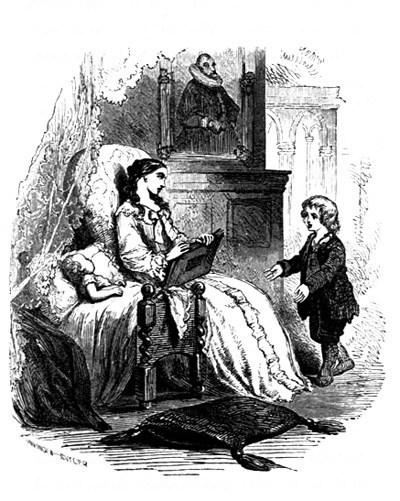
"Why, my child," she said kindly, "what do you want of me?"
"I want those little birds," he replied rather bluntly.
"Those birds!" she answered, "why, did not Auguste give you part of the money? I told him to."
"I don't want any money," said Leon, "I want the birds back again. It wasn't good of you to buy them—their father and mother are grieving for them. It was a wicked thing to steal away their little ones, and the nice nest they had worked so hard to make. Aint you afraid that they will fly up to God and tell him all about it? And how would you feel to have some great giant's boy come and steal your little one, and carry it away in that pretty nest, there?"
At first, the Countess smiled at this earnest little speech—then the tears rushed to her eyes; she bent down and kissed her sleeping babe, then, turning to Leon, she laid her hand caressingly on his head, saying, "I thank you, my dear child, for the lesson you have taught me. Surely you shall have the little robins back again. I have done wrong to buy them. I ask pardon of you, and of God."
"And of the birds," added Leon.
"And of the birds," repeated the Countess, smiling a little at the child's simplicity.
So Leon received the nest of little young robins, and took it safely back to the old oak tree in the forest. He stopped on the way to dig some worms, with which he fed his little feathered friends, who were getting quite clamorous with hunger. When he had fixed the nest securely in its old place, he hid himself in a clump of bushes near by, to watch for the coming of the old birds. All the afternoon he watched and waited, and still they did not come.
At last, when it was almost twilight—the time for flowers and little birds to go to sleep, he saw the two robins—he was sure they were the same birds—come slowly winging their way towards the oak. It seemed they could not sleep away from their home, although it had been made so desolate. The male bird flew in among the upper branches, and perched on one of them; but the female bird stopped in a tree near by. It appeared that she was hardly equal to the sight of the dear old place.
Soon Leon saw the male bird flutter on his perch, and turn his head quickly this way and that. He had heard those little complaining voices chirping below him!—then he darted downward and hovered over the nest a moment, to be sure they were all there, then flew to his mate, to tell her the glad news. In another moment, they were both back by the nest, hopping and hovering about it—chirping joyfully and lovingly in answer to the eager little chirps of their young ones. Late as it was, they flew about, and got up a nice little supper of worms for their darlings. After that, while the mother-bird spread over them her soft warm wings, and hushed them to sleep with the happy beating of her heart, the father bird flew up to a branch above them, and burst into a glad, delicious song.
"He is thanking God," said Leon softly to himself, reverently taking off his little cap, and making the sign of the cross—"he is thanking God."