ENVOY AND THE MORAL?
Reading edition
“I am here in a strange land and have perhaps the seat of honor at table in this inn; but the man down there on the end has just as good a right here and there as I, since we are both here only guests.”
Martin Luther: Sermons. Jubilate, 1542.
It is not very much the fashion in these modern days to ask for the moral meaning of things, but we are old-fashioned enough to hold with those who believe that things have not only a soul, but that they give us a lesson too in revealing their soul to us, “la leçon des choses,” as the French, whom we are inclined to call condescendingly the immoral French, call it. Old Frederic the Great in his famous interview with the poet Gellert in Leipzig, after hearing from him one of his fables “The Painter of Athens,” did not fail to ask the all-important question: “And the Moral?”
Many a reader who has followed us but hesitatingly into regions that seemed to him at the beginning of doubtful moral value, will be perhaps surprised to see us conclude our investigations with this same question. But I am sure we will do it with good profit, since in doing so we shall have the chance to hear many a sermon of Doctor Martinus Luther, whose moral force we children of the twentieth century would love to dig out of his writings if its gold did not seem to us so hopelessly buried under the sand of antiquated dogmatical quarrels.
The tavern sign has its moral lesson for all concerned, guests and landlords alike. From its modest and unknown creators the modern artist too may receive many a valuable inspiration. When the poet Seume, in December, 1801, started from Grimma in Saxony on his long pilgrimage to Syracuse, his way seems to have led him soon to a knightly George, who fights the dragon in all Christian lands, over many a tavern door for centuries and whom Shakespeare celebrated in the verses:—
“St. George that swindg’ed the Dragon, and e’er since Sits on his horseback at mine hostess’ door.”
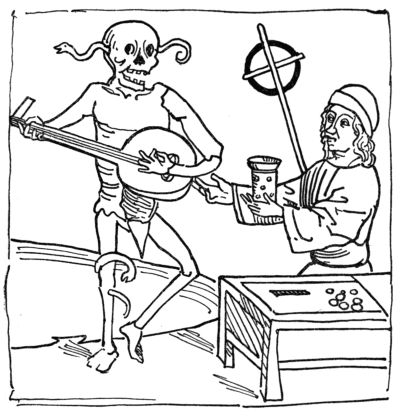
Looking at the great green beast our romantic pilgrim prayed: “May heaven grant me honest, friendly landlords and polite guardians at the city gates from Leipzig to Syracuse!” In those old days when the gate was dangerously near the tower and its dungeon, it was indeed of the highest importance to find polite officials at the city gates; just as we might sometimes pray to-day for polite customs officials, the successors of the old grumpy watchmen who guarded the city entrance and wrote the newcomer’s name in their big books. Still more important, too, is it for the modern traveler to find friendly landlords. They seem as in the old days a gift from heaven, for which we must pray and which we cannot buy. Truly many travelers seem to think a full purse buys everything, but they forget the old truth which Charles Wagner, in his book “La vie simple,” has expressed rightly in the following sentence: “Le travail d’un homme n’est pas une marchandise au même titre qu’un sac de blé ou un quintal de charbon. Il entre dans ce travail des éléments qu’on ne peut évaluer en monnaie.” And just these fine elements in the work of a landlord and his servants which we cannot weigh or pay for make the simplest inn so homelike and cozy. A good landlord does not need to fear even Death, who seems to seize only the dishonest one, if we believe the author of a “Dance of Death” from the fifteenth century in the Stuttgarter Hofbibliothek. In a few forceful lines the old artist traces the figure of the bad landlord sitting behind his counter and trying to win the good favors of the uncanny musician Death, by offering him a great stein of beer and humbly confessing: “Against God and against law I sought to win earthly goods, taking money unjustly from knights and peasants as a robber does. Oh, if I only should not die now, I could hope to improve and to win grace.”
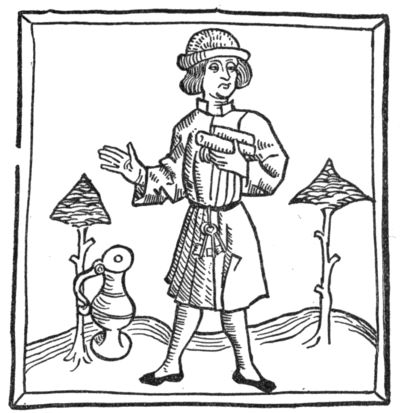
Many a landlord would gladly follow the example of Abraham if only his guests would try to learn a little from the angels. But how often come to him such wild fellows who claim every good thing he has in cellar and kitchen, and when it comes to pay take French leave.
It is well known that, as the old Bible saying goes, the sun is shining over good and bad, over just and unjust, but Luther thought he does not do it gladly. Perhaps the Doctor, who knew so many roads from his own experience, even thought of the golden tavern sun when he said: “The sun would prefer that all the bad fellows should get not a single little gleam from him and it is a great grief and cross to him that he must shine over them, wherefore he sighs and moans.”
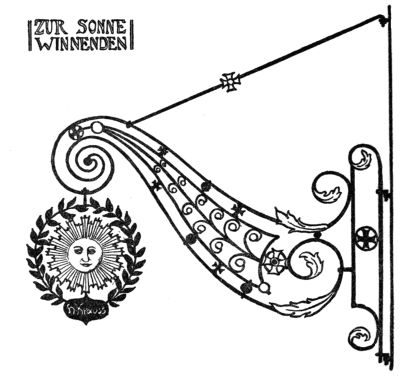
ZUR SONNE WINNENDEN
Nobody has admonished us so heartily as Doctor Martinus to hold ourselves as pious guests in this inn of Life, to live honestly and decently in it as it becomes a guest. “If you wish to be a guest, be peaceful and behave yourself as a Christian; otherwise they will soon show you the way to the tower.” It is characteristic for Luther to remind the unruly guest of the tower, i.e., the prison. In other connections too he readily refers to Master John the Hangman who is to his mind a very useful, nay, even charitable man.
Since we did not hesitate to threaten the landlord with the ghastly musician of the “Dance of Death,” it will seem only fair to remind the guests of the tower, which in the old days was used as prison for the peace-breakers. Luther, like all good Germans, was not a prohibitionist; he recognized “a drink in honor,” “einen Trunk in Ehren,” but he was a fierce enemy of all “drunkards and loafers” who lie in taverns Sunday and week-day and pour the beer down their throats as cows gulp water, saying: “What do I care about God, what do I care about death? You miserable hog, you shall get what you are striving for, you shall die too and be swallowed up by the mouth of Hell.” To every decent landlord such guests are a curse. To chase them from his threshold the owner of the “George and Dragon” in Great Budworth (Cheshire) invented the fine rhyme which should stand over every tavern door:—
“As St. George in armed array Did the fiery dragon slay, So may’st thou, with might no less, Slay that dragon drunkenness.”
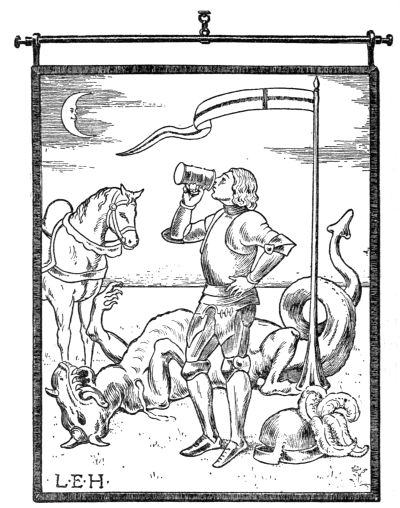
A decent behavior surely, but no melancholy teetotalism, such is Luther’s standpoint. “Those have not been of the devil who drank a little more as their thirst required and became joyful.”—“It is not the fault of the eating and drinking, that some people degrade themselves to swine.” Just as dancing in itself is no sin: “Why not admit an honorable dance at a marriage feast? Go and dance! The little children dance too without sin; do the same and be like a child whose soul is not injured by dancing.”
The whole world appears to Luther like an inn in a strange town, in which the pilgrim lies. In his nightly dreams he does not think of becoming a citizen or a major of this town, his thoughts wander away through the gate to the far city where his home is.
To the pretentious traveler his description of “Christ’s Inn,” which reminds us of our Swiss sign, “Hie zum Christkindli,” might serve as a little lesson in modesty. Thus he speaks about it in a Christmas sermon: “Look, how the two parents in a strange land in a strange city search in vain for good and hospitable friends. Even in the inns was no room, since the city at that time was so crowded. In a cow-stable they had to go and make the best of it as poor poor people! There was no couch, no linnen, no cushions, no feather-beds; on a bundle of straw they made their bed as close neighbours of the good cattle. There in a hard winter-night the noble blessed fruit was born, the dear child Jesus.” And in another Christmas sermon he says: “If you look at it with cow’s or swine’s eyes it was a miserable birth ... but if you open your spiritual eyes you will see countless thousands of angels, filling the heaven with their song and honouring not only the child but the manger too in which it lies.”
Everything depends finally upon the way we look at it, if with cows’ eyes or with spiritual eyes. Only these will enable us to see in the poorest inn the angel of hospitality covering us at night with gentle wings. Till finally Mother Earth shall cover us softly in our last quiet “Deversorium” in which we have at least the hangman’s comfort: “You shall be called to no more payments, fear no more tavern bills which are often the sadness of parting as the procuring of mirth.”
But we must not end without delivering a little sermon to the signs, too, that still glitter in the warm sunshine. To them, cocks, deer, bears, oxen, and horses, a church-tower cock, celebrated by the humorous clergyman poet Möricke of Schwabenland, gives this solemn warning:—
“You poor old iron things, Why should you be so vain? Who knows how many springs You will up there remain?”