Chapter XII · THE ENEMIES OF THE SIGN AND ITS END
Reading edition
“Ne songez pas même à réformer les enseignes d’une ville!”
In mediæval times the signs were not only charming or pious decorations of the snug narrow streets, but they were also very useful and practical guides for the wayfarer through the labyrinth of crooked lanes. Even the uneducated understood their pictorial language like illustrations in a book which give even to a child a certain clue to its meaning. For this very reason the learned Sebastian Brant decorated his edition of Virgil of 1522 with elaborate pictures,—expolitissimis figuris atque imaginibus nuper per Sebastianum Brant superadditis,—firmly hoping that now even the unlearned would easily understand the beauties of his beloved author: “Nec minus indoctus perlegere illa potest.” While the learned men in general continued to despise pictures in their editions of the classics, the first popular books tried through their wood-cuts to speak to the fancy of the common people and thus win their applause. Just as these pictures in the old books, so the signs in the streets spoke to the indoctus. Therefore, if somebody wished to send a letter to his banker in Fleet Street, London, he needed only to tell his messenger that it was at the “Three Squirrels,” and he was sure that even the greatest numskull could find it. Unfortunately the owners of this old banking-house have withdrawn the sign, so it took me quite a while before I found it safely hung up on a modern iron arm in the office of Messrs. Barclay & Co., No. 19, Fleet Street. The characteristic interpretation of the sign, given to me by the banker himself, was: “May you never want a nut to crack.”
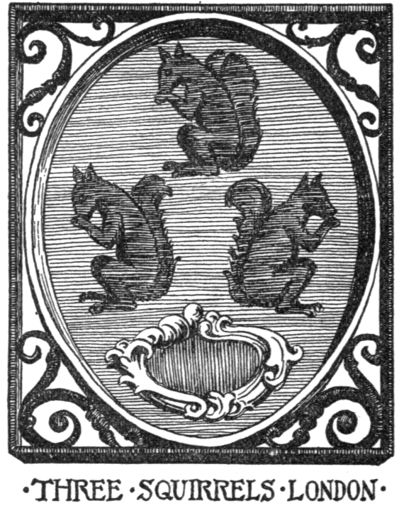
·THREE·SQUIRRELS·LONDON·
In the old times the streets were not yet numbered, as Macaulay tells us, not even at the end of the seventeenth century. “There would indeed have been little advantage in numbering them; for of the coachmen, chairmen, porters, and errand-boys of London, a very small proportion could read.... The shops were therefore distinguished by painted signs, which gave a gay and grotesque aspect to the streets. The walk from Charing Cross to Whitechapel lay through an endless succession of Saracens’ Heads, Royal Oaks, Blue Bears, and Golden Lambs, which disappeared when they were no longer required for the direction of the common people.” As a useful guide to find one’s way the sign was expressly recognized by the state authorities; so in a privilege granted by Charles I to the inhabitants of London to hang out signs “for the better finding out such citizens’ dwellings, shops, arts, or occupations.” For the landlords, it was even made obligatory so as to facilitate the police in determining if the laws concerning the liquor trade were properly observed. An Act of Parliament in the reign of Henry VI forced the brewers to hang out signs and an ordinance of Louis XIV for Paris distinctly demands: “Pour donner à connoître les lieux où se vendent les vins en détail et si les réglements y sont observez, nul ne pourra tenir taverne en cette dite ville et faubourgs sans mettre enseigne et bouchon.” Similar regulations we find in Switzerland; as, for instance, in Maienfeld where the city fathers punished every one who kept tavern without an “open sign.” Through such restrictions they hoped to stop the competition of the simple burgher, “the temporary landlord,” who tried to sell the surplus product of his own vineyard, and thus to secure the patronage of all thirsty souls for the legal “Schildwirt,” the landlord with a sign, even if he lived only from the “bouchon” or cork and could not accommodate guests overnight.
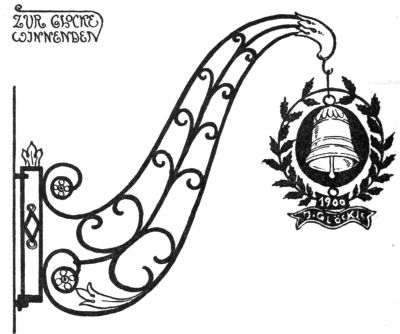
ZUR GLOCKE WINNENDEN
If they had not a sign out, how could the watchman, after the night-bell—sometimes called “Lumpenglocke” in Germany—had sounded, investigate properly if the tavern-keepers really stopped to furnish the guests with new wine? And was it not the duty of the city fathers to look after the morals of their subjects and to teach them the wisdom of the German saying:—
“Er hat nicht wol getrunken, der sich übertrinket. Wie ziemet das biderbem Mann, daz ihm die Zunge hinket?”
So the sign was in many ways a useful institution topographically, politically, and morally. Its merits are not yet exhausted: it was a good weather prophet, too. When the old iron things began to moan and to squeak, storm and rain surely were not far, as an English rhyme whimsically says:—
“But when the swinging signs your ears offend With creaking noise, then rainy floods impend.”
How was it possible, then, that such an institution as our amiable sign, approved and furthered by the State, such a popular, often artistically charming creation, could have enemies? The first reason, as we have seen in our chapter on “Religious Signs,” was that pious signs were used by impious innkeepers or that religious themes were represented in a manner insulting to all religious feeling. No wonder, if a French landlord called his tavern “Au sermon,” and illustrated the word “sermon” by a deer (cerf) and a mountain (mont), that the really pious citizen protested and exclaimed indignantly: “Ne devrait-on pas condamner à une grosse amende un misérable cabaretier qui met à son enseigne un cerf et un mont pour faire une ridicule équivoque à sermon? Ce qui autorise des ivrognes à dire qu’ils vont tous les jours au sermon ou qu’ils en viennent.”
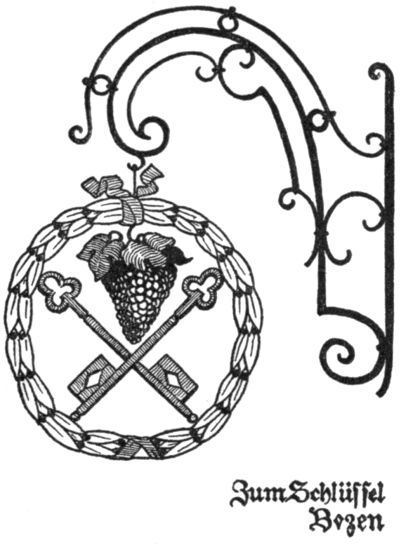
ZUM SCHLÜSSEL BOZEN.
Surely the really pious signs subsisted beside their frivolous brothers, as the English doctor-sign of 1623, beautifully carved and gilded and now a treasure of a collector, proves by its inscription: “Altissimus creavit de terra medicynam et vir prudens non abhorrebit illam.” Curiously enough, the schoolmaster souls took offense at the sign’s absurd combinations, its lack of “sound literature and good sense,” its impossible orthography and ridiculous mottoes, which, by the way, were added only later to the pictures. All this was extremely shocking to these people and many of them thought it a noble life-task to reform the signs. One of these reformers developed his programme in one of the oldest English periodicals, “The Spectator,” in an April number of the year 1710, fully aware of attempting an herculean labor. Combinations, such as “Fox and Goose,” he deigns to admit; but what sense, asks he, in logical indignation, “is in such absurdities as ‘Fox and the Seven Stars,’ or worse still, in the ‘Three Nuns and a Hare’?” Molière, in “Les Fâcheux,” has ridiculed these sign reformers, a species not unknown in Paris either, in the person of Monsieur Caritidès, who humbly solicited Louis XIV to invest him with the position of a General Sign Controller. His petition reads, in Molière’s inimitable French, as follows:—
Sire:
Votre très-humble, très-obéissant, très-fidèle et très savant sujet et serviteur Caritidès, Français de nation, Grec de profession, ayant considéré les grands et notables abus qui se commettent aux inscriptions des enseignes des maisons boutiques, cabarets, jeux de boule et autres lieux de votre bonne ville de Paris, en ce que certains ignorants, compositeurs des dites inscriptions, renversent, par une barbare, pernicieuse et détestable orthographe, toute sorte de sens et de raison, sans aucun regard d’etymologie, analogie, énergie ni allégorie quelconque au grand scandale de la république des lettres et de la nation Française, qui se décrie et déshonore, par les dits abus et fautes grossières, envers les étrangers, et notamment envers les Allemands, curieux lecteurs et inspecteurs des dites inscriptions ... supplie humblement Votre Majesté de créer, pour le bien de son État et la gloire de son empire une charge de contrôleur, intendant-correcteur, réviseur et restaurateur général des dites inscriptions et d’icelle honorer le suppliant....
In all impartiality we have to admit that really the sign lost by and by its usefulness as a street-guide, since the trades and crafts occupying a house changed often, while the old signs, especially those which formed a part of its architecture, remained unchanged, thus producing the most ridiculous contradictions against which the above-mentioned reformer of “The Spectator” protested not without reason, saying: “A cook should not live at ‘The Boot’ nor a shoemaker at ‘The Roasted Pig.’”
But the most ruthless enemy of the sign became the police itself, who once protected it. As early as the year 1419 we find an English police regulation, threatening with a fine of forty pence—in those days quite a sum—“that no one in future should have a stake bearing either his sign or leaves, extending or lying over the King’s highway, of greater length than seven feet at most.” As every innkeeper tried to outdo the other by the size and the magnificence of his sign, one arrived finally at absurdly great constructions which really hampered the traffic: as in England, where we find wrought-iron signs which, like arches of triumph, reached from one side of the street to the other. A precious old book, “A Vademecum for Malt-Worms” (British Museum), in a quaint woodcut, “The Dog in Shoreditch,” gives us a picture of such a sign monument. To the artist’s eyes they were charming things, combining happily great lanterns with the sign into a harmony which we so often find lacking in modern days, where beautiful old signs through the addition of ugly modern lamps lose all their artistic charm of yore.
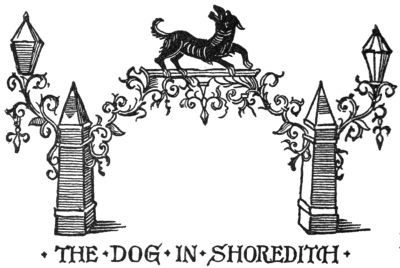
·THE·DOG·IN·SHOREDITCH·
Mercier’s “Tableau de Paris” tells us of ridiculously great signs: spurs as large as a wheel, gloves big enough to house a three-year-old babe, and the like. In old Germany, too, the sight of the giant signs, as Victor Hugo describes them from Frankfurt-on-the-Main, must have been fantastic enough. “Under the titanic weight of these sign monuments caryatides are bowed down in all positions of rage, pain, and fatigue.” Some of them carry an impudent bronze negro in a gilded tin mantle; others an enormous Roman emperor—a monolith of twenty feet in height—“dans toute la pompe du costume de Louis XIV avec sa grande perruque, son ample manteau, son fauteuil, son estrade, sa crédence où est sa couronne, son dais a pentes découpées et à vastes draperies.”
Especially objectionable to the police in London were those signs that reached far out over the street and, shaken by the wind, constituted a real danger to the passer-by. So the fall of such a huge inn sign in Fleet Street, London, in 1718, caused the death of two ladies, a court jeweler, and a cobbler. Similar dangers threatening an innocent public were vividly set forth in a Parisian police ordinance in 1761, in an amusing bureaucratic French: “Les enseignes saillantes faisaient paraître les rues plus étroites et dans les rues commerçantes elles nuisaient considérablement aux vues des premiers étages, et même a la clarté des laternes, en occasionnant des ombres préjudiciables à la sureté publique; elles formaient un péril perpetuellement imminent sur la tête des passants, tant par l’inattention des propriétaires et des locataires sur la vétusté des enseignes ou des potences, qui en ont souvent abattu plusieurs et causé les accidents les plus funestes.”
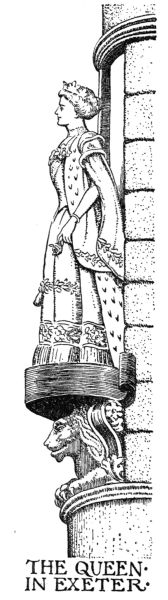
THE QUEEN·IN EXETER·
If the police had contented itself in eliminating the offensive or really dangerous signs, nobody could have blamed it. Unfortunately it was much more aggressive, especially in France, the paradise of the “ronds de cuir,” and attempted to cut down every individual or artistic invention on the part of the signmakers. We are, therefore, not surprised to find so little in modern France that could remind us of the old abundance. The officials of the Revolution proved themselves just as narrow-minded as those of royal times. Both, animated by the bureaucratic instinct to confine everything to narrow rules, tried to suppress all individual poetical invention that once was the charm of the sign. A royal edict of 1763 prescribes a very uninteresting design as a binding model for all signs, giving at the same time the exact measurements of the same and warning the public not to dare to make any changes on the “dessein cy-dessus marqué.” It was a poor consolation for the owners of beautiful old signs that the same edict granted them the great privilege of giving their art-treasures in account as old iron—“quinze deniers la livre”—when paying the bill for the new sign patented by the State. Still more radically acted the men of the Revolution, who sincerely hated the signs, with their crowns and heraldry, as abominable “marques du despotisme.” They made short work, and simply ordered: “Toutes les enseignes qui portent des signes de royalisme, féodalité et de superstition seront renouvelées et remplacées par des signes républicains: les enseignes ne seront plus saillantes mais simplement peintes sur les murs des maisons.”
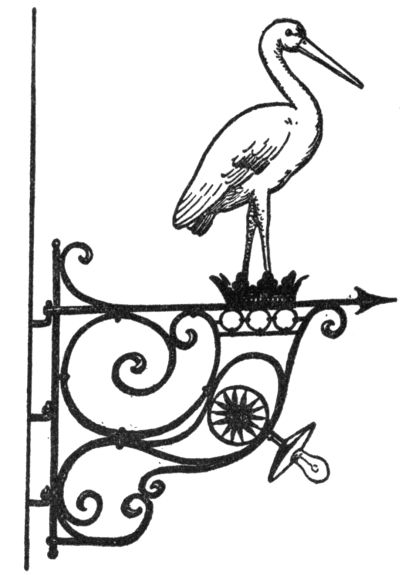
Another danger for the sign resulted from the attempt to number the houses of which we hear, perhaps for the first time in France, as early as 1512. This first attempt failed, but in the enlightened eighteenth century the new and certainly more reasonable method of distinguishing a house from its neighbor decidedly gained ground. In 1805 it was made obligatory by the Parisian police. A similar development we observe in England. Nobody will deny the practical progress and no business man would like to return to the old times when an English bookseller, for instance, had to give the address of his shop in the following way: “Over against the Royal Exchange at the Sugar Loaf next Temple Bar.” In Germany, where the centralization in large capitals made slower progress and a multitude of small social and political centers kept their own, the rational institution of numbering the houses, so necessary in great cities like Paris or London, was not accepted so quickly. In 1802 Dresden, for instance, had not even on the street corners signs indicating their names; “an institution that facilitates topography and topography facilitates business,” remarks a judicious contemporary. Here in Germany the cold number did not conquer so easily over the poetical warmth of the dear old sign. In the quiet, imperial towns of the south the artistic sign of the Rococo period and the Empire style, unpersecuted and unmolested, keep their place in the sun up to the present day in spite of some ill-advised landlords who thought it necessary to hide the humble oxen or lamb in the garret and call their house by some new pretentious French name like “Hotel de l’Europe” or the like.
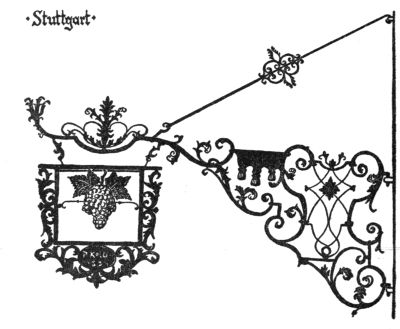
·Stuttgart·
In our own enlightened times of general school education, nobody needs any more the sign as a guide through even the most modest town. Everywhere the number has taken its place for this purpose and we regret to admit for the history of the sign too the truth of Darwin’s words: “Progress in history means the decline of phantasy and the advance of thought.”
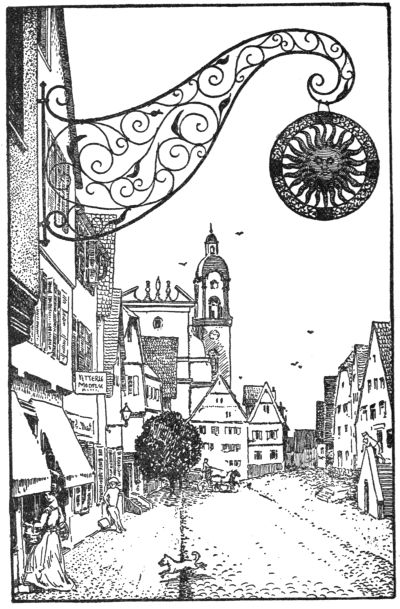
Sonne Neckarsulm, Württemberg