APPENDIX List of Notes (continued 2)
Reading edition
Vigna lutea.—This plant was found by me growing on the beaches and in their vicinity. Hillebrand merely speaks of it as “growing at short distances from the shore.”
Some of the trees, usually littoral in their station in the tropical Pacific, which are regarded as having been introduced in early times into the Hawaiian group by the Aborigines (see Chapter VII.), behave, nevertheless, quite like indigenous plants in the inland regions and in the lower levels. This is true, for instance, of Hibiscus tiliaceus and Pandanus odoratissimus, the last-named forming forests at the sea-board extending in places far up the mountain slopes. The same, however, may be said of other plants known to have been introduced since the discovery of the islands, as in the cases of Cactus Tuna and of Ricinus communis; and it also applies to Aleurites moluccana, the Candle-nut Tree, which, although it could only have been introduced by the Aborigines, now forms forests on the lower slopes of the mountains.
NOTE 32 (pages 19, 112, 165) The Fijian Species of Premna
I was much interested in the small trees and shrubs of this genus in Fiji, more especially on account of the relation between the shore and 561inland species. This is an Old World genus containing some eighty species mainly characteristic of tropical Asia and Malaya, and represented in the South Pacific archipelagoes by two species, one Premna taitensis or tahitensis, spread over the region and very near P. integrifolia, an Asiatic species; the other Premna serratifolia, an Asiatic plant found in Fiji, the Marquesas, and other groups. Without endeavouring to give a precise value to the Fijian plants, I will merely describe the prevailing forms, which are, however, connected by intermediate varieties. These trees, I may add, are known by the same name in the various Pacific groups, “Avaro” or “Avalo” in Tahiti, “Alo-alo” in Samoa, “Yaro” and “Yaro-yaro” in Fiji.
The Fijian plants may be thus described.... (a) Premna serratifolia, an inland tree, growing in open woods and on the outskirts of the forest, 25 to 30 feet high, more or less hairy, leaves coarsely serrated with long tapering points, putamen prominently tuberculated and thick-walled.
(b) Premna taitensis or P. integrifolia, a low straggling coast tree or shrub of the beaches, the coral islets, the swampy borders of the estuaries, and the inland talasinga plains, its usual height being eight to ten feet, except in the inland plains, where it is dwarfed, and three to five feet high. It is more or less glabrous, the leaves being typically entire with obtuse or retuse and mucronate apices. The putamen is thin-walled and relatively smooth. (c) Intermediate forms found generally in the inland plains or talasinga regions.
On the Modes of Dispersal.—Speaking generally, the small drupes of both species float at first, but the soft parts are soon removed by decay, and the stone is freed. In the case of the coast species, P. taitensis, the stones float indefinitely and are often found afloat in rivers. In the case of the inland tree, P. serratifolia, most of the stones sink at once, whilst the others sink in a few days. It is probable that currents are one of the effective agencies in distributing the coast species, but this could not apply to the inland tree. The fruits of both the inland and the coast species would attract birds, and the stones would resist injury in their crops. This is the agency advocated by Prof. Schimper for the shore species, P. integrifolia, of Indo-Malaya; and fruits referred with a query to this genus were found in the collection of seeds and fruits obtained by me from the crops of pigeons in the Solomon Islands (Bot. Chall. Exped., Introd. p. 46, part IV. p. 312).
On the Cause of the Buoyancy of the Stone or Putamen of the Coast Species.—This is primarily connected with the empty seed-cavities, the four-celled stone usually developing only one seed, the other cavities being empty. This inference was established by the dissection of a large number of stones, but it will be seen from the table below that one-seeded stones are also frequent in the case of the inland tree (P. serratifolia), where they as a rule sink. With either species the substance of the stone has no floating power, but with the shore species, on account of the thin-walled 562stone, the empty seed-cavities cause it to be specifically lighter than water whilst with the inland species the walls of the stone are so thick that the empty spaces of the unfilled seed-cavities do not effect the same result. It may be remarked that when the coast species grows in the inland plains the buoyancy of the stone is preserved.
One-seeded stones. Two-seeded stones. Three-seeded stones.
Inland tree (P. serratifolia) 73 per cent. 23 per cent. 4 per cent.
Coast tree (P. taitensis) 92 per cent. 8 per cent. —
NOTE 33 (page 63) De Candolle’s List of Plants dispersed exclusively by Currents
Drepanocarpus lunatus; Ecastaphyllum Brownei; Mucuna urens, D.C.; Tephrosia piscatoria; Hibiscus tiliaceus; Rhizophora mangle; Guilandina Bonduc, Linn.; Ipomœa pes capræ; Canavalia obtusifolia.
I have experimented on the buoyancy of the fruits and seeds of all these plants excepting the two first named. In five species the seeds float in sea-water unharmed for several months. With Rhizophora it is the floating seedling that disperses the plant. Neither the pods nor the seeds of Tephrosia piscatoria are suited for dispersal by the currents.
NOTE 34 (page 64) The Littoral Plants of the Easternmost Polynesian Islands
Except in the case of Hernandia peltata my authority here is the Botany of the “Challenger” Expedition. Mr. J. H. Maiden gives some further details of the flora of Pitcairn Island in a more recent paper (Austral. Assoc. Rep., Melbourne, 1901, vol. 8), and Hernandia peltata is included in his list.
NOTE 35 (page 68) Distribution of the Littoral Plants with Buoyant Seeds or Fruits that are found in the Fijian, Tongan, Samoan, Tahitian, and Hawaiian Groups
This list probably contains nearly all the species of the Polynesian region, but it is not implied that these plants have been recorded from all the groups (vide infra).
(a) Species found only in the Old World.—Calophyllum inophyllum, Hibiscus diversifolius, Thespesia populnea, Heritiera littoralis, Kleinhovia hospita, Carapa moluccensis, C. obovata, Smythea pacifica, Colubrina asiatica, Mucuna gigantea, Erythrina indica, Strongylodon lucidum, 563Dalbergia monosperma, Pongamia glabra, Inocarpus edulis, Derris uliginosa, Afzelia bijuga, Barringtonia racemosa, B. speciosa, Rhizophora mucronata, Bruguiera Rheedii, Terminalia Katappa, T. littoralis, Lumnitzera coccinea, Pemphis acidula, Morinda citrifolia, Guettarda speciosa, Wedelia biflora, Scævola Kœnigii, Cerbera Odollam, Ochrosia parviflora, Cordia subcordata, Tournefortia argentea, Ipomœa glaberrima, I. grandiflora, I. peltata, Aniseia uniflora, Clerodendron inerme, Vitex trifolia, Hernandia peltata, Excæcaria Agallocha, Tacca pinnatifida, Cycas circinalis, Pandanus odoratissimus, Scirpodendron costatum.
(b) Species occurring in both the Old and New Worlds.—Hibiscus tiliaceus, Suriana maritima, Ximenia americana, Dodonæa viscosa, Canavalia obtusifolia, C. ensiformis, Vigna lutea, Sophora tomentosa, Cæsalpinia Bonduc, C. Bonducella, Entada scandens, Gyrocarpus Jacquini, Luffa insularum, Ipomœa pes capræ, Cassytha filiformis, Cocos nucifera.
(c) Species occurring in America to the exclusion of the Old World.—Dioclea violacea, Mucuna urens, Rhizophora mangle.
(d) Species found only in Polynesia.—Canavalia sericea, Mucuna platyphylla(?), Cynometra grandiflora, Serianthes myriadenia, Parinarium laurinum(?), Premna tahitensis.
Remarks.—Of these seventy plants there is not one that has not come within the scope of my observations and experiments. The West Coast of Africa is included in the American region for reasons given in Chapter VIII. For the other authorities on the buoyancy of these seeds and fruits reference should be made to the list given under Note 2 and to other parts of this work. About one or two of the plants, like Ipomœa peltata, one scarcely knows whether they are most characteristic of the coast-flora or of the inland-flora.
NOTE 36 (page 72) Hawaiian Plants with Buoyant Seeds and Fruits known to be dispersed by the Currents either exclusively or, as in a few Species, with the Assistance of Frugivorous Birds
Colubrina asiatica.—Usually regarded as confined to the Old World; but since nearly all the species are American, that continent may be considered as the probable home also of this species. Hillebrand gives it a locality in the West Indies.
Dioclea violacea.—Tropical America.
Mucuna gigantea.—Old World.
Mucuna urens.—America, and extending to the African West Coast, which is to be included in the American region of shore-plants.
Strongylodon lucidum.—Old World.
Vigna lutea.—Old and New Worlds.
Cæsalpinia Bonducella.—Old and New Worlds.
Scævola Kœnigii.—Usually regarded as confined to the Old World, but 564according to the synonymy accepted by some authors it is also to be ascribed to America. The genus is chiefly Australian, and it is possible that the littoral species may have reached America through the agency of birds, since all the species of the genus possess fruits that would attract frugivorous birds.
Ipomœa glaberrima (Boj.).—Old World.
Ipomœa pes capræ.—Old and New Worlds.
Vitex trifolia.—Old World. The genus is also dispersed by pigeons.
Cassytha filiformis.—Old and New Worlds. Like Scævola the genus is chiefly Australian, and here, also, the fruits of the littoral species are not only dispersed by the currents, but are known to be also disseminated by fruit-pigeons.
It is possible that birds may have taken a predominant part in the dispersal of the species of Scævola, Vitex and Cassytha.
There thus remain nine species for consideration. Of these two are exclusively American, three are found in both the Old and New Worlds and four are usually regarded as exclusively Old World plants, but one of them (Colubrina asiatica) has a fair claim to be regarded as of American origin. Thus it is quite possible that six out of these nine plants were brought to Hawaii from America through the agency of the currents.
NOTE 37 (page 78) On Vivipary in the Fruits of Barringtonia racemosa and Carapa obovata
As observed by me in the Rewa delta, Fiji, there was no external evidence of such a process in the case of the fruits on the trees; but I did not pay very special attention to the matter, and it will be gathered from Chapter XXX. that the initial stage of germination may show no indication in the appearance of the fruit. More observation is needed for both species. As indicated in Note 50, the structure of the seed of Barringtonia racemosa is suggestive of a lost viviparous habit. With regard to Carapa, Schimper (p. 43) remarks that he has never observed vivipary; but Miquel, in his Flora Indiæ Bataviæ, particularly speaks of the seeds germinating in the capsule. I think this is very likely, and that perhaps even the rupture of the capsule may be partly due to this cause.
NOTE 38 (page 78) On the Temperature and Density of the Surface-water of the Estuaries of the Rewa River in Fiji, and of the Guayaquil River in Ecuador
(a) The Rewa Estuary.—My observations were made mostly in the warm, wet seasons, from October to January, 1897-99, and generally in 565the vicinity of the Roman Catholic Mission. The density varied usually between 1·000 and 1·010, the water being quite fresh after heavy rains inland. Though the density was usually greatest at high water, this was by no means always the case. The temperature of the water in dry weather varied from 79° to 84° F. With the river in flood after heavy rains it fell to 75° and 76°. As a rule, the fresher the water the lower the temperature, but this was not invariable. There was evidence of super-heating in the estuary, the water there having sometimes a temperature of 82° or 83°, when the water higher up the river as far as Viria was two or three degrees cooler, the sea-temperature being 79° to 80°. The average temperature of the water of the estuary during the season would be 80 to 81°.
(b) The Estuary of the Rio Guayas, also known, as the Guayaquil River.—My observations were made in the last week of February and in the first half of March, 1904. Whilst the sea-temperature a few miles off the Ecuador coast varied from 76° to 80° F., the water of the estuary from the mouth up to Guayaquil ranged from 79° to 86°, whilst rather higher up the river the temperature was about 79° or 80°. The super-heating of the estuary is thus directly indicated. It was well marked in the lower part of the estuary during one of my ascents of the river.
Surface-temperatures of estuary of the Guayaquil River, March 13, 1904, 11 a.m. to 4 p.m.; tide running up.
Sea-temperature 5-10 miles off the mouth 79·7
Estuary-temperature at the mouth, off Puna 82·7
Estuary-temperature 3 miles above Puna 84·4
Estuary-temperature 15 miles above Puna 86·5
Estuary-temperature 25 miles above Puna 82·5
Estuary-temperature off Guayaquil 81·8
The water of the estuary was, as a rule, cooler with the ebbing tide.
The density of the estuary-water at the mouth opposite Puna during the two days the ship was in quarantine ranged from 1·004 to 1·016, being generally about 1·010, and salter with the up-going tide. Off Guayaquil the water during the ebbing tide was quite fresh and, from an Ecuadorian standpoint only, potable, whilst at high water it may be a little brackish. The sea-water has much freer access to the channels in the mangrove-district at the back of the city of Guayaquil, where at high water I found the density to be 1·014.
Off Puna, on Feb. 25, I noticed that the surface-current which was running down the stream was from one to two fathoms deep, whilst below it was a strong current running up the river which carried my thermometer up against the surface-current.
NOTE 39 (page 82) On the Pacific Species of Strongylodon
Hillebrand in his Hawaiian Flora, following Seemann, regards S. lucidum, Seem., and S. ruber, Vogel, as one species found in Fiji, 566Hawaii, and Tahiti, and by the former placed also in Ceylon. Hillebrand and Seemann are followed by Drake del Castillo as regards the Tahitian species. Taubert, in his monograph on the Leguminosæ (Engler’s Pflanz. Fam., Teil 3, Abth. 3, 1894), takes the same view of the Polynesian species and of its wide distribution. However, in the Genera Plantarum and in the Index Kewensis, the Asiatic and Polynesian species have been always kept apart. The two species of the genus mentioned in the first work are increased to five in the Index Kewensis, viz., one in Fiji (S. lucidum), one in Hawaii (S. ruber), two in Madagascar, and one in the Philippines.
NOTE 40 (page 88) Precautions in Testing Seed-buoyancy
Many seeds and fruits require a few hours’ soaking before they sink; and when small they will rest a long time on the surface of still water, but a touch with the finger or a drop of water will send them to the bottom. A few will float a few days (3 or 4) before sinking; but such are included in the non-buoyant group. Only in rare cases does prolonged drying increase the period of flotation by more than a few days, examples being given at the end of the Table of Buoyancy results under Note 10. Adherent air-bubbles, a common cause of adventitious buoyancy, must always be removed.
NOTE 41 (page 91) The Buoyancy of the Seeds of Convolvulus Soldanella in Fresh Water and Sea-water compared
The experiments were commenced at the close of September, 1894, and covered six months. At the end of this period in Mr. Millett’s experiment, 56 per cent. of the seeds were afloat in fresh water, and 62 per cent. in sea-water; whilst in my own experiment 72 per cent. floated in fresh water, and 65 per cent. in sea-water. I was indebted to Mr. Millett’s courtesy for the seeds.
NOTE 42 (page 96) On Secular Changes in Sea-density
Exact data bearing on this subject are not at my disposal; but it would seem that geologists have formed conflicting conclusions from similar premises. There is the view that the composition of the ocean water was very different in early geological periods (Encycl. Brit., x., 221); but I should imagine that the character of the crustacean fauna of those seas would negative any great divergence from the present condition. Suess implies that the ancient seas carried the same minerals in solution that they do now, and it is to be inferred in a similar proportion (E. de Margerie’s French edition of Das Antlitz der Erde, ii., 343 and 345).
I paid considerable attention to this subject from the standpoint of dispersal some years ago, and published most of the results in Science Gossip for Sept., 1894. This peculiar quality of seeds had been noticed by Dr. Kerner in his Pflanzenleben (vol. i., 1887-91), and was regarded as illustrating a mode of dispersal of seeds by adherence. As a rule, such seeds when placed in water become coated with mucus in a few minutes, or within an hour, and when allowed to dry on feathers they adhere as firmly as if gummed. I found that this quality is not affected by prolonged drying, as in the cases of Nepeta glechoma and Salvia verbenaca, where it was exhibited to the same degree after the seed-like fruits had been kept from one to three years. I especially tested about 110 British plants that were likely to display this quality, and found that about a dozen exhibited it in a marked degree, and if to these we add those plants with seeds that display it to a limited extent so that they merely become adhesive when wetted, the total would be nearly twenty. It will be noticed from the list subjoined that the plants showing marked mucosity belong to twenty genera and to ten families, the Labiatæ and Cruciferæ predominating. Although in some genera, like Plantago, there is reason to suppose that the seeds of all the species would behave in this fashion, it would be wrong to infer that this is usually the case, six genera being indicated below to which such a rule would not apply, and doubtless the number could be extended. These plants in England mostly occur at the roadside, on waste ground, and in dry meadows. It may be added that although in most cases the seeds appear in water to emit mucus, “exuded mucilage” being the expression used in the English edition of Kerner’s work, in some instances, as with Helianthemum vulgare, there appears to be a dissolving process affecting the outer seed-covering.
I. Plants with Seeds or Seed-like Fruits that emit Mucus to a Marked Degree when placed in Water.
Arabis thaliana, G. Cruciferæ.
Camelina sativa, K. Cruciferæ.
Teesdalia, K. Cruciferæ.
Capsella bursa-pastoris, G. Cruciferæ.
Lepidium sativum, D. Cruciferæ.
Helianthemum vulgare, G. Cistaceæ.
* Viola tricolor (Field Pansy), G Violaceæ.
Linum usitatissimum, D. Linaceæ.
Linum, K. Linaceæ.
568* Matricaria chamomilla, K. G. Compositæ.
* Senecio vulgaris, G. B. Compositæ.
Collomia, K. Polemoniaceæ.
Gilia, K. Polemoniaceæ.
* Veronica beccabunga, S. Scrophulariaceæ.
Ocimum basilicum, K. Labiatæ.
Salvia verbenaca, G., &c. Labiatæ.
Salvia, K. B. Labiatæ.
* Nepeta glechoma, G. Labiatæ.
* Dracocephalum, K. Labiatæ.
Prunella vulgaris, G. Labiatæ.
Plantago, K. Plantagineæ.
Plantago major, lanceolata, maritima, G. Plantagineæ.
Luzula campestris. G. Juncaceæ.
Explanation of Abbreviations.—The capital letter following the name indicates my authority, which is not necessarily the oldest in each case: B = Beal; D = Darwin; G = Guppy; K = Kerner; S = Scott Elliot. The respective works quoted will be found at the end of this volume. The papers of Darwin quoted will be found in Journ. Linn. Soc., “Botany,” vol. i., 1857, and in the Gardeners Chronicle for 1855.
The asterisk is placed before those genera of which other species examined by me exhibited no mucosity; these species are Arabis hirsuta, Viola canina, V. palustris, Matricaria inodora, Senecio aquaticus, Veronica agrestis, V. arvensis, Nepeta cataria, Dracocephalum canariensis.
II. Plants with Seeds or Seed-like Fruits which in my Experiments only exhibited Mucosity in a Slight Degree, becoming merely “Sticky” or Adhesive when placed in Water.
Arabis albida, Chrysanthemum leucanthemum, Lamium purpureum (occasionally), Thymus sp., Juncus bufonius, J. communis, J. glaucus, J. squarrosus.
III. Plants with Seeds or Small Fruits that exhibit Adhesiveness in the Dry State and are apt to stick to one’s fingers.
Adenostemma viscosum, Lycopus europæus, Piper Macgillivrayi, &c. One may include here also Lagenophora (see page 276) as well as the familiar instances of Pisonia (page 347) and Boerhaavia (page 356).
NOTE 44 (page 121) On the Effects of Inland Extension on the Buoyancy of the Seeds or Fruits of Littoral Plants
When in Fiji I experimented on the buoyancy of the following beach-plants that had extended far into the interior of Vanua Levu, as will be 569found described in Note 22. Those tested were Cassytha filiformis, Cerbera Odollam, Ipomœa pes capræ, Morinda citrifolia, Premna tahitensis, Scævola Kœnigii, and Tacca pinnatifida. In all but Cerbera Odollam, where I contented myself with establishing that the fruits floated buoyantly in sea-water, the experiments were prolonged for many weeks and often for several months; and in some cases, as with Ipomœa pes capræ, three or four experiments were made on seeds from different inland localities. The result was to establish in all cases that the floating powers were as great with the inland as with the coast plants of the same species; nor could any structural difference of importance be noticed. It should be observed that there is every reason to believe that the “talasinga” plains of Fiji have been occupied by the intruding beach-plants for many ages.
NOTE 45 (page 122) Tabulated Results of the Classification, according to Schimper’s Application of the Natural Selection Theory, of the Buoyant Seeds and Fruits of the Tropical Littoral Plants on the Basis of the Structural Characters concerned in Buoyancy
Region. Classification of species. Proportion of non-adaptive and adaptive species. Total number of species dealt with.
Non-adaptive. Adaptive.
First group. Second group. Third group. Percentage of non-adaptive species. Percentage of adaptive species.
Number. Per cent. Number. Per cent. Number. Per cent.
Pacific Islands 27 40 10 15 30 45 55 45 67
Pacific Islands, tropical America, and Indo-Malaya 28 35 12 15 40 50 50 50 80
Note.—If to the last we add the eight British shore plants, the buoyant fruits of which are described in Chapter XII., three non-adaptive and five adaptive, we get a proportion of adaptive species for temperate and tropical regions of fifty-one per cent. This is probably fairly typical of the world generally; but it must be remembered by the reader that the author regards them all as non-adaptive. In that case, the table can be used for the numerical results of the three groups which are based only on structural characters without reference to any theory.
NOTE 46 (page 124) On the Modes of Dispersal of the Genus Brackenridgea.
Seed-vessels of this genus found afloat in the New Guinea drift are described by Mr. Hemsley as having two curved cavities crossing each other one containing a seed, the other empty. “This empty cavity,” it is stated “gives the fruit its buoyancy” (Bot. Chall. Exped., iii., 289; plate 54) Dr. Beccari, in the English edition of his Wanderings in Borneo, p. 187, 570speaks of the closed air-containing cavities in the seed-vessels, or rather “stones,” of this genus as probably giving them buoyancy and thus enabling them to be dispersed by currents. He points out that the fleshy covering of these fruits would also aid their dispersal by birds. The Italian botanist implies that the two Bornean species grow in swamps. The Fijian species, as observed by me in flower in Vanua Levu, grew in the dry talasinga districts bordering the Mathuata coast, the locality where Seemann found the plant. One of the most recent accounts of the genus is given by Van Tieghem in his memoir on the Ochnaceæ in Ann. des. Sci. Nat. Bot., tome 16, 1902. According to him there are nine species, all from Malaya and New Guinea, with the exception of one in Fiji. Previous authors have also referred to Queensland and Zanzibar species. However, all the species have a limited distribution, a fact which plainly assigns to birds the principal share in the dispersal of the genus.
NOTE 47 (page 125) On the Transport of Gourds by Currents
Small calabashes or bottle-gourds are not uncommonly to be found floating in the Fijian estuaries and stranded on the beaches; and I have also found them in the sea off the coasts. They are usually more or less globular, 3 or 4 inches across, and are evidently able to float for very long periods and to carry the seeds unharmed. Most of those I examined from the drift were dry inside and contained the seeds dried together into a loose ball about an inch in size. The seeds are not those figured in Gaertner’s De Fructibus et Seminibus, as belonging to Lagenaria vulgaris, and more resemble those of Cucurbita, but are non-buoyant. One of these gourds, picked up by me in the sea in Fiji, was placed in sea-water, and two months later was still floating buoyantly. After being then kept dry for seven months, it was broken open; and ten of the seeds were put in soil, two of them germinating in a few days.
In Ecuador gourds similar in size and shape were frequently observed by me floating in the drift of the Guayaquil River and stranded on the sea-beaches. The seeds are similarly caked together in a loose mass in the cavity of the fruit. Their characters indicate that they belong to another species of gourd; and they differ also from the Fijian seeds in their buoyancy, some of them in my experiments floating two months and afterwards germinating.
It has been known since the days of Ström and Gunnerus, two Norwegian naturalists of the 17th century, that gourds and calabashes are from time to time stranded with other Gulf-stream drift on the coasts of Norway. We learn from Sernander that those found are usually worked calabashes; but he alludes to one that was unworked and contained several seeds (see Sernander, p. 119).
571It is scarcely likely that a seed-carrying gourd stranded on a beach would be able to establish the plant without the aid of man; but it seems highly probable that gourds have often been introduced into new countries by the currents and that man has afterwards cultivated them. These plants may be contrasted with that remarkable Cucurbit, Luffa insularum, a genuine littoral plant, the seeds of which, and not the fruits, are dispersed in the Pacific by the currents (see page 426).
NOTE 48 (page 126) On the Useless Dispersal by Currents of the Fruits of the Oak (Quercus robur) and other Species of Quercus, and also of the Hazel (Corylus avellana)
The fruits of different species of Quercus are of not infrequent occurrence in the seed-drift both of the temperate and tropical regions, being brought down by the rivers to the sea and then stranded on the neighbouring beaches. They were amongst the drift gathered by Mr. Moseley in the open sea, 70 miles off the New Guinea coast (Bot. Chall. Exped., iv., 294). I found them on the beaches of Keeling Atoll where no oak exists, and on the beaches of the south coast of Java; whilst Prof. Schimper noticed them among the stranded drift of the Java Sea, and Prof. Penzig found them stranded on the shores of Krakatoa. They also came under my notice on the Sicilian beaches and on the Italian coast at Cumæ. Those of Quercus robur are to be found on the English beaches and in the autumn drift of the Thames, but they soon sink and disappear from river-drift. They are referred to by Dr. Sernander as frozen with other floating seeds in the ice of the Scandinavian rivers; but he evidently does not regard them as possessing much independent floating power.
Some years ago the author made a number of experiments on the buoyancy of the acorns of Quercus robur, and he formed the conclusion that when freshly collected not more than 4 to 8 per cent. of mature fruits will float in fresh-water, and not more than about 10 to 12 per cent. in sea-water, but that in either case they all sink in a day or two. Immature acorns float much longer, and it is these that mostly figure in the drift. However, unlike most fruits of little initial buoyancy the mature fruits gain considerable floating power by drying. Of some that had been kept for seven months 20 per cent. floated after four weeks in sea-water and 15 per cent. after 10 weeks.... It may be added that, according to Thuret, the fruits of Quercus ilex have little or no floating power.
The buoyancy of the fruits of Quercus is due entirely to the cavity left by the shrinking of the kernel. I never remember to have found one with a sound seed amongst the drift in England and Sicily; and I should doubt much whether those in the tropical drift retain their germinating powers. 572But, apart from this, the genus Quercus finds in its own constitution or habit the greatest obstacle in most species to the adoption of a littoral station. However, there are exceptional tendencies displayed by the evergreen oaks; and this is very significant, since in their xerophilous leaves they possess the preliminary qualification for a station near the sea. Quercus ilex, it is well known, shows a partiality for the sea-air, and Q. virens, the “live oak,” flourishes near the sea in the southern states of America, a maritime variety being distinguished by botanists. One of the willow-oaks of America, Q. phellos, which grows in swampy land, also has a beach variety.
The Hazel-tree (Corylus avellana) must be placed in the same category with Quercus. I found the empty nuts commonly amongst the stranded drift of the Sicilian and English beaches. The fruits were also frequently noticed by Dr. Sernander in the Scandinavian sea-drift; but he says nothing of their empty condition. Mr. Darwin remarks, in the Origin of Species, that he found that fresh hazel-nuts sank, but that after drying a long time they floated for ninety days and subsequently germinated. The floating-power is no doubt due to the cavity arising from the shrinking of the kernel, and it is to this cause that Dr. Sernander attributed the slight initial buoyancy observed by him. However, the hazel, like the common oak, lacks the habit that would fit it for a station by the sea, and, whatever capacity its fruits may possess for dispersal by currents, it is quite useless for the spread of the species.
NOTE 49 (page 131) On the Distribution of Ipomœa pes capræ, Convolvulus soldanella, and Convolvulus sepium
Whilst Ipomœa pes capræ is cosmopolitan in the tropical zones, Convolvulus soldanella is cosmopolitan in both the north and south temperate zones; but, as might be expected, the two species at times meet and their areas overlap. Thus, according to Mr. Cheeseman (Trans. New Zealand Inst., xx., 1887), they meet in the Kermadec Islands, in the South Pacific, in about latitude 30°. From my observations on the coast of Chile it would seem that C. soldanella in its northward extension fails somewhere between Valparaiso and Coquimbo, that is to say, between 33° and 30° S. lat. Gay merely refers to the plant as existing in North Chile, which in his time would include the coast between 33° and 24° S. lat. It intrudes within the “thirties” on the coast of California and is found in Madeira in about 33° N. lat. Ipomœa pes capræ in its turn extends into subtropical regions, being recorded from the Kermadecs, as above noted, and from the Bermudas in 32° N. lat. Owing probably to special physical conditions of the coast, which are referred to in Chapter XXXII., this plant is evidently limited to the tropics on the west coast of South America. It did 573not come under my notice on the beaches of North Chile, and it is apparently not mentioned by Gay in his work on the Chilian flora.
Convolvulus sepium, the frequent inland associate of the littoral C. soldanella over the temperate regions of the globe, belongs to the same section of the genus (Calystegia). Its extraordinary occurrence by itself in the island of St. Paul, in the Southern Ocean, about fifty yards from the shore (Bot. Chall. Exped., ii., 153, 264), almost suggests that we have here a dimorphic species with a littoral and an inland form; and its existence in the Azores is in this connection very remarkable. It may be here noted that of three plants raised from seeds found in the beach-drift near Palermo two had the foliage of C. sepium and one of C. soldanella. Perhaps one of my readers, in imitation of De Vries with Œnothera, might be able to settle this point by raising some hundreds of seedlings from the seeds of the beach species. It is possible that the relation between these two species of Convolvulus may be in some respects akin to that between Cæsalpinia Bonducella and C. Bonduc, two littoral plants that accompany each other over much of the tropical zone.
The student of dispersal will, however, find some curious gaps in the distribution of Convolvulus soldanella even in the temperate regions; and it will be curious to observe how they affect the distribution of C. sepium. He will have to answer the query of De Candolle:... “Admitting, if one wishes, that the currents have transported this marine species, how comes it that it chances to be in the Pacific and in Europe, without occurring on the east coasts of America and on the east and west coasts of Africa?” (Geographie Botanique, ii., 1056). He will have to explain why some botanists give C. soldanella a habitat in the tropics, as in the Indian region. Schimper, who investigated this point, says that he arrived at no certain result (p. 127). See Notes 13 and 41 and pages 29, 91, for further remarks on these two species of Convolvulus.
NOTE 50 (pages 79, 132) On the Structure of the Seeds and Fruits of Barringtonia
As regards the fruits and their coverings, the littoral and inland species of Fiji evidently fall into different sections, the first named (B. speciosa and B. racemosa) being distinguished by their outer fibrous husk, to which the buoyancy is due, the last-named (B. edulis and an undescribed species) possessing a hard stone surrounding the seed, and here the fruits sink or float only for limited periods.
The fruits of B. edulis have an outer almost fleshy covering, a little fibrous at the outside, and the hard ligneous “stone,” containing an edible seed, requires a hammer to break it. They float heavily for three or four weeks, whereas those of the littoral species float for many months. In the case of another inland species found by me growing as a small tree 12 feet 574high on the slopes of Mount Seatura in Vanua Levu at an elevation of 1,000 feet above the sea, the seed was similarly protected by a hard “stone” that could only be broken with an axe, and the fruit was non-buoyant, with thin and perishable outer coats.
This mountain species of Fiji, which I may name Barringtonia seaturæ, has the general habit of B. racemosa, with which the natives persisted in linking it; whilst the fruit and foliage come nearer to those of B. edulis. The leaves are entire, taper at the base, and have a petiole 1 inch long. The fruits are oblong, at least 3 inches in length, and are obscurely angled.
It would appear from Schimper’s description (p. 173) that the fruits of the Malayan Barringtonia excelsa possess both the hard stone-shell of the inland Fijian species and the dry air-bearing fibrous husk of the littoral species. This is of special interest, since the tree is both a coast and an inland species.
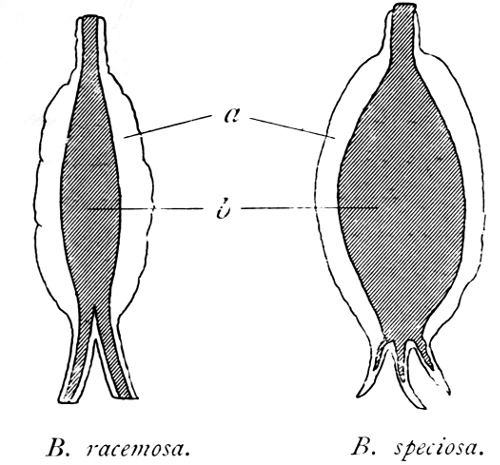
The following notes on the structure of the seeds of Barringtonia were made whilst I was drifting about in my canoe in the creeks of the Rewa delta in Fiji; and whatever may be their deficiencies they have the merit of having been written in the home of the plants.... When we cut across a seed like that of B. racemosa or B. speciosa, we observe that the different parts of the embryo are indistinguishable, being united into a homogeneous, firm, fleshy mass. But if we look closely we notice a central fusiform portion marked out from the surrounding parts by a faint line, along which a delicate membrane of vascular tissue has been developed. When “germination” begins, though, as the reader will subsequently perceive, this term is here hardly appropriate, the real nature of this singular structure becomes more apparent, as is indicated in the accompanying figure. The central fusiform portion proves to be the young plant without cotyledons and growing at either end to form the root and the stem. The delicate investing membrane becomes thicker and more apparent as germination proceeds, extending upwards and downwards with the growth of the stem and root and forming a cortical covering in either case. The investing fleshy portion of the seed, which is now separable with the fingers, remains attached to the lower part of the seedling for some time, being evidently a source of nutriment, and gives a bulbous appearance to the young plant. Young bulbous plants of B. racemosa, 1 to 2 feet high, are very common on the edge of Fijian mangrove swamps where the parent tree thrives. The seedlings of B. speciosa have the same appearance, but the outer fleshy part of the bulb is not so thick.
[To face page 574.
B. racemosa., B. speciosa.
Diagrams illustrating the structure of the growing seeds of Barringtonia (two-thirds the natural size). That of B. speciosa represents a seed removed from a fruit displaying the young plant protruding two or three inches. That of B. racemosa represents the lower end of the seedling when the plant is eighteen inches high.
a = the exorhiza.
b = the neorhiza invested by the medullary sheath.
This structure of the seeds of Barringtonia speciosa and of B. racemosa was for a long time meaningless to me, until one day, whilst seated on the banks of the Lower Rewa, with a number of the sected seeds and bulbous seedlings gathered around, I reflected that the fruits of the latter species that floated past me in the river-drift were nearly always germinating. This called up “vivipary” to my mind; and as I looked at the Rhizophora seedlings dangling from the branches of the mangrove-trees close by, it 575occurred to me that this seed-structure might be the result of a lost viviparous habit. One apparently had to deal here not with an ordinary seed containing an embryo in the midst of albumen, but with a seed in an arrested stage of germination surrounded by a body that might perhaps prove homologous with the “cotyledonary body” of Rhizophora. The process of development that goes on without a break in Rhizophora, from the fertilisation of the ovule to the detachment of the seedling from the branch, was here, as I considered, arrested after germination had begun, but before the protrusion of the seedling from the fruit. With nearly all plants, as I reflected, there is a rest-stage of varying length, which might be called the seed-stage. With the mangrove-genera, Rhizophora and Bruguiera, I had convinced myself by a long series of observations, the results of which are given in Chapter XXX., that this rest-stage does not exist. It occurs, I argued, in Barringtonia, but only after germination has begun, and, therefore, displaced when compared with the typical seed-stage of most plants.
In this connection it may be noted that a difference in germinating behaviour might be expected between the two shore species on account of their difference in stations, Barringtonia speciosa growing on the sandy beach, and B. racemosa in the wet ground around a mangrove-swamp. There is a strong suspicion that the rest-stage in B. racemosa is very short, though I never found germination in progress on a tree (see Note 37). There is no doubt, on the other hand, that the rest-stage of B. speciosa is often, as with most other plants, very long. This, then, was my lesson from the Barringtonia fruits on the banks of the Rewa, and the question arose whether this interpretation of these curious seed-structures accorded with the opinion formed of their nature by botanists.
Curious seed-structures of this kind must have their significance in the history of the plant; and on returning to England I looked a little further into the matter. To follow up this kind of inquiry, however, would carry me far beyond the limits prescribed for this note, and I have only treated it here in a tentative fashion. Different botanists of eminence have paid attention to this subject, amongst them Roxburgh, Thomson, and Miers (see Dr. T. Thomson in Journ. Linn. Soc. Bot., vol. ii., p. 47, 1858, and Mr. J. Miers in Trans. Linn. Soc. Bot., vol. i., 1880). It would appear that the seed-structure of Barringtonia is also found in Careya, a genus of the same Myrtaceous tribe, and in Garcinia and other genera of the Guttiferæ, as well as in other inland plants.
Mr. Miers, after reviewing the opinions of his predecessors, gives the results of his own investigations. The solid embryo found in Barringtonia and many other genera consists, he observes, (a) of an external portion, the “exorhiza,” which nourishes the germinating seed and then dies away; (b) of an internal portion, the “neorhiza,” which, growing at each end, forms the central portion of the stem and root; and (c) the “medullary sheath” of Mirbel, that lies between the two, and is composed of elementary vascular tissue, which ultimately gives origin to the wood, bark, and 576leaves of the stem and yields woody fibre to the root. The exorhizal portion in some cases, as in Barringtonia acutangula, splits into four parts during germination. Mr. Miers compares this seed-structure with that of Rhizophora, employing the same terms, “neorhiza” for the internal portion which forms the seedling, and “exorhiza” for the external portion which merely nourishes it. However, I may add that the exorhizal portion in Rhizophora, as shown in Chapter XXX., is now regarded as formed by the coalesced cotyledons, and is termed the “cotyledonary body”; so that by implication the corresponding part of a Barringtonia seed should be regarded from the same standpoint.
It may be apposite to notice here that Barringtonia racemosa displays one capacity which does not appear to belong to B. speciosa. The branches stuck in wet soil throw out roots and establish themselves. This capacity of vegetative reproduction is turned to account by the Fijians, who make “live-fences” of this tree in wet localities.
NOTE 51 (page 135) On a Common Inland Species of Scævola in Vanua Levu, Fiji
This is a tall shrub, or small tree, nine or ten feet high, which corresponds with S. floribunda, Gray, as far as Seemann describes it. It has small, black, juicy drupes, well suited for dispersal by birds, having no “suberous” mesocarp as in the shore species (S. Kœnigii), and no capacity for dispersal by currents. It grows, much like the Hawaiian inland species, in exposed situations where there is plenty of light, as on mountain-peaks, at the borders of forests, in open-wooded districts, and in the plains, and is to be found at all elevations from near the sea up to the highest mountain summit (3,500 feet) when the station is suitable. I noticed it on the higher slopes and frequently on the tops of nearly all the principal mountains that I climbed. It is evident that birds carry the “stones” from one mountain-peak to another, and no doubt they explain the presence of the species in Tonga. Dr. Seemann speaks of it as a beach plant in Viti Levu. The plant familiar to me in Vanua Levu is only on very rare occasions to be seen as an intruder in the beach-flora.
NOTE 52 (page 137). On the Capacity for Dispersal by Currents of Colubrina oppositifolia, an Inland Hawaiian Tree
The seeds in my experiments sank within ten days; but they are not readily detached from the fruit, as in the case of the buoyant seeds of the littoral species (C. asiatica). The fruits, which may float for a week or two, break down, as Hillebrand observes, tardily and imperfectly, and could give but little assistance to dispersal by water.
We have in E. indica a widely distributed littoral species, ranging from India through Malaya to eastern Australia, and over nearly all the groups of the Pacific, reaching to Tahiti and the Marquesas, but not occurring in Hawaii. It is associated in Fiji and Tonga with another shore-species, E. ovalifolia, Roxb., found also in India and Malaya. I did not come on the second species in Fiji, and according to Seemann it is rare. It is possible that there is a genetic connection between the two; and it is noteworthy that in one case Seemann was uncertain (p. 426) whether the species was E. ovalifolia or only a variety of E. indica.
In different parts of their areas both these species may be found inland. This no doubt is to be connected with their occasional cultivation. The Polynesians who esteem E. indica for its handsome scarlet flowers and its scarlet seeds often plant it near their houses; but it is curious that if we look at the pages of Seemann, Horne, and one or two other botanical authors who have written on the Pacific, we find no reference to its littoral station, the first-named botanist merely characterising it in Fiji as occurring “wild or planted.”
However, in various localities in Fiji, as on the shores of Natewa Bay in Vanua Levu, Erythrina indica thrives as a characteristic beach tree. Dr. Reinecke speaks of it as widely spread on the Samoan coasts; and the French botanists refer to it as a tree of the Tahitian beaches. Prof. Schimper frequently mentions the two littoral species of Erythrina as amongst the components of the Malayan strand-flora. Dr. Treub, when he visited Krakatoa in 1886, three years after the eruption, noticed some young plants of Erythrina growing on the shore; whilst Prof. Penzig in 1897 found that both E. indica and E. ovalifolia had established themselves on the beach. Mr. Kurz again is quoted by Prof. Schimper (p. 170) as including E. indica amongst the “beach-jungle” of Pegu.
There is abundant evidence in support of the dispersal of the genus by currents. I have observed the seeds of Erythrina indica on the beaches of Keeling Atoll. Schimper noted Erythrina seeds amongst the stranded drift of the Java Sea. Treub remarked young plants of the genus growing on the shore of Krakatoa three years after the great eruption, and Penzig places Erythrina indica and E. ovalifolia amongst the beach-plants brought to Krakatoa through the agency of the currents. The seeds of E. indica not infrequently came under my observation stranded on the Fijian beaches and floating in the Rewa estuary; and in an experiment made in Fiji they still floated after five months in sea-water. Mr. Hemsley years ago formed the opinion, from the drift collections at Kew, that the genus was dispersed by the currents. I may here add in further illustration of this point that Erythrina seeds were found by me in South America 578floating in numbers in the Guayaquil estuary and stranded on the beaches of Ecuador.
It is noteworthy that, unlike some of the other shore-plants, Erythrina indica has at least three sets of names in the South Pacific. Thus it is known as Rara and Ndrala in Fiji, Ngatae in Samoa, Futuna, and Rarotonga, Atae in Tahiti, and Kenae in the Marquesas. The Samoan and Tahitian name recalls the Burmese name of Ka-thit, whilst the Marquesan word is suggestive of the Makassar name Kăne or Kanur. The Hawaiian name of E. monosperma is Wili-wili, which evidently has arisen from the screw-like movement of the open pod when thrown into the air. The same name in the form of Wiri-wiri is applied for a similar reason to Gyrocarpus Jacquini in Fiji. It is possible that the Polynesians have assisted the dispersal of the coast-species (E. indica); but the currents could have performed the distribution unaided, and the variety of aboriginal names is not in favour of human intervention.
With reference to the possible extermination by insects of Erythrina in Hawaii, it has been before remarked (p. 143) that this would not account for the survival of an inland species, such as E. monosperma in Hawaii. However, this species since the occupation of that group by the white man is on the road to extinction. Dr. Hillebrand observes that the species was much more common formerly than in his time (1851-1871), a result evidently due to the ravages of the common tropical mealy bug, a pest of relatively modern introduction (see Koebele in Stubb’s Agricultural Report on Hawaii). It may be added here that Cordia subcordata, a littoral tree, had been almost exterminated by the ravages of a small moth even in Dr. Hillebrand’s time. During my examination of the coasts of the large island of Hawaii, in 1896-7, I was shown several places not long before occupied by this tree; and, as indicated in Note 29, it only came under my notice in a few localities.
NOTE 54 (page 145) On the Genus Canavalia
Of the three maritime species, C. obtusifolia, D.C., occurs on beaches all round the tropical zone. I was familiar with it on North Keeling Island in the Indian Ocean, in Fiji, and in Ecuador. C. ensiformis, D.C., is just as widely spread; but it is both inland and maritime in its station, and except when collecting it in the Solomon Islands I have had but little acquaintance with it. C. sericea (Gray) is a characteristic beach-plant in Fiji, but is infrequent. In Rarotonga, according to Cheeseman, it is a common littoral plant. It was also found in Tahiti by Banks and Solander, and is seemingly peculiar to the Pacific islands.
Besides C. ensiformis, the other two shore species may at times be found inland. Thus it is singular that the French botanists do not, as a rule, speak of C. sericea as a Tahitian beach plant; and Nadeaud only 579remarks, concerning its station, that it frequents the wooded slopes of the valleys of the interior. In North Keeling Island C. obtusifolia presented itself to me not only as a beach-creeper, its usual habit, but as a climber over the branches of the coast trees. In one locality in Vanua Levu I found a variety of this species growing on a hill a mile inland and about 700 feet above the sea. On one of the beaches it approached C. sericea in some of its characters, as in the form of the calyx and in the hairiness.
Although the seeds of C. obtusifolia have long been known to be dispersed by the currents, having been found in Moseley’s collections of floating drift off the New Guinea coast (Bot. Chall. Exp., IV, 291), they displayed remarkable fickleness when experimented on by me in Fiji. As a rule, however, about 10 per cent. sank at once in sea-water, 50 per cent. floated after three weeks, and 10 per cent. after twelve weeks. Of seeds that had been kept three years, 50 per cent. floated after eleven weeks. The seeds are to be found in numbers amongst the stranded drift of the Fijian and Ecuador beaches, and I noticed them also afloat in the Rewa estuary of Fiji.
I tested the floating-power of the seeds of C. sericea in Fiji, and found that half of them remained afloat after sixty days. On the seeds of C. ensiformis I have not experimented; but their buoyancy is indicated by the frequent occurrence of the plant on the Solomon Island coral islets (Guppy’s Solomon Islands, pp. 290, 292, 296), and probably the Canavalia seeds identified at Kew from my drift collections on these islets belong to this species. Schimper (p. 166) refers to the seeds of a Canavalia in Java that were still afloat after ten weeks. These littoral plants are indebted for the floating capacity of the seed to the buoyant kernel.
NOTE 55 (page 42 and Note 20) The Inland Extension of Scævola Kœnigii
Scævola sericea (Forst.), a hairy variety of this littoral plant, will probably prove in some localities to be the inland form of the species. Dr. Reinecke, who mentions only this variety for Samoa, says that it is found in very moist ground in river-ravines, and no other station is referred to. It would seem that both the glabrous and hairy forms occur in Hawaii. Dr. Seemann speaks of the hairy variety as littoral in Fiji.
NOTE 56 (page 149) On the Capacity for Dispersal by Currents of Sophora tomentosa, S. chrysophylla, and S. tetraptera
(1) Sophora tomentosa, Linn.—The moniliform pods will float for few weeks, but it is to the seeds liberated by the breaking down of 580the pod that the wide dispersal of this beach-plant by the currents is due. When experimenting on the freshly obtained seeds in Fiji I found that four-fifths of them floated after three months in sea-water. With seeds that had been kept for three years, half floated after twelve months and retained their sound condition. The seeds owe their floating power to the buoyant kernel.
(2) Sophora chrysophylla, Seem.—The dry pods of this Hawaiian mountain species float between one and two weeks in sea-water, but being brittle they readily break down and the seeds escape. The seeds have no buoyancy even after drying for four years.
(3) Sophora tetraptera, Ait., from the coast of Chile.—After floating from ten to fourteen days in sea-water, the dry pods become sodden and begin to break up, the seeds escaping. Since, however, the pods tend to decay and break open on the tree they would not be available for dispersal by currents. Out of a number of freshly gathered seeds all floated buoyantly after a month in sea-water, when the experiment ended; and of seeds that had been kept over a year six out of ten floated after four months in sea-water, two of them germinating afterwards in soil. Like those of S. tomentosa the seeds possess buoyant kernels to which the floating power is due. On account of the hardness of the tests the seeds to ensure rapid germination require to be filed.
NOTE 57 (page 153) On the Species of Ochrosia
Schumann distinguishes the following species:
(a) O. parviflora, Hensl., widely spread in the Pacific islands.
(b) O. compta, Schumann, confined to Hawaii and corresponding to var. B. of O. sandwicensis as given by Hillebrand.
(c) O. borbonica, Spr., synonym O. oppositifolia, Lam., from Mauritius and Madagascar to Java and Singapore.
(d)
Both probably varieties of O. borbonica.
O. sandwicensis, Gray, of Hawaii. O. elliptica, Lab., of New Caledonia.
(e) O. parviflora, Schumann, of New Guinea, probably identical with O. mariannensis.
NOTE 58 (page 156) On Pandanus (from Warburg)
(a) The size (length) of the drupes of endemic species in oceanic islands.—The drupes of P. reineckei of Samoa are 4-5 cm. (13⁄5-2 inches). Those of P. joskei and P. thurstonii in Fiji measure respectively 6 cm. (22⁄5 inch) and 21⁄2 cm. (1 inch).
Out of about sixteen species in the Mascarene Islands (Mauritius, Réunion, and Rodriquez) quite half have drupes 2-31⁄2 cm. (4⁄5-12⁄5 inch) 581in size, whilst they run up to 8 or 10 cm. (3-4 inches), and may be less than a centimetre (2⁄5 inch).
(b) The affinities of the Fijian and Samoan species.
P. odoratissimus Wide-ranging Section Keura.
P. joskei Fiji Section Lophostigma.
P. samoensis Samoa Section Lophostigma.
P. thurstonii Fiji Section Acrostigma.
P. reineckei Samoa Section Hombronia.
NOTE 59 (page 188) Seeds in Petrels
Darwin, in his correspondence (1859) with Sir Joseph Hooker, refers to the occurrence of large West Indian seeds in the crops of some nestling petrels observed by Sir William Milner at St. Kilda (Life and Letters, II, 147, 148). Mr. Charles Dixon in Ibis (1885) refers to Sir W. Milner’s observation in the case of the Fulmar Petrel (Procellaria glacialis) and speaks of them as Brazilian seeds brought by the Gulf Stream, adding that he himself found a nut in the crop of one of these birds in the same locality. He supposes that the birds pick them up from the water. Mr. Hemsley very kindly wrote to Sir Joseph Hooker recently on this point with the object of obtaining some idea of the nature of the seeds; but after this lapse of time it has not been found possible to satisfy my curiosity. I live in the hope of their proving to be Cæsalpinia seeds.
NOTE 60 (page 202) Schimper on the Halophilous Character of Littoral Leguminosæ and of Shore Plants generally
As a result of extensive microchemical investigations, this eminent German botanist arrived at the conclusion that plants living on the sea-shore, or in inland stations rich in chlorides, are able, as a rule, to store up in their tissues a large quantity of these salts, a capacity enabling them to live in localities where the subsoil is rich in these materials. This inference, as shown in his experiments, is just as applicable to the shore-plants of temperate regions, such as Aster tripolium, Crambe maritima, and Eryngium maritimum, as it is to such typical littoral plants of the tropics as Barringtonia speciosa, Ipomœa pes capræ, Scævola Koenigii, Tournefortia argentea, &c. However, with the Leguminosæ experimented upon, this capacity of storing up chlorides was often exhibited but slightly or not at all; and characteristic Pacific beach-plants, such as Canavalia turgida, Pongamia glabra, and Sophora tomentosa are especially cited as examples (Schimper’s Ind. Mal. Strand-flora, pp. 140-151; Wolff’s ash-analyses are here quoted).
The summit is formed of bare rock and sand, the phanerogamic vegetation ceasing a couple of thousand feet below. Some low plant-forms doubtless occur under the moist, warm conditions near the steam-cracks, since Wilkes mentions his finding a small moss; but with this exception the surface may be described as sterile.
Dryness of the Air and Electrical Phenomena.—Wilkes refers to the association of these conditions more than once in his narrative. Whenever, as sometimes happened, the dew point could not be obtained with Pouillet’s hygrometer, electricity was easily excited, and was developed in large sparks. On taking off the clothes at night, sparks would appear. As shown in the table subjoined, electrical phenomena were noticed during the first few days of my sojourn on the summit when the relative humidity was very low. My red blanket at night crackled in my hands and emitted sparks, and a glowing line was produced by drawing the finger along. Whilst the air was in this condition I observed that the wings of dead butterflies lying on the ground stuck to my fingers tenaciously like a needle to a magnet. The adhesiveness disappeared when the excessive dryness gave place to humidity. The physiological effect on me of the associated dryness and electrical state of the air was displayed in a hot, dry, sweatless skin (cracking and chapping rapidly), severe headache and sore-throat, general lassitude, and great irritability. When the weather changed and the air became humid, these unpleasant symptoms quickly disappeared.
As a result of these dry conditions on the summit of Mauna Loa, decomposition does not occur. I found in one place on the top, on the site of an old camp, the remains of a quarter of beef, the meat fresh but dried up. From a water-bottle left behind by one of the party and subsequently restored to him, I learned that the visit had been made in the previous summer. This non-decomposition seems a little strange, since, as remarked below, flies and other insects were not infrequent on the summit. However, as Hann remarks, when speaking of mountain climates, everything dries much more quickly at great altitudes; animals that have been shot, or killed by falling, become mummies without undergoing decay (Schimper’s Plant-Geography, 697).... The scorching power of the sun in a sky usually cloudless, or nearly so, was a trying feature of my daily experiences; and I found that when I faced it with unshaded eyes during my walks I suffered from severe pain in the eyeballs at night.
Insects on the Summit.—It may seem a strange thing to relate, that in a region apparently absolutely sterile, the flies and other winged insects caused me much discomfort in my small tent when I was confined to it through illness. When lying down one morning I noticed the house-fly, the blue-bottle, and two or three other flies, small beetles not over a fifth of 583an inch in size, a moth, and a wasp. They were no doubt quite happy in the heat, as the temperature inside was over 80° F., and the sun’s rays felt almost scorching through the thin duck canvas. Butterflies (and occasionally large moths) were often observed flying in a drowsy condition about the summit and were easily caught. They were fond of fluttering around the steam-holes. In places, numbers were to be seen dead and dried up on the ground, the detached wings lying about. In the case of a recently dead butterfly I found its carcase already attacked by numerous small bugs. The butterflies were most frequent when there was a fresh southerly breeze, and were doubtless blown up the slopes from the forests below.
Whymper in his Travels amongst the Great Andes of the Equator gives many particulars of the occurrence of insects at great elevations. He noticed beetles, diptera, butterflies, moths, and several other insects at altitudes of 15,000 to 16,000 feet. At 16,500 feet he obtained a small bug of the genus Emesa. He quotes Humboldt and Bonpland as showing that insects are transported into the upper regions of the atmosphere 16,000 to 19,000 feet above the sea, and he remarks that the transportation of insects by ascending currents of air has occasionally been observed in operation. These facts bear directly on the dispersal of insects.
The Winds.—My tent, which was pitched near the middle of the western border of the crater, happened to be situated in the battle-ground of the northerly and southerly winds, in a region of gusty winds, fitful airs, and dead calms. The northerly winds were usually from N.-N.N.W. and the southerly winds from S.W.-S.S.W., easting in either case being rarely observed, the northerly winds rather prevailing at night. As a result of this location miniature whirlwinds were frequent in the vicinity of my tent, which carried sand into the air and more than once threatened to lift up my tent bodily and carry it off into the crater below. At the north end of the crater-border north-easterly winds prevailed, and at the south end southerly winds occasionally showing easting. When on one occasion I walked round the crater-margin, a fresh south-easterly wind prevailed at most parts of the circumference except in the vicinity of my camp, where there was a light S.S.W. wind both at 8 a.m. and 6 p.m. when I started and returned. The local character of the winds was often displayed in my walks. On one occasion, having left my camp, where a southerly wind was blowing, and walked half a mile to the north, I found a bitterly cold N.N.E. gale in my face which so impeded my progress that I returned to my camp where the same southerly breeze continued.
Commodore Wilkes was encamped on the east side of the crater, and there (December and January) he experienced strong south-west winds, on at least three days having the force of a gale. These are the prevailing winds in this season over the group; whereas in August, the time of my sojourn, south-westerly winds are quite out of season, this being in the midst of the period of the N.E. trades.
It will be gathered from the foregoing remarks that the mere record of 584the winds is insufficient for the purpose of obtaining any definite notion of the air-currents at this elevation (13,600 feet). It is to close observation of the clouds that we must look for data of importance.
The Clouds.—The clouds on the summit of Mauna Loa were an unending source of interest to me, and I will give briefly the results of my observations. The highest clouds were wispy cirri, often arranged as in a mackerel sky, and evidently at a great altitude. They were only observed on four or five days. (The lower clouds are indicated in the accompanying diagram.) Below them and at no great height above the mountain were to be not infrequently observed isolated woolly clouds that were carried in a few minutes across the sky and had a brief existence, often forming and melting away as one gazed at them. Next, there was a heavy bank of cumulus, which formed on the south-west slope near the top of the mountain, from which lines of cloud extended along each flank. Lowest of all was a broad belt, or rather a sea, of cumulus that was developed on both sides of the mountain about one-third way down its slopes, and during the day-time isolated the peak from the world below. It is with the last two cloud formations that we are most concerned, and I will first describe the sea of cumulus.
The sea of cumulus, as in the case of similar cloud-formations of most other isolated mountains, when viewed from above, as from the mountain-top, presents a cloud-field of dazzling whiteness, sparkling in the sun. Seen from below, as from the coast, it has the dark lowering appearance of the rain-cloud and indicates the rain-belt. Disappearing during the night, this broad belt begins to form again between 8 and 9 a.m., and by 10 or 11 a.m. the lower regions are completely hidden and the mountain’s summit, cut off from the world, rises above the level of the sea of clouds like an island in an Arctic ocean. As the day progresses the clouds become more compact and dense. The usual altitude of this broad belt of cloud is between 7,000 and 8,000 feet. This level is indicated by the burying of the Kohala mountains, which rise to a height of 5,500 feet in the distant north-west corner of the island, and by the usual emergence of the highest summit of Hualalai, which rises, still nearer, to an elevation of 8,275 feet. On some days, however, it attains a height of nearly 9,000 feet. On such occasions the highest peak of Hualalai kept reappearing and disappearing during the day, but the distant summit of Haleakala in East Maui, 10,032 feet in elevation and 80 miles away, was always visible.
Words fail to describe the magnificent aspect of this sea of cloud which shuts off the spectator from the world below. From the summit of the mountain he gazes down on its surface lit up by a sun shining in a typically cloudless sky. At one time it appears as an undulating Arctic land covered with snow of dazzling whiteness. At another time it looks like a hummocky frozen Polar sea sparkling in the sunshine. Through occasional rifts, however, one can discern a dark dismal region of mist and rain-cloud beneath. Miss Bird, who passed a night on the summit in June, 1874, 585well describes this sea of cloud in her book on the Sandwich Islands as “all radiance above and drizzling fog below.”
[To face page 585.
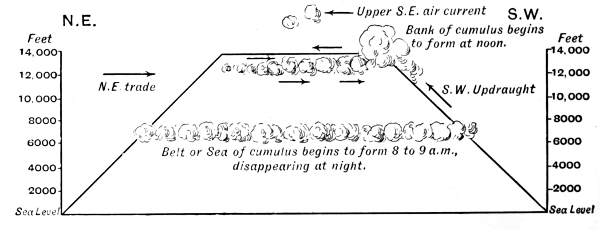
Diagram illustrating the prevailing cloud-formations of Mauna Loa during August, 1897.
The heavy bank of cumulus, that forms at noon on the south-west slope at an altitude of 10,000 to 13,000 feet above the sea, and sometimes rises above the mountain, is one of the most conspicuous of the cloud-phenomena on the summit of Mauna Loa. Apparently extending from it, but in reality moving towards it, are two lines of small cumuli that follow the same level along either flank above the sea of cumulus, as is indicated in the accompanying diagram. It was observed by Wilkes in mid-winter, 1840-41, but at a lower level. “Clouds would approach us (he writes) from the south-west when we had a strong north-east trade wind blowing, coming up with their cumulus front reaching the height of about 8,000 feet, spreading horizontally and then disappearing.” During my sojourn this bank formed a very striking feature in the landscape during the early afternoon. On two or three occasions when I visited the south side of the summit and descended for about a thousand feet I passed through this bank, being then exposed to a driving mist coming up the slopes from the south-west. Though its upper surface viewed from a distance is dazzling white, below it is dark and nimboid.
It is to an updraught of warm moist air on the south or south-west slopes of the mountain, and to the prevailing cool north-east trade that strikes the north side of the summit, that we must look for the explanation of the development and situation of this bank. Although the trade-wind is markedly stronger than the south-west updraught, some of the warm, moist, southerly air-currents find their way, as shown by the observations at my camp, along the sides of the summit, and a line of condensation is produced where they come into contact with the cool air of the north-east trade as it sweeps past the flanks of the mountain. Sometimes at my camp, when there was a light southerly breeze blowing, I have noticed the line of small cumuli moving south along the mountain side towards the bank of cumulus.... I may remark that on a few days a small bank of cumulus formed under similar conditions on the north-west side of the summit.
From my study of the clouds I arrived at the conclusion that there were three prevailing air-currents on the summit of Mauna Loa:
(1) The updraught of warm moist air on the south and south-west slopes of the mountain.
(2) The north-east trade wind, the upper limit of this air-current being probably not far above the summit.
(3) An upper air-current from the south-east (E.S.E.-S.S.E.), which, from the velocity of the clouds it carried, was often probably not over a couple of thousand feet above the summit. It may be observed that on the coast at the base of the southern slope of the mountain in the middle of September, when the wind was N.E. and carried the lower clouds with it, the upper clouds were, on several occasions, noticed travelling in the opposite direction, namely, from the south.
586The volcano was quiescent during my visit and could have exercised but little influence on the air-currents.
The Shadow of the Mountain.—Every morning and evening, in clear weather, for about twenty minutes after sunrise and before sunset, the shadow of the mountain was thrown back against the sky of the opposite horizon. It seemed as if some Titanic brush, at work in the sky far away, had painted in the profile of the mountain with a very uncanny blue. At sunset the peak was the last to disappear. Commodore Wilkes, who only records it once, namely, at sunset on the 1st of January, describes it as “a beautiful appearance of the shadow of the mountain projected on the eastern sky ... as distinct as possible, its vast dome seemed to rest on the distant horizon.” This phenomenon is, of course, well known in the case of other isolated mountains. According to Murray’s Handbook of Southern Italy (1892), the correct thing for a visitor to Stromboli is to make an early ascent of the cone to observe “the very curious triangular shadow of the mountain cast by the rising sun upon the sea.” Unfortunately I neglected my opportunity when on the island. The shadow of the mountain is also one of the sights of Etna, a dark-violet, triangular shadow (Baedeker) being thrown at sunrise over the surface of West Sicily, that is, on the land. I saw the shadow but imperfectly outlined, as the weather was not favourable at the time of my ascent. When at Nicolosi, on the south slope of Etna, I noticed at sunset a faint shadow of the mountain thrown against the eastern sky. I gathered from a short conversation with Prof. Ricco, the director of the Catania Observatory, when I told him of the shadow of the Hawaiian mountain, that the interest lay in its projection against the sky. It is doubtless akin to the spectre of the Brocken and other mountain spectres.
Some Previous Meteorological Observations on Mauna Loa.—.... Mr. Douglas, the botanist, who was subsequently found dead in a cattle-pit on Mauna Kea, spent a day on the summit of Mauna Loa in the middle of January, 1834. He mentions that a little way below the top the thermometer fell at night to 19° F. The wind on the top was N.W. The air at 11.20 a.m. was 33°, the hygrometer registering 0·5. He remarks that the great dryness of the air was evident without the assistance of the hygrometer (Hawaiian Spectator, vols. I and II, 1838-9).
Commodore Wilkes, in vol. IV of his Narrative of the United States Exploring Expedition, gives the following observations on the temperature and winds on the top of Mauna Loa between Dec. 23, 1840, and Jan. 13, 1841. Those on the temperature are incomplete, but they give a fair idea of the prevailing conditions. The degrees are in Fahrenheit’s scale.
Dec. 23, 1840: elevation, 13,190 feet; 3 p.m., 25° F.; strong S.W. gale; night temperature, 15°.
Dec. 24, 1840: summit (13,600 feet); night minimum, 22°.
587Dec. 26, 1840: summit (13,600 feet); violent S.W. gale; night min., 17°.
Dec. 27, 1840: summit (13,600 feet); sunrise temp., 20°; night min., 17°; wind, S.W.
Dec. 29, 1840: summit (13,600 feet); noon temp. in shade, 47°; night min., 20°.
Dec. 30, 1840: summit (13,600 feet); noon temp., 55°; night min., 13°.
Dec. 31, 1840: summit (13,600 feet); night min., 17°.
Jan. 2, 1841: summit (13,600 feet); sunrise, 20°; wind, N.E.
Jan. 3, 1841: summit (13,600 feet); night min., 17°.
Jan. 4, 1841: summit (13,600 feet); daylight, 20°.
Jan. 8, 1841: summit (13,600 feet); S.W. gale.
Jan. 10, 1841: summit (13,600 feet); night temp., 16°.
Jan. 12, 1841: summit (13,600 feet); night temp., 17°.
Jan. 13, 1841: summit (13,600 feet); strong S.W. wind.
The usual variation of temperature in the twenty-four hours is given as 17°-50°. The south-west was evidently regarded as the prevailing wind, and the clouds are spoken of as sometimes moving from opposite directions towards the same centre.
When Miss Bird spent a night on the summit of Mauna Loa during the eruption of June, 1874, the cold was described as intense, eleven degrees of frost (21° F.).
Observations on the Summit of Mauna Kea.—.... When Prof. Alexander with a party of scientists ascended this mountain (in the summer of 1892), the thermometer at night fell to 13° F., and the trade-wind was found to be blowing as strongly on the summit as down below (Whitney’s Tourist Guide to Hawaii). It is to be inferred that the party camped by the small lake which is a few hundred feet below the actual summit (13,800 feet). This lake, which I visited on May 20, 1897, is about 120 yards across, and evidently shallow, probably not more than three or four fathoms deep. A carpet of algæ covered the bottom. At noon, by the lake, the air in the shade was 53° F., whilst the temperature of the surface-water was 51°. The lower clouds were moving from S.S.E. This lake is said to be permanently frozen over in the winter, and to have been visited by skaters.
Permanent Water Supply on the Summit of Mauna Loa.—In this barren rocky region water derived from the winter-snow is to be found all the year through at the bottom of the deep cracks or fissures in the lava-rock. Such fissures are from two to four feet wide, and in the case of that near my tent the bucket had to be lowered to a depth of seventeen or eighteen feet to reach the water, or rather the ice, since it was often necessary to break the surface ice. In these deep, narrow fissures, which the sun scarcely penetrates, the water would probably be frozen over all through the seasons; but in those of less depth it would remain liquid in summer.
588Register of Observations on Wind, Relative Humidity, Cloud, Rain, and Temperature, made by H. B. Guppy on the Summit of Mauna Loa at an Elevation of 13,500 Feet above the Sea, August 9th to 31st, 1897. (Camp about Middle of West Side of Crater Margin)
Date. Observation. 12-4 A.M. 4-8 A.M. 8-12 A.M. 12-4 P.M. 4-8 P.M. 8-12 P.M. Air in shade. Remarks.
Min. Max. Range.
9 Wind S.S.W-S.W. 2 Variable ... W.S.W.-W.N.W. 3 N.N.W.-N. 1 N.N.W.-N. 3 F. F. F. A beautifully coloured lunar halo at 1 A.M. Electrical condition of the atmosphere (see text).
Rel. hum. ... ... ... ... ... ... 27·5 61·2 33·7
Cloud 0 0 0 0 0 0
Rain 0 0 0 0 0 0
10 Wind ... N.N.W. 2 S.S.W.-W.S.W. 3 S.S.W.-W.S.W. 2 Calm ... Electrical condition of the atmosphere. Faint lunar halo at 8 P.M.
Rel. hum. ... ... 34 42·5 46 ... 33·5 59·7 26·2
Cloud ... 0 1 2 0 ...
Rain 0 0 0 0 0 0
11 Wind Calm W.S.W. 1 ... ... S.S.W.-S.W. 1 ... Electrical condition of the atmosphere.
Rel. hum. ... ... 28·5 ... ... ... 22·5 61·2 38·7
21
Cloud 0 0 0 1 0 ...
Rain 0 0 0 0 0 0
12 Wind Calm Calm N.N.W.-N. 2-3 N.N.W. 1 N.N.W.-N. 2-4 N. 2-4, S.W.-W.S.W. 3-5 Earth tremors. Total rain, 10⁄100. At sunset, wind N.W., wet canvas of tent froze hard. At 10 P.M., strong southerly wind, canvas thawed, rain with strong gusty wind until 4 A.M., when wind less.
Rel. hum. ... ... 45 79 89 ... 23 54·7 31·7
Cloud 0 0 5 10 10 5
Rain 0 0 0 Rain Rain Rain
13 Wind S.W. 4-6 S.W. 3-5 S.W.-S.S.E. 3-4 S.W. 3 Calm; N.W. 1 ... Earth tremors. Total rain 10⁄100.
Rel. hum. ... ... 86 86 78 ... 33·6 48·7 15·1
Cloud ... 10 7 10 9 ...
Rain Rain Rain 0 Rain Rain 0
14 Wind N.N.W.-N. 1 Northerly, 3 N.N.W. 3 N.N.W. 2 N.N.W. 1 ... Butterflies flying about in a semi-torpid state, and easily caught with the hand.
Rel. hum. ... 61·5 47 42 45·5 ... 32·5 52·2 19·7
Cloud 3 0 0 0-2 0 ...
Rain 0 0 0 0 0 0
15 Wind Northerly, 1 W.S.W. 1, N.N.W. 1 S.W.-W. 2 Calm; Southerly, 1 Calm; N.N.W. 1 N.N.E.-1-2 Wind fitful during day; north-westerly and south-westerly airs with calms.
Rel. hum. ... ... 38 44·5 62 ... 28 54·7 26·7
52·5
Cloud 0 0 0 7 7-0 0
Rain 0 0 0 0 0 0
16 Wind Calm N.N.W. 2 N. 3 ... Southerly, 1 ... Carefully observed the shadow of the mountain which, at sunrise and sunset, is projected against the opposite horizon.
Rel. hum. ... ... 32 ... 61 ... 26 53.2 27.2
28
Cloud ... 0 0 7 0 ...
Rain 0 0 0 0 0 0
17 Wind ... N.N.W. 1 N.N.W. 2, Southerly, 2 N.-N.N.E 3, Southerly, 2 N.N.W. 1 ... Fitful northerly and southerly winds causing miniature whirlwinds that carried dust and paper up into the air.
Rel. hum. ... ... 32 32·5 ... ... 20·5 58·7 38·2
Cloud ... 0 0 1 0 ...
Rain 0 0 0 0 0 0
18 Wind Calm S.W. 1 Variable ... S.W. 2 ... —
Rel. hum. ... ... 26 ... 47 ... 23 58 35
Cloud 0 0 0 1 0 ...
Rain 0 0 0 0 0 0
19 Wind ... ... N.N.W. 1, W.S.W. 1 Northerly, 3, S.S.W. 3 Northerly, 2, Southerly, 2 Southerly, 3 Through the day, fitful northerly and southerly breezes.
Rel. hum. ... ... 20 23 24 ... 22 58·7 36·7
35·5
Cloud ... ... 0 0 0 0
Rain 0 0 0 0 0 0
20 Wind Southerly, 2 Northerly, 1, Southerly, 1 Northerly, 1, Southerly, 1 S.S.W.-S.W. 4 Northerly, 2, Southerly, 1 Southerly, 3 Fitful northerly and southerly airs, often reversing several times in a few minutes.
Rel. hum. ... ... 26·5 25 29·5 ... 22 57·2 35·2
Cloud 0 0 0 0 0 0
Rain 0 0 0 0 0 0
21 Wind Southerly, 4 Southerly, 3-4 S.S.W. 3-4 S.S.W. 4-5 S.W. 4-5 S.W. 4 At camp, strong southerly winds all day. At 7 A.M., walked half-mile north and found a bitterly cold N.N.E. gale blowing there, which forced me to return to camp where the south wind still blew freshly.
Rel. hum. ... ... 35·5 31 47 ... 26·5 53·7 27·2
Cloud ... 0 0 0 0 ...
Rain 0 0 0 0 0 0
22 Wind ... S.S.W. 1 ... ... Calm, Southerly, 2 ... Walked round the crater from 8 A.M. to 6 P.M.
Rel. hum. ... ... 58 ... ... ... 20·5 46·7 26·2
Cloud ... 0 0 1 0 ...
Rain 0 0 0 0 0 0
23 Wind ... S.S.W. 2 ... N.N.W.-N.E. 1-3, Southerly, 3 Southerly, 1 Calm A few drops of rain at 2 P.M.
Rel. hum. ... ... 60 52·5 70 ... 24 50·7 26·7
54·5 64
Cloud ... 0 3 3-8 3-6 0
Rain 0 0 0 Rain 0 0
24 Wind ... Northerly, 3 S.W. 1 N.N.W.-N. 2-3 N.N.W.-N. b. E. 2-3 Northerly 2
Rel. hum. ... ... 54·5 ... 53 ... 20 52·7 32·7
Cloud ... 0 0-1 4 0 ...
Rain 0 0 0 0 0 0
25 Wind Calm ... Calms with N.W. and S.W. airs Calms with N.W. and S.W. airs Northerly and Southerly airs Northerly and Southerly airs A few drops of rain at 3 P.M.
Rel. hum. ... ... 42·5 73·5 61 ... 17 52·2 35·2
37·5 61·5
Cloud 0 0 0-1 2-9 0 0
Rain 0 0 0 Rain 0 0
26 Wind Northerly, 2 N.N.W. 1 ... N.N.W.-N. 3 N.N.W. 2 ... Descended through the bank of cumulus on S.W. slope and found driving mist coming up the slope from S.W.
Rel. hum. ... ... 49·5 ... 64 ... 19·5 53·7 34·2
Cloud 0 ... 3 3 0 0
Rain 0 0 0 0 0 0
27 Wind Calms with light airs Calms with light airs S.W.-W.S.W. 2 W.S.W.-W. 1 Southerly Calm Rain not measurable. Rain-clouds poured into and filled the huge crater.
Rel. hum. ... ... 35 73·5 ... ... 18·5 50·7 32·2
Cloud 0 0 4 10 4 0
Rain 0 0 0 Rain 0 0
28 Wind Calms with northerly airs Calms with variable airs N.N.W.-N. 2-3 S.S.W. 3 Northerly, 3 Calms with variable airs 9 A.M., high stationary cirrus; at noon, solar halo; in afternoon, nimbus partly filling crater causing a rainbow there; a few drops of rain at 4 P.M.
Rel. hum. ... ... 46·5 64·5 ... ... 15 49·7 34·7
59·0 73·0
Cloud 0 0 5 7 0 0
Rain 0 0 0 Rain 0 0
29 Wind N.N.W.-N. 3 N.N.W.-N. 2 N.-N. b. E. 3 N.N.W. 3, S.S.W. 2 Calms with variable airs Northerly, 1
Rel. hum. ... ... 45 44 60·5 ... 21·5 48·7 27·2
Cloud 0 0 0 0 0 0
Rain 0 0 0 0 0 0
30 Wind Calms with northerly airs Southerly, 1 N.N.W. 2-3 N.N.W. 3 Calms with variable airs ...
Rel. hum. ... ... 32·5 41·0 ... ... 18 50·7 32·7
54·5
Cloud 0 0 0 0 0 0
Rain 0 0 0 0 0 0
31 ... ... ... ... ... ... ... 18·5 50·0 31·5
Date. Observation. 12-4 A.M. 4-8 A.M. 8-12 A.M.
9 Wind S.S.W-S.W. 2 Variable ...
Rel. hum. ... ... ...
Cloud 0 0 0
Rain 0 0 0
10 Wind ... N.N.W. 2 S.S.W.-W.S.W. 3
Rel. hum. ... ... 34
Cloud ... 0 1
Rain 0 0 0
11 Wind Calm W.S.W. 1 ...
Rel. hum. ... ... 28·5
21
Cloud 0 0 0
Rain 0 0 0
12 Wind Calm Calm N.N.W.-N. 2-3
Rel. hum. ... ... 45
Cloud 0 0 5
Rain 0 0 0
13 Wind S.W. 4-6 S.W. 3-5 S.W.-S.S.E. 3-4
Rel. hum. ... ... 86
Cloud ... 10 7
Rain Rain Rain 0
14 Wind N.N.W.-N. 1 Northerly, 3 N.N.W. 3
Rel. hum. ... 61·5 47
Cloud 3 0 0
Rain 0 0 0
15 Wind Northerly, 1 W.S.W. 1, N.N.W. 1 S.W.-W. 2
Rel. hum. ... ... 38
Cloud 0 0 0
Rain 0 0 0
16 Wind Calm N.N.W. 2 N. 3
Rel. hum. ... ... 32
28
Cloud ... 0 0
Rain 0 0 0
17 Wind ... N.N.W. 1 N.N.W. 2, Southerly, 2
Rel. hum. ... ... 32
Cloud ... 0 0
Rain 0 0 0
18 Wind Calm S.W. 1 Variable
Rel. hum. ... ... 26
Cloud 0 0 0
Rain 0 0 0
19 Wind ... ... N.N.W. 1, W.S.W. 1
Rel. hum. ... ... 20
Cloud ... ... 0
Rain 0 0 0
20 Wind Southerly, 2 Northerly, 1, Southerly, 1 Northerly, 1, Southerly, 1
Rel. hum. ... ... 26·5
Cloud 0 0 0
Rain 0 0 0
21 Wind Southerly, 4 Southerly, 3-4 S.S.W. 3-4
Rel. hum. ... ... 35·5
Cloud ... 0 0
Rain 0 0 0
22 Wind ... S.S.W. 1 ...
Rel. hum. ... ... 58
Cloud ... 0 0
Rain 0 0 0
23 Wind ... S.S.W. 2 ...
Rel. hum. ... ... 60
54·5
Cloud ... 0 3
Rain 0 0 0
24 Wind ... Northerly, 3 S.W. 1
Rel. hum. ... ... 54·5
Cloud ... 0 0-1
Rain 0 0 0
25 Wind Calm ... Calms with N.W. and S.W. airs
Rel. hum. ... ... 42·5
37·5
Cloud 0 0 0-1
Rain 0 0 0
26 Wind Northerly, 2 N.N.W. 1 ...
Rel. hum. ... ... 49·5
Cloud 0 ... 3
Rain 0 0 0
27 Wind Calms with light airs Calms with light airs S.W.-W.S.W. 2
Rel. hum. ... ... 35
Cloud 0 0 4
Rain 0 0 0
28 Wind Calms with northerly airs Calms with variable airs N.N.W.-N. 2-3
Rel. hum. ... ... 46·5
59·0
Cloud 0 0 5
Rain 0 0 0
29 Wind N.N.W.-N. 3 N.N.W.-N. 2 N.-N. b. E. 3
Rel. hum. ... ... 45
Cloud 0 0 0
Rain 0 0 0
30 Wind Calms with northerly airs Southerly, 1 N.N.W. 2-3
Rel. hum. ... ... 32·5
Cloud 0 0 0
Rain 0 0 0
31 ... ... ... ...
Date. Observation. 12-4 P.M. 4-8 P.M. 8-12 P.M.
9 Wind W.S.W.-W.N.W. 3 N.N.W.-N. 1 N.N.W.-N. 3
Rel. hum. ... ... ...
Cloud 0 0 0
Rain 0 0 0
10 Wind S.S.W.-W.S.W. 2 Calm ...
Rel. hum. 42·5 46 ...
Cloud 2 0 ...
Rain 0 0 0
11 Wind ... S.S.W.-S.W. 1 ...
Rel. hum. ... ... ...
Cloud 1 0 ...
Rain 0 0 0
12 Wind N.N.W. 1 N.N.W.-N. 2-4 N. 2-4, S.W.-W.S.W. 3-5
Rel. hum. 79 89 ...
Cloud 10 10 5
Rain Rain Rain Rain
13 Wind S.W. 3 Calm; N.W. 1 ...
Rel. hum. 86 78 ...
Cloud 10 9 ...
Rain Rain Rain 0
14 Wind N.N.W. 2 N.N.W. 1 ...
Rel. hum. 42 45·5 ...
Cloud 0-2 0 ...
Rain 0 0 0
15 Wind Calm; Southerly, 1 Calm; N.N.W. 1 N.N.E.-1-2
Rel. hum. 44·5 62 ...
52·5
Cloud 7 7-0 0
Rain 0 0 0
16 Wind ... Southerly, 1 ...
Rel. hum. ... 61 ...
Cloud 7 0 ...
Rain 0 0 0
17 Wind N.-N.N.E 3, Southerly, 2 N.N.W. 1 ...
Rel. hum. 32·5 ... ...
Cloud 1 0 ...
Rain 0 0 0
18 Wind ... S.W. 2 ...
Rel. hum. ... 47 ...
Cloud 1 0 ...
Rain 0 0 0
19 Wind Northerly, 3, S.S.W. 3 Northerly, 2, Southerly, 2 Southerly, 3
Rel. hum. 23 24 ...
35·5
Cloud 0 0 0
Rain 0 0 0
20 Wind S.S.W.-S.W. 4 Northerly, 2, Southerly, 1 Southerly, 3
Rel. hum. 25 29·5 ...
Cloud 0 0 0
Rain 0 0 0
21 Wind S.S.W. 4-5 S.W. 4-5 S.W. 4
Rel. hum. 31 47 ...
Cloud 0 0 ...
Rain 0 0 0
22 Wind ... Calm, Southerly, 2 ...
Rel. hum. ... ... ...
Cloud 1 0 ...
Rain 0 0 0
23 Wind N.N.W.-N.E. 1-3, Southerly, 3 Southerly, 1 Calm
Rel. hum. 52·5 70 ...
64
Cloud 3-8 3-6 0
Rain Rain 0 0
24 Wind N.N.W.-N. 2-3 N.N.W.-N. b. E. 2-3 Northerly 2
Rel. hum. ... 53 ...
Cloud 4 0 ...
Rain 0 0 0
25 Wind Calms with N.W. and S.W. airs Northerly and Southerly airs Northerly and Southerly airs
Rel. hum. 73·5 61 ...
61·5
Cloud 2-9 0 0
Rain Rain 0 0
26 Wind N.N.W.-N. 3 N.N.W. 2 ...
Rel. hum. ... 64 ...
Cloud 3 0 0
Rain 0 0 0
27 Wind W.S.W.-W. 1 Southerly Calm
Rel. hum. 73·5 ... ...
Cloud 10 4 0
Rain Rain 0 0
28 Wind S.S.W. 3 Northerly, 3 Calms with variable airs
Rel. hum. 64·5 ... ...
73·0
Cloud 7 0 0
Rain Rain 0 0
29 Wind N.N.W. 3, S.S.W. 2 Calms with variable airs Northerly, 1
Rel. hum. 44 60·5 ...
Cloud 0 0 0
Rain 0 0 0
30 Wind N.N.W. 3 Calms with variable airs ...
Rel. hum. 41·0 ... ...
54·5
Cloud 0 0 0
Rain 0 0 0
31 ... ... ... ...
Date. Air in shade. Remarks.
Min. Max. Range.
F. F. F.
9 27·5 61·2 33·7 A beautifully coloured lunar halo at 1 A.M. Electrical condition of the atmosphere (see text).
10 33·5 59·7 26·2 Electrical condition of the atmosphere. Faint lunar halo at 8 P.M.
11 22·5 61·2 38·7 Electrical condition of the atmosphere.
12 23 54·7 31·7 Earth tremors. Total rain, 10⁄100. At sunset, wind N.W., wet canvas of tent froze hard. At 10 P.M., strong southerly wind, canvas thawed, rain with strong gusty wind until 4 A.M., when wind less.
13 33·6 48·7 15·1 Earth tremors. Total rain 10⁄100.
14 32·5 52·2 19·7 Butterflies flying about in a semi-torpid state, and easily caught with the hand.
15 28 54·7 26·7 Wind fitful during day; north-westerly and south-westerly airs with calms.
16 26 53.2 27.2 Carefully observed the shadow of the mountain which, at sunrise and sunset, is projected against the opposite horizon.
17 20·5 58·7 38·2 Fitful northerly and southerly winds causing miniature whirlwinds that carried dust and paper up into the air.
18 23 58 35 —
19 22 58·7 36·7 Through the day, fitful northerly and southerly breezes.
20 22 57·2 35·2 Fitful northerly and southerly airs, often reversing several times in a few minutes.
21 26·5 53·7 27·2 At camp, strong southerly winds all day. At 7 A.M., walked half-mile north and found a bitterly cold N.N.E. gale blowing there, which forced me to return to camp where the south wind still blew freshly.
22 20·5 46·7 26·2 Walked round the crater from 8 A.M. to 6 P.M.
23 24 50·7 26·7 A few drops of rain at 2 P.M.
24 20 52·7 32·7
25 17 52·2 35·2 A few drops of rain at 3 P.M.
26 19·5 53·7 34·2 Descended through the bank of cumulus on S.W. slope and found driving mist coming up the slope from S.W.
27 18·5 50·7 32·2 Rain not measurable. Rain-clouds poured into and filled the huge crater.
28 15 49·7 34·7 9 A.M., high stationary cirrus; at noon, solar halo; in afternoon, nimbus partly filling crater causing a rainbow there; a few drops of rain at 4 P.M.
29 21·5 48·7 27·2
30 18 50·7 32·7
31 18·5 50·0 31·5
591Method of Observation employed by the Author on the Summit of Mauna Loa.—My camp was placed near the middle of the west margin of the crater about 13,500 feet above the sea. The instruments employed were a Sixe’s maximum and minimum thermometer made by Negretti and Zambra, several unmounted thermometers, and a reference thermometer (with a Kew certificate) by the above-named makers, which was used as a standard. The freezing point was also tested for all the instruments on the summit in melting powdered ice. The maximum air observations and those on the relative humidity were taken in a small cave with a hole in the roof, through which there was a steady flow of air. One day was occupied in comparing the cave-observations with those obtained under a temporary screen rigged up outside my tent, the only difference shown being as a rule less than a degree. The minimum observations taken in my tent, where there was no artificial heat, were usually only 1·5° higher than those given by a thermometer outside the tent.
Results of the Observations on the Top of Mauna Loa, Aug. 9-31, 1897
Mean minimum temperature of air in shade 23·2° F.
Mean maximum temperature of air in shade 53·8°
Mean daily range of temperature 30·6°
Lowest reading 15·0°
Highest reading 61·2°
Mean temperature for the period 38·5°
Mean relative humidity, 8-9 a.m., 44·5 %
Mean relative humidity, noon ... 43 %
Mean relative humidity, 5-6 p.m., 56 %
Many observations included which are not given in the register.
On Aug. 11th, at 10 a.m., wet bulb, 33·2°; dry bulb, 52°; difference, 18·8°.
On Aug. 19th, at 11 a.m., wet bulb, 35·7°; dry bulb, 56°; difference, 20·3°.
Owing to the varying winds at my camp, the relative humidity fluctuated greatly in a short time. Thus, on Aug. 12 it was 46% at noon, and 79% at 2 p.m.
Average Cloudiness (10 indicating a Sky completely Overcast)
12-4 A.M. 0 Cloudless during 12 out of 13 days
4-8 A.M. 0 Cloudless during 19 out of 20 days
8-12 A.M. 1·3 Cloudless during 13 out of 22 days
12-4 P.M. 3·5 Cloudless during 6 out of 22 days
4-8 P.M. 1·5 Cloudless during 17 out of 22 days
8-12 P.M. 0 Cloudless during 11 out of 12 days
592The winds at the camp were extremely variable and local from north and south, usually light, with force 1-3: see under Winds and Clouds in the text.
Rain fell on six days, total 30⁄100 of an inch: but on four of the days it was not measurable.
NOTE 62 (page 222) On the Relative Proportion of Vascular Cryptogams in Fiji
According to Seemann’s work, where about 617 indigenous flowering plants and about 195 ferns and lycopods are enumerated, the vascular cryptogams would form about 24 per cent. of the whole flora. (All weeds and cultivated plants are here excluded.) The vascular cryptogams, however, seem to figure too prominently in Seemann’s collections. From Horne’s data, who says that he added 363 flowering plants to the flora, the flowering plants would amount to about 980; and since Baker implies, in Trimen’s Journal of Botany, 1879, that Horne added 42 species of ferns and lycopods to the flora, this would increase the vascular cryptogams to 237, which enables us to estimate the relative proportion of vascular cryptogams in Fiji as about 20 per cent. of the whole flora of vascular plants. This is probably near the truth.
NOTE 63 (page 222) On the Table of Vascular Cryptogams of Tahiti, Hawaii, and Fiji
In the case of Tahiti, I have gone carefully through the list given by Drake del Castillo, comparing it with other Polynesian lists given by Seemann, Horne, Hillebrand, Hemsley, &c., and have reduced his endemic species from 19 to 13. The same thing has been done with Hillebrand’s list for Hawaii, some of his species having been found in other parts of Polynesia, thus reducing the endemic species from 75 to 70. The data relating to Fiji are referred to in Note 62.