Gordon Stables
Reading edition
"O'er Many Lands, on Many Seas"
Chapter One.
“And I have loved thee, Ocean! and my joy Of youthful sports was on thy breast to be Borne, like thy bubbles, onward; from a boy I wantoned with thy breakers—they to me Were a delight... For I was, as it were, a child of thee.” Byron.
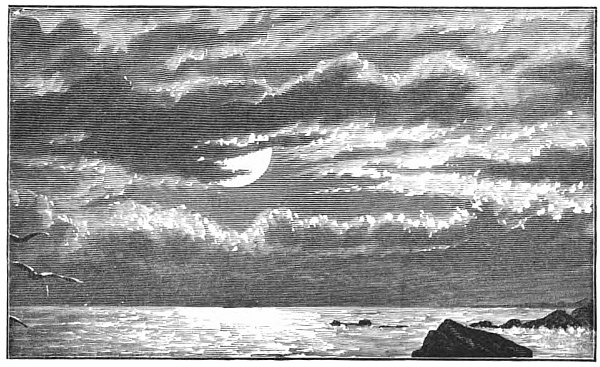
Not a breath of wind from any direction. Not a cloud in the sky, not a ripple on the ocean’s blue. Only when a bird alighted on the water, quisling rings of silver formed all around it, and widened and widened, but soon were lost to view. Or when a fish leaped up, or the dorsal fin of some monster shark appeared above the surface, the sea about it trembled for a time, trembled and sparkled as if a shower of diamonds had suddenly fallen there.
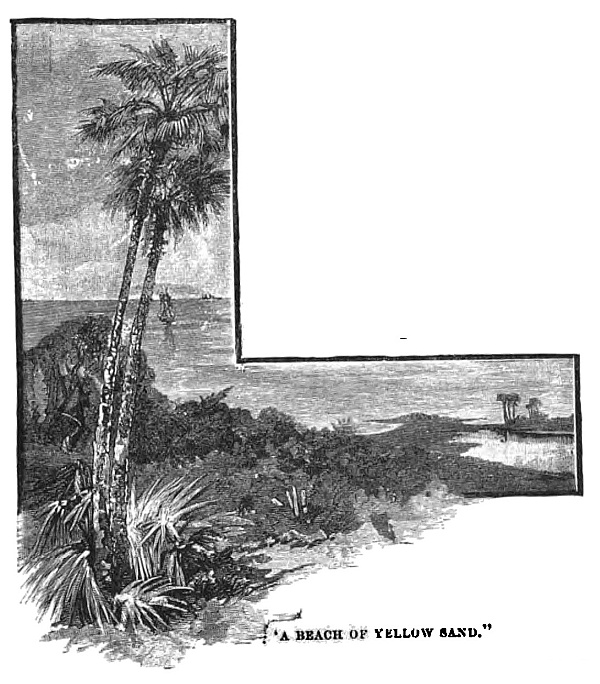
And a broad low swell came rolling in from the Indian Ocean, as if the bosom of the sea were moving in its sleep. But landwards, had you looked, you might have seen it break in a long fringe of snowy foam on a beach of yellow sand; and, had you listened, the distant hum and boom of those breakers would have fallen on your ears in a kind of drowsy long-drawn monotone.
The brave ship Niobe (this word is pronounced as if spelt “Ni-o-bee”) slowly rose and slowly fell, and gently rocked and rolled on this heaving tide, and sometimes her great sails flapped with the vessel’s motion, but, alas! not with the rising wind.
No, not with the rising wind, but whenever they moved, the officer who paced up and down the white-scoured quarter-deck, would glance above as if in hope; then he would gaze seawards, and anon shorewards, wistfully, wishfully, uneasily.
Uneasy, indeed, was the feeling on the minds of all on board.
The vessel was far too near the shore, the wind had been dead for hours, but it had died away suddenly, and the glass had gone tumbling down. That it would come on to blow again, and that before long, everyone from the captain to the dark-skinned Kroo-boy was well aware. But from what direction would the wind come? If from the east, strong though the Niobe was, close to the wind though she could sail, well-officered and manned though she was, there was more than a probability she would be dashed to pieces on that sandy beach.
And small mercy could the survivors, if any, expect from the savage Somali Indians, and the still more cruel Arabs, who dwelt in the wretched little towns and villages on the coast. For the ship was here in the Indian Ocean for the avowed purpose of putting down slavery and piracy, and by slavery and piracy those Arabs lived.
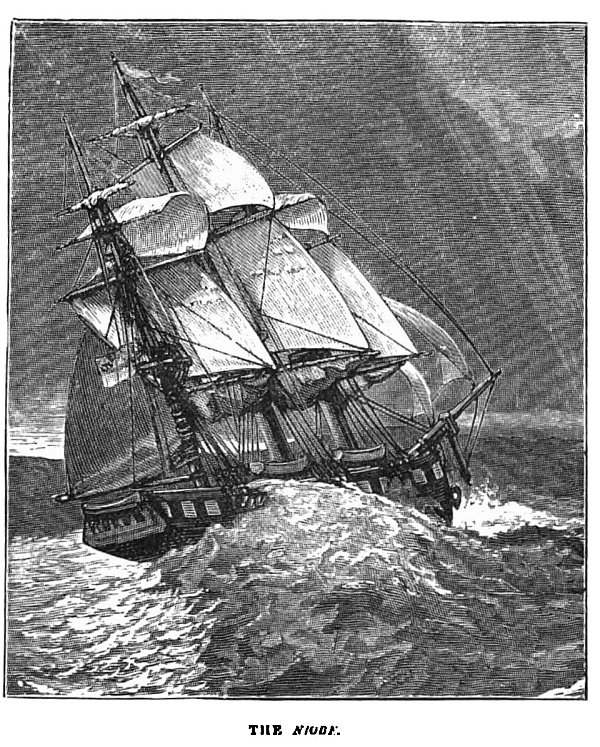
It was in the days before steam-power was generally adopted by our navy, when sailors were sailors in reality, and not merely in name.
The crew of the Niobe numbered about seventy, all told fore—and—aft. She carried ten good guns, and an unlimited supply of small arms, cutlasses, and boarding pikes. The timbers of this brave craft were of the toughest teak, ay, and her men were hearts of oak. They feared nothing, they hated nothing, save uncertainty and inaction. All that they longed for was to be accomplishing the object of their cruise.
Had you been on board the Niobe when the wind was blowing half a gale, and the ship ripping through the waves with, maybe, green seas hitting her awful thuds at times, and the foam dashing high over the main or fore-tops, you would have found the men as merry and jolly as boys at cricket. Had you been on board when the battle raged, and the cannon roared, and balls crashed through her sides or rigging, when splinters flew and men dropped bleeding to the deck, you would have found nought save courage and daring in every eye, and calmness in every hand.
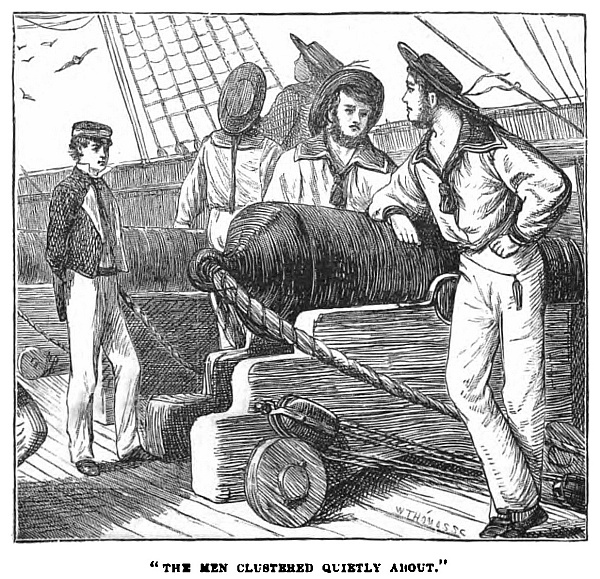
But to-day, at the time our story opens, there was neither laughing, joking, nor singing to be heard. The men clustered quietly about bows or fo’c’sle, or leaned lazily over the bulwarks watching the vessel roll—for at one moment she would heel over till the cool clear water could be touched with the hand, and the next she would raise her head or side until a yard at least of her copper sheathing shone in the sunlight like burnished gold.
There was no sound to break the stillness save the far-off boom of the breakers; so quiet was it that the sound of even a rope’s-end thrown on deck grated harshly on the ear, and a whisper could be heard from one end of the ship to the other.
“Bill,” said one sailor to another, biting off the end of a chunk of nigger-head tobacco, “I don’t half like this state of affairs.”
“And I don’t like it either, Jack,” was the reply, “but I suppose we must put up with it.”
“Do ye think it would be any good to whistle for the wind, Bill?”
“Whistle for your grandmother,” replied Bill, derisively.
“Bill,” persisted Jack, “they do tell me—older men, I mean, tell me—that whistling for the wind is sure to bring it.”
“Ay, lad, if you whistle long enough. Look here, Jack, don’t be a superstitious donkey. I’ve seen five hands at one time whistling for the wind; but, Jack, they nearly whistled the whites o’ their eyes out.”
“And the wind didn’t come?”
“Never a breath. Never a puff.”
“Hand in sail!” This was an order from the quarter-deck.
“Ay, ay, sir.” This was an answer from for’ard.
“Thank goodness,” cried Jack and Bill both. “Better something than nothing.”
There was plenty of bustle and stir and din now, for a time at least, and bawling of orders, and shrill shriek of boatswain’s pipe. But when all was done that could be done, silence once more settled down on the ship—lethargy claimed her again as its own.
“I think, sir,” said the boatswain, touching his cap to the officer on watch, “I think, and I likewise hope, the wind’ll come off the land when it does come, sir. Anyhow, if it doesn’t commence to blow for the next ten hours we’ll get away into the open sea.”
“You’re an old sailor, Mr Roberts, and know this coast better than I do, so I like to hear you say what you do. Well, sure enough, the sun will be down in three hours, then we may get a bit of a land breeze. But the falling glass, Mr Roberts! I don’t like the falling glass!”
“No more do I, sir, and I’ve seen a tornado in these same waters, and the glass not much lower than it is now.”
Leaving these two talking on the quarter-deck, let us take a look down below.
Within a canvas screen, that formed a kind of a square tent on the main deck, a cot was swung in which there lay, apparently asleep, the fragile form of a young woman. A woman, a mother, and still to all appearance but little more than a girl.
Presently the screen was gently lifted, and a young soldier, dressed in the scarlet jacket of a sergeant of the line, glided in, dropped the screen again, then silently seating himself on a camp stool beside the cot, he began to smooth the delicate little snow-white hand that lay on the coverlet. Then her eyelids lifted, and a pair of orbs of sad sweet blue looked tenderly at the soldier by her side.
She smiled.
“Oh, Sandie!” she said, “I’ve had such a dear delightful dream. I thought that our darling had grown up into such a beautiful child, and that you, and he, and I, were back once more, wandering among the bonnie hills, and over the gowany braes of bonnie Arrandale. I thought that father had forgiven us, Sandie, and kissed and blessed our boy, and was laughing to see him stringing gowans into garlands, and hanging them around the neck of our old and faithful Collie.”
“Cheer up, dear wife,” said the young sergeant, kissing her pale brow. “Oh! if you only knew how much good it does my heart to see you smiling once again. Yes, dear, and I too have good hopes, brave hopes, that all will yet be well with us. I was but a poor corporal when you fell in love with me, Mary; when, despite the wishes of your father, who would have wedded you to the surly old laird of Trona, and to lifelong misery, I made you my wife. Your father knew I had come of gentle blood—that Dunryan belongs by rights to me—but he saw before him only the humble soldier of fortune; and he cursed me and spurned me.
“But see, dear, look at these stripes on my arm, behold the medal. I carry already a sergeant’s sword; that sword I hope to wave and wield on many a field of battle, and with its aid alone, though friendless now, I mean to earn both fame and glory, ay, and with it win my spurs. Then, Mary, the day will come when your father will be glad to own me as a son.
“But sleep now, dear; remember, the doctor says you are not to move. Sleep; nay, you must not even talk. See, I have brought my guitar; I will sit here and sing to you.”
He touched a few chords as he spoke, then sang low, sweet, loving songs to her, and ere long she was back once more in the land of dreams.
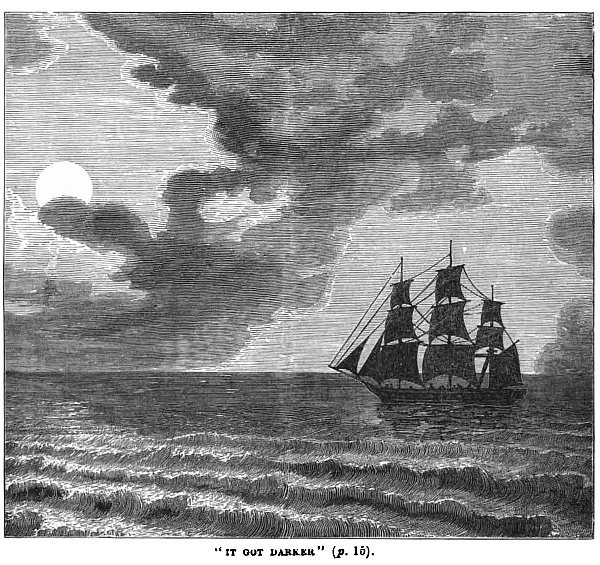
The sun sank lower and lower in the heavens, and at last leapt like a fiery ball down behind the waves. A short, very short twilight succeeded, a twilight of tints, tints of pink, and blue, and yellow. Sky and ocean seemed to meet and kiss good-night. Then shadows fell, and the stars shone out in the eastern sky, and twinkled down from above, and finally glittered even over the distant hills of the western horizon: then it got darker and darker.
But no breeze came off the shore, and this was in itself full ominous.
The captain was now on deck with his first lieutenant.
“We cannot be very many miles,” he said, “off the river.”
“Yes, sir,” replied the lieutenant, “I reckon I know what you are thinking about. If we cannot keep off from the shore in the event of its coming on to blow, you would try to cross the bar.”
“I would,” replied the captain. “It would indeed be a forlorn hope, but better that than certain destruction.”
“I fear, sir, it would be but a choice of deaths.”
“Better die fighting for life, though,” said the captain, “than without a struggle.”
“Quite true,” said the other, “and once over the bar we could get round the point and shelter would be certain. But that terrible bar, sir!”
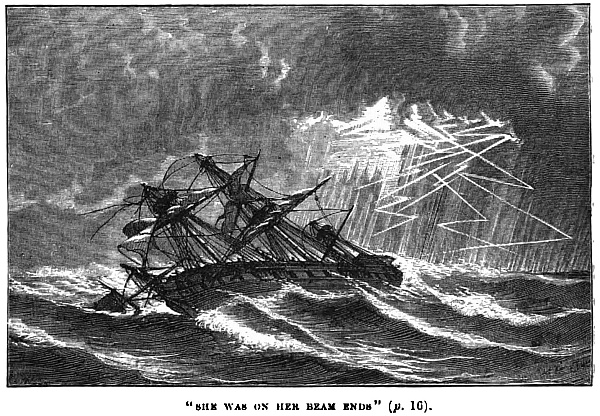
It was far on in the middle watch ere the storm that had been brewing came on at last. It came from the east, as the captain had feared it would. Clouds had first risen up and gradually obscured the stars. Among these clouds the lightning flashed and played incessantly, but for a long time no thunder was heard. This, at last, began to mutter, then roll louder and louder, nearer and nearer, then a bank of white was seen creeping along the sea’s surface towards the ship, and almost immediately after the wind was upon her, she was on her beam ends with the sea dashing through her rigging, and the storm seeming to hold her down, but gradually she righted and sprang forward like an arrow from a bow, and apparently into the very teeth of the wind.
The ship had been battened down and made ready in every way hours before the gale began, and well was it for all on board that preparations had thus been made.
She was headed as near to the wind as she would sail, but for some time it seemed impossible for her to keep off the shore. Gradually, however, the wind veered more to the south, and she made a good offing. But the storm increased rather than diminished; still the good ship struggled onwards through darkness and danger.
The royal masts had been got down early on the previous afternoon so as to reduce top-hamper to a minimum, but the pitching and rolling were frightful, yet she made but little water.
Towards morning, however, fire and wind and waves appeared to combine together for the destruction of the ship. The gale increased suddenly to all the fury of a hurricane, the roaring of the wind drowned even the rattle of the thunder, a ball of fire quivered for a moment over the fore-top-mast, then rent it into fragments, ran along a stay and splintered the bulwarks ere it reached the water, while at the same moment the whole ship was engulphed by a solid sea that swept over her bows, and carried away almost everything it reached, bulwarks, boats, and men.
Then, as if it had done its worst, the gale moderated, the sea became less furious, the thunder ceased to roll, the lightning to play, and in half an hour more the grey light of morning spread over the ocean, and on the eastern horizon a bank of lurid red showed where the sun was trying to struggle through the clouds.
With bulwarks ripped away and boats gone, the Niobe looked little better than a wreck, while, sad to relate, when the roll was called five men failed to answer. Five men swept away during the darkness and tempest, five brave hearts for ever stilled, five firesides at home in merrie England made to mourn for those whom their friends would sadly miss, but never, never see again!
But see: the gale begins once more with redoubled fury, and to the horror of that unhappy ship, the wind goes round to meet the sun.
“I fear, sir,” said the lieutenant to the captain, “that nothing can now save us. We must die like men.”
“That we will, I trust,” replied the captain, “but we will die doing our duty to the very last. Is there any one on board who knows this coast well?”
“The boatswain, sir, Mr Roberts.”
“Send for him.”
“Ay, ay, sir.”
“Mr Roberts, what think you of the outlook?”
“A very poor one, captain. But I have been looking at the land, sir, and hazy though it is I find we are right off the bar of Lamoo.”
“Why, then, we must have been driven back many many miles; we were off Brava last night.”
“I reckon, sir, we made up our leeway at times like, when there was a bit of a shift of wind, and lost it again when it veered. But our only chance now is to head for that bar, sir.”
“You’ve been over it?”
“I have, sir, many is the time; and I’ll try to pilot the good Niobe over it now.”
“Very well, Mr Roberts, you shall try; if you succeed, you are a made man, if you fail—”
“All,” said the boatswain, “I knows what failure’ll mean, sir.”
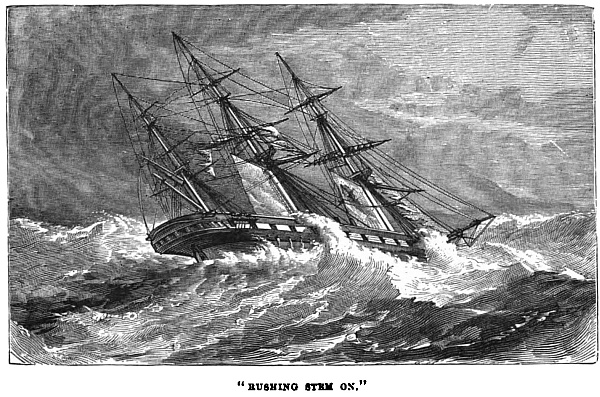
Half an hour afterwards, stripped of nearly every inch of canvas save what sufficed to steer her, with four men at the wheel, and the sturdy pilot guiding them with hand movements alone—for his voice could not be heard amid the raging of the storm and awful roar of the breaking billows that were everywhere around them—the brave Niobe was rushing stem on through the mountain seas that rolled shorewards over the most dreaded bar on all the African coast.
It is impossible to describe the turmoil and strife of the waves when the vessel was once fairly on the bar; and to add to the terror of the scene more than once she struck the sandy bottom with a force that made every timber creak and groan. Next moment she would be swallowed up apparently in boiling, breaking, swirling water, but rising again on the crest of a wave, she would shake herself free and rush headlong on once more.
But look at her now: she is on the very top of a curling avalanche, and speeding shorewards with it, her jibboom and bowsprit, and even part of her bows, hang clear over that awful precipice of water, and if the ship moves faster than the breaker beneath her then her time is come.
It is a moment of awful suspense, but it is only a moment, for in shorter time than pen takes to describe it, the billow seems to sink and melt beneath her; again she bumps on the sand, but next minute amidst a chaos of snowy foam she is hurled into the deep water beyond.
An hour afterwards the Niobe is lying snugly at anchor in a little wooded bay, with all her sails furled, and nothing to tell of the dangers she has just come through, save the splintered mast, the ragged rigging, and sadly-torn bulwarks.
But the wind goes moaning through the mangrove forest, where birds and beasts are crouching low for shelter among the gnarled boughs and roots, and although the water around the Niobe is calm enough, the storm roars through her upper rigging, and she rocks and rolls as if out at sea.
The youthful sergeant is sitting beside the cot within the screen, but his head is bowed down with grief, and a sorrow such as men feel but once in a life-time is rending his heart. The little white hand of his wife still lies on the coverlet, but it is cold now as well as white. The heart that loved him had ceased to beat—
“And closed for aye the sparkling glance That dwelt on him sae fondly.”
All his bright visions of yesterday have fled away, all his hopes are crushed, his very soul seems dead within him.
At the very time the gale was raging its fiercest, and the sea threatening every minute to engulph the ship, the lady’s life had passed away, and he who sits here pen in hand was left without a mother’s care. Born on the stormy ocean, rocked in infancy on the cradle of the deep, no wonder he loves the sea, and can look back with pleasure even to the dangers he has encountered and gone through.
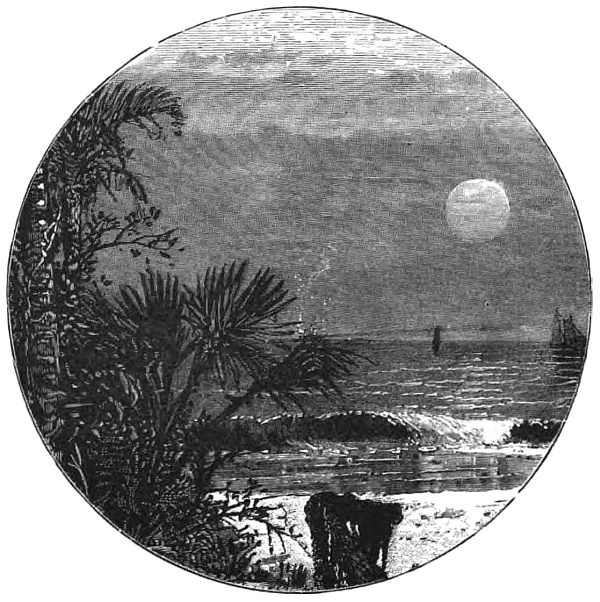
As the sea on which he was born, so stormy has been the life of him who tells this tale.
Chapter Two.
“Majestic woods of every vigorous green, Stage above stage, high waving o’er the hills; Or to the far horizon wide diffused, A boundless deep immensity of shade.” Thomson’s “Seasons.” “Hearts of oak!” our captain cried, “when each gun From its adamantine lips, Spread a death-shade round the ships, Like the hurricane eclipse of the sun.” Campbell.
There are two events in the history of a man, of which he himself in writing his autobiography can hardly be expected to give any very clear account, namely, his birth and his death. To describe the former, he would require to be born with his eyes very wide open indeed, and instead of a silver spoon in his mouth, which they tell me some children are born with, a silver pencil-case behind his ear; to describe the latter, a man would need to be a prophet in reality. How is it then, it may be asked, that I, Niobe Radnor, am able with truthfulness and accuracy to give an account of the occurrences that were taking place around me when I first made my appearance on “the stage of life.” For the ability to do so, I am indebted to the only father I ever knew, my true and trusty old friend Captain (formerly boatswain) Ben Roberts, who supplies me with the facts.
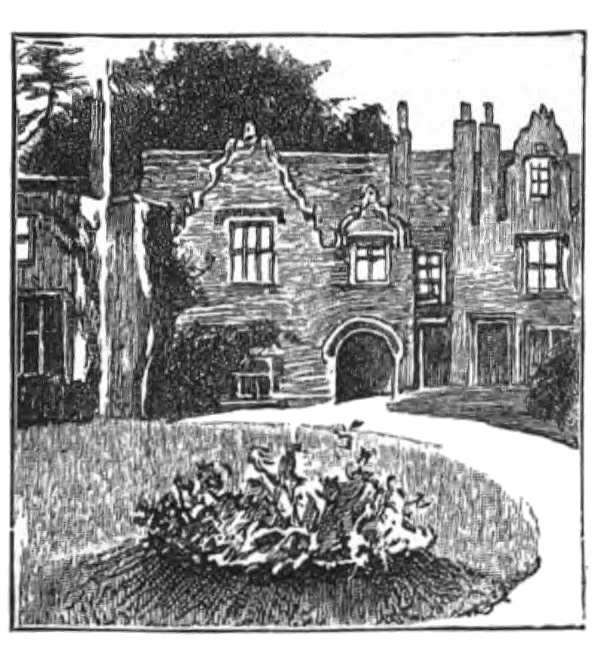
Yonder he is, sitting out on the rose lawn there, as I write, book in hand, his white beard glittering in the spring sunshine, and his jolly old round red face surmounted by an immensity of straw hat—just as if his complexion could be spoiled, just as if a complexion that has borne the brunt of a thousand storms, been scathed and scarred in battle, blistered by many a fierce and scorching summer sun, and reddened by the snows of many a hard and stormy winter, could be spoiled.
Ah! dear old Ben! he is getting old, wearing up towards the threescore years and ten—
”—That form That short allotted span. That binds the few and weary years Of pilgrimage to man.”
Yes, Ben is getting old. As oaks get old, so is my faithful friend getting old. As oaks in age are hard and tough, and defiant of the gales that rage through the forest, uprooting mighty trees, so is Ben my friend; and for all the storms he has weathered, I trust I shall have him by me yet for years and years to come. Ben is so buoyant and fresh, it always instils new blood into my veins merely to talk to him. “Ben, my boy,” I often say, “you are, by your own confession, some twenty years my senior, and yet I believe you feel as young and even younger than I do.”
“Well, Nie,” he replies, “I believe it’s the heart that does it, you know.
“For old as I am, and old as I seem, My heart is full of youth. “Eye hath not seen, tongue hath not told, And ear hath not heard it sung, How buoyant and bold, though it seem to grow old, Is the heart for ever young. “For ever young—though life’s old age Hath every nerve unstrung; The heart, the heart, is a heritage That keeps the old man young.”
He always calls me “Nie” for short, “because,” he added once, by way of explanation, “your name is a heathenish kind of one at best, but a person is bound to make the most of it.”
I cannot deny that Ben is right; my name is a heathenish one. How did I come by it? I will tell you. I was born, as you know, at sea, in the Indian Ocean, in the Niobe, whilst she was cruising in that region in the search of slavers—born not long before the appearance of that terrible gale of wind described in the first chapter of this story, when the tempest was at its fiercest, and the stormy waves were doing their worst; born on board a vessel which seemed doomed to certain destruction. And it is the custom of the service to call a child by the name of the ship in which he first sees the light of day.
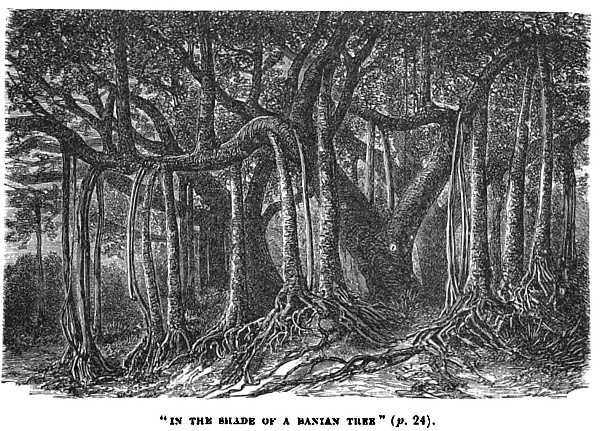
I never knew a father’s love or a mother’s tender care, for the gentle lady who gave me birth lived but a little after that event; but she bequeathed me all she had—her blessing—and died. In a glade in the gloomy depths of an African forest my mother is sleeping, in the shade of a banian tree. I stood by that lonely grave one morning not many years ago. The ground, I remember, was all chequered with sunshine and with shade from the tree above; little star-like primulas grew here and there. Among these and the fallen leaves sea-green lizards were creeping; high overhead bright-winged birds sang soft lullabies, and every time the wind moved the boughs a whole shower of sparkling drops fell down, like tears.
And my father? He never seemed to rally after my mother’s death until one hour before his own, just a fortnight and a day from that on which he had followed her to her grave in the forest like one dazed. He did not appear in his mess-place after this. He took no food, he spoke to no one, he spent his time mostly within the screen by the empty cot where my mother had been—in grief.
About the tenth day he suffered my friend Roberts (the boatswain) to lead him like a child to the spare cabin where his baby boy was sleeping; and in a daze he had seen her loved remains laid to rest beneath the tree. He bent over the grave for a moment, and then for the first time he burst into tears.
The Niobe remained for ten days where she had cast anchor, in order to make good repairs.
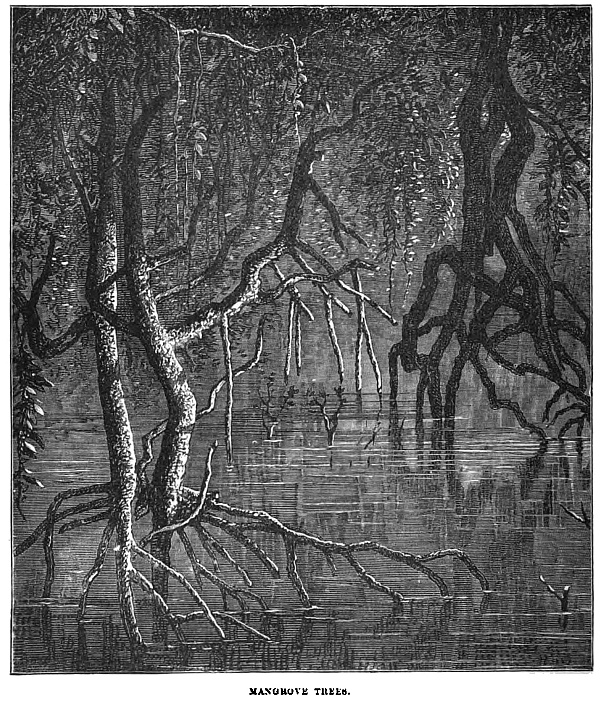
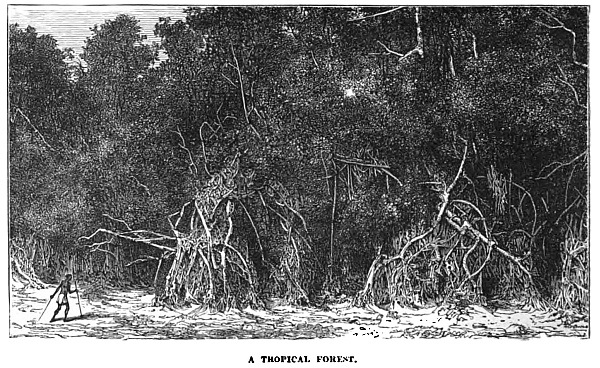
It was a very quiet spot in which she lay, a kind of bay or bight, as the sailors called it, with mangrove trees growing all around it close down to the water’s edge, except at the one side where the great river stole silently away seaward, its current seeming hardly to affect in any degree the waters in the bay itself.
At last all repairs were finished, and the “clang, clang, clang” of the carpenters’ hammers, that had been till now incessant all day long, and far into the night, was hushed, sails were shaken half loose, and the Niobe only waited for a breeze to bear her down the river and across the great and dreaded bar, where, even in the calmest weather, the breakers rolled and tumbled mountains high.
But the breeze seemed in no hurry to come. During the day those dull dreamy woods and forests lay asleep in the sunshine, and stirred not leaf or twig, and the creatures that dwelt therein were as silent as the woods around them. Had you landed on that still shore, and wandered inland through the trees, you would have seen great lizards enjoying themselves in patches of sunlight, an occasional monkey enjoying a nap at a tree foot or squatting on a bough blinking at the birds that—open-beaked as if gasping for more air—sat among the branches too languid to hop or fly. But except a startled cry at your presence emitted by some of these, hardly any other sound would have fallen on your ears.
The only creatures that seemed to be busy were the beetles on the ground and the bees, the latter long, dark, dangerous-looking hornets that flew in clouds about the lime and orange-trees, and behaved as if all the forest belonged to them, the former of all shapes and sizes, and of colours more brilliant than the rainbow. No doubt they knew exactly what they were about and had their ideas carefully arranged, but what their business was in particular would have puzzled any human being to tell—why they dug pits and rolled little pieces of stones down them, or why they pulled pieces of sticks along bigger than themselves, dropped them, apparently without reason, and went in search of others. There was, one would have thought, no method in the madness of these strange but lovely creatures: it looked as though they were doomed to keep moving, doomed to keep on working, and doing something, no matter what.
In the great river itself sometimes small herds of hippopotami would appear, especially in parts where the water was shallow. They came but to enjoy a sunshine bath and siesta.
But at night both forest and river seemed to awaken from their slumbers.
The river cows now came on shore to feed, and their grunting and bellowing, that often ended in a kind of shriek, mingled (Two pages missing here).
“Well, my friend, how much for your bananas, and that bottle of honey, and those eggs, and fowls? Come, I’ll buy the lot,” said the boatswain.
“De Arab chief come in big ship, two three week ago. De ship he hide in de bush. He come to-night when de moon am shine. He come on board you big ship, plenty knife, plenty spear, plenty gun, killee you all for true. Den he take all de money and all de chow-chow. Plenty much bobbery he makee, plenty much blood he spillee, plenty much murder. Sweeba tell you for true.”
While this conversation was going on the fruit, eggs, and fowls were being handed on board and money thrown into the boat, which was quickly concealed by the natives in their cummerbunds.
They found themselves richer than they had ever been before in their lives.
“But why do you come and tell us?” then inquired Roberts. (Roberts, by the way, was the only one the native would converse with. He had eagerly requested the captain and officers to keep away, for fear of exciting the suspicion of those who he averred were lurking in the forest.)
“What for I come and tellee you?” he replied. “English have been good to me many time ’fore now. Arab chief he bad man. He come to my house, he tie me to a tree by de neck. He think I dead. Den he takee my poor wife away, and all de poor piccaninnies. My poor ole mudder she berry bad. She not fit to trabbel away to de bush, so he cut her head off, and trow her in de blaze. He burn all my hut, all my house. I not lub dat Arab chief berry berry much.”
“I shouldn’t think you did,” was the reply; “but now, my friend, if all goes well come back to-morrow, and we will reward you.”
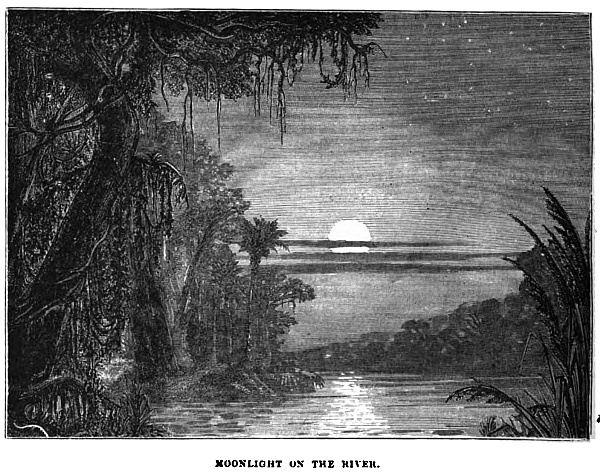
About eight o’clock that same night, the full moon rose slowly up over the woods, bathing the trees in a soft blue haze, but changing the river, ’twixt the ship and the distant shore, into a broad pathway of light that shimmered and shone like molten gold. There was hardly a cloud in the heaven’s dark blue, and the stars shone with unusual brilliancy.
No one was visible on the Niobe’s decks, and never a light burned aloft, but, nevertheless, sentinels were watching the water on all sides, and down below the crew, fully armed, were waiting. The guns were all ready to run out, and there was no talking save in whispers, and when any one had occasion to cross the deck he did it so lightly that you could scarcely have heard his footfall.
Except the officers of the watch, all others were in the saloon or ward-room. They too were armed, but passing the time in quietly playing draughts and other games. Instead of being in his cabin, the captain was there along with his officers.
Presently the boatswain, whose duty it was to keep one of the night-watches, came quietly in to make a report.
“There are no signs yet, sir. The forest is quiet enough, except for the birds and beasts. It is very bright now. If they do come, we will have light enough to give ’em fits.”
“I hope they will, then,” replied the captain; “I sincerely trust that tall native wasn’t a-gammoning us.”
“I feel sure enough he wasn’t, sir.”
“Hark!” cried the captain.
It was the sentry’s hail. Next moment his rifle rang out on the night air. It seemed to be caught up by the echoes of the forest, and the sound multiplied indefinitely, but there was instant evidence that this was no echo.
A long line of fire swept across the forest shore, and bullets rattled through the rigging or on the vessel’s sides.
The attack was about to commence.
Guns were speedily run out in the direction from which the volley had come, and just by way of showing the enemy that the Niobe was prepared, two loaded with shrapnel were fired.
The yell of rage and pain that rang through the forest, told plainly enough that some of the savages had bitten the dust. The battle had begun.
But it was not to be a fight of rifle against big guns. The Arabs, unless at close quarters, are ever at disadvantage. The chief who led this particular band bore a fierce and implacable hatred to the English race, more especially to those who wore the blue uniform of the Royal Navy. Many a time had he been thwarted in his designs by the ubiquitous British cruiser, and, sword in hand, he had sworn by Allah—sworn on his “book”—to have revenge.
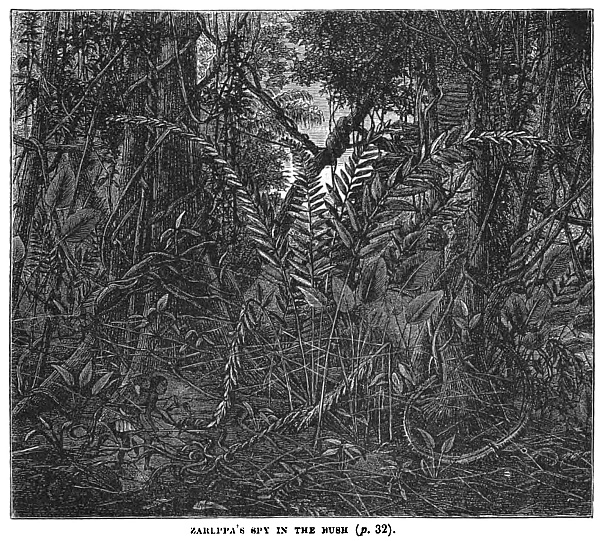
His time, it almost seemed, had come to-night. Though far south when the first news of the disaster to the Niobe had been brought to him by a swift-footed Somali spy, Zareppa had lost no time in setting sail in his largest dhow—he was the proud owner of many—and making his way north.
It was no trouble for this daring piratical slaver to cross the bar even on a light wind. He had stolen up the river by night unseen, and soon after planned his attack.
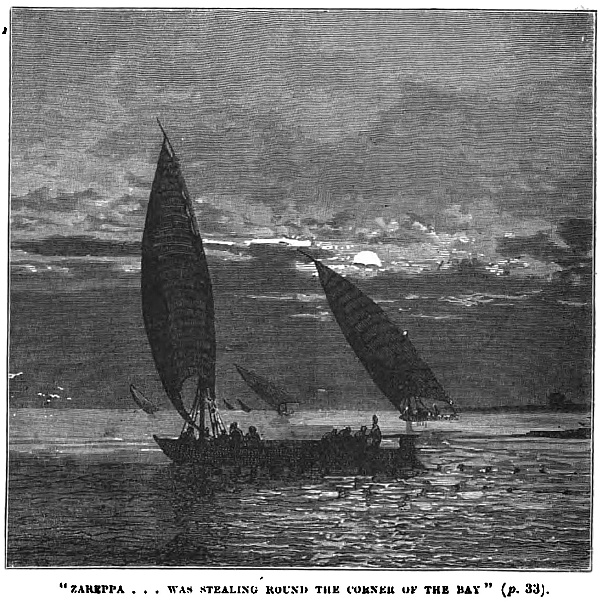
Now at the very moment that a whole fleet of canoes filled with armed Somalis and Arabs left the forest shore, under cover of volley after volley from the bush, Zareppa, the pirate chief, was stealing round the corner of the bay with over a hundred of his best warriors, who were lying down so that they might not be seen, to attack the Niobe on the other quarter.
Swiftly came they while guns thundered forestward, and all hands lay on the port side to repel boarders. It looked as though the fate of the good ship were sealed.
Till this moment the soldier sergeant—my father—had lain apparently helpless and apathetic in a screen berth on the main deck. But the sound of warfare will stir the blood of even a dying soldier, as the blast of a bugle does that of the aged and worn-out war-horse. No sooner had the firing commenced than he started from his cot and speedily dressed himself, often tottering as he did so.
Captain Roberts tells me that even then my father could hardly have known what he was about: that all he could have been certain of was that a fight was going on, and it was his duty to be in it.
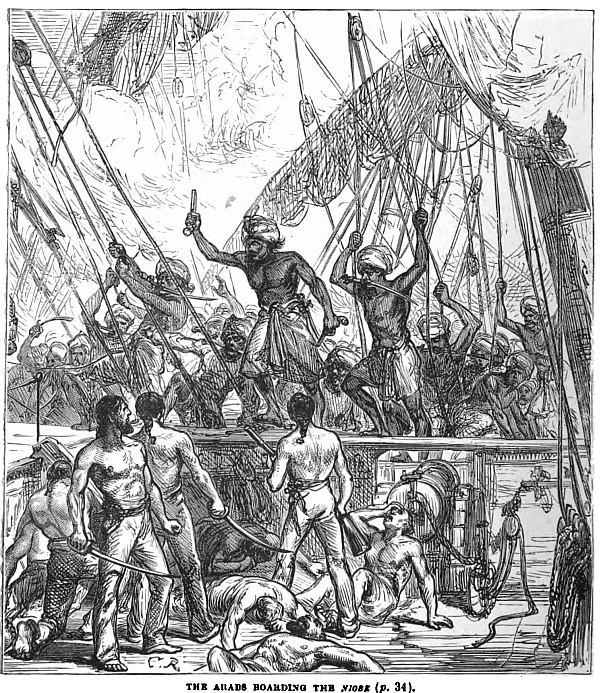
Grasping sword and pistol, he rushed on deck. Still staggering, and gazing wildly around him, almost the first thing he saw was the approach of Zareppa’s boats. He was all alive now, he rushed across the deck, and more by gesture than by voice made the commander aware of the terrible danger.
None too soon. Already the heads of the foremost boarders were appearing above the bulwarks. But our men were speedily divided into two parties, and in a minute more the battle was raging fiercely on both sides of the deck.
“Deen! Deen! Deen!” was the fierce and shrill Arab war-cry.
“Hurrah! hurrah!” was the bold and answering shout of our marines and bluejackets.
The tall form of Zareppa seemed everywhere. It towered high on the bulwarks. It was seen springing down on deck, and vaulting backwards, and wherever it came death followed in its wake.
Soon no sound even of pistol was heard. It was a hand-to-hand fight on deck, for the Niobe had been boarded: hand to hand, and breast to breast; cutlass and sword ’gainst Somali dagger and Arab spear. There were the shrieks of pain, the cries of exultation, and horrible oaths as well, I blush to say, mingling with the groans of the dying in this dreadful mêlée.
How peacefully the moon shone—how quiet and lovely and still the forest looked all around! How great the contrast ’twixt man and nature!
But, see! the fight is finished. The enemy are borne backwards into the sea. Our fellows hack them down as they fly, for they are wild with the excitement of the strife.
But high on the poop a young soldier is engaged in a deadly strife with the Arab chief himself. All his skill would hardly save Zareppa. For several minutes the duel seemed to rage. Then with a wild rash the Arab dashed forward on the soldier, his sword passed through his body and—my father fell dead.
“English dogs!” shouted Zareppa, standing for a moment on the bulwarks with bleeding sword upheld. “Dogs of English, Zareppa’s day will come! Beware!”
He would have vaulted into the sea, but up from behind the very place where he stood rose a dark naked figure. A dagger gleamed one instant in its hand, and next was plunged into the back of the chief, who gave a fearful shriek.
“Ha! ha! aha!” yelled this strange figure, “Zareppa’s day hab come. Plenty quick. Ha!”
The Arab chief fell face forward on the deck.
It was the negro Sweeba, who had brought the news of the intended attack.
From his own side of the river he had heard the firing and the wild shouts that told of the raging combat, and had speedily launched his rude canoe, intent on revenge for the murder of his poor wife and babes.
Chapter Three.
“Hope, with her prizes and victories won, Shines in the blue of my morning sun, Conquering hope with golden ray, Blessing my landscape far away.” Tupper.
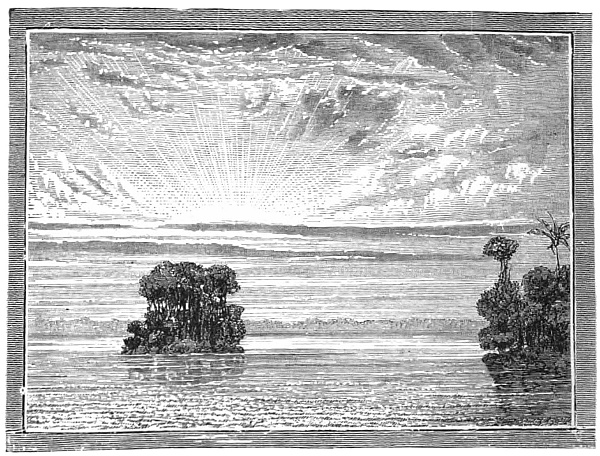
Not a single prisoner was taken.
Those who were not fatally wounded had sprung overboard.
The rest of the night passed in quietness, but when day broke, the sun shone on a sad and ghastly scene. There still lay about broken cutlasses, spears, torn pieces of cloth, and all the débris of fight, and blood, blood everywhere.
On one side of the deck, with upturned faces, lay in ghastly array the dead of the enemy, on the other our own poor fellows had been put, and carefully covered with flags.
All hands were summoned to prayers, to bury the dead and clear up decks.
When, after service, the commander and his officers—alas! among those who lay beneath the Union Jack were one or two officers—went round to view the bodies, to their astonishment, they found that Zareppa had gone.
He had only shammed death, then, in order to escape!
Incidents of the very saddest character are soon forgotten in the service. It is as well it should be so. But a battle is no sooner fought than the decks are carefully washed, the damages all made good, and even rents and holes in the ship’s side, that might well redound to her honour, are not only carefully repaired but painted over. And whenever a vessel has had sails torn in a gale of wind, sailors are put to mend them on the following day.
For modesty always goes hand-in-hand with true valour.
In a fortnight after the fight in the river the brave Niobe was once more at sea, and looking all over as smart a craft as ever sailed.
Just as I wrote these lines my good friend, Captain Roberts, looked over my shoulder.
“Ay, lad,” he said, “and she was a smart craft too. They don’t make such ships now, and they couldn’t find the men to man ’em if they did. I tell you, Nie, it was a sight that used to make Frenchmen stare to see the old Niobe taking down top-gallant masts.”
“Well, my dear old sea-dad,” I replied, “of course you are fond of the good old times. It is only natural you should be.”
“But they were times. Why, nowadays they could no more do the things we did than they could pitch a ball o’ spun yarn ’twixt here and Jericho. I’m right, lad, I tell you, and I should know.”
“Oh!” I replied, “for the matter of that, I was living in those brave old days as well as yourself.”
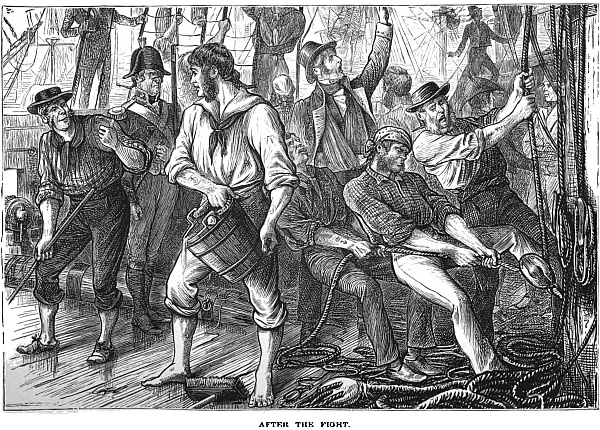
“Yes, so you were,” cried the old captain, laughing. “You were borne on the books o’ the old Niobe as well as myself, and a queer little chap you were when first we met. Heigho! time flies: it’s more’n forty years ago, Nie.”
“Wait half a minute,” I said, for I knew the old man was going to spin me a yarn that I was never tired of hearing—the story of my own early years. Why was it that I liked to hear him tell the tale over and over again, you may ask. For this reason—he never told it twice quite the same: always the same in the main incidents, doubtless, but with something new each time.
“Wait half a minute.”
“Ay, ay, lad!”
I brought out the little table and set it down under his favourite tree on the lawn, and placed thereon his favourite pipe and his pouch.
The old sailor smiled, and drew his great straw chair up and sat down, and I threw myself on the grass and prepared to listen.
The captain had his two elbows on the table; he was teasing the tobacco, and when he began to speak he was evidently following out some train of thought, and addressing the tobacco, not me.
“As saucy a wee rascal he turned out as ever put a foot on board a ship,” said Captain Roberts.
“Whom are you talking about, old friend?” I asked.
“I’m talking about baby Nie,” replied the captain, still addressing the tobacco. “I wonder, now, what would have become of him, though, if it hadn’t been for old Bo’swain Roberts. Why, he would have died. Died? Ay, but I wouldn’t see poor Sergeant Radnor’s baby thrown to the sharks, not for all the world. Fed him first on hen’s milk (the name given by sailors to egg beaten up in water). Didn’t do well on that. ‘Cap’n,’ says I to the skipper one day, ‘soon’s we go to Zanzibar we must get a nanny-goat for the young papoose, else he’ll lose the number of his mess, and the doctor will have to mark him D.D.’ (discharged dead.) ‘Very well, Roberts,’ says the skipper, ‘that’s just as you like.’
“Now our purser was a mean old fellow. ‘Nanny-goat!’ he cries, when I went to ask him for the money. ‘What next, I wonder? the service is going to the deuce. No, Her Majesty pays for no nanny-goats, I do assure ye.’
“I just touches my hat and marches off to our dear old doctor. I knew he had a kindly heart. ‘Nanny-goat,’ cries he, ‘why, of course the darling baby’ll have a nanny-goat. We’ll keep it out of the sick-mess fund, and mark it down medical comforts.’ (Note 1.) ‘Excuse me, sir,’ said I, catching hold of the doctor’s hand—it was as rough as my own—‘but you’re a brick.’
“And that, ‘Nie,’ is how you came for the first five years o’ your life to be called nothing else but young ‘medical comforts.’”
“Five years!” I said, “that is a long spell for a ship to be on one station.”
“Ay, lad, you’re right. But ships were ships in those days.
“Young ‘medical comforts’,” he continued, “as they called you, in less than four years was a deal smarter than any monkey on board. Not that he could climb quite so high, maybe, but he was more tricky, and that is saying a lot. And it was among the monkeys that ‘medical comforts’ would mostly be, too.
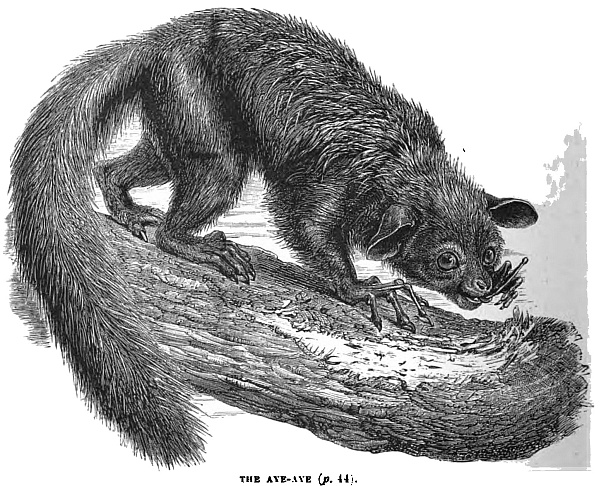
“But the monkeys all seemed to like you, Nie; they would tease each other, and fight each other, but they never touched you. There was one animal in particular, and he was your favourite, the queerest old chap you ever saw. We got him down in Madagascar, and they called him the Ay-ay. Doctor always said he was a being from another world, a kind of a spirit, and the men used to be afraid of him. He had hands like a human being, but the middle finger was much longer than the others, and not thicker than a straw. When only a baby, he used to dip this long skinny finger in milk and give you to suck, and when you went to sleep he never left your side. Sometimes he would stroke your face and say, ‘Ay-ay’ as tenderly as if he’d been a mother to you. But the men always declared it was ‘Nie, Nie,’ he’d be saying.
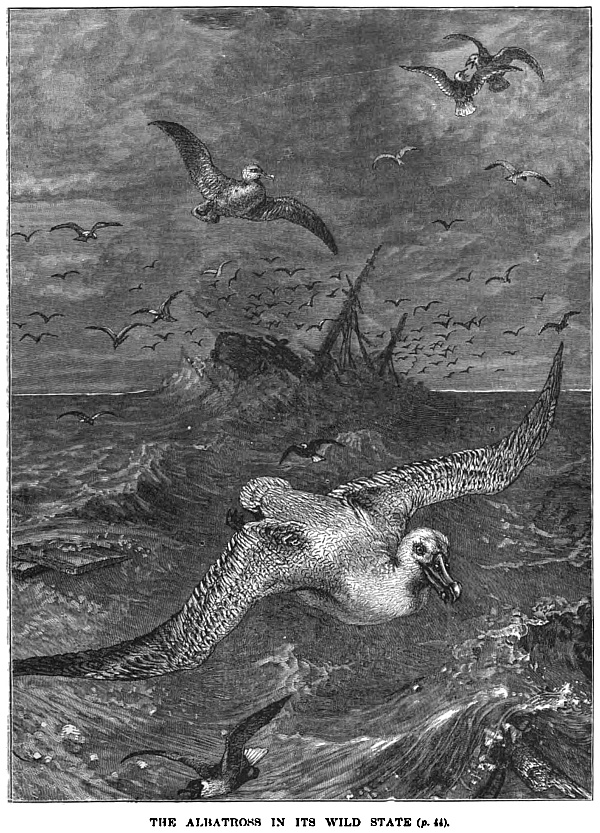
“But you had one pet on board that maybe you mind on—the Albatross?”
“I do,” said I, “young as I must have been at the time.”
“People say,” the captain went on, “they’ve never been tamed; but there he was, sure enough, in an immense great hencoop, that the doctor had made for him, and there you’d be in front of him often enough, though he would have cut the nose of anyone but yourself; and never a flying-fish was caught you didn’t get hold of, and take to him. The men got small share of these. But, bless you, Nie, you were the ship’s chief pet, and the men would have gone through fire and water for you any hour of the day or night.
“The jealousies there used to be about you, too, Nie! Why, lad, if it had been a young lady it couldn’t have been worse. Jealousies, Nie, ay, and more than jealousies, for our fellows didn’t need much to make them strip to the waist and fight. Fact is, when times were dull with us, I think they rather liked the excuse. I’ve heard a row got up for’ard just in the following fashion:
“You would be playing on Davis’s knee.
“‘Give us half an hour o’ the wee chap,’ Bill would say.
“‘Go along,’ Davis would reply, ‘you ’ad him all day yesterday.’
“‘He’s smilin’ to me,’ Bill would say.
“‘Smilin’ at you, you mean,’ Davis would answer derisively.
“‘Smilin’ at your ugly face. Why, that mouth o’ yours couldn’t be made any bigger ’athout shifting your ears back.’
“This would be enough.
“‘Come below,’ Bill would cry, ‘and I’ll see if a big ugly lubber like you is to cheek me!’
“‘Go with him, Davis!’ half a dozen would cry. ‘I’ll hold the youngster!’
“And there would be such a scramble to get you, that I used to wonder you weren’t torn to pieces. And all the while that animal with the long skinny middle finger would be jumping around like a demon and crying—
“‘Ay-ay!—Ay-ay!—Ay-ay!’
“As he never cried like this without all the monkeys following suit, and all the parrots whistling and shrieking—on occasions like these, Nie, there was five minutes of a rough ship, I can tell you.”
Note 1. Medical comforts are luxuries for the sick, bought at the surgeon’s discretion out of the sick-mess fund.
Chapter Four.
“Still onward, fair the breeze nor rough the surge, The blue waves sport around the stern they urge; Far on the horizon’s verge appears a speck, A spot—a mast—a sail—an armed deck.” Byron.
“Well, Ben,” I said, “life must have been very pleasant to me then.”
“And isn’t it now, Nie? isn’t it now, lad? Look at the beautiful old place that you have around you—all your own; you ought to be thankful. Listen to the birds on this delightful morning, their songs mingling with the cry o’ the wind through the poplars. And, lad, you cannot draw a breath out on the lawn here, without inhaling the odour of honey, and the perfume of flowers.”
“You are quite poetic, Ben Roberts,” I replied.
“Quite enough to make the barnacliest old tar that ever lived feel poetic, Nie,” quoth Ben.
“Well, fill your pipe again, Ben.”
“Ha! ha!” laughed the old man, “fill my pipe again, eh? That means heave round with another yarn, eh?”
“Something very like it,” I said.
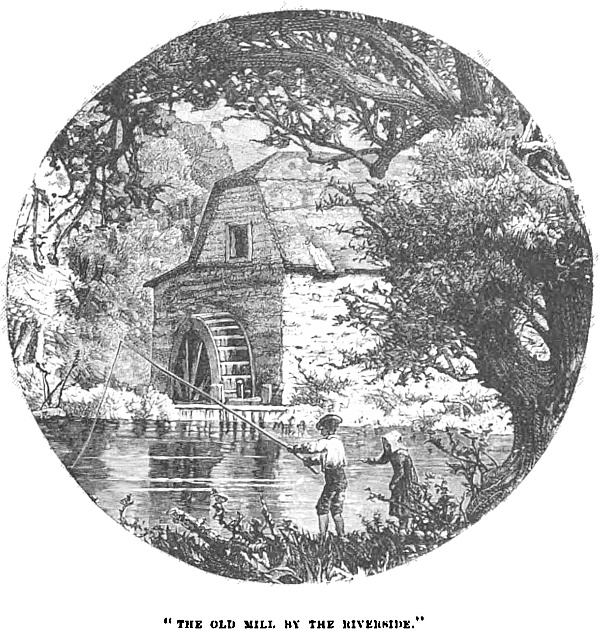
“Well,” said the captain, “an old man is to be forgiven if he does get a little bit gossiping now and then, and wanders from his subject, and I always was fond of a bit o’ pretty scenery, Nie—pretty bits like the old mill by the riverside down yonder.”
“And a bit of fishing and shooting, Ben?”
“Ay, lad. But memory is at this moment taking me back to one of the loveliest bits o’ woodland landscape in the world. What a poem our Robbie Burns could have written there! You were still the Niobe’s pet, but old enough now to be left at times without your sea-dad. Away miles and miles into the wooded interior of Africa, we were a good long distance south the Line, and just sitting down, me and my mates, to a snack o’ lunch on the banks of a roaring tumbling brook, where we’d been bathing. We’d had a smartish week’s shooting, and were thinking of returning to the ship the very next day.
“Our guns were lying carelessly enough at some little distance, when suddenly a branch snapped, and before any of us could have stood up to defend ourselves, had it been an unfriendly Arab, or a savage Somali, a dark skin pushed the branches aside and stood before us.
“It was our faithful Sweeba, the negro who had brought us the news of Zareppa’s intended attack on the night your poor father was killed, Nie.
“‘Sweeba, what on earth brings you here?’ says I.
“‘Commander’s orders,’ said Sweeba, saluting.
“Now Sweeba was always dressed when on board like a British sailor, but here he was almost as naked as the stem of a palm-tree.
“‘What have you done with your clothes, Sweeba?’ I asked.
“‘I expect he has pawned them,’ said little Brown, our purser’s clerk.
“‘I not can run muchee wid English clothes,’ Sweeba said modestly.
“‘And so you hid them in the bush, eh?’
“‘Ah! Massa Roberts,’ replied the negro, smiling; ‘you berry much clebber.’
“‘Well, and what are the commander’s orders?’
“‘You come back plenty much quick.’
“‘Ship on fire?’
“‘No, sah.’
“‘Anything happened to Nie?’
“‘No, sah. Nie and de monkey all right, sah.’
“‘Well, explain.’
“‘Only dis, sah, we goin’ to fight Arab dhow.’
“We were all up quick enough at this intelligence. We didn’t stop to finish our luncheon.
“‘Lead the way, Sweeba,’ I cried.
“And off went Sweeba through the forest, we following in Indian file. We didn’t take more of the game with us than we could easily carry, so the jackals had a good feed that night.
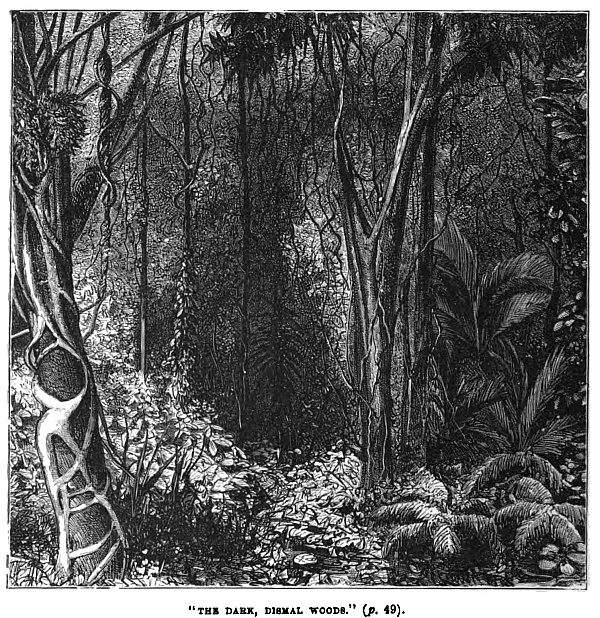
“It was a long and a rough road to travel. You know the style of thing, Nie; the dark dismal woods, the broad swamps, the hills and the wide stony uplands, where never a thing lives or thrives, bar the lizards and a few snakes, and then last of all the mangrove forests. Our anxiety to get back made us hurry all the more. We made forced marches, and burned but two camp fires ere we reached the coast.
“The ship we had left lying at anchor in a little wooded creek. We returned to find it gone.
“‘Massa, massa; we too late,’ cried Sweeba. ‘Now de Arab men come quick and kill us all for true.’
“‘Where is the nearest village, Sweeba?’
“‘Long way, sah; long way, and no good. Dey kill Englishman. No gib mooch time to tink.’
“‘Well, we’re in a fix, I think,’ I said.
“‘Not a bit of it,’ cried a cheery voice close behind us; and looking round there stood little Midshipman Leigh, of the starboard watch. The young rascal had heard us coming, and hidden his boat among the trees, making his men lie close, as he expressed it, to see how we’d look.
“Our orders were to follow the Niobe south, where she had gone to pitch into a whole fleet of piratical slavers, and it was currently reported that our old friend Zareppa was admiral of the pirates, and thirsting for his revenge.
“What a lovely day it was, Nie; the sea as blue and tranquil as the eye of a beautiful child.”
“More poetry, old tar,” I said.
“Wait a bit,” said Captain Roberts. “Well, we cruised along down the coast with just enough sea-breeze to bear us onwards and keep the oars in-board.
“We expected to find our ship at a little island called Chaksee, where she would wait us; or, if absent when we went home, as our middy called it, we could wait till she returned to this rendezvous.
“There wasn’t a sail in sight when we started, nor a speck on the ocean’s breast, except a jumping skip-jack now and then, or a big shark asleep on the surface, with a bird perched upon his protruding fin.
“The breeze held, and very pleasant it was, and most of us, I think, were asleep at the moment the outlook at the bows sang out—
“‘Sail ho!’
“‘Where away?’ cried the midshipman.
“‘Rounding the point yonder, sir.’
“The midshipman scrambled forward, and we were all alert enough now. She wasn’t a dhow, and no one could make anything of her at first, but we soon made her out to be one of those low freeboard one-masted craft that the Portuguese had in those days as coasters, and which they often used as slavers or even pirates.
“‘She seems very low in the water,’ said the midshipman, ‘Is she too big to fight, Mr Roberts?’
“‘A deal too big,’ I replied, ‘We’d better let her alone, I think.’
“We got to windward of her anyhow, so we could have a peep on board. We loaded with ball cartridge, and stood by for whatever might happen.
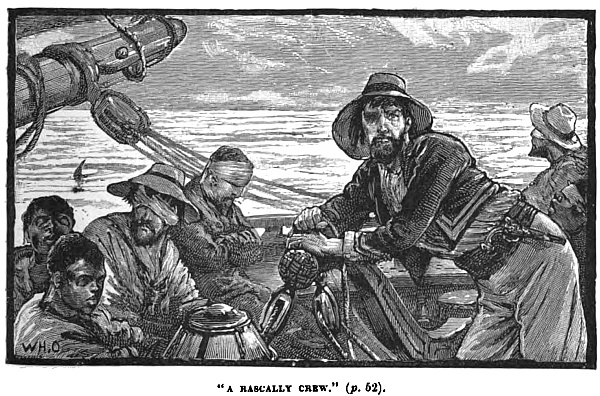
“The strange craft stood right on her course, and never seemed to heed us, though the lowering glance her captain gave us showed he bore us no good will. She was crowded with a rascally crew of Portuguese and negroes, and many bore ghastly wounds, that showed she had been in a recent fray; and it afterwards turned out that she had had a brush with the Niobe, but escaped.
“On her deck were four or five biggish guns. Discretion in this case was evidently then the better part of valour, for she could easily have blown us out of the water, but she seemed too disheartened for anything else but flight.
“I think we were pleased also to escape an encounter that would certainly have ended in disaster.
“The wind fell about sunset, then oars were got out, and, laden as we were, it was a stiffish pull. All in the dark too, until eight o’clock, when the moon rose, half hidden at first by a bank of greyish clouds, which she soon surmounted, and then shone out with a splendour that you only see in one part of the world.”
“And that,” said I, interrupting him, “is the Indian Ocean.”
“True, Nie, true,” said Roberts.
“We were among islands now, some bare and level, others wooded, a few with lofty cocoa-palms.
“We had just landed on one of the latter, because owing to the cocoa-nut trees there would be, as you know, Nie, a few natives, and we expected a bit of hot supper. We had drawn our boat well up on the sandy beach of a little cove, hidden by some scraggy bushes when—
“‘Look, look!’ cried our purser’s clerk.
“All eyes were directed seaward.
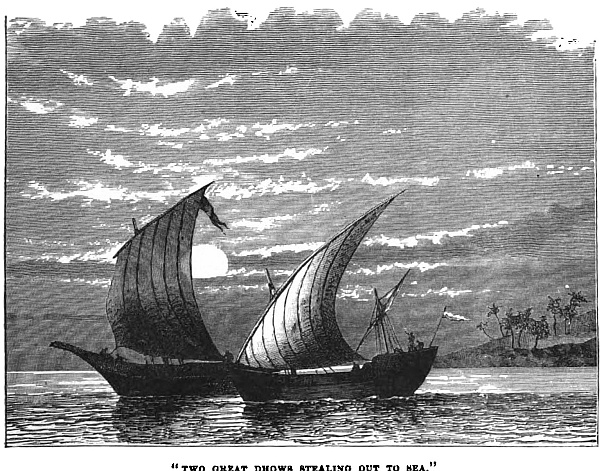
“Two great dhows stealing out to sea! They were off in the same direction that we were going, and from the cut of their sails we could tell they were pirates, that is Arab fighting slavers.
“‘I say, Mr Roberts,’ said the middy, ‘I wouldn’t tackle those, would you?’
“‘We’d never see England again if we did,’ I replied.
“‘Well,’ said the boy, ‘I’m precious hungry, aren’t you, Mr Roberts?’
“‘I could do with a pick,’ I replied.
“Then young Leigh gave his orders like a prince.
“‘Bear a hand, lads,’ he cried, ‘and get supper; gather sticks, light a fire, on with the pot; some of you run to the village and bring half a dozen fowls. Cut up the bacon. Did you bring the onions? Smith, if you’ve forgotten the onions, I’ll have you flogged.’
“‘Then I won’t be flogged,’ said Smith.
“Well, Nie, the remembrance of that stew, that cock-a-leekie soup, made gipsy-fashion in that lonely island of the ocean, makes me truly hungry to think of even now.”
“Shall I get you a ham sandwich, Roberts?” I asked provokingly.
“A ham sandwich!” he cried, “What! sawdust and paint, and the memory of that stew hovering round one like the odours of Araby the Blest? Don’t insult me, Nie. I tell you, boy, that a hungry man might have been content to dine off the steam. There!
“Well, we had a good long rest after supper.”
“You needed it, I should think,” I said, laughing.
“None o’ your sauce,” said the old captain. “We rested, and smoked our pipes, and looked on the sea. Oh! to see the moonlight dancing on the rippling waves!”
“I can easily imagine it, because I’ve often seen the like myself,” I replied.
“It was late that night when we got to Chaksee. The ship was in behind the rocks so snug that we thought at first she wasn’t there.
“All on board were glad to see us, including Nie himself.”
“How old would I be then, Roberts?”
“About five. The Niobe, it seems, was ordered down to the Cape to refit; all her crew were to return to England, but, as you know, I preferred to stop in the old ship with the new crew. I’m like the cats, I don’t like to move.
“The captain and I had a long talk. He treated me just as if I’d been a commissioned officer. He told me he had found a whole nest of pirates, that he had given one fits a day or two before, and meant to pepper the others soon if he had a chance. They were over there, he said, pointing to the African coast, and he would have them.
“The commander of the Niobe, indeed, was in high glee. He had been ordered home, he said, but he would wait for those piratical scoundrels and old Zareppa if it were a month. Then, surely, if he destroyed him and his ships his country would, in some way or other, requite his good services, and either promote him or give him a better command.
“We lay snug behind the rocks at Chaksee for two whole days. Our top-gallant masts were down, and no one in passing the island could have told there was a vessel there at all.
“On a hill, not far off, two men were kept always on the outlook.
“On the morning of the third day the signalmen left their posts and hurried towards the ship.
“Three large piratical dhows, carrying the blood-red flag of the Arab nation, were bearing down towards the island. They turned out to be the very same we’d seen two nights before, in company with another and much larger one.
“We determined not to frighten them off by coming out too soon. We didn’t know then that these fellows rather courted fight than otherwise.
“All sails were loosened and at last we got clear, took up the boats that had been heading us, lifted sails, and stood out to meet them.
“Every man was at his post. The marines lying down on deck under arms, the bluejackets, stripped to the trousers, standing by the guns on both decks. There was a glorious breeze blowing. Oh! Nie, lad, it was just the morning for a fight. My old blood dances in my veins yet at the very thoughts of it.
“I must say that those Arabs managed their little craft beautifully. The largest one was the first to advance, and the first to receive and return our fire. She had even the daring and pluck to fire at us.”
“Did she succeed?”
“She did, alas! and she poured a broadside into us that made our upper deck like shambles. Meanwhile the other two dhows were at us, on us almost, for we were sometimes fighting gun to gun, and we had to fight on both sides of our vessel at once.
“The commander of the Niobe wanted all his wits about him, for it was a trying time.
“We had one advantage over the pirates, namely, our marines.
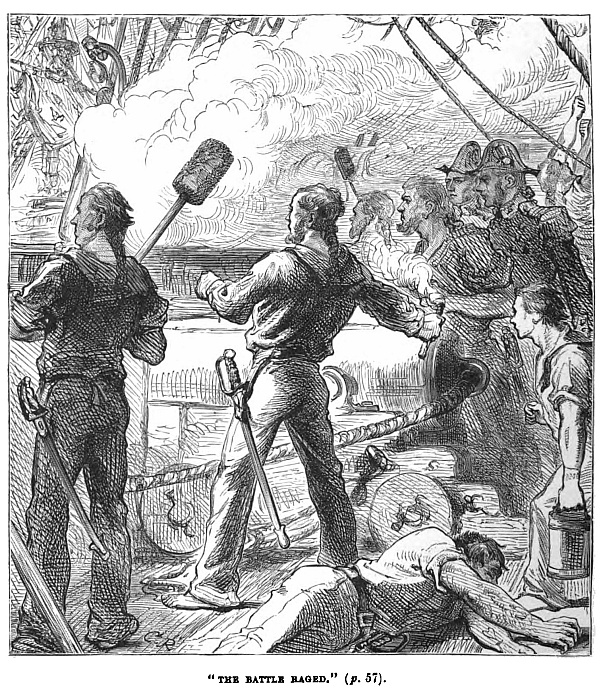
“The pirates had muskets, it is true, but either they were very bad ones, or they couldn’t use them properly, one or the other.
“We stationed our marines in the tops and rigging, and every shot told home, every bullet got its billet.
“There were times during the fight when all the combatants seemed to pause. It was as if the ships were taking breath, but in reality we stopped to allow the smoke of battle to clear away, for our ship was surrounded, so to speak, and all our gear was hanging anyhow.
“The impetuosity of the attack of Arabs fighting at sea is very similar to the way in which they charge on terra firma; it is furious while it lasts.
“It lasts as long as hope promises brightly, when it goes it goes at once, and, except in the case of fanatics in a religious war, there is a wild stampede. Victory for a time hung in the balance, then it seemed to sway to the side of the enemy, because the Niobe became for a time unmanageable.
“It was a trying time to the nerves of the bravest of us. There would be small mercy accorded to those among our poor fellows who happened to fall into Zareppa’s bands.
“The commander held a hurried consultation with his first lieutenant, at which I was present. It was over in two minutes; in ten minutes more, during which time the battle raged with unabated fury, we had all the sails set which the few hands that could be spared were able to clap on her, and were clearing sheer away from the scene of action, steering as close to the wind as possible. And the Niobe could luff too, I can tell you.
“Shots tore through our rigging as we fled, or seemed to fly, and derisive jeers and cheers, worse by far than bullets, were fired after us, till we were out of earshot, out of reach. We replied not either by shot or shout. We drew the big dhow after us—and that was all we wanted—as near as she could come. We even let her gain on us, and her shots began to tell again. Then all sail was clapped on, and next—
“‘Ready about,’ was the cry.
“Ah! Nie, my boy, it was a beautiful sight, and a supreme moment.
“We thundered down on that devoted pirate. She never even divined our intention. We might overwhelm her perhaps, she thought. She prepared to out-manoeuvre us. Then all seemed to become confusion on board her. Mind, she was over-manned to begin with, her rigging too was badly damaged, and her decks hampered with her dead and dying.
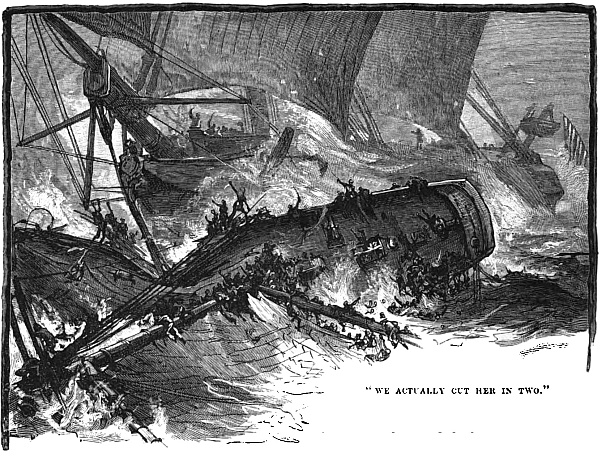
“In a minute more we had hurtled into her. We actually cut her in two; she sank before our eyes, almost before we could sheer off.”
At this part of his yarn, poor old Captain Roberts stopped. I feel sure he was thinking of that dreadful scene; that, long ago though it was, he saw again that blood-stained ship sinking beneath the waves, with its living freight, many of them innocent slaves.
He filled his pipe before he resumed.
“Ah, well! poor misguided wretches, to do them justice they died bravely, and cheered wildly as they sank beneath the billows.”
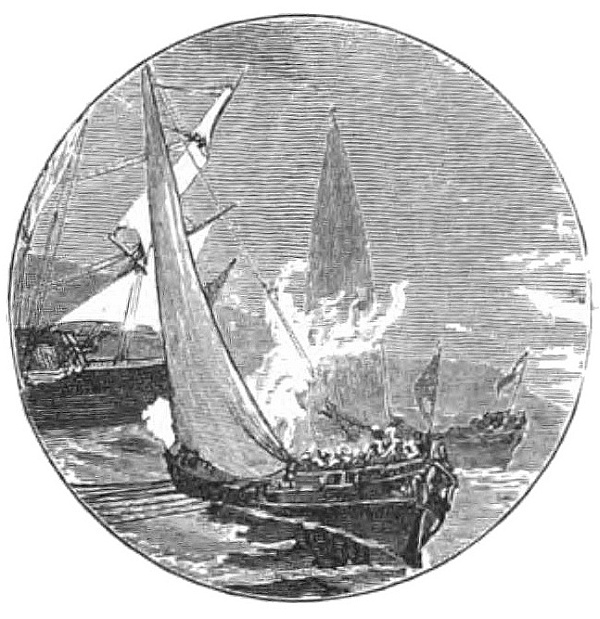
“And so,” I said; “Zareppa escaped even yet.”
“Yes, it was a plucky thing. He swum out from the wreck ere she sank, and one of the dhows ran up even under our guns, and picked him out of the water.
“Then both got clear away.”
Chapter Five.
“Like mountain cat that guards its young. Full at Fitz-James’s throat he sprung.” Scott. “He watched me like a lion’s whelp, That gnaws and yet may break its chain.” Byron.
“Ben Roberts, dear old friend,” I said, as soon as the captain had finished. “I remember that sea-fight which you have just so graphically described.”
“And pray,” said he, “what and how much of it could you remember, seeing you were down below, and were so well used to guns thundering over your baby head, that you often went to sleep during general quarters? Now, just you tell me.”
“Well,” I replied, “I suppose it must have been the collision at the conclusion, for I was knocked all of a heap off the chair, and the Ay-ay and I threw ourselves into each other’s arms and wept.”
“Yes, lad, and I found you, when I went down to my cabin, in each other’s arms, and both fast asleep.”
I myself, dear reader, must now resume the thread of my narrative, from the place where Captain Roberts gives it up.
When the crew of the Niobe returned to their native land from the Cape, and the new crew joined, I remained with my foster-father—my dear old sea-dad.
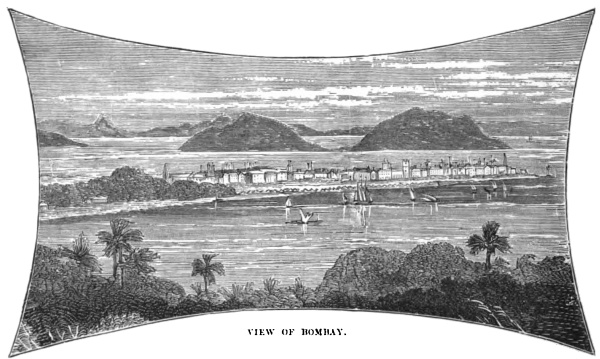
From the Cape we sailed straight to Bombay, it being found that the old Niobe would require to go into dry dock.
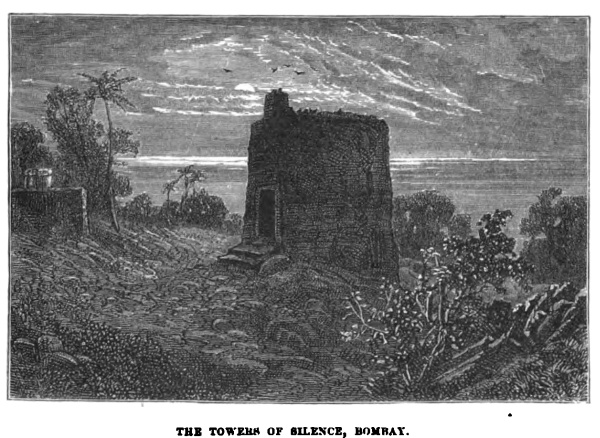
I remember being dazzled with all I saw in Bombay, except those terrible Towers of Silence, on which the dead bodies of the Parsees are exposed to be devoured by birds. What I think struck me most was the gorgeous dresses of the natives, and the enormous amount of gold and silver ornaments they wore about them; bangles, and bracelets, and jewelled noselets, and ear-rings as big as cymbals, or the brass plates that barbers hang out in front of their doors. If I wondered at the natives, the natives wondered at me—the piccaninny sailor-boy, as they called me—for I was now dressed out quite like a man-o’-war’s man.
From Bombay we returned to our cruising ground, which was at that time called the Cape station, and stretched all along the entire east coast of Africa, from the Cape to the Red Sea, including not only Madagascar with its circlet of tiny islets, but Mozambique, the Comoro Islands, and Seychelles as well. Were I to tell you all my adventures on these shores, I should have no space to devote to sketches probably quite as interesting.
Let me come then as speedily as I may to the one great event of my life: my capture by that arch-fiend Zareppa, and my treatment while a prisoner for ten long years in the wildest part of the interior of Africa.
As soon as we reached Zanzibar, I being then of the ripe age of six years, the captain called me aft, and Roberts the boatswain came along with me.
“My man,” said the captain to me, “You are six now, and it is high time you were rated.”
I began to cry. A rating I thought meant a flogging, and I had seen poor fellows tied up over and over again and flogged until the blood gushed out of their backs.
“It is nothing,” said the kindly captain; “I’m going to make a man of you.”
“Oh!” I said, and wiped my eyes.
“But,” continued the captain laughing, “We’ll make a second-class boy of you first.”
Roberts laughed now.
“I’ll teach him sir,” he said, saluting the captain, “to splice and reef and steer.”
“Well, away you go,” said the captain, “and see, my little man, that you do all you are told.”
I touched my forelock, and went away forward with the good boatswain; so proud that I’m sure I didn’t feel my feet touching the deck.
My education had begun long before; it continued now, and I hope I did my duty.
For the next four years we had plenty of chasing of ships, plenty of cruising, plenty of jollity and fun, both on shore and afloat, and now and then a pitched battle.
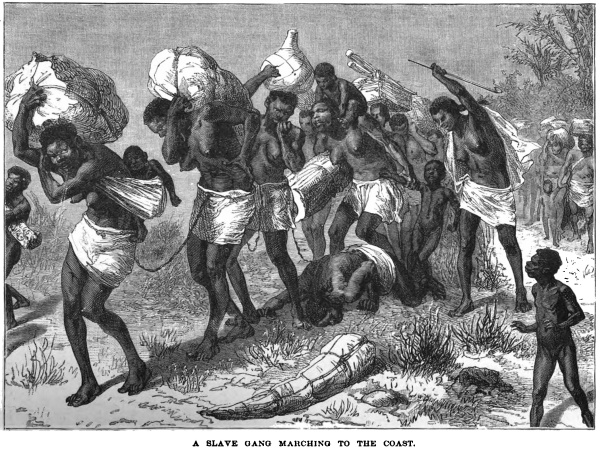
We had never seen Zareppa again, but we had often and often heard of him. We knew that he was in the habit of marching into the interior upon peaceful negro villages lying about the Equator, burning them, and capturing the inhabitants as slaves.
Oh! boys at home, if you but knew the horrors of the slave trade; if you could but realise even a tithe of the misery and wretchedness and fearful crimes included in that one word “slavery,” as applied to Africa alone, you would not deem yourself entitled to the proud name of British boy, until you had registered a vow to do all that may ever lie in your power, be that little or be it much, by deeds or by words alone, to wipe out the curse.
Had you seen what I have seen of it, had you sojourned where I have sojourned, you would have witnessed deeds that would harrow your mind to think of even till your dying day.
My life on board the Niobe was altogether a very pleasant one; the best part of it was the long glorious cruises we used to have in open boats. Fancy, if you can, going away in a well-found boat, away from your ship entirely for, perhaps, a month or six weeks at a time, in the glorious summer weather, with the blue sky above, the blue sea below, and hardly ever more wind than sufficed to cool and fan you, and to raise the sea into a gentle ripple. We cruised along the coast, we cooked our food on shore—and oh! what jolly “spreads” they used to be, what soups, what stews!—we cruised along the coast, and we sailed or pulled up rivers, and into many a lovely wooded creek, going everywhere, in fact, where there was a chance of capturing a slaver, or of making a prize. When the slave ships ran we chased them, when they fired on us we fought them, and they were always beaten. They might win a race, but never a battle. We were some fifty men strong; we never stopped, therefore, for an invitation to go on board; we went, sword or cutlass in hand, and they were bound to give way.
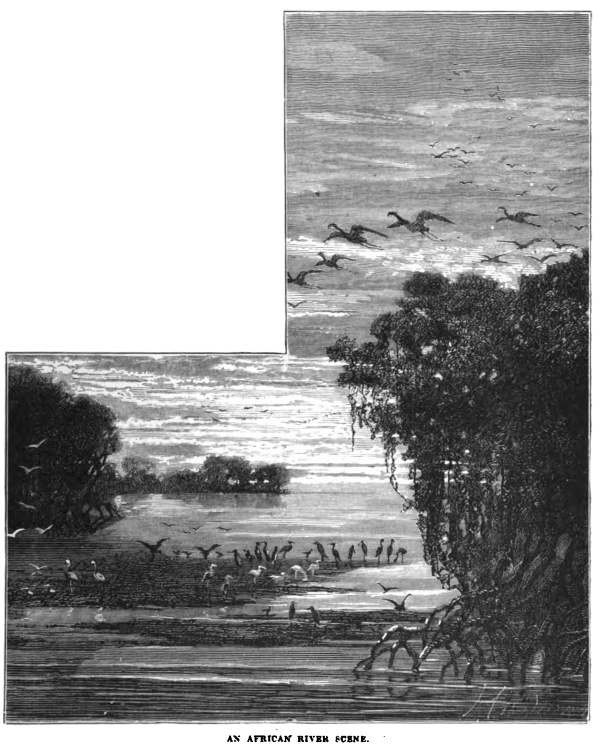
But to me, I think, the glad sense of being away from the ship and of leading a free and roving life, was the greatest part of the pleasure, and I used to be so sorry when we bore up at last for the rendezvous where we were to meet our ship.
That, then, was the bright side of the picture of my life in these glad old days. And I must confess that it really had not a dark one, although sadness used to steal over my heart, when letters came from what others called home—England.
Home! To me the word had no other meaning except the wide ocean, and yet when I saw others reading their letters with such joy depicted on every countenance, well—it was very foolish of me, no doubt—but I used to steal away into some quiet corner, and weep.
“Now, my lad,” cried Roberts to me one day. “Get that twopenny-ha’penny cutlass of yours out, and prepare to go on shore. We’re going up country to fight those rascally Arabs. We are going to storm Zareppa’s own stronghold.”
“Hurrah!” I shouted; “And you will really take me with you, Mr Roberts?”
“That I will, lad; and you’re not your father’s son unless you know how to behave yourself in presence of a foe.”
I said nothing; but at that moment I almost thought that Roberts instigated an act on my part, which followed some days after this. Had he not mentioned Zareppa and my father in two consecutive sentences—my father and my father’s slayer?
“Oh!” I said inwardly, “could I but meet the man face to face!” What a childish thought, you will say, for a mere stripling, with a twopenny-ha’penny cutlass! The cutlass, by the way, was a middy’s dirk, of which I felt very proud indeed.
The boats were called away. The expedition against the Arab stronghold was going to be “a big thing,” as Roberts said, so every man that could be spared from the ship joined it.
Our guide was poor Sweeba. This negro had but one thought in life; namely, to avenge the murder of his family. I’m afraid that revenge is a very human though an improper feeling; and it is easy enough to understand, without attempting to justify, Sweeba’s thirst for vengeance. I hope that I myself shall never forget that Bible text which says—
“Vengeance is Mine, I will repay.”
The utmost caution was necessary in passing up through the forest and jungle, for we were surrounded by enemies on all sides. However, we made forced marches in silence and all by night, and in three days’ time, being favoured by fortune, we arrived in front of Zareppa’s stronghold, and within two miles of the place. We lay closely hidden till daybreak, a good two hours, sending Sweeba forward to scout. He returned shortly with the intelligence that the Arabs were in great force, and had both camels and cavalry, and that they had also thrown up a strong earthwork on the hill around their position.
Before sunrise we were ready; a mere band we were, but a brave one, about one hundred and twenty in all, bluejackets and marines. Ere the sun had mounted over the forest land we were close upon Zareppa’s position, and in the darkness our fellows had even cut out a company of war and baggage camels. It was here that the fighting first began, but taken by surprise, the camel-drivers, after a faint show of resistance, fled hurriedly up towards the fort.
It was now daylight, but the beams of the sun were sadly shorn by the smoke that arose from the fort as a tremendous volley was fired to check our advance. Under cover of this volley down thundered the foe to the charge. But little more than two hundred yards intervened between the fort and our fellows. Yet many a horse lost its rider, many a brave and stately Arab bit the dust, ere the enemy reached us.
I cannot describe what followed. No one can give an account of anything save his own experience in a fight like this. The enemy fought with terrible courage. Again and again were they foiled, again and again did they return to the charge with redoubled determination. They leaped on our very bayonets, over their own wounded, and their dead and dying fell together in heaps. But all in vain. Zareppa at last, despairing of success, withdrew his daring followers.
“Now, lads,” cried our commander, “follow me into the fort. They have shown us how Arabs fight; we will now show them what true Britons can do. Hurrah!”
The wild “Deen! deen!” of the Arab is nothing in strength of volume to the stern British “Hurrah!” It is a war-cry that has struck terror into the hearts of foemen on every land on which the sun shines. It is a war-cry that means business. It meant business to-day, as our fellows dashed up that hill and entered the fort. Then the fighting commenced in deadly earnest; the Arabs had leaped from their chargers, which were held in readiness in the rear, and fought with swords only, even their spears being for a time discarded. Our fellows fought with sword, with bayonet, or with butt-end, and men fell fast on both sides.
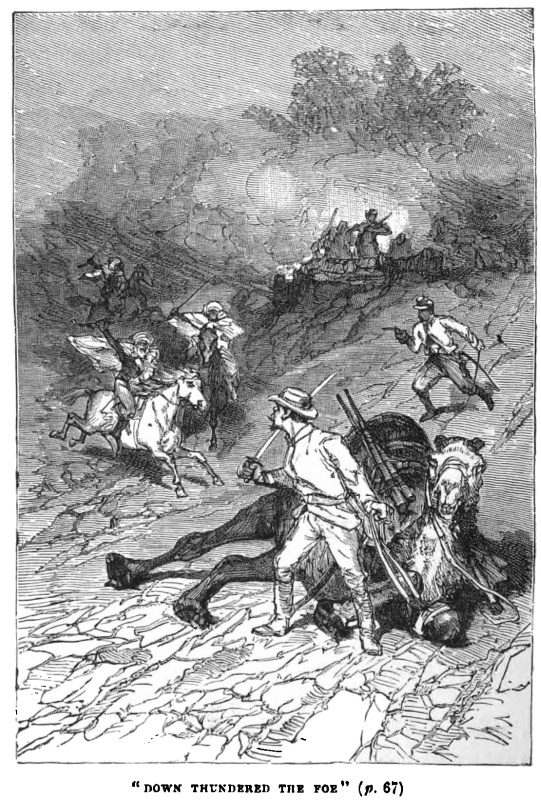
Only once during this fight Roberts was near me, but then his good sword saved me from a fearful cut. “Back to the rear, boy,” I heard him yell; “you’re too young for this work.”
But, look! yonder is the chief, yonder is Zareppa. Though I had never seen him before, an instinct seemed to tell me that that was the man who had slain my father. I flew at him—foolishly enough, no doubt—flew at him as if I had been a wild cat. I clutched his belt and raised my arm to strike. He bore me to the ground by a blow from his sword-hilt. He seemed to scorn to fight with such as I.
Next moment he himself was down. Sweeba had felled him, but was, in his turn, cut down almost immediately. On the ground I grappled again with the pirate chief. It seems all like a dream now, but I have little doubt my agility saved me, and enabled me to make such good use of my dirk that Zareppa never rose again.
Years after this I knew we had gained this fight, but now, as for me, I was taken prisoner, bound hand and foot, and carried into the interior. After the death of their chief, the Arabs had fought only long enough to secure possession of the boy who had killed their leader. This done, they mounted and fled.
I was, it would seem, reserved for the torture. But the king of a warlike tribe fancied the boy for a white slave, and the cupidity of the Arabs overcame their love even for vengeance—I was sold into slavery.
Then began a long, dreary march into the interior. It is only fair to say, however, that from the commencement King Otakooma was not unkind to me. He ordered my wrists to be untied, and I was set free—such freedom as it was, for with a mob of savages around me I dared not attempt to escape. Indeed, I cared little now what became of me, and for the first few days I refused all food. Then nature asserted herself, and I ate greedily of the fruit that grew plentifully everywhere in the country through which we were passing.
I had pulled what appeared to me a most delicious-looking large berry, when suddenly I heard our chief shriek.
“Oa eeah wa ka!” and at the same moment the fruit was dashed from my hand ere I could convey it to my lips. I knew from this it was poison. Then the chief called me towards him, and placed me on the grass, and put before me a plate of boiled paddy (a kind of rice) and a bright glittering dagger. I knew what he meant, and chose the paddy. Then the king laughed till his fat sides shook again. He was a sort of half-caste Arab, I suppose, and yellow, not black. Perhaps his colour made him king, for his followers were very black, tall, wiry, and savage-looking.
The king on the other hand simply looked good-humouredly idiotic, but I found out afterwards that he could be both cruel and fierce, and though not a cannibal, he was addicted to human sacrifices. Piles of skulls adorned his palace grounds. He built them up like rockeries, and flowers actually grew on them, although they had never been planted.
As soon as I had eaten the rice, he patted my cheek and asked me, through a boy interpreter, if I would have some rum. I refused; upon which a cocoa-nut half full and the dagger were again placed before me.
I drank the rum, and I learned a lesson; and whenever afterwards the king asked me to do anything that I had scruples at performing, I pretended to be exceedingly eager to do it—and thus got off.
Our adventures on our journey inland were many and varied. Under other circumstances I should have enjoyed them, but every mile west was taking me away from all I held dear in the world, so no wonder my heart sank within me and that I loathed the savages, loathed the fat old king, and even the boy interpreter, although he was the only one with whom I could converse.
Jooma was his name, and he turned out no friend to me. He entertained me from the first with terrible stories about the cruelties of the tribe I was going amongst, tales that made me long for death and my very blood run cold.
Then I thought of the poison berry, and was strangely tempted to eat a few. Thank Heaven, I did not give way to the fearful temptation! It is an awful thing for a human soul to hurry unbidden into the presence of its Maker.
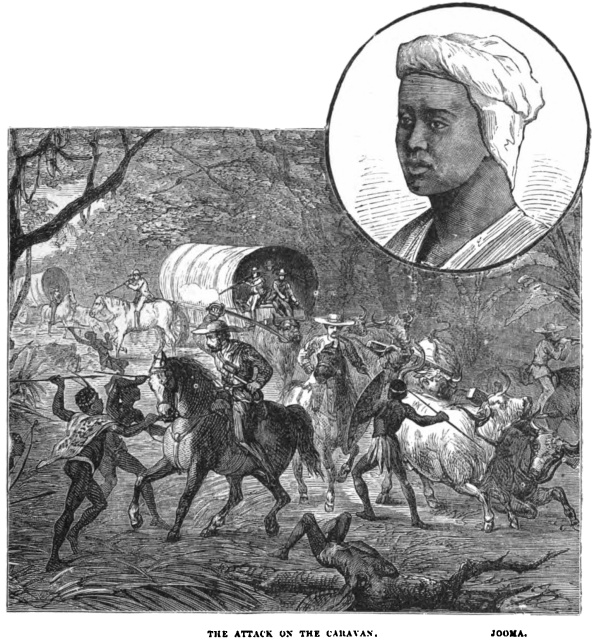
One adventure thrilled me at first with delight, afterwards with grief. We met and attacked a caravan of English travellers. I was bound to a horse and strictly guarded, at a distance from the scene of action. I do not know what occurred, but from the exultant looks of the savages on their return, and from the blood-stained booty they brought with them, I feared the worst.
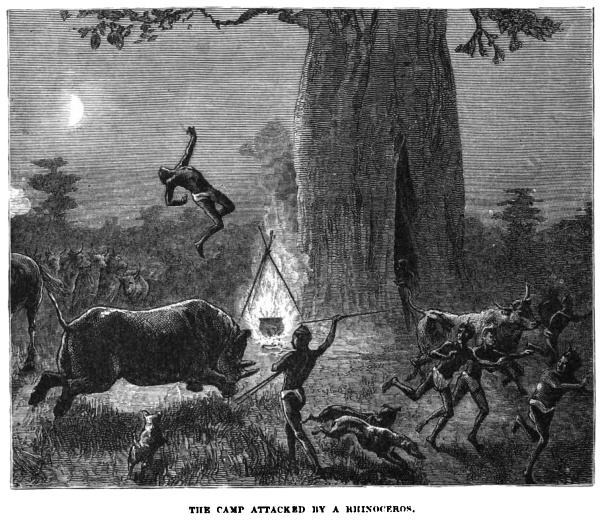
Another adventure I remember was a night attack on our camp by a rhinoceros. The savages fled before the infuriated brute more speedily than they would have done before a human foe.
But my experience, gained since then, is that rhinoceroses are not as a rule dangerous animals, although a great many marvellous stories are told about them, usually travellers’ tales.
Sometimes the hill and the jungle gave place to wide marsh lands, through which the cattle were driven first, the horses following, and last of all the foolish old king on his litter, with his rum bottle beside him.
Often he used to drink till he fell asleep. Sometimes he would make me sit by him. Once he had his great hand on my shoulder, and kept feeling at my neck.
I afterwards asked Jooma what he meant.
“Nothing he mean,” replied Jooma, grinning, “only feel for proper place to cut your head away. Dat nothing!”
This was pleasant.
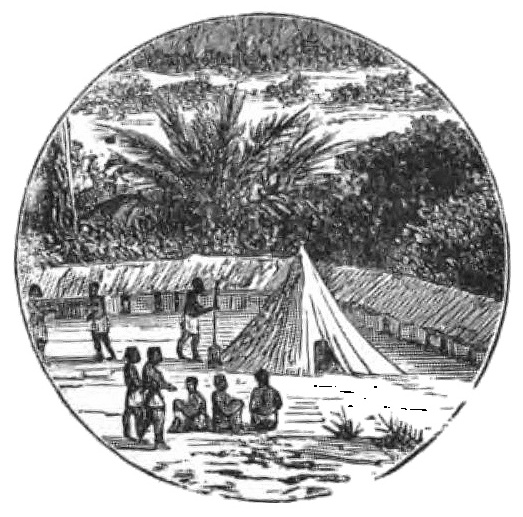
At last we arrived in the king’s country, and a small tent was assigned to me near the royal palace.
The country all round, although unfilled, was fertile and lovely in the extreme. Giant cocoa-palms waved on high, some parts of the landscape were wild orchards of the most delicious fruit, the hills were covered with purple heath, the valleys carpeted with grass and flowers of every shape and hue; while the birds that flitted among the boughs, and the monster butterflies that floated from one bright blossom to another, were lovelier than anything you could imagine in your happiest dreams.
To King Otakooma’s country bands of wandering Arabs occasionally came, and visited the king in his summer tent or his winter palace—for he had both. They came to solicit his assistance in the inhuman raids they made upon surrounding tribes of less warlike negroes.
Did I hope for escape through these Arabs? As well might the linnet beg the hawk to deliver her from the talons of the owl.
Chapter Six.
“Much I misdoubt this wayward boy, Will one day work me more annoy. I’ll watch him closer than before.” Byron.
When I look back now to the first two, or even three, years that I spent in Otakooma’s country, among Otakooma’s savages, I wonder that I was not bereft of reason, or that, knowing escape by death to be in my power, I did not have recourse to the deadly poison berry that grew in abundance in many a thicket. Our goats ate freely of this berry, by-the-bye, but it seemed to have no other effect upon them than to make them lively.
But even at this date, strange to say, there are certain sights and sounds that never fail to recall to me not merely my life among those savages, but the very feelings I then had. For instance, in the county in England where I now reside, the cow-boys, or sheep-herds (I will not call them shepherds), have a peculiar way of calling to each other; it is a kind of prolonged shrill quavering shout, and it bears some faint resemblance to the howl of Otakooma’s savages, as heard by night in the forest. Again, anyone drumming on the table with his finger-nails will sometimes bring to my mind the feelings I used to have on hearing the beating of the horrid tom-toms. The beating of tom-toms and the howling, combined now and then with a shriek as of some poor wretch in mortal agony and dread, even when I was not present, but probably a prisoner in my hut, used to tell me as well as words could, that a human sacrifice was progressing somewhere in the vicinity of the royal palace.
The smell of weeds burning in a field only yesterday depressed me; the savages were constantly burning fires of different kinds of dried roots and weeds.
Just one more instance. I would not have a rockery in my grounds or garden; it would remind me of Otakooma’s terrible piles of skulls on which weeds grew green, and flowers bloomed, and lizards—sea-green lizards with crimson marks on their shoulders, and lizards the colour of a starling’s breast, that is, metallic-changing colour—used to creep.
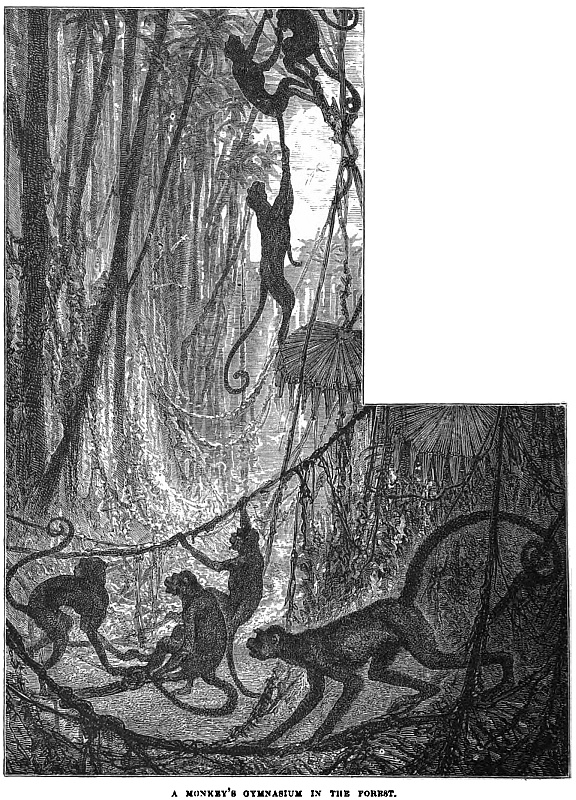
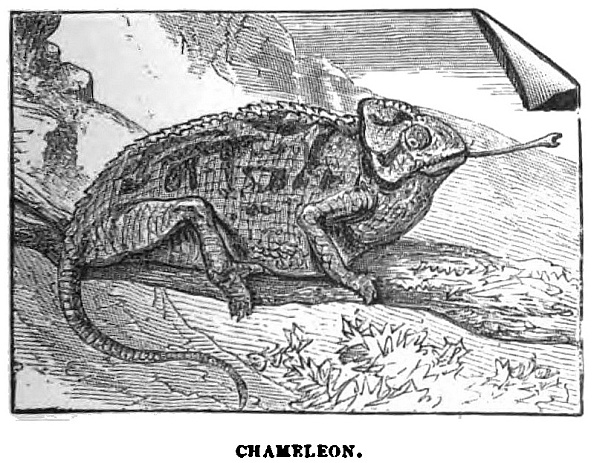
If ever at that time I spent a happy hour it was in studying and wondering at the tricks and manners of the many strange denizens of the forest. Monkeys, mongooses, and even chameleons I managed to tame.
You see, then, I could not have been very happy. How could I? For at least two years I lived in constant dread of a violent death, and I never knew what shape it would take. I might die by the spear of some angry savage; I might be sacrificed to please some sudden fancy of the king; I might be burned at the stake or die by the torture.
My enemy—and he ought to have been my friend—was the boy Jooma. He was jealous, no doubt, of my influence with the king. I tried my best in every way to please this lad, because he could talk English, but in vain. He belied me one day after I had been a whole year in the country, belied me to the king in my presence—he pointed his hand at me. I struck the hand.
Then, as he threatened to kill me with his knife, I squared up in good English fashion and let my enemy have one straight from the shoulder. He went down as if he had been shot.
The fat old king shouted for joy. That boy Jooma had never had a proper British bleeding nose before in his life, I expect. And he did not like it. He kept lying on the ground, because he saw me in the attitude to give him another blow. But the king made him stand up, and for fear of offending the king I had to put him down again. Then he refused to rise. The king told him that a cock and a goat and two curs were going to be carried in procession to the execution ground that afternoon, and that if he, Jooma, did not fight “the foreign boy” he should head the procession and finally lose his head. So Jooma had to fight as well as he could, and although I did not punish him willingly, he was paid out for many an ill turn that he had done me.
I was a favourite with the king for fully a month after this. He brought boy after boy for me to thrash. Indeed, three or four times a day I was fighting. I suppose every boy about the king’s village had a set-to with me. I cannot say I blacked their eyes because they were already black, but they must have felt my knocks, and I know they did not love me any the better for it.
I did not know how all this would end, but my heart leaped to my mouth when one day the king himself, valiant through the rum he had drunk, stood up and announced his intention of trying conclusions with me himself.
What could I do?
What would you have done, gentle reader?
I knew I could have thrashed him, for though not old I was very hardy and wonderfully strong for my years, but I did not want to figure in a procession. So I submitted to be knocked down. Then I had to get up and be knocked down again and again. It didn’t hurt very much, but there was indignity attached to it.
The king had found a new pleasure, and every afternoon or evening I was summoned to the palace yard or grounds, and first I had to fight the king, then a boy of my own standing. Well, I am afraid that if I suffered in body and mind from my encounter with the king, I took it out of the smaller savage to follow. There was some satisfaction in that.
But one day, to show his own wonderful powers of fisticuff, the king summoned a crowd of his warriors to his palace, and made them form a great ring. Then I was ordered in and pitted against an Indian boy bigger than myself. I never cared how big they were, they held their arms wide and hit downwards as if thumping a piano.
After one or two boys had been disposed of, to the wild delight of the warriors, the king took a drink of rum and handed the leather bottle to his chief executioner; then he took off his extra garments—his one boot and his crown, an old tin kettle without a bottom to it—and stood up in front of me. I went down several times according to my own programme, and the savages shook their spears and rattled them against their shields of buffalo hide, and shouted and shrieked to their hearts’ content.
Then the king hit me rather hard, and I suppose my English pride was touched, for the next thing I remember is—horror of horrors!—the sacred person of his Majesty King Otakooma sprawling on the dusty ground and his nose bleeding.
A silence deep as death fell on all the crowd.
Then there was a rush for me. Spears were at my breast and I expected only instant death, when the king sprang to my rescue and all fell back.
If I had knelt to him and begged his pardon, even then I might have been forgiven.
But an English youth to sue on his knees for mercy from a savage! Nay, it was not to be thought of.
The king sat down.
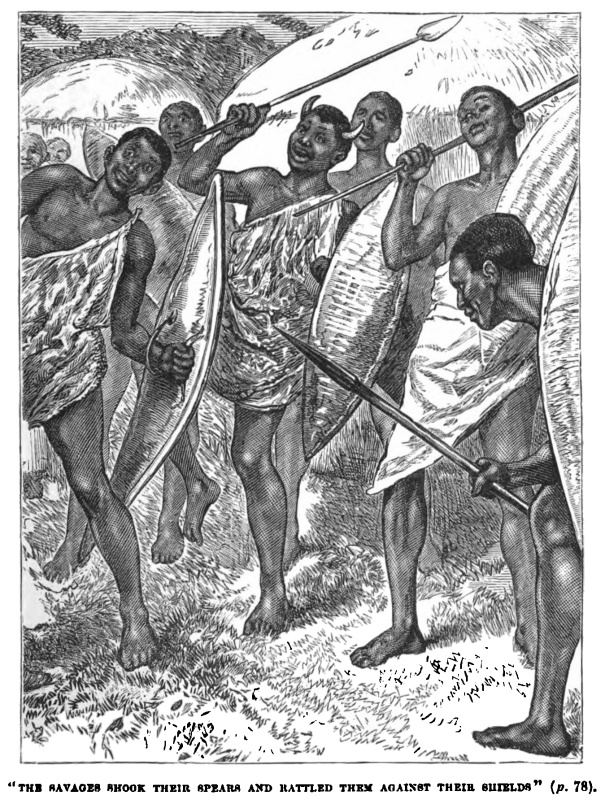
The king was silent for a space of time. The king took more rum.
Then he ordered ropes of skin to be brought, and I was bound hand and foot and taken away to a loathsome dungeon.
I knew I was to die next day, and I longed for sunrise to have it past, for I suffered excruciating agony from the tightness of the cords that bound me.
The time came. I was to form part in a procession, and did; I was carried shoulder-high, lying on my back on a kind of bark tray, amid tom-tom beating, howling, shrieking, and a deal of capering and dancing that at any other time I should have laughed most heartily at.
At the execution ground goats and cocks were killed, then it came to my turn.
The king came to have a last look at me. The cords were undone, and I stood up staggering because my feet were swollen. The king looked at my hands: they were swollen double the size.
The king rubbed his nose.
The king was thinking.
“Now,” he must have thought, “here is a hand (meaning my swollen fist) that couldn’t hurt anybody. What a chance to redeem my lost honour!”
The king took more rum.
Then he started from his throne and shouted. What he said matters little. At the conclusion of his speech I was again dragged up to fight the king. If I could have hit him then I would have done so. But with such hands, how could I? So it ended in my being fearfully punished.
Then there was such shouting and yelling as I had never before heard in my life. But I was free.
The king took more rum.
For a whole year after this I was kept under almost constant surveillance, but there was no more fighting.
Sometimes the king and his savages went away on the war-path, for many weeks together. When they did so, I was confined in a dungeon, and had no other companions except frogs, lizards, and centipedes. All the food they gave me was a piece of dried cassava root (the root from which arrowroot is made), daily, and I had very little water.
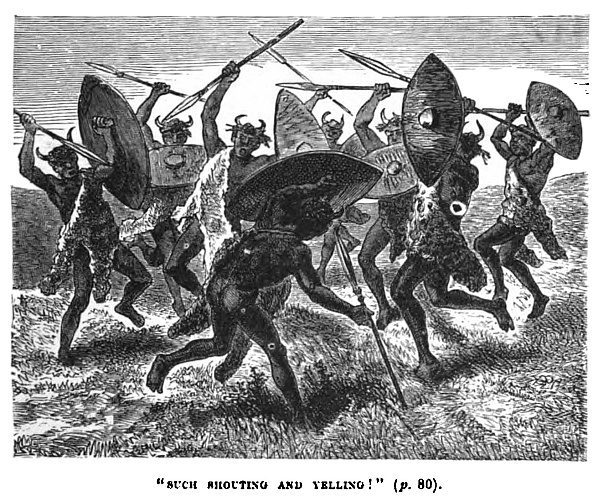
But in spite of my hardships, I grew strong and robust. Probably, if I had not been a friendless orphan, if I had had a mother for instance, or a father, or sisters, or brothers, in a far-off home to think about, my misery would have been greater; as it was I had no one, for I believed that Roberts and all the people of the Niobe had been slain in that terrible fight at Zareppa’s fort.
Amelioration of my sufferings came at last, and in a strange way.
The king fell ill.
The king took more rum.
The king grew worse, and all the sorcery of his medicine men could not cure him, so I was sent for.
I had seen Jooma putting poison into the rum, and I told the king he had been poisoned. Who had done so? he asked: the culprit should die. No human being, I was determined, should die on account of anything I said. I told him, however, that next day I should fetch the evil creature who had destroyed the health of the king. Meanwhile the rum was poured on the ground, and I made him a pill of the poison berry, and a little scraped cassava root. He saw me mix it. His medicine men assured him it would be death to take it; I took a pill myself, and when he saw I did not die, he followed my example, and took two or three. For I had found out that in small doses this poison berry was medicinal. The king slept, and awoke refreshed.
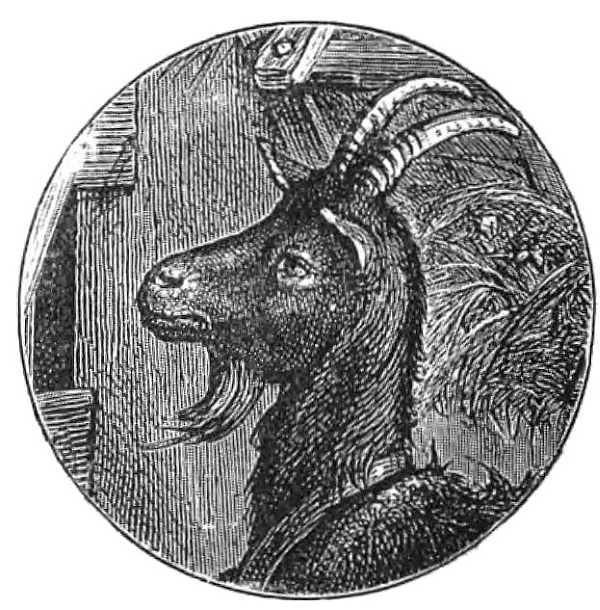
Then he called for the culprit who had dared to poison his rum.
I went and found Jooma. I told him that his guilt was discovered, and that his life was in my hands; that a word from me would march him to the execution ground. He knelt and prayed for mercy. I told him he needn’t trouble, that Englishmen were far too honourable to harbour revenge. Then I made him bring a very old and savage billy-goat, and together we brought it to the king.
The king was greatly pleased. He said he never had liked the looks of the billy-goat, and he had no doubt that it had worked some deadly spell upon his rum. So the billy-goat—poor beast—was slain, and after a few more pills the king got better, and I was chief favourite among all the tribe.
Chapter Seven.
“But what avails this wondrous waste of wealth, This gay profusion of luxurious bliss? Ill-fated race! the softening arts of peace, Kind equal rule, the government of laws, These are not theirs.” Thomson.
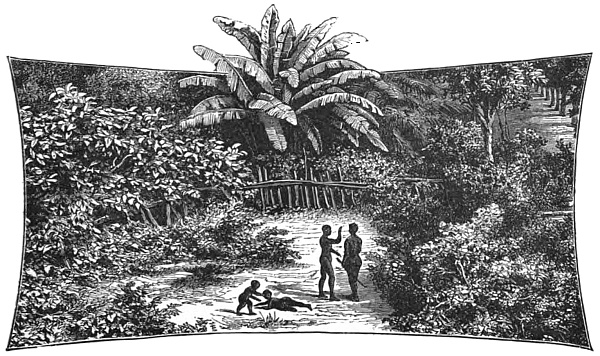
I became the king’s head-counsellor, his prime-minister, so to speak, his chief medicine man. There was not much honour in this, certainly, but nevertheless it procured me some amelioration of my sufferings. There was less of the dungeon after this, and fewer threats of decapitation.
I think the king still hankered after rum, and it was an anxious day for me when some Arab chiefs appeared in camp. Otakooma assembled not only, all his forces but most of his people. Something was going to happen, I knew, but till now I had had no idea of the utter depravity of this wretch.
He was positively going to barter his people for rum. The Arabs would buy them as slaves.
It was terrible to see these same Arabs walking round among the sable mob, as calmly as a farmer does among a herd of cattle, and picking one out here and there. But, oh! the grief, and the agony, and the anxiety displayed in voice and in action by these poor doomed creatures—the scene defies description. Here was the child torn shrieking from its mother’s side, there a wife separated from her husband, or a husband from a weeping wife.