Gordon Stables (continued 2)
Reading edition
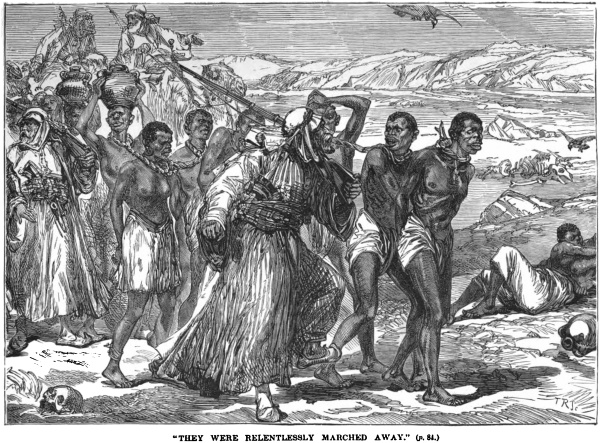
Some indulged their grief quietly, others gave vent to loud howls and lamentations; while others lay moaning and groaning on the ground, ever and anon taking up great handfuls of dust, and throwing it up over their poor heads!
I could not help turning away and shedding tears. But had they been tears of blood they could not have saved these people. They were relentlessly marched away, and I was really glad when night fell, and sleep sealed the eyes of even those who mourned.
It was bright clear moonlight. I rose from my couch, and stole out into the open air. I wanted to think. The close warm atmosphere of the tent seemed to stifle me, and I could not sleep.
I passed slowly up the beaten footpath towards the king’s tent. There was not a single soul astir, it had been a busy exciting day with everyone, and the king had been liberal enough in his offers of rum to his chief favourites; and although some of them ought to have been doing duty as sentinels near to his sacred person, they had preferred retirement and slumber.
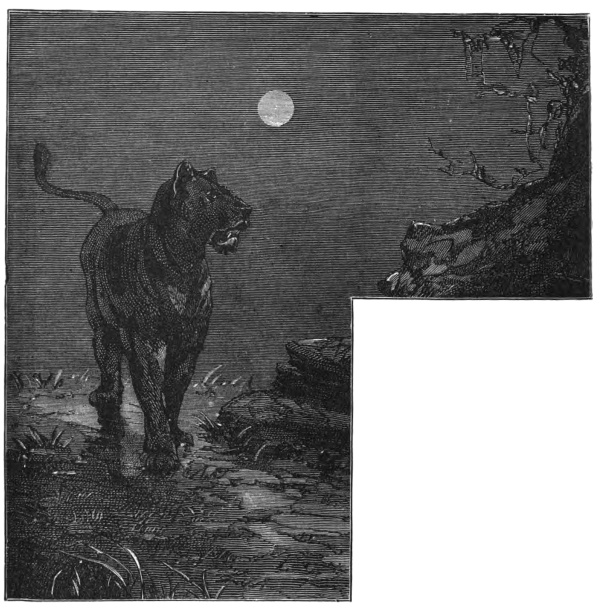
I stole away from the camp, and ascended an eminence some distance from it, and sat me down on a rock. It was cool and pleasant here, away from that blood-stained camp. The moonlight flooded all the beautiful country, bathing plain and rock and tree in its mellow rays. The only sounds that broke the stillness were the yapping howl of the cowardly jackal, and farther off in the woods the mournful roar of lions.
It was a lovely scene, but terrible in its loveliness. I buried my face in my hands. I was boldly struggling against my sorrow. How long, I thought, would this life last? Should I live and die among these terrible savages? Escape there seemed none. To attempt it, I knew, would end in failure, and probably in death by torture. I was many hundreds of miles from the sea. I did not even know in what direction Zanzibar lay. No, I must wait for a time, at all events. What mattered a year or two more to one so young as I!
I suppose this last reflection had some kind of a drowsy influence on me, for I lay down with my head on a piece of rock, and with face upturned to the sky, fell fast asleep.
How long I had slept I know not. I awoke with a start: something cold had touched my face, and I had heard a creature breathing close at—almost into—my ear. I started, as well I might. The thing that had waked me was a jackal; but there, not thirty yards away, standing boldly out against the moonlit sky, was a gigantic lioness!
There was astonishment depicted in every line of her great face. Strange to say, at that moment I could not help thinking that she looked far from cruel, and I could not help admiring the splendid animal. I never moved, but gazed as if spell-bound. Probably it was my fixity of look that saved me, for after staring steadily, but wonderingly, at me for fully a minute, she turned round and stalked solemnly off, giving many a look behind, as if expecting I should follow her.
I waited till she was well away. I felt very happy at that moment, and very bold. I went straight back to camp, and approached the tent of the king, and softly entered. He was fast asleep and snoring. In the matter of rum he had been even more liberal to himself than to his followers. There lay the skins of spirits in a corner, not far from the couch of the drunken king. I hesitated not a moment, but seizing the king’s own dagger, I stabbed—not the king, but the skins of rum.
Then I hastened away with my heart in my mouth. Remember, I was very young.
There were terrible doings next day in camp, and, I’m sorry to say, more than one human sacrifice. I, as medicine man and chief sorcerer, went through a great many mummeries, which I managed to make last all the forenoon. I was endeavouring to find out the wretch who had dared to spill the great king’s rum; that is, I was pretending to. There was more than one chief on whose shoulders I permitted my magician’s wand to rest for a while, just by way of a mild revenge, but the lot finally fell once again on an aged billy-goat. I had saved the king, and saved many of his subjects, for when the king was intoxicated, human sacrifices were of everyday occurrence. At ordinary times they were no more numerous than Bank Holidays in our own country.
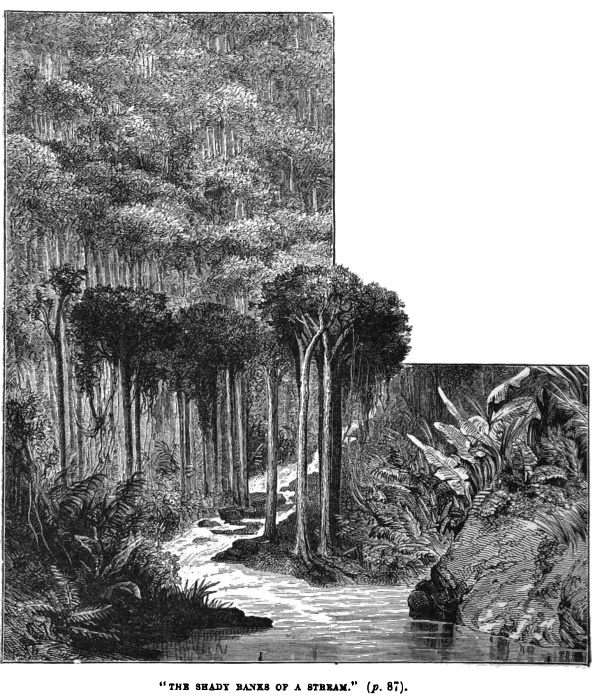
When it was all over I stole away to the shady banks of a stream to bathe, and lie and watch the kingfishers. It was a favourite resort of mine, whenever I dared be alone.
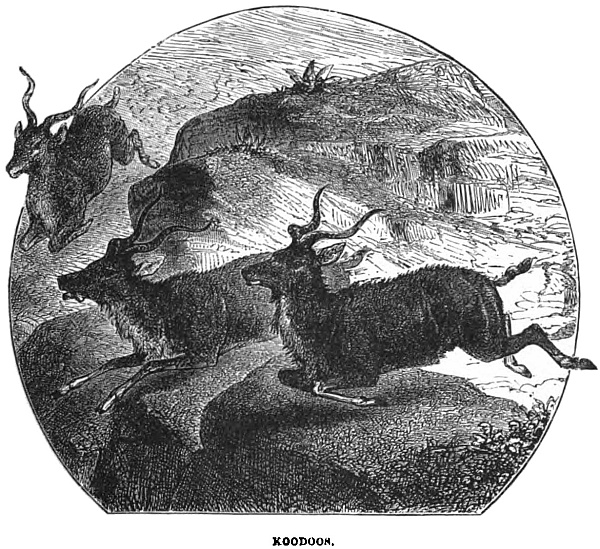
The warriors of this tribe spent most of their time either on the hunting grounds—forest and plain—or in making raids on their neighbours. I was allowed to join the hunting expeditions, but not the forays. I became an expert horseman. I could ride bare-backed as well as any circus-man I have ever seen since. The king was too fat to ride much, but he used to follow to the chase of the koodoo.
This is a kind of beautiful antelope, and excellent eating, its principal recommendation in the eyes of Otakooma. We often caught the young, and they became as tame as our goats.
Now once having taken it into my head that escape from this country of savages was impossible, strange to say I began to settle down, in everything else except human bloodthirstiness, and soon became a very expert savage, taking a wild kind of pride in my exploits.
Mine was now a life of peril and hardship; adventures to me were of everyday occurrence; I carried my life in my hand; I grew as wily as a jackal, and I hope as bold as a lion. I take no credit to myself for being bold; I had to be so.
The king and I continued friends. At the end of the sixth year of my captivity, Jooma died. He died from wounds received at the horns of a wild buffalo in the forest.
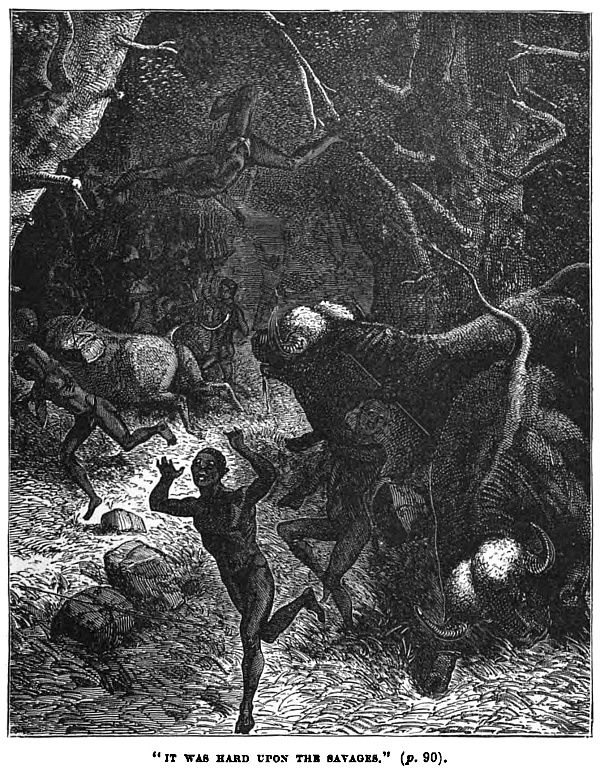
This buffalo-hunting had for me a very great charm, and it certainly was not unattended with danger, for there were times when, headed by an old bull or two, a whole herd of these animals would charge down upon us. This was nothing to me. I could climb trees as well as most monkeys, so I got out of harm’s way, but it was hard upon the savages, who were not always so nimble.
Jooma was terribly tossed and wounded by a bull, and he died at the tree foot. He called me to him before his eyes were for ever closed, and asked me to forgive him for all the ill he had done me, and tried to do me.
“I have been to you one ver bad fellow,” said poor Jooma; “I have want to kill you plenty time. Now I die. You forgive Jooma?”
“I do, Jooma,” I said, and pressed his cold hard hand.
“Ver well,” said the lad, faintly and slowly. “Now I die. Now, I go home—go home—home.”
We buried him just where he lay, between the gnarled roots of a great forest tree, and piled wood over the grave to keep the sneaking jackals at bay.
One morning about two years after this, I was awakened early—indeed it was hardly dawn—by hearing a tremendous uproar and commotion in the camp, with much warlike shouting and beating of those everlasting tom-toms (Note 1).
The king was running about wildly—too wildly, indeed, for his weight—and was summoning his warriors to arms.
White men were coming to attack the camp!
This was glorious news for me.
But who, or what could they be, or what could they want?
All that day, from far and near, the warriors of Otakooma came trooping into camp. To do them justice they were fond of fighting, and eager for the fray; they loved fighting for its own sake, but a battle with white men was a thing that did not happen every day.
The old men, the women and children, and the cattle were separated from the main or soldier portion of the tribe, and taken westwards towards the distant hills. So it was evident that Otakooma and his people meant business.
What part should I take in the coming fray? I might have fled, and remained away until the victory was secured by the white men, but this would have been both unkind and cowardly. On the other hand, I would not lift a spear or poise a lance against my own people.
That same evening, after all was hushed in the camp, I sought out the king. He looked at me very suspiciously before I spoke.
I sat quietly in front of him on the ground, and explained to him my situation.
He was wise enough to see exactly how I stood, but he told me there was an easy way out of the difficulty. Early in the morning he would chop off my head. He bore me no grudge, he explained, it was a mere matter of policy.
“Quite right,” I replied, “and, if he chose, he might take my head off then and there. I didn’t at all mind; and would just as soon be without a head as with one.”
The king smiled, and seemed pleased.
“But,” I continued, “you may look at the possession of a head in a different light, so far as your own particular head is concerned. If your people are beaten, you will assuredly lose that head, unless a white man is near to take your part. I will be your friend,” I said, “in this matter, and during the battle I will stand by your person and never leave you.”
Otakooma was delighted at the proposal, and so we arranged matters to our mutual satisfaction, and I felt glad I had come; I had certainly lost nothing by my candour. No one ever does.
Firing began early in the morning. The battle raged till nearly noon, with dreadful slaughter on the side of the savages, who were finally borne backwards a disorganised mob.
I stuck by the king. He did not fly. He felt safe and said so, but he wept to see his children, as he called them, slain before his very eyes.
Oh! the glad sight it was to me, after all these years, to behold the bold bluejackets, and brave marines, dashing after the foe, gun and bayonet in hand!
But a more joyful surprise awaited me when the battle was over; for the very first man to rush up to me and shake me by the two hands was my dear friend Ben Roberts.
“Nie, old boy!” he cried, “I wouldn’t have known you. You’ve grown a man, and what a savage you do look! And do you know, Nie, what all this fighting has been about?”
“No,” I said innocently.
“Why, about you!” He almost shouted the last word, and I could see in his honest eyes the tears which he could hardly keep from failing.
Note 1. A tom-tom is a kind of kettle-drum. It is simply a log of wood hollowed out at one end, and a dried skin stretched over it.
Chapter Eight.
“The sea! the sea! the open sea! The blue, the fresh, the ever free!” Proctor. “England, thy beauties are tame and domestic, To one who has roamed o’er the mountains afar.” Byron.
Yes, all the fighting had been about me.
Our fellows had not lost the battle that day at Zareppa’s fort; on the contrary, they had given the Arabs a grievous defeat. I had at first been reported killed, but as I was not found among the dead and wounded, search was made for me more inland, and it was soon elicited that I had been carried away prisoner, and no doubts were left in the minds of my shipmates, that I had died by the torture, in order to avenge the death of the pirate chief.
The old Niobe had been wrecked since my incarceration in the land of the savages. Roberts had been made lieutenant, and it was not until he returned to the shores of Africa, several years after, that he heard from friendly Arabs that there was an English prisoner in the hands of a warlike tribe of savages, who lived almost in the centre of the dark continent. After this my dear friend never rested in his hammock, as he himself expressed it, until he had organised the expedition that came to my relief.
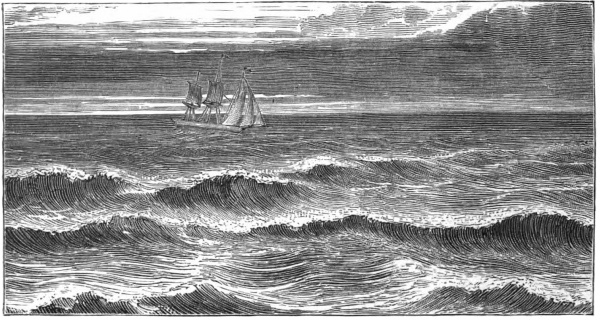
What a delightful sensation it was to me to feel myself once more at sea!
“The glorious mirror, where the Almighty’s form Glasses itself in tempest.”
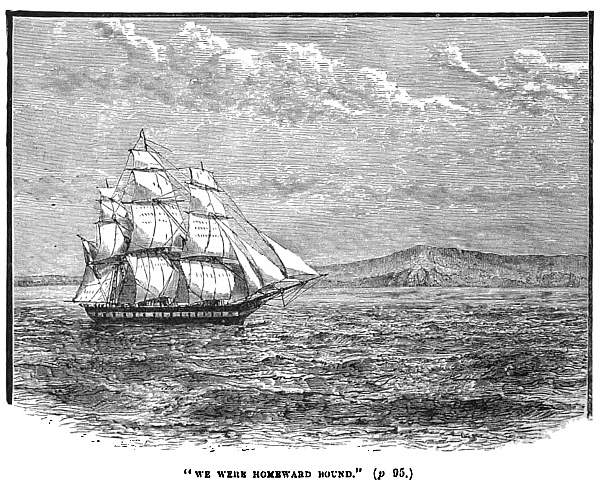
We were homeward bound. I was a passenger, and we had splendid weather, so everything seemed to combine to make me feel joyful and happy. Joyful, did I say? why, there were times when I wanted to run about and shout for joy like a schoolboy, or like the savage that I fear I had almost become.
But I could not run about and shout on board a trim and well-disciplined man-o’-war. The very appearance of the
“White and glassy deck, without a stain Where, on the watch, the staid lieutenant walked,”
forbade, so at such moments I used to long to be away in the woods again, in order to give proper vent to my exultation.
Besides, I had good cause to be staid and sedate. Roberts had heard news that changed the whole course of my life. I was no longer a friendless sailor-boy. My grandfather was dead, and I was the heir to his estate. It was not a very large patrimony, I admit. It was simply a competence, but to me, when I heard it described, it appeared a princely fortune. There would be no longer any need for me to sail the seas. I could settle down in life, or I could choose some honourable career on shore, and, if I was good for anything at all, distinguish myself therein.
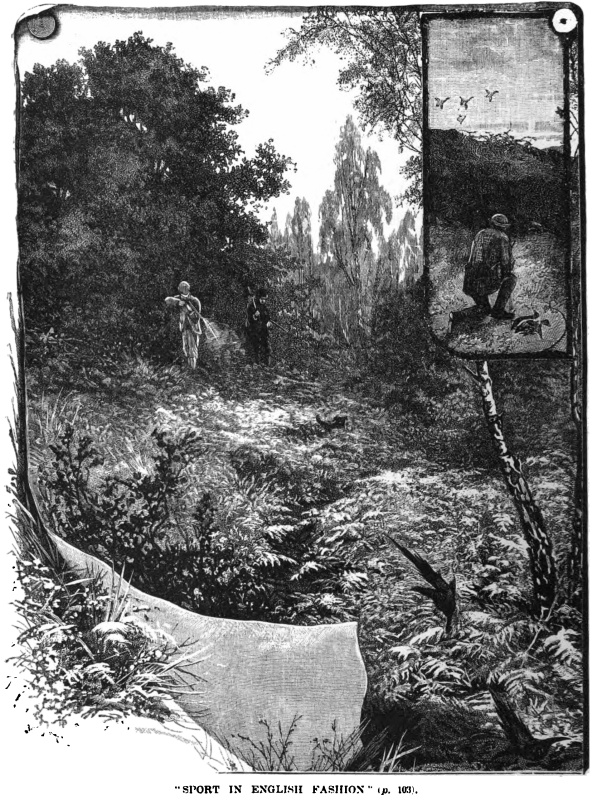
Or, stay, I thought, should I become a soldier? “No, no, no,” was the answer of my soul. The war was past and gone; even the terrible Indian Mutiny had been quelled at last. To be a soldier in the field was a career worthy of a king’s son. To be a soldier, and have nothing to do but loll about in some wretched garrison town, play billiards or cricket, have a day’s shooting, English fashion, now and then, be admired by school-misses and probably snubbed by men with more money than brains; no, such a life would not suit me.
I should much prefer, I thought, to stay at home and till my garden. With my jacket off, my shirt-sleeves rolled up, and an axe or spade in hand, I should feel far more free than playing with a useless sword.
Lieutenant Roberts was about to retire from active service in the Royal Navy, and he had already been promised the command of a ship in the Merchant Service. But before he left England he would, he said, see me, his foster-son, well settled down.
The ship was homeward bound. There was nothing but laughing and talking and singing all day long, for many of the poor fellows on board had not placed foot on their native shores for five long years and more. What a glorious place England must be, I mused, to make these men so happy at the prospect of returning to it. How brightly the sun must shine there! How blue and beautiful must be the seas that lave her coasts!
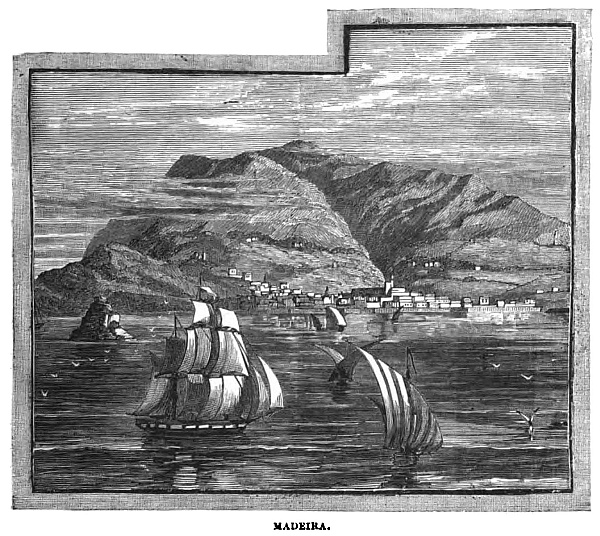
So we presently crossed the Line and sailed north, and north, and north. Past Madeira—and then the brightness began to leave the sky. The wind to me grew chilly, biting, and cruel. The sea became a darker blue, and finally, as we entered the Bay of Biscay, a leaden grey. My hopes of happiness fell, and fell, and fell. Roberts tried all he could to cheer me up, told me of the monster cities I should see, of the ballrooms, of the concert-rooms, and of a multitude of wonderful things, not forgetting cricket and football.
We sailed past the Isle of Wight with a grey chopping sea all around us, grey clouds above us, a bitter cold wind blowing, and a drizzling rain borne along on its wings.
Then we entered Portsmouth harbour, and cast anchor among the wooden walls of England. Finally I landed. Landed, much to my disgust, upon stones instead of soft sand. Landed, still more to my disgust, among crowds of people who stared at me as if I had a plurality of heads, or only one eye right in the middle of my brow. I glanced around me with all the proud dignity of a savage prince. The crowd laughed, and Roberts hurried me on.
I daresay a visit to a fashionable tailor and its subsequent results made me a little more presentable, but I disliked this town of Portsmouth with a healthy dislike, and was glad when my friend took me away.
I had to go to London. The railway amused me, and made me wonder, but used as I was to the quiet of the desert and forest, it deafened me, and the shaking tired me beyond conception.
My solicitor, a prim white-haired man, said he was so glad to see me, though I do believe he was a little afraid of me. Probably not without cause, for at the very moment he was entering into business as he called it, and arranging preliminaries, I was thinking how quickly Otakooma’s savages would rub all the starch out of this respectable citizen. They would not take long to arrange preliminaries with the little man, and as to entering into business, they would do so in a way that would considerably astonish his nerves.
“Bother business!” I exclaimed at last, in a voice that made the prim solicitor almost spring off his chair.
“Oh! my dear sir,” he pleaded, mildly. “We must go into these little matters.”
He ventured to give me two fingers to shake as I left the office with Roberts. I feel sure he was afraid to entrust me with all his hand.
“And as soon as you get home you will telegraph to me; won’t you, Mr Radnor?”
“Telegraph!” I said in astonishment. “Telegraph! and you tell me it is five hundred miles from here to Dunryan. Do you think you can see a fire at that distance? It must be a precious big one I’ll have to light, and the mountains around Dunryan must be amazingly high.”
Both Roberts and the solicitor laughed; they could see that the only idea I had of telegraphing was the building of fires on hill-tops.
I arrived at Dunryan at last—my small patrimony. If I was pleased with it at all, it was simply because it was my own; but everything was so new and so strange and so tame, that as soon as my friend saw me what he called “settled,” and went away to sea and left me, I began, in the most methodical manner possible, to dislike everything round me.
People called on me, but I’m sure they were merely curious to hear my history from my own lips, and partly afraid of me at the same time. They invited me out to tea! Ha! ha! ha! I really cannot help laughing about it now as I write; but fancy a savage sitting down to tea, of all treats in the world, with a company of gossiping ladies of both sexes.
Now my neighbours made me out to be a bigger savage than I really was, because, to do myself justice, I did know a little of the courtesies of civilised life. There was one lady who expressed a wish to have the “dreadful creature” to tea with her. I found out before I went that she had styled me so, though her note of invitation was most politely worded.
The “dreadful creature” did go to tea, intent on a kind of quiet revenge. They could not get a word out of me—neither my hostess nor the three old ladies she had asked to meet me by way of protection. I did nothing but drink cup after cup of tea, handing in my cup to be replenished, and drinking it at once. The bread and butter disappeared in a way that seemed to them little short of miraculous. I saw that they were getting frightened, so I thought I would make them a little soothing speech.
“Ahem!” I began, standing up. I never got any further.
One old lady fainted; another “missed stays,” as a sailor would say, when making for the doorway, and tumbled on the floor; a third fell over the piano-stool. All screamed—all thought I was about to do something very dreadful.
All I did do was to step gingerly out into the hall, pick up my hat, and go off.
I lived in Dunryan for a year. The scenery all around was charming in the extreme. The very name will tell you that Dunryan is in Scotland; the very word Scotland conjures up before the eye visions both of beauty and romance.
But one year even of Scotland, the “land of green heath and shaggy wood,” was enough for me then.
There was no sport, no wild adventure; all was tame, tame, tame, compared to what I had been used to.
But if following game in Scotland seemed tame to me, what could I say of sport in English fashion? I tried both; grew sick of both. Hunting the wild gorilla in the jungles of Africa was more in my line.
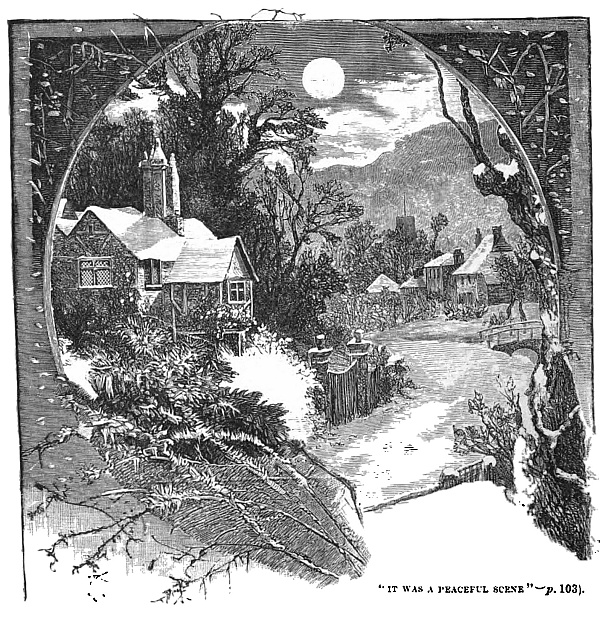
One night, soon after the first snow had fallen, a carriage drove up to my door. It was to bear me away to the distant railway-station. The moon was shining brightly down upon our little village as we drove through; here and there in the windows shone a yellow light; but all was silent, and neither the horses’ hoofs nor the carriage wheels could be heard on the snow-muffled street.
It was a peaceful scene, and I heaved one sigh—well, it might have been of regret. For many and many a long year to come I never saw Dunryan again.
Chapter Nine.
“The dismal wreck to view Struck horror to the crew.” Old Song.
The earlier history of a human being’s life is engraved upon his mind as with a pen of steel. After one comes to what are termed years of discretion, the soul is not so impressionable, and events must be of more than usual interest to be very long remembered. The story, then, of a chequered life cannot be told with even a hopeful attempt at minuteness, unless a log has been kept day after day and year after year; and my opinion is, that although diaries are often most religiously commenced, especially about New Year’s time, they are seldom if ever kept up very long.
My own adventures, and the scenes I passed through in the first stages of my existence, were not, as the reader already knows, of a kind to be very easily forgotten, even had my mind never been very impressionable. It was easy enough, therefore, to record them in some kind of chronological form.
The few adventures I and my friend Ben Roberts tell in the pages that follow, and our sketches of life, are given as they occur to our memory; often brought back to our minds by the incidents of our present everyday life.
But I do not think that even if Ben and I live as long as Old Parr, we shall either tire of spinning our yarns, or fall short of subject matter.
Let me say a word or two about the place I live in now, and where Ben so often pays me a visit.
We call it Rowan Tree Villa.
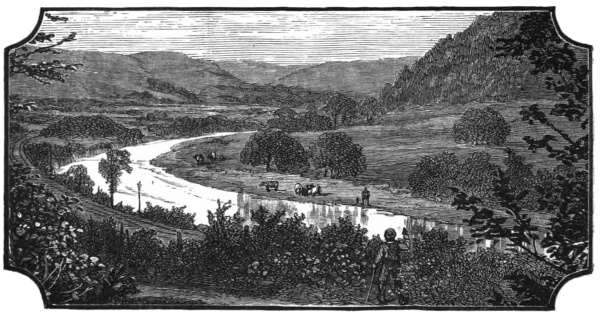
It stands mid-way up a well-wooded hill, about two and a half miles from a dreamy, drowsy old village, in one of the dreamiest, drowsiest nooks of bonnie, tree-clad Berkshire.
The top of the hill is covered by tall-stemmed pine trees, and from this eminence you can see, stretching far away below, all the undulating country, the fertile valley of the Thames, and the river itself winding for many and many a mile through it—a silver thread amidst the green.
From the top of this hill, too, if you take the trouble to climb it, you can have a bird’s-eye view of Rowan Tree Villa.
There it is, a pretty, many-gabled cottage, with a comfortable-looking kitchen garden and orchard behind it, and a long, wide lawn in front. Now this lawn has one peculiarity. From the gate on each side up to the terrace in front of the house sweeps a broad carriage drive, bounded on both its sides, first by a belt of green grass, carefully trimmed and dotted here and there with patches of flowers, and secondly by two rows of rowan trees (the mountain ash), trained on wires, and forming the prettiest bit of hedge-work you could easily imagine.
If you were Scotch, and looked at that hedge even for a moment, the words, and maybe the air as well, of the Baroness Nairne’s beautiful song would rise in your mind—
“Thy leaves were aye the first in spring, Thy flowers the summer’s pride; There was nae sic a bonnie tree In a’ the country side. And fair wert thou in summer time, Wi’ a’ thy clusters white, And rich and gay thy autumn dress Of berries red and bright. Oh, rowan tree!”
Well, it is June to-day—an afternoon in June; a day to make one feel life in every limb—a day when but to exist is a luxury. The roses are bending their heads in the sweet sunshine, for there is not a cloud in Heaven’s blue. The butterflies are chasing each other among the flowers on the lawn, where we recline among the daisies, and the big velvety bees go droning and humming from clover blossom to clover blossom.
“Strange, is it not, my dear Ben,” I said, “that on such a day as this, and in the midst of sunshine, I should bethink me of some night-scenes at sea and on land?
“I remember well my first experience of a storm by night in the Northern Ocean. We were going to the Arctic regions, cruising in a sturdy and, on the whole, not badly fitted, nor badly found ship.
“The anchor was weighed, the sails were set, and spread their wings to the breeze; the crew had given their farewell cheer, and the rough old pilot, having seen us safely out of Brassy Sound, had shaken the captain roughly by the hand, and wishing us ‘God-speed and safely home,’ had disappeared in his boat round a point.
“We were once more on the deep and dark blue ocean. Then the night began to fall, and soon the only sound heard was the tramp, tramp on deck, or the steady wash of the water, as our vessel ever and anon dipped her bows or waist in the waves.
“The captain had given his last orders on deck, and came below to our little saloon, the only occupants of which were myself and the ship’s cat.
“Poor Pussy was endeavouring, rather ineffectually, to steady herself on the sofa, and looked very much from home, while I myself was trebly engaged: namely, in placing such articles as were constantly tumbling down into a safer and steadier position, in keeping the fire brightly burning, and in reading a nautical book.
“There was a shade of uneasiness on the captain’s face as he looked at the barometer; and when he entered his state-room, and presently after emerged dressed in oilskins and a sou’-wester hat, I felt as sure we were going to have a dirty night as though he had rigged himself out in sackcloth and ashes.
“He sat down, and, calling for some coffee, invited me to join in a social cup.
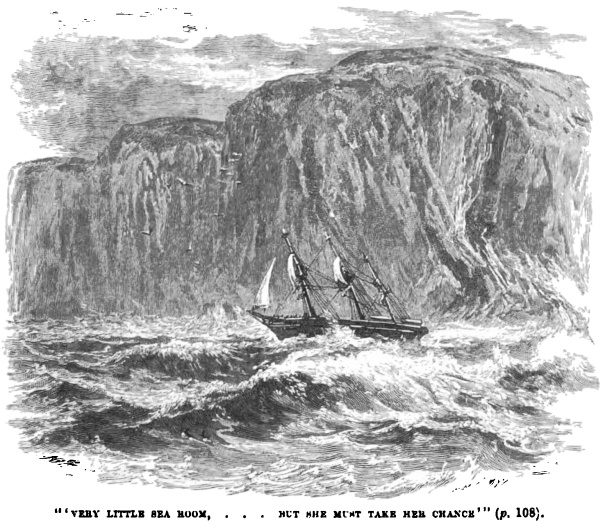
“‘Is there plenty of sea-room?’ I inquired.
“‘Very little sea-room,’ he replied; ‘but she must take her chance.’
“Then we relapsed into silence.
“About an hour or two after this it became a difficult matter to sit on a chair at all, so much did the vessel pitch and roll.
“The captain had gone on deck, and as I had neither the need nor the desire to follow him, I threw myself on the sofa, at the risk even of offending my good friend and companion, Pussy.
“The storm was now raging with terrible fury.
“Two watches were called to shorten sail, and the din and noise of voices could be distinctly heard rising high over the dashing of the waves, and the whistling of the wind among the rigging and shrouds. Every timber was stretched, every plank seemed to creak and wail in agony; yet the good ship bore it well.
“Tired of the sofa I turned into bed, hoping to have a few hours of sleep; but was very soon obliged to turn out again, having been awakened from a pleasant dream of green fields, pine-clad hills, and a broad, quiet river, where ferns and water-lilies grew, by the crashing of crockery in the steward’s pantry. It sounded as if bottles, dishes, plates, and cups were all in a heap in the middle of the floor breaking each other to infinitesimal pieces. And that is precisely what they were doing.
“Things in the saloon were fast verging into a state of chaos, and appeared to be making very merry in my absence. The fender and fire-irons presided over the musical department.
“The captain’s big chair was dancing very emphatically, but rather clumsily, with the coal-scuttle as a partner; the table was bowing to the sofa, but the sofa begged to be excused from getting up. The only reasonable-looking article of furniture in the room was a chair, which was merely staggering around with my coat on, while the cat had gone to sleep in my sou’-wester; and while endeavouring to restore quiet and order, I was thrown below the table like a pair of old boots, where, for the want of ability to do anything better, I was fain to remain.
“‘Clear away the wreck!’ I could now hear the captain’s voice bawling, for our fore-mast had gone by the board.
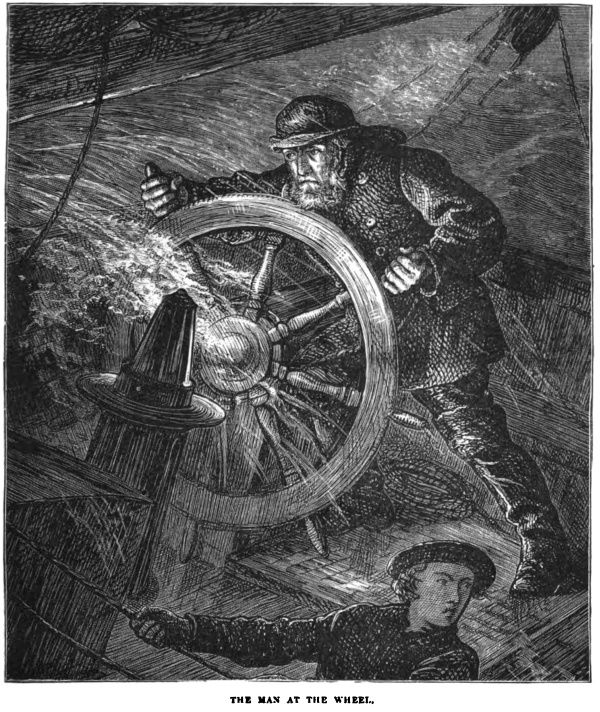
“His voice was not the only one I heard. On passing the man at the wheel, I heard the captain ask, ‘What! are you getting afraid, man?’ And the brave British voice that so firmly replied ‘Not at all, sir!’ explained better than printed volumes could have done the secret of all our naval greatness; for to hearts like his, and hands like his, in many a dark and stormy night, Britannia entrusts her honour, and bravely is it kept and guarded.
“Musing on this fact, I fell soundly to sleep beneath the table, and when I awoke the storm had ceased.
“There are few situations in which a healthy man can be placed that are more full of discomfort than that of being at sea in a small ship during a storm. I do not refer to a mere ‘capful of wind;’ I mean a great-gun gale. There is, literally speaking, no rest for the sole of the foot. Tossed about in all directions, in vain do you seek to exchange your chair for the sofa. Probably you are sent rolling off on to the deck, and thankful you ought to be if the cushions are the only things that follow you. Flesh-sore and weary, perhaps you seek for solace in a cup of tea: thankful you may be again if the steward succeeds in pouring it into your cup, instead of spilling it down your neck. Then, if you so far forget the rules of the sea as to place it for a moment on the table without a hand to guard it, you are instantly treated to a gratuitous shower-bath.
“Still the ocean has its pleasures and its charms as well as the land. My mind, even now, carries me back and away to a scene very different from that which I have just been describing.
“I am sitting in my little cabin. It is a summer’s evening, and all is peace within and around my barque. Yonder is my bed, and the little port close by my snow-white pillow is open, and through it steals the soft, cool breeze of evening, and wantonly lifts and flutters the little blue silken hangers. Not far off I can catch glimpses of the wooded hills and flowery valleys of a sunny land. And night after night the light wind that blows from it is laden with the sweet breath of its flowers; and between there lies the ocean, asleep and quiet and still, and beautiful with the tints of reflected clouds.
“Often in the cool night that succeeds a day of heat have I lain awake for hours, fanned by the breath of the sea, gazing on the watery world beneath and beyond me, and the silvery moon and tiny stars, that make one think of home, till sleep stole gently down on a moonbeam, and wafted me off to dreamland.
“But in witnessing even the war of the elements at sea, a sailor often finds a strange, wild pleasure. Enveloped in the thundercloud you mount with every wave to meet the lightning’s flash, or descend, like an arrow, into the gulf below—down, down, down, till the sun, lurid and red, is hidden at last from view by the wall of black waters around you.
“Or fancy the picture, which no artist could depict, of a ship far away in ocean’s midst by night in a thunderstorm. Dimly through the murky night behold that tumbling sea, lighted only by its own foam and the occasional flash from the storm-cloud. See that dark spot on the sea; it is a ship, and living souls are there—human beings, each with his own world of cares and loves and thoughts that are even now far away, all in that little spot. Whish! now by the pale lightning’s flash you can see it all. The black ship, with her bare poles, her slippery, shining deck and wet cordage, hanging by the bows to the crest of that great inky wave. What a little thing she looks, and what a mighty ocean all around her; and see how pale appear the faces of the crew that ‘cling to slippery shrouds,’ lest the next wave bear them into eternity.
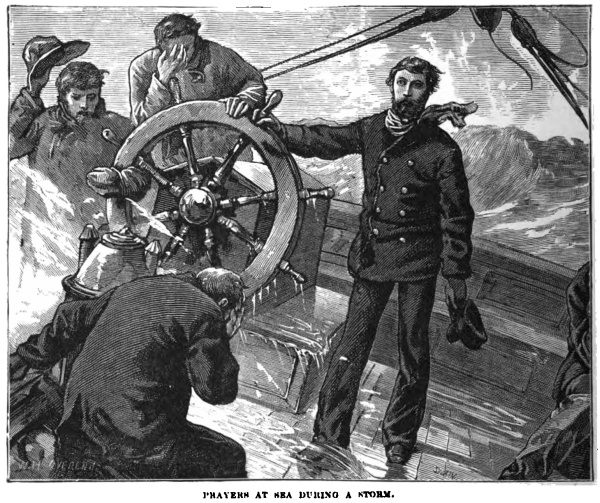
“Whoever has been to prayers at sea during a storm has had a solemn experience he will never forget.”
“Perhaps there is no more impressive ocean-scene ever beheld by the sailor,” said Captain Ben Roberts, “than the phosphorescent seas witnessed at times in the tropics.” But though far more common in these regions than in the temperate zones, this extraordinary luminosity of the water is sometimes observed around our own coasts.
“I shall always remember,” he continues, “the first time I witnessed the phenomenon, though I’ve often seen it since.
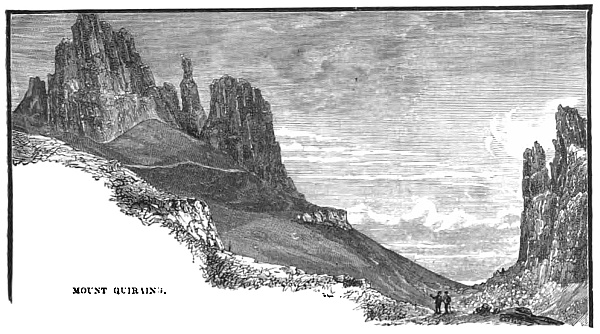
“What a happy day we had had, to be sure! We were a party of five—I but a schoolboy, my comrades little more. It was the first time I had been to that most bewitching of western islands called Skye. We had started off one morning early on a ramble. We simply meant to go somewhere—anywhere, so long as we did not come back again for a night or two. Not that we were not happy enough in the old-fashioned manse of K—. But we wanted change, we wanted adventure if we could find any, and if we did not, then probably we should be able to make some. There was, at all events, the wild mountain peak of Quiraing to be climbed, with its strange top—the extinct crater of a burning mountain. Ah! but long before we came anywhere near it, there was a deal to be done.
“We had started from the beautiful little bay of Nigg, keeping a northerly course over a broad Highland upland.
“It was the month of June; the heather was not purple yet, but it was long and rank and green, and it was inhabited by many a curious wild bird, whose nests we hunted for, but did not rob; we saw some snakes, too, and one of us killed a very long one, and we all thought that boy a very hero, though I know now it was no more dangerous or deadly than a tallow candle.
“But the best fun we got was when we took to horse-catching. There was not much harm in this after all. There were dozens of ponies roaming wild over the green moor, and if they allowed themselves to be caught and ridden for miles through the heather, why, it did not hurt them; they soon danced back again.
“We laughed, and screamed, and whooped, loud enough to scare even the curlews, and that is saying a good deal. I’m not sure, indeed, that we didn’t scare the eagles from their eeries; at all events we thought we did. Then we began to ascend Quiraing, a stiff climb and somewhat hazardous; and light-hearted though we were, I believe we were all impressed with the grandeur of the view we caught from between the needle-like rocks that form one side.
“We went down to the plains below more quickly than we came up.
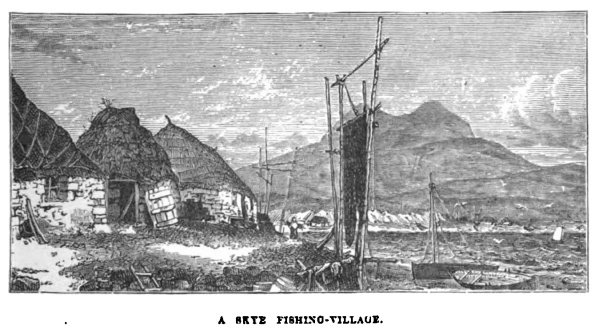
“Presently we came to a little Highland village close to the sea, and there, to our joy, we found that a large fishing-boat was going round the northernmost and east part of the island to Portree, the capital. For a trifle we managed to take a passage. We had lots of bread and cheese in our wallets, and we had some money in our pockets, good sticks, and stout young hearts; so that we should not be badly off even although we should have to trudge on foot back again to the old manse. Which, by the way, we had to.
“Our voyage was a far longer one in time than we had expected it would be, because the wind fell. But the beauty of the scenery, the hills, the strange-shaped mountains, the rocks and cliffs, with waterfalls tumbling sheer over them and falling into the sea; the sea itself, so calm and blue, and the distant mainland, enshrouded in the purple mist of distance, repaid us for all, and made the day seem like one long, happy dream.
“But daylight faded at last, and just as the gloaming star peeped out there came down upon our boat a very large shoal of porpoises, which the boatman gravely assured us at first was the great sea-serpent. These creatures were in chase of herrings, but they were so reckless in their rush and so headlong, that we were fain to scream to frighten them off, and even to arm ourselves with stones from the ballast, and throw at those that came too near.
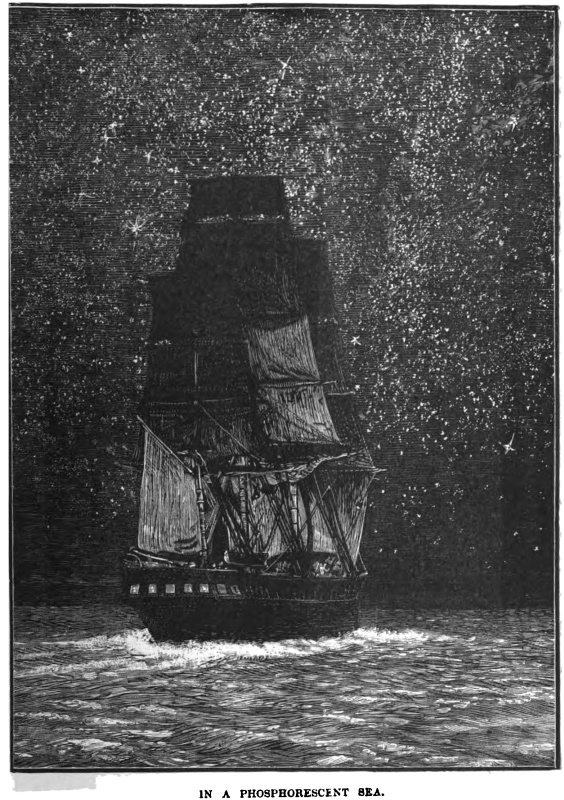
“Night fell at last, and we were still at sea, and the stars came out above us. But if there were stars above us there were stars beneath us too; nay, not only beneath us, but everywhere about and around us. The sea was alive with phosphorescent animalculae; the wake of the boat was a broad belt of light behind us, every ripple sparkled and shone, and the water that dripped from the oars looked like molten silver.”
“Ah!” said I, “that was one of your first experiences of the open sea, wasn’t it, Ben?”
“I was only a boy, Nie,” replied my friend. “I’ve had many a sleep in the cradle of the deep since then.”
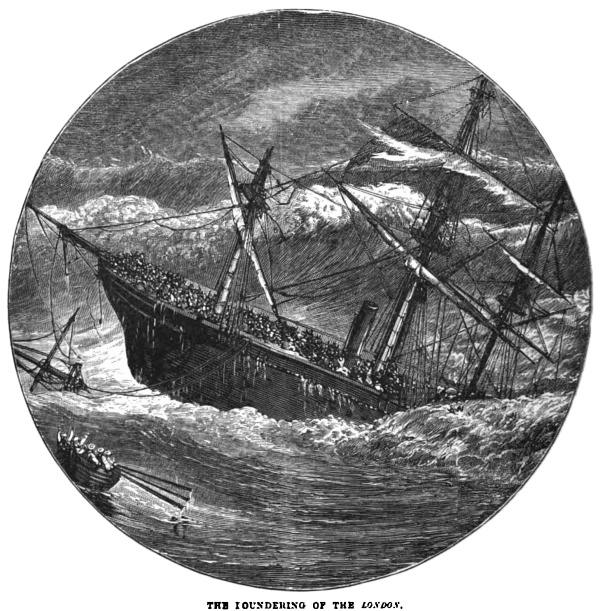
“I was reading this morning,” I said, “of that terrible shipwreck in the Atlantic. It puts me in mind of the loss of the London. I was in the Bay of Biscay in that very gale, Ben; our vessel unmanageable, wallowing in the trough of the seas, the waves making a clean breach over us; and, Ben, at the very darkest hour of midnight, we saw, by the lightning’s gleam, a great ship stagger past us. We were so close that we could have pitched a coil of rope on board. There were no men on her decks; her masts were carried away, and her bulwarks gone, and it was evident she was foundering fast. There were more ships lost, Ben, that night in the Bay of Biscay than ever we shall know of—
“‘Till the sea gives up its dead.’”
Chapter Ten.
“Throned in his palace of cerulean ice, Here Winter holds his unrejoicing court.” Thomson’s “Seasons.”
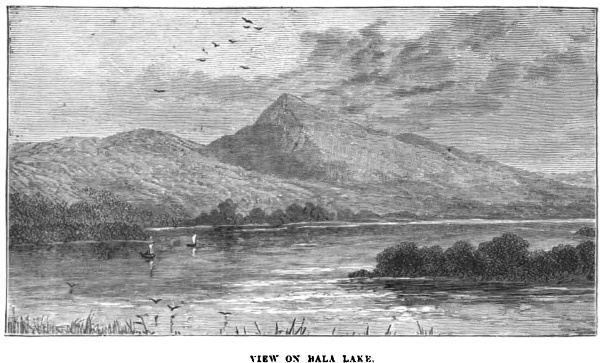
“I don’t think,” said I, as Captain Ben Roberts and I sat at breakfast one day in a homely old hotel in Bala, North Wales, “I don’t think, Ben, my boy, I ever ate anything more delicious in the way of fish than these same lovely mountain trout.”
“Well, you see,” replied my friend, “we caught them ourselves, to begin with; then the people here know exactly how to cook them. But, Nie, lad, have you forgotten the delicious fries of flying-fish you used to have in the dear old Niobe?”
“Almost, Ben; almost.”
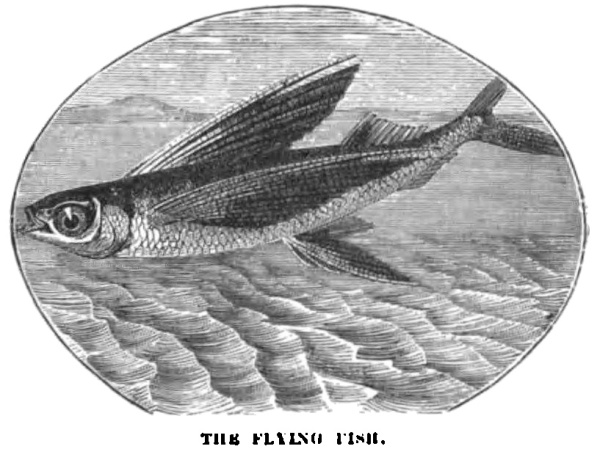
“Well, I can tell you that you did use to enjoy them, all the same.”
“Ay, and I’ve enjoyed them since many and many is the time in the tropics, and especially in the Indian Ocean.”
“So have I,” said Ben Roberts. “Funny way they used to have of catching them, though, in the old Sans Pareil. Of course you know they will always fly to a light if held over the ship’s side?”
“Yes.”
“Well, but the orders were not to have lights kicking about the deck at night, either naked or in a lantern; so some of our fellows—not that I at all approve of what they did—utilised a wild cat the doctor kept in a cage. When they came on deck to keep the middle watch—we were on a voyage from Seychelles to the Straits of Malacca—they would swing him, cage and all, over the stern. His eyes would be gleaming like bottled wildfire. ’Twasn’t long, I can tell you, before the flying-fish sprang up at the cage. Old Tom put out his claws and hooked some of them in; but lots flew on board, and they were being fried five minutes afterwards.”
“I quite believe you, Roberts,” I said; “though some would call that a traveller’s tale. But just look at that lovely pair of Persian cats in the corner there, Ben; it seems almost impossible to believe they can belong to the same family as the wild cat you’ve been speaking about.”
“Yes, Nie, civilisation is a wonderful thing when it can extend even to the lower animals. You were once a savage yourself too, Nie. Think of that.”
“I shan’t think about it,” I replied. “None of your sauce, my worthy friend. What were you doing at Seychelles, and what were you doing with a wild cat on board?”
“We had queerer things than wild cats on board, Nie; the fact is, we were what they call cruising on special service. We had a fine time of it, I can tell you. We seemed to go everywhere, and do nothing in particular. At the time we had that wild cat on board, Nie, we had already been three years in commission, and had sailed about and over almost every ocean and sea in the world.”
“What a lot of fun and adventure you must have had, Ben! Wish I had been with you.”
“You were in the Rocky Mountains then, I believe?”
“Yes, and in Australia, and the Cape. You see, I had a turn after gold and diamonds wherever I thought I could find them. But help yourself and me to some more of those glorious trout, and spin your yarn.”
“Let us get away out of doors first, Nie. On this lovely summer’s day we should be on the lake.”
So we were, reader, one hour afterwards; but the sun was too bright; there were neither clouds nor wind, and the fish wouldn’t bite; so we pulled on shore, drew up our boat, and seated ourselves at the shady side of a great rock on a charming bit of greensward, and there we stayed for hours, Ben lazily talking and smoking, I listening in a dreamy kind of way, but enjoying my friend’s yarn all the same.
“Yes,” said Ben, “we were on special service. One day we would be dredging the bottom of the sea, the next day taking soundings. One day we would be shivering under polar skies, the next roasting under a tropical sun.”
“Come, come, be easy, Ben; be easy,” I cried, half-rising from the grass. “If you were under polar skies one day, how, in the name of mystery, could you be in the tropics next, Captain Roberts? I shall imagine you are going to draw the long bow, as the Yankees call it.”
“Well, well, Nie; the fact is, we passed so pleasant an existence in the Sans Pareil, that time really glided away as if we had been in dreamland all the while. We sailed away to the far north in the early spring of the year. We didn’t go after either seals or whales; but we did have the sport for all that. Our captain was one of those real gentlemen that you do find now and then commanding ships in the Royal Navy. Easy-going and complacent, but a stickler for duty and service for all that. There wasn’t a man or officer in the ship who wouldn’t have risked his life at any moment to please him—ay, or laid it down in duty’s cause. Indeed, the men would any day do more for Captain Mann’s nod and smile, than they would do for any one else’s shouted word of command.
“We dredged our way up north to Greenland. It was a stormy spring. We often had to lie-to for a whole week together; but we were a jolly crew, and well-officered, and we had on board two civilians—Professor kind of chaps I think they were—and they were the life and soul of the whole ship. Whenever we could we took soundings, and hauled up mud and shingle and stuff from the bottom of the dark ocean, even when it was a mile deep and more. But when that mud was washed away, and the living specimens spread out and arranged on bits of jet-black paper, what wonders we did see, to be sure! Our Scotch doctor called them ‘ferlies’: he called everything wonderful a ‘ferlie.’ But these particular ferlies, Nie, took the shape of tiny wee shells of all the colours in the rainbow, and funny wee fishes, some not bigger than a pin-point. But, oh! the beauty, the more than loveliness of them! The roughest old son of a gun on board of us held up his hands in admiration when he saw them. We cruised all round Spitzbergen, and all down the edge of the eastern pack ice. We shot bears and foxes innumerable; walruses, narwhals, seals, and even whales fell to our guns; while the number of strange birds we bagged and set up would have filled a museum.
“Some of those walruses gave us fun, though. I remember once we fell amidst ice positively crowded with them. They seemed but little inclined to budge, either. Again and again we fought our way through them; but the number seemed to increase rather than diminish, till at last our fellows—we were two boats’ crews—were thoroughly exhausted, and fain to take to the boats. Was the battle ended then? I thought it was only just beginning, when I saw around us the water alive with fierce tusked heads evidently bent on avenging the slaughter of their comrades.
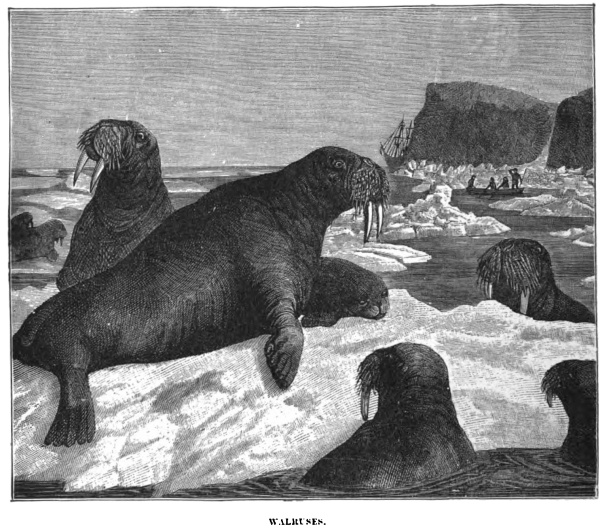
“Our good surgeon was as fond of sport as anyone ever I met, but he confessed that day he had quite enough of it. At one time the peril we were in was very great indeed. Several times the brutes had all but fastened their terrible tusks on the gunwale of our boat. Had they succeeded, we should have been capsized, and entirely at their mercy.
“The surgeon, with his great bone-crushing gun, loaded and fired as fast as ever fingers could; but still they kept coming.
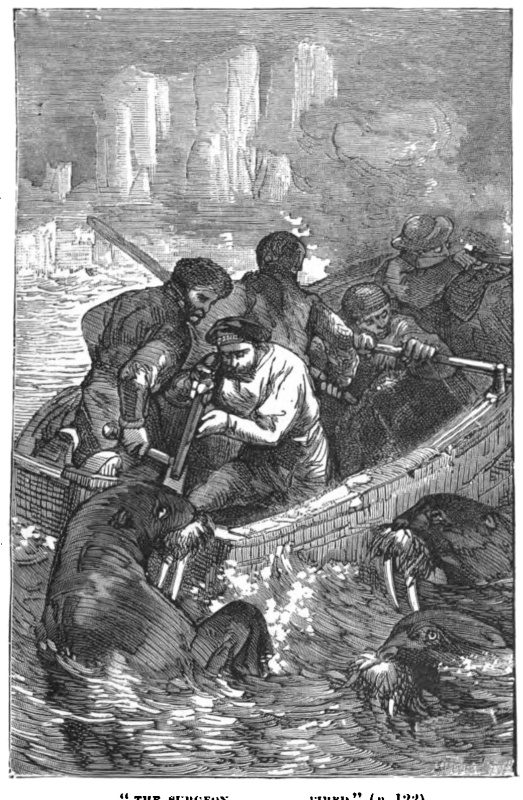
“‘Ferlies’ll never cease,’ cried the worthy medico, blowing the brains clean out of one who had almost swamped the boat from the stern. Meanwhile it fared but badly with the other boat. The men were fighting with clubs and axes, their ammunition being entirely spent. One poor fellow was pierced through the arm by the tusk of a walrus and fairly dragged into the water, where he sank before he could be rescued.
“The ship herself bore down to our assistance at last, and such a rain of bullets was poured upon the devoted heads of those walruses that they were fain to dive below. The noise of this battle was something terrible; the shrieks of the cow walruses, and the grunting, groaning, and bellowing of the bulls, defy all attempts at description.
“What do you think,” continued Captain Roberts, “I have here in my pocket-book? Look; a sketch of a strangely fantastic little iceberg the doctor made half an hour after the battle. He was a strange man—partly sportsman, partly naturalist, poet, painter, all combined.”
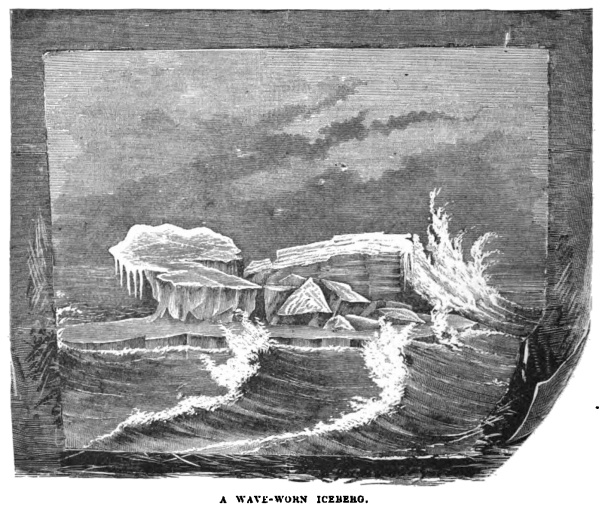
“Is he dead?”
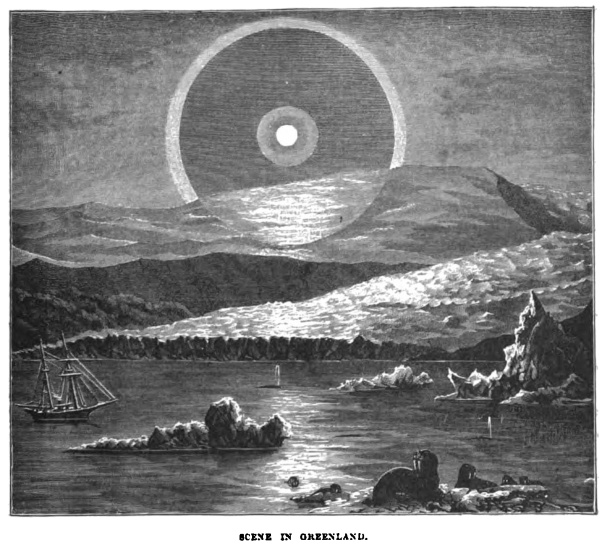
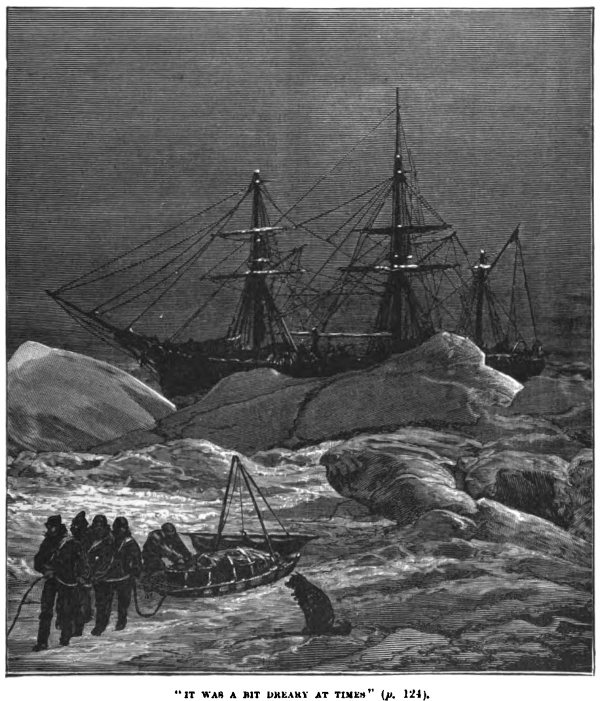
“No, not he; I’ll warrant he is busy sketching somewhere in the interior of Africa at this very moment. But I loved Greenland so, Nie, that old as I am I wouldn’t mind going back again. The beauty of some of the aurora scenes, and the moonlight scenes, can never be imagined by your stay-at-home folk. We went into winter quarters. Well, yes, it was a bit dreary at times; but what with fun and jollity, and games of every kind on board, and sledging parties and bear and fox hunts on shore on the ice around us, the time really didn’t seem so very long after all.”
“What say you to lunch, Ben, my boy?” I remarked.
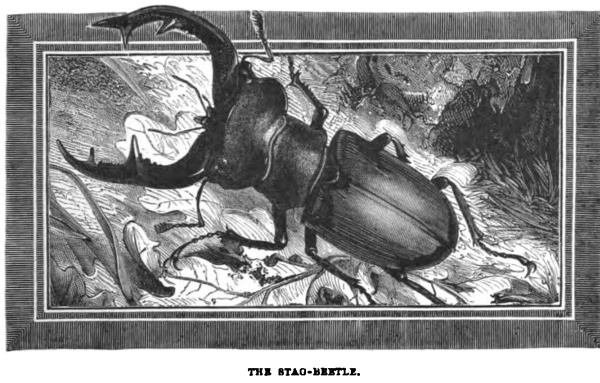
“The very thing,” replied my friend; “but first and foremost, just shake that ferocious-looking stag-beetle off your shoulder; he’ll have you by the ear before you know where you are.”
“Ugh!” I cried, knocking the beast a yard away. The creature turned and shook his horrid mandibles threateningly at me, for a stag-beetle never runs away. Although admiring his pluck, I could not stand his impudence, so I flicked him away, and he fell into the lake.
“Ah! Nie,” Captain Roberts said, “if the wild beasts of the African jungle were only half as courageous and fierce as that beetle, not so many of our gay sportsmen would go after them. Only fancy that creature as big as an elephant!
“Well, Nie, in that cruise of ours, we had no sooner got back to England and been surveyed than off we were down south, across the Bay of Biscay. No storms then; we could have crossed it in the dinghy boat. Visited Madeira. You know, Nie, how grand the scenery is in that beautiful island.”
“And how delicious the turtle!” I said.
“True, O king!” said Ben; “the bigwigs in London think they know what turtle tastes like, but they’re mistaken; there is as much difference between the flavour of a turtle newly caught, and one that has been starved to death as your London turtles are, as there is between a bit of cork and a well-boiled cauliflower.”
“Bravo! Ben, you speak the truth.”
“Then we visited romantic Saint Helena. It used to be called ‘a rock in the middle of the ocean.’ How different now! A more fertile and luxuriant place there isn’t in all the wide, wide world. We called at Ascension next; well, that is a rock if you like, not a green thing except at the top o’ the hill (it has since been cultivated). But the birds’ eggs, Nie, and the turtle. It makes me hungry to think of them even now.
“We had whole months of sport at the Cape and in South Africa, and all up the coast as far as Zambesi. We visited Madagascar; more sport there, and a bit of honest fighting; then on to the Comoro islands—more romantic scenery, and more fighting; then to Zanzibar. Captured prizes, took soundings, dredged, and went on again. On, to Seychelles, then to Java, Sumatra, Penang, then back to India, and thence to Africa, the Red Sea, Mocha; why, it would be easier far to mention the places we did not visit. But the best of it was that we stayed for months at every new place where we cast anchor.”
“Visited Ceylon, I dare say?”
“Yes, hid, and had some rare sport elephant-shooting. I tell you what, Nie, there was some clanger attached to that sort of thing in those days, but now it is little better than shooting cows, unless you get away into the little-known regions of equatorial Africa; there you still find the elephant has his foot—and a big one it is—upon his native soil. But I remember once—I and my man Friday—being charged by two gigantic tuskers, and the whole herd rushing wildly down to their assistance. It was a supreme moment, Nie. I thought my time was come; I would have given anything and everything I possessed to get up into the top of the palm-tree close beside me.
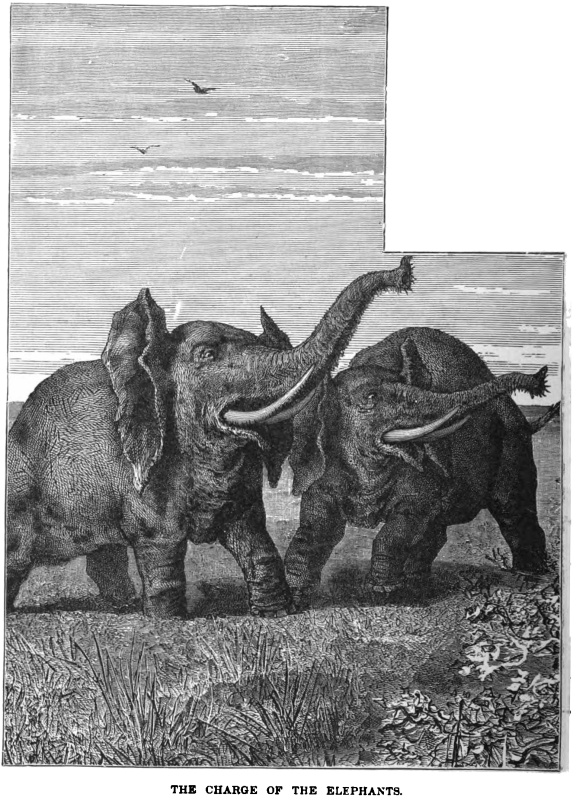
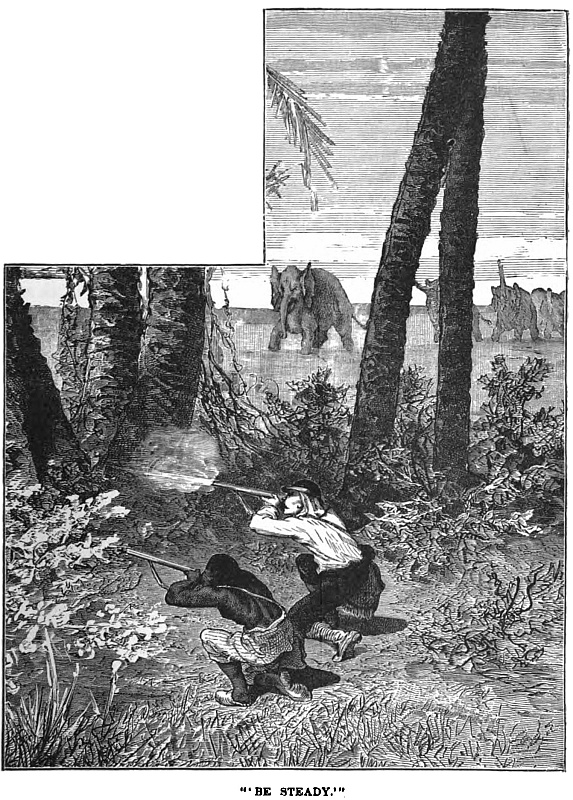
“‘Now, Friday,’ I cried, ‘be steady if you value your own life and mine.’
“I fired, and my tusker dropped. But the terrible noise and trumpeting must have shaken Friday’s nerves a bit. He was usually a good shot, but on this occasion he missed. I loaded at once again, and as the great brute came down on us, let him have it point-blank. He reeled, but still came on. I felt rooted to the spot. My life in a moment more, I thought, would be crushed out of me. Ah! but there must have been a mist of blood before the tusker’s eyes; it was a tree he charged; his tusk snapped like a pipe-stalk, and the great elephant at once fell dead.”
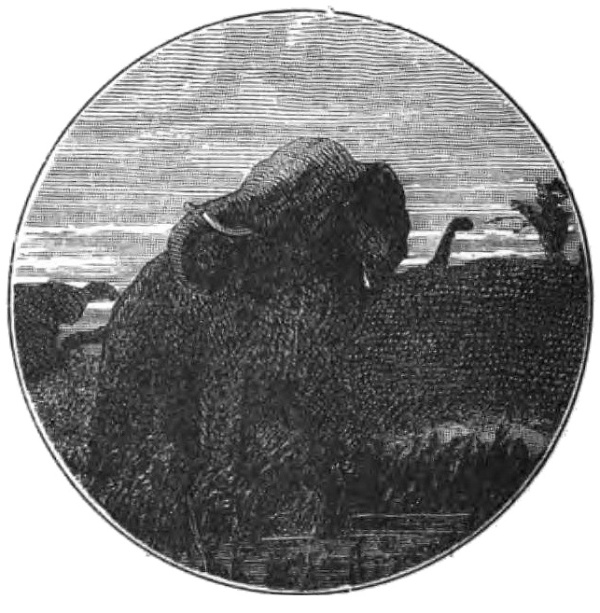
“It was a narrow escape.”
“Well, it was, but for the matter of that, Nie, who knows but that our lives may be ever in danger, no matter where we are. A hundred times a day, perhaps, we are upheld by the kind hands of an unseen Providence, ‘our eyes are kept from tears, and our feet from falling.’
“Should we be grateful when our lives are spared? I think so, Nie, lad; only the reckless, and the braggart, and too often the coward, boast of the dangers they have come through, just as if their own strength alone had saved them.”
Chapter Eleven.
“They are all, the meanest things that be. As free to live, and to enjoy that life, As God was free to form them at the first, Who in His sovereign wisdom made them all.” Cowper.
We had just finished lunch by the lake-side at Bala, my friend Ben Roberts and I, and were thinking of trying the fishing once more, for the clouds had banked up from the west and obscured the sun’s glare, a little breeze had rippled the water, and everything looked promising, when the Captain burst out laughing.
“Shiver my timbers! as sailors say on the stage, Nie,” cried he, “if there isn’t that same old stag-beetle making his way up your jacket again, intent on revenge.”
“Plague take it!” I exclaimed, shaking the brute off again; “I have flicked him away once; I shall have to kill him now.”
“No you won’t,” said Ben Roberts; “the world happens to be wide enough for the lot of us. Let him live. I’m a kind of Brahmin, Nie; I never take life unless there is dire necessity.
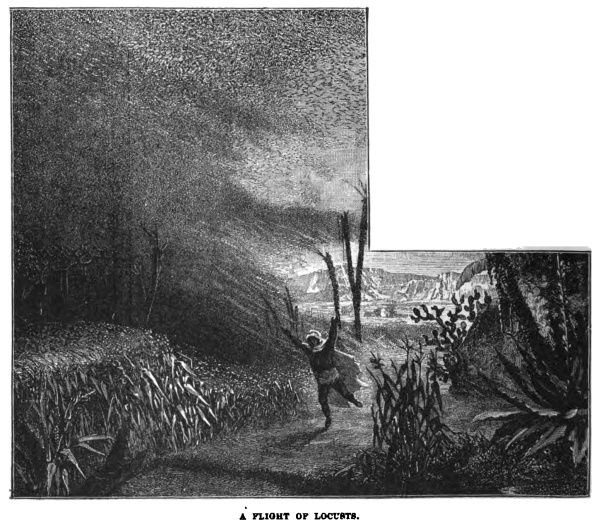
“We in England,” continued Captain Roberts, “have little to complain about in the matter of insects; our summer flies annoy us a little, the mountain midges tickle, and the gnats bite, and hornets sting. But think of what some of the natives of other countries suffer. I remember as if it were this moment a plague of locusts that fell upon a beautiful and fertile patch of country on the seaboard of South Africa. It extended only for some two hundred miles, but the destruction was complete.
“The scenes of grief and misery I witnessed in some of the villages I rode through, I shall remember till my dying day.
“‘All, all gone!’ cried one poor Caffre woman who could talk English, ‘no food for husband, self, or children, and we can’t eat the stones.’
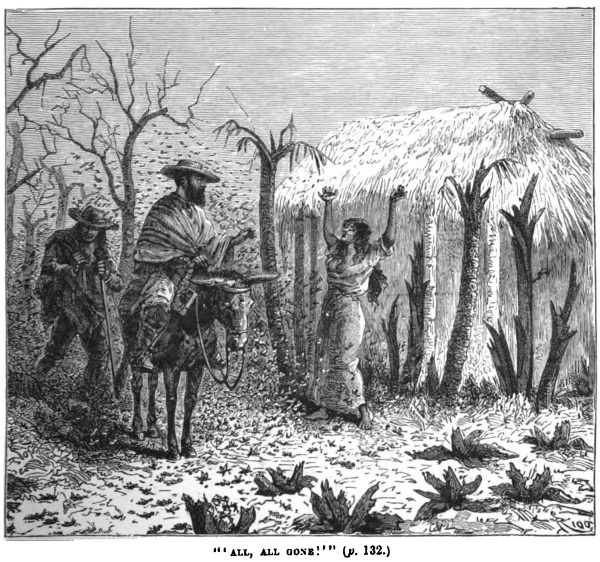
“These poor wretches were positively reduced to eating the locusts themselves.”
“I shouldn’t like to be reduced to eating insects,” said I; “fancy eating a stag-beetle fried in oil.”
“And yet I doubt,” replied the Captain, “if it is a bit worse than eating shrimps or swallowing living oysters. You’ve seen monkeys eating cockroaches?”
“Yes, swallowing them down as fast as they possibly could, and when they couldn’t eat any more, stuffing their cheeks for a future feast.”
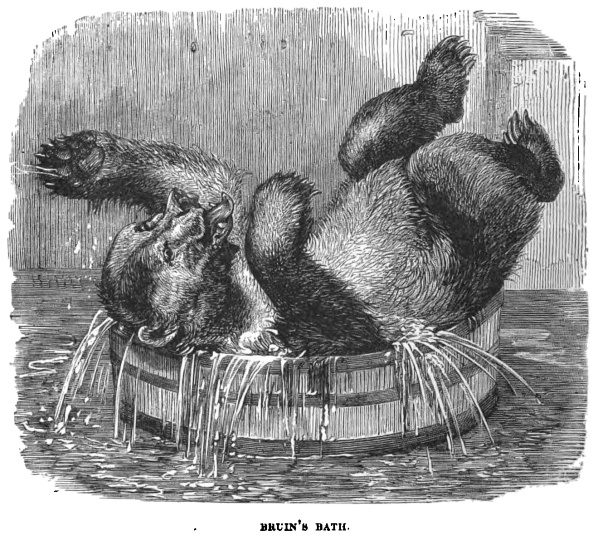
“On the old Sans Pareil we had fifteen apes and monkeys, besides the old cat and a pet bear. Ah! Nie, what fun we did use to have, to be sure!”
“Didn’t they fight?”
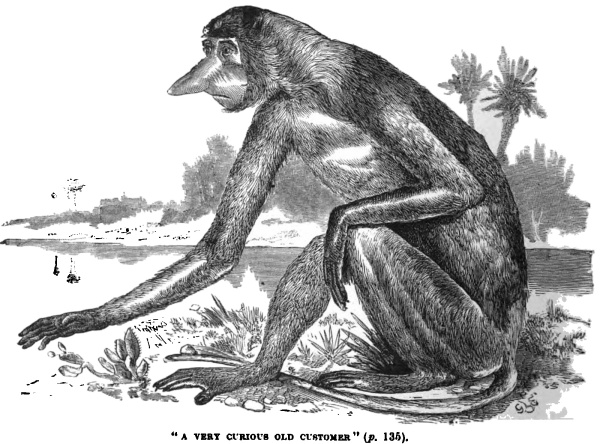
“No, they all knew their places, and settled down amiably enough. The very large ones were not so nimble, and some of them were very solemn fellows indeed; the smaller gentry used to gather round these for advice, we used to think, and apparently listened with great attention to everything told them, but in the end they always finished up by pulling their professors by their tails. If at any time they did happen to find that old cat’s tail sticking out of the cage, oh! woe betide it! they bent on to it half a dozen or more, and it was for all the world like a caricature of our sailors paying in the end of a rope. Meanwhile the howls of the cat would be audible in the moon, I should think. Then up would rush our old cook with the broom, and there would be a sudden dispersal. But they were never long out of mischief. The little bear came in for a fair share of attention. You see, he wasn’t so nimble as the monkeys; they would gather round him, roll him on deck, and scratch him all over. The little Bruin rather liked this, but when three or four of the biggest held his head and three or four others began to stuff cockroaches down his throat, he thought it was taking advantage of good nature; he clawed them then and sometimes squeezed them till they squeaked with pain or fright. They used to bathe Bruin, though. The men brought the bath up, then the monkeys teased the bear until he got on his hind-legs and began clawing the air; this was their chance. They would make a sudden rush on the poor little fellow, he would step back, trip, and go souse into the bath. Then the chattering and jumping and grinning of the monkeys, and the laughing and cheering of the men, made a fine row, I can tell you. We had two monkeys that didn’t brook much nonsense from the others—an orang, and a long-nosed monkey—we got her in Sumatra—who looked a very curious old customer. The best of it was that the sailors taught the long-nosed one to snuff, and the orang to drink a glass of rum.
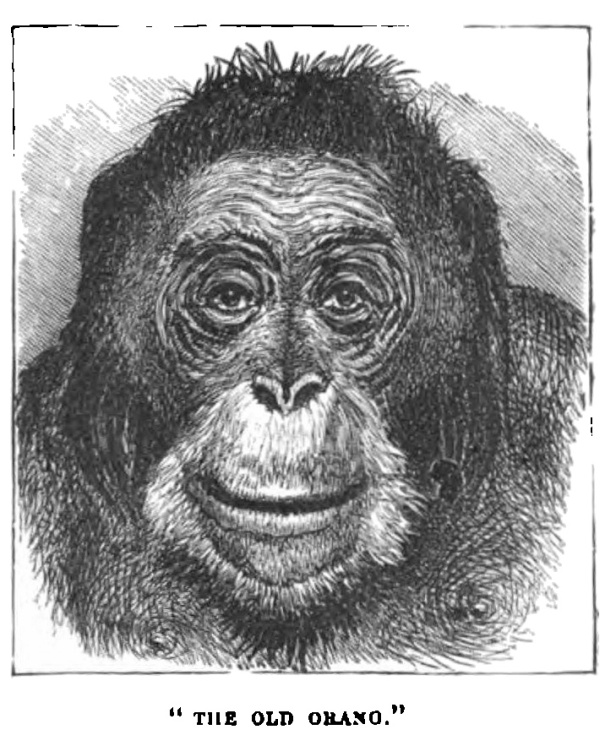
“As soon as the old orang heard the hammering on the rum-cask to knock out the bung, he began to laugh, and he beamed all over when his basin of grog was brought. The other old monkey taking a pinch was a sight to see. She stack to the box at last, and when any of her friends came to see her would present it to them with a ‘hae! hae! hae!’ that spoke volumes.”
“Any other funny pets on the Sans Pareil?”
“Oh, yes, lots. We had an adjutant. Ah! Nie, we did use to laugh at that bird, too. Five feet tall he was, and a more conceited old fop of a fellow I never did see. He had a pouch that hung down in front. Well, he used to eat everything, from a cockroach to half a leg of mutton; and when he couldn’t hold any more he used to stuff his pouch.
“‘Comes in handy, you see,’ he seemed to say, alluding to this pouch of his. ‘But, dear me!’ he would continue, ‘ain’t I a pretty bird? Look at my pretty little head; there ain’t much hair on it; but never mind, look at my bill. There is a bill for you! Just see me eat a fish, or a frog, or a snake! And now, look at my legs. Pretty pair, ain’t they? See me walk!’
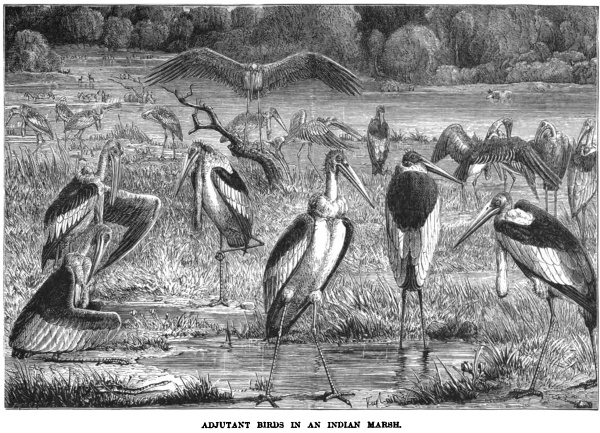
“Then he would set off to promenade up and down the deck till the ship gave a bit of a lurch, when down he would go, and the monkeys would all gather round to laugh and jibber, and Snooks, as we called him, would deal blows with his bill in all directions, which the monkeys, nimble though they were, had some difficulty in dodging.
“‘Can’t you see,’ he would say, ‘that I didn’t tumble at all—that I merely sat down to arrange my pretty feathers?’ And Snooks would retain his position for about half an hour, preening his wings, and scratching his pouch with the point of his bill, just to make the monkeys believe he really hadn’t fallen, and that his legs were really and truly serviceable sea-legs.
“I’ve lain concealed and watched the adjutants in an Indian marsh for hours; there they would be in scores, and in every conceivable idiotic position.
“Suddenly, perhaps, one would mount upon an old tree-stump, and spread wide his great wings. ‘Hullo, everybody!’ he would seem to cry, ‘look at me. I’m the king o’ the marsh! Hurrah!
“‘My foot’s upon my native heath, My name, Macgregor;’
“or words to that effect, Nie.”
“You were always fond of birds, and beasts, and fishes, weren’t you, Ben?”
“I was, Nie, lad, and never regretted it but once.”
“How was that?”
“I was down with that awful fever we call Yellow-Jack; and, oh! Nie, it seemed to me that at first all the awful creatures ever I had seen on earth or in the waters came back to haunt my dream; and often and often I awoke screaming with fright. Indeed, the dream had hardly faded when my eyes were opened, for I would see, perhaps, a weird-looking camel or dromedary’s head drawing away from the bed, or a sea-elephant, a bear, an ursine seal, or an old-fashioned-looking puffin.
“In my fever, thirst was terribly severe, and I used to dream I was diving in the blue pellucid water of the Indian Ocean, down—down—down to beds of snow-white coral sands, with submarine flowers of far more than earthly beauty blooming around me; suddenly I should perceive that I was being watched by the terrible and human-like eyes of a monk shark, or—I shudder even now, Nie, to think of it—I should see an awful head—the uranoscope’s—with extended jaws and glaring protruding eyes. Then I would awake in a fright, shivering with cold, yet bathed in perspiration. But, Nie, when I began to get well a change came o’er the spirit of my dreams. The terrible heads, the horrid fishes, and the slimy monsters of the deep appeared no more; in their place came beautiful birds, and scenery far more lovely than ever I had clapped a waking eye upon. So, in one way, Nie, I was rewarded for my love for natural history.”
“What a lovely day!” I remarked, looking around me.
“Yes,” replied Ben; “but do you know what this very spot where we are now standing puts me in mind of—lake and all, I mean?”
“I couldn’t guess, I’m sure,” I replied.
“Well, it is just like the place where I was nearly killed by a panther, and would have been, but for my man Friday.”
“He must have been a useful nigger, then,” I said, “that man Friday.”
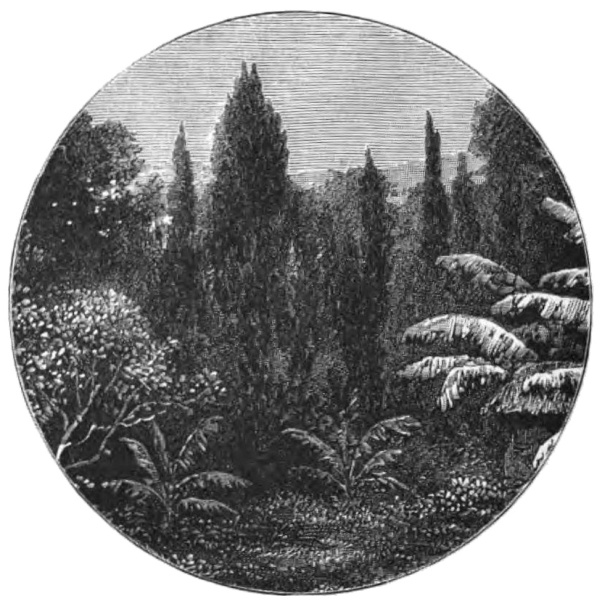
“He came in precious handy that day, Nie. You see, it was like this:—Neither he nor I had ever been to South America before; so when we went away shooting together we weren’t much used to the cries of the birds or beasts of the woods. The birds seemed to mimic the beasts, and reptiles often made sounds like birds. We had been away through the forest, and such a forest—ah! Nie, you should have seen the foliage and the creepers. We had had pretty good sport for strangers. We shot and bagged everything, snakes and birds and beasts, for I was making up a bag for the doctor, who was a great man for stuffing and setting up. We had just sat down to rest, when suddenly the most awful cries that ever I heard began to echo through the woods.
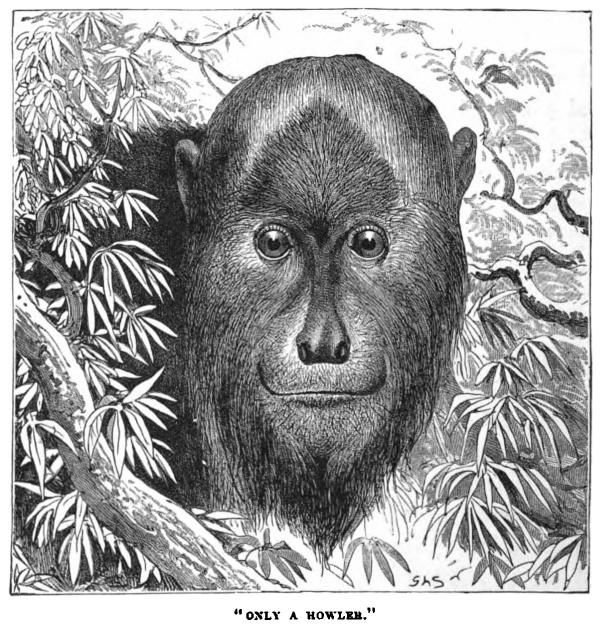
“They came from a thicket not very far away, and at one moment were plaintive, at the next, discordant, harsh, dreadful.
“‘Friday,’ I cried, starting up and seizing my gun, ‘there is murder, and nothing less, being done in that thicket. Let’s run down and see.’
“‘It seems so, massa,’ said Friday; ‘it’s truly t’rific.’
“We ran on as we spoke, and soon came to the place, and peered cautiously in.
“It was only a howler monkey after all.”
“And was nothing the matter with him?” I asked.
“Nothing at all. It was merely this monkey’s way of amusing itself.”
“Did you shoot him?”
“I never shot a monkey in my life, and never will, Nie; it appears to me almost as bad as shooting a human being.
“‘We’ll go back to the lake-side now, Friday,’ I said, ‘and have dinner.’
“Alas! I had no dinner that day, Nie, nor for many a long day to come.
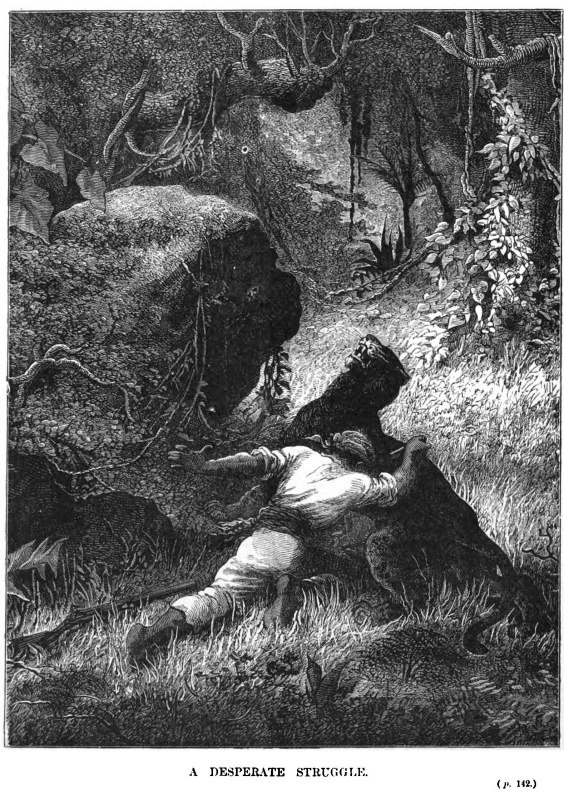
“There is no fiercer wild beast in all the forests or jungles than the cougar or puma, and none more treacherous. I have an idea myself that the darker in colour the more courageous and bloodthirsty they are; however that may be, I would any day as soon fight hand-to-hand with a man-eating tiger as I would with some of the monstrous pumas I have seen in South America. And yet I have heard sportsmen despise them, probably because they have never met one face to face as I have done, and as I did on the day in question.
“We were quietly returning, Friday and I, to the place where we had left our provisions and bags, when he suddenly cried, ‘Look, massa! look dere!’ We had disturbed one of the largest boa-constrictors I had ever seen, and it was moving off, strange to say, instead of boldly attacking us, but hissing and blowing with rage as it did so. It looked to me like the trunk of some mighty palm-tree in motion along the ground.
“‘Fire!’ I cried; ‘fire! Friday.’
“The crack of both of our rifles followed in a second, but though wounded, the terrible creature made good its escape.
“I hurried after him, loading as I went, and thus got parted for a short time from my faithful servant and body-guard.
“I soon discovered, to my sorrow, the reason why the boa had not attacked us.
“In these dense forest lands, the wildest animals prey upon each other. Thus the boa often seizes and throttles the life out of even the puma, agile and fierce though it be. This particular boa had been watching a puma, evidently, when we came up. The brute gave me not a moment to consider, nor to finish my loading.
“I yelled in terror as I found myself seized by the shoulder. I remember no more then.
“Friday had boldly rushed to my rescue. He struck the puma over the head with his useless rifle. The beast sprang backwards fully fifteen feet, and prepared to give Friday battle, but the brave fellow was on him, knife in hand, in a moment. Friday told me afterwards that he literally flung himself on the puma. Had he missed his aim, he would never have had another chance, but deep into the monster’s very heart went the dagger, and he never moved a muscle more. Friday was unwounded.”
“And you, Ben?”
“Fearfully cut in the shoulder with the puma’s teeth, cut in the back with the talons of his fore feet, and lacerated in the stomach with his hind. They have an ugly way of cutting downwards with those talons of theirs, few who have felt it are likely to forget.”
Chapter Twelve.
“Wide-rent, the clouds Pour a whole flood; and yet, its flame unquenched Th’ unconquerable lightning straggles through Ragged and fierce, or in red whirling balls, And fires the mountains with redoubled rage.” Thomson.
My old friend Captain Roberts is quite a remarkable man in his way—yes, I might go farther and say, in many of his ways. As a pedestrian, for example, there are few young men can beat him. When he and I make up our minds to have a walk, the elements do not prevent us. We start and go through with it.
But in summer or spring weather, when the roads are not quite ankle-deep in mud, we dearly love to mount our tricycles and go for a good long spin. We like to return feeling delightfully hungry and delightfully tired; then we dine together, and after dinner, when good old Ben gets his pipe in full blast, it would indeed do your heart good to listen to him. Everything or anything suggests a yarn to Ben, or brings back to his mind some sunny memory or gloomy recollection.
One day last summer we started for a ride, for the morning looked very promising, and the roads were in splendid form. We followed the course of the Thames upwards, and about noon found ourselves enjoying our frugal luncheon near a pretty little reach of the river, one of the thousand beautiful spots by the banks of this famous old stream.
As the clouds, however, began to bank up rather suddenly in the west, and as they soon met and quite hid the sun, and as the day was still and sultry, we expected, what we soon got, a thunderstorm. Neither my friend nor I am very shy, when it comes to the push, so we ran for shelter, and just as the thunder began to roll and the raindrops to fall, we got our ’cycles comfortably housed in a farmer’s shed.
The farmer was not content, however, until he had us both indoors in his comfortable parlour. He threw the window wide open, because, he said, the glass drew the lightning; so there we sat with the thunder rattling overhead, the rain pattering on the grass and sending up delicious odours of red and white clover, while the lightning seemed to run along the ground, and mix itself up with the sparkling rain-rush in quite a wonderful way.
“Terrible thunder!” said Captain Roberts. “Terrible! puts me in mind of South America.”
The farmer looked eagerly towards him.
The farmer’s wife entered with tea, and this completed our feeling of comfort.
“You’ve got something to tell us, Ben,” I said. “There is something which that storm reminds you of. Better out with it, without much further parley.”
“Ah, well,” he said, “I suppose I must. Not that it is very much of a story; only, gentlemen, it is true. I haven’t lived long enough yet to have to invent yarns. I haven’t told half what I’ve seen and come through. But not to weary you—what delicious tea, ma’am!”
“So glad it pleases you, sir.”
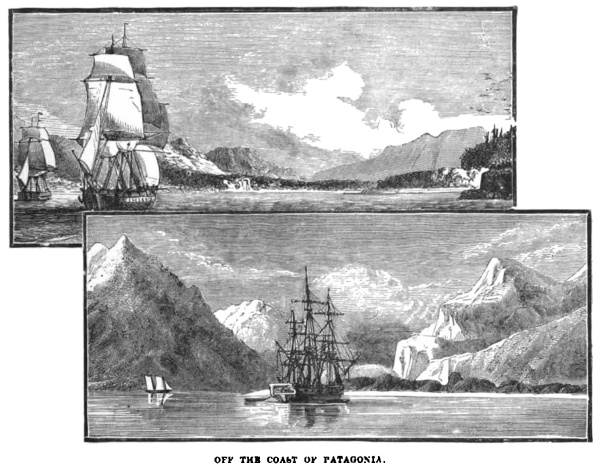
“I’ve sailed around a good many coasts in my time; but I think you will find scenery more charming on the seaboard of some parts of South America than in any other country in the world. Round about Patagonia, now, what can beat the coast line for grandeur and stern beauty? Nothing that I know of.
“But farther north—on the shores of Bolivia, for instance—the scenery is just a trifle disappointing; the coast is low and sandy, and very rough in places.
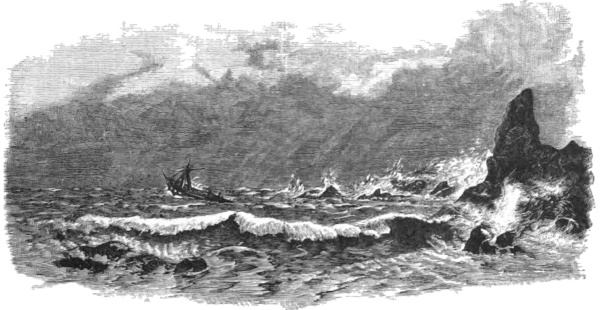
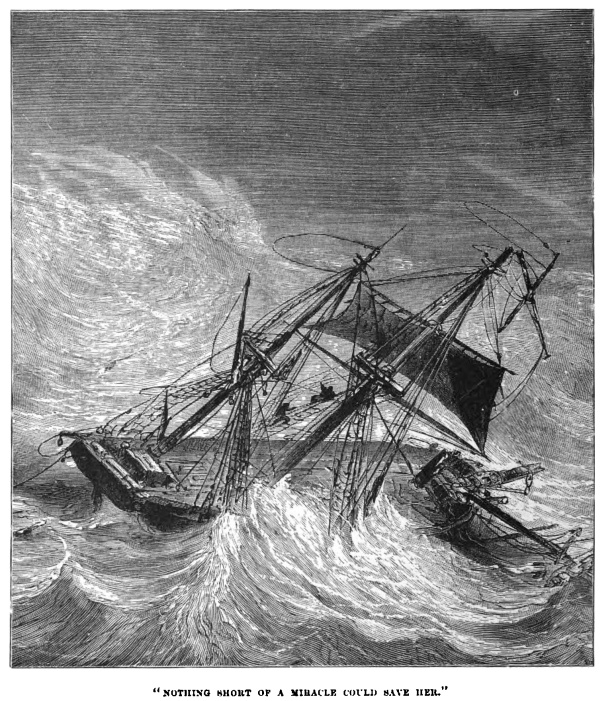
“They call the ocean that laves it the Pacific. Bless my soul! friends, had you but seen it one day in the month of April, 18—, you wouldn’t have said there was much ‘pacific’ about it. The bit of a barque I was coasting in was on a lee-shore, too, and there was nothing short of a miracle could save her. We all saw that from the first. That miracle never took place. We were carried on shore—carried in on top of a mountain wave, struck with fearful force, and broke in two in less than an hour.
“It was a wonder anybody was saved. As it was, seven of us got on shore one way or another, and there we lay battered and bruised. The sun dried one half of our clothes; then we rolled round, and he dried the other. We had tasted no food for four-and-twenty hours, for we had been battened down, and all hands had to be on deck. So when a case rolled right up to our very feet we weren’t long looking inside it, and glad enough to find some provisions in the shape of tinned soup.
“Stores floated on shore next day, and spars, and one thing and another, so we rigged a tent, and made ourselves as much at home as it was possible for shipwrecked mariners to do.
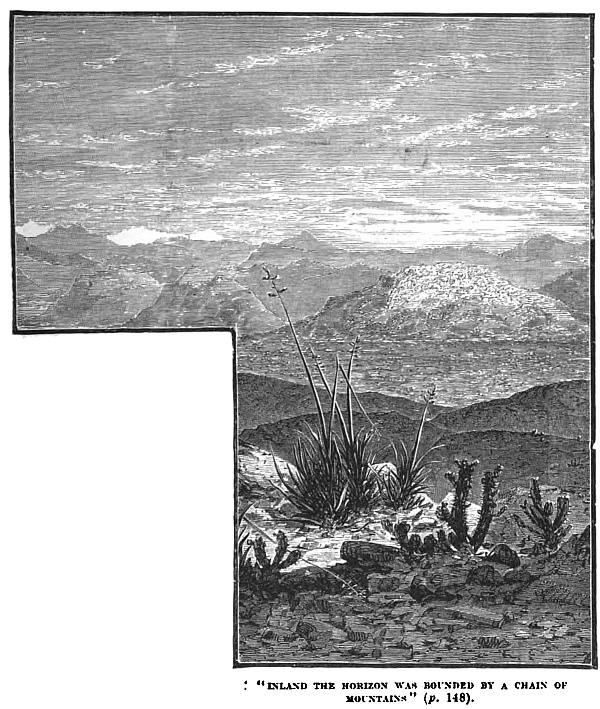
“We had been shipwrecked apparently on a most inhospitable shore. To say there wasn’t a green thing in sight would hardly be correct. Bits of scrubby bushes grew here and there in the sand, and a kind of strong rough grass also in patches; but that was all. Inland, the horizon was bounded by a chain of mountains; to the west was the ocean, calm enough now, very wide and dark and blue, with not even an island to break its monotony.
“It was a poor look-out for us, only we all agreed that it would be better to stay where we were until our wounds and bruises were somewhat healed, and until we had gathered sufficient strength to explore the country.
“We had plenty to eat and drink where we were; we could not tell how we might fare elsewhere. Only we were quite out of the way of ships, and our provisions would not last for ever.
“For the first three or four days, I may say we did nothing else but bury our dead. Sad enough employment, you must allow. But after this a breeze of wind sprang up, which during the night increased to a gale, blowing right on to the shore. When the darkness lifted, to our great joy we found our ship, or rather the pieces of her that had in a sort of way held together, floated high and dry on the beach.
“Had we wished now to become Crusoes we should have had every convenience, for we not only got provisions of all kinds out of the wreck, but boxes of stores, guns, and ammunition. For the last we were very grateful; and rough sailors though we were, we did not forget to kneel down there on the sands and thank the Giver of all good, not only for having mercifully spared us from the violence of the sea, but for giving us this earnest of future good fortune.
“The hawk scents the quarry from afar, and early next morning we were not surprised to receive a visit from some armed Indians. They rode on horses and on mules that seemed as fleet as they were sure-footed. These Indians were kind enough to express a wish, not over-politely worded, to possess samples of our various stores. We gave them to eat as much as they liked; but when they attempted to pillage the wreck, we first and foremost smilingly and persuasively hinted our disapproval of such a proceeding.
“This hint not being taken, we tried another: we levelled guns at them, and they fled.
“They came again the next day; and we made them many presents, and asked them, in broken Spanish and a deal of sign language, to conduct us safely over the mountains to the nearest Bolivian town or settlement.
“They were in all about twenty, and if they were half as bad in heart as they looked, then they were indeed scoundrels of the first water. But we numbered seven—seven bold hearts and true, and we were well armed, and able enough to drive a bargain with these fellows to our mutual advantage.
“We did so in this way: we were to have several horses and five mules, which should be laden with all our own especial baggage. They—the Indians—should have as much as they liked of the stores that remained.
“They appeared to consent to this willingly enough. So we made our packs up—taking the best of everything, of course, and whatever was of the greatest value.
“It was now well on in the afternoon, so we determined to start on our journey inland the very next morning. The Indians had still half a dozen good mules left, and they at once set about making preparations for loading them.
“There was a deal of squabbling and wrangling over the division, and more than once they seemed coming to blows.
“As soon as they had chosen all they could carry, we set about piling up the rest of the wreckage in a heap, preparatory to setting fire to it. This was absolutely necessary, for if anything was left behind it would be but a short convoy those Indians would give us. They would hide their mule packs among the mountains and hurry back for more.
“They were very much displeased, therefore, to see what we were about.
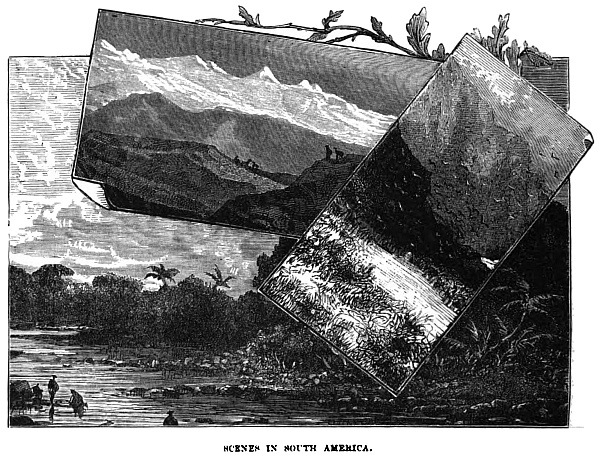
“But nothing cared we; and just as the sun dipped down into the western ocean we set fire to the immense pile.
“When darkness fell, and the flames leaped high into the air, the scene was one worthy of the brush of a Rembrandt. The sea was lit up for miles with a ruddy glare; the sands were all aglow with the blaze; the Indians and their mules thrown out in bold relief looked picturesque in the extreme, while we, the white men, armed to the teeth, and carefully watching the Indians, though not in any way to give them cause for alarm, formed a by no means insignificant portion of the scene.
“We were early astir the next day, and on the road before the sun had begun to peep down over the eastern hills.
“We marched in single file, an old grey-bearded Indian leading the van as our guide.
“Before many hours we had left the sandy hills along the seashore, and had entered the mountain defiles.
“Scenery more rugged, wild, and beautiful I had seldom clapped eyes upon, either before or since. At the same time we could not help feeling thankful that we had obtained the guidance of these Indians, treacherous though they no doubt were, for we never could have made our way otherwise across this range of rugged mountains, nor through the wild entanglement of forest.
“By day many a wild beast crossed our pathway, but only seldom we shot them, and we never followed far; we were shipwrecked sailors trying to make our way to some semi-civilised town, where we could live in some degree of safety until we found out the lay of the land, as our mate called it, and fell in at last with some British ship.
“These fellows, our guides, could tell us nothing, but they led us day after day towards the east and the north.
“We kept a strict watch over their every movement, and it was well we did so. At night we bivouacked but a little distance from their camp, and had separate fires and separate sentries.
“Almost every evening after supper they made themselves madly drunk with the wine they had received from us, and without which they would have refused to guide us at all.
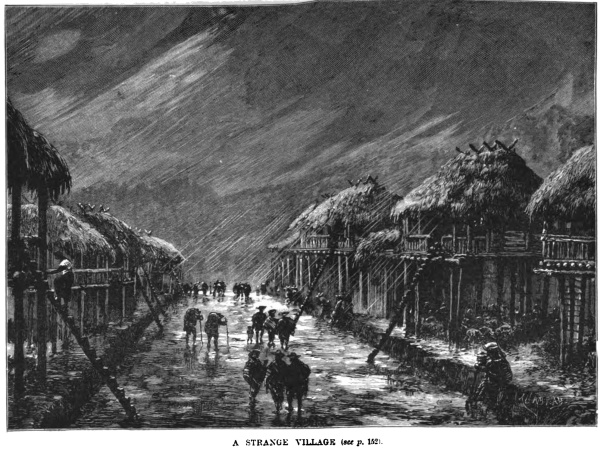
“After four days’ wandering we arrived, during a pitiless storm of thunder and rain, at a strange and semi-barbarian village. The houses or huts were built upon piles, and the inhabited portion of them stood high above the ground; you had to ascend to this on a sort of hen’s ladder.
“The street itself at the time we entered the town was more like a river than anything else. But we were glad enough to find shelter of any kind, drenched to the skin as we were, and wet and weary as well.
“Next day was bright and clear again, and it seemed to me that every one of the villagers turned out to see us start. They appeared to be peaceable enough, so we made little presents to the women, and advised our Indian guides to do the same. They were not inclined to part with anything, however, and evidently looked upon us as fools for what we did.
“Our march that day was across vast plains and swamps towards another mountain-chain, more rugged and grand than any we had yet seen.
“We chatted pleasantly and sang as we rode on, for the Indians assured us that in two days more we should arrive at a very large and populous city, where plenty of rich white men lived, with splendid houses, broad paved streets, hotels, and even palaces. We bivouacked that night at the very foot of the chain of mountains, and next morning entered and rode through gloomy glens and dark woods, and the farther we rode the wilder the country seemed to become. Yet some of the woodland scenes were inexpressibly lovely. We came out at last on the brow of a hill, just as the sun was setting over the distant forest, and bathing with its golden glory a scene as lovely as it was sad and melancholy.
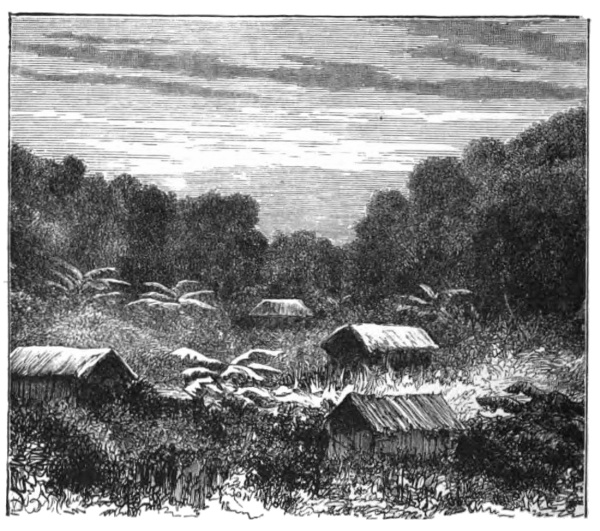
“A vast plain in the centre of an amphitheatre of hills, clad almost to their summits with lofty trees, a broad river meandering through this plain, and on both banks thereof what appeared from where we stood to be a city of palaces. Alas! on entering it we found it a city of ruins. Trees and shrubs grew where the streets had been, the gardens had degenerated into jungles; we saw wild beasts hiding behind the mouldering walls, and heard them growl as we passed; and we saw monster snakes and lizards wriggling hither and thither, and these were the only inhabitants of this once large and populous town.
“Yet in the halls of its palaces the banquet had once been spread, and gaiety, mirth, and music had resounded in its streets and thoroughfares, till war came with murder and pestilence, and then all was changed. The city’s best sons were sent to work in mines, or slain; the city’s fairest daughters marched away in chains to become the slaves of their terrible foes.
“I could not help thinking of all this as I rode through this ruined city of the plain, and sighed as I did so. The words and music of the sad old song came into my mind:
“‘So sinks the pride of former days When glory’s thrill is o’er. And hearts that once beat high with praise Now feel that pulse no more.’
“But the sun set and night came on, and with it storm and darkness.”
Chapter Thirteen.
“Here roams the wolf, the eagle whets his beak. Birds, beasts of prey, and wilder men appear.” Byron.
My friend Ben paused for a moment.
A sheet of lightning almost blinded us. It was followed instantaneously by one of the most terrific peals of thunder I have ever heard in this country.
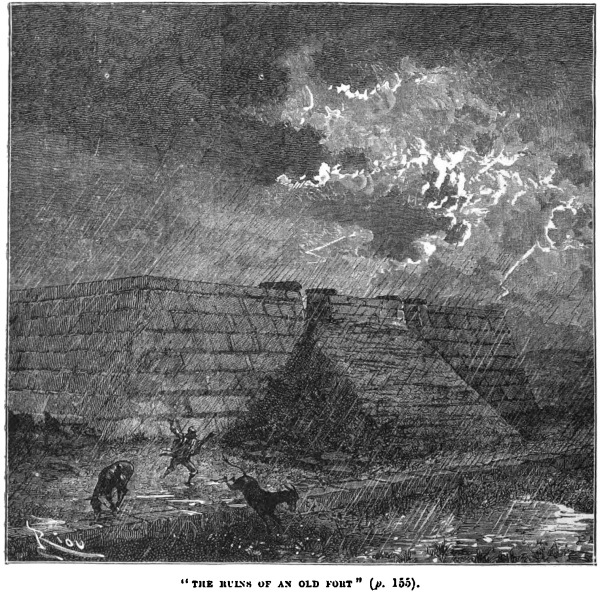
“It was in just such a storm as this,” said Captain Roberts, “that we took shelter in the ruins of an old fort. We tethered our mules outside, and we had not even the heart to keep the Indians from sharing our quarters. For once, and it was the last time, we ate with them, drank with them, and talked to them. How little we suspected them of treachery!
“We found plenty of dry wood in the old fort and soon had a roaring fire with which to warm up our soup and cook our vegetables.
“‘Who goes sentry to-night?’ I said to the mate.
“‘Well,’ replied the mate, ‘I guess we’d better draw for it. He’ll have a wet skin whoever does it.’
“It was just after dinner when this conversation took place.
“‘But,’ continued the mate, stretching himself before the fire, ‘I expect it will be between you and me, for, look, the other fellows have all gone to sleep, and I feel so drowsy I really—don’t—know—how long—’
“He said no more; he was asleep.
“‘Poor fellows,’ I said to myself, as I took up my gun and prepared to leave the room, ‘they’re tired. I’ll station myself here by the door, where I can be in the dry and still see all that is going on.’
“The storm continued with unabated violence. The rain came down in sheets; the thunder seemed to rend the old fort and shake it to its very foundation, while the lightning was everywhere; the whole world looked as if on fire. Night was coming on, and rude though our shelter was, I felt thankful we were not out in the gloom of the forest.
“‘How soundly they sleep!’ I said to myself about half an hour after when I went to heap more wood on the five. ‘How I envy them! I’ll sit a moment and think. The Indians are not so bad as they look. First impressions are not always—the—best.’
“The next thing I was conscious of was hearing voices close beside me. It was the Indians bending over me and over my companions, and seeming to listen for our breathing.
“‘They’re dead,’ one said.
“‘Better make sure,’ said another.
“Then with half-open eyes I could see drawn daggers gleaming in the fire-light; but I was unable to stir hand or foot; I felt like one in some dreadful nightmare. I tried to shriek, but my voice failed me. Then, ‘O God, be merciful to us!’ I inwardly prayed, ‘for our hour is come.’
“Two Indians advanced, knives in hand, towards the mate. One pulled his head back, the other had his arm uplifted to strike, when suddenly he sprang back appalled.
“Was it sent as in answer to my prayer? I know not; yet I firmly believe nothing happens by chance. The electric fluid had entered by the roof, shattering the masonry and scattering the fire. It gleamed on the uplifted knife of the would-be assassin; he dropped it, and with arm paralysed and hanging by his side fled shrieking from the building. The others uttered exclamations of terror and surprise, and quickly followed the first.
“I remember no more then. Daylight was shimmering in through the broken roof of the building, and the fire had long gone out, when I awoke shivering, and started to my feet.
“Almost at the same moment the mate jumped up. He was the first to speak.
“‘We have been drugged,’ he cried, pressing his hand to his aching head.
“‘Drugged?’ I answered. ‘Yes, fools that we were to trust those scoundrels; we’ve been drugged, and, doubtless, robbed.’
“The mate looked very pale and ghastly in the early light of the morning; probably I myself looked little better. My surmise was right: the Indians had gone. They had taken all our goods and our pack-mules with them, and driven away the spare animals. Thank goodness, they had left us our arms and ammunition.
“Not even on the morning after the shipwreck did we poor fellows feel so miserable as we did now, seated round a meagre meal of bananas and gourds.
“But we were intent on regaining our goods.
“Clever though these Indians might be if alone and unencumbered, they could hardly go fast, nor far at a time, through forest and jungle with horses and laden mules. Nor could they go anywhere without leaving a trail that even a white man could pick up and follow.
“The rain of the previous night favoured us. We soon found the trail, and, better still, we had not gone very far ere a sound fell upon our ears that caused us to pause and listen. It was soon repeated—the neighing of a horse. I sprang into the jungle, and there, to my joy, found not only the horse I had ridden, but two others and some mules besides. The poor brutes were quietly browsing on the herbage and the tender leaves of young palm-trees, but were evidently delighted to see us.
“We went on now with more comfort, and had good hope of speedily coming up with the pillaging Indians, of whom we never doubted we could give a good account.
“Somewhat to our surprise we found they were taking a westerly direction, instead of going east and by north, as they had been leading us. They were either then bent upon returning to their own village, or making their way to some seaport where they could sell their plunder. If this latter surmise was the correct one, we were comparatively safe; if the former, any chance we had of recapturing our goods lay in our being able to come up with them before they were reinforced by members of their own tribe. This thought made us redouble our exertions. But we were weak for want of food and from the effects of the drug that had been administered to us on the previous evening, so that our progress was not so great as we wished it to be.
“The trail continued all day to lead us through the jungle; but before sunset we found ourselves out in the open, on the brow of a hill that overlooked a vast, almost treeless, swamp. It was bounded on the further horizon by a chain of mountains—spurs, no doubt, of the ubiquitous Andes. Away to the left, and just under the hills, we could see smoke rising, and had no doubt that here our friends were encamped.
“We speedily held a council of war, at which we discussed the best plan for attacking the Indians.
“We stirred not then till long past nine o’clock, when the moon rose and flooded all the landscape. Then we took to the swamp. It was a terrible ride: at times our horses floundered in the quagmires, at other times they had to swim, to our imminent danger of being devoured by the huge alligators with which the place seemed to swarm. We startled the birds from their beds in the reeds, the wild beasts from their lairs in the patches of jungle, and herds of fleet-footed creatures fled, bounding away towards the forest at sight of us. It was a dangerous ride. But we cared for nothing now; it was life or death with us. We must reach the camp of the Indians, conquer them, or die in the attempt.
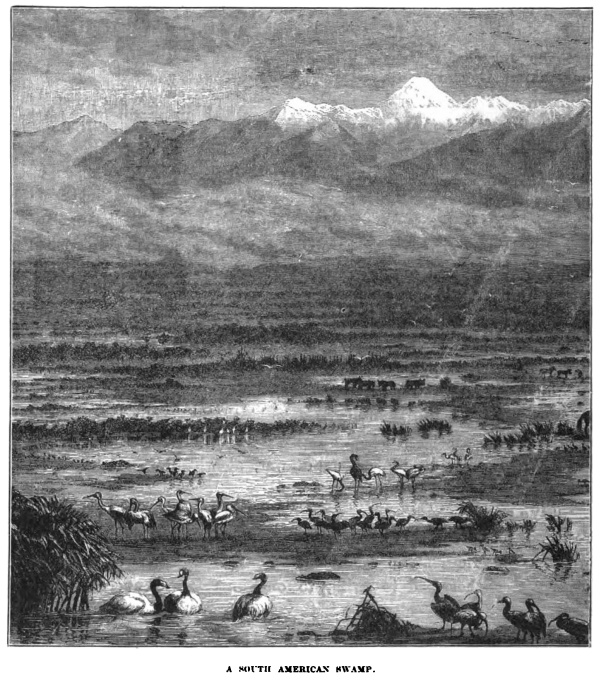
“All night we rode, struggling and fighting against fearful odds; but at five o’clock in the morning, or about one hour before sunrise, we left the plain and entered the forest, determined to take our foes by surprise. The ride through the tangled forest, without any pathway save that made by the beasts, was one of extreme difficulty. But we were free at last; and tethering our horses, we prepared for the attack. We could see the Indians on a small plateau not three hundred yards beneath us, asleep by their smouldering fires. But we were on the brow of a hill, they much nearer the plain; beneath was a precipice, overhung with trailing shrubs and creepers, fully five hundred feet in depth, which it was impossible to descend without risk of being seen.
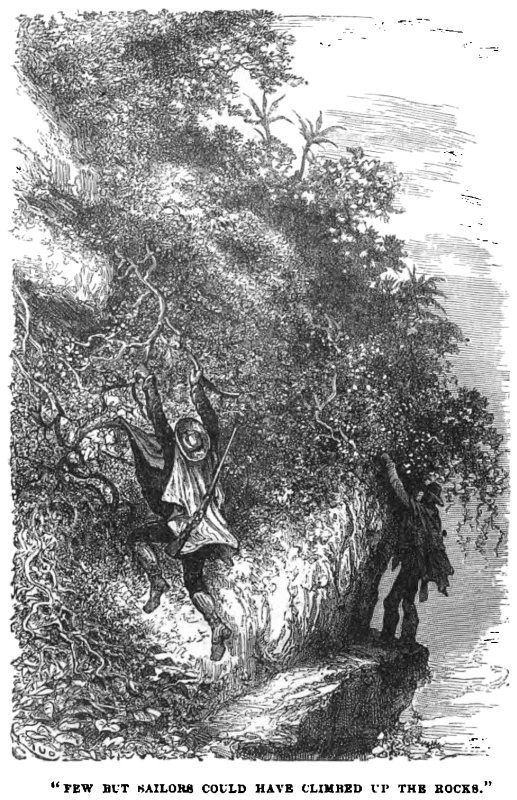
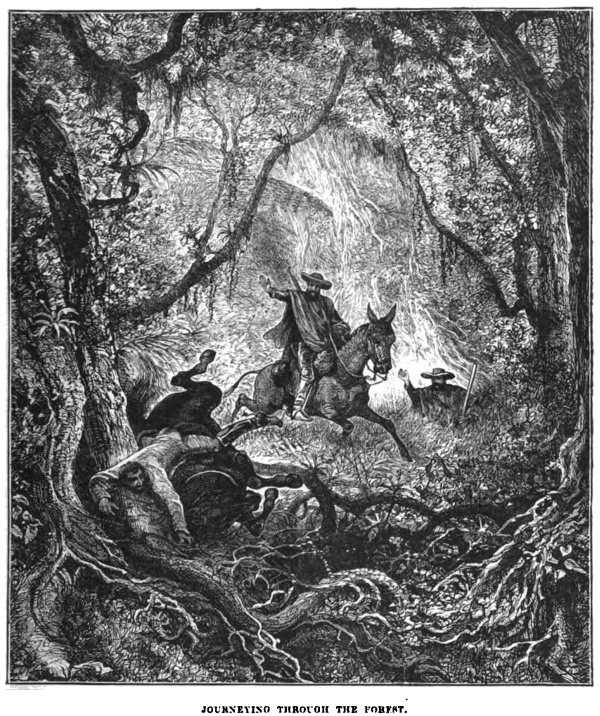
“The place the Indians had chosen for a camping-ground was fortified by nature. Probably that is the reason they had not troubled to set a sentry. We saw our advantage at once; it was to make a détour, gain the level of the plain, then creep up the hill upon them, attacking both in flank and rear.
“We carried out our plans most successfully. Few but sailors could have climbed up the rocks which led to the plateau. So steep were they that in some places the loosening of a stone or one false step might mean death.
“Just as we were at the very brink of this precipice, and within twenty yards of where the enemy lay, a bough snapped with a loud report, and next moment they were all up and on the alert.
“There was no need for further concealment; we speedily showed ourselves, poured a volley into their bewildered ranks, and before they could recover from their surprise we were on them with our muskets, which we used as clubs.
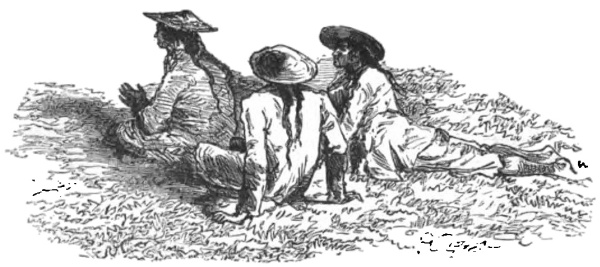
“They were nearly three to one. They fought like fiends. So did we, and the battle for a time was desperate. They were beaten at last, and the few who remained alive ran shrieking away towards the rocks. We cared but little how they fared.
“Our mate and another man were wounded, but not severely, and in two days’ time we were able to resume our journey.
“Providence was kind to us. We came upon a broad old war-road that led through the forest and jungles and plains towards the setting sun, and in one week more we were overjoyed to find ourselves standing on a hill-side overlooking a verdant plain, with a river and a town, and beyond it the blue sea itself, studded with the ships of many nations.
“And those who climb the hills in Greenland in spring-time to catch the first rays of the returning sun, were not more joyful than we were now. We laughed and shouted, and I believe the tears rolled down over our cheeks.
“But we did not forget to kneel down there, and, with our faces on the ground, thank in silence the kind Father who had led us through so many troubles and dangers. And now, Nie, the storm is gone. We must thank these good people for their kind hospitality, and start.”
Chapter Fourteen.
“Some say, that ever ’gainst that season comes Wherein our Saviour’s birth is celebrated, The bird of dawning singeth all night long: And then, they say, no spirit dare stir abroad. The nights are wholesome; then no planets strike. No fairy takes, nor witch hath power to charm; So hallow’d and so gracious is the time.” Shakespeare.
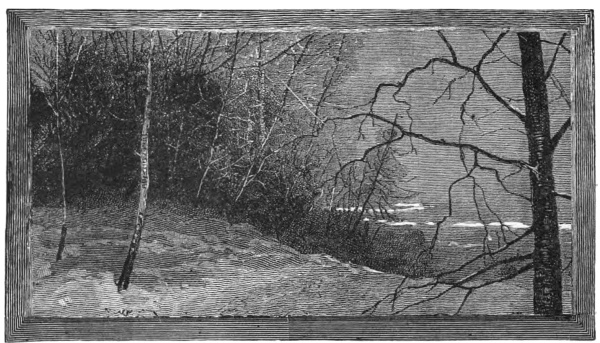
It was Christmas Eve. It was going to be an old old-fashioned Christmas, too, there was no mistake about that. And to-night the snow lay fully two feet deep on the lawn in front of Rowan Tree Villa. The sky was overspread with masses of darkest cloud that were being continually driven onward on the wings of a fierce north wind, seldom permitting even one solitary star to peep out. The storm roared through the leafless elm trees, and shrieked and moaned among the giant poplars. It was indeed a wild and wintry night.