THE OPEN DOOR By LAURENCE HOUSMAN
Reading edition
For fifty years, every night of his life, old Caleb had locked the door before going to bed. And so, having made the house safe, he slept sound.
All that time he had lived alone, working hard, a labourer upon the land, for a small weekly wage. Now that he had grown old and feeble his wage had become less, and he had little enough to live on; still it was enough; and in his small two-roomed cottage he had just the necessary things for keeping house. This he did all by himself: he had no children, no wife, no friend, and no money. People, living near about, spoke of him as “the lonely man”; and so he had been for fifty years: he had got into the way of it, nor was it likely now that he would ever get out of it.
One night, just as he was locking the door, the thought came to him, “What have I in the house that anyone could wish to take? Why, then, do I go on every night locking the door?”
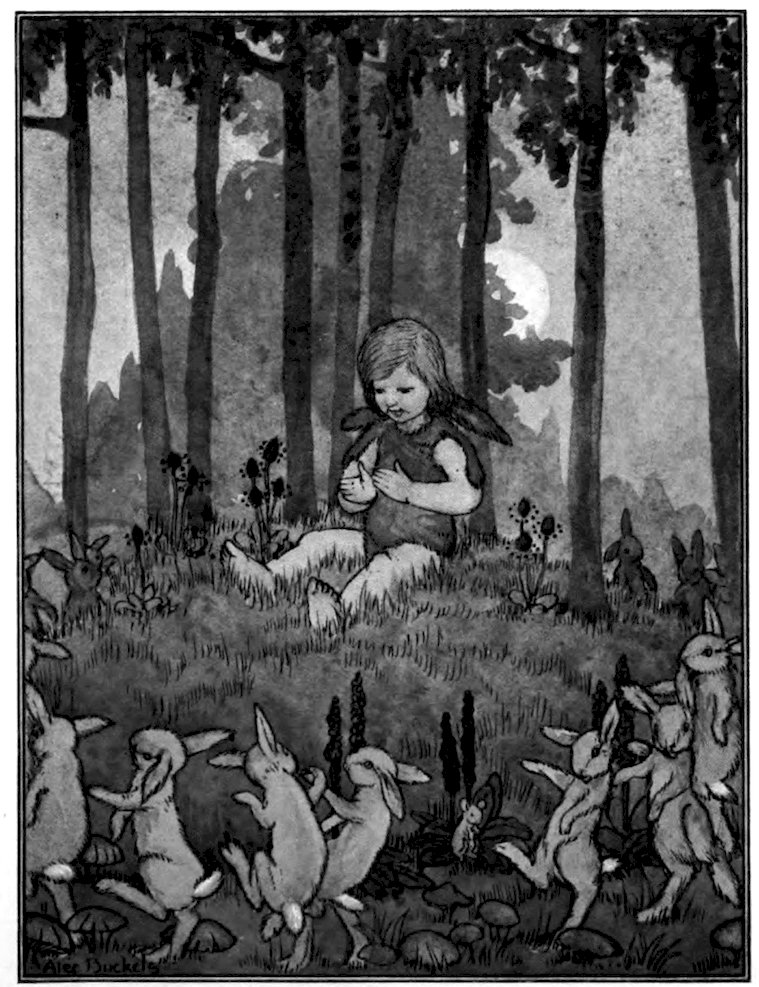
Twice from force of habit he turned the key in the lock, and twice he unturned it again. Then he opened the door and looked out. It was a cold night and a full moon; but inside the remains of a fire still glowed upon the hearth, and the house was cosy and warm. As long as he had strength to go out into the forest and gather fuel, the comfort of warmth would still belong to him, however poor he might become. Now, though the nights were cold, the heat of the hearth went 201up into the room where he slept, and there was never a night when he did not sleep soundly and well. And so, because that comfort belonged to him, the frost outside under the moon looked beautiful. He came in again, closed the door but did not lock it, and went up to bed.
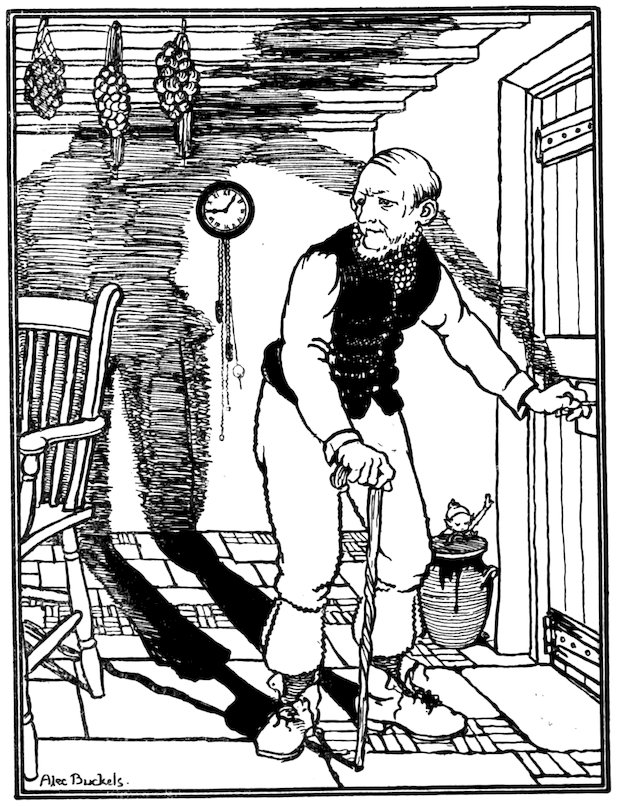
“What have I in the house that anyone could wish to take?”
202Now whether it came of going into the cold air from the warm room, I do not know; but next morning when he woke up he found his limbs stiff and full of pain; he could not bend his back, he could hardly walk: and so, for the first time on a week-day for fifty years, he stayed at home and did not go out to work.
He was in no danger of starving, for he had a barrel of meal and a flitch of bacon in the house, and outside a big bury of potatoes. Also he had dried herbs with which to make herb tea, and in the well there was water; but he had no store of wood.
So all day, wishing to make his scant wood last till he was well again, he kept up only a small fire, and went to bed cold, wondering whether he had wood enough left to last for another day.
The next morning when he got up he was no better; he could not bend his back, and he could not go out. But still his wood lasted through the day; and so it did the next day, and the next.
This puzzled him, and he began to look at it attentively, where it lay piled in a dark corner by the hearth. And presently he became quite sure that, if anything, it did not diminish but grew; there was always enough to keep the fire going during the day and until he went up to bed; and the next morning he always found there was still enough to carry on through another day.
203So one night, on going to bed, he counted the logs that he had left—only twelve; and when he came down the next morning there were twenty-five.
Suddenly he remembered that this had begun to happen since he had left off locking his door. It meant, then, that somebody had come in during the night to supply his needs; but as he had no friends in the world, and as, so far as he knew, nobody had heard about his present plight, he wondered who it could be.
And so, that night, when he went up to bed, he lay down upon it, but did not undress, and did not go to sleep.
For a long while he lay listening, but there was no sound—no steps outside, no opening of the door, no noise of anyone moving below; till, as he waited and nothing happened, he fell asleep, and when he woke it was morning. And then, going downstairs, he found more logs lying by the hearth and the fire embers still glowing and warm.
The next night he waited as before; and when after two hours of listening he heard no sound, he rose up softly and crept down; and there, sitting in his chair before the fire, he saw an old man, as bent and old as himself, stooping forward and warming his hands at the blaze of a log that had only just been put on.
The old man seemed so quiet and easy, and so much at home, that Caleb had no fear or anger at seeing him seated there, as though chair and house belonged to him. Going softly across he touched the intruder upon the shoulder, and asked, “How did you come here?”
And without lifting his head or turning to look at him the old man answered, “You left your door open; that’s how.”
204
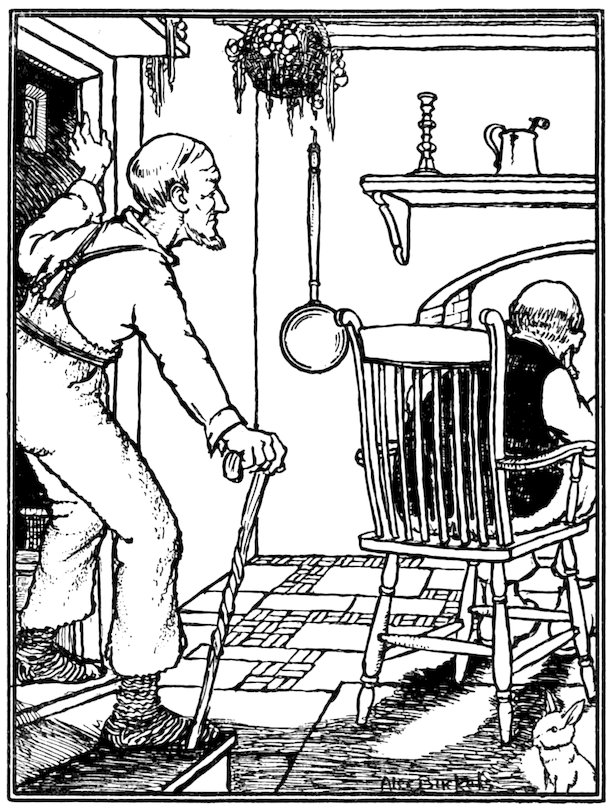
Sitting in his chair before the fire he saw an old man.
205“I left it unlocked,” said Caleb, “I know.”
“Unlocked is open,” said the other, “as soon as one tries the latch.”
“How did you come to try it?” inquired Caleb.
“I’ve tried it every night for the last fifty years,” answered the stranger; “but it was always locked.”
“Yes,” said Caleb.
“Why?”
“Don’t people generally lock their doors at night?”
“Aye, if they’ve any reason for it. Had you?”
Caleb sat and thought awhile, then said: “Once there went out of my door something that I valued. It never came back. Ever since that I’ve always locked my door, till last week.”
“Had you anything of value still left to make you do it?”
“No,” answered Caleb sadly, “I’d nothing left. I locked it because, if I’d only begun locking it before, perhaps I shouldn’t have lost what I did.”
“What did you lose?”
“My little daughter. She was only three years old then. Her mother was dead. One night I laid her to sleep; and when I went up to bed myself, there she lay sleeping sound. When I woke up in the morning she was gone. I searched everywhere, inside and out, field and wood; I followed the stream, I looked in the well, I never found her. She never came back.”
Heaving a great sigh, he crossed to the other side of the hearth, and there, seating himself, remained quite still looking into the flames.
“And so, after that, you began locking your door?”
“Yes, but it was too late then.”
206The stranger said, “That same night I came to your door, found it locked, and went away again.”
“You came!” cried Caleb, in great astonishment. “What for? Who are you?”
The other looked at him a little strangely. “So you don’t remember me?” he said. “We’ve been two people so long. Name? Names mean little. I’m just your fellow-man.”
“Why did you come then, that night?” asked Caleb, looking at him hard.
“It was a cold night,” replied the other, “a full moon, frost. Here, inside, I saw the glow of a fire still burning upon the hearth. You had forgotten to put that out. I wanted to come in and be warm; but I found the door locked.”
“But what brought you here at all?”
There was a long pause before the other answered. Then he said, pondering his words as he spoke: “It seemed the place where I was most wanted. That day you’d lost yourself—lost heart, lost hope. But there in the moon I saw the track leading up to your door; and I said to myself, ‘That’s where I came from; I’ll go back.’”
“Back?” queried Caleb.
But without any pause the other continued. “And as I went I saw something—a strange sight it was, and a pretty! Oh, you’d have believed it then, that night when first you locked your door. You might have looked out then, and seen it too.”
Caleb began to have a fear. “What did you see?” he asked.
“Out on the open hill where the wood leaves off,” said the other, “I saw a lot of grey rabbits dancing in a ring. I say 207dancing, because there was such life and joy and movement in it, and it all went to time as though there was music which one could not hear. And in the middle of them all sat a little child, a small three-year-old, wrapped in a silver rabbit-skin; there she sat, and clapped her hands and crowed, while all the rabbits danced round her.”
Caleb’s hand went down heavily to the bench upon which he was sitting. “So!” he cried, “it was as I thought: ’twas the fairies that carried her away.”
“Fairies?” queried the other. “I don’t know about fairies. Rabbits was all that I saw.”
“But,” said Caleb, “you saw her wearing the silver rabbit-skin. If they weren’t fairies, how did she come by that?”
“Maybe she just found it, and put it on,” Fellow-man answered.
“Aye, aye,” said Caleb, “that might well be the way of it. That’s the sort of thing they do; they leave it lying, you come along, you find it and put it on; then you belong to them.” Then he added: “You saw all that, you say? For how long? Where did they go?”
“I went softly,” Fellow-man answered, “skirted the field so as not to disturb them in their play; then, when I got to the path leading here, they all began following me.”
Caleb sat up, very still and expectant.
“Followed you, you say?”
“Yes.”
“Did she follow, too?”
“That’s why the others did. When she saw me, she got up and came after me. Then they all came after her.”
208“To this door?” said Caleb, in a voice scarcely above a whisper.
“Almost,” replied the other. “She was still coming on towards me, as I put out my hand to lift the latch. Then I found the door locked; and when I turned and looked round they were all gone.”
Caleb bowed his head, as though that grief had only happened now. “But why didn’t you call?” he asked. “I was never asleep! Weeks and weeks I didn’t sleep—waiting.”
“You’d locked the door,” said the other. “After that I always found it locked.”
“Always? Why did you come again?”
The other looked at him silently for a while, then answered: “You see, I was your fellow-man.”
Caleb turned searching eyes and looked at him hard. “And you say that you have been to my door every night for the last fifty years?”
“Yes,” said the other, “that is so; it seemed a long time waiting till the door opened.”
Caleb was thinking hard now. “Did you ever see her again?” he asked at last.
“Of course, every night.”
Here was something wonderful—hardly to be believed. “You mean to say,” cried Caleb, “that you saw her that night when you came and found the door open only a week ago?”
“I saw her to-night,” replied the other.
“That little thing? How could you? It’s fifty years now.”
“She hasn’t changed,” replied Fellow-man. “The night when I found the door open and looked back, she was there; 209she still stood, waiting, looking. Always before that, when I had looked for her, she had gone. The next night she came a little nearer, and the next night nearer still. Now when she follows me she comes right up to the door, just as if she were wanting to come in too. Some night she will.”
“Do the grey rabbits come in?”
“Oh! aye; they come in and they go again. It’s to please little silver-skin they do that, I reckon. Aye! right inside and up to the fire they come; and she watching them.”
Caleb felt as though he could not breathe: he got up and stumbled to the door, opened it and looked out. “There’s nothing there now,” he said, having gazed long and steadily into the night. And it seemed to him suddenly that all the old man had been telling him was only a dream.
But then he remembered something that was not a dream; he came in again, shut the door, and said: “I have to thank you for bringing me wood; but for you, this last week, I should have had to go without. You’ve been a kind friend.”
“No,” replied Fellow-man, “I’ve not brought you any wood. How was I to know you wanted it? To be sure, sometimes, when I’ve come in, I’ve put a piece upon the fire just to keep it going while I was here. Maybe you’ll find out who brings you the wood if you stay up long enough.”
“And how long,” asked Caleb, “when you come, do you stay?”
“Till you wake up,” replied the other.
“But I am awake now!” cried Caleb; and as he spoke he found himself actually awake, sitting on the bench by the hearth, and looking at the empty chair over which the grey light of day was beginning faintly to show.
210There was nothing there to prove that what had now become a dream had ever been true. “And yet,” he said to himself, “I couldn’t have dreamed that; no, that would be impossible!”
He went and opened the door, and looked out. Soft and grey through a mist of rain came the dawn, the frost had gone. He stooped (he found he could bend his back again), and searched in the soft earth for the print of feet. If during the night anyone had come in and gone out, there would surely be foot-prints. But of human foot-prints he could find none. And yet foot-prints there were, the path was strewn with them; here, there, everywhere, scores upon scores, the marks of rabbits’ feet. So if his meeting with Fellow-man and their talk together had proved but a dream, the rabbits’ feet were true. Daylight told him that.
Cured of his aches and pains, he went back to work and renewed his store of wood; and at night, because illness had made him weak, he came home very tired. But when after he had supped the hour grew late, the thought of bed or sleep became impossible.
Drawing his chair round to the other side of the hearth so that it faced the door, he put out the light and in the warm glow of the wood-embers sat waiting. But presently it seemed to him that this was not enough; his mind went so much further than he could see; and if now at night he left the door unlocked, why should it not also be open? So going across he opened it wide, propped it so that the wind should not close it again, and went back to his place.
It was a clear night, the waning moon rose late and thin; but as it mounted its beams grew strong, sending along the 211ground dark shadows of grass-blades and stones. Presently, moving forward through these, he saw the longer shadows of rabbits’ ears, all upright and alert for sound; and hiding behind them came the rabbits themselves, one silver, and all the rest grey.
The silver rabbit looked in across the threshold this way and that, waited, listened, then jumped and was in. One by one all the grey rabbits came after.
“Don’t move, don’t speak!” said a voice in his ear; and there was Fellow-man seated close at his side.
The silver rabbit hopped slowly round the room, stopped at the foot of the stairs, rose up on its hind legs as though about to mount, then turned, frisked back to the door and was gone. And all the grey rabbits went after it.
Caleb’s eyes were hungry as he watched it go; but all he said was, “That was wonderful! Even if I were to wake up now, I should not believe that this was a dream.”
As he said so, the same thing happened as on the night before; he woke to find himself alone; it was morning again.
But now the question whether it was dream or truth began no longer to trouble him; for having opened his door Caleb had opened his mind too; and as everything that comes to the open mind is true while it lasts, what better could he wish than night after night to have so beautiful a dream, which, so long as it lasted, could not be anything but true?
The next night, after Caleb had settled down in his chair with the door open, the rabbits came again—the silver and the grey; and Fellow-man was there at his side.
212
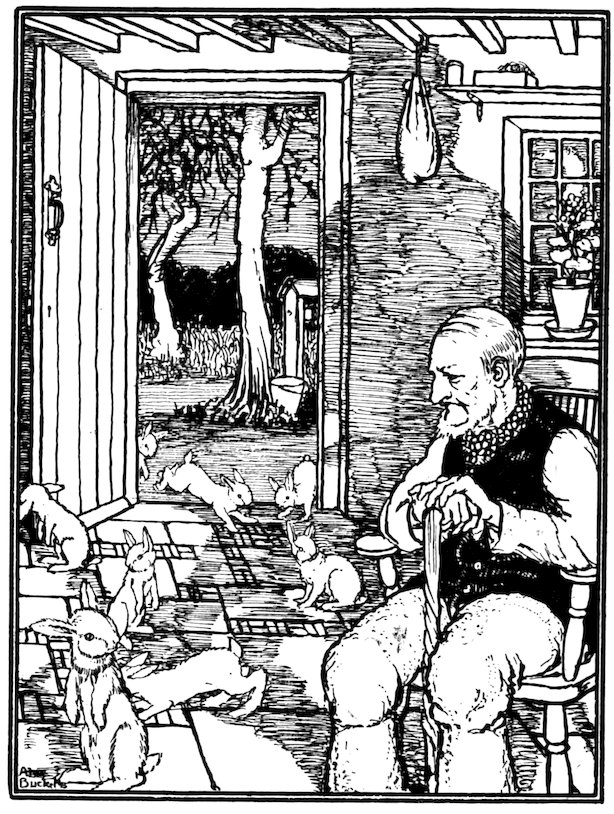
The silver rabbit looked in across the threshold.
This time the rabbits were bolder and stayed longer; and as it went by where he sat the silver rabbit stopped, put 213two tiny paws upon his foot, lifted its head and looked at him. Then going all round the room, it stopped again at the foot of the stairs, ran up, came down again, and went out. And all the grey rabbits went after it.
Caleb had been holding his breath for quite a long time. “It went upstairs!” he cried when all were gone. “It went upstairs! Did you see? I never could have invented that in a dream.”
And as he said so, the dream ended and he woke.
The next night Caleb got a little basin, and filled it with bread-and-milk; and when the silver rabbit came it sat at his feet eating the bread-and-milk with all the grey rabbits looking on. And when it went up the stairs it remained there for quite a long time, and all the grey rabbits sat below waiting for it. And when at their departure Caleb woke to find that it was morning again, he found also that the bread-and-milk had really been eaten—that anyhow it was gone. So much at least of his dream remained true.
The thought of it made him happy all day; and at night when he got home, it seemed to him as though his old heart danced and sang, knowing so certainly that before the night was out the little silver rabbit would come again.
Also, for this night, he had another idea, an idea of such beautiful possibilities that it almost frightened him. From upstairs he brought down the little cot in which, fifty years ago, the three-year-old one had been used to sleep. He brought it from where it had always stood by the side of his bed; he made it soft with pillows, and warm with a covering of wool, and setting it before the hearth with the small basin of bread-and-milk close beside it, he waited for the silver rabbit to come.
214The silver rabbit came just as before; sat at his foot, stood up and looked in his face, ate its bread-and-milk, then stood up again and looked at the cot. For quite a long time it stood and looked, while all the grey rabbits sat watching it.
Then, oh joy, oh wonder to behold! it took off its silver rabbit-skin, and there came out from beneath, all rosy, cosy and warm, a little three-year-old child, naked as on the day when it was new; and climbing up into the cot it snuggled down and went to sleep, with its old father of fifty years ago looking on, as well as he could look on for the tears of happiness which filled his eyes.
By the side of the cot just where the three-year-old had left it, lay the silver rabbit-skin, empty of its inhabitant now the first time for fifty years. Slowly old Caleb reached out his hand and took hold of it; and all at once the grey rabbits sprang up with a low squeak of alarm and ran out of the house.
Away in the open they stopped, and turned to look back. Across the threshold the firelight fell on their frightened eyes, their poor ears flapped anxiously up and down; a queer noise of shivering came through their fur as though inside their bodies were all being shaken.
And there sat Caleb, holding the silver rabbit-skin in his hand; very still he sat looking at it, and for a long time he did not move. By his side sat Fellow-man watching him.
Caleb said, “Now that I’ve got this she need never go back to them. I’ve only to burn it, and she will be all mine.”
Fellow-man said, “Will she remember you again after fifty years?”
Caleb stooped down and looked at the sleeping child. “She hasn’t changed,” he said, “not a day.”
215“But you have,” said Fellow-man; “you have become old.”
“Aye,” answered Caleb, “I haven’t long to live now.”
“But she,” said Fellow-man, “may live many years yet. When you have her back she won’t stay as she is now. Life will take hold of her; she too will begin to grow old. To make up for lost time, perhaps she will age soon. Who knows? It’s fifty years.”
Caleb did not answer, he bent down and looked long at the face of the sleeping child.
“She looks happy,” he said at last; “she looks well. There, see! She is laughing in her sleep; she is happy even in her dreams.”
“Perhaps she is dreaming about you.”
“Oh, no,” said Caleb, “not about me! It’s fifty years, and that is a long time.”
“And yet, as she hasn’t changed, why should she not be dreaming of you? Time to her may mean nothing. It’s only in your brain that fifty years have gone. In hers, perhaps, it’s only a day.”
“Then,” said Caleb, “she would remember me.”
“Aye,” replied Fellow-man, “but other things—would she forget.”
Again Caleb sat looking and did not reply. So close he bent over the sleeping three-year-old that her warm breath became his; and from his forehead a long lock of grey hair fell touching the curls of gold.
“Her little mind is full of dreams,” he said at last. “She is happy even in her sleep. The grey rabbits have been good to her. But if she comes back to me—who knows? I’ve 216not had so happy a life myself. Maybe the fairies have done better by her than I could have done. Anyway, it’s not for me to decide; let her do that herself.”
The grey rabbits, looking anxiously through the door, saw him put down the silver rabbit-skin in the place from which he had taken it. Presently they saw that he was no longer awake but asleep, and by his side Fellow-man seemed asleep also.
Into the house they ran, and shaking the cot of the sleeping three-year-old, “Wake, wake!” they cried. “Get up! Put on your rabbit-skin and come, for in here there is danger!”
The little three-year-old woke, sat up and rubbed her eyes, while round and round ran the grey rabbits telling her to make haste. Looking up, she saw an old man with bent head sitting asleep; and before any of the grey rabbits could stop her, she stood up from the end of her little cot and climbed on to his knee; climbed higher, put her arms round his neck and kissed his face. Then she slipped down, put on her silver rabbit-skin, and in another moment was out of the house. And all the grey rabbits ran after her.
When Caleb woke it was morning again. He looked at the empty crib, felt the hollow still just warm where the little three-year-old had lain; looked on the floor where he had left the silver rabbit-skin. That too was gone, but a few of its white hairs were left. One by one he gathered them carefully together and laid them in a safe place. “So that’s decided,” he said. Then he got up, lighted the fire, had breakfast, and went to work.
217
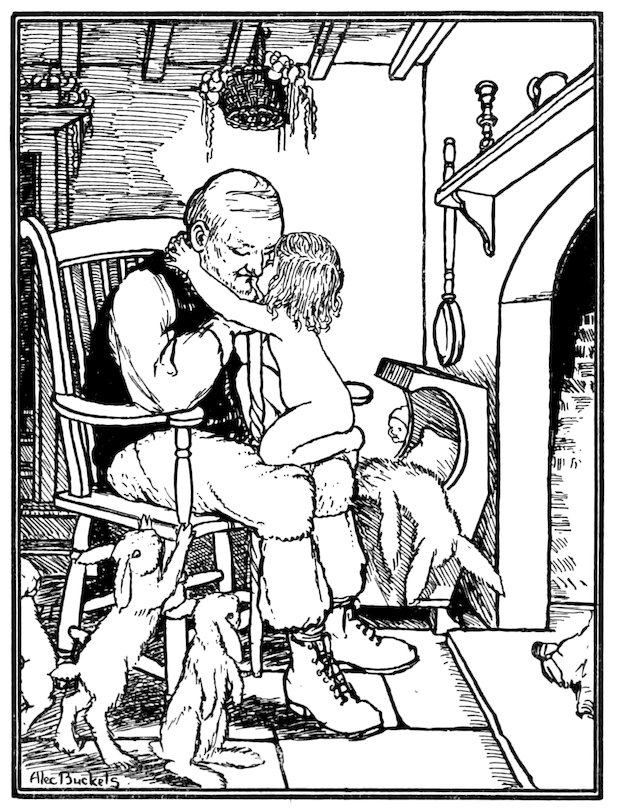
She stood up from the end of her little cot and climbed on to his knee.
The next night, as they sat together over the fire, he told Fellow-man his dream—the dream that had come to him after 218they had both gone to sleep—of the little three-year-old getting up from her crib, climbing upon his knee, giving him a kiss, and then back into her rabbit-skin and away with all the grey rabbits after her.
Caleb had not yet opened the door. “It’s strange,” he said, when Fellow-man asked him why, “I don’t think she’ll come again; and why should she? I know everything I need to know. She’s happy; she’s got a long life; she’s going to stay young. What more do I want now?”
Fellow-man said, “The first night I came to your door—the first night it was locked—I passed them dancing together on the hill. A pretty sight that was. Maybe they’ll be there now.”
Caleb got up, went to the door and opened it. “Why, there’s snow!” he exclaimed surprised. “There was none when I came in; and now it’s lying deep.”
Fellow-man came and stood by his side, “Aye, it’s a fair night,” he said. “If they are dancing in the snow now, to-morrow you’ll see their marks. Oh, a pretty sight it must be!”
“Let us go,” said Caleb, “and see!”
“Nay, nay,” answered Fellow-man, “you know the road as well as I do. You don’t need me to show it you now. I won’t come. I’ll bide here and wait.”
As Caleb went out, all at once he remembered something that had never yet been explained. Coming back, he said to Fellow-man, “If it wasn’t you who brought me the wood every night, who was it?”
Fellow-man turned and smiled at him. “I thought you knew,” he said; “the grey rabbits, of course.”
219“The grey rabbits!” cried Caleb, astonished.
“When you came to need it,” answered Fellow-man; “as soon as you began leaving your door open. It was only then they were able to. After all they did owe you something in return for what they’d taken, didn’t they?”
Caleb was still trying to get the thing fixed in his mind; and, as his way was with Fellow-man, he made no direct answer, only went on thinking.
“Then it was their wood that was warming me,” he said slowly, “when I——” He stopped; then a curious look of contentment came into his face.
“Fellow-man,” he said, “do you know how glad I am now that I didn’t burn the rabbit-skin?”
Fellow-man nodded. “Yes, I know,” he said. “You were right.”
“Aye, right’s the word!” replied Caleb. Then, as he went out, “There’s more snow coming,” he said, and shut the door.
Nobody ever again saw Caleb alive. Late the next day he was found lying in a deep drift of snow at the bottom of an old lime-pit. It looked as though he must have fallen over from above; but more snow had fallen since, covering him as he lay; so nobody could be quite sure.
His face, when they uncovered it, was very happy and peaceful; and when, digging deeper, they uncovered more, maybe they found the reason for that look of deep content; for there in his arms, hidden away under his coat, lay a silver-white rabbit, too fast asleep ever to wake again.
220’Tis more than fifty years now since Caleb died. The country-folk say that the house where he used to live is haunted; and yet, if it is so, no one seems to be afraid of it.
A shepherd told me a tale of it once. Going by, late at night, he saw a light showing; and the door, which in daytime was shut, stood open. Coming up the overgrown path, now so seldom used, he saw within two old men sitting, both so exactly alike that you could not tell them apart. But in the arms of one of them something small lay snuggled; and at his feet stood a child’s crib all ready for use, but no one in it. Nothing was doing; neither of the old men stirred or spoke; and yet, to look at, they seemed very companionable.
“And all about the open door,” said the shepherd, “there were a lot of grey rabbits sitting and looking in. It was a curious thing to see,” he said; “and maybe I only thought I saw it because a gust of wind had come and blown open the door. For it’s strange what things a man can make himself see, by just looking through an open door.”
PRINTED IN GREAT BRITAIN BY BILLING AND SONS, LTD., GUILDFORD AND ESHER
TRANSCRIBER’S NOTES
Fixed typos; non-standard spelling and dialect retained.