PUCK’S MAGIC By MADELEINE NIGHTINGALE
Reading edition
The common spread in every direction and the road had suddenly disappeared. Moreover, look where he would, things were different. For instance, never before was the common bounded four-square by a high red-brick wall, and if it had been Tony was quite sure there should be doors in it; otherwise you could go neither in nor out. And here on the site of the old lime-kiln a fountain spirted. That too was new, and unusual on any common. Even more unusual was it, that the jet of water shot straight up out of sight, and never came down again, curling, as it went, like a corkscrew, or a watershoot upside down. Beyond the fountain was the white goat. She, at least, was an old friend. Possibly she could explain things. He would go and see.
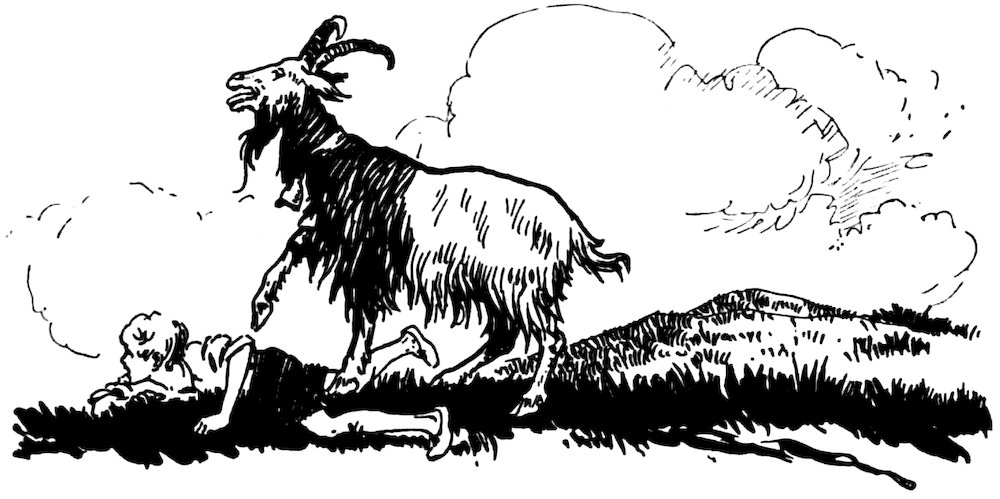
As he approached she stared at him with a certain importance in her amber-coloured eyes; then butted unexpectedly, and with great shrewdness, so that he bowled over as easily as a ninepin and lay quite flat on the ground. Even then she was not satisfied, but rolled him over on his face, and planting her two forefeet on his back began to beat out a tune with them. In spite of his great discomfort under the operation, he solemnly gasped out the words—
105
“Ding dong! Ding dong! All across the Down,
Twelve o’clock is striking in Littlehampton Town.
Robin’s gone a-marketing with all his merry mob;
Wares to sell! Wares to sell, on Twelve O’clock Knob!”[3]
Then a sudden crash startled him into wakefulness, and he realised that someone just outside his door had dropped something. It rolled along the boards and bumped the wainscot, so he decided it was probably a candlestick, and as steps passed along the corridor he knew that his father was just going to bed. It would be about ten o’clock then. His back was quite sore between the shoulder-blades where Nanny had stamped on him. No, though! That was a dream, of course. He turned over on his side and then remembered the hair-brush he had lain upon to keep himself awake. Perhaps it was that. He hunted about in the dim light, and it fell upon 106the floor with so loud a bump, that his heart was in his mouth lest someone should come and demand the cause of the clatter. Everything was quite still, however, as he pulled his little luminous watch from beneath his pillow and studied it. Quarter to eleven. Oh, dear! Why, of all nights, should his father be late upon this one? Well, he must risk it. At least their window faced the other way. There was that in his favour. They would not be able to see him.
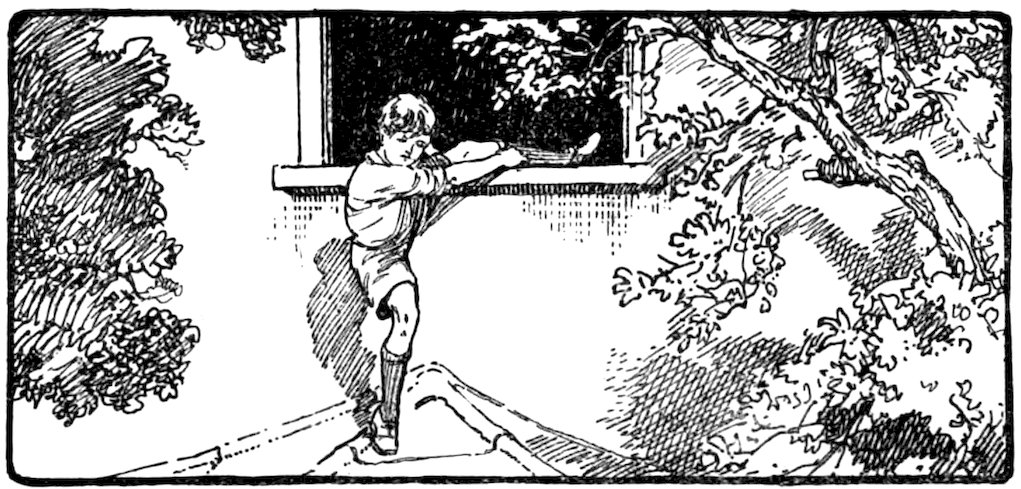
He slid out of bed, disclosing to the moon and a branch of the big pear-tree which looked in at his window that from the waist downwards he was still fully clothed. Hastily he exchanged his pyjama jacket for his small tweed coat, rebuttoned the neck of his cricketing shirt, and peered out into the garden. It looked very quiet and lonely. A rabbit was sitting up in the very centre of the lawn washing its face with its forepaws, and as Tony cautiously put his legs over the window-sill it whisked off like a streak and vanished into the far hedge of the kitchen garden. Tony smiled to himself. Old Hiram, the gardener, was so fierce on the question of rabbits and 107rabbit-wire. All the young wall-flower plants had been nibbled to short bare stumps, so this bunny would begin on the lettuces. He let himself down very neatly and quietly to the top of the porch, and glided with considerable skill down its sloping roof till he fetched up with his heels in the gutter of its eaves. Then, a few inches at a time, he worked himself sideways until, clasping the pedestalled corner firmly, he could lower his legs into space. Here they dangled precariously, whilst they felt for and found a post. Down this he slid rapidly and safely to the ground, and, pausing only to wriggle his puckered, twisted garments into place, set off at full speed across the grass. At the gate of the orchard he turned at right angles, running along the thick box hedge out of sight of the house as far as the lane. Following it due west, he reached the main Midhurst road, and struck off across the fields towards Vinings Wood. He was out of breath by now, however, and the rising ground forced him to slacken pace. He steadied down to a walk at last, and as he trudged upwards proceeded for the twentieth time to review the situation.
It all began with the old Mushroom Man.
Now the Mushroom Man, besides being a great personal friend of Tony’s, was reputed to be the wise man of the village; though, from his appearance, one would hardly have suspected it. He had a round, red, simple face fringed by a complete circle of short white hair, so that he looked extraordinarily like some rare-hued sunflower when, as often happened, he looked down at you over the wall of his raised garden. His light rather shabby trousers were tied round with string just below the knee and always seemed out of character with his brown velveteen coat; for this was very smart and lent him a kind of superiority over the ordinary villagers. He wore 108also a billycock hat on week-days, as did no one else in the district, not even Tony’s father. He spoke slowly and carefully, wasting no words—a habit, perhaps, which had earned him his reputation; for this, of course, is wisdom, as no one can deny.
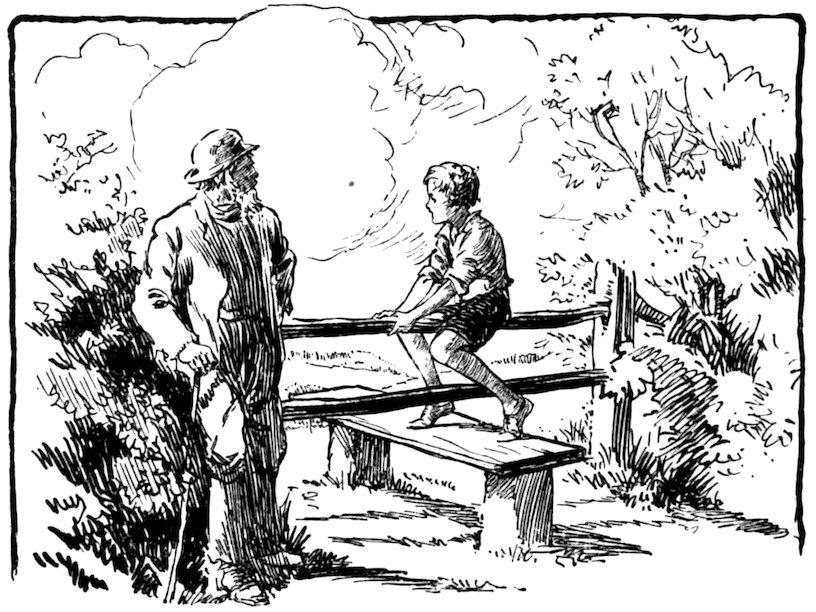
Tony was sitting on the stile of the path that leads to Bexley, and accosted the old fellow as he passed.
“Ding dong! Ding dong! All across the Down,
Twelve o’clock is sounding in Littlehampton Town,”
he shouted. “Oh, Mr. Hockley, what does Twelve O’clock Knob mean, really?”
The Mushroom Man came across the grass from the road, and leaned up against the stile-post.
109“It’s the liddle Pharisees’ market-place, surelye, Mas’ Tony.”
“Tell me,” Tony said persuasively, but the old man shook his head.
“I’m noways avised of it, Mas’ Tony. You’ll best see for yourself.”
“How?” the boy questioned.
Mr. Hockley looked furtively round. There was a big tuft of dock-leaves spreading by the gate-post, and he stirred it with his foot as though looking for something that might be concealed beneath. Then he leaned down and whispered in Tony’s ear.
“Fern seed,” he said.
Tony slid off the stile in his excitement.
“Fern seed? Why, that’s what the poem said.”
The Mushroom Man nodded his head, not once but many times like a mandarin.
“Fern seed,” he repeated. “That’s how.”
“Fern seed! Fern seed!
Out of Verdley Wood:
An acorn cup to gather it,
And see the measure’s good!”
Tony chanted. “Oh, Mr. Hockley, do tell me! Is that it?”
The Mushroom man nodded again. Then he swung open the gate beside the stile.
“You come along o’ me and I’ll tell you,” he said.
Tony followed him.
Side by side they crossed the meadow towards Snapelands Copse, and as they walked Mr. Hockley talked. He always 110spoke with the soft, sweet intonation of old Sussex, and many of his words and phrases were words and phrases lost or forgotten by any save Sussex folk. Tony understood, because all his life he had lived amongst them, but since perhaps you children who read would not always understand very easily, and sometimes not at all, I am going to tell you in my own words the story that he told. Where he got it from I cannot say, for I have never been able to find it, but it was very real and true to him, and to Tony it has always been very real and true too.
Once upon a time, then, on the cliffs a few miles west of Littlehampton, there stood a fisherman’s cottage. It was a poor little place, old, tumbledown and not very weatherproof, so that the wind from the sea used often to find its way through the cracks and crevices. It must have been a rather kind wind, though, for when a baby was born to the humble fisherfolk whose home this cottage was and the wind, having slipped in, was wandering about the room, it often stayed to play round the small head in the old oak rocking-cradle, and the baby would stretch its arms and crow with delight, which it certainly would not have done had the wind been harsh and unpleasant. Indeed, so fond did the little fellow grow of this unseen companion of his that he would lie quiet for hours in his cradle or a chair on the brick path of the garden, provided the wind were there to pat his cheeks and ruffle his downy hair; whereas on a still day he was lonely and lost, and whimpered sorrowfully to his mother as she hung the clothes out, or roared remonstrance if she left him entirely whilst she did her work indoors. As he grew older their intimacy deepened, but because people laughed at him and called him fanciful, he never spoke of it, nor, indeed, allowed people to know he even thought of the wind at all. Nevertheless, when he had finished work 111with his father, the boat all clean and neat being drawn high and dry up the beach, and the fish packed ready for their journey to the town, often, instead of playing games with the other fisher-boys, he would wander off by himself miles away, where no one could disturb him. Here, on cliff or shore or inland on the downs, he would be utterly happy and content in HER company alone. That he never thought of her as a man, but always as a woman or a girl was, perhaps, a sign that in some dim measure he understood her. He had, indeed, in his mind a picture of her face, very beautiful and young and simple like a child’s.
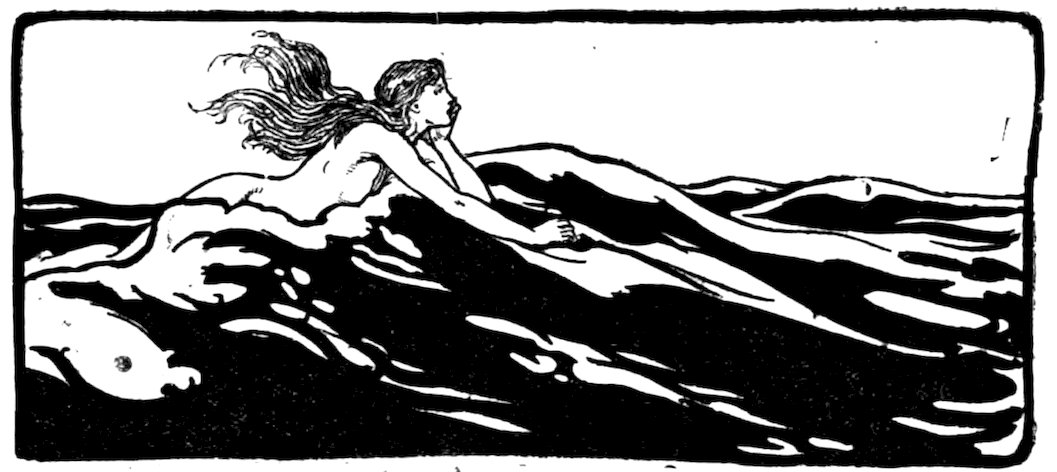
Then one day a wonderful thing happened. He was lying on his chest on the sands, six miles west of his home, his chin on his hands, his heels swinging in the air behind him, his eyes fixed steadily on the sea. There was a stiff wind blowing from the south (south of south-west he would have said), and it scurried the long billows into line after line of white clouds of foam. Suddenly, amongst them all he caught sight of something floating landwards—a spar, as 112he thought, from some forgotten wreck. He watched it, not curiously, but listlessly, for his mind was on other things, until, as it drew nearer, he realised it was not a piece of wood, but a human figure, and that it was not swimming, but seemed to be borne smoothly on the crest of one great unbroken wave. Then, indeed, he was curious. He sprang to his feet and ran down to the edge of the incoming tide, staring with all his might in wonder who this might be. And the wave rolled on, still without breaking, until it laid the figure at his feet, very gently. As it did so, it burst at last into shallow foam that surged round his ankles and then ebbed back, leaving both him and her high on the wet rippled sand. He knelt down beside her and looked into her face.
“Are you my wind?” he asked.
She laughed, but answered quite seriously:
“Not quite, although the wind brings me.”
“Who are you?” Then there came to him the memory of a tale he had read in a book the old priest had lent him, and he added, “Dione?”
She laughed again.
“So the Greeks called me. And other names they had for me, too. But names are nothing, little fisher-boy. To know me is enough.”
“Do I know you?” he asked, and she nodded.
Then she told him how, as the years passed over him, he might forget her, and that lest he should do so she had come to warn and safeguard him. There was a remedy, it seemed, against so dreadful a happening.
“Puck’s magic is the talisman,” she said, “for those who care to buy.”
113And so it came about that first a mortal heard of the market on Twelve O’clock Knob.
Tony had listened in breathless interest, padding along at Mr. Hockley’s side.
“And did he go and buy?” he asked, but here the Mushroom Man had become a little vague.
“They do say he did,” he returned, adding, “’Twas fern seed was his money, surelye.” But what exactly he bought or how the buying was effected he either could not or would not tell. “Midsummer Eve be Puck’s market-day,” he asserted, “and ’tis from Verdley Wood the fern seed he be brought. And twelve o’clock be the hour or thereabouts. Leastways, I’ve heard my father say.”
Tony had brooded over this lore for days, and then, with infinite ingenuity, engineered an excursion to Verdley Wood botanising with his father. There were strange mosses there, he suggested, as, indeed, was true. Accordingly they had ridden as far as possible by road, stabled Brownie and his father’s mare at a wayside farm, and then struck across country. It was whilst his father lazed and smoked after their midday meal of sandwiches and fruit that Tony effected the real object of his visit. He had the greatest difficulty in finding ferns and was almost in despair, when at last he tumbled upon a little nest of them at the end of a kind of fosse. Nor was it the easiest thing in the world to gather the seed, but he shook it down upon a piece of paper, slid it into an envelope and licking it up put it thankfully into his pocket. Then he raced back to his father, whom, fast asleep by this time, he found lying flat on his back beneath a chestnut sapling, with an enormous caterpillar reared on its tail in the very centre of his 114shirt front. In the excitement of being rescued from a crawler (whose whole genus he loathed), Mr. Tremayne forgot to ask the reason of so long an absence, and since a specimen of quite rare moss had been found, both returned home completely content and happy.
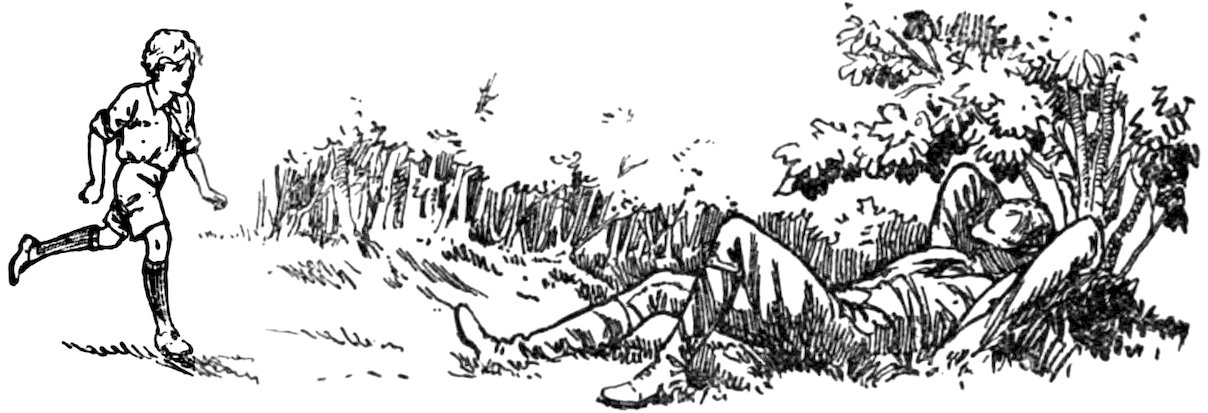
So here was Tony at 11.15 p.m. on Midsummer Eve, trudging along alone through the shadows and stillness of Vinings Wood, with his precious envelope of fern seed in one knicker-pocket, an acorn cup in the other, and not a little excitement in his soul.
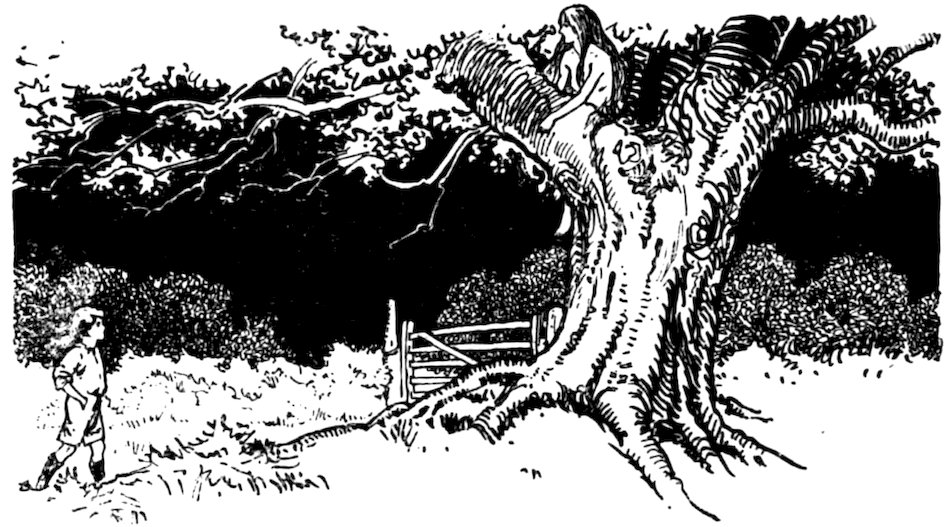
Now, I don’t suppose for a moment any of you children who read have been in a great wood at that hour on Midsummer Eve or indeed any other eve, so that without a little help you will never be able to imagine what it is like. To begin with, all the trees seem more alive and more friendly than they do in the sunshine, and they stretch their big arms out and down to you, almost as if they wished to stop you as you pass and hold you there, and talk and play with you. And when, just now, I spoke of the “stillness” I did not mean at all that there were no sounds to hear. On the contrary, not only the wood, but, as it seemed, the whole world was so still that Tony heard more 115sounds than he had ever heard before—very quiet, mysterious sounds, such as you don’t expect to hear. For instance, a squirrel scampered along the ground in front of him, and the scuffling scratch of his little claws as he ran up the trunk of a big oak-tree was exactly like the patter of Curly, the cockerspaniel’s feet on the red-tiled hall at home. Whereas, in the daytime, as everybody knows, a squirrel climbs a tree quite noiselessly. A tiny twig, disturbed by a half-awakened wood-pigeon, fell on the sandy path just in front of Tony’s nose with so loud a plop that he nearly cried out. In the daytime, numbers of quite big twigs are broken and fall, without your hearing them at all. Later, a stoat emerged suddenly from the shadows on the left, and, unconscious of Tony (who at that particular moment was standing quite still), walked across the moonlit path into the shadows again; but Tony heard him rustling over the leaves into the distance, and it was quite a long time before the sound of his progress died away. In the daytime, stoats or rabbits, or any small animals, shoot into sight and out of it without your hearing anything at all. All the time, too, there was so much stir amid the leaves and branches overhead, that Tony decided the Dryads must be a very restless race; or, perhaps, they belonged most to the nighttime, he reflected, remembering that he had never heard them moving about so energetically by day. He could even hear the murmur of their conversation, but though he stopped many times straining his ears, he could never distinguish the actual words. He caught a glimpse of one of them, however, in the fork of the great oak-tree, that overshadows the gate at the far end of Vinings Wood. He was a little uncertain whether all Dryads were ladies, but certainly this one was. He saw her shoulders gleaming white in the moonlight against the grey 116lichened trunk, and her beautiful hair hung down ever so far and wafted to and fro in the soft breeze. He fancied he heard her singing too, and that reminded him of Dryope, so that he fell to wondering whether by night she was allowed to resume her mortal shape, and he looked round, half expecting to see a tiny child playing in the tree’s shadow; for Tony had been brought up familiar with many of the old classical myths. He had known, therefore, all about the fisher-boy’s Dione, and he was specially fond of the tale of Princess Dryope. (I wonder if you children remember it too. How she plucked the lotus blossom for her little son, and how blood trickled from its broken stem. And whilst she stood staring at it in wonder, a voice cried out that she had slain Lotus, the wood nymph, who, fleeing from Priapus, god of the shade, had changed herself into a flower to escape him. Terrified, Dryope turned to fly, but alas! she could not move. Swiftly tree-bark grew around her, upward and upward. Her arms changed into twisted branches. Her hands were filled with leaves. But before the bark closed over her face, she besought that her child might play often beneath her branches. Do you remember? And how when the winds rustled the leaves of the trees, the ancients used to say that Dryope was lulling her child?) Tony thought of all this, but there seemed to be no one beneath the tree’s shade except himself and a quite unfrightened rabbit, who sat like a little hunchy mole-hill staring at him not ten yards from his feet. Then a great owl flew out from the very fork where the Dryad had been perched, and Tony was so startled by the hooting and the sudden whir of wings, that he climbed the gate without another glance and ran on as quickly as his legs would carry him.
117Now when you pass this particular gate of Vinings Wood you are on the cart-track of Boggarty Farm, and have climbed already to very high ground. On your right the hill, quite thickly clothed with trees and brushwood, falls rapidly to a steep valley that runs backwards towards Bexley. In front, however, this valley is cut short, and round the head of it along the crest the road runs to Grevatt’s and to the Heath itself. Boggarty Farm is on the left, just where the road curves; but I am not going to say much about that because Boggarty Farm has a story all to itself. It stands there, though, very lonely and grey and quiet, with its yard in front of it, and its shed-wall fronting the road—for all the world as though to warn off any inquirers into the old house’s privacy.
Tony skirted it and then branched off to the right, past an old forsaken barn, where a shaggy, grey donkey leaned like a stone statue, asleep apparently, against a crumbled scratching-post. To his left now there was a turf wall all along the side of Lane End Field, and at the lane’s end itself a five-barred 118gate. He swung it open, jumping a little at the squeal of its hinge, and passed through, latching it behind him. Then for a moment he stood quite still and, following the suggestion of old Hockley, said aloud and rather slowly the first stanza of “Puck’s Market”:
“Up amongst the heather,
When the moon is high,
Lamplight in the valley,
Starlight in the sky,
Swinging on the bracken
That’s bowing to the breeze,
In and out the twinkling stems
Go the Pharisees.”
Now, I don’t for a moment promise that any of you children living in Tony’s part of Sussex and taking upon yourselves to try his experiment will achieve the same result. It may be you will, it may be not. I have known Tony so long and heard so many of his strange “happenings” that I have grown to be surprised at none of them. But whether they happen as easily to others or largely because Tony is Tony is another question.
At any rate, there he stood beyond Lane End Gate, and he said his charm slowly and solemnly and faithfully, and immediately things began to happen.
First of all, there was no doubt about the bracken-stems. They were twinkling sure enough, though not at all in the way Tony expected, for they were hung with thousands of glowworm lanterns which, lightening and darkening with every movement, swung to and fro in the breeze.
Then the gate behind him was opened again and slammed back noisily over its latch.
119Someone touched him on the shoulder.
“Here we be, Mas’ Tony.” It was the Mushroom Man. “And don’t the fairy sparks a-shimper, surelye? I caught a glimpse of you while you come aside the farm there. I was een a’most the top o’ the wood by then, but too far from ye to shout.”
“But why did you come, Mr. Hockley?”
The Mushroom Man pulled something from his pocket and held it out in the palm of his hand. It was an acorn cup.
“It’ll no be the first time I’ve bought Puck’s Magic,” he said.
“But what do you use it for?” Tony questioned.
Mr. Hockley nodded knowingly.
“Mayhap you’ve heard ’em speak of me as a wise ’un over at the village,” he said, and it was Tony’s turn to nod.
“It’s noan but seeing it be the sun makes the shadows, leastways when it ain’t the moon. One or t’other it be, surelye, a-shining behind what casts ’em. ’Twas the liddle Pharisees taught me that. Seeing’s believing, I do reckon, Mas’ Tony. There’s some folks don’t hold there be fairies whatsoever. But them that gathers fern seed, they know better’n that.”
Tony pondered this for some minutes in silence.
“I’d always known they were true,” he said, at last. “It wasn’t just to make sure that I came.”
“What for, then?”
Tony leaned back against the gate-post and stared thoughtfully beyond Mr. Hockley and the bracken and the heather and even the fairy lights.
120
“Well, you see,” he said, “Dione wasn’t just Dione. She meant quite a lot more than that. She meant everything that was beautiful then, and I expect, even now, to have her always would make you never forget things are nice when they don’t seem nice ... nice underneath I mean, same as you say the sun’s behind the things that throw the shadows. The fairies don’t ever forget. I expect that is why they are always laughing and happy and kind. I expect it was a sort of fairy sight Dione meant the fisher-boy to buy, so’s he could always go on seeing her and loving her. And I want to buy that too.”
The Mushroom Man took out his big red handkerchief and blew his nose slowly and loudly. It was a custom of his when doubtful what to say.
121
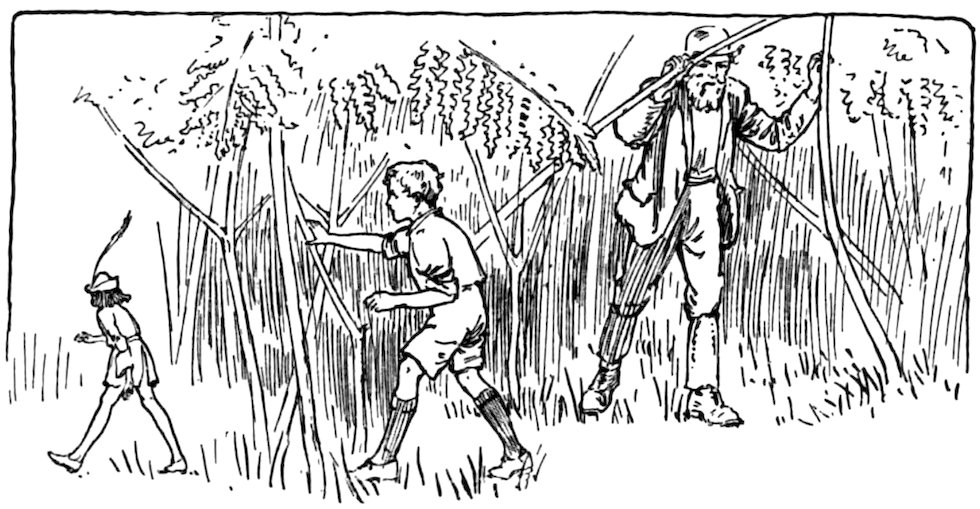
“There’s a liddle Pharisee behind yon mole-hump, a-waiting to take us,” he remarked, when he had thrust it back into his pocket; and as Tony looked in the direction of his pointing finger the “liddle” Pharisee came towards them.
He was a tiny fellow, not much more than twelve inches high, very like the pixies Tony had seen two years before. Like them he was clothed in a kind of jerkin and hose, but instead of their sober brown, his was green as the grass of the watermead, and his cap was bright red with a white feather set jauntily at one side.
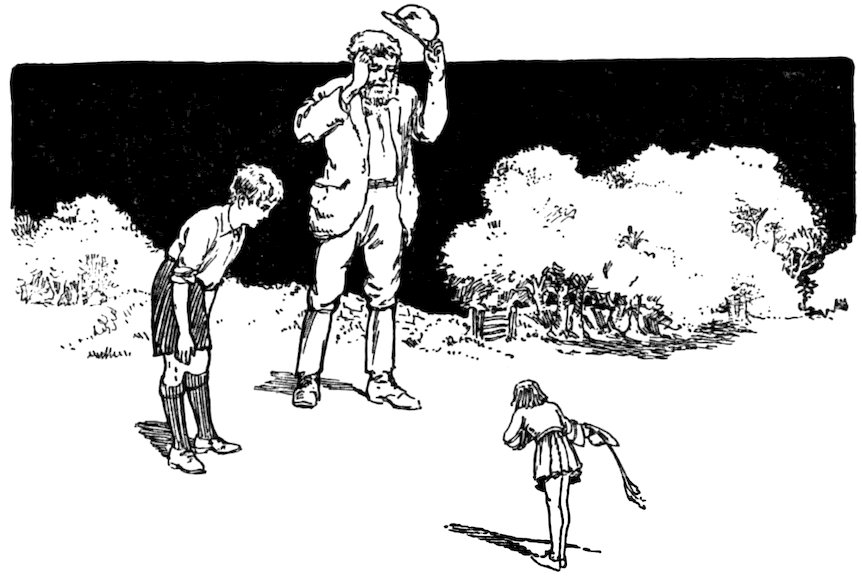
He doffed it as he came to a halt in front of them, and made a low bow.
Tony, too, bowed gravely, and Mr. Hockley solemnly removed his billycock, and pulled at the topmost point of his circle of white hair. Nobody spoke, however, and the fairy, wheeling round, set off swiftly through the twinkling bracken-stems. It was not until next day it occurred to Tony that, 122as they threaded their way after him, either the bracken had grown very tall or else he and Mr. Hockley, like Alice after the magic cake, had dwindled to one-quarter of their ordinary size. It seemed at the time perfectly natural to be walking beneath a roof of fern-fronds and bumping occasionally into bracken-stems as thick as bamboo canes. As for the glowworm lanterns, if they hung above their heads, well, after all, that is just where you expect a lantern to be, isn’t it?
Still in silence, they made their way across the broad sweep of heath, and it was only when another fairy stepped from the thick side-growth and stood in their path that their first guide turned and spoke.
“It’s Pease Blossom,” he said, “for the Mushroom Man.”
He laid his hand on Tony’s shoulder, adding, “Wait!”
Tony watched Mr. Hockley go on his way until both he and Pease Blossom were out of sight. Then, a little uneasy and perhaps a little lonely, he wriggled from beneath the restraining touch.
“I’m going too!” he cried, but the fairy held him fast.
“You must go alone if you’d buy at Puck’s Market,” he said sternly.
Tony ceased struggling.
“All right!” he said, shaking himself a little petulantly.
“Don’t hold me, please, Mr.——”
“Mustard Seed,” the fairy finished for him and let go as he spoke. “Sit down and rest a bit.”
Tony, tired by his long climb, obeyed rather thankfully, and Mustard Seed swarmed up one of the bracken-stems, 123and began to swing himself to and fro. Hardly, however, had he swung a dozen times before he was down again. He stood in front of Tony with his head bent and one finger raised. “Listen! Listen!” he whispered.
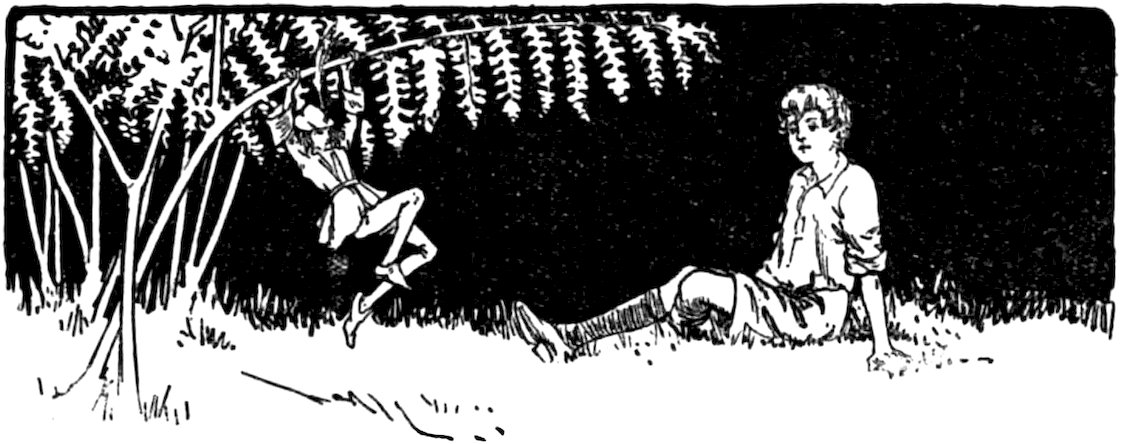
From somewhere, not very far distant, came the sound of music—a melody, very dainty, very happy, very enticing.
“They are beginning to dance,” Mustard Seed said. “Come along.”
They set off again along the path, which threaded in and out, in and out, amongst the bracken growth; and always, as they went, the music grew louder and louder.
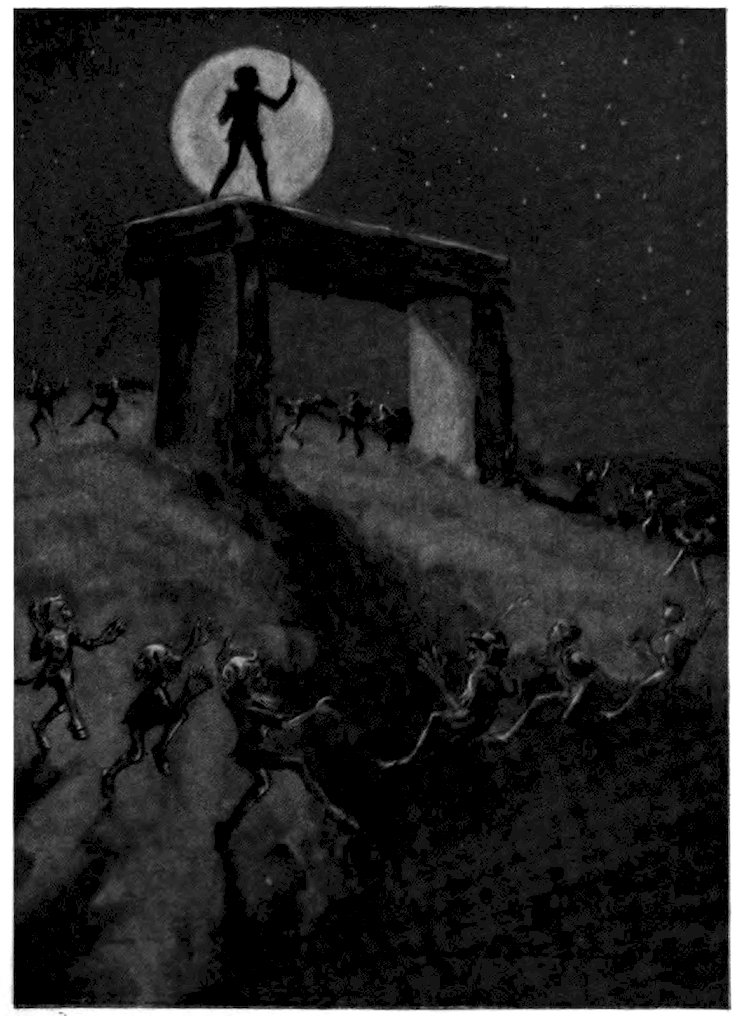
At last they broke out into the open, and Tony saw at once exactly where they were, and where the music came from. They stood almost at the edge of the heath. Just in front was the little circular clearing known as Twelve O’clock Knob, and, immediately beyond, the hill fell very steeply to the few cottages gathered at its foot. On a great stone, reared in the very centre of the Knob, stood Robin Goodfellow. As the moon was exactly behind him, however, Tony saw him only as a sharply cut black silhouette against the big yellow circle of 124it; but even so, and although Tony had never consciously imagined him, there was no possibility of mistake. The quaint elvish figure could have been no one else. He was quite motionless, except for his right arm, which with a little baton beat time for the music, and his head was thrown back as though he were looking at the stars. From somewhere high above, too, the music came, so perhaps it was from the stars he summoned it. There was a phrase running in Tony’s head that seemed to explain somewhat. It was about the “morning stars singing together,” but he could not remember it quite. And then there was something else he had once heard that spoke of them “singing as they shine.” Long ago, too, his old Irish nurse had told him that fairy music always came from the sky. Why, this was the reason, then. The stars made it, and Puck’s magic charmed it down to earth in order that fairies (and mortals, too, if they had ears for it) might enjoy it. All around Puck’s stone were little shadowy, dancing figures, but Tony barely noticed them. He was watching, rather, Puck’s arm swinging gently backwards and forwards; and, as he watched, the music stole down to him and all round until the gladness of it almost hurt.
Then with an effort he roused himself.
“Puck!” he cried, with a funny little unexpected break in his voice. “Puck! Oh, Puck! See, I’ve come.”
As he strode forward on to the Knob itself, everything changed. The music ceased. Flitting figures brushed against him and passed. Puck and his stone vanished like a falling star, and heather and grass were gone from beneath his feet as was the twinkling night-sky overhead. Instead, with sunshine everywhere, his feet clattered a little upon cobblestones, 125and he fronted an awning-covered market stall, breast-high with mint-rock rolls, and slabs of stick-jaw, and long, black liquorice laces. Behind it, a little old man peered over at him through huge horn spectacles, whose glasses rays from the setting sun caught now and then and lit up like windows on a distant hill.
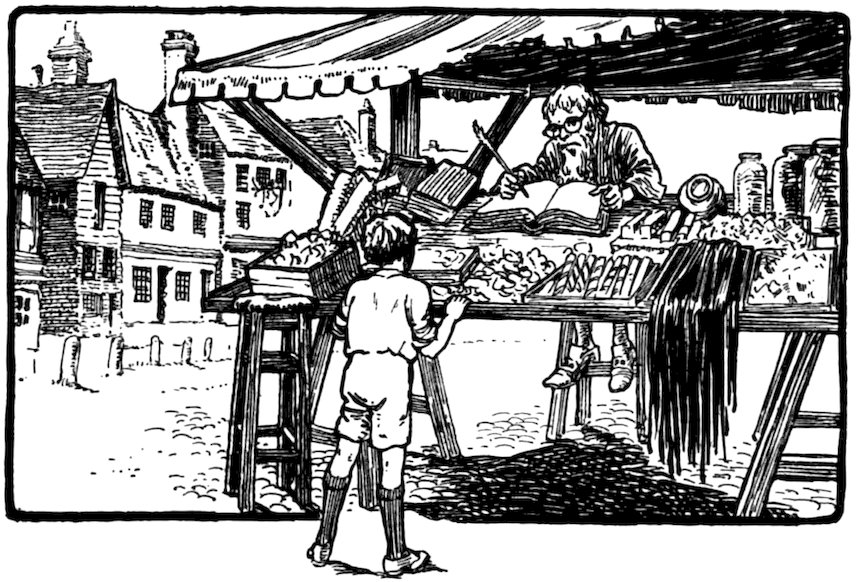
“Wares to sell! Wares to sell!” he called in a quavering old sing-song. “Now then, little gentleman, what can I do for you? Mint rock, is it? Or candy?”
Tony blinked his eyes very rapidly. He had seen things of this kind happen before, and sometimes, if you blinked hard enough, they un-happened and you were reassured. Then he shut them entirely for quite half a minute. But when he looked again, there were the stall and the lollipops and the old 126man just the same, so that they had obviously come to stay and must be dealt with accordingly.
“No sweets, thank you,” he said politely. “It’s magic I’ve come to buy.”
The old man leaned right over and peered at him more intently.
“Name?” he demanded.
“Tony o’ Dreams,” returned Tony, very brisk and prompt.
“Age?”
“Ten.”
“Occupation?”
Tony hesitated.
“I’ve got so many,” he said, “I don’t know which I do most. But I know I’m growing all the time. Would that do?”
“Currency?”
Tony stared.
“What are you offering to pay in?” the salesman explained.
“Oh,” said the boy, “fern seed”—he thrust his hands in his pockets—“an acorn cup full, good measure.” He held out both seed-envelope and acorn as he spoke. “You can measure for yourself, if you like.”
But the old man was entering all the details in a ledger, and he closed the fat book with a bang before he stretched out his hand for the proffered payment.
Then very carefully he measured out the little brown specks, tipping them into a tiny glass goblet which he held up to the light.
“And so you really want my magic?” he said.
127“Puck’s Magic,” Tony corrected, and sitting down upon a high stool in front of the counter he proceeded to explain.
He told all the tale of Dione and the fisher-boy, and his own ideas upon its meaning.
“So I think it’s fairy sight I want to buy,” he finished.
But the old man shook his head.
“Not even Puck can sell you quite that,” he said.
Tony’s face fell.
“Nor,” added the other, “is that exactly what you need.”
“What then?”
“Ah!” The old man came round the stall and laid a knobbly, wrinkled hand on the boy’s head.
“It used to be said that ’twas fern seed might make a mortal man invisible, but ’tis more like there’s things invisible fern seed can make a man to see.”
“Why?” demanded Tony.
“Well ...” said the old man, “I don’t know that I can exactly tell, nor yet, for that matter, that you’d be the wiser even if I could. Fern seed to many folks is fern seed and no more; but magic—why, it’s magic, when you believe in it. And so the fairies are where you look for them; and that’s not far for those that care to gather fern seed for the market on Twelve O’clock Knob.”
Tony found this a little bewildering, and the stallman nodded kindly.
“It’s all right, Tony,” said he, “and of small account to understand. You go on always looking for them, always expecting. That’s what Dione meant, or thereabouts.”
128He came behind the boy and clasped his head with his big hands, laying his fingers over his eyes and smoothing on the lids something soft and cool and fragrant.
Tony sniffed luxuriously.
“What is it? Oh, what is it?”
“Child”—the old voice was very tender—“oh, child, it’s the gift of the Good Folk ye’re buying. Far away north there’s many that will tell you of it. The Fairies’ Ointment they call it there, but here Puck’s Magic is the name of it, and a fair name too. For ’tis a blessing you have bought, and little it matters what you or any call it. ’Twill be enough for you to have it.”
Tony rose to his feet. Then he turned and looked long and thoughtfully into the old man’s face.
“Yes,” he said, at last. “Of course, I know you now. It is Puck, isn’t it? You see, I knew you at once when I saw you beating time against the moon. Then ... behind your stall, I didn’t know. I thought you were just an ordinary market-man like Mr. Hobbs at Petworth. But I see now. It’s only your clothes and the outside of you I was looking at before. Underneath you’re just as fairy as any fairy well could be. I see that.”
He wagged his head sagely and contentedly, and once more Robin Goodfellow laid hands on his shoulder—two hands this time. “You’ll see fairy under most things now, my Tony, and, what is wiser still, the truth beneath your dreams.”
“Shall I?” Tony answered, and added, though he scarcely understood, “I’m so glad.”
Then with a sudden pressure of his fingers Robin swung the boy round, and Tony found himself once more in the moonlight 129on Twelve O’clock Knob. But now he faced homewards and the long dim sweep of the downs. Somewhere very faint and far away the fairy music sounded, but dancing fairies, Puck, and even Puck’s stone itself, had disappeared. Nor was there sight or sound of Mustard Seed, and Tony felt himself suddenly very much alone. After a while, however, as his eyes grew accustomed again to the darkness and the shadows, away in front of him and a little to the right where its view southward was quite uninterrupted he caught sight of a figure standing, and by its billycock recognised Mr. Hockley.
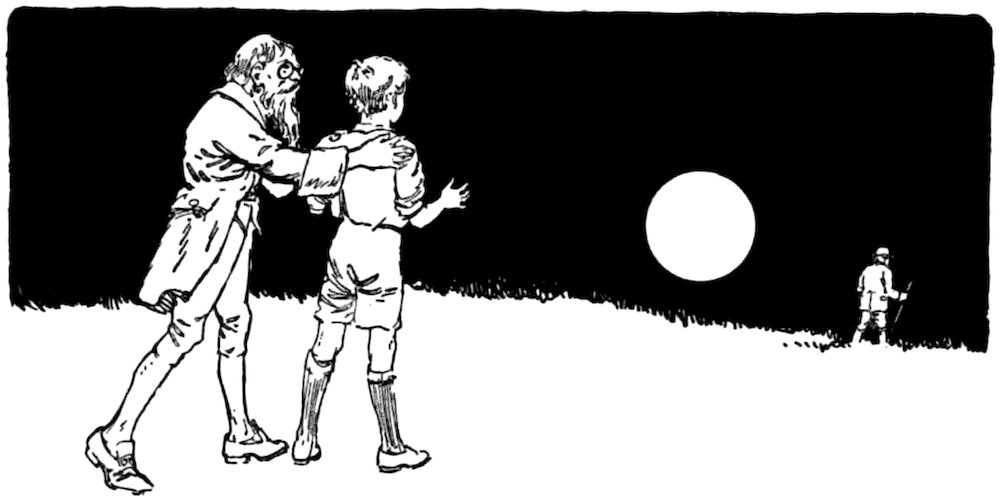
“Mr. Hockley! Hi! Ahoy!” he shouted.
The Mushroom Man turned, beckoning, and Tony ran to him, plunging and ploughing through the thick heather as he went.
“Did you find him?” he cried at Mr. Hockley’s side. “I did and I bought it, too. Puck’s Magic. I’ve got it. Puck says so. They call it the Fairies’ Ointment in some parts. Did you get it?” His sentences came out in little gasps, for 130running on heathery ground is hard work and he was out of breath.
Mr. Hockley looked about him a little uneasily. “Mayhap I’ve got it somewhat,” he answered, “or maybe not. Best not to speak of ’em. But hearken yonder! Do you hear?”
“Ding dong! Ding dong! Ding dong!”
Right across the down the chimes came, and then the hour struck.
“One ... two ... three ... four....”
Tony went on counting, and then laughed in sudden understanding.
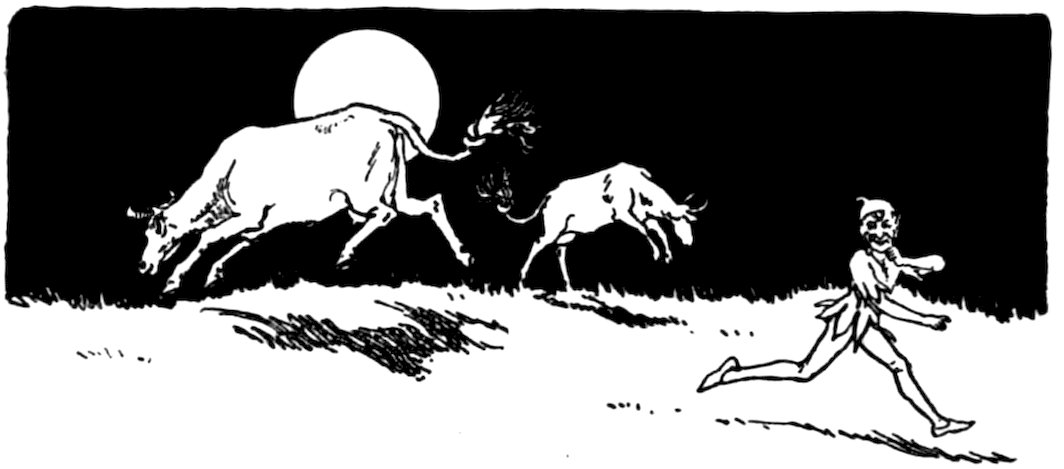
“‘Twelve o’clock is sounding in Littlehampton Town,
There’s cow-tails still to tangle and hen-roosts still to rob....’
Oh, and I never asked him about that; I did mean to.”
The Mushroom Man grunted.
131
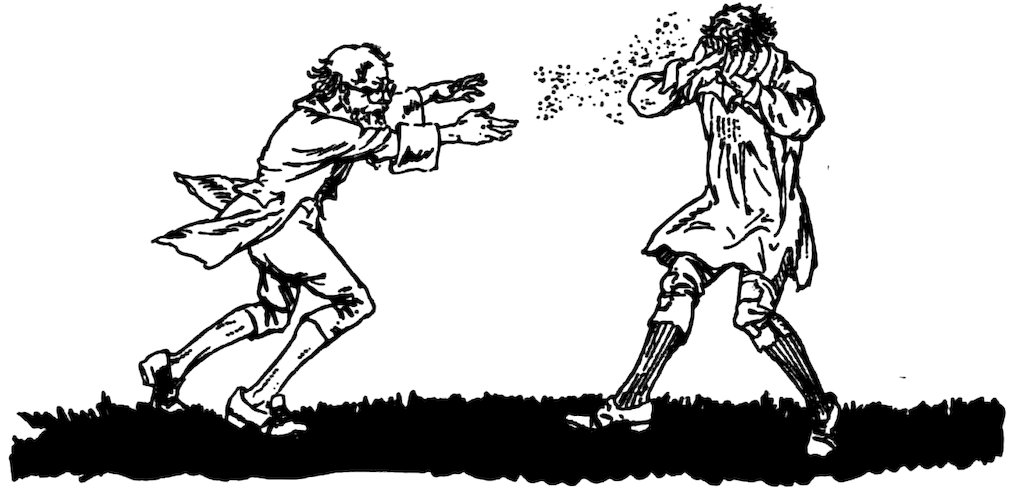
“And lucky for you you didn’t!” said he. “The liddle gentleman don’t like it. Was one as I knew asked him long ago and he flung his fern seed back on him in a passion, and everywhere the fern seed touched him he come out in dunnamany bunches, and a rash over him like as he’d the measles. And never no magic there was for him. ‘’Taint the Pharisees I got on Twelve O’clock Knob,’ says he, ‘but the rheumatics more like.’ And surelye he was noanbut kiddle the rest of his life. But come along, Mas’ Tony, the downs they be getting haitchy, and ’tis time we were home, I do reckon.”
Tony hitched his fingers in the crook of Mr. Hockley’s velveteen arm, and plodded along at his side. After all, he was not used to these late hours, and was beginning to feel very tired and sleepy. Indeed, he was too sleepy to remember his manners, so that it was Mr. Hockley who opened the gate of Lane End Field; and by the time they passed Boggarty Farm, Tony was clutching his friendly arm more tightly still 132in order to walk with his eyes shut. At the gate of Vinings Wood, however, he opened them.
“There’s a dryad in the oak-tree,” he whispered drowsily; “I think it’s Dryope.”
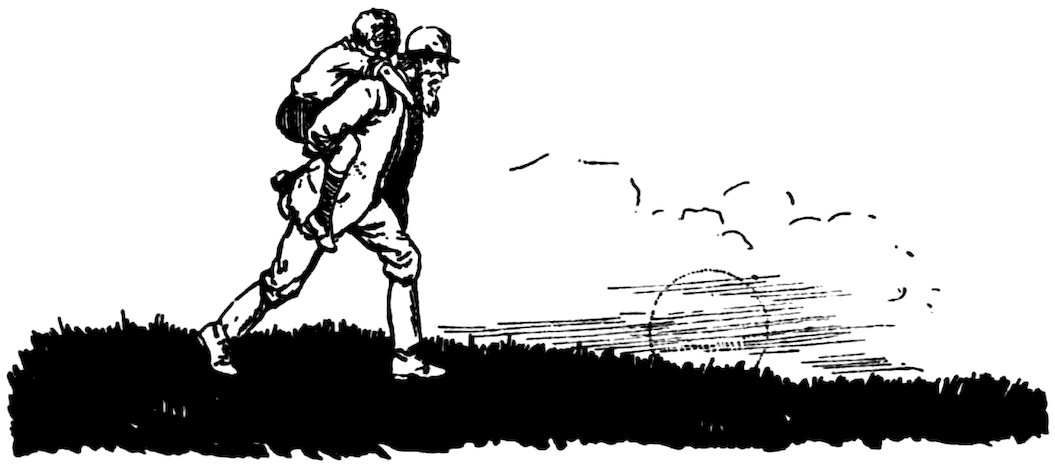
Mr. Hockley stopped suddenly, and, big boy as Tony was, swung him on to his back.
The boy slid his hands beneath the old man’s white beard, and locked the fingers of them as firmly as he could. Never in all his life had he felt so sleepy.
“I’m so sorry,” he murmured regretfully. “But I don’t ... think ... I ... can ... keep a ... wake. It is ... a ... pity.”
It was a pity! He wanted so much to see the “chimney-shadows streaking down the sandy street” as they passed through, and he was anxious, too, that Mr. Hockley should see how easily he climbed the porch-post and scrambled up the little gabled roof. As it was, Mr. Hockley must have found a door or a window open and carried him upstairs. He even changed his jacket for him, for when Tony woke in the morning, although he was still half-dressed, as he had been when he dozed the night before, he had his pyjama jacket on top, instead of the tweed coat he had worn for his moonlight excursion. This was rather puzzling and set him wondering for a moment whether he had dreamed it all, but then he caught sight of his hair-brush in its proper tray upon the dressing-table, and he remembered how it had wakened him and fallen to the floor.
“I picked it up just before I got out of the window,” he said thoughtfully.
Jumping out of bed, he ran across the carpet and looked out over the sill.
133There were streaky marks where he had slid down the roof, so it was quite true; and even if Mr. Hockley stared at him and shook his head when questioned ... well, after all, it was not the first time he had refused to talk aloud about such things. Probably he thought the more.
134