Front matter
Reading edition
Edinburgh: Printed by George Waterston & Sons FOR DAVID DOUGLAS
LONDON, SIMPKIN, MARSHALL, HAMILTON, KENT, AND CO., LIMITED CAMBRIDGE, MACMILLAN AND BOWES GLASGOW, JAMES MACLEHOSE AND SONS
NOTES ON THE NATURAL HISTORY OF THE BELL ROCK By J. M. CAMPBELL WITH AN INTRODUCTION BY JAMES MURDOCH LATE SECRETARY TO THE BOARD OF NORTHERN LIGHTHOUSES
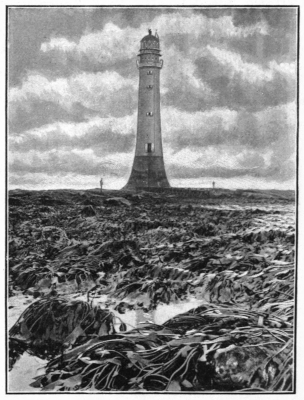
Edinburgh: DAVID DOUGLAS, Castle Street 1904
PREFACE.
These desultory notes were originally undertaken at the instigation of an invalid friend, desirous of a closer acquaintance with our lonely environments.
At the termination of a nine years’ residence on the Rock, I have been advised to publish them in book form, and being fortunate in securing the services of a generous publisher, they are now collected from the columns of the local press and issued in this form in the hope that they may interest the general reader.
I have to thank the Editors of The Arbroath Guide and Chambers’s Journal for their courtesy.
J. M. CAMPBELL, Assistant Lightkeeper.
Bell Rock Lighthouse,
May 1904.
INTRODUCTION.
In consequence probably of my connection of more than fifty years with the Northern Lighthouse Board, and of the almost equally long service of my father, I have been requested, and with much diffidence have complied with the request, to write, by way of Introduction to these very interesting and instructive “Notes from the Bell Rock,” a few words regarding Lighthouses, and a short account of the Northern Lighthouse Service and its Lightkeepers. My love for that service, and the esteem I have for those responsible and patient watchmen of the night, whose duty it is to keep their lights burning to guard the mariner from some of the dangers to which he is exposed, and to guide him on his way over the vasty deep, may possibly enable me to say something to interest readers of the Notes in a service whose appropriate motto is “In Salutem Omnium.”
The origin, as well as the early history, of lighthouses is involved in much obscurity, although we learn from ancient writers that lights of some sort, or beacon fires, were used for guiding vessels or warning them of danger at least three hundred years before the Christian era. The Colossus of Rhodes and the Pharos of Alexandria are those that we first read of, but very little authentic information is to be got regarding them. At a much later date we know that sea lights for such purposes were produced by the burning of wood and coal in chauffers on coasts where they could be well seen. One such beacon fire was shown from a tower on the Isle of May, at the entrance to the Firth of Forth, from the year 1635 till 1816, when the present lighthouse was built, and is supposed to have been the first sea light on the coast of Scotland. It is not unlikely, however, that long before that date some of the most dangerous parts of the Mediterranean were lighted in a like primitive manner.
The first lighthouse of any note of which we have authentic record is the Tour de Corduan, near the mouth of the river Garonne, in the south-west of France, which was founded in 1584, but not completed and lighted till 1610. On account of the style and grandeur of its architecture, it was long regarded as one of the wonders of the world, the Pharos of Alexandria having been regarded as another. Its lightroom was originally constructed for the combustion of wood in a kind of chauffer raised six feet above the floor of the lantern; but it has undergone many alterations and improvements since then, to bring it into keeping with the progressing and modern system of lighthouse illumination, which has made great strides during the last half-century.
Winstanley’s wooden structure to mark the Eddystone Rock off Plymouth was probably the next work of importance in lighthouse building. It was lighted in 1698, but washed away in a storm about five years afterwards when Winstanley, who had gone there with some workmen to execute certain repairs, and the lightkeepers all perished. A subsequent lighthouse, also of wood, on the Eddystone, was accidentally burned down about fifty years later, after which Smeaton’s structure of stone was placed on it. This building stood until a few years ago, when it was seen the sea was making such serious inroads on the rock on which it was founded, that it was deemed advisable to take it down and have another built on a different part of the reef. The success of Smeaton’s lighthouse having been assured, attention was directed at the beginning of last century to the Bell Rock, which was a source of great danger to vessels navigating the East Coast of Scotland, and particularly to those sailing to or from the Firths of Forth and Tay, many of them being lost on it.
The Commissioners of Northern Lighthouses accordingly resolved to erect a lighthouse there, somewhat after the model of Smeaton’s Eddystone, but the work proved to be a much more difficult and arduous undertaking owing to the Rock being always covered by the sea, except for a short time at low water, whereas the Eddystone was never altogether covered, even at high water. The Bell Rock is a low flat lying reef, the surface of which becomes uncovered to any extent only at low water of spring tides, but on which at high water there is a depth of from twelve to sixteen feet. Its extent is about 1400 or 1500 feet in length, with a breadth of about 300 feet. In olden times it was known as the Inchcape Rock. Tradition has it that at one time an Abbot of Aberbrothock being impressed with its danger, and anxious to avert to some extent, if possible, the loss of life which often occurred on it by shipwrecks, moored thereon a buoy or log of wood, having a bell attached to it, which the action of the sea tolled continuously, thus giving warning of danger. It afterwards became known as the Bell Rock. Tradition also says that a pirate known as Ralph the Rover, who frequented these seas, finding that the bell interfered with his nefarious occupation, removed it. Retribution, however, was not long of overtaking him, for it is said that his vessel shortly afterwards struck on the reef and was lost with all on board. Southey’s graphic ballad, descriptive of the legend, entitled “Sir Ralph the Rover,” is so well known that it is quite unnecessary to do more than refer to it here.
The sanction of Government having to be procured before the erection of the lighthouse could be proceeded with, considerable time was occupied with the necessary negotiations, but in 1807, Mr Robert Stevenson, the Engineer to the Northern Lighthouse Board, was allowed to commence operations, and after encountering and overcoming innumerable difficulties by his indomitable skill, energy, and perseverance, he at last completed the work, and had a light shown from it on 1st February 1811. It is very satisfactory to be able to state as testifying to the excellency of the materials used in its construction, as well as to the careful and well devised scheme and execution of the workmanship, that the tower as yet shows no symptoms of decay, and stands as strong to-day as when newly erected.
In a highly interesting lecture which the writer of the Notes delivered at Arbroath, about a year ago, he thus described the lightroom and lighting apparatus, which had just been renewed, not on account of tear and wear, but to bring it up to present day standard:—
“In the centre of the floor stands the revolving machinery enclosed in a heavy metal case, upon which the huge lens, with its supporting carriage, revolves. The lens itself—a marvel of the glassmaker’s art—is the production of a French firm. Imagine a huge saucer, twelve feet in diameter, composed of twenty concentric prisms of purest glass, each with a diameter almost as much as a man may enclose with both hands, terminating centrally in a sixteen inch plano-convex lens or bull’s-eye. Suppose the rim of this saucer to the extent of four prisms be turned sharply inwards, the whole set vertically on edge—convexity outwards—and a vertical section—in which the bull’s-eye and three adjoining prisms are alone intact—projected a foot further forward, one may gain some idea of that particular portion of the lens allotted to the red flash, the colour of which is attained by means of sheets of red glass attached inside the central section and on the outside of the adjoining wings. On the opposite side of the lens, and in a line with the central red section, is a similar section—minus the adjoining wings and the red media—through which the white flash is transmitted. Both flashes are intended to equal each other in intensity, which accounts for the much smaller portion of the lens allotted to the white. A belt of horizontal prisms, three feet wide, connects the wings of the red section with the white on either side, and reflects the rays of light equally to both sections. Stooping underneath this belt, access is obtained to a fixed circular platform in the interior of the lens. In the centre of this platform, upon an iron pedestal, is placed the source of illumination, a large six-wick lamp. Between this platform and the top of the machine case, the circular carriage upon which the superstructure of the lens is erected revolves upon twelve five-inch steel rollers travelling upon a circular metal pathway. Attached to the under side of this carriage is a heavy gun-metal ring, six feet in diameter, toothed on its inner circumference, which engages with a horizontal pinion wheel rising from the corner of the machine case, and through which the driving power is transmitted. The machine—an exaggerated form of clockwork—is driven by a weight of 400 lbs. travelling in the centre of the spiral stair on the first flat. The speed of the machine is regulated by adjustable fans; and a speed indicator, furnished with an alarm bell, intimates the periods of winding—an operation necessitating two minutes’ stiff winding every half-hour. The entire lens, with its supporting carriage, is estimated to weigh about six tons. The lamp, as I have already stated, is placed upon an iron pedestal in the centre of the platform, or service table, as it is called, in the interior of the lens. It is fitted with what is known as the stepped Doty burner, and carries six concentric wicks, each slightly elevated above the other towards the centre. The burner is six inches in diameter, and consumes paraffin oil at the rate of eighteen gills per hour. To maintain this supply, a forty gallon tank of polished brass is placed on the lightroom floor; and a small force pump, with triple plungers, working in conjunction with the revolving machine, maintains a constant supply of oil, which is kept cool by circulating within an inch of the burning edge of the wicks, the surplus oil returning to the pump-tank. The flash, on being transmitted through the lens, is reckoned to be equal to 60,000 candles; and the characteristic of the light—a red and white flash alternately every half-minute—visible twenty miles distant.”
A description of the work of renewal of the lighting apparatus and the erection of a new and enlarged lantern to hold it on the top of the tower, is also given in the Notes; and no further reference to it is needed than to say that the light, which has the same characteristic as before, is now, by means of the new apparatus, made much stronger and more brilliant.
Such an erection as this lighthouse—standing, as it were, a pillar in the ocean, with a stormy sea raging round it—may surely be described as one of the noblest and most wonderful works of man. As no ship has been wrecked on the Rock since the light was first exhibited, it is incalculable how many valuable lives may have been saved by it. Sir Walter Scott, on the occasion of his visiting the Bell Rock as the guest of the Commissioners on their annual tour of inspection in 1814, gave beautiful expression to his feelings in the following appropriate lines, which he wrote in the Lighthouse Album:—
Pharos Loquitur.
Far in the bosom of the deep, O’er these wild shelves my watch I keep, A ruddy gem of changeful light Bound on the dusky brow of night; The seaman bids my lustre hail And scorns to strike his timorous sail.
The Eddystone and the Bell Rock Lighthouses having been, as it were, the forerunners of the class of lighthouse that required to be built on rocks exposed to the full fetch of heavy seas, many more of the same sort have since been erected off the coasts of Great Britain and Ireland. That of Skerryvore, which is situated in the Atlantic, west of the Island of Tiree in Argyllshire, is regarded as probably the finest specimen of lighthouse architecture in the world. This lighthouse was the creation of Alan Stevenson, who succeeded his father, Robert, as Engineer to the Northern Lighthouse Board, and it is interesting to know that the designing and engineering of the Northern Lighthouses has now been in the hands of the Stevenson family for more than a hundred years, Mr David Alan Stevenson, one of the grandsons of Robert, now holding the position of Engineer to the Board. But the family is not altogether indebted to lighthouse engineering for its fame, as the late talented and lamented writer and novelist, Robert Louis Stevenson, who made a world-wide name for himself, was another grandson of the Bell Rock Engineer.
It is not necessary to say more about lighthouses, but I considered it desirable to give a short description of one or two of the most notable, including that of the Bell Rock, in which these Notes were written, to show from what limited sources a man of intelligence and keen observation can procure subjects of surpassing interest to engage his attention, as well as to instruct and amuse others.
The Lighthouse Authorities of the United Kingdom are the Trinity House for England, the Commissioners of Northern Lighthouses for Scotland, and the Commissioners of Irish Lights for Ireland. The Trinity House exerts a certain control over the Scottish and Irish Boards, particularly as to the site and character of lights proposed by them, and the Board of Trade holds the financial control of all three. The Boards are not all similarly constituted, the members of the Trinity House being mostly men of nautical knowledge, while those composing the Irish Board are mostly connected with the Corporation of Dublin. The Commissioners of Northern Lighthouses are the Lord Advocate and the Solicitor-General for Scotland, the Lord Provosts of Edinburgh, Glasgow, Aberdeen, and Dundee; the Provosts of Greenock, Inverness, Campbeltown, and Leith; the eldest Bailies of Edinburgh and Glasgow—and the Sheriffs of the maritime counties of Scotland. The origin of the Board dates from 1786, and it was incorporated by an Act of Parliament passed in 1798. The primary and general object of the three Boards is the erection and maintenance of lighthouses and other sea marks, such as beacons and buoys, for the security of navigation and the saving of life and property. The funds for these objects are got by levying tolls on shipping.
In 1815 the Northern Lighthouse Commissioners acquired the right to erect lighthouses on the Isle of Man, which since then has been under their jurisdiction.
In olden times, many lighthouses in England and Ireland were the property of private individuals, who had the power of charging dues for their erection and maintenance; but the Isle of May light was the only one of that kind in Scotland, and it became the property of the Commissioners of Northern Lighthouses by purchase in 1814. The tolls or dues have long been collected for the different Boards by the Collectors of Customs at the various ports, and are now paid into what is called the “General Lighthouse Fund,” which is held by the Board of Trade, and on which the Lighthouse Boards draw according to their requirements. Sixty years ago this tax, as it may be called, on shipping varied as regarded different lighthouses from a farthing to one-penny-halfpenny per ton for each light passed, the rates on over-sea voyages being generally double those for coasting voyages; but since then they have frequently been reduced, both in amount and in incidence. Ships of the Navy and all lighthouse vessels are, of course, exempt from such dues. On 1st April 1899, an alteration was made by which vessels were no longer charged a rate per ton for each light passed, but a rate per ton per voyage, and in some cases a rate per vessel; and a deduction was made when a number of similar voyages took place during the year. Very recently, a further reduction has been granted by an abatement of twelve-and-a-half per cent. on the total. This, of course, is all paid by the shipowners, who have long been, and still are, discontented at being charged for light dues at all, their contention being that all the expenditure necessary for erecting and maintaining lighthouses and other sea marks should be paid out of the Imperial taxation of the country. They also now desire to be represented on the three Boards, and have a share in the management. I, who have seen half-a-century’s administration by the Commissioners of Northern Lighthouses, may be allowed to express an opinion that it would be very difficult to construct a Board to do its work better than the Northern Lighthouse Board. The Commissioners require no eulogy from me; but I cannot imagine any other body of men, be they scientific or unscientific, nautical or commercial, paid or unpaid—and be it noted that the Commissioners are all unpaid—taking more interest in their work, or devoting more time and attention to it. The introduction of shipowners, who may have conflicting interests to serve in the lighting of different parts of the coast, might introduce an element of discord from which the present Board, so far as I am aware, has always been exempt.
The staff of the Board consists of an Engineer and a Secretary, who also acts as General Manager, with an accountant, examiner of accounts, and five clerks. Then there is a superintending staff, consisting of a superintendent, with an assistant, and three district superintendents. Four small steamers, the property of the Board, deliver stores and oil, and fill with gas the lighted beacons and buoys, as well as relieve the keepers at some of the rock lighthouses. A number of boats also attend certain island and remote stations. There are more than 200 lightkeepers attached to about 80 lights, most of these lights being attended by two keepers, one acting as principal and the other as assistant. At rock and fog signal stations, however, there are three or four keepers, according to requirement; such lighthouses as the Bell Rock, Skerryvore, and several others of that class having four. At the Isle of May, which is an electric light station, there is an engineer in charge, with six assistants. Besides these, there are also a number of small beacon and subsidiary lights which do not require the personal attendance of lightkeepers. In the early part of last century lightkeepers were mostly chosen from the seafaring class, or from men who resided in the district in which a lighthouse was placed, and age was considered no detriment so long as they were able-bodied and of good character. The Scottish Board never employed women as lightkeepers, but not very long ago it was customary in certain cases for lightkeepers’ wives to act in this capacity in Ireland. As lighthouses increased in number, applications to fill the post of lightkeepers also became more numerous, and now it is almost essential that an applicant, in order to get his name placed on the expectant list, should be either a mechanic or a seaman. Before receiving an appointment he has also to undergo a period of probation at one or two lighthouses, where he gets instruction in his duties. There is now so much delicate and expensive machinery in lightrooms that those placed in charge should not only have skill to keep it in good working order, but be able to execute slight repairs should accidents occur. It is also found that seamen are most suitable for rock or island stations, where there is much boating or landing of stores and provisions, their early training and familiarity with the sea giving expertness to their movements and a confidence which few landsmen can ever acquire. There is now an age limit for entrance to the service, consequently all are young when first appointed, and before getting an appointment require to pass an examination in reading, writing, and arithmetic, and give evidence of general intelligence. They must also pass a medical examination to prove that they are free from physical defects and have a sound constitution, and freedom from colour blindness. At sixty years of age they may retire, and at sixty-five they must do so, pensions being awarded them according to their period of service. The day duties are light, except during spells of fog, when at those stations where there are fog signals, and the sirens require to be continually sounded, close attention must be given to the engines and machinery connected with them. The night duties are divided into watches similar to those adopted on board ships. Lightkeepers are not allowed to read, write, or work while on watch in the lightroom, as duty there requires all the attention they can give to keep the lights burning brightly, and at revolving lights to watch and wind up the machinery periodically. Then during certain states of the atmosphere the glass of the lantern requires cleaning, more especially when snow is falling on it and obscuring the light. A graphic description of this operation at the Bell Rock is given in the Notes.
The lives of all lightkeepers are insured, and much is done to make their position and that of their families a comfortable one. They have a liberal allowance of holidays; and, if sickness overtakes them or any member of their families, medical attendance and medicines are furnished by the Board practically free. Comfortable dwelling-houses, with a certain amount of furniture, are supplied to all of them, with uniform clothing, bedding, cooking utensils, coal, and oil for lighting purposes. When men are doing duty on rock lighthouses, their food and all their wants are, as a matter of course, supplied. At stations remote from schools, a boarding allowance is given to enable lightkeepers to get their children boarded and educated elsewhere. Nor must I omit to mention that all are liberally supplied with illustrated and other newspapers, monthly periodicals, and books of useful and general literature. Lightkeepers and their families at most island stations have also means afforded them for occasional attendance on Divine ordinances. They have time to indulge in hobbies, such as handicraft of various kinds, from the making and mending of shoes to the construction of beautiful models of lighthouses and ships, or, like that of the writer of the Notes, the studying of the natural history of the objects around them. I knew one who, on the eve of his retirement, built for himself a small boat of plate iron, in which he afterwards used to go fishing.
The lights shown from lighthouses have all special characteristics—such as fixed, flashing, or a variation in colour—to distinguish them from each other, and to enable the mariner when he sights them to know exactly off what part of the coast he is. Unfortunately, this does not always prevent shipwrecks occurring; for, although he should not do so, sometimes the mariner mistakes his light, and runs into danger instead of out of it; or fog may render a light invisible; or a storm may drive a vessel on a lee shore in spite of any light. It might be said that wrecks should never occur from the first of these causes, viz., a mariner mistaking his light; but sailors are sometimes careless, like other people, and only learn their lesson when too late. It is different, however, when a master or officer has been storm tossed, probably for many days and nights, without seeing the sun or stars to give him an idea of his whereabouts. Suddenly the fog lifts a little and he sees a gleam of light which, in the anxious state of his mind, he supposes to be one which he thinks he ought to be approaching, and then taking, as he supposes, his correct course, runs on the rocks. Such a case occurred about five years ago, when the s.s. Labrador, bound from Halifax, Nova Scotia, to Liverpool, was lost on the Skerryvore reef. The captain had not been able for many days to take an observation owing to fog, and the tide had evidently carried him further to the north than he reckoned on, when suddenly the light of Skerryvore appeared, and mistaking it for a light on the north coast of Ireland, he unfortunately altered his course, with the result that the ship ran on a portion of the Skerryvore reef and became a total wreck. Fortunately, all on board were saved. Two boat-loads of crew and passengers were picked up by a steamer and landed on the Island of Mull; while another boat, containing the remainder, eighteen in all, reached the rock where the lighthouse stood, and, assisted by the lightkeepers, landed and found shelter there, and had all their wants attended to till the lighthouse steamer Hesperus went to their assistance and took them to Oban. Many acts of heroism since that of Grace Darling have been performed by lightkeepers in saving life from shipwreck, and have been suitably acknowledged by the Lifeboat Institution or Humane Society. A short time ago, two daughters of the principal lightkeeper at Kyleakin, observed a sailing boat struck by a squall off the lighthouse, and its occupants (two men) thrown into the water. The tide was running fast, and as there was no time to lose, they rushed down to the shore, and, getting into a boat, rowed out to where they saw one man struggling in the water, and, after taking him on board, rowed after the upturned boat, which had the other man clinging to it, and saved him also.
In closing my short Introduction I cannot do better than refer to a visit paid to the Bell Rock Lighthouse by some fifty members of the British Association in 1850, and give a few quotations from a speech made by Dr Robinson, of Armagh, at a general meeting of that Association held in Edinburgh shortly afterwards, when he moved a vote of thanks to the Commissioners of Northern Lighthouses for their courtesy in conveying the party and showing them over the Lighthouse. He said he had been led to an object which, almost from the days of his childhood, engrossed his attention, and which he had ever regarded as one of the wonders of the world.
“When I visited that marvellous, beautiful structure, rising up in its strength and loneliness out of the deep, I found that though the sea was calm and the wind was still, yet there was quite enough of danger in the enterprise of approaching it. Under these circumstances it enabled the mind to call up for itself the terrors which must in former years have beset those who were unhappily entangled in that wilderness of rocks, which that noble structure now crowns as a beacon.... It was impossible not to feel admiration for the beneficent courage and the mechanical skill of the late distinguished engineer, Robert Stevenson.... When I thought of the extraordinary resources, both of wealth and talent, that must have been accumulated to overcome such a tremendous difficulty, I naturally looked to the nature of the power by which such marvels had been achieved, and I found not a mere unenlightened body of what are called practical men, of persons who followed the road of experience, going always into the same old track, and incapable of availing themselves of the progress of the age to perfect their feeble endeavours. I found I was among men who were able to teach me in many important facts regarding which I had in vain sought for information for years, and which I learned in that excursion.... When I was led to ask the question, Who are the controllers of this admirable system? I learned with surprise that the Commissioners of Northern Lighthouses are not a set of salaried functionaries, whose professional habits might have led them to interest themselves in these pursuits, but a body of lawyers and municipal magistrates.”
Dr Robinson’s appreciation of the Commissioners in the important services they render to the shipping interests is, I am sure, shared and endorsed by all who know or have known the Commissioners of any period.
J. M.
Edinburgh, August 1904.
NOTES ON THE NATURAL HISTORY OF THE BELL ROCK.
April 1901.

APRIL 1901.
I wonder how many people have had the pleasure of a trip to the Bell Rock Lighthouse. I don’t mean the customary trip per summer steamer, which keeps at a very respectable distance, and gives one but a faint idea of what the building is really like; but those who have made a landing on the Rock, and spent an hour or two in admiring the ingenuity and skill displayed in the erection of this noble structure, which has so bravely stood the test of almost a century’s storms. It is not my intention to enter into a detailed description of the Lighthouse, but merely to jot down in haphazard fashion any little items which may serve to interest or amuse the general reader. The usual signs which to the landsman’s eye chronicle the passing seasons are here unknown; but to us, the fish, shell fish, marine plants, migratory birds, etc., constitute an endless calendar. Early this month the flocks of eider and long-tailed ducks, which have been in close attendance since September, have gone housekeeping, and one belated pair of eiders alone remain, evidently as undecided as some of their human contemporaries about taking the important step. The gulls, which have been levying blackmail from the ducks all winter, have almost all disappeared, and we miss their raucous voices at our door, contending for the after-dinner scraps. One would scarcely credit the swallowing capacity of these omnivorous birds. A piece of ham skin, nine inches long and three inches broad, and about the consistency of sole leather, was greedily bolted by a blackback without apparent effort. These birds, though not classed as divers, I have frequently seen go completely under water to recover a sinking tit-bit. I had an interesting view from the balcony the other morning of a seal which was breakfasting off a full-sized cod which he had just captured. Seizing the fish by the shoulders in his teeth, and pushing it from him with his fore flippers he tore off a great strip clear to the tail. Elevating his head in the air, he gulped it over. Diving after the disappearing fish, he quickly had it on the surface again, and the pushing and tearing repeated till there was nothing left but the head and backbone. A couple of gulls kept circling and screaming over him, picking up any strayed pieces which came their way, but he took good care their share was small, and kept a wary eye on their movements, evidently suspecting they had designs on the fish itself. They, in turn, I noticed, always kept their wings elevated when resting for a moment on the water awaiting his reappearance with the fish, prepared to shoot into the air should he attempt to rush at them.
The white whelk, whose numbers here are legion, are now making their appearance from their winter quarters, where, in sheltered nooks and crannies, they have successfully resisted the winter’s gales. Unlike some of their species, which subsist solely on marine plants, they are not vegetarians, but, spreading themselves over the Rock like a devastating army, they devour all animal matter they come across. Armed with a strong muscular proboscis, containing within itself the necessary boring apparatus, and which consists of a cylindrical implement, the extremity of which forms the mouth of the animal, and is surrounded by two strong muscular lips, enclosing a tongue, armed with spines, they are able, by the joint action of tongue and lips, to perforate the hardest shells. Fixing itself on the defenceless mussel, the boring operation is carried on through the furrow on the one side of the rim of the whelk, and a neat cylindrical orifice, no bigger than a pinhole, is eventually made in the mussel shell, through which the tongue is thrust and the contents gradually extracted. Two years ago the Rock was literally covered with patches of immature mussels, but is now completely denuded by these rapacious hordes. Some seasons the mussel spawn is pretty much in evidence here, but they never come to maturity; the white whelk takes care of that; but apart from that cause, it is doubtful if they could manage to subsist in such a boisterous situation. The workmen, while employed here in the building of the Lighthouse, in order to regale themselves with a fresh diet occasionally, made the experiment of transplanting mussels from the shore, but without success. The white whelk was evidently considered the chief offender, as barrels of them were collected and destroyed without any appreciable diminution of their numbers. The attempt was ultimately abandoned in disgust.
“All is not gold that glitters,” neither does every whelk shell enclose its legitimate owner. Pick up that one which moves with such unusual speed through this shallow pool, and you will find a pair of lobster like claws dangling from its mouth. Gently crack the shell—for you will find it next to impossible to extract him alive otherwise—and you will see, what one may be pardoned for supposing, a miniature lobster, but which in reality belongs to another distinct species, namely, the hermit crab. Whether he has obtained occupancy by force of arms or merely through decease of the original tenant is a moot point, but the first supposition is highly probable, as he is a most belligerent little customer. An amusing sight may be witnessed by placing several of them, deprived of the shells, in an ordinary soup plate, with a little sea water and some empty shells—fewer shells than crabs. The fighting and struggling to secure houses is ludicrous in the extreme. One may be seen almost successful in mooring himself within a shell—which, by the way, is effected by means of the shelly plates at the extremity of his soft, twisted tail—when another seizes him by the nape of the neck, as it were, and he is dragged reluctantly forth. The evictor still holds him struggling at claw’s length, and not until he himself is safely ensconced does he relinquish his grasp. Others, again, may be seen prospecting the interior of a shell. Extended at full length on the top of the shell, with their claws groping within, one is forcibly reminded of a person “guddling” for trout. Should there be any portion of the original whelk remaining in the shell, this, after repeated tuggings, is cleared out. The tail is then inserted, and the whole body withdrawn into the shell, providing it is large enough; if not, he stands a bad chance of being evicted by the next pugnacious house-hunter.
May 1901.
MAY 1901.
Flowery May! Well, not exactly. To us here this month generally spells fish, and is looked forward to as a pleasant change from the usual regime. It may probably surprise many to learn that though planted here, right in the centre of the fishing grounds, our table for the greater part of the year is “fishless”; for, unlike Mahomet and the mountain, the fish must come to us, even to our very door—for from our doorway the most of our fish are caught, save an occasional one taken with rod and line from the deep pools left on the Rock by the receding tide. The catching of fish from one’s doorstep will be easily understood when it is known that a stumble from our door at full tide means a sheer fall of fifteen feet into two or three fathoms of water. A stay fixed in the doorway, with its outer end attached to the landing-slip fifty feet from the tower, carries a weighted pulley, to which is attached the fishing line, while pending from the pulley is the snid and hook. The pulley is carried to the extremity of the stay by its own momentum, and is hauled back by means of the fishing line. The most of our fly-fishing is carried on with this apparatus, our largest catches being generally in the fall and consisting principally of poddlies, with an occasional lithe or cod. Strangers often ask why we do not keep a boat here; it might almost as reasonably be asked why we don’t keep a cow. Simply because we have not the necessary accommodation—that is, unless one could be devised with the properties of a limpet, and be none the worse for several hours’ immersion every tide. Besides, our Commissioners have decreed that it would not be advisable, as the temptation to wander might end in our being cast away, and the possible result of the Rock being left even for one night without its customary warning light might be too horrible to contemplate.
Cyclopterus lumpus is again with us. This is not a new form of the plague, but merely the technical term for the fish called the lump-sucker, better known on the East Coast as the paidle-cock and paidle-hen. Early this month they annually visit the Rock to deposit their ova. This the hen does in some convenient angle of the Rock, often so ill-judged as to expose the nest at low water. The ova is cemented into a compact mass, and adheres to the Rock by means of a gelatinous envelope surrounding each egg. This operation performed, the hen evidently considers her share of the contract as finished, as she immediately clears out to deep water, leaving the cock to mount guard over the nest. This duty he faithfully performs, as he is always to be seen with his nose close up to the ova, and never seems to leave it for a moment. I have frequently taken them away from the nest and placed them in a different part of the pool, but they invariably returned to their post. A stick or other substance intruded in the vicinity of the nursery is viciously snapped at. The ova seems to be considered a desirable dainty by other fishes, as the stomachs of the cod caught by us bear indisputable evidence of the cock’s inefficiency as guardian of his embryonic progeny. The hen is about eighteen inches long, and of a somewhat repulsive appearance. The cock is about half this size, and more attractive, being brilliantly coloured, combining various shades of blue, purple, and rich orange. A broad sucking disc between the pectoral fins enables the fish to moor itself to the rock and maintain an upright position. The dorsal ridge somewhat resembles a cock’s comb, and is probably the origin of the name paidle-cock.
“Treasure-trove—Discovery of Specie on the Bell Rock.” There is a heading for a sensational article, recalling visions of that fictitious personage Ralph the Rover and his ill-gotten wealth. Well, many a yarn is built on a less slender foundation. Here are the facts:—The specie did not consist of Spanish dollars stacked in massive oaken coffers, but of a similar metal enclosed in a far more ingenious receptacle, simply a shilling in a live mussel. The shilling appeared as crisp as if newly struck, and bore the date 1839. It had turned a dark brown colour and had some filaments of the byssus or “beard” of the mussel adhering to it. The mussel was one of a quantity taken from underneath Granton Pier, and was being opened here for bait purposes when the “discovery” was made.
On the evening of the 20th inst. we had a grand view of a flotilla of torpedo destroyers steaming south. Although the sea was comparatively calm, they appeared to be making heavy weather of it; they literally “shovelled” the sea over themselves, and the steersmen, being placed further forward than in ordinary vessels, were being continually drenched. The terrific speed and the flames spurting from their short, stumpy funnels suggested the idea of their being on an errand of life and death rather than on a peaceful tour.
We have just completed a small aquarium, by means of which we hope to become better acquainted with the more minute organisms with which the Rock at this season of the year teems. Apart from the study of man himself, what can be more interesting than to be an actual eye-witness of the gradual evolution of the different forms in the great life-scheme of the Creator, from the simple nucleated speck of protoplasm (amœba), which multiplies by simple division, to the more complex structure of the members of the vertebrate kingdom?
June 1901.
JUNE 1901.
A heavy, pounding, nor’-east swell in the early part of this month has almost denuded the higher portions of the Rock of the young vegetation, the tangles being as cleanly cut as if by a reaper. The paidle-cocks’ nests also suffered, as not a vestige of them was left. Several cocks have been seen wandering aimlessly about, their occupation evidently gone.
On the afternoon of the 14th we had a heavy shower of hail, accompanied with loud peals of thunder; but on the whole the month has been fairly good. At high water on several days the Rock was literally black with poddlies feeding on young sand eels, half-a-dozen terns and several small gulls joining in the feast, while a number of gannets kept wheeling and diving in the vicinity, evidently picking up a decent living. The continual splashing of the fish in pursuit of their prey could be distinctly heard by us through our open window while lying in bed. Strange to say, our efforts to “take in” a few of them met with but little success; probably the sufficiency of eels was the cause of their ignoring our questionable lure. The few that we caught were choke full of eels, several of which were disgorged in our doorway still alive.
On the 4th of the month we had a visit from a carrier pigeon, which had evidently strayed in the haze. It carried no message, but was stamped on the wing, and had a numbered rubber ring on its leg. After feeding, it was liberated next morning, with a message attached. We occasionally have similar visitors. Last year one of them landed home in Warwickshire—the owner thanking us and enclosing a consideration for our kindness to the bird.
“There’s nothing new under the sun.” This much quoted aphorism was forcibly suggested to our minds the other day while collecting specimens for our aquarium. In the first instance, a spider-crab, which, when stranded high and dry, appeared but an unsightly mass of tangled seaweed, when placed in the aquarium assumed all the beauties of a verdant grove. From every available point on the upper surface of his mossy-covered shell beautiful variegated plants streamed and waved their delicately-feathered fronds. Conspicuous amongst this luxurious growth were specimens of the corallines or sea-firs, which a casual observer might easily suppose to be miniature fir trees, but which in reality are plants only in semblance. Each of these delicate looking plants is actually an animal; in fact, a colony of animals. Closely placed along each side of the stem and delicate branches of other growths are slight projections or nodules, each containing a separate animal, which it surprises one to learn is eventually destined to become a jelly fish. The benefits of this partnership between crab and coralline is probably mutual, but the advantage to the crab in being thus arrayed is easily seen, as he can remain completely concealed from his enemies, and be able to stalk his prey with greater certainty of success. Shakespeare, in his tragedy of “Macbeth,” caused an attacking force to advance under cover of a wood they had cut down for that purpose, but here in Nature’s own arena similar tactics are being pursued, and probably were ages before “Birnam Wood came to Dunsinane,” or any of the genus homo ever saw the light.
In the second instance, our attention was centred in a small jelly-fish swimming about in a quiet pool, its translucent body being scarcely distinguishable but for the beautiful flashes of iridescent light it was continually giving off in the bright sunshine. This beautiful object might, without exaggeration, be truly termed a living gem. Transferring it to a glass of sea water for a closer inspection, our curiosity was amply rewarded. In shape and size similar to a nutmeg, its body was divided by eight equidistant bands running, as it were, from its North to its South Pole. Two long filamentous tentacles streamed from the lower portion of the animal, and were constantly being shot forth and withdrawn into its body, probably concerned in some way in the animal’s nutrition. Along one side of each tentacle were ranged delicate filaments, scarcely perceptible to the naked eye, and were probably of service in entangling the minute food forms contained in the water. Each of the eight vertical bands was seen to be furnished with minute plates overlapping each other like the plume of a feather. These plates, being continually in motion, were the means by which the animal was propelled through the water; by reversing the action it moved backwards, and by moving those on one side only, a rotary motion was obtained, the action of the plates producing the most brilliant prismatic effects. Call these plates paddles, and their different movements a-head, a-stern, port and starboard, and man’s wonderful invention the paddle-wheel does not appear so very “new under the sun.” The various motions man obtains by means of ponderous machinery are here vested in this simple, almost structureless animal, which has aptly been likened to a drop of animated sea water, and the facility with which it rises to the surface or descends to any depth might furnish hints towards the solution of the submarine vessel, which is at present so engrossing the attention of naval authorities the world over. Dwellers by the sea at this season of the year should have little trouble in procuring specimens of this most beautiful and interesting animal, which would certainly prove to them “a thing of beauty and a joy for”—well, several days, if the water is renewed.
July 1901.
JULY 1901.
Excessive heat, coupled with an unusual continuance of fog, have been the principle features of this month. The continual booming of our explosive fog-signal every five minutes, night and day, would be rather apt to “get on” a stranger’s nerves were he compelled to sleep within a few feet of it; as a rule, it does not disturb us in the least, but with such protracted spells as we have had this month it does become a trifle irksome. The first shot generally sends the beads of some of the window cases rattling down the traps. This has a more disturbing effect on us when asleep than the actual shot itself, of which we are just dimly conscious.
The few boats which have been prosecuting the lobster fishing here for the last three months have now abandoned it. Although fairly successful at the commencement, they were latterly reduced to a mere pittance. A return of four lobsters for the hauling of fifty “sunks” is but a precarious living. Anchored close to the Rock, in order to avoid being run down by prowling trawlers, they often passed the night, sleeping underneath their sails. Their cooking range, consisting of an old metal pail with holes punched through the sides, set on a stone slab, while an empty meat tin did duty as kettle, fish-pan, or tea-pot, as occasion required. It is only within this year or two that the Rock has again attracted the attention of the lobster fisher, after a lapse of many years. Prior to that time, we could always rely on an occasional lobster being found in the holes on the Rock at low water; while crabs, which could be had in abundance, are now extremely scarce, and the lobster, as far as we are concerned, might well be as extinct as the Dodo. We had rather a surprising catch in a lobster-creel one time here. On hauling our creel, instead of the expectant lobster a huge conger-eel was found in possession, his girth just barely admitting him through the “funnel.” A further surprise, however, awaited us; for, on being cut open, a full-grown lobster was found in his stomach. How the biter in this case escaped being bitten is a mystery, as one would naturally suppose the lobster, with his powerful claws, would be more than his match. This recalls an incident which happened the other day. A pretty little fish, of a kind we had not yet seen, was, after some manœuvring, placed in a bucket of water along with some other fish, sea weeds, and shells. On examining our catch a little later, our pretty stranger was nowhere visible; suspicion falling on an ugly-looking little “poach” complacently resting at the bottom of the bucket, Jeddart justice was summarily meted out to the suspected cannibal; a post-mortem conclusively established his guilt. That these fish are cannibals there is not the slightest doubt. I picked up one about a foot long on a beach in Orkney, which had partly succeeded in swallowing, tail first, a brother half his size, but had been choked in the attempt; the horns on either side of his victim’s head becoming embedded in his gullet, he could neither entertain nor reject him. Amongst the numerous aliases by which the “Poach” is known are the following—Bullhead, Hardhead, Cobbler, Shoemaker, Gunflucker, Comper, and Johnny Mainland, the latter being his Orcadian name.
The terns have increased to over a hundred this month; from daylight to dark their creaking voices are dinning in our ears. Most active little birds, they are almost continually on the wing, wheeling and diving with wonderful celerity. Their prey being surface-swimmers—chiefly herring-fry at present—necessitate a dive of only a few inches. The young birds, of which there is a goodly sprinkling, though almost as big as the parents, have not yet acquired the forked tail nor the pronounced plumage of the older birds. Awanting also in dexterity, they are being frequently fed by their parents. It is amusing to witness the chagrin of a youngster when, as sometimes happens, an old one has mistaken it for its own offspring, and only discovers the error when about to drop the glistening prize into its gaping mouth. Woe to the gull who dares invade their sphere of operations when following a shoal of “fry”; he is soon put to rout at the point of the bayonet—for their bills are quite as sharp pointed. While stationed in Orkney I have, when in the vicinity of their nests, been “assaulted to the effusion of blood” as the police reports say, their bills easily penetrating my tweed cap. Horses and cattle are driven in mad flight before these bold little birds, they all the while pecking mercilessly till well clear of their nursery.
The pleasure steamers which formerly visited the Rock from Leith and Dundee have this summer scarcely made an appearance, possibly the attractions of the Glasgow Exhibition is the cause; as yet, only three visits have been made, and these from Dundee. An hour’s fishing is generally given the passengers by the Dundee steamer. The diversity of tackle with which some of these amateur fishermen are equipped is fearful, and clock-weights, half-bricks, and scrap-iron of every conceivable shape take the place of the ordinary sinker. Closely ranged along the vessel’s sides, one can imagine the result of lines so differently weighted, and should a fish be hooked confusion follows. If the sea happens to be a bit “choppy” many of them may be seen earnestly engaged in compulsorily contributing to the support of their erstwhile intended prey, each drawing his own line of demarcation down the vessel’s side, as if suspicious of his neighbour encroaching on his territory.
August 1901.
AUGUST 1901.
The extreme heat prevalent in the earlier part of this month was characterised by a number of unusual visitors but ill adapted for any lengthened sojourn here. Butterflies, bees, wasps, and moths innumerable were to be seen flitting about the rocks in the daytime and clinging to the lantern at night, numbers of them being drowned every time the rocks were submerged. Several daddy-longlegs and a single specimen of the beautiful painted butterfly were seen among the ill-fated host. Why they should have journeyed to such inhospitable quarters is not very apparent, but possibly the steady westerly wind then blowing was responsible for their presence here, and, finding themselves unable to stem the current, like many other unfortunates, they followed the line of least resistance—then, Facilis descensus Averni, and there you are! We have frequent glimpses at present of an exportation of which the statute-books take no cognisance. Quantities of thistledown are to be seen careering before the off-shore wind, probably with Norway for their future home. What a wonderful provision of Nature that enables these mute messengers of the fleeting summer to virtually wing their way to pastures new! suggestive in their silent flight of the
... whisper down the field, Where the year has shot her yield, And the ricks stand grey to the sun.
The sea in our vicinity is just now actually alive with shoals of immature fish, chiefly sand-eels, herring-fry, and what appears to us to be finger-long whitings. Incessant war is being continually waged upon them by the terns from above and the poddlies from below. Watch this particular shoal of “fry” as it swims with the current past our door; notice the orderliness which prevails amongst them, as of a disciplined army. But from below the poddlies have sighted them, and swift as light they are amongst them with a deadly rush. Completely disorganised, the “fry” scatter in every direction. Some seek shelter beneath the glassy domes of the passing jelly fishes; others, twisting and doubling like hares coursed by hounds, spurt spasmodically along the surface in their frantic endeavours to escape the enemies destined by nature for their destruction. The successful raiders are seen scurrying about, with their glistening prizes dangling from their mouths, dodging the thieving attacks of their less successful brethren in the foray. But suddenly a flash of bronze in the bright sunshine betokens the leap of the lordly lythe, as he in turn seizes his victim from amongst the attacking force and as quickly returns to his lurking-place among the luxuriant tangles. And so the war is waged, the strong preying upon the weak, right down the chain of life, till the unaided eye can but discern the destroyer alone. One is apt to experience a feeling of revulsion at the tactics pursued by the lythe in thus lurking concealed, while above him his prey sport in blissful ignorance of his presence. On the other hand, with what little compunction do we ourselves, by every available means, harry their numbers to supply our table, and a savoury dish they are at present; cooked when freshly caught they are simply delicious.
On Saturday the 10th we had a heavy thunderstorm; the lightning was extremely vivid, and appeared to zig-zag from the sea to the zenith, while the thunder, at first resembling the rippling discharge of small arms, gradually increased to the deep boom of heavy ordnance. The hitherto unbroken sea was threshed into white foam by the heaviest rain I have ever seen here. The poddlies, though busy amongst the “fry” at the time, would not deign to look at our “fly,” and, though we tried our best, we did not succeed in hooking a single one. A similar result is experienced during the operation of our explosive fog-signal. As an instance how fish of the same kind may differ, there is a circular pool on the Rock at low water, a couple of fathoms deep and about four fathoms in diameter, named Neill’s Pool, but which we have jocularly nicknamed “the hospital,” as the poddlies taken from there are, as a rule, extremely poor in flesh, often presenting queer abnormities. Some are twisted and deformed; others have constrictions upon their bodies, where at some period of their existence they had been almost cut in two by the snap of some larger fish, probably a lythe; others, again, have been taken with hooks embedded in their jaws and gills, and, though in the last stages of emaciation, do not apparently profit by their former experience. The full-grown lythe may be truly termed the poor man’s salmon, not from a food point of view—though in itself not to be despised—but as a source of sport. Equipped with a rod such as fishermen use who fish for a living, and for a lure preferably a fresh-water eel about six or seven inches long, skinned from the “busking” downwards, a struggle with one of these lusty fish imparts most of the pleasurable sensations of the salmon fisher. Possibly at the first cast your lure is flipped clean out of the water by a vanishing tail, denoting that his lordship has not quite made up his mind about your invitation. However, your next cast is almost sure to be followed by a swift rush, which carries him well out of the water, and your lure is off to the bottom and possibly your tackle along with it, for, despite your triple gut, unless great care is exercised in the first few mad rushes, there will be a dissolution of partnership. Easily fagged, once you succeed in getting his head above the surface, a little judicious towing will land your two-feet bronzed beauty at your feet.
September 1901.
SEPTEMBER 1901.
The Rock has taken on quite a wintry appearance. The vegetation on the more exposed portions has entirely disappeared under the influence of the heavy seas experienced during the greater part of this month. The acorn barnacles with which the higher parts were encrusted are following suit owing to the ravages of the white whelk; the terns have deserted us, and, to complete the prospect, on the morning of the 19th we had the first visit of our winter boarders, the eider duck. A chip of rock covered with acorn barnacles becomes an interesting object when placed in the aquarium. Each conical shell is packed as close as possible to its neighbour, apex upwards. The apex is open, and fitted with a lid composed of four shells. Under water these lid-shells are seen to separate, and a bunch of “fingers” set on a stalk are thrust out, make a clutch, and are withdrawn. The “fingers” have extremely fine hair-like processes fixed at right angles to them, the whole forming a sort of net through which the water is filtered and the minute food-forms retained. It is interesting to know that although now fixed immovably to the rock these animals began life as free swimmers, and, strange to say, closely resembled the young crab. Another object we had under observation at the same time was one of the sea anemones, named the dahlia wartlet. A fleshy-looking disc studded with pieces of broken shell and sand, it appeared anything but attractive; but seen in the aquarium, the connection with its floral namesake was at once apparent. Unfolding itself from an orifice in the centre, as one would “flype” a stocking, rows of beautiful coloured tentacles were disclosed. These tentacles have the property of adhering to any object they come in contact with, and contain within themselves some wonderful mechanism. Placing a fly on the extremity of one of the tentacles, it was immediately held fast. The whole of the tentacles then curled inwards, carrying the fly with them, thus clearly showing their function.
The heavy easterly surf has deprived us for the present of our fishing, forcing the fish off the rock to deeper water. There are evidently plenty about, as the gannets are to be seen busy diving in the vicinity. It is extremely interesting to watch these birds pursuing their prey. Flitting near the surface, they enter the water at an angle of about twenty degrees; again, at a higher altitude, they drop like a plummet, describing an arc of bubbling foam from their entrance to where they emerge with a bounce a few feet further ahead, beating the water with their wings for several yards before being again fairly on the wing. The air cells pervading various parts of the body of a bird, and which contribute to its buoyancy, are probably vested in a greater degree in the gannet, an extremely large one being situated in front of the forked bone, or clavicles. Several instances are recorded where a bird which had its windpipe temporarily obstructed was able, by means of these cells, to carry on the function of respiration through the wing bone, the broken end of which protruded through the skin. The voluntary compression of these cells, by expelling the air, destroys the buoyancy of the bird, and explains the amazing rapidity of its descent. An objectionable method is practised in some places for the capture of these birds. A submerged piece of planking with a herring fixed to its upper surface is set adrift, or towed from a boat, in the vicinity of their fishing grounds. Swooping from an altitude, say, of a hundred feet, they apparently see but the herring alone, with the result that their necks are dislocated by impact with the plank, the impetus of their descent being sometimes so great as to bury their bills to the base in the wood. It is a common sight here, during the breeding season, to see these birds trooping past in Indian file to their home on the Bass Rock, in batches of a dozen or so, each preserving a regular distance from his neighbour. Though I have frequently watched them pursuing their vocation, I have never seen them bring their prey to the surface, nor could I say whether their dive was successful or not; but occasionally they emerge from their dive with a satisfied “honk,” which may be translated “got ’im.” Gifted with an insatiable appetite, they sometimes gorge themselves to such an extent as to be incapable of rising from the water, when they may be easily captured, as they make no attempt to dive. An instance of this was witnessed by a large crowd one Sunday, a few summers ago, in Arbroath Harbour. Some conception of the carrying capacity of these birds may be had when it is known that a sitting mother bird has been seen to insert her bill into the inviting mouth of her returned partner and deftly extract, one by one, as many as six full-grown herring.
A “false alarm” was occasioned at the end of last month by two cormorants or scarts appropriating the signal poles as a roosting-place. One of these poles is fixed on either side of the balcony, and projects horizontally. When a signal is made from the Rock, two-feet discs are suspended from them in pre-arranged positions. A wire stay from the balcony railing supports the extremity of each pole, and on this stay the birds were seated, one at the outer end, the other in the middle. Discs in this position, but pendant from the pole, by our code reads “Send boat,” and this the keeper on shore duty in Arbroath construed it to be and acted accordingly, with the result that we were somewhat alarmed by the appearance of the harbour tug about eleven the same evening. Our impression was that something serious had happened on shore, and that one of our number was urgently wanted. On the tug hailing us, and saying they had been sent out in response to signals shown from the Rock that afternoon, our minds reverted to the birds, and our fears set at rest. Considerable alarm prevailed amongst our families, and not until the tug returned with the news that “All was well on the Rock” were their fears allayed.
On the morning of the 27th the sea round the Rock was seen to be strewn with apples, a few dozen of which we managed to secure. Their presence here is a mystery, and we trust has no connection with the long spell of fog we have had. On the 24th we completed a fusillade of forty hours, a record run of fog.
October 1901.
OCTOBER 1901.
The flock of eider ducks which keep us company through the winter increases daily, and now numbers over thirty. Swimming and diving amongst the breakers from daylight till dark, it is astonishing how they escape being smashed on the bare rocks. The receding wave may leave them almost stranded, and just as the incoming breaker is about to engulf them, they pop through its base and come up on the other side in a smother of foam. They are sometimes quite close to the tower, and then we have an interesting view of their proceedings. The diving of one is generally the signal for the remainder to follow, and the whole flock may be clearly seen, a couple of fathoms down, scurrying over the rocks in eager quest of the different dainties on their menu, consisting chiefly of small crabs. The capture of one of these crabs by no means ensures that it will ultimately contribute to the duck’s sustenance—this is not intended as a reflection on their digestive power, which appears equal to anything short of nails, considering the quantity of hard-shelled crabs they assimilate during a day’s fishing—for, on gaining the surface with his prize, he may be immediately assailed by the marauding gulls and compelled to dive with his prey. This may be repeated several times, until he reluctantly surrenders the succulent tit-bit, or is compelled to swallow it under water—a proceeding they are evidently averse to, otherwise the gulls would fare but poorly in their nefarious calling. The uncertainty of the crab’s final lodgment is again demonstrated in the case of the successful “blackmailer.” Hastily swallowing his booty to avoid being plundered in turn by his fellows, he is again on watch for the reappearance of his unwilling providers. But retribution occasionally overtakes the despoiler as it does his human prototype, with the difference that in default of imprisonment, he is mulcted in the contents of his stomach, the nemesis in this case being the dusky-coated skua or robber gull, who with his hawk-like flight easily heads him at every turn, and the chase terminates only when the contents of the stomach are disgorged, or the excrement voided, either of which is adroitly caught by this foul freebooter of the sea before it reaches the water.
A hazy moonless night, with a sou’-easterly breeze and drizzling rain—given these conditions, at this season of the year we have numerous visits of various birds, members of the autumnal migratory flight. Making straight for the light, they dash themselves against the heavy plate-glass of the lantern; many of them are thus killed and swept by the wind into the sea. Others, again, arrive with more caution, and though taken in the hand and thrown clear of the tower invariably return, and remain fluttering against the glass till daylight reveals to them the futility of their exertions in that direction. The most numerous of these visitors are the redwings and fieldfares, but blackbirds, larks, starlings, wheatears, finches, tits, etc., may be met with in the course of the season. It is somewhat startling, when on watch in the lightroom, to hear the thud with which they strike. The woodcock, owing to his rapid flight, strikes hardest of all, and the other extreme is met with in the smallest of our British birds, the tiny gold-crested wren, whose presence on the lantern is announced by a feeble tinkling sound, which a robust butterfly might easily imitate. The heavier birds do not always strike with impunity; instances have occurred where ducks have gone clean through the lantern to the derangement of the revolving gear of the light, the splintered glass bringing the machinery to a dead stop. An incident of this nature happened a few years ago at Turnberry Lighthouse, on the Ayrshire coast, the intruder in this case being a curlew or whaup. A storm-pane is considered a necessary adjunct to every lightroom, and is always held in readiness to be shipped in case of such emergency. At some shore stations it is customary on the approach of a favourable night, during the migratory period, to keep the cats indoors to prevent them mangling the expected catch. In one particular instance the birds collected of a morning filled an ordinary clothes-basket, and a few nights later included five wild geese, which were secured out of a large flock that came to grief on the dome.
An hour before daybreak on the 22nd it appeared as if we were about to suffer a bombardment, and that daylight was to witness the commencement of hostilities. No less than seven torpedo-boat destroyers were seen creeping close up to the Rock, their low black hulls scarcely discernible in the feeble light, and not until daylight disclosed the white ensign were we assured of their intentions. A little later they were joined by three gunboats and, after some clever manœuvring, formed into three lines, the gunboats occupying the centre. They then steamed away in the direction of the Firth of Forth. Two hours later other three gunboats passed us, going in the same direction, escorted by four destroyers, and followed shortly after by a solitary gunboat. Extremely interesting it was to witness the precision and dexterity of their movements as they swung into their respective positions for the advance, their semaphores all the while going like windmills. Again, on the 24th, about 11 a.m., a fleet of about a dozen battleships, headed by a dispatch boat, was seen moving in stately procession from the Tay, evidently bound for the Forth.
We have had several heliographic communications from our shore station in Arbroath during the month, and providing there is sunshine there is now no difficulty in transmitting messages to the Rock by this means. Four years ago the late Dr Russell, Arbroath, while on a professional visit to the shore station, for which he was medical attendant, witnessed our initial attempts in this direction, and, convinced of the feasibility of the method, urged upon us, in his characteristically vigorous style, the necessity for persevering in our attempts, at the same time predicting that it would ultimately prove successful. Little did we then dream it was soon to become the means of conveying the sorrowful intelligence of this estimable gentleman’s death.
November 1901.
NOVEMBER 1901.
Boisterous weather prevailing for the greater part of this month, we have been closely confined to the house. Our connection with the amphibia being so extremely remote completely disqualifies us from enjoying our usual “constitutional,” the grating, even at low water, being occasionally swept by the heavy seas. Our winter boarders, the eider ducks, have been reinforced, on the morning of the 14th—somewhat later than usual—by the arrival of a flock of long-tailed ducks. These, with the eiders, will keep us company till April again calls their attention to domestic affairs. Our relief, which was due on the night of the 11th, was effected just in time; had it been delayed another day a “missed relief” would probably have been recorded. The morning after brought a severe north-easterly gale, which precluded all possibility of making a landing during the three succeeding days. That is usually the time allotted by the steamer in the attempt. Should she fail to make a landing on the third day, we are abandoned for another fortnight, minus the time engaged in the attempt. As our stock of fresh provisions is generally consumed by the time the relief is due, a missed relief means a fortnight’s regime of “hard tack” and “beef embalmed,” of which during the winter months we have a three months’ reserve stock on hand in case of such emergencies. Fortunately, this is not of common occurrence; during the past six years but three reliefs have been missed, and only one in the preceding ten. This speaks much for the ability and skill of those concerned in the handling of the boats, for during the winter months the landings were until recently effected in darkness, and an exciting scene it was to see the two boats buffeting their way through the foaming channels, with jutting rocks so close on either side that an oar’s length deviation would entail serious disaster. A powerful searchlight has of recent years been added to the equipment of the relieving steamer, and is of much advantage in the guidance of the boats, though it has the peculiarity of grossly exaggerating the tempestuous appearance of the sea. The sea, which on the evening of the relief was comparatively calm, was the next day rolling down on us like a solid wall, and viewed from the balcony in all its magnificent grandeur what a puny, frail, unstable structure our habitation seemed in comparison. Each succeeding wave seemed imbued with the sole motive of accomplishing our destruction, and as they struck and sliced away on either side in two mighty crescents of hissing foam, blinded our kitchen windows seventy feet above the rock. Clashing together again to leeward with a roar, as if incensed at our stubborn resistance, they drive their way furiously along the remaining portion of the reef in foam-capped ridges, and where the cross seas meet them the spray is flung high in the air from their points of intersection. The appearance of the reef at this stage, as seen from our elevation, is of a number of rectangular enclosures, each about the size of an ordinary bowling-green, with well-defined walls, the whole under a heavy coating of snow, with each corner marked by a snow-laden tree. At high water—the sea having flowed about twelve or fifteen feet on the building by that time—the waves, generally unbroken, slip past harmlessly; an hour before or after high water is when we experience the heaviest shocks, for then the depth of water is such that the waves are arrested by the rock when close to the tower, and their whole volume flung violently against the building. The effect of such weather on the tower must be felt to be understood. The nearest description I can give of the seas striking is as if a log of wood were hurled by each sea, striking end on, and a short, sharp, tremulous motion—sufficient to rattle the crockery in the kitchen cupboard—is imparted to the tower by each impact. This tremor is more particularly felt when the gale subsides and the heavy swell sets in, for when the gale is at its height, the seas are so broken and tossed about that their assaults are but feeble in comparison with those of the long curly-headed combers of the after-swell. The bell-shaped formation of the base of the tower is admirably adapted for withstanding the assaults of the sea, and is built solid to a height of thirty feet, above which the seas never strike, though I have seen the spray carried right over our balcony, a hundred feet from the rock. That the building remains to all appearance as intact as when completed, almost a century ago, speaks volumes for the skill and ingenuity displayed in its erection. In weather such as I have described we are as completely cut off from outside assistance as though we were at the North Pole; indeed, it is doubtful if there is another situation—save similar ones, of course—where men could live so comfortable and unconcerned and yet remain for the time being so completely “ungetatable.”
December 1901.
DECEMBER 1901.
As a consequence of the stormy weather which has been prevailing here of late, we have been visited by numerous “Travellers.” This may seem strange considering the inclemency of the season, but stranger still when it is known that our reception of them is fiercely hostile, and our duty only considered accomplished when we have completely annihilated them. Huge boulders of hard red sandstone, sometimes weighing over three tons; these are our “Travellers,” and their appearance on the Rock is at once resented and their speedy removal effected by blasting and hammering whenever the tide and weather permits. This is absolutely necessary, for if allowed to remain lying in the boat tracks they constitute a serious danger at relief times, besides the possibility of their carrying away portions of our cast-iron grating, which occasionally does happen in spite of all precautions. Where they come from is a mystery; ever since the tower was built they have been in evidence. Although composed of the same material, the Rock itself does not suffer any apparent diminution, nor can their original abode be located even at the lowest tides. Many of them carry a crop of seaweed and tangles, and have their angularities rubbed down and water-worn; none of them, however, bear any trace of recent detachment, but probably from their similarity of structure they at some remote period formed a part of the reef. They generally effect their entrance from the south side of the reef during the prevalence of a heavy ground swell. This side of the reef forms a steep declivity, sloping to 35 fathoms at a distance of ¾ mile, while at a similar distance on the north side the depth, though not exceeding 11 fathoms, presents a more precipitous barrier to these wanderers of the deep. A dull, rumbling noise, distinctly audible in the light room, announces their presence at the base of the tower, and at low water a dotted line of chips and abrasions marks their passage across the Rock to where they are again hurled to the depths. Others, again, may bring up in some sheltered corner, where, if not considered dangerous, they may remain a fixture for years.
An instance occurred recently where one was wheeled against our grating after occupying a safe position for many years. Those that take up positions in the boat tracks are of course assailed at the earliest opportunity, an operation which generally entails a bit of submarine mining on our part. The reef consists of hard, red sandstone, arranged in irregular layers, with a dip of 15 degrees towards the south-east and extends in a north-easterly and south-westerly direction, having an area of about 500 yards by 100 yards considered dangerous to shipping. The north-east end, on which the Lighthouse is built, is slightly higher, and has an area of about 140 yards by 70 yards, the highest portions of which do not exceed 10 feet above the lowest tides. The geological formation of the Bell Rock is similar to that of the Redhead, in Forfarshire, and can be traced northward through Rossshire, while in the opposite direction the shores of Berwick present the same features, and continues as far as Cumberland. Soundings prove the existence of a ridge or shallower part of the sea bottom extending a considerable way in these directions, and as the adjacent coasts present ample evidence of the sea having at some remote period in the world’s history occupied a much higher level, the theory that the Bell Rock did not always occupy the isolated position it now does, but stretched continuously from the Red Head to Berwick, damming the waters of the Forth and Tay, appears highly tenable. Possibly our present day “Travellers” are, through some great seismic disturbance, wandering evidences supporting this theory.
An item of interest to Arbroath Freemasons is the laying of the foundation stone of the Bell Rock Lighthouse, on the 10th July 1808, with Masonic honours, by the builder, Robert Stevenson, who, in his own words, applied the square, the level, and the mallet, and pronounced the following benediction:—“May the Great Architect of the Universe complete and bless this building,” on which three hearty cheers were given and success to the future operations was drunk with the greatest enthusiasm. Another interesting feature of that period was the existence of the “Pressgang,” which, owing to our war with the Northern Powers, was considered necessary. Centres were established at Dundee, Aberdeen, and Arbroath, and were the means of rendering the Lighthouse operations popular with seamen, as they stood protected from impressment while in that employment. Prior to this there was a tendency among seamen to shun the works on account of the hazardous nature of the undertaking. As the impress officers were exceedingly active in their duty, it was found necessary to furnish each seaman engaged in the operations at the Rock with a “ticket,” descriptive of his person, to which was attached a silver medal, emblematical of the Lighthouse Service. On one side of the medal was a figure of the Bell Rock Lighthouse, and on the other the word “Medal,” referring to the Admiralty protection, and a description of the person by the engineer. One of these medals is at present in possession of an Arbroath gentleman, and is said to be the only one in existence. The following is a copy of one of the “tickets,” taken from “Stevenson’s Bell Rock Lighthouse”:—
Bell Rock Workyard, Arbroath, 31st March 1808.
“John Pratt, seaman, in the service of the Honourable the Commissioners of the Northern Lighthouses, aged 35 years, 5 feet 8 inches high, black complexion, and slightly marked with the smallpox.”
(Signed) Robert Stevenson, Engineer for Northern Lighthouses.
Obverse.
“The Bearer, John Pratt, is serving on board of the ‘Sir Joseph Banks’ tender and craft, employed at the erection of the Bell Rock Lighthouse.”
The signature of the Master of the tender.
(Signed) David Taylor. The signature of the bearer (Signed) John Pratt.
Notwithstanding these precautions, so rigorous were the impress officers that they actually pressed a Bell Rock seaman named George Dall, while on a visit to some friends near Dundee, in July 1810, and this despite the fact of his having the protection medal and ticket in his possession. These proofs the officer chose to ignore, holding that a seaman only stood protected on board the ship to which the Admiralty protection had been granted, or in a boat belonging to the ship. This was absurd, as it was impossible for each man to carry the ship’s protection with him. However, Dall was kept a prisoner, and only on the representations of the Lighthouse Commissioners did the Dundee Magistrates order his release.
January 1902.
JANUARY 1902.
A ramble round the rocks at low water just now discloses a scene of bareness quite in keeping with the season of the year. The upper surface of the higher lying rocks is as bare as a street pavement, and only an occasional patch of acorn barnacles remains of the encrustation with which they were invested during the summer. The white whelk, so much in evidence here, have all gone into winter quarters, and underneath projecting ledges and in sheltered nooks they may be seen in myriads, their position being so judiciously chosen as to be completely protected from the heavy north-east seas. So closely are they wedged together that were a given space to be cleared it would be found almost impossible to replace them in the same area. Detaching one from its anchorage, it seems quite dormant and inert, and appears to have lost the alacrity with which, in summer, they withdraw themselves into their shells, and only with apparent difficulty is the operculum or door of their domicile closed against intruders. To witness the continual thumping and pounding to which the Rock is subjected during the winter, one is surprised to find that life in any form should continue to exist under such conditions. A close search reveals exceedingly minute forms of life. Here in this stony basin, originally but a shallow depression in which a stone had lodged, and by the swirling action of the seas converted to its present shape, with its sediment of broken shells, is a small crab, so small indeed that a split pea might easily conceal him. He is not a youngster either, but fully adult, in proof of which we have frequently found them, in the proper season, with their spawn attached. Deep in his little pit he seems quite immune from the furious seas that tumble overhead as the tide makes. Numbers of small white-banded whelks, which one may easily crush between the fingers, maintain their position on the base of the tower, despite the constant swirl of waters, though they may be detached with a flick of the finger.
Vegetation now exists only at low-water mark; above that, broken tangle roots, or, to be more correct, the claspers are seen still adhering to the rocks, the tangles themselves having been shorn clean from their moorings. Away towards the south-west, in the deeper water, a boat may float among whole groves of storm-torn tangles as they flaunt their tattered banners in the frosty sunlight, suggestive of leafless trees in a winter landscape. Over the recently emptied contents of the cook’s slop-pail a flock of gulls are circling and screaming, actually hustling each other in their attempts to capture anything edible. A solitary “black-back” is seen amongst the noisy crowd, and as he swoops at some tempting morsel, his black, beady eye watches our every movement with suspicion. What a handsome bird he is as he swings past within a few feet of us, the back and wings presenting a dead black appearance in startling contrast with the immaculate whiteness of the fan-shaped tail and the remainder of the body. Despite his handsome appearance, he is a veritable vulture, and nothing comes amiss to him in the way of food, be it fish, flesh or fowl. Frequently I have seen them make a meal of a wounded duck, and once witnessed in Orkney a tug-of-war between two of them for the possession of a dead lamb, resulting, thanks to its decomposed state, in an equal division.
More gruesome meals are credited to them by those who have witnessed their proceedings on a wreck strewn shore where loss of life had been involved. A terror also on the grouse moors, they devour both eggs and young, and even the sitting grouse herself is not safe from him. One can scarcely credit such a sweeping indictment against this handsome bird, but the proofs are all too plain. Consequently we find him outside the pale of the Wild Birds Protection Act, an Ishmael among his kind, whom any man may slay when and wherever found. Except when harrying the eider ducks of their legitimate spoil, he may be seen riding gracefully, head to wind, in front of our kitchen window, with his weather eye always lifting in our direction. A hand thrust from the window is sufficient invitation, he is up at once, and the smallest morsel tossing among the foaming breakers does not escape his keen eye. How gracefully he floats back to his former position, lighting on the surface like a fleck of foam. What a contrast to the eiders, who, when changing their fishing ground, wing their way with such rapid wing beats as to give one the impression that they are barely able to support themselves, and finally strike the water with an awkward splash, reminding one of the somewhat inelegant term with which boys designate a bad dive—a “gutser.” Should a flock of eiders be fishing to leeward of the tower, an amusing sight may be witnessed if advantage be taken, while they are under water, of pouring a little paraffin oil from the balcony, so that it will drift in their direction. No sooner does the head of the first emerge in the greasy track of the oil than he is conscious of something unusual having taken place. Flippering hither and thither with outstretched neck, he becomes quite excited, and each as he bounces to the surface joins in the commotion, frequently colliding with each other. Finally, with loud cacklings, the whole flock takes wing, evidently in high dudgeon at the insult offered to their olfactory organs.
Sea pheasant is the name by which the long tailed duck is known in some localities, and as we watch a flock of them crossing the reef in full flight the synonym is at once apparent. In style of flight and shape, to the long tail feathers, they are similar to the pheasant, but only half the size, with beautiful plumage of black and white. Here they are known as “candlewicks,” their call notes needing but little stretch of the imagination to be rendered “Here’s a candlewick,” repeated several times in shrill falsetto, which on a quiet day becomes somewhat annoying as it clamorously floats through our bedroom window. Some queer visitors we have here at times in the way of birds. Once we captured a large owl dosing sleepily in one of our windows. During the week of his captivity he would not deign to partake of any food we offered him. Coming off watch one night I took one of a flock of larks which were making suicidal attempts to pierce the plate glass of the lantern. Placing it in the room where the owl was roosting, it fluttered to the window, when, like a flash of lightning and equally as noiseless, from the other side of the room the owl came crash against the glass, a few feathers later on testifying his appreciation of this form of dietary.
February 1902.
FEBRUARY 1902.
Piercing cold weather here of late, with a good deal of frost and occasional snow showers. No matter how heavy the snowfall may be here we only see it falling, as it does not lie long round our doors, and only when our gaze is directed Arbroathwards—which, you may be sure, is not seldom—are we reminded of its occurrence. The close of last month saw our barometer taxed to its utmost intelligence, and though a tenth higher would have seen its limit, nothing of a phenomenal nature was noted. The solan geese or gannets, which are pretty much in evidence here during the breeding season, foraging for their families on the Bass Rock, gradually disappeared, till during the month of November not one was to be seen. A solitary one was seen in the first week of December, and since then the number sighted has gradually increased, till in the middle of the present month, as many as eight in one string were counted winging their way southward. The Bass Rock, Ailsa Craig, and the outlying stacks of lonely St Kilda, are said to be the only breeding places of these birds in Scotland. At the beginning of the past century they were considered a dainty article of food by the Edinburgh gentry, and the Bass Rock was rented for the purpose of supplying the market, the birds selling at the rate of half-a-crown a-piece. I have seen it stated that the modus operandi of these birds when engaged in fishing is to flit along the surface till fish are sighted, when they rise to a high altitude, close their wings, and drop hawk-like on their prey. This, I venture to think, is scarcely correct. My experience is that when flitting near the surface if fish are sighted they are invariably struck at without rising to a higher elevation. It is a well known fact that objects under water are more easily distinguished from a height than from near the surface, so that it may be taken for granted that the higher these birds are flying when in pursuit of prey the deeper the fish are swimming. Again, when diving from a high altitude, the wings are kept rigidly outspread, and as the tail is never seen spread rudder-like, as in the case of the hawk, any deviation from their line of descent is controlled by the long narrow wings, and only when nearing the “plunge” are they partially closed.
For the past fortnight we have had the company of a solitary seal. His fishing does not seem to be very successful, either in quantity or quality, as the only catch we have seen him negotiating was a saithe the length of a man’s forearm. Playing with it as a cat would a mouse, he would allow it to swim feebly for some distance, then diving he would bring it to the surface, till latterly, with a toss of his head and a thrust with his fore flipper, he quite disembowelled it, an act of charity which the screaming gulls were not slow to appreciate. Although so long here he has not been seen to rest on the rocks; indeed, I only once saw one ashore here, and as we had a somewhat amusing experience with him it will perhaps bear relating. For several days it was seen, as the tide fell, to rest in one particular place a few yards from the base of the tower. Our outer door opens outwards, and is always closed at night, not that we are afraid of burglars, but merely to prevent the entrance of the seas, and for our own general comfort. The opening of this door always alarmed the seal, and sent him into the water instanter. Dropping a line from the balcony at low water, we made the end of it fast within a few feet of his accustomed resting place. Next day, as the tide fell and the rocks began to appear, he was seen to take up his former position, yawning lazily as he rolled from side to side in the sunshine. Fixing a four ounce charge of tonite to our electric cable, we quietly lowered it down the line we had already made fast till within about six feet from where he lay, apparently in blissful ignorance of what was happening overhead. When yawning at his widest, we, by means of our magneto-exploder, fired the charge, and, well—he stopped yawning and went away! and his going was about the smartest thing I ever witnessed. The force of the explosion, being unconfined, merely tilted him on his side, but quickly recovering himself he flopped into the water and shot seaward through the gully like a flash, a black line under water denoting his course. Rounding the outer end of the gully, he doubled back on the outside of the reef, and when opposite his original position, made his appearance on the surface, a very much startled seal. His aspect was quite comical as he stood, so to speak, on his tip-toes evidently investigating the cause of his hurried departure.
Several schools of porpoises have been seen this month, presumably in pursuit of herring. To anyone who has seen these animals gambolling in front of a ship’s bows when travelling at her best, the ease with which they maintain their distance is a matter of surprise—always on the point of being run down, but ever ahead, snorting playfully as if in derision at the possibility of their being overtaken by their lumbering follower. Off the island of Anticosta, in the Gulf of St Lawrence—where these animals attain a size several times larger than those of our home waters, and are of a cream colour—I had an interesting view of their manner of suckling their young. I have seen it stated that the mother by muscular compression expels the nutritive fluid, which is absorbed by the young one as it floats to the surface. The operation appeared to me to be one of actual contact. The young one—which, by the way, is of a slatey-blue colour—snuggling as close as possible to the mother as she lay somewhat on her side on the surface, all the while exhibiting the tenderest solicitude for her offspring. Truly the one touch of nature which makes the whole world kin. It is surprising to learn the evolution these animals have undergone in order to accommodate themselves to their altered circumstances. Land-dwellers at one stage of the world’s history, but acquiring a taste for fish, they gradually became aquatic in their habits, dispensing with such portions of their anatomy as were no longer necessary, while developing others more appropriate to their new sphere of existence, till, like their big brother the whale, from being a four-footed animal they became quite fish like in appearance, even to the cultivation of a dorsal fin, though still possessing rudimentary traces of their former construction. Change is apparent on every hand in the plan of nature; ages were necessary for the evolution of our present day horse from his five toed ancestors; and after all it does not seem so very startling when the transformation is enacted before our very eyes in a few short stages, as in the case of the common frog, from the gill breathing tadpole to the lung breathing adult. More startling it is to learn that man himself was at one time a gill breather, and, as biologists affirm, still exhibits traces of gill clefts at one stage of his embryonic development.