Front matter (continued 2)
Reading edition
March 1902.
MARCH 1902.
Signs of uneasiness and unrest are now apparent amongst our winter boarders, the eiders and long-tailed ducks. Taking wing on the slightest provocation, they wheel aimlessly round the Rock, and instead of their usual steady persistence in diving for a living, they seem quite discontented with their lot, and plainly making up their minds to desert us for the summer. Advances by the males are as yet met with scornful rebuffs by their less showy plumaged partners, but soon a mutual understanding will be arrived at, and before the month closes they will have gone house-hunting, eiders possibly to the Isle of May, while the long-tails, being migratory, seek their homes in the frozen North. It seems a strange anomaly that the less robust looking longtail should choose such rigorous latitudes for the rearing of its brood, while the sturdy “dunter,” swathed in his arctic coat, should elect to stay at home. On the other hand, we have been visited on hazy nights by numbers of larks and thrushes returning to our shores, after wintering in “Norroway ower the faem.” These members of the spring migratory movement often come to grief on our lantern, and when one considers the number of lighthouses round our coasts, it will be understood that the death-roll from this cause alone must be extremely high. Designed to save life, we unwittingly lure our feathered friends to their destruction.
A couple of seals have been sporting round our door of late, and they also exhibit signs of exuberance in keeping with the season. At high water they come quite close to the tower, and their antics are seen to advantage from our balcony. Rolling over each other, they make for the bottom, gliding along the rocks like hounds hunting in couples; then with a rush they are on the surface, floating bolt upright, with their muzzles almost touching, staring with their large, expressive eyes into each other’s face. An almost human touch was given to their play by one taking the head of the other between his fore-flippers, as if about to salute him, or more likely her, in the orthodox fashion. One was seen the other morning in possession of a large fish, while a number of gulls sat at a safe distance round him, waiting for the fragments when the feast should begin. By the way he glared at them, he was evidently annoyed at their presence. Sinking for a few seconds, he appeared on the surface minus the fish. This was evidently intended as a ruse, and meant to imply that he had lost it; but the gulls seemed to know better, and kept their position. Diving, he made his appearance some distance off, this time with the fish in his mouth, only to find himself, to his annoyance, again the centre of wistful expectations. Presuming these gulls to be up-to-date birds, their exulting cacklings might be literally rendered—“You better begin, Mister Phoca; it’s no use trying, you know; you can’t possibly dewett us!” At least, the seal seemed to think so, for he there and then opened the banquet with a rip of his teeth that distributed the offal amongst the hungry cordon.
The rocks become at this season of the year invested with a slippery coating of algæ, which renders it extremely difficult to maintain one’s footing, and also necessitates repeated applications of hot lime to our gratings in order to render them passable. Myriads of minute whelks, no larger than turnip seed, strew the rocks and crunch under foot as we walk, while great patches of mussel spawn delight the heart of the more venturesome of the white whelks—a prospecting party who will doubtless communicate the promising state of the commissariat to their fellows still in winter quarters.
Fishing in the Rock pools has been tried for the first time this season, and resulted in the capture of a solitary “cobbler.” It may be a month hence before we meet with any success.
This month has been extremely mild, though the hills behind Arbroath are still seen to carry portions of their winter coat, while the higher ranges inland are completely snow-capped. On a clear day our view is limited by Tod Head, about twenty-five miles to the north, and St Abb’s Head thirty miles south of us. The coast-line presents a uniform flatness, which becomes monotonous in comparison with the more picturesque raggedness of the West Coast. A most conspicuous feature in the landscape in the vicinity of Arbroath is the clump of trees on the summit of the Law Hill—a landmark well known to navigators, and easily discernible, as it stands sharply defined against the sky-line. Arbroath, when not enveloped in smoke, is clearly seen, and with the aid of our telescope the after-church promenaders can be distinguished on the Protection Wall, or wending their way towards the Victoria Park.
April 1902.
APRIL 1902.
The extremely low tides prevalent at the opening of the month enabled us to extend our hunting grounds somewhat further than usual, and also to reach and demolish several “travellers” which the heavy seas had hurled into the boat tracks, thus constituting a serious danger at relief times. Quite a forest of luxuriant tangles now cover the lower lying portion of the reef. Their dripping blades appear on the surface, scintillating in the brilliant sunshine like so many diamonds, till the receding tide permits the warm sun to rob them of their freshness, their beauty vanishing in a perceptible vapour, leaving them flaccid and inert till the returning tide restores their pristine beauty. The badderlock or henware is here also in great profusion, and usually selects a position the reverse of peaceful, being generally found where the wash of the seas is most constant. Of rapid growth, they attain a great length, some measuring fully sixteen feet; one we had under observation was seen to increase a foot in length in six weeks time. Owing to hazy weather we had a number of compulsory visitors to dinner yesterday. Seated outside our kitchen window was a party of fog-bound travellers, consisting of a pigeon, a starling, a wagtail, a robin, and a couple of wheatears. The starling was sitting bunched up by himself, preserving a stolid indifference at his enforced detention, and appeared to treat the animated expansion and flirting of the wheatears’ tails as undue levity, unbecoming their sorrowful predicament. The beautiful black-throated wagtail is all alertness, and the slightest movement on our part sends him circling round the Rock till, unable to sight the land, he is fain to regain his resting place. The pigeon has been here a week now, and evidently has no intention of leaving. Should the window be left open he makes bold enough to enter, although but the other day he gave us a somewhat dramatic illustration of the proverbial hen on the hot “griddle” by rehearsing a fandango on the top of our cooking range, a position from which he had to be forcibly removed. To-day, the 21st, he has been joined by a companion of his own species, a red-chequered homer; but instead of the mutual demonstrations of pleasure one would expect to witness at their meeting in such isolation, they remained quite indifferent to each other’s presence, the newcomer possibly from motives of disdain, as he appears to belong to the aristocracy, seeing he sports an aluminium bracelet, on which are the letters “U.B.” and the year 1901, besides a number composed of three figures, which, unfortunately, I took no note of. A strong southerly breeze on the 22nd deprived us of their company. Losing the shelter of the tower, they were unable to make headway against the wind, and, fortunately for themselves, were driven landwards.
On the 20th a small patch of paidle-fish spawn was seen cemented in a sheltered nook of the rocks. This is unusually early for nesting operations, as it is generally May before they are much in evidence here. The extremely small quantity may denote a change of mind on the part of the depositor; besides, the site is badly chosen, as the nest is a couple of feet above low water, and consequently without the cock’s guardianship for some time each tide. Possibly the heavy seas prevalent during the past fortnight may have warned the builder of being somewhat premature in her operations.
We had ocular demonstration the other day concerning a matter of which doubts have been expressed, namely, the skinning of their prey by seals. Not only do they skin their fish, but each shred of skin is greedily swallowed as soon as stripped. The skinning entails a good deal of trouble, as the fish is pushed away from the seal at every mouthful, and consequently sinks, so that a dive is necessary each time in order to resume operations. Why he should take all this trouble is not apparent, but presumably he understands his own business best. His operations at present are watched by us with longing eyes, for though he appears to have all he wants we are as yet fishless. However, the presence of the paidle spawn is a hopeful sign, and is the first attraction for the wandering cod, by whom it is greedily devoured, providing they can steal a march on the red-coated sentry—a difficult matter, one would think, considering how assiduous he is in the protection of his charge. The white whelks, presumably adopting the promising report of the reconnoitring party sent out last month, have turned out en masse, and are now waging a one-sided war of extermination upon the defenceless mussels.
The times change and we change with them. Our present light is doomed, and what the assaults of almost a century’s gales have failed to accomplish will succumb to the demands of modern innovation. Doubtless, the presiding genius of the reef will be congratulating himself, as he bares his head each tide to witness the process of demolition, on the return of the palmy days when as yet no meddling light interfered with the working of his own sweet will in dealing death and destruction to many a stout ship. Happily, this view is only apparent, for by early autumn a much more powerful light will be installed, and a new lease of life granted to the grand old building which has so effectively served the maritime world since 1811. Probably but few on shore noticed the first appearance of the temporary light on the evening of the 30th. Of weaker power, but presenting similar characteristics as the future light, namely, red and white flashes alternately, with an interval of thirty seconds between each flash, it will remain in use till ousted by its more powerful successor.
May 1902
MAY 1902.
December in May fitly describes the prevailing state of the weather during this month. Chilling winds, accompanied by snow, hail, or sleet showers, engender doubts as to the veracity of the calendar, but the arrival of a number of terns on the 18th dispels all doubts upon the matter. Sojourning in Africa since their departure in September, they invariably make their appearance here in May. At present there are about thirty of these energetic little birds busy diving among the breakers, picking up small fry, among which is seen inch long sand eels. A flock of kittiwake gulls also hunt alongside of them, while several gannets are to be seen further off, plunging in pursuit of larger game. Clustered in sheltering nooks of the rock are numerous patches of ova, deposited by the white whelk. Closely resembling ears of wheat in size and shape, each is attached to the rock by a short footstalk, terminating in a flattened disc. On being pressed, a milky fluid, somewhat granular, is exuded from the free end. The whelks themselves are at present feasting on limpets, whose shells have been fractured by the debris consequent on the alterations in progress, though at other times they do not appear to attack the limpets, their thick shells possibly making the game not worth the candle.
Despite the inclemency of the weather, the work in connection with the alterations is being rapidly pushed forward. The removal of the old lantern and parapet wall turned out a more laborious undertaking than the erection of the new ones. Strength and stability were the outstanding features of the old erection, and were carried to such an extent as would probably be considered superfluous in these days. The stone parapet wall would in itself be an eye-opener to our modern jerrybuilders. Octagonal outside, circular within, the wall was composed of five courses of Craigleith freestone, each course feathered and grooved, while each stone dovetailed its entire depth into its neighbour. At each point of the octagon holes were drilled from top to bottom of the wall to receive the two inch iron bolts which secured the heavy cast iron lantern to the parapet. It was necessary to reduce the stones to fragments before hurling them into the sea, in order to prevent them obstructing the boat tracks or damaging the gratings. Between the outer and inner linings of the copper dome a scrap of newspaper was found wrapped round what appeared to be a file handle. The printed matter was quite legible, and bore reference to an unfortunate episode, happily long since relegated to the realms of oblivion, namely, the investigation into the conduct of the then Princess of Wales in 1806. In one of the ventilators which pierced the parapet wall on a level with the balcony, but long since disused, a perfectly desiccated specimen of a wren was found. Attracted probably by the light while on a migratory journey, it had evidently taken shelter in the ventilating tube just prior to its being plugged up with a wad of tow, a material which for many years has been superseded throughout the service by cotton waste.
The ping-pong craze has come our length, and in imitation of other manlier sports a trophy has been instituted for competition, the said trophy to become the property of the holder after being won thirteen consecutive times. The trophy takes the form of a handsome cup of silver, or, to be more explicit, of a metal usually found in conjunction with silver, and is quite Grecian in its simplicity of design. It is considered to be of foreign origin, and bears evidence of having at one time been profusely chased and engraved. A beautiful pastoral scene is depicted on the one side, while, on the other, two foreign words are barely decipherable, namely, “Lait Concentré.” The trophy generally graces our tea table for some time prior to the competition, and materially aids in stimulating the flagging energies of the competitors.
June 1902
JUNE 1902.
Only towards the end of this month did we experience anything like summer weather. Belieing the wintry weather we had been experiencing, the fragrant odour of the hawthorn blossom borne on the off-shore wind imparts a pleasurable sensation, recalling scenes of earlier days when void of care we went “flourish” gathering, or later on disported ourselves amongst the “hips and haws.” Here, no sylvan scenery greets the tired eye nor gives respite to the senses from the everlasting waste of waters, with its ever-changing moods, from placid glassy calm to the wildest turbulence, when blustering Boreas drives his team amain, and the white-maned coursers charge down upon us like an avalanche. As the tide drops, and the long lush tangles trail their tattered tops on the surface, a dank heavy odour is perceptible, scarcely so pleasing to the senses as that of the “hawthorn bud that opes in the month of May.” Equipped with a stout stick bearing an iron hook, an hour’s crab-hunting among the rocks brings one into contact with many forms of life otherwise unnoticed. Groping underneath a projecting ledge, to ascertain if the inmate is at home, the eye is arrested by minute nodules of scarlet jelly pendant from the roof, and destined to become a close imitation of their terrestrial namesake the anemone, or, in similar situations, patches of white whelk ova appear like so many grains of wheat arranged as close as possible to each other.
Recently a solitary instance was noticed of a whelk carrying the ova attached to the exterior of its own shell. Many different species of whelks are thus met with, some scarcely distinguishable by the naked eye. The intrusion of the crab-stick soon betrays the presence of the crab. Gripping the “cleek” in his claws, he prepares for resistance by forcing his back against the roof of his domicile with all the power his crooked legs are capable of. Should he feel himself being drawn he immediately releases his grip, and, if possible, “seeks his benmost bore.” Should the cleek find a favourable hold, such as under the armpit, so to speak, he is soon dislodged, but if the hole be somewhat crooked it is extremely difficult to move him, and even then he may make his appearance in sections, as he parts company with the different members of his body on the slightest provocation, a proceeding about which he has but little compunction, as he knows well others will soon sprout in their places, a convenience which Nature might with advantage have extended to the genus homo. Poachers, it is stated, have made use of these crustaceans while “ferretting” rabbits, by sending them into the burrows with a stump of lighted candle stuck on their backs. One can fancy the surprise with which “bunny” would stand aghast at such a fearful apparition.
Scarcely a bird is to be seen in our vicinity at present, nesting operations calling them elsewhere. A few foraging gannets are seen daily passing and repassing, catering for their sitting mates on the Bass Rock. The terns and gulls will probably have their wants supplied from the shores in the neighbourhood of their nurseries. The nest of the tern is of the simplest description—a slight depression on a gravelly beach or grassy mound, or even the bare surface of a rock is considered sufficient for their purpose, nest-building, in their estimation, being evidently considered superfluous. It is surprising that the eggs remain in some of the positions in which they are deposited. I have frequently set them rolling along the rock surface by the action of my breath. On their exit from the egg the young are immediately led by the parents to a shingly beach, or other place of concealment, where it is extremely difficult to detect them from their surroundings. Here they are fed with sand-eels and other small fry till such time as they are able to wing their way to the fishing grounds themselves, though even then they are frequently the recipients of the parents’ generosity, their hunting powers being as yet inadequate to supply their needs.
The work in connection with the alterations here progresses rapidly, and by the end of next month it is expected but little will be left undone. To all external appearance the work is already finished, but the building of the huge lens and revolving machinery, along with the internal fittings, have yet to be completed.
July 1902
JULY 1902.
Myriads of medusae or jellyfishes are constantly streaming past our door, apparently without any powers of volition of their own, but helplessly at the mercy of the tides. Of various sizes, shapes, and colours, they impart quite a gay appearance to the seascape, somewhat resembling a grassy sward carpeted with beautiful flowers—huge sunflowers predominating—the whole moving silently just beneath the green, glassy surface. Great tremulous discs, twelve inches in diameter, trail their streaming tentacles several feet behind them; others, again, no larger than a pea possess the power of radiating, from the ciliary bands with which they are furnished, all the colours of the rainbow. Stranded high and dry, what a contrast to their former glory, now an inert mass of slobbery mucilage. At one period of their existence they appear quite plant-like in their habits. Attached to the rocks, they closely resemble miniature fir trees, each plant ultimately producing whole colonies of juvenile medusae. Fish have been fairly plentiful this month, but owing to the work at present in progress we have but little time to avail ourselves of the opportunity. On the 6th a red chequered pigeon, stamped “J. B. Sollaway, Beeston,” on wing, was released after a night’s detention. On Saturday the 12th, other two pigeons were captured at 8.30 p.m. One a red chequered homer, with aluminium ring on leg marked N.U. 01, H.A. 587, also rubber racing ring on other leg, marked 132 outside and 263 Q inside; the other a blue chequered homer, with leg ring marked N.U. 99, C. 8953, and racing ring marked Q 513 inside and 174 outside; wing feathers stamped “Walter H. Walker, Bank House, Horsforth, Leeds.” Both pigeons, after being watered and fed, were released at 11 a.m. on 13th, each steering a sou’-westerly course from the Rock.
On the evening of Sunday the 27th our new light was exhibited for the first time, the coveted honour of “first light” falling in the ordinary routine of duty to the writer. The new apparatus—a bewildering arrangement of massive glass prisms—is in striking contrast with its predecessor, the old reflector system of lighting, a system, by the way, now almost obsolete. The following description of the new light is copied from an engraved plate affixed to the new apparatus:—“Combined hyper-radiant and 1st order apparatus, with equiangular dioptric elements and catadioptric back prisms; power of red flash and white flash equalised. White and red flashing light, showing white and red flashes alternately every half minute, the period being one minute. Designed by Messrs Stevenson, Civil Engineers, Edinburgh. Contractors, Messrs Steven & Struthers, Glasgow, and Messrs Société Des Etablissements Henry Lepaute, Paris. David A. Stevenson, Engineer to the Board. Apparatus makes one revolution in one minute—1901.”
Occasionally during the progress of the alterations our population, unlike that of Arbroath, increased to a somewhat alarming extent, mounting at times to a grand total of seven all told. Considering that the majority of the population were unaccustomed to life under such “cribbed, cabined, and confined” conditions, it was surprising to witness the cheerfulness and good humour with which they accepted their sixteen weeks’ solitary confinement. At times the resources of our commissariat were taxed to their utmost. Beef, which is stored in our safe on the balcony, and retains its freshness for a fortnight in cold weather, demands a liberal salting at present, otherwise it does become a trifle “gamey,” but, on the whole, it is preferable to its relative in tins—a relationship, by the way, extremely difficult to prove, and hopelessly so should the label be missing. What though at times a transverse section of our loaves disclosed a landscape in cerulean tints undreamt of by the most vivid impressionist, the transference to “hard tack” was accepted with better grace than when a similar move had to be made from the salted meat to the “embalmed commodity.”
August 1902
AUGUST 1902.
The coating of acorn barnacles with which the higher surfaces of the Rock and also the base of the tower are whitened in summer is fast disappearing before the ravages of that ruthless destroyer the white whelk. Seen from the balcony, this encrustation resembles a lime-hauled wall, and presents a suitable background for the observation of moving objects under water. These barnacles are frequently mistaken by the casual observer for young limpets, whereas, unlike the limpet, which moves freely from place to place in quest of vegetable diet, the moment the young barnacle settles to erect his limey habitation, he possesses a fixity of tenure which terminates only with his existence. An outer wall, with razor edges, surrounds a hollow cone, his private apartment, and probably guards his four-leaved door from injury. This opening, through which all business with the outer world is transacted, is scarcely discernible when above water; but immediately the tide covers it, the hollow cone is seen to fall apart in four vertical sections, a bunch of fingers is thrust forth and rhythmic clutches made at invisible food. How little they resemble their relatives who swing by their pendulous stalks from ships’ bottoms or submerged wreckage, and see the world without any exertion of their own. The ancients firmly believed that from these animals certain birds were produced, probably from the resemblance of their shelly casement to the beak of a bird, and the bird known as the barnacle-goose owes his name to this belief. Even to-day there are persons who solemnly declare that the Northern Diver is so evolved.
Another fallacy common amongst fishing communities on the West Coast is the attributing the destructive effects of the teredo navalis, or ship-worm, to the innocent barnacle, whose only fault is the resistance their multitudes offer to a ship’s progress through the water. A log of wood which has been adrift at sea for a lengthened period will generally be found to have its surface clustered with pendulous barnacles. The removal of these disclose minute pin-holes on the surface, which, in the interior, assume the diameter of a man’s little finger, and permeate the log from end to end like a honeycomb. Each little tunnel is smoothly enamelled with a deposit of lime by this indefatigable borer, the teredo. Though boring parallel with his neighbour, the thickness of paper only separating them, they never, by any chance, encroach on each other’s bore. Their tracks are seen to abruptly diverge when all but into that of their neighbour, so that they are evidently cognisant of each other’s proximity, an interesting fact also apparent in rats on board wooden vessels, who, though they will gnaw their way through any woodwork, instinctively refrain from suicidal attempts on the outer skin of the ship.
On the memorable 9th we had a bird’s-eye view of the Coronation celebrations in Arbroath. With the aid of our telescope the crowds on the Common were clearly visible, the ladies in white dresses being most conspicuous. The flash of the guns firing the royal salute was seen fifty-five seconds before the report reached us. In the afternoon the sports in the Victoria Park occupied our attention, and the white-clad competitors in the high jump could be seen taking their preliminary run and rising over the obstacle. Parties straying on the beach had only their heads visible, and as they neared the margin appeared to vanish under water. The progress of the bonfire on the Common at night was also watched, and the moving figures could be plainly seen silhouetted in the glare. Probably but few noticed our attempt to celebrate the occasion. Two strings of flags from the balcony to the rocks fluttered gaily in the breeze, while the balcony railing was similarly decked. Amongst those suspended from the rail was a flag of peculiar interest, namely, one which had been sewn by Miss Stevenson, a sister of the builder, Robert Stevenson, almost a hundred years ago. The central subject depicted on the white ground is the Bell Rock Lighthouse; on the right, the patron saint of Scotland with his cross; while a ship under full sail occupies the left, the whole bordered with a deep edging of red. The figures are extremely well executed, and the colouring to the flesh tints remarkable. The flag was presented to the Rock by Miss Stevenson to be used as a table draping during divine service.
Several white butterflies and moths innumerable were seen passing here this month. It seems these insects have their migratory periods as well as birds, and at stations favourable for their observation they appeared, to quote from a writer in a recent number of “Chambers’s,” “as a dense snowstorm driven by a light breeze, and this not for one day only, but for many in succession. Whereas birds come and go with clockwork regularity, the immigration of butterflies is uncertain, and of all those which survive the perils of the deep no single one returns.”
September 1902
SEPTEMBER 1902.
A good deal of heavy weather has been experienced on the Rock this month, and the stability of our new lantern subjected to a fair strain, though probably nothing to what it will have to encounter during the course of the winter. The lantern—composed of gun metal astragals, narrowed to the utmost limit compatible with strength, in order to intercept as little light as possible—may be looked upon as a huge hollow cylinder of glass, which in itself seems but a feeble barrier to the onslaughts of the storm. But the three tiers of triangular panes are of heavy plate glass, and the apparently slim like astragals are braced together in the most effective manner to ensure the greatest degree of strength, and need cause no uneasiness to the stranger viewing the outlook during the progress of a gale. It is awful to think that out in that dark void, amid the warring elements, fellow beings may be battling for their lives in close proximity to where we sit in comfort and security, totally ignorant of their condition, and utterly helpless to render them the slightest assistance. Probably a case in point occurred during the gale of the 3rd. On the 9th, about noon, we were somewhat surprised to see the gunboat Seamew approaching the Rock with a hoist of flags, indicating that they wished to communicate with us. Bringing up close to the Rock, they signalled, “Have you seen a vessel in distress?” to which we answered “No”; and then remembering we had seen a torpedo boat pass the day previous, and fearing another case of “buckling” had occurred, we asked “Was it a torpedo boat?” in reply to which they communicated the intelligence, “No; it is a sailing craft from Anstruther last Wednesday, and seven hands.” On our replying “We have not seen her,” the signal “Thank you” was hoisted, and the gunboat steamed out to the eastward on her sorrowful quest. Passing a torpedo boat at gun practice, she was seen to signal her also, with the difference that the flags then used had no existence in our code. Later in the evening she was again seen making for Dundee.
We have had several takes of fish of late, though there seems to be a scarcity of “fry” compared with last year, the absence of which probably accounts for the terns failing to call upon us with their young for a few weeks’ feasting prior to commencing their migratory journey southwards. Gannets may be seen at present striking at fish within a few feet of our doorway, while a flock of young gulls hover expectantly, with feeble peeping cries anticipating the feast in store for them when the dinner scraps make their appearance. Further off a few eider ducks—who only arrived on the 25th, somewhat later than last year—evidently eye the proceedings of these juvenile degenerates with disdain, preferring to refrain from such pampered luxuries and dine on the products of the chase alone. The eiders present are as yet all adult males, the females presumably still occupied with family cares teaching the young idea how to shoot, or rather fish, if plucking mussels, catching crabs, etc., can be called so, for such is their diet, and does not include fish. Strange that the foremost arrivals among migratory birds are all males. Why this is so is not agreed upon by observers, some supposing that the females are detained by maternal duties; others, again, affirm that they migrate en masse, and that the more vigorous males soon outstrip and ungallantly leave the gentler sex to bring up the rear. On the 6th we had our first intimation of the autumnal migratory flight in the arrival of a flock of wheatears, accompanied by a solitary wren. On the 27th several greenfinches, larks, and starlings were making insane efforts to follow the line of most resistance, resulting in our new lantern receiving its first baptism of blood, as the glass next morning testified. Several porpoises are to be seen puffing and blowing a mile off, and on the 28th a school of “finner” whales were seen heading north.
I see by the Arbroath Guide that one of our old fog bells has been presented by our Commissioners to the Arbroath Museum, a fit resting place after its long sojourn on the Rock. Should the date upon it happen by any chance to become erased, what possible controversies it may yet become the subject of amongst posterity as to its connection with that mythical personage “Ralph the Rover.” I myself can testify to its having conformed in one respect at least with that of the poem, for on lowering it from its position on the balcony for shipment the tide had overflowed the Rock about a couple of feet, causing the bell to settle with an audible gurgle, or as one of the seamen (Fraser) appropriately quoted, “The bell sank down with a gurgling sound.”
October 1902
OCTOBER 1902.
We have had occasional visits of feathered migrants during the month, but it is a matter of remark that each year sees a decrease in the number of arrivals here. Probably the increased number of lights on our coast accounts for this diminution, some proving more attractive than ours. A few years ago it was quite on the cards at this season of the year—thanks to the migratory instinct—to have an additional course at dinner, to which fieldfares, blackbirds, and redwings were the voluntary contributors, and even at times the gamey woodcock “graced the groaning board”—for our “board,” being double-leaved and somewhat senile, does occasionally groan, and this without reference to any superincumbent strain. Amongst the more noteworthy of our captures here, at various times, the following may be mentioned:—A peregrine falcon, large horned owl, small brown owl, kestrels, sparrow hawks, crows, cormorants, corn-crakes, and a turtle dove. Birds generally arrive here in a fagged condition, and are easily captured. As an instance, a kestrel landed on our balcony railing during fog, and, despite the explosions of our fog-signal twenty feet overhead, tucked his head under his wing and fell sound asleep. Another arrival of note was a common blue pigeon, which, after a few hours’ stay, surprised us by depositing an egg in our doorway. Disturbed on our appearance, it reluctantly deserted its treasure, but not without many backward glances before spreading its wings shorewards.
Podley-fishing has been fairly successful during the month, and several codlings have been taken from the pools at low water. Whilst photographing lately, another of our number was busy endeavouring to extract a breakfast from Port Hamilton. Hooking a fair sized codling, the camera was turned on the scene, and fish à la photo figured in our bill of fare next morning. A few years ago a photo was taken of a paidle cock and hen, both of which were taken from their nests for this purpose, and proved amenable sitters; the cock appearing in the photo quite conscious of his importance, though the hen appeared somewhat bored, having been snapped in the middle of a huge “gape,” which some of my previous sitters might interpret as a yawn. Both were returned to their nests none the worse of their unique experience, and possibly yet relate their feelings before the camera to the admiring wonder of fishy audiences, till puffed with the idea of their own importance they now probably suffer from a disease (peculiar to some higher vertebrates with as slender a reputation) resulting in what is colloquially known as “swelled head.”
Wouldn’t the fishermen of Arbroath fancy their lines had fallen in pleasant places should the fish they pursue at such hazard come sailing voluntarily into the harbour, and even without the usual ceremony of dropping them a line, appear on the surface, mutely asking to be lifted out? Such, however, was our experience lately. Shortly before daybreak one quiet morning our attention was attracted by the movements of a few gulls, evidently interested in some object in the water at the edge of the reef. As daylight advanced it was seen to be a large fish wobbling erratically upon the surface. On extinguishing the light and descending to the rocks, which the advancing tide had not yet covered, the fish was seen to have entered the Johnny Gray boat track, and was propelling itself, keel upwards, in our direction. A fish in this unusual position indicates an abnormal distension of the swimming bladder, which, by over-increasing its buoyancy, entirely upsets its centre of gravity, and forces it topsy-turvy to the surface. A steam trawler, which had been working close to the Rock for several days previous, was probably responsible for our friend’s “blown” condition. Stepping gingerly over beds of white whelks as we wade bare foot to welcome our visitor, we mentally contrast our inferiority with more juvenile days—a time when even road metal could be safely negotiated. The screaming gulls resent our interference with their expected feast, no doubt slanging us unmercifully as we land our capture, an arm-long lythe, safely on the grating. Their clamouring, however, is soon stilled, as each retires with as big a share of the offal as his strength and agility can command.
The long-tailed ducks are now only wanting to complete the list of our winter boarders, and their advent may be looked for early next month. The eiders have now attained their numerical strength for the winter, and are busily engaged picking up a living, not only for themselves, but also for the parasitical gulls which hover in close attendance, shepherding them with unwearied diligence. The peculiar cackling of the eiders—not unlike that of wild geese—becomes somewhat disturbing as their operations are occasionally carried on underneath our bedroom window. Gannets are now rarely seen here, but at their breeding haunts on the Bass Rock—which we had the opportunity of visiting while on our way here last relief—they are still in evidence, though by the end of the month they will have commenced their journey southwards. A new light is being completed on the Bass Rock, and on the first of December, yet another factor in our dwindling list of visitors will be in operation—ostensibly a lighthouse—but to our feathered friends, alas! a veritable slaughter-house.
November 1902
NOVEMBER 1902.
Exceedingly stormy weather, with a prevalence of sou’-easterly winds and heavy seas, has been our portion here this month, restricting our movements out of doors, till with circling round our promenade on the balcony one almost doubts the possibility of ever again being able to hold a straight course when opportunity offers. Workmen have been engaged this month fitting up a service of copper piping from the grating at the base of the tower to the cisterns in the oil store on the third flat, whereby the operation of storing oil will in future be rendered much easier. The oil will now be landed in forty-gallon casks, instead of the small six-gallon ankers as formerly, emptied into a sifting tank on the grating, and by means of a rotary pump forced upwards to the oil cisterns—a vast improvement on the old system, when each anker had to be hoisted indoors, and then shouldered upstairs to the cisterns.
A pleasing incident of the month was the arrival of a handsome present for each of the keepers, consisting of a silver mounted briar pipe, a pound of golden bar tobacco, and a liberal supply of first class reading matter. All keepers throughout the service—over 200—were similarly supplied, so that the gift will be seen to be a pretty extensive one, and the donor, James Coats, junr., Paisley, has without doubt earned the gratitude of the service by this generous act of kindness.
About the beginning of the month we had a few feathered visitors, chiefly blackbirds, fieldfares, and starlings. On the morning of the 5th several struck heavily on the lantern, but were swept away by the strong sou’-east wind then blowing. The gannets have now all disappeared, none having been seen since the 27th. The eiders continue in close attendance and have had their numbers augmented by the arrival of the longtails on the 9th, a week earlier than last year, thus completing our list of regular boarders for the winter. At 6 p.m. on the 13th we were privileged with the unusual spectacle of a lunar rainbow. The bow—a faint white arc against the dark background—was distinctly visible in the nor’-west, though, of course, void of the vivid colouring inseparable from its solar namesake.
While taking a turn round the balcony on the evening of the 15th, our attention was attracted to what appeared to be a peculiar shaped mass of foam resting on the rocks immediately beneath us. On careful observation, however, the object was seen to move slightly in the faint moonlight, and by the aid of our telescope the outline of a seal could be dimly seen. On the change of the watch at 6 p.m. an attacking party, including the workmen then on the Rock, was organised, and a plan of campaign drawn up. Descending the outside ladder, which was fortunately in deep shadow, we were able to gain a footing on the Rock unperceived. His suspicions had, however, evidently been aroused, as he was seen to lift his head sniffing uneasily in our direction. Bracing ourselves within the margin of the shadow cast by the tower, we charged down upon him at the double, expecting to see him beat a hasty retreat to the water; but, to our surprise, he made no effort whatever in that direction, but seemed to consider himself quite a match for us, and that there was no present necessity for retreating. Snarling and snapping viciously as we surrounded him, he appeared at a great disadvantage compared with his agile movements when in his element, his hind flippers being now of practically little use to him, his lumbering movements being effected by the aid of the fore flippers alone. His furious efforts to sample portions of our anatomy were easily avoided, and by laying hold of his hind flippers, as one would trundle a barrow, he was immediately placed hors-de-combat. An unfortunate squid or cuttlefish, which had been left stranded by the receding tide, when pushed within his reach was seized and energetically shaken with all the vim of an accomplished ratter. The wooden shaft of a boat-hook was similarly treated, and still bears evidence of his utter ignorance of the dental profession. A rope being procured, a clove hitch was slipped over one of his hind-flippers, the other end made fast to an eye-bolt on the Rock. Thus secured, he was left to his novel reflections for the night.
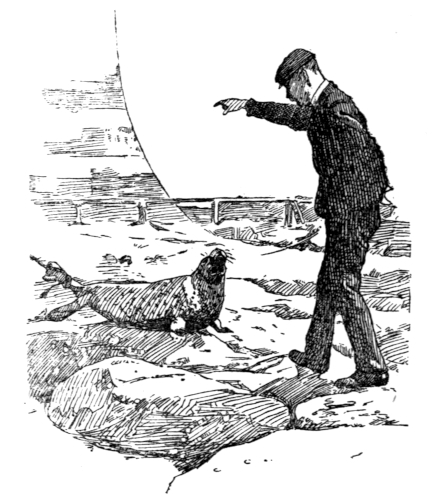
As the tide covered the Rock he could be seen in the clear moonlight ploughing along the creamy surface, stretching his tether in every direction in futile efforts to escape. At daylight next morning he was found sheltering under a projecting ledge of rock. What a clean, well-groomed fellow he looked, with his sleek, glossy coat glistening in the sunshine, his squat, plump body adapting itself to the inequalities of the surface on which it rested. His coat, by the way, as much fur as that of a horse—grey above, mottled with dark spots, while the under surface is of a creamy yellow. His beautiful teeth gleaming white against the scarlet interior of his mouth, as he snapped fruitlessly on either side, suggested the maximum of robust animal health. As a memento of his visit the camera was brought on the scene, and another addition made to our list of illustrious visitors.
Liberating him proved to be more difficult than his capture, for when cut adrift he persisted in facing us instead of making for the water, towards which we endeavoured to drive him. After some manœuvring, however, he was driven to the edge of the gulley, but even with his body half submerged he maintained a defensive attitude, not seeming to realise that he was at liberty to depart. An incoming wave, however, moved him to a sense of his position, and with a defiant snort he slipped under water. Omitting, in his hurry, to take proper bearings, he took the wrong direction, and, finding himself in a cul-de-sac, made his appearance again on the surface, and with a hurried glance at his position again sank, this time making a bee-line for the outlet, being clearly seen, as he passed under water close to where we stood, and was last seen buffeting his way through the foaming breakers, evidently none the worse for his compulsory detention on the Rock.
December 1902
DECEMBER 1902.
The broken stones and other debris, consequent upon the late alterations here, which had collected in various holes in the Rock and maintained their position up till now, have nearly all been cleared out by the severe gales of this month, and a couple of heavy iron poles, erected lately to mark the boat tracks or entrances to the landings, and which were sunk two feet in the solid rock and heavily cemented, have been shaken loose in their sockets by the pounding seas which have been besieging us of late. The rocks appear bleak and bare, and utterly void of vegetation. The white whelks have collected their scattered forces, and gone into winter quarters. Secure in sheltering nooks, they lie huddled together in close packed squadrons. Numerous small white banded whelks adhere to the base of the tower with a tenacity that seems surprising considering the swirling seas they are subjected to. This species, however, never seem to dream of hibernating. The eiders and longtails, with an unswerving attention to business, pursue their calling amid the hurly-burly of broken, tumbling seas—evidently little concerned whether the weather be fair or foul—and in the glassy hollows alternating between the breakers they can be distinctly seen scurrying over the rock surface like so many fish. Gannets this month are conspicuous by their absence, and only a few parasitic gulls divide their attention between the kitchen refuse and the hard won earnings of the eiders.
On several occasions during the month our fog signal was brought into action through the occurrence of heavy snowfalls. A silent, feathery fall on shore no doubt has charms peculiarly its own, but at sea constitutes a very serious danger to the anxious mariner as he steams at reduced speed through the fleecy curtain, shrieking his every two minute warning, his vessel’s head scarcely visible from the bridge. In snowstorms such as we have had of late our lantern soon becomes plastered up with snow on the weather side, necessitating constant removal to prevent it from completely blinding our light in that direction. This is an operation often accomplished with difficulty, especially when carried out in the teeth of a gale—an experience somewhat akin to lying out on a yardarm under similar conditions, only one doesn’t have the lift and ’scend of the vessel to contend with; yet his grip must be equally as sure, or, as the old salts phrase it, “Every finger a fish-hook,” on such occasions. Mounting by an outside ladder to the grated gallery which encircles the base of the lantern, one is exposed to the full force of the blast, and a firm grip must be taken to avoid being blown away. Below, the seas in wild tumult break against the building with a deafening roar, sending a perceptible tremor through the entire structure with each impact. Only by energetically hauling on the hand-rail can the slightest progress be made in the desired direction, the wind’s eye being the objective point, where possibly on arrival one may find himself pinned flat to the lantern, like an entomological specimen, by the force of the wind. The snow removed, the return journey is effected by simply allowing oneself to be blown gradually back.
While relieving the Bass Rock on our way ashore last relief, a good opportunity was afforded of witnessing the mode of effecting a landing under adverse circumstances. On arrival there, it was considered dangerous to attempt a landing at either of the two landing places, owing to the heavy sea then running. The landings—a flight of concrete steps from the water edge to the rocks above—are situated on either side of a slight promontory immediately beneath the lighthouse; and as deep water obtains to the rock face, it will be obvious that similar conditions must frequently prevail at either landing. The boat being loaded with the necessary stores, and the relieving keeper on board, an approach was made to within suitable distance of the Rock. A kedge anchor was then thrown overboard, and the boat slacked down till within working distance. The keepers meanwhile had been busy erecting an iron pole or derrick on the rocks above the position now occupied by the boat, and which, being slightly inclined seawards, a tackle from its extremity was drawn by means of a guy-line to the boat, and the stores hoisted ashore by the keepers in charge of the tackle-fall above. Seated in a loop of the rope, the relieving keeper was then hoisted, and his shore-going neighbour similarly lowered. As an extra precaution, a second boat was sent from the ship to stand by the working boat in case of accident. Fortunately, however, their services were not required.
Our final relief here for the year was effected with some difficulty on the 29th. Owing to the doubtful aspect of the landing, only one boat was sent ashore instead of two as usual. The fortnightly supply of coal and water being omitted on this occasion does not, however, inconvenience us, as a three months’ reserve stock of necessaries is always maintained during the winter months.
January-February 1903
JANUARY-FEBRUARY 1903.
Bright, sunny weather characterised the opening day of the year, the sea assuming a suspicious placidity quite summer-like in appearance but for the keen nip in the air perceptible out of doors. This state of affairs, however, proved but ephemeral, and for the remainder of the month we have experienced most boisterous weather. Strong westerly winds occasionally attained the force of a gale, accompanied with driving seas, which roared and sang a lullaby scarcely compatible with the shore-dwellers’ sense of security, but which, strange to say, has a more somnolent effect upon us than a breathless stillness, though an occasional thumper of a sea, more forceful than its fellows, demonstrates the stability of our domicile by imparting a gentle tremor to the entire structure, awakening in the sleeper a glimmer of consciousness and a hazy impression of a traction-engine lumbering somewhere in the vicinity.
Our entrance doorway—thirty feet from the Rock—faces south-west, and is guarded by a heavy double leaved door, which opens outwards, and held open against the building by means of heavy brass thumb-snecks. An inner or vestibule door of solid brass is placed six feet further inwards—the walls here, by the way, being seven feet thick, tapering to one foot immediately beneath the balcony, sixty feet higher up. This door is also double-leaved, with the upper panels of heavy plate glass, frequently obscured by the strong westerly wind whipping the tops of the seas as they rise in front, and carrying them souse into the doorway. Standing here during the prevalence of a gale, the outlook is being constantly darkened by a curtain of hissing foam drawn across the doorway, as each sea breaks against the base of the tower, flinging the spray high overhead. Fifteen miles in front of us lies the Isle of May, with its castle-like lighthouse crowning its summit, while on a lower level stands a whitewashed relic—remnant of a time, not so long ago, when the Island boasted a double light, and electricity had not as yet usurped sole sway. Emerging from the right of the May appears the bluff outline of the Bass Rock, while away in the far distance North Berwick Law cleaves the sky-line. Away to St Abb’s Head, on the left, the Haddington coast stretches hazy and indistinct, while the green, grassy slopes of Fife, with the spires of St Andrews faintly visible, fill in the right of the picture. Laying hold of the man-ropes suspended in the doorway, and turning to the right, the Forfarshire coast is seen extending from the Tay in a long unbroken line, with the snow-clad Grampians towering majestically in the background. Right in front of us are the smoking stalks of Arbroath. Two conspicuous white dots in the foreground mark the pierheads, in front of which an impatient “flaxer” cruises in glorious uncertainty of ever being permitted to fulfil her charter and deposit her Riga-run freight on the right side of the bar. This is the panorama from the viewpoint of our doorway on a clear day, but, as seen of late through sheets of flying foam, it reminds one of a cinematograph display, in which the films are far from perfect.
On the first Sunday of the year hundreds of gulls were seen resting on the surface of the sea, half a mile nor’-west from here, evidently by their movements enjoying a feast of “fry,” and in all probability proclaiming the presence of herring shoals. During the gale of 10th January over a dozen gannets were seen swooping and diving, presumably at herring. Only with difficulty could we maintain our position on the balcony, owing to the force of the wind, yet these birds circled and dived amid the turmoil of wind and water with a graceful ease and precision that seemed truly wonderful considering the force of wind they occasionally beat up against, or, as they turned broadside on, were wafted without the least exertion in the opposite direction. The first week of February saw hundreds of these birds back to their breeding haunts on the Bass Rock. From the deck of the “Relief” steamer lying within a few hundred yards their movements are clearly seen. Each projecting ledge of the precipitous cliffs is tenanted by some members of the cackling crowd, their heads see-sawing from side to side. The birds are evidently engaged in brisk conversation, a monopoly of which is certainly not tolerated amongst them, judging by the vigorous efforts of each to be heard above his neighbour. Probably the new lighthouse is being discussed in the light of an innovation on their ancestral rights of possession, and later, as its beams fall athwart their nursery, tradition may recall man’s former intrusion on their solitary keep many hundred years ago. No doubt their ups and downs since last meeting on terra firma are fully discussed, for it is a curious fact that these birds are rarely, if ever, known to rest on shore except when engaged in domestic duties. Occasionally a depraved specimen may be seen floating helplessly on the water, a victim of his own gluttony, having dined not wisely but too well.
February has been a repetition of its predecessor, cold and blowy, with excessive rainfalls. In a shallow depression on the higher rock surface our attention has been attracted to a solitary plant, a specimen, I understand, of “Himanthalia lorea.” A cylindrical stem (an inch in length) supports a thick, fleshy disc, about an inch in diameter. From the centre of this disc three separate branches rise with their terminals, blunted at first, but which were gradually seen to bifurcate. This is our “flower in the crannied wall,” and is in its own way equally as suggestive.
The eiders are occasionally seen varying their diet with a vegetable course. Seizing the tip of a tangle blade two or three inches from the surface, they spin round it like a top, till the portion held in their bill is twisted off and greedily swallowed. No need for them to evade the gulls while engaged in this repast. It is most amusing to witness the discomfiture of the gulls as they hurry from a distance expecting to share in something edible, only to find the duck negotiating six inches of seaweed. That the white whelk itself is not immune from enemies was recently brought before our notice, one being picked up with a long black worm dangling from its mouth. On withdrawing the worm—somewhat resembling a boot lace—portions of the deceased tenant followed. Doubtless every organism has its own particular parasite.
“Big fleas have little fleas upon their backs to bite ’em, And these again have lesser fleas and so ad infinitum.”
March 1903
MARCH 1903.
Traditionally correct, the advent of this month was decidedly leonine, and its exit as certainly lamb-like; but between these periods, though a few really beautiful days could be credited to the latter symbol of peacefulness, the lion was largely in the ascendant. Borne on the off-shore wind comes the odour of heather—not the fragrant perfume one usually associates with this sweet-smelling plant, but the smoky incense consequent on moor-burning—and at night the higher levels of the coast line exhibit lights which are certainly not recognised in the Mariners’ Sailing Directions.
Over a score of steam trawlers have been busy in our neighbourhood all the month. Sunday or Saturday is all the same to them; they are at it night and day, and the weather must be bad indeed to detain them in port. Often they are seen passing here burying themselves to the foremast in the seas on their way to the fishing grounds, perhaps twenty miles outside of us. The Rock seems to be a recognised stage in their journey; for, whenever abreast of it, over goes their log, and a compass course is laid for the distant banks. Here, far outside the three-mile limit, the presence of the Brenda or the Minna[1] causes no alarm; and, providing their numbers are correctly exposed, receive no interference from these coasting policemen. A few summers ago, one of these same trawlers, while on her way out from Dundee one Sunday, surprised us by driving right up on the reef in broad daylight, a hundred yards from the tower. Fortunately, the sea was like glass at the time, otherwise the consequences must have been disastrous. The tide being on the ebb, their attempts to back off were unsuccessful; and there they remained hard and fast from one o’clock till six in the evening, when a passing trawler succeeded in towing them off, evidently none the worse of their brief acquaintance with the Bell Rock. During their detention, the crew paid us a visit in their boat, recalling to our mind a story in which a clumsily handled brig, in coming to an anchorage in a crowded harbour, ran aboard of a vessel already anchored. Visiting this vessel a few days later, to apologise for the occurrence, the offender was thus announced by the steward: “Captain S—— has come on board, Sir.” “Oh, indeed,” sarcastically remarked the aggrieved mariner. “Has he brought his brig with him?”
The rocks are this year more plentifully strewn with mussel-spawn and acorn barnacles than usual; and already the whelks have sallied from their winter’s sleep, bent on their destruction. Hundreds of hermit crabs have also made their appearance, notably first in the deeper pools, but gradually taking up their quarters in the shallows. Towards the end of the month, a few small spats of paidlefish spawn were seen deposited in convenient crevices of the rocks. This is unusually early for “nesting” operations, and engenders hopes of an early fishing, as the ova is generally the first inducement for the wandering cod to come within reach of our rods. Numerous clusters of the wheat-like ova of the white whelk are also seen; but, unlike that of the paidlefish (lumpsucker)—which may be detached from its gelatinous fastenings in a solid mass—each egg adheres separately by its own footstalk. Though the adult “paidles” are only to be seen here during the period of incubation—the term seems quite applicable, seeing that the guardian “cock” is always in close attendance, with his nose thrust into the centre of the mass of ova, at which point there is always a depression, and frequently a hole right through it—juveniles are occasionally met with at all seasons; and, on the first anniversary of their birthday, are seen to have attained the length of two inches.
Numbers of peculiar looking slugs are met with at present, somewhat resembling a section of a small orange with the skin attached. On their upper surface, near to one end, a minute orifice is seen, through which a small rosette like arrangement is protruded when at rest, but which is instantly withdrawn when the animal is disturbed. This is the only visible sign of life in this otherwise inert object, and is probably its means of obtaining a living. Its under or ambulatory surface is similar to that of a limpet, without its tenacity, but with a somewhat similar rate of progression. Another small slug noticed this month—no larger than one’s finger nail and recalling the general appearance of the “fretful porcupine,” with “quills” arranged along its back, and displaying beautiful shades of brilliant blue and crimson.
Saturday, 14th.—A beautiful warm sunny day, the sea like glass, dappled here and there with great greasy-like patches peculiar to still weather. Flocks of eiders, longtails, and gulls appear to be having a day off, and float listlessly hither and thither, seeming only intent on making themselves aggressively audible in the stillness, the longtails piping a shrill treble to the sonorous bass of the eiders, while the gulls contribute a fairly good imitation of a laughing chorus. Later, the gulls are seen to bestir themselves, as myriads of small circles break the glassy surface in their vicinity, betraying the presence of “fry,” their legitimate food. Pecking from side to side as they float silently through the shoal, they evidently enjoy the feast thus provided for them. The sight of the gulls thus engaged apparently reminds the ducks of their negligence in this respect, and paddling full speed ahead, they are soon busy diving in the shallower water of the reef. The longtails push their way right up to the base of the tower, round which they are seen circling, plucking at the green vegetation adhering to the stonework, and cackling loudly as they breathe for a few seconds on the surface, all unconscious of our presence on the balcony above them. A small piece of coal dropped while they are still under water causes them to shoot away like startled minnows, and only when they have put some distance between them and the source of alarm do they make their appearance on the surface, evidently much flustered by the mysterious noise. Though a couple of fathoms deep, their alarm was apparent at the same moment the coal struck the surface, proving that the sound and not the appearance of the falling body was the disturbing cause. The end of the month still sees them in close attendance, but any day now may witness their exodus. But few spring migrants have come our way this month, principally a few blackbirds, thrushes, and starlings.
April 1903
APRIL 1903.
Warm, sunny weather in the earlier part of the month raised our hopes of a change of diet, and, coupled with the early appearance of the paidlefish spawn, our expectations of an early fishing ran high. On the 8th, the capture of three small cods in “Johnny Gray” track increased our hopes, and again on the 9th, eight were taken, but since then we’ve had no other. Cold, blowy weather, with heavy seas, has rendered all attempts in this direction futile; however, the attraction—as evidenced by the stomachs of those captured—still increases, and numbers of bloated paidle “hens,” with their lower jaws protruding like a prize bull-dog, are seen cruising sluggishly among the tangles in quest of a suitable nesting place. The nests this season are unusually small; sometimes they contain as much ova as would fill a quart pot. Each ovum is a sixteenth of an inch in diameter, and were all permitted to come to maturity—instead of becoming food for other fishes as most do—would soon fill the sea of themselves. “All nature is at one with rapine and war,” and necessarily so, otherwise we would soon be crowded out of existence.
Our winter residents, the eiders and longtails, have gradually disappeared. On the 4th, a representative pair of each alone remained, but these have now thought better of it and gone the way of their more sensible comrades. A few gulls, herring, and kittiwakes hover about, and guillemots and gannets are now common.
The gannets, I am informed by the keepers on the Bass Rock, commenced laying there on the 11th. The solitary egg these birds deposit is heavily coated with lime, which, when scrubbed off, exposes a pale blue surface. This coating is probably the origin of the fallacy that these birds ensure the safety of their eggs by cementing them to the bare rock. On the contrary, each nest is composed of quite a barrow-load of material of the most miscellaneous description. One of these nests noted on the Bass this season was seen to have the end of a soft-soap barrel for a foundation, armfuls of withered grass, dried tangles, bits of rope, string, cotton waste, and other flotsam and jetsam picked up about the Rock. Amongst the lining of the nest, pheasant and partridge feathers were seen, which were certainly not garnered on the Bass. The harvesting of the withered grass was accomplished between dark and daylight, and, therefore, unnoticed by the keepers, but the area of their operations, as seen next day, suggested the presence of a lawn mower. Thousands of these birds are slaughtered annually by the St Kildians as an article of diet, and the wonder is, considering the solitary egg deposited and that three years elapse before the adult stage is reached, that they continue so numerous.
Dr Wallace, in his “Natural Selection,” speaking of birds in general, tells us that, if permitted to live, in the ordinary course of production “in fifteen years each pair of birds would have increased to more than two thousand millions. Whereas we have no reason to believe that the number of the birds of any country increases at all in fifteen or in one hundred and fifty years. On the average, all above one become food for hawks and kites, wild cats or weasels, or perish of cold and hunger as winter comes on.”
Myriads of white whelks are now scattered over the Rock surface, and already patches of mussels and acorn barnacles have been cleared by their voracity. Their ova, which is to be met with in almost every nook and cranny, is left to take care of itself. A patch of this ova is situated in a position which a paidle-hen subsequently fancied for a nursery, and, scorning all rights of possession, plastered her ova indiscriminately over that of the whelks, with the result that they are now under the special care of the guardian “cock.”
A stranded cuttlefish was an object of much interest one evening this month. What a queer-looking object it appeared, with its eight long tentacles squirming in all directions, its body a slobbery mass of animated mucilage. Although only a foot in diameter it required some force to detach it from the rock, as each of the tentacles is furnished with rows of suckers on its under side. By extending the tentacles in front, the animal was able to move along the Rock surface, not in a jerky fashion, as might be expected, but with a continuous gliding motion, clearly showing that each sucker acted independently of its neighbour. If taken hold of, one or other of the tentacles is immediately twisted round the hand with a tenacity that seems surprising considering the size of the animal, and one can then realise to some extent the stories occasionally heard of its giant relatives of the tropics. Irritated, it appears to have the properties of the chameleon, flushing through all the gradations of colour in quick succession, and latterly discharging a jet of fluid of inky blackness. This resource, however, was utterly useless in the present circumstances, but, on placing the animal in a shallow pool of water, its use was at once apparent, for on being touched it immediately rendered itself invisible by the inky fluid discharged. Frequent irritation, however, exhausted its stock of ink, and latterly only clear water was expelled. This expulsion, when effected on the Rock, was accompanied by an audible murmur. The narrow slits of eyes closely resemble those of a dog-fish, and the head, with the anterior tentacle elevated in the air, grotesquely reminds one of an elephant in the act of trumpeting.
May 1903
MAY 1903.
During the first few hours of this month our lantern was the centre of a twittering throng of feathered migrants. Wheatears, rockpipits, starlings, wrens, and robins fluttered erratically through the rays or clamoured in their innocence against the glass, apparently desiring a closer acquaintance with the source of light. Puffs of feathers floated away on the easterly breeze as some unfortunate, less discreet than his fellows, crashed against the invisible barrier. The coming dawn, however, reveals to the survivors the absurdity of their position, and ere the light is extinguished they have resumed their journey shorewards. Frequent fogs occurred in the earlier part of the month, and during the prevalence of a long spell a long-eared owl was captured on the balcony and held prisoner for a week, during which time various samples of our commissariat were offered for his acceptance without avail. A luckless sparrow, the only one by the way I have seen here, was then captured and placed at his disposal. This proved more in his line of business, for on the morning after the rump and tail feathers alone were left. Next day the indigestible portions, feathers, etc., were cast up in the form of a compact ball. Later a thrush was similarly offered, but after a couple of days in each other’s company remained untouched. It was amusing to see the spirited attitude assumed by the thrush when in the presence of his natural foe. Screaming aggressively at the slightest movement of the owl, he would lunge furiously in his direction, his bill all the while snapping audibly. The fog having cleared somewhat, both were then set at liberty.
Another very rare visitor seen here this month was a sheldrake, which passed close overhead flying south. This is the first I have seen here, but in Orkney these birds are very numerous and are there known as the burrow duck, or sly-goose. Sly they certainly are, as evidenced by a pair which nested regularly within a couple of hundred yards of the lighthouse at which I was then stationed. A covered drain was the site annually chosen, the nest being placed several yards from the mouth, which opened out on a spacious grassy hollow. The bright brown and white plumage, with vermilion bill and feet, render these birds most conspicuous objects in an ordinary landscape; but squatting on a shingly beach, where their colours harmonise better with their surroundings, their presence is less easily detected. Frequently I have watched their movements with a telescope from the lantern, and though no one was stirring within seeing distance of them, the greatest caution was always exercised in approaching the nest. Lighting a hundred yards from the nest, a pretence of feeding diligently was made, though their heads could be seen frequently lifting in the direction from which intrusion was to be expected. Gradually circling nearer the nest, passing and repassing it with apparent indifference, till within a few feet of it they would then suddenly vanish. The exact moment of their entrance I was never able to note, as they appeared to assume an invisibility during the remaining few feet of their journey that was really astonishing, but which is less a matter of surprise when one has witnessed the squatting in concealment of a hen pheasant on sparse grassy ground. Burrow duck is a name applied to these birds from their habit of nesting in disused rabbit burrows. I have counted as many as forty young ones following a single pair, while others may have only three or four juveniles in their train. It is said they do not scruple to steal the young ones from each other. If alarmed while feeding among the decaying seaware on the beach, some of the parents will fly to meet the intruder and endeavour to divert his attention in another direction, while the others fly seawards, followed by their callow broods flapping their little wings, while their feet tip-tip the surface—a veritable walking on the waters.
Just as the rocks were being overflowed the other day, we had a visit of another bird which is but rarely seen here, namely, the oyster-catcher. The plumage beautiful black and white, the feet and bill a brilliant red; the latter, which is flattened vertically, suggestive of a stick of sealing wax. Though fairly well acquainted with this species, I never had the good fortune till now to see them in the rôle of limpet pickers, by which name they are known in some localities. From the balcony, with the aid of the telescope, his movements were brought within a few feet of us. Wading an inch or so deep, where the limpets were probably opening to the influence of the incoming tide, he appeared to make a judicious selection; then, with a single sidelong blow of his chisel-like bill, he turned the no doubt astonished mollusc upside down. Seizing it in his bill, he carried it to a still dry portion of the Rock, and in a twinkling he had the limpet out of its shell, and journeying up his long bill to its doom. The tip of the upper mandible appeared to do the scooping out, while the lower merely acted as a resistance outside the shell, the operation being performed more quickly than even the adroit oyster-man turns out his wares on the half-shell. Though not web-footed nor in the habit of diving, I remember seeing one of these birds, which had been winged with a gun-shot, dive repeatedly in order to escape further injury.
On the afternoon of the 16th, two days earlier than last year, a loud chorus of discordant voices floating to our bedroom windows announced the presence of a large flock of terns—their first arrival here since wintering in the sunny south. Screaming and diving, they appear tireless in the pursuit of their prey, which, with the aid of the telescope, is seen to consist of inch-long “fry.” How trim and neat they appear as they cluster on the rocks as the tide recedes, pruning their feathers and chattering vociferously; the head enshrouded in a black, glossy skull-cap, the back and wings a bluish grey, the under parts of unsullied white; the long sharp-pointed scarlet bill tipped with black in harmony with the legs, and small webbed feet. This active little bird is also called the Sea Swallow, an alias assumed from its long narrow wings and forked tail.
The sea has been literally alive with large poddlies this month. Morning and evening they can be seen “breaking” on the surface in pursuit of “fry,” splashing loudly in their efforts. Though somewhat averse to our lure, we generally manage to secure a breakfast. On quiet, still days, good sized cod are seen prowling over the rocks; and, though lines were set at low water, they were seen at high water to pass the temptation with indifference. Fishermen aver that all fish have times when the most tempting delicacy fails to attract their attention; and possibly this is the case with those which have been lately under our observation. Hermit crabs at present are seen to be carrying spawn; and one which was removed from its shell was seen to have the spawn so far advanced that, when placed in a shallow pool, they released their attachment with the parent, and began life as free swimmers. A small fish of the blenny species, when taken from the crevice in which the tide had left it, was quite dark coloured, but when placed in a pool was seen to adapt itself to the colouring of the bottom on which it rested, assuming a mottled grey scarcely distinguishable from the pool bottom.
Painters have been busy for the latter half of this month repainting the outside of the building. Favoured with suitable weather, a fortnight sufficed for the operation of donning the triennial coat, which will explain the apparent proximity with which it has been lately viewed from Arbroath.
June-July 1903
JUNE-JULY 1903.
A close inspection of the flowing tide as it swirls around our gratings reveals the presence of myriads of minute globular jellyfishes—the cydippe pileus—said to be the favourite food of the arctic whale, though one would scarcely expect these bulky cetaceans to thrive or even subsist on such watery diet. Ranging in size from a pin head to a walnut, what a gap each mouthful must make in their numbers. The poddlies themselves are not averse to this form of food, as they are occasionally seen to disgorge them when landed in our doorway. The common jellyfish progresses through the water with a pulsating movement of the entire disc, such movement being termed “pulmonigrade,” and somewhat resembles the action of an umbrella being partially opened and closed. The mode of progression in the case of the cydippe is, however, different, and is termed “ciliograde,” as the propulsion is effected by means of eight vertical bands of cilia or minute plates overlapping each other. Each plate having an independent action of its own, the animal can propel itself in any desired direction, or, by resting them against its spherical body, sink to the bottom. In sunshine these animals in their evolutions emit the most beautiful combinations of colour one could imagine, but “you seize the flower, its bloom is shed”—scooped up in the hollow of the hand their beauty vanishes, and only a small spat of inert transparent jelly remains. Here at present in the Rock pools one may witness a peculiar phase in the evolution of the jellyfish. Along with many beautiful varieties of marine vegetation, miniature forests of fir trees garnish the bottom of each shallow pool. These lilliputian firs, with their branches no thicker than a hair, are but plants in semblance, for here is the opening chapter in the life history of the medusae. Under the lens each fragile shoot is seen to consist of multitudes of small discs piled upon each other like so many saucers, each of which will, in due course, detach itself from its neighbour and enter on its new existence as fully equipped as the exaggerated specimens frequently seen stranded on our beaches. Lurking amongst the vegetation in the pools are numerous tiny spider-crabs, roaming about in search of food. Only by their movements can they be located, as each bears about with it quite a luxuriant growth of vegetation, with which I understand all crustaceans would become invested did they not—ludicrous as it may seem—regularly attend to their toilet. The “spider,” however, unable to procure a living by force of arms like his bigger brother, has recourse to the subterfuge of posing as an innocent patch of marine vegetation, and by such concealment is enabled to capture food which would be otherwise unattainable. The females at present are seen to be carrying spawn. When changing their position in the pool it is somewhat surprising to see a portion of the plants, which one has been admiring, suddenly become endowed with the powers of locomotion, detach itself from the mass, and, ambling leisurely round the pool, come to rest on the fringe of some other patch with which it completely harmonises.
During the whole of June, at daybreak and again in the evening, the sea around us appeared literally alive with large-sized poddlies. Their continual flip-flop on the surface in pursuit of “fry” could be distinctly heard from the balcony. Though frequently within reach of our attempts from the doorway, they failed to appreciate our invitation to any extent, and only with much perseverance did we occasionally manage to breakfast at their expense. A few cod have been taken from the pools at low water. The deepest of these pools is about a couple of fathoms at low water, and has the reputation of being a sort of convalescent home, as fish are occasionally taken there which are in anything but the pink of condition. Fishing there lately, I hooked a cod two feet long, and was somewhat surprised to see the feeble resistance it made. On landing it, however, it was seen to be a most phthisical-looking specimen and in the last stages of emaciation, the bones almost protruding through the skin. Needless to state, his life was spared, and the patient returned to his element. I have frequently seen emaciated specimens of the cod family, but as they were full grown, fishermen attributed this to old age, but this was certainly not the case with our catch, it being but half grown.
I often wonder if any one has noticed the following peculiarity. When fish show an unusual tenacity of life, that is, after being gutted and cleaned, exhibit strong muscular action for some time after, that this phenomenon invariably precedes a change of some kind in the weather, usually more wind or heavier sea. This at least is my experience from several years’ observations.
The remaining patches of white whelk ova now appear flaccid and empty. Brushing the hand over the apparently empty capsules, a granular deposit adheres to the skin, which on close examination is seen to be minute whelks. Even with the aid of the lens the sulci or furrow, through which boring operations are conducted, is not yet apparent, but which later is common to this species. The rocks at present are thickly sewn with these juveniles, and myriads of adults are busy clearing the rocks of barnacles and immature mussels. As late as 28th July a solitary paidle-cock was seen guarding its nest; this is unusually late, as they are generally finished nursing by the end of June.
The middle of July brought us our first young tern, and towards the close of the month several were in attendance. A large school of bottle-nose whales crossed the reef on the last Sunday of July, their puffing and blowing being quite audible as they headed north, probably after herring.
Pleasure steamers from Dundee have been frequently round the Rock during June and July, some of the trippers evidently enjoying the sail, others emphatically not. One of the passengers, as the steamer got to windward of us, favoured us with a cornet solo, which we gratefully acknowledged with a dip of our flag. On several evenings an hour’s fishing was given the passengers, but their catches could scarcely be expected to have any appreciable influence on the market. Broken weather, excessive rain, with occasional thunderstorms, describes the weather we have been having, the seasonable days of sunshine and warmth being few and far between.
August 1903
AUGUST 1903.
A month of variable weather, much rain and heavy seas occasionally compelling the boats engaged in the herring fishing to run for it. Dearly bought indeed is their silvery freight as they thresh their way homewards followed by a stiff sou’-easter, their oilskins glistening with repeated drenchings, and twelve miles’ ploughing and a doubtful bar yet to be negotiated ere safety is reached. How different! no running for home with us; here we remain secure and comfortable amid the hurly-burly, and trust to the stability of the grand old building for our safety. Right well does it merit our confidence. After a century’s buffetings with the elements, not a single sign of weakening in the never ceasing conflict is evident. Surely a creditable testimony to the honesty of the labour employed in its erection.
That herring are occasionally in our vicinity is evidenced by the industrious diving of the gannets, accompanied by large flocks of gulls and terns, and also by the presence of whales snorting and puffing close to the Rock. At low water the reef is covered with gulls and terns resting from their labours of the tide. Scorning such relaxment, the gannets, wheeling and diving, maintain their ceaseless chase, establishing their kinship with that bird of the Ancient Mariner, the tireless albatross. A skua or robber-gull has billeted himself amongst the gulls and terns, and is frequently seen harrying them of their legitimate prey. It is surprising that the terns at least, with their needle-pointed bills and belligerent propensities, suffer themselves to be so despoiled, and make no attempt to combine and drive off this pirate on the fruits of their industry. On the contrary, after a fruitless twisting and doubling in mid-air, in which they are invariably worsted, they seem to accept these periodic attacks of the skua as a matter of course.
Amateur fishers have been but seldom in evidence here this summer; even the lobsters have enjoyed a season of comparative rest. Possibly the uncertain state of the weather prevented their usual visits. Towards the close of the month a trio of amateurs cast anchor—or rather what does duty as such—within hail of our kitchen window, a favourite spot of theirs. Lines were no sooner down than a brisk business began in cod, varied by an occasional poddley which has little or no market value, but which to us here is always acceptable, and forms the principal part of our catches. Several good catches of these have been taken here during the month. What appears to be whitings two inches in length is seen to be their food at present. The terns also are seen to be on similar diet, and though engaged in conveying a mouthful to their young ones, it in no way impedes their full flow of language, nor muffles in the slightest degree their strident throat notes.
During the unusually low tides occurring this month an opportunity was afforded of examining a most peculiar form of animal life of which I have nowhere seen any account. Attached to the rocks amongst groups of corallines this curious object[2] has all the semblance of a bird’s claw. Imagine the leg of a bird amputated at the knee, firmly fastened to the rock by the cut end, and imbued with life, and you have a fair idea of this animal. About half an inch in length, the “leg” is seen to be composed of segments, and terminates in three toes, furnished with sharp, curved claws, which keep up a constant clutching—at what is not apparent; but the action strongly reminds one of a similar effect produced by juveniles who have become the proud possessor of a hen’s foot, and for a piece of slate pencil—the usual juvenile currency—demonstrate to admiring companions the utility of the extensor muscles.
Last month we had the unique experience of being serenaded by the Dundee trippers with a cornet solo, but the last Saturday of this month fairly eclipsed this performance. As we were about to sit down to tea we were somewhat startled to hear the regular beat of a drum and the unmistakeable music of the bagpipes. A hasty survey from the kitchen window sent us flying to the balcony, there to witness the novel sight of a ship, manned by boys—a training brig evidently, bound for Dundee. Bearing down upon us from the eastward, she approached close to the Tower, the tide being about full. Flag courtesies being exchanged, crowds of juvenile faces were seen lining the rail, while midships pipers discoursed some lively music, including the “Cock o’ the North.” The wind being light, the vessel made but little way, and as she slowly crossed the reef the youngsters lustily cheered us, which we returned as best we could. Breaking into song, the whole ship’s company favoured us with “Poor Cock Robin,” the youthful voices having a most pleasing effect in the stillness of a really beautiful summer’s evening. Applauding our loudest, cheers were again exchanged as she slowly drifted beyond our hearing, the whole scene strongly reminiscent of “H.M.S. Pinafore.”
September-October 1903
SEPTEMBER-OCTOBER 1903.
The man that pours the water out has certainly been paying attention to his business, and in conjunction with the puffy bellower of storms favoured us with weather anything but peaceful. Unlike the farmers, we have little cause of complaint. No sodden fields or ruined crops appal the eye, for even after a “regular snorter” things here remain pretty much as they were. True, the aspect changes as the season advances. The whitewashed appearance of the rock surface in summer, due to the presence of the acorn barnacle, has now vanished—thanks to the voracity of the white whelk—and the rocks appear in their natural colour, a reddish-brown. The “sere and yellow” is well represented in the once luxuriant crops of heavy tangles, but lately swaying on the surface with a freshness and beauty peculiarly their own, now storm-tossed, frayed and abraded, denuded of their palm-like fronds, they appear but a vestige of their former selves. The turbulent state of the weather interferes seriously with our fishing, keeping the poddlies at a respectful distance from our door; indeed, any approach in our direction at present would certainly denote suicidal mania on their part. At a safe distance outside the breakers, they are to be seen playing on the surface in the early morning and evening, so that our expectations are still high should the weather but abate.
The eider ducks, which on the 20th September were represented by a solitary individual—the first arrival—now number over a hundred. The longtails are still awanting to complete our list, but their advent may be looked for early next month. On suitable nights for the past two months we have always had some feathered visitors “becking and booing” to us through the lantern. On 4th October an extremely rare visitor—here at least—made its appearance, namely, the ring-ousel, the first I have seen. In size, shape, and general colouring, this migrant might easily be mistaken for a hen blackbird, but for the conspicuous white crescent across the throat, in this instance somewhat faint, but well defined, owing possibly to the bird being in immature plumage. On the morning of the 24th October over two dozen tiny gold-crest wrens were circling round our lantern, jostling and tumbling over each other in frantic efforts to keep in line with the white flash, the red flash evidently having no attraction for them. A skylark and robin were also of the company, as well as several redwings. The robin always seems to have a truer sense of his position than any other of our visitors. While the others clamour futilely against the glass he maintains an aloofness and self-possession truly remarkable. His eyes seem to be everywhere, and only with difficulty and the exercise of a little strategy is his capture effected. Of course, our captures are but temporary, and merely for the sake of a few minutes’ examination.
We had rather a disappointing experience with the Channel Fleet while cruising in these waters last month (September). Passing north in the dark, we were quite unaware of their presence, the Sutlej alone being seen later steaming north at 6 p.m. on the 21st, nearer to Arbroath than to us. On returning south a string of brilliant lights passing three miles outside of us at two o’clock in the morning was all we saw of the procession.
On 29th October a flock of thirteen field-fares passed at 9 a.m., flying towards Arbroath. This is the first arrival here of these birds, and earlier than usual.
On examining a lark which had been killed on the lantern the other night, a small land shell was found adhering to the feathers on the under part of the body. Arguing from this instance, the assumption that they also are imbued with the migratory instinct and adopt this mode of travelling would probably be considered far-fetched. That there is much undreamt of in our philosophy is as pregnant as when uttered, and possibly the connection between mollusc and bird was due to circumstances other than purely accidental.
November 1903
NOVEMBER 1903.
Sunday, 1st.—A flat calm. A pleasant change, indeed, after our recent experience, and one which has fortunately continued for the greater part of the month. Fish, which had maintained a safe distance during the turmoil of last month, now ventured within catching distance, and several good takes were had. After the middle of the month heavy seas again drove them out of reach into deep water. Those that were caught were seen to be gorged with soil half an inch in length, resembling a piece of white thread with a black dot on either side at one end representing the eyes. Amongst the first that were taken the small jellyfish—cydippe pileus—seemed to have been their principal diet, but latterly the soil appeared to be preferred to the medusae. Outside the breakers they are still occasionally seen playing on the surface in the evenings. “Playing” is scarcely correct, as their play is, in reality, strict attention to business, and their appearance on the surface merely denotes their having overleaped themselves in pursuit of their legitimate prey. Our flock of eider ducks, much larger than it has been for several years back, now numbers 120. Amongst the smothering breakers they seem to be in their glory, and are busily engaged in clearing off the immature mussels that have escaped the voracity of the white whelks. On the 2nd, the first two longtails were seen, exactly a week earlier than last year, but their numbers are being but tardily reinforced, as they only totalled six at the end of the month. Though the main body of the solan geese or gannets left their breeding haunts on the Bass Rock on the 5th of the month for the fishing grounds—in the Mediterranean it is said—occasional stragglers are still seen in our vicinity.
On the night of the 8th we had a few migrants on the lantern, ten blackbirds—three only of which were males—and three fieldfares. Several of them appeared much fatigued, and after a few preliminary hops round the lantern, settled down on the lee side to have a nap. A fresh breeze blowing at the time, those still on the move were frequently hustled by the wind against the sleepers, who, thus rudely awakened, vigorously resented what they no doubt considered a deliberate attempt to assault, with the result that all hands were at times engaged in a battle royal; the hen “blackies” only engaging with those of their own sex, while the cocks and fieldfares tackled all comers indiscriminately. It was rather amusing to witness the finish between a pair thus engaged. Edging round the narrow pathway in their struggle, they gradually came under the influence of the wind sweeping round the lantern, when suddenly one of them would be wheeled off its feet away into the darkness, its opponent peering after it in evident astonishment, and probably congratulating itself on its prowess. The haze, responsible for their appearance here, clearing after midnight, before 3 a.m. they had all resumed their journey shoreward. On the 20th, a pair of grey crows passed, going east, and on the 22nd a heron was seen travelling in the same direction. Again, on the night of the 27th, three hen blackbirds and a starling had the lantern all to themselves.
The white whelks have now gone into winter quarters, and only a few are to be seen lingering among patches of immature mussels. The black edible whelk, or periwinkle, whose vegetarian habits demand a more inshore life, is here conspicuous by its absence. Occasionally, during the summer months, a very close search reveals a few solitary specimens. Two different varieties of slugs have been much in evidence among the rocks here of late. One of them (Doris coccinea), resembling in shape and colour a section of an orange, I have already described; the other somewhat resembles the common snail. Furnished with anterior horns and fleshy spines, ranged along the back, it curls itself up when out of water like a hedgehog. Earlier in the season they were mostly of a beautiful bluish colour, now they appear quite red. Without any visible means of defence, one can fancy these shell-less molluscs furnishing a delectable tit-bit for a hungry cod.