Front matter (continued 3)
Reading edition
It is useless to go out specially to collect fungi, either during the dry hot weather of summer or the frosts of winter; it sometimes, however, happens that odd fungi may be found here and there, in out-of-the-way places, such as the sides of open cellars and sawpits, under bridges, on prostrate logs in streams, in damp outhouses, or about old water-butts, &c.; therefore I never go out without two or three old seidlitz-powder boxes, some thin paper, and a strong knife, in case any waifs and strays should fall in my way. I have sometimes found good species in a friend's dustbin or cistern, or upon the sides of the open cellar of a public-house. I once found an agaricus on the cornice of London Bridge, to secure which I had to get over the parapet, and was nearly being taken into custody as one tired of life; another time I found a colony of Coprinus domesticus upon a friend's scullery wall, and a Peziza upon my brother's ceiling. Moral: Fungologists' pockets should, at all times, contain one or two small boxes for securing stray and erratic members of the fungus family.
The equipment for a fungus foray differs with the nature of the fungi to be collected. If the plants sought for are wholly microscopic, a small vasculum, knife, pocket-lens, and package of thin paper will be found sufficient; but if Agarics, Boleti, the larger Polyporei, &c., are to be brought home, a more complete set of things will be required, which should include a very small garden-trowel or carpenter's gouge (any saddler or bootmaker will make a suitable leather case for the blades for a shilling or two), a strong knife—such as gardeners use for pruning trees, a few sheets of thin paper, a lens, pocket-compass, and some string. If truffles are desired, a rake is necessary, and the best plan is to carry the iron-toothed end separately in a leather case, and made to screw on to the end of a walking-stick; when not in use, this end can be carried in the pocket with the trowel, &c. It is requisite that the vasculum be large, with straps to carry it over the shoulders; and the collector should be provided with a set of cardboard boxes, large and small, to go inside the vasculum, and to contain the more delicate or choice spoils of the day. Leather gloves and a thin great-coat are good things for the chilly days of early winter—this coat should be provided with at least four large pockets; and, if the weather is inclement, strong boots and waterproof leggings will be found serviceable. An old felt hat and large cotton umbrella are also desirable, for it is only a piece of folly to go into the wet dripping woods with good clothes. As for the umbrella, it should be one of the Mrs. Gamp pattern, of good size, and with a (removable) ring at the end farthest from the handle, so that it may be suspended from branches of trees, &c., whilst the fungi are sorted or examined below, or a frugal luncheon is discussed (perhaps during a passing storm of rain). The string will be found useful for tying up the larger Polyporei; these are frequently of great size, and often weigh many pounds. In collecting, all Agarics should be kept separate as much as possible; for this purpose thin paper, such as is used by stationers and milliners, is indispensable; every specimen should be wrapped very lightly in a piece of thin paper before boxing, as the elasticity of the paper not only prevents breaking and bruising, but it also prevents the spores of one species being scattered over another. In carrying fungi about, or sending fresh specimens from one place to another, nothing is so good as this thin paper interspersed here and there with fronds of the common bracken. Sawdust, hay, or wool, should never, on any account, be used: such things totally destroy the plants; but with careful packing with paper and bracken-fronds, fungi may be transported for any distance, by rail or otherwise, perfectly intact and undamaged. In packing the vasculum, see that the heavier plants are at the bottom and the lighter ones at the top; for if packed otherwise any fragile species will be certainly destroyed. I have known a good collection of Agarics rendered worthless by a loose puff-ball being placed with them, which has rolled about with every movement of the collector's body, and damaged big and little species alike, when a piece of paper or a fern-frond or two, to prevent rolling, would have kept all quite safe.
It is hardly necessary to specify localities, because fungi abound everywhere. If leaf fungi are sought for, hedge-sides will produce an abundant crop; if the Agaricini and Polyporei, forests and woods must be ransacked; if the edible species are wanted, rich open pastures (with few exceptions) must be traversed: the various species of truffles must be looked for principally in leafy glades—many prefer a calcareous subsoil, but at times they may be met with even in hedge-sides, town parks, or elsewhere.
When the collection of the day is complete, no species must be allowed to remain in the collecting-cases all night; for if the boxes are not carefully opened and the contents laid out, it will probably be found in the morning that some will have dissolved into an inky fluid, others will have got into the treacle state, whilst a third lot will be overrun with mould, or the smaller ones perhaps entirely eaten up by slugs or larvæ. Few things decompose so rapidly as fungi, especially the full-grown Boleti; these, though apparently perfectly sound one day, will sometimes be a horrible mass of fœtid treacle the next. I have sometimes received large parcels by rail or post when this horrible stinking matter has been dripping out, perhaps all over the carter's hands or down the postman's trousers; for ladies always will send Boleti in bonnet-boxes, tied with thin twine. Should any extra charge be demanded, on the ground of the insufficiently prepaid postage, or the parcels be unpaid, I invariably refuse to take them in, to the disgust of the parties bringing them. I shall not soon forget an ill-tempered postman who brought me two of these dripping treasures at the same time last autumn, with a demand for extra postage, and his look of silent disrelish as he walked off with one twine-suspended bonnet-box in each hand, the fragrant Boleti-treacle meanwhile manifesting itself upon the pavement. Even when quite fresh, the odour of some species is disgusting in the extreme; for instance, a single specimen of Phallus impudicus in the collecting-box will affect a whole railway carriage with the most horrible and sickening stench; whilst the curious truffle Melanogaster ambiguus is perhaps worse still, for its abominable odour is perfectly insufferable.
To dry and preserve a collection of fresh fungi is at times a very difficult task; for instance, some species are so entirely covered with a tenacious gluten that if they were at once put between drying-papers, it is certain they would never come out again with the least chance of being recognized by even the most acute fungologist; others are so deliquescent that in an hour or two they would dissolve into a watery mass, soak through all the paper, and leave a mere dirty stain between the sheets where the plant was originally placed. As a contrast, some of the Polyporei (as the young state of Polyporus igniarius) are so hard that nothing but a steam-hammer would have any chance of flattening them. There is considerable difficulty in ridding the plants from the larvæ with which they are often infested. A few drops of the oil of turpentine will, however, generally drive them from Agarics and other fleshy fungi; and, in regard to the woody Polyporei, a good plan is to place the plants in an oven, or on a hob for a short time, where the heat is not too powerful to destroy the plants, but still sufficiently potent to drive the larvæ from their holes. If this is not done, the collector's experience will probably be the same as mine has more than once been; viz. on opening a package (which should contain some choice dried fungus), to find only a stain, a few skins of dead maggots, and a little dirt—in fact, some of the species in my herbarium, though mostly poisoned with corrosive sublimate, get entirely devoured by rapacious and poison-proof larvæ, mites, and minute beetles.
In addition, however, to the mere drying, certain notes and particulars are required, without which the best dried specimens are worthless; and, again, for the larger fungi to be of real service, the spores of each species must be separately preserved. As regards the drying of the fleshy fungi themselves, the process to observe is as follows:—Lay all ordinary Agarics out separately in a dry place, or in a current of dry air from six to twelve, or even twenty-four hours, according to the species, so that they may part with their superfluous moisture, and thus facilitate drying. In the case of species with glutinous pilei, it will be found that the gluten will more or less set, if carefully attended to, in a dry warm place. If the larger fleshy fungi are inadvertently placed under a propagating-glass, or left on a lawn or grassy place, or kept in damp air from over-night till next morning, the chances are that they will never properly dry at all. When the superfluous moisture has evaporated they may be put gently between drying-papers, but the weight put upon them must at first be of the slightest kind; ordinary books, more or less light, will be found quite sufficient; and few, or perhaps no other plants, require such frequent changing as Agarics. An hour, or often less, suffices for the first pressure, when care must be taken to supply them with fresh and perfectly dry paper, or they will immediately mould. It is a good plan, when the plants are half dry, to take them out of the papers and put them in dry air, or in a sunny place for a short time (the length of time being determined by experience and the nature of the species), to part with more of their moisture: so, with constant attention and frequent changing of the papers, very presentable specimens may at last be obtained. These dried fungi will now be found very useful for showing the more superficial characters of the plants; but without sections, spores, and proper notes, they will be next to useless. In Agarics it is of the first importance to show the nature of the attachment of the gills to the stem: and should the stems be furnished with a volva or annulus, this must be preserved with the greatest care—young specimens, too, in different stages of growth, are often of great value. If possible, it is well to have a series of dried specimens of each species; one, as in Fig. 38, A, to display the nature of the tubes in Boletus and the gills in the Agaricini, whether they are thick or thin, crowded together or distant from each other, plain or serrated, free or annexed; another, as at B, to show the pileus, whether smooth or floccose, plain, warted, or zoned, and the nature of the margin, whether striate, bullate, or plain; a third, as at C, to show the attachment of pileus to stem in infancy; and, fourthly, a section or thin slice removed from the exact middle of the young plant from top to bottom, as at D: this will show the nature of the veil (if present), and whether universal or not; and if absent, whether the margin is at first straight, incurved, or involute. A similar section through the mature plant is also required, E and F (Fig. 39): this will give the attachment of gills to stems (a character of great importance), and the nature of the stem itself, whether solid, stuffed, or hollow. Great care and experience are required to cut a thin and perfect slice from the middle of a tender Agaric or Boletus; for there is often a sort of articulation at the point G, which causes the slice to fall in two. As for preserving fungi in fluids, I think it in all ways undesirable. It may more or less answer for single or unique specimens, or for large museums, where space is of no consequence; but for all purposes of constant reference and private study, any process of this sort is worthless. Few persons, I imagine, would care to have hundreds (or I might say thousands) of tolerably large glass bottles of fluids in their houses. It is essential that the spores should be secured, as their colour and size are very important. They may be preserved in various ways: if coloured, they are best kept on white paper, and if white, on black glazed paper, such as is supplied to photographers; or they may be at once deposited and kept on glass slides and covered, or between thin sheets of mica, such as photographers use. I prefer the spores free on paper, as they can easily be transferred to glass for examination by breathing on a corner of a glass slide and just touching it on to the dry spores; thousands will attach themselves to the glass, and, moreover, the supply from one fungus appears to be perfectly inexhaustible. To secure a good batch of spores, it is not sufficient to let the Agaric merely rest in the position shown at H (Fig. 40), for the spores will not properly fall when this plan is adopted; a far better one is to cut a small hole, about the size of the diameter of the stem of the fungus, in the centre of the paper on which the spores are to be deposited: slip the stem through the hole, carefully draw up the paper collar, and support the fungus in a small pot, glass, or dry phial (placed under a propagating-glass to keep the plant fresh) as shown in Fig. 41. If it is wished to fix the spores, let the paper be first washed with a thin solution of gum-arabic, which must be allowed to get perfectly dry; the spores may now fall upon the dry gummed paper; and after the deposition the gummed surface must be breathed upon to moisten the gum, and when it has dried for the second time the spores will be fixed, and not readily rubbed off.
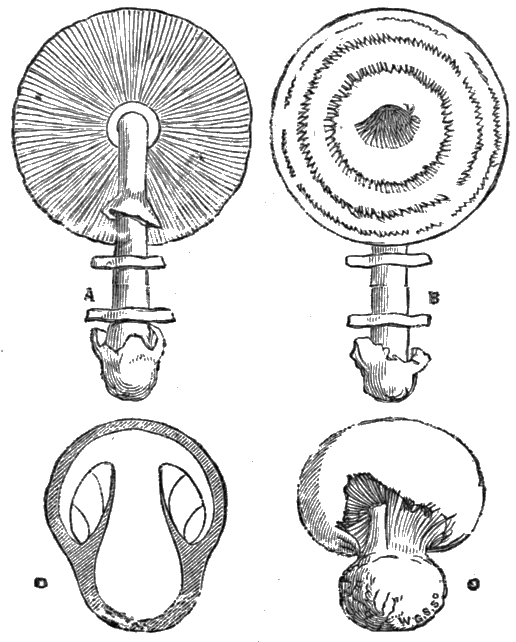
Fig. 38. Specimens showing the gills, rings, and stages of growth.
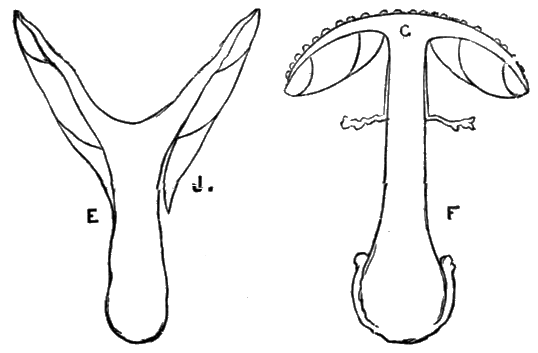
Fig. 39. Section cut through Agaricus.
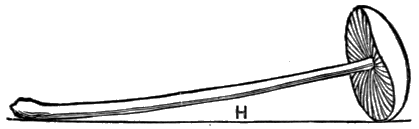
Fig. 40.
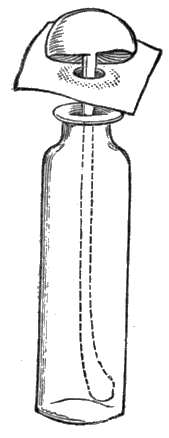
Fig. 41. Agaric placed to catch spores.
It is necessary to prepare the woody specimens in a different manner. They must first be perfectly dried before the fire, or in the sun, and then a thin slice must be sawn (or cut with a powerful knife) out of the middle. This slice may be poisoned, as described hereafter, and mounted on the herbarium sheets at once. If the Polyporus is very thin, it may be mounted in company with the slice, but more than one specimen is desirable, as it is indispensable to have both surfaces handy for examination. If the specimens are very large, they are best kept in wooden boxes, and labelled according to the genera and sub-genera they contain; or they may be kept in drawers, the drawers being divided by partitions if large, and labelled outside. If boxes are used, they should all be the same depth; the height and width may be doubled or halved according to the nature of the plants: the plan will be better understood by reference to the diagram, Fig. 42. If this plan is adopted, there will be no waste space, and the boxes will stand evenly upon a sideboard or against a wall.
Before the specimens are transferred to the herbarium they may or not be poisoned, according to the wish or convenience of the collector. Some of my plants which have never been poisoned remain perfectly uninjured, whilst others, which have been treated with a strong solution of corrosive sublimate, have been devoured by larvæ, &c., introduced, I presume, since the plants were put away. A solution of corrosive sublimate in pyroligneous naphtha, carefully washed over the specimens, has been recommended; but the ordinary poison is oil of turpentine, mixed with finely-powdered sublimate, well shaken before applied. If the specimens are to be glued down, they should be mounted as shown in Figs. 38 and 39, so as to display all their characters, and fixed with poisoned gum tragacanth; but some botanists, and myself amongst the number, prefer to have the specimens free. For this purpose I have envelopes gummed to the herbarium sheets, and the specimens (including a small paper containing the spores) are free within the envelopes. Some mites are very fond of the spores of certain fungi, whilst they will not touch the spores of others: therefore, if the specimens are to be kept perfectly intact, gummed paper must be used, or they may be kept between little slips of mica. As to the labelling of the herbarium sheets, I shall not touch upon that, as the plan universally followed is similar to the one used for flowering plants, and described in this volume. Some sub-genera of Agaricus, however (as Tricholoma), are so numerous in species that it will be found requisite to have several wrappers for one sub-genus.
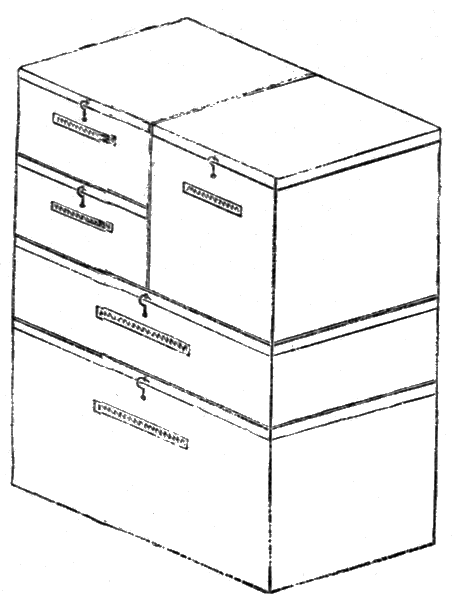
Fig. 42. Cabinet for Fungi.
Now as to the necessary notes to be made on the sheets: the points in discriminating fungi differ considerably from those used in naming flowering plants. It is presumed the spores have been preserved by the collector. Now, if he has time, the next best thing is to measure and note them at once, in decimals of an inch and millimetre: a second and essential thing is a note as to the taste of the fungus, whether it is mild, acrid, bitter, &c. This point will be found very useful, as some species are tasteless, insipid, or extremely acrid, bitter, or poisonous: it is only necessary to taste a small piece; but as so little is really known of the qualities of fungi, unless this is done no advance will be made. I invariably taste every fungus new to me, and have notes to this effect of all the species which have passed through my hands: in some species the effect is very peculiar, sometimes (as in Agaricus melleus) it causes a cold sensation at the back of the ears, and swelling of the throat; at others (as in Marasmius caulicinalis), the taste proves to be intensely bitter; some are so fiery (as in Lactarius turpis, blennius, and acris), that the smallest piece placed upon the tongue resembles the contact of a red-hot poker. Often, when I have been out botanizing with young men and amateurs, when a dubious Russula or Lactarius has been shown me to name, I have requested the inquirer to taste it, as, if mild or pungent, the taste might at times decide the species; I have generally found, however, that though certain persons are anxious enough to acquire names, they will not burn their tongues to secure them. No fungi that I am acquainted with are really pleasant raw, unless it is Hydnum gelatinosum, though many are very good when cooked. A very important thing to note is the odour in the larger fungi: many are very pleasant, like meal; a few are sweet; some resemble stinking fish (as Agaricus cucumis); one, mice (as A. incanus); another, camphor, whilst Marasmius fœtidus and impudicus are like putrid carrion; others are like burnt flannel, garlic, rotten beans, and almost every imaginable disagreeable thing. The habitat is of great importance: if the plant grows upon trees, the tree should be named; or if parasitic upon any other material, the matrix should be named with the place. The viscidity, dryness, or bibulosity must be given, and in the Agaricini, any notes that may suggest themselves as to the presence or absence of a veil, volva, or trama, and whether the gills have a habit of separating from the stem, as at J (Fig. 39), must be carefully noted.
The study of the larger fungi has been to me one of the greatest pleasures of my life: when all things else have failed, this has never failed; it has taken me into the pleasantest of places and amongst the best of people. Had it not been for fungi, I should have been dead years ago; often tired, jaded, and harassed with business matters, a stroll in the rich autumn woods has given me a renewed lease of life. In these favourite haunts I never tire or flag; rain, fog, and mud, never detract from the pleasures of the woods to me—I am only depressed in the hot, dry weather of midsummer. In the autumn I constantly visit the forests, with all my collecting paraphernalia; I sometimes take a saw to cut off the big, woody, fungus excrescences of trees. I was once fortunate enough to find a ladder in a wood, which proved invaluable for ascending the beeches in search of Agaricus mucidus, &c. I, however, find fungi everywhere: I only go round the corner, and there they are. I often visit a neighbouring builder's yard, and descend the sawpits, to the amazement of the operatives: some of the rarest species of our Flora, and many new ones, I have found within a few minutes' walk of my own house. I once found a rare Lentinus on a log as it was being carted down King William Street, and a year or so ago an undescribed Peziza flourished inside my cistern.
Collecting fungi is not without its humours as well as its pleasures, as the following will show. I once saw a portly, well-dressed gentleman walking along the high road, with his vasculum over his shoulders, and carrying home (one in each hand) a pair of cast-off, rotten boots, discarded by some vagrant; the rotting leather having produced a crop of rare microscopic fungi. At times abominable cast-off fœtid gipsy rags will be lovingly taken from out a ditch, and choice pieces cut out and consigned to the vasculum of the cryptogamic botanist; at other times some rare species will be seen "up a tree," and it has several times happened in my presence that one enthusiastic botanist has got on to the shoulders of another to secure a prize, or even waded into a pond to get at some prostrate fungus-bearing log. The humours of truffle hunting are manifold. I have seen a gentleman trespass, on hands and knees, through a holly hedge, on to a gentleman's lawn, and there dig up the turf in some promising spot, risking an attack from the house-dog, or a few shots from the proprietor; the said trespasser meanwhile armed with a rake, gouge, and dangerous-looking open knife. Country labourers are often sorely puzzled by the acts of cryptogamic botanists; they stand agape in utter amazement to witness poisonous "frog-stools" bagged by the score. Ofttimes one gets warned that the plants are "deadly pisin"; but collectors are usually looked upon as harmless lunatics, a climax in this direction generally being reached if a gentleman in search of Ascoboli and the dung-borne Pezizæ, sits down, and after making a promising collection of horse or cow-dung, carefully wraps these treasures in tissue paper, and puts them in his "sandwich-box."
One word of warning to the beginner—never, on any account, amass and put away a lot of imperfect materials with insufficient notes, for in the end they will prove worse than useless. To name fungi with certainty the fullest notes and most complete materials are indispensable: without these nothing whatever can be done. It is far better to laboriously make out twenty species, and know them in all their aspects for certain, than to amass imperfect materials of two thousand without any sound botanical knowledge. If the former course is pursued, the study of fungi will prove a never-failing source of pleasure to the mind and of health to the body.
In conclusion, I cannot do better than quote a few words written by the illustrious Fries (now more than eighty years of age) in the preface to a recent work of his on Fungi. He says: "Now in the evening of my life, I rejoice to call to mind the abundant pleasures which my study of the more perfect fungi, sustained for more than half a century, has throughout this long time afforded me.... Therefore, to botanists, who can wander at will the country side, I commend the study of these plants as a perennial fountain of delight and admiration for that Supreme Wisdom which reigns over universal nature."
XIII.
LICHENS.
By the Rev. Jas. Crombie, F.L.S., etc.
Much as it is to be regretted, it cannot be questioned that of those who have devoted themselves to the study of botany, lichenists have always been "few and far between." While flowering plants have had their hosts of enthusiastic students, and while other classes of cryptogamics have had due attention paid to them, the study of lichens has, up even to the present time, been but too much neglected. To many indeed the term conveys only some faint and confused idea, and though they know that there are plants so called, they are at the same time utterly ignorant of their nature. With flowering plants, ferns, mosses, seaweeds, and even fungi, they have at least some acquaintance, more or less accurate; but lichens they generally pass by with indifference, regarding them merely as "time-stains" on the trees, the walls, and the rocks where they grow. Nay, we have even met with some professed, and otherwise well-informed botanists, who, while recognizing certain of the larger and more conspicuous species as lichens, yet fancied that many of the smaller and more obscure species were merely inorganic discolorations. It is certainly very difficult to account for such a state of matters at the present day, when so much attention is being paid to almost every other class of plants. Vainly have I sought either in the nature of the case itself or in my conversations with botanists, for any intelligible solution of such apathy and neglect: though many good and sufficient reasons have presented themselves to my mind why they should be regarded in a very different light. It cannot with any show of propriety be objected that lichens are an uninteresting class of plants, and consequently undeserving of serious study. So far from this, they are in various respects as interesting not only as any other class of cryptogamics, but also as many other plants, which occupy a higher and more conspicuous place in the scale of vegetation. Being as it were the pioneers of all other plant life, for which they serve to prepare the soil on the coral islet and the barren rock,—constituting the most generally diffused class of terrestrial plants on the surface of the globe, from arctic lands to tropical climes,—presenting essential simplicity of structure, being composed entirely of an aggregation of cells, though at the same time this is amply compensated for by endless variety of form,—adorning as they do, with their variously coloured thalli and apothecia, the most romantic and the most dreary situations,—affording in some cases valuable material for the dyer and the perfumer, nay, even for medicinal purposes,—supplying, as some of them do, more or less, nutritious food for man and beast, under circumstances and in regions where no other can be had,—it is very evident that the prevailing neglect of them cannot arise from their being in any way uninteresting, and destitute either of beauty or utility. Nor does this, as might be inferred, result from any peculiar difficulty attending their study. There indeed seems to be a notion prevalent, not only amongst the students of phænogamic, but also amongst those of cryptogamic plants, that there are, somehow or other, almost insuperable difficulties connected with the pursuit of Lichenology. Now, it is quite true that the correct study of these plants is by no means an easy one, and that an accurate knowledge of them is not to be obtained in a day or an hour; but the same may, with equal truth, be said of any other branch of Phytology, which requires minute research and microscopical examination. Here, as elsewhere, there is no royal road to learning, and the difficulties which lie in the way must be boldly faced. If the student can only muster up sufficient courage to cross the threshold and prosecute his investigations with zeal and steady perseverance, he will find in this, as in other cases, that the difficulties which looked so formidable at a distance, will, one by one, be successfully surmounted.
But to whatever cause the paucity of lichenists, both in our own and other countries, is to be attributed, it certainly does not originate in any difficulty connected with their collection and preservation. In fact, there is no other class of plants, where these, and more especially the latter, can be so easily effected, at a little expenditure of time and trouble. A few simple directions are, therefore, all that are necessary to be given on these points. As to the collecting of lichens, it has already been intimated that they are almost universally distributed, though of course in this respect subject to the same laws as the higher orders of vegetation. In our own country we have now a list of about eight hundred species, constituting by far the greater proportion of the Lichen Flora of Europe. In most parts of Great Britain and Ireland, a very fair number of these may readily be gathered, capable, as they are, of existing in almost every situation where they can derive requisite nourishment from the atmosphere. On the rocks and boulders of the seashore and the mountain-side, on the trunks and branches of trees in woods and forests, on peaty soil of bare moorlands, and on stone fences in upland tracts, nay, even on old pales and walls in suburban districts, a goodly harvest may generally be reaped. Few localities indeed there are, within the area of these islands (London and its environs, where the atmosphere is so impregnated with smoke, being the chief exception), in which the lichenist will find his occupation gone. True, it is only in some more favoured tracts, chiefly maritime and montane, that he can expect to meet with many of our rarer species; but even in most lowland districts, especially such as are well wooded, he may, with profit, pursue his researches, and collect various of the more common species. These will just be as useful in making him acquainted with the structure and physiology of lichens as though he had gathered the rarest that grow on Ben Lawers or by Killarney's lake. The apparatus requisite for collecting is neither complicated nor expensive.
A tin japanned vasculum, or what is perhaps better still, a black leather haversack, of larger or smaller dimensions as the case may be, suspended over the shoulder by a strap, is of course indispensable for holding the specimens gathered. The latter of these we have found to be more generally convenient, as we can take it with us also for a short ramble, without its attracting so much attention from curious rustics, as the less-known and more singular-looking vasculum. Two sets of instruments are also necessary for removing the plant from the substratum on which it grows, as well as for breaking off in many cases a thin portion of the latter along therewith. These are a geologist's hammer and chisel for such as grow on rocks, boulders, and stones; a gardener's pruning-knife for such as grow on trees, pales, and the ground; as also an ordinary table-knife for detaching, by insertion under them, such foliaceous species as can thus be separated from the substratum. To these must be added several sheets of soft and moderately thick paper, cut into different sizes (some newspapers suit remarkably well), in which to wrap up the individual specimens and prevent them rubbing against each other; a few card-boxes also, of various sizes, in which for greater safety to place any of the more brittle species, or fragments of the rarer ones, by themselves; and a pocket-lens of good magnifying power, by which we may be able to detect on the spot those minuter species which the naked eye can with difficulty distinguish. With these the lichenist is fully equipped for an excursion, whether "near at hand or far away," and, with waterproof and umbrella, is ready to take the field even in threatening weather. A good deal of discrimination must be used in the selection of specimens for removal, which, in all cases where such can be obtained, ought to be fertile, with both apothecia and spermagones fully developed. Hence, such as are too old or too young, may be passed by, as neither the spores nor spermatia, by which alone, in many instances, they can be determined, will be found in a normal condition, any more than the thallus itself. The specimens gathered ought in every case to be of sufficient size to show distinctly the character of the thallus and of the fructification. Where, however, the thallus, as it frequently does, spreads very extensively over the substratum, it will be sufficient to break off such a portion from the circumference towards the centre, as will give an adequate idea of the more important characteristics of the plant. This is a point of considerable consequence; for should a portion be taken off from the circumference alone, or from the centre alone, it will often be entirely unsuitable for showing the real nature of the plant, and be quite useless for purposes of description. A little experience, however, will serve to prevent the commission of a mistake, into which, judging from the number of imperfect specimens which are sent me to be named, beginners are very apt to fall. Practice will also in time enable the tyro to use the hammer and chisel in such a way as to obtain neat specimens of saxicole species—a matter of importance with respect to their subsequent mounting. As to the best season for collecting, I need scarcely remind the reader that lichens are perennial plants, remarkable for their longevity, and that during the whole year round they may be found in fruit. The lichenist has not to wait for any particular month or months, as other botanists have to do, before he can collect the objects of his search in a fully-developed condition. Spring, summer, autumn, and even winter, except when the snow conceals all vegetation beneath its white mantle, are all alike to him, and in each he will find every species of lichen in perfection. At the same time, he will be most successful after a shower of rain or a slight frost has fallen, inasmuch as, becoming swollen with the moisture then imbibed, many of the minuter species which might otherwise be overlooked, are more readily perceived, and the foliaceous species more easily removed from the substratum to which they are more or less closely affixed.
Nothing more need be said on the collecting of lichens, as a short experience will be more useful than further details. We proceed, therefore, to give a few hints on their subsequent preservation. This is a very easy process, presenting no difficulty whatever, and occupying but little time. We shall suppose that the collector has returned from a successful expedition, with his vasculum or haversack well filled with specimens from all sorts of habitats. Opening the papers in which they have been wrapped up, he will take them out one by one, and place them separately upon a table, over which a newspaper has previously been spread. If gathered in wet weather, they ought not to be left long in the papers, as in this case they are very apt to become covered with mould. After allowing them to remain in this position till they are thoroughly dry, he may at once proceed with hammer and chisel, or with knife and scissors, to reduce to a suitable size such of them as he could not conveniently thus manipulate in the field. When this is done, they may then be affixed with gum, of a rather thick consistency, to slips of white paper, with the locality and date of their collection written beneath. There will be no difficulty felt in thus affixing saxicole, corticole, and lignicole species, though where the nature of the stone or wood is more absorbent, several applications of the gum may be necessary before they properly adhere. With terricole species, however, a somewhat more lengthened process is necessary, owing to the brittle nature of the substratum, in consequence of which, if not properly preserved, they often crumble into dust in the herbarium. To prevent this, M. Norman, of Trömsoe, Norway, has recently prescribed a solution of isinglass in spirits of wine, which, when liquefied in a vessel plunged in water of the temperature of 25°-30°C., is greedily imbibed by the earth, and becomes inspissated into a solid gelatine at a temperature below 15°. This solution may be applied until the earth becomes thoroughly saturated, and after it is perfectly dry, the specimens will possess sufficient hardness and tenacity, and may then be mounted like the others. So far, however, as my own experience goes, I have found a weak solution of gum-arabic, frequently repeated, and applied to the under surface and edges of the specimens, to be quite as efficacious; and if after becoming thoroughly dry, they be first affixed by a thicker solution to slips of thin tissue-paper, they will be equally ready for being mounted as above. Either of these two methods may also with advantage be applied to such species as grow upon decayed mosses. Slight pressure may be applied to the thallus of fruticulose, filamentose, and foliaceous species, in order that they may lie better in the herbarium; but this should be done only to a very limited degree, so as not to obliterate the normal appearance of the branches or lobes. As the character of the under surface of the thallus is frequently of great importance, at least in foliaceous and fruticulose plants, a portion of this, not necessarily detached, should be turned over, for facility of inspection, and pressed down on the paper, before the specimens have become quite dry and rigid. In order to destroy any insects that may be upon the plants when gathered, or by which they may afterwards be infested, lichenists at one time were in the habit of poisoning them with corrosive sublimate. Frequent exposure, however, to the air in dry weather, and the presence of a little camphor, will be quite sufficient to prevent any mischief from this source.
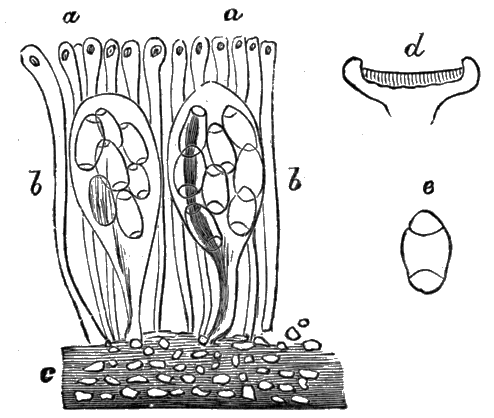
Fig. 43. Section of Physcia parietina. a. Paraphyses. b. Asci with spores. c. Hypothecium. d. Section of apothecium. e. Spore.
But having thus arranged, though the arrangement is but temporary, the specimens gathered, on slips of white paper, the next and most important point is their due examination and determination. This, in the present advanced state of Lichenology, is unquestionably, in many cases, a task of considerable difficulty, and in the short space at our disposal it would be quite impossible to give anything like an adequate explanation of the mode in which this is to be effected. Suffice it at present to say that sections must be made of the thallus to ascertain the character of its different layers, as also sections of the apothecia and spermagones to ascertain the nature of the spores and spermatia. For both purposes a good microscope, with 1/4-inch object-glass, is absolutely indispensable to the student. The examination of the spores, upon which, in so many cases, the determination of the species chiefly depends, should present little or no difficulty, at least to the fungologist. It may be readily effected by moistening the apothecium with water, and then, with a dissecting-knife, making a thin vertical section through its centre. Putting this on a glass slide, or in a compressorium, in a drop of hydrate of potash, and then placing it under the microscope, a view will be obtained of the asci, spores, paraphyses, hypothecium, &c., each of which may afterwards be insulated and examined more minutely in detail. Take, for example, the well-known beautiful yellow lichen (Physcia parietina), so common everywhere on walls, rocks, and trees, and treat a very thin section of the mature apothecium as before mentioned. Under the microscope it will appear as represented in Fig. 43.
In the same way the spermagones may be examined, when the nature of the sterigmata and spermatia will be apparent. By cutting across the thallus of the above species, we can perceive even by the naked eye that it consists of three different layers, which when microscopically examined present the appearance shown in the above figure.
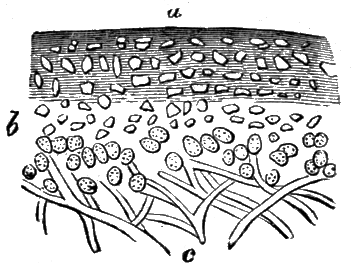
Fig. 44. Section of Physcia parietina. a. Cortical stratum. b. Gonidic stratum. c. Medullary stratum.
But in addition to this microscopical examination, it is also requisite to observe the different chemical reactions produced on the asci or the hymeneal gelatine with iodine (I), which will tinge these either bluish or reddish wine-coloured, or else leave them uncoloured. Similarly the thallus, including both the cortical layer and the medulla, may be tested with hydrate of potash (K), and hypochlorite of lime (C), the latter being applied either by itself or added to K when wet. In some cases no reaction will be produced by these either upon the cortical stratum or the medulla; in others they will be tinged yellowish or reddish. The formulæ for the preparation of these reagents are: for iodine, iodine, gr. j; iodide of potash, gr. iij, distilled water, 1/2 oz.; for hydrate of potash, equal weights of caustic potash and water; for hydrochlorite of lime, chloride of lime and water of any strength. After correctly ascertaining the specific name of the specimens collected, this is to be written on the slips of paper to which they are affixed, above the locality and date, and the best of them, including all varieties and forms, selected for subsequent mounting in the herbarium. This may be effected either in the same way as the mounting of phanerogamic plants, or by affixing the specimens to pieces of millboard covered with white paper, and arranging them according to the order of the genera and species in the system of classification which may be adopted. For facility of reference the latter is undoubtedly the preferable method; and if the cards are disposed in a cabinet with shallow drawers, they will not, so far at least as our British species are concerned, be found to occupy too much space.
XIV.
SEAWEEDS.
By W. H. Grattann.
In some articles published in 'Science-Gossip' a few years ago, I gave some directions for collecting and preserving Marine Algæ, or seaweeds, and although, I think, it will be difficult to simplify those directions, or even to add much that would be really serviceable to young beginners in this delightful pursuit, it is my intention, in going over the ground once more, to be as explicit as I possibly can; and here, on the threshold of the subject, I have a few words to say to one or two occasional contributors to that journal, who, in calling attention to the beauty of marine vegetation, and urging young persons to collect and preserve Algæ, have advised them to ignore books on the subject, and go to the shore, use their own eyes, and collect for themselves, &c. I am sorry very greatly to differ from such advice. Collecting in this way may be amusing enough to those who care not for science, but when it leads to parcels of seaweeds, picked up at random, being sent to botanists with a request that the names of such plants should be sent to the writer, it is the reverse of pleasure to the scientific botanist, for it gives him infinite trouble, and enables him to convey but very imperfect information to his applicant. The editor of that journal has often been thus appealed to, and packages of decayed rubbish have frequently been sent to me for examination, containing species or rather fragments of plants, which, for the most part, were utterly worthless and defied identification.
Almost all collectors commence by mounting plants which a little experience proves to be really what the old poet termed "alga projecta vilior"; but as seaweed-gathering, like everything else, requires practice, beginners must not be disappointed because they do not find rarities or fine specimens whenever and wherever they may seek for them.
When I think of the difficulties I experienced at the outset of my study of marine botany, especially in the collecting and drying of seaweeds, I feel strongly inclined to urge all beginners to obtain some information concerning Marine Algæ before they go to the shore to collect for themselves. A very few hours of study with an experienced algologist, or even a perusal of some illustrated work on British algæ, will save much trouble and materially assist the unpractised eye in selecting specimens for the herbarium. I may here mention as highly useful to incipient algologists Dr. Landsborough's 'British Seaweeds' and Professor Harvey's 'Manual,' either of which may be obtained for a few shillings; but if my readers are resident in London, I advise them to pay a few visits to the Library of the British Museum, and there inspect Dr. Harvey's 'Phycologia Britannica.' In this magnificent work they will find coloured figures of nearly every British seaweed, with drawings from magnified portions, and various structural details of the highest value to students; and I once more impress on all collectors the importance of some degree of book-learning ere they sally forth, bag or vasculum in hand, to cull the lovely "flowers of the ocean," or gather what best may please them from the rejectamenta on the shore.
If the collector wishes to learn, not merely the names of plants, but to distinguish species, he will do well to provide himself with a copy of Harvey's little volume the 'Synopsis of British Seaweeds,' and a Stanhope or Coddington lens, by means of which he can examine portions of delicate plants as he finds them, and compare them with the descriptions given in the 'Synopsis'; in this way, if he have any success during his excursions, he will quickly become familiar with most of the plants which are cast ashore or grow within tide-marks.
Time will not admit of, neither is space at present available for, a single line beyond what may be practically serviceable to my youthful readers; therefore I will hasten to describe the course of action in seaweed-collecting as I have practised it for many years. At once, then, to the shore, but not to the sandy shore, for only useless decayed rubbish, or here and there some straggling plants of Zostera marina, or grass-wrack, will be met with there. The collector must away to the rocks, and search carefully every pool he meets with, from a little distance below high-water mark, and so on down to the water's edge, always remembering that it is better to collect while the tide is receding than as it is coming in.
Presuming that few persons will think of collecting seaweeds much earlier than the month of May, let me observe that most of the accessible species of olive and green plants which grow on rocky shores and in tide-pools, will be found from May to June in pretty fair condition, but very few red plants, except those which grow on the shady sides of rock-pools, or under the shelter of the larger olive weeds, will be met with until a considerable space is laid bare by the receding water at the low spring tides, about a day or two before and after the full moon.
As nearly all the rare red weeds grow in deep water, they are seldom taken in any degree of perfection unless they are dredged; but in the summer months, say from June to the end of August, many fine plants are occasionally thrown up from deep water, and others are found growing on the stems of the great oar-weeds, portions of which are cast ashore, beautifully fringed with one or more species of Delesseria and other rare Rhodosperms—in fact, during the rising tide, diligent collectors may secure many a lovely deep-water plant as it comes floating in, but which, if allowed to remain long exposed to the action of sunlight, will fade in colour and decompose before it can be mounted. This is especially the case with all the soft gelatinous red plants, such as the Callithamnia, and all the Gloiocladiæ, as well as a few of the softer olive weeds; and here I may observe that there is one genus of beautiful olive plants, the Sporochnaceæ, which must on no account be put into the vasculum with any of the delicate red plants, for they not only very rapidly decompose, but injure almost all others with which they are placed in contact. The species are not numerous, and they may be easily recognized, after having been previously studied from the coloured figures either in Harvey's 'Phycologia,' or in Bradbury and Evans's 'Nature-printed Seaweeds.' It is also a curious fact respecting this genus, that while they are all of a beautiful olive tint in the growing state, they invariably change to a fine verdigris-green in drying; and indeed this is very generally the case with the filamentous olive weeds, the Fuci, or common rock-weeds, as constantly turning quite black after mounting: whence the term, that of "Melanosperm," which is given to the subdivision to which all the olive weeds belong.
As there are so few seaweeds which have generally known common names, I shall make no apology for using the names by which they are known to science, presuming that all intending collectors will, as I have already suggested, gain some knowledge of Terminology ere they go out "seaweeding."
Beginners should be cautioned against the very natural error of bringing home too many plants at a time; they must be moderate in their gatherings, or be content to risk the loss of some choice specimens, which will decompose unless they are attended to before night. The first thing to be done upon arriving at home, is to empty the collecting-bag into a white basin of sea-water, and to select the best and cleanest plants as soon as possible, giving each a good swill before placing it in another vessel of clean water, and getting rid of rejected plants at once, so that the basin first used will be available for rewashing the weeds before they are severally placed in the mounting dish. When a day is fixed on for seaweeding, the collector should order a large bucket of clean sea-water, which, after being left to settle, should be strained through a towel, so as to be as free as possible from sand and dirt. Two or three large pie-dishes will be necessary, the deeper the better, and white, if such can be obtained. Place these on a separate table with towels under them, and reserve a table specially for the mounting dish and the parcels of papers, calicoes, and blotting-papers. The large white bath used in photography is very well adapted for mounting seaweeds; the lip at one corner is convenient for pouring off soiled water, and its form—that of an oblong—is most suitable for receiving the papers on which the plants are to be mounted. Beside this vessel should be placed the following implements—a porcupine quill, two camel-hair pencils (one small, the other large and flat), a pair of strong brass forceps, a penknife, a pair of scissors, a small sponge, an ivory paper-knife, and two thin plates of perforated zinc somewhat less in length and breadth than the inside of the mounting dish.
Smooth drawing paper, or fine white cartridge paper, is generally employed for mounting. The operator should be provided with three different sizes of paper, and these should have each a piece of very fine calico and four pieces of blotting-paper to correspond. The process of mounting one of the filamentous or branching species is as follows:—The specimen being cleaned and placed in the mounting dish, a piece of paper of suitable size is laid on one of the perforated zinc plates, and both are then slipped quickly under the floating weed. The root or base of the specimen is then pressed down on the paper with a finger of the left hand, while the right hand is employing the forceps or porcupine quill in arranging the plant in as natural a position as possible, ere the zinc plate is gently and gradually raised at the top or bottom, as may be necessary, to ensure a perfect display of every portion of the plant; but if, upon drawing it out of the water, it should present an unsightly appearance from too thick an overlapping of the branches, the whole must be reimmersed, and a little pruning of superfluous portions may be employed with advantage to the specimen and satisfaction to the operator. Care should be taken that the water be drained off the paper as completely as possible before the calico is laid over the plant, and this is accomplished by raising the paper containing the plant as it still lies on the zinc plate, and transferring it to a thin board placed in an inclined position against one of the basins, and with the large camel-hair pencil paint off the water as it runs away from the specimen, and absorb what remains, when the paper is laid flat, with the sponge. Delicate species may be left to drain for a few minutes, while the operator is arranging other specimens. When the water is sufficiently drained off, the paper is then laid on the blotter, and the piece of calico is placed upon the plant—a sheet of blotter being laid upon the calico.
Care should be observed in subjecting plants to pressure, which, in the first instance, should be sufficient only to help the absorption of water. The first set of blotting-papers should be changed in half an hour after the whole batch of specimens have been placed in the press, and these must be thoroughly dried before they are used again. After the second or third change of blotters, the plants should remain under strong pressure for two or three days; but the pieces of calico must not be removed until it is pretty certain that the papers and plants are quite dry.
With the exception of the Fuci or common rock-weeds, I never place seaweeds in fresh water: with these, especially Fucus serratus, F. nodosus, F. vesiculosus, and F. canaliculatus, a few hours' immersion in fresh water is an advantage, as it soaks the salt out of their fronds and renders them more pliable. As all the Fuci turn black in drying, and few of them adhere well to paper, I arrange my specimens in single layers between the folds of a clean dry towel, and keep them under pressure until they are quite dry; they may then be put away loosely, or gummed on sheets of paper.
The foregoing directions for mounting filamentous seaweeds are applicable to all the branching species of Olive, Red, and Green plants; but in each of the three subdivisions there are a few species which are so gelatinous—in fact, so soft and spongy, that they require the utmost care during pressure, otherwise they adhere to the calico and break off in fragments as it is drawn away. Such plants must be left to dry in a horizontal position for an hour or so before the calico and blotters are placed over them, and pressure must be very slight until they have adhered closely to the paper. Among the Chlorosperms, or green plants, there are the various species of Codium, young plants of which only are manageable or indeed desirable. In the Melanosperms, some species of the genus Mesogloia will require care and patience in mounting, as well as the long string-like plant, known as Chorda filum; and again, the spreading tuberous mass called Leathsia tuberiformis, portions of which should be cut from the rock, the sand scraped and washed out, then laid on the wet paper, and allowed to shrink for some hours ere calico blotters and pressure be applied. These difficulties are much more numerous among the Rhodosperms, or red seaweeds, experience only teaching the best method of treatment. I will, however, mention the names of some very troublesome plants, the fronds of which, if subjected to pressure too soon, burst and discharge their carmine contents; not only presenting an unsightly appearance, but destroying the specimen. These are Griffithsia corallina, Dudresnaia coccinea, Naccaria Wigghii, all the Chylocladia, and the rare Gloiosiphonia, as well as the slimy worm-like plant known as Nemalion multifidum.
In addition to these troubles among the red plants, there is an opposite difficulty connected with several Rhodosperms which must be pointed out; and that is owing to an absence or scarcity of gelatine in their substance, which is in some of a stout, leathery, or horny nature, and in others is due to a coating of carbonate of lime, which completely envelops the vegetable structure. Among the former may be mentioned the several species of Phyllophora, and several among the genera Gigartina, Chondrus, and Sphærococcus; and in the latter, all the calcareous Algæ, especially the well-known Corallina officinalis and Jania rubens. All these, and several others of a membraneous nature, among the olive as well as the red weeds, must be first mounted in the ordinary manner, and when they are tolerably dry and begin to shrink away from the paper, fill the mounting-dish with stale skimmed milk; refloat the plants on their papers in the milk, and indeed go through the same process as before with the sea-water, but be careful to absorb all the milk from off the surface of the plants and the back of the papers, and then, after the usual time for drying and pressing, the most obstinate seaweed will be found adhering perfectly to the paper, and will remain so permanently.
One more difficulty must be referred to for the benefit of young beginners, who, in mounting some of the Laminaria and that peculiar olive weed called Himanthalia lorea, may wish to preserve the thick-branching roots and stems. First wash the roots as clean as possible, and then, with a sharp penknife, make a clean cutting horizontally of the whole root and some little distance up the thick round stem; then, after having removed the cut portions, place the inner surface of the root and stem on the paper, and the gelatinous matter which oozes from the plant will cause the roots to adhere firmly to the paper, and in drying, the usual olive tint of the various species of Laminaria will be finely preserved. Some botanists employ a mixture made of isinglass, dissolved in alcohol, to fix some of the horny or robust species on paper; but if gum be made use of, it is better to employ gum tragacanth than gum-arabic, because, in drying, the former has none of that objectionable glare which is peculiar to gum arabic.
As regards the best method of pressing seaweeds, I think I can hardly do better than refer my readers to the figure of a Seaweed Press (Fig. 45), which I invented for myself many years ago, in which I have pressed many thousands of beautiful seaweeds. Almost any degree of pressure can be obtained in it: first, by the thumb-screws on the iron rods at each corner, and, finally, by means of the clamp which is strapped on the top of the press. Any intelligent cabinet-maker or ironmonger could provide such a press from an inspection of the figure; the cost, of course, varying with the dimensions and the number of boards.
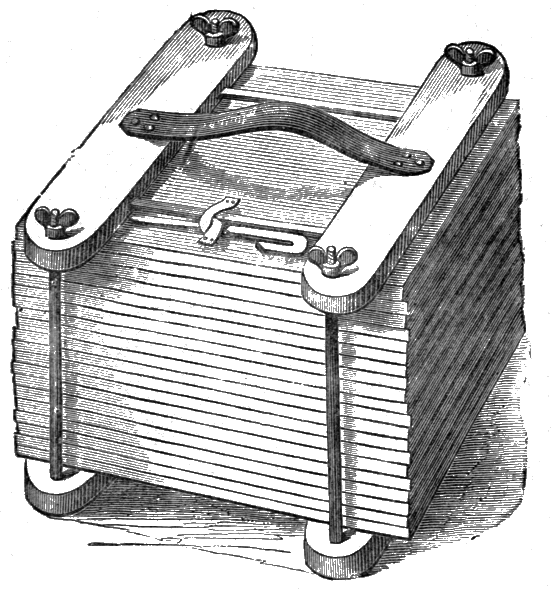
Fig. 45. Seaweed Press.
With respect to localities favourable to seaweed-gathering, I may specially mention the south coast of Devon; from Exmouth, where Bryopsis and Padina pavonia grow in perfection, to Torquay and the coves of Torbay, and down the coast to Plymouth, Cawsand Bay, and finally Whitsand Bay, the "happy hunting-grounds" of the enthusiastic algologist. On the north-east coast, Filey and Whitby must be mentioned, as well as the shores upwards from Tynemouth to Whitley. Peterhead is also a good locality, the rare Ectocarpus Mertensii, Odonthalia dentata, and Callithamnion floccosum being found there in abundance. Other favourable stations in Scotland, well known to me, are Lamlash Bay and Whiting Bay; nor must the Isle of Wight be forgotten, for in the rock-pools, at Shanklin especially, the most magnificent form of Padina pavonia may be found growing during the summer months in the utmost profusion.
In conclusion, I beg leave to inform my readers that I have recently published a volume on British Marine Algæ, in which every species that is likely to be met with by ordinary collectors is described, and every British seaweed that is capable of illustration in a work intended for popular information, is figured from plants in my own possession, and, in addition, diagrams and figures from drawings of magnified portions, illustrative of structure and fructification, appear throughout the pages of my work.
INDEX.
[A] [B] [C] [D] [E] [F] [G] [H] [I] [J] [K] [L] [M] [N] [O] [P] [Q] [R] [S] [T] [U] [V] [W]
PAGE
A
Adventures of fungus hunters,
178
Advice to fungus collectors,
179
Affixing lichens,
189
Agaric placed to catch spores,
172
Agaricus cucumis,
176
—— melleus,
175
—— mucidus,
177
Agrostis stolonifera,
140
American moth-trap,
57
Ammonia for insects,
59
Anatomy of molluscs,
22
—— of vertebrates,
18
Anchomenus sexpunctatus,
71
Ants' nests for beetles,
91
Apothecia,
191
Apparatus for taking insects,
57
Arm of man,
21
Arrangement of eggs,
39
—— of fossils, 11,
13
—— of plants,
135
—— of shells,
116
Arranging grasses,
142
—— lichens,
191
Artificial beetle-traps,
87
Assiminea Grayana,
108
Attracting insects,
57
B
Beating for beetles,
89
—— for larvæ,
47
Beech,
121
Beetles,
67
—— by post,
86
——, where to find them,
86
-
94
Bentall's drying-paper,
141
Best season for lichens,
188
—— trees for insects,
51
Birds' eggs,
27
—— nests,
42
Bivalves,
104
Bleaching bones,
23
Blooms for attracting insects,
53
Blowing eggs,
30
Blowpipe for eggs,
31
Bog mosses,
145
Bombyces,
45
Bones,
16
—— of dog,
17
Bone-preservers' shops,
17
Books on seaweeds,
196-7
,
208
Boring holes in eggs,
33
Bottle for beetles,
76
Boulders,
5
Box for carrying insects,
55
Braces for insects,
61
Breeding beetles,
68-9
Bulb-tube,
31
Bulimus acutus,
107
Butterflies and moths,
44
—— at rest,
50
Butterworts,
123
Buying eggs,
28
C
Cabinet for fungi,
173
Cabinets for insects,
66
—— for plants,
136
Cage for virgin lepidoptera,
52
Callithamnion floccosum,
208
Campanula glomerata,
129
—— rotundifolia,
130
—— uniflora,
130
Cardboard for mounting beetles,
79
Cataloguing of eggs,
36
Caution in carrying boxes,
97
Ceratodon purpureus,
152
Chemical testing of lichens,
194
Chip boxes,
48
Chloroform bottle,
58
Chorda filum,
204
Chrysalis collecting,
48-9
—— preserving,
49
Classification of mosses,
154
Cleaning the inside of eggs,
33
—— shells,
113
Coal-shale,
3
Collecting and preserving insects,
44
—— birds' eggs abroad,
30
—— fungi,
160
—— mosses,
146
Collecting plants and ferns,
117
—— seaweeds,
195
'Comparative Anatomy of Vertebrates',
18
Construction of egg cabinet, 38,
40
Conovulus,
107
Converts to geology,
4
Coprinus atramentarius,
160
—— domesticus,
161
Coprophaga, where to find,
90
Corallina officinalis,
205
Cork saddle for insects,
61
Corrosive sublimate,
133
Cortical stratum of lichens,
193
Cotyledons,
120
Cure for mould on insects,
64
D
Decomposition of fungi,
164
Description of eggs,
37
Difficulties in seaweed mounting,
206
Diœcious plants,
127
Directions in mounting beetles,
82-3
Discoloured beetles,
84
Discriminating fungi,
175
Dissection of beetles,
85
Distribution of lichens,
182
—— of mosses,
156
Dried yolk,
35
Drying fungi,
166
Drying-paper for grasses,
141
Duck's-head hammer,
7
Dudresnaia coccinea,
204
E
Economy of lichens,
184
Ectocarpus Mertensii,
208
Egg collector's note-book,
35
—— drills,
30
Eggs of moths, &c.,
45
Embryo of plants,
119
English names of plants,
134
Entomological pins,
83
Equipment of coleopterist,
71
—— for fungus hunting,
161
—— for gathering plants,
128
—— of geologist,
9
—— of hymenopterist,
95
—— for procuring land and freshwater shells,
102
—— for seaweed collecting,
200
Examination of lichen spores,
192
—— of mosses,
149
F
Fading of eggs,
35
Favourable spots for shells,
108
Fertilization of plants,
126
Flowers frequented by hymenoptera,
96
—— of plants,
126
Flowering plants and ferns,
117
Fluid for mounting slugs,
115
Fore leg of horse,
21
Fossil hunting,
5
—— plants,
4
Fossils in boulders,
6
French chalk for insects,
65
Fries' 'Fungi',
180
Fruits of plants,
128
Fuci,
203
Fungi, collecting of,
178
Furze,
123
G
Gardiner's 'British Mosses',
153
Gathering lichens,
187
Gentiana collina,
130
Geological cabinets,
11
—— enjoyment,
14
—— equipment,
9
—— examination of strata,
10
—— hammers,
7
—— maps,
10
—— specimens,
1
Geology in fields,
5
Glass-topped boxes,
13
Gloiosiphonia,
204
Gonidic stratum of lichens,
193
Grasses, when to select,
128
——, collecting of,
139
——, preserving of,
140
Griffithsia corallina,
204
Grossulariaceæ,
134
Gum for mounting beetles,
79
Gumming down plants,
133
H
Habitats of grasses,
144
Habits of mole,
19
—— of snails,
109
Half-hatched eggs,
33
Harvey's 'Phycologia',
197
Helix caperata,
107
—— virgata,
107
Hepaticæ,
145
Herbaria,
132
Herbarium sheets,
136
Himanthalia lorea,
206
Holcus mollis,
140
How to get fungus spores,
171
How to prepare skeletons,
23
Hybernation of butterflies,
50
Hydrobia ventrosa,
108
—— similis,
108
Hymenoptera,
95
Hypothecium of lichens,
192
I
Identification of eggs,
29
Insect forceps,
83
J
Jania rubens,
205
Jungermanniaceæ,
154
K
Kew herbarium,
132
Killing hymenoptera,
97
—— insects,
58-9
—— snails,
111
L
Labelling eggs,
36
—— fossils,
11
—— specimens,
134
Labels,
135
Lactarius turpis,
176
Laminaria,
206
Land and freshwater shells,
102
Landsborough's 'British Seaweeds',
196
Lantern for catching insects,
53
Larvæ on fungi,
166
Leathsia tuberiformis,
204
Leaves of plants,
125
Lens for examining beetles,
85
Lepidodendron,
4
Lepidoptera,
44
Lichen flora of Europe,
185
Lichens, collecting of,
181
Lime (
Tilia Europœa
),
120
Liver mosses,
145
Localities for fungi,
164
—— seaweed gathering,
207
—— obtaining shells,
106
-
110
London Catalogue,
129
Luck in capturing beetles,
70
Lycopods,
145
M
Maceration of specimens,
24
McIvor's 'Hepaticæ Britannicæ',
153
Mantell's, Dr., Works,
3
Marasmius caulicinalis,
176
—— fœtidus,
176
—— impudicus,
176
Materials for beetle preserving,
80
Medals of creation,
3
Medullary stratum of lichens,
193
Melanogaster ambiguous,
165
Melanosperms,
204
Membraneous seaweeds,
205
Method of setting out insects,
61
Microscopical examination of lichens,
193
Microscopical examination of mosses,
150
Missing links,
12
Mode of securing hymenoptera,
96
Modelling slugs, &c.,
114
Monœcious plants,
127
Mosses,
145
Mosses in bogs,
157
—— in fields,
156
—— on heaths,
156
—— on rocks,
157
—— on shady banks,
157
—— by streams,
157
—— by trees,
157
—— on walls,
156
—— on waste ground,
156
—— in woods,
157
Moths at rest,
50
Mounting beetles,
78
—— mosses,
152
—— plants,
131
—— seaweeds,
201
Mussel shells,
104
Mussels, how to prepare,
111
N
Naccaria Wigghii,
204
Neglect of lichens,
182
Net for beetle catching,
72-73
—— for sugaring,
55
—— for water beetles,
74
O
Obtaining caterpillars,
46
Odonthalia dentate,
208
Odour of fungi,
176
Oil-beetles,
81
Olive-coloured seaweeds,
199
Osbert Salvin,
39
Osteology, 16,
22
—— of the mammalia,
18
P
Packing eggs,
38
—— fungi,
163
—— lichens,
174
Paddle of whale,
21
Padina pavonia,
208
Page's Introductory 'Text-book',
3
Paraphyses of lichens,
192
Paper for grasses,
140
Petrology,
6
Peristomes of mosses,
155
Phallus impudicus,
165
Phillips's 'Guide to Geology',
3
Physcia parietina,
192
Pinning insects,
60
Pins for setting hymenoptera,
98
Pisidium, how to prepare,
112
Plants for herbarium,
125
Platypus hammer,
7
Poa compressa,
140
—— pratensis,
140
Poisoning fungi,
174
Pollen of plants,
127
Polyporus,
172
—— igniarius,
166
Precaution against grease,
65
Preparation of mosses,
148
Preparing shells for cabinet,
110
Preservation of fungus spores,
171
—— of lichens,
188-90
—— of mosses,
151
Preserving animals,
23
—— cocoons,
49
—— eggs for cabinet,
28
—— fresh fungi,
165
—— fungi in fluid,
170
—— insects' eggs,
45
—— insects from decay,
64
—— slugs,
110
Pressing seaweeds,
206
Pseudo-bombyces,
45
Public herbaria,
132
Q
Quarantine for insects,
64
R
Rare fungi,
178
Rearing beetles from larvæ,
68
Re-carding beetles,
84
Red seaweeds,
198
Removing bodies from shells,
112
—— grease from insects,
65
Repairing eggs,
34
Rhinoceros bones,
22
Rhizomes,
123
Rhodosperms,
204
S
Sand pits for beetles,
86
Searching for larvæ,
46
Season for collecting shells,
109
Seaweed gathering,
207
—— press,
207
Seaweeds, collecting of,
195
Section cut through agaricus,
170
Seeds of plants,
128
Setting bristle,
61
—— moths for cabinets, 62,
63
Setting out hymenoptera,
99
Skeleton of mole,
20
Skeletons of birds,
20
Skull of a crocodile,
19
Sliding stages for egg cabinets,
40
Snail shells,
104
Solution for killing slugs,
114
Specimens showing gills, &c., of fungi,
169
Spermagones,
191
Sphinges,
45
Sterigmata of lichens,
193
Study of the larger fungi,
177
Stupefying insects,
97-8
Subterranean pupæ,
49
Sugaring,
54
—— drum,
56
Sweeping for beetles,
89
Sycamore,
122
T
Table for hymenoptera,
99
Thallus of lichens,
193
Thatch beating,
52
Tools for fungus collecting,
162
—— for lichen collecting,
186
Tortula muralis, 147,
150
Trimming hammer,
7
Triticum repens,
140
U
Umbelliferæ,
134
Umbrella net,
47
Use of camphor,
66
—— of osteological specimens,
25
V
Varieties of species,
129
Varnishing eggs,
35
Vasculum for lichens,
185
W
Washing eggs,
34
Where to find caterpillars,
46
Where to find chrysalis,
49
—— —— fungi,
160
—— —— lichens,
184
—— —— mosses,
147
—— —— seaweeds,
199
—— to "sugar",
54
Woody specimens of fungus,
172
London: Printed by W. H. Allen & Co., 13, Waterloo Place, S.W.
Transcriber's Note
Illustrations were moved to paragraph breaks. The chapter number (XIV.) for Seaweeds was added to the title page of that chapter.
On page 155, Georginceæ was changed to Georgiaceæ.
Cover image modified from image obtained from The Internet Archive and placed in the Public Domain.