Front matter (continued 2)
Reading edition
For mounting specimens, five or six small pieces of the finest and most transparent gum tragacanth, or "gum dragon," with rather less than the same number of pieces of clear gum arabic, are to be put in a wide-mouthed bottle with about a large wine-glassful of cold water. In a short time (twenty-four hours at most) the gum absorbs the fluid and swells; then add half as much more water, and stir the mixture, which, on being left for another twenty-four hours at most, will be ready for use. The mixture should be dull white, of even texture, and not quite fluid. Never make a large quantity at one time, or be persuaded to put anything else into it. Card for mounting should be the whitest, smoothest, and best that can be procured. "Four-sheet Bristol board" for large specimens, and three-sheet for ordinary use, are about the proper degrees of thickness. Robersons, of Long Acre, artists' colourmen, have promised the writer to turn out cardboard of this kind with an extra milling, to ensure a good surface. Upon strips of this card, pinned on a setting board, the insects to be set out are mounted, one at a time, and not too close to each other, each on a separate "dab" of the gum, the limbs being duly set out with a fine pin or needle mounted in a paint-brush stick. A pin with the point very finely turned, so as to form a minute hook, is very useful; and for extremely minute work a "bead-needle" is valuable. The gum-brush should not be used in setting, but one or two very fine-pointed camel's-hair brushes may be found of advantage. Before mounting, reverse the specimen on the blotting-paper, and brush out its limbs as far as practicable with a damp flat brush. Very refractory individuals may require to be gummed on their backs; as soon as the gum is dry, their limbs can be more easily got into position, and they can then be gently damped off their temporary mount, and treated as above.
A small pair of brass microscope-forceps, ground or cut to a minute point, will often materially assist in getting refractory limbs into position. French white liquid glue (not made of shell-lac) is useful for fastening down larger specimens, as it is very strong and dries readily; and with a very small quantity of it rows of specimens can quickly and securely be roughly mounted, in the Continental way, which is preferable in many cases to leaving the insects for a long time in laurel before setting them out. Such specimens can afterwards, if desired, be relaxed by leaving them on damp sand, or in the cyanide or laurel bottle, and be then set in the way above indicated.
Care must be taken, in setting, not to put the specimen lop-sided on the card, or to distort its segments unnaturally by pulling them out of position, &c., and not to allow gum to lodge anywhere on the upper surface. It is easy, soon after a specimen is securely mounted, to remove with clean water and brush any superfluous gum. In preparing such insects as are liable to "run up" in drying (e.g. the Staphylinidæ), the abdomen should be duly pulled out by a bead-needle inserted at its apex; and to prevent the contraction of the internal muscles in drying, this part may be held with the liquid glue above mentioned. Usually, by putting these insects as soon as mounted into a box and keeping it closed for a few hours, while the first drying takes place, the proper dimensions of the abdomen may be preserved, and thus the natural facies of the insect retained. The contents of the bodies of very large insects may well be removed, either by the anal orifice, or by an incision on the lower side of the abdomen. The Oil-beetles (Meloë) alone require careful stuffing. This is best done by separating the entire abdomen from the metathorax, beneath the elytra, and close to their point of insertion: the body is then easily emptied and washed out, and may be filled with cut-up wool, which packs closely; when gummed on again, the junction is not visible, and the entire insect preserves its wonderfully obese appearance.
To save time, in mounting many specimens, it is better to merely gum straight on the strip of card as many specimens as can be managed at a sitting. The left side of each of these can then be slightly damped with clear cold water, and its left limbs set out: when all are thus done, the first one will be nearly, if not quite, ready to have its right side treated in like manner; and so on to the end. Very refractory specimens will sometimes require to be even held down with little braces of card on pins, and to have each limb damped and set out by a separate operation. The card of large specimens will often curl upwards in drying, owing to the amount of damp: to counteract this, the lower face of the card may be washed with a wet brush, just before gumming its surface.
Before putting insects away, when dry, the individual specimens should be cut off the strips of card by a straight cut on each side, one at right angles to the sides in front, and another behind, all (except the last) close to the tips of the limbs as set out, so that the whole card forms a parallelogram. A very little practice will enable the operator to do this both certainly and quickly. No two individuals (save perhaps a male and female, of whose sexual relations there can be no doubt, or an example mounted on its back, to show its under side, along with a member of the same species) should be allowed to continue on one card; much less should a row be left together. The reason of this is, that in many cases species closely resembling each other often get confused; and it is, moreover, difficult to get a glass of anything but a very low power to bear upon all parts of the individuals without injuring some of them. Each specimen should have sufficient card left behind it to allow of a glass of high power being passed between it everywhere and its pin. The pin should perforate the card in the middle of, and close to, its hinder margin; and the whole card be lifted three-fourths up the pin, to keep it from mites and dirt as much as possible. Proper entomological pins can be obtained of all sizes at the agents of Edelsten, 17, Silver Street, St. Martin's-le-Grand; also (with all other apparatus) of any natural-history agent or dealer in London; such as Mr. E. W. Janson, 28, Museum Street, or Cooke, New Oxford Street. "No. 8" pin is, perhaps, the most useful size. In removing many specimens, proper insect forceps will be found handy: these can be obtained at the two last addresses; or of Buck, cutler, Tottenham Court Road.
Specimens will occasionally become discoloured with grease, usually from defective drying, though many water beetles and internal feeders, and most autumn-caught specimens, are specially liable to this defect. Benzine is an effectual remedy for it and for mites, and can be liberally applied with a brush. Carbolic or phænic acid, dissolved in that fluid (or alone, see p. 64), is an effectual safeguard against mould from damp; and when in solution with water, this acid has been found useful as a wash for card and boxes, which then are not attacked by mites. To re-card a specimen that has become discoloured (whether from either of these causes, or from age), it is only necessary that it should be floated in cold water for a few minutes; the insect can then be dried, well saturated with benzine, and again mounted, looking as fresh as ever. But, in re-carding specimens, it is necessary to be very careful with such as were originally kept too long in a laurel or cyanide bottle, as they are apt to become so rotten that a little damp will cause a "solution of continuity."
As to storing the specimens when quite dry, I can add nothing to the excellent observations of Dr. Knaggs, at p. 65; the same remarks applying with equal force to Coleoptera; except, perhaps, that, even when the collector has (and is satisfied with) a cabinet, he is likely, in proportion to the real work done by him, to establish type-boxes of all the difficult groups.
For the examination of insects, readily manipulated by being pinned singly on a square, flat, thick piece of cork or bung, a pocket glass is, of course, necessary. In this case, the best instrument is the cheapest in the long run, whatever its cost; and one by a good maker, such as Ross, with modifications of four powers, will suffice for any ordinary work. For very small species, a Coddington, of the clearest definition and highest power attainable, is of immense help. But when the collector finds that he needs a compound microscope to separate species, it is the firm opinion of the present writer that that collector had better take to some other pursuit than studying Coleoptera. To anyone, however, whose researches entail an examination of the minute cibarian and other organs of beetles, whether for purposes of classification or otherwise, the compound is absolutely necessary; though even then the lower powers are usually sufficient. For rough dissection, all that is needed are an oculist's very small lance-headed dissecting-knife and a stout and fine needle. With these, under a lens mounted on a little stage to allow the free use of both hands, much may be done. The writer, however, has seen and used a very pretty (and comparatively inexpensive) dissecting-stand, with various powers and much latitude of motion, by Ross.
After mentioning that, in sending mounted beetles by post to correspondents, it is far more practical to use a strong box, not too deep, to fasten the pins securely, with a layer of manufactured wool in the lid (glazed side towards the beetles, so as not to catch limbs), and to put more wool outside, and write the address and affix the stamp on a label attached, than it is to pack carelessly, write "With care" outside,[F] and then grumble at the post-office because the insects are broken,—I think I cannot, with use, say anything more upon beetles in their preserved condition; and I will therefore now give some hints as to their haunts when alive.
To exhaust the accidental-capture system above alluded to, mention must first be made of sand-pit collecting, a most profitable employment, especially in spring and early summer. A clean, straight-sided silver-sand pit is the best, and if in or near a wood its attractions will be at their highest. Beetles, flying of an evening and by night, dash against the pit sides and fall to the bottom; others merely crawl in for shelter, or tumble over the sides, and many seem attracted by the mere damp at the bottom or in the corners. Old collectors used to recommend a sheet spread out to attract insects; and there is no doubt that a certain number can be found by such means, just as they can be picked up floating on horse-troughs or on ponds. Artificial traps exist in the corridors of the Crystal Palace, some half-inclosed country railway stations, and such places; crawling up the windows of which many specimens are to be found. But these can only be considered as indications of what species occur in the district, as they are mere stragglers. Deliberately laying traps in sand pits, on commons, &c., will be found most productive. Small dead animals, fir branches, dead leaves, &c., can be examined time after time with profit in such situations. Burying a stout branch with the bark on, leaving the top above the soil, and periodically examining it when damp and nearly rotten, has been found effective; many insects collecting beneath the loose wet bark.
After heavy floods, as during severe droughts, beetles may be found in great profusion; in the former case, by sifting the refuse left by the water; in the latter, by diligently examining the damp residuum of former ponds, and if no damp be found, by even searching below the surface where it last occurred.
The wet hay, often decayed and mouldy, at the bottoms of stacks, which bad farmers have placed directly on the ground, will be found to teem with beetle-life; as will the margins of dung and vegetable-refuse heaps, wood-stacks, cut grass, &c.; and many good things may be taken by gently waving a light gauze net to and fro, just before sunset, close to such places, whither the instinct of nature impels the flight of myriads.
In winter, isolated tufts of grass in wet places, on the margins of streams, the crests of banks, &c., must be cut close to the ground, and gently torn in pieces over brown paper. Wherever many insects seem to be found, it will in most of these cases be found advisable to sift the fragments, and bring home the beetles and small stuff unexamined in a bag with a string at the neck to prevent their escape. Moss should be treated in this way, and the layers of black and rotting leaves found in woods, especially at their outskirts. Beech leaves usually produce many species, and the autumn and spring are the best times for hunting for them.
In winter, also, many species will be found hybernating in grass at the roots of trees, under bark, &c., in conditions not usual with them at other times.
In autumn, fungi, in woods especially, will be found most productive.
General sweeping, except during the winter, will always be more or less remunerative. No general rules can be laid down for this; in a good neighbourhood (on chalk or sand, or, better still, in a district where both these soils are found) beetles will swarm almost anywhere in due season, and the most unlikely-looking spots will frequently be found the best in the end. In luxuriant herbage, among low shrubs, in the close-growing vegetation of hill-sides, the sweeping net may be plied with success; but the best way, with all Phytophaga at least, is to start with a fixed idea as to catching certain definite species, and then, at the right time, to hunt for such plants as these are known or supposed to frequent; and, such failing in the district, to try their allies. Of course, the collector will not fail to sweep flowers in woods and lanes, whereon, in the hot sunshine, many showy beetles bask. Many good things will be found by sweeping under fir trees, especially towards evening, and even by night; in many places, especially marshes, nocturnal feeders may be secured by the vague use of this net. By night, also, many species may be found at sugar put on trees for moths, and on ivy or sallow-blossom.
Beating is most productive in early summer, especially in the second year's growth of young cuttings in woods; and the oak, hazel, and poplar will generally yield many species to the tap of the stick. Good thick, and especially old hedges, must also be always carefully thrashed into the net; very many good things, otherwise not procurable, will reward this toil. Another scheme for getting rare species is to beat the tops of trees with a long pole, placing beneath a sheet or tent covering.
Breaking away the extreme edges of banks, throwing water on them, treading heavily on the margins, diligently examining grass and roots close to the water, reeds (especially if cut and on the ground in heaps), &c., will bring to light great numbers of wet-loving beetles. Water beetles, pure and simple, must be dragged and dredged for, especially round water plants beneath the surface, and along the sides of ponds, in eddies of running streams, in the moss on stones in them, and on the stones themselves, &c.
The Coprophaga will be found readily in the droppings of various Mammalia, and also in holes bored in the ground beneath, often to a great depth. An easy and clean way to secure them is to throw droppings, ground and all, into water, the beetles coming to the surface.
As to wood beetles, they must be sought for under and in bark, in solid wood, in decaying branches, and such places; a rule to be remembered is, that most of these occur at the tops of trees: hence the paucity of so many species in collections. Indeed, to properly hunt for the majority of them, it is necessary to obtain carte blanche and a ladder, if any success be hoped for. Felled trunks are, of course, easy to manipulate; and their freshly-cut stumps, exuding either resin or a peculiar and often sweet mucor, are very attractive to many beetles, as is freshly-cut sawdust, and most especially the (to us) fetid and acrid juice resulting from the attacks of the larva of the Goat-moth. Rotten fruit, &c., are also not to be passed by without examination. Many small species occur in, or can be obtained from, the topmost twigs of trees blown down by the wind.
Dead animals, as before mentioned, must be examined, as must the vegetation and soil near them. A keeper's tree in a wood will always produce something for the collector, who need only hold his net beneath the gibbeted feræ and bang their hides and bones with his beating-stick. During different stages of decomposition and desiccation, beetles of widely varied affinities will result from this method of collecting.
Ants' nests would require a special notice, so productive are they: their material can be sifted and their neighbouring "runs" or paths examined, traps laid near or on them, and periodically cleared out, &c. Bees' and wasps' nests also produce good, though fewer species, and are, moreover, not quite so easy of access. The nests of birds, especially if the latter are gregarious, and, indeed, the habitations of any animals, will be found to harbour many beetles, amongst other insects.
In gardens, the beetle collector should lay cunning traps of cut grass, twigs, planks, bones, &c.; by a periodical examination of which he will secure many good things. If there be a hothouse about the premises, it and its belongings will always act as a bait.
Large tracts of waste land and commons, though superficially apparently unproductive, often contain congregations of good species, in some little oasis of damp or vegetation; moreover, on them several peculiar beetles occur. Hills and mountains will often suddenly repay the toil of the collector, who has despondently worked his way up, turning over stones, and finding comparatively nothing. The moss, &c., attending the channels of any streams in such places should be carefully searched, and the stones on the top especially not neglected. River banks and salt marshes are invariably frequented by good insects, and the very heaps of seaweed, dry or wet, on the shore harbour countless beetles. In such places small sand-loving plants should be pulled up by the roots, and, with the neighbouring soil, shaken over brown paper. The sand itself may in many instances be scraped, and burrowing beetles brought to light; but if the hunter comes upon a dead fish or bird, a full bottle will be his.
Thus it will be seen that almost every locality contains beetles, if the collector can only detect them (and it may be as well here to impress on him that it is better to bottle a dubious insect and examine it at home, than to reject it for being apparently common). Still there can be no doubt that certain soils and districts are much more productive than others; for instance, most of the midland and western counties, and some of the south-western, are not by any means so prolific as the eastern, southern, and many parts of the northern districts of Great Britain; clay being the worst of all soils for the Coleopterist.
The collector will do well, after a first hurried "burst" at all beetles that come in his way, to select a special group, and lay himself out to work it carefully, buying or borrowing the works of authorities upon it, and making himself master of the botany connected with it, if it be a group of plant-frequenting habits. By such a way of working, he will more quickly, though step by step, acquire a good collection, and a stock of useful knowledge, than by any other. He will of course keep a register of the date and place of capture, and any peculiarity of habit of each insect he takes. Figures of the date of the year (usually the last two are sufficient), followed by another set, commencing with 1, will generally be quite enough; corresponding entries being made in the first column of a ruled diary. These figures may be written in ink on the under side of the card of a mounted specimen, or on a circular disc of paper, pierced by the pin of one too large to be carded.
VI.
HYMENOPTERA.
By John B. Bridgman.
Having been asked to give some instructions as to the method of setting and preserving the aculeate Hymenoptera, it is with great pleasure I comply, and I hope it may be the means of inducing others to collect these insects. To begin at the beginning, it is almost needless to state that the females of all of them (a few of the ants excepted) are furnished with stings, but with very little care one need never be stung. As Mrs. Glass says, "First catch your hare": so first I shall give a few instructions where to look for and how to catch these insects. All the apparatus necessary is a gauze ring-net, a cyanide bottle, and a pocket full of small card pill-boxes; the cyanide bottle is best made by wrapping a small piece of cyanide of potassium in two or three thicknesses of blotting-paper, tying it round with cotton to prevent it shaking out, then fixing it to the bottom of a wide-mouthed flat bottle with sealing-wax, which is made to adhere firmly to the glass by heating the glass carefully over a lamp, and then corking it up. The pill-boxes ought to have the tops and bottoms fastened in with liquid glue (a preparation of shell-lac). These are all that are required to catch and bring home the game; which is to be looked for at the flowers of trees, bushes, and plants—one season's experience will teach the best, as some species frequent one, some another, and some almost all. The flowers I have found the greatest favourites are sallows, willows, sycamore, holly, blackthorn, bramble, hawkweeds, ragwort, thistles, and umbelliferæ. Some bore in putrescent wood, and must be looked for on or in the neighbourhood of old posts and palings; some are to be found flying about dry banks, hard-trodden pathways, on heaths, while old sand pits are favourite places; but they should be sought for in any warm, rough, weedy spot; and some may be obtained by digging them out of their burrows with a trowel. My plan of proceeding, after having got one in the net, is to catch hold of the net so that the insect is inclosed in a sort of sack, I then uncork the cyanide, and introduce that into the sack, holding the net firmly round the neck of the bottle, so that there is no other escape for the insect from the net but into the bottle, then gradually work the insect into the bottle and close the mouth with several folds of the net, watch my opportunity and insert the cork: when the insect is stupefied, which happens in a few seconds if the bottle is slightly warm, I turn it into the pill-box. A word of caution: it is necessary to be methodical in carrying the boxes. I always keep the empty ones in my right-hand pocket, and the filled ones in the left-hand one, as, if they are carried sometimes one way, sometimes another, sooner or later a previously filled one will be opened to put an insect in, which will result in the former tenant speedily making room for the new comer; and my experience has been, if you do lose anything it is generally your best capture.
Having got home with the left-hand pocket more or less filled, turn the boxes out, preparatory to killing the contents, which must be done with burnt sulphur. My mode of proceeding is as follows:—I stupefy the contents of each box with chloroform, in a manner I will describe farther on. Having stupefied them, I empty them all into a short, wide-mouthed, round bottle, having a piece of glass tube put through the cork; the mouth of the tube is plugged with cotton wool, not too tight, to act as a strainer. I then put this in a Nabob pickle-bottle (any other bottle will do as well), through the stopper of which I have drilled a hole about a sixteenth of an inch in diameter, in which is fixed a copper wire, having a shallow tin cup at the end. In this tin cup is placed the sulphur. The tin cup is then held over the flame of a lamp, gas, or candle, till the sulphur is burning, then put it into the bottle and press it down. When all the oxygen is consumed the sulphur goes out. Leave them for about three hours, take them out, and put them into a damp box for twelve or more hours: they will then be in a splendid condition for setting. To stupefy the insects I tip the lids on one side, put them into the sulphur bottle, pour a drop or two into the tin cup, and put it into the bottle. Be careful not to chloroform them too much, as if killed so they become so rigid that it is with difficulty they can be set.
Having killed them, there only remains to pin and set them. There are various sizes of pins used; most collectors have fancies of their own on this subject; I shall therefore only say what is my practice. The pins I use are D. F. Tayler & Co.'s, New Hall Works, Birmingham; No. 15 for bumble-bees only; the other sizes I find most useful are 15, 10, and 18. Some pin the insects straight, and some with the pin inclining forward. Having pinned them, the next thing is to set them. There are two ways of doing this; one is, cut an oblong square of stout cardboard, and put a pin through one end; after the legs are stretched out, this is put into the cork, one on each side, till the upper surface of cork is just below the level of the wings, which are then laid out on the card, and held there by a brace the same shape as the table (see Fig. 28). If the insect has been properly killed, the legs and antennæ will keep set out without the aid of pins; if not, this is done with bent or straight pins, as may be necessary. The other way is a "hymn of my own composing."
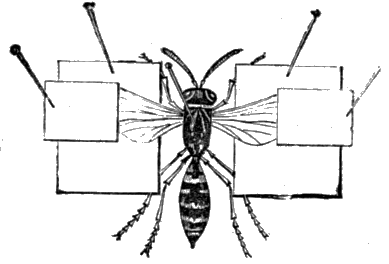
Fig. 28 Insect set with Table Braces.
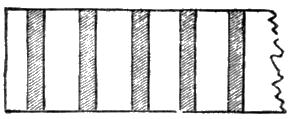
Fig. 29 Wood, with the Strips glued on.
First take one of the strips of cork as sold at the shops, paper it on both sides with thin soft paper; then take a piece of wood a little larger than the cork, about half an inch thick; on this I glue strips of cardboard, or thin wood, according to the size of the insect, side by side, and as far apart as necessary (see Fig. 29). These being dry, I glue the sheet of cork on to the top of the strips, which leaves it looking like a succession of bridges. When this is dry the cork must be cut through between the pieces first fastened on the wood. These pieces are then taken out and glued to the wood (see Fig. 30); this leaves many setting boards, something similar to the single rounded ones used by Lepidopterists; but these are flat—they want to be just deep enough for the insect and wide enough to allow the legs to be stretched out. A little practice will soon determine the size. The wing I hold down with small triangular braces. Each board will hold about seventy or eighty insects; beneath I put the date they were set, and leave them on the board about a month to dry, as if taken off too soon the wings spring. Always put a label to each specimen, either with the date or a number corresponding to one in a book, in which enter the date and locality.

Fig. 30. Ditto, side view. A, the same with the cork glued on; B, cork; C, the same with the cork cut through at the dotted lines in A, and fastened down.
One more observation and I have done. Sometimes one comes across an insect whose rigid wings seem to defy all attempts to set; in such cases just press firmly at the back part of the thorax, between that and the abdomen, towards the pin, and the wings will sometimes fly open of their own accord, or will allow of their being easily set in the required direction, which should always be set well forward.
VII.
LAND AND FRESHWATER SHELLS, ETC.
By Professor Ralph Tate, F.G.S., etc.
A young friend, desirous of entering upon one of the most accessible natural history pursuits, that of the study of Land and Freshwater Molluscs, begged of me some practical hints on the collection and preservation of these objects of our woodlands, waysides, and watercourses. Believing that this kind of work offers a good stepping-stone to the study of nature in its more extended forms and complicated relations, I was most anxious to help my tyro naturalist, and that beyond his utmost expectations, as I made a few initiatory trips with him in a search for the coveted treasures.
Our equipment was simple and inexpensive, consisting of a block-tin saucepan finely perforated at the bottom, about six inches across, and having a hollow handle of a size to receive firmly the end of a common walking-stick—such a dredge or a sifter will cost ninepence or a shilling at a tinman's; secondly, of a pocket lens; and lastly, of a variety of boxes, and a bag to contain specimens of different sizes. Thus provided, our first excursion had for its object an examination of certain neighbouring ponds and streams. My pupil, guessing the use of the perforated saucepan, makes his way to the nearest pond, fixes the improvised handle, dashes in the sifter with impatient ardour, and having brought up a quantity of mud from the bottom, looked upon the oozy mass with despair. Patience, my lad! Remember that the pleasure of success in science is the higher the greater the labour expended in obtaining the objects of our search. Expect failure now and again, but do not be disheartened. Ohne Hast ohne Rast, should be the motto of every naturalist. Now, shake the tin in the water, keeping its rim just out of the water, dipping it down now and then. That is well; thus you see that you have cleared off the mud, and what you want is probably left behind along with the rubbish. What, nothing! Come, try again; but this time scrape the sifter along the surface of the mud, and I am confident that you will find something to reward you, and with much less trouble and display of temper. In this way, after repeated trials, a number of shells were secured and transferred to the boxes. Then, after the first gush of excitement is over, we retire to an adjoining bank to con over the spoils, and I to make mention of the various habits of freshwater snails, and consequently of the different modes of search. My young friend's enthusiasm is aroused by the mention that a few large mussel-like shells are inhabitants of our fresh waters, and great is his haste to be up and again doing, in the hope of adding some of them to his stock. But in vain were his many attempts to find them in the pond which had already yielded us such a variety. "Do they live here?" is at last the anxious question. "No; but let us away to yon sluggish brook, for it is in such that we may expect to meet with them." "Now I see them. Are not those their ends just peeping above the mud?" And full of eagerness he dashes in the dredge, but with little result, excepting that of a dead shell or two. "Oh! how can I get them? Shall I take off my shoes and socks and wade for them?" "Well, you might secure them that way, and sometimes it is the only way, but on this occasion I do not think it necessary. Come, we will move a little higher up, where the stream is clear, and the shellfish undisturbed. Observe the gaping ends of the shell, and thus I push the end of the stout rod between the partially-open valves; now they close upon the stick, and so we bring our prize holding on to the stick to the bank."
"You will recollect," addressing my companion, "that in the muddy pond we have just left, we chiefly got small bivalves and only a few snail shells. I have already told you that water shells differ much in their habits, and that consequently our search for any particular species, or set of species, can only be successfully carried on when that knowledge is our guide. Those little bivalves, and a few of the snails that we have gathered, habitually live at the bottom, and will of course be brought up in the dredge when that implement is dragged over it; but there are many shells which live at or near the surface, and which feed on the submerged and floating plants. Therefore we must seek out a weedy pool if we would increase the variety of our collection." Such a spot is reached; and the dredge is brought into requisition, anon to snatch up a floating snail, or again to sweep over and through the plants, varying our occupation by dragging to the margin the tangled masses of weeds; by all of which means a considerable number of the class of air-breathing water snails was obtained—admonishing my young friend that this last plan does very well when the plants grow in dense masses, because when thus interlaced they form a natural net to catch those snails which on the slightest disturbance lose their hold upon the weeds, and which would otherwise fall to the bottom.
Yet another plan remains to be pursued, one by which the few small shells hiding among the roots of the plants may be secured. Obviously the dredge misses such; but by pulling up the plants by their roots, and well shaking them in the half-sunken sifter, we yet after all obtain them.
From causes which need not be explained here, the shells living in some ponds are all much eroded, or coated with a ferruginous deposit; it will be desirable therefore to find out the localities where specimens are in the best condition, so that you may have typical specimens for comparison before an extensive collection is made.
Our experience is, that though a considerable number of species may be obtained from a ditch or pond, yet a few are found as the sole molluscan tenants of particular sheets of water; that lakes exhibit a dearth of life, and that the greatest variety is often to be met with in canals; but should a search be carried on in them, avoid the towpath side, for reasons that a little thought will readily suggest.
Living near the sea, and within a short distance of wooded hill-sides, we had within a limited area such a variety of physical features that we were led to infer the existence of a rich molluscan fauna for the neighbourhood. Our second excursion was devoted to a search for snails along the sea margin and shores of the estuary. Proceeding along the low sand-dunes—at first sight a most uninteresting spot—Helix caperata, H. virgata, Bulimus acutus, and a few other snails, were found clustering upon the low stunted vegetation in such numbers, that handfuls might have been gathered within an area of a few square feet. Leaving the seashore, our way led us over the foreshore of the mouth of the river, crushing under our feet at every step shells of Cardium edule, Scrobicularia piperata, and a few other bivalves which find a congenial habitat in such situations. Gaining the muddy margins of the higher part of the estuary, Conovulus was looked for, and found under the stones along the high-water mark. Higher up the river the rejectamentum on its banks was carefully turned over, and we were successful in securing a number of land shells. The animals, of course, do not live in such places; but their empty shells, which alone were found, had been brought down from the land surface by the agency of the streams and tributaries of the river. Nevertheless such an omnium gatherum should demand attention, as its contents give an insight into the character of the land and freshwater forms within the area of drainage of the river.
The number of estuarine species which have a place in our works devoted to British land and freshwater snails is very few, and the majority, moreover, are confined to the margins of the tidal rivers in the south of England. Thus Assiminea Grayana, Hydrobia ventrosa, and H. similis, live on the mud banks beneath the shade of sedges and rushes, skirting the Thames below Greenwich. To gather these small shells singly is a tedious operation; but if a thin piece of flat wood, or other substitute as the ingenuity of the collector suggests, be used to scrape lightly over the surface of mud, transferring the mass to the dredger, and washing in water, a number of specimens sufficient to stock every private cabinet in the country may be obtained in a short space of time.
For the third initiatory excursion our steps were directed inland, and as we proceeded the hedgerows, mossy banks, and margins of watercourses were diligently searched, finding a Helix here, a Pupa or a Succinea there. Gaining the woods, we turn over the damp leaves, grub under the clumps of ferns and wood-rushes for small Helices, Pupæ, and the like; scan the trunks of the trees for the climbing Clausiliæ, Bulimi, and Helices, not unmindful that each little dirt-like mass is probably a Bulimus obscurus, which, by covering its shell with mud, thus exhibits a protective faculty, and often escapes detection. Raise the rotting bark for Balia; lift the stones at our feet, or roll away a log for Helicella, and other small shells which usually live in such situations.
From all this we learn that each species affects certain stations, and therefore, with the knowledge of the circumstances in which they are found, we may set out with some definite idea as to what we are likely to meet with; and, in consequence, when to collect and where to collect are regulated by the unvarying habits of the objects of our search.
Now, a large portion of the life of most land snails is passed in a state of sleep. Those living in open situations are inactive during the heat of a summer's day, and when there is continued drought; but on the first shower, or after the fall of dew at night, they recover and move about in search of food. Cold acts much in the same way as heat, and with the fall of the leaf they retire to winter quarters in crannies of rocks, crevices of walls, under heaps of decaying vegetation, &c., or bury themselves in the soil, there to hybernate till the genial showers of spring awaken them.
The best time of the year for collecting is in the autumn, when the shells are full-grown. Those collected in spring have lost much of their original beauty by exposure to the rains and cold of the winter months.
As regards the particular time of day to collect with advantage, it has already been implied that a search in an open country should be prosecuted after a shower of rain, or during early morn. In damp woods, where throughout the day the air is sufficiently moist to maintain the animals in full activity, no such considerations determine the best time for collecting. In such places, light is usually the desideratum, and consequently I have found that a search conducted at midday in a clear sky has been amply rewarded.
Land snails exhibit a partiality for calcareous soils, not only by those living on downs and hill-sides, but also by the woodland species.
Having spent the forenoons of three days in gathering slugs and snails as before detailed, one evening was devoted to the preparation of the specimens for the cabinet.
The first step was to remove the animals, and, as all know, it is neither an easy nor a clean task to separate the living snail and its house; but kill your snail, and the muscular connection with the shell being severed, its whole body is readily taken out by means of a pin—why, it is just like picking periwinkles; and if the proclivities of our childhood's days are not entirely obliterated, cleaning out larger snails from their shells will be a task requiring no teaching. But, with regard to the smaller kind, it is another matter, and it will be my duty to show you how to set about the work.
Now pick out those shells, the apertures of which are wide enough, as it seems to you, to permit the removal of the dead body of the snail by a pin. You may also place with them the larger bivalves. All these we will boil to kill the animals; then strain off the water, and wash with cold water. By this means the bodies contract, and being firmer are not so liable to be broken in the process of removal. Shake the water out of the empty shell, and place them before the fire to dry; do not rub them, but particles of dirt may be gently flicked off by the aid of a camel-hair brush. Thus we treat the larger snails. Now for the mussels. Doubtless most of the dead bodies will have fallen out between the open valves while in the water; should any remain, a slight shaking of the shell held by the hand in the water will remove the contained body. Taken from the water, the valves gape widely; dry the inside and outside with a cloth, and having tape or cotton at hand, close the valves by the pressure of the thumb and fingers of the one hand, and with the end of the thread between your teeth, wind the thread two or three times around the shell with the other; now tie the thread as tight as you can. "Yes, I have done so, but still the valves are not closed." True, this is because of the elasticity of thread. If, however, you will take the precaution to wet the thread before tying, you will find that the tie is more secure, and that there is less difficulty in making the second knot.
With patience and a little skill, bivalves as small as Cyclas cornea may be treated in this way. But the smaller Pisidiums, and some of the minute snails, as Carychium minimum, may be prepared for the cabinet by gently drying them in sand; too great a heat causes a transfusion of the carbonaceous matter of the animal into the substance of the shell, which is thereby discoloured.
There still remain for treatment such shells as Clausilia, Bulimus, Helicella, some Helices, &c., the animals of which retreat, on the least irritation, beyond the reach of a pin, and whose shells, indeed, will hardly bear the rough handling almost necessary when a pin is used. Their bodies might be dried within the shells, but if it be possible to remove some portion only of the animal, an attempt should be made to do so.
Land snails, when placed in water, do their best to effect an escape from a medium so fatal to them; their efforts are usually exhibited by stretching out their bodies to the utmost, swaying them to and fro as if in search of a foothold. Taking advantage of this propensity, the snails should be immersed in tepid water, because the majority, after a day or two's confinement in the collecting boxes, will be in a dormant condition, and warm water has a greater resuscitating effect than cold. When all the snails are struggling to find a way out of their unpleasant situation, gradually add hot water so as to kill or paralyze them while in an extended state. They may now be thrown into boiling water, the better to relax the muscular attachments, and the bodies, or so much as will come away, dragged out by forceps, or a pin passed through the foot. The shells may now be dried in sand, as before mentioned.
In cleaning the shells of some species, great care is needed, so as not to remove the hairs or bristles which clothe the surface of the epidermis.
The shells of such snails as Paludina, Cyclostoma, &c., &c., would be imperfectly illustrated without the opercula or lids which close the apertures of their shells. Each one should be detached from the foot of the snail, the interior of the shell plugged with cotton wool, and the specimen gummed down in its natural position.
The preservation of slugs requires separate treatment, and I can give but little additional information to that published in my 'British Land and Freshwater Molluscs' an extract from which is subjoined:—
"As regards the internal shell, it may be obtained by making a conical incision in the shield, taking care not to cut down upon the calcareous plate, which can then be removed without difficulty. The animals can only be conserved by keeping them in some preservative fluid; but the great object to keep in view is to have the slug naturally extended. Most fluids contract the slugs when they are immersed in them. The slugs should be killed whilst crawling, by plunging them into a solution of corrosive sublimate, or into benzine. Models in wax or dough are sometimes substituted for the animals. A writer in the 'Naturalist' gives a process for the preservation of slugs, which he states to answer admirably, and to be very superior to spirit, glycerine, creosote, and other solutions:—'Make a cold saturated solution of corrosive sublimate; put it into a deep wide-mouthed bottle; then take the slug you wish to preserve, and let it crawl upon a long slip of card. When the tentacles are fully extended, plunge it suddenly into the solution; in a few minutes it will die, with the tentacles fully extended in the most life-like manner; so much so indeed, if taken out of the fluid it would be difficult to say whether it be alive or dead. The slugs thus prepared should not be mounted in spirit, as it is apt to contract and discolour them. A mixture of one and a half parts of water and one part of glycerine, I find to be the best mounting fluid. It preserves the colour beautifully, and its antiseptic qualities are unexceptionable. A good-sized test-tube answers better than a bottle for putting them up, as it admits of closer examination of the animal. The only drawback to this process is, that unless the solution is of sufficient strength, and unless the tentacles are extruded when the animal is immersed, it generally, but not invariably, fails. Some slugs appear to be more susceptible to the action of the fluid than others; and it generally answers better with full-grown than with young specimens. But if successful, the specimens are as satisfactory as could be desired; and even if unsuccessful, they are a great deal better than those preserved in spirit; for, although the tentacles may not be completely extruded, they are more or less so'".
The Testacellæ I have treated in the following manner: by partially drying them in sand, and removal of the soft parts through a cut in the length of the foot, filling up with cotton wool and a renewal of the drying.
Our land and freshwater snails have other structures besides their shells which should claim our attention. These, which include their jaws, tongues, and some other minute parts, are not so inaccessible as one is at first too apt to consider, and are deservedly in favour as microscopic objects requiring a low power. I shall assume that the collector has preserved the bodies or the heads of the snails in spirit, which he has removed from their shells in the process of preparing them for his cabinet. He will take care to keep separate the animals of each species.
A last word upon the mode of displaying the shells in the cabinet. Here one has considerable choice, as they may be kept in open card trays, or in glass-topped boxes, or gummed on cards, papered boards, or glass tablets. Loose specimens admit of ready examination, whilst the method of mounting permits an arrangement of individuals according to size and locality, and is much to be preferred.
VIII.
FLOWERING PLANTS AND FERNS.
By James Britten, F.L.S.
PART I.
The kindred subjects of the collecting of plants and their arrangement in the herbarium have been treated of over and over again, and it might almost seem as though nothing further need be said upon the matter. But in spite of all that has been written, it cannot be said that anything like uniform excellence has been attained, either in the collecting or drying of specimens: on the contrary, much carelessness is still exhibited in both particulars, and the following remarks on the subject may therefore be useful to some, at any rate, among the readers of 'Science Gossip.' It has been found impossible to treat both points adequately in one paper, so, on the present occasion, we shall devote ourselves to collecting, leaving the arrangement and matters connected therewith for another occasion.
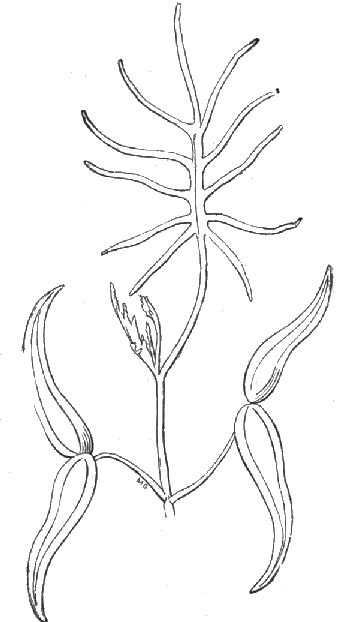
Fig. 31. Young Plant of Ipomæa Quamoclit (from Decandolle's 'Organographie').
The great aim to be kept in view in collecting is to obtain as perfect and comprehensive a specimen as possible; that is, one showing every part of the plant—root, leaves, flowers, and fruit. It is not always practicable to show all these upon one specimen, and in such cases such a number must be selected as will carry out this plan. The wretched scraps with which some collectors content themselves are not only useless to their owners, but annoyances to everyone who has to do with them, or who is requested to pronounce an opinion upon them. Anyone who has had anything to do with naming plants for 'Science Gossip' or any other journal, which in this manner supplies information to its subscribers, will be able to testify to the large number of persons who do not scruple to send for determination single leaves, or a terminal shoot of a flowering plant, or a pinnule of a fern without fruit; a proceeding which is unfair to those to whom they are submitted, inasmuch as they either have to risk their reputation for accuracy, or to appear uncourteous by refusing to have anything to do with such specimens.
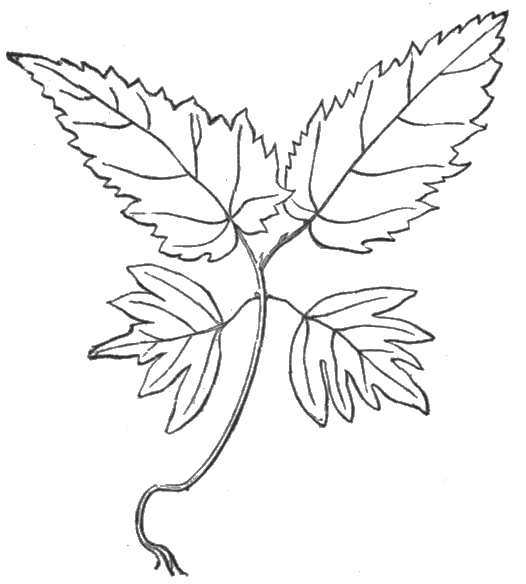
Fig. 32. Lime (Tilia Europæa).
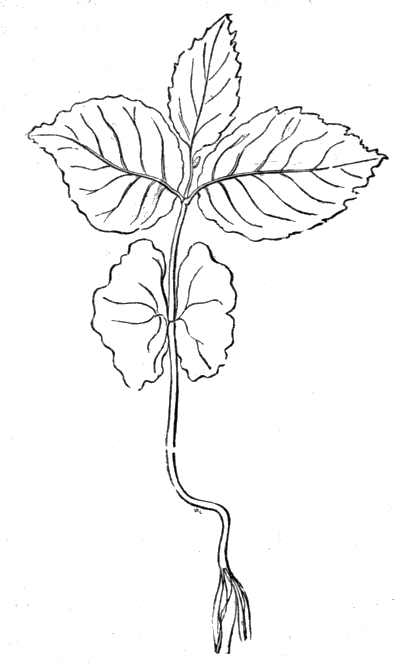
Fig. 33. Beech (Fagus sylvatica).
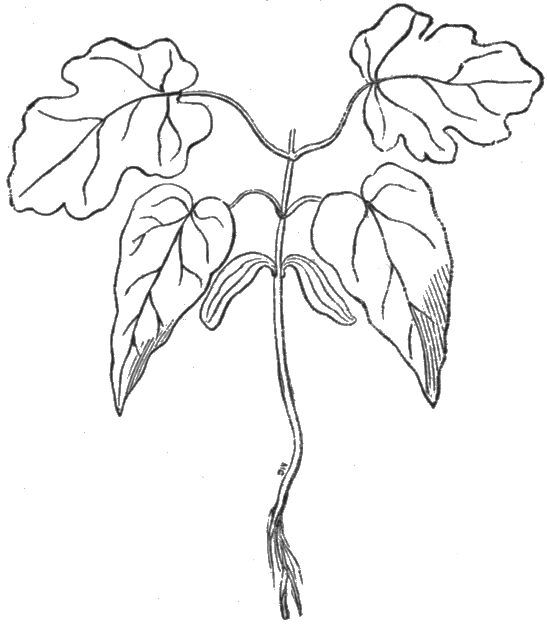
Fig. 34. Sycamore (Acer pseudo-platanus), showing cotyledons and first and second pair of leaves.
To begin at the beginning, How rarely do we find the embryo of any species represented in a collection of dried plants? It ought to be there, not only as essential to the complete presentment of the history of the species, but as in certain cases indicating relationships which are not apparent when the plant is more advanced. Those who have not observed them would be surprised to find how much variety of form exists in the cotyledons alone, from the fleshy cotyledons of many of the Leguminosæ, the horse-chestnut, &c., to the foliaceous ones, or seed-leaves, of other plants. Among the latter may be noted and compared the lobed or palmate cotyledons of the lime (Fig. 32); the glossy dark green, somewhat kidney-shaped ones of the beech (Fig. 33); and the pinnatifid ones of the common garden cress (Lepidium sativum); the obcordate ones of the mustard or radish; the long, narrow, thin ones of the sycamore (Fig. 34); the sinuous or corrugated and bilobed ones of the walnut, and many more which will occur to the observant reader, or which may be collected by anyone who will take the trouble to watch the germination of plants. And by making such collections, unexpected discoveries may arise, which will yet further confirm what has been said about the variety in form and structure even in these beginnings of growth. Plants which are, on account of their general affinities, reckoned among the dicotyledons, may be found on investigation to have but one cotyledon, as Dr. Dickson observed to be the case with two of our butterworts, Pinguicula vulgaris and P. grandiflora, the third species, P. lusitanica, being dicotyledonous; or even to be acotyledonous, as is the case with the dodder (Cuscuta). In the latter-named genus, it is of importance to collect young specimens, as showing that the plant, although parasitic as soon as it comes in contact with a suitable foster-plant, is of independent origin. A search among young plants will no doubt lead to the discovery of some abnormalities, such as tricotyledonous embryos and other irregularities. Of some plants, such as the furze, the true leaves can only be found at an early stage of growth; in others, much variation may be noted in many points between the first leaves and the more perfect ones which succeed them; some, as the holly, at once developing leaves similar to those which are produced throughout the life of the plant, and others going through many modifications before the ultimate shape is attained, as in the ash, elder, ivy, maple, &c.
The roots or rhizomes also require to be much more fully represented and carefully collected than is usually the case. In every instance where the size of the plant does not prevent, the subterranean and subaqueous parts should be carefully procured and preserved.
Dr. Trimen has lately directed attention to the corm-like tubers of the water plantain (Alisma),[G] closely resembling those of the arrowhead (Sagittaria), which have been described and figured by Nolte, but "do not seem to have been observed, or at least properly understood, in this country. They are buds remaining dormant through the winter, and containing a store of nutriment, to be employed in the development of the new plant from the tuber in the next year." Similar bulbs are developed by the frogbit (Hydrocharis). In determining many grasses and rushes, it is of importance to ascertain whether the rhizome is creeping or cæspitose, and it is therefore essential to collect good specimens. In the case of such plants as the coral-wort (Dentaria bulbifera) and toothwort (Lathræa squamaria), the root-stocks are eminently characteristic. Of such parasites as the broomrapes (Orobanche), some care is requisite in obtaining specimens in which the connection between the parasite and its foster-plant may be preserved and shown. The absence or presence of tubers should also be noted, and if present, they must be represented.
Passing on to the leaves, we may note the importance of obtaining in every case the root-leaves of each species. These are often very different in form from the stem-leaves, as in such species as the harebell (Campanula rotundifolia), Pimpinella saxifraga, the earth-nut (Bunium flexuosum), and many more; in some instances, as in the Jersey bugloss (Echium plantagineum), they at once characterize the species. Still more important are these lower leaves in the case of water-plants: in the arrowhead (Sagittaria), for example, they are narrow, and resemble those of the bur-reed (Sparganium); and in the water plantain (Alisma plantago), the submerged leaves are equally different from those which rise out of the water. This difference is still more noticeable in the case of the aquatic Ranunculi, where a knowledge of the submerged leaves is essential to the discrimination of the various forms or species.
Where practicable, the whole plant should be collected for the herbarium; but when, from its size, this cannot be accomplished, leaves from the root, the centre of the main stem, and the lateral branches, should be taken. As to the stem itself, that must be represented: in the Rubi, indeed, it is essential. "To judge properly of a bramble from a preserved specimen," says Professor Babington, "we require a piece of the middle of the stem with more than one leaf; the base and tip of the stem are also desirable, likewise a piece of the old stem with the flowering shoot attached to it; the panicle with flowers, and the fruit. We likewise want to know the direction of the stem throughout, of the leaflets, and of the calyx; also the shape of the petals and the colour of the styles: a note of these should be made when the specimen is gathered."
Passing on to the flowers, we shall find it necessary to represent them in almost every stage, from the bud to the perfecting of the fruit. It is of course in most cases possible to select an example in such a state as to show upon the same plant buds, flowers, and fruits; but where this is not the case, each of these particulars must be supplemented by additional specimens. The turn which botanical investigation has recently taken towards the study of the phenomena connected with fertilization has given the collector another subject to which his attention may be profitably directed. It has been observed that in some plants the stamens are developed before the pistils; in others, the pistils are matured before the stamens; while in yet a third set, stamens and pistils are simultaneously perfected. These three groups of plants are termed respectively protandrous, protogynous, and cynacmic, and a very little observation will show that examples of each are sufficiently common.
Then in diœcious and monœcious plants, both male and female flowers must be collected, and in some cases, as in the willows, four specimens are necessary to the complete presentment of the species, showing respectively the male and female catkins, the leaves, and the fruit. Some plants produce two distinct forms of blossom, as is noticeable in the violets and the woodsorrel, one being conspicuous and usually barren, the other insignificant and often apetalous, but producing perfect fruit. The pollen will afford occupation to the microscopist: the researches of Mr. Gulliver and Mr. Charles Bailey have demonstrated that important distinguishing characters are in some instances furnished by it. While on this point it may be suggested that it is convenient in many cases to collect several specimens of the flowers alone, which, when dried, should be placed in a small envelope or capsule, and attached to the sheet on which the plant is represented. In the event of any examination which may be requisite after the plant is dried, these detached blossoms will be found very useful, and will prevent the necessity of damaging the specimen. In the case of such plants as shed their corollas very readily, as the speedwells, it is as well to put them in press as soon as collected; and the colour of many may be retained by the same means.
The fruits and seeds of plants are too generally neglected by amateur collectors, but are essential to the completeness of a specimen. It may be found practically convenient to keep these in a separate place, and detached from the plant; and in many cases of dried fruits it is advisable to sort them into their places without previous pressing. By this means the modes of dehiscence will readily be seen: pulpy and succulent fruits should be preserved in spirit. In such plants as the species of sea sandwort (Lepigonum), and some Chenopodia, important specific characters are drawn from the seed; as they are from the pods of Melilotus and the fruits of Agrimonia. In collecting ferns, well-fruited fronds must be selected, as it is impossible to determine specimens without fructification. Grasses should be selected when in flower and fruit, but must not be allowed to attain too great an age before they are collected.
We have been speaking so far of the things to be collected, and space will not allow us to dilate at any length upon the apparatus necessary to that end. Nor indeed is this necessary; a good-sized vasculum, with one or two smaller boxes for the pocket, in which the more delicate plants may be preserved; a strong pocket-knife or small trowel, for procuring roots, and a hooked stick wherewith to fish out water-plants, or pull down branches, are the principal things required. To anyone residing for any length of time, or even only for a few days, in a district, a "London Catalogue" is an important acquisition, in which should be marked off all the species met with; by this means the flora of the neighbourhood is ascertained at a very slight expenditure of time and trouble. It is not advisable to collect too many plants at once, or to crowd the vasculum, unless under exceptional circumstances; nor should the desire to possess rare plants tend, as is too often the case, to the neglect and exclusion of commoner ones.
A careful and observant collector will frequently meet with forms which deviate more or less from the accepted type of a species. When these appear to offer any marked characters, they should be noted; and in all cases it is well to preserve any forms which, from external circumstances, have a different appearance from the normal state. The differences produced by soil and situation alone are very considerable; and though the essential characters are usually to be discerned, the interest and value of a herbarium are very much increased by a selection of examples showing the range of a species. Campanula glomerata offers a good example of this. In damp meadows it is from one to two feet high, with a large spreading terminal head of blossoms, while on chalk downs it does not attain more than as many inches, with only one or two flowers; in this state it was described by Withering as a gentian, under the name of Gentiana collina; and the same author gives as Campanula uniflora a one-flowered mountain state of the harebell (C. rotundifolia).
The collector will also do well to keep a look-out for deviations in structure, which are often of great interest. In short, nothing should be neglected which can tend to the perfect presentment of a species in the herbarium: its utility is commensurate with its completeness. The mere collector may be satisfied with scraps of a rare plant and the absence of commoner species; but the real worker will pride himself rather upon the possession of instructive examples, which may be of assistance to himself, as well as to all those who may consult them.
IX.
FLOWERING PLANTS AND FERNS.
By James Britten, F.L.S.
PART II.
We will assume that our collecting for the year has come to a close; that the long evenings are beginning, and that our dried plants have been brought together from their temporary resting-places to be revised and selected from, so that they may be intercalated in their places in the herbarium, if we already possess one, or, if we are as yet quite novices, that they may form a nucleus around which the whole British flora shall be gathered in due course. First of all, we must make all necessary preparation for—
Mounting, the first essential to which is paper. Much of the neatness of a herbarium depends upon its uniformity, so that it is desirable to lay down a definite plan at the beginning and to act up to it consistently. Amateurs often spoil specimens which they have collected and preserved with considerable care by transferring them from one sheet to another; from books—but it is only very amateur botanists who keep their plants in this way!—to loose sheets, from small paper to large, and so on; each change being attended with some slight damage to the specimen so treated. It is, I believe, the common practice on the Continent to keep the specimens loose in folded sheets of paper; but this plan is not followed in England, and although advantageous, as permitting the fullest examination of the plant, it is attended with much risk to the specimens in the way of breakage; so that we may consider it settled that we are going to fasten our plant down upon a sheet of paper. This must be rather stout, and large enough to admit the full representation of the species. The sheets used at the Kew Herbarium are 16-1/2 inches long by 10-1/3 inches wide; those employed at the British Museum are 17-1/2 inches by 11-1/4 inches; but the former will be found amply sufficient for our purpose. The next consideration is the means by which the specimens are to be secured, which are more various than might at first be supposed. Some persons sew them to the paper; others place straps over them, which are secured with small pins; but the choice practically lies between fixing the whole specimen to the paper with gum, paste, or glue, or securing it with straps of gummed paper. The former plan, which is that adopted at our great public herbaria, is certainly better for specimens which are likely to be much consulted; but the latter is in some respects more satisfactory, if somewhat tedious, as it admits the removal of the plant to another sheet if necessary, and delicate portions, such as thin petals or leaves, are not injured as they are when gummed down. At the British Museum and Kew a mixture of gum tragacanth and gum-arabic (the former dissolved in the latter), in about equal parts, is used for this purpose; but very coriaceous specimens are secured with glue at the last-named establishment, while in the former the stems and ends of branches are usually also secured with straps. When the specimen is entirely gummed down, it is a good plan to keep a few extra flowers or fruits in a small capsule attached to the sheet: these will be useful if it is required to dissect such portions, and the specimen need not be injured for such purpose.
Poisoning.—Some persons are in the habit of employing a solution of corrosive sublimate for the purpose of washing over their plants when mounted, and so preventing the development of animal life. The solution in use at the Kew Herbarium is composed of one pound of corrosive sublimate, and the same quantity of carbolic acid to four gallons of methylated spirit; this fulfils the purpose for which it is intended very well, but is somewhat disagreeable to use. At the British Museum it is found that the presence of camphor, frequently renewed in each cabinet, is sufficient to prevent the attacks of insects. It will soon be discovered that some plants, such, for example, as the Umbelliferæ and Grossulariaceæ, are peculiarly liable to such attacks; and these orders must be inspected from time to time, so that any insect ravages may at once be checked. Damp is to be avoided in the situation of the herbarium, as it favours the development not only of insects but of mould, and renders the specimens rotten.
The question of labelling is of some importance, especially to those who value neatness and uniformity in the appearance of their herbarium. One or two sets of printed labels for this purpose have been issued, but they cannot be recommended. They give more than is necessary, e.g. the English, or, more correctly, the book-English names, the general habitats, and definite localities of rare species, and allow very insufficient space for filling in the date and place of collecting, the name of the collector, and such remarks as occasionally occur. The plan of writing all necessary information upon the sheet itself is a good one; but those who prefer a uniform series of labels will find that a form like the following is as useful as any which they can adopt, and includes all necessary information. The size here given will be adequate for almost all requirements, and is a "happy medium" between the small tickets upon which we have animadverted, and the enormous ones with which some botanists think it necessary to accompany their specimens. Care should be taken to avoid the possibility of a misplacement of labels; many serious blunders have arisen from the neglect of due precaution in this matter.
Herb. John Smith.
Ranunculus acris, L. & R. Steveni, Reich.
Loc. Meadows near Barchester.
Date, June 30, 1874.
Coll. John Smith.
Arrangement.—The plants, being now affixed to their respective sheets and duly labelled, are ready to be placed in covers, and rendered available for ready reference. Each genus will require a separate cover, which may well be of somewhat stouter paper than that on which the plants are mounted; the name of the genus should be written at the left-hand corner, followed by a reference to the page of the manual by which the plants are arranged, or to the number which it bears in the "London Catalogue," if that be employed in their arrangement—a purpose for which it is very suitable. Should the species be represented by more than one sheet, it is convenient to inclose each in a cover of thinner paper, which may bear the number assigned to the plant in the right-hand corner; and it is also convenient to write the name of the plant at the bottom of each sheet, and to number it also in the right-hand corner. These details may appear trivial, but they in reality affect in no small degree the readiness with which any species may be referred to. Should the plants be arranged in accordance with the "London Catalogue," a copy should be kept with the herbarium, in which the plants should be ticked off, so that it may serve as a catalogue of the species represented.
Cabinets.—It will of course be necessary to provide some accommodation for our specimens, and for this purpose we shall find no better model than the cabinets in use in the Botanical Department of the British Museum. The accompanying figure (drawn to scale) is an exact representation of one of these. The measurements can of course be modified so as to suit the size of the herbarium sheets. Each shelf is a separate drawer, which with its contents can be taken out and replaced at will. Two cabinets such as that figured will be found amply sufficient to contain a very good British herbarium. At Kew the cabinets employed are somewhat similar, but their height is greater and the shelves are fixed.
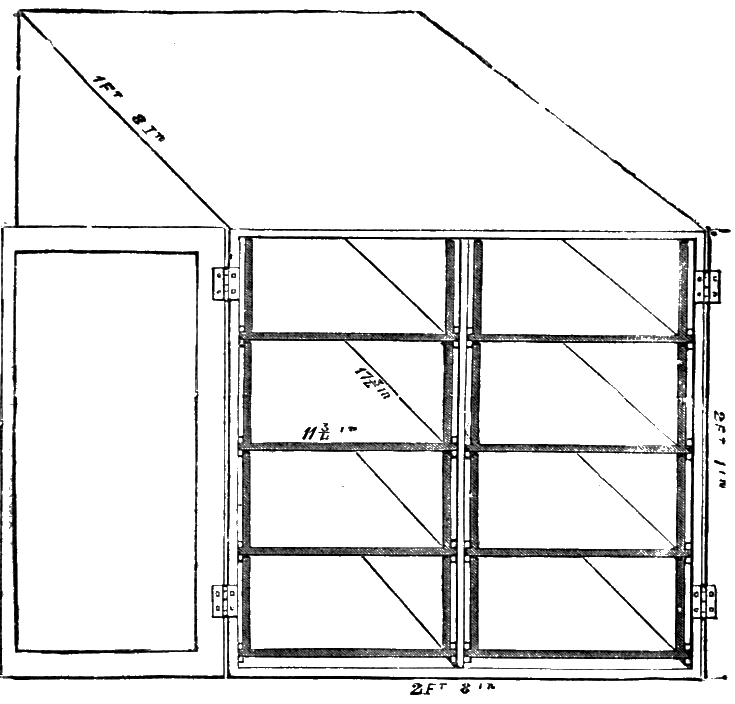
Fig. 35. Cabinet for Herbarium Sheets.
The above are the principal points connected with the arrangement of a herbarium, considered as distinct from the work of collecting. It is possible that I may have omitted to touch upon certain details which may occur to the amateur; should such be the case, I may add that I shall be happy to supply any additional information, either by letter or by word of mouth; or to show the system adopted at the British Museum to anyone who may call upon me there for further hints upon the subject.
X.
GRASSES, ETC.
By Professor Buckman, F.G.S., etc.
Grasses form such a distinct group of plants, and their study is so often undertaken for special purposes, that a few remarks upon their collection and preservation can hardly be considered as out of place in this little manual.
Delicately as grasses are formed, yet it cannot be said that their tissues are so liable to injury, or their colours so evanescent, as those of the flowering plants which the botanist ordinarily delights in. Nor indeed are the grasses so succulent as many other herbs. In this respect they may be said to hold a place between ferns and those plants which usually are called flowers.
Again, in the dried state their organs are generally so well preserved as to present all that a botanist can wish for, for identification as well as arrangement; and the student of grasses ever finds his collection to contain beauties not only in point of rarity, but as regards delicacy of structure and grace of outline.
Viewing them in this light alone, we have often been astonished that so many students of plants pay so little attention to them, and this feeling is enhanced when the great value of the grasses is considered.
If then a few simple directions for preserving these plants shall have the effect of winning a convert to these views, we shall be delighted; and to this end we shall make our descriptions as plain as our process has ever been easy and simple, and yet complete.
In collecting grasses, as in other tribes of plants, it will be necessary that our specimens should be chosen with the view to exhibit every feature of interest. With this aim, then, it will be best in the general way to obtain as much of the plant as possible, so that it may be necessary to get them up by the roots. Still, in many species the root is not of much importance: but there are a few which possess rhizomata, or underground stems; such as the Triticum repens, Poa pratensis, P. compressa, Holcus mollis, Agrostis stolonifera, and others. These should always exhibit these parts; and as such examples are usually agrarian, it is easier to mark down desirable specimens and seek a fork at the neighbouring farm-buildings wherewith to completely get them out, than to carry any substitute in a smaller and less perfect implement.
Haying made these remarks, we will suppose that we are now about to sally forth in search of grasses; in which case we make the following preparations.
As we do not file our copy of the 'Times' we make use of it as collecting-paper as follows:—Each side of the paper is cut in two, or, as a Cockney would say, "in half." Each half is then folded into a double collecting-sheet, and as many of these are taken as are likely to be useful. In each of these papers is put a small slip of writing-paper, on which to note the locality and any other noteworthy fact connected with a specimen when put in the paper. These papers, separately folded, are placed with the open ends inwards in a convenient portfolio, and the collector is ready to take the field.
Of course there will be those who will advocate Bentall's drying-paper, blotting-paper, and so on, and we would not have it supposed that we despise these luxuries; but as we have found the plan advocated always to answer the purpose for grasses, we have felt independent of the more refined collecting-papers.
Now let us suppose that we have gathered fifty specimens, and have returned home. The next thing will be to put them as soon as may be in a position for drying.
Our drying apparatus then consists of half-a-dozen smoothly planed deal boards, and for our first collection we take two of these, and upon one we lay some few folds of our old 'Times' then a specimen in their papers (having previously improved their arrangement, when necessary), and then some more folds of paper, and proceed as before, until all the specimens have been placed; then put a board on the top sheet, and upon that a stone, or a 7 or 14 lb. weight, according to the size and quantity of the specimens. If another day's collection of specimens be made before the foregoing are dry, they may be arranged in the same way on the top board, and another board used and the weight replaced. The object of this is to keep partially dried from fresh specimens, the putting together of which is a fertile source of mildew and decay.
In arranging our specimens for the herbarium, we procure sheets of cartridge paper 18 inches long by 11 inches wide, using a folded sheet for each species.
In these papers the specimens are fastened down in the following manner:
Gum over a portion of the cartridge paper (so as to have the same colour) with two consecutive coats of a clean solution of gum-arabic.
This can be cut into slips of any length and breadth, making them as narrow as possible for the sake of neatness, and when the specimen is placed in its paper, a few of these slips may be made to confine it in the desired position. Each example is then to be labelled at the bottom of the sheet, and each label should set forth—a, Its botanical name; b, its trivial or local name; c, the locality whence it was obtained; d, the date when gathered; added to which, if presented, the donor's name.[H]
The sheets so prepared may be arranged in groups or genera, each being folded in convenient paper or cloth wrappers, and the whole arranged in volumes of stiff covered portfolio.
This, then, is all that seems to us necessary in the collection and preservation of grasses; but we would recommend the student, if an artist, to make a typical specimen of each sit for its portrait. In this way we have made drawings of all the species and varieties that have come in our way.
Our drawings are life-size, usually lined in with Indian ink with a fine "lithographic pen." These we partially colour on the spot.
The anatomical details are much enlarged and always fully coloured. To this end our impedimenta for a day among the grasses consist of, besides the collecting portfolio, a sketching block, large octavo size, and a small box of soft colours. Armed with these we have made many a drawing of a grass under the shade of a tree, or in the parlour of some contiguous inn.
Lastly, we would venture to remark, if, besides the interest which grasses should have for the student of botany, these plants be viewed, as they have ever been by us, as indicators of the nature of soil and the value and capabilities of the land on which they grow, the collector should not fail to make notes connected with the soil, situation, and other practical facts connected with the habitats of Grasses.
XI.
MOSSES.
By Dr. Braithwaite, F.L.S., etc.
In making a collection of the vegetable productions of a country we find considerable differences in the structure of the various groups of plants, and in the tissues of which they are composed; and hence special manipulation is requisite in dealing with certain orders. Some are of so succulent a nature, or have a framework so easily disintegrated, that they contain within themselves the elements of destruction, and present the greatest difficulty in satisfactory preservation, while others are so slightly acted on by external agents, that little trouble is required to prepare specimens of permanent beauty.
The Ferns and Lycopods, being generally appropriated by the collector of flowering plants, will be treated on with the latter, and following these come the Mosses, to which we will now direct attention, taking the alliance in its broadest sense, as including the three groups of Frondose Mosses, Bog Mosses, and Liver Mosses, or Hepaticæ, all of which are readily collected and preserved, and yield an endless fund of instructive entertainment to the microscopist. But it may be asked, Where is the game to be found? Where are the pleasant hunting-grounds in which they most do congregate? We answer, everywhere may some species or other be met with; yet, though many are cosmopolitan, the majority have their special habitats, and some their special seasons, both being considerably influenced by the presence of moisture.
Collecting.—The bryologist has one advantage over the phænogamous botanist, for it is not imperative that mosses should be laid out and pressed immediately; and hence less care is required in collecting them, than is bestowed on flowering plants; the necessary apparatus is confined to a pocket-knife, to remove specimens from stones or trees, a stock of stout waste paper, and a vasculum, or, better still, a strong bag, in which to carry the packets. When collecting the plants, it is well to remove any superfluous earth or stones, or to squeeze out the water from those found in bogs; and then each is to be wrapped separately in paper, and the locality marked outside; or the more minute species may, for greater safety, be placed in chip boxes. On reaching home, if we do not prepare the specimens at once, we must not leave the parcels packed together in their receptacle, or mould will soon attack them and spoil the whole; but we must spread them out on the floor until quite dry, and then reserve them to a convenient opportunity to lay out; as in the dry state they may be kept for years unchanged.
It often happens that our line of study is developed by some fortuitous circumstance. A neglected flowerpot in the corner of the garden attracts attention by its verdant carpet of moss, or, peeping over the wall, we see the crevices between the bricks bristling with capsules of Tortula muralis, the red twisted peristome freshly brought to view by the falling away of the lid, and, taking a bit indoors to submit to the microscope, we are so captivated therewith that we then and there determine to become a bryologist. Nor is this all that a journey round the garden will disclose: the neglected paths yield other species not less worthy of examination, and old apple-trees are not unfrequently tenanted by mosses.
Extending our walks to the commons, lanes, and woods, we may find on the ground and banks, in bogs and on the stumps and trunks of trees, a number of species greatly extending our list; while others again are only met with on the clay soil of stubble-fields, as various species of Pottia and Ephemerum: appearing in October, their delicate texture is developed by the constant moisture of winter, and with it also they vanish, to appear no more until the succeeding season. Travelling yet farther away, we find that each locality we visit yields some novelty: old walls and rocks of sandstone or slate, limestone districts, and, above all, a mountainous country, are rich in species we seek in vain elsewhere. Here peat bogs, and rocks dripping with water, ever supplied by the atmosphere, or the tumbling streams everywhere met with, are the chosen homes of these little plants, and thither must the collector resort, if he would reap his richest harvest. Winter and spring in the lowlands, and a later period in the elevated districts, will be found most productive of fruiting plants.
Preparation of Specimens.—So rapidly does the cellular texture of the mosses transmit fluid, that, when soaked in water, we see them swell up and expand their little leaves, and in a short time look as fresh as when growing; hence a basin of water, a towel, and drying-paper are all we require to prepare our specimens for the herbarium. If the tufts are large, we must separate them into patches sufficiently thin to lie flat, and by repeated washing, get rid of adherent earth, mud, or gravel. This is conveniently accomplished by holding the tuft in the palm of the hand, under a tap, and allowing a stream of water to pass through it; then by pressure in the folding towel we remove superfluous moisture and immediately transfer to paper, arranging the plants as we wish them to lie permanently, and placing with each a ticket bearing the name: a moderate weight is sufficient to dry them, as with great pressure the capsules split, and thus the value of the specimen is decreased. It not unfrequently happens that two or three species grow intermixed: these must be carefully separated at the time of soaking, and any capsules required to show the peristome must also be removed before the plants are submitted to pressure.
Examination of Specimens.—We have very much to learn about a moss before we can become masters of all the characters that pertain to it as a specific individual. We must observe its branching, the mode of attachment of the leaves to the stem, and their direction; the form and structure of a separate leaf, the position of the male flowers, and, lastly, the position and structure of the fruit. For the efficient determination of these we require a microscope (the simple dissecting microscope is amply sufficient), a couple of sharp-edged, triangular needles fixed in handles, and a few glass slides and covers. Having soaked our specimen in water, we lay it on a slide, and by cutting through the stem with one of the needles, close to the attachment of a leaf, we can readily remove the leaf entire, and two or three may be transferred to another slide, and placed in a drop of water under a cover: the same thing may be roughly accomplished by scraping the stem backwards with one of the needles; but in this way the leaves are often torn.
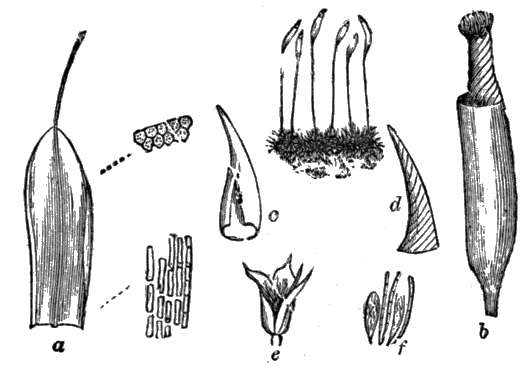
Fig. 36. Tortula muralis. a. Leaf and its areolation. b. Capsule. c. Calyptra. d. Lid. e. Male flower. f. Antheridia and paraphyses.
By examination of a leaf we notice its form, the condition of its margin, whether entire or serrated or bordered; the presence and extent of the nerve; and lastly, and most important of all, the form and condition of its component cells; and for this a higher power is required. With a 2/3-inch object-glass and C eyepiece we can observe their form, and whether their walls are thickened so as to render them dot-like; their contents, whether chlorophyllose or hyaline; and their surface, whether smooth or covered with papillæ; for often these points are so characteristic, that by them alone we can at once refer a barren specimen to its proper family or genus.
Preservation of Specimens.—This may be discussed under two heads: 1st, as microscopic objects; 2nd, for the herbarium.
1. The parts required for microscopic examination are the capsules and peristome, entire specimens of the smaller species, and detached leaves. The capsules having to be viewed by condensed light, must be mounted dry as opaque objects; and for this purpose I use Piper's wooden slides, with revolving bone cover; and in one of these we may fix a capsule with the lid still attached, another laid on its side, but showing the peristome, and a third with the mouth of the capsule looking upward, a position very useful for the species of Orthotrichum, as we are thus enabled to see the inner peristome; and with them also may be placed the calyptra: should the cost of these be an object, a cheaper substitute may be found in shallow pill-boxes, blackened on the inside.
To preserve the leaves in an expanded state we may employ the fluid media used for vegetable tissues, or, when time is of consequence, Rimmington's glycerine jelly is a convenient material in which to mount them, a ring of dammar cement being first placed on the slide, and within this the liquefied jelly, to which the expanded specimen is quickly transferred, and the cover securely sealed by gold size. Preparations of this kind are of the highest value as types for comparison with actual specimens we may have for determination.
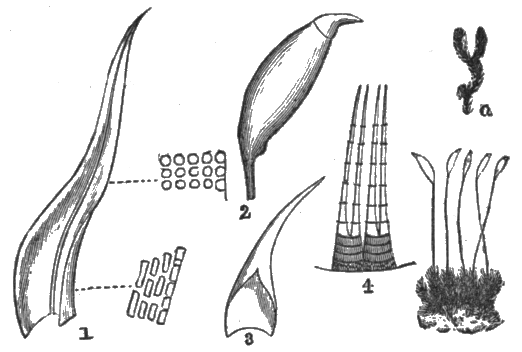
Fig. 37. Ceratodon purpureus. a. Male plant. 1. Leaf and its areolation. 2. Capsule. 3. Calyptra 4. Two teeth of the peristome.
2. In mounting specimens for the herbarium we must be guided by the limits which we have fixed on for the extent of the same; and I may first describe the method adopted for my own collection. Every species has a separate leaf of cartridge-paper measuring 14-1/2 × 10-1/2 inches, and on this the specimens are fixed, each mounted by a little gum on a piece of toned paper; thus 4 or 6 to 12 specimens, according to size, are attached to each leaf,—varieties have one or more additional leaves; and to each is also fixed a triangular envelope, inclosing loose capsules and leaves for ready transfer to the microscope, and also a label indicating the name, habitat, and date of collection. A pink cover for each genus includes the species, and a stout millboard cover embraces the genera of each family, with the name of which it is labelled outside, the whole shutting up in a cabinet.
Another form is that seen in Rabenhorst's Bryotheca Europæa, quarto volumes of 50 specimens, one occupying each leaf, and so arranged that the specimens do not come opposite to each other. Others again use loose sheets of note-paper, within each of which a single specimen is mounted; but this, from their size, is very cumbersome. Or we may take a single well-chosen typical specimen and arrange many species on a page, as is seen in the beautiful volume of Gardiner's 'British Mosses' or McIvor's 'Hepaticæ Britannicæ.' Whatever plan we adopt, our specimens, once well dried and kept in a dry place, are unchangeable, and are always looked upon with pleasure, each recalling some pleasing associations, or perchance reminding us of some long-lost friend, in companionship with whom they were collected or studied. A stock of duplicates must also be reserved, from which to supply our friends, or exchange with other collectors for desiderata in our own series: these may be kept in square cases of various sizes, cut so as to allow the edges of the top and sides to wrap over the other half folded down on the specimens.
The Hepaticæ of the family Jungermanniaceæ are treated precisely as mosses, the capsules, however, show but little diversity, and will not require separate preservation; but the elaters, or spiral threads accompanying the seeds, are elegant microscopic objects. The Marchantiaceæ must be pressed when fresh, as they do not revive with the same facility as other species, owing to their succulent nature and numerous layers of cells.
Classification.—On this I have fully treated elsewhere ("The Moss World," 'Popular Science Review,' Oct., 1871), and it may suffice here simply to indicate the families of British mosses and their mode of arrangement. The cell-texture of the leaf takes an important place in the characters, and in accordance with this principle the Cleistocarpous or Phascoid group is broken up and distributed in various families. We have two orders; one indeed, comprising only the genus Andreæa, is distinguished by the capsule splitting into four valves united at apex; the other, including the bulk of the species, has in most cases a lid, which separates transversely, and usually discloses a peristome of tooth-like processes. The structure of these teeth again enables us to form three divisions. In the first they consist of a mass of confluent cells; in the second, of tongue-shaped processes, composed of agglutinated filaments; and in the third, of a double layer of cells, transversely articulated to each other, the outer layer composed of two rows of firm coloured cells, the inner of a single series of vesicular hyaline cells, on which the hygroscopic quality of the tooth depends.
Sub-Class SPHAGNINÆ. Bog Mosses. Fam. 1.—Sphagnaceæ. Sub-Class BRYINÆ. Frondose Mosses. Order 1.—Schistocarpi. Fam. 1.—Andreæaceæ. Order 2.—Stegocarpi. Div. 1.—Elasmodontes. Fam. 2. Georgiaceæ. Div. 2.—Nematodontes. Fam. 3.—Buxbaumiaceæ. Fam. 4.—Polytrichaceæ. Div. 3.—Arthrodontes. Subdiv. 1.—Acrocarpici. *Distichophylla. Fam. 5. Schistostegaceæ. | Fam. 6. Fissidentaceæ. **Polystichophylla. Fam. 7. Dicranaceæ. | Fam. 12. Splachnaceæ. " 8. Leucobryaceæ. | " 13. Funariaceæ. " 9. Trichostomaceæ. | " 14. Bryaceæ. " 10. Grimmiaceæ. | " 15. Mniaceæ. " 11. Orthotrichaceæ. | " 16. Bartramiaceæ. Subdiv. 2.—Pleurocarpici. Fam. 17. Hookeriaceæ. | Fam. 20. Leskeaceæ. " 18. Fontinalaceæ. | " 21. Hypnaceæ. " 19. Neckeraceæ. | Sub-Class HEPATICINÆ. Liver Mosses. Fam. 1. Jungermanniaceæ. | Fam. 3. Anthocerotaceæ. " 2. Marchantiaceæ. | " 4. Ricciaceæ.
Among species which may be generally met with by beginners on the look-out for mosses, we may enumerate the following:
On Walls.—Tortula muralis and revoluta, Bryum capillare and cæspiticium, Grimmia pulvinata, Weisia cirrhata.
In Clay Fields.—Phascum acaulon, Pottia truncatula and Starkeana.
On Waste Ground and Heaths.—Ceratodon purpureus, Funaria hygrometrica, Campylopus turfaceus, Bryum argenteum, nutans, and pallens, Pleuridium subulatum, Dicranella heteromalla and varia, Physcomitrium pyriforme, Pogonatum aloides, Polytrichum commune, piliferum, and juniperinum, Tortula unguiculata and fallax, Bartramia pomiformis, Jungermannia bicuspidata, Lepidozia reptans, Ptilidium ciliare, Frullania tamarisci.
Shady Banks and Woods.—Catharinea undulata, Weisia viridula, Tortula subulata, Mnium hornum, Dicranum scoparium, Hypnum rutabulum, velutinum, cupressiforme, prælongum, purum, and molluscum, Plagiothecium denticulatum, Pleurozium splendens and Schreberi, Hylocomium squarrosum and triquetrum, Thuyidium tamariscinum, Fissidens bryoides, Plagiochila asplenioides, Jungermannia albicans, Lophocolea bidentata.
In Bogs.—Sphagnum cymbifolium and acutifolium, Gymnocybe palustris, Hypnum cuspidatum, stellatum, aduncum, and fluitans, Jungermannia inflata.
Rocks and by Streams.—Grimmia apocarpa, Tridontium pellucidum, Hypnum serpens, filicinum, commutatum, and palustre, Scapania nemorosa, Metzgeria furcata, Marchantia polymorpha, Pellia epiphylla, Fegatella conica.
On Trees.—Ulota crispa, Orthotrichum affine and diaphanum, Cryphæa heteromalla, Homalia trichomanoides, Hypnum sericeum, Isothecium myurum, Frullania dilatata, Radula complanata, Madotheca platyphylla.
Small as this list is, it will be found to yield ample store for investigation, and if true love for the study be thereby excited, the circle of forms will be found to widen with every new locality visited. If we have contributed in any way to facilitate the pursuit, then is our object fulfilled, and we may conclude with the words of Horace:
Vive, vale! si quid novisti rectius istis, Candidus imperti, si non, his utere mecum.
XII.
FUNGI.
By Worthington G. Smith, F.L.S.
With the fogs and rains of autumn the fungologist's harvest begins. A few fungi (large and small) appertain to the spring, and some species may be found in every month of the year; but it is not till September has well set in, or October is reached, that the glut of fungi is really upon us. Fungi may generally be met with in abundance for three months of the year; viz. from the latter half of September till the middle of December, the month of October taking pre-eminence for producing the greatest abundance of species. A season of moderate heat and rain is the most productive, for an excessive amount of either dryness or moisture appears to destroy the fecundity of the mycelium, which it must always be remembered is alive and at work (underground) the whole of the year; for, as a matter of course, this year's fungi is produced from last year's spores. These spores are set free in autumn, and at once vegetate and form masses of mycelium, from which next years crop must spring; just as the seeds of our wild annuals are self-sown at the fall of each year and first germinate at that season. It is a great mistake to suppose that Agarics and Boleti wait till the leaves fall, so that they may prey upon them; for, as a rule, the larger fungi never live upon the leaves of the same year as that in which they (the fungi) come up; fungi live upon the fallen leaves of the previous autumn. The spring and summer months will sometimes prove very productive, especially after stormy weather; but the collector must always bear in mind that fungi, like all other things, have their seasons. I have known the fungus harvest quite over by the end of August, and I have also known it not come in before December: it depends entirely upon a certain amount of atmospheric heat and moisture. A damp summer and stormy August will produce the crop at the beginning of September; but a dry autumn, without much rain till November, will delay the fungus crop till Christmas. Some species appear regularly twice a year from the same mycelium; once after the rains of March and April, and again in October. This is the case with Coprinus atramentarius, which I have growing (originally from spores) in a bed of my own garden.