Replies.
Reading edition
BLANCO WHITE'S SONNET.
(Vol. vii., pp. 404. 486.)
This sonnet first appeared in The Bijou, an annual published by Pickering in 1828. It is entitled:
"NIGHT AND DEATH. A Sonnet: dedicated to S. T. Coleridge, Esq. by his sincere friend Joseph Blanco White. Mysterious night, when the first man but knew Thee by report, unseen, and heard thy name, Did he not tremble for this lovely frame, This glorious canopy of light and blue? Yet 'neath a curtain of translucent dew, Bathed in the rays of the great setting flame, Hesperus, with the host of heaven came, And lo! creation widen'd on his view. Who could have thought what darkness lay concealed Within thy beams, O Sun? Or who could find, Whilst fly, and leaf, and insect stood reveal'd, That to such endless orbs thou mad'st us blind? Weak man! Why to shun death this anxious strife? If light can thus deceive, wherefore not life?"
In a letter from Coleridge to White, dated Nov. 28, 1827, he thus speaks of it:
"I have now before me two fragments of letters begun, the one in acknowledgment of the finest and most graceful sonnet in our language (at least it is only in Milton's and Wordsworth's sonnets that I recollect any rival, and this is not my judgment alone, but that of the man κατ' ἐξοχὴν φιλόκαλον, John Hookham Frere), the second on the receipt of your 'Letter to Charles Butler,'" &c.
In a subsequent letter, without date, Coleridge thus again reverts to the circumstance of its having been published without his or White's sanction:
"But first of your sonnet. On reading the sentences in your letter respecting it, I stood staring vacantly on the paper, in a state of feeling not unlike that which I have too often experienced in a dream: when I have found myself in chains, or in rags, shunned, or passed by, with looks of horror blended with sadness, by friends and acquaintance; and convinced that, in some alienation of mind, I must have perpetrated some crime, which I strove in vain to recollect. I then ran down to Mrs. Gillman, to learn whether she or Mr. Gillman could throw any light on the subject. Neither Mr. nor Mrs. Gillman could account for it. I have repeated the sonnet often, but, to the best of my recollection, never either gave a copy to any one, or permitted any one to transcribe it; and as to publishing it without your consent, you must allow me to say the truth: I had felt myself so much flattered by your having addressed it to me, that I should have been half afraid that it would appear to be asking to have my vanity tickled, if I had thought of applying to you for permission to publish it. Where and when did it appear? If you will be so good as to inform me, I may perhaps trace it out: for it annoys me to imagine myself capable of such a breach of confidence and of delicacy."
In his Journal, October 16 [1838?], Blanco White says:
"In copying out my 'Sonnet on Night and Death' for a friend, I have made some corrections. It is now as follows:
'Mysterious Night! when our first parent knew Thee from report divine, and heard thy name, Did he not tremble for this lovely frame, This glorious canopy of light and blue? Yet 'neath a curtain of translucent dew, Bathed in the rays of the great setting flame, Hesperus with the Host of Heaven came, And lo! creation widen'd in man's view. Who could have thought such darkness lay conceal'd Within thy beams, O Sun! or who could find, Whilst fly, and leaf, and insect stood reveal'd, That to such countless orbs thou mad'st us blind! Why do we then shun death, with anxious strife? If light can thus deceive, wherefore not life?'"
S. W. Singer.
GOLOSHES.
(Vol. ix., p. 304.)
This word, Seleucus says, "is of course of American derivation." By no means: it is found in German, gallosche or gallusche; and in French, galoche or galloche. The word itself most likely comes to us from the French. The dictionaries refer to Spenser as using it under the form galage; and it occurs written galege, galosh, calosh, &c. The French borrowed the term from the Latin Gallicæ; but the Romans first derived the idea and the thing itself from Gaul, Gallicæ denoting Gallic or Gaulish shoes. Cicero speaks of the Gallicæ with contempt.—"Cum calceis et toga, nullis nec gallicis nec lacerna;" and again, "Cum gallicis et lacerna cucurristi" (Philip. ii. 30.). Blount, in his Law Dictionary (1670), gives the following, which refers to one very early use of the term in this country:
"Galege (galiciæ), from the French galloches, which signified of old a certain shoe worn by the Gauls in foul weather, as at present the signification with us does not much differ. It is mentioned 4 Edw. IV. cap. 7., and 14 & 15 Hen. VIII. cap. 9."
Therefore the thing itself and the word were known among us before America was discovered. As it regards the Latin word Gallicæ, I only know of its use by Cicero, Tertullian, and A. Gellius. The last-named, in the Noctes Atticæ, gives the following anecdote and observations relating to this word. T. Castricius, a teacher of rhetoric at Rome, observing that some of his pupils were, on a holiday, as he deemed, unsuitably attired, and shod (soleati) with gallicæ (galloches, sabots, wooden shoes or clogs), he expressed in strong terms his disapprobation. He stated it to be unworthy of their rank, and referred to the above-cited passage from Cicero. Some of his hearers inquired why he called those soleati who wore goloshes (gallicæ) and not shoes (soleæ). The expression is justified by a statement which sufficiently describes the goloshes, viz., that they call soleæ (shoes) all those which cover only the lower portions of the foot, and are fastened with straps. The author adds:
"I think that gallicæ is a new word, which was begun to be used not long before Cicero's time, therefore used by him in the Second of the Antonians. 'Cum gallicis,' says he, 'et lacerna cucurristi.' Nor do I read it in any other writer of authority, but other words are employed."
The Romans named shoes after persons and places as we do: for examples, see Dr. W. Smith's Dictionary of Greek and Roman Antiquities, sub voc. "Calceus."
B. H. C.
Poplar.
This word is not of American derivation. In the Promptorium Parvulorum we find,—
"Galache or Galoche, undersolynge of manny's fote."
Mr. Way says in his note:
"The galache was a sort of patten, fastened to the foot by cross latchets, and worn by men as early as the time of Edward III. Allusion is made to it by Chaucer,
'Ne were worthy to unbocle his galoche.'—Squires Tale, 10,869."
Among many other quotations Mr. Way gives the following:
"To geten hym gilte spores, Or galoches y-couped."—Piers Ploughman, 12,099.
And in the Wardrobe Book of Prince Henry, A.D. 1607, are mentioned—
"1 pair of golossians, 6s.; 16 gold buckles with pendants and toungs to buckle a pair of golosses."—Archæol. xi. 93.
Nares says:
"Galage. A clown's coarse shoe from galloche, a shoe with a wooden sole, old French, which itself is supposed to be from gallica, a kind of shoe mentioned by Cicero, Philip. ii. 30., and A. Gellius, xiii. 21. If so, the word has returned to the country whence it was first taken, but I doubt much of that derivation; by the passages referred to in the above authors, it seems more likely that the gallica was a luxurious covering, than one so very coarse as the galloche. Perhaps the caliga, or military strong boot of the Romans, from which Caligula was named, may be a better origin for it. The word galloche is now naturalised among us for a kind of clog, worn over the shoes."
See also Richardson's Dictionary, s. v. "Galoche."
Zeus.
Seleucus need not have gone quite so far as to "the tribe of North American Indians, the Goloshes," or to America at all, for his derivation. If he will look in his French dictionary he will find,—
"Galoche (espèce de mule que l'on porte par dessus les souliers), galoshoe."
I quote from Boyer's Dictionnaire Royal, edit. 1753.
Cole, in his English dictionary, 1724, has—
"Galeges, galages, galloches, galloshoes, Fr., wooden shoes all of a piece. With us outward shoes or cases for dirty weather, &c."
C. de D.
CONSONANTS IN WELSH.
(Vol. ix., p. 271.)
For the gratification of your correspondent J. M., I give you the result of an enumeration of the letters and sounds in three versions of the Hundredth Psalm in Welsh, and three corresponding versions of it in English.
1. From the authorised translations of the Bible, Welsh and English.
2. The metrical version of Tate and Brady, and that of Archdeacon Prys.
3. Dr. Watts's metrical version and a Welsh imitation of it.
Letters in three Welsh Versions.
Bible. Prys. Watts.
Consonants 185 205 241
Vowels 148 165 159
—— —— ——
Apparent excess of consonants in Welsh 37 40 82

Letters in three English Versions.
Bible. Tate & Brady. Watts.
Consonants 220 271 275
Vowels 134 163 170
—— —— ——
Apparent excess of consonants in English 86 108 105
Sounds in three Welsh Versions.
Bible. Prys. Watts.
Consonants 150 173 200
Vowels 148 165 159
—— —— ——
Real excess of consonants in Welsh 2 8 41
Sounds in three English Versions.
Bible. Tate & Brady. Watts.
Consonants 195 241 240
Vowels 122 149 159
—— —— ——
Real excess of consonants in English 73 92 81
From this analysis it appears that the excess of consonant letters over vowels is, in English, 299; and in Welsh, 159, a little more than one-half. The excess of consonant sounds is, in English, 246; in Welsh, 51, considerably less than one-fourth.
This result might readily have been anticipated by anybody familiar with the following facts:
1. On examining lists of the elementary sounds of both languages, it will be found that the Welsh has a greater number of vowels than the English, and the English a greater number of consonants than the Welsh.
2. Welsh diphthongs are much more numerous than English.
3. In English, three vowels only constitute words in themselves (a, article; I, pronoun; O, interjection), and each is used only in one sense. In Welsh, five of the vowels (a, e, i, o, y) are words; and they are used in at least a dozen different significations. A, besides being an affirmative and interrogative adverb, answers to the English and, as, with, will go.
4. Diphthongs forming distinct words are much more numerous in Welsh than in English. The following occur: ai, a'i (=a ei), a'u, ei, eu, ia, ïe, i'w, o'i, o'u, ow, ŵy, yw.
5. In Welsh there are no such clusters of consonants as occur in the English words arched (pronounced artsht), parched, scorched, marched, hinged (hindzhd), singed, cringed, fringed, purged (purdzhd), charged (tshardzhd), scratched, &c. &c. From the difficulty encountered in pronouncing some of these combinations, arise the vulgar errors heard in some parts of the country: burstis for bursts, castis for casts. Three consonants are very rarely thus crushed together in Welsh,—four, never.
6. The Welsh, to avoid an unpleasant hiatus, often introduce a consonant. Hence we have y or yr, the; a or ac, and; a or ag, as; na or nac, not; na or nag, than; sy or sydd, is; o, from, becomes odd; i, to, becomes idd. I cannot call to mind more than one similar example in English, a or an; and its existence is attributable to the superfluity of consonants, n being dropped in a, not added in an.
The mystery of the consonants in the swearing Welshman's mouth (humorously described by Messrs. Chambers) is difficult of explanation. The words usual in Welsh oaths afford no clue to its solution; for the name of the Deity has two consonants and one vowel in English, while it has two vowels and one consonant in Welsh. Another name invoked on these occasions has three consonants and two vowels in English, and one of the vowels is usually elided; in Welsh it has three vowels and three consonants, and colloquially the middle consonant is dropped. The Welsh borrow a few imprecatory words from the English, and in appropriating them they append the vowel termination o or io. Prejudice or imagination, therefore, seems to have had something to do in describing poor Taffy's profanities.
In conclusion, I may add that the Hundredth Psalm was chosen for analysis without a previous knowledge that it would present a greater excess of consonants (letters or sounds) in English than in Welsh. I do not believe two chapters from the Bible can be produced, which will show an opposite result.
Gwilym Glan Tywi.
There is no k in the Welsh alphabet, a circumstance which reduces the consonants to twenty; while a farther reduction is made by the fact that w and y are always vowels in Welsh, instead of being only occasionally so, as in English. J. M. will therefore find that the Welsh alphabet contains but eighteen consonants and seven vowels, twenty-five letters in all.
This, however, I imagine, is not the point on which he wishes for information. If a stranger glances at a page of Welsh without being aware that y and w are, strictly speaking, vowels, he will of course naturally conclude that he sees an over proportion of consonants. Hence, probably, has arisen the very general idea on the subject, which is perhaps strengthened by the frequent occurrence of the double consonants Ll and Dd, the first of which is but a sign, standing for a peculiar softening of the letter; and the latter for Th of the English language.
J. M. will be interested to know that the Welsh language can furnish almost unexampled instances of an accumulation of vowels, such as that furnished by the word ieuainc, young men, &c.; but above all by the often-quoted englyn or stanza on the spider or silkworm, which, in its four lines, does not contain a single consonant:
"O'i wiŵ wy i weu ê â,—a'i weau O'i wyau e weua: E weua ei ŵe aia, A'i weau yw ieuau iâ."
Seleucus.
In reply to J. M. I beg to ask who ever before heard that consonants "cracked and cracked, and ground and exploded?" and how could the writer in Chambers's Repository possibly know that the drunken Welshman cursed and swore in consonants? There is scarcely a more harshly-sounding word in the Welsh language—admitted by a clever and satirical author to have "the softness and harmony of the Italian, with the majesty and expression of the Greek"—than the term crack, adopted from the Dutch. There is no Welsh monosyllable that contains, like the Saxon strength, seven consonants with only one vowel. There is no Welsh proper name, like Rentzsch, the watchmaker of Regent Street, that contains six consonants in succession in one syllable; and yet the Welsh have never accused their younger sister with the use of consonants which "cracked and cracked, and ground and exploded." But if the Welsh language, with "its variety, copiousness, and even harmony, to be equalled by few, perhaps excelled by none," has no instance of six consonants in succession, it has one of six vowels in succession, Gwaewawr, every one of which requires, according to the peculiarity of its pronunciation, a separate inflection of the voice.
J. M. may be assured that the remark of the writer in question is only one of those pitiful "cracks" which flippant authors utter in plain ignorance of Cymru, Cymraeg, and Cymry.
Cymro.
Marlbro.
I think the following englyn or epigram on a silkworm, which is composed entirely of vowels, will satisfy your correspondent. I have seen it in some book, the name of which I forget. It must be borne in mind that w is a vowel in Welsh, and is sounded like oo in boot.
"O'i wiw ŵy i weu ê â a'i weau O'i wyau e weua; E' weua ei ŵe aia'. A'i weau yw ieuau iâ."
"I perish by my art; dig my own grave; I spin my thread of life; my death I weave."
Thomas O'Coffey.
SONGS of DEGREES (ASCENTS).
(Vol. ix., pp. 121. 376.)
The analysis of the word הַמַּעֲלוֹת (the steps), confining ourselves to sensible objects, shows, first, the preposition עַל, over (=up + on); and, secondly, מַעֲלָה, the chamber-over. (Neh. ix. 4., xii. 37.; Jos. x. 10.; 1 Sam. ix. 11.; Am. ix. 6.; Ps. civ. 13.) The translators of the authorised version, in using the word "degrees," intended probably to convey the notion of rank; but the modern mixed-mathematical ideas lead us of this day rather to think of geographical, barometrical, &c. degrees. That steps is the word most accordant with the ancient notions is evident from the concurrence of the Greek, Latin, Syriac, Arabic, and Ethiopic versions, as also from the Chaldee Targum, alluded to by J. R. G., which has the inscription שירא דאתאמר עַל מַסוקִין דְּתְחוֹמָא, "a song called 'over the steps of the deep'" (Deut. viii. 7.; Ex. xv. 8.). The root of this moral is עלח, in the Hebrew and its cognates, and the primitive notion is to ascend; from which is formed in Arabic , adscendit in tectum; in Syriac , contignatio superior, cœnaculum (Jud. iii. 23-25.; Luc. xxii. 12.); and the Chaldee עַלִּית, pars domus superior, cubiculum, sive cœnaculum superius, Græc. ὑπερῶον (Dan. vi. 11.). See Shaw's Itinerary, pp. 360-365.

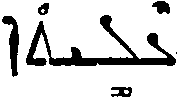
The מ prefixed is the participial form of the verb, equivalent to the termination ing in English; and converts the verb also into a verbal noun, conveying the generalised idea of a class of actions; and thereby the steps, המעלות, the steppings upward, literally, which means "the ascents," or "the ascendings."
Your journal would not afford me sufficient space for an excursus to establish the suggestion, not assertion, that I have adventured as to the domestic use of the Alphabetic and Degree Psalms, but there is negative evidence that these Psalms were not used in the Jewish liturgy. I will only refer you to Lightfoot's ninth volume (Pitman's edition), where the Psalms used, and indeed the whole service of the Jews, is as clearly set forth as the Greek service is in the liturgies of Basil and Chrysostom.
T. J. Buckton.
Lichfield.
THE SCREW PROPELLER.
(Vol. ix., p. 394.)
Anon. is clearly mistaken in thinking that, when Darwin says that "the undulating motion of the tail of fishes might be applied behind a boat with greater effect than common oars," he had any idea of a screw propeller. He meant not a rotatory, but, as he says, an "undulating" motion, like that of the fish's tail: such as we see every day employed by the boys in all our rivers and harbours, called sculling—that is, driving a boat forward by the rapid lateral right and left impulsion of a single oar, worked from the stern of the boat. It was the application of steam to some such machinery as this that Darwin seems to have meant; and not to the special action of a revolving cut-water screw.
I avail myself of this occasion to record, that about the date of Darwin's publication, or very soon after, the very ingenious Earl Stanhope not only thought of, but actually employed, the identical screw propeller now in use in a vessel which he had fitted up for the purpose; and in which, by his invitation, I, and several other gentlemen, accompanied him in various trips backwards and forwards between Blackfriars and Westminster bridges. The instrument was a long iron axle, working on the stern port of the vessel, having at the end in the water a wheel of inclined planes, exactly like the flyer of a smoke-jack; while, inboard, the axle was turned by a crank worked by the men. The velocity attained was, I think, said to be four miles an hour. I am sorry that I am not able to specify the exact date of this experiment, but it must have been between 1802 and 1805. What Lord Stanhope said about employing steam to work his machine, I do not clearly recollect. He entered into a great many details about it, but I remember nothing distinctly but the machine itself.
C.
AMONTILLADO SHERRY.
(Vol. ix., pp. 222. 336.)
The wines of Xérès consist of two kinds, viz. sweet and dry, each of which is again subdivided into two other varieties. Amontillado sherry, or simply Amontillado, belongs to the latter class, the other description produced from the dry wine being sherry, properly so called, that which passes in this country generally by that name. These two wines, although differing from each other in the peculiarities of colour, smell, and flavour, are produced from the same grape, and in precisely a similar manner; indeed, it frequently happens that of two or more botas, or large casks, filled with the same moùt (wort or sweet wine), and subjected to the same manipulation, the one becomes Amontillado, and the other natural sherry. This mysterious transformation takes place ordinarily during the first, but sometimes even during the second year, and in a manner that has hitherto baffled the attempts of the most attentive observer to discover. Natural sherry has a peculiar aromatic flavour, somewhat richer than that of its brother, the Amontillado, and partakes of three different colours, viz. pale or straw, golden, and deep golden, the latter being the description denominated by us brown sherry. The Amontillado is of a straw colour only, more or less shaded according to the age it possesses. Its flavour is drier and more delicate than that of natural sherry, recalling in a slight degree the taste of nuts and almonds. This wine, beings produced by a phenomenon which takes place it is imagined during the fermentation, is naturally less abundant than the other description of sherry, and there are years in which it is produced in very small quantities, and sometimes even not at all; for the same reason it is age for age dearer also. The word "Amontillado" signifies like or similar to Montilla, i. e. the wine manufactured at that place. Montilla is situated in Upper Andalusia, in the neighbourhood of Cordouc, and produces an excellent description of wine, but which, from the want of roads and communication with the principal commercial towns of Spain, is almost entirely unknown.
The two sweet wines of Xérès are the "Paxarite," or "Pedro Ximenès," and the "Muscatel." The first-named is made from a species of grape called "Pedro Ximenès," sweeter in quality than that which produces the dry sherry, and which, moreover, is exposed much longer to the action of the sun previous to the process of manufacture; its condition when subjected to the action of the pressers resembling very nearly that of a raisin. Fermentation is in this case much more rapid on account of the saccharine nature of the moùt or wort. In flavour it is similar to the fruit called "Pedro Ximenès," the colour being the same as that of natural sherry. Muscate wine is made from the grape of that name, and in a manner precisely similar to the Paxarite. The wine produced from this grape is still sweeter than the Pedro Ximenès, its taste being absolutely that of the Muscat grape. In colour also it is deeper; but the colour of both, like that of the two dry wines, increases in proportion to their age, a circumstance exactly the reverse of that which takes place in French wines. German sherry wines are capable of preservation both in bottles and casks for an indefinite period. In one of the bodegas or cellars belonging to the firm of M. P. Domecq, at Xérès, are to be seen five or six casks of immense size and antiquity (some of them, it is said, exceeding a century). Each of them bears the name of some distinguished hero of the age in which it was produced, Wellington and Napoleon figuring conspicuously amongst others: the former is preserved exclusively for the taste of Englishmen.
The history of sherry dates, in a commercial point of view, from about the year 1720 only. Before this period it is uncertain whether it possessed any existence at all; at all events it appears to have been unknown beyond the immediate neighbourhood in which it was produced. It would be difficult, perhaps, to say by whom it was first imported: all that can be affirmed with any degree of certainty is, that a Frenchman, by name Pierre Domecq, the founder of the house before mentioned, was among the earliest to recognise its capabilities, and to bring it to the high state of perfection which it has since attained. In appreciation of the good service thus rendered to his country, Ferdinand VII. conferred upon this house the right exclusively to bear upon their casks the royal arms of Spain. This wine, from being at first cultivated only in small quantities, has long since grown into one of the staple productions of the country. In the neighbourhood of Xérès there are at present under cultivation from 10,000 to 12,000 arpents of vines; these produce annually from 30,000 to 35,000 botas, equal to 70,000 or 75,000 hogsheads. In gathering the fruit, the ripest is invariably selected for wines of the best quality. The wines of Xérès, like all those of the peninsula, require the necessary body or strength to enable them to sustain the fatigue of exportation. Previous, therefore, to shipment (none being sold under four to five years of age), a little eau de vie (between the fiftieth and sixtieth part) is added, a quantity in itself so small, that few would imagine it to be the cause of the slight alcoholic taste which nearly all sherries possess.
In consequence of the high price of the delicious wines, numerous imitations, or inferior sherries, are manufactured, and sold in immense quantities. Of these the best are to be met with at the following places: San Lucar, Porto, Santa Maria, and even Malaga itself. The spurious sherry of the first-named place is consumed in larger quantities, especially in France, than the genuine wine itself. One reason for this may be, that few vessels go to take cargoes at Cadiz; whilst many are in the habit of doing so to Malaga for dry fruits, and to Seville for the fine wool of Estremadura. San Lucar is situated at the mouth of the Guadalquiver.
W. C.
RECENT CURIOSITIES OF LITERATURE.
(Vol. ix., p. 136.)
Mr. Thackeray's work, The Newcomes, would, if consulted by your correspondent, furnish him with farther examples. For instance, Colonel Newcome's Christian name is stated (pp. 27. 57.) to be Thomas: at p. 49. he is designated Col. J. Newcome. The letter addressed to him (p. 27.) is superscribed "Major Newcome," although at p. 25. he is styled "Colonel." At p. 71. mention is made of "Mr. Shaloo, the great Irish patriot," who at p. 74. becomes "Mr. Shaloony," and at p. 180. relapses into the dissyllabic "Shaloo." Clive Newcome is represented (p. 184.) as admiring his youthful mustachios, and Mr. Doyle has depicted him without whiskers: at p. 188. Ethel, "after Mr. Clive's famous mustachios made their appearance, rallied him," and "asked him if he was (were?) going into the army? She could not understand how any but military men could wear mustachios." On this the author remarks, three lines farther on: "If Clive had been in love with her, no doubt he would have sacrificed even those beloved whiskers for the charmer."
At p. 111. the Rev. C. Honeyman is designated "A.M.," although previously described a Master of Arts of Oxford, where the Masters are styled "M.A." in contradistinction to the Masters of Arts in every other university. Cambridge Masters frequently affix M.A. to their names, but I never heard of an instance of an Oxonian signing the initials of his degree as A.M.
Apropos of Oxford, I recently met the following sentence at p. 3. of Verdant Green:
"Although pronounced by Mrs. Toosypegs, his nurse, to be 'a perfect progidye,' yet we are not aware that his début on the stage of life, although thus applauded by such a clacqueur as the indiscriminating Toosypegs, was announced to the world at large by any other means than the notices in the county papers."
If the author ever watched the hired applauders in a Parisian theatre, he would have discerned among them clacqueuses as well as clacqueurs.
Juverna, M.A.
ROLAND THE BRAVE.
(Vol. ix., p. 372.)
In justification of Dr. Forbes' identifying Roland the Brave with the hero of Schiller's ballad, Ritter Toggenburg, I beg to refer your correspondent X. Y. Z. to Deutsches Sagenbuch, von L. Bechstein, Leipzig, 1853, where (p. 95.) the same tale is related which forms the subject of Mrs. Hemans' beautiful ballad, only with this difference, that there the account of Roland's death entirely agrees with Schiller's version of the story, whereas the English poet has adopted the general tradition of Roland's fall at Roncesvalles.
Most of the epic poems of the middle ages in which Roland's death is recorded, especially the different old French Chansons de Roland ou de Roncevaux, an Icelandic poem on the subject, and Stricker's middle-high German lay of Roland, all of them written between A.D. 1100 and 1230—agree in this, that after Roland's fall at Roncesvalles, and the complete rout of the heathen by Charlemagne, the latter returns home and is met—some say at Aix-la-Chapelle, others at Blavie, others at Paris—by Alda or Alite, Olivier's sister, who inquires of him where Roland, her betrothed, is. On learning his fate she dies on the spot of grief. According to monk Conrad (about A.D. 1175), Alda was Roland's wife. See Ruolandes Liet, von W. Grimm, Göttingen, 1838, pp. 295—297.
The legend of Rolandseck, as told by Bechstein from Rhenish folk lore, begins thus:
"Es sasz auf hoher Burg am Rhein hoch über dem Stromthal ein junger Rittersmann, Roland geheiszen, (manche sagen Roland von Angers, Neffe Karls des Groszen), der liebte ein Burgfräulein, Hildegunde, die Tochter des Burggrafen Heribert, der auf dem nahen Schlosz Drachenfels sasz," &c.
Here the question is left open whether the hero of the story was Roland the Brave, or some other knight of that name. The latter seems the more probable, as Roland's fall at Roncesvalles is one of the chief subjects of mediæval poetry, whereas the death of knight Roland in sight of Nonnenwerth on the Rhine, forms the very pith of the German local legend. From certain coincidences, however, it was easy to blend the two stories together into one, as was done by Mrs. Hemans. As to Schiller, we may suppose that he either followed altogether a different legend, or, perhaps to avoid misconception, substituted another name for that of knight Roland, similar to what he has done in other instances.
R. R.
Canterbury.
I think your correspondent X. Y. Z. is mistaken in attributing to Mrs. Hemans the lines on the "Brave Roland." In Mr. Campbell's Poems he will find some stanzas which bear a striking resemblance to those he has quoted. I subjoin those stanzas to which X. Y. Z. has referred:
"The brave Roland! the brave Roland! False tidings reach'd the Rhenish strand That he had fall'n in fight; And thy faithful bosom swoon'd with pain, O loveliest maiden of Allemayne! For the loss of thine own true knight. "But why so rash has she ta'en the veil, In yon Nonnenwerder's cloisters pale, For her vow had scarce been sworn, And the fatal mantle o'er her flung, When the Drachenfels to a trumpet rung, 'Twas her own dear warrior's horn! . . . . . . "She died! he sought the battle plain; Her image fill'd his dying brain, When he fell and wish'd to fall: And her name was in his latest sigh, When Roland, the flower of chivalry, Expired at Roncevall."
X. Y. Z. seems also to have forgotten what Mr. Campbell duly records, viz. that Roland used to station himself at a window overlooking "the nun's green isle;" it being after her decease that he met his death at Roncevall, which event, by the way, is alluded to by Sir W. Scott in Marmion, canto vi.:
"Oh, for a blast of that dread horn, On Fontarabian echoes borne, That to King Charles did come; When Roland brave, and Olivier, And every paladin and peer, At Roncesvalles died!"
H. B. F.
The legends of Roland, the nephew of Charlemagne, are very numerous and vary much from each other. The Orlando of Pulci has a very different history from the Orlando of Bojardo and Ariosto.
The legend of "Rolandseck and the Nonnenwerth," which has been adopted by Campbell, not Mrs. Hemans, and charmingly set to music by Mrs. Arkwright, is well known on the Rhine. There are two poems on the legend in Simrock's Rheinsagen (12mo., Bonn, 1841), one by the editor, and another by August Kopisch. They exactly accord with Campbell's poem.
The legend of Ritter Toggenburg resembles that of Roland in many particulars, but it is not the same, and it belongs to another locality, to Kloster Fischingen, and not to Nonnenwerth. "Roland the Brave" appears in all the later editions of Campbell's Poems. Simrock's Rheinsagen is one of the most delightful handbooks that any one can take through the romantic region which the poems (partly well selected by the editor, and partly as well written by himself) describe.
E. C. H.
The author of the beautiful lines which are quoted by your correspondent X. Y. Z., is Campbell, not Mrs. Hemans. The poet, in the fifth stanza of his ballad, tells how the unfortunate Roland, on finding that Hildegund had taken the veil, was accustomed to sit at his window, and "sad and oft" to look "on the mansion of his love below."
"There's yet one window of that pile, Which he built above the nun's green isle; Thence sad and oft look'd he (When the chant and organ sounded slow) On the mansion of his love below, For herself he might not see. "She died! He sought the battle plain, Her image fill'd his dying brain, When he fell and wish'd to fall; And her name was in his latest sigh, When Roland, the flower of chivalry, Expired at Roncevall."
F. M. Middleton.
Scott has, in Marmion,—
"When Roland brave, and Olivier, And every paladin and peer, At Roncesvalles died!"
I quote from memory, and have not the poem.
F. C. B.
PHOTOGRAPHIC CORRESPONDENCE.
Recovery of Silver.—As many correspondents of "N. & Q." have asked how to recover the silver from their nitrate baths when deteriorated or spoiled, perhaps the following hints may be acceptable to them. Let them first precipitate the silver in the form of a chloride by adding common salt to the nitrate solution. Let them then filter it, and it may be reduced to its metallic state by either of the three following methods.
1. By adding to the wet chloride at least double its volume of water, containing one-tenth part of sulphuric acid; plunge into this a thick piece of zinc, and leave it here for four-and-twenty hours. The chloride of silver will be reduced by the formation of chloride and sulphate of zinc, and of pure silver, which will remain under the form of a blackish powder, which is then to be washed, filtered, and preserved for the purpose of making nitrate of silver.
2. The chloride of silver which is to be reduced is put into a flask with about twice its volume of a solution of caustic potash (of one part of caustic potash to nine of water), in which a small portion of sugar has been dissolved. Let it boil gently. The operation is complete when the blackish powder which results from this process, having been washed in several waters, is entirely soluble in nitric acid, which is easily ascertained by experimenting on a small quantity. This powder is to be preserved in the same way as the former for the purpose of converting it into nitrate of silver.
3. The metallic silver is obtained in the form of a button, by mixing thoroughly 100 parts of dried chloride of silver, 70 parts of chalk or whitening, and 4 parts of charcoal. This mixture is to be exposed in a crucible to a fierce red heat for at least half an hour. When completely cold the crucible is broken, and a button of pure silver is the result. The first two processes are those which I should most strongly recommend to your correspondents.
N. C.