Prehistoric Indian Relics Found In The Vicinity Of "Cahokia Mound."
Reading edition
By Gus Bluemke
April 20, 1913, a party of archaeologists from Bloomington and Normal Ill. visited "Cahokia" or "Monk's Mound" in search of relics. The weather was ideal and all who availed themselves of the opportunity were indeed well repaid in the success of the trip and also for the enjoyment and recreation which these journeys afford.
Our party was composed of the following: Mark Piper, C. H. Robinson, T. J. Robinson, S. W. LeNeve, Miss Minerva LeNeve, Herman Cox and Milo Custer. A second trip was made October 12, 1913, and on this occasion the following members visited "Cahokia": C. H. Robinson, Homer Haworth, Mark Piper, R. T. Robinson, Wm. Brigham, Stanley East, S. W. LeNeve and the writer.
Several good specimens of arrow-heads were found, one particularly rare specimen was found by the writer which is shown in the cut furnished by me. This point has six notches on each edge, each of which are one-eight of an inch in depth. The length of this point from tip to base is one and one-quarter inches. There is also shown in the same cut a very small arrow point one-half inch in length, and of pink colored flint. This is a very good specimen of such a small sized arrow point. There are shown herewith several other types of arrow points of different sizes.
Cut furnished by Stanley M. East and Homer Haworth
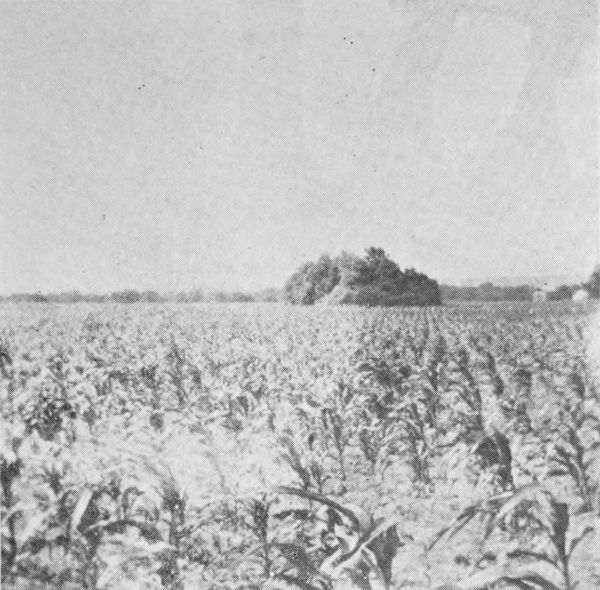
(1) Mound on farm of W. J. Eichorn near Spring Bay, Woodford County, Illinois.
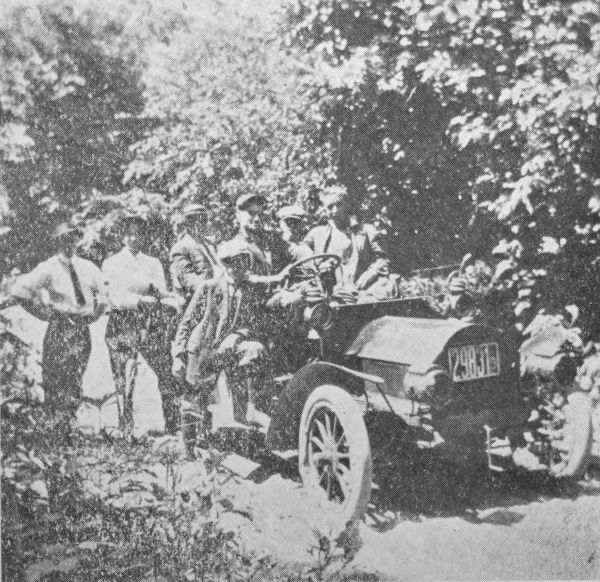
(2) Members of the Kickapoo Club at Spring Bay, Illinois, July 6, 1913.
It is a notable fact that practically all arrow points found in this locality are small, ranging from three-quarters of an inch to an inch and one-half in length. The cut shows several other relics, all of which were found near "Cahokia." The surface of the adjoining fields are literally covered with fragments of ancient pottery. Judging from the fancy rims and handles and the engravings on these fragments it is evident that the mound builders were very adept in the manufacture of this kind of pottery. The cut shows two specimens of broken pottery and the particular surface markings on the same. There is also an imitation of a birds head made of the same material. This was probably an ornament or handle for some vessel. This pottery was evidently colored in some manner as some of the fragments are bright red in color and others are jet black or brown. Many pieces were highly polished. There is also shown in the cut a conch core or sea shell with reversed whorls. This one is six inches long and of these there seem to be a great number found in this locality and found in such a position and under such circumstances as to leave hardly a doubt in the mind that they were held sacred by the mound builders and used in their religious ceremonies.
A brass signet ring was also found which is evidently traders material and may possibly have been brought there by the "monks." This ring has a pecular emblem on the flat circular surface which looks like a right angle with a character in the center shaped like a heart. The circular surface of the seal or signet is five-sixteenths of an inch in diameter and the size of the ring is three-quarter inch.
There is also shown a blue glass bead. Several beads of different material have been found here but the most rare is one shown in the cut, made of shell, circular in form, one inch in diameter and three-sixteenths of an inch in thickness, with a three-sixteenths inch hole through the center. This specimen is of the kind commonly known as wampum and was used by the Indians as money. There is also shown in the cut a bear's claw of which several were found by members of our party.
The largest specimen shown in the center of the cut is a chert hoe or cultivating implement found by the writer. This specimen is seven and one half inches long and tapers from two to four and three quarters inches in width. It was discovered about eighteen inches below the surface in the field north-east of the great "Cahokia mound." The accompanying cut shows the location of this find and a good view of the surroundings.