The Crath Carpathian Walnut in Illinois
Reading edition
By A. S. Colby
The Persian walnut (Juglans regia), usually and incorrectly called the English walnut, has been highly prized both for the beauty of the tree and the quality of its nuts since ancient times. The species flourishes in Southern Asia and Europe and in our Southwestern and Pacific Coast States, but most of the attempts that have been made to fruit it in Northern and Eastern sections have failed. The varieties or strains tried there were for the most part native to sections of the Old World where the winters are comparatively mild and they were therefore not able to survive our colder and more changeable climate. The late E. A. Riehl, of Alton, Illinois, tried repeatedly to grow named varieties of this nut which are successful in California, but often stated that the species had no future in Illinois. In extreme southern Illinois, at Robert Endicott's place, in Villa Ridge, several Persian walnut trees are growing but their bearing habits are disappointing.
One of the most promising recent developments in Northern nut culture is the introduction into America of hardier strains of the Persian walnut, through the efforts of Rev. Paul C. Crath, of Toronto, Canada, a native of Poland, and whose father was the head of the Agricultural College in the Ukraine. He went back to his own country as a missionary in the early 1930's, and there noticed the hardiness of the Persian walnuts growing in that severe climate. Realizing the possibilities of these strains for fruiting in North America, he combed that rich Russian agricultural region in the Carpathian Mountains for seed for experimental planting over here, harvesting it from trees uninjured at temperatures of -40° F. These parent trees were carefully selected for regular production of good crops of thin-shelled, easily-cracked nuts of good quality. The trees were growing at such distances from others that cross-pollination was avoided. Rev. Crath had observed that seedlings from such self-pollinated trees usually bore nuts that closely resembled those of the parent.
Each tree from which nuts were saved was given a number in order to keep future records straight. The nuts were planted in a nursery established by Rev. Crath near Toronto. Wishing some point in this country where his trees could be distributed without the difficulty and delay incurred in moving small shipments across the border, Rev. Crath arranged with Mr. Samuel H. Graham, of Ithaca, New York, to take sole charge of their distribution in the United States. Considerable interest has been aroused in the possibilities of these strains and their distribution has been wide-spread, with over 2,000 seedlings sent to many Northern States since 1937. In a few more years, after a considerable proportion of these numbered seedlings have come into bearing, we shall have some valuable information regarding their possibilities in sections of the country where previously it had not been considered possible to grow Persian walnuts.
Several Illinois horticulturists have planted seedlings of these strains and have already brought one or more of them into bearing. Others have used scion wood of the Crath types in top-working black walnut trees. The sample Crath Carpathian walnut No. 1 on display at the 1942 meeting of the Illinois Horticultural Society at Quincy was grown by Mr. Royal Oakes, of Bluffs, Illinois. Mr. Oakes topworked a black walnut with Crath Seedling No. 1 scions in 1938 and harvested six nuts in 1942. At the Illinois Agricultural Experiment Station at Urbana, we have over 20 Crath seedlings under number, planted in 1937 and 1939. They are all healthy and vigorous, and several bore pistillate flowers in 1942.
Comparatively little is known about the bearing habits of the Crath walnut strains. Several growers have noted that their trees began to bear pistillate flowers within a few years after planting but set no nuts. Evidently the staminate catkins necessary for pollen production are somewhat slower in appearing. Other strains of Persian walnuts are said to be slow in this regard, usually beginning to bear female flowers from 3 to 5 years before male flowers are produced. It is thought possible that Persian walnut pistils will accept black walnut pollen. Mr. Oakes reports that there were no staminate flowers on the Crath (from which he picked the nuts he exhibited at Quincy), but black walnut pollen was abundant nearby at that time and for good measure he also brought in butternut bouquets. As he states, "something worked."
The prospective planter should understand that these new walnut strains are as yet only in the experimental stage. It is believed that some of them have considerable promise, at least in the southern and the central, and possibly in the northern, parts of this state. However, they must be properly planted and cared for if one expects them to grow and bear. Too close planting should be avoided and some attention must be given to forming the head when the tree is young. No one knows exactly when they will bear, how much, and how long. In their native country, trees have been observed estimated to be over 300 years old. Most of us can expect to enjoy nuts from trees we plant, with more for our grandchildren and great-grandchildren. One might ask also in this connection, as does one nut nurseryman, "How soon will a Chinese elm or soft maple bear nuts?"
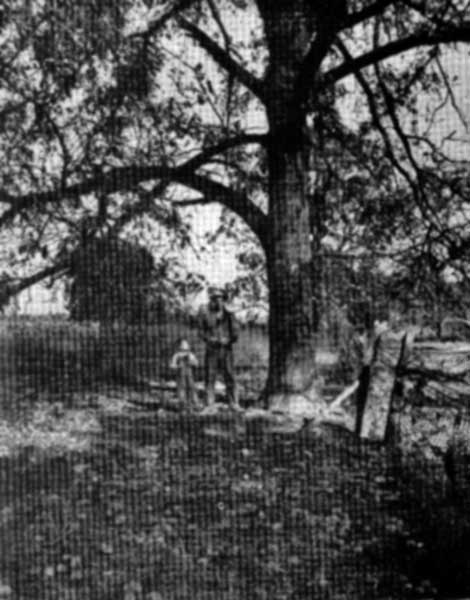
Parent tree of Ohio black walnut, on the farm of Charles Arbogast, 1½ miles northwest of McCutchenville, Ohio. The tree is 2½ feet in diameter and very vigorous. It is said to bear heavy crops in alternate years. Photograph by O. D. Diller, Ohio Agricultural Experiment Station, Oct. 8, 1943.